Literary Reading through a
Linguistic Context
What is the importance of understanding the way
language is used in a particular text?
Listen to the most popular songs you know about. Share with
your partner the meaning and symbolisms found in it.
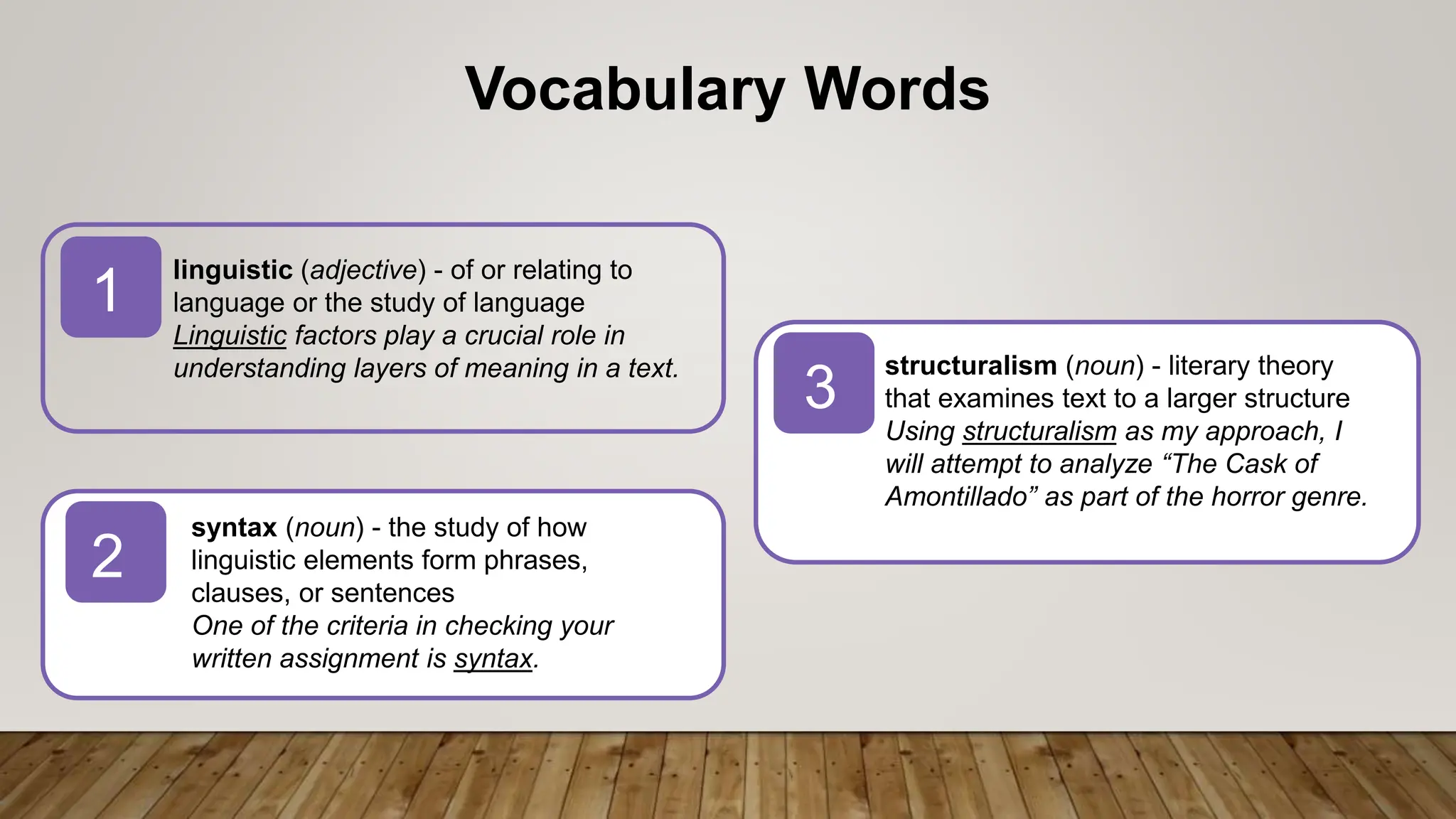
linguistic (adjective) - of or relating to
language or the study of language
Linguistic factors play a crucial role in
understanding layers of meaning in a text.
syntax (noun) - the study of how
linguistic elements form phrases,
clauses, or sentences
One of the criteria in checking your
written assignment is syntax.
1
2
3
Vocabulary Words
structuralism (noun) - literary theory
that examines text to a larger structure
Using structuralism as my approach, I
will attempt to analyze “The Cask of
Amontillado” as part of the horror genre.
poststructuralism (noun) - a school of
literary theory that examines underlying
structures in a text that may have varied
interpretations
Poststructuralism began as a response to
structuralism.
5
Vocabulary Words
4
formalism (noun) - a school of literary
theory focused on structure, through
which a text is examined without exterior
influences
Formalism is usually the first approach
taught to students when dealing with
literature.
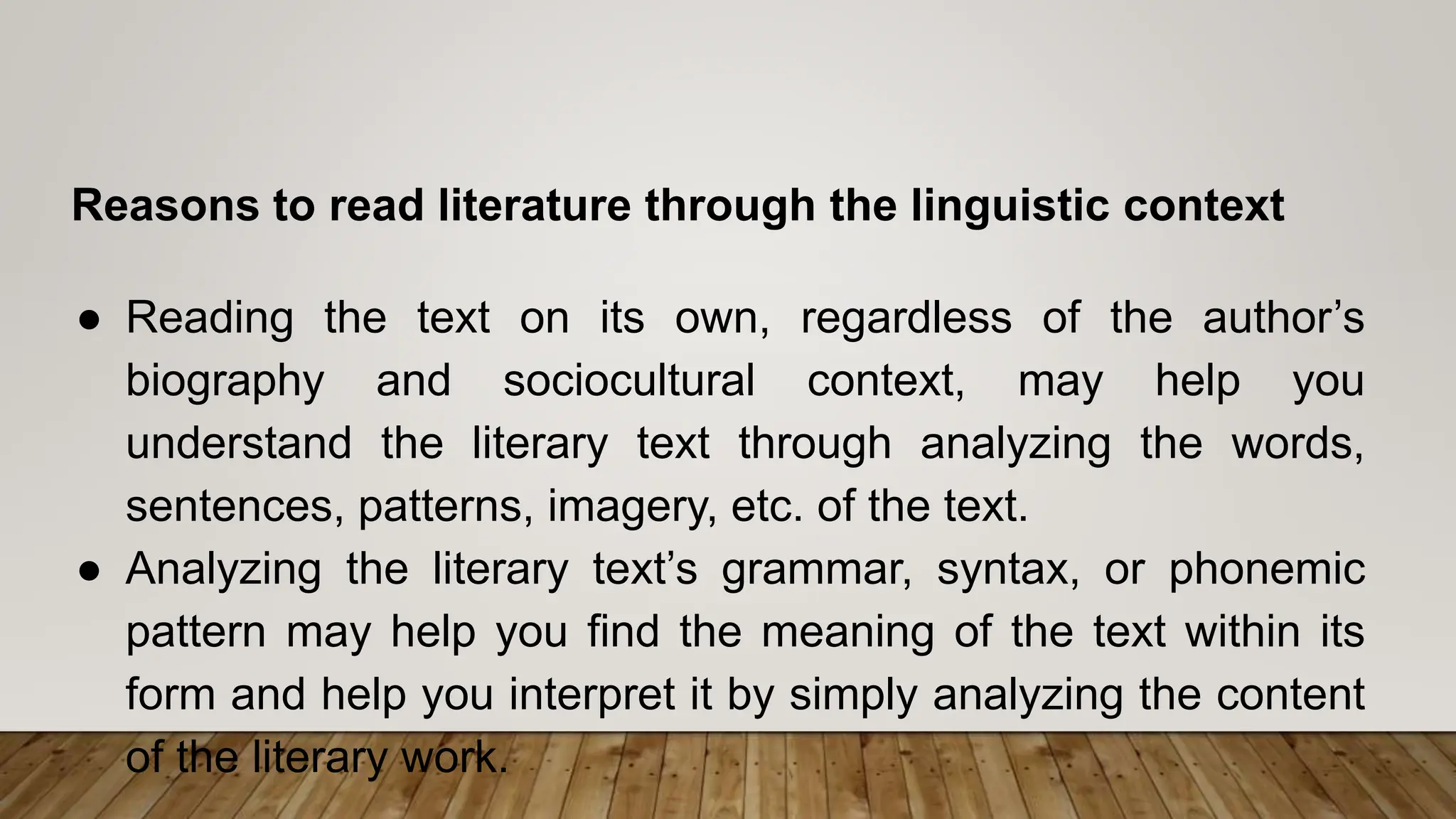
Reasons to read literature through the linguistic context
● Reading the text on its own, regardless of the author’s
biography and sociocultural context, may help you
understand the literary text through analyzing the words,
sentences, patterns, imagery, etc. of the text.
● Analyzing the literary text’s grammar, syntax, or phonemic
pattern may help you find the meaning of the text within its
form and help you interpret it by simply analyzing the content
of the literary work.
Strategies for reading a text through the linguistic context
● Analyze the diction or choice of words in the text.
● Examine the texts’ syntax or use of sentences, clauses,
phrases, line cuts, etc.
● Observe the use of figurative language.
● Analyze the mood and tone of the text.
● Observe the text’s overall structure.
● Analyze the content of the text.
Guide questions for reading through linguistic context
● What were the striking words in the text? What words were
unfamiliar to you? Which words attracted your attention? What
words were dramatic?
● What nouns are the most prominent? Are these concrete or
abstract nouns? What about verbs? Does the author use
common words or lofty diction? Are the words short or long? Is
there any word that has two or more meanings?
● Are the sentences in the usual order of subject-predicate?
What are the dependent clauses? What are the independent
clauses? If you restructure a sentence or a phrase, would it
make a difference? Is the voice active or passive? Is there a
rhythm in the sentence structure in relation to the length of the
sentences or lines?
● What literary devices are used? Are there images? Do those
images stand for anything aside from their literal meaning?
● What is the tone? Is the speaker happy about the subject? Is
the tone negative or positive?
● What is the structure of the text? Is it a narrative? Is it linear
or nonlinear? What is the point of view of the text? Is it a
poem? What type of poem is it?
● Does the language help in delivering and understanding its
content? Is there a theme? What is it saying about its subject
matter? How do the literary elements contribute to the
effectiveness of the text?
● What is the text saying about the world in general?
Notes before reading a text through the linguistic context:
● Some writers may not follow grammatical rules, and this kind of
deviation may be used in your analysis.
● The characteristics of the language in which the text was written
may help in analyzing the text.
● You may consult literary approaches that focus on language.
Structuralism, poststructuralism, and formalism have
linguistic aspects.
Perspective Explanation
Structuralism Structuralism relays the texts being examined to
a larger structure.
Formalism (or
New Criticism)
Formalism is a school of literary criticism and
literary theory that focuses on the structure of a
particular text.
Perspective Explanation
Poststructuralism In the linguistic context, there may be underlying
structures that may have different
interpretations based on how the words or
phrases were used in the text.
“Hope” is the thing with feathers
Emily Dickinson
Guide Questions
1. What is the central image or metaphor of the poem? How is it
described?
2. How does language help develop the metaphor?
3. What words stand out, and how do these add to the poem’s
meaning?
4. What other linguistic features are repeatedly used? How are
these significant?
5. What is the tone of the poem? How does it help convey the
theme?
Read and analyze the poem below, then answer the questions
that follow comprehensively. Responses must be at least one
paragraph long.
Sonnets from the Portuguese 14:
If thou must love me, let it be for nought
Elizabeth Barrett Browning
Short Response Questions
1. Who is the persona? What words give clues to his/her
characteristics?
2. What words, grammatical structures, or punctuations stand
out? What effect do they have on the poem?
3. What is the structure of the text? How does it add meaning?
4. What is the tone? How is it developed?
5. What is the theme? What statement does it make about life?
Criteria Score
Content
(The question is answered comprehensively. Textual evidence is
provided to support the given answer.) 6 pts
Organization
(Logical progression of details/events; clear transitions between
ideas.) 6 pts
Language
(spelling, mechanics, grammar, and word choice) 3 pts
Score: /15
Values Integration
We have learned how the use of language can be
closely examined in order to find layers of meaning.
How can the knowledge and understanding of
language use help us understand others better?
1. Form groups of 3.
2. Each group must choose 3 songs that are related lyrically or
thematically. No groups can have the same set of songs. Submit
the song titles to your teacher to finalize your set.
3. Each group’s task is to come up with a 24- to 30-line poem that
combines ideas from the 3 songs. You must use words,
grammatical structures, punctuations, and other linguistic devices
to enhance your poems. You may retain some forms already
present in the original songs. Merely copy-pasting sections of
songs together will not be considered valid work.
4. Be ready to present your work in class.
Assignment
Read and analyze the short story, research on the author, and
answer the questions that follow.
If—
Rudyard Kipling
Guide Questions
1. Who is the persona? What words give clues to his/her
characteristics?
2. What words, grammatical structures, or punctuations stand
out? What effect do they have on the poem?
3. What is the structure of the text? How does it add meaning?
4. What is the tone? How is it developed?
5. What is the theme? What statement does it make about life?
Criteria Score
Content
(The question is answered comprehensively. Textual
evidence is provided to support the given answer.) 6 pts
Organization
(Logical progression of details/events; clear transitions
between ideas.) 6 pts
Language
(spelling, mechanics, grammar, and word choice) 3 pts
Score: /15

Literary REading through Linguistic Context.pptx

  • 1.
    Literary Reading througha Linguistic Context
  • 2.
    What is theimportance of understanding the way language is used in a particular text?
  • 3.
    Listen to themost popular songs you know about. Share with your partner the meaning and symbolisms found in it.
  • 4.
    linguistic (adjective) -of or relating to language or the study of language Linguistic factors play a crucial role in understanding layers of meaning in a text. syntax (noun) - the study of how linguistic elements form phrases, clauses, or sentences One of the criteria in checking your written assignment is syntax. 1 2 3 Vocabulary Words structuralism (noun) - literary theory that examines text to a larger structure Using structuralism as my approach, I will attempt to analyze “The Cask of Amontillado” as part of the horror genre.
  • 5.
    poststructuralism (noun) -a school of literary theory that examines underlying structures in a text that may have varied interpretations Poststructuralism began as a response to structuralism. 5 Vocabulary Words 4 formalism (noun) - a school of literary theory focused on structure, through which a text is examined without exterior influences Formalism is usually the first approach taught to students when dealing with literature.
  • 6.
    Reasons to readliterature through the linguistic context ● Reading the text on its own, regardless of the author’s biography and sociocultural context, may help you understand the literary text through analyzing the words, sentences, patterns, imagery, etc. of the text. ● Analyzing the literary text’s grammar, syntax, or phonemic pattern may help you find the meaning of the text within its form and help you interpret it by simply analyzing the content of the literary work.
  • 7.
    Strategies for readinga text through the linguistic context ● Analyze the diction or choice of words in the text. ● Examine the texts’ syntax or use of sentences, clauses, phrases, line cuts, etc. ● Observe the use of figurative language. ● Analyze the mood and tone of the text. ● Observe the text’s overall structure. ● Analyze the content of the text.
  • 8.
    Guide questions forreading through linguistic context ● What were the striking words in the text? What words were unfamiliar to you? Which words attracted your attention? What words were dramatic? ● What nouns are the most prominent? Are these concrete or abstract nouns? What about verbs? Does the author use common words or lofty diction? Are the words short or long? Is there any word that has two or more meanings?
  • 9.
    ● Are thesentences in the usual order of subject-predicate? What are the dependent clauses? What are the independent clauses? If you restructure a sentence or a phrase, would it make a difference? Is the voice active or passive? Is there a rhythm in the sentence structure in relation to the length of the sentences or lines? ● What literary devices are used? Are there images? Do those images stand for anything aside from their literal meaning?
  • 10.
    ● What isthe tone? Is the speaker happy about the subject? Is the tone negative or positive? ● What is the structure of the text? Is it a narrative? Is it linear or nonlinear? What is the point of view of the text? Is it a poem? What type of poem is it?
  • 11.
    ● Does thelanguage help in delivering and understanding its content? Is there a theme? What is it saying about its subject matter? How do the literary elements contribute to the effectiveness of the text? ● What is the text saying about the world in general?
  • 12.
    Notes before readinga text through the linguistic context: ● Some writers may not follow grammatical rules, and this kind of deviation may be used in your analysis. ● The characteristics of the language in which the text was written may help in analyzing the text. ● You may consult literary approaches that focus on language. Structuralism, poststructuralism, and formalism have linguistic aspects.
  • 13.
    Perspective Explanation Structuralism Structuralismrelays the texts being examined to a larger structure. Formalism (or New Criticism) Formalism is a school of literary criticism and literary theory that focuses on the structure of a particular text.
  • 14.
    Perspective Explanation Poststructuralism Inthe linguistic context, there may be underlying structures that may have different interpretations based on how the words or phrases were used in the text.
  • 15.
    “Hope” is thething with feathers Emily Dickinson
  • 16.
    Guide Questions 1. Whatis the central image or metaphor of the poem? How is it described? 2. How does language help develop the metaphor? 3. What words stand out, and how do these add to the poem’s meaning? 4. What other linguistic features are repeatedly used? How are these significant? 5. What is the tone of the poem? How does it help convey the theme?
  • 17.
    Read and analyzethe poem below, then answer the questions that follow comprehensively. Responses must be at least one paragraph long. Sonnets from the Portuguese 14: If thou must love me, let it be for nought Elizabeth Barrett Browning
  • 18.
    Short Response Questions 1.Who is the persona? What words give clues to his/her characteristics? 2. What words, grammatical structures, or punctuations stand out? What effect do they have on the poem? 3. What is the structure of the text? How does it add meaning? 4. What is the tone? How is it developed? 5. What is the theme? What statement does it make about life?
  • 19.
    Criteria Score Content (The questionis answered comprehensively. Textual evidence is provided to support the given answer.) 6 pts Organization (Logical progression of details/events; clear transitions between ideas.) 6 pts Language (spelling, mechanics, grammar, and word choice) 3 pts Score: /15
  • 20.
    Values Integration We havelearned how the use of language can be closely examined in order to find layers of meaning. How can the knowledge and understanding of language use help us understand others better?
  • 21.
    1. Form groupsof 3. 2. Each group must choose 3 songs that are related lyrically or thematically. No groups can have the same set of songs. Submit the song titles to your teacher to finalize your set. 3. Each group’s task is to come up with a 24- to 30-line poem that combines ideas from the 3 songs. You must use words, grammatical structures, punctuations, and other linguistic devices to enhance your poems. You may retain some forms already present in the original songs. Merely copy-pasting sections of songs together will not be considered valid work. 4. Be ready to present your work in class.
  • 22.
    Assignment Read and analyzethe short story, research on the author, and answer the questions that follow. If— Rudyard Kipling
  • 23.
    Guide Questions 1. Whois the persona? What words give clues to his/her characteristics? 2. What words, grammatical structures, or punctuations stand out? What effect do they have on the poem? 3. What is the structure of the text? How does it add meaning? 4. What is the tone? How is it developed? 5. What is the theme? What statement does it make about life?
  • 24.
    Criteria Score Content (The questionis answered comprehensively. Textual evidence is provided to support the given answer.) 6 pts Organization (Logical progression of details/events; clear transitions between ideas.) 6 pts Language (spelling, mechanics, grammar, and word choice) 3 pts Score: /15