Cerebral Palsy
Dr. Asir John Samuel, PhD (Physiotherapy), MPT (Neurosciences and Paediatric Neurology),
BPT, BSc (Psychology), DYScEd, MAcu,
Additional Professor,
Yenepoya Physiotherapy College
Yenepoya (Deemed to be University),
Mangalore, Karnataka
Definition of CP
A group of permanent disorders of the
development of movement and posture,
causing activity limitation, that are attributed
to non-progressive disturbances that occurred
in the developing foetal or infant brain.
(Modified after Bax et al. 2005)
Definition of CP (Continuation)
The motor disorders of CP are often
accompanied by disturbances of sensation,
perception, cognition, communication,
behaviour, seizures and secondary
musculoskeletal problems.
(Modified after Bax et al. 2005)
Prevalence
• CP only affects between 2 and 3 ( 2.11) per
1000 live births
• Most common cause of serious physical
disability in childhood
Aetiology
• There is no single specific
• potential causes of CP are known to occur
in the prenatal stage of development,
• Prenatal (prepartum), perinatal (peripartum)
or neonatal time period, and
• Postnatal or post-neonatal time period
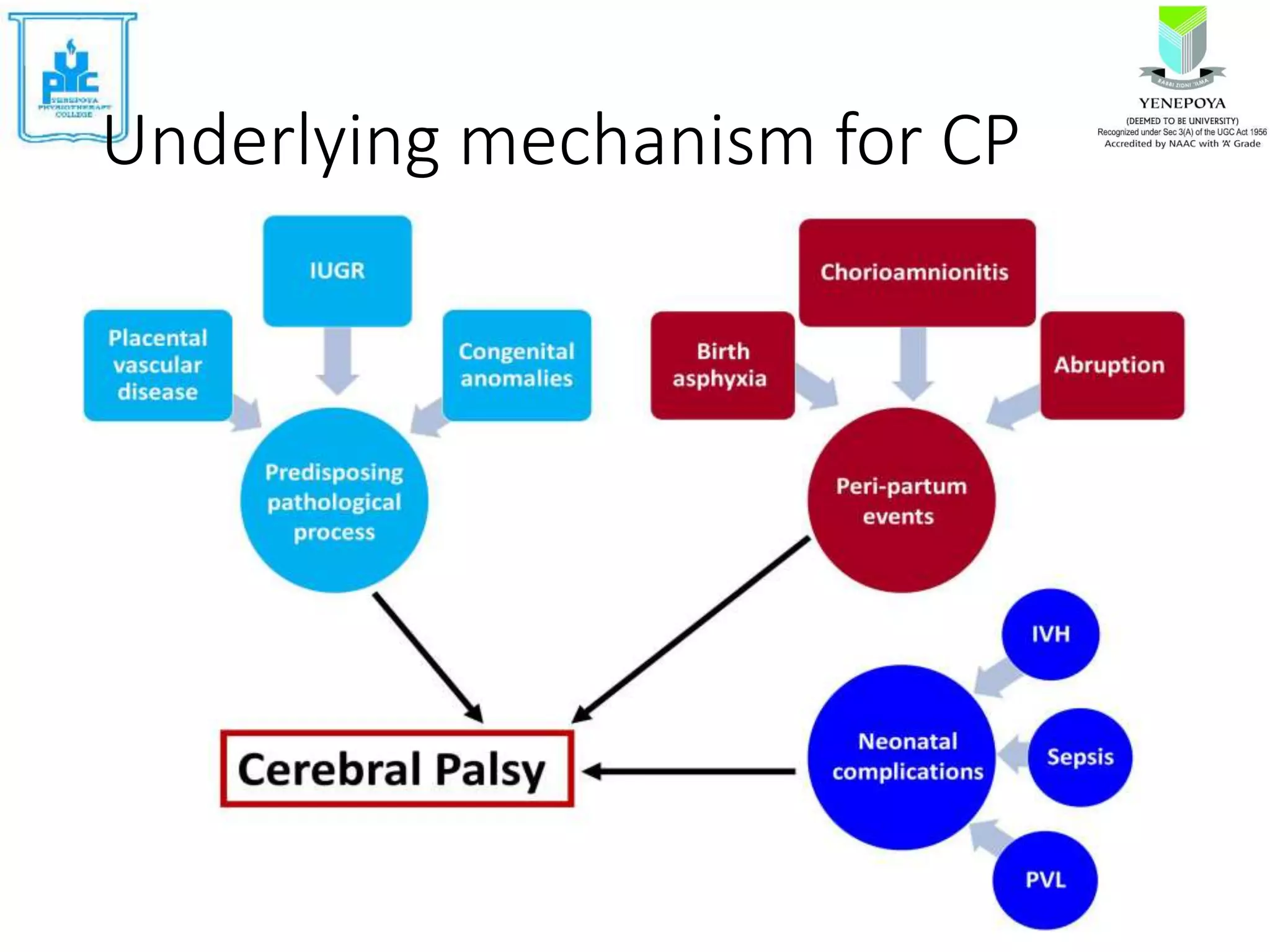
Underlying mechanism for CP
Risk factors - CP
Signs & symptoms - Diagnosis
• Abnormal muscle tone
• Atypical posture
• Movement with persistence of primitive reflexes
- Diagnosed < 2 years
• Milder cases
- Diagnosed 4 to 5 years
Diagnosis
• Evaluation of child’s motor skills
• Neuroimaging
• Cranial ultrasound (CUS) – high-risk preterm infant
• Computed tomography (CT)
• Magnetic resonance imaging (MRI)
• Not progressing
Prenatal Causes of CP
• Vascular events such as a middle cerebral artery
infarct
• Maternal infections during the first and second
trimesters,
• Rubella, cytomegalovirus, and toxoplasmosis
• Metabolic disorders, maternal ingestion of toxins
• Rare genetic syndromes
Perinatal Causes of CP
Problems During Labor and Delivery
• Obstructed labour
• Antepartum haemorrhage
• Cord prolapse
• Other Neonatal Causes
Other Neonatal Causes
• Hypoxic–ischemic encephalopathy (HIE)
• Neonatal stroke, usually of the middle cerebral
artery
• Severe hypoglycemia
• Untreated jaundice
• Severe neonatal infection
Postneonatally Acquired CP
Metabolic Encephalopathy
• Storage disorders
• Metabolic disorders
• Toxicity such as alcohol
• Infections (meningitis, septicemia, malaria)
Postneonatally Acquired CP
Injuries
• Cerebrovascular accident
• Following surgery for congenital malformations
• Near-drowning
• Trauma (like, Motor vehicle accident – MVA)
• Child abuse such as shaken baby syndrome
Classification
• Type of movement disorder – Motor type
• Anatomical location of the child’s impaired
motor function – Distribution
Classification: Type of movement
disorder
• Spastic
• Hypotonic
• Dyskinetic
• Ataxic
Classification: Anatomical location
• Hemiplegia, which involves one arm and one leg on
the same side of the body
• Diplegia, which involves both lower extremities
• Quadriplegia, which refers to involvement of all
four limbs as well as back and neck musculature
Classification: Motor dysfunction
• Gross Motor Function Classification System
(GMFCS), by Palisano and colleagues in 1997
• Bimanual Fine Motor Function Classification System
(BFMFCS), by Beckung and Hagberg
Gross Motor Function
Classification System
Bimanual Fine Motor Function
Classification System (BFMFCS)
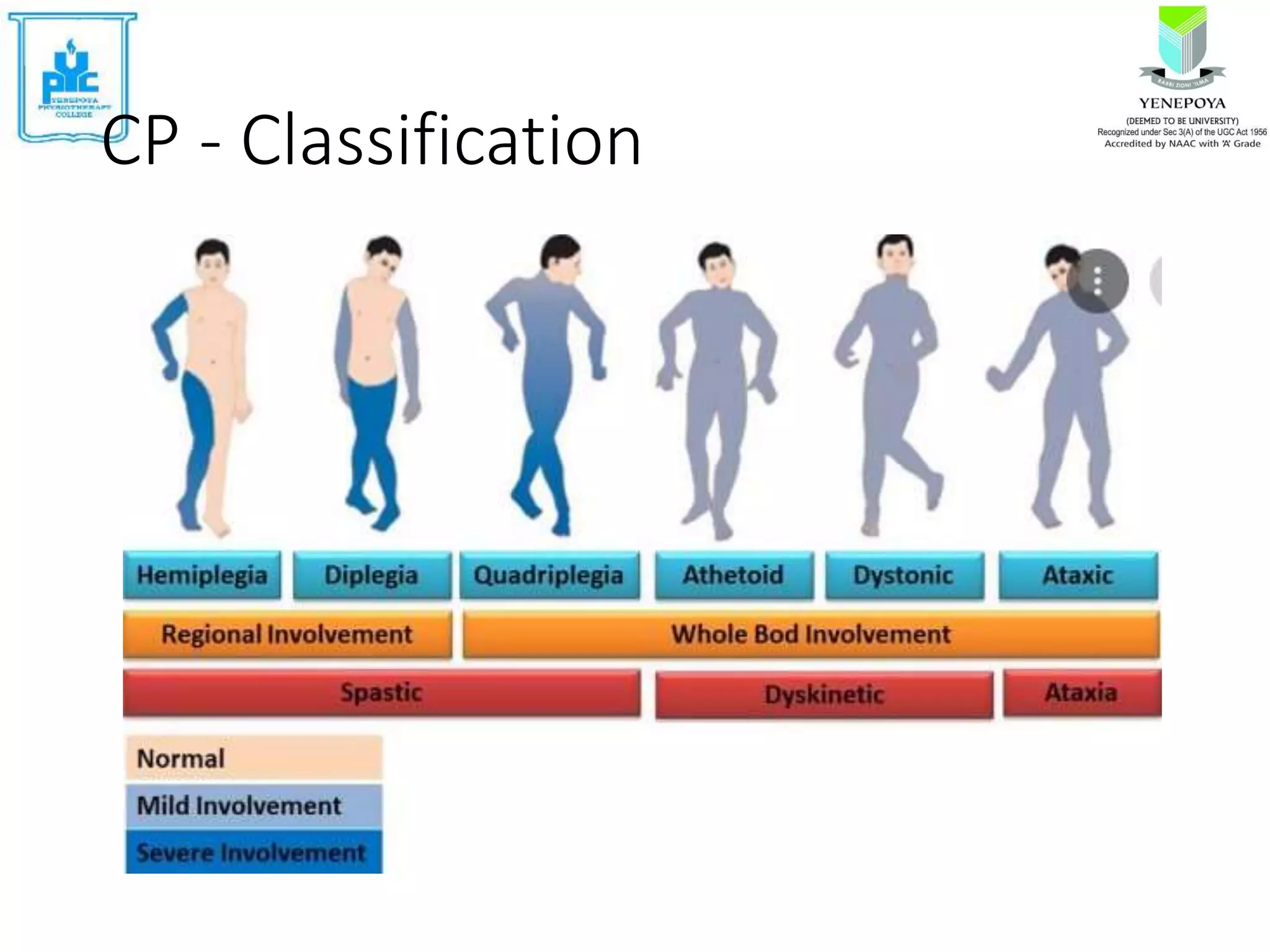
Classification: Type of movement
disorder
• Spastic
• Hypotonic
• Dyskinetic
• Ataxic
Spastic
• Spasticity occurs in approximately 75% of all children
with CP
• Distribution of spastic CP as,
- 40% to 44% quadriplegia
- 17% to 33% diplegia, and
- 21% to 23% hemiplegia
- < 1% monoplegia
Hypotonic
• Hypotonia/low tone – less common
• Hypotonia in a child with CP can be permanent but
is more often transient in the evolution of athetosis
or spasticity
• Might not represent a specific type of CP
Dyskinetic
• Cortical–basal ganglia–thalamic loop
• Sensory and motor feed-forward and feedback
circuit
• Result in generally uncontrolled and involuntary
movement that includes athetosis, rigidity, tremor,
dystonia, ballismus, and choreoathetosis
Ataxic
• Ataxic CP (39%) is primarily a disorder of balance
and weakness, incoordination, a wide-based gait,
and a noted tremor.
• Deficits in cerebellum
• Difficulty with transference of skills
• Specific task-oriented approach to treatment
Classification: Anatomical location
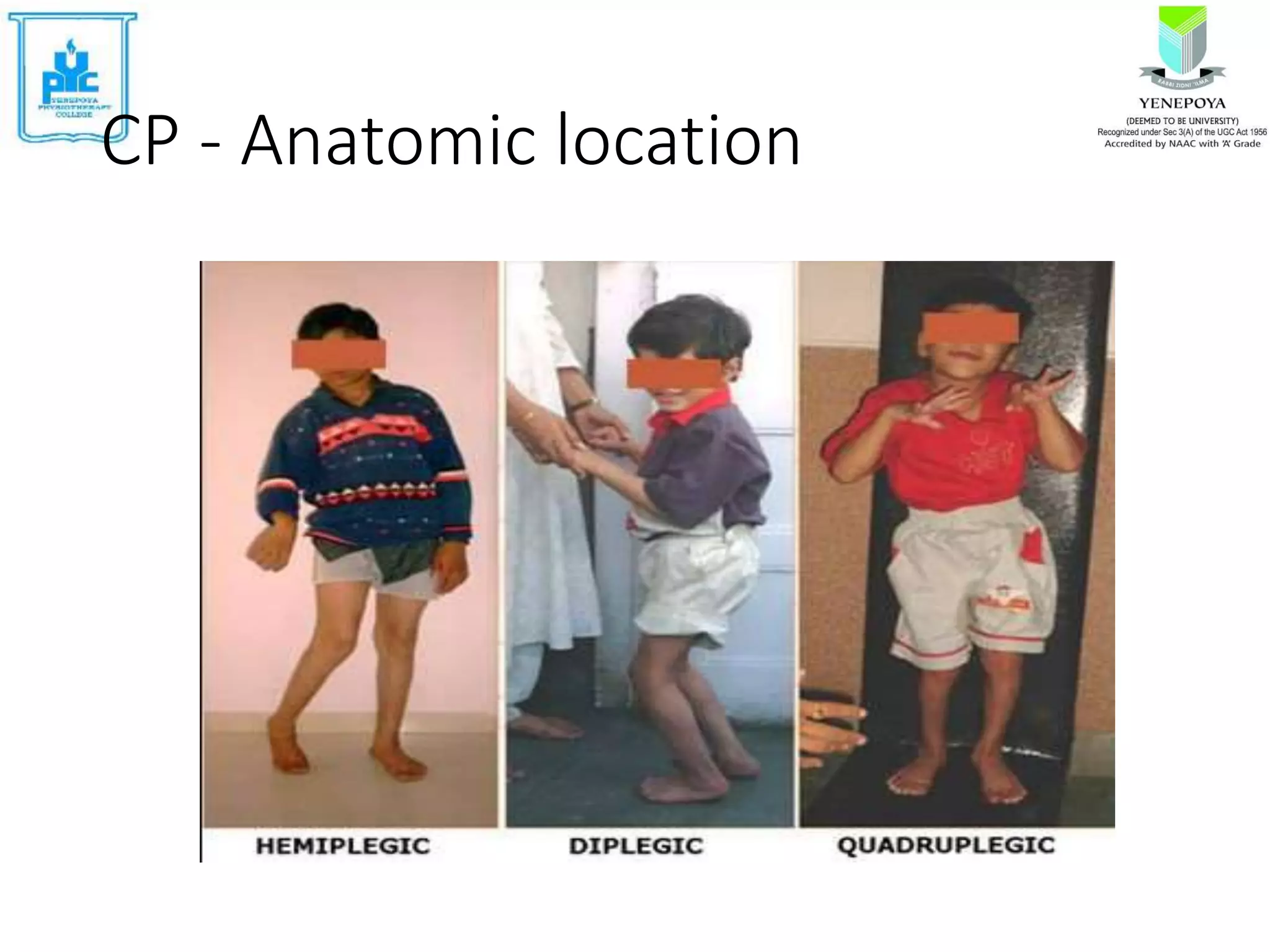
• Hemiplegia, which involves one arm and one leg on
the same side of the body
• Diplegia, which involves both lower extremities
• Quadriplegia, which refers to involvement of all
four limbs as well as back and neck musculature
CP - Anatomic location
Diplegia
• Diplegia is the most common form of spastic CP
• White matter infarct in the periventricular areas
caused by hypoxia can lead to spastic diplegic CP
• Affects bilateral LEs, resulting in issues with gait,
balance, and coordination
Hemiplegia
• A subtype of spastic CP in which UE & LE
on the same side of the body are affected
• Periventricular white matter abnormalities
• Cervical–subcortical lesions, brain
malformations, and nonprogressive
postnatal injuries
Hemiplegia
• UE is typically more affected than the LE, and
both tend to have more distal involvement than
proximal involvement
• Muscle spasticity on the affected side
decreases muscle and bone growth, resulting
in decreased ROM
Quadriplegia
• A subtype of CP in which volitional muscle control
of all four extremities is severely impaired
• Neck and trunk involvement
• Periventricular white matter lesions
• Extensive lesions affecting the basal ganglia or
occipital area often lead to visual impairments and
seizures
Quadriplegia
• Cognition can vary from normal to severely
impaired and is unique to each child with
quadriplegia
• Who are unable to speak are often regarded as
being cognitively impaired
CP - Anatomic location
CP - Classification
Assessment of the infant and child
with CP
Data Collection
• Date of birth
• Date of assessment
• Chronologic age/adjusted age
• Reason for referral
• Relevant medical history
• Overview of function (a few sentences)
• Family and environmental characteristics
• Contextual factors (conditions and restraints on function)
• Assistive technology/adaptive equipment
Assessment of the infant and child
with CP
Examination
• Morphology
• Functional skills and the capacity for change
• Gross motor control
• Communications
• Fine motor control
• Social skills/control of behavior
• Objective test results
• Observation of posture and movement
Assessment of the infant and child
with CP
Evaluation
• List client’s competencies
• Areas of concern
• System impairments
• Ineffective posture and movement
• Functional limitations
• Barriers to participation
• Analyze each level and how they interrelate, creating
the functional limitations of the client
• Analyze the potential for change according to the
findings
Assessment of the infant and child
with CP
Individual system review related to function
• Neuromuscular
• Musculoskeletal
• Sensory
• Respiratory
• Cardiovascular
• Integumentary
• Gastrointestinal
• Perceptual/cognitive
• Regulatory
Assessment of the infant and child
with CP
Plan of Care
• Specify the anticipated goals and expected outcomes
(long term and short term)
• Specify frequency and duration of intervention
• Strategies of intervention
• Role of client, family, and other medical and
educational professionals
• Client-centered programs as appropriate
• Measures to promote health, wellness, and fitness
• Schedule for re examination
Positions to assess functional
antigravity control
• Supine
• Prone
• Side-lying
• Sitting—short sit, long sit, side sit, ring sit
• Quadruped
• Kneeling
• Half-kneeling
• Standing
• Walking
If the child possesses higher-level
skills, then evaluate
• Climbing stairs
• Navigating ramps or curbs
• Unilateral stance
• Running
• Jumping
• Skipping
Child who functions from a
wheelchair should be observed for
• Alignment and mobility of body
• Shifting of weight
• Propulsion of wheelchair
• Management of wheelchair and its parts
• Transfer to and from wheelchair
Impairments (Neuromotor system)
• Decreased stiffness in neck and trunk
• Increased stiffness in extremities, distal or
proximal
• Difficulty initiating certain muscle groups (i.e.,
hip extensors and triceps)
Impairments (Neuromotor system)
• Difficulty sustaining certain muscle groups (i.e.,
thoracic extensors and abdominals)
• Difficulty terminating certain muscle groups
(i.e., hip flexors, adductors, and internal
rotators)
• Activation of muscles only in small ranges
• Difficulty with eccentric control (quadriceps)
Impairments (Musculoskeletal system)
• Limited range of motion of certain muscles
• Some muscles are overlengthened (the antagonists)
• Decreased ability to generate force in certain muscles,
also in spastic muscles
• Decrease muscle strength
• High risk for scoliosis
• At risk for hip subluxation and/or dislocation
Impairments (Cardiovascular and
Respiratory Systems)
• Decreased breath support
• Shallow breathing with weak abdominals
• Poor diaphragm – weak cough
• Decreased cardiovascular fitness
Impairments (Sensory system)
• Decreased tactile and proprioceptive awareness
• Difficulty discriminating different kinds of touch
• Decreased kinesthesia throughout the body
• Decreased vestibular registration
• Decreased body awareness
• Vision used more in an upward gaze, sometimes
asymmetrically
Impairments (Fine motor)
• Poor skills due to an inability to grade precise
movements
• Difficulty with activities requiring dissociation of
the arms
Impairments (Gross motor)
• Uses a very wide base to move independently
• Keeps legs flexed in vertical to lower the center of
gravity
• Poor balance in upright
Impairments (Oral motor)
• Wide range of movement
• Difficulty with a variety of textures and tastes
• Difficulty in mouth closure
• Drooling
• Drooping of food particles
Activities limitation
• Toileting (bladder, bowels and bathing)
• Feeding
• Mobility
• Transfer
• Stairclimbing
• Dressing
• Self care activities
Participation restriction
• Schooling
• Playground activities
• Competitive sports
GOALS
• SMART
• Specific
• Measurable
• Achievable
• Realistic
• Time bound

Cerebral Palsy

  • 1.
    Cerebral Palsy Dr. AsirJohn Samuel, PhD (Physiotherapy), MPT (Neurosciences and Paediatric Neurology), BPT, BSc (Psychology), DYScEd, MAcu, Additional Professor, Yenepoya Physiotherapy College Yenepoya (Deemed to be University), Mangalore, Karnataka
  • 2.
    Definition of CP Agroup of permanent disorders of the development of movement and posture, causing activity limitation, that are attributed to non-progressive disturbances that occurred in the developing foetal or infant brain. (Modified after Bax et al. 2005)
  • 3.
    Definition of CP(Continuation) The motor disorders of CP are often accompanied by disturbances of sensation, perception, cognition, communication, behaviour, seizures and secondary musculoskeletal problems. (Modified after Bax et al. 2005)
  • 4.
    Prevalence • CP onlyaffects between 2 and 3 ( 2.11) per 1000 live births • Most common cause of serious physical disability in childhood
  • 5.
    Aetiology • There isno single specific • potential causes of CP are known to occur in the prenatal stage of development, • Prenatal (prepartum), perinatal (peripartum) or neonatal time period, and • Postnatal or post-neonatal time period
  • 6.
  • 7.
  • 8.
    Signs & symptoms- Diagnosis • Abnormal muscle tone • Atypical posture • Movement with persistence of primitive reflexes - Diagnosed < 2 years • Milder cases - Diagnosed 4 to 5 years
  • 9.
    Diagnosis • Evaluation ofchild’s motor skills • Neuroimaging • Cranial ultrasound (CUS) – high-risk preterm infant • Computed tomography (CT) • Magnetic resonance imaging (MRI) • Not progressing
  • 10.
    Prenatal Causes ofCP • Vascular events such as a middle cerebral artery infarct • Maternal infections during the first and second trimesters, • Rubella, cytomegalovirus, and toxoplasmosis • Metabolic disorders, maternal ingestion of toxins • Rare genetic syndromes
  • 11.
    Perinatal Causes ofCP Problems During Labor and Delivery • Obstructed labour • Antepartum haemorrhage • Cord prolapse • Other Neonatal Causes
  • 12.
    Other Neonatal Causes •Hypoxic–ischemic encephalopathy (HIE) • Neonatal stroke, usually of the middle cerebral artery • Severe hypoglycemia • Untreated jaundice • Severe neonatal infection
  • 13.
    Postneonatally Acquired CP MetabolicEncephalopathy • Storage disorders • Metabolic disorders • Toxicity such as alcohol • Infections (meningitis, septicemia, malaria)
  • 14.
    Postneonatally Acquired CP Injuries •Cerebrovascular accident • Following surgery for congenital malformations • Near-drowning • Trauma (like, Motor vehicle accident – MVA) • Child abuse such as shaken baby syndrome
  • 15.
    Classification • Type ofmovement disorder – Motor type • Anatomical location of the child’s impaired motor function – Distribution
  • 16.
    Classification: Type ofmovement disorder • Spastic • Hypotonic • Dyskinetic • Ataxic
  • 17.
    Classification: Anatomical location •Hemiplegia, which involves one arm and one leg on the same side of the body • Diplegia, which involves both lower extremities • Quadriplegia, which refers to involvement of all four limbs as well as back and neck musculature
  • 18.
    Classification: Motor dysfunction •Gross Motor Function Classification System (GMFCS), by Palisano and colleagues in 1997 • Bimanual Fine Motor Function Classification System (BFMFCS), by Beckung and Hagberg
  • 19.
  • 20.
    Bimanual Fine MotorFunction Classification System (BFMFCS)
  • 21.
    Classification: Type ofmovement disorder • Spastic • Hypotonic • Dyskinetic • Ataxic
  • 22.
    Spastic • Spasticity occursin approximately 75% of all children with CP • Distribution of spastic CP as, - 40% to 44% quadriplegia - 17% to 33% diplegia, and - 21% to 23% hemiplegia - < 1% monoplegia
  • 23.
    Hypotonic • Hypotonia/low tone– less common • Hypotonia in a child with CP can be permanent but is more often transient in the evolution of athetosis or spasticity • Might not represent a specific type of CP
  • 24.
    Dyskinetic • Cortical–basal ganglia–thalamicloop • Sensory and motor feed-forward and feedback circuit • Result in generally uncontrolled and involuntary movement that includes athetosis, rigidity, tremor, dystonia, ballismus, and choreoathetosis
  • 25.
    Ataxic • Ataxic CP(39%) is primarily a disorder of balance and weakness, incoordination, a wide-based gait, and a noted tremor. • Deficits in cerebellum • Difficulty with transference of skills • Specific task-oriented approach to treatment
  • 26.
    Classification: Anatomical location •Hemiplegia, which involves one arm and one leg on the same side of the body • Diplegia, which involves both lower extremities • Quadriplegia, which refers to involvement of all four limbs as well as back and neck musculature
  • 27.
    CP - Anatomiclocation
  • 28.
    Diplegia • Diplegia isthe most common form of spastic CP • White matter infarct in the periventricular areas caused by hypoxia can lead to spastic diplegic CP • Affects bilateral LEs, resulting in issues with gait, balance, and coordination
  • 29.
    Hemiplegia • A subtypeof spastic CP in which UE & LE on the same side of the body are affected • Periventricular white matter abnormalities • Cervical–subcortical lesions, brain malformations, and nonprogressive postnatal injuries
  • 30.
    Hemiplegia • UE istypically more affected than the LE, and both tend to have more distal involvement than proximal involvement • Muscle spasticity on the affected side decreases muscle and bone growth, resulting in decreased ROM
  • 31.
    Quadriplegia • A subtypeof CP in which volitional muscle control of all four extremities is severely impaired • Neck and trunk involvement • Periventricular white matter lesions • Extensive lesions affecting the basal ganglia or occipital area often lead to visual impairments and seizures
  • 32.
    Quadriplegia • Cognition canvary from normal to severely impaired and is unique to each child with quadriplegia • Who are unable to speak are often regarded as being cognitively impaired
  • 33.
    CP - Anatomiclocation
  • 34.
  • 35.
    Assessment of theinfant and child with CP Data Collection • Date of birth • Date of assessment • Chronologic age/adjusted age • Reason for referral • Relevant medical history • Overview of function (a few sentences) • Family and environmental characteristics • Contextual factors (conditions and restraints on function) • Assistive technology/adaptive equipment
  • 36.
    Assessment of theinfant and child with CP Examination • Morphology • Functional skills and the capacity for change • Gross motor control • Communications • Fine motor control • Social skills/control of behavior • Objective test results • Observation of posture and movement
  • 37.
    Assessment of theinfant and child with CP Evaluation • List client’s competencies • Areas of concern • System impairments • Ineffective posture and movement • Functional limitations • Barriers to participation • Analyze each level and how they interrelate, creating the functional limitations of the client • Analyze the potential for change according to the findings
  • 38.
    Assessment of theinfant and child with CP Individual system review related to function • Neuromuscular • Musculoskeletal • Sensory • Respiratory • Cardiovascular • Integumentary • Gastrointestinal • Perceptual/cognitive • Regulatory
  • 39.
    Assessment of theinfant and child with CP Plan of Care • Specify the anticipated goals and expected outcomes (long term and short term) • Specify frequency and duration of intervention • Strategies of intervention • Role of client, family, and other medical and educational professionals • Client-centered programs as appropriate • Measures to promote health, wellness, and fitness • Schedule for re examination
  • 40.
    Positions to assessfunctional antigravity control • Supine • Prone • Side-lying • Sitting—short sit, long sit, side sit, ring sit • Quadruped • Kneeling • Half-kneeling • Standing • Walking
  • 41.
    If the childpossesses higher-level skills, then evaluate • Climbing stairs • Navigating ramps or curbs • Unilateral stance • Running • Jumping • Skipping
  • 42.
    Child who functionsfrom a wheelchair should be observed for • Alignment and mobility of body • Shifting of weight • Propulsion of wheelchair • Management of wheelchair and its parts • Transfer to and from wheelchair
  • 43.
    Impairments (Neuromotor system) •Decreased stiffness in neck and trunk • Increased stiffness in extremities, distal or proximal • Difficulty initiating certain muscle groups (i.e., hip extensors and triceps)
  • 44.
    Impairments (Neuromotor system) •Difficulty sustaining certain muscle groups (i.e., thoracic extensors and abdominals) • Difficulty terminating certain muscle groups (i.e., hip flexors, adductors, and internal rotators) • Activation of muscles only in small ranges • Difficulty with eccentric control (quadriceps)
  • 45.
    Impairments (Musculoskeletal system) •Limited range of motion of certain muscles • Some muscles are overlengthened (the antagonists) • Decreased ability to generate force in certain muscles, also in spastic muscles • Decrease muscle strength • High risk for scoliosis • At risk for hip subluxation and/or dislocation
  • 46.
    Impairments (Cardiovascular and RespiratorySystems) • Decreased breath support • Shallow breathing with weak abdominals • Poor diaphragm – weak cough • Decreased cardiovascular fitness
  • 47.
    Impairments (Sensory system) •Decreased tactile and proprioceptive awareness • Difficulty discriminating different kinds of touch • Decreased kinesthesia throughout the body • Decreased vestibular registration • Decreased body awareness • Vision used more in an upward gaze, sometimes asymmetrically
  • 48.
    Impairments (Fine motor) •Poor skills due to an inability to grade precise movements • Difficulty with activities requiring dissociation of the arms
  • 49.
    Impairments (Gross motor) •Uses a very wide base to move independently • Keeps legs flexed in vertical to lower the center of gravity • Poor balance in upright
  • 50.
    Impairments (Oral motor) •Wide range of movement • Difficulty with a variety of textures and tastes • Difficulty in mouth closure • Drooling • Drooping of food particles
  • 51.
    Activities limitation • Toileting(bladder, bowels and bathing) • Feeding • Mobility • Transfer • Stairclimbing • Dressing • Self care activities
  • 52.
    Participation restriction • Schooling •Playground activities • Competitive sports
  • 53.
    GOALS • SMART • Specific •Measurable • Achievable • Realistic • Time bound