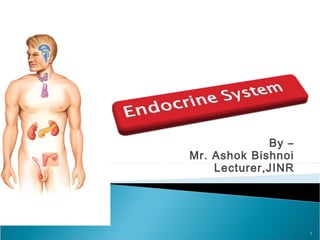
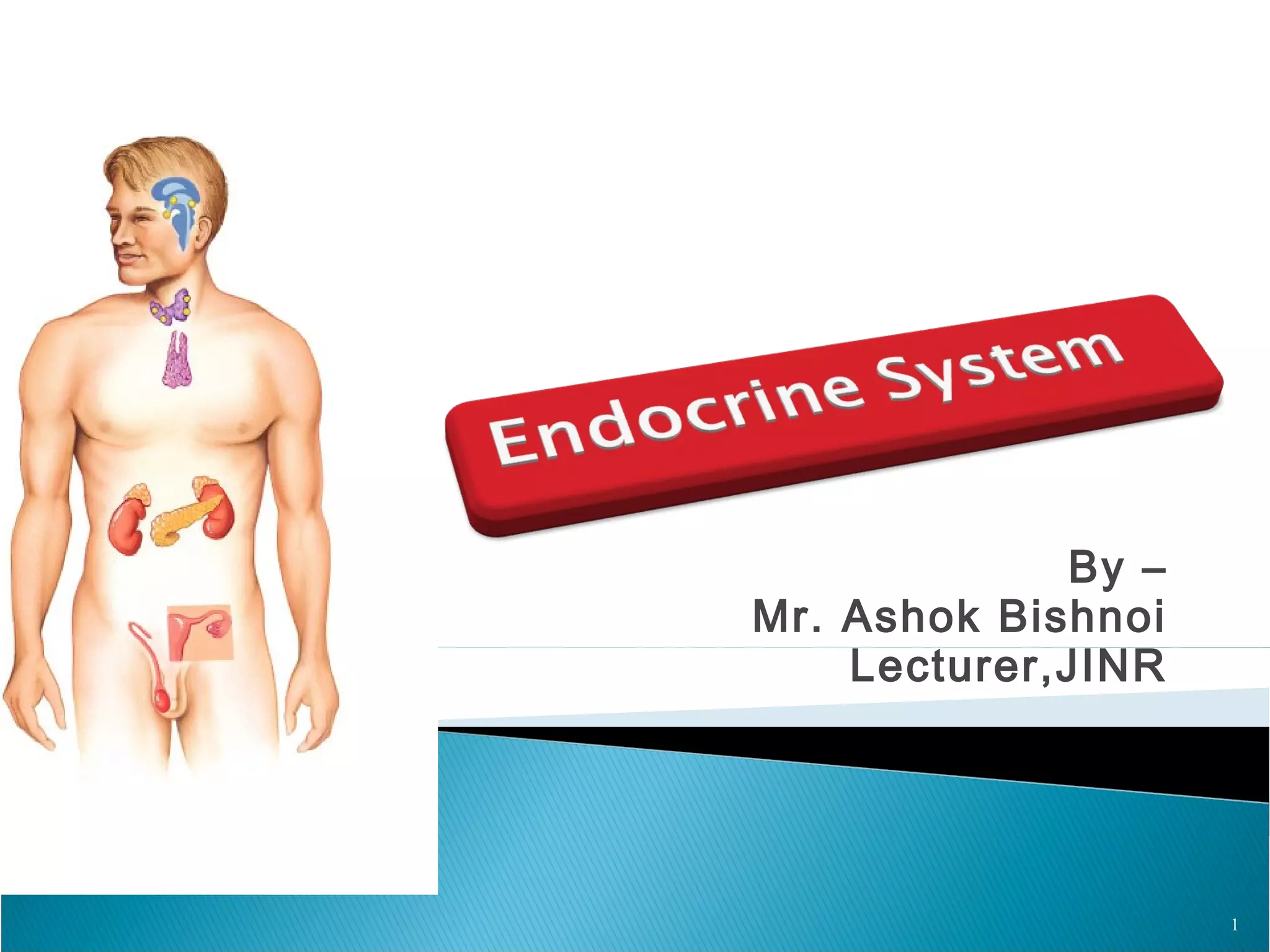
By –
Mr. Ashok Bishnoi
Lecturer,JINR
1
 Gland:- It is a group of cell which take certain
material from tissue fluid & make new substances
of them.
 Classification:- it is classified in to two groups.
◦ Exocrine & duct gland -which secrete in to cavity.
◦ Endocrine & ductless gland:- which secrete in to
tissue & blood.
2
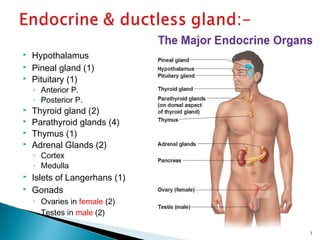
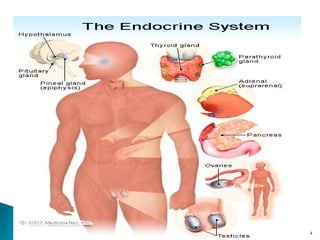
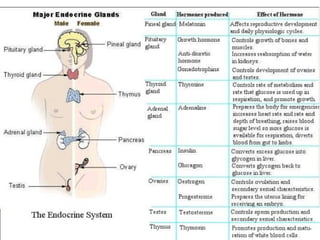
 Hypothalamus
 Pineal gland (1)
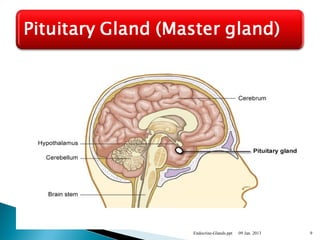
 Pituitary (1)
◦ Anterior P.
◦ Posterior P.
 Thyroid gland (2)
 Parathyroid glands (4)
 Thymus (1)
 Adrenal Glands (2)
◦ Cortex
◦ Medulla
 Islets of Langerhans (1)
 Gonads
◦ Ovaries in female (2)
◦ Testes in male (2)
3
09 Jan. 2013Endocrine-Glands.ppt 4
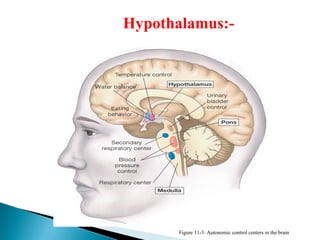
Figure 11-3: Autonomic control centers in the brain
Hypothalamus:-
 It Regulates , emotions, feeding/satiety, thirst,
body temperature, etc.
 Controls the release of hormones from the anterior
and posterior pituitary
6
“7” releasing hormones are made in the hypothalamus
Thyrotropin-Releasing Hormone (TRH)
Corticotropin-Releasing Hormone (CRH)
Gonadotropin-Releasing hormone (GnRH)
Growth hormone-Releasing Hormone (GHRH)
Growth hormone-Release Inhibiting Hormone (GHIH)
Prolactin-Releasing factor (PRF)
Prolactin-Inhibiting Hormone (PIH)
 All of these are released into the blood in the
capillaries and travel immediately
8
09 Jan. 2013Endocrine-Glands.ppt 9
 It is lie in the hypophyseal phosa of the sphenoid
bone below the hypothalamus.
 Weight is about “500” mg
Endocrine-Glands.ppt 10
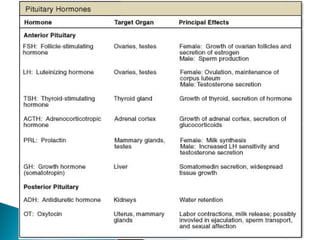
 Anterior P. (Adenohypophysis):-
◦ Growth Hormone (GH)
◦ Prolactin Hormone (PH)
◦ Melanocyte-Stimulating Hormone (MSH)
◦ Thyroid-Stimulating Hormone (TSH)
◦ Adrenocorticotropic Hormone(ACTH)
◦ Follicle-Stimulating Hormone (FSH)
◦ Luteinizing Hormone (LH)
11
Endocrine-Glands.ppt 12
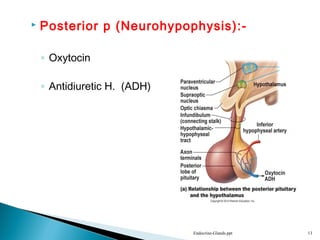
 Posterior p (Neurohypophysis):-
◦ Oxytocin
◦ Antidiuretic H. (ADH)
Endocrine-Glands.ppt 13
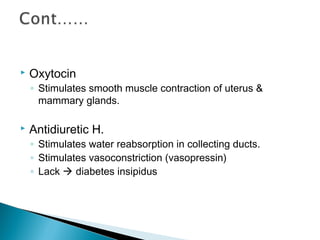
 Oxytocin
◦ Stimulates smooth muscle contraction of uterus &
mammary glands.
 Antidiuretic H.
◦ Stimulates water reabsorption in collecting ducts.
◦ Stimulates vasoconstriction (vasopressin)
◦ Lack  diabetes insipidus
Endocrine-Glands.ppt 16
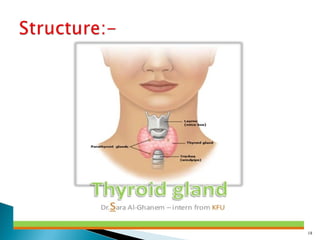
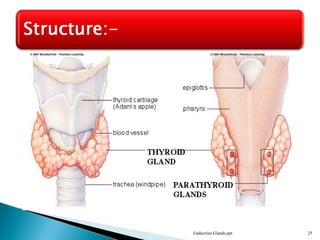
 Position:- Situated in the neck in front of the
larynx & trachea at the level of 5th
,6th
& 7th
cervical
& 1st
thoracic vertebrae.
 Weight it is about:- 25 gm
 Shape:- Butterfly in shape
17
18
 It consisting of two lobes one on either side of
thyroid cartilage
 The lobe are cone shaped
 About 5cm long
 3 cm wide
19
 Blood supply by:- Superior & inferior thyroid
artery.
 Venous drainage by:- thyroid vein
20
Secretion of hormone:-
1. T3 (Tri-iodothyronine)
2. T4 (Thyroid)
Function:-
◦ Increases BMR & produce energy
◦ It help in metabolism of protein ,fat
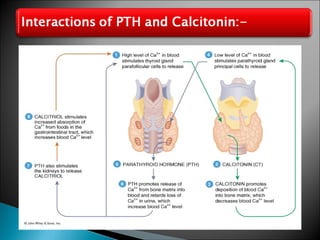
3. Calcitonin
Function:-
◦ Reduce blood calcium level
◦ It reduce reabsorbtion of calcium level from bone
21
22
 Location:- The parathyroid gland is located in the
neck
 There are “4”small parathyroid glands.
 Two abunded in the posterior surface of each lob
of the thyroid glands.
23
 Shape:- Spherical in shape
 Length:- 0.3-0.6cm long
 Weight:- 25mg
24
Endocrine-Glands.ppt 25
 Arterial supply: inferior thyroid artery (superior
thyroid,)
 Venous drainage: Inferior, middle, superior
thyroid veins
26
 Parathyroid hormone (PTH)
Function:-
 Increase blood calcium level when it is low
(9-10.5 mg/dl)
27
29
30
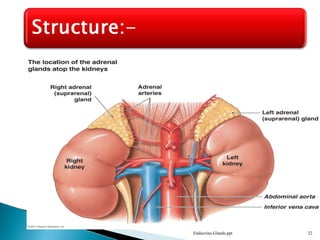
 Position:-One situated on the upper pole of the
each kidney
 Length:- About “4” cm long
 Around “3” cm thick
Endocrine-Glands.ppt 31
Endocrine-Glands.ppt 32
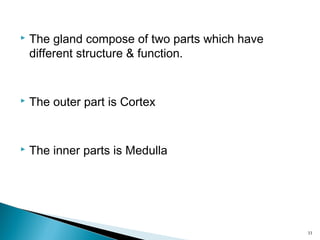
 The gland compose of two parts which have
different structure & function.
 The outer part is Cortex
 The inner parts is Medulla
33
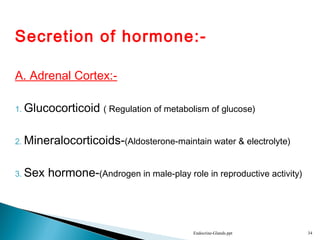
Secretion of hormone:-
A. Adrenal Cortex:-
1. Glucocorticoid ( Regulation of metabolism of glucose)
2. Mineralocorticoids-(Aldosterone-maintain water & electrolyte)
3. Sex hormone-(Androgen in male-play role in reproductive activity)
Endocrine-Glands.ppt 34
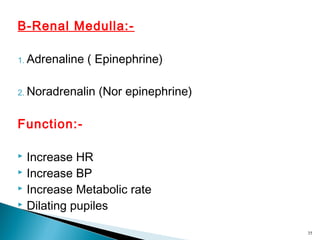
B-Renal Medulla:-
1. Adrenaline ( Epinephrine)
2. Noradrenalin (Nor epinephrine)
Function:-
 Increase HR
 Increase BP
 Increase Metabolic rate
 Dilating pupiles
35
 Hypo-secretion
Addison’s disease -
glucocorticoid deficiency
person becomes highly
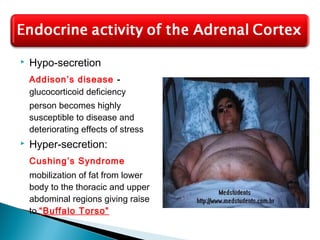
susceptible to disease and
deteriorating effects of stress
 Hyper-secretion:
Cushing’s Syndrome
mobilization of fat from lower
body to the thoracic and upper
abdominal regions giving raise
to “Buffalo Torso”
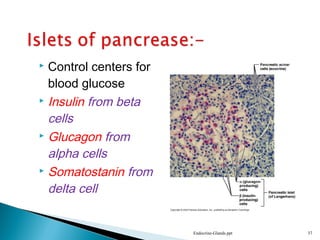
 Control centers for
blood glucose
 Insulin from beta
cells
 Glucagon from
alpha cells
 Somatostanin from
delta cell
Endocrine-Glands.ppt 37
09 Jan. 2013Endocrine-Glands.ppt 38
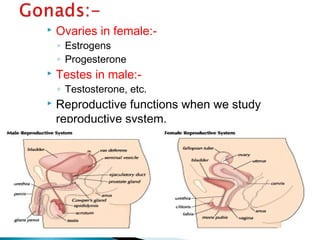
 Ovaries in female:-
◦ Estrogens

◦ Progesterone
 Testes in male:-
◦ Testosterone, etc.
 Reproductive functions when we study
reproductive system.
Endocrine-Glands.ppt 39
 Suspended in third ventricle from
diencephalon
 Melatonin
◦ ? Inhibits early puberty
◦ ? Day/night cycles
 Timing of sleep, body temperature, appetite
09 Jan. 2013Endocrine-Glands.ppt 40
 = “Thymus gland”
 Thymopoietins, thymic factor, thymosins
◦ Influence development of T lymphocytes
09 Jan. 2013Endocrine-Glands.ppt 41
 Stomach (gastrointestinal hormones)
 Heart  ANP(Atrial natriuretic peptide)
 Kidneys  erythropoietin
 Adipose tissue  leptin
 Skin  cholecalciferol (vit. D precursor)
 Placenta  progesterone
09 Jan. 2013Endocrine-Glands.ppt 42
 Growth
 Healing
 Water balance & Blood Pressure
 Calcium Metabolism
 Energy Metabolism
 Stress
 Regulation of other Endocrine Organs
Endocrine glands

Endocrine glands

  • 1.
    By – Mr. AshokBishnoi Lecturer,JINR 1
  • 2.
     Gland:- Itis a group of cell which take certain material from tissue fluid & make new substances of them.  Classification:- it is classified in to two groups. ◦ Exocrine & duct gland -which secrete in to cavity. ◦ Endocrine & ductless gland:- which secrete in to tissue & blood. 2
  • 3.
     Hypothalamus  Pinealgland (1)  Pituitary (1) ◦ Anterior P. ◦ Posterior P.  Thyroid gland (2)  Parathyroid glands (4)  Thymus (1)  Adrenal Glands (2) ◦ Cortex ◦ Medulla  Islets of Langerhans (1)  Gonads ◦ Ovaries in female (2) ◦ Testes in male (2) 3
  • 4.
  • 5.
    Figure 11-3: Autonomiccontrol centers in the brain Hypothalamus:-
  • 6.
     It Regulates, emotions, feeding/satiety, thirst, body temperature, etc.  Controls the release of hormones from the anterior and posterior pituitary 6
  • 7.
    “7” releasing hormonesare made in the hypothalamus Thyrotropin-Releasing Hormone (TRH) Corticotropin-Releasing Hormone (CRH) Gonadotropin-Releasing hormone (GnRH) Growth hormone-Releasing Hormone (GHRH)
  • 8.
    Growth hormone-Release InhibitingHormone (GHIH) Prolactin-Releasing factor (PRF) Prolactin-Inhibiting Hormone (PIH)  All of these are released into the blood in the capillaries and travel immediately 8
  • 9.
  • 10.
     It islie in the hypophyseal phosa of the sphenoid bone below the hypothalamus.  Weight is about “500” mg Endocrine-Glands.ppt 10
  • 11.
     Anterior P.(Adenohypophysis):- ◦ Growth Hormone (GH) ◦ Prolactin Hormone (PH) ◦ Melanocyte-Stimulating Hormone (MSH) ◦ Thyroid-Stimulating Hormone (TSH) ◦ Adrenocorticotropic Hormone(ACTH) ◦ Follicle-Stimulating Hormone (FSH) ◦ Luteinizing Hormone (LH) 11
  • 12.
  • 13.
     Posterior p(Neurohypophysis):- ◦ Oxytocin ◦ Antidiuretic H. (ADH) Endocrine-Glands.ppt 13
  • 14.
     Oxytocin ◦ Stimulatessmooth muscle contraction of uterus & mammary glands.  Antidiuretic H. ◦ Stimulates water reabsorption in collecting ducts. ◦ Stimulates vasoconstriction (vasopressin) ◦ Lack  diabetes insipidus
  • 16.
  • 17.
     Position:- Situatedin the neck in front of the larynx & trachea at the level of 5th ,6th & 7th cervical & 1st thoracic vertebrae.  Weight it is about:- 25 gm  Shape:- Butterfly in shape 17
  • 18.
  • 19.
     It consistingof two lobes one on either side of thyroid cartilage  The lobe are cone shaped  About 5cm long  3 cm wide 19
  • 20.
     Blood supplyby:- Superior & inferior thyroid artery.  Venous drainage by:- thyroid vein 20
  • 21.
    Secretion of hormone:- 1.T3 (Tri-iodothyronine) 2. T4 (Thyroid) Function:- ◦ Increases BMR & produce energy ◦ It help in metabolism of protein ,fat 3. Calcitonin Function:- ◦ Reduce blood calcium level ◦ It reduce reabsorbtion of calcium level from bone 21
  • 22.
  • 23.
     Location:- Theparathyroid gland is located in the neck  There are “4”small parathyroid glands.  Two abunded in the posterior surface of each lob of the thyroid glands. 23
  • 24.
     Shape:- Sphericalin shape  Length:- 0.3-0.6cm long  Weight:- 25mg 24
  • 25.
  • 26.
     Arterial supply:inferior thyroid artery (superior thyroid,)  Venous drainage: Inferior, middle, superior thyroid veins 26
  • 27.
     Parathyroid hormone(PTH) Function:-  Increase blood calcium level when it is low (9-10.5 mg/dl) 27
  • 29.
  • 30.
  • 31.
     Position:-One situatedon the upper pole of the each kidney  Length:- About “4” cm long  Around “3” cm thick Endocrine-Glands.ppt 31
  • 32.
  • 33.
     The glandcompose of two parts which have different structure & function.  The outer part is Cortex  The inner parts is Medulla 33
  • 34.
    Secretion of hormone:- A.Adrenal Cortex:- 1. Glucocorticoid ( Regulation of metabolism of glucose) 2. Mineralocorticoids-(Aldosterone-maintain water & electrolyte) 3. Sex hormone-(Androgen in male-play role in reproductive activity) Endocrine-Glands.ppt 34
  • 35.
    B-Renal Medulla:- 1. Adrenaline( Epinephrine) 2. Noradrenalin (Nor epinephrine) Function:-  Increase HR  Increase BP  Increase Metabolic rate  Dilating pupiles 35
  • 36.
     Hypo-secretion Addison’s disease- glucocorticoid deficiency person becomes highly susceptible to disease and deteriorating effects of stress  Hyper-secretion: Cushing’s Syndrome mobilization of fat from lower body to the thoracic and upper abdominal regions giving raise to “Buffalo Torso”
  • 37.
     Control centersfor blood glucose  Insulin from beta cells  Glucagon from alpha cells  Somatostanin from delta cell Endocrine-Glands.ppt 37
  • 38.
  • 39.
     Ovaries infemale:- ◦ Estrogens ◦ Progesterone  Testes in male:- ◦ Testosterone, etc.  Reproductive functions when we study reproductive system. Endocrine-Glands.ppt 39
  • 40.
     Suspended inthird ventricle from diencephalon  Melatonin ◦ ? Inhibits early puberty ◦ ? Day/night cycles  Timing of sleep, body temperature, appetite 09 Jan. 2013Endocrine-Glands.ppt 40
  • 41.
     = “Thymusgland”  Thymopoietins, thymic factor, thymosins ◦ Influence development of T lymphocytes 09 Jan. 2013Endocrine-Glands.ppt 41
  • 42.
     Stomach (gastrointestinal hormones) Heart  ANP(Atrial natriuretic peptide)  Kidneys  erythropoietin  Adipose tissue  leptin  Skin  cholecalciferol (vit. D precursor)  Placenta  progesterone 09 Jan. 2013Endocrine-Glands.ppt 42
  • 43.
     Growth  Healing Water balance & Blood Pressure  Calcium Metabolism  Energy Metabolism  Stress  Regulation of other Endocrine Organs