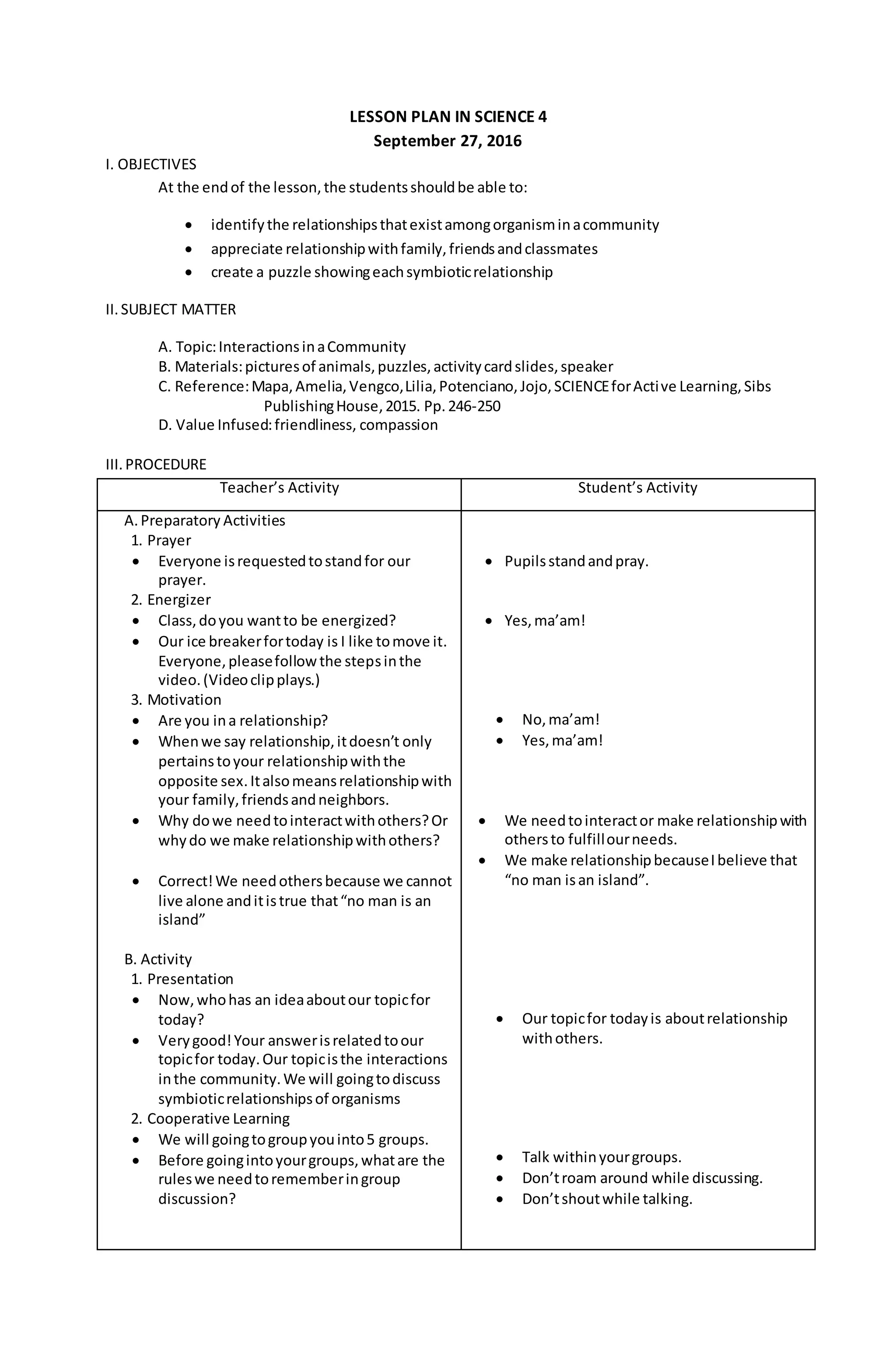
LESSON PLAN IN SCIENCE 4
September 27, 2016
I. OBJECTIVES
At the endof the lesson,the studentsshouldbe able to:
 identifythe relationshipsthatexistamongorganisminacommunity
 appreciate relationshipwithfamily,friendsandclassmates
 create a puzzle showingeachsymbioticrelationship
II.SUBJECT MATTER
A. Topic:InteractionsinaCommunity
B. Materials:picturesof animals,puzzles,activitycardslides,speaker
C. Reference:Mapa,Amelia,Vengco,Lilia,Potenciano,Jojo,SCIENCEforActive Learning,Sibs
PublishingHouse,2015. Pp.246-250
D. Value Infused:friendliness, compassion
III.PROCEDURE
Teacher’s Activity Student’s Activity
A.Preparatory Activities
1. Prayer
 Everyone isrequestedtostandfor our
prayer.
2. Energizer
 Class,doyou wantto be energized?
 Our ice breakerfortoday is I like tomove it.
Everyone,pleasefollowthe stepsinthe
video.(Videoclipplays.)
3. Motivation
 Are you ina relationship?
 Whenwe say relationship,itdoesn’t only
pertainstoyour relationshipwiththe
opposite sex.Italsomeansrelationshipwith
your family,friendsandneighbors.
 Why dowe needtointeractwithothers?Or
whydo we make relationshipwithothers?
 Correct!We needothersbecause we cannot
live alone anditistrue that“no man is an
island”
B. Activity
1. Presentation
 Now,whohas an ideaaboutour topicfor
today?
 Verygood!Your answerisrelatedtoour
topicfor today.Our topicisthe interactions
inthe community.We will goingtodiscuss
symbioticrelationshipsof organisms
2. Cooperative Learning
 We will goingtogroupyouinto5 groups.
 Before goingintoyourgroups,whatare the
ruleswe needtorememberingroup
discussion?
 Pupilsstandandpray.
 Yes,ma’am!
 No,ma’am!
 Yes,ma’am!
 We needtointeractor make relationshipwith
othersto fulfillourneeds.
 We make relationshipbecauseIbelieve that
“no man isan island”.
 Our topicfor todayis aboutrelationship
withothers.
 Talk withinyourgroups.
 Don’troam around while discussing.
 Don’tshoutwhile talking.
 Then,forma circle.Choose yourleaderand
reporter.We will give you6 minutestofinish
your discussion.Youonlyhave 2minutesto
presentyourpuzzle.
 (Distributingthe activitycards)
GROUP 1
DIRECTIONS:Formthe givenpuzzle.Tell
somethingabout the relationshipof two
species inclass.
GROUP 2
DIRECTIONS:Formthe givenpuzzle.Tell
somethingaboutthe relationshipof two
speciesinclass.
GROUP 3
DIRECTIONS:Formthe givenpuzzle.Tell
somethingaboutthe relationshipof two
speciesinclass.
GROUP 4
DIRECTIONS:Formthe givenpuzzle.Tell
somethingaboutthe relationshipof two
speciesinclass.
C. PostActivity
1. Analysis
 What have youlearnedfromgroup1?
 Verygood! Because theybenefitfromeach
other,howdo we call this?
 Verygood!
 Mutualismisa relationshipinwhichtwo
organismslive togetheranddependoneach
other.
 What have youlearnedfromgroup2?
 Verygood!
 We call theirrelationshipascommensalism.
Commensalismisasymbioticrelationshipin
whichone organismbenefitswhile otheris
not affected.
 What have youlearnedfromgroup3?
 Verygood! Whenone organismbenefits
and the otheris harmed,we call this
relationshipasparasitism.
 In thiskindof relationship,whatdowe call
to the one who benefits?
 In thiskindof relationship,whatdowe call
to the one who isharmed?
 What have youlearnedfromgroup4?
 Correct! An animal that kills and eats
another animal is called predator. The
smallerandweakeranimal thatthe predator
kills and eats is called the prey. We call this
relationship as predation.
GROUP 5
DIRECTIONS:Formthe givenpuzzle.Tell
somethingaboutthe relationshipof two
speciesinclass.
 Both the flowerandthe butterflybenefit
fromeach other.
 We call it as mutualism.
 The small fishbenefitsfromthe shark.
 He usesthe sharkfor transportationand
to avoidpredators.
 The sharkwas not harmedor helpedby
the small fish.
 The mosquitobenefitsfromthe human
 The human isharmedby the mosquito.
 We call thisas a parasite.
 We call thisas the host.
 The lioneatsthe weakanimal.
 The lionisa predator.
 The lionisconsideredstronger.
 What have youlearnedfromgroup5?
 Verygood! That relationship iscalled
competition. Animalsinanecosystemuse
space,waterand foodas theyincrease in
size. Competitionisthe struggle among
organismsforthe same materialsor
conditions.
 Those five relationshipsare calledsymbiosis.
 What do you think the meaning of
symbiosis?
 Very good! Symbiosis is the interaction
between the two species.
2. Generalization
 What do you learned from today’s
discussion?
 Verygood!So whatare those five symbiotic
relationshipsthatwe justlearned?
3. Application
 Can youimagine yourselflivinginanisland
all by yourself?There’snofamily,friendsor
neighbortohelp?
 Do youthinkyou can survive there?
 Why?
 Okay, I guessyouhave realizedhow
importanttheyare in yourlife andhow
importantisinteraction inyourlife.
 The birdsare competingfora worm.
 There isa competitionbetweenthe two
birds.
 Symbiosisisthe interdependent
relationshipbetweentwospecies.
 I learnedaboutthe symbiosis.
 I learnedaboutthe differentthe
interactionsinthe community.
 I learnedthatthere are five symbiotic
relationships.
 The five symbioticrelationshipsthatwe
learnedare mutualism, commensalism,
parasitism, predationandcompetition.
 No ma’am!
 No,ma’am!
 I thinkI will alwaysneedtherehelpto
fulfillmyneeds.
 I can’t live alone because Iwill feelsad
and lonely.
IV.EVALUATION
Directions:Choose the bestanswer.Write youranswerona¼ sheetof paper.
1. The symbioticrelationshipwhenbothorganismsbenefitfromone anotheriscalled______.
a. commensalism c. mutualism
b. competition d. parasitism
2. It isthe interactionbetweenthe twospecies.
a. predation c. mutualism
b. competition d. symbiosis
3. What type of relationshipdothe remorafishandsharkhave?
a. commensalism c. mutualism
b. competition d. parasitism
4. What type of relationshipdoflowerandbutterflyhave?
a. commensalism c. mutualism
b. competition d. parasitism
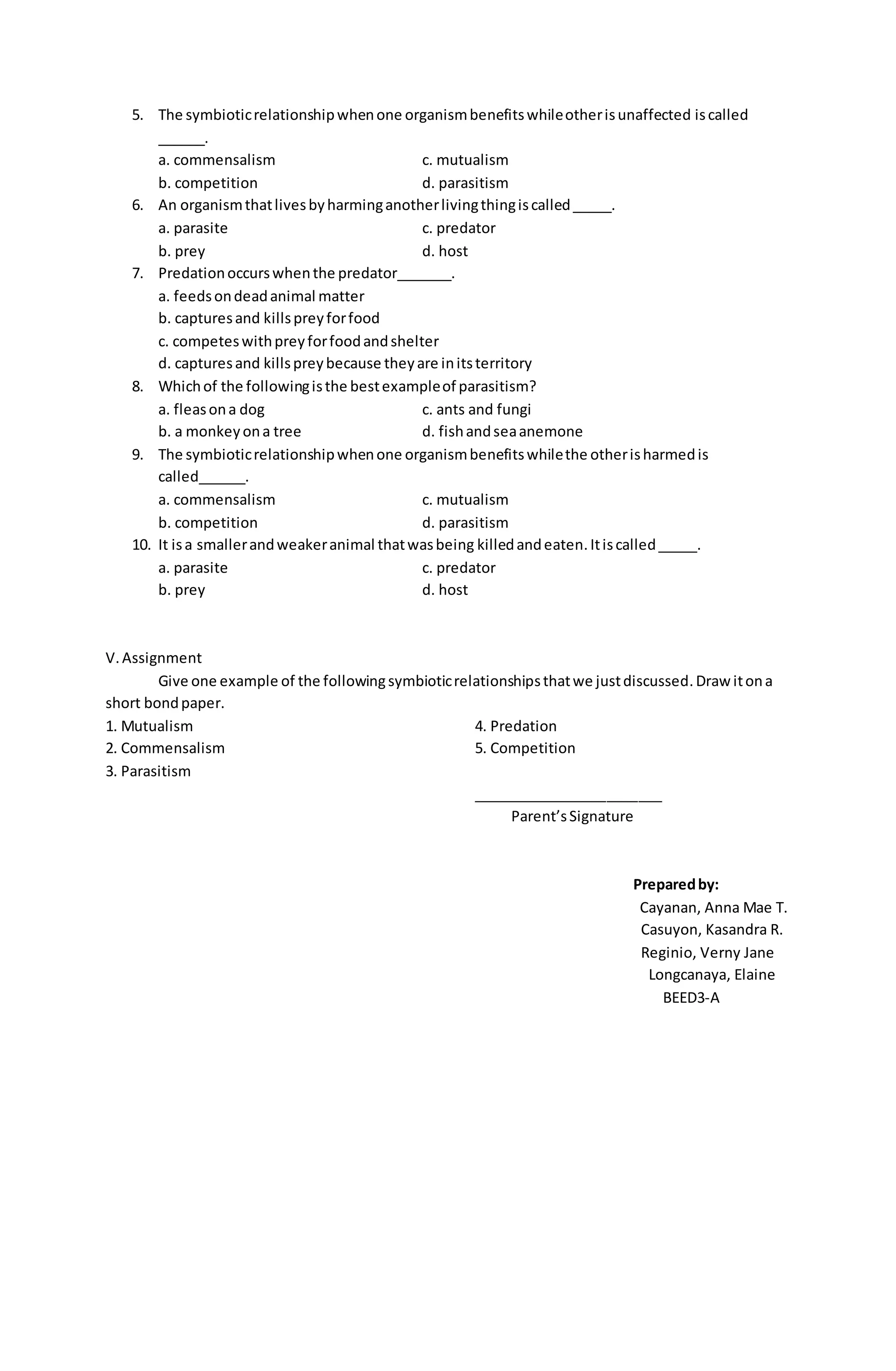
5. The symbioticrelationshipwhenone organismbenefitswhileotherisunaffected iscalled
______.
a. commensalism c. mutualism
b. competition d. parasitism
6. An organismthatlivesbyharminganotherlivingthingiscalled_____.
a. parasite c. predator
b. prey d. host
7. Predationoccurswhenthe predator_______.
a. feedsondeadanimal matter
b. capturesand killspreyforfood
c. competeswithpreyforfoodandshelter
d. capturesand killspreybecause theyare initsterritory
8. Whichof the followingisthe bestexampleof parasitism?
a. fleasona dog c. ants and fungi
b. a monkeyona tree d. fishandseaanemone
9. The symbioticrelationshipwhenone organismbenefitswhilethe otherisharmedis
called______.
a. commensalism c. mutualism
b. competition d. parasitism
10. It isa smallerandweakeranimal thatwasbeing killedandeaten.Itiscalled_____.
a. parasite c. predator
b. prey d. host
V.Assignment
Give one example of the followingsymbioticrelationshipsthatwe justdiscussed.Draw itona
short bondpaper.
1. Mutualism
2. Commensalism
3. Parasitism
4. Predation
5. Competition
________________________
Parent’sSignature
Preparedby:
Cayanan, Anna Mae T.
Casuyon, Kasandra R.
Reginio, Verny Jane
Longcanaya, Elaine
BEED3-A

Detailed Lesson Plan (Science)

  • 1.
    LESSON PLAN INSCIENCE 4 September 27, 2016 I. OBJECTIVES At the endof the lesson,the studentsshouldbe able to:  identifythe relationshipsthatexistamongorganisminacommunity  appreciate relationshipwithfamily,friendsandclassmates  create a puzzle showingeachsymbioticrelationship II.SUBJECT MATTER A. Topic:InteractionsinaCommunity B. Materials:picturesof animals,puzzles,activitycardslides,speaker C. Reference:Mapa,Amelia,Vengco,Lilia,Potenciano,Jojo,SCIENCEforActive Learning,Sibs PublishingHouse,2015. Pp.246-250 D. Value Infused:friendliness, compassion III.PROCEDURE Teacher’s Activity Student’s Activity A.Preparatory Activities 1. Prayer  Everyone isrequestedtostandfor our prayer. 2. Energizer  Class,doyou wantto be energized?  Our ice breakerfortoday is I like tomove it. Everyone,pleasefollowthe stepsinthe video.(Videoclipplays.) 3. Motivation  Are you ina relationship?  Whenwe say relationship,itdoesn’t only pertainstoyour relationshipwiththe opposite sex.Italsomeansrelationshipwith your family,friendsandneighbors.  Why dowe needtointeractwithothers?Or whydo we make relationshipwithothers?  Correct!We needothersbecause we cannot live alone anditistrue that“no man is an island” B. Activity 1. Presentation  Now,whohas an ideaaboutour topicfor today?  Verygood!Your answerisrelatedtoour topicfor today.Our topicisthe interactions inthe community.We will goingtodiscuss symbioticrelationshipsof organisms 2. Cooperative Learning  We will goingtogroupyouinto5 groups.  Before goingintoyourgroups,whatare the ruleswe needtorememberingroup discussion?  Pupilsstandandpray.  Yes,ma’am!  No,ma’am!  Yes,ma’am!  We needtointeractor make relationshipwith othersto fulfillourneeds.  We make relationshipbecauseIbelieve that “no man isan island”.  Our topicfor todayis aboutrelationship withothers.  Talk withinyourgroups.  Don’troam around while discussing.  Don’tshoutwhile talking.
  • 2.
     Then,forma circle.Chooseyourleaderand reporter.We will give you6 minutestofinish your discussion.Youonlyhave 2minutesto presentyourpuzzle.  (Distributingthe activitycards) GROUP 1 DIRECTIONS:Formthe givenpuzzle.Tell somethingabout the relationshipof two species inclass. GROUP 2 DIRECTIONS:Formthe givenpuzzle.Tell somethingaboutthe relationshipof two speciesinclass. GROUP 3 DIRECTIONS:Formthe givenpuzzle.Tell somethingaboutthe relationshipof two speciesinclass. GROUP 4 DIRECTIONS:Formthe givenpuzzle.Tell somethingaboutthe relationshipof two speciesinclass.
  • 3.
    C. PostActivity 1. Analysis What have youlearnedfromgroup1?  Verygood! Because theybenefitfromeach other,howdo we call this?  Verygood!  Mutualismisa relationshipinwhichtwo organismslive togetheranddependoneach other.  What have youlearnedfromgroup2?  Verygood!  We call theirrelationshipascommensalism. Commensalismisasymbioticrelationshipin whichone organismbenefitswhile otheris not affected.  What have youlearnedfromgroup3?  Verygood! Whenone organismbenefits and the otheris harmed,we call this relationshipasparasitism.  In thiskindof relationship,whatdowe call to the one who benefits?  In thiskindof relationship,whatdowe call to the one who isharmed?  What have youlearnedfromgroup4?  Correct! An animal that kills and eats another animal is called predator. The smallerandweakeranimal thatthe predator kills and eats is called the prey. We call this relationship as predation. GROUP 5 DIRECTIONS:Formthe givenpuzzle.Tell somethingaboutthe relationshipof two speciesinclass.  Both the flowerandthe butterflybenefit fromeach other.  We call it as mutualism.  The small fishbenefitsfromthe shark.  He usesthe sharkfor transportationand to avoidpredators.  The sharkwas not harmedor helpedby the small fish.  The mosquitobenefitsfromthe human  The human isharmedby the mosquito.  We call thisas a parasite.  We call thisas the host.  The lioneatsthe weakanimal.  The lionisa predator.  The lionisconsideredstronger.
  • 4.
     What haveyoulearnedfromgroup5?  Verygood! That relationship iscalled competition. Animalsinanecosystemuse space,waterand foodas theyincrease in size. Competitionisthe struggle among organismsforthe same materialsor conditions.  Those five relationshipsare calledsymbiosis.  What do you think the meaning of symbiosis?  Very good! Symbiosis is the interaction between the two species. 2. Generalization  What do you learned from today’s discussion?  Verygood!So whatare those five symbiotic relationshipsthatwe justlearned? 3. Application  Can youimagine yourselflivinginanisland all by yourself?There’snofamily,friendsor neighbortohelp?  Do youthinkyou can survive there?  Why?  Okay, I guessyouhave realizedhow importanttheyare in yourlife andhow importantisinteraction inyourlife.  The birdsare competingfora worm.  There isa competitionbetweenthe two birds.  Symbiosisisthe interdependent relationshipbetweentwospecies.  I learnedaboutthe symbiosis.  I learnedaboutthe differentthe interactionsinthe community.  I learnedthatthere are five symbiotic relationships.  The five symbioticrelationshipsthatwe learnedare mutualism, commensalism, parasitism, predationandcompetition.  No ma’am!  No,ma’am!  I thinkI will alwaysneedtherehelpto fulfillmyneeds.  I can’t live alone because Iwill feelsad and lonely. IV.EVALUATION Directions:Choose the bestanswer.Write youranswerona¼ sheetof paper. 1. The symbioticrelationshipwhenbothorganismsbenefitfromone anotheriscalled______. a. commensalism c. mutualism b. competition d. parasitism 2. It isthe interactionbetweenthe twospecies. a. predation c. mutualism b. competition d. symbiosis 3. What type of relationshipdothe remorafishandsharkhave? a. commensalism c. mutualism b. competition d. parasitism 4. What type of relationshipdoflowerandbutterflyhave? a. commensalism c. mutualism b. competition d. parasitism
  • 5.
    5. The symbioticrelationshipwhenoneorganismbenefitswhileotherisunaffected iscalled ______. a. commensalism c. mutualism b. competition d. parasitism 6. An organismthatlivesbyharminganotherlivingthingiscalled_____. a. parasite c. predator b. prey d. host 7. Predationoccurswhenthe predator_______. a. feedsondeadanimal matter b. capturesand killspreyforfood c. competeswithpreyforfoodandshelter d. capturesand killspreybecause theyare initsterritory 8. Whichof the followingisthe bestexampleof parasitism? a. fleasona dog c. ants and fungi b. a monkeyona tree d. fishandseaanemone 9. The symbioticrelationshipwhenone organismbenefitswhilethe otherisharmedis called______. a. commensalism c. mutualism b. competition d. parasitism 10. It isa smallerandweakeranimal thatwasbeing killedandeaten.Itiscalled_____. a. parasite c. predator b. prey d. host V.Assignment Give one example of the followingsymbioticrelationshipsthatwe justdiscussed.Draw itona short bondpaper. 1. Mutualism 2. Commensalism 3. Parasitism 4. Predation 5. Competition ________________________ Parent’sSignature Preparedby: Cayanan, Anna Mae T. Casuyon, Kasandra R. Reginio, Verny Jane Longcanaya, Elaine BEED3-A