PRESENTATION ON DBMS AND ITS APPLICATIONS Presented By :  Prof. Amit Chandra
DBMS is the interface between the users (application programmers) and the database (the data). A database is a collection ofdata that represents important objects in a user’s business. A database management system (DBMS) is a program that allows users to define, manipulate, and process the data in a databasein order to produce meaningful Information. DBMS is collection of programs that enables you to store, modify, and extract important information from a database. There are many different types of DBMS, ranging from small systems that run on personal computers to huge systems that run on mainframes.
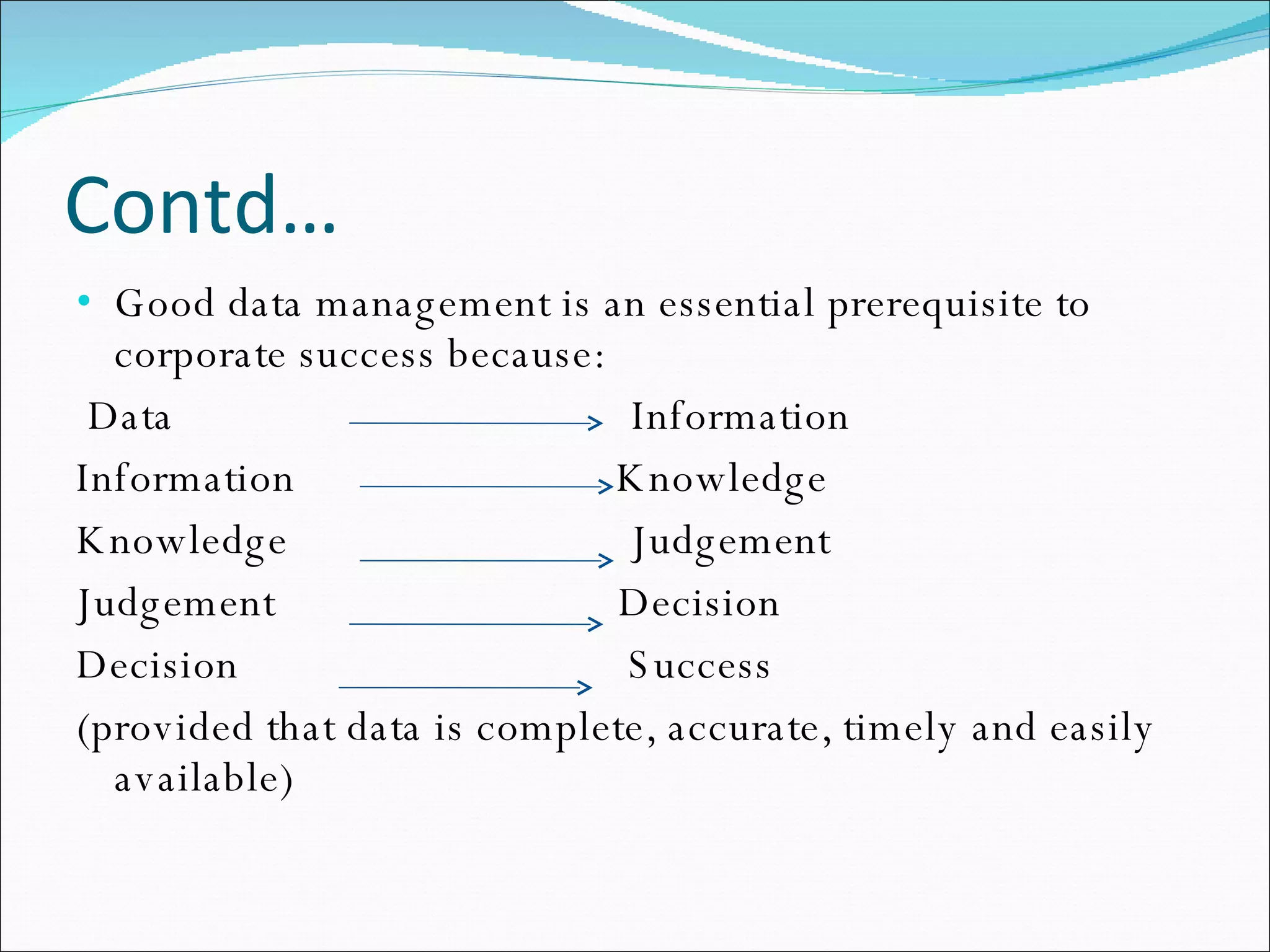
Contd… Good data management is an essential prerequisite to corporate success because: Data  Information Information  Knowledge Knowledge  Judgement Judgement  Decision Decision  Success  (provided that data is complete, accurate, timely and easily available)
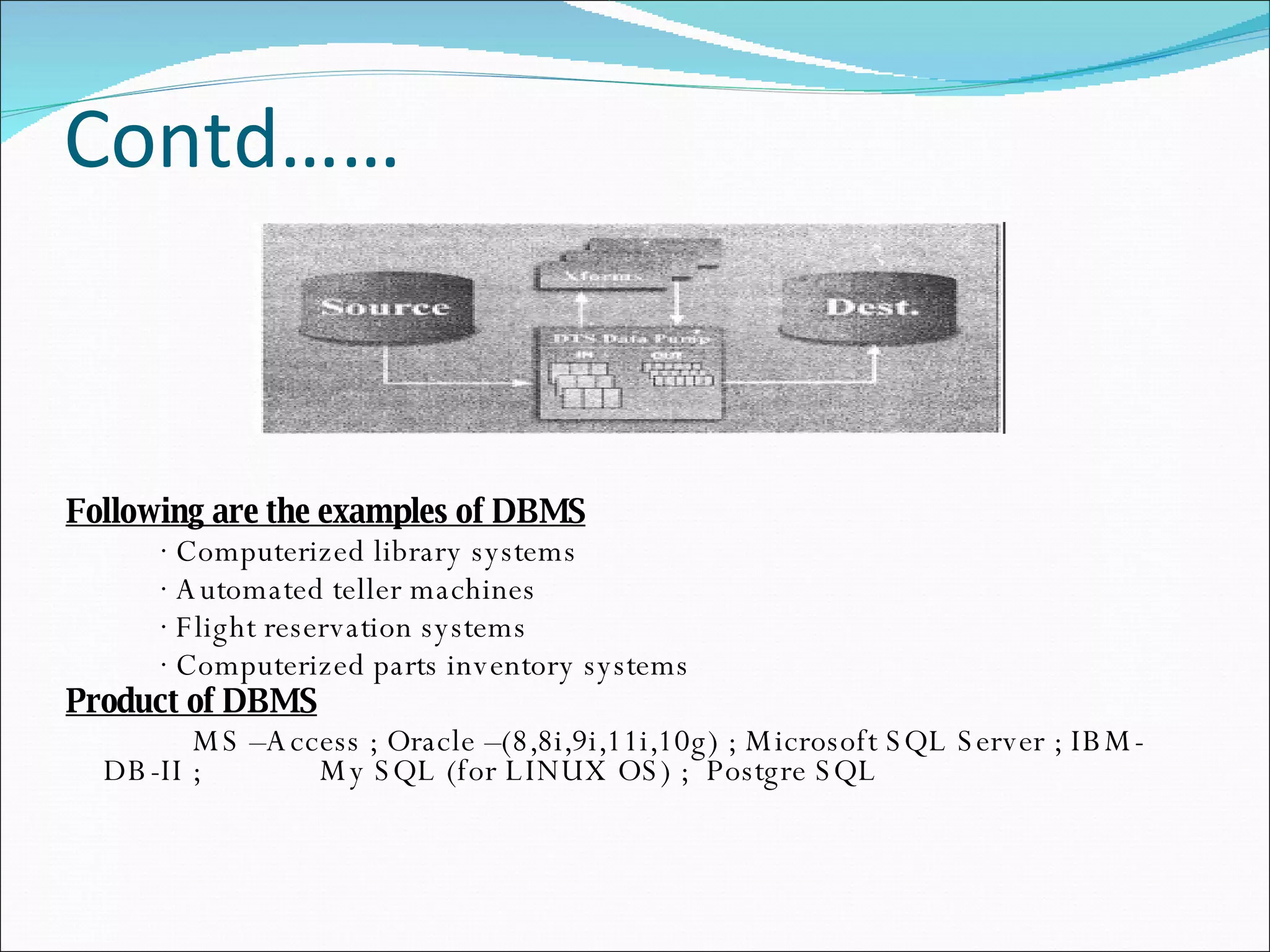
Contd…… Following are the examples of DBMS · Computerized library systems · Automated teller machines · Flight reservation systems · Computerized parts inventory systems Product of DBMS MS –Access ; Oracle –(8,8i,9i,11i,10g) ; Microsoft SQL Server ; IBM-DB-II ;  My SQL (for LINUX OS) ;  Postgre SQL
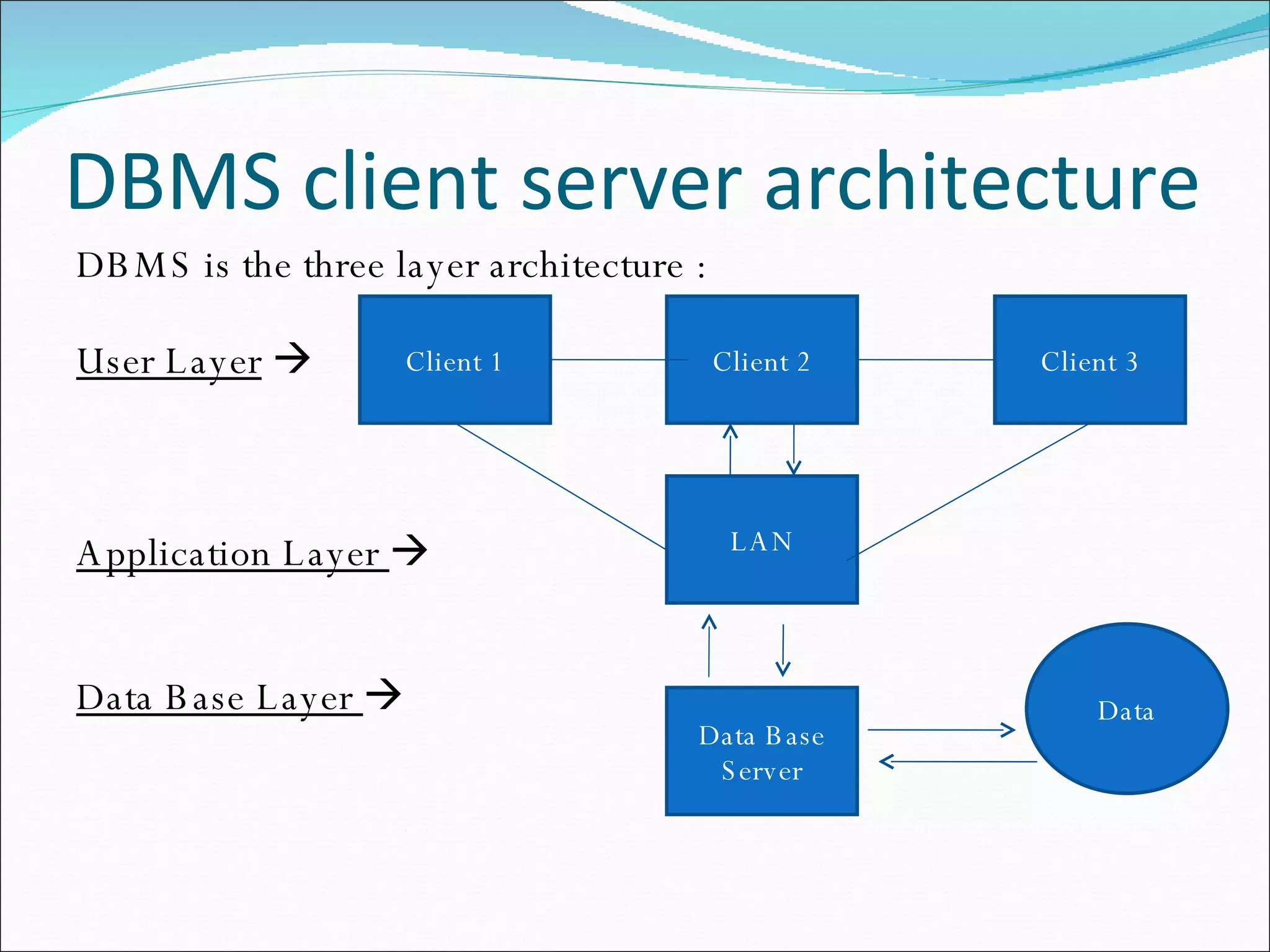
DBMS client server architecture DBMS is the three layer architecture : User Layer    Application Layer   Data Base Layer   Client 1 Client 2 Client 3 LAN Data Base Server Data
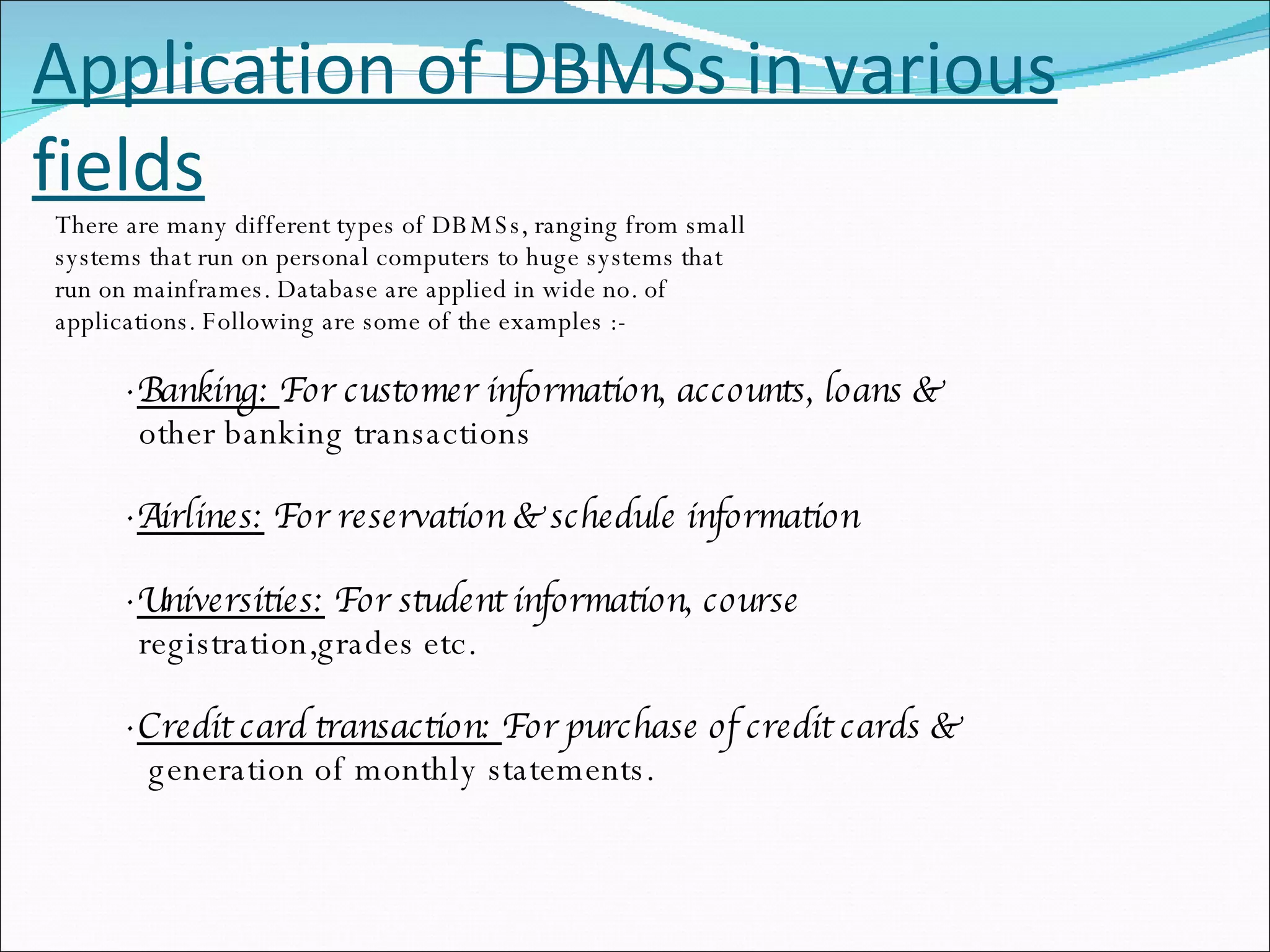
Application of DBMSs in various fields There are many different types of DBMSs, ranging from small systems that run on personal computers to huge systems that run on mainframes. Database are applied in wide no. of applications. Following are some of the examples :- ·  Banking:  For customer information, accounts, loans & other banking transactions ·  Airlines:  For reservation & schedule information ·  Universities:  For student information, course registration,grades etc. ·  Credit card transaction:  For purchase of credit cards & generation of monthly statements.
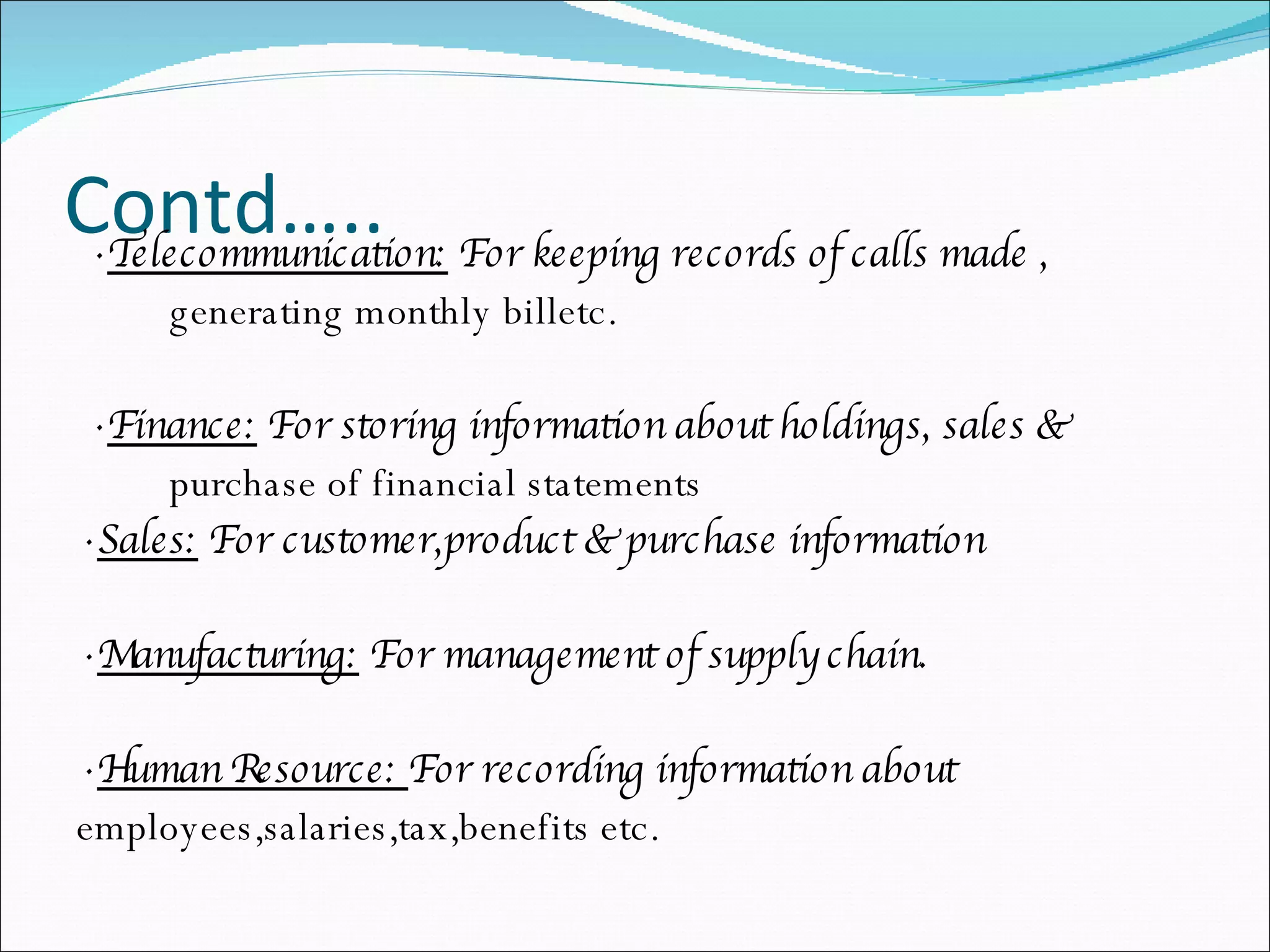
Contd….. ·  Telecommunication:  For keeping records of calls made , generating monthly billetc. ·  Finance:  For storing information about holdings, sales & purchase of financial statements ·  Sales:  For customer,product & purchase information ·  Manufacturing:  For management of supply chain. ·  Human Resource:  For recording information about employees,salaries,tax,benefits etc.
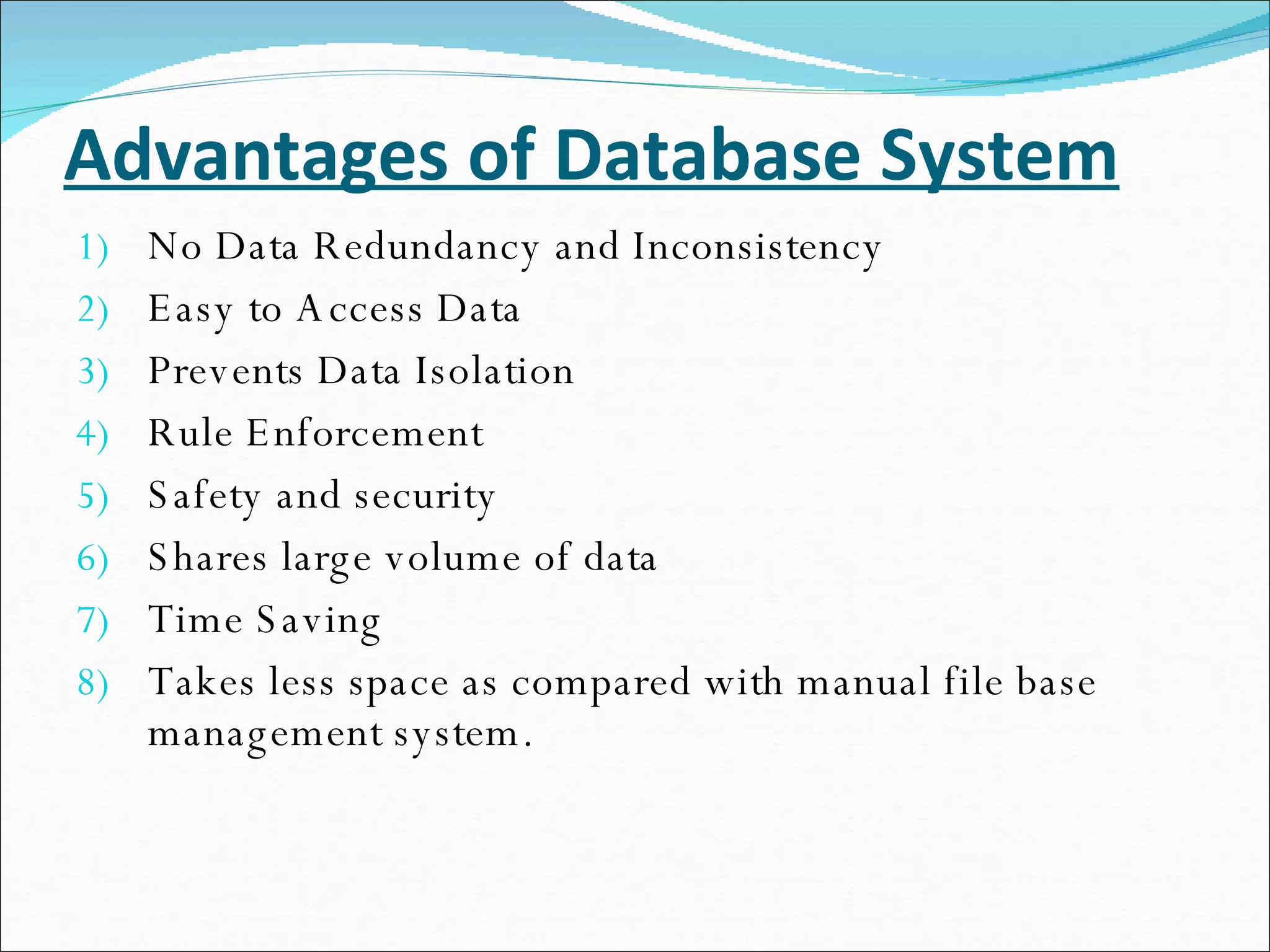
Advantages of Database System No Data Redundancy and Inconsistency Easy to Access Data Prevents Data Isolation Rule Enforcement Safety and security Shares large volume of data Time Saving Takes less space as compared with manual file base management system.
THANK YOU


Data Base System Application - Unit 7

  • 1.
    PRESENTATION ON DBMSAND ITS APPLICATIONS Presented By : Prof. Amit Chandra
  • 2.
    DBMS is theinterface between the users (application programmers) and the database (the data). A database is a collection ofdata that represents important objects in a user’s business. A database management system (DBMS) is a program that allows users to define, manipulate, and process the data in a databasein order to produce meaningful Information. DBMS is collection of programs that enables you to store, modify, and extract important information from a database. There are many different types of DBMS, ranging from small systems that run on personal computers to huge systems that run on mainframes.
  • 3.
    Contd… Good datamanagement is an essential prerequisite to corporate success because: Data Information Information Knowledge Knowledge Judgement Judgement Decision Decision Success (provided that data is complete, accurate, timely and easily available)
  • 4.
    Contd…… Following arethe examples of DBMS · Computerized library systems · Automated teller machines · Flight reservation systems · Computerized parts inventory systems Product of DBMS MS –Access ; Oracle –(8,8i,9i,11i,10g) ; Microsoft SQL Server ; IBM-DB-II ; My SQL (for LINUX OS) ; Postgre SQL
  • 5.
    DBMS client serverarchitecture DBMS is the three layer architecture : User Layer  Application Layer  Data Base Layer  Client 1 Client 2 Client 3 LAN Data Base Server Data
  • 6.
    Application of DBMSsin various fields There are many different types of DBMSs, ranging from small systems that run on personal computers to huge systems that run on mainframes. Database are applied in wide no. of applications. Following are some of the examples :- · Banking: For customer information, accounts, loans & other banking transactions · Airlines: For reservation & schedule information · Universities: For student information, course registration,grades etc. · Credit card transaction: For purchase of credit cards & generation of monthly statements.
  • 7.
    Contd….. · Telecommunication: For keeping records of calls made , generating monthly billetc. · Finance: For storing information about holdings, sales & purchase of financial statements · Sales: For customer,product & purchase information · Manufacturing: For management of supply chain. · Human Resource: For recording information about employees,salaries,tax,benefits etc.
  • 8.
    Advantages of DatabaseSystem No Data Redundancy and Inconsistency Easy to Access Data Prevents Data Isolation Rule Enforcement Safety and security Shares large volume of data Time Saving Takes less space as compared with manual file base management system.
  • 9.
  • 10.
  • 11.
  • 12.
  • 13.