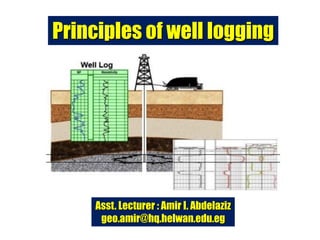
Principles of well logging
Asst. Lecturer : Amir I. Abdelaziz
geo.amir@hq.helwan.edu.eg
Lab. 1 : Well logging principles
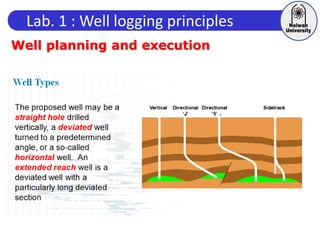
Well planning and execution
Lab. 1 : Well logging principles
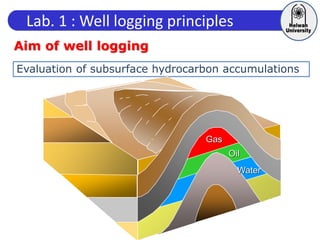
Aim of well logging
Evaluation of subsurface hydrocarbon accumulations
Gas
Oil
Water
Lab. 1 : Well logging principles
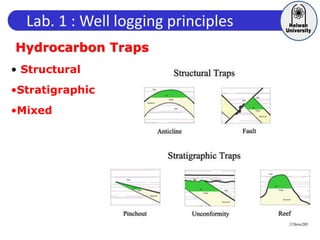
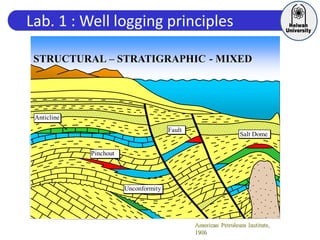
Hydrocarbon Traps
• Structural
•Stratigraphic
•Mixed
Lab. 1 : Well logging principles
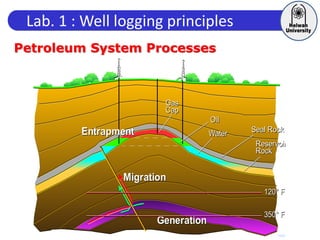
Petroleum System Processes
24803
Petroleum System ElementsPetroleum System Elements
120° F120° F
350° F350° F
GenerationGeneration
MigrationMigration
Seal RockSeal Rock
Reservoir
Rock
Reservoir
Rock
OilOil
WaterWater
Gas
Cap
Gas
Cap
EntrapmentEntrapment
Lab. 1 : Well logging principles
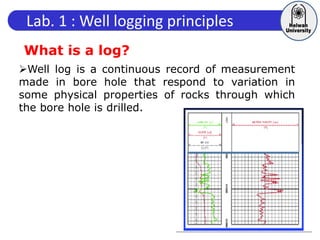
What is a log?
Well log is a continuous record of measurement
made in bore hole that respond to variation in
some physical properties of rocks through which
the bore hole is drilled.
Lab. 1 : Well logging principles
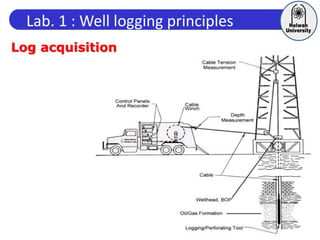
Log acquisition
Lab. 1 : Well logging principles
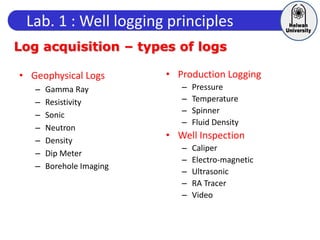
Log acquisition – types of logs
• Geophysical Logs
– Gamma Ray
– Resistivity
– Sonic
– Neutron
– Density
– Dip Meter
– Borehole Imaging
• Production Logging
– Pressure
– Temperature
– Spinner
– Fluid Density
• Well Inspection
– Caliper
– Electro-magnetic
– Ultrasonic
– RA Tracer
– Video
Lab. 1 : Well logging principles
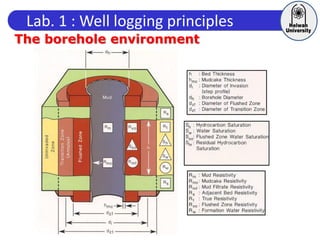
The borehole environment
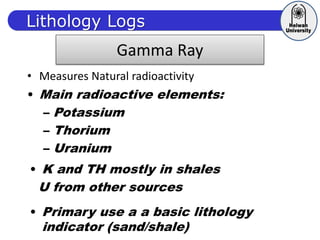
Lithology Logs
Gamma Ray
• Measures Natural radioactivity
• Main radioactive elements:
– Potassium
– Thorium
– Uranium
• K and TH mostly in shales
U from other sources
• Primary use a a basic lithology
indicator (sand/shale)
Lab. 1 : Gamma Ray log
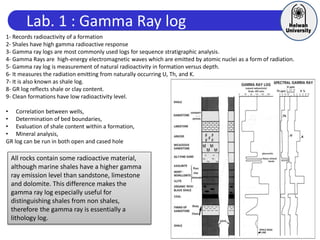
1- Records radioactivity of a formation
2- Shales have high gamma radioactive response
3- Gamma ray logs are most commonly used logs for sequence stratigraphic analysis.
4- Gamma Rays are high-energy electromagnetic waves which are emitted by atomic nuclei as a form of radiation.
5- Gamma ray log is measurement of natural radioactivity in formation versus depth.
6- It measures the radiation emitting from naturally occurring U, Th, and K.
7- It is also known as shale log.
8- GR log reflects shale or clay content.
9- Clean formations have low radioactivity level.
• Correlation between wells,
• Determination of bed boundaries,
• Evaluation of shale content within a formation,
• Mineral analysis,
GR log can be run in both open and cased hole
All rocks contain some radioactive material,
although marine shales have a higher gamma
ray emission level than sandstone, limestone
and dolomite. This difference makes the
gamma ray log especially useful for
distinguishing shales from non shales,
therefore the gamma ray is essentially a
lithology log.
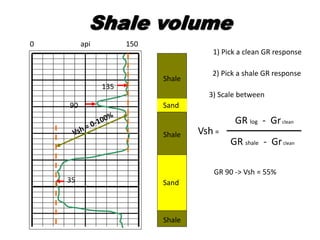
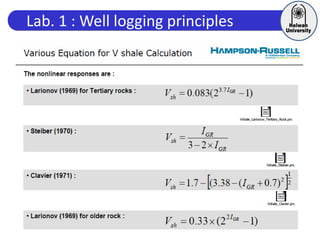
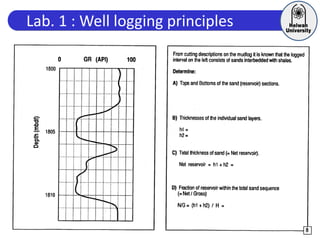
Shale volume
Shale
Sand
Shale
Shale
Sand
1) Pick a clean GR response
GR 90 -> Vsh = 55%
0 150api
2) Pick a shale GR response
3) Scale between
35
90
GR log - Grclean
Vsh =
GR shale - Grclean
135
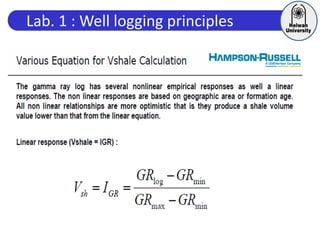
Lab. 1 : Well logging principles

Well loggining. Gamma Ray log

  • 1.
    Principles of welllogging Asst. Lecturer : Amir I. Abdelaziz geo.amir@hq.helwan.edu.eg
  • 2.
    Lab. 1 :Well logging principles Well planning and execution
  • 3.
    Lab. 1 :Well logging principles Aim of well logging Evaluation of subsurface hydrocarbon accumulations Gas Oil Water
  • 4.
    Lab. 1 :Well logging principles Hydrocarbon Traps • Structural •Stratigraphic •Mixed
  • 5.
    Lab. 1 :Well logging principles Petroleum System Processes 24803 Petroleum System ElementsPetroleum System Elements 120° F120° F 350° F350° F GenerationGeneration MigrationMigration Seal RockSeal Rock Reservoir Rock Reservoir Rock OilOil WaterWater Gas Cap Gas Cap EntrapmentEntrapment
  • 6.
    Lab. 1 :Well logging principles
  • 7.
    Lab. 1 :Well logging principles What is a log? Well log is a continuous record of measurement made in bore hole that respond to variation in some physical properties of rocks through which the bore hole is drilled.
  • 8.
    Lab. 1 :Well logging principles Log acquisition
  • 9.
    Lab. 1 :Well logging principles Log acquisition – types of logs • Geophysical Logs – Gamma Ray – Resistivity – Sonic – Neutron – Density – Dip Meter – Borehole Imaging • Production Logging – Pressure – Temperature – Spinner – Fluid Density • Well Inspection – Caliper – Electro-magnetic – Ultrasonic – RA Tracer – Video
  • 10.
    Lab. 1 :Well logging principles
  • 11.
    Lab. 1 :Well logging principles
  • 12.
    Lab. 1 :Well logging principles The borehole environment
  • 13.
    Lithology Logs Gamma Ray •Measures Natural radioactivity • Main radioactive elements: – Potassium – Thorium – Uranium • K and TH mostly in shales U from other sources • Primary use a a basic lithology indicator (sand/shale)
  • 14.
    Lab. 1 :Gamma Ray log 1- Records radioactivity of a formation 2- Shales have high gamma radioactive response 3- Gamma ray logs are most commonly used logs for sequence stratigraphic analysis. 4- Gamma Rays are high-energy electromagnetic waves which are emitted by atomic nuclei as a form of radiation. 5- Gamma ray log is measurement of natural radioactivity in formation versus depth. 6- It measures the radiation emitting from naturally occurring U, Th, and K. 7- It is also known as shale log. 8- GR log reflects shale or clay content. 9- Clean formations have low radioactivity level. • Correlation between wells, • Determination of bed boundaries, • Evaluation of shale content within a formation, • Mineral analysis, GR log can be run in both open and cased hole All rocks contain some radioactive material, although marine shales have a higher gamma ray emission level than sandstone, limestone and dolomite. This difference makes the gamma ray log especially useful for distinguishing shales from non shales, therefore the gamma ray is essentially a lithology log.
  • 15.
    Shale volume Shale Sand Shale Shale Sand 1) Picka clean GR response GR 90 -> Vsh = 55% 0 150api 2) Pick a shale GR response 3) Scale between 35 90 GR log - Grclean Vsh = GR shale - Grclean 135
  • 16.
    Lab. 1 :Well logging principles
  • 17.
    Lab. 1 :Well logging principles
  • 18.
    Lab. 1 :Well logging principles
  • 19.
    Lab. 1 :Well logging principles
  • 20.
    Lab. 1 :Well logging principles