Fluidization &
Fluidized Beds
Aijaz Ali Mooro
What is Fluidization?
The operation by which fine solids are
transformed into a fluidlike state through
contact with a gas or liquid.
Some Key Terminology
• Attrition: breakdown of particles
• Choking: collapse of a dilute-phase
suspension into a dense-phase flow as the
gas velocity is reduced at constant solids
flow
• Circulating fluidized bed: configuration
intended to send particles around in a loop
continuously, with no upper interface
within the bed
Some Key Terminology
• Downer: column where particles are
made to fall through under gravity, usually
with cocurrent gas flow
• Distributor or Grid: support plate at
bottom which introduce the gas to the
bottom of the bed and supports the weight
of the bed when it is shut down
• Elutriation: tendency for fine particles to
be preferentially entrained from the reactor
Some Key Terminology
• Fast fluidization: flow regime whereby
there is a relatively dense suspension, but
no distinct upper surface, and a superficial
velocity generally at least 3 m/s
• Fines: generally particles smaller than 37
µm in diameter (smallest regular sieve
size)
• Freeboard: region extending from top of
bed surface to top of reactor vessel
Some Key Terminology
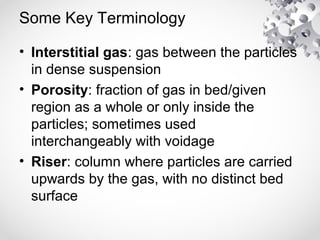
• Interstitial gas: gas between the particles
in dense suspension
• Porosity: fraction of gas in bed/given
region as a whole or only inside the
particles; sometimes used
interchangeably with voidage
• Riser: column where particles are carried
upwards by the gas, with no distinct bed
surface
Some Key Terminology
• Segregation: tendency for particles to
gather in different zones according to their
size and/or density
• Solids: used synonymously with particles
• Superficial velocity: gas flow rate divided
by total column surface area
Some Key Terminology
• Transport disengaging zone: region in
freeboard beginning at bed surface in
which particle flux decreases with height
and above which the entrainment is
independent of height
• Voidage (or void fraction): fraction by
volume of suspension or bed which is
occupied by the fluid
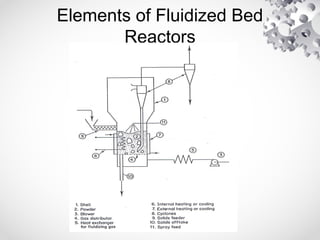
Elements of Fluidized Bed
Reactors
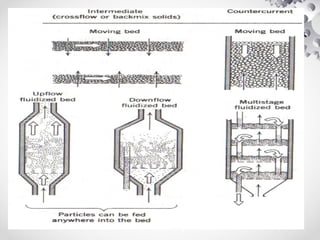
Contacting Methods
• Batch, cocurrent, backmix, crossflow,
countercurrent
• Solids may often be represented by backmix
flow
• By using proper baffling and staging of units,
and with negligible entrainment of solids, the
contacting in fluidized beds can be made to
approach closely the usually desirable
extreme of cuntercurrent plug flow
• For good design, proper contacting of phases
is essential
Advantages of Fluidized Beds
• The smooth, liquid-like flow of particles allows
continuous automatically controlled operations
with ease of handling.
• The rapid mixing of solids leads to nearly
isothermal conditions throughout the reactor,
hence the operation can be controlled simply
and reliably.
• It is suited to large-scale operations.
Advantages of Fluidized Beds
• The circulation of solids between two fluidized
beds makes it possible to transport the vast
quantities of heat produced or needed in large
reactors.
• Heat and mass transfer rates between gas and
particles are high when compared with other
modes of contacting.
• The rate of heat transfer between a fluidized bed
and an immersed object is high, hence heat
exchangers within fluidized beds require
relatively small surface areas.
Disadvantages of Fluidized Beds
• The difficult-to-describe flow of gas, with its large
deviation from plug flow and the bypassing of
solids by bubbles, represents an inefficient
contacting system.
• The rapid mixing of solids in the bed leads to
nonuniform residence times of solids in the
reactor.
• Friable solids are pulverized and entrained by
the gas.
• Erosion of pipes and vessels from abrasion by
particles.
• For noncatalytic operations at high temperature
Commercial Applications
• Solid-Catalysed Gas-Phase Reactions:
– Fluid catalytic cracking, reforming
– Fischer-Tropsch synthesis
– Phthalic and maleic anhydride
– Acrylonitrile and aniline
– Chlirination and bromination of hydrocarbons
– Polyethylene and polypropylene
– Oxidation of SO2 to SO3
Commercial Applications
• Gas-Solid Reactions:
– Roasting or ores (ZnS, Cu2S, nickel sulphides,
etc.)
– Combustion and incineration
– Gasification, coking and
pyrolysis/carbonization
– Calcination (limestone, phosphates,
aluminium hydroxide)
– Flurination of uranium oxide
– Fluid coking
– Reduction of iron oxide
Commercial Applications
• Gas-Phase Non-Catalytic Reactions:
– Natural gas combustion
• Gas-Liquid-Solid:
– Hydrotreating, hydroprocessing
– Biochemical processes
Commercial Applications
• Physical Processes:
– Drying of particles
– Coating of surfaces
– Granulation (growing particles)
– Heat treatment (e.g. annealing, quenching)
– Medical beds
– Filtration
– Back-purging of filters
– Blending
– Classification
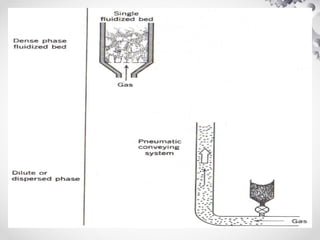
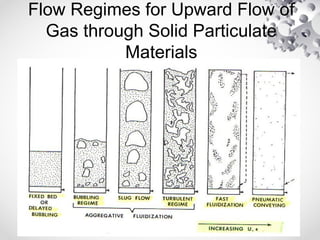
Flow Regimes for Upward Flow of
Gas through Solid Particulate
Materials
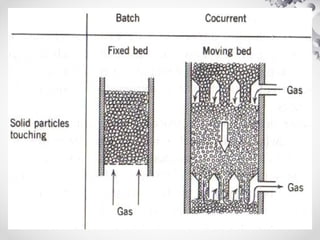
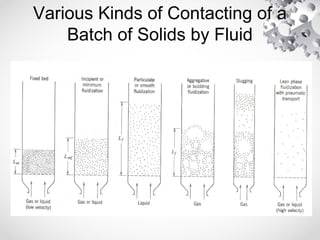
Various Kinds of Contacting of a
Batch of Solids by Fluid
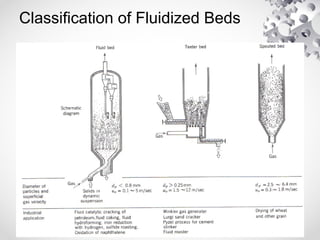
Classification of Fluidized Beds
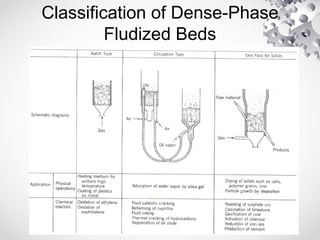
Classification of Dense-Phase
Fludized Beds
Industrial Applications of Fluidized Beds
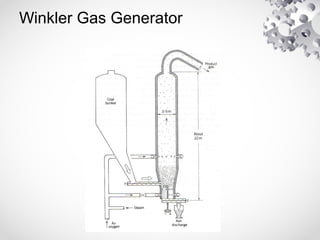
Winkler Gas Generator
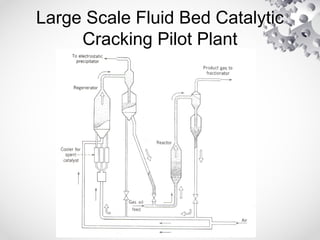
Large Scale Fluid Bed Catalytic
Cracking Pilot Plant
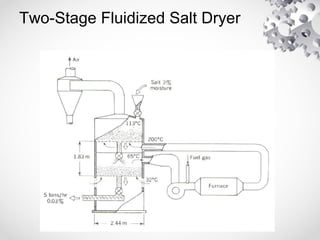
Two-Stage Fluidized Salt Dryer
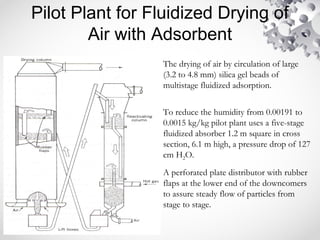
Pilot Plant for Fluidized Drying of
Air with Adsorbent
The drying of air by circulation of large
(3.2 to 4.8 mm) silica gel beads of
multistage fluidized adsorption.
To reduce the humidity from 0.00191 to
0.0015 kg/kg pilot plant uses a five-stage
fluidized absorber 1.2 m square in cross
section, 6.1 m high, a pressure drop of 127
cm H2O.
A perforated plate distributor with rubber
flaps at the lower end of the downcomers
to assure steady flow of particles from
stage to stage.
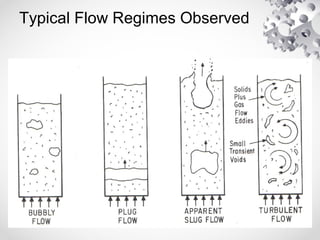
Typical Flow Regimes Observed
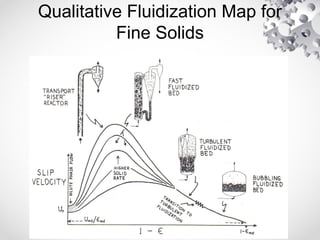
Qualitative Fluidization Map for
Fine Solids
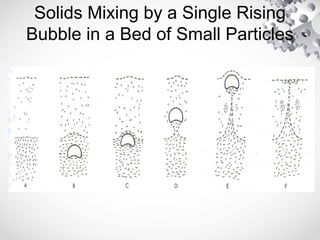
Solids Mixing by a Single Rising
Bubble in a Bed of Small Particles
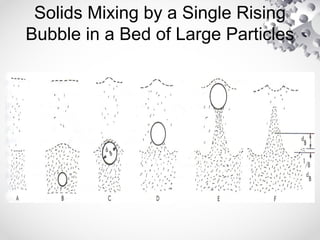
Solids Mixing by a Single Rising
Bubble in a Bed of Large Particles

Fluidization and Fluidized Beds

  • 1.
  • 2.
    What is Fluidization? Theoperation by which fine solids are transformed into a fluidlike state through contact with a gas or liquid.
  • 3.
    Some Key Terminology •Attrition: breakdown of particles • Choking: collapse of a dilute-phase suspension into a dense-phase flow as the gas velocity is reduced at constant solids flow • Circulating fluidized bed: configuration intended to send particles around in a loop continuously, with no upper interface within the bed
  • 4.
    Some Key Terminology •Downer: column where particles are made to fall through under gravity, usually with cocurrent gas flow • Distributor or Grid: support plate at bottom which introduce the gas to the bottom of the bed and supports the weight of the bed when it is shut down • Elutriation: tendency for fine particles to be preferentially entrained from the reactor
  • 5.
    Some Key Terminology •Fast fluidization: flow regime whereby there is a relatively dense suspension, but no distinct upper surface, and a superficial velocity generally at least 3 m/s • Fines: generally particles smaller than 37 µm in diameter (smallest regular sieve size) • Freeboard: region extending from top of bed surface to top of reactor vessel
  • 6.
    Some Key Terminology •Interstitial gas: gas between the particles in dense suspension • Porosity: fraction of gas in bed/given region as a whole or only inside the particles; sometimes used interchangeably with voidage • Riser: column where particles are carried upwards by the gas, with no distinct bed surface
  • 7.
    Some Key Terminology •Segregation: tendency for particles to gather in different zones according to their size and/or density • Solids: used synonymously with particles • Superficial velocity: gas flow rate divided by total column surface area
  • 8.
    Some Key Terminology •Transport disengaging zone: region in freeboard beginning at bed surface in which particle flux decreases with height and above which the entrainment is independent of height • Voidage (or void fraction): fraction by volume of suspension or bed which is occupied by the fluid
  • 9.
  • 10.
    Contacting Methods • Batch,cocurrent, backmix, crossflow, countercurrent • Solids may often be represented by backmix flow • By using proper baffling and staging of units, and with negligible entrainment of solids, the contacting in fluidized beds can be made to approach closely the usually desirable extreme of cuntercurrent plug flow • For good design, proper contacting of phases is essential
  • 14.
    Advantages of FluidizedBeds • The smooth, liquid-like flow of particles allows continuous automatically controlled operations with ease of handling. • The rapid mixing of solids leads to nearly isothermal conditions throughout the reactor, hence the operation can be controlled simply and reliably. • It is suited to large-scale operations.
  • 15.
    Advantages of FluidizedBeds • The circulation of solids between two fluidized beds makes it possible to transport the vast quantities of heat produced or needed in large reactors. • Heat and mass transfer rates between gas and particles are high when compared with other modes of contacting. • The rate of heat transfer between a fluidized bed and an immersed object is high, hence heat exchangers within fluidized beds require relatively small surface areas.
  • 16.
    Disadvantages of FluidizedBeds • The difficult-to-describe flow of gas, with its large deviation from plug flow and the bypassing of solids by bubbles, represents an inefficient contacting system. • The rapid mixing of solids in the bed leads to nonuniform residence times of solids in the reactor. • Friable solids are pulverized and entrained by the gas. • Erosion of pipes and vessels from abrasion by particles. • For noncatalytic operations at high temperature
  • 17.
    Commercial Applications • Solid-CatalysedGas-Phase Reactions: – Fluid catalytic cracking, reforming – Fischer-Tropsch synthesis – Phthalic and maleic anhydride – Acrylonitrile and aniline – Chlirination and bromination of hydrocarbons – Polyethylene and polypropylene – Oxidation of SO2 to SO3
  • 18.
    Commercial Applications • Gas-SolidReactions: – Roasting or ores (ZnS, Cu2S, nickel sulphides, etc.) – Combustion and incineration – Gasification, coking and pyrolysis/carbonization – Calcination (limestone, phosphates, aluminium hydroxide) – Flurination of uranium oxide – Fluid coking – Reduction of iron oxide
  • 19.
    Commercial Applications • Gas-PhaseNon-Catalytic Reactions: – Natural gas combustion • Gas-Liquid-Solid: – Hydrotreating, hydroprocessing – Biochemical processes
  • 20.
    Commercial Applications • PhysicalProcesses: – Drying of particles – Coating of surfaces – Granulation (growing particles) – Heat treatment (e.g. annealing, quenching) – Medical beds – Filtration – Back-purging of filters – Blending – Classification
  • 21.
    Flow Regimes forUpward Flow of Gas through Solid Particulate Materials
  • 22.
    Various Kinds ofContacting of a Batch of Solids by Fluid
  • 23.
  • 24.
  • 25.
  • 26.
  • 27.
    Large Scale FluidBed Catalytic Cracking Pilot Plant
  • 28.
  • 29.
    Pilot Plant forFluidized Drying of Air with Adsorbent The drying of air by circulation of large (3.2 to 4.8 mm) silica gel beads of multistage fluidized adsorption. To reduce the humidity from 0.00191 to 0.0015 kg/kg pilot plant uses a five-stage fluidized absorber 1.2 m square in cross section, 6.1 m high, a pressure drop of 127 cm H2O. A perforated plate distributor with rubber flaps at the lower end of the downcomers to assure steady flow of particles from stage to stage.
  • 30.
  • 31.
  • 32.
    Solids Mixing bya Single Rising Bubble in a Bed of Small Particles
  • 33.
    Solids Mixing bya Single Rising Bubble in a Bed of Large Particles