Boiler Feed Water
Aijaz Ali
Introduction
• Industrial water
– Process water
• Water that is used for, or comes in contact with an
end product or the materials used in an end
product.
– Boiler feed water
• Water that serves in any level of the manufacturing
process
• Common contaminants: Ca, Mg, Fe, Al,
Silica, silt, oil
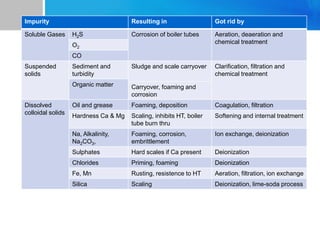
Impurity Resulting in Got rid by
Soluble Gases H2S Corrosion of boiler tubes Aeration, deaeration and
chemical treatment
O2
CO
Suspended
solids
Sediment and
turbidity
Sludge and scale carryover Clarification, filtration and
chemical treatment
Organic matter Carryover, foaming and
corrosion
Dissolved
colloidal solids
Oil and grease Foaming, deposition Coagulation, filtration
Hardness Ca & Mg Scaling, inhibits HT, boiler
tube burn thru
Softening and internal treatment
Na, Alkalinity,
Na2CO3,
Foaming, corrosion,
embrittlement
Ion exchange, deionization
Sulphates Hard scales if Ca present Deionization
Chlorides Priming, foaming Deionization
Fe, Mn Rusting, resistence to HT Aeration, filtration, ion exchange
Silica Scaling Deionization, lime-soda process
Treatment Methods
• External Treatment
• Internal Treatment
External methods of conditioning
• Clarification
• Filtration
• Ion exchange
• Membrane separation
Clarification
• Removes all types of solids & large particles – sediments, oil,
natural org. matter, colour etc.
• Consists of 4 steps – screening, coagulation-flocculation,
sedimentation, fine filtration.
• Screening protects downstream units from large, easily separable
objects.
• Three types:
– Fine screening (spacing < 10 mm)
– Medium screening (spacing 10 – 40 mm)
– Coarse screening (spacing > 40 mm)
• Coagulation-flocculation removes suspended solids & colloidal
particles.
Clarification (contd.)
• Important factors – velocity gradient, time, pH
• Flotation – to separate particles having density lesser
than water.
• Three types:
– Natural
– Aided
– Induced
• Induced flotation facilitated through bubbling of air; 2
types –
– Dissolved air flotation (DAF) (bubbles of 40 – 70 mm)
– Mechanical flotation (bubbles of 0.2 – 2 mm)
Ion Exchange
• Resins - acidic/basic radicals with ions fixed on them; exchanged
with ions present in water.
• Theoretically removes 100 % of salts; does not remove organics,
virus or bacteria.
• 2 types of resins – gel type (microporous) and macroporous or
loosely cross-linked type.
• 3 systems of resin beds:
– Strong acid cation + Strong base anion
– Strong acid cation + weak base anion + Strong base anion
– Mixed-bed Deionization
• Ion exchange plant – softens water, removes heavy metals,
produces demineralized water.
Reverse Osmosis (RO)
• By applying pressure greater than osmotic pressure, water flows
from the higher concentration solution to lower one.
• Mostly used for desalination; also for waste water treatment.
• Applied pressure depends on the type and salinity of water.
• Working pressure:
– < 15 bar for tap water (< 1500 ppm)
– 15 – 25 bar for brackish water (< 8000 ppm)
– 50 – 75 bar for sea water (35000 – 45000 ppm)
• RO plant preceded by pretreatment to avoid membrane fouling by
sediments, bacteria, metal oxides & chlorine.
• RO permeate water more acidic than the feed water due to
dissolved CO2. Common post-treatment are pH neutralization and
remineralization.
Electrodionization
• Combines membrane separation and ion-
exchange to provide high efficiency
demineralization process.
• Electric potential transports & segregates
charged aqueous species.
• Electric current continuously regenerates resin;
no need for periodical regeneration.
• Deionization chamber - ion exchange resin,
packed between cationic & anionic exchange
membranes.
Electrodionization (Cont…)
• Advantages
– continuous operation
– eliminates use of chemicals for regeneration
– low power consumption
• Disadvantages
– Not used for water with hardness > 1
– requires purification pretreatment
– Pre-removal of CO2
Internal Treatment methods
• Deaerators
• Dissolved non-condensibles: O2 and CO2
• Pitting and corrosion
• Mechanical deaeration: reducing solubility of gases
– Increased temperature
– Decreased partial pressure over the water
– Commonly used purge gas: steam
– Advantages:
– No added impurities
– Easily available
– Also provides heat
– Pressure/Vacuum operation, ~98% of total and free is removed
• Coupled with chemical scavengers for complete
deaeration
Corrosion control
• pH control
– Different for different components, different
alloys
– CS : optimum pH = 9.2 to 9.6 at feed water
temperatures
– MS : optimum pH = 8.5 to 12.7 in boilers
– Cu and CS : 8.8 to 9.2
– Maintained by addition of amines or small
amount of caustic soda
– Avoidance of addition of ammonia
Corrosion control (Cont…)
• Oxygen control: during operation
– Chemical Scavengers added to feedwater and
condensates
• Sodium sulfite, bisulfite, hydrazine
• Quinone, ascorbate
– Common entry: between deaerator and storage
Sodium sulfite: easy to handle, safe, for pressures of < 70 bar,
solid addition to system, decomposition to corrosive gases
Hydrazine: no solid addition, high pressures, but toxic, handling
issues, Ammonia liberation, slower reaction
– Constant sampling and monitoring
Deposits
• Scaling/deposition from carryover
• Carbonate/Phosphate control
– Addition of certain amounts of carbonate/phosphate for ensuring
precipitate in the form of salts. Prevention of Sulphates
– For removal of hardness, Ca and Mg
– Precipitation in bulk instead of at walls, non-adherent
• Organic supplements: fluid sludge formation (polymer
addition)
– Bottom blowdown removes sludge
• Chelant control
• Combination of additives
• Blowdown
Deaerators
Discussion
• What Is Deaeration?
• The Process - Removing O2
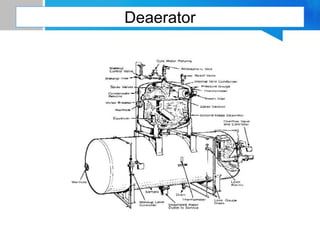
• Equipment
• DA Problems
• Operational Impacts
• Monitoring
What Is It?
• Deaeration is the process of removing
oxygen and other non-condensable gases
from the boiler feed water like Co2
Removing Oxygen
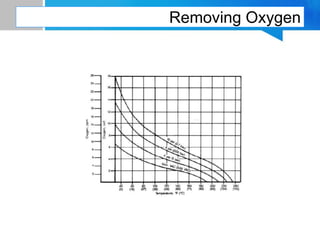
• Water @ 70oF and Atmospheric Pressure
Will Have About 7,000 ppb of O2
• A Properly Functioning DA Will Reduce the
Level to Approximately 5 - 10 ppb
• The Remaining O2 Is Removed With an
Oxygen Scavenger, (i.e. Sulfite etc)
Removing Oxygen
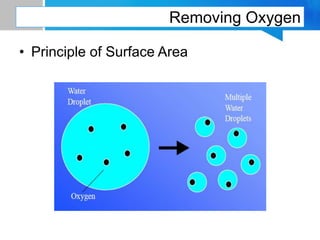
• Three Driving Forces
– 1- Heat
• (Low Pressure Steam, Condensate)
– 2- Surface Area
• (Nozzles, Trays)
– 3- Pressure
• (Vent)
Removing Oxygen
• Principle of Surface Area
Removing Oxygen
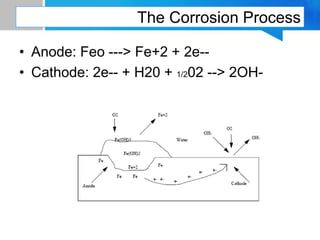
The Corrosion Process
• Anode: Feo ---> Fe+2 + 2e--
• Cathode: 2e-- + H20 + 1/202 --> 2OH-
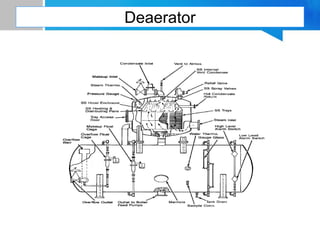
Deaerator
Deaerator
DA Problems
• Inadequate Venting
• Inadequate Steam Flow, Steam Pressure,
or Condensate
• Flows Outside of Design Specifications
• Broken, Plugged or Missing Nozzles
• Broken, Plugged or Missing Trays
• Broken or Missing Baffles
Operational Impacts
• Corrosion Potential
• Fe in the Boiler
• Higher Oxygen Scavenger Usage
– Increased Boiler Conductivity, Lower Cycles
• Reduced Boiler Efficiency
– Greater Chemical Costs
• Reduced DA Life
Monitoring
• Flow
• Temperature
• Pressure
• Scavenger Usage
• Venting
• Inspections
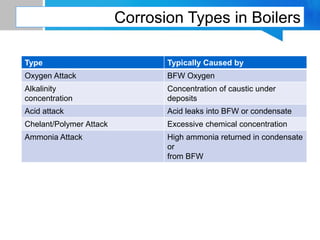
Corrosion Types in Boilers
Type Typically Caused by
Oxygen Attack BFW Oxygen
Alkalinity
concentration
Concentration of caustic under
deposits
Acid attack Acid leaks into BFW or condensate
Chelant/Polymer Attack Excessive chemical concentration
Ammonia Attack High ammonia returned in condensate
or
from BFW
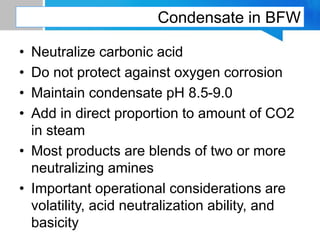
Condensate in BFW
• Neutralize carbonic acid
• Do not protect against oxygen corrosion
• Maintain condensate pH 8.5-9.0
• Add in direct proportion to amount of CO2
in steam
• Most products are blends of two or more
neutralizing amines
• Important operational considerations are
volatility, acid neutralization ability, and
basicity
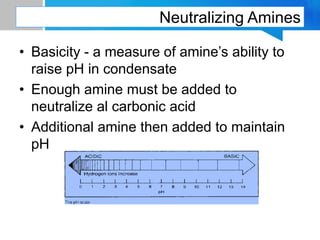
Neutralizing Amines
• Basicity - a measure of amine’s ability to
raise pH in condensate
• Enough amine must be added to
neutralize al carbonic acid
• Additional amine then added to maintain
pH
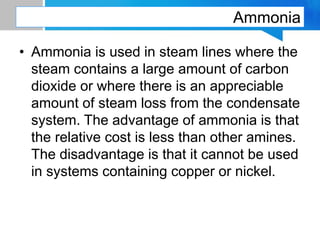
Ammonia
• Ammonia is used in steam lines where the
steam contains a large amount of carbon
dioxide or where there is an appreciable
amount of steam loss from the condensate
system. The advantage of ammonia is that
the relative cost is less than other amines.
The disadvantage is that it cannot be used
in systems containing copper or nickel.
Thank You

Boiler Feed Water

  • 1.
  • 2.
    Introduction • Industrial water –Process water • Water that is used for, or comes in contact with an end product or the materials used in an end product. – Boiler feed water • Water that serves in any level of the manufacturing process • Common contaminants: Ca, Mg, Fe, Al, Silica, silt, oil
  • 3.
    Impurity Resulting inGot rid by Soluble Gases H2S Corrosion of boiler tubes Aeration, deaeration and chemical treatment O2 CO Suspended solids Sediment and turbidity Sludge and scale carryover Clarification, filtration and chemical treatment Organic matter Carryover, foaming and corrosion Dissolved colloidal solids Oil and grease Foaming, deposition Coagulation, filtration Hardness Ca & Mg Scaling, inhibits HT, boiler tube burn thru Softening and internal treatment Na, Alkalinity, Na2CO3, Foaming, corrosion, embrittlement Ion exchange, deionization Sulphates Hard scales if Ca present Deionization Chlorides Priming, foaming Deionization Fe, Mn Rusting, resistence to HT Aeration, filtration, ion exchange Silica Scaling Deionization, lime-soda process
  • 4.
    Treatment Methods • ExternalTreatment • Internal Treatment
  • 5.
    External methods ofconditioning • Clarification • Filtration • Ion exchange • Membrane separation
  • 6.
    Clarification • Removes alltypes of solids & large particles – sediments, oil, natural org. matter, colour etc. • Consists of 4 steps – screening, coagulation-flocculation, sedimentation, fine filtration. • Screening protects downstream units from large, easily separable objects. • Three types: – Fine screening (spacing < 10 mm) – Medium screening (spacing 10 – 40 mm) – Coarse screening (spacing > 40 mm) • Coagulation-flocculation removes suspended solids & colloidal particles.
  • 7.
    Clarification (contd.) • Importantfactors – velocity gradient, time, pH • Flotation – to separate particles having density lesser than water. • Three types: – Natural – Aided – Induced • Induced flotation facilitated through bubbling of air; 2 types – – Dissolved air flotation (DAF) (bubbles of 40 – 70 mm) – Mechanical flotation (bubbles of 0.2 – 2 mm)
  • 8.
    Ion Exchange • Resins- acidic/basic radicals with ions fixed on them; exchanged with ions present in water. • Theoretically removes 100 % of salts; does not remove organics, virus or bacteria. • 2 types of resins – gel type (microporous) and macroporous or loosely cross-linked type. • 3 systems of resin beds: – Strong acid cation + Strong base anion – Strong acid cation + weak base anion + Strong base anion – Mixed-bed Deionization • Ion exchange plant – softens water, removes heavy metals, produces demineralized water.
  • 9.
    Reverse Osmosis (RO) •By applying pressure greater than osmotic pressure, water flows from the higher concentration solution to lower one. • Mostly used for desalination; also for waste water treatment. • Applied pressure depends on the type and salinity of water. • Working pressure: – < 15 bar for tap water (< 1500 ppm) – 15 – 25 bar for brackish water (< 8000 ppm) – 50 – 75 bar for sea water (35000 – 45000 ppm) • RO plant preceded by pretreatment to avoid membrane fouling by sediments, bacteria, metal oxides & chlorine. • RO permeate water more acidic than the feed water due to dissolved CO2. Common post-treatment are pH neutralization and remineralization.
  • 10.
    Electrodionization • Combines membraneseparation and ion- exchange to provide high efficiency demineralization process. • Electric potential transports & segregates charged aqueous species. • Electric current continuously regenerates resin; no need for periodical regeneration. • Deionization chamber - ion exchange resin, packed between cationic & anionic exchange membranes.
  • 11.
    Electrodionization (Cont…) • Advantages –continuous operation – eliminates use of chemicals for regeneration – low power consumption • Disadvantages – Not used for water with hardness > 1 – requires purification pretreatment – Pre-removal of CO2
  • 12.
    Internal Treatment methods •Deaerators • Dissolved non-condensibles: O2 and CO2 • Pitting and corrosion • Mechanical deaeration: reducing solubility of gases – Increased temperature – Decreased partial pressure over the water – Commonly used purge gas: steam – Advantages: – No added impurities – Easily available – Also provides heat – Pressure/Vacuum operation, ~98% of total and free is removed • Coupled with chemical scavengers for complete deaeration
  • 13.
    Corrosion control • pHcontrol – Different for different components, different alloys – CS : optimum pH = 9.2 to 9.6 at feed water temperatures – MS : optimum pH = 8.5 to 12.7 in boilers – Cu and CS : 8.8 to 9.2 – Maintained by addition of amines or small amount of caustic soda – Avoidance of addition of ammonia
  • 14.
    Corrosion control (Cont…) •Oxygen control: during operation – Chemical Scavengers added to feedwater and condensates • Sodium sulfite, bisulfite, hydrazine • Quinone, ascorbate – Common entry: between deaerator and storage Sodium sulfite: easy to handle, safe, for pressures of < 70 bar, solid addition to system, decomposition to corrosive gases Hydrazine: no solid addition, high pressures, but toxic, handling issues, Ammonia liberation, slower reaction – Constant sampling and monitoring
  • 15.
    Deposits • Scaling/deposition fromcarryover • Carbonate/Phosphate control – Addition of certain amounts of carbonate/phosphate for ensuring precipitate in the form of salts. Prevention of Sulphates – For removal of hardness, Ca and Mg – Precipitation in bulk instead of at walls, non-adherent • Organic supplements: fluid sludge formation (polymer addition) – Bottom blowdown removes sludge • Chelant control • Combination of additives • Blowdown
  • 16.
  • 17.
    Discussion • What IsDeaeration? • The Process - Removing O2 • Equipment • DA Problems • Operational Impacts • Monitoring
  • 18.
    What Is It? •Deaeration is the process of removing oxygen and other non-condensable gases from the boiler feed water like Co2
  • 19.
    Removing Oxygen • Water@ 70oF and Atmospheric Pressure Will Have About 7,000 ppb of O2 • A Properly Functioning DA Will Reduce the Level to Approximately 5 - 10 ppb • The Remaining O2 Is Removed With an Oxygen Scavenger, (i.e. Sulfite etc)
  • 20.
    Removing Oxygen • ThreeDriving Forces – 1- Heat • (Low Pressure Steam, Condensate) – 2- Surface Area • (Nozzles, Trays) – 3- Pressure • (Vent)
  • 21.
  • 22.
  • 23.
    The Corrosion Process •Anode: Feo ---> Fe+2 + 2e-- • Cathode: 2e-- + H20 + 1/202 --> 2OH-
  • 24.
  • 25.
  • 26.
    DA Problems • InadequateVenting • Inadequate Steam Flow, Steam Pressure, or Condensate • Flows Outside of Design Specifications • Broken, Plugged or Missing Nozzles • Broken, Plugged or Missing Trays • Broken or Missing Baffles
  • 27.
    Operational Impacts • CorrosionPotential • Fe in the Boiler • Higher Oxygen Scavenger Usage – Increased Boiler Conductivity, Lower Cycles • Reduced Boiler Efficiency – Greater Chemical Costs • Reduced DA Life
  • 28.
    Monitoring • Flow • Temperature •Pressure • Scavenger Usage • Venting • Inspections
  • 29.
    Corrosion Types inBoilers Type Typically Caused by Oxygen Attack BFW Oxygen Alkalinity concentration Concentration of caustic under deposits Acid attack Acid leaks into BFW or condensate Chelant/Polymer Attack Excessive chemical concentration Ammonia Attack High ammonia returned in condensate or from BFW
  • 30.
    Condensate in BFW •Neutralize carbonic acid • Do not protect against oxygen corrosion • Maintain condensate pH 8.5-9.0 • Add in direct proportion to amount of CO2 in steam • Most products are blends of two or more neutralizing amines • Important operational considerations are volatility, acid neutralization ability, and basicity
  • 31.
    Neutralizing Amines • Basicity- a measure of amine’s ability to raise pH in condensate • Enough amine must be added to neutralize al carbonic acid • Additional amine then added to maintain pH
  • 32.
    Ammonia • Ammonia isused in steam lines where the steam contains a large amount of carbon dioxide or where there is an appreciable amount of steam loss from the condensate system. The advantage of ammonia is that the relative cost is less than other amines. The disadvantage is that it cannot be used in systems containing copper or nickel.
  • 33.