PSYCHOSOCIAL
Development
of
Infancy and Toddler
Erik Erikson
• Dropped out of high school and
spent time traveling in Europe and
studying art
• Became interested in how young
people acquire a personal identity
and how society helps shape it
• Because his theory integrates personal, emotional and
social development, it is often called Psychosocial Theory
• Erikson is an ego-analyst – relationship between
individual and the world or the self and the world
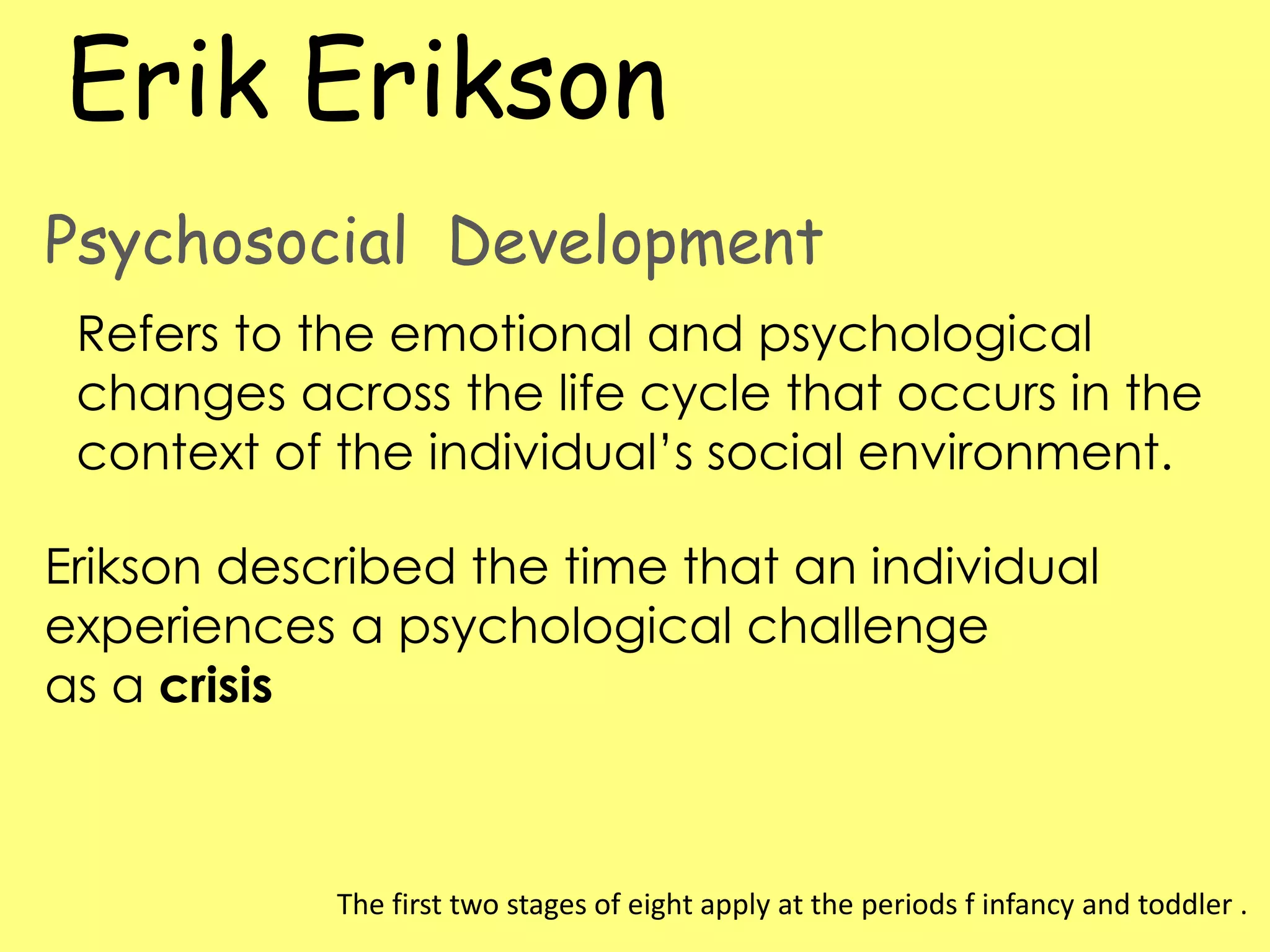
Erik Erikson
Psychosocial Development
Erikson described the time that an individual
experiences a psychological challenge
as a crisis
Refers to the emotional and psychological
changes across the life cycle that occurs in the
context of the individual’s social environment.
The first two stages of eight apply at the periods f infancy and toddler .
Trust | Mistrust
Birth to 18 months
Can I trust the people
around me?
 Infant’s basic needs:
food , sustenance, and comfort
 Infant’s view that world is trustworthy:
expose to warmth, regularity and dependable affection
Feeding: Oral Stage
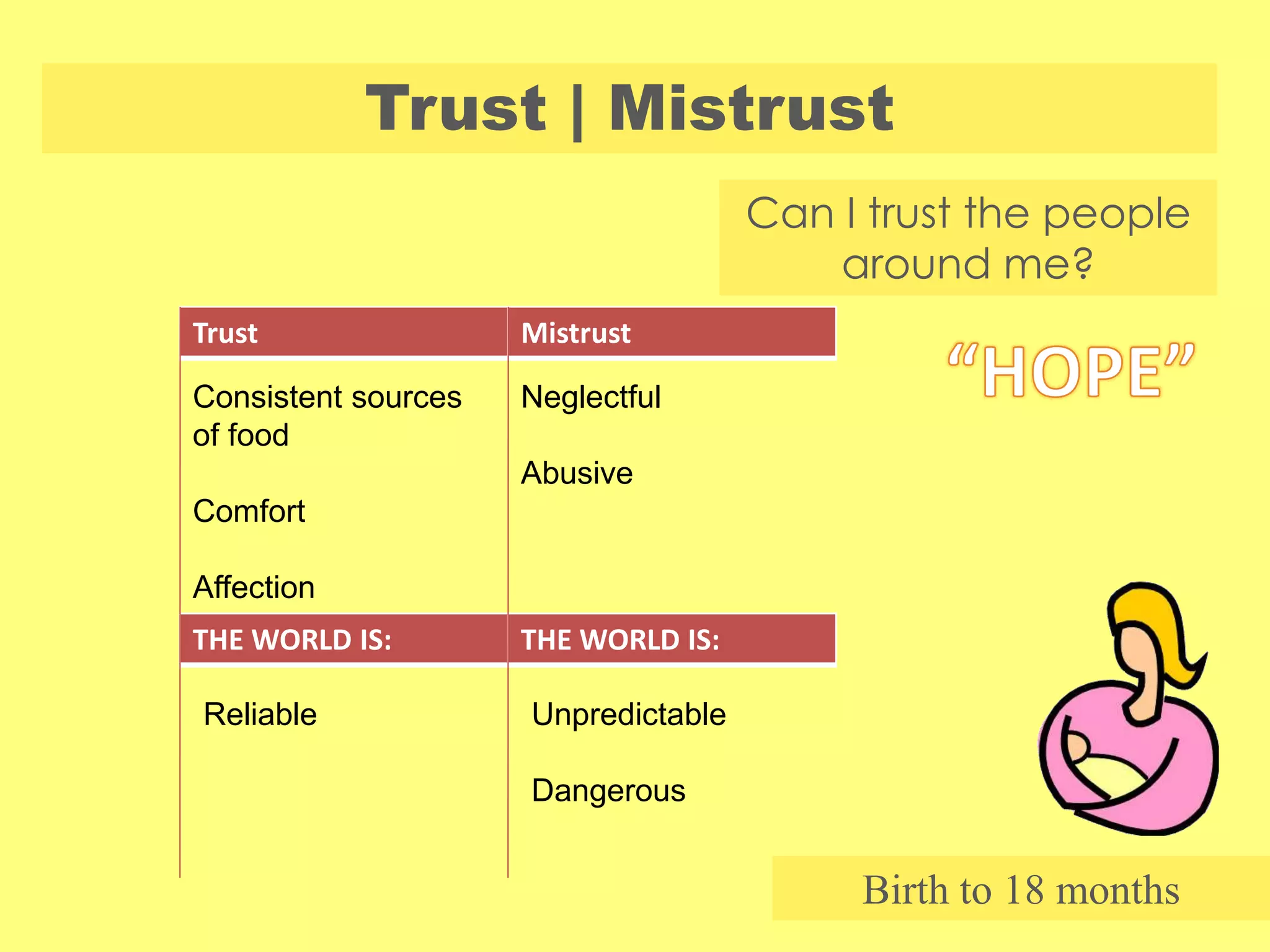
Trust | Mistrust
Birth to 18 months
Can I trust the people
around me?
Trust Mistrust
Consistent sources
of food
Comfort
Affection
Neglectful
Abusive
THE WORLD IS: THE WORLD IS:
Reliable Unpredictable
Dangerous
Autonomy | Shame & Doubt
18 mos. to 30 mos.
Can I do things by my
own?
 Toddler asserts their own will:
satisfying their own needs
- Feed themselves
- Wash and dress themselves
- Use bathroom
Toilet Training: Anal Stage
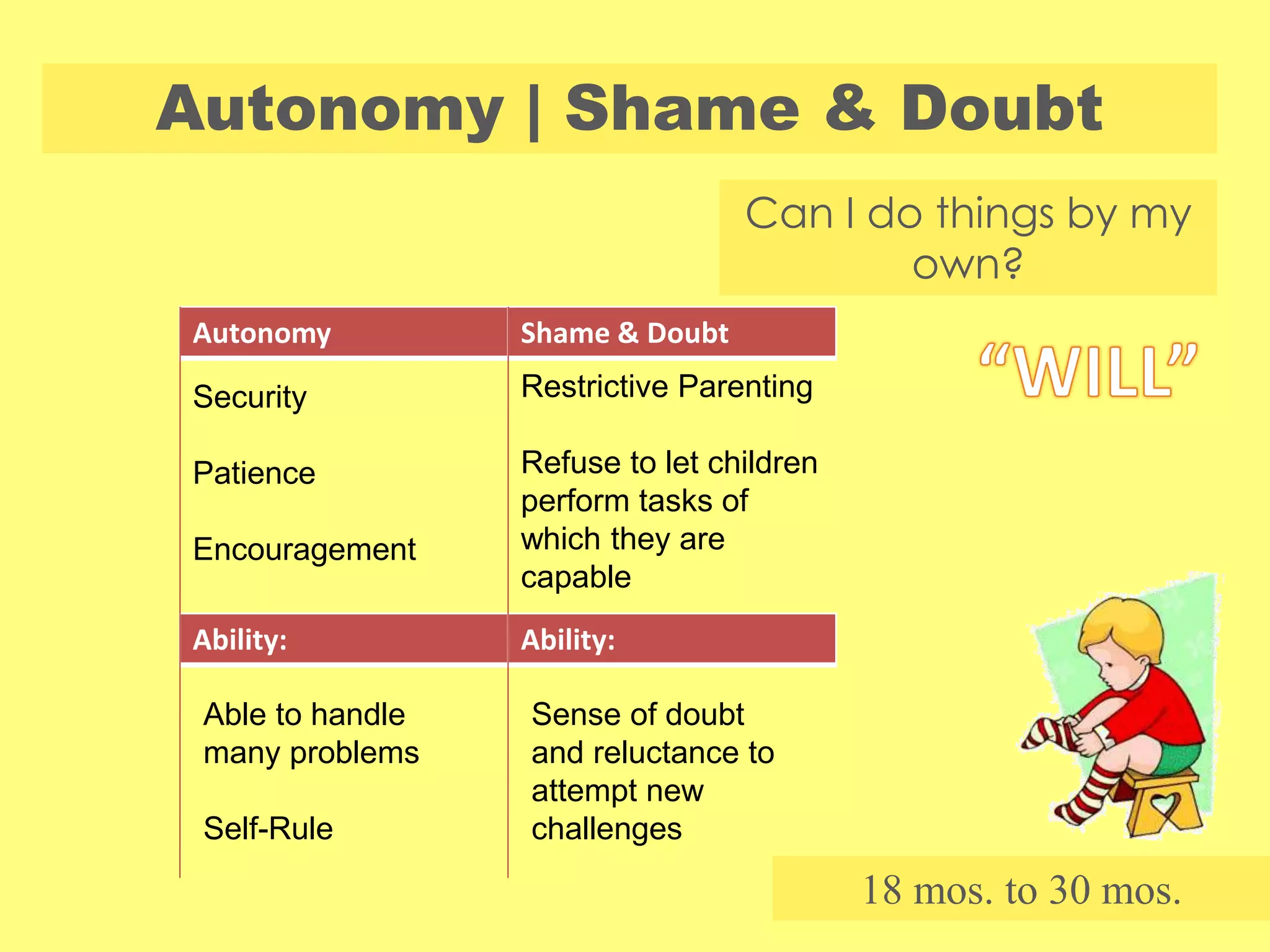
Autonomy | Shame & Doubt
18 mos. to 30 mos.
Can I do things by my
own?
Autonomy Shame & Doubt
Security
Patience
Encouragement
Restrictive Parenting
Refuse to let children
perform tasks of
which they are
capable
Ability: Ability:
Able to handle
many problems
Self-Rule
Sense of doubt
and reluctance to
attempt new
challenges
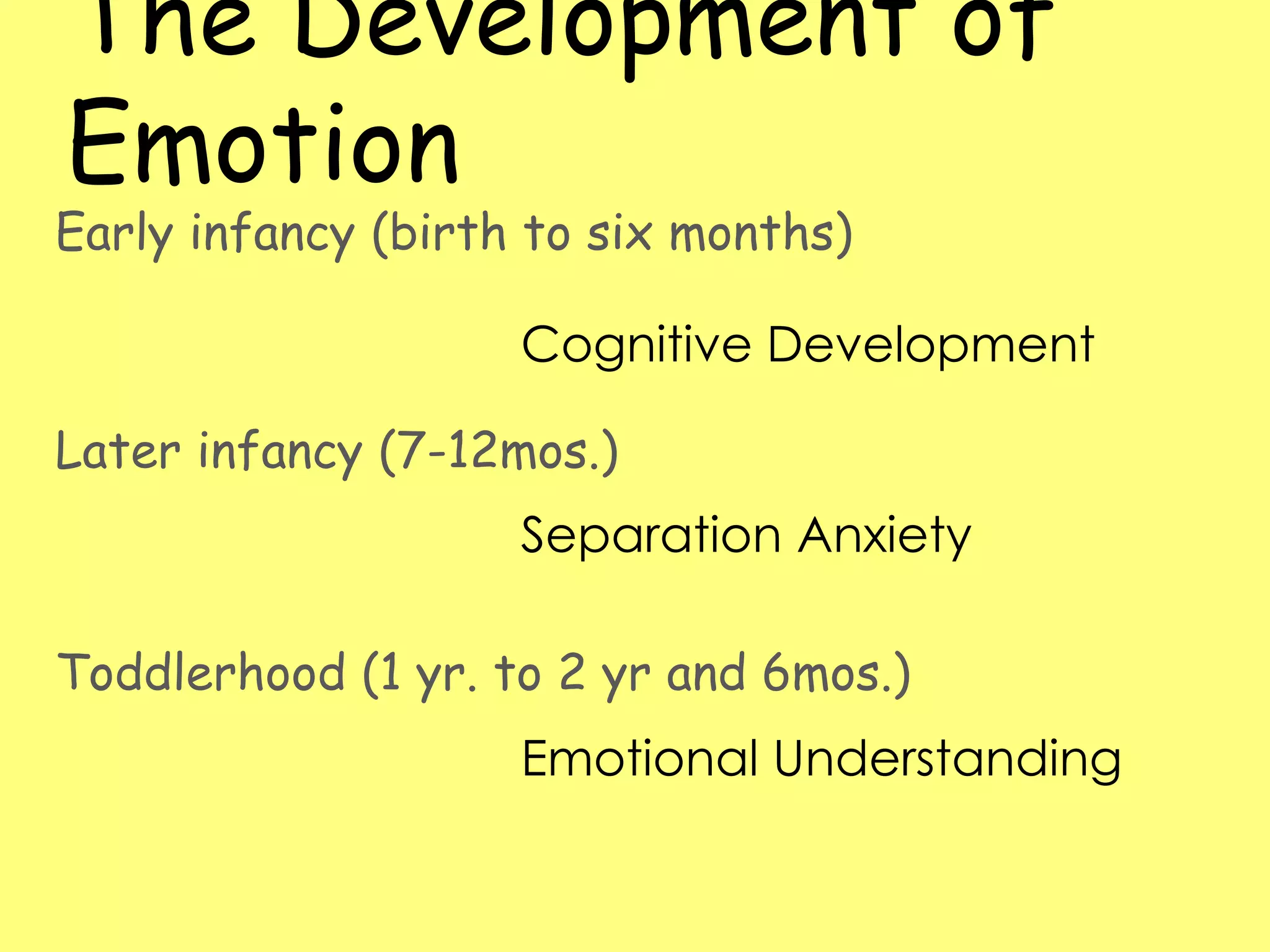
The Development of
Emotion
Early infancy (birth to six months)
Cognitive Development
Later infancy (7-12mos.)
Toddlerhood (1 yr. to 2 yr and 6mos.)
Separation Anxiety
Emotional Understanding
The Development of
Emotion
Early infancy (birth to six months)
Cognitive Development:
As a response to the social smile (adult smile and
interaction) usually accompanied by other pleasure-
indicative actions and sounds (cooing and mouthing).
Cognitive Development:
Laughter promotes social development.
The Development of
Emotion
Early infancy (birth to six months)
The Development of
Emotion
Later infancy (7-12mos.)
Separation Anxiety:
Fear
Disgust
Anger
The Development of
Emotion
Toddlerhood (1 yr. to 2 yr and 6mos.)
Emotional Understanding: Regulation Skills
Verbally Expressed:
Shame
Embarrassment
Pride
Uncomfortable
Learning Empathy
The Formative Years
The importance of the first three years in human
development falls in this stage. A so-called formative
years parents and other caregivers play a significant
role in the development of infants and toddlers.
Elements:
Attachment:
Temperament:
Based on an interaction of genetics and interactions with
the environment
Balance between temperament and environment
determines outcomes
EMOTIONAL BOND: a tendency to seek and maintain closeness
Elements:
Attachment:
EMOTIONAL BOND: a tendency to seek and maintain closeness
Dr. John Bowly, the father of attachment theory , the
beginning of attachment occur with a variety of built-in signals
that baby uses to keep her/his caregiver engaged.
When baby cries, gazing eyes, smiles, and etc.
Baby develops in her degree of attachment to her parents.
It smiles more freely at them than any strangers.
Elements:
Attachment:
STRANGE SITUATION:
use to assess attachment patterns between infant and adult
or the mother.
It consists episodes and take less than an hour. It is designed to trigger the
emergence attachment –related behaviors.
1. The mother twice leaves the baby in an unfamiliar room, the first time with
a stranger.
2. The second time she leaves the baby alone, and the stranger comes back
before the mother does.
3. The mother then encourages the baby to explore
and play again and gives comfort if the baby seem to
need it.
Elements:
Attachment:
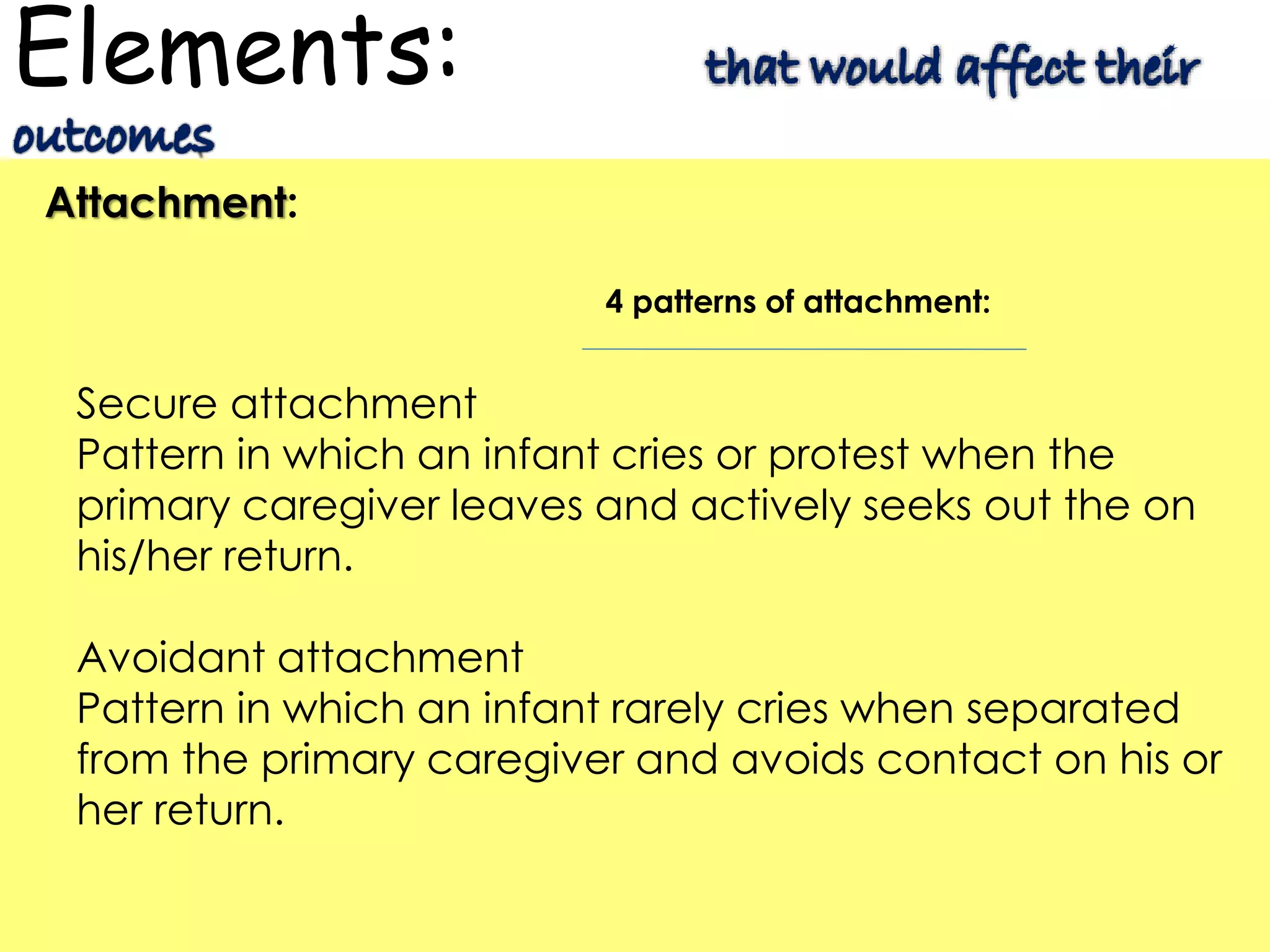
STRANGE SITUATION: 4 patterns of attachment:
Secure attachment
Avoidant attachment
Ambivalent (resistant) attachment
Disorganized-disoriented attachment
Elements:
Secure attachment
Pattern in which an infant cries or protest when the
primary caregiver leaves and actively seeks out the on
his/her return.
Avoidant attachment
Pattern in which an infant rarely cries when separated
from the primary caregiver and avoids contact on his or
her return.
Attachment:
4 patterns of attachment:
Elements:
Ambivalent (resistant) attachment
Pattern in which an infant becomes anxious before the
primary caregiver leaves, is extremely upset during his or
her absence, and both seeks and resists contact on his or
her return.
Disorganized-disoriented attachment
Patterns in which an infant, after separation from the
primary caregiver, shows contradictory repetitious , or
misdirected behaviors on his or her return.
4 patterns of attachment:
Attachment:
Elements:
Temperament:
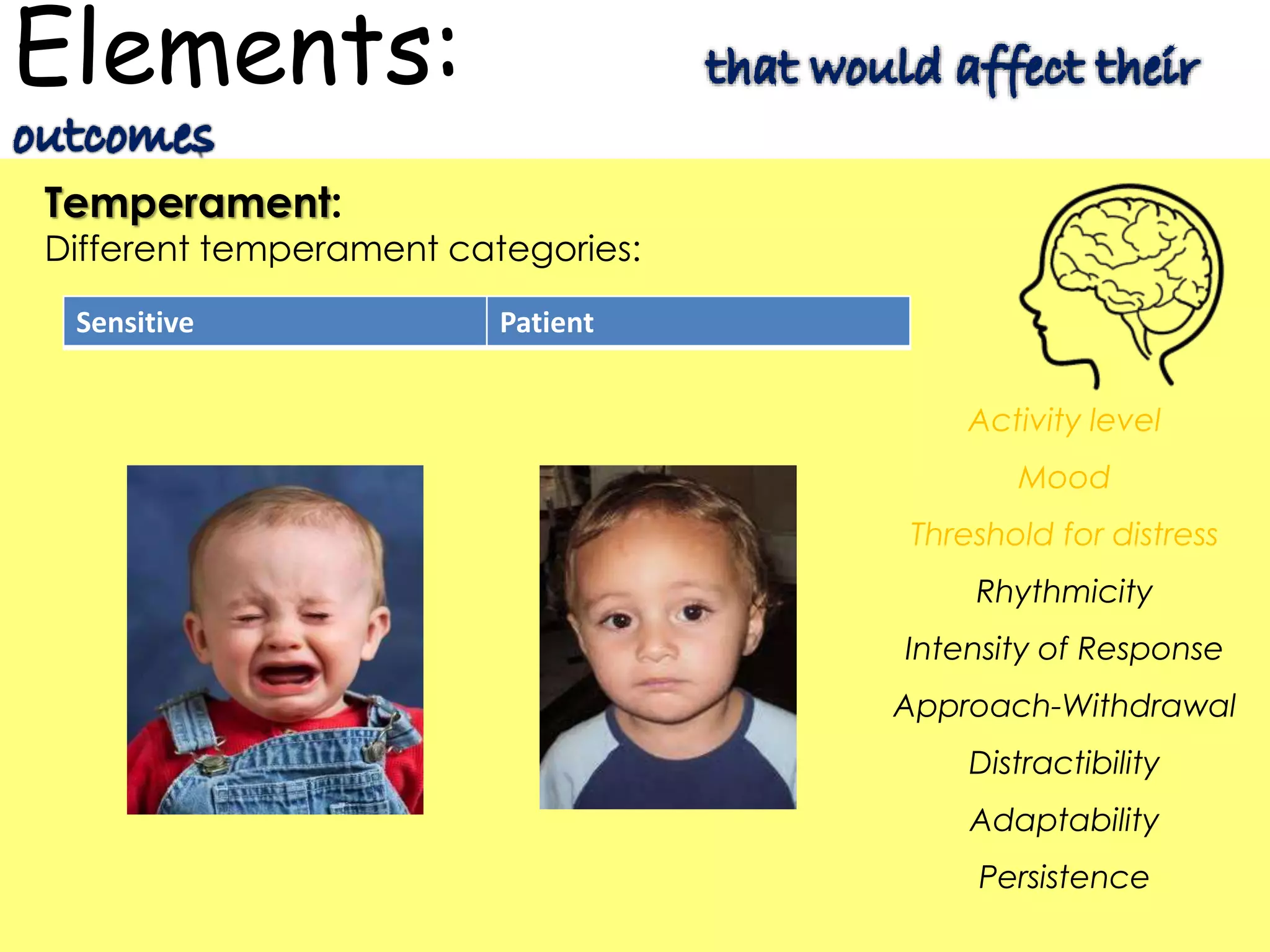
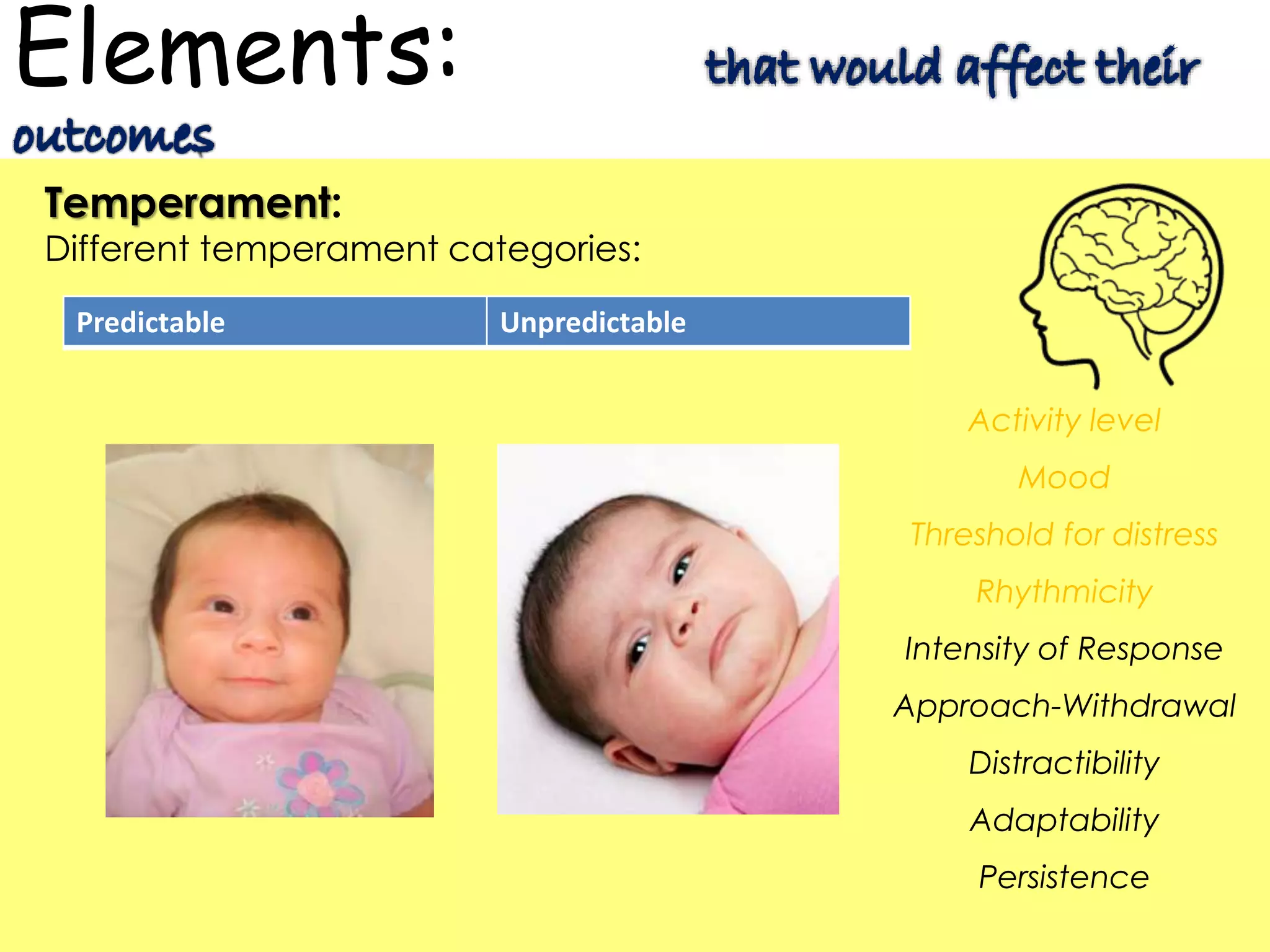
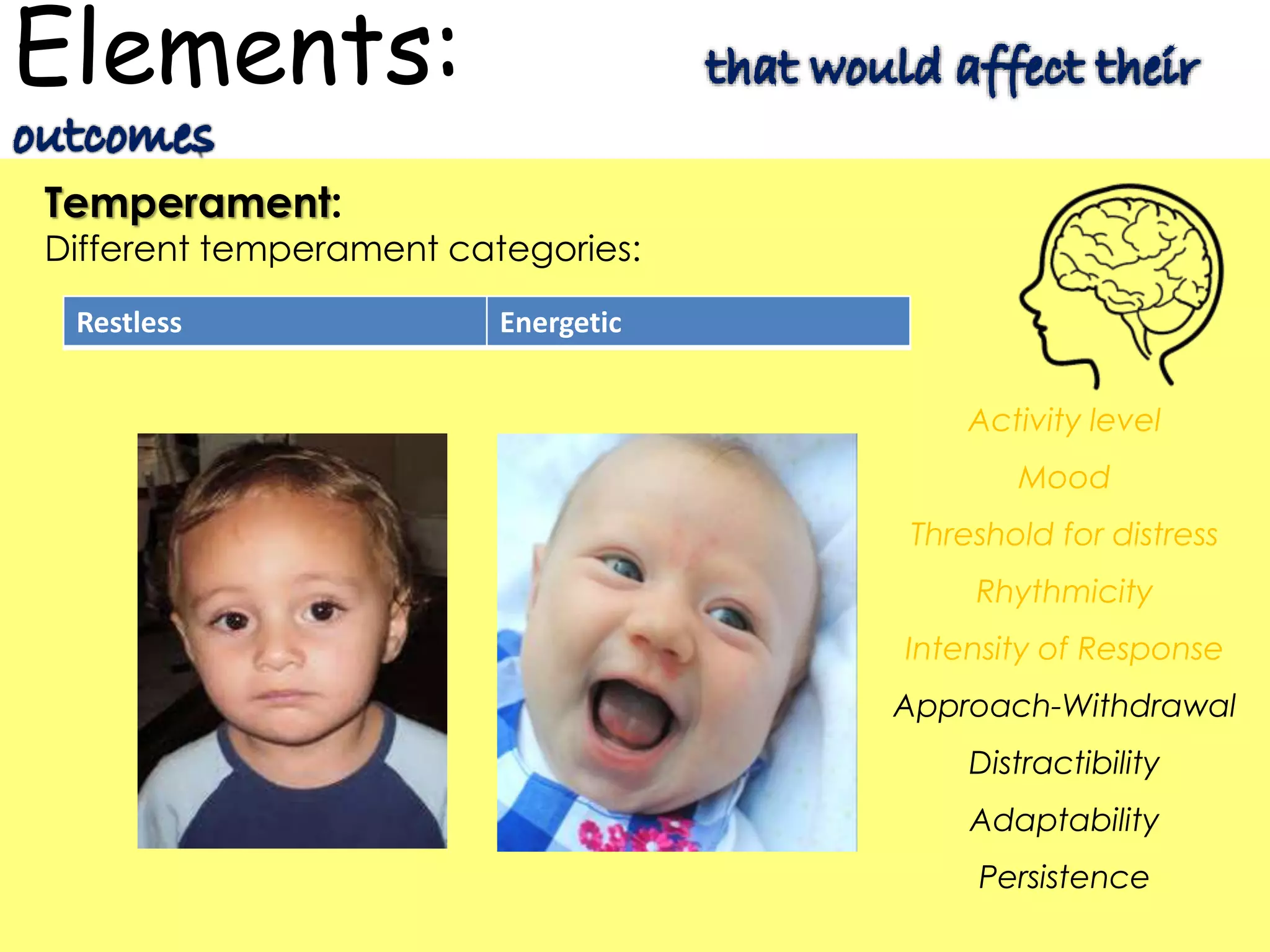
Every baby expresses personality traits we call temperament.
Different temperament categories:
Activity level
Mood
Threshold for distress
Rhythmicity
Intensity of Response
Approach-Withdrawal
Distractibility
Adaptability
Persistence
Elements:
Temperament:
Different temperament categories:
Activity level
Mood
Threshold for distress
Rhythmicity
Intensity of Response
Approach-Withdrawal
Distractibility
Adaptability
Persistence
Active Inactive
Elements:
Temperament:
Different temperament categories:
Activity level
Mood
Threshold for distress
Rhythmicity
Intensity of Response
Approach-Withdrawal
Distractibility
Adaptability
Persistence
Smiley and Cheerful More solemn & unhappy
Elements:
Temperament:
Different temperament categories:
Activity level
Mood
Threshold for distress
Rhythmicity
Intensity of Response
Approach-Withdrawal
Distractibility
Adaptability
Persistence
Sensitive Patient
Elements:
Temperament:
Different temperament categories:
Activity level
Mood
Threshold for distress
Rhythmicity
Intensity of Response
Approach-Withdrawal
Distractibility
Adaptability
Persistence
Predictable Unpredictable
Elements:
Temperament:
Different temperament categories:
Activity level
Mood
Threshold for distress
Rhythmicity
Intensity of Response
Approach-Withdrawal
Distractibility
Adaptability
Persistence
Restless Energetic
Elements:
Temperament:
Different temperament categories:
Activity level
Mood
Threshold for distress
Rhythmicity
Intensity of Response
Approach-Withdrawal
Distractibility
Adaptability
Persistence
Cautious Wild
Elements:
Temperament:
Different temperament categories:
Activity level
Mood
Threshold for distress
Rhythmicity
Intensity of Response
Approach-Withdrawal
Distractibility
Adaptability
Persistence
Concentrated Easily Distracted
Elements:
Temperament:
Different temperament categories:
Activity level
Mood
Threshold for distress
Rhythmicity
Intensity of Response
Approach-Withdrawal
Distractibility
Adaptability
Persistence
Adoptable Complexity
Elements:
Temperament:
Different temperament categories:
Activity level
Mood
Threshold for distress
Rhythmicity
Intensity of Response
Approach-Withdrawal
Distractibility
Adaptability
Persistence
Child Attention Span
Easy Child
Difficult Child
Slow-to warm-up-child
Established regular routines
Irregular in daily routines
Mild, low-key, negative in mood,
adjust slowly to new experience

Psychosocial Development of Infancy & Toddlerhood

  • 1.
  • 2.
    Erik Erikson • Droppedout of high school and spent time traveling in Europe and studying art • Became interested in how young people acquire a personal identity and how society helps shape it • Because his theory integrates personal, emotional and social development, it is often called Psychosocial Theory • Erikson is an ego-analyst – relationship between individual and the world or the self and the world
  • 3.
    Erik Erikson Psychosocial Development Eriksondescribed the time that an individual experiences a psychological challenge as a crisis Refers to the emotional and psychological changes across the life cycle that occurs in the context of the individual’s social environment. The first two stages of eight apply at the periods f infancy and toddler .
  • 4.
    Trust | Mistrust Birthto 18 months Can I trust the people around me?  Infant’s basic needs: food , sustenance, and comfort  Infant’s view that world is trustworthy: expose to warmth, regularity and dependable affection Feeding: Oral Stage
  • 5.
    Trust | Mistrust Birthto 18 months Can I trust the people around me? Trust Mistrust Consistent sources of food Comfort Affection Neglectful Abusive THE WORLD IS: THE WORLD IS: Reliable Unpredictable Dangerous
  • 6.
    Autonomy | Shame& Doubt 18 mos. to 30 mos. Can I do things by my own?  Toddler asserts their own will: satisfying their own needs - Feed themselves - Wash and dress themselves - Use bathroom Toilet Training: Anal Stage
  • 7.
    Autonomy | Shame& Doubt 18 mos. to 30 mos. Can I do things by my own? Autonomy Shame & Doubt Security Patience Encouragement Restrictive Parenting Refuse to let children perform tasks of which they are capable Ability: Ability: Able to handle many problems Self-Rule Sense of doubt and reluctance to attempt new challenges
  • 8.
    The Development of Emotion Earlyinfancy (birth to six months) Cognitive Development Later infancy (7-12mos.) Toddlerhood (1 yr. to 2 yr and 6mos.) Separation Anxiety Emotional Understanding
  • 9.
    The Development of Emotion Earlyinfancy (birth to six months) Cognitive Development: As a response to the social smile (adult smile and interaction) usually accompanied by other pleasure- indicative actions and sounds (cooing and mouthing). Cognitive Development: Laughter promotes social development.
  • 10.
    The Development of Emotion Earlyinfancy (birth to six months)
  • 11.
    The Development of Emotion Laterinfancy (7-12mos.) Separation Anxiety: Fear Disgust Anger
  • 12.
    The Development of Emotion Toddlerhood(1 yr. to 2 yr and 6mos.) Emotional Understanding: Regulation Skills Verbally Expressed: Shame Embarrassment Pride Uncomfortable Learning Empathy
  • 13.
    The Formative Years Theimportance of the first three years in human development falls in this stage. A so-called formative years parents and other caregivers play a significant role in the development of infants and toddlers.
  • 14.
    Elements: Attachment: Temperament: Based on aninteraction of genetics and interactions with the environment Balance between temperament and environment determines outcomes EMOTIONAL BOND: a tendency to seek and maintain closeness
  • 15.
    Elements: Attachment: EMOTIONAL BOND: atendency to seek and maintain closeness Dr. John Bowly, the father of attachment theory , the beginning of attachment occur with a variety of built-in signals that baby uses to keep her/his caregiver engaged. When baby cries, gazing eyes, smiles, and etc. Baby develops in her degree of attachment to her parents. It smiles more freely at them than any strangers.
  • 16.
    Elements: Attachment: STRANGE SITUATION: use toassess attachment patterns between infant and adult or the mother. It consists episodes and take less than an hour. It is designed to trigger the emergence attachment –related behaviors. 1. The mother twice leaves the baby in an unfamiliar room, the first time with a stranger. 2. The second time she leaves the baby alone, and the stranger comes back before the mother does. 3. The mother then encourages the baby to explore and play again and gives comfort if the baby seem to need it.
  • 17.
    Elements: Attachment: STRANGE SITUATION: 4patterns of attachment: Secure attachment Avoidant attachment Ambivalent (resistant) attachment Disorganized-disoriented attachment
  • 18.
    Elements: Secure attachment Pattern inwhich an infant cries or protest when the primary caregiver leaves and actively seeks out the on his/her return. Avoidant attachment Pattern in which an infant rarely cries when separated from the primary caregiver and avoids contact on his or her return. Attachment: 4 patterns of attachment:
  • 19.
    Elements: Ambivalent (resistant) attachment Patternin which an infant becomes anxious before the primary caregiver leaves, is extremely upset during his or her absence, and both seeks and resists contact on his or her return. Disorganized-disoriented attachment Patterns in which an infant, after separation from the primary caregiver, shows contradictory repetitious , or misdirected behaviors on his or her return. 4 patterns of attachment: Attachment:
  • 20.
    Elements: Temperament: Every baby expressespersonality traits we call temperament. Different temperament categories: Activity level Mood Threshold for distress Rhythmicity Intensity of Response Approach-Withdrawal Distractibility Adaptability Persistence
  • 21.
    Elements: Temperament: Different temperament categories: Activitylevel Mood Threshold for distress Rhythmicity Intensity of Response Approach-Withdrawal Distractibility Adaptability Persistence Active Inactive
  • 22.
    Elements: Temperament: Different temperament categories: Activitylevel Mood Threshold for distress Rhythmicity Intensity of Response Approach-Withdrawal Distractibility Adaptability Persistence Smiley and Cheerful More solemn & unhappy
  • 23.
    Elements: Temperament: Different temperament categories: Activitylevel Mood Threshold for distress Rhythmicity Intensity of Response Approach-Withdrawal Distractibility Adaptability Persistence Sensitive Patient
  • 24.
    Elements: Temperament: Different temperament categories: Activitylevel Mood Threshold for distress Rhythmicity Intensity of Response Approach-Withdrawal Distractibility Adaptability Persistence Predictable Unpredictable
  • 25.
    Elements: Temperament: Different temperament categories: Activitylevel Mood Threshold for distress Rhythmicity Intensity of Response Approach-Withdrawal Distractibility Adaptability Persistence Restless Energetic
  • 26.
    Elements: Temperament: Different temperament categories: Activitylevel Mood Threshold for distress Rhythmicity Intensity of Response Approach-Withdrawal Distractibility Adaptability Persistence Cautious Wild
  • 27.
    Elements: Temperament: Different temperament categories: Activitylevel Mood Threshold for distress Rhythmicity Intensity of Response Approach-Withdrawal Distractibility Adaptability Persistence Concentrated Easily Distracted
  • 28.
    Elements: Temperament: Different temperament categories: Activitylevel Mood Threshold for distress Rhythmicity Intensity of Response Approach-Withdrawal Distractibility Adaptability Persistence Adoptable Complexity
  • 29.
    Elements: Temperament: Different temperament categories: Activitylevel Mood Threshold for distress Rhythmicity Intensity of Response Approach-Withdrawal Distractibility Adaptability Persistence Child Attention Span Easy Child Difficult Child Slow-to warm-up-child Established regular routines Irregular in daily routines Mild, low-key, negative in mood, adjust slowly to new experience