METHODS OF DNA EXTRACTION
PRESENTED BY: AYESHA KABEER
UNIVERSITY OF GUJRAT SIALKOT SUBCAMPUS
DNA Extraction
• DNA extraction is a procedure used to isolate DNA from
the nucleus of cells.
• Purpose of DNA Extraction
To obtain DNA in a relatively purified form which can be
used for further investigations, i.e. PCR, sequencing, etc
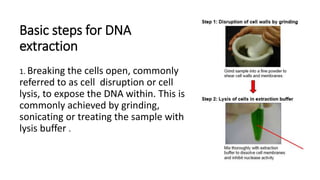
Basic steps for DNA
extraction
1. Breaking the cells open, commonly
referred to as cell disruption or cell
lysis, to expose the DNA within. This is
commonly achieved by grinding,
sonicating or treating the sample with
lysis buffer .
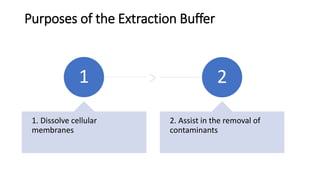
Purposes of the Extraction Buffer
1
1. Dissolve cellular
membranes
2
2. Assist in the removal of
contaminants
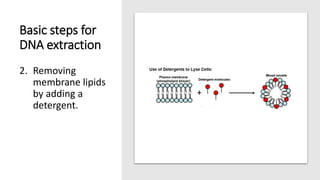
Basic steps for
DNA extraction
2. Removing
membrane lipids
by adding a
detergent.
Basic steps for DNA extraction
3. Removing proteins by adding a protease (optional but
almost always done).
4. Precipitating the DNA with an alcohol — usually ice-cold
ethanol or isopropanol. Since DNA is insoluble in these
alcohols, it will aggregate together, giving a pellet upon
centrifugation. This step also removes alcohol-soluble salt.
Most Commonly used DNA Extraction Procedures
 Organic (Phenol-Chloroform) Extraction
 Inorganic (Proteinase K and Salting out)
 NCM / Nylon membrane i.e. kit method(Collection,
Storage, and Isolation)
ORGANIC EXTRACTION REAGENTS
• Cell Lysis Buffer - Non-ionic detergent , Salt, Buffer, EDTA
designed to lyse outer cell membrane, but will not break
down nuclear membrane.
• EDTA (Ethylenediaminetetraacetic disodium salt) is a
chelating agent of divalent cations such as Mg2+. Mg2+is a
cofactor for DNase nucleases. If the Mg2+is bound up by
EDTA, nucleases are inactivated.
ORGANIC EXTRACTION REAGENTS
• Proteinase K - it is usual to remove most of the protein by
digesting with proteolytic enzymes such as proteinase K,
which are active against a broad spectrum of native proteins,
before extracting with organic solvents. Proteinase K is
approximately 10 fold more active on denatured protein.
Proteins can be denatured by SDS or by heat.
ORGANIC EXTRACTION REAGENTS
• Phenol/Chloroform- remove proteinaceous material.
• TE Buffer - Tris-EDTA Buffer: TE buffer is often used to store DNA and
RNA. EDTA in TE chelates Mg2+ and other divalent metals ions
necessary for most causes of DNA and RNA degradation, suppressing
these processes. Tris is a buffering agent to keep the solution at a
defined pH.
• Ethanol or isopropanol: which help in precipitation of DNA.
ORGANIC EXTRACTION
PROCEDURE
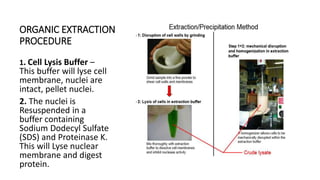
1. Cell Lysis Buffer –
This buffer will lyse cell
membrane, nuclei are
intact, pellet nuclei.
2. The nuclei is
Resuspended in a
buffer containing
Sodium Dodecyl Sulfate
(SDS) and Proteinase K.
This will Lyse nuclear
membrane and digest
protein.
ORGANIC
EXTRACTION
PROCEDURE
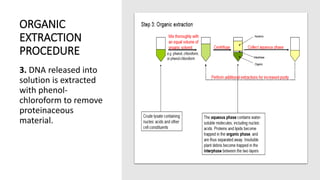
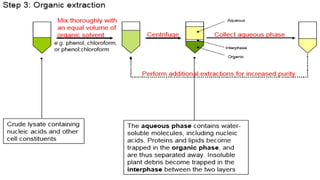
3. DNA released into
solution is extracted
with phenol-
chloroform to remove
proteinaceous
material.
ORGANIC EXTRACTION PROCEDURE
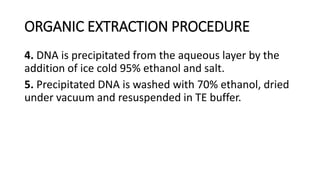
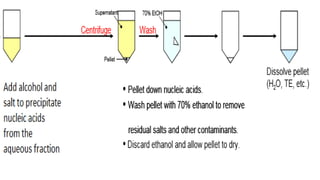
4. DNA is precipitated from the aqueous layer by the
addition of ice cold 95% ethanol and salt.
5. Precipitated DNA is washed with 70% ethanol, dried
under vacuum and resuspended in TE buffer.
INORGANIC DNA EXTRACTION
Does not use organic reagents such as phenol or chloroform.
Digested proteins are removed by salting out with high
concentrations of LiCl.
However, if salts are not adequately removed, problems could occur
with the procedure due to alteration of DNA mobility (band shifting)
INORGANIC DNA EXTRACTION
Procedure:
1. Cell Lysis Buffer Containing Proteinase - lyse cell membrane, lyse
nuclear membrane and digest protein at high temperature e.g. 65℃
for 2 hours. Temperature helps denature proteins, and Proteinase K
auto digests itself
2. To remove proteinaceous material, LiCl is added to a final
concentration of 2.5 M, and incubated on ice. Proteins precipitate
out and are pelleted by centrifugation.
INORGANIC DNA EXTRACTION
Procedure:
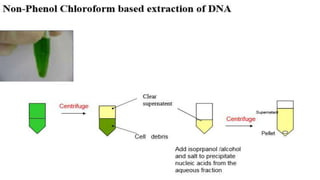
3. DNA remains in solution. Transfer supernatant to a new
tube, care must be taken not to take any of protein pellet.
4. DNA is precipitated by the addition of room temperature
isopropanol. LiCl will not precipitate with DNA.
5. Precipitated DNA is washed with 70% ethanol, dried under
vacuum and resuspended in TE buffer.
Membrane based
method(i.e. kit
method)
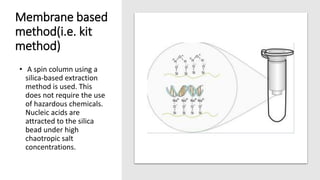
• A spin column using a
silica-based extraction
method is used. This
does not require the use
of hazardous chemicals.
Nucleic acids are
attracted to the silica
bead under high
chaotropic salt
concentrations.
STEPS
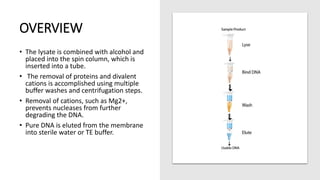
• The stages of the method are:
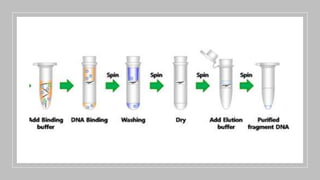
• Lyse – The cells of a sample are broken open with a lysis procedure.
• Bind – A buffer solution is then added to the sample along with
ethanol or isopropanol. This forms the binding solution. The binding
solution is transferred to a spin column and the column is put in a
centrifuge. The centrifuge forces the binding solution through a silica
gel membrane that is inside the spin column. If the pH and salt
concentration of the binding solution are optimal, the nucleic acid will
bind to the silica gel membrane as the solution passes through.
STEPS
• Wash – The flow-through is removed and a wash buffer is added to
the column. The column is put in a centrifuge again, forcing the wash
buffer through the membrane. This removes any remaining impurities
from the membrane, leaving only the nucleic acid bound to the silica
gel.
• Elute – The wash buffer is removed and an elution buffer (or simply
water) is added to the column. The column is put in a centrifuge
again, forcing the elution buffer through the membrane. The elution
buffer removes the nucleic acid from the membrane and the nucleic
acid is collected from the bottom of the column.
OVERVIEW
• The lysate is combined with alcohol and
placed into the spin column, which is
inserted into a tube.
• The removal of proteins and divalent
cations is accomplished using multiple
buffer washes and centrifugation steps.
• Removal of cations, such as Mg2+,
prevents nucleases from further
degrading the DNA.
• Pure DNA is eluted from the membrane
into sterile water or TE buffer.

METHODS OF DNA EXTRACTION

  • 1.
    METHODS OF DNAEXTRACTION PRESENTED BY: AYESHA KABEER UNIVERSITY OF GUJRAT SIALKOT SUBCAMPUS
  • 2.
    DNA Extraction • DNAextraction is a procedure used to isolate DNA from the nucleus of cells. • Purpose of DNA Extraction To obtain DNA in a relatively purified form which can be used for further investigations, i.e. PCR, sequencing, etc
  • 3.
    Basic steps forDNA extraction 1. Breaking the cells open, commonly referred to as cell disruption or cell lysis, to expose the DNA within. This is commonly achieved by grinding, sonicating or treating the sample with lysis buffer .
  • 4.
    Purposes of theExtraction Buffer 1 1. Dissolve cellular membranes 2 2. Assist in the removal of contaminants
  • 5.
    Basic steps for DNAextraction 2. Removing membrane lipids by adding a detergent.
  • 6.
    Basic steps forDNA extraction 3. Removing proteins by adding a protease (optional but almost always done). 4. Precipitating the DNA with an alcohol — usually ice-cold ethanol or isopropanol. Since DNA is insoluble in these alcohols, it will aggregate together, giving a pellet upon centrifugation. This step also removes alcohol-soluble salt.
  • 7.
    Most Commonly usedDNA Extraction Procedures  Organic (Phenol-Chloroform) Extraction  Inorganic (Proteinase K and Salting out)  NCM / Nylon membrane i.e. kit method(Collection, Storage, and Isolation)
  • 8.
    ORGANIC EXTRACTION REAGENTS •Cell Lysis Buffer - Non-ionic detergent , Salt, Buffer, EDTA designed to lyse outer cell membrane, but will not break down nuclear membrane. • EDTA (Ethylenediaminetetraacetic disodium salt) is a chelating agent of divalent cations such as Mg2+. Mg2+is a cofactor for DNase nucleases. If the Mg2+is bound up by EDTA, nucleases are inactivated.
  • 9.
    ORGANIC EXTRACTION REAGENTS •Proteinase K - it is usual to remove most of the protein by digesting with proteolytic enzymes such as proteinase K, which are active against a broad spectrum of native proteins, before extracting with organic solvents. Proteinase K is approximately 10 fold more active on denatured protein. Proteins can be denatured by SDS or by heat.
  • 10.
    ORGANIC EXTRACTION REAGENTS •Phenol/Chloroform- remove proteinaceous material. • TE Buffer - Tris-EDTA Buffer: TE buffer is often used to store DNA and RNA. EDTA in TE chelates Mg2+ and other divalent metals ions necessary for most causes of DNA and RNA degradation, suppressing these processes. Tris is a buffering agent to keep the solution at a defined pH. • Ethanol or isopropanol: which help in precipitation of DNA.
  • 11.
    ORGANIC EXTRACTION PROCEDURE 1. CellLysis Buffer – This buffer will lyse cell membrane, nuclei are intact, pellet nuclei. 2. The nuclei is Resuspended in a buffer containing Sodium Dodecyl Sulfate (SDS) and Proteinase K. This will Lyse nuclear membrane and digest protein.
  • 12.
    ORGANIC EXTRACTION PROCEDURE 3. DNA releasedinto solution is extracted with phenol- chloroform to remove proteinaceous material.
  • 14.
    ORGANIC EXTRACTION PROCEDURE 4.DNA is precipitated from the aqueous layer by the addition of ice cold 95% ethanol and salt. 5. Precipitated DNA is washed with 70% ethanol, dried under vacuum and resuspended in TE buffer.
  • 16.
    INORGANIC DNA EXTRACTION Doesnot use organic reagents such as phenol or chloroform. Digested proteins are removed by salting out with high concentrations of LiCl. However, if salts are not adequately removed, problems could occur with the procedure due to alteration of DNA mobility (band shifting)
  • 17.
    INORGANIC DNA EXTRACTION Procedure: 1.Cell Lysis Buffer Containing Proteinase - lyse cell membrane, lyse nuclear membrane and digest protein at high temperature e.g. 65℃ for 2 hours. Temperature helps denature proteins, and Proteinase K auto digests itself 2. To remove proteinaceous material, LiCl is added to a final concentration of 2.5 M, and incubated on ice. Proteins precipitate out and are pelleted by centrifugation.
  • 18.
    INORGANIC DNA EXTRACTION Procedure: 3.DNA remains in solution. Transfer supernatant to a new tube, care must be taken not to take any of protein pellet. 4. DNA is precipitated by the addition of room temperature isopropanol. LiCl will not precipitate with DNA. 5. Precipitated DNA is washed with 70% ethanol, dried under vacuum and resuspended in TE buffer.
  • 20.
    Membrane based method(i.e. kit method) •A spin column using a silica-based extraction method is used. This does not require the use of hazardous chemicals. Nucleic acids are attracted to the silica bead under high chaotropic salt concentrations.
  • 21.
    STEPS • The stagesof the method are: • Lyse – The cells of a sample are broken open with a lysis procedure. • Bind – A buffer solution is then added to the sample along with ethanol or isopropanol. This forms the binding solution. The binding solution is transferred to a spin column and the column is put in a centrifuge. The centrifuge forces the binding solution through a silica gel membrane that is inside the spin column. If the pH and salt concentration of the binding solution are optimal, the nucleic acid will bind to the silica gel membrane as the solution passes through.
  • 22.
    STEPS • Wash –The flow-through is removed and a wash buffer is added to the column. The column is put in a centrifuge again, forcing the wash buffer through the membrane. This removes any remaining impurities from the membrane, leaving only the nucleic acid bound to the silica gel. • Elute – The wash buffer is removed and an elution buffer (or simply water) is added to the column. The column is put in a centrifuge again, forcing the elution buffer through the membrane. The elution buffer removes the nucleic acid from the membrane and the nucleic acid is collected from the bottom of the column.
  • 24.
    OVERVIEW • The lysateis combined with alcohol and placed into the spin column, which is inserted into a tube. • The removal of proteins and divalent cations is accomplished using multiple buffer washes and centrifugation steps. • Removal of cations, such as Mg2+, prevents nucleases from further degrading the DNA. • Pure DNA is eluted from the membrane into sterile water or TE buffer.