THE MATERIALS SELECTION 
PROCESS 
S Austin Moses 
1
Goal And Objectives 
The overall goal of this is to illustrate how systematic selection 
procedures can be used to select optimum materials and processes 
for a given component. 
General Steps In Material Selection : 
2 
1. Analysis of the performance requirements. 
2. Development of alternative solutions to the problem. 
3. Evaluation of the different solutions. 
4. Decision on the optimum solution.
Analysis Of Material Performance Requirements 
The material performance requirements can be divided into 5 broad 
categories: 
 Functional requirements 
 Processability requirements 
 Cost 
 Reliability requirements 
 Resistance to service conditions 
3 
1.
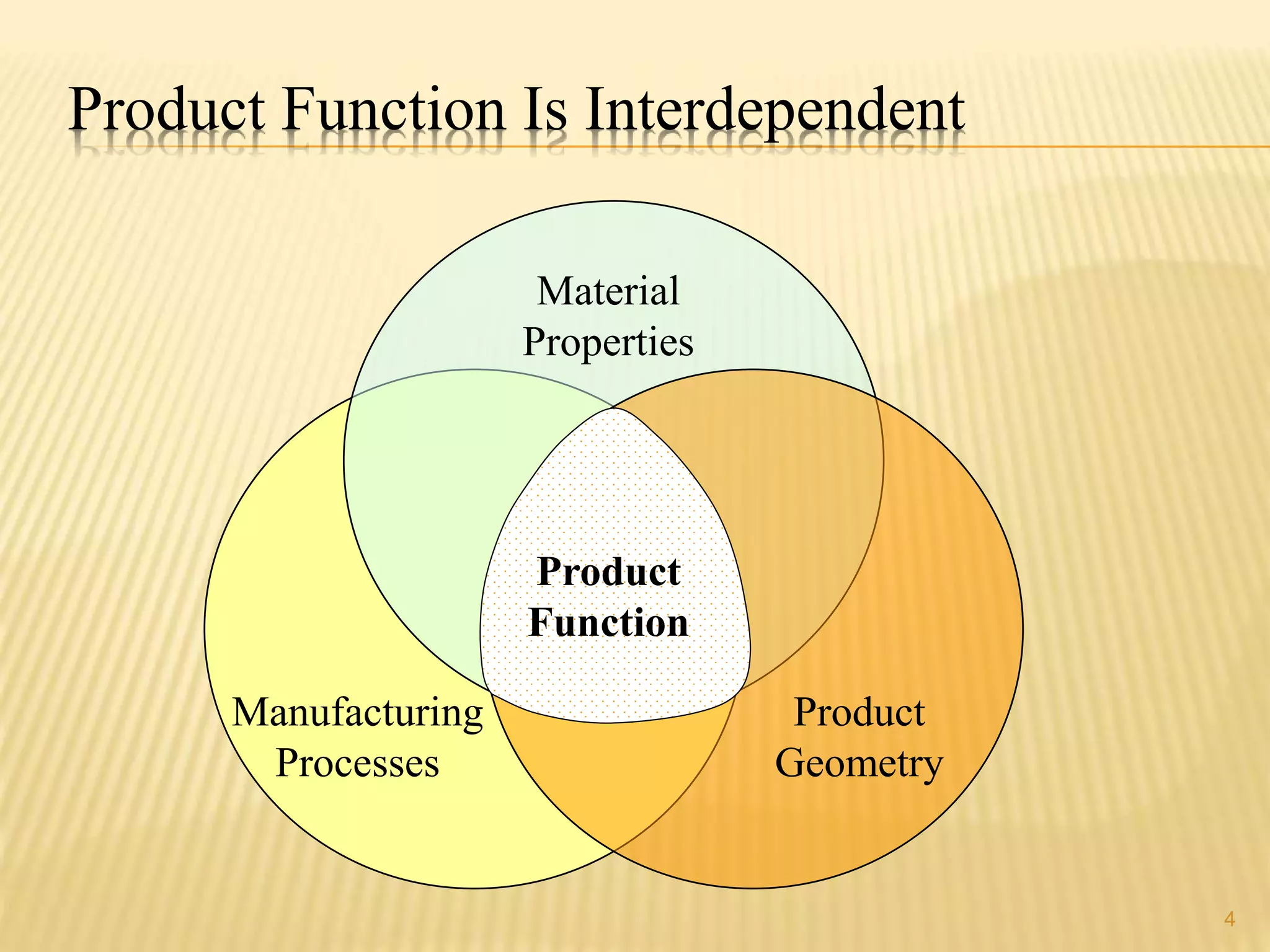
Product Function Is Interdependent 
4 
Material 
Properties 
Manufacturing 
Processes 
Product 
Geometry 
Product 
Function
Creating Alternative Solutions 
Having specified the material requirements, the rest of the selection 
process involves the search for the material that would best meet 
those requirements. 
The starting point is the entire range of engineering materials. 
 A steel may be the best material for one design concept while a 
plastic is best for a different concept, even though the two designs 
provide similar functions. 
The importance of this phase is that it creates alternatives without 
much regard to their feasibility. 
5 
2.
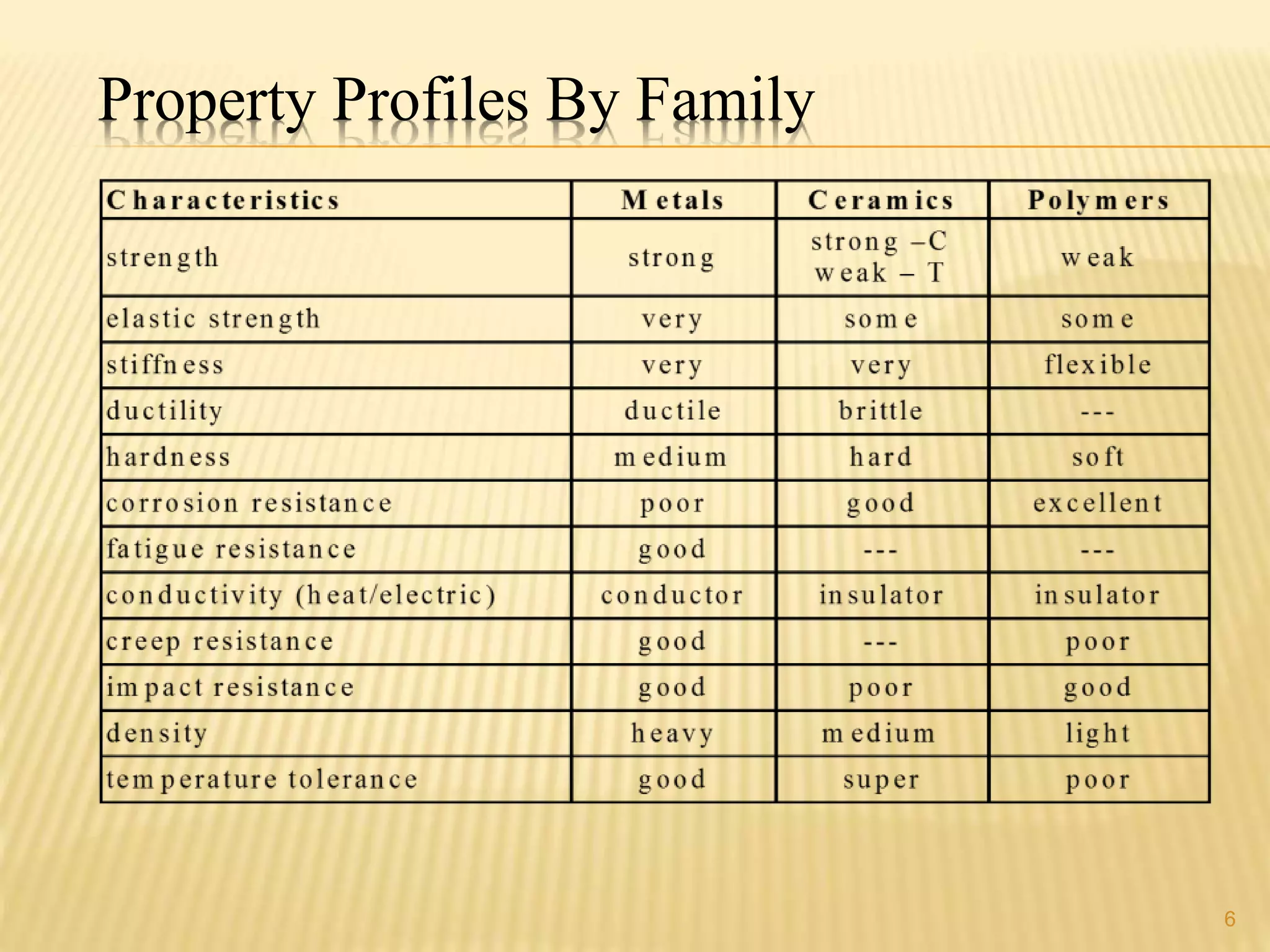
Property Profiles By Family 
6
Screening: How Do We Choose A Material? 
Product function depends upon… 
material, manufacturing process, geometry 
We have to consider all three 
 Do we select a few feasible materials first… 
then select the specific mfg process? 
OR 
 Do we select a few feasible mfg processes… 
then select the specific material? 
7
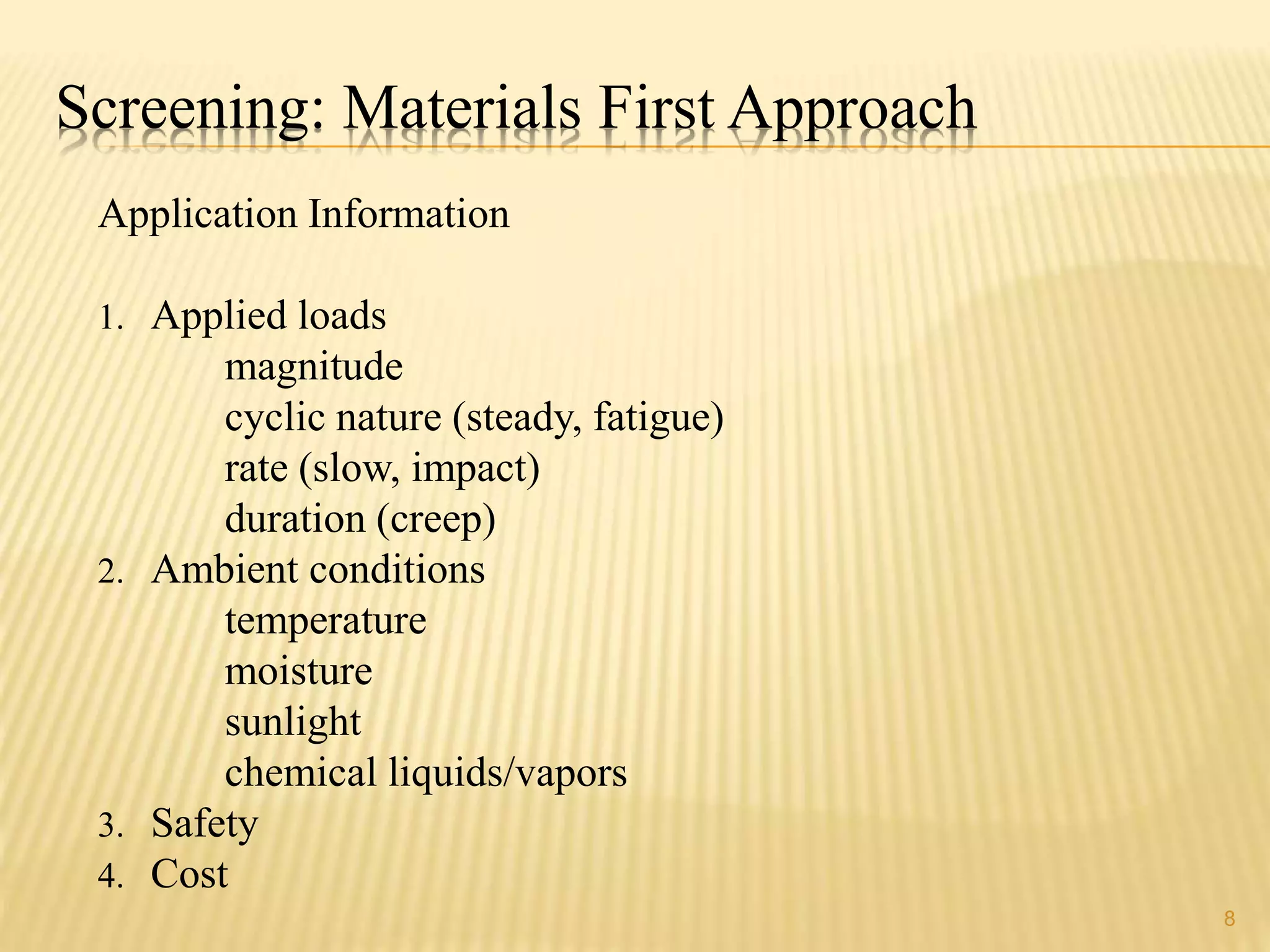
Screening: Materials First Approach 
Application Information 
1. Applied loads 
magnitude 
cyclic nature (steady, fatigue) 
rate (slow, impact) 
duration (creep) 
2. Ambient conditions 
temperature 
moisture 
sunlight 
chemical liquids/vapors 
3. Safety 
4. Cost 
8
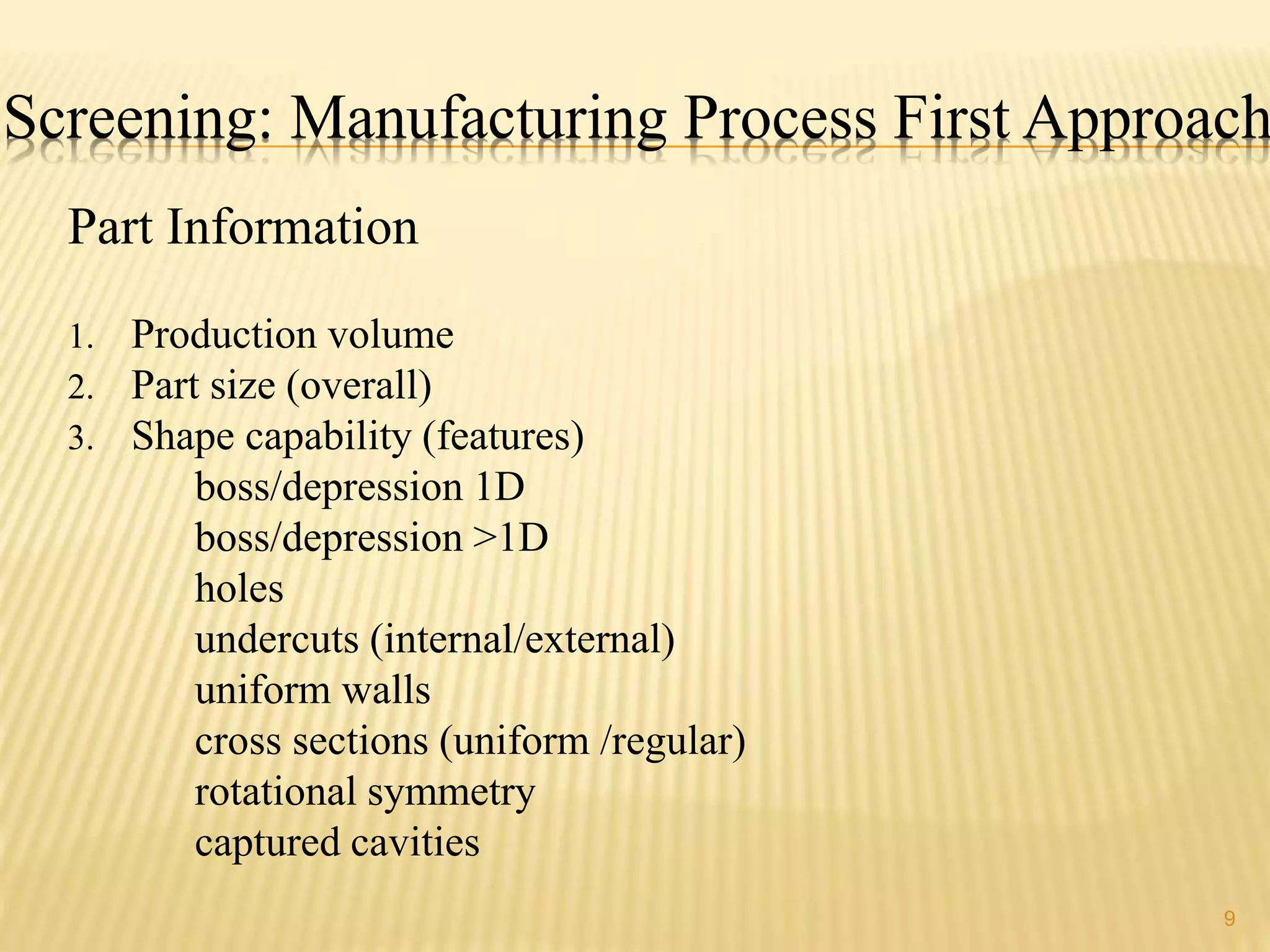
Screening: Manufacturing Process First Approach 
9 
Part Information 
1. Production volume 
2. Part size (overall) 
3. Shape capability (features) 
boss/depression 1D 
boss/depression >1D 
holes 
undercuts (internal/external) 
uniform walls 
cross sections (uniform /regular) 
rotational symmetry 
captured cavities
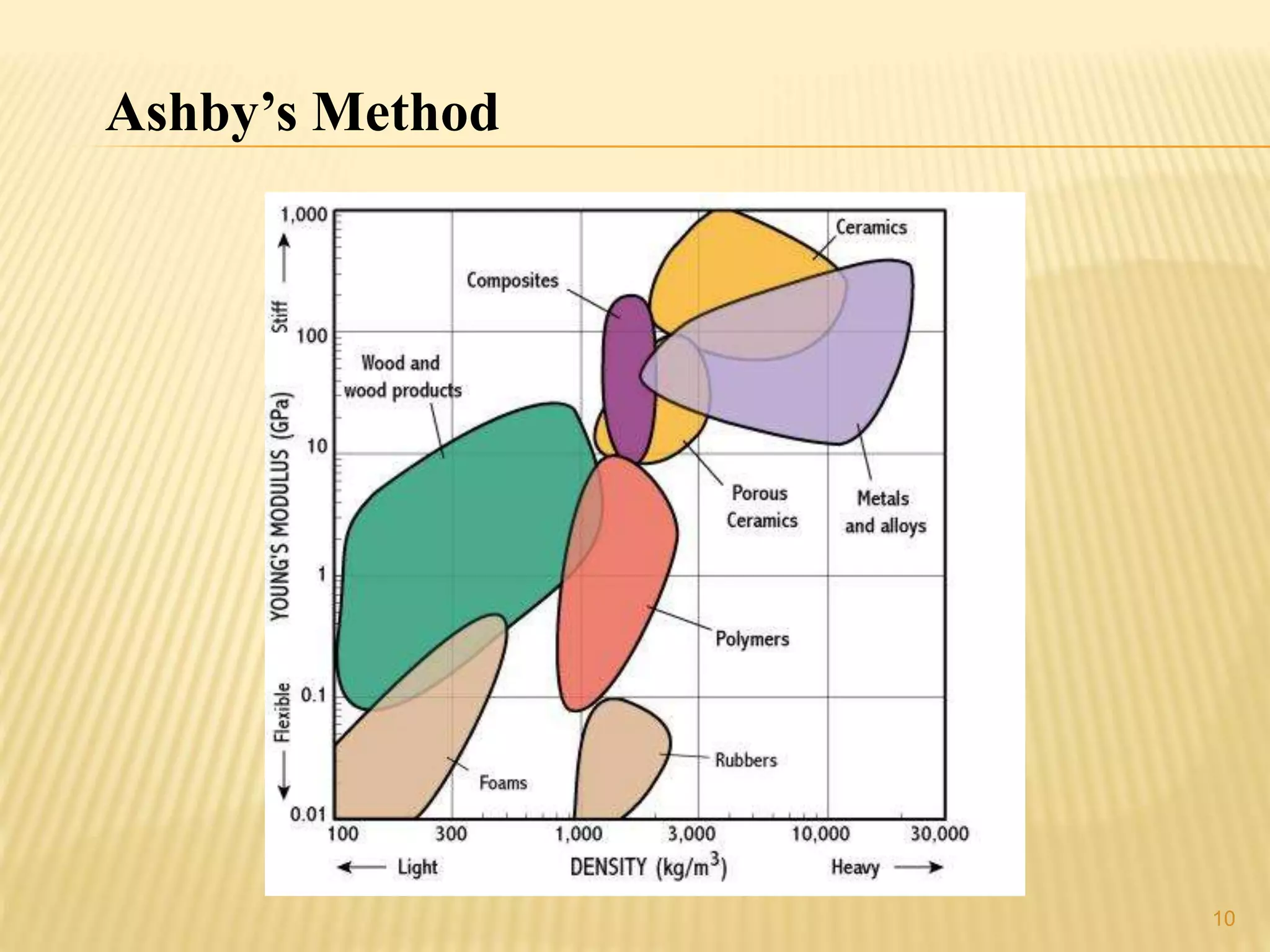
Ashby’s Method 
10
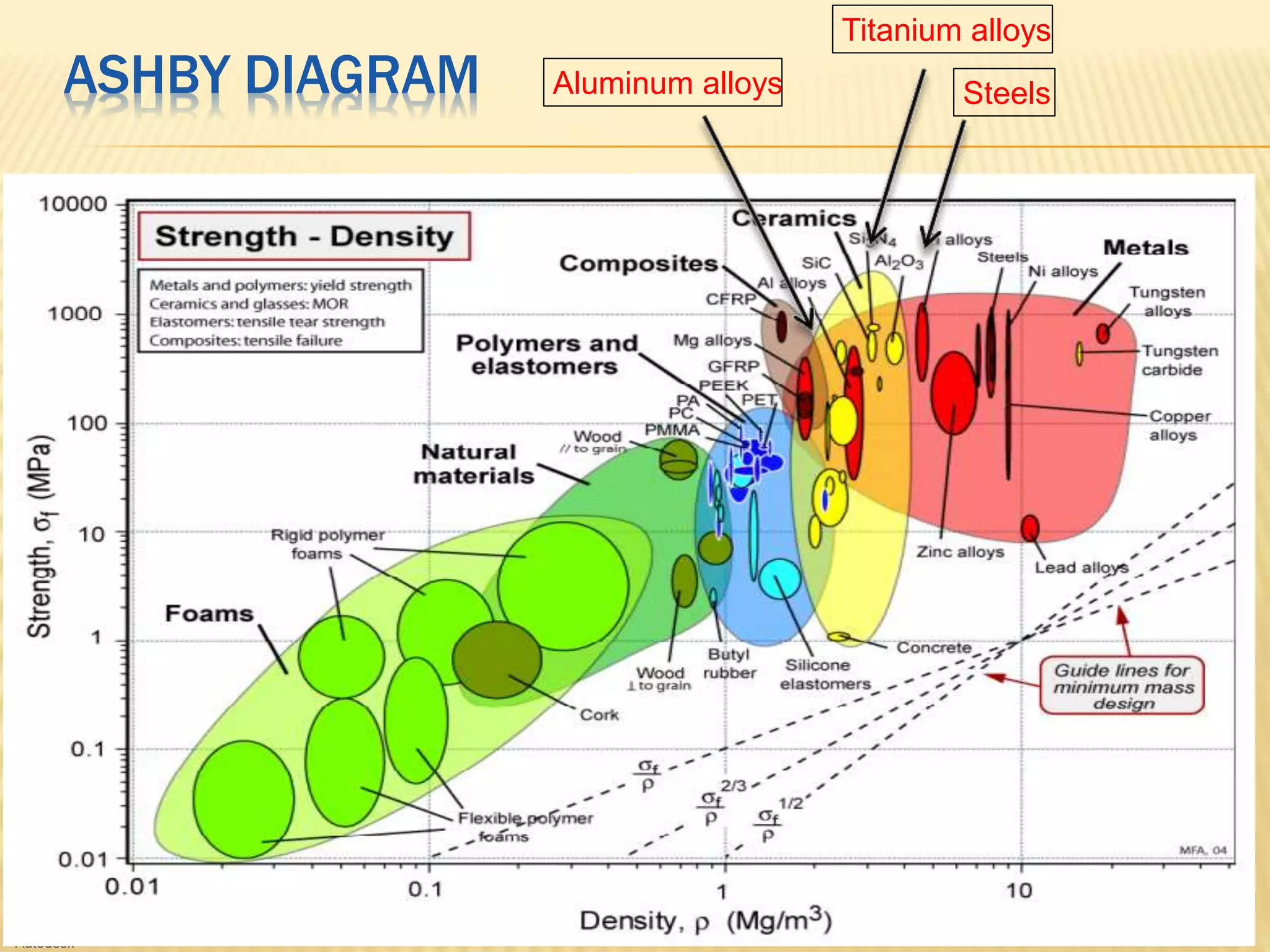
ASHBY DIAGRAM 
© 2013 
Autodesk 
Titanium alloys 
Aluminum alloys Steels
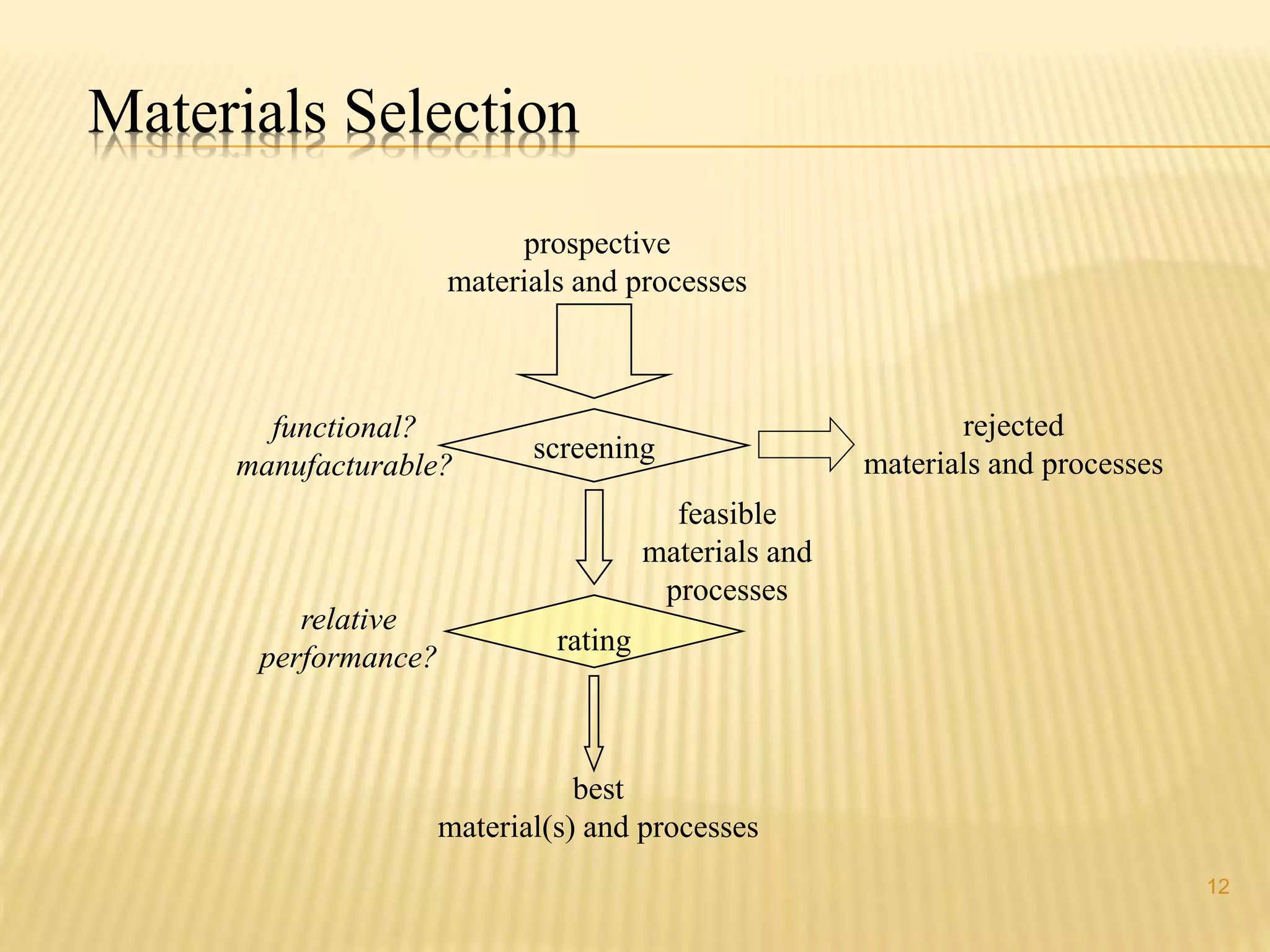
Materials Selection 
12 
prospective 
materials and processes 
screening 
rating 
rejected 
materials and processes 
best 
material(s) and processes 
functional? 
manufacturable? 
relative 
performance? 
feasible 
materials and 
processes
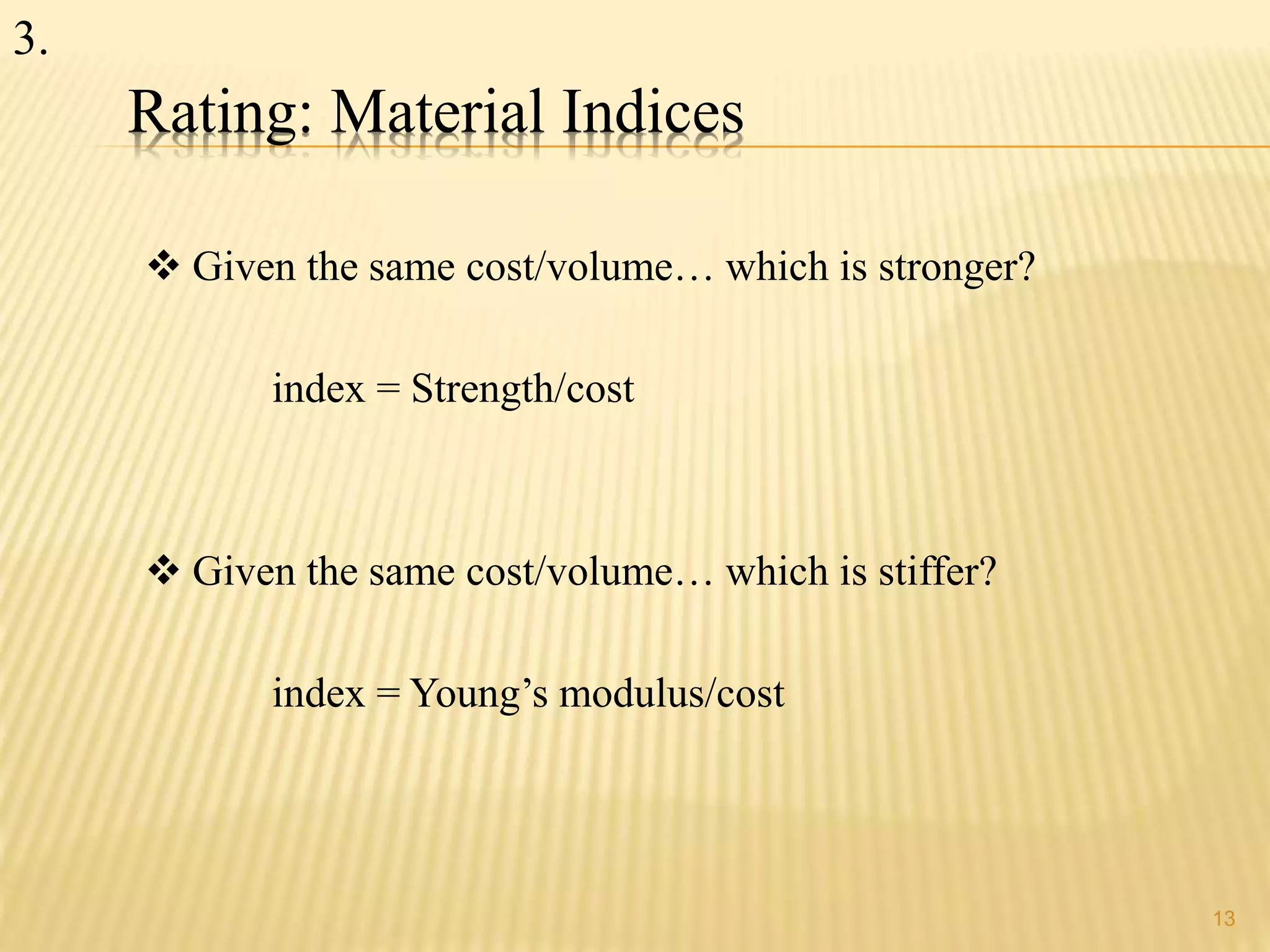
Rating: Material Indices 
 Given the same cost/volume… which is stronger? 
index = Strength/cost 
 Given the same cost/volume… which is stiffer? 
index = Young’s modulus/cost 
13 
3.
Comparing And Ranking Alternatives I 
Weighted Properties Method I 
In this method each material requirement is assigned a certain 
weight, depending on its importance. 
A weighted property value is obtained by multiplying the scaled 
value of the property by the weighting factor (α). 
The weighted property values of each material are then summed to 
give a performance index (γ). The material with the highest 
performance index (γ) is optimum for the application. 
B = scaled property = numerical value of property x 100 
------------------------------------------- 
maximum value in the list 
14
Comparing And Ranking Alternatives I 
Weighted Properties Method II 
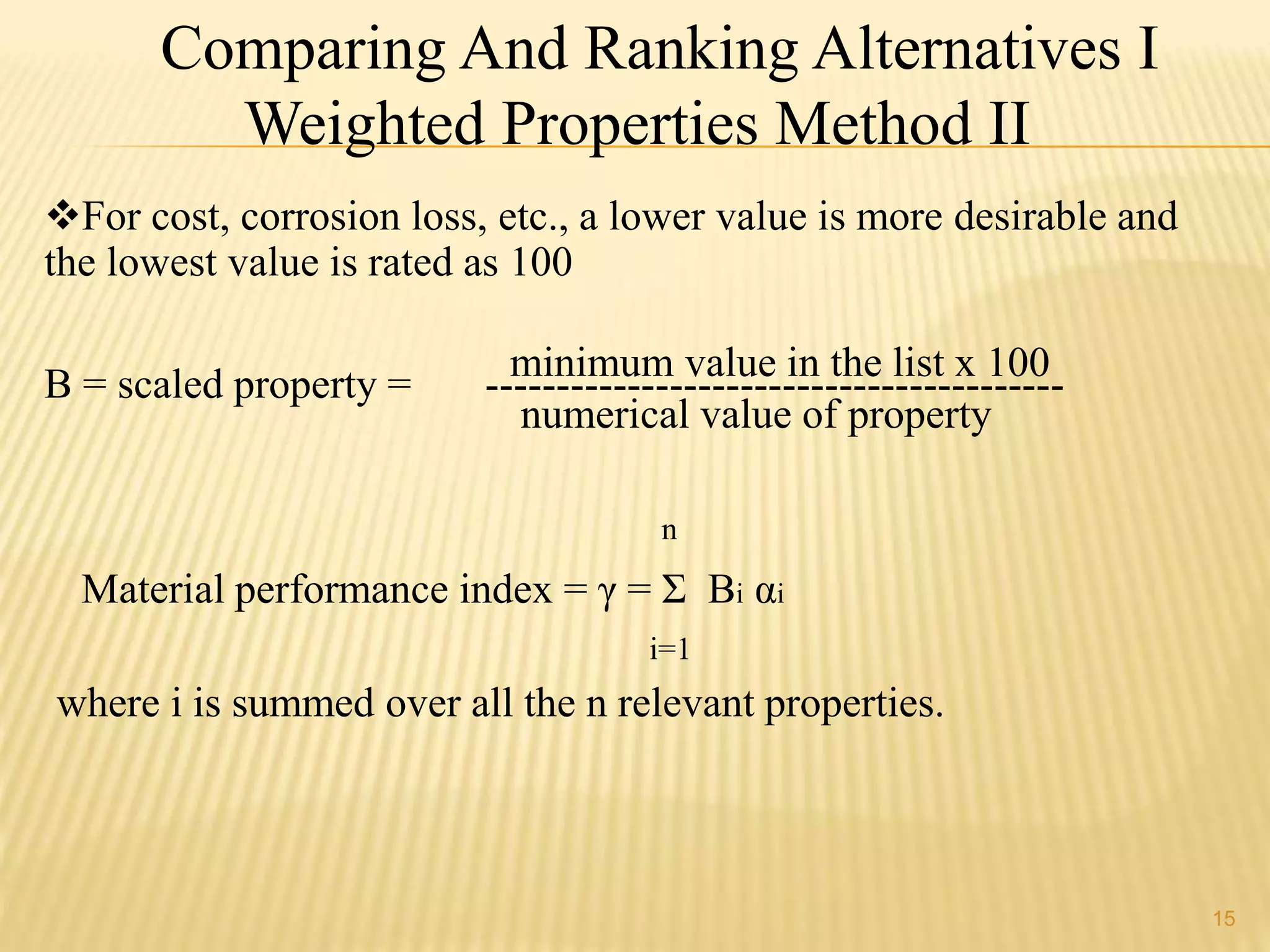
For cost, corrosion loss, etc., a lower value is more desirable and 
the lowest value is rated as 100 
minimum value in the list x 100 
B = scaled property = ----------------------------------------- 
numerical value of property 
n 
Material performance index = γ = Σ Bi αi 
i=1 
where i is summed over all the n relevant properties. 
15
16 
Reaching Final Decision 
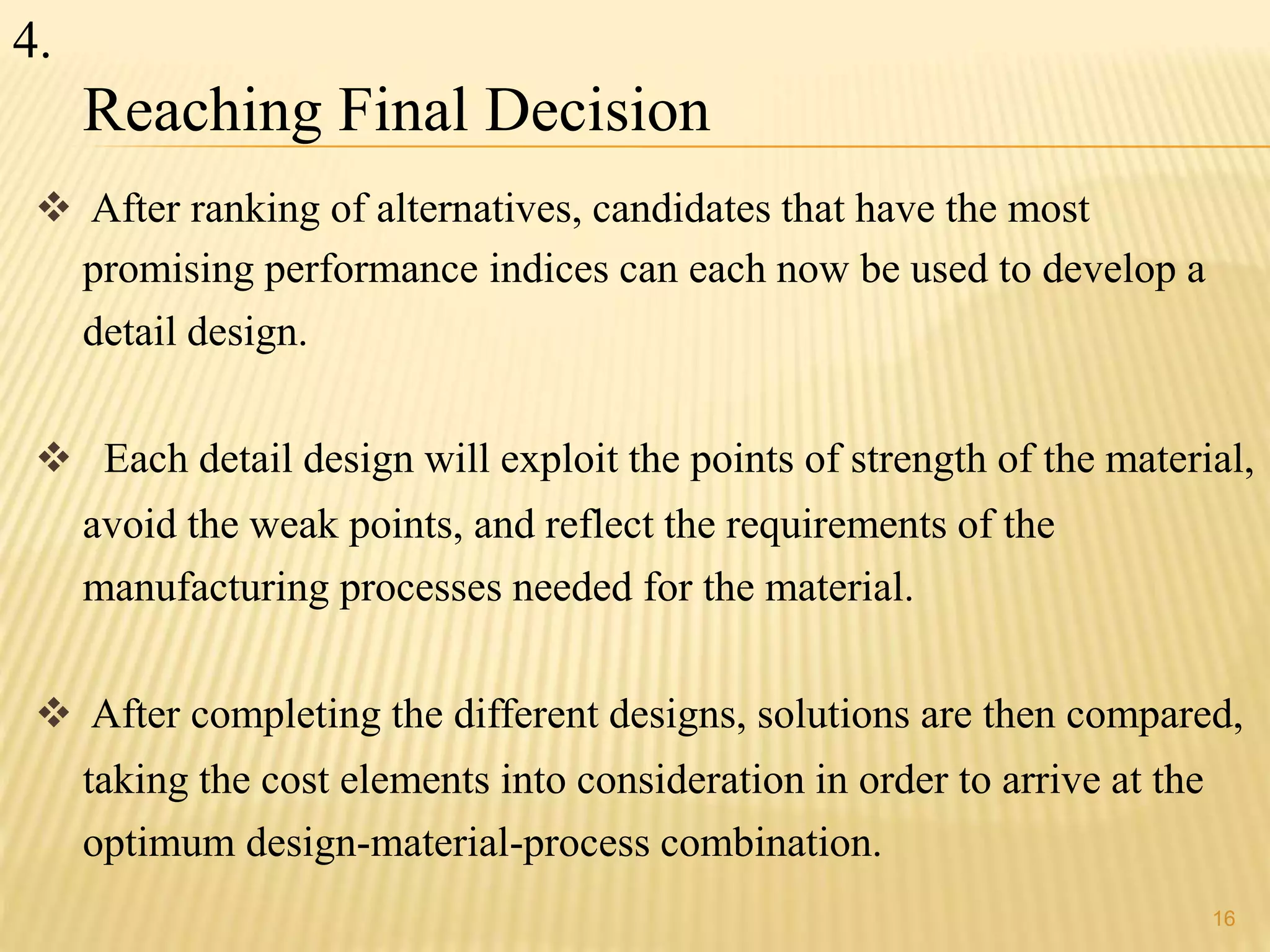
 After ranking of alternatives, candidates that have the most 
promising performance indices can each now be used to develop a 
detail design. 
 Each detail design will exploit the points of strength of the material, 
avoid the weak points, and reflect the requirements of the 
manufacturing processes needed for the material. 
 After completing the different designs, solutions are then compared, 
taking the cost elements into consideration in order to arrive at the 
optimum design-material-process combination. 
4.
17 
Case Study -Selecting A Beam Material For 
Minimum Cost 
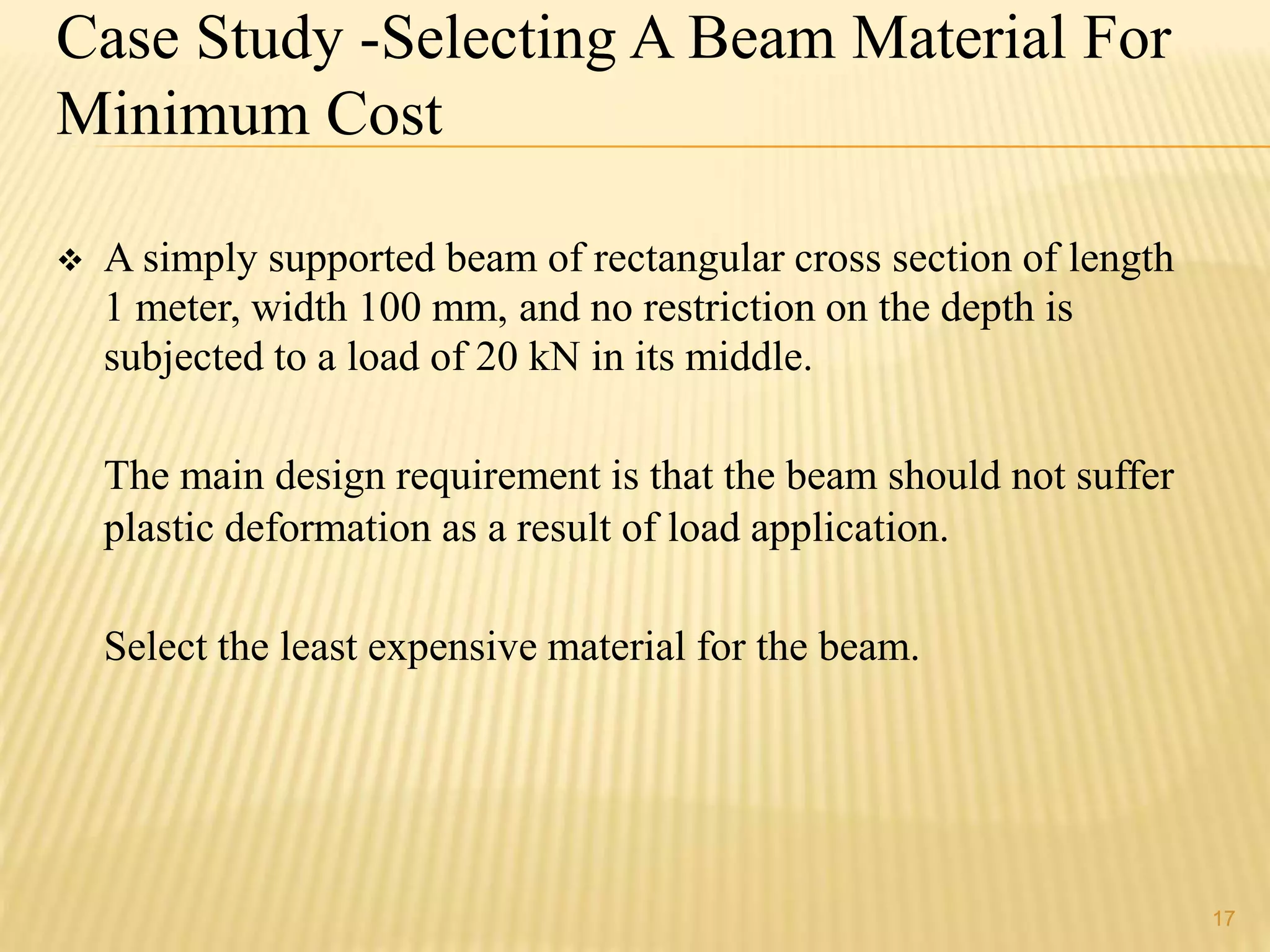
 A simply supported beam of rectangular cross section of length 
1 meter, width 100 mm, and no restriction on the depth is 
subjected to a load of 20 kN in its middle. 
The main design requirement is that the beam should not suffer 
plastic deformation as a result of load application. 
Select the least expensive material for the beam.
18 
Case Study -Selecting A Beam Material For 
Minimum Cost 
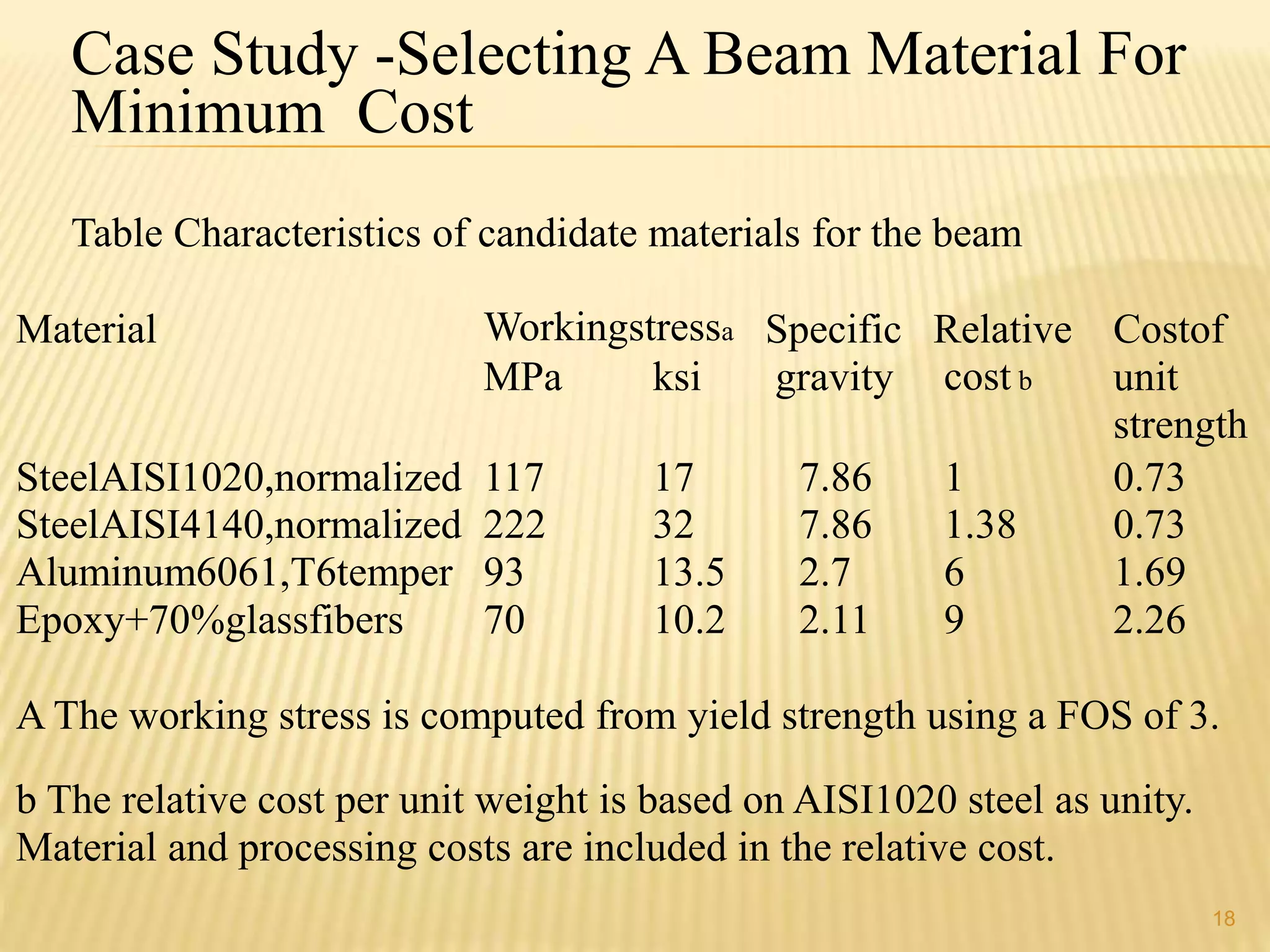
Table Characteristics of candidate materials for the beam 
Material Workingstressa 
Specific Relative 
gravity 
cost b 
Costof 
unit 
strength 
MPa ksi 
SteelAISI1020,normalized 
SteelAISI4140,normalized 
Aluminum6061,T6temper 
Epoxy+70%glassfibers 
117 
222 
93 
70 
17 
32 
13.5 
10.2 
7.86 
7.86 
2.7 
2.11 
1 
1.38 
6 
9 
0.73 
0.73 
1.69 
2.26 
A The working stress is computed from yield strength using a FOS of 3. 
b The relative cost per unit weight is based on AISI1020 steel as unity. 
Material and processing costs are included in the relative cost.
THANK YOU 
19

Material Selection

  • 1.
    THE MATERIALS SELECTION PROCESS S Austin Moses 1
  • 2.
    Goal And Objectives The overall goal of this is to illustrate how systematic selection procedures can be used to select optimum materials and processes for a given component. General Steps In Material Selection : 2 1. Analysis of the performance requirements. 2. Development of alternative solutions to the problem. 3. Evaluation of the different solutions. 4. Decision on the optimum solution.
  • 3.
    Analysis Of MaterialPerformance Requirements The material performance requirements can be divided into 5 broad categories:  Functional requirements  Processability requirements  Cost  Reliability requirements  Resistance to service conditions 3 1.
  • 4.
    Product Function IsInterdependent 4 Material Properties Manufacturing Processes Product Geometry Product Function
  • 5.
    Creating Alternative Solutions Having specified the material requirements, the rest of the selection process involves the search for the material that would best meet those requirements. The starting point is the entire range of engineering materials.  A steel may be the best material for one design concept while a plastic is best for a different concept, even though the two designs provide similar functions. The importance of this phase is that it creates alternatives without much regard to their feasibility. 5 2.
  • 6.
  • 7.
    Screening: How DoWe Choose A Material? Product function depends upon… material, manufacturing process, geometry We have to consider all three  Do we select a few feasible materials first… then select the specific mfg process? OR  Do we select a few feasible mfg processes… then select the specific material? 7
  • 8.
    Screening: Materials FirstApproach Application Information 1. Applied loads magnitude cyclic nature (steady, fatigue) rate (slow, impact) duration (creep) 2. Ambient conditions temperature moisture sunlight chemical liquids/vapors 3. Safety 4. Cost 8
  • 9.
    Screening: Manufacturing ProcessFirst Approach 9 Part Information 1. Production volume 2. Part size (overall) 3. Shape capability (features) boss/depression 1D boss/depression >1D holes undercuts (internal/external) uniform walls cross sections (uniform /regular) rotational symmetry captured cavities
  • 10.
  • 11.
    ASHBY DIAGRAM ©2013 Autodesk Titanium alloys Aluminum alloys Steels
  • 12.
    Materials Selection 12 prospective materials and processes screening rating rejected materials and processes best material(s) and processes functional? manufacturable? relative performance? feasible materials and processes
  • 13.
    Rating: Material Indices  Given the same cost/volume… which is stronger? index = Strength/cost  Given the same cost/volume… which is stiffer? index = Young’s modulus/cost 13 3.
  • 14.
    Comparing And RankingAlternatives I Weighted Properties Method I In this method each material requirement is assigned a certain weight, depending on its importance. A weighted property value is obtained by multiplying the scaled value of the property by the weighting factor (α). The weighted property values of each material are then summed to give a performance index (γ). The material with the highest performance index (γ) is optimum for the application. B = scaled property = numerical value of property x 100 ------------------------------------------- maximum value in the list 14
  • 15.
    Comparing And RankingAlternatives I Weighted Properties Method II For cost, corrosion loss, etc., a lower value is more desirable and the lowest value is rated as 100 minimum value in the list x 100 B = scaled property = ----------------------------------------- numerical value of property n Material performance index = γ = Σ Bi αi i=1 where i is summed over all the n relevant properties. 15
  • 16.
    16 Reaching FinalDecision  After ranking of alternatives, candidates that have the most promising performance indices can each now be used to develop a detail design.  Each detail design will exploit the points of strength of the material, avoid the weak points, and reflect the requirements of the manufacturing processes needed for the material.  After completing the different designs, solutions are then compared, taking the cost elements into consideration in order to arrive at the optimum design-material-process combination. 4.
  • 17.
    17 Case Study-Selecting A Beam Material For Minimum Cost  A simply supported beam of rectangular cross section of length 1 meter, width 100 mm, and no restriction on the depth is subjected to a load of 20 kN in its middle. The main design requirement is that the beam should not suffer plastic deformation as a result of load application. Select the least expensive material for the beam.
  • 18.
    18 Case Study-Selecting A Beam Material For Minimum Cost Table Characteristics of candidate materials for the beam Material Workingstressa Specific Relative gravity cost b Costof unit strength MPa ksi SteelAISI1020,normalized SteelAISI4140,normalized Aluminum6061,T6temper Epoxy+70%glassfibers 117 222 93 70 17 32 13.5 10.2 7.86 7.86 2.7 2.11 1 1.38 6 9 0.73 0.73 1.69 2.26 A The working stress is computed from yield strength using a FOS of 3. b The relative cost per unit weight is based on AISI1020 steel as unity. Material and processing costs are included in the relative cost.
  • 19.