Management
Information System
Meaning of MIS
• Management Information System is a planned,
organized and systematic collection of relevant
accurate, precise and timely information which
are properly processed and supplied to required
persons economically for the purpose of achieving
organized objectives
Definition of MIS
• Walter J . Kennvan defined MIS as, “a formal
method of collecting timely information in a
presentable form in order to facilitate effective
decision making and implementation in order
to carryout organizational operations for the
purpose of achieving the organizational goals”
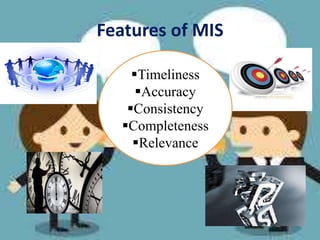
Features of MIS
Timeliness
Accuracy
Consistency
Completeness
Relevance
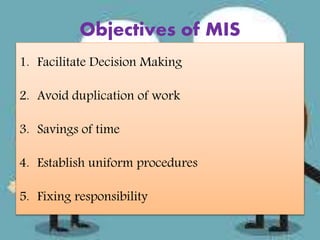
Objectives of MIS
1. Facilitate Decision Making
2. Avoid duplication of work
3. Savings of time
4. Establish uniform procedures
5. Fixing responsibility
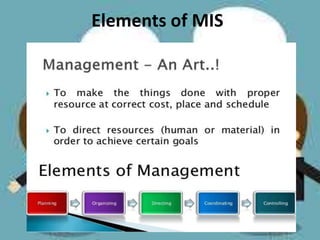
Elements of MIS
System
• System is a functional unit, which involves set of
procedures/functions to produce certain
outputs by processing data/information given
as input. Input Process Output
Areas of MIS
1. Decision Making
2. Planning
3. Control
Importance of MIS
1. Complexity of business operations
2. Size of business unit
3. Changes in economic structure
4. Technological changes
5. Social Changes
6. Determination of training needs
7. Wide use of computer
Factors affecting to MIS
1. Availability
2. Quality
3. Quantity
4. Timeless
1. Availability
• Availability of information refers to more
accurate relevant information. All decisions
are made available information
2.Quality
Quality of information describes its compactness and
accuracy. Decisions are taken only out of quality of
information.
3. Quantity
• To much information cannot be processed very
easily by the management within stipulated time and
difficult to get accurate information.
4.Timeliness
Information must be available when needed.
Sometimes some important decisions can be delayed
due to non-availability of unneccary information
properly in time and opportunity.
Types of Information
1. Operating Information
2. Status Information
3. Resource Information
4. Social Information
5. Planning and Control Information
Contd:
6. Govt. Information
7. Social Information
8. Economic Information
9. Technology Information
10. Complete Information
Designing the MIS
1. Supplies complete, accurate and timely data
2. Identify and quantify inter related operations
3. Measures and control the performance
4. Identify needs of decentralized organization
5. Information in summarized form
6. Flexibility
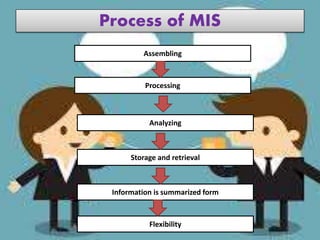
Process of MIS
Assembling
Processing
Analyzing
Storage and retrieval
Information is summarized form
Flexibility
1.Assembing
• It means finding and collection of data and
recorded in a set of files. The well defined
sources of information facilitates the
collection of data.
2.Processing
It means that the data has been summarized ,edited
and proceed. During editing irrelevant and
inaccurate data have been eliminated from the
records
3.Analsing
• Data has been analyzed to develop or
calculate percentages and ratios are providing
useful information to the decision maker.
4.Storage and Retrieval
Indexing, coding, filing and location of
information are coming under the process of
storage. Provisions have been made to quick
relocation of such information and retrieval
when it is necessary.
5.Evaluation
• The determinations of usefulness of information
in terms of accuracy, precise and relevance. The
degree of accuracy, precise and reliance is based
upon the needs of the decision maker.
6. Dissemination
• It means supplying the required information in
the specified format at the right time to the
decision maker
Advantage of MIS
• It improves personal efficiency.
• It expedites problem solving(speed
up the progress of problems solving
in an organization).
• It facilitates interpersonal
communication
• It promotes learning or training.
• It increases organizational control.
•It generates new evidence in support of a
decision.
•It creates a competitive advantage over
competition.
•It encourages exploration and discovery on
the part of the decision maker.
•It reveals new approaches to thinking about
the problem space.
•It helps automate the Managerial processes.
Outputs Of a MIS
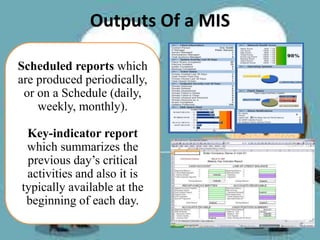
Scheduled reports which
are produced periodically,
or on a Schedule (daily,
weekly, monthly).
Key-indicator report
which summarizes the
previous day’s critical
activities and also it is
typically available at the
beginning of each day.
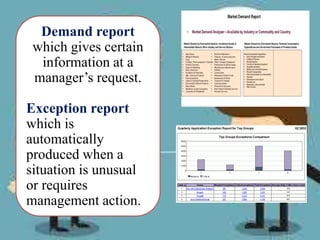
Demand report
which gives certain
information at a
manager’s request.
Exception report
which is
automatically
produced when a
situation is unusual
or requires
management action.
Management information system

Management information system

  • 1.
  • 3.
    Meaning of MIS •Management Information System is a planned, organized and systematic collection of relevant accurate, precise and timely information which are properly processed and supplied to required persons economically for the purpose of achieving organized objectives
  • 4.
    Definition of MIS •Walter J . Kennvan defined MIS as, “a formal method of collecting timely information in a presentable form in order to facilitate effective decision making and implementation in order to carryout organizational operations for the purpose of achieving the organizational goals”
  • 5.
  • 6.
    Objectives of MIS 1.Facilitate Decision Making 2. Avoid duplication of work 3. Savings of time 4. Establish uniform procedures 5. Fixing responsibility
  • 7.
  • 10.
    System • System isa functional unit, which involves set of procedures/functions to produce certain outputs by processing data/information given as input. Input Process Output
  • 11.
    Areas of MIS 1.Decision Making 2. Planning 3. Control
  • 12.
    Importance of MIS 1.Complexity of business operations 2. Size of business unit 3. Changes in economic structure 4. Technological changes 5. Social Changes 6. Determination of training needs 7. Wide use of computer
  • 13.
    Factors affecting toMIS 1. Availability 2. Quality 3. Quantity 4. Timeless
  • 14.
    1. Availability • Availabilityof information refers to more accurate relevant information. All decisions are made available information 2.Quality Quality of information describes its compactness and accuracy. Decisions are taken only out of quality of information.
  • 15.
    3. Quantity • Tomuch information cannot be processed very easily by the management within stipulated time and difficult to get accurate information. 4.Timeliness Information must be available when needed. Sometimes some important decisions can be delayed due to non-availability of unneccary information properly in time and opportunity.
  • 16.
    Types of Information 1.Operating Information 2. Status Information 3. Resource Information 4. Social Information 5. Planning and Control Information
  • 17.
    Contd: 6. Govt. Information 7.Social Information 8. Economic Information 9. Technology Information 10. Complete Information
  • 18.
    Designing the MIS 1.Supplies complete, accurate and timely data 2. Identify and quantify inter related operations 3. Measures and control the performance 4. Identify needs of decentralized organization 5. Information in summarized form 6. Flexibility
  • 19.
    Process of MIS Assembling Processing Analyzing Storageand retrieval Information is summarized form Flexibility
  • 20.
    1.Assembing • It meansfinding and collection of data and recorded in a set of files. The well defined sources of information facilitates the collection of data. 2.Processing It means that the data has been summarized ,edited and proceed. During editing irrelevant and inaccurate data have been eliminated from the records
  • 21.
    3.Analsing • Data hasbeen analyzed to develop or calculate percentages and ratios are providing useful information to the decision maker. 4.Storage and Retrieval Indexing, coding, filing and location of information are coming under the process of storage. Provisions have been made to quick relocation of such information and retrieval when it is necessary.
  • 22.
    5.Evaluation • The determinationsof usefulness of information in terms of accuracy, precise and relevance. The degree of accuracy, precise and reliance is based upon the needs of the decision maker. 6. Dissemination • It means supplying the required information in the specified format at the right time to the decision maker
  • 23.
    Advantage of MIS •It improves personal efficiency. • It expedites problem solving(speed up the progress of problems solving in an organization). • It facilitates interpersonal communication • It promotes learning or training. • It increases organizational control.
  • 24.
    •It generates newevidence in support of a decision. •It creates a competitive advantage over competition. •It encourages exploration and discovery on the part of the decision maker. •It reveals new approaches to thinking about the problem space. •It helps automate the Managerial processes.
  • 25.
    Outputs Of aMIS Scheduled reports which are produced periodically, or on a Schedule (daily, weekly, monthly). Key-indicator report which summarizes the previous day’s critical activities and also it is typically available at the beginning of each day.
  • 26.
    Demand report which givescertain information at a manager’s request. Exception report which is automatically produced when a situation is unusual or requires management action.