COMMUNITY HEALTH NURSING
TOPIC :- MANAGEMENT INFORMATION SYSTEM
BY :- MISS HARLEEN KARWAL
Introduction
Management Information System is a computer based information
system which is basically concerned with processing data into
information which is then communicated to the various departments in
an organization to support the operations, the management & the
decision making function in the organization.
Define :- Management Information System
Management Information System broadly refers to a
computer based system that provides managers with the
tools to organize , evaluate & efficiently manage
departments within an organization.
1) MANAGEMENT :-Management is the effective utilization of
human & material resources to achieve the objectives. It is a process
consisting of the 5 basic functions:-
* Planning * Directing *Controlling
* Organizing * Staffing
2) INFORMATION :- Information means the processed data that
helps the management in planning, controlling & operations.
3) SYSTEM :- A system is an orderly grouping of interdependent
components linked together according to a plan to achieve a specific
objective. E.g :- Human body is composed of various parts , which
are working together towards a common objectives, that is to live.
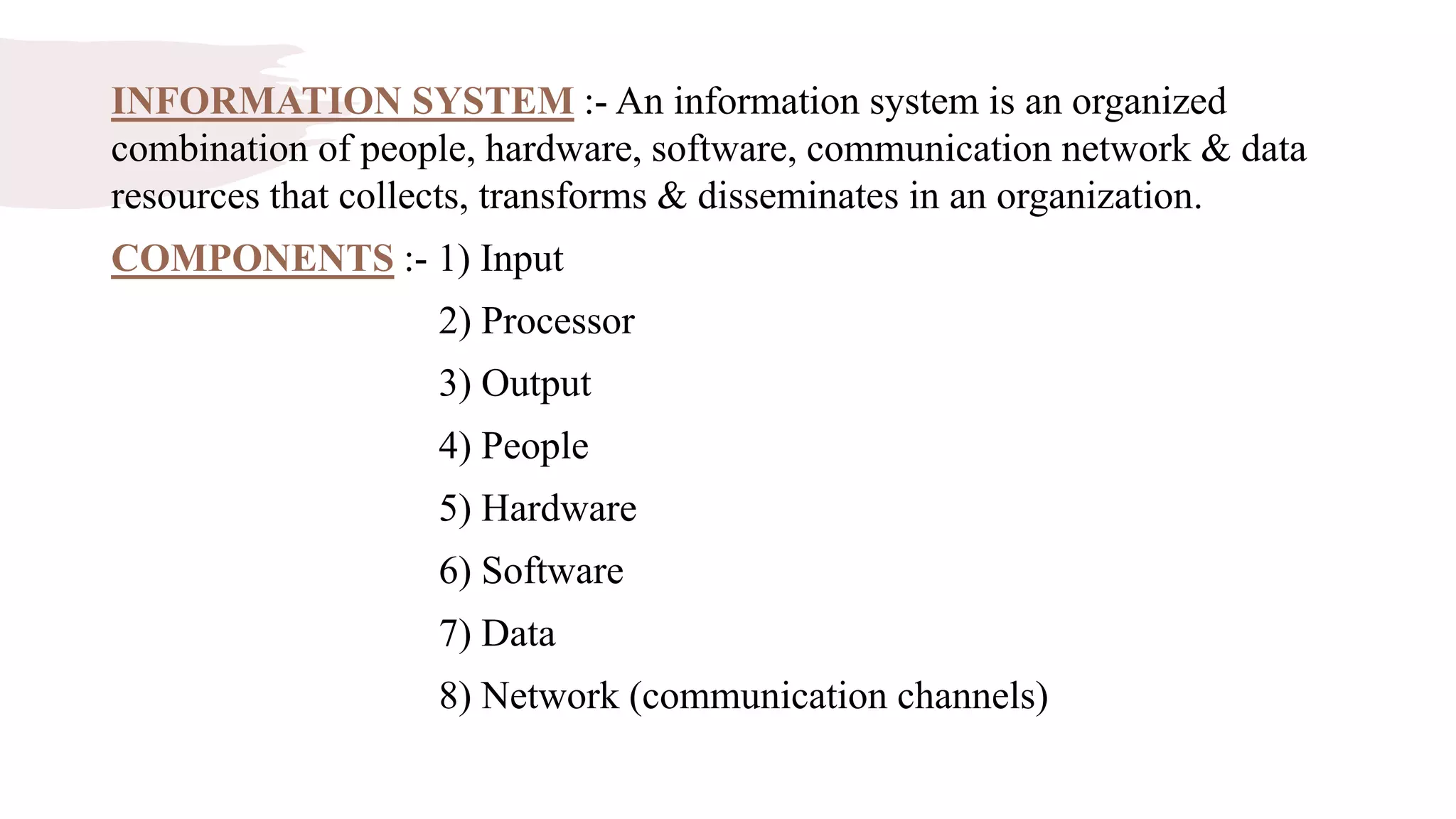
INFORMATION SYSTEM :- An information system is an organized
combination of people, hardware, software, communication network & data
resources that collects, transforms & disseminates in an organization.
COMPONENTS :- 1) Input
2) Processor
3) Output
4) People
5) Hardware
6) Software
7) Data
8) Network (communication channels)
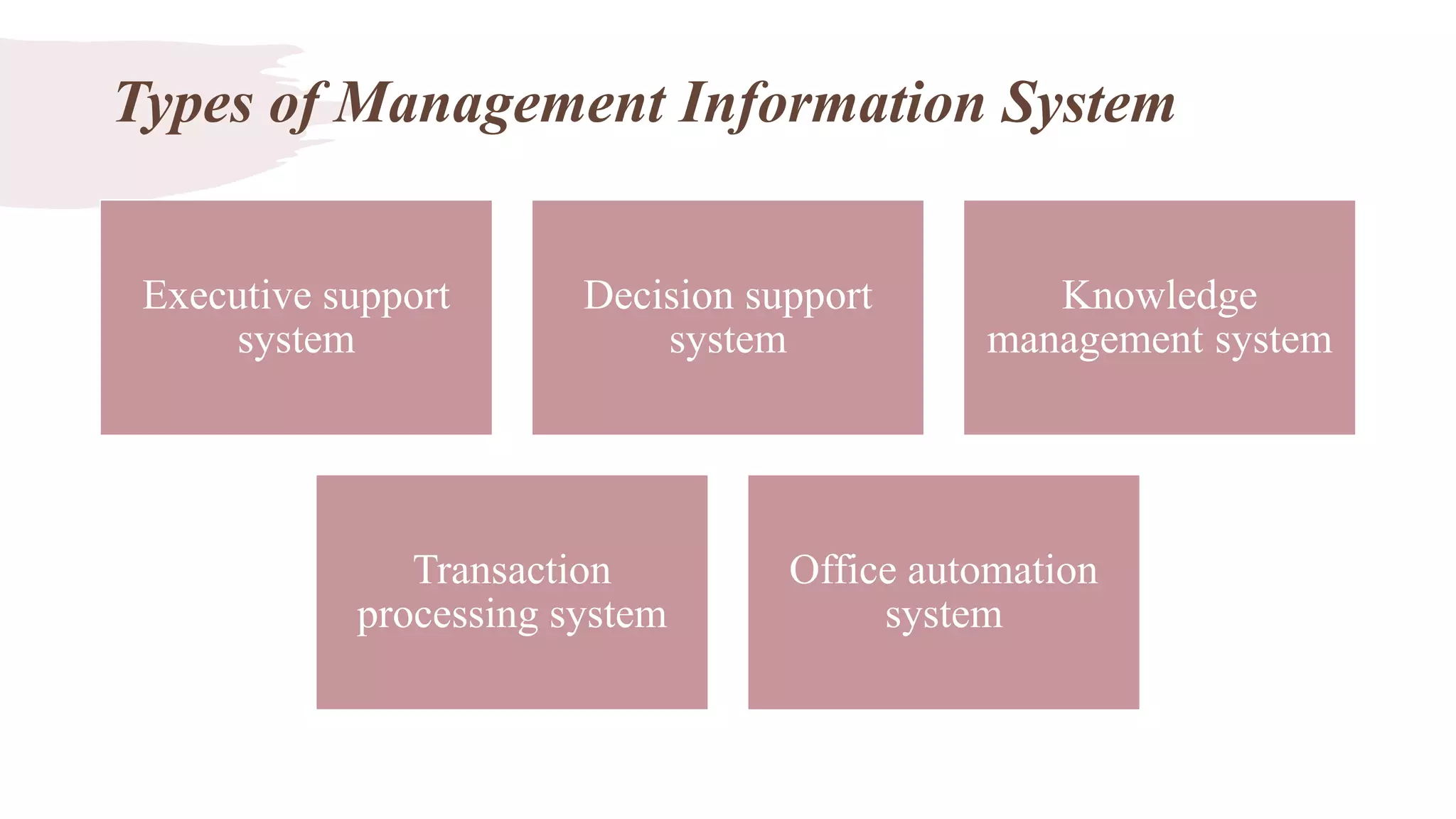
Types of Management Information System
Executive support
system
Decision support
system
Knowledge
management system
Transaction
processing system
Office automation
system
Types of Management Information System
1. Executive supportive system involve lots of data analysis &
modelling tools to help senior management make strategic decisions.
2. Decision support system specially designed to help management
make decisions in situation where there is uncertainty about the
possible outcomes of those decisions.
3. Knowledge management system are used in a business where
employees create new knowledge – which can then be shared by
other people in an organization to create further commercial
opportunities.
4) Transaction processing system designed to process routine
transactions efficiently. These systems are used by managers to deal
with such tasks as payroll, payments to suppliers.
5) Office automation system is used to improve the productivity of
employees who need to process data & information. E.g :-Microsoft
office XP
CHARACTERISTICS OF MANAGEMENT
INFORMATION SYSTEM (MIS)
Information used as a resource
Common Database
Management
Oriented
Computerized
Management
Directed
Characteristics of MIS
1. Information used as a resource :- It is the major ingredient of any
MIS.
2. Computerized :- Increases the efficiency & effectiveness of the
system.
3. Common Database :- Basic feature to achieve the objective of using
MIS in business organization.
4. Management oriented :- Provide information support to the
management for decision – making.
5. Management Directed :- It should be directed by management,
because it is the management who tells their needs & requirements
more effectively than anyone else.
BENEFITS OF MIS
• Data can easily be assessed & analyzed without time consuming
manipulation & processing.
• Decisions can be made more quickly with confidence.
• Significant cost benefits, time savings & productivity gains.
• Speed up the progress of problem solving in an organization.
• It facilitates interpersonal communication.
• Promotes learning.
• Increases organizational control.
STEPS IN MIS DEVELOPMENT
Preliminary
Investigation
Requirement
Analysis
Systems
Design
Procurement
Implementation/Installation
STEPS IN MIS DEVELOPMENT
Preliminary Investigation
• The problem
• Magnitude & scope
• Alternatives
• Viability & cost effectiveness
Requirements Analysis
• Knowing the primary & secondary users
• Ascertaining user needs
• Primary & secondary sources of information
• Design , development & implementation needs
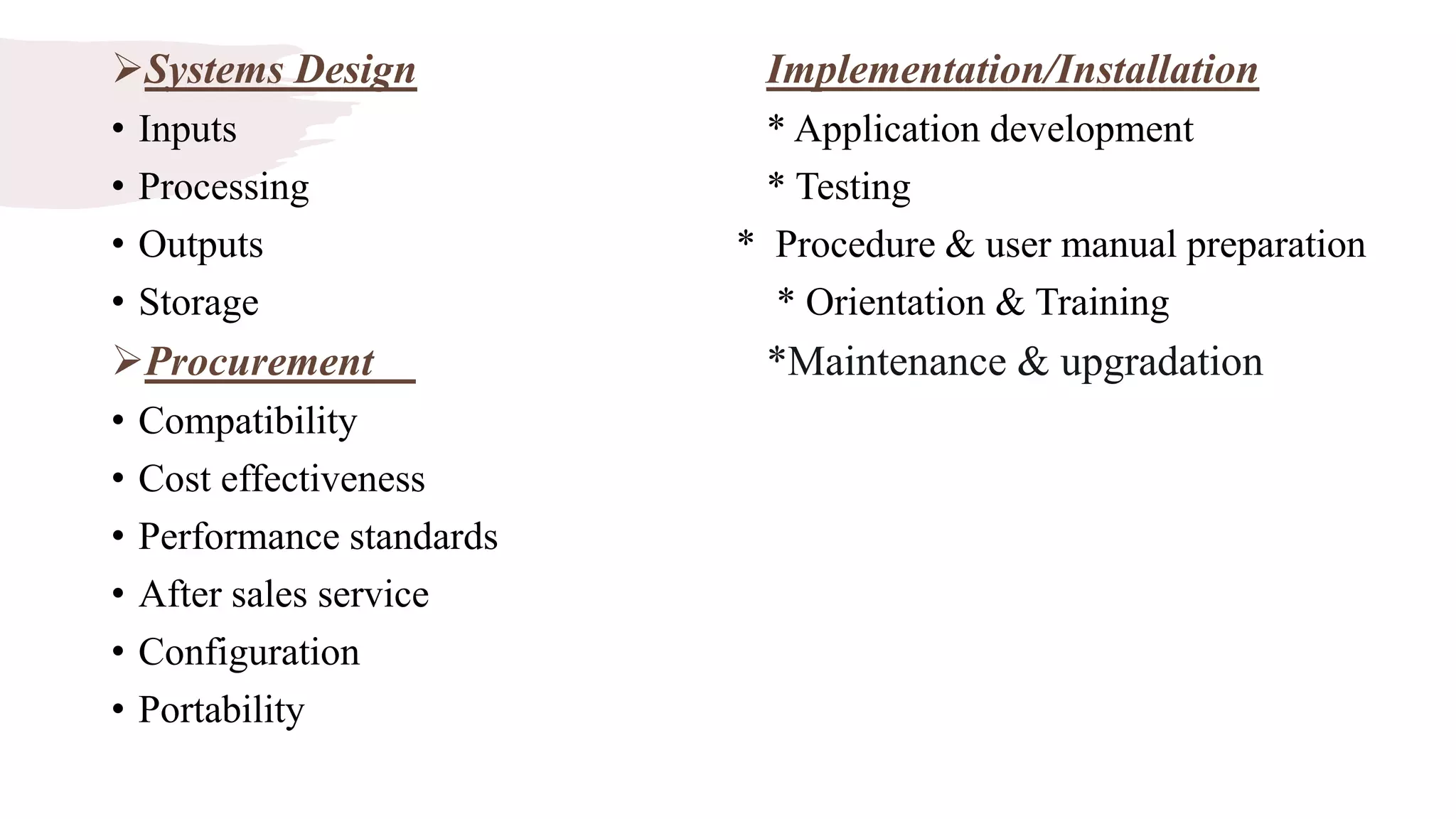
Systems Design Implementation/Installation
• Inputs * Application development
• Processing * Testing
• Outputs * Procedure & user manual preparation
• Storage * Orientation & Training
Procurement *Maintenance & upgradation
• Compatibility
• Cost effectiveness
• Performance standards
• After sales service
• Configuration
• Portability
Role of MIS coordinator in developing a MIS
 Interact with user groups
 Identify the needs of users of MIS
 Designing of reporting formats
 Ensure smooth flow of information within & outside of organization
 Time Management
 Identify training needs of staff in MIS
 Organizing monthly/periodic meetings to assess performance &
follow-up on decisions.
 Interface with the various division in the organization for information
sharing.
Components of a MIS in a not for profit organization
• A database to record transactions of the different units within the NGO with
their client system to record all interactions in key functions of the
organization.
• A work plan application to enable people to plan their activities.
• A performance measurement application to report the progress of the
activities.
• Financial information system to query, view & modify activity related
information & finances.
• Documentation & information resource system
• Personnel information system
These needs to be compatible & built on the existing system to minimize
costs & time of the staff .

Management information system

  • 1.
    COMMUNITY HEALTH NURSING TOPIC:- MANAGEMENT INFORMATION SYSTEM BY :- MISS HARLEEN KARWAL
  • 2.
    Introduction Management Information Systemis a computer based information system which is basically concerned with processing data into information which is then communicated to the various departments in an organization to support the operations, the management & the decision making function in the organization.
  • 3.
    Define :- ManagementInformation System Management Information System broadly refers to a computer based system that provides managers with the tools to organize , evaluate & efficiently manage departments within an organization.
  • 4.
    1) MANAGEMENT :-Managementis the effective utilization of human & material resources to achieve the objectives. It is a process consisting of the 5 basic functions:- * Planning * Directing *Controlling * Organizing * Staffing 2) INFORMATION :- Information means the processed data that helps the management in planning, controlling & operations. 3) SYSTEM :- A system is an orderly grouping of interdependent components linked together according to a plan to achieve a specific objective. E.g :- Human body is composed of various parts , which are working together towards a common objectives, that is to live.
  • 5.
    INFORMATION SYSTEM :-An information system is an organized combination of people, hardware, software, communication network & data resources that collects, transforms & disseminates in an organization. COMPONENTS :- 1) Input 2) Processor 3) Output 4) People 5) Hardware 6) Software 7) Data 8) Network (communication channels)
  • 6.
    Types of ManagementInformation System Executive support system Decision support system Knowledge management system Transaction processing system Office automation system
  • 7.
    Types of ManagementInformation System 1. Executive supportive system involve lots of data analysis & modelling tools to help senior management make strategic decisions. 2. Decision support system specially designed to help management make decisions in situation where there is uncertainty about the possible outcomes of those decisions. 3. Knowledge management system are used in a business where employees create new knowledge – which can then be shared by other people in an organization to create further commercial opportunities.
  • 8.
    4) Transaction processingsystem designed to process routine transactions efficiently. These systems are used by managers to deal with such tasks as payroll, payments to suppliers. 5) Office automation system is used to improve the productivity of employees who need to process data & information. E.g :-Microsoft office XP
  • 9.
    CHARACTERISTICS OF MANAGEMENT INFORMATIONSYSTEM (MIS) Information used as a resource Common Database Management Oriented Computerized Management Directed
  • 10.
    Characteristics of MIS 1.Information used as a resource :- It is the major ingredient of any MIS. 2. Computerized :- Increases the efficiency & effectiveness of the system. 3. Common Database :- Basic feature to achieve the objective of using MIS in business organization. 4. Management oriented :- Provide information support to the management for decision – making. 5. Management Directed :- It should be directed by management, because it is the management who tells their needs & requirements more effectively than anyone else.
  • 11.
    BENEFITS OF MIS •Data can easily be assessed & analyzed without time consuming manipulation & processing. • Decisions can be made more quickly with confidence. • Significant cost benefits, time savings & productivity gains. • Speed up the progress of problem solving in an organization. • It facilitates interpersonal communication. • Promotes learning. • Increases organizational control.
  • 12.
    STEPS IN MISDEVELOPMENT Preliminary Investigation Requirement Analysis Systems Design Procurement Implementation/Installation
  • 13.
    STEPS IN MISDEVELOPMENT Preliminary Investigation • The problem • Magnitude & scope • Alternatives • Viability & cost effectiveness Requirements Analysis • Knowing the primary & secondary users • Ascertaining user needs • Primary & secondary sources of information • Design , development & implementation needs
  • 14.
    Systems Design Implementation/Installation •Inputs * Application development • Processing * Testing • Outputs * Procedure & user manual preparation • Storage * Orientation & Training Procurement *Maintenance & upgradation • Compatibility • Cost effectiveness • Performance standards • After sales service • Configuration • Portability
  • 15.
    Role of MIScoordinator in developing a MIS  Interact with user groups  Identify the needs of users of MIS  Designing of reporting formats  Ensure smooth flow of information within & outside of organization  Time Management  Identify training needs of staff in MIS  Organizing monthly/periodic meetings to assess performance & follow-up on decisions.  Interface with the various division in the organization for information sharing.
  • 16.
    Components of aMIS in a not for profit organization • A database to record transactions of the different units within the NGO with their client system to record all interactions in key functions of the organization. • A work plan application to enable people to plan their activities. • A performance measurement application to report the progress of the activities. • Financial information system to query, view & modify activity related information & finances. • Documentation & information resource system • Personnel information system These needs to be compatible & built on the existing system to minimize costs & time of the staff .