‫الرحيم‬ ‫الرحمن‬ ‫ال‬ ‫بسم‬‫الرحيم‬ ‫الرحمن‬ ‫ال‬ ‫بسم‬
Mandibular first premolarMandibular first premolar
chronologychronology
 11stst
evidence of calcification: 1 ¾ : 2 yearsevidence of calcification: 1 ¾ : 2 years
 Crown completed: 5-6 yearsCrown completed: 5-6 years
 Eruption: 10-12 yearsEruption: 10-12 years
 Root completed:12-13 yearsRoot completed:12-13 years
Characteristics which resemble theCharacteristics which resemble the
mandibular caninemandibular canine
11--The buccal cusp is long and sharp. It isThe buccal cusp is long and sharp. It is
the only occluding cuspthe only occluding cusp..
22--the B L measurement is similar to thatthe B L measurement is similar to that
of mand canineof mand canine..
33--The occlusal surface slopes linguallyThe occlusal surface slopes lingually..
44--the outline from occlusal aspectthe outline from occlusal aspect
resembles the outline from incisalresembles the outline from incisal
aspect of mand canineaspect of mand canine
44--the mesio buccal cusp ridge is shorterthe mesio buccal cusp ridge is shorter
than the disto buccal cusp ridgethan the disto buccal cusp ridge..
Characteristics which resemble theCharacteristics which resemble the
mand 2nd premolarmand 2nd premolar
 1-the outline of crown and root resembles that1-the outline of crown and root resembles that
of mand 2nd premolar from the buccal aspect.of mand 2nd premolar from the buccal aspect.
 2- M and D contact areas are nearly at the2- M and D contact areas are nearly at the
same levelsame level
 3- curvature of cervical line mesially and3- curvature of cervical line mesially and
distally are the same.distally are the same.
 4-it has more than one cusp.4-it has more than one cusp.
Buccal aspectBuccal aspect
* the crown is roughly trapezoidal (the shorter* the crown is roughly trapezoidal (the shorter
being at the cervix)being at the cervix)
**mesial contact area is straight or slightly concavemesial contact area is straight or slightly concave
from cervical line till the M CAfrom cervical line till the M CA
**M contact area is broad and and present justM contact area is broad and and present just
cervical to the junction of the mid and occ thirdcervical to the junction of the mid and occ third..
**D outline is slightly concave from the cervicalD outline is slightly concave from the cervical
line till the area of contactline till the area of contact
**CA distally is broader than mesially and presentCA distally is broader than mesially and present
just cervical to the junction of the mid and occjust cervical to the junction of the mid and occ
third ( CAs at the same levelthird ( CAs at the same level((
**M slope is shorter than the distal slope and the tipM slope is shorter than the distal slope and the tip
of the buccal cusp is mesial to the center of theof the buccal cusp is mesial to the center of the
crown. It is pointedcrown. It is pointed..
 M slope has shown some concavityM slope has shown some concavity
while distal slope usually showswhile distal slope usually shows
concavityconcavity
 Cervical line is convex root wiseCervical line is convex root wise
 Crown is narrower MD at the cervixCrown is narrower MD at the cervix
when compared with the MD width atwhen compared with the MD width at
the CAthe CA
 B surface is more convex than that ofB surface is more convex than that of
max premolars specially at the cervicalmax premolars specially at the cervical
and mid third.and mid third.
 B ridge is well developed andB ridge is well developed and
extend from cervical third to theextend from cervical third to the
cusp tip.cusp tip.
 Developmental depressions areDevelopmental depressions are
seen between the 3 lobes.seen between the 3 lobes.
 Root is shorter than that ofRoot is shorter than that of
mand canine by 3-4 mmmand canine by 3-4 mm
 B surface of the root is smoothB surface of the root is smooth
and convexand convex
 Root tapers and has pointedRoot tapers and has pointed
apex.apex.
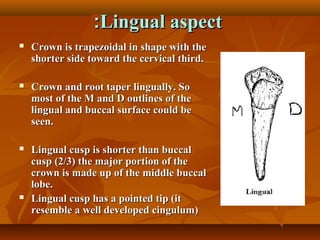
Lingual aspectLingual aspect::
 Crown is trapezoidal in shape with theCrown is trapezoidal in shape with the
shorter side toward the cervical third.shorter side toward the cervical third.
 Crown and root taper lingually. SoCrown and root taper lingually. So
most of the M and D outlines of themost of the M and D outlines of the
lingual and buccal surface could belingual and buccal surface could be
seen.seen.
 Lingual cusp is shorter than buccalLingual cusp is shorter than buccal
cusp (2/3) the major portion of thecusp (2/3) the major portion of the
crown is made up of the middle buccalcrown is made up of the middle buccal
lobe.lobe.
 Lingual cusp has a pointed tip (itLingual cusp has a pointed tip (it
resemble a well developed cingulum)resemble a well developed cingulum)
 Lingual cusp is on a line with theLingual cusp is on a line with the
buccal triangular ridge.buccal triangular ridge.
 The ML dev groove divides the lingualThe ML dev groove divides the lingual
cusp into 2 parts (lobes) smaller oncusp into 2 parts (lobes) smaller on
the mesial side , larger on the distalthe mesial side , larger on the distal
side.side.
 2 dev grooves on the M and D side2 dev grooves on the M and D side
making the mesial and distal fossamaking the mesial and distal fossa
( no triangular fossa since the shape is( no triangular fossa since the shape is
not triangular)not triangular)
 The CA and MRs are pronounced .The CA and MRs are pronounced .
the CA are broad.the CA are broad.
 Cervical portion of the crown isCervical portion of the crown is
narrow and convex.narrow and convex.
 Roots tapers lingually andRoots tapers lingually and
there is a narrow ridge w isthere is a narrow ridge w is
smooth and convex. This allowsmooth and convex. This allow
the M and d surface to be seen.the M and d surface to be seen.
 Root tapers from the cervix toRoot tapers from the cervix to
the pointed apex.the pointed apex.
 The occ surface slopes towardThe occ surface slopes toward
the lingual side . most of thethe lingual side . most of the
occ surface of this tooth can beocc surface of this tooth can be
seen from this aspect. Theseen from this aspect. The
cervical line is convex rootcervical line is convex root
wise.wise.
Mesial aspectMesial aspect
 Crown outline is rhomboidal in shapeCrown outline is rhomboidal in shape
 Buccal outline of the crown is convexBuccal outline of the crown is convex
from cervical line till the cusp tip.from cervical line till the cusp tip.
 Crest of curvature is present justCrest of curvature is present just
below the junction of the mid andbelow the junction of the mid and
cervical third.cervical third.
 The lingual outline (represented byThe lingual outline (represented by
the lingual cusp) is convex from thethe lingual cusp) is convex from the
cervical line till the tip of the cusp.cervical line till the tip of the cusp.
(the convexity is less than the buccal(the convexity is less than the buccal
outline).outline).
 The crest of curvature linguallyThe crest of curvature lingually
approaches the mid third of theapproaches the mid third of the
crown.crown.
 The tip of the buccal cusp is centeredThe tip of the buccal cusp is centered
over the root. It may be a little buccalover the root. It may be a little buccal
to the center.to the center.
 On the other hand, the tip of theOn the other hand, the tip of the
lingual cusp is on a line with thelingual cusp is on a line with the
lingual border of the root.lingual border of the root.
 It must be noted that the crest ofIt must be noted that the crest of
curvature of the lingual surface is outcurvature of the lingual surface is out
of the lingual outline of the root. ( theof the lingual outline of the root. ( the
convexity of the lingual outline of theconvexity of the lingual outline of the
lingual lobe is lingual to the linguallingual lobe is lingual to the lingual
outline of the root).outline of the root).
 The lingual cusp is 2/3 of the buccalThe lingual cusp is 2/3 of the buccal
cusp, so the buccal cusp is the onlycusp, so the buccal cusp is the only
occluding cusp.occluding cusp.
 Cervical line is concave root wise. ItCervical line is concave root wise. It
is regular with average 1 mm depth.is regular with average 1 mm depth.
 The mesial marginal ridge is parallelThe mesial marginal ridge is parallel
to the buccal triangular ridge.to the buccal triangular ridge.
 On the mesiolingual lobe there is aOn the mesiolingual lobe there is a
depression (DD) . this depressiondepression (DD) . this depression
harbors the mesiolingual dev groove.harbors the mesiolingual dev groove.
 The mesial surface of the crown isThe mesial surface of the crown is
smooth except for the mesiolingualsmooth except for the mesiolingual
dev groove,(MLDG).dev groove,(MLDG).
 At the mesial CA , the surface isAt the mesial CA , the surface is
convex , below the CA , the surfaceconvex , below the CA , the surface
is concave till the cervical line.is concave till the cervical line.
 The root outline from the mesialThe root outline from the mesial
aspect is parallel till the apical 1/3 ,aspect is parallel till the apical 1/3 ,
then it tapers giving a pointed apexthen it tapers giving a pointed apex
(lined with the buccal cusp).(lined with the buccal cusp).
 The mesial surface of the root isThe mesial surface of the root is
smooth till the mid third except forsmooth till the mid third except for
the presence of a deep DG.the presence of a deep DG.
 The root may be bifurcated in thisThe root may be bifurcated in this
area.area.
Distal aspectDistal aspect
 Distal surface is the reverseDistal surface is the reverse
picture of mesial one withpicture of mesial one with
some differences:some differences:
 DMR is higher above theDMR is higher above the
cervixcervix
 It does not slope linguallyIt does not slope lingually
but it is horizontal andbut it is horizontal and
perpendicular to the axisperpendicular to the axis
of crown and root.of crown and root.
 DMR is confluent with theDMR is confluent with the
lingual cusp ridgelingual cusp ridge
 No DLDGNo DLDG
 Curvature of cervical line mesially is less thanCurvature of cervical line mesially is less than
distallydistally
 CA are broader distally than mesiallyCA are broader distally than mesially
 Distal surface of the root exhibits moreDistal surface of the root exhibits more
convexityconvexity
 A shallow DD is centered on the root but itA shallow DD is centered on the root but it
does not contain deep DG.does not contain deep DG.
Occlusal surfaceOcclusal surface
 Occ aspect may be diamond orOcc aspect may be diamond or
circular in shapecircular in shape
 The mand 1st premolars haveThe mand 1st premolars have
similar characteristics whensimilar characteristics when
viewed from the occ aspect eitherviewed from the occ aspect either
it was diamond or circular.it was diamond or circular.
 1- mid buccal lobe make the1- mid buccal lobe make the
greatest bulk of the toothgreatest bulk of the tooth
 2-buccal ridge is prominent2-buccal ridge is prominent
 3- MB and DB line angles are3- MB and DB line angles are
rounded (MB& DB)rounded (MB& DB)
 4-D and M contact areas are4-D and M contact areas are
broad ( Distal is broader)broad ( Distal is broader)
 Crown converge sharpely to theCrown converge sharpely to the
lingual surfacelingual surface
 Lingual cusp is smallerLingual cusp is smaller
 MR are well developedMR are well developed
 B triangular ridge is heavy whileB triangular ridge is heavy while
lingual triangular ridge is smalllingual triangular ridge is small
 On the occ surface there are 2On the occ surface there are 2
depressions:depressions:
 Mesial (linear) fossa and distalMesial (linear) fossa and distal
(circular fossa)(circular fossa)
 M fossa harbors a groove calledM fossa harbors a groove called
mesial DG. It is linear in shape.mesial DG. It is linear in shape.
 D fossa harbors another crescentricD fossa harbors another crescentric
groove called DDG.groove called DDG.
 Also, there is the distal D pit andAlso, there is the distal D pit and
another groove called MLDGanother groove called MLDG
which crosses the lingual cusp &which crosses the lingual cusp &
appear on the lingual surface.appear on the lingual surface.
Radiating supplemental groovesRadiating supplemental grooves
may appear from the occ aspectmay appear from the occ aspect
radiating from the DG.radiating from the DG.
THANK YOUTHANK YOU

Lower First Premolar

  • 1.
    ‫الرحيم‬ ‫الرحمن‬ ‫ال‬‫بسم‬‫الرحيم‬ ‫الرحمن‬ ‫ال‬ ‫بسم‬
  • 2.
  • 3.
    chronologychronology  11stst evidence ofcalcification: 1 ¾ : 2 yearsevidence of calcification: 1 ¾ : 2 years  Crown completed: 5-6 yearsCrown completed: 5-6 years  Eruption: 10-12 yearsEruption: 10-12 years  Root completed:12-13 yearsRoot completed:12-13 years
  • 4.
    Characteristics which resembletheCharacteristics which resemble the mandibular caninemandibular canine 11--The buccal cusp is long and sharp. It isThe buccal cusp is long and sharp. It is the only occluding cuspthe only occluding cusp.. 22--the B L measurement is similar to thatthe B L measurement is similar to that of mand canineof mand canine.. 33--The occlusal surface slopes linguallyThe occlusal surface slopes lingually.. 44--the outline from occlusal aspectthe outline from occlusal aspect resembles the outline from incisalresembles the outline from incisal aspect of mand canineaspect of mand canine 44--the mesio buccal cusp ridge is shorterthe mesio buccal cusp ridge is shorter than the disto buccal cusp ridgethan the disto buccal cusp ridge..
  • 5.
    Characteristics which resembletheCharacteristics which resemble the mand 2nd premolarmand 2nd premolar  1-the outline of crown and root resembles that1-the outline of crown and root resembles that of mand 2nd premolar from the buccal aspect.of mand 2nd premolar from the buccal aspect.  2- M and D contact areas are nearly at the2- M and D contact areas are nearly at the same levelsame level  3- curvature of cervical line mesially and3- curvature of cervical line mesially and distally are the same.distally are the same.  4-it has more than one cusp.4-it has more than one cusp.
  • 7.
    Buccal aspectBuccal aspect *the crown is roughly trapezoidal (the shorter* the crown is roughly trapezoidal (the shorter being at the cervix)being at the cervix) **mesial contact area is straight or slightly concavemesial contact area is straight or slightly concave from cervical line till the M CAfrom cervical line till the M CA **M contact area is broad and and present justM contact area is broad and and present just cervical to the junction of the mid and occ thirdcervical to the junction of the mid and occ third.. **D outline is slightly concave from the cervicalD outline is slightly concave from the cervical line till the area of contactline till the area of contact **CA distally is broader than mesially and presentCA distally is broader than mesially and present just cervical to the junction of the mid and occjust cervical to the junction of the mid and occ third ( CAs at the same levelthird ( CAs at the same level(( **M slope is shorter than the distal slope and the tipM slope is shorter than the distal slope and the tip of the buccal cusp is mesial to the center of theof the buccal cusp is mesial to the center of the crown. It is pointedcrown. It is pointed..
  • 8.
     M slopehas shown some concavityM slope has shown some concavity while distal slope usually showswhile distal slope usually shows concavityconcavity  Cervical line is convex root wiseCervical line is convex root wise  Crown is narrower MD at the cervixCrown is narrower MD at the cervix when compared with the MD width atwhen compared with the MD width at the CAthe CA  B surface is more convex than that ofB surface is more convex than that of max premolars specially at the cervicalmax premolars specially at the cervical and mid third.and mid third.
  • 9.
     B ridgeis well developed andB ridge is well developed and extend from cervical third to theextend from cervical third to the cusp tip.cusp tip.  Developmental depressions areDevelopmental depressions are seen between the 3 lobes.seen between the 3 lobes.  Root is shorter than that ofRoot is shorter than that of mand canine by 3-4 mmmand canine by 3-4 mm  B surface of the root is smoothB surface of the root is smooth and convexand convex  Root tapers and has pointedRoot tapers and has pointed apex.apex.
  • 11.
    Lingual aspectLingual aspect:: Crown is trapezoidal in shape with theCrown is trapezoidal in shape with the shorter side toward the cervical third.shorter side toward the cervical third.  Crown and root taper lingually. SoCrown and root taper lingually. So most of the M and D outlines of themost of the M and D outlines of the lingual and buccal surface could belingual and buccal surface could be seen.seen.  Lingual cusp is shorter than buccalLingual cusp is shorter than buccal cusp (2/3) the major portion of thecusp (2/3) the major portion of the crown is made up of the middle buccalcrown is made up of the middle buccal lobe.lobe.  Lingual cusp has a pointed tip (itLingual cusp has a pointed tip (it resemble a well developed cingulum)resemble a well developed cingulum)
  • 12.
     Lingual cuspis on a line with theLingual cusp is on a line with the buccal triangular ridge.buccal triangular ridge.  The ML dev groove divides the lingualThe ML dev groove divides the lingual cusp into 2 parts (lobes) smaller oncusp into 2 parts (lobes) smaller on the mesial side , larger on the distalthe mesial side , larger on the distal side.side.  2 dev grooves on the M and D side2 dev grooves on the M and D side making the mesial and distal fossamaking the mesial and distal fossa ( no triangular fossa since the shape is( no triangular fossa since the shape is not triangular)not triangular)  The CA and MRs are pronounced .The CA and MRs are pronounced . the CA are broad.the CA are broad.  Cervical portion of the crown isCervical portion of the crown is narrow and convex.narrow and convex.
  • 13.
     Roots taperslingually andRoots tapers lingually and there is a narrow ridge w isthere is a narrow ridge w is smooth and convex. This allowsmooth and convex. This allow the M and d surface to be seen.the M and d surface to be seen.  Root tapers from the cervix toRoot tapers from the cervix to the pointed apex.the pointed apex.  The occ surface slopes towardThe occ surface slopes toward the lingual side . most of thethe lingual side . most of the occ surface of this tooth can beocc surface of this tooth can be seen from this aspect. Theseen from this aspect. The cervical line is convex rootcervical line is convex root wise.wise.
  • 15.
    Mesial aspectMesial aspect Crown outline is rhomboidal in shapeCrown outline is rhomboidal in shape  Buccal outline of the crown is convexBuccal outline of the crown is convex from cervical line till the cusp tip.from cervical line till the cusp tip.  Crest of curvature is present justCrest of curvature is present just below the junction of the mid andbelow the junction of the mid and cervical third.cervical third.  The lingual outline (represented byThe lingual outline (represented by the lingual cusp) is convex from thethe lingual cusp) is convex from the cervical line till the tip of the cusp.cervical line till the tip of the cusp. (the convexity is less than the buccal(the convexity is less than the buccal outline).outline).  The crest of curvature linguallyThe crest of curvature lingually approaches the mid third of theapproaches the mid third of the crown.crown.  The tip of the buccal cusp is centeredThe tip of the buccal cusp is centered over the root. It may be a little buccalover the root. It may be a little buccal to the center.to the center.
  • 16.
     On theother hand, the tip of theOn the other hand, the tip of the lingual cusp is on a line with thelingual cusp is on a line with the lingual border of the root.lingual border of the root.  It must be noted that the crest ofIt must be noted that the crest of curvature of the lingual surface is outcurvature of the lingual surface is out of the lingual outline of the root. ( theof the lingual outline of the root. ( the convexity of the lingual outline of theconvexity of the lingual outline of the lingual lobe is lingual to the linguallingual lobe is lingual to the lingual outline of the root).outline of the root).  The lingual cusp is 2/3 of the buccalThe lingual cusp is 2/3 of the buccal cusp, so the buccal cusp is the onlycusp, so the buccal cusp is the only occluding cusp.occluding cusp.  Cervical line is concave root wise. ItCervical line is concave root wise. It is regular with average 1 mm depth.is regular with average 1 mm depth.  The mesial marginal ridge is parallelThe mesial marginal ridge is parallel to the buccal triangular ridge.to the buccal triangular ridge.  On the mesiolingual lobe there is aOn the mesiolingual lobe there is a depression (DD) . this depressiondepression (DD) . this depression harbors the mesiolingual dev groove.harbors the mesiolingual dev groove.
  • 17.
     The mesialsurface of the crown isThe mesial surface of the crown is smooth except for the mesiolingualsmooth except for the mesiolingual dev groove,(MLDG).dev groove,(MLDG).  At the mesial CA , the surface isAt the mesial CA , the surface is convex , below the CA , the surfaceconvex , below the CA , the surface is concave till the cervical line.is concave till the cervical line.  The root outline from the mesialThe root outline from the mesial aspect is parallel till the apical 1/3 ,aspect is parallel till the apical 1/3 , then it tapers giving a pointed apexthen it tapers giving a pointed apex (lined with the buccal cusp).(lined with the buccal cusp).  The mesial surface of the root isThe mesial surface of the root is smooth till the mid third except forsmooth till the mid third except for the presence of a deep DG.the presence of a deep DG.  The root may be bifurcated in thisThe root may be bifurcated in this area.area.
  • 19.
    Distal aspectDistal aspect Distal surface is the reverseDistal surface is the reverse picture of mesial one withpicture of mesial one with some differences:some differences:  DMR is higher above theDMR is higher above the cervixcervix  It does not slope linguallyIt does not slope lingually but it is horizontal andbut it is horizontal and perpendicular to the axisperpendicular to the axis of crown and root.of crown and root.  DMR is confluent with theDMR is confluent with the lingual cusp ridgelingual cusp ridge  No DLDGNo DLDG
  • 20.
     Curvature ofcervical line mesially is less thanCurvature of cervical line mesially is less than distallydistally  CA are broader distally than mesiallyCA are broader distally than mesially  Distal surface of the root exhibits moreDistal surface of the root exhibits more convexityconvexity  A shallow DD is centered on the root but itA shallow DD is centered on the root but it does not contain deep DG.does not contain deep DG.
  • 22.
    Occlusal surfaceOcclusal surface Occ aspect may be diamond orOcc aspect may be diamond or circular in shapecircular in shape  The mand 1st premolars haveThe mand 1st premolars have similar characteristics whensimilar characteristics when viewed from the occ aspect eitherviewed from the occ aspect either it was diamond or circular.it was diamond or circular.  1- mid buccal lobe make the1- mid buccal lobe make the greatest bulk of the toothgreatest bulk of the tooth  2-buccal ridge is prominent2-buccal ridge is prominent  3- MB and DB line angles are3- MB and DB line angles are rounded (MB& DB)rounded (MB& DB)  4-D and M contact areas are4-D and M contact areas are broad ( Distal is broader)broad ( Distal is broader)  Crown converge sharpely to theCrown converge sharpely to the lingual surfacelingual surface  Lingual cusp is smallerLingual cusp is smaller
  • 23.
     MR arewell developedMR are well developed  B triangular ridge is heavy whileB triangular ridge is heavy while lingual triangular ridge is smalllingual triangular ridge is small  On the occ surface there are 2On the occ surface there are 2 depressions:depressions:  Mesial (linear) fossa and distalMesial (linear) fossa and distal (circular fossa)(circular fossa)  M fossa harbors a groove calledM fossa harbors a groove called mesial DG. It is linear in shape.mesial DG. It is linear in shape.  D fossa harbors another crescentricD fossa harbors another crescentric groove called DDG.groove called DDG.  Also, there is the distal D pit andAlso, there is the distal D pit and another groove called MLDGanother groove called MLDG which crosses the lingual cusp &which crosses the lingual cusp & appear on the lingual surface.appear on the lingual surface. Radiating supplemental groovesRadiating supplemental grooves may appear from the occ aspectmay appear from the occ aspect radiating from the DG.radiating from the DG.
  • 26.