Contents
■ Morphology of Permanent Mandibular Central Incisor
■ Chronology and dimensions of Mandibular Central
Incisor
■ Brief morphology of Mandibular Lateral Incisor
Objectives
■ Identification of mandibular incisors from other teeth
■ Understand the morphology of mandibular central and
lateral incisor
■ Distinguish between the labial, lingual, mesial, distal and
incisal surfaces of the mandibular incisors
Introduction
Mandibular incisors are four in number
Mandibular central incisor and lateral are similar in
anatomy and complement each other in function
They are smaller than the maxillary incisors
Mandibular central incisor erupts between the age of 6
and 7
Mandibular lateral incisor erupts between the age of 6
and 8
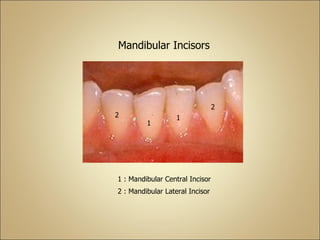
Mandibular Incisors
2
12
1
1 : Mandibular Central Incisor
2 : Mandibular Lateral Incisor
Mandibular Central Incisor
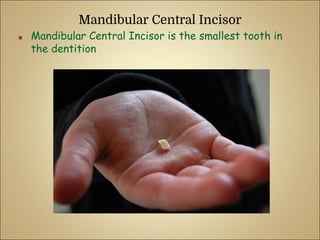
■ Mandibular Central Incisor is the smallest tooth in
the dentition
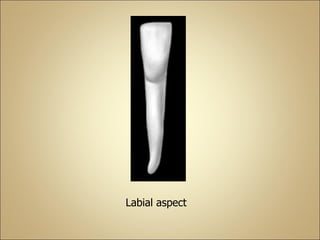
Labial aspect
Labial aspect
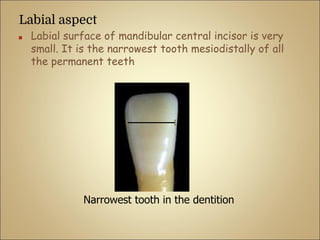
■ Labial surface of mandibular central incisor is very
small. It is the narrowest tooth mesiodistally of all
the permanent teeth
Narrowest tooth in the dentition
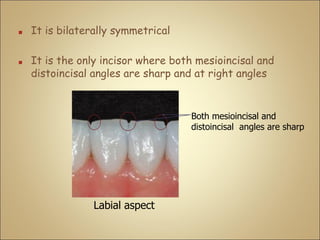
■ It is bilaterally symmetrical
■ It is the only incisor where both mesioincisal and
distoincisal angles are sharp and at right angles
Labial aspect
Both mesioincisal and
distoincisal angles are sharp
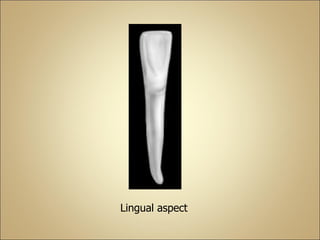
Lingual aspect
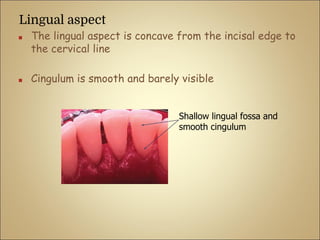
Lingual aspect
■ The lingual aspect is concave from the incisal edge to
the cervical line
■ Cingulum is smooth and barely visible
Shallow lingual fossa and
smooth cingulum
■ The surface is smooth and devoid of any grooves. No
other tooth in the mouth, except the mandibular
lateral incisor, shows so few developmental lines and
grooves.
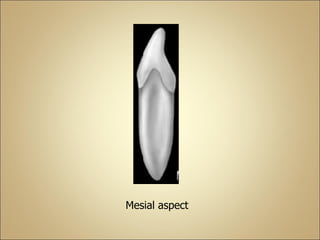
Mesial aspect
Mesial aspect
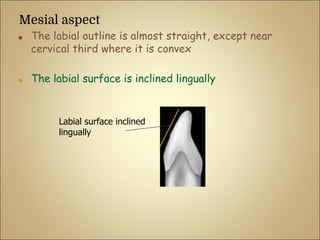
■ The labial outline is almost straight, except near
cervical third where it is convex
■ The labial surface is inclined lingually
Labial surface inclined
lingually
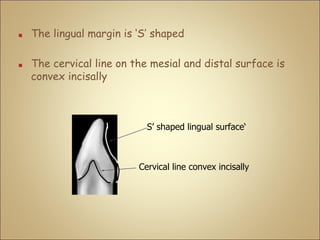
■ The lingual margin is ‘S’ shaped
■ The cervical line on the mesial and distal surface is
convex incisally
S’ shaped lingual surface‘
Cervical line convex incisally
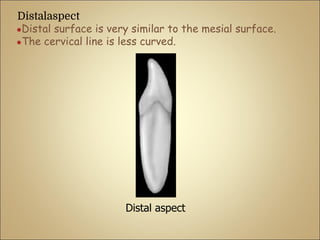
Distalaspect
●Distal surface is very similar to the mesial surface.
●The cervical line is less curved.
Distal aspect
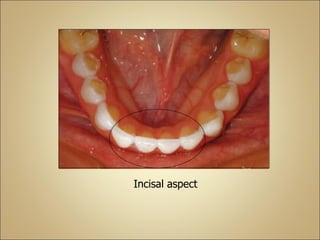
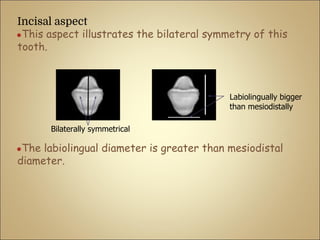
Incisal aspect
Incisal aspect
●This aspect illustrates the bilateral symmetry of this
tooth.
●The labiolingual diameter is greater than mesiodistal
diameter.
Bilaterally symmetrical
Labiolingually bigger
than mesiodistally
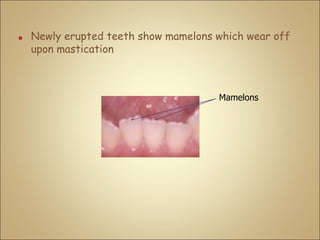
■ Newly erupted teeth show mamelons which wear off
upon mastication
Mamelons
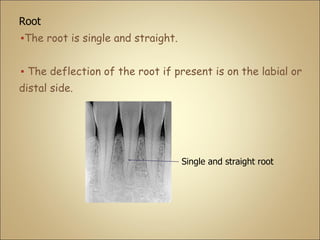
Root
▪The root is single and straight.
▪ The deflection of the root if present is on the labial or
distal side.
Single and straight root
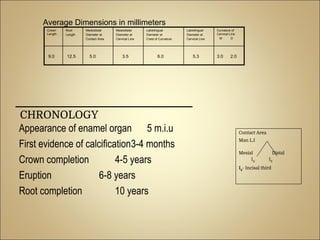
3.0 2.05.36.03.55.012.59.0
Curvature of
Cervical Line
M D
Labiolingual
Diameter at
Cervical Line
Labiolingual
Diameter at
Crest of Curvature
Mesiodistal
Diameter at
Cervical Line
Mesiodistal
Diameter at
Contact Area
Root
Length
Crown
Length
Average Dimensions in millimeters
CHRONOLOGY
Appearance of enamel organ 5 m.i.u
First evidence of calcification3-4 months
Crown completion 4-5 years
Eruption 6-8 years
Root completion 10 years
Contact Area
Man L.I
Mesial Distal
I3
I3
I3
- Incisal third
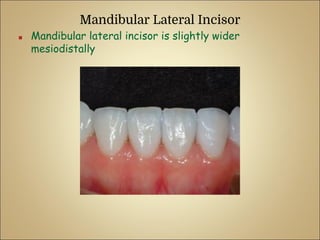
Mandibular Lateral Incisor
■ Mandibular lateral incisor is slightly wider
mesiodistally
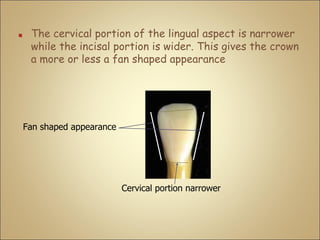
■ The cervical portion of the lingual aspect is narrower
while the incisal portion is wider. This gives the crown
a more or less a fan shaped appearance
Cervical portion narrower
Fan shaped appearance
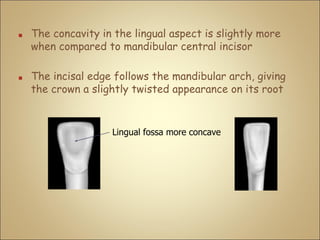
■ The concavity in the lingual aspect is slightly more
when compared to mandibular central incisor
■ The incisal edge follows the mandibular arch, giving
the crown a slightly twisted appearance on its root
Lingual fossa more concave
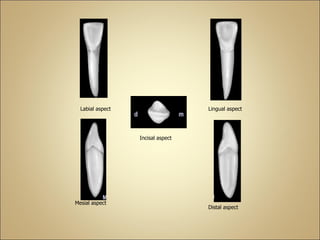
Labial aspect Lingual aspect
Mesial aspect
Distal aspect
Incisal aspect

Lower Central & Lateral Incisor

  • 2.
    Contents ■ Morphology ofPermanent Mandibular Central Incisor ■ Chronology and dimensions of Mandibular Central Incisor ■ Brief morphology of Mandibular Lateral Incisor Objectives ■ Identification of mandibular incisors from other teeth ■ Understand the morphology of mandibular central and lateral incisor ■ Distinguish between the labial, lingual, mesial, distal and incisal surfaces of the mandibular incisors
  • 3.
    Introduction Mandibular incisors arefour in number Mandibular central incisor and lateral are similar in anatomy and complement each other in function They are smaller than the maxillary incisors Mandibular central incisor erupts between the age of 6 and 7 Mandibular lateral incisor erupts between the age of 6 and 8
  • 4.
    Mandibular Incisors 2 12 1 1 :Mandibular Central Incisor 2 : Mandibular Lateral Incisor
  • 5.
    Mandibular Central Incisor ■Mandibular Central Incisor is the smallest tooth in the dentition
  • 6.
  • 7.
    Labial aspect ■ Labialsurface of mandibular central incisor is very small. It is the narrowest tooth mesiodistally of all the permanent teeth Narrowest tooth in the dentition
  • 8.
    ■ It isbilaterally symmetrical ■ It is the only incisor where both mesioincisal and distoincisal angles are sharp and at right angles Labial aspect Both mesioincisal and distoincisal angles are sharp
  • 9.
  • 10.
    Lingual aspect ■ Thelingual aspect is concave from the incisal edge to the cervical line ■ Cingulum is smooth and barely visible Shallow lingual fossa and smooth cingulum
  • 11.
    ■ The surfaceis smooth and devoid of any grooves. No other tooth in the mouth, except the mandibular lateral incisor, shows so few developmental lines and grooves.
  • 12.
  • 13.
    Mesial aspect ■ Thelabial outline is almost straight, except near cervical third where it is convex ■ The labial surface is inclined lingually Labial surface inclined lingually
  • 14.
    ■ The lingualmargin is ‘S’ shaped ■ The cervical line on the mesial and distal surface is convex incisally S’ shaped lingual surface‘ Cervical line convex incisally
  • 15.
    Distalaspect ●Distal surface isvery similar to the mesial surface. ●The cervical line is less curved. Distal aspect
  • 16.
  • 17.
    Incisal aspect ●This aspectillustrates the bilateral symmetry of this tooth. ●The labiolingual diameter is greater than mesiodistal diameter. Bilaterally symmetrical Labiolingually bigger than mesiodistally
  • 18.
    ■ Newly eruptedteeth show mamelons which wear off upon mastication Mamelons
  • 19.
    Root ▪The root issingle and straight. ▪ The deflection of the root if present is on the labial or distal side. Single and straight root
  • 20.
    3.0 2.05.36.03.55.012.59.0 Curvature of CervicalLine M D Labiolingual Diameter at Cervical Line Labiolingual Diameter at Crest of Curvature Mesiodistal Diameter at Cervical Line Mesiodistal Diameter at Contact Area Root Length Crown Length Average Dimensions in millimeters CHRONOLOGY Appearance of enamel organ 5 m.i.u First evidence of calcification3-4 months Crown completion 4-5 years Eruption 6-8 years Root completion 10 years Contact Area Man L.I Mesial Distal I3 I3 I3 - Incisal third
  • 21.
    Mandibular Lateral Incisor ■Mandibular lateral incisor is slightly wider mesiodistally
  • 22.
    ■ The cervicalportion of the lingual aspect is narrower while the incisal portion is wider. This gives the crown a more or less a fan shaped appearance Cervical portion narrower Fan shaped appearance
  • 23.
    ■ The concavityin the lingual aspect is slightly more when compared to mandibular central incisor ■ The incisal edge follows the mandibular arch, giving the crown a slightly twisted appearance on its root Lingual fossa more concave
  • 24.
    Labial aspect Lingualaspect Mesial aspect Distal aspect Incisal aspect