Submergent & Emergent
Landforms
Why does sea level change?
Eustatic change
• The change in the amount of water in the sea.
– During an Ice Age there is less water in the ocean
as much precipitation falls as snow and joins the
ice on the land. Therefore sea level falls.
• When ice melts then the volume of the water
begins to increase and so sea levels rise. This
can happen quite quickly.
• Global warming is increasing sea levels.
– This is due to thermal expansion as water gets
warmer
• It is also due to melting of freshwater ice
sheets, e.g. Greenland. Melting of sea ice will
not increase sea levels
Eustatic change
Isostatic change
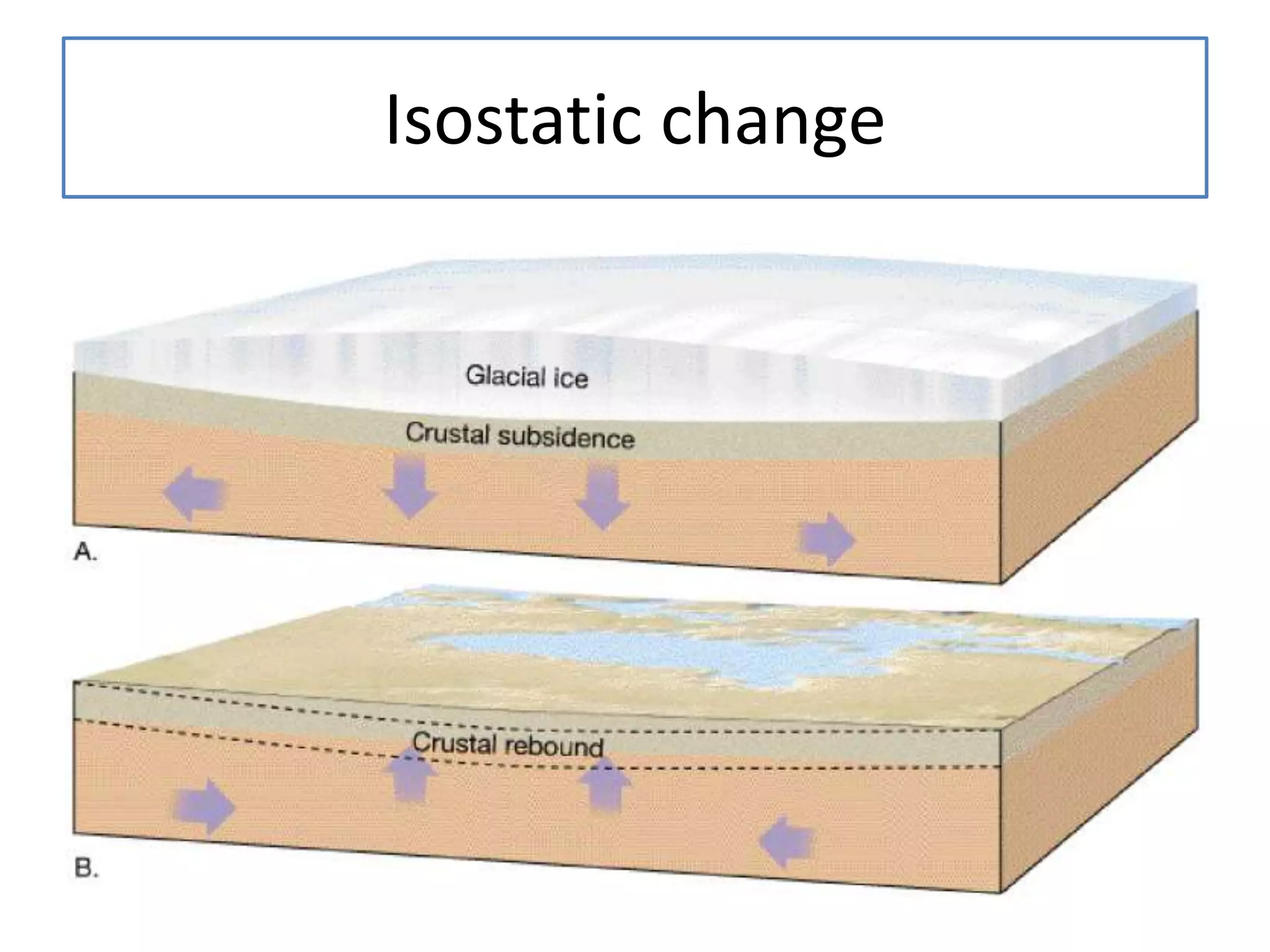
• Isostatic change occurs much more slowly
than eustatic change.
• When large ice sheets cover the land it weighs
down the land and actually makes it sink.
• When the ice melts the land begins to rise as
the weight is removed.
– This is called isostatic readjustment.
Isostatic change
Isostatic change in Britain
Landforms
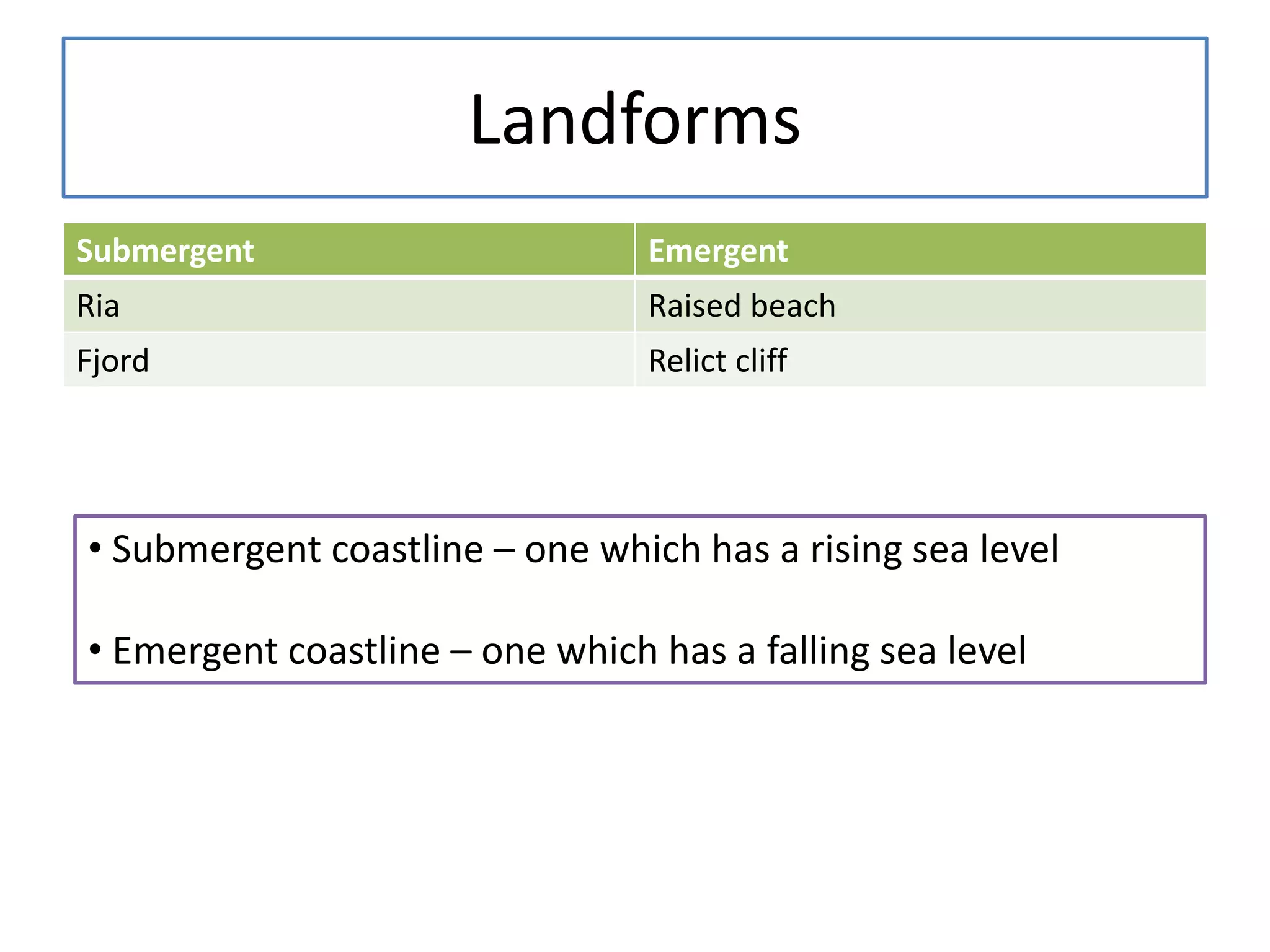
Submergent Emergent
Ria Raised beach
Fjord Relict cliff
• Submergent coastline – one which has a rising sea level
• Emergent coastline – one which has a falling sea level
This is a drowned river valley. As sea levels rise they flood the
river valleys, leaving only the high land visible.Ria
Rias have a long section and
cross profile typical of a river
valley and usually a dendritic
system of drainage.
Ria
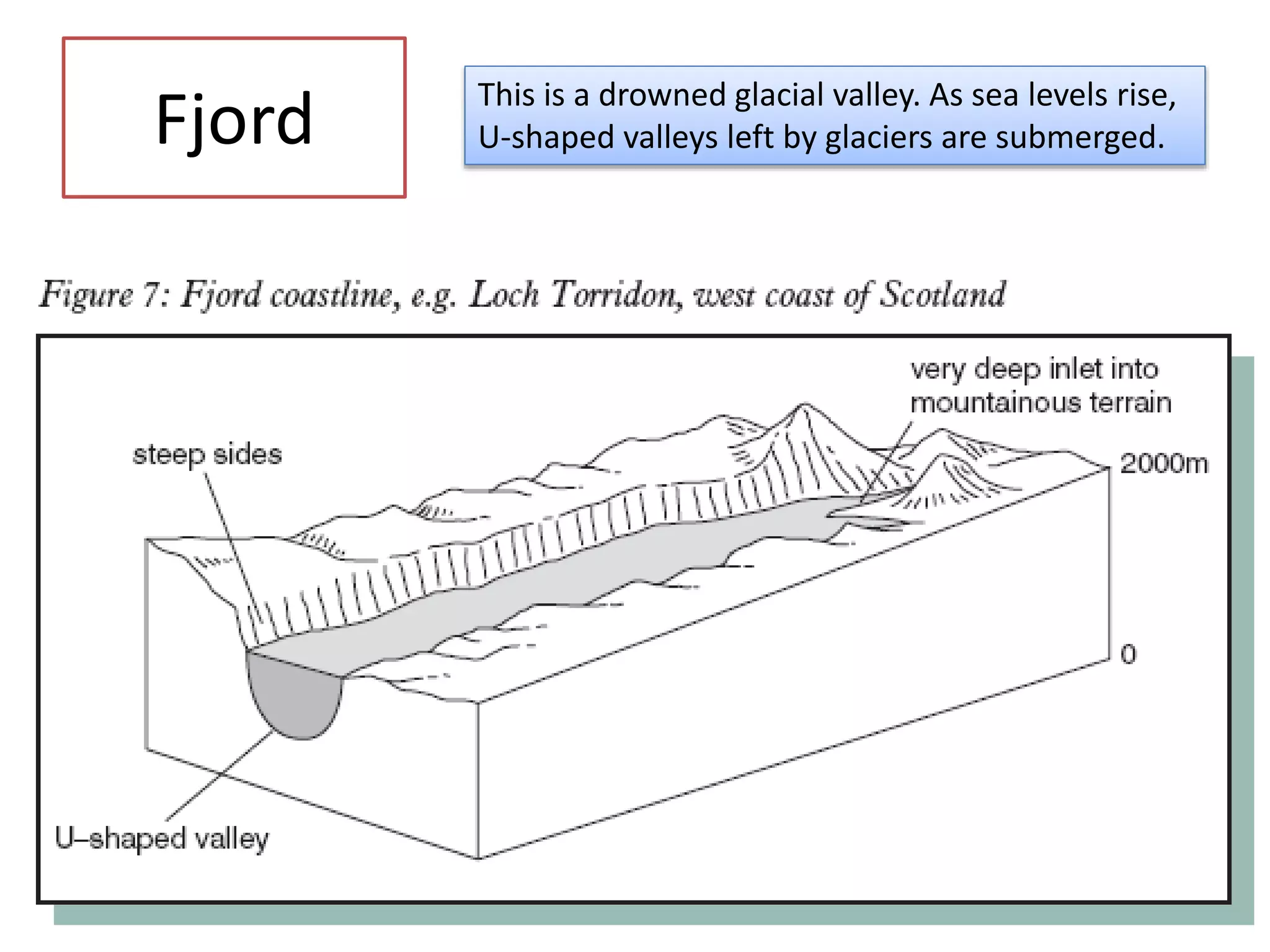
Fjord This is a drowned glacial valley. As sea levels rise,
U-shaped valleys left by glaciers are submerged.
Fjord
• Fjords have steep valley
sides and are fairly
straight and narrow.
• They have a u-shaped
cross-section with
hanging valleys on
either side.
• At the mouth they have
a shallower section
called a threshold.
• This is thought to be due
to reduced glacial
erosion as the glacier
came into contact with
the sea.
Fjord
Raised Beaches
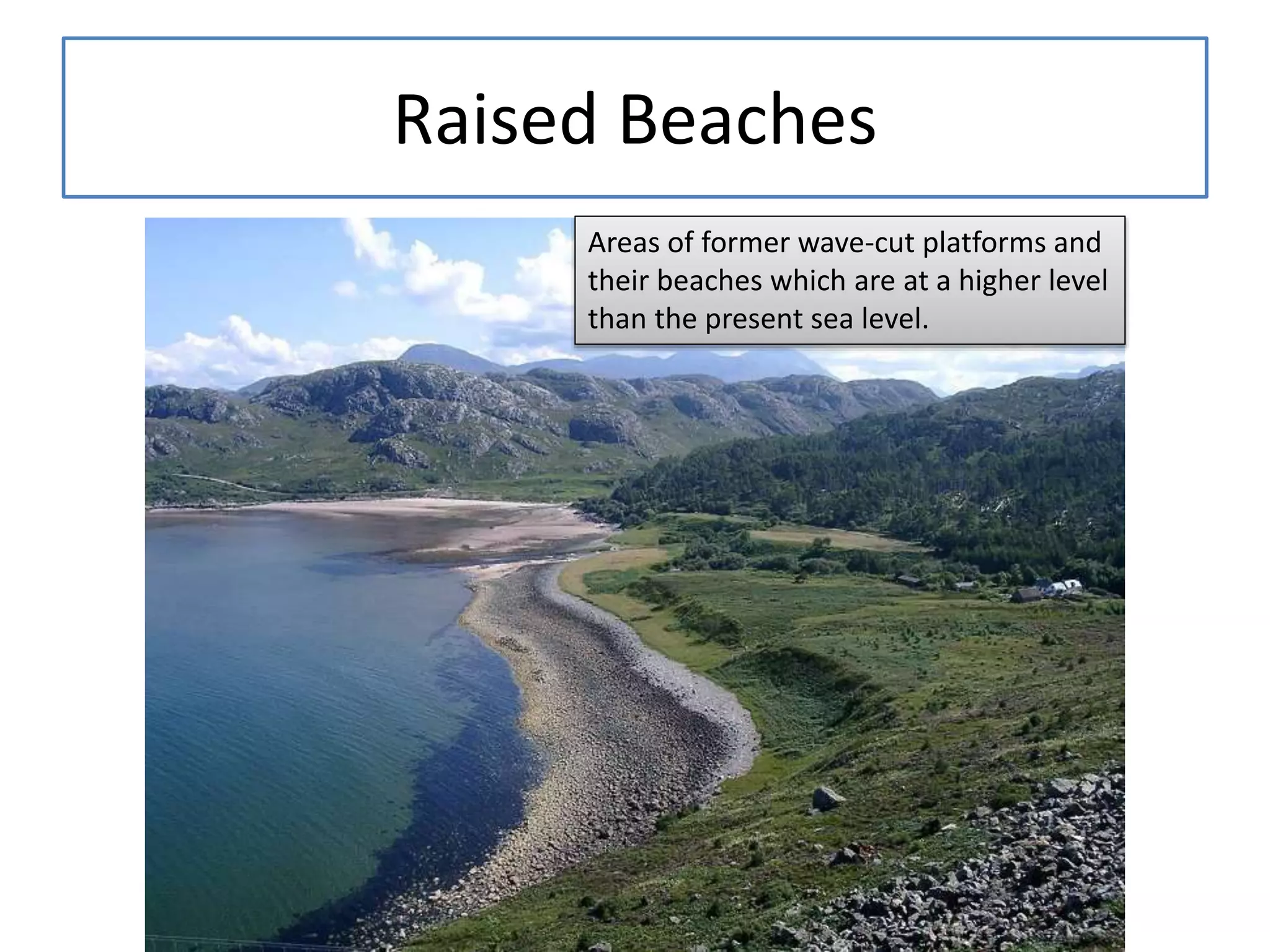
Areas of former wave-cut platforms and
their beaches which are at a higher level
than the present sea level.
• Raised beaches are common in Scotland.
• The Isle of Arran is a good example.
Raised Beaches
Relict cliffs
An old cliff displaying features such
as caves, arches and stacks.
Impacts of present and predicted sea
level rise
• Rising sea level has been happening quite
slowly in recent millenia – 1-2mm per year
• Rate has increased recently to 4-5mm per year
• Future predictions are uncertain: between 0.3
and 0.5m increase by 2090
• Coastal flooding – particularly low-lying areas
and increased erosion, e.g. Holderness.
• Southeast Britain is at greatest risk of flooding
due to combined eustatic change and
subsidence.
• Key areas: London, Hull, Middlesborough
• Major road and rail links and power stations.
Impacts of present and predicted sea
level rise
Impacts of present and predicted sea
level rise on UK settlements
Impacts of present and predicted sea
level rise on London
• Impact on underground water resources.
• Intrusion of salt water beneath the land could
contaminate freshwater stores
• Abstraction points would have to be moved
upstream/inland.
Impacts of present and predicted sea
level rise on fresh water sources
• Coastal habitats threatened – wetlands and
salt marsh
• Ecosystems can adjust but depends how fast
the sea level rise is.
• Also, coastal squeeze may occur in salt marsh.
Environmental impacts of present and
predicted sea level rise
• More developments are occurring on at risk
areas.
• Insurance is expensive – which may dissuade
people from moving into these areas
Socio-economic impacts of present
and predicted sea level rise

Submergent and emergent coastlines

  • 1.
  • 2.
    Why does sealevel change?
  • 3.
    Eustatic change • Thechange in the amount of water in the sea. – During an Ice Age there is less water in the ocean as much precipitation falls as snow and joins the ice on the land. Therefore sea level falls. • When ice melts then the volume of the water begins to increase and so sea levels rise. This can happen quite quickly.
  • 4.
    • Global warmingis increasing sea levels. – This is due to thermal expansion as water gets warmer • It is also due to melting of freshwater ice sheets, e.g. Greenland. Melting of sea ice will not increase sea levels Eustatic change
  • 5.
    Isostatic change • Isostaticchange occurs much more slowly than eustatic change. • When large ice sheets cover the land it weighs down the land and actually makes it sink. • When the ice melts the land begins to rise as the weight is removed. – This is called isostatic readjustment.
  • 6.
  • 7.
  • 8.
    Landforms Submergent Emergent Ria Raisedbeach Fjord Relict cliff • Submergent coastline – one which has a rising sea level • Emergent coastline – one which has a falling sea level
  • 9.
    This is adrowned river valley. As sea levels rise they flood the river valleys, leaving only the high land visible.Ria
  • 10.
    Rias have along section and cross profile typical of a river valley and usually a dendritic system of drainage. Ria
  • 11.
    Fjord This isa drowned glacial valley. As sea levels rise, U-shaped valleys left by glaciers are submerged.
  • 12.
  • 13.
    • Fjords havesteep valley sides and are fairly straight and narrow. • They have a u-shaped cross-section with hanging valleys on either side. • At the mouth they have a shallower section called a threshold. • This is thought to be due to reduced glacial erosion as the glacier came into contact with the sea. Fjord
  • 14.
    Raised Beaches Areas offormer wave-cut platforms and their beaches which are at a higher level than the present sea level.
  • 15.
    • Raised beachesare common in Scotland. • The Isle of Arran is a good example. Raised Beaches
  • 16.
    Relict cliffs An oldcliff displaying features such as caves, arches and stacks.
  • 18.
    Impacts of presentand predicted sea level rise • Rising sea level has been happening quite slowly in recent millenia – 1-2mm per year • Rate has increased recently to 4-5mm per year • Future predictions are uncertain: between 0.3 and 0.5m increase by 2090
  • 19.
    • Coastal flooding– particularly low-lying areas and increased erosion, e.g. Holderness. • Southeast Britain is at greatest risk of flooding due to combined eustatic change and subsidence. • Key areas: London, Hull, Middlesborough • Major road and rail links and power stations. Impacts of present and predicted sea level rise
  • 20.
    Impacts of presentand predicted sea level rise on UK settlements
  • 21.
    Impacts of presentand predicted sea level rise on London
  • 22.
    • Impact onunderground water resources. • Intrusion of salt water beneath the land could contaminate freshwater stores • Abstraction points would have to be moved upstream/inland. Impacts of present and predicted sea level rise on fresh water sources
  • 23.
    • Coastal habitatsthreatened – wetlands and salt marsh • Ecosystems can adjust but depends how fast the sea level rise is. • Also, coastal squeeze may occur in salt marsh. Environmental impacts of present and predicted sea level rise
  • 24.
    • More developmentsare occurring on at risk areas. • Insurance is expensive – which may dissuade people from moving into these areas Socio-economic impacts of present and predicted sea level rise