WS & S
Lecture 1
Objectives
1. To Learn Basic Concepts of wastewater
engineering (Origin , Quantities ,
Characteristics and Carriage etc.)
2. To design Wastewater Collection system
3. To Design various Wastewater treatment
processes
• Text Book
Water supply & Sewerage by E.W Steel and Mcghee
• Reference Books
1. Wastewater Engineering, Treatment , Disposal,
Reuse by Metcalf and Eddy , 3rd Edition
2. Water and Wastewater Engineering by Fair and
Geyer
3. Water and Wastewater Technology by Masle
J.Hammer
Basic Terms
• Sewage: It is the Liquid Waste or Wastewater
produced as a result of water use.
• Sewer: It is a pipe or conduit for carrying
sewage. It is generally closed and flow takes
place under gravity .
• Sewerage: Sewerage is the system of collection of
wastewater and conveying it to the point of disposal
with or without treatment.
Sources of Wastewater
1.Dometic: It is wastewater from houses offices,
other buildings, hotels and institutions
2.Industrial: It is the liquid waste from industrial
process
3.Storm-water: It includes surface run-off
generated by rainfall and the street wash
Components of Wastewater
Engineering
1. Collection System  Network of Sewer pipes
2. Disposal  Sewage Pumping Stations and
Outfalls
3. Treatment Works  Wastewater treatment
Plants
Fig: Components of Wastewater Engineering
Types of Sewers
1. Sanitary Sewer- It carries sanitary sewage like waste
from municipalities including domestic and industrial
waste-water
2. Storm Sewer-It carries storm sewage including surface
run-off and street wash
3. Combined Sewer- It carries domestic, industrial and
storm Sewage
4. House Sewer-It is the sewer conveying sewage from
plumbing system of a building to common municipal
system
5. Lateral Sewer- This sewer carries discharge from
houses sewer
Types of Sewers
6.Sub-main-This sewer receives discharge from two or
more laterals
7.Main/Trunk Sewer- Receives discharge from two or
more sub-mains
8. Outfall Sewer- It receives discharge from all
collecting system and conveys it to the point of final
disposal
House
Sewer
Lateral
Main/Trunk
Sewer
Sub-main
sewer
Outfall sewer
Fig: Types of Sewers
Types of Sewer Systems
• 1. Separate System
If storm water is carried separately from domestic
and industrial wastewater the system is called as
separate system.
Separate systems are favored when
(i) There is an immediate need for collection of the
sanitary sewage but not for storm water.
(ii) When sanitary sewage needs treatment but the
storm water does not.
Types of Sewer Systems
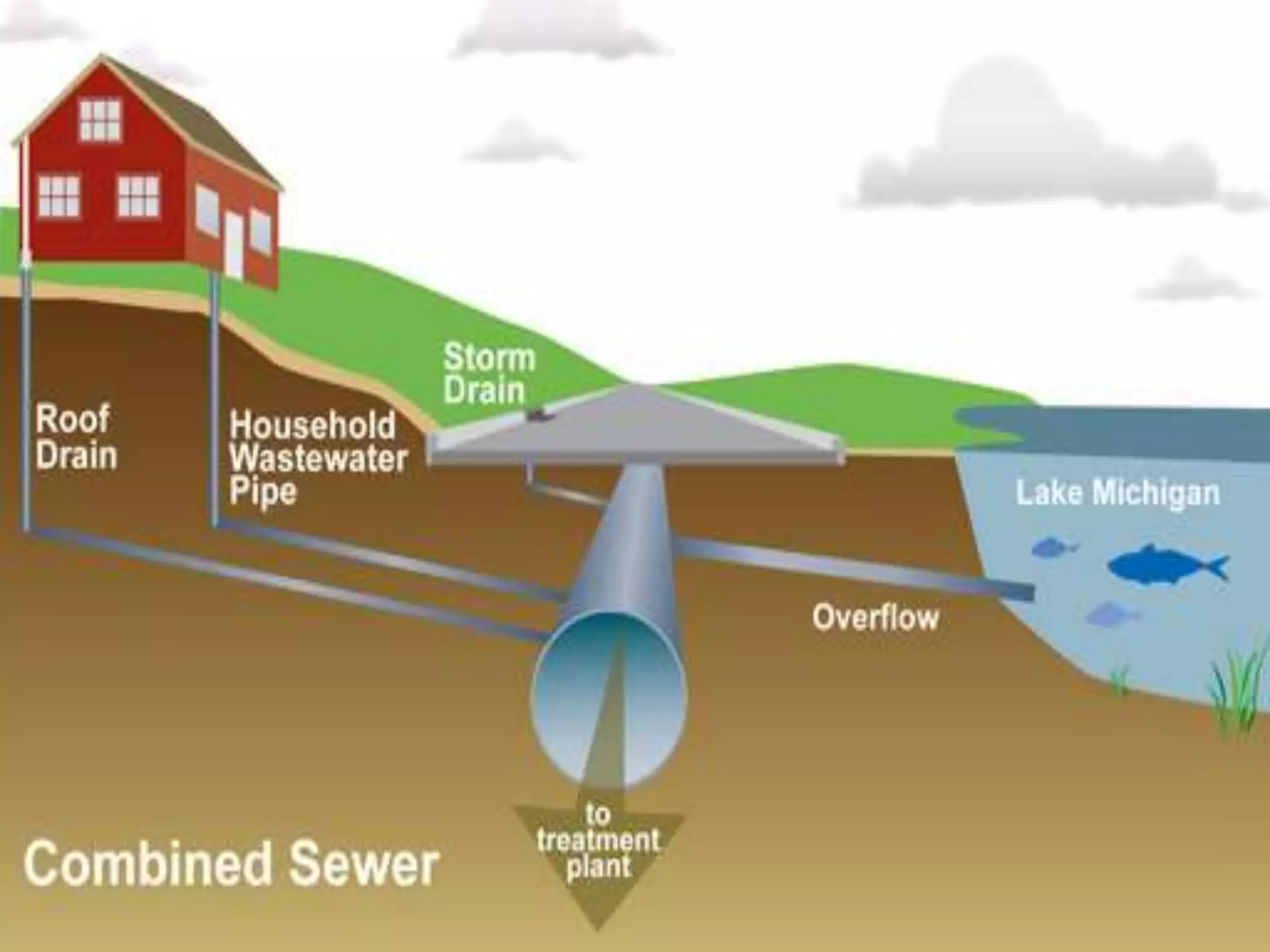
2. Combined System
It is the system in which the sewers carry both
sanitary and storm water, combined system is
favored when;
(i) Combined sewage can be disposed off without
treatment
(ii) Both sanitary and storm water need treatment
(iii) Streets are narrow and two separate sewer
cannot be laid
Types of Sewer Systems
3. Partially Combined System
If some portion of storm or surface run-off is
allowed to be carried along with sanitary
sewage the system is known as partially
combined system.
(In Urban area of developing countries, mostly
partially combined system is employed as it is
economical)
In Pakistan we use this system
Note
• Sanitary wastewater is not allowed to
discharge in any stream
• When there is storm water inside the sewer
some portion of sanitary sewer might go as its
effects would be less since due to dilution
• Sanitary wastewater remains at the bottom
usually because of high density than storm
water
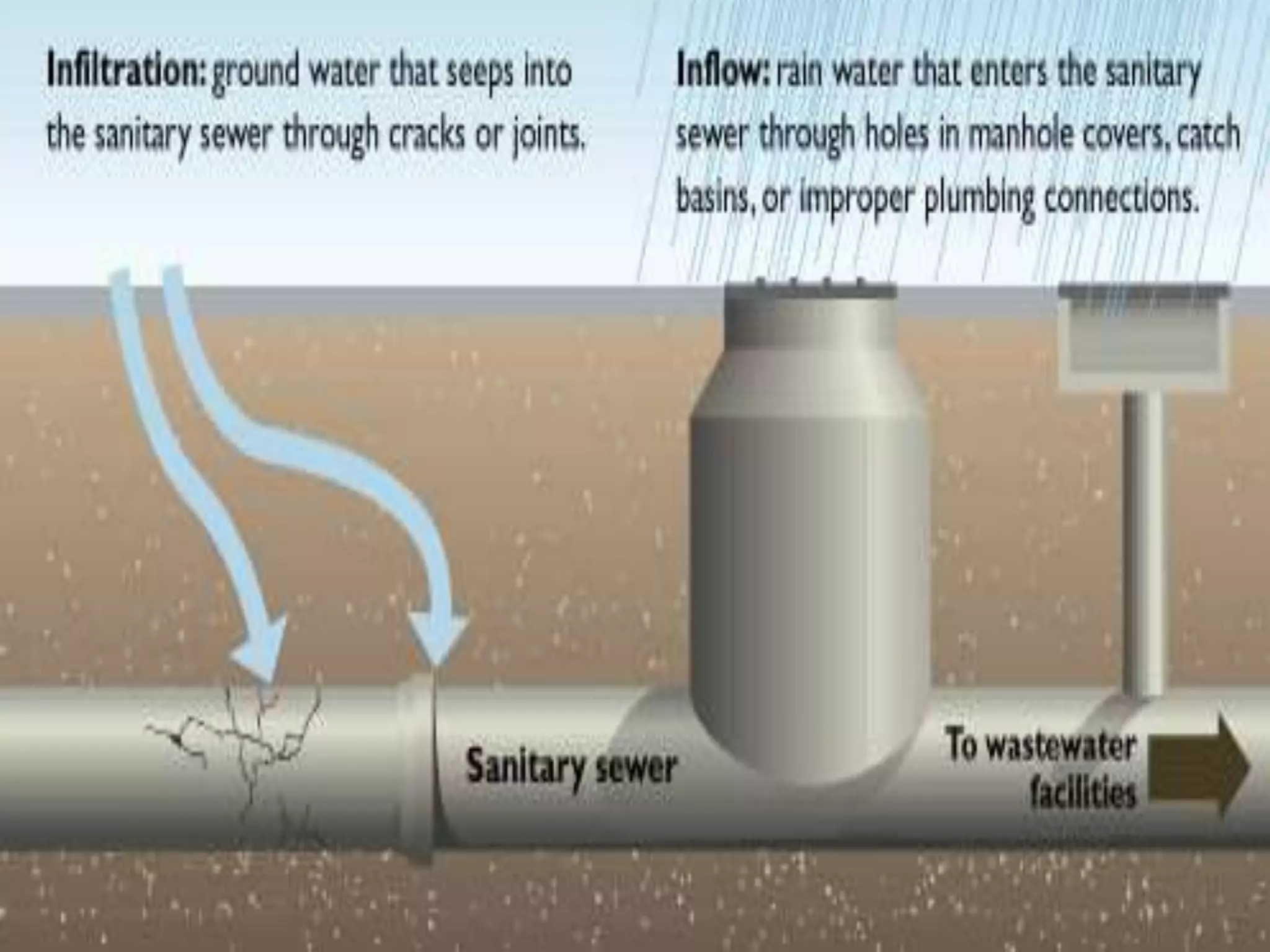
Infiltration
• It is the wastewater that enters sewers through
joints, cracked pipes, walls and covers of the
wholes
• Infiltration is almost non-existent in dry weather
but increases during rainy season
• Water and Sanitation Agency (WASA) Lahore uses
the following infiltration rates for the design of
sewer system.
Pipe dia. Up to 600mm  5% avg. sewage flow
for greater than 600mm 10% avg. sewage flow
Sewage Generation & Water
Consumption
• Around 70-130% of water consumed gets into
sewers
1. Industries with private point of discharge
2. Poor Sewer joints
General Range 70-90% of water consumption
when infiltration is taken into consideration
then
Avg. sewage flow equals the avg. rate of water
consumption
Variation in Sewage Flow
• Like Water Supply the sewage flow varies from
time to time since the sewers must be able to
accommodate the max. rate of flow the
variation in sewage flow need to studied
(1). HERMAN FORMULA: is used to estimate the
ratio of max. to avg. flow
M=
𝑄𝑚𝑎𝑥.
𝑄𝑎𝑣𝑔.
= 1 +
14
4+ 𝑃
P = Pop. In 1000
M = Peak Factor
Variation in Sewage Flow
Water Supply & Sanitation Agency(WASA), Lahore consider the
following relationship for sewer design
Average Flow (m3/day) Peak Factor
< 2500 4
2500-5000 3.4
5000-10000 3.1
10000-25000 2.7
25000-50000 2.5
50000-100000 2.3
100000-250000 2.15
>500000 2
Variation in Sewage Flow
• Minimum rate of Sewage Flow
Generally taken as 50% of avg. sewage
- It is used in the design of sewage pumping
station
- To investigate the velocities in sewer during
Low Flow periods
Numerical
• The residential area of a city has a population
density of 15000 per/ Km2 and an area of
120,000 m2. If the average water consumption
in 400 lpcd. Find the average sewage flow and
the maximum sewage flow that can be
excepted in m3/day.
Design Period and Use of Sewage Flow
Data
1. Design of Sewer System.
Period of design is indefinite as the system is
designed to care for the maximum development
of area
-Use of Qmax (maximum flow) for sewer design
-Use of Qmin (minimum flow) to check velocities
during low flow
Design Period and Use of Sewage Flow
Data
2. Design of sewage pumping station
-Design period is usually 10 years
-We consider average daily flow , peak and
minimum flow including infiltration
3. Design of sewage treatment Plants
-Design period is usually 15-20years,
-Require data of average flow , infiltration , peak
flow

Lec 1 (wastewater collection system)

  • 1.
  • 2.
    Objectives 1. To LearnBasic Concepts of wastewater engineering (Origin , Quantities , Characteristics and Carriage etc.) 2. To design Wastewater Collection system 3. To Design various Wastewater treatment processes
  • 3.
    • Text Book Watersupply & Sewerage by E.W Steel and Mcghee • Reference Books 1. Wastewater Engineering, Treatment , Disposal, Reuse by Metcalf and Eddy , 3rd Edition 2. Water and Wastewater Engineering by Fair and Geyer 3. Water and Wastewater Technology by Masle J.Hammer
  • 4.
    Basic Terms • Sewage:It is the Liquid Waste or Wastewater produced as a result of water use. • Sewer: It is a pipe or conduit for carrying sewage. It is generally closed and flow takes place under gravity .
  • 5.
    • Sewerage: Sewerageis the system of collection of wastewater and conveying it to the point of disposal with or without treatment. Sources of Wastewater 1.Dometic: It is wastewater from houses offices, other buildings, hotels and institutions 2.Industrial: It is the liquid waste from industrial process 3.Storm-water: It includes surface run-off generated by rainfall and the street wash
  • 6.
    Components of Wastewater Engineering 1.Collection System  Network of Sewer pipes 2. Disposal  Sewage Pumping Stations and Outfalls 3. Treatment Works  Wastewater treatment Plants
  • 7.
    Fig: Components ofWastewater Engineering
  • 8.
    Types of Sewers 1.Sanitary Sewer- It carries sanitary sewage like waste from municipalities including domestic and industrial waste-water 2. Storm Sewer-It carries storm sewage including surface run-off and street wash 3. Combined Sewer- It carries domestic, industrial and storm Sewage 4. House Sewer-It is the sewer conveying sewage from plumbing system of a building to common municipal system 5. Lateral Sewer- This sewer carries discharge from houses sewer
  • 9.
    Types of Sewers 6.Sub-main-Thissewer receives discharge from two or more laterals 7.Main/Trunk Sewer- Receives discharge from two or more sub-mains 8. Outfall Sewer- It receives discharge from all collecting system and conveys it to the point of final disposal
  • 10.
  • 11.
    Types of SewerSystems • 1. Separate System If storm water is carried separately from domestic and industrial wastewater the system is called as separate system. Separate systems are favored when (i) There is an immediate need for collection of the sanitary sewage but not for storm water. (ii) When sanitary sewage needs treatment but the storm water does not.
  • 14.
    Types of SewerSystems 2. Combined System It is the system in which the sewers carry both sanitary and storm water, combined system is favored when; (i) Combined sewage can be disposed off without treatment (ii) Both sanitary and storm water need treatment (iii) Streets are narrow and two separate sewer cannot be laid
  • 16.
    Types of SewerSystems 3. Partially Combined System If some portion of storm or surface run-off is allowed to be carried along with sanitary sewage the system is known as partially combined system. (In Urban area of developing countries, mostly partially combined system is employed as it is economical) In Pakistan we use this system
  • 18.
    Note • Sanitary wastewateris not allowed to discharge in any stream • When there is storm water inside the sewer some portion of sanitary sewer might go as its effects would be less since due to dilution • Sanitary wastewater remains at the bottom usually because of high density than storm water
  • 19.
    Infiltration • It isthe wastewater that enters sewers through joints, cracked pipes, walls and covers of the wholes • Infiltration is almost non-existent in dry weather but increases during rainy season • Water and Sanitation Agency (WASA) Lahore uses the following infiltration rates for the design of sewer system. Pipe dia. Up to 600mm  5% avg. sewage flow for greater than 600mm 10% avg. sewage flow
  • 22.
    Sewage Generation &Water Consumption • Around 70-130% of water consumed gets into sewers 1. Industries with private point of discharge 2. Poor Sewer joints General Range 70-90% of water consumption when infiltration is taken into consideration then Avg. sewage flow equals the avg. rate of water consumption
  • 23.
    Variation in SewageFlow • Like Water Supply the sewage flow varies from time to time since the sewers must be able to accommodate the max. rate of flow the variation in sewage flow need to studied (1). HERMAN FORMULA: is used to estimate the ratio of max. to avg. flow M= 𝑄𝑚𝑎𝑥. 𝑄𝑎𝑣𝑔. = 1 + 14 4+ 𝑃 P = Pop. In 1000 M = Peak Factor
  • 24.
    Variation in SewageFlow Water Supply & Sanitation Agency(WASA), Lahore consider the following relationship for sewer design Average Flow (m3/day) Peak Factor < 2500 4 2500-5000 3.4 5000-10000 3.1 10000-25000 2.7 25000-50000 2.5 50000-100000 2.3 100000-250000 2.15 >500000 2
  • 25.
    Variation in SewageFlow • Minimum rate of Sewage Flow Generally taken as 50% of avg. sewage - It is used in the design of sewage pumping station - To investigate the velocities in sewer during Low Flow periods
  • 26.
    Numerical • The residentialarea of a city has a population density of 15000 per/ Km2 and an area of 120,000 m2. If the average water consumption in 400 lpcd. Find the average sewage flow and the maximum sewage flow that can be excepted in m3/day.
  • 27.
    Design Period andUse of Sewage Flow Data 1. Design of Sewer System. Period of design is indefinite as the system is designed to care for the maximum development of area -Use of Qmax (maximum flow) for sewer design -Use of Qmin (minimum flow) to check velocities during low flow
  • 28.
    Design Period andUse of Sewage Flow Data 2. Design of sewage pumping station -Design period is usually 10 years -We consider average daily flow , peak and minimum flow including infiltration 3. Design of sewage treatment Plants -Design period is usually 15-20years, -Require data of average flow , infiltration , peak flow