MBA 9061
Services Marketing
Managing Relationship And Building
Loyalty, Complaint Handling And Service
Recovery Strategies
Course Instructor: Sneha Sharma, PhD*, MBA, Dip T & D, UGC-NET JRF Qualified
MBA 906
Managing Relationships
and Building Loyalty
MBA 906
Four Stages of Brand Loyalty in a
Consumer
Cognitive
loyalty
• perception
from brand
attribute
information
that one
brand is
preferable to
its
alternatives
Affective
loyalty
• developing a
liking for the
brand based
on
cumulatively
satisfying
usage
occasions
Conative
loyalty
• commitment
to re-buying
the same
brand
Action loyalty
• exhibiting
consistent
repurchase
behavior
MBA 906
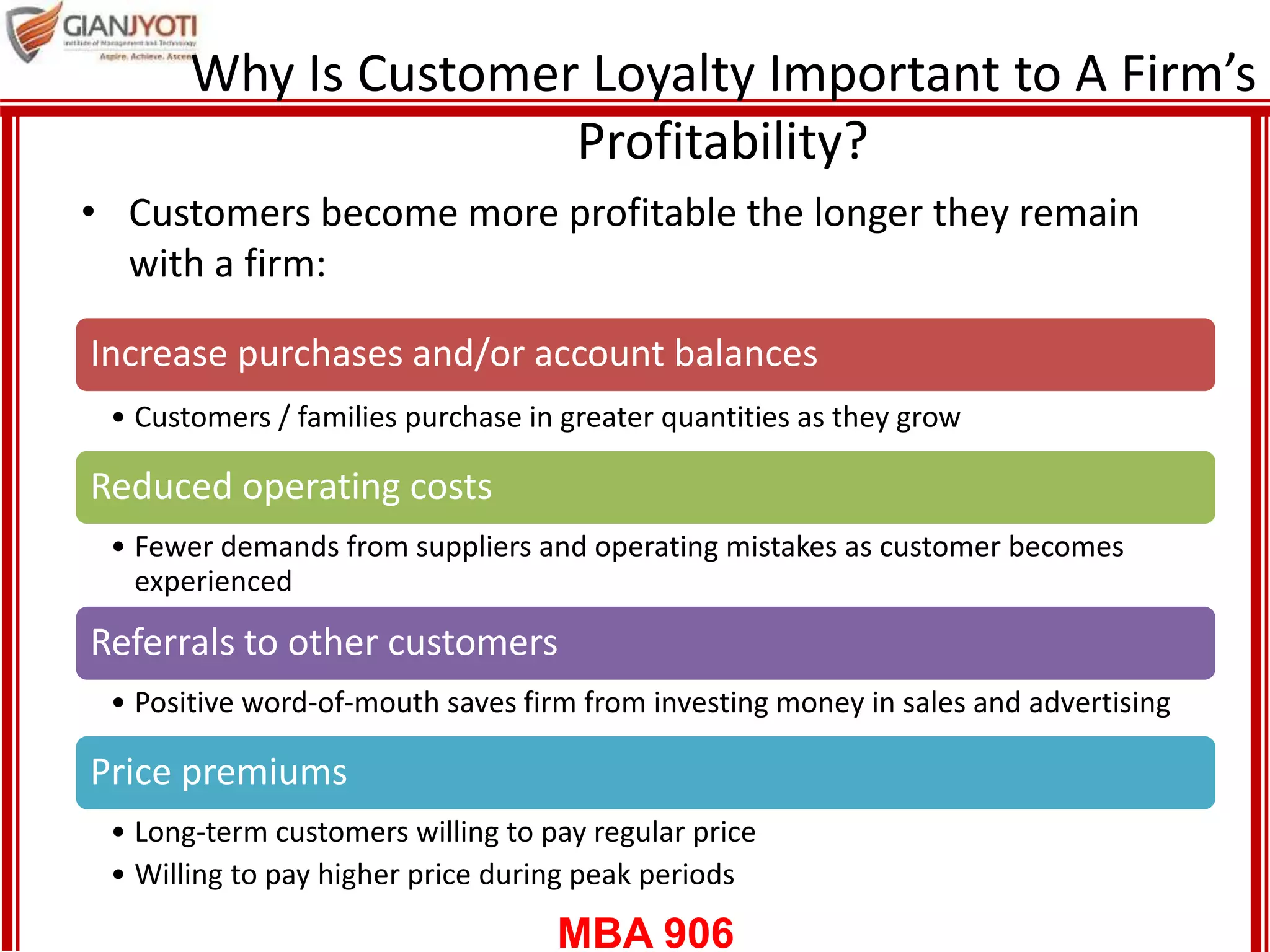
Why Is Customer Loyalty Important to A Firm’s
Profitability?
• Customers become more profitable the longer they remain
with a firm:
Increase purchases and/or account balances
• Customers / families purchase in greater quantities as they grow
Reduced operating costs
• Fewer demands from suppliers and operating mistakes as customer becomes
experienced
Referrals to other customers
• Positive word-of-mouth saves firm from investing money in sales and advertising
Price premiums
• Long-term customers willing to pay regular price
• Willing to pay higher price during peak periods
MBA 906
Assessing the Value of a Loyal
Customer
Wrong Assumption: Loyal
customers are always more
profitable than those making
one-time transactions
• Large customers may
expect price discounts in
return for loyalty
• Revenues don’t necessarily
increase with time for all
types of customers
Tasks
• Determine costs and
revenues for customers
from different market
segments at different
points in their customer
lifecycles
• Predict future profitability
MBA 906
Why are Customers Loyal?
• Customers stay loyal when we create value
for them
• Value can be created for customers through
– Confidence benefits
– Social benefits
• Mutual recognition and friendship between service provider
and customer
– Special treatment
MBA 906
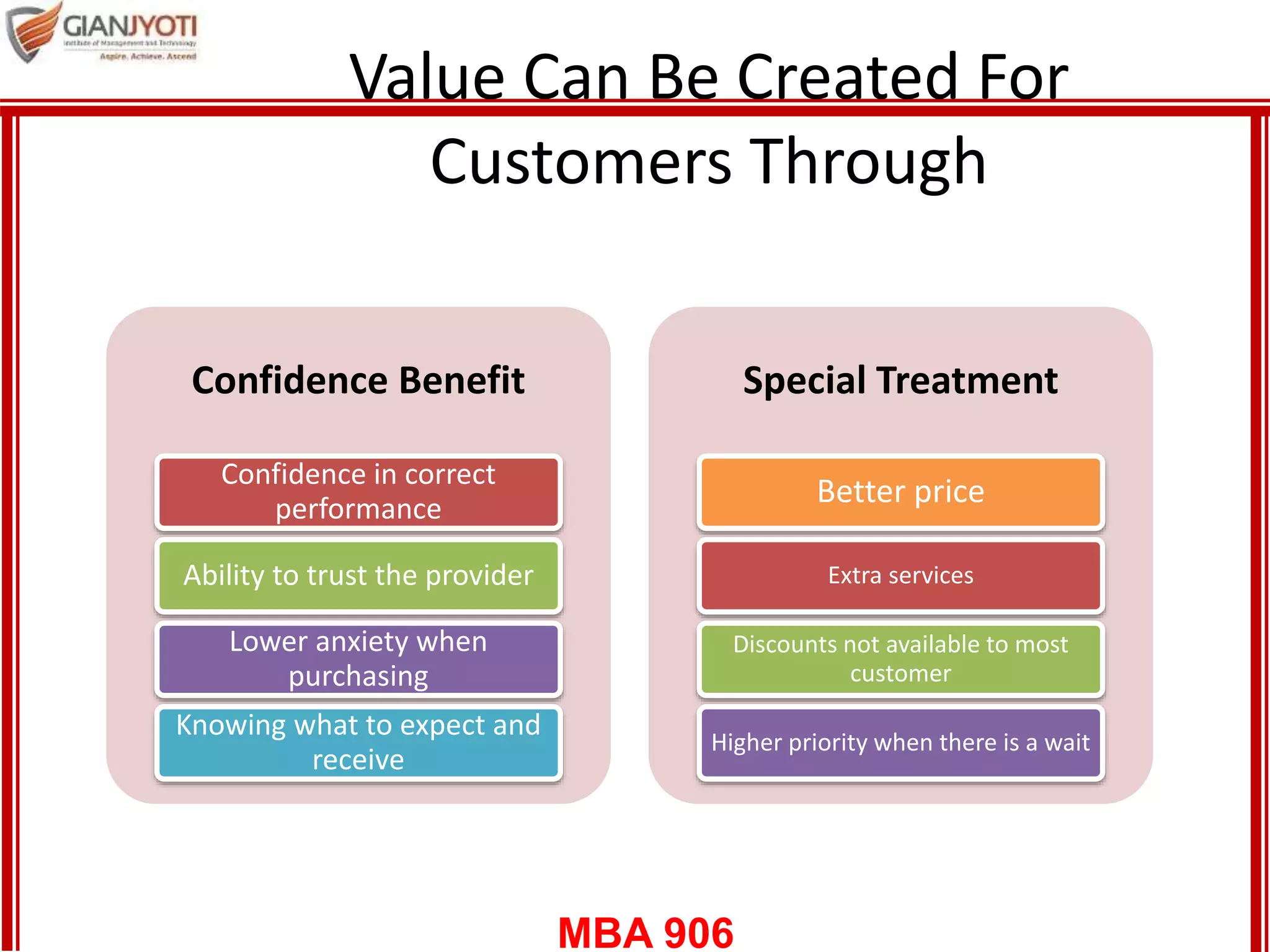
Value Can Be Created For
Customers Through
Confidence Benefit
Confidence in correct
performance
Ability to trust the provider
Lower anxiety when
purchasing
Knowing what to expect and
receive
Special Treatment
Better price
Extra services
Discounts not available to most
customer
Higher priority when there is a wait
MBA 906
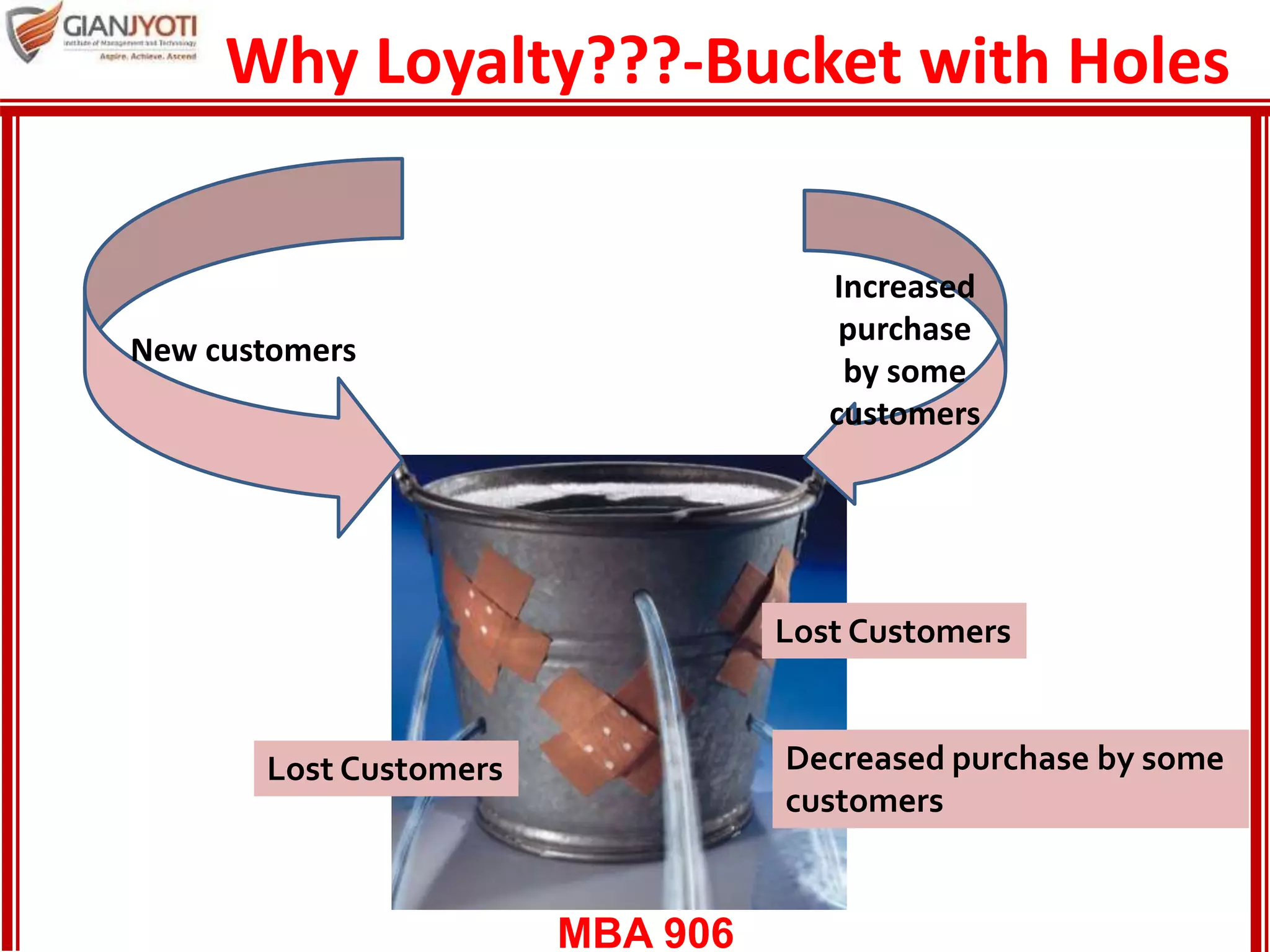
Why Loyalty???-Bucket with Holes
Increased
purchase
by some
customers
New customers
Lost Customers
Decreased purchase by some
customers
Lost Customers
MBA 906
A Loyal Customer Pyramid
• Relationship of partner
• Actively recommends you
• Supports you passively
• Repeat business, but passive or
negative attitude
• Carried out one transaction
• Potential customer
MBA 906
Loyalty Wheel
MBA 906
BUILDING A FOUNDATION FOR
LOYALTY
MBA 906
Targeting the Right Customers and Searching
for Value, Not Volume
• Target the right customer and match them to
what firm can deliver
– How do customer needs relate to company?
– How well can service personnel meet expectations
of different types of customers?
– Can company match or exceed competing services
that are directed at same types of customers?
MBA 906
• Focus on number of customers served as well as
value of each customer
– Heavy users who buy more frequently and in larger
volumes are more profitable than occasional users
– Avoid targeting customers who buy based on lowest price
Targeting the Right Customers and Searching
for Value, Not Volume
MBA 906
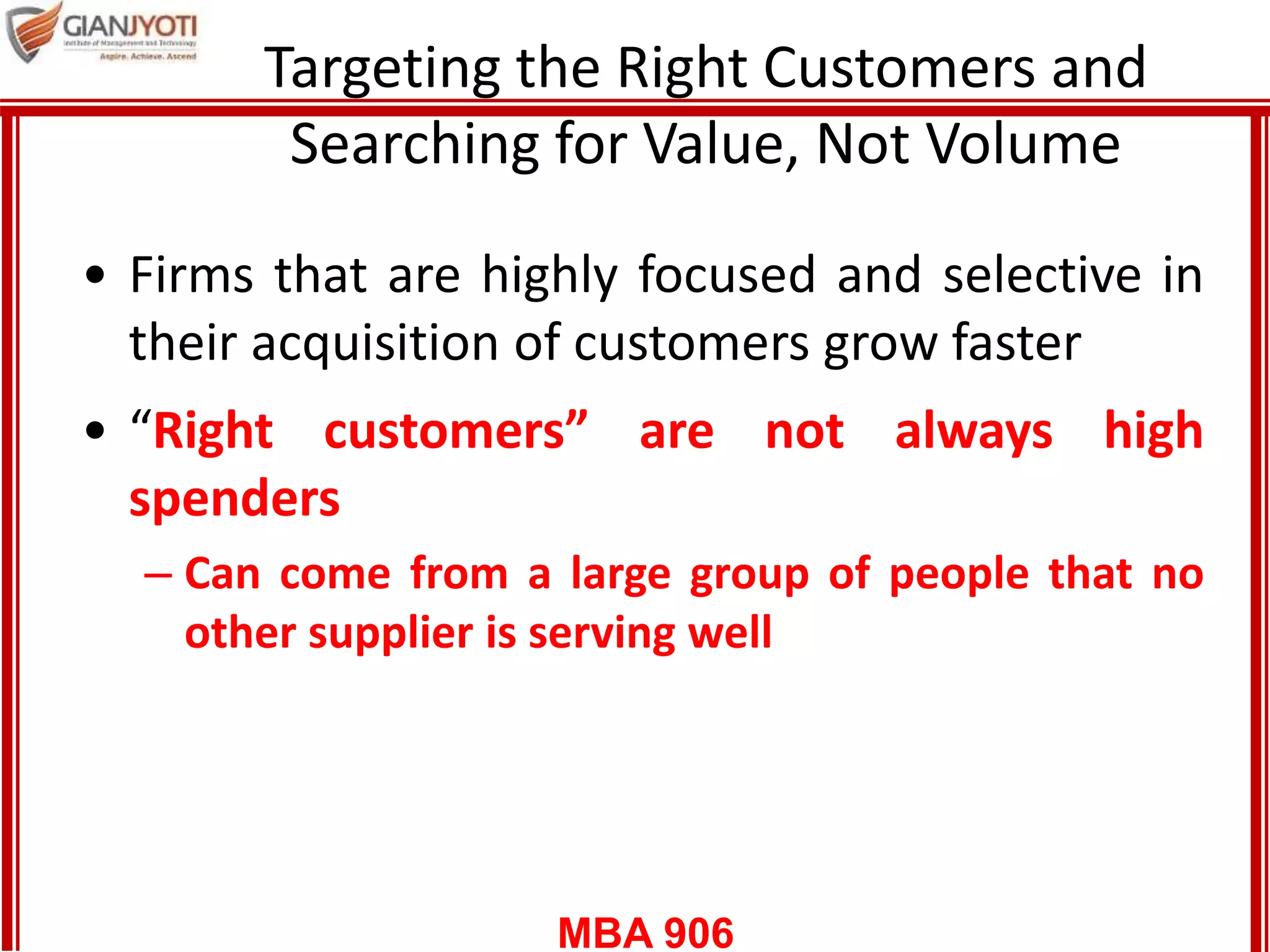
Targeting the Right Customers and
Searching for Value, Not Volume
• Firms that are highly focused and selective in
their acquisition of customers grow faster
• “Right customers” are not always high
spenders
– Can come from a large group of people that no
other supplier is serving well
MBA 906
Effective Tiering of Service The
Customer Pyramid
MBA 906
The Customer Satisfaction
Loyalty Relationship
MBA 906
STRATEGIES FOR DEVELOPING
LOYALTY BONDS WITH CUSTOMERS
MBA 906
Deepening The Relationship
Bundling/Cross-selling
services
• Makes switching a major effort
that customer is unwilling to go
through unless extremely
dissatisfied with service
provider
Customers benefit from
buying all their various
services from the same
provider
• One-stop-shopping, potentially
higher service levels, higher
service tiers etc
MBA 906
Loyalty Bonds with Customers
Excellent
Service andValue
1. Financial Bond
2.SocialBond
3. Customization Bond
4.StructuralBond
Stable
Pricing
Personal
Relationships
Joint
Investments
Shared
processes
and
equipments
Anticipation/
Innovation
Mass
customization
Customer
Intimacy
MBA 906
Reward Based Bonds
Financial bonds
• Discounts on
purchases,
loyalty program
rewards (e.g.
frequent flier
miles), cash-
back programs
Non-financial
rewards
• Priority to
loyalty program
members for
waitlists and
queues in call
centers; higher
baggage
allowances,
priority
upgrading,
access to
airport lounges
for frequent
flyers
Intangible
rewards
• Special
recognition and
appreciation
Reward-based
loyalty programs
• Relatively easy
to copy and
rarely provide a
sustained
competitive
advantage
MBA 906
STRATEGIES FOR REDUCING
CUSTOMER DEFECTIONS
Understand reasons for customer switching
MBA 906
What Drives Customers to Switch?
MBA 906
Address Key Issues
• Deliver quality service
• Reduce inconvenience and non-monetary costs
• Have fair and transparent pricing
• Industry specific drivers
– Cellular phone industry: handset replacement a common reason for
subscribers discontinuing services – offer handset replacement
programs
• Take active steps to retain customers
– Save teams: specially trained call center staff to deal with customers
who want to cancel their accounts
– Be careful about how save teams are rewarded
MBA 906
Customer Response Categories to
Service Failures
MBA 906
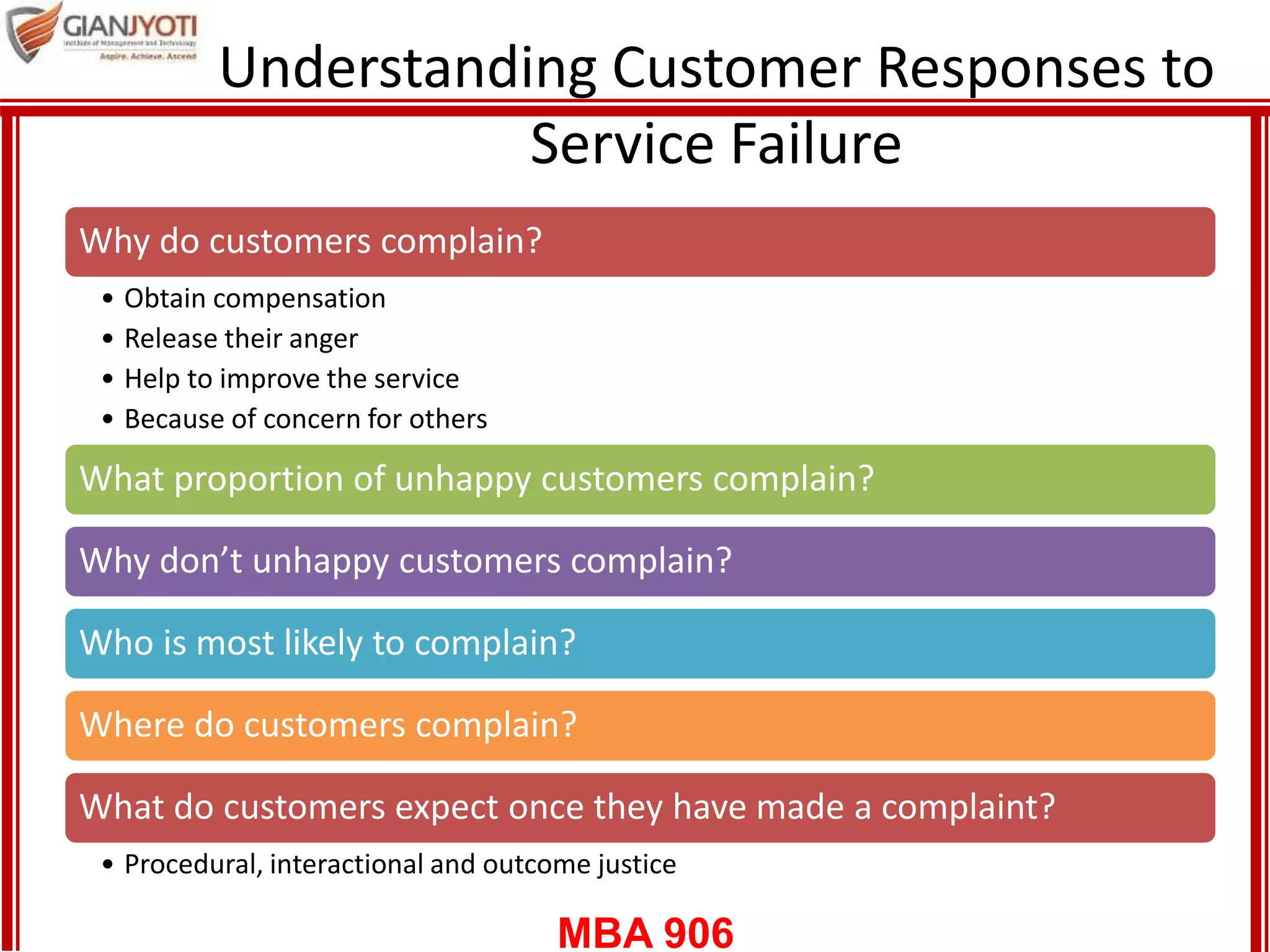
Understanding Customer Responses to
Service Failure
Why do customers complain?
• Obtain compensation
• Release their anger
• Help to improve the service
• Because of concern for others
What proportion of unhappy customers complain?
Why don’t unhappy customers complain?
Who is most likely to complain?
Where do customers complain?
What do customers expect once they have made a complaint?
• Procedural, interactional and outcome justice
MBA 906
3 Dimensions of Perceived Fairness in
Service Recovery Process
MBA 906
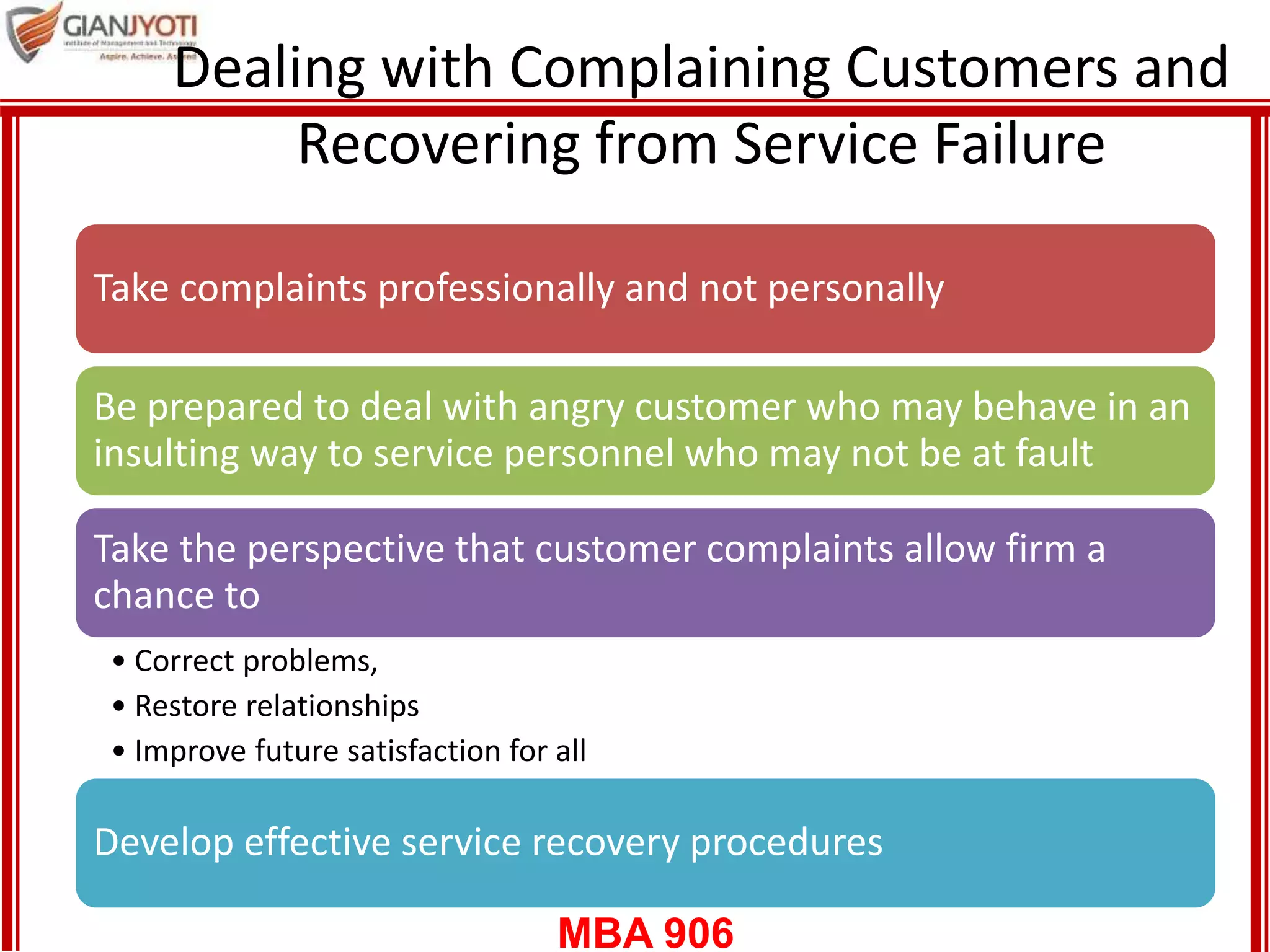
Dealing with Complaining Customers and
Recovering from Service Failure
Take complaints professionally and not personally
Be prepared to deal with angry customer who may behave in an
insulting way to service personnel who may not be at fault
Take the perspective that customer complaints allow firm a
chance to
• Correct problems,
• Restore relationships
• Improve future satisfaction for all
Develop effective service recovery procedures
MBA 906
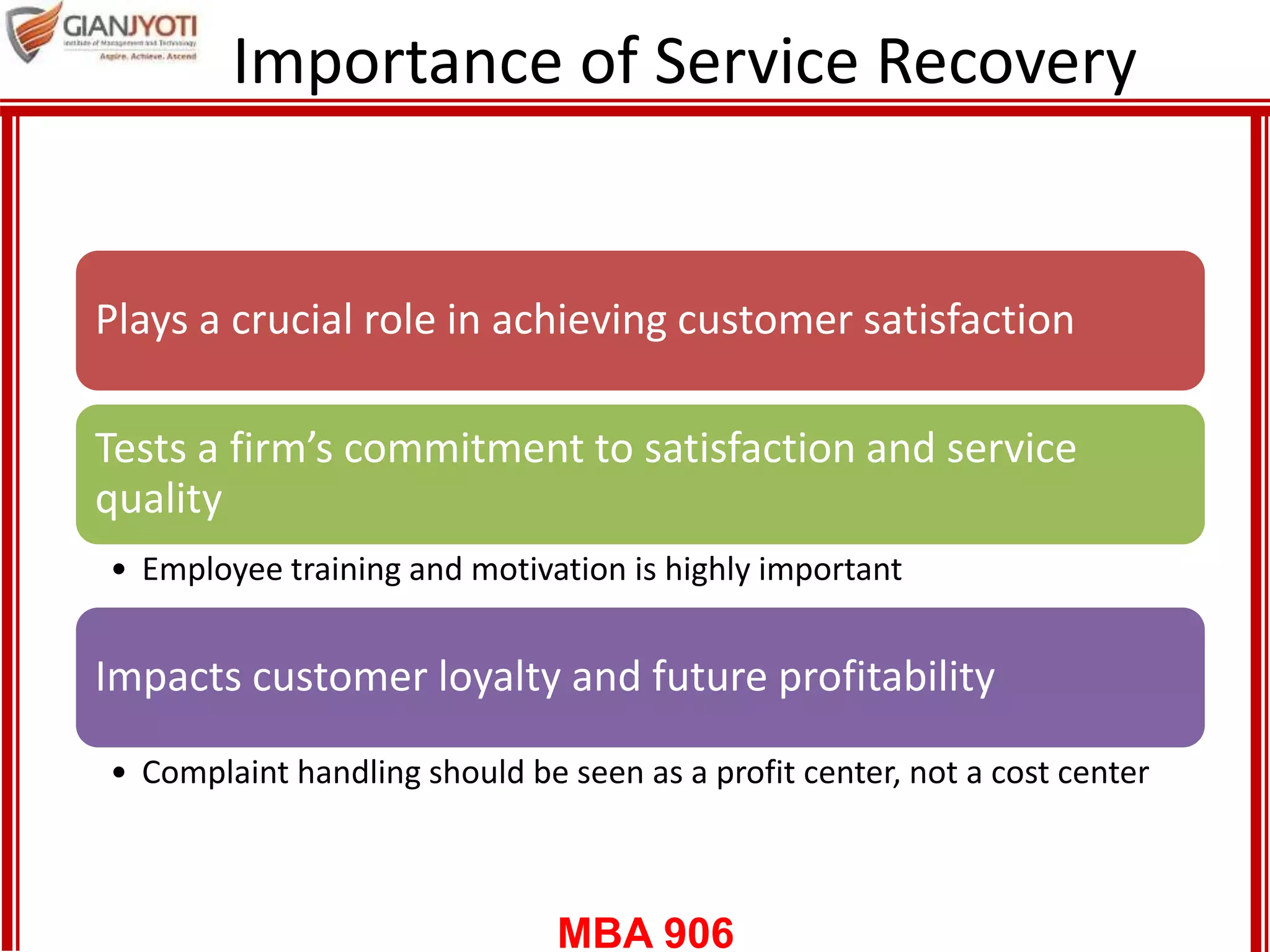
Importance of Service Recovery
Plays a crucial role in achieving customer satisfaction
Tests a firm’s commitment to satisfaction and service
quality
• Employee training and motivation is highly important
Impacts customer loyalty and future profitability
• Complaint handling should be seen as a profit center, not a cost center
MBA 906
The Service Recovery Paradox
• Note: not all research supports this paradox
Customers who experience a
service failure that is satisfactorily
resolved may be more likely to
make future purchases than
customers without problems
• the paradox disappears—customers’ expectations
have been raised and they become disillusioned
If second service failure occurs,
• (e.g., spoiled wedding photos) may limit firm’s
ability to delight customer with recovery efforts
Severity and “recoverability” of
failure
• Do it right the first timeBest strategy
MBA 906
Figure 10.1 (Source: Adapted from Schindlholzer, 2008)
Customerloyalty
Time
Customers who
experience service failure
and successful recovery
Customers who do not
experience service
failure
Customer loyalty
difference
Service recovery
Service
failure
The Service Recovery Paradox
MBA 906
Principles of Effective Service
Recovery Systems
MBA 906
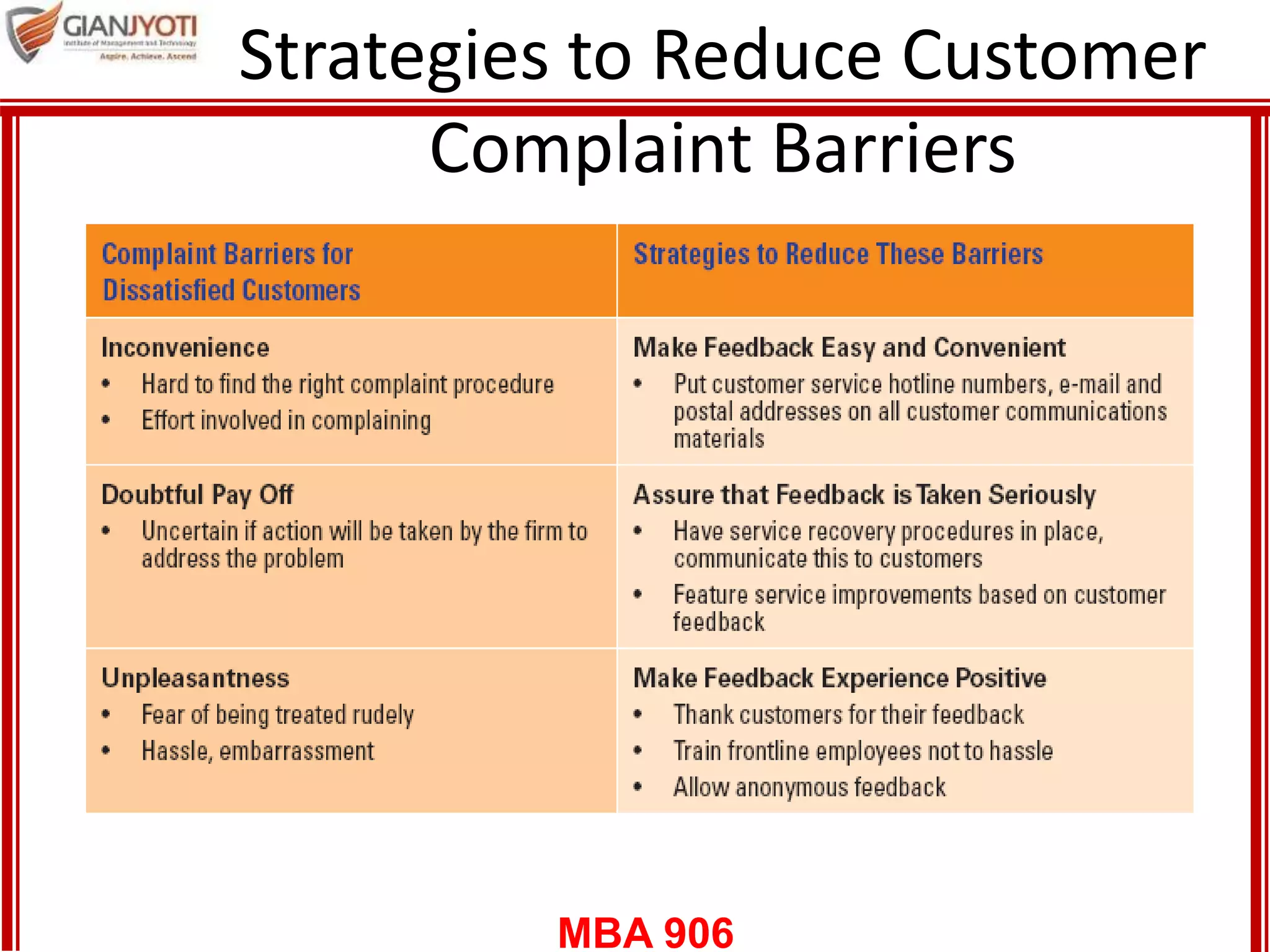
Strategies to Reduce Customer
Complaint Barriers
MBA 906
How to Enable Effective Service
Recovery
Be proactive
• On the spot, before customers complain
Plan recovery procedures
• Identify most common service problems and have prepared scripts to guide employees
in service recovery
Teach recovery skills to relevant personnel
Empower personnel to use judgment and skills to develop recovery
solutions
MBA 906
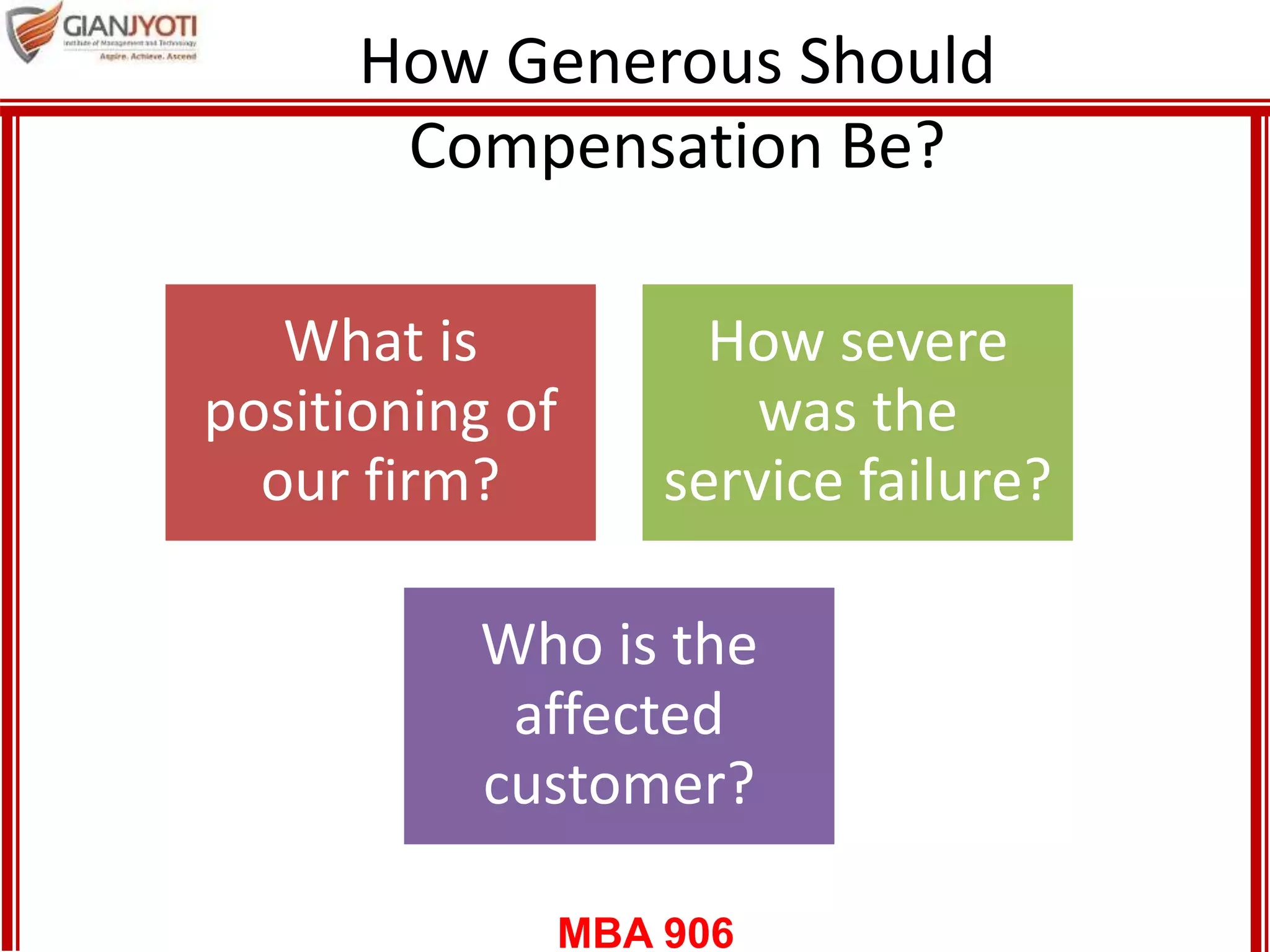
How Generous Should
Compensation Be?
What is
positioning of
our firm?
How severe
was the
service failure?
Who is the
affected
customer?
MBA 906
Service Recovery Process
Apology
Frames customer’s perceptions and paves
the way to recovery
Urgent
reinstatement
Quick action to correct or remove
problem
Empathy
Employee understanding and
responsiveness
Symbolic
atonement
Tangible evidence of organization’s
willingness to take responsibility
Follow-up Evaluate recovery plan
MBA 906
Effective Recovery Process Leads To
Impacts
customer
satisfaction
Impacts
perceptions of
quality
Impacts
bottom-line
performance
Enhances
customer
loyalty
Stimulates
positive word
of mouth
MBA 906
The Customer Complaint Iceberg
Figure 10.2 (Source: based on TARP, 1979)
MBA 906
Service Guarantees
MBA 906
The Power of Service Guarantees
Force firms to focus
on what customers
want
Set clear standards
Require systems to
get & act on customer
feedback
Force organizations to
understand why they
fail and to overcome
potential fail points
Reduce risks of
purchase and build
loyalty
MBA 906
How to Design Service Guarantees
Unconditional
Easy to
understand and
communicate
Meaningful to
the customer
Easy to invoke Easy to collect Credible
MBA 906
Reasons And Criteria For Service Guarantees
Table 10.1 (Source: based on Hart, 1990; Zeithaml et al, 2007)
Reasons for service guarantees Criteria for designing guarantees
A good guarantee forces the company
to focus on its customers
The guarantee should be totally
unconditional
An effective guarantee sets clear
standards for the organization
It must be easy to understand and
communicate to the customer
A good guarantee generates immediate
and relevant feedback from customers
It must be meaningful to the customer
and compensation more than adequate
Information generated from the
guarantee program can be used for
continuous improvement
The guarantee must be easy to invoke
When the guarantee is invoked there is
an immediate opportunity to recover
It should be easy to collect
Guarantees build ‘marketing muscle’
by reducing the risk of purchase
decision
The guarantee should be credible
Employee morale and loyalty can be
enhanced as a result of a good
guarantee program
MBA 906
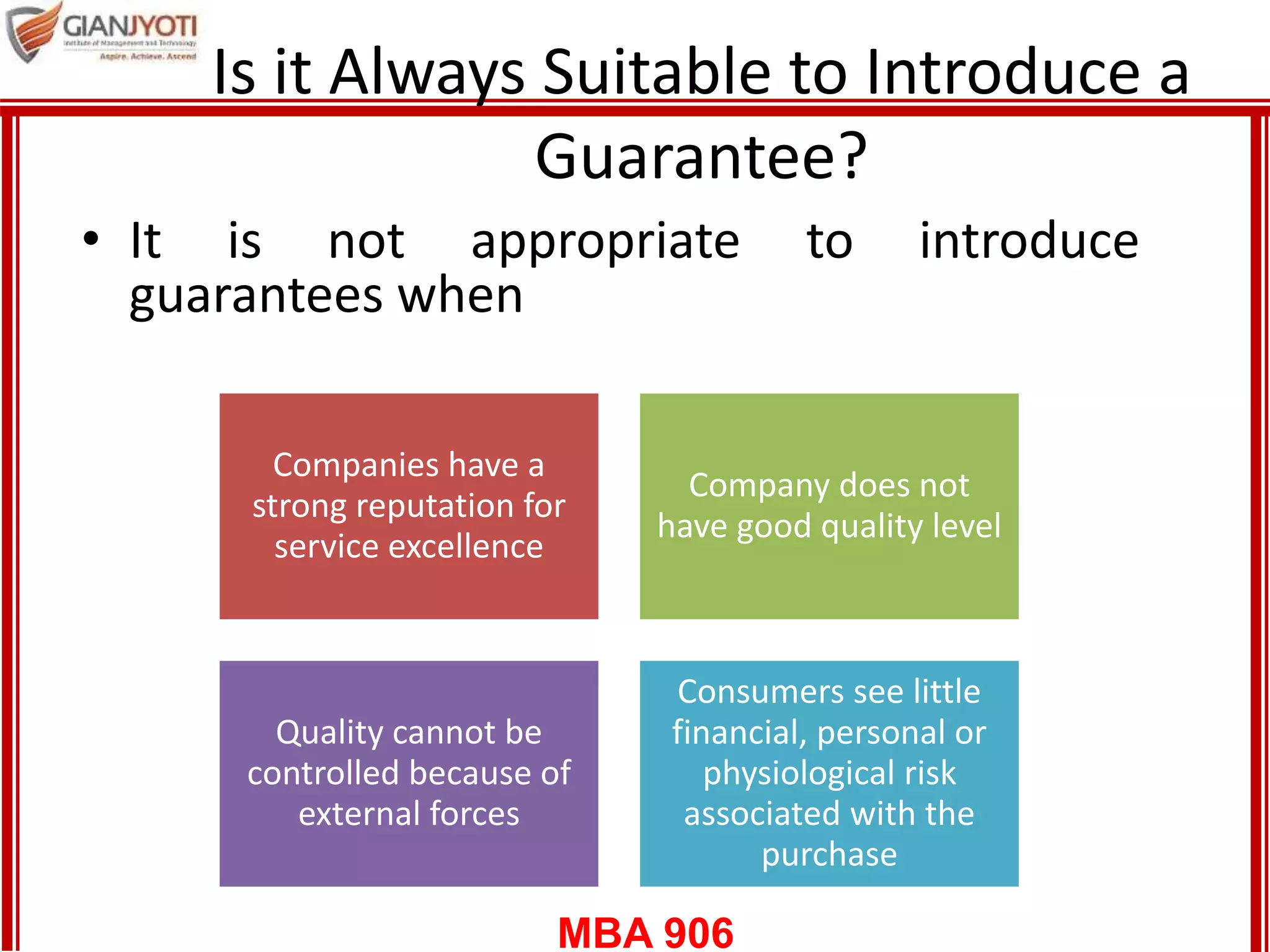
Is it Always Suitable to Introduce a
Guarantee?
• It is not appropriate to introduce
guarantees when
Companies have a
strong reputation for
service excellence
Company does not
have good quality level
Quality cannot be
controlled because of
external forces
Consumers see little
financial, personal or
physiological risk
associated with the
purchase
MBA 906
JAYCUSTOMERS
A customer who behaves in a thoughtless
or abusive fashion, causing problems for
the firm, its employees, and other
customers
MBA 906
SEVEN TYPES OF JAYCUSTOMERS
44
MBA 906
Seven Types of Jaycustomers
• The Cheat: thinks of various way to cheat the firm
• The Thief: No intention of paying--sets out to steal
or pay less
– Services lend themselves to clever schemes to avoid
payment
• e.g., bypassing electricity meters, circumventing TV
cables, riding free on public transportation
– Firms must take preventive actions against thieves, but
make allowances for honest but absent-minded
customers
45
MBA 906
Seven Types of Jaycustomers
• The Rule breaker
– Many services need to establish rules to guide customers safely
through the service encounter
– Government agencies may impose rules for health and
safety reasons
– Some rules protect other customers from dangerous
behavior
• e.g. ski patrollers issue warnings to reckless skiers by
attaching orange stickers on their lift tickets
– Ensure company rules are necessary, not should not be too much or
inflexible
• Family Feuders
– People who get into arguments with other customers – often
members of their own family
MBA 906
• The Belligerent
– Shouts loudly, maybe mouthing insults, threats and curses
– Service personnel are often abused even when they are not to be blamed
– Confrontations between customers and service employees can easily
escalate
– Firms should ensure employees have skills to deal with difficult situations
• The Vandal:
– Service vandalism includes pouring soft drinks into bank cash machines;
slashing bus seats, breaking hotel furniture
– Bored and drunk young people are a common source of vandalism
– Unhappy customers who feel mistreated by service providers take
revenge
– Prevention is the best cure
Seven Types of Jaycustomers
 In a public environment, priority is to remove person from other
customers
 May be better to support employee’s actions and get security or the
police if necessary if an employee has been physically attacked
MBA 906
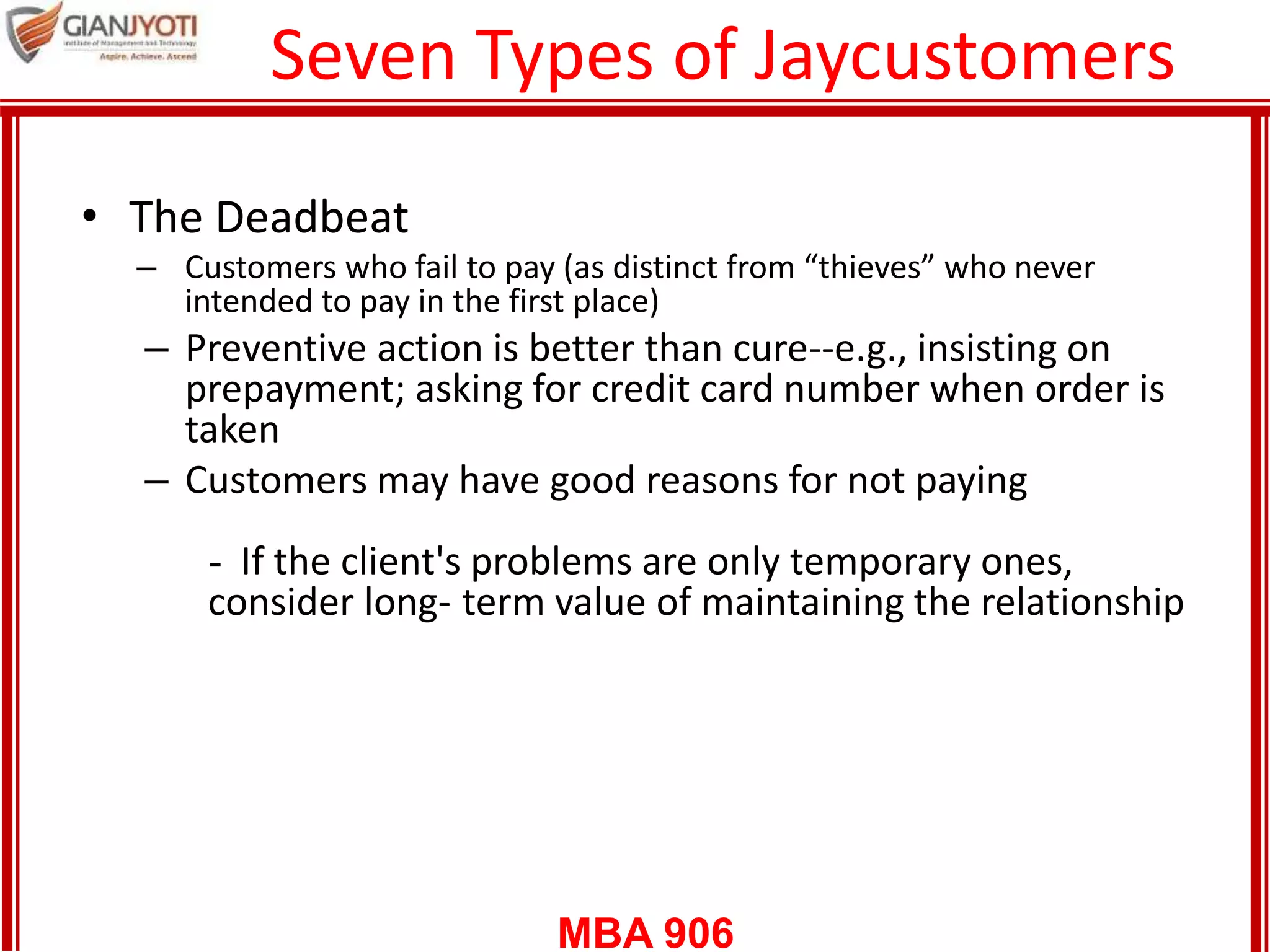
Seven Types of Jaycustomers
• The Deadbeat
– Customers who fail to pay (as distinct from “thieves” who never
intended to pay in the first place)
– Preventive action is better than cure--e.g., insisting on
prepayment; asking for credit card number when order is
taken
– Customers may have good reasons for not paying
- If the client's problems are only temporary ones,
consider long- term value of maintaining the relationship
MBA 906
Dealing with Customer Fraud
• If in doubt, believe the customer
• Keep a database of how often customers invoke service
guarantees or of payments made for service failure
• Insights from research on guarantee cheating:
– Amount of a guarantee payout had no effect on customer cheating
– Repeat-purchase intention reduced cheating intent
– Customers are reluctant to cheat if service quality is high (rather than
just satisfactory)
• Managerial implications:
– Firms can benefit from offering 100 percent money-back guarantees
– Guarantees should be offered to regular customers as part of
membership program since regular customers are unlikely to cheat
– Excellent service firms have less to worry about than average providers
MBA 906
Service Guarantee Impacts On Marketing And
Operations
Internal & external
marketing
Internal & external
operating standards
Enhance
operational
competency
Enhance
market awareness
Experience
Quality
Service
Guarantee
Expected
Quality
MBA 906

Managing relationship and building loyalty

  • 1.
    MBA 9061 Services Marketing ManagingRelationship And Building Loyalty, Complaint Handling And Service Recovery Strategies Course Instructor: Sneha Sharma, PhD*, MBA, Dip T & D, UGC-NET JRF Qualified
  • 2.
  • 3.
    MBA 906 Four Stagesof Brand Loyalty in a Consumer Cognitive loyalty • perception from brand attribute information that one brand is preferable to its alternatives Affective loyalty • developing a liking for the brand based on cumulatively satisfying usage occasions Conative loyalty • commitment to re-buying the same brand Action loyalty • exhibiting consistent repurchase behavior
  • 4.
    MBA 906 Why IsCustomer Loyalty Important to A Firm’s Profitability? • Customers become more profitable the longer they remain with a firm: Increase purchases and/or account balances • Customers / families purchase in greater quantities as they grow Reduced operating costs • Fewer demands from suppliers and operating mistakes as customer becomes experienced Referrals to other customers • Positive word-of-mouth saves firm from investing money in sales and advertising Price premiums • Long-term customers willing to pay regular price • Willing to pay higher price during peak periods
  • 5.
    MBA 906 Assessing theValue of a Loyal Customer Wrong Assumption: Loyal customers are always more profitable than those making one-time transactions • Large customers may expect price discounts in return for loyalty • Revenues don’t necessarily increase with time for all types of customers Tasks • Determine costs and revenues for customers from different market segments at different points in their customer lifecycles • Predict future profitability
  • 6.
    MBA 906 Why areCustomers Loyal? • Customers stay loyal when we create value for them • Value can be created for customers through – Confidence benefits – Social benefits • Mutual recognition and friendship between service provider and customer – Special treatment
  • 7.
    MBA 906 Value CanBe Created For Customers Through Confidence Benefit Confidence in correct performance Ability to trust the provider Lower anxiety when purchasing Knowing what to expect and receive Special Treatment Better price Extra services Discounts not available to most customer Higher priority when there is a wait
  • 8.
    MBA 906 Why Loyalty???-Bucketwith Holes Increased purchase by some customers New customers Lost Customers Decreased purchase by some customers Lost Customers
  • 9.
    MBA 906 A LoyalCustomer Pyramid • Relationship of partner • Actively recommends you • Supports you passively • Repeat business, but passive or negative attitude • Carried out one transaction • Potential customer
  • 10.
  • 11.
    MBA 906 BUILDING AFOUNDATION FOR LOYALTY
  • 12.
    MBA 906 Targeting theRight Customers and Searching for Value, Not Volume • Target the right customer and match them to what firm can deliver – How do customer needs relate to company? – How well can service personnel meet expectations of different types of customers? – Can company match or exceed competing services that are directed at same types of customers?
  • 13.
    MBA 906 • Focuson number of customers served as well as value of each customer – Heavy users who buy more frequently and in larger volumes are more profitable than occasional users – Avoid targeting customers who buy based on lowest price Targeting the Right Customers and Searching for Value, Not Volume
  • 14.
    MBA 906 Targeting theRight Customers and Searching for Value, Not Volume • Firms that are highly focused and selective in their acquisition of customers grow faster • “Right customers” are not always high spenders – Can come from a large group of people that no other supplier is serving well
  • 15.
    MBA 906 Effective Tieringof Service The Customer Pyramid
  • 16.
    MBA 906 The CustomerSatisfaction Loyalty Relationship
  • 17.
    MBA 906 STRATEGIES FORDEVELOPING LOYALTY BONDS WITH CUSTOMERS
  • 18.
    MBA 906 Deepening TheRelationship Bundling/Cross-selling services • Makes switching a major effort that customer is unwilling to go through unless extremely dissatisfied with service provider Customers benefit from buying all their various services from the same provider • One-stop-shopping, potentially higher service levels, higher service tiers etc
  • 19.
    MBA 906 Loyalty Bondswith Customers Excellent Service andValue 1. Financial Bond 2.SocialBond 3. Customization Bond 4.StructuralBond Stable Pricing Personal Relationships Joint Investments Shared processes and equipments Anticipation/ Innovation Mass customization Customer Intimacy
  • 20.
    MBA 906 Reward BasedBonds Financial bonds • Discounts on purchases, loyalty program rewards (e.g. frequent flier miles), cash- back programs Non-financial rewards • Priority to loyalty program members for waitlists and queues in call centers; higher baggage allowances, priority upgrading, access to airport lounges for frequent flyers Intangible rewards • Special recognition and appreciation Reward-based loyalty programs • Relatively easy to copy and rarely provide a sustained competitive advantage
  • 21.
    MBA 906 STRATEGIES FORREDUCING CUSTOMER DEFECTIONS Understand reasons for customer switching
  • 22.
    MBA 906 What DrivesCustomers to Switch?
  • 23.
    MBA 906 Address KeyIssues • Deliver quality service • Reduce inconvenience and non-monetary costs • Have fair and transparent pricing • Industry specific drivers – Cellular phone industry: handset replacement a common reason for subscribers discontinuing services – offer handset replacement programs • Take active steps to retain customers – Save teams: specially trained call center staff to deal with customers who want to cancel their accounts – Be careful about how save teams are rewarded
  • 24.
    MBA 906 Customer ResponseCategories to Service Failures
  • 25.
    MBA 906 Understanding CustomerResponses to Service Failure Why do customers complain? • Obtain compensation • Release their anger • Help to improve the service • Because of concern for others What proportion of unhappy customers complain? Why don’t unhappy customers complain? Who is most likely to complain? Where do customers complain? What do customers expect once they have made a complaint? • Procedural, interactional and outcome justice
  • 26.
    MBA 906 3 Dimensionsof Perceived Fairness in Service Recovery Process
  • 27.
    MBA 906 Dealing withComplaining Customers and Recovering from Service Failure Take complaints professionally and not personally Be prepared to deal with angry customer who may behave in an insulting way to service personnel who may not be at fault Take the perspective that customer complaints allow firm a chance to • Correct problems, • Restore relationships • Improve future satisfaction for all Develop effective service recovery procedures
  • 28.
    MBA 906 Importance ofService Recovery Plays a crucial role in achieving customer satisfaction Tests a firm’s commitment to satisfaction and service quality • Employee training and motivation is highly important Impacts customer loyalty and future profitability • Complaint handling should be seen as a profit center, not a cost center
  • 29.
    MBA 906 The ServiceRecovery Paradox • Note: not all research supports this paradox Customers who experience a service failure that is satisfactorily resolved may be more likely to make future purchases than customers without problems • the paradox disappears—customers’ expectations have been raised and they become disillusioned If second service failure occurs, • (e.g., spoiled wedding photos) may limit firm’s ability to delight customer with recovery efforts Severity and “recoverability” of failure • Do it right the first timeBest strategy
  • 30.
    MBA 906 Figure 10.1(Source: Adapted from Schindlholzer, 2008) Customerloyalty Time Customers who experience service failure and successful recovery Customers who do not experience service failure Customer loyalty difference Service recovery Service failure The Service Recovery Paradox
  • 31.
    MBA 906 Principles ofEffective Service Recovery Systems
  • 32.
    MBA 906 Strategies toReduce Customer Complaint Barriers
  • 33.
    MBA 906 How toEnable Effective Service Recovery Be proactive • On the spot, before customers complain Plan recovery procedures • Identify most common service problems and have prepared scripts to guide employees in service recovery Teach recovery skills to relevant personnel Empower personnel to use judgment and skills to develop recovery solutions
  • 34.
    MBA 906 How GenerousShould Compensation Be? What is positioning of our firm? How severe was the service failure? Who is the affected customer?
  • 35.
    MBA 906 Service RecoveryProcess Apology Frames customer’s perceptions and paves the way to recovery Urgent reinstatement Quick action to correct or remove problem Empathy Employee understanding and responsiveness Symbolic atonement Tangible evidence of organization’s willingness to take responsibility Follow-up Evaluate recovery plan
  • 36.
    MBA 906 Effective RecoveryProcess Leads To Impacts customer satisfaction Impacts perceptions of quality Impacts bottom-line performance Enhances customer loyalty Stimulates positive word of mouth
  • 37.
    MBA 906 The CustomerComplaint Iceberg Figure 10.2 (Source: based on TARP, 1979)
  • 38.
  • 39.
    MBA 906 The Powerof Service Guarantees Force firms to focus on what customers want Set clear standards Require systems to get & act on customer feedback Force organizations to understand why they fail and to overcome potential fail points Reduce risks of purchase and build loyalty
  • 40.
    MBA 906 How toDesign Service Guarantees Unconditional Easy to understand and communicate Meaningful to the customer Easy to invoke Easy to collect Credible
  • 41.
    MBA 906 Reasons AndCriteria For Service Guarantees Table 10.1 (Source: based on Hart, 1990; Zeithaml et al, 2007) Reasons for service guarantees Criteria for designing guarantees A good guarantee forces the company to focus on its customers The guarantee should be totally unconditional An effective guarantee sets clear standards for the organization It must be easy to understand and communicate to the customer A good guarantee generates immediate and relevant feedback from customers It must be meaningful to the customer and compensation more than adequate Information generated from the guarantee program can be used for continuous improvement The guarantee must be easy to invoke When the guarantee is invoked there is an immediate opportunity to recover It should be easy to collect Guarantees build ‘marketing muscle’ by reducing the risk of purchase decision The guarantee should be credible Employee morale and loyalty can be enhanced as a result of a good guarantee program
  • 42.
    MBA 906 Is itAlways Suitable to Introduce a Guarantee? • It is not appropriate to introduce guarantees when Companies have a strong reputation for service excellence Company does not have good quality level Quality cannot be controlled because of external forces Consumers see little financial, personal or physiological risk associated with the purchase
  • 43.
    MBA 906 JAYCUSTOMERS A customerwho behaves in a thoughtless or abusive fashion, causing problems for the firm, its employees, and other customers
  • 44.
    MBA 906 SEVEN TYPESOF JAYCUSTOMERS 44
  • 45.
    MBA 906 Seven Typesof Jaycustomers • The Cheat: thinks of various way to cheat the firm • The Thief: No intention of paying--sets out to steal or pay less – Services lend themselves to clever schemes to avoid payment • e.g., bypassing electricity meters, circumventing TV cables, riding free on public transportation – Firms must take preventive actions against thieves, but make allowances for honest but absent-minded customers 45
  • 46.
    MBA 906 Seven Typesof Jaycustomers • The Rule breaker – Many services need to establish rules to guide customers safely through the service encounter – Government agencies may impose rules for health and safety reasons – Some rules protect other customers from dangerous behavior • e.g. ski patrollers issue warnings to reckless skiers by attaching orange stickers on their lift tickets – Ensure company rules are necessary, not should not be too much or inflexible • Family Feuders – People who get into arguments with other customers – often members of their own family
  • 47.
    MBA 906 • TheBelligerent – Shouts loudly, maybe mouthing insults, threats and curses – Service personnel are often abused even when they are not to be blamed – Confrontations between customers and service employees can easily escalate – Firms should ensure employees have skills to deal with difficult situations • The Vandal: – Service vandalism includes pouring soft drinks into bank cash machines; slashing bus seats, breaking hotel furniture – Bored and drunk young people are a common source of vandalism – Unhappy customers who feel mistreated by service providers take revenge – Prevention is the best cure Seven Types of Jaycustomers  In a public environment, priority is to remove person from other customers  May be better to support employee’s actions and get security or the police if necessary if an employee has been physically attacked
  • 48.
    MBA 906 Seven Typesof Jaycustomers • The Deadbeat – Customers who fail to pay (as distinct from “thieves” who never intended to pay in the first place) – Preventive action is better than cure--e.g., insisting on prepayment; asking for credit card number when order is taken – Customers may have good reasons for not paying - If the client's problems are only temporary ones, consider long- term value of maintaining the relationship
  • 49.
    MBA 906 Dealing withCustomer Fraud • If in doubt, believe the customer • Keep a database of how often customers invoke service guarantees or of payments made for service failure • Insights from research on guarantee cheating: – Amount of a guarantee payout had no effect on customer cheating – Repeat-purchase intention reduced cheating intent – Customers are reluctant to cheat if service quality is high (rather than just satisfactory) • Managerial implications: – Firms can benefit from offering 100 percent money-back guarantees – Guarantees should be offered to regular customers as part of membership program since regular customers are unlikely to cheat – Excellent service firms have less to worry about than average providers
  • 50.
    MBA 906 Service GuaranteeImpacts On Marketing And Operations Internal & external marketing Internal & external operating standards Enhance operational competency Enhance market awareness Experience Quality Service Guarantee Expected Quality
  • 51.