Open Channel Hydraulics
1
Hydraulics
Dr. Mohsin Siddique
Assistant Professor
Steady Flow in Open Channels
Specific Energy and Critical Depth
Surface Profiles and Backwater Curves in Channels of
Uniform sections
Hydraulics jump and its practical applications.
Flow over Humps and through Constrictions
Broad Crested Weirs andVenturi Flumes
2
Specific Energy and Critical Depth
Basic Definitions
Head
Energy per unit weight
Energy Line
Line joining the total head at different positions
Hydraulics Grade Line
Line joining the pressure head at different positions
3
Specific Energy and Critical Depth
Basic Definitions
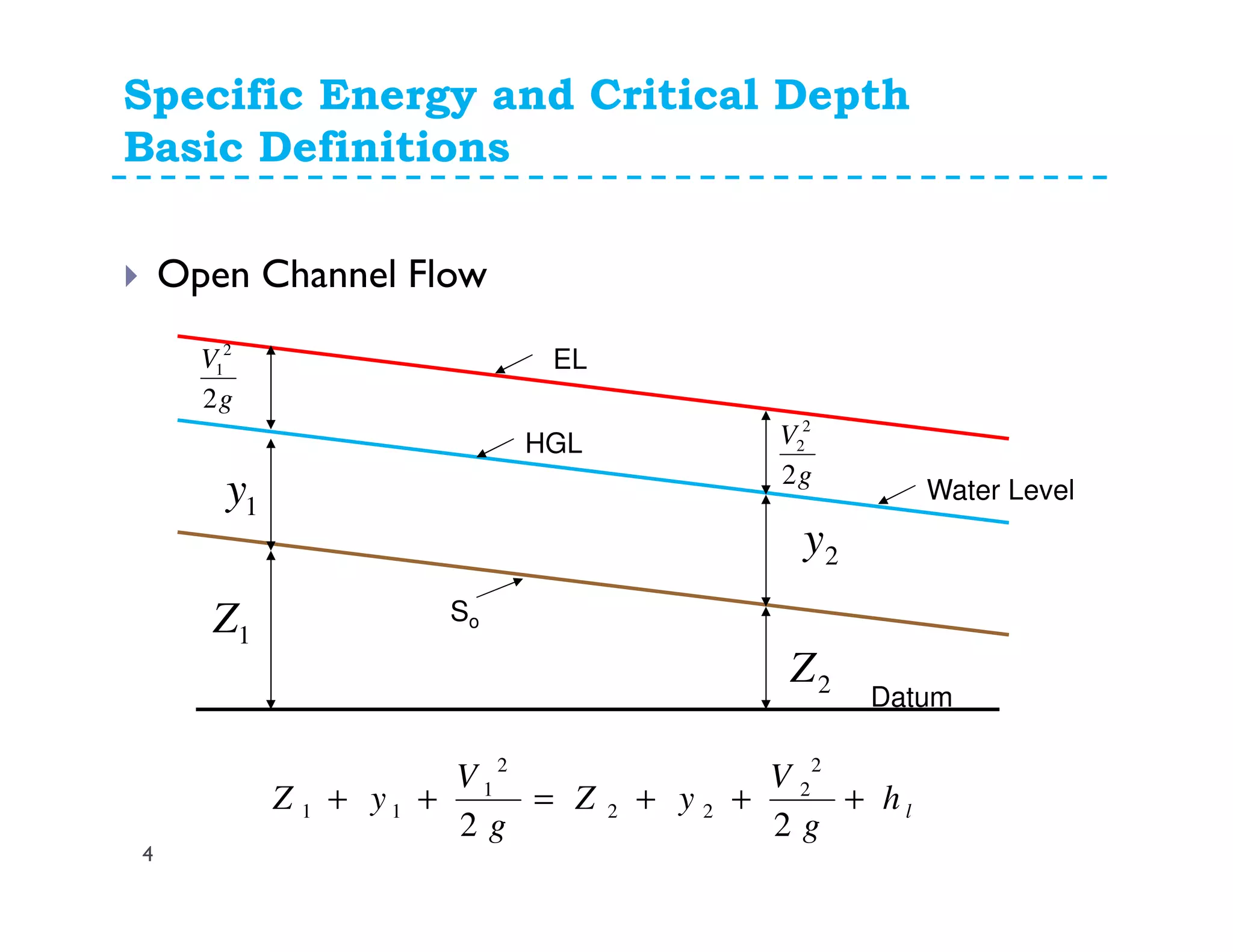
Open Channel Flow
1Z
g
V
2
2
1
Datum
So
1y
2Z
g
V
2
2
2
2y
HGL
EL
Water Level
lh
g
V
yZ
g
V
yZ +++=++
22
2
2
22
2
1
11
4
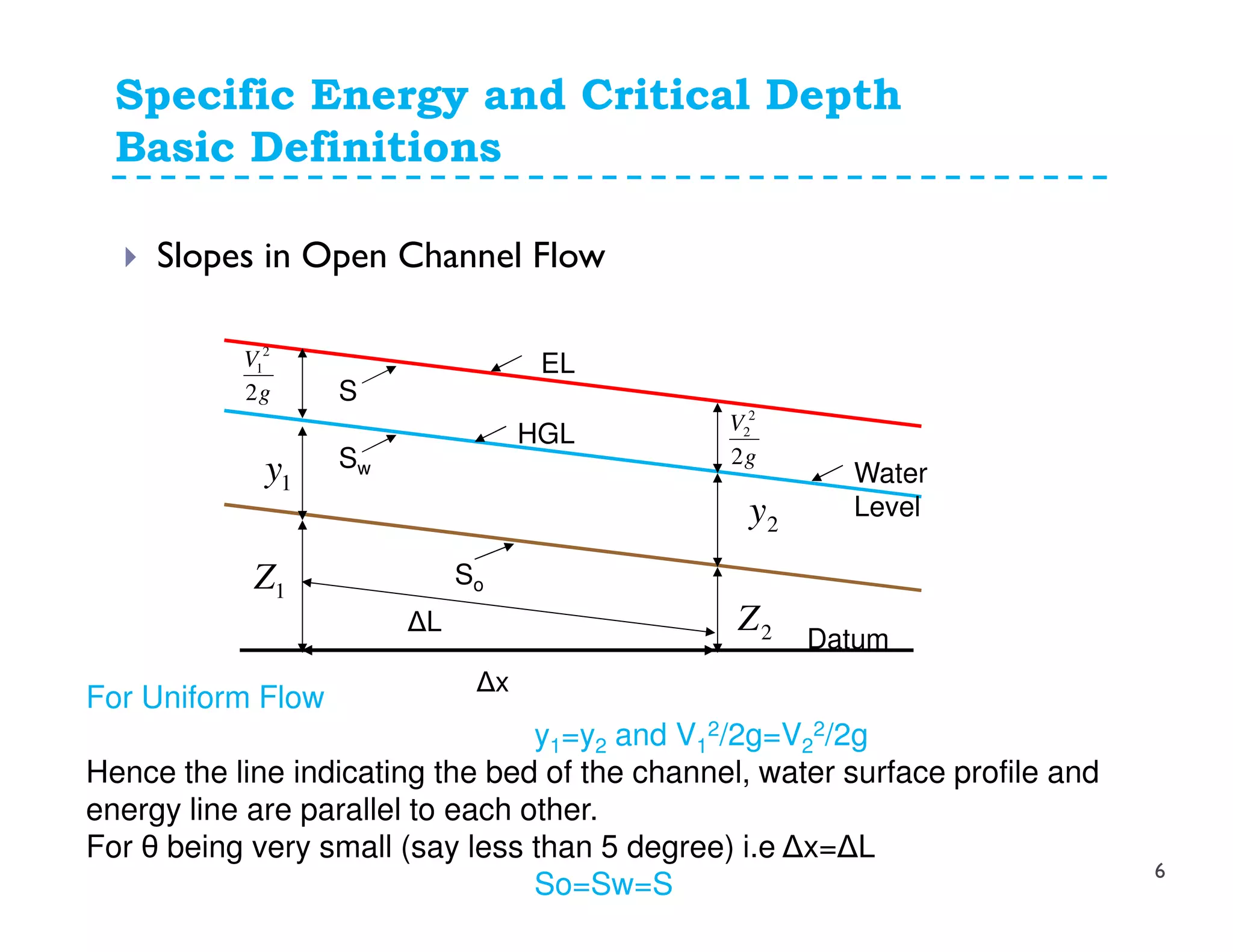
Slopes in Open Channel Flow
So= Slope of Channel Bed = (Z1-Z2)/(Δx)= -ΔZ/Δx
Sw= Slope of Water Surface= [(Z1+y1)-(Z2+y2)]/Δx
S= Slope of Energy Line= [(Z1+y1+V1
2/2g)-(Z2+y2+V2
2/2g)]/Δx
= hl/ΔL
1Z
g
V
2
2
1
Datum
So
1y
2Z
g
V
2
2
2
2y
HGL
EL
Water
Level
Sw
S
∆L
∆x
Specific Energy and Critical Depth
Basic Definitions
5
Specific Energy and Critical Depth
Basic Definitions
Slopes in Open Channel Flow
1Z
g
V
2
2
1
Datum
So
1y
2Z
g
V
2
2
2
2y
HGL
EL
Water
Level
Sw
S
∆L
∆x
For Uniform Flow
y1=y2 and V1
2/2g=V2
2/2g
Hence the line indicating the bed of the channel, water surface profile and
energy line are parallel to each other.
For θ being very small (say less than 5 degree) i.e ∆x=∆L
So=Sw=S
6
Specific Energy and Critical Depth
Basic Definitions
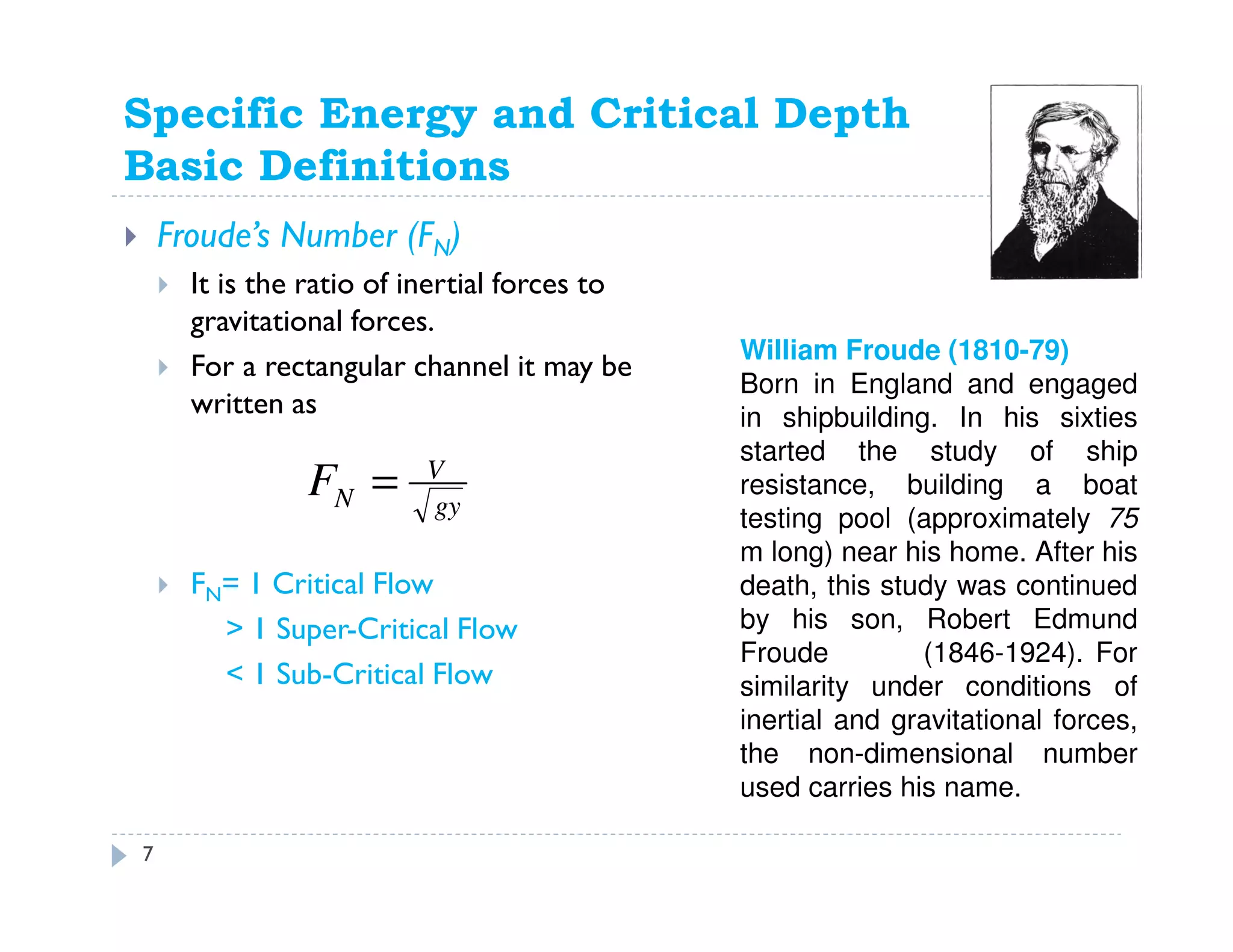
Froude’s Number (FN)
It is the ratio of inertial forces to
gravitational forces.
For a rectangular channel it may be
written as
FN= 1 Critical Flow
> 1 Super-Critical Flow
< 1 Sub-Critical Flow
gy
V
NF =
William Froude (1810-79)
Born in England and engaged
in shipbuilding. In his sixties
started the study of ship
resistance, building a boat
testing pool (approximately 75
m long) near his home. After his
death, this study was continued
by his son, Robert Edmund
Froude (1846-1924). For
similarity under conditions of
inertial and gravitational forces,
the non-dimensional number
used carries his name.
7
Specific Energy and Critical Depth
(Rectangular Channels)
Specific Energy
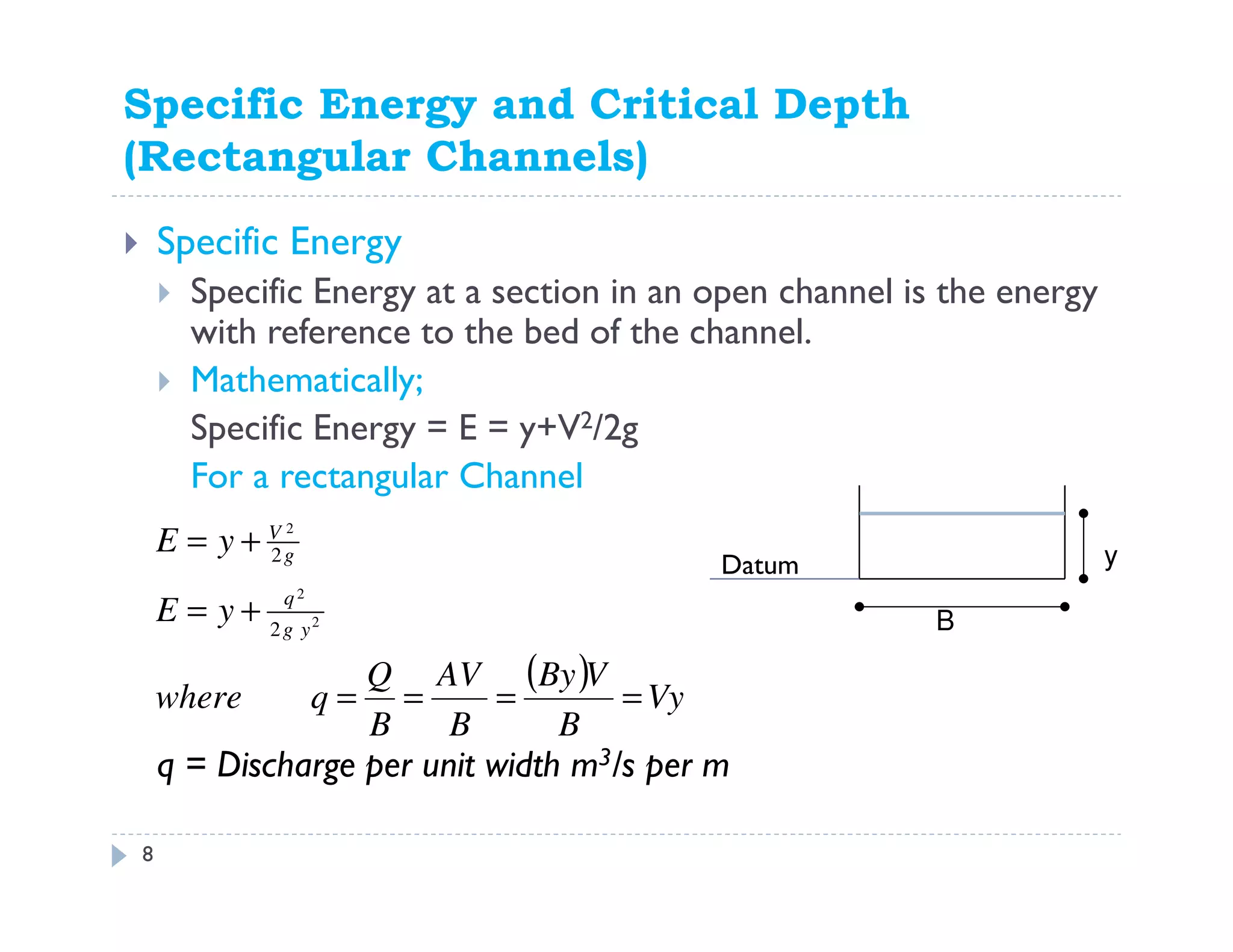
Specific Energy at a section in an open channel is the energy
with reference to the bed of the channel.
Mathematically;
Specific Energy = E = y+V2/2g
For a rectangular Channel
q = Discharge per unit width m3/s per m
B
( ) Vy
B
VBy
B
AV
B
Q
qwhere
yE
yE
yg
q
g
V
====
+=
+=
2
2
2
2
2 y
8
Datum
Specific Energy and Critical Depth
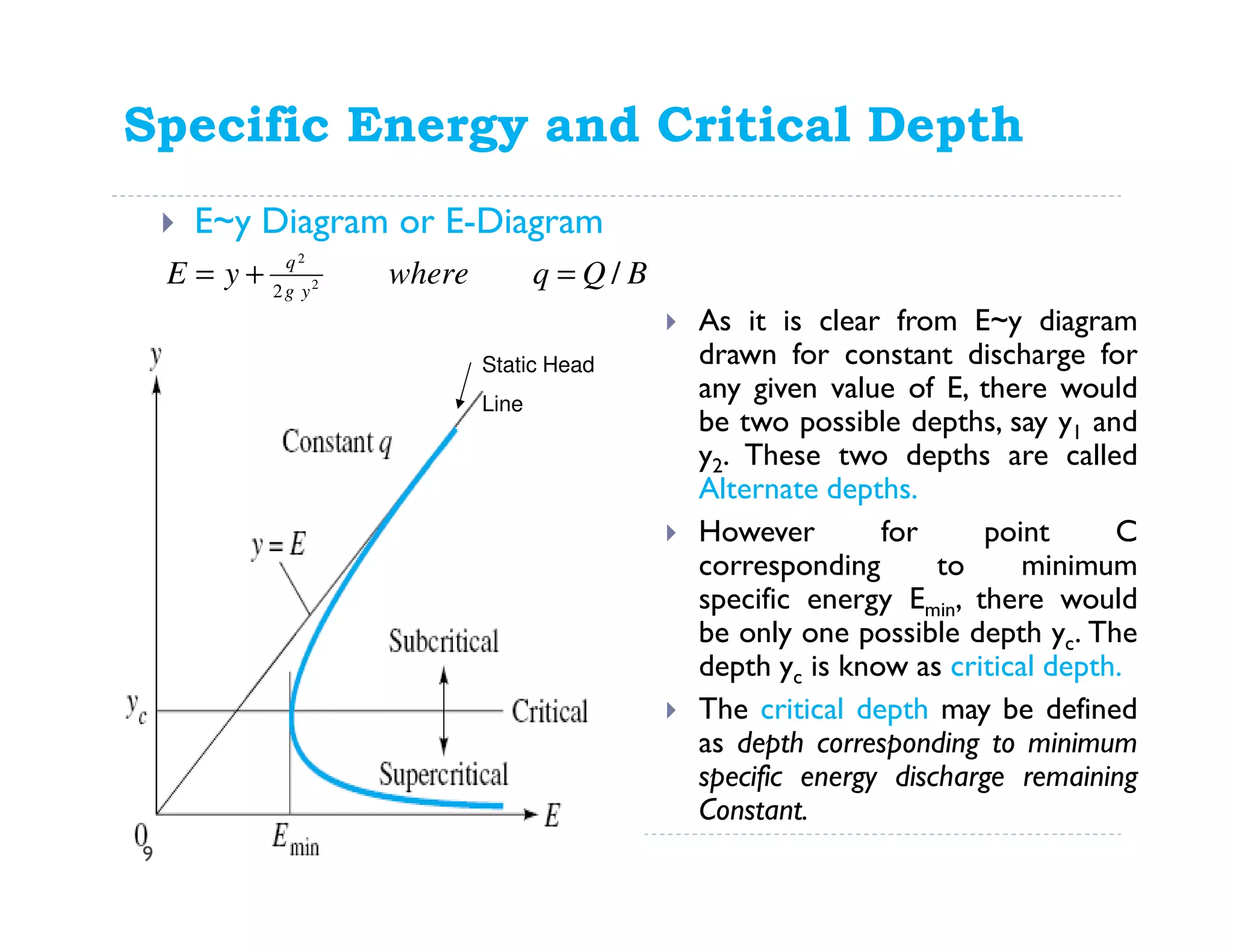
As it is clear from E~y diagram
drawn for constant discharge for
any given value of E, there would
be two possible depths, say y1 and
y2. These two depths are called
Alternate depths.
However for point C
corresponding to minimum
specific energy Emin, there would
be only one possible depth yc. The
depth yc is know as critical depth.
The critical depth may be defined
as depth corresponding to minimum
specific energy discharge remaining
Constant.
E~y Diagram or E-Diagram
Static Head
Line
BQqwhereyE yg
q
/2
2
2
=+=
9
Specific Energy and Critical Depth
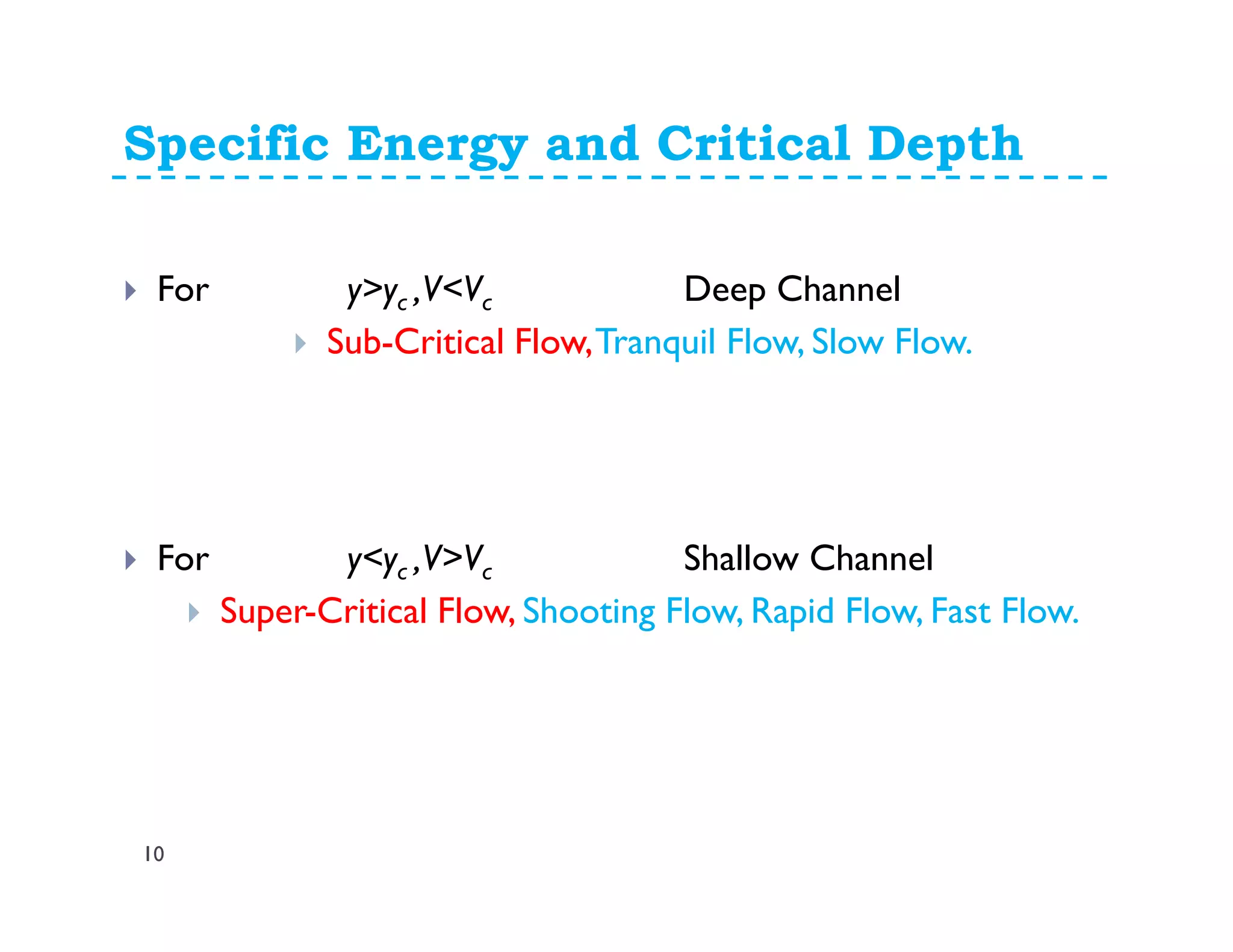
For y>yc ,V<Vc Deep Channel
Sub-Critical Flow,Tranquil Flow, Slow Flow.
For y<yc ,V>Vc Shallow Channel
Super-Critical Flow, Shooting Flow, Rapid Flow, Fast Flow.
10
Specific Energy and Critical Depth
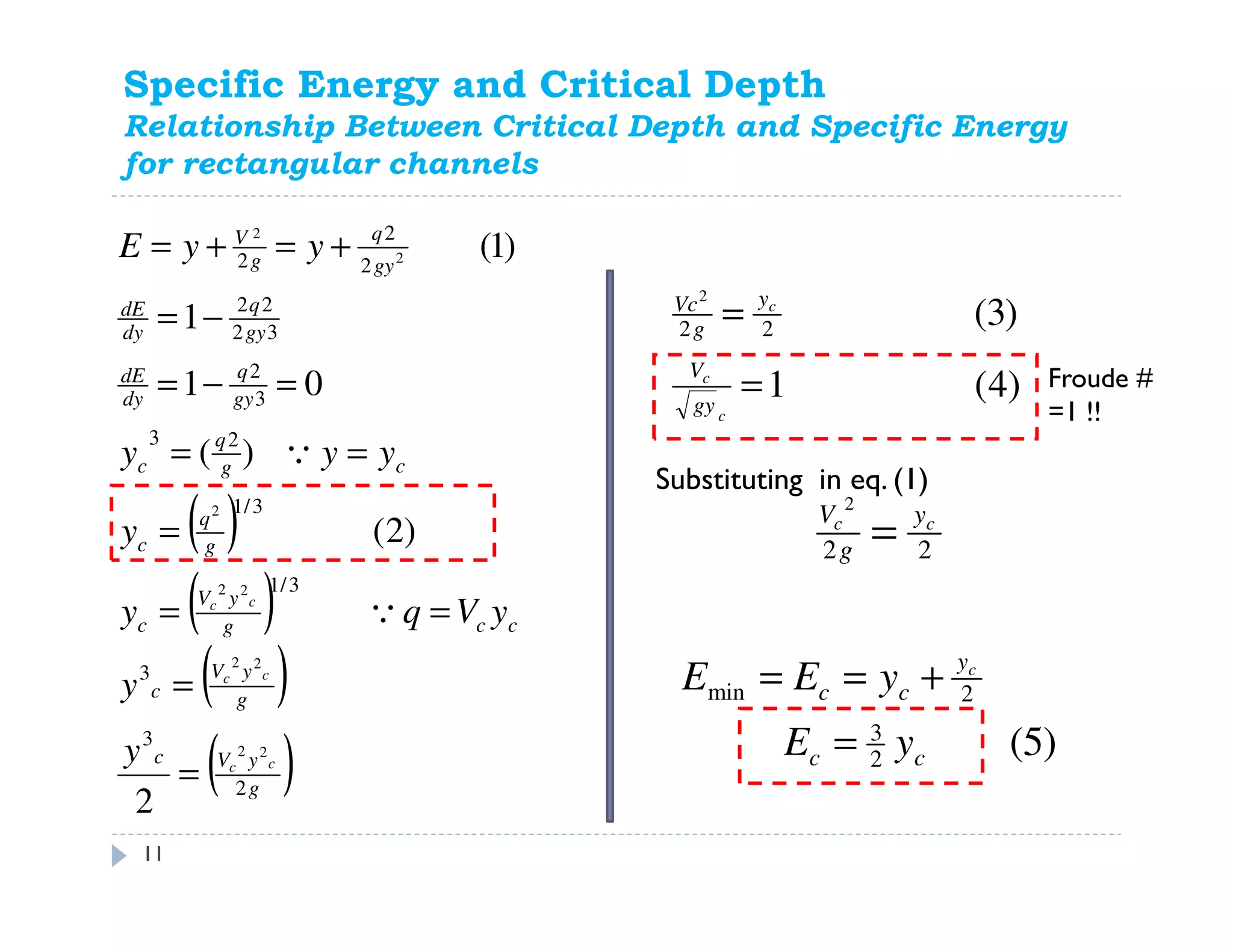
Relationship Between Critical Depth and Specific Energy
for rectangular channels
22
2
cc y
g
V
=
Substituting in eq. (1)
( )
( )
( )
( )g
yVc
g
yV
c
ccg
yV
c
g
q
c
cg
q
c
gy
q
dy
dE
gy
q
dy
dE
gy
q
g
V
cc
cc
cc
y
y
yVqy
y
yyy
yyE
2
3
3
3/1
3/1
23
3
2
32
22
2
2
2
22
22
22
2
2
2
2
)2(
)(
01
1
)1(
=
=
==
=
==
=−=
−=
+=+=
Q
Q
)5(2
3
2min
cc
y
cc
yE
yEE c
=
+==
11
)4(1
)3(22
2
=
=
c
c
c
gy
V
y
g
Vc
Froude #
=1 !!
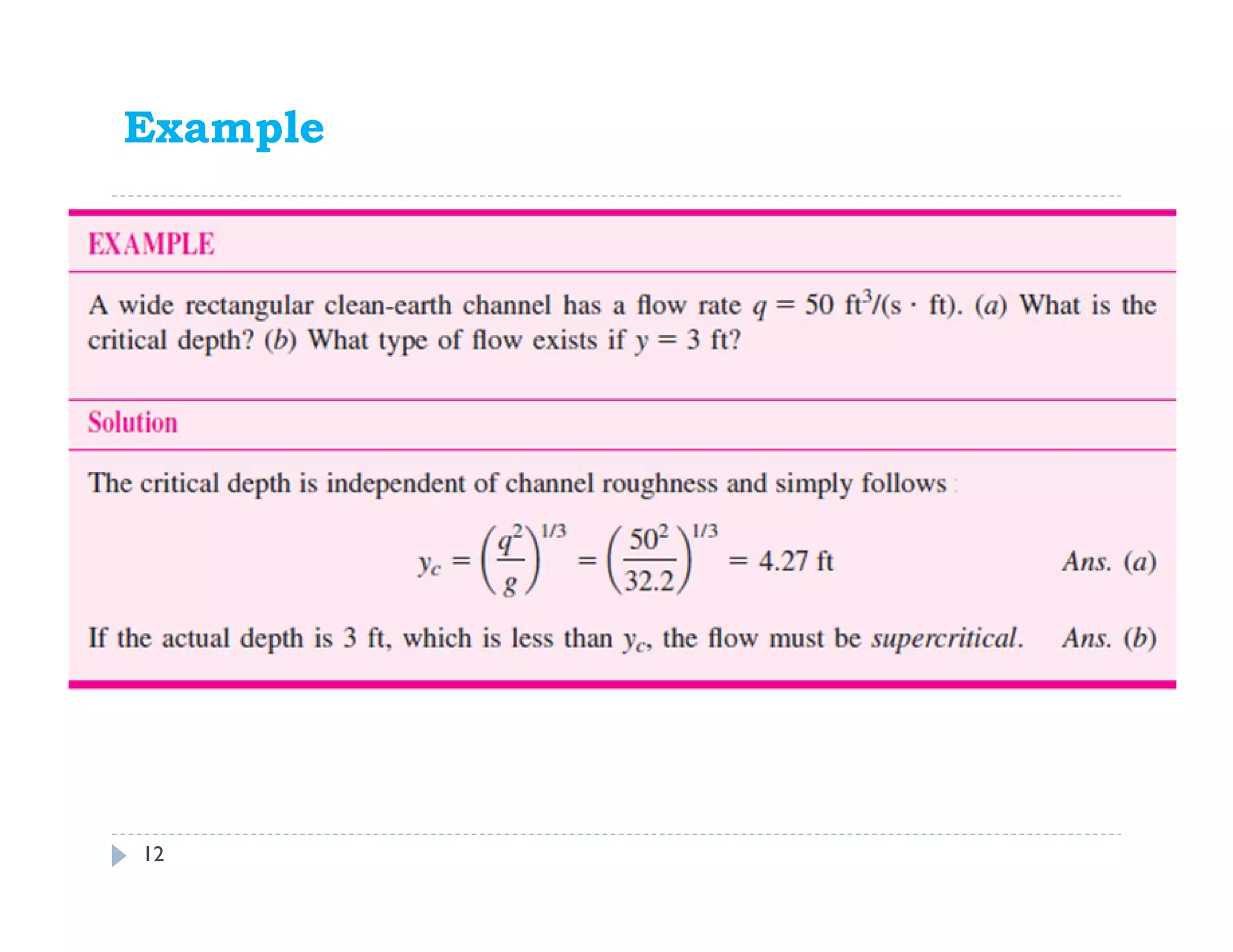
Example
12
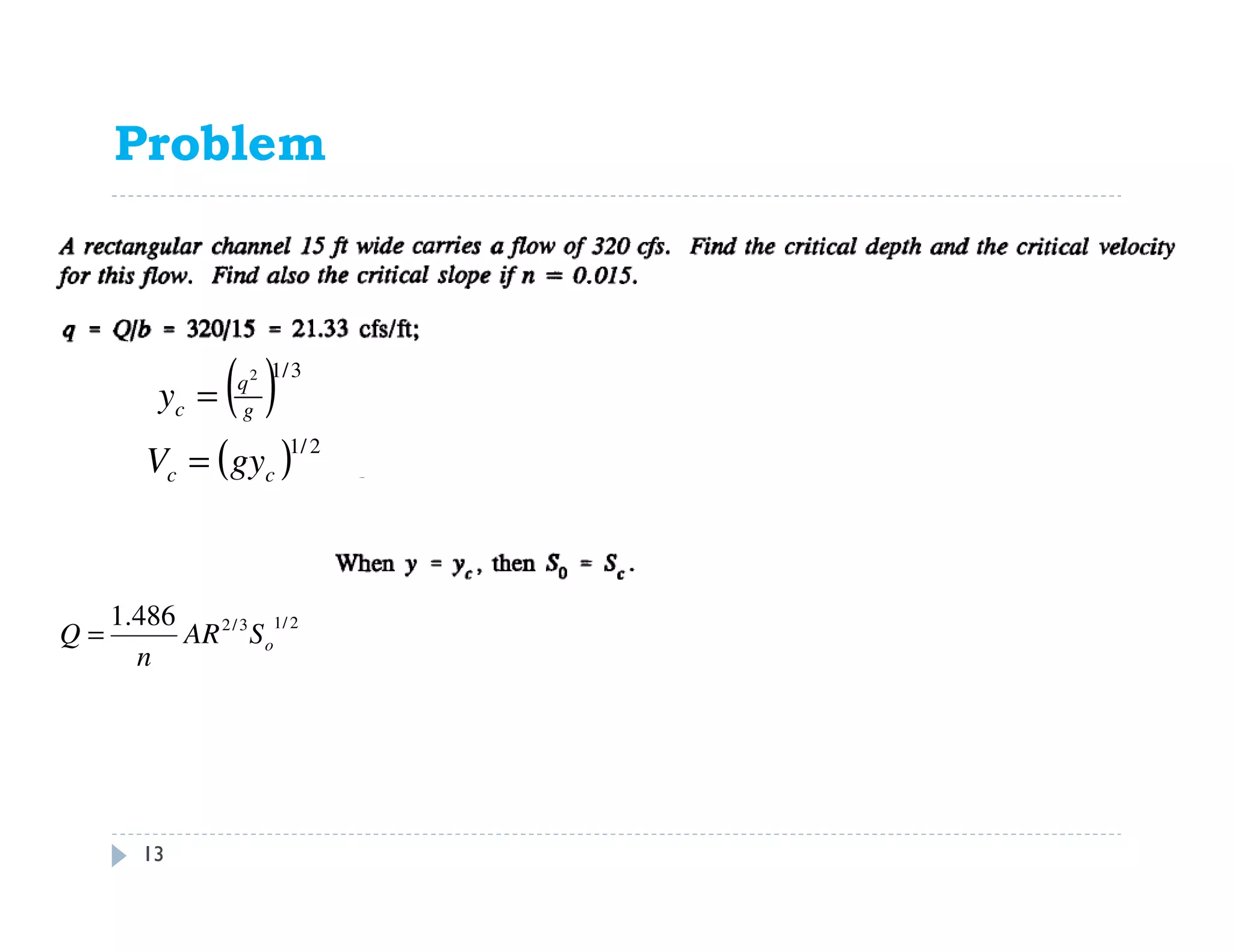
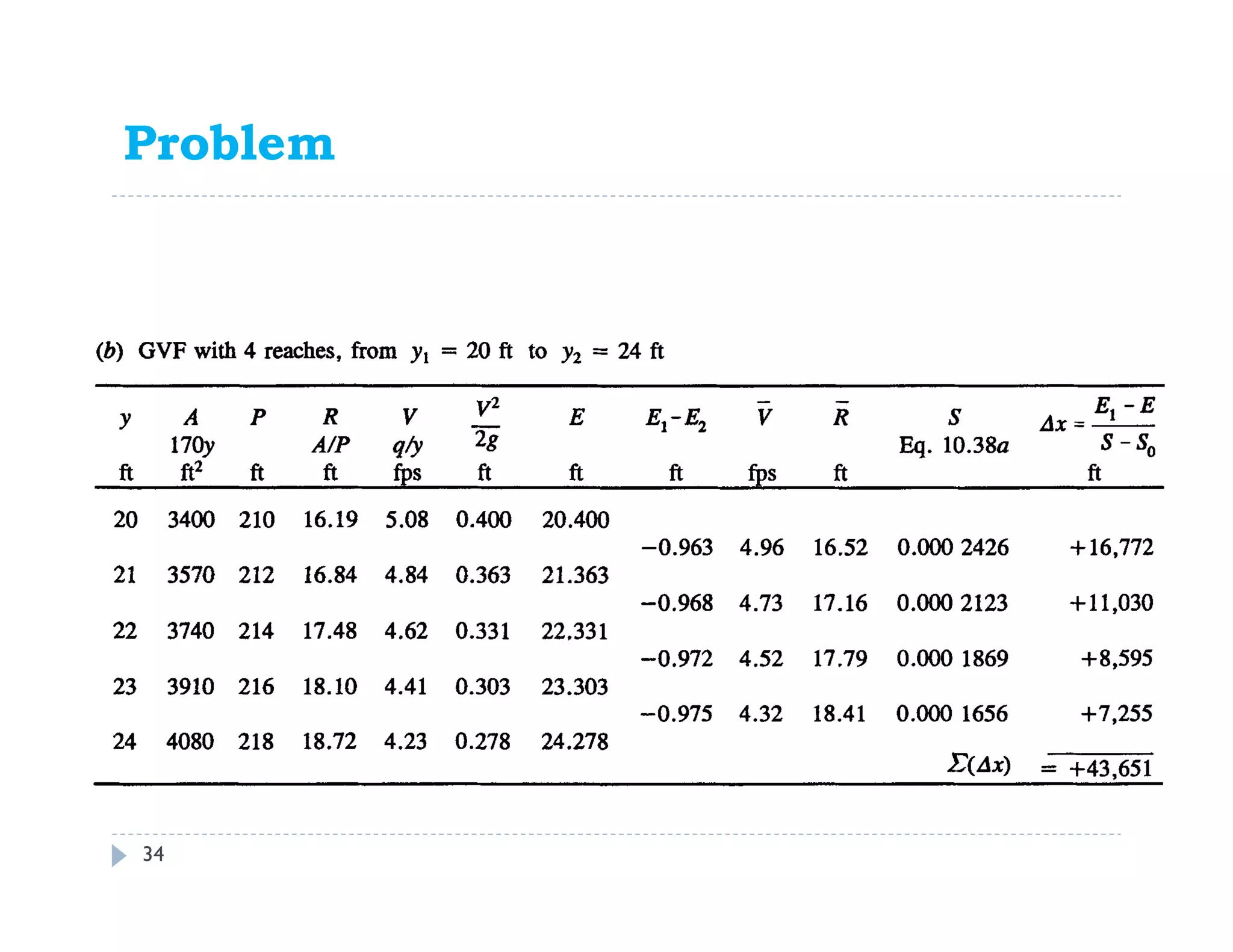
Problem
13
( ) 3/12
g
q
cy =
( ) 2/1
cc gyV =
2/13/2486.1
oSAR
n
Q =
Problem 11.38
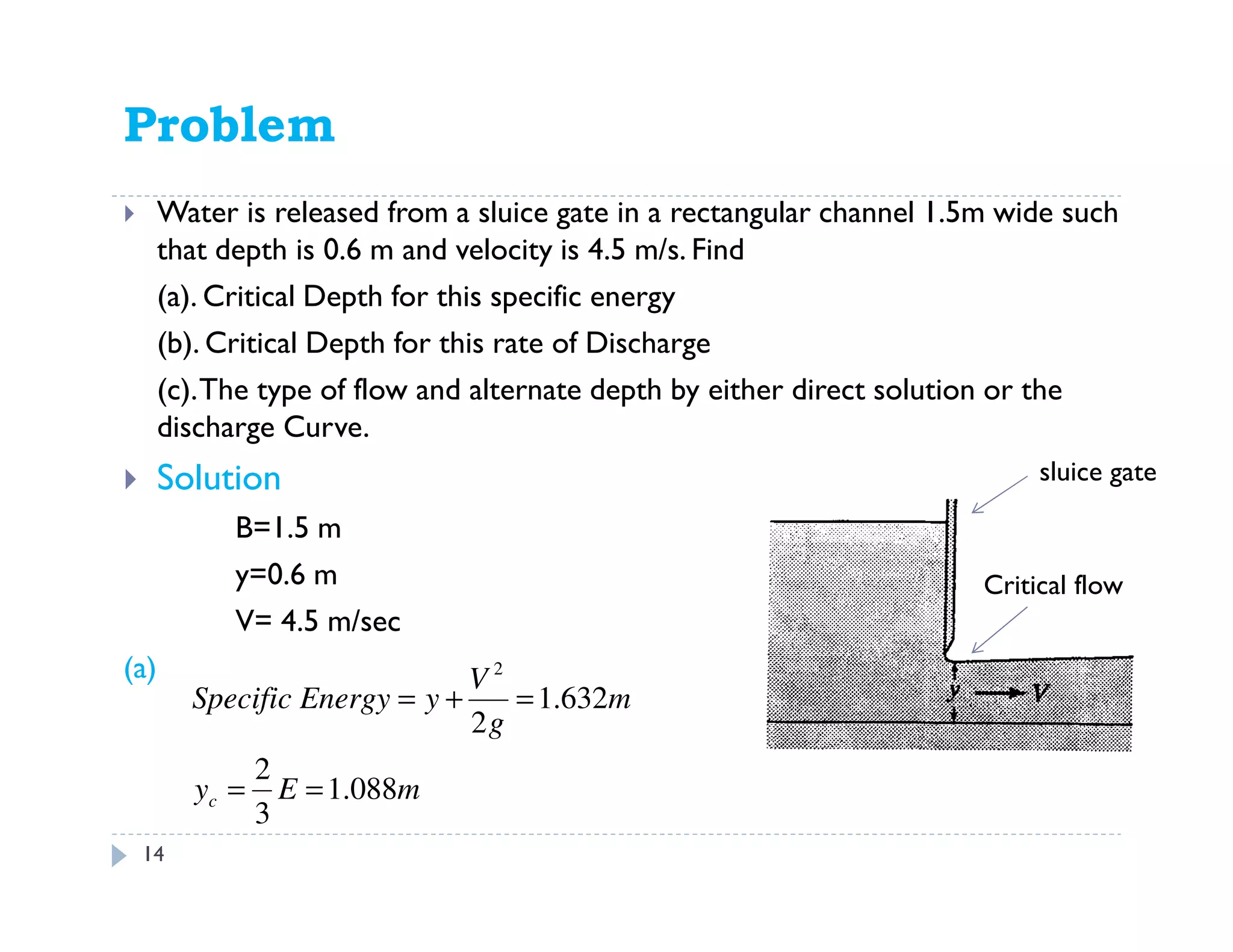
Water is released from a sluice gate in a rectangular channel 1.5m wide such
that depth is 0.6 m and velocity is 4.5 m/s. Find
(a). Critical Depth for this specific energy
(b). Critical Depth for this rate of Discharge
(c).The type of flow and alternate depth by either direct solution or the
discharge Curve.
Solution
B=1.5 m
y=0.6 m
V= 4.5 m/sec
(a)
mEy
m
g
V
yEnergySpecific
c 088.1
3
2
632.1
2
2
==
=+=
sluice gate
14
Critical flow
Problem 11.38
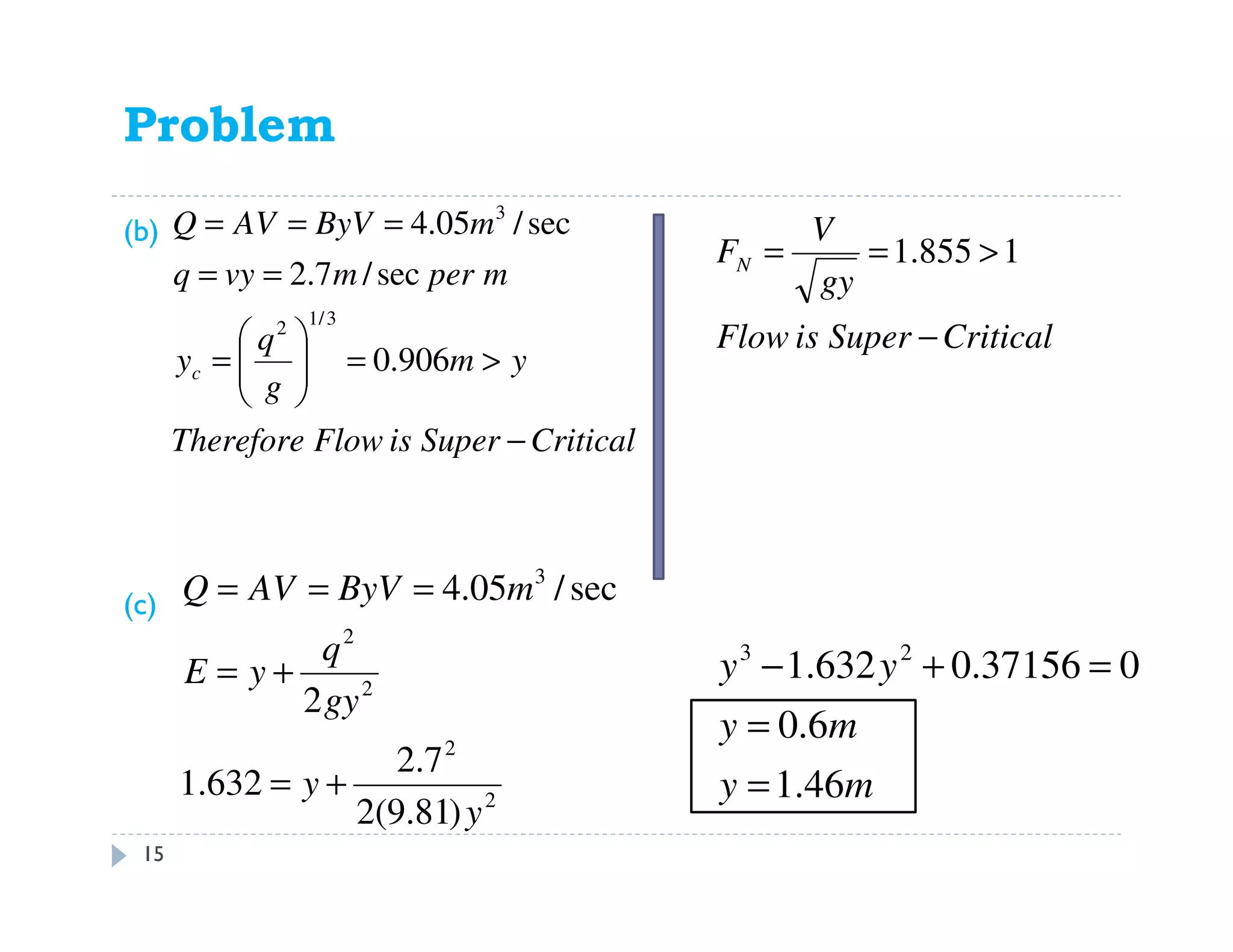
(b)
(c)
CriticalSuperisFlowTherefore
ym
g
q
y
mpermvyq
mByVAVQ
c
−
>=





=
==
===
906.0
sec/7.2
sec/05.4
3/12
3
CriticalSuperisFlow
gy
V
FN
−
>== 1855.1
2
2
2
2
3
)81.9(2
7.2
632.1
2
sec/05.4
y
y
gy
q
yE
mByVAVQ
+=
+=
===
my
my
yy
46.1
6.0
037156.0632.1 23
=
=
=+−
15
Specific Energy and Critical Depth
(Non Rectangular Channels)
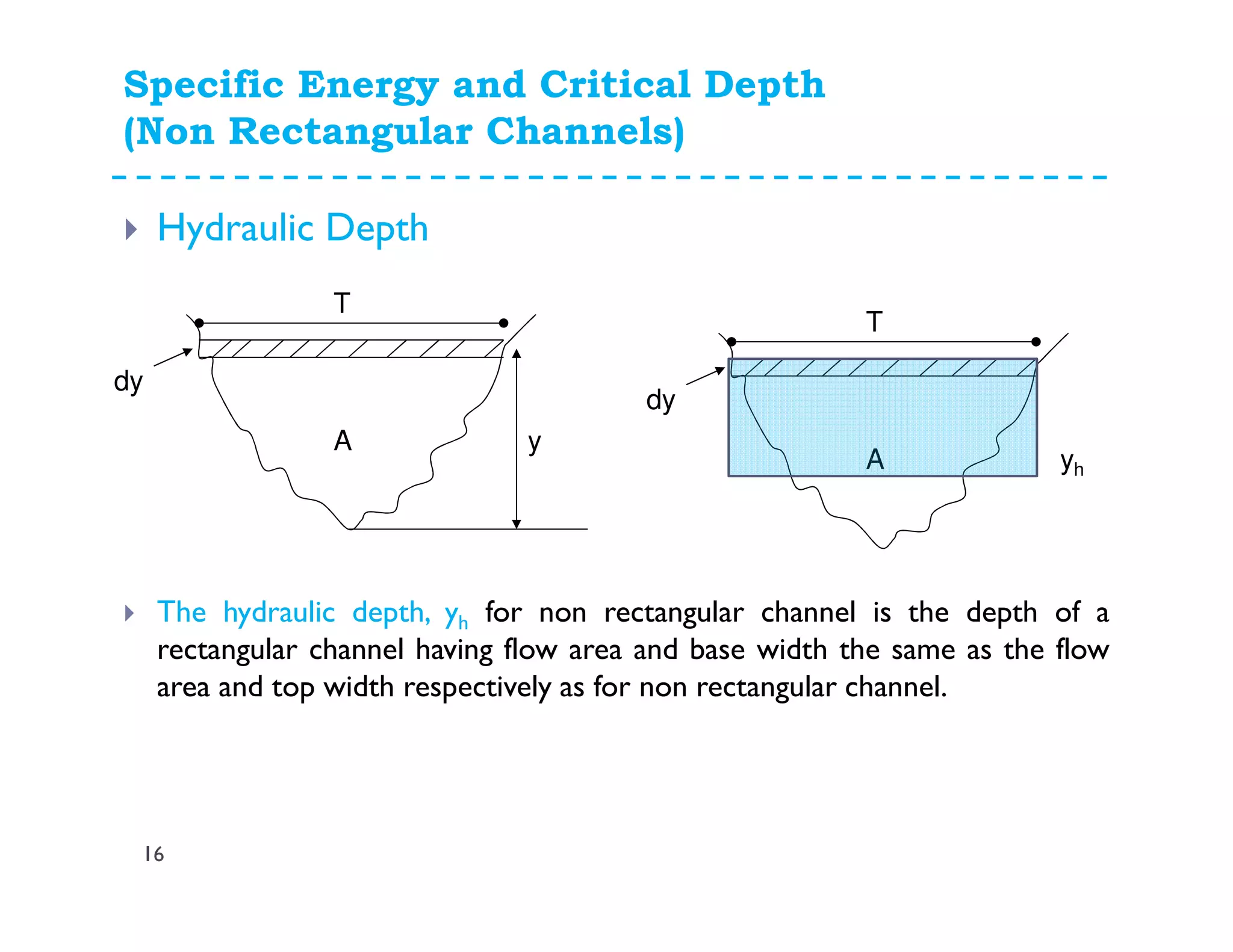
Hydraulic Depth
The hydraulic depth, yh for non rectangular channel is the depth of a
rectangular channel having flow area and base width the same as the flow
area and top width respectively as for non rectangular channel.
dy
T
A y
dy
T
A yh
16
Specific Energy and Critical Depth
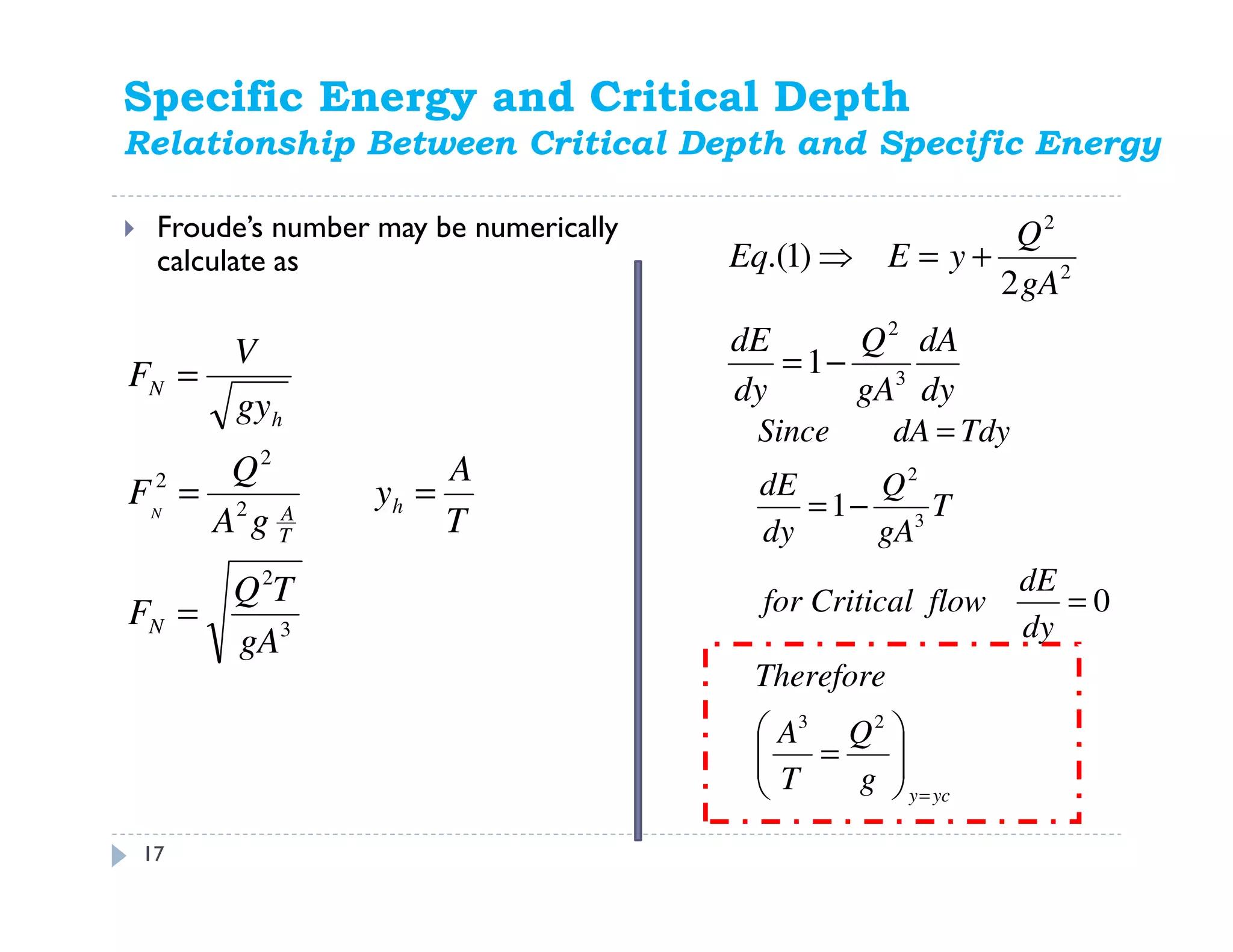
Relationship Between Critical Depth and Specific Energy
Froude’s number may be numerically
calculate as
3
2
2
2
2
gA
TQ
F
T
A
y
gA
Q
F
gy
V
F
N
h
T
A
h
N
N
=
==
=
ycy
g
Q
T
A
Therefore
dy
dE
flowCriticalfor
T
gA
Q
dy
dE
TdydASince
=






=
=
−=
=
23
3
2
0
1
17
dy
dA
gA
Q
dy
dE
gA
Q
yEEq
3
2
2
2
1
2
)1.(
−=
+=⇒
Problems11.45
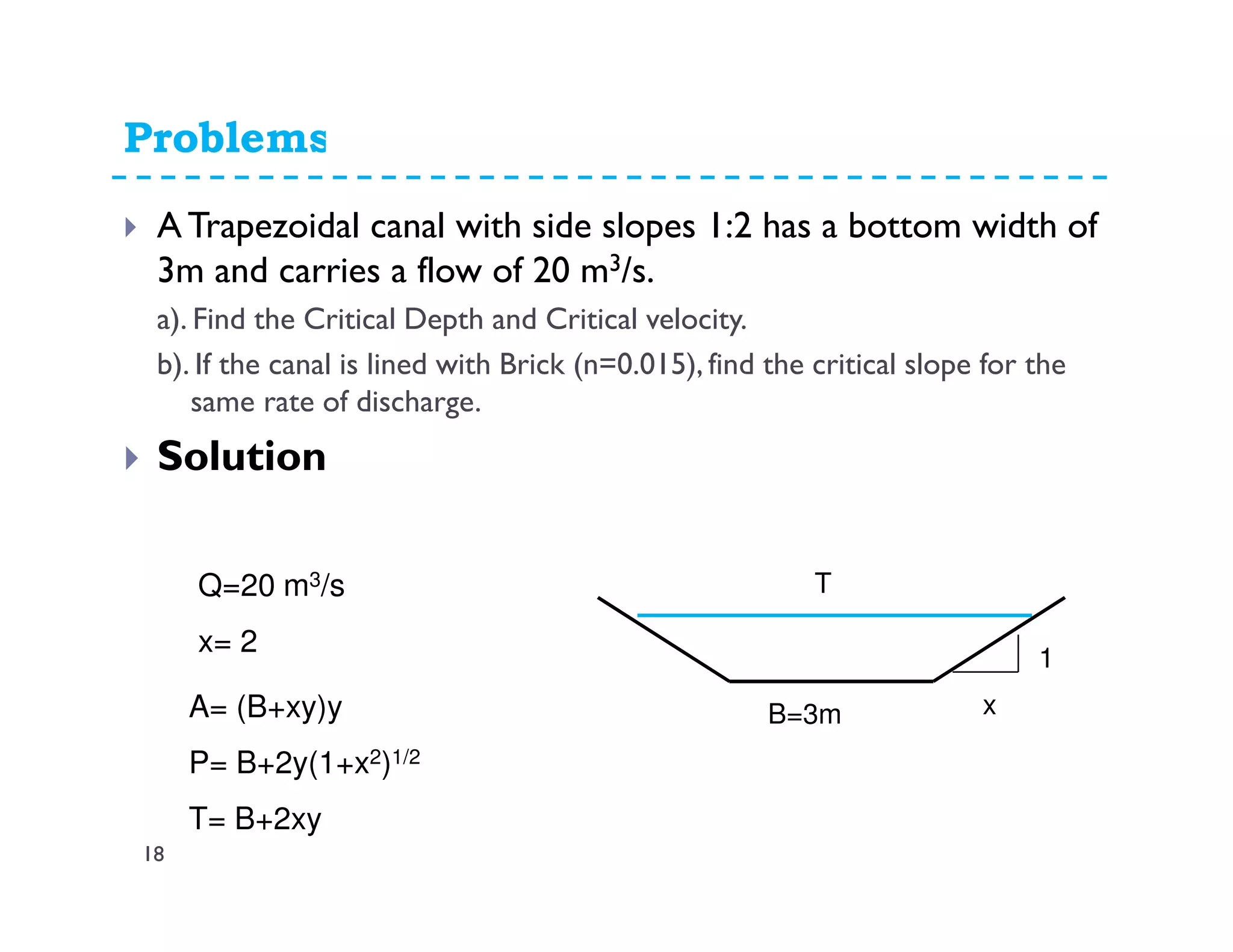
A Trapezoidal canal with side slopes 1:2 has a bottom width of
3m and carries a flow of 20 m3/s.
a). Find the Critical Depth and Critical velocity.
b). If the canal is lined with Brick (n=0.015), find the critical slope for the
same rate of discharge.
Solution
B=3m
T
A= (B+xy)y
P= B+2y(1+x2)1/2
T= B+2xy
1
x
Q=20 m3/s
x= 2
18
Problem 11.45
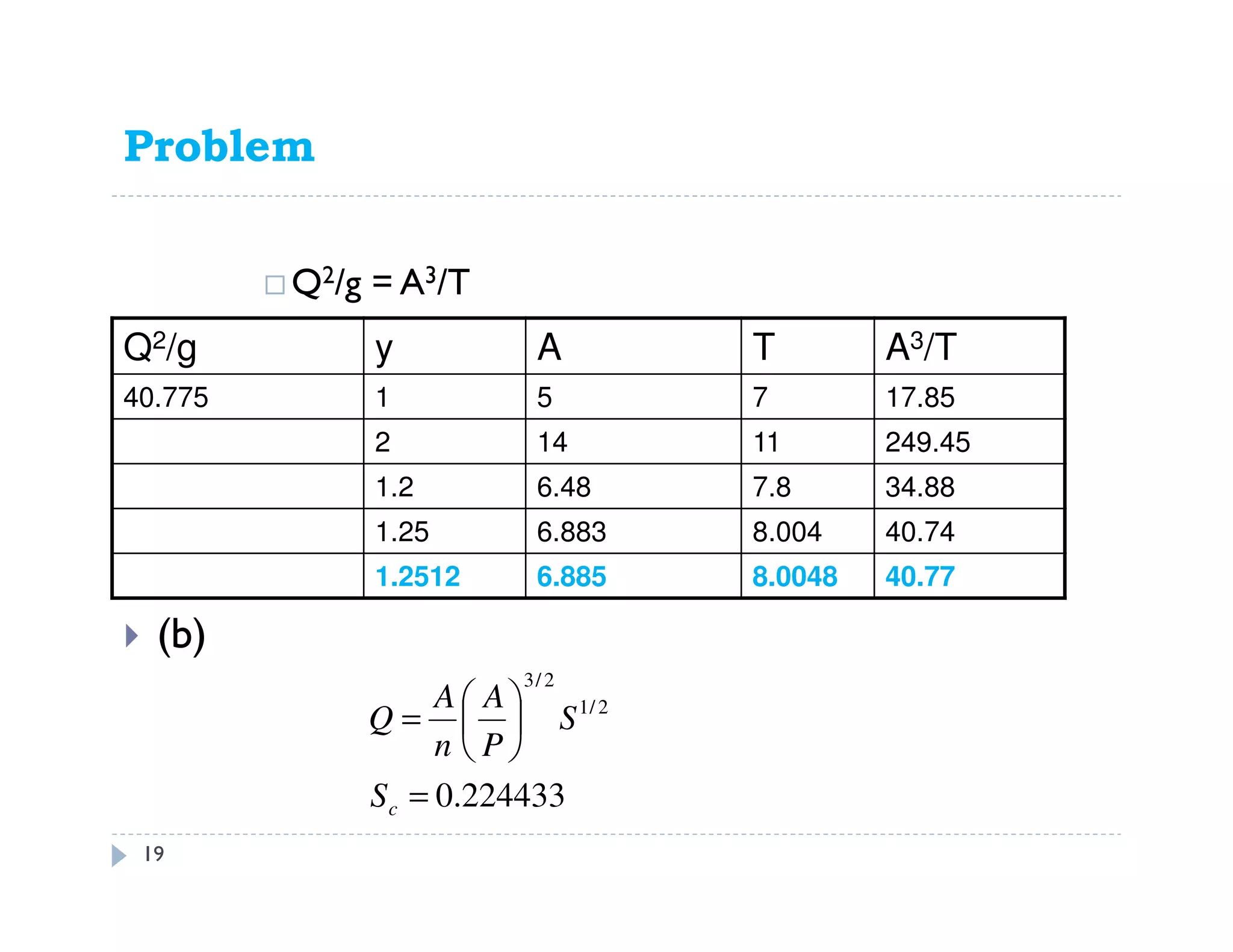
Q2/g = A3/T
(b)
Q2/g y A T A3/T
40.775 1 5 7 17.85
2 14 11 249.45
1.2 6.48 7.8 34.88
1.25 6.883 8.004 40.74
1.2512 6.885 8.0048 40.77
224433.0
2/1
2/3
=






=
cS
S
P
A
n
A
Q
19
Problem
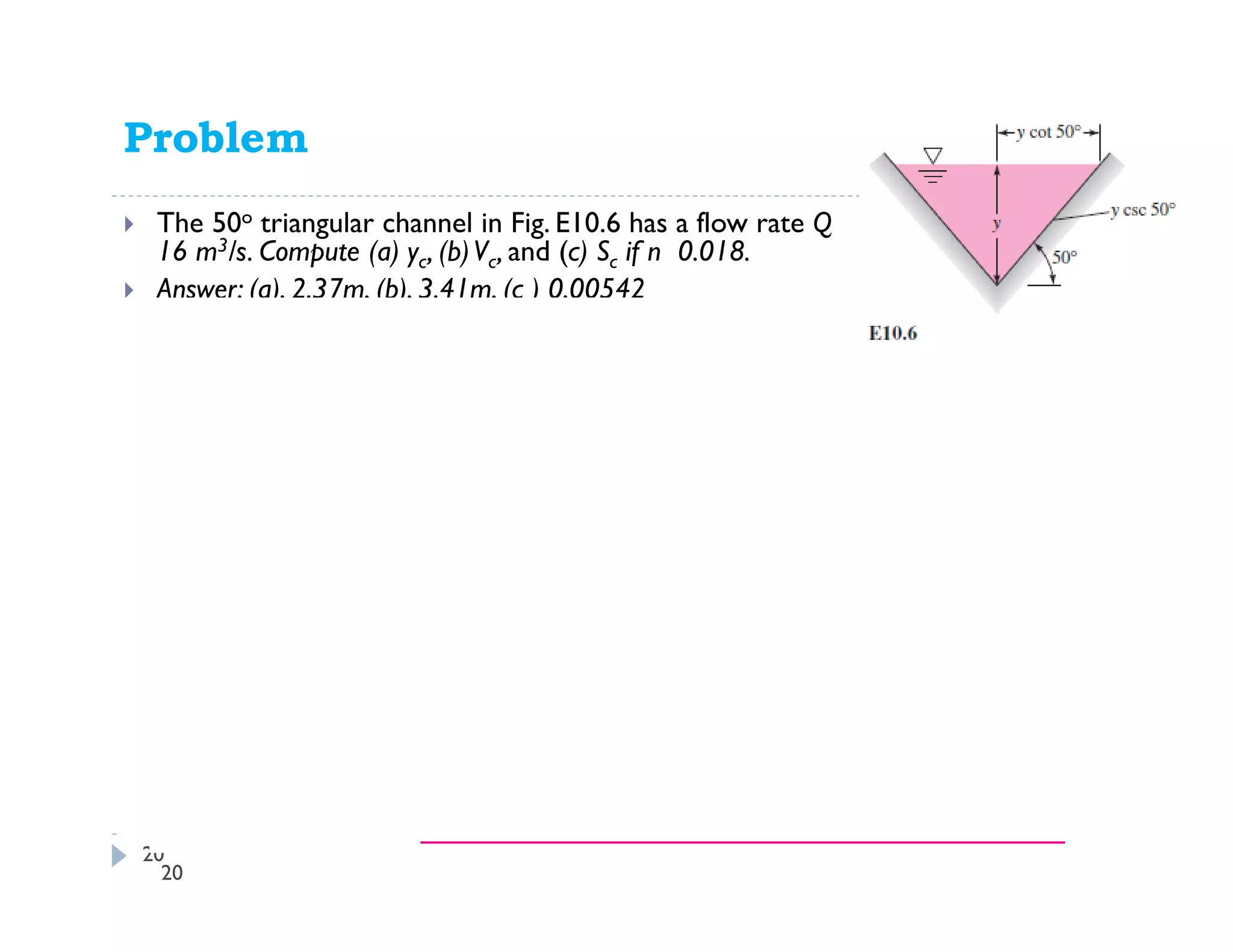
The 50o triangular channel in Fig. E10.6 has a flow rate Q
16 m3/s. Compute (a) yc, (b)Vc, and (c) Sc if n 0.018.
Answer: (a). 2.37m, (b). 3.41m, (c ) 0.00542
20
20
Surface Profiles and
Backwater Curves in Channels of
Uniform sections
21
Steady Flow in Open Channels
Specific Energy and Critical Depth
Surface Profiles and Backwater Curves in Channels of
Uniform Sections
Hydraulics jump and its practical applications.
Flow over Humps and through Constrictions
Broad Crested Weirs andVenturi Flumes
22
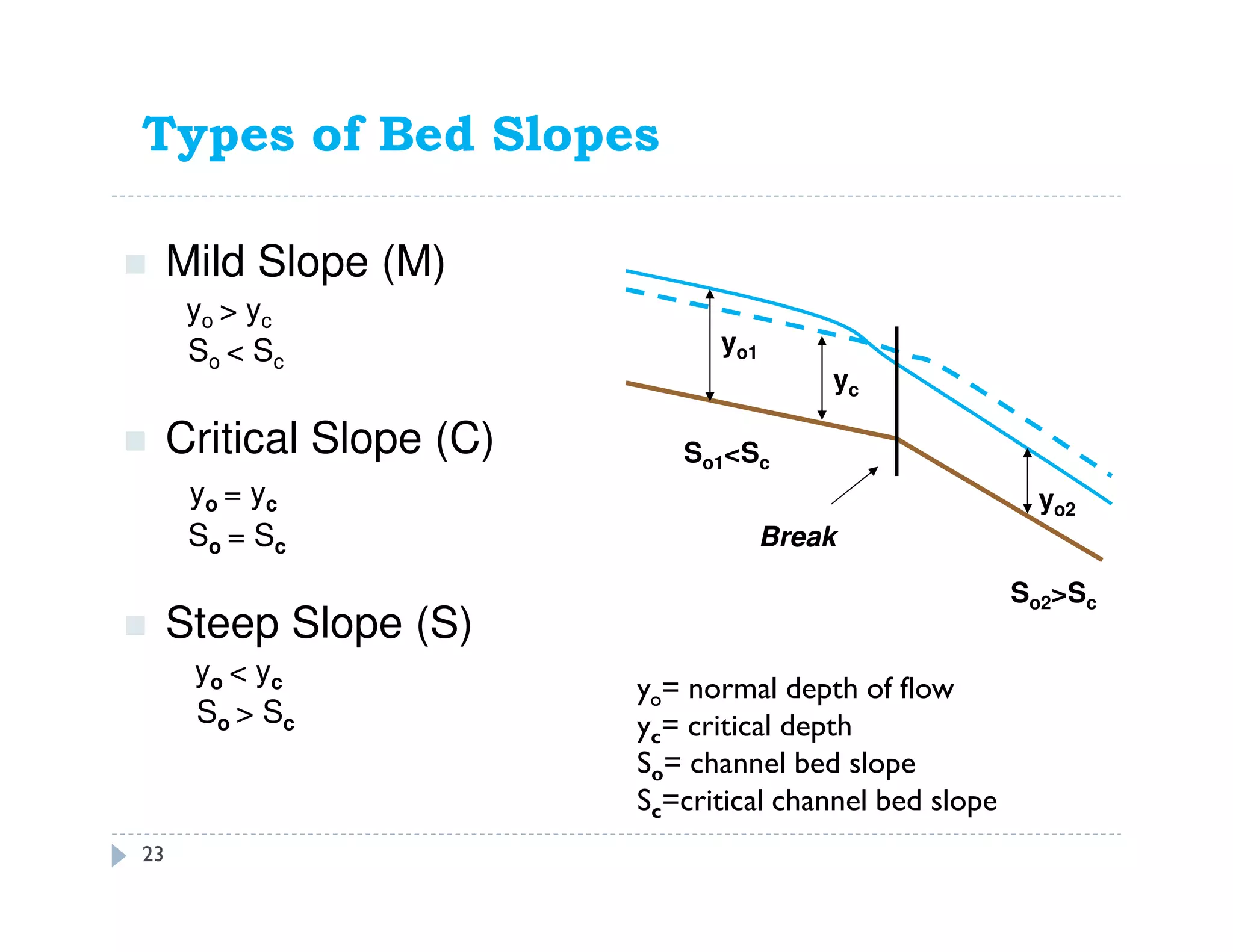
Types of Bed Slopes
Mild Slope (M)
yo > yc
So < Sc
Critical Slope (C)
yo = yc
So = Sc
Steep Slope (S)
yo < yc
So > Sc
So1<Sc
So2>Sc
yo1
yo2
yc
Break
23
yo= normal depth of flow
yc= critical depth
So= channel bed slope
Sc=critical channel bed slope
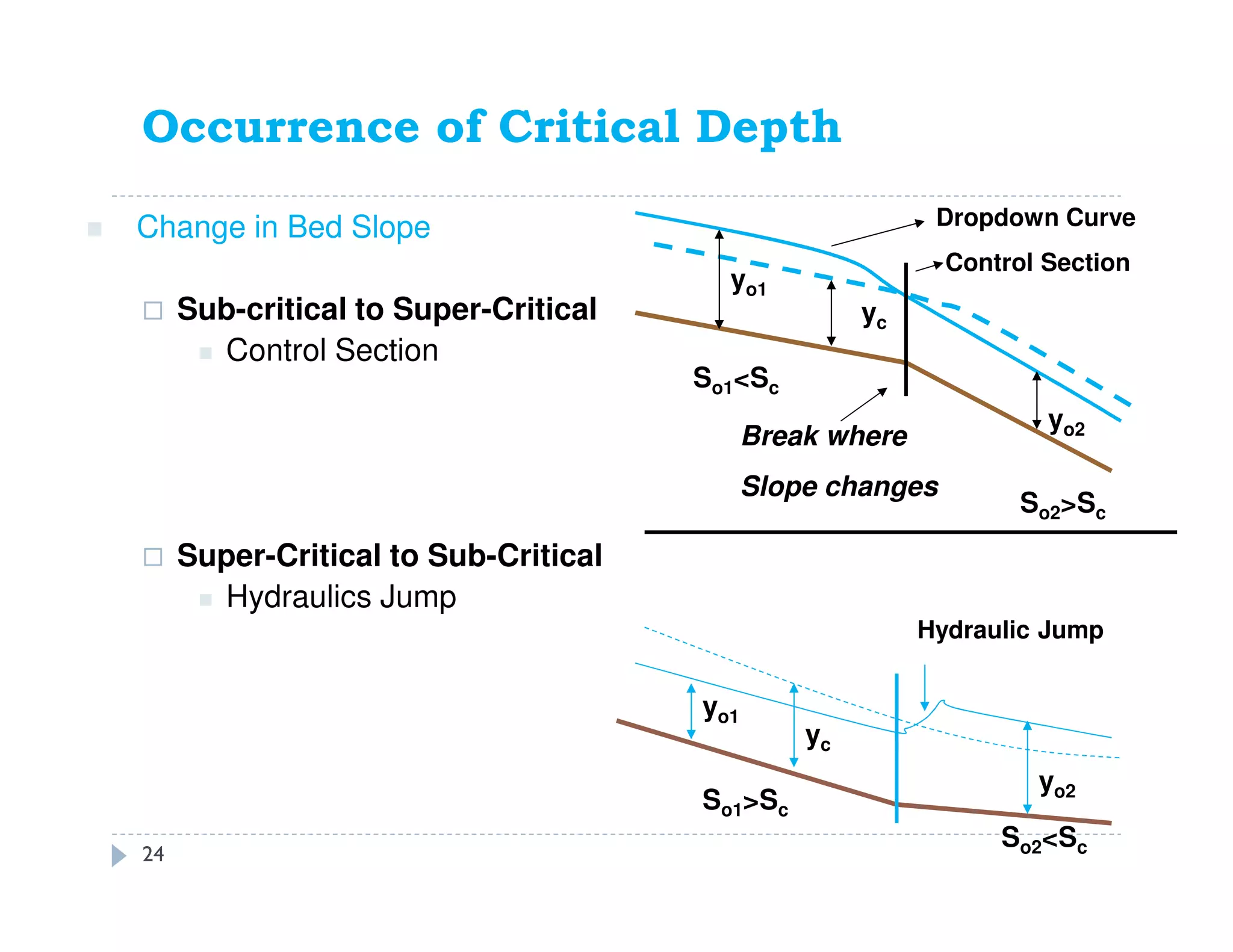
Occurrence of Critical Depth
Change in Bed Slope
Sub-critical to Super-Critical
Control Section
Super-Critical to Sub-Critical
Hydraulics Jump
Control Section
So1<Sc
So2>Sc
yo1
yo2
yc
Break where
Slope changes
Dropdown Curve
So1>Sc
So2<Sc
yo1
yo2
yc
Hydraulic Jump
24
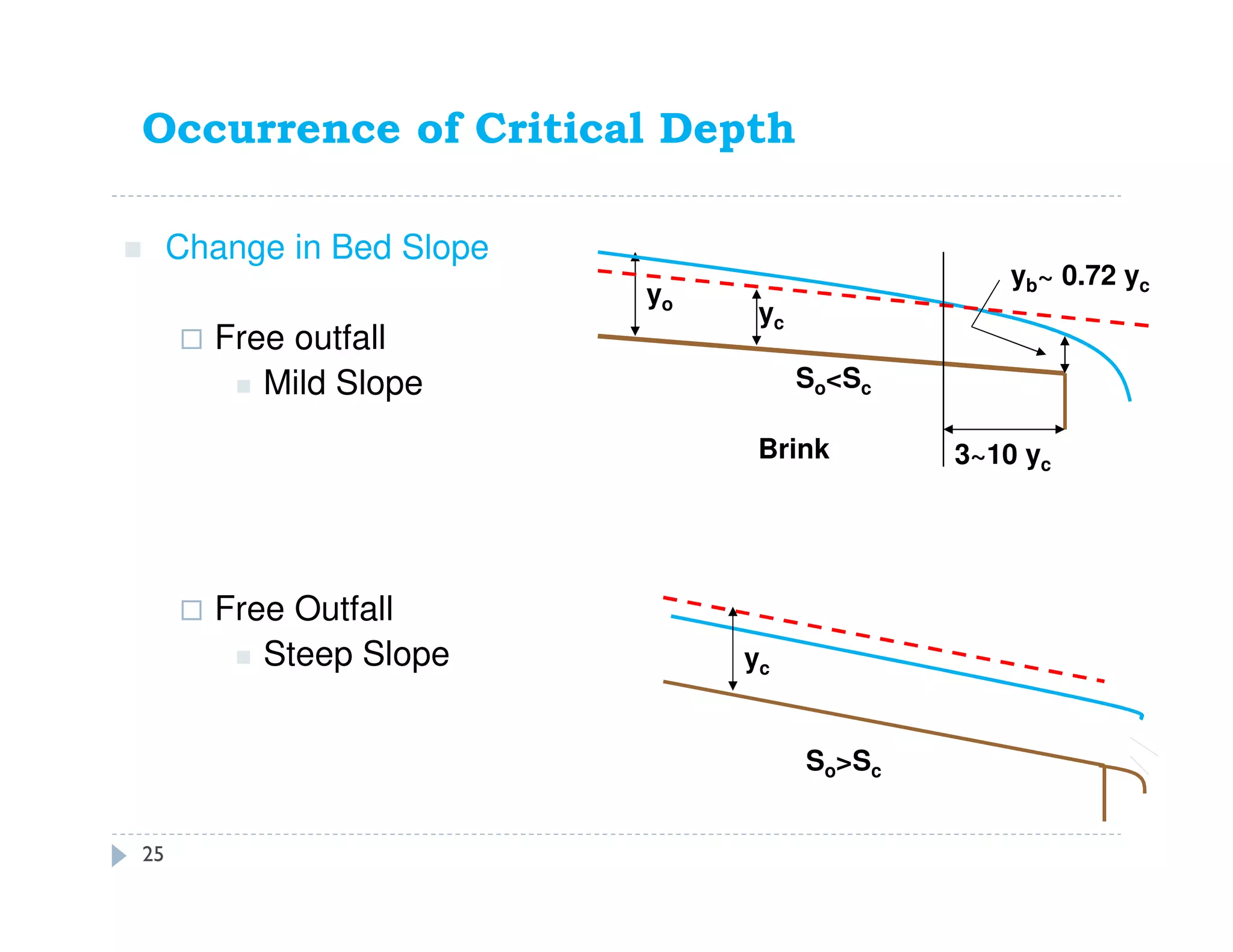
Occurrence of Critical Depth
Change in Bed Slope
Free outfall
Mild Slope
Free Outfall
Steep Slope
yb~ 0.72 yc
So<Sc
yo
yc
3~10 yc
Brink
yc
So>Sc
25
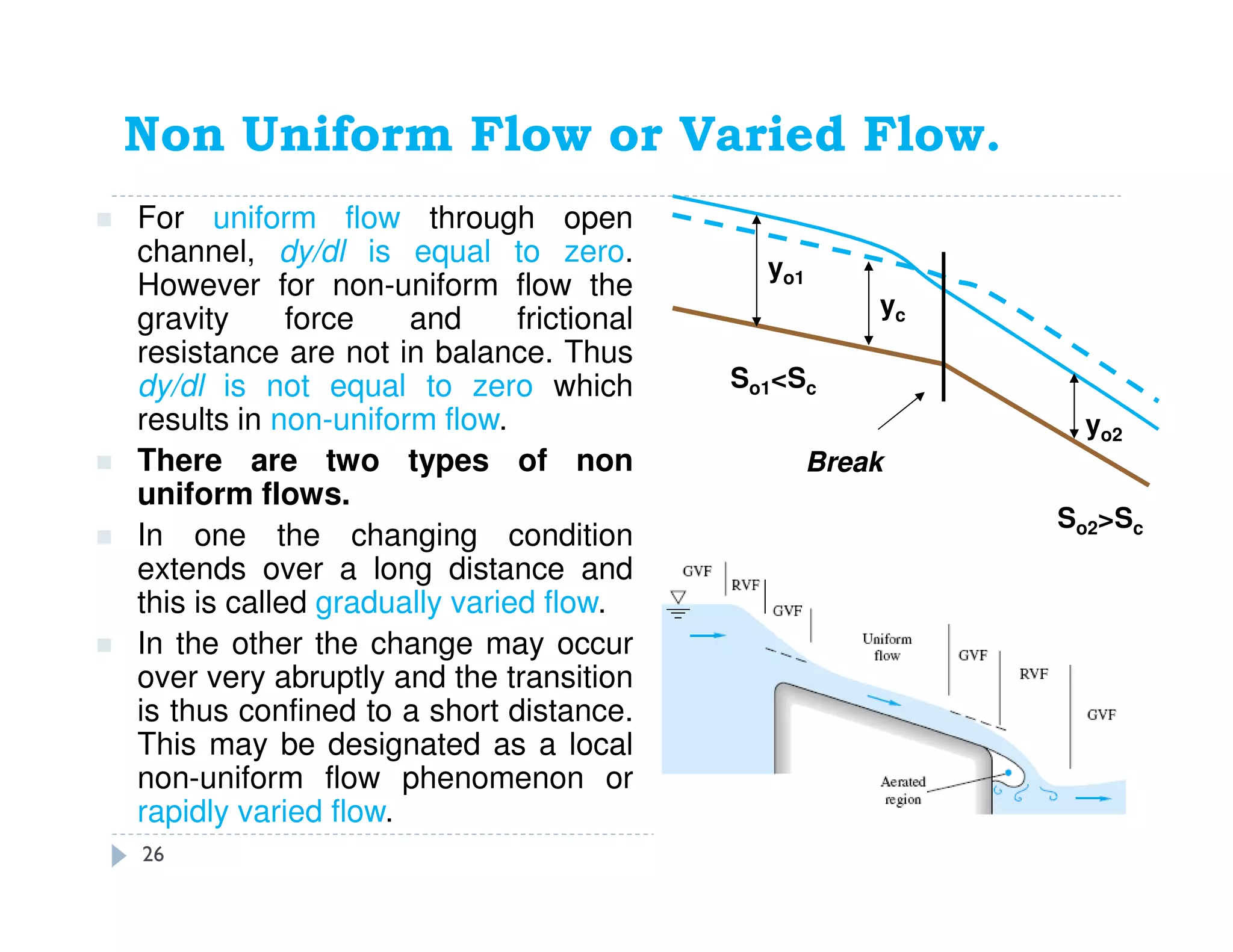
Non Uniform Flow or Varied Flow.
For uniform flow through open
channel, dy/dl is equal to zero.
However for non-uniform flow the
gravity force and frictional
resistance are not in balance. Thus
dy/dl is not equal to zero which
results in non-uniform flow.
There are two types of non
uniform flows.
In one the changing condition
extends over a long distance and
this is called gradually varied flow.
In the other the change may occur
over very abruptly and the transition
is thus confined to a short distance.
This may be designated as a local
non-uniform flow phenomenon or
rapidly varied flow.
So1<Sc
So2>Sc
yo1
yo2
yc
Break
26
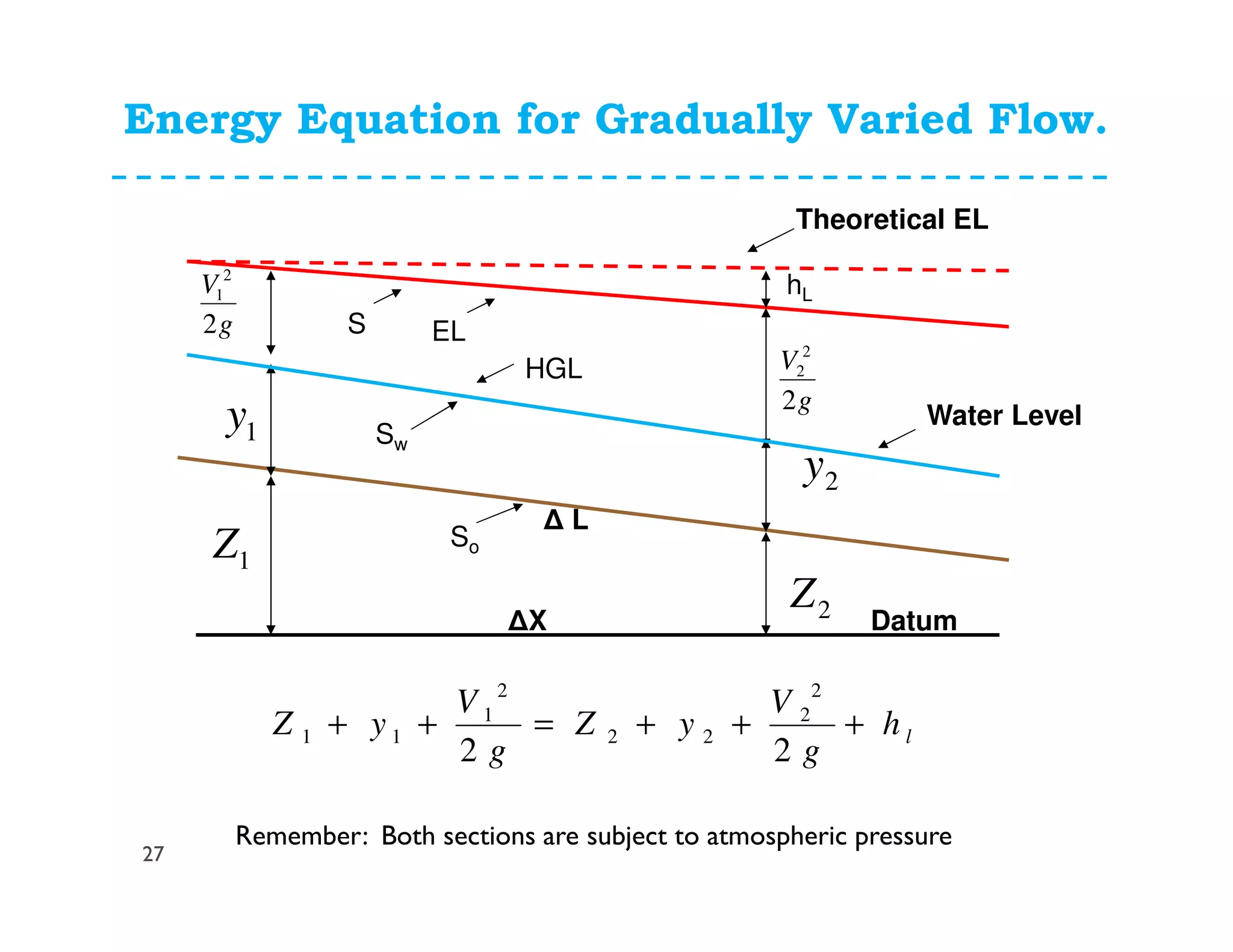
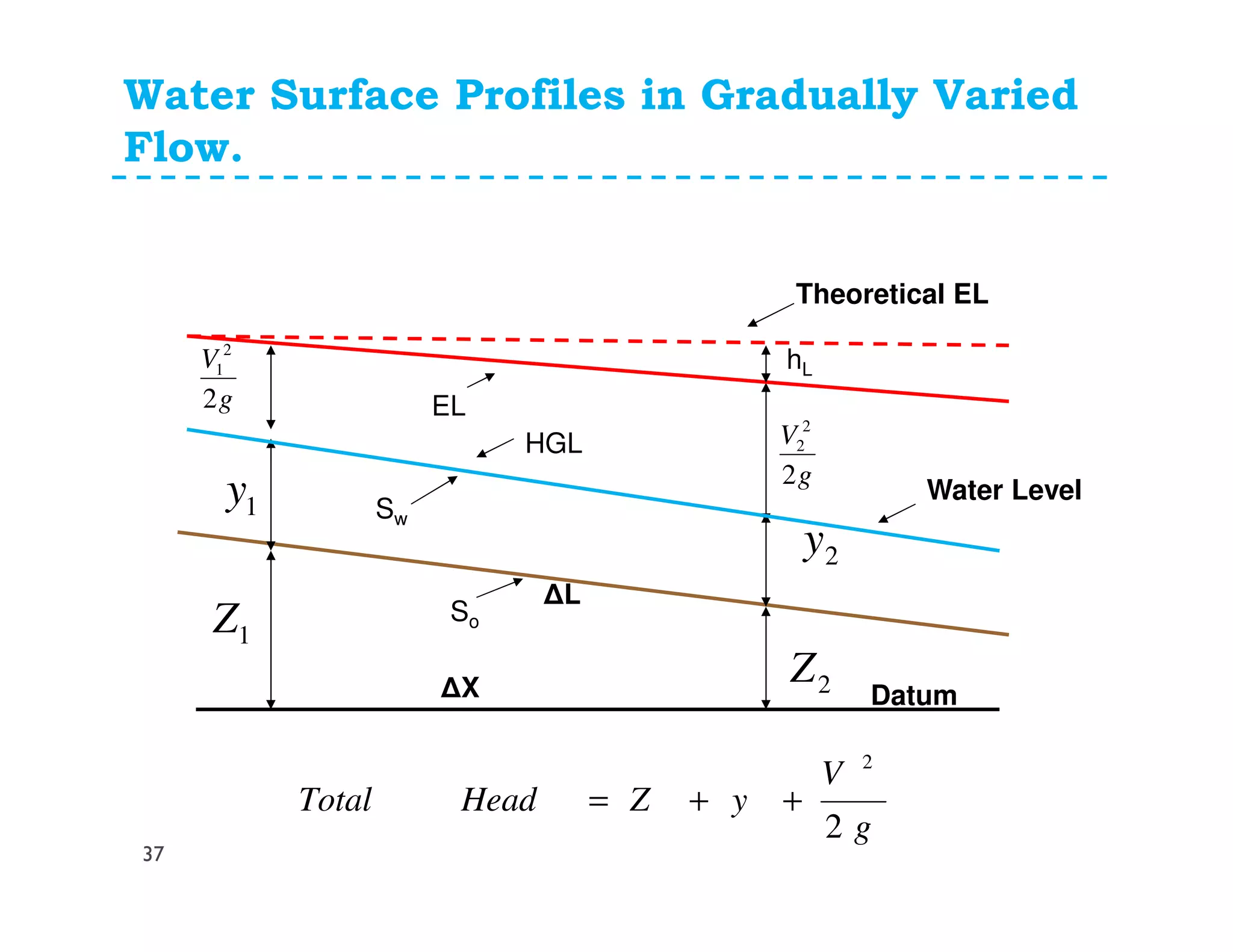
Energy Equation for Gradually Varied Flow.
1Z
g
V
2
2
1
Datum
So
1y
2Z
g
V
2
2
2
2y
HGL
EL
Water Level
lh
g
V
yZ
g
V
yZ +++=++
22
2
2
22
2
1
11
Theoretical EL
Sw
hL
∆X
∆ L
S
27
Remember: Both sections are subject to atmospheric pressure
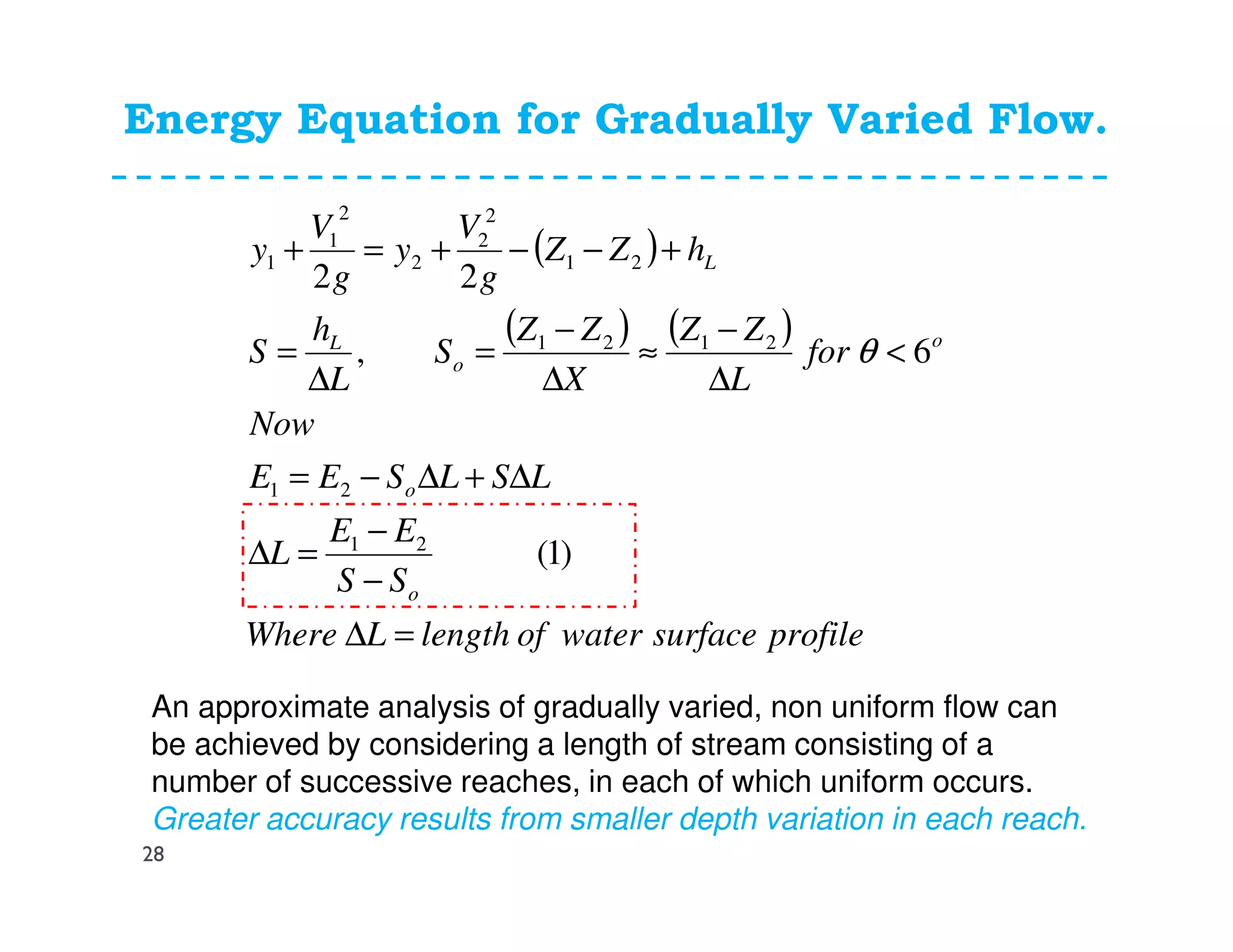
Energy Equation for Gradually Varied Flow.
( )
( ) ( )
profilesurfacewateroflengthLWhere
SS
EE
L
LSLSEE
Now
for
L
ZZ
X
ZZ
S
L
h
S
hZZ
g
V
y
g
V
y
o
o
o
o
L
L
=∆
−
−
=∆
∆+∆−=
<
∆
−
≈
∆
−
=
∆
=
+−−+=+
)1(
6,
22
21
21
2121
21
2
2
2
2
1
1
θ
An approximate analysis of gradually varied, non uniform flow can
be achieved by considering a length of stream consisting of a
number of successive reaches, in each of which uniform occurs.
Greater accuracy results from smaller depth variation in each reach.
28
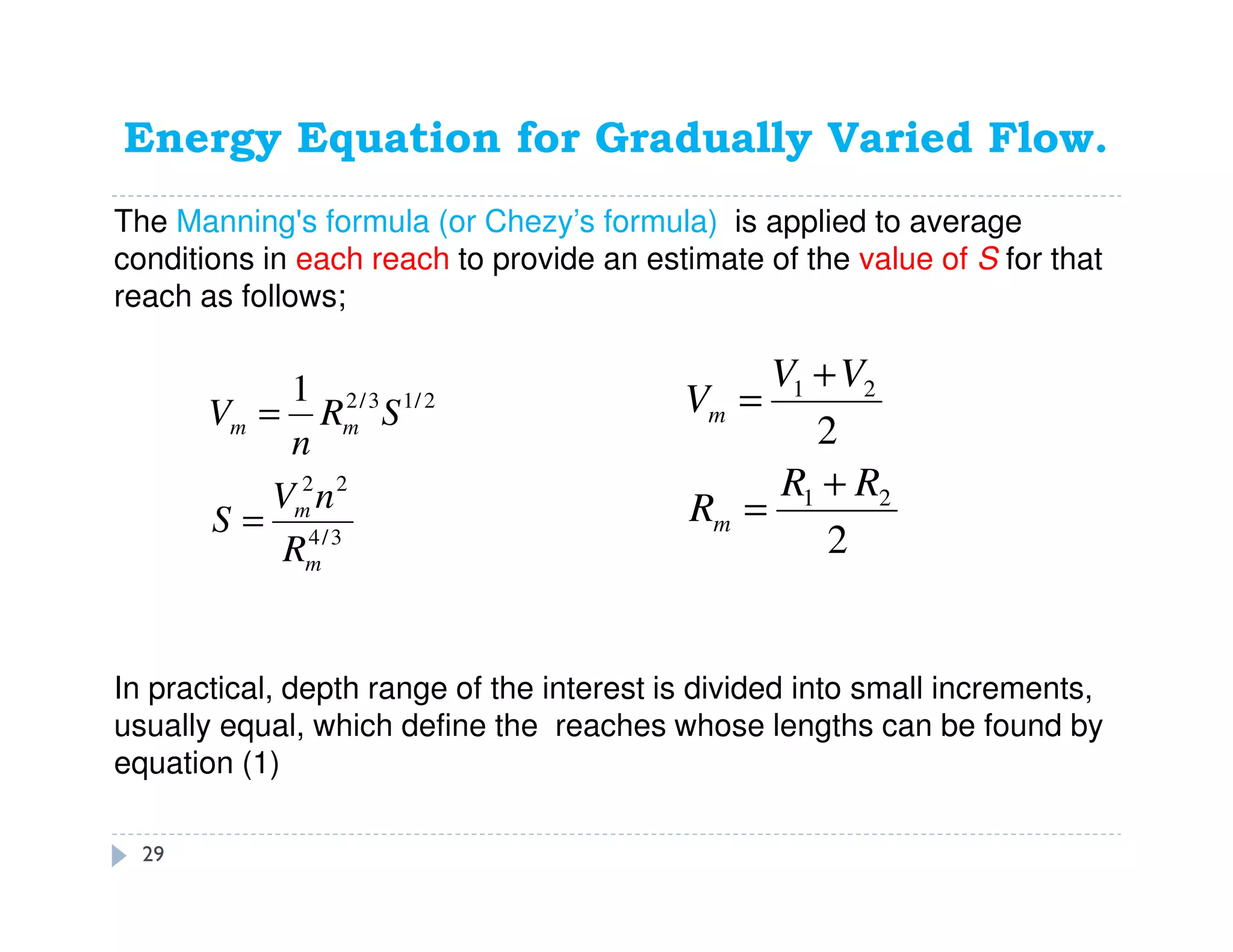
Energy Equation for Gradually Varied Flow.
3/4
22
2/13/21
m
m
mm
R
nV
S
SR
n
V
=
=
The Manning's formula (or Chezy’s formula) is applied to average
conditions in each reach to provide an estimate of the value of S for that
reach as follows;
2
2
21
21
RR
R
VV
V
m
m
+
=
+
=
In practical, depth range of the interest is divided into small increments,
usually equal, which define the reaches whose lengths can be found by
equation (1)
29
Problem 11.59
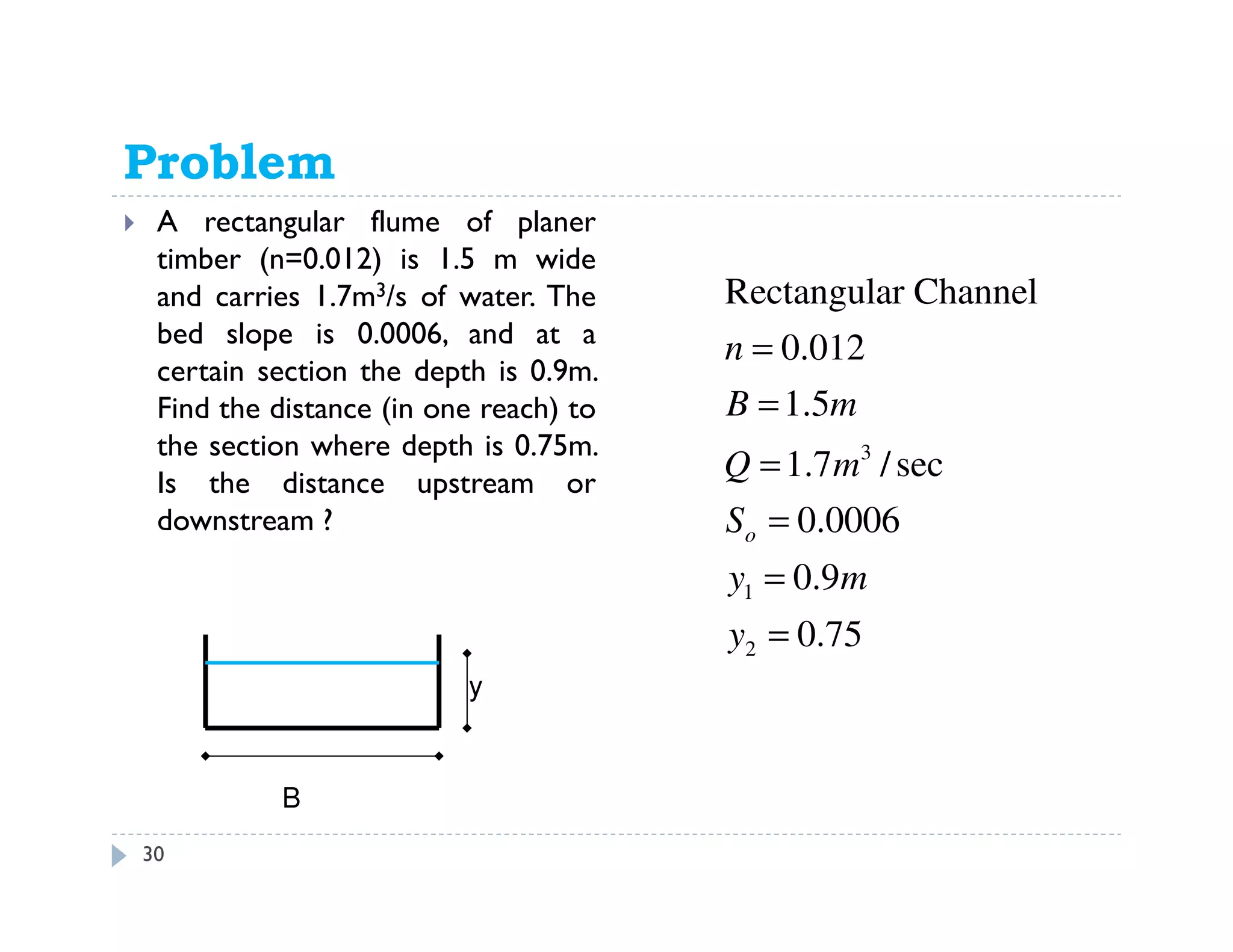
A rectangular flume of planer
timber (n=0.012) is 1.5 m wide
and carries 1.7m3/s of water. The
bed slope is 0.0006, and at a
certain section the depth is 0.9m.
Find the distance (in one reach) to
the section where depth is 0.75m.
Is the distance upstream or
downstream ?
3
1
2
Rectangular Channel
0.012
1.5
1.7 /sec
0.0006
0.9
0.75
o
n
B m
Q m
S
y m
y
=
=
=
=
=
=
B
y
30
Problem 11.59
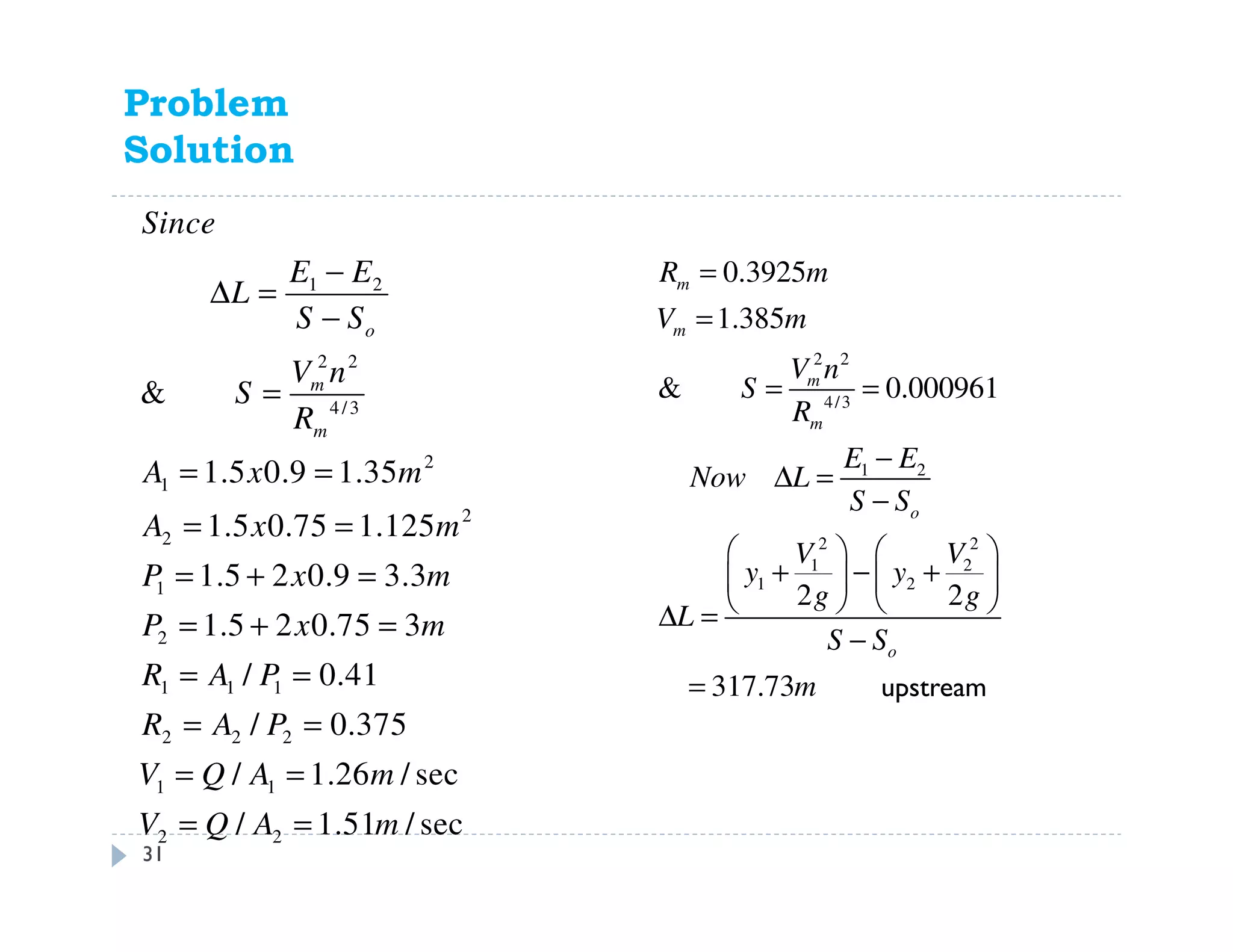
Solution
1 2
2 2
4/3
2
1
2
2
1
2
1 1 1
2 2 2
1 1
2 2
&
1.5 0.9 1.35
1.5 0.75 1.125
1.5 2 0.9 3.3
1.5 2 0.75 3
/ 0.41
/ 0.375
/ 1.26 / sec
/ 1.51 / sec
o
m
m
Since
E E
L
S S
V n
S
R
A x m
A x m
P x m
P x m
R A P
R A P
V Q A m
V Q A m
−
∆ =
−
=
= =
= =
= + =
= + =
= =
= =
= =
= =
2 2
4/3
1 2
2 2
1 2
1 2
0.3925
1.385
& 0.000961
2 2
317.73
m
m
m
m
o
o
R m
V m
V n
S
R
E E
Now L
S S
V V
y y
g g
L
S S
m Downstream
=
=
= =
−
∆ =
−
   
+ − +   
   ∆ =
−
=
31
upstream
Problem
32
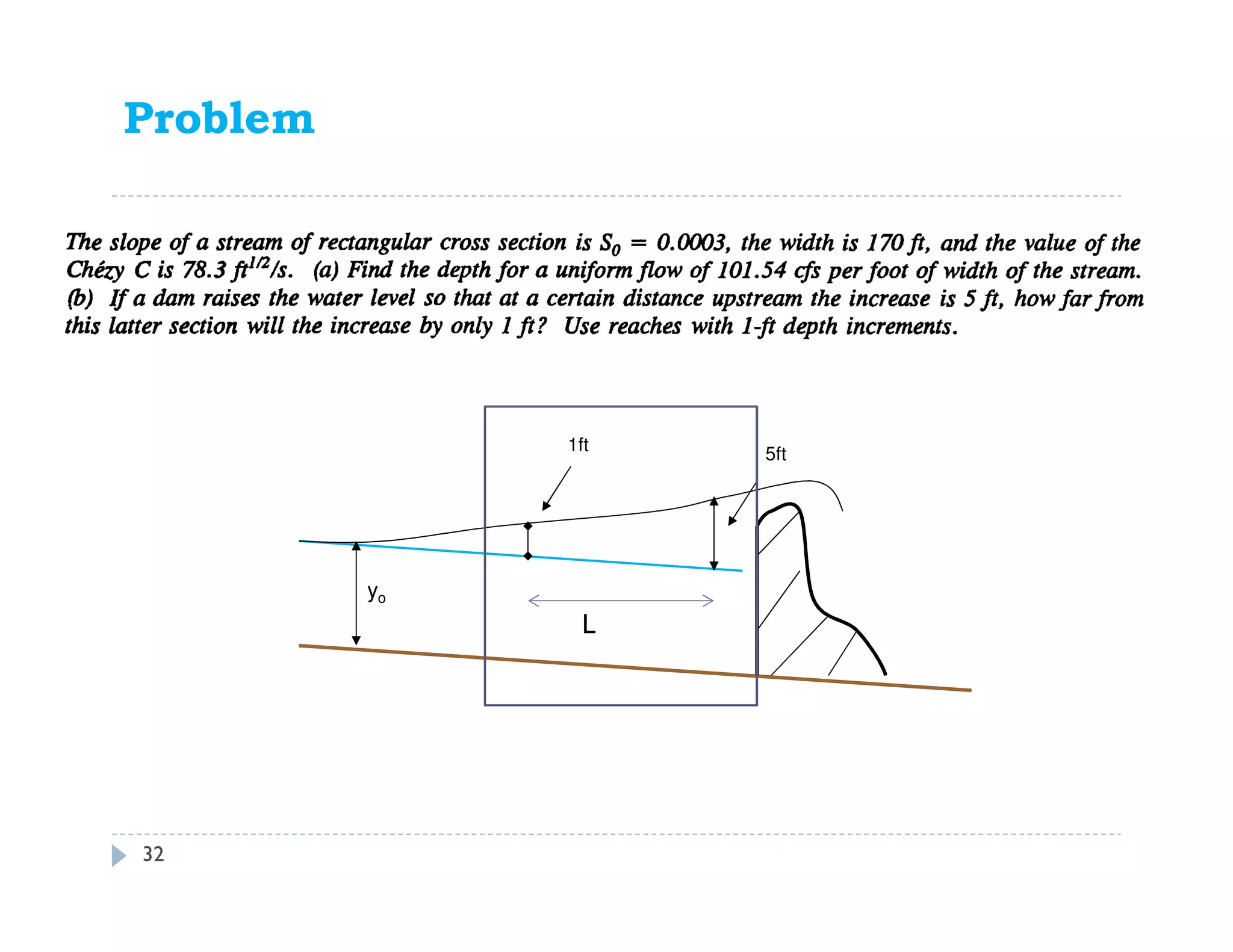
5ft
yo
1ft
L
Problem
33
Problem
34
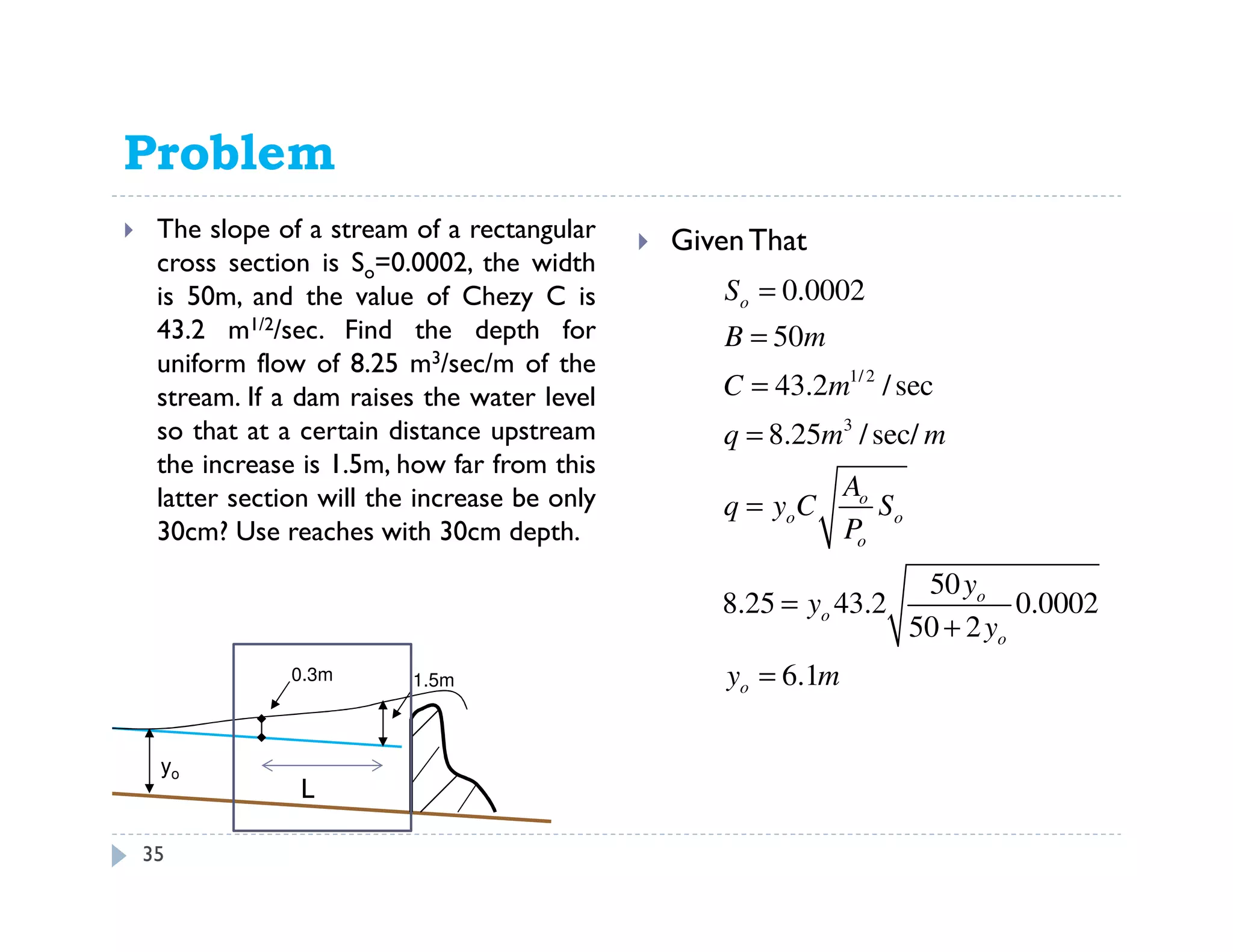
Problem 11.66
The slope of a stream of a rectangular
cross section is So=0.0002, the width
is 50m, and the value of Chezy C is
43.2 m1/2/sec. Find the depth for
uniform flow of 8.25 m3/sec/m of the
stream. If a dam raises the water level
so that at a certain distance upstream
the increase is 1.5m, how far from this
latter section will the increase be only
30cm? Use reaches with 30cm depth.
GivenThat
1.5m
yo
0.3m
1/ 2
3
0.0002
50
43.2 /sec
8.25 /sec/
50
8.25 43.2 0.0002
50 2
6.1
o
o
o o
o
o
o
o
o
S
B m
C m
q m m
A
q y C S
P
y
y
y
y m
=
=
=
=
=
=
+
=
L
35
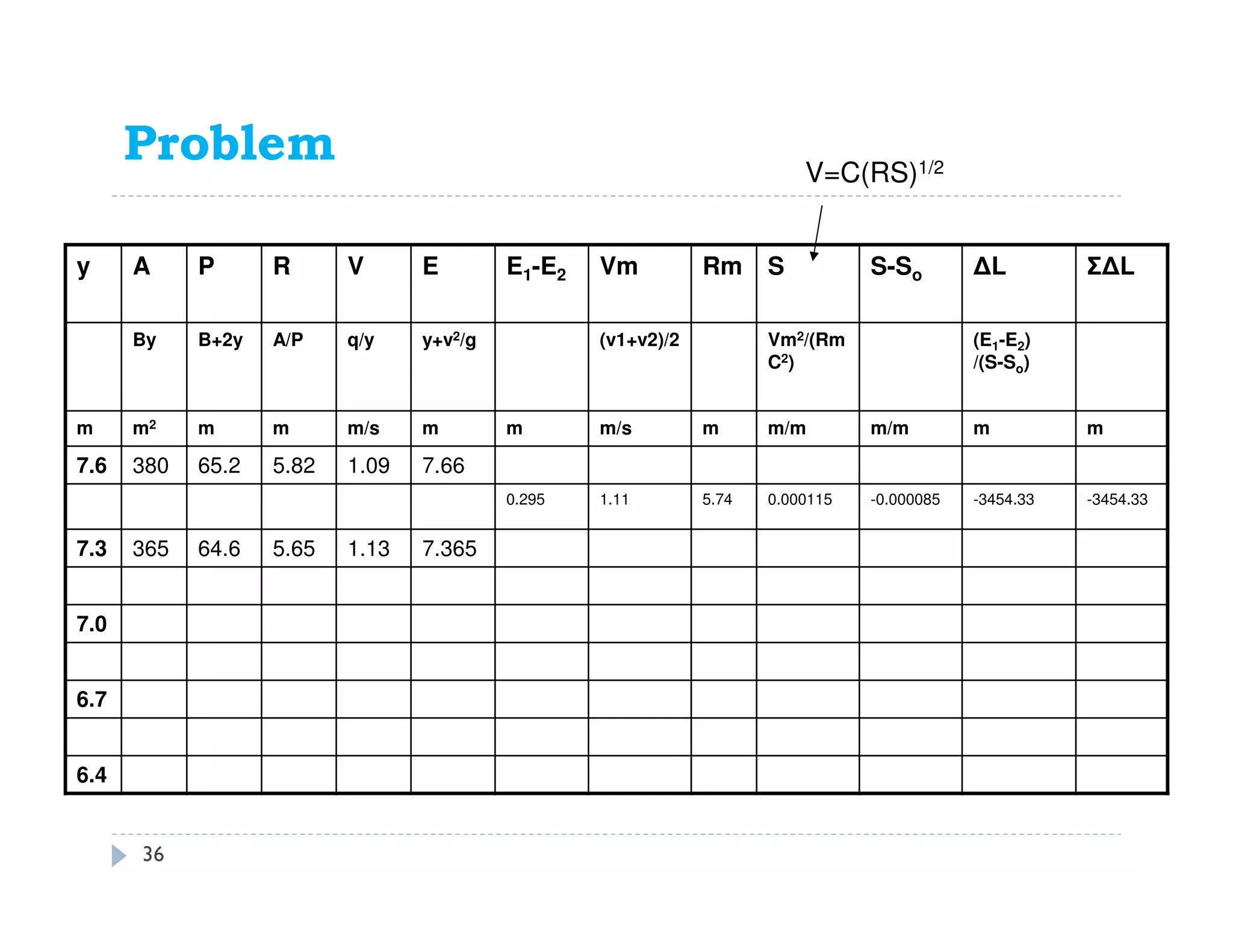
Problem 11.66
y A P R V E E1-E2 Vm Rm S S-So ∆L Σ∆L
By B+2y A/P q/y y+v2/g (v1+v2)/2 Vm2/(Rm
C2)
(E1-E2)
/(S-So)
m m2 m m m/s m m m/s m m/m m/m m m
7.6 380 65.2 5.82 1.09 7.66
0.295 1.11 5.74 0.000115 -0.000085 -3454.33 -3454.33
7.3 365 64.6 5.65 1.13 7.365
7.0
6.7
6.4
V=C(RS)1/2
36
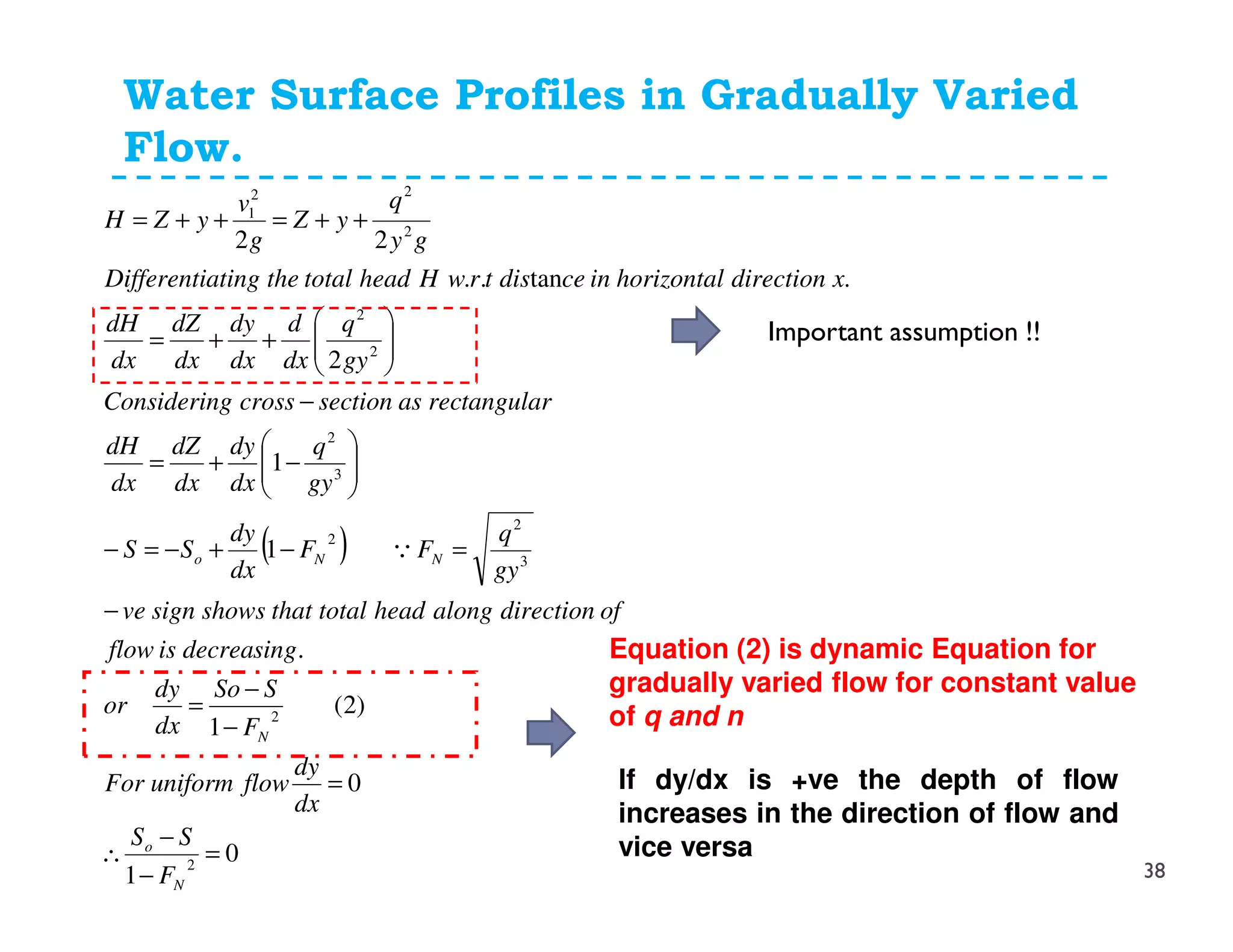
Water Surface Profiles in Gradually Varied
Flow.
1Z
g
V
2
2
1
Datum
So
1y
2Z
g
V
2
2
2
2y
HGL
EL
Water Level
g
V
yZHeadTotal
2
2
++=
Theoretical EL
Sw
hL
∆X
∆L
37
Water Surface Profiles in Gradually Varied
Flow.
( )
0
1
0
)2(
1
.
1
1
2
.tan..
22
2
2
3
2
2
3
2
2
2
2
22
1
=
−
−
∴
=
−
−
=
−
=−+−=−






−+=
−






++=
++=++=
N
o
N
NNo
F
SS
dx
dy
flowuniformFor
F
SSo
dx
dy
or
gsindecreaisflow
ofdirectionalongheadtotalthatshowssignve
gy
q
FF
dx
dy
SS
gy
q
dx
dy
dx
dZ
dx
dH
gulartanrecastionseccrossgConsiderin
gy
q
dx
d
dx
dy
dx
dZ
dx
dH
xdirectionhorizontalincedistrwHheadtotaltheatingDifferenti
gy
q
yZ
g
v
yZH
Q
Equation (2) is dynamic Equation for
gradually varied flow for constant value
of q and n
If dy/dx is +ve the depth of flow
increases in the direction of flow and
vice versa
38
Important assumption !!
Water Surface Profiles in Gradually Varied
Flow.
3/10
3/10
22
3/10
22
2/13/5
2/13/2
1
1






=∴
=
=
=
=
≈
y
y
S
S
y
qn
S
channel
gulartanrecinflowuniformFor
y
qn
S
orSy
n
q
orSy
n
V
yR
channelgulartanrecwideaFor
o
o
o
o
2
1 F
SS
dx
dy o
−
−
=
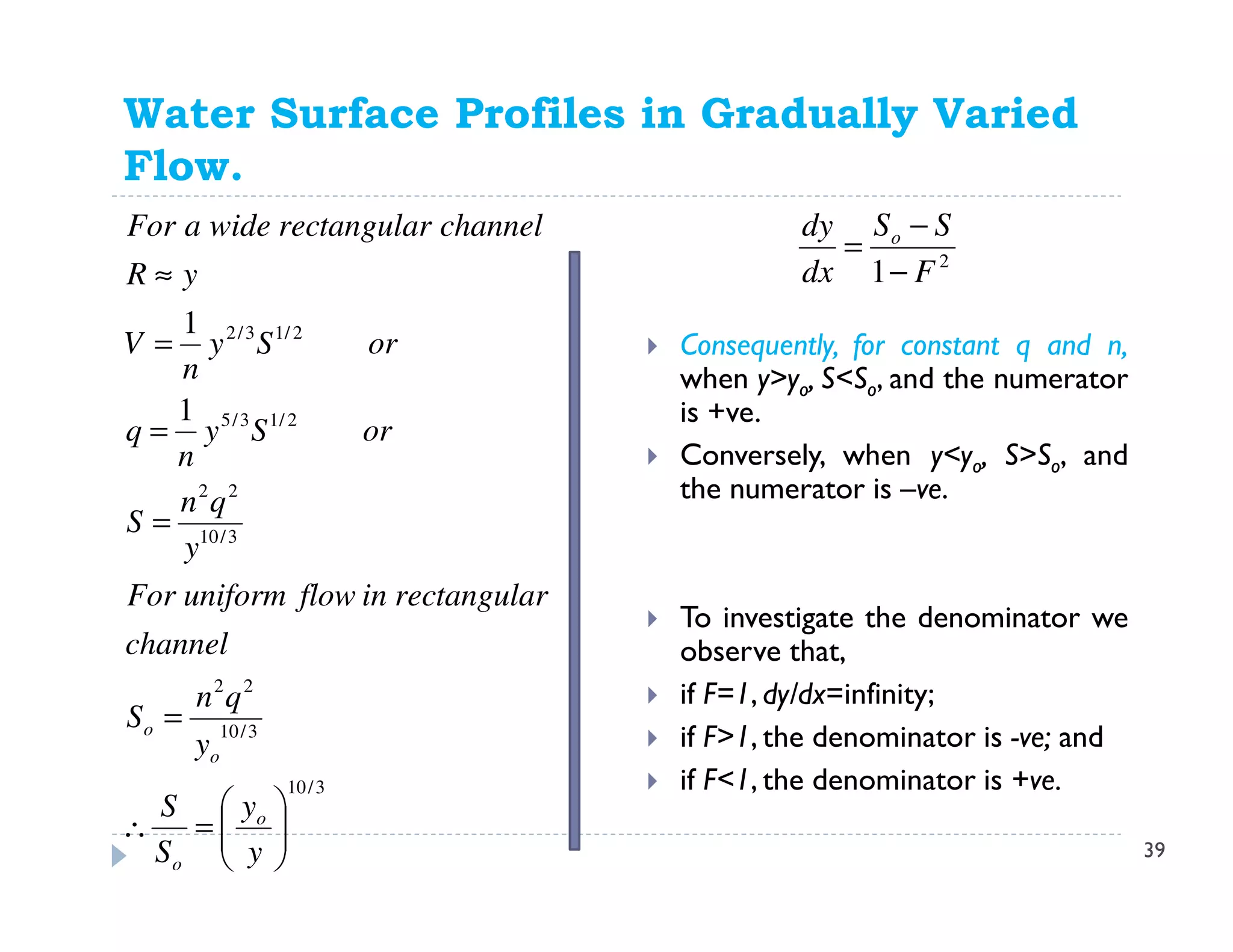
Consequently, for constant q and n,
when y>yo, S<So, and the numerator
is +ve.
Conversely, when y<yo, S>So, and
the numerator is –ve.
To investigate the denominator we
observe that,
if F=1, dy/dx=infinity;
if F>1, the denominator is -ve; and
if F<1, the denominator is +ve.
39
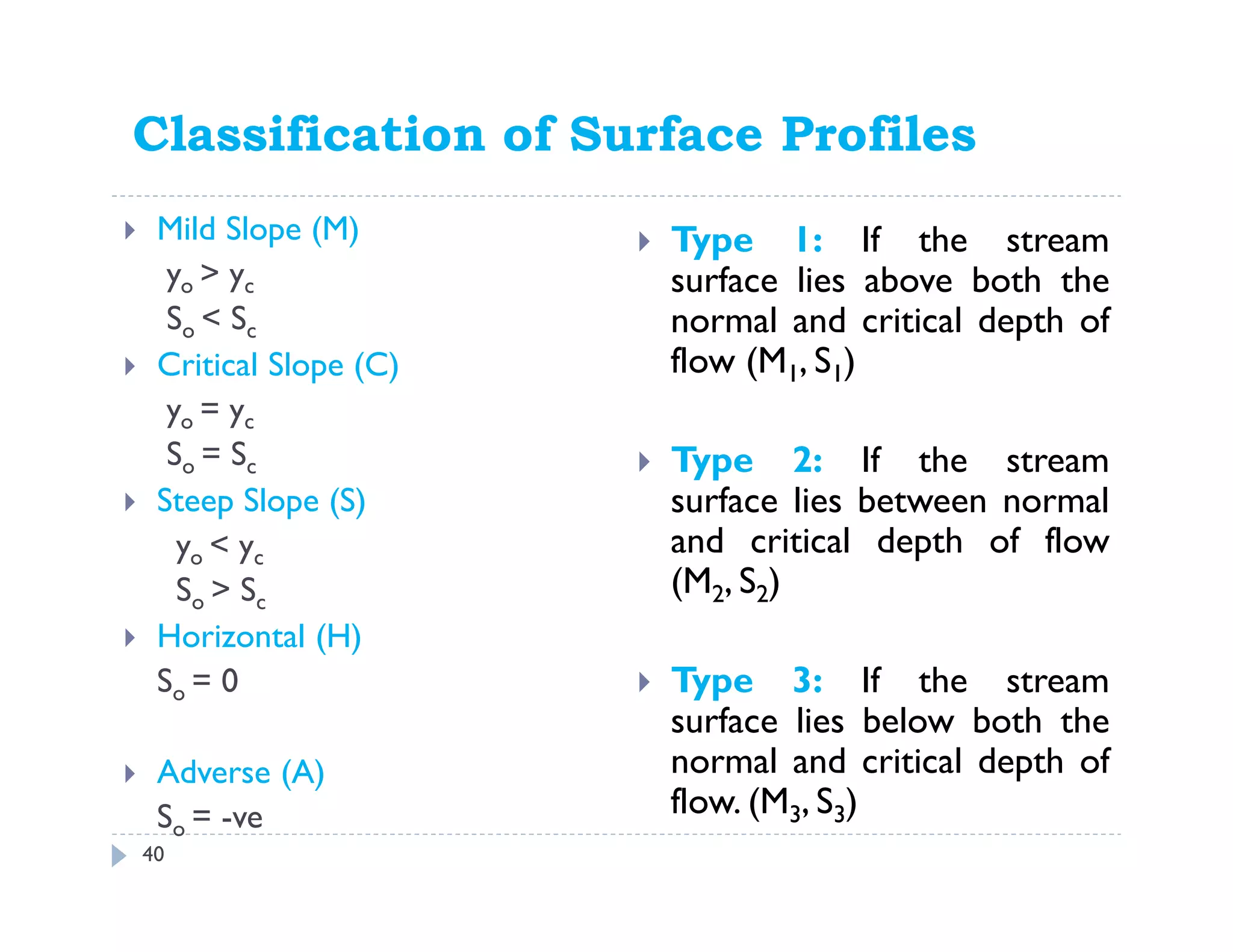
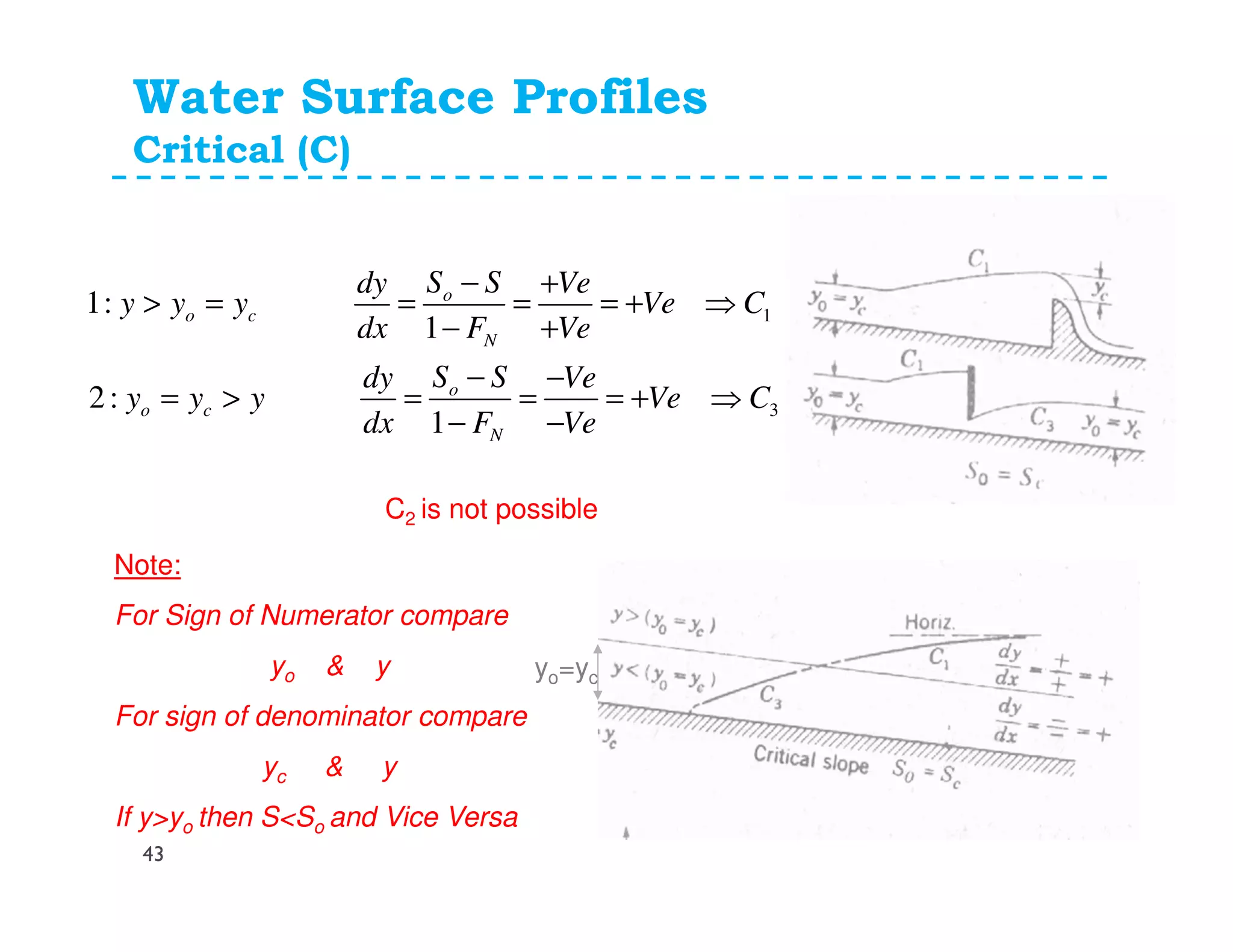
Classification of Surface Profiles
Mild Slope (M)
yo > yc
So < Sc
Critical Slope (C)
yo = yc
So = Sc
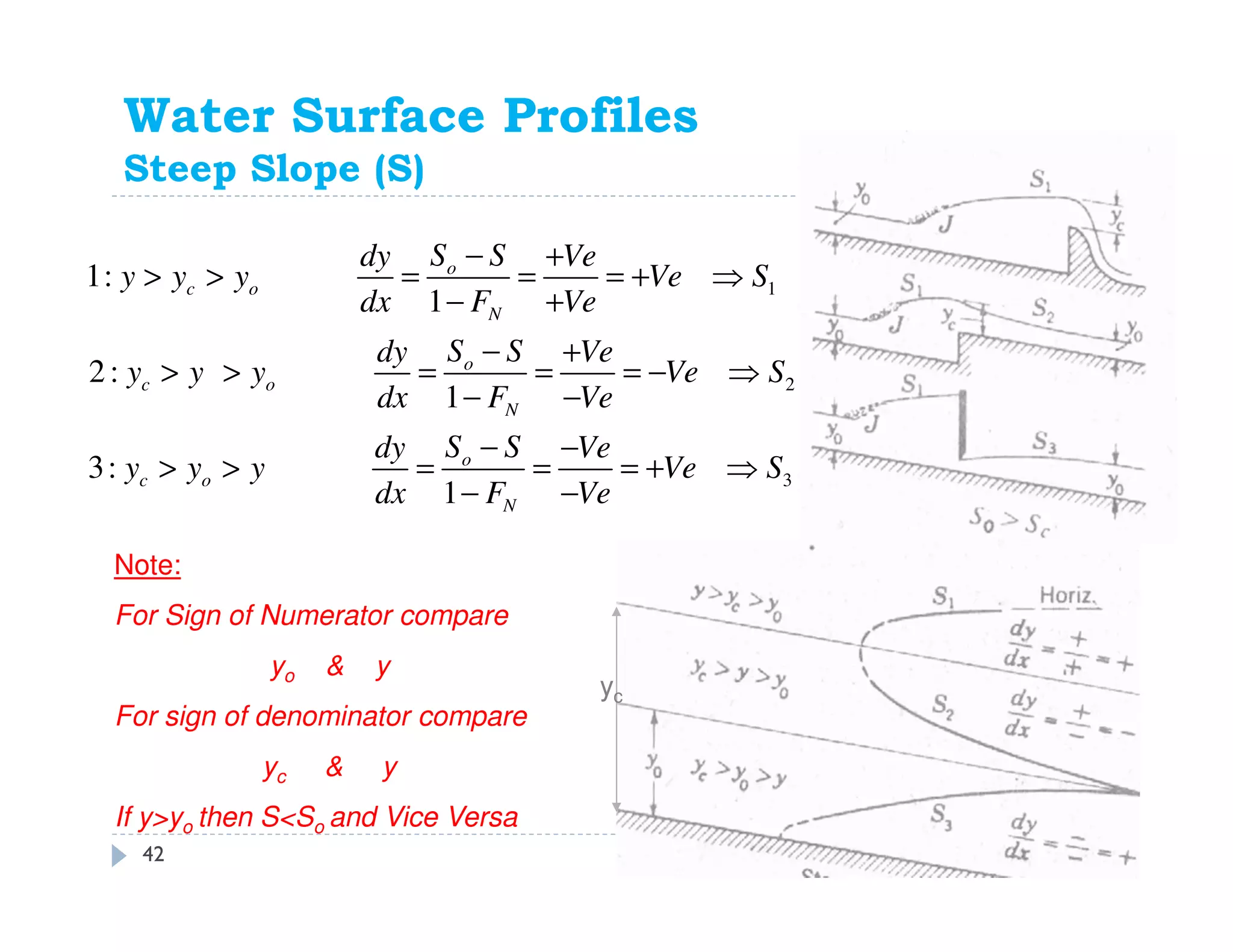
Steep Slope (S)
yo < yc
So > Sc
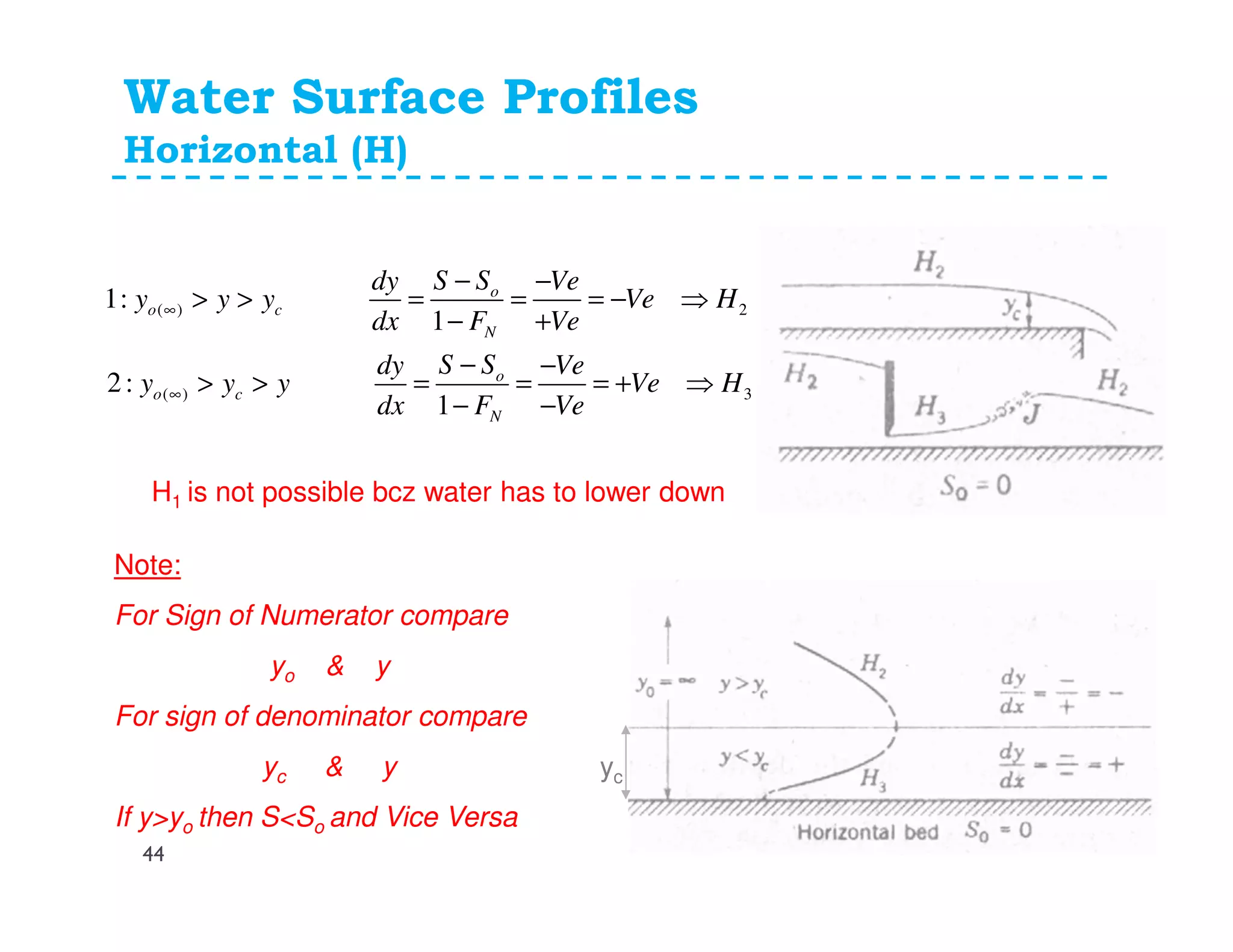
Horizontal (H)
So = 0
Adverse (A)
So = -ve
Type 1: If the stream
surface lies above both the
normal and critical depth of
flow (M1, S1)
Type 2: If the stream
surface lies between normal
and critical depth of flow
(M2, S2)
Type 3: If the stream
surface lies below both the
normal and critical depth of
flow. (M3, S3)
40
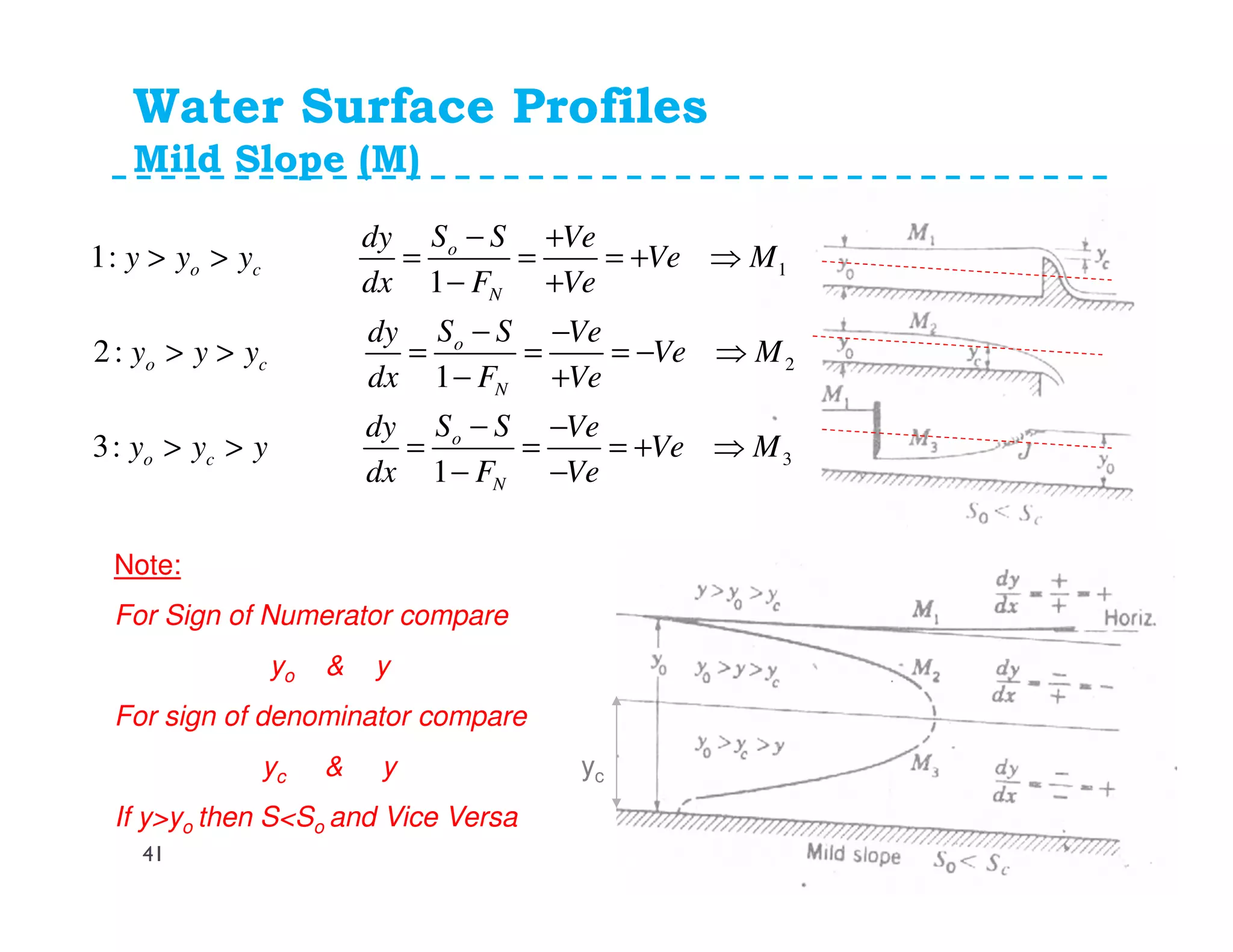
Water Surface Profiles
Mild Slope (M)
1
2
3
1:
1
2:
1
3:
1
o
o c
N
o
o c
N
o
o c
N
S Sdy Ve
y y y Ve M
dx F Ve
S Sdy Ve
y y y Ve M
dx F Ve
S Sdy Ve
y y y Ve M
dx F Ve
− +
> > = = = + ⇒
− +
− −
> > = = = − ⇒
− +
− −
> > = = = + ⇒
− −
yc
Note:
For Sign of Numerator compare
yo & y
For sign of denominator compare
yc & y
If y>yo then S<So and Vice Versa
41
Water Surface Profiles
Steep Slope (S)
1
2
3
1:
1
2:
1
3:
1
o
c o
N
o
c o
N
o
c o
N
S Sdy Ve
y y y Ve S
dx F Ve
S Sdy Ve
y y y Ve S
dx F Ve
S Sdy Ve
y y y Ve S
dx F Ve
− +
> > = = = + ⇒
− +
− +
> > = = = − ⇒
− −
− −
> > = = = + ⇒
− −
Note:
For Sign of Numerator compare
yo & y
For sign of denominator compare
yc & y
If y>yo then S<So and Vice Versa
yc
42
Water Surface Profiles
Critical (C)
1
3
1:
1
2:
1
o
o c
N
o
o c
N
S Sdy Ve
y y y Ve C
dx F Ve
S Sdy Ve
y y y Ve C
dx F Ve
− +
> = = = = + ⇒
− +
− −
= > = = = + ⇒
− −
Note:
For Sign of Numerator compare
yo & y
For sign of denominator compare
yc & y
If y>yo then S<So and Vice Versa
yo=yc
C2 is not possible
43
Water Surface Profiles
Horizontal (H)
( ) 2
( ) 3
1:
1
2:
1
o
o c
N
o
o c
N
S Sdy Ve
y y y Ve H
dx F Ve
S Sdy Ve
y y y Ve H
dx F Ve
∞
∞
− −
> > = = = − ⇒
− +
− −
> > = = = + ⇒
− −
Note:
For Sign of Numerator compare
yo & y
For sign of denominator compare
yc & y
If y>yo then S<So and Vice Versa
yc
H1 is not possible bcz water has to lower down
44
Water Surface Profiles
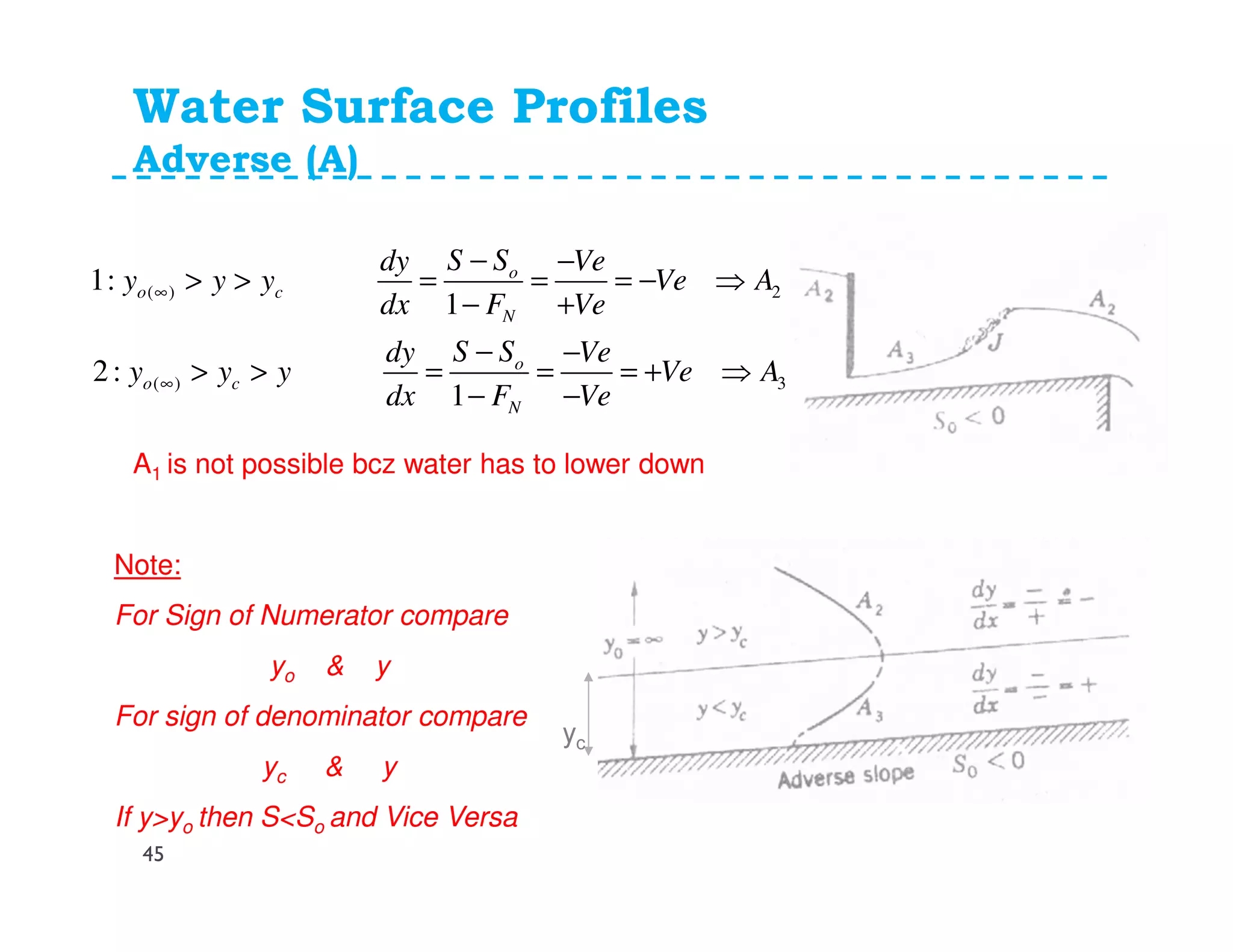
Adverse (A)
( ) 2
( ) 3
1:
1
2:
1
o
o c
N
o
o c
N
S Sdy Ve
y y y Ve A
dx F Ve
S Sdy Ve
y y y Ve A
dx F Ve
∞
∞
− −
> > = = = − ⇒
− +
− −
> > = = = + ⇒
− −
Note:
For Sign of Numerator compare
yo & y
For sign of denominator compare
yc & y
If y>yo then S<So and Vice Versa
yc
A1 is not possible bcz water has to lower down
45
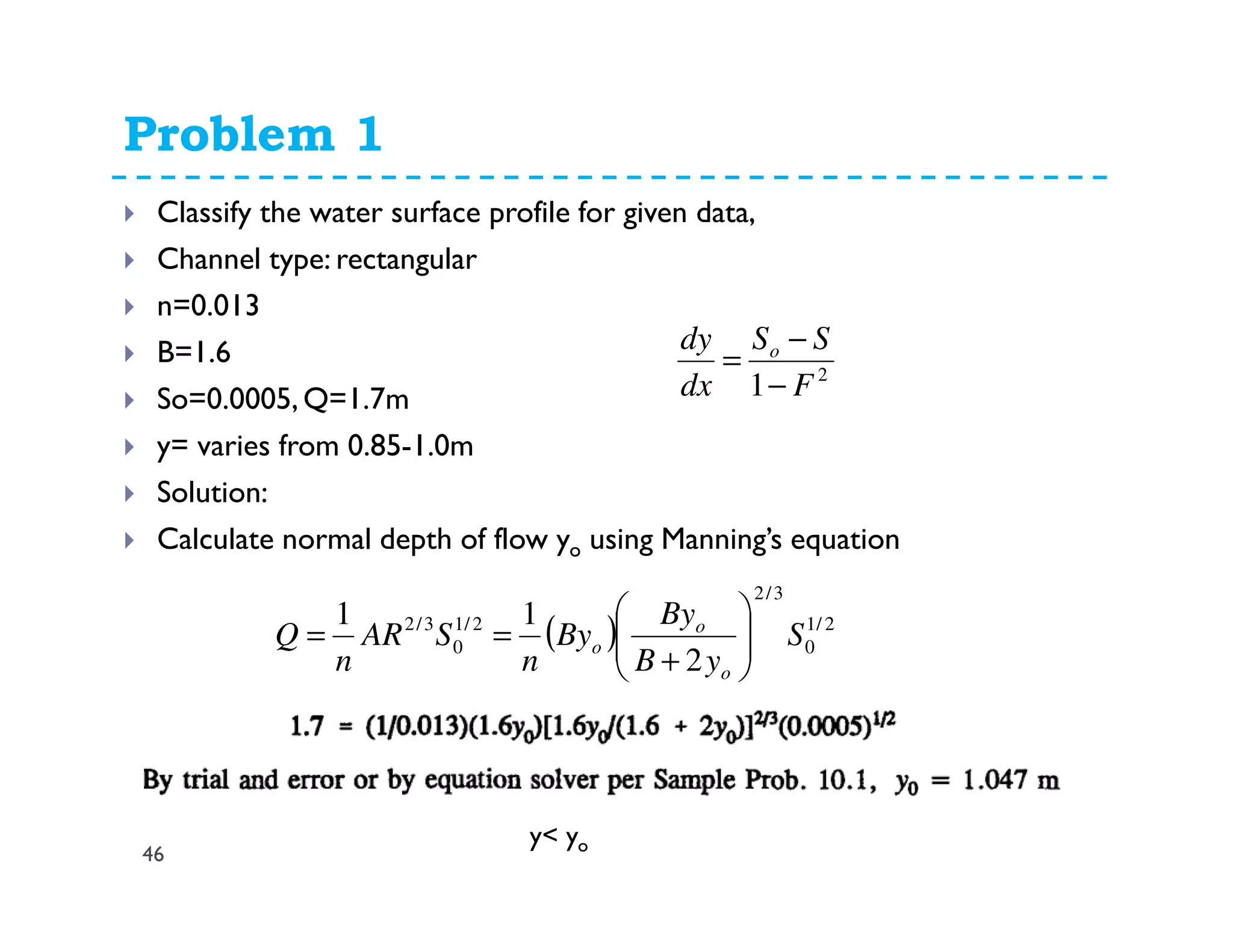
Problem 1
46
Classify the water surface profile for given data,
Channel type: rectangular
n=0.013
B=1.6
So=0.0005, Q=1.7m
y= varies from 0.85-1.0m
Solution:
Calculate normal depth of flow yo using Manning’s equation
2
1 F
SS
dx
dy o
−
−
=
( ) 2/1
0
3/2
2/1
0
3/2
2
11
S
yB
By
By
n
SAR
n
Q
o
o
o 





+
==
y< yo
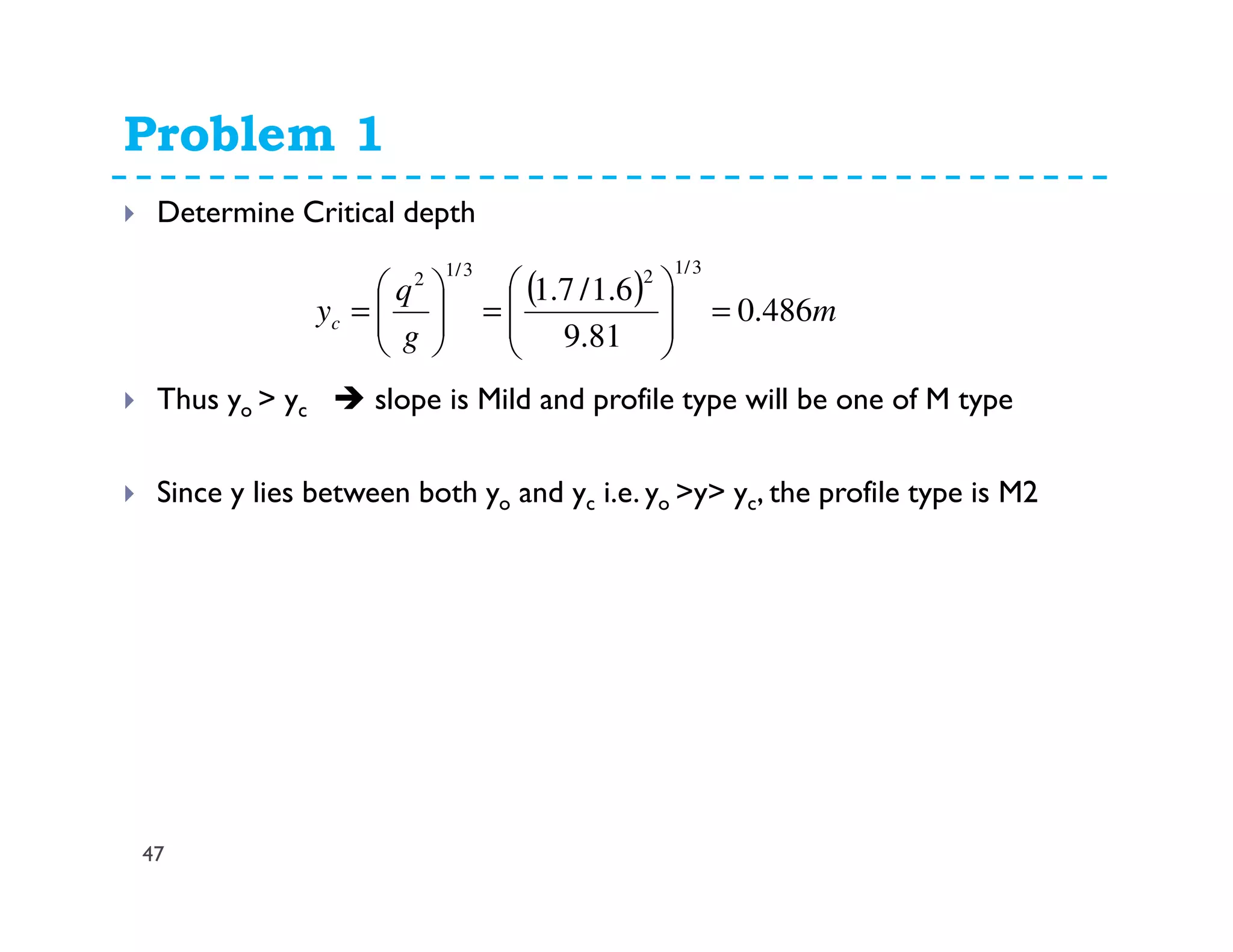
Problem 1
47
Determine Critical depth
Thus yo > yc slope is Mild and profile type will be one of M type
Since y lies between both yo and yc i.e. yo >y> yc, the profile type is M2
( ) m
g
q
yc 486.0
81.9
6.1/7.1
3/123/12
=







=





=
Problem 2
48
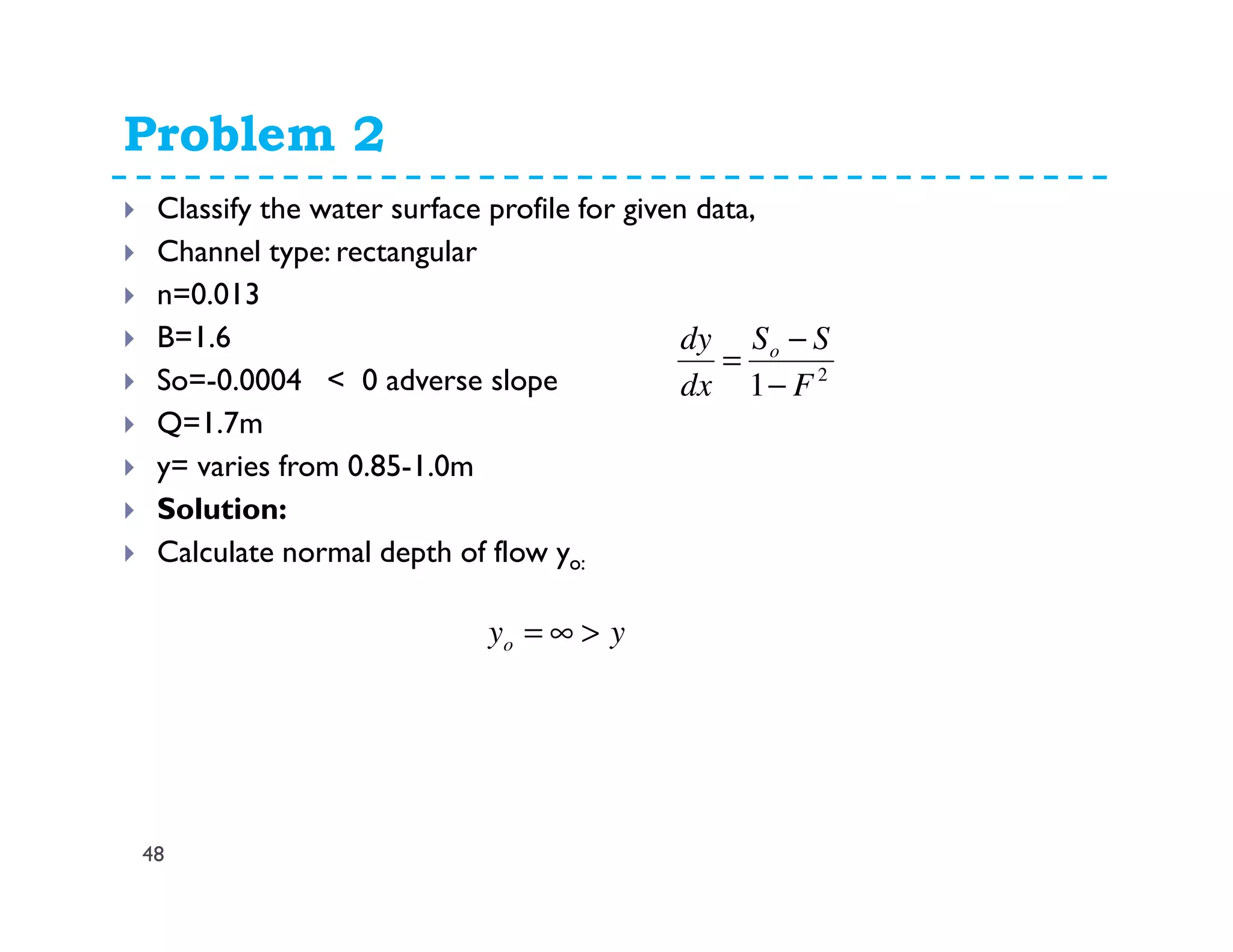
Classify the water surface profile for given data,
Channel type: rectangular
n=0.013
B=1.6
So=-0.0004 < 0 adverse slope
Q=1.7m
y= varies from 0.85-1.0m
Solution:
Calculate normal depth of flow yo:
2
1 F
SS
dx
dy o
−
−
=
yyo >∞=
Problem 2
49
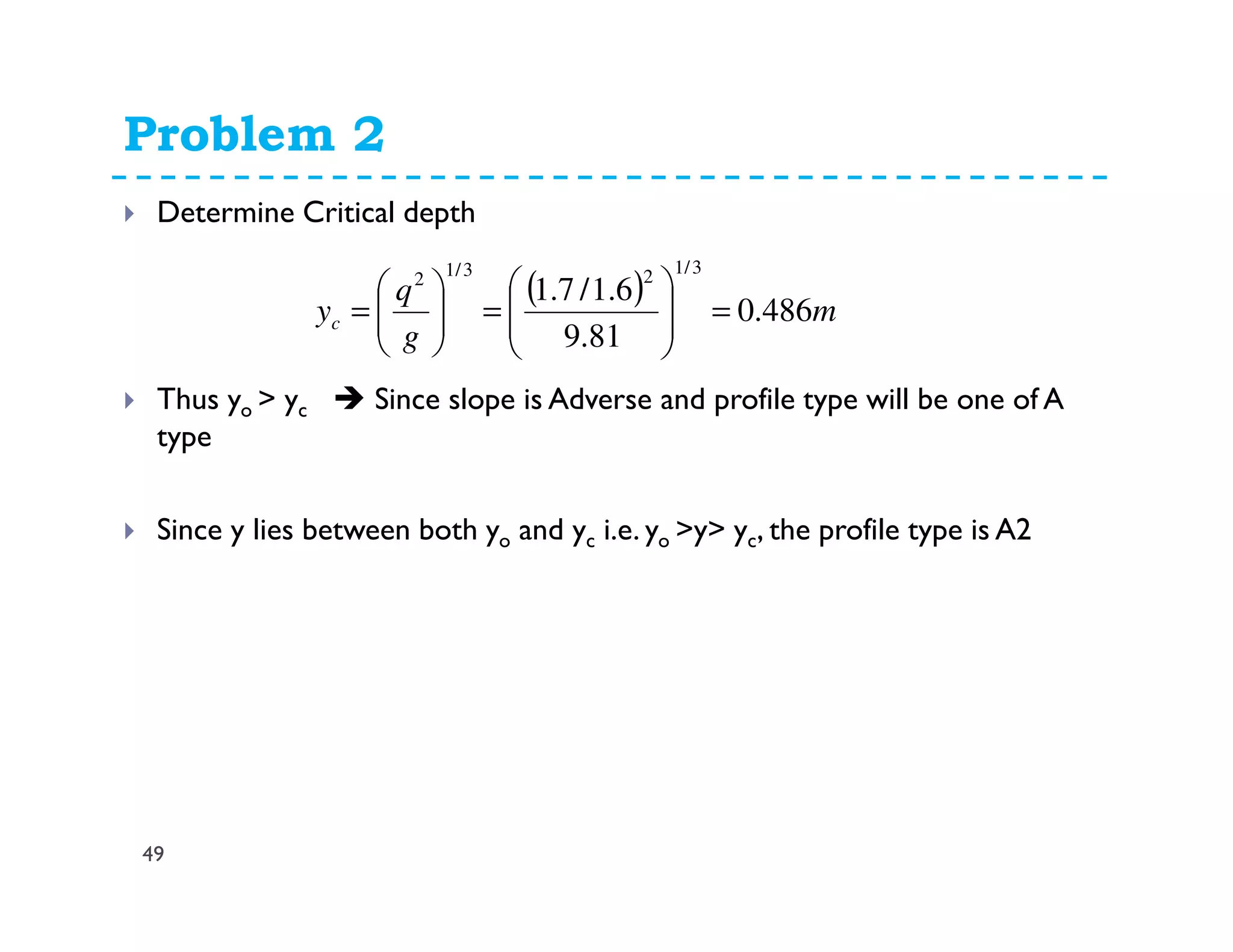
Determine Critical depth
Thus yo > yc Since slope is Adverse and profile type will be one of A
type
Since y lies between both yo and yc i.e. yo >y> yc, the profile type is A2
( ) m
g
q
yc 486.0
81.9
6.1/7.1
3/123/12
=







=





=
Problem 3
50
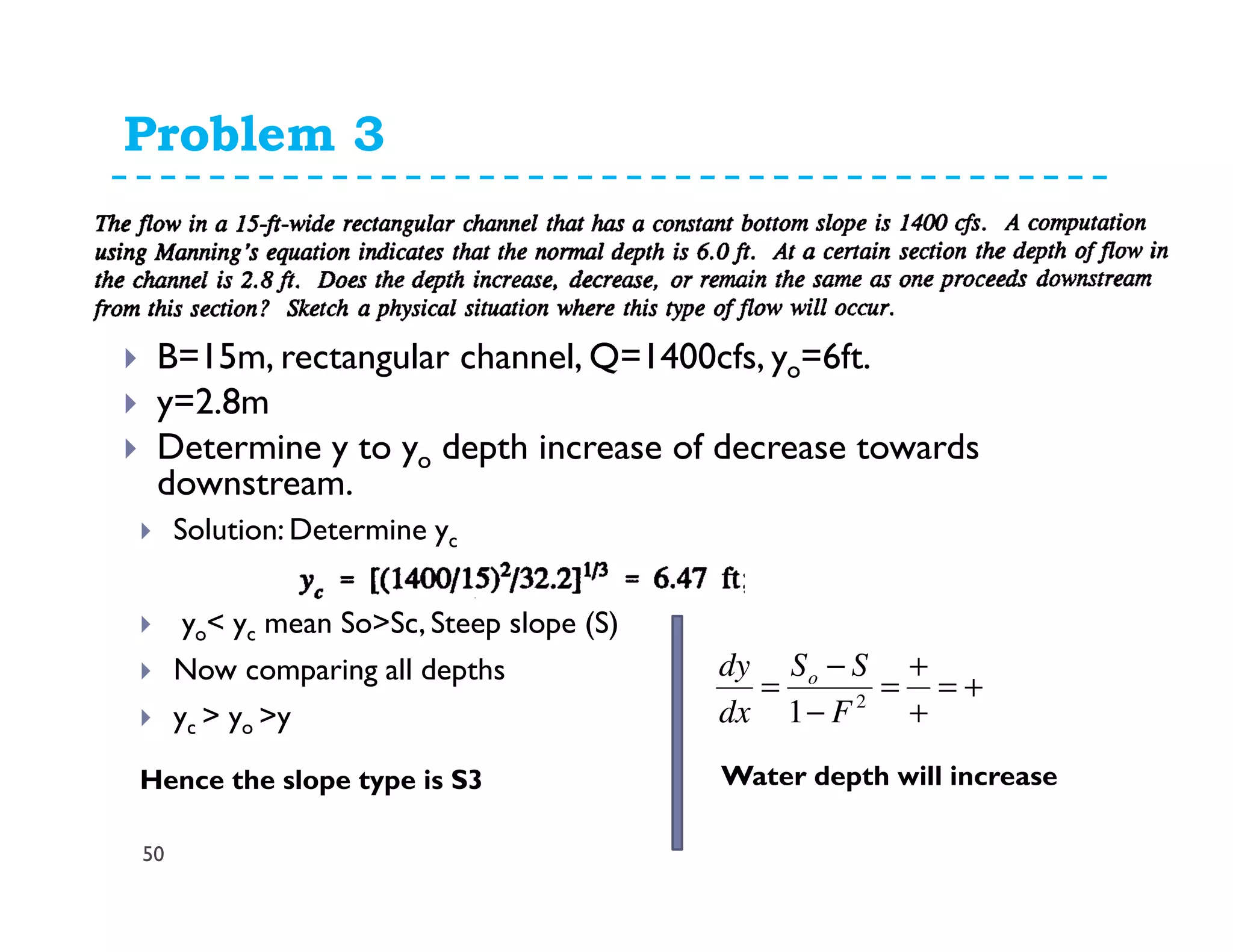
B=15m, rectangular channel, Q=1400cfs, yo=6ft.
y=2.8m
Determine y to yo depth increase of decrease towards
downstream.
Solution: Determine yc
yo< yc mean So>Sc, Steep slope (S)
Now comparing all depths
yc > yo >y
Hence the slope type is S3
+=
+
+
=
−
−
= 2
1 F
SS
dx
dy o
Water depth will increase
Practice problems
51
Thank you
Questions….
Feel free to contact:
52

(Part ii)- open channels

  • 1.
    Open Channel Hydraulics 1 Hydraulics Dr.Mohsin Siddique Assistant Professor
  • 2.
    Steady Flow inOpen Channels Specific Energy and Critical Depth Surface Profiles and Backwater Curves in Channels of Uniform sections Hydraulics jump and its practical applications. Flow over Humps and through Constrictions Broad Crested Weirs andVenturi Flumes 2
  • 3.
    Specific Energy andCritical Depth Basic Definitions Head Energy per unit weight Energy Line Line joining the total head at different positions Hydraulics Grade Line Line joining the pressure head at different positions 3
  • 4.
    Specific Energy andCritical Depth Basic Definitions Open Channel Flow 1Z g V 2 2 1 Datum So 1y 2Z g V 2 2 2 2y HGL EL Water Level lh g V yZ g V yZ +++=++ 22 2 2 22 2 1 11 4
  • 5.
    Slopes in OpenChannel Flow So= Slope of Channel Bed = (Z1-Z2)/(Δx)= -ΔZ/Δx Sw= Slope of Water Surface= [(Z1+y1)-(Z2+y2)]/Δx S= Slope of Energy Line= [(Z1+y1+V1 2/2g)-(Z2+y2+V2 2/2g)]/Δx = hl/ΔL 1Z g V 2 2 1 Datum So 1y 2Z g V 2 2 2 2y HGL EL Water Level Sw S ∆L ∆x Specific Energy and Critical Depth Basic Definitions 5
  • 6.
    Specific Energy andCritical Depth Basic Definitions Slopes in Open Channel Flow 1Z g V 2 2 1 Datum So 1y 2Z g V 2 2 2 2y HGL EL Water Level Sw S ∆L ∆x For Uniform Flow y1=y2 and V1 2/2g=V2 2/2g Hence the line indicating the bed of the channel, water surface profile and energy line are parallel to each other. For θ being very small (say less than 5 degree) i.e ∆x=∆L So=Sw=S 6
  • 7.
    Specific Energy andCritical Depth Basic Definitions Froude’s Number (FN) It is the ratio of inertial forces to gravitational forces. For a rectangular channel it may be written as FN= 1 Critical Flow > 1 Super-Critical Flow < 1 Sub-Critical Flow gy V NF = William Froude (1810-79) Born in England and engaged in shipbuilding. In his sixties started the study of ship resistance, building a boat testing pool (approximately 75 m long) near his home. After his death, this study was continued by his son, Robert Edmund Froude (1846-1924). For similarity under conditions of inertial and gravitational forces, the non-dimensional number used carries his name. 7
  • 8.
    Specific Energy andCritical Depth (Rectangular Channels) Specific Energy Specific Energy at a section in an open channel is the energy with reference to the bed of the channel. Mathematically; Specific Energy = E = y+V2/2g For a rectangular Channel q = Discharge per unit width m3/s per m B ( ) Vy B VBy B AV B Q qwhere yE yE yg q g V ==== += += 2 2 2 2 2 y 8 Datum
  • 9.
    Specific Energy andCritical Depth As it is clear from E~y diagram drawn for constant discharge for any given value of E, there would be two possible depths, say y1 and y2. These two depths are called Alternate depths. However for point C corresponding to minimum specific energy Emin, there would be only one possible depth yc. The depth yc is know as critical depth. The critical depth may be defined as depth corresponding to minimum specific energy discharge remaining Constant. E~y Diagram or E-Diagram Static Head Line BQqwhereyE yg q /2 2 2 =+= 9
  • 10.
    Specific Energy andCritical Depth For y>yc ,V<Vc Deep Channel Sub-Critical Flow,Tranquil Flow, Slow Flow. For y<yc ,V>Vc Shallow Channel Super-Critical Flow, Shooting Flow, Rapid Flow, Fast Flow. 10
  • 11.
    Specific Energy andCritical Depth Relationship Between Critical Depth and Specific Energy for rectangular channels 22 2 cc y g V = Substituting in eq. (1) ( ) ( ) ( ) ( )g yVc g yV c ccg yV c g q c cg q c gy q dy dE gy q dy dE gy q g V cc cc cc y y yVqy y yyy yyE 2 3 3 3/1 3/1 23 3 2 32 22 2 2 2 22 22 22 2 2 2 2 )2( )( 01 1 )1( = = == = == =−= −= +=+= Q Q )5(2 3 2min cc y cc yE yEE c = +== 11 )4(1 )3(22 2 = = c c c gy V y g Vc Froude # =1 !!
  • 12.
  • 13.
    Problem 13 ( ) 3/12 g q cy= ( ) 2/1 cc gyV = 2/13/2486.1 oSAR n Q =
  • 14.
    Problem 11.38 Water isreleased from a sluice gate in a rectangular channel 1.5m wide such that depth is 0.6 m and velocity is 4.5 m/s. Find (a). Critical Depth for this specific energy (b). Critical Depth for this rate of Discharge (c).The type of flow and alternate depth by either direct solution or the discharge Curve. Solution B=1.5 m y=0.6 m V= 4.5 m/sec (a) mEy m g V yEnergySpecific c 088.1 3 2 632.1 2 2 == =+= sluice gate 14 Critical flow
  • 15.
  • 16.
    Specific Energy andCritical Depth (Non Rectangular Channels) Hydraulic Depth The hydraulic depth, yh for non rectangular channel is the depth of a rectangular channel having flow area and base width the same as the flow area and top width respectively as for non rectangular channel. dy T A y dy T A yh 16
  • 17.
    Specific Energy andCritical Depth Relationship Between Critical Depth and Specific Energy Froude’s number may be numerically calculate as 3 2 2 2 2 gA TQ F T A y gA Q F gy V F N h T A h N N = == = ycy g Q T A Therefore dy dE flowCriticalfor T gA Q dy dE TdydASince =       = = −= = 23 3 2 0 1 17 dy dA gA Q dy dE gA Q yEEq 3 2 2 2 1 2 )1.( −= +=⇒
  • 18.
    Problems11.45 A Trapezoidal canalwith side slopes 1:2 has a bottom width of 3m and carries a flow of 20 m3/s. a). Find the Critical Depth and Critical velocity. b). If the canal is lined with Brick (n=0.015), find the critical slope for the same rate of discharge. Solution B=3m T A= (B+xy)y P= B+2y(1+x2)1/2 T= B+2xy 1 x Q=20 m3/s x= 2 18
  • 19.
    Problem 11.45 Q2/g =A3/T (b) Q2/g y A T A3/T 40.775 1 5 7 17.85 2 14 11 249.45 1.2 6.48 7.8 34.88 1.25 6.883 8.004 40.74 1.2512 6.885 8.0048 40.77 224433.0 2/1 2/3 =       = cS S P A n A Q 19
  • 20.
    Problem The 50o triangularchannel in Fig. E10.6 has a flow rate Q 16 m3/s. Compute (a) yc, (b)Vc, and (c) Sc if n 0.018. Answer: (a). 2.37m, (b). 3.41m, (c ) 0.00542 20 20
  • 21.
    Surface Profiles and BackwaterCurves in Channels of Uniform sections 21
  • 22.
    Steady Flow inOpen Channels Specific Energy and Critical Depth Surface Profiles and Backwater Curves in Channels of Uniform Sections Hydraulics jump and its practical applications. Flow over Humps and through Constrictions Broad Crested Weirs andVenturi Flumes 22
  • 23.
    Types of BedSlopes Mild Slope (M) yo > yc So < Sc Critical Slope (C) yo = yc So = Sc Steep Slope (S) yo < yc So > Sc So1<Sc So2>Sc yo1 yo2 yc Break 23 yo= normal depth of flow yc= critical depth So= channel bed slope Sc=critical channel bed slope
  • 24.
    Occurrence of CriticalDepth Change in Bed Slope Sub-critical to Super-Critical Control Section Super-Critical to Sub-Critical Hydraulics Jump Control Section So1<Sc So2>Sc yo1 yo2 yc Break where Slope changes Dropdown Curve So1>Sc So2<Sc yo1 yo2 yc Hydraulic Jump 24
  • 25.
    Occurrence of CriticalDepth Change in Bed Slope Free outfall Mild Slope Free Outfall Steep Slope yb~ 0.72 yc So<Sc yo yc 3~10 yc Brink yc So>Sc 25
  • 26.
    Non Uniform Flowor Varied Flow. For uniform flow through open channel, dy/dl is equal to zero. However for non-uniform flow the gravity force and frictional resistance are not in balance. Thus dy/dl is not equal to zero which results in non-uniform flow. There are two types of non uniform flows. In one the changing condition extends over a long distance and this is called gradually varied flow. In the other the change may occur over very abruptly and the transition is thus confined to a short distance. This may be designated as a local non-uniform flow phenomenon or rapidly varied flow. So1<Sc So2>Sc yo1 yo2 yc Break 26
  • 27.
    Energy Equation forGradually Varied Flow. 1Z g V 2 2 1 Datum So 1y 2Z g V 2 2 2 2y HGL EL Water Level lh g V yZ g V yZ +++=++ 22 2 2 22 2 1 11 Theoretical EL Sw hL ∆X ∆ L S 27 Remember: Both sections are subject to atmospheric pressure
  • 28.
    Energy Equation forGradually Varied Flow. ( ) ( ) ( ) profilesurfacewateroflengthLWhere SS EE L LSLSEE Now for L ZZ X ZZ S L h S hZZ g V y g V y o o o o L L =∆ − − =∆ ∆+∆−= < ∆ − ≈ ∆ − = ∆ = +−−+=+ )1( 6, 22 21 21 2121 21 2 2 2 2 1 1 θ An approximate analysis of gradually varied, non uniform flow can be achieved by considering a length of stream consisting of a number of successive reaches, in each of which uniform occurs. Greater accuracy results from smaller depth variation in each reach. 28
  • 29.
    Energy Equation forGradually Varied Flow. 3/4 22 2/13/21 m m mm R nV S SR n V = = The Manning's formula (or Chezy’s formula) is applied to average conditions in each reach to provide an estimate of the value of S for that reach as follows; 2 2 21 21 RR R VV V m m + = + = In practical, depth range of the interest is divided into small increments, usually equal, which define the reaches whose lengths can be found by equation (1) 29
  • 30.
    Problem 11.59 A rectangularflume of planer timber (n=0.012) is 1.5 m wide and carries 1.7m3/s of water. The bed slope is 0.0006, and at a certain section the depth is 0.9m. Find the distance (in one reach) to the section where depth is 0.75m. Is the distance upstream or downstream ? 3 1 2 Rectangular Channel 0.012 1.5 1.7 /sec 0.0006 0.9 0.75 o n B m Q m S y m y = = = = = = B y 30
  • 31.
    Problem 11.59 Solution 1 2 22 4/3 2 1 2 2 1 2 1 1 1 2 2 2 1 1 2 2 & 1.5 0.9 1.35 1.5 0.75 1.125 1.5 2 0.9 3.3 1.5 2 0.75 3 / 0.41 / 0.375 / 1.26 / sec / 1.51 / sec o m m Since E E L S S V n S R A x m A x m P x m P x m R A P R A P V Q A m V Q A m − ∆ = − = = = = = = + = = + = = = = = = = = = 2 2 4/3 1 2 2 2 1 2 1 2 0.3925 1.385 & 0.000961 2 2 317.73 m m m m o o R m V m V n S R E E Now L S S V V y y g g L S S m Downstream = = = = − ∆ = −     + − +       ∆ = − = 31 upstream
  • 32.
  • 33.
  • 34.
  • 35.
    Problem 11.66 The slopeof a stream of a rectangular cross section is So=0.0002, the width is 50m, and the value of Chezy C is 43.2 m1/2/sec. Find the depth for uniform flow of 8.25 m3/sec/m of the stream. If a dam raises the water level so that at a certain distance upstream the increase is 1.5m, how far from this latter section will the increase be only 30cm? Use reaches with 30cm depth. GivenThat 1.5m yo 0.3m 1/ 2 3 0.0002 50 43.2 /sec 8.25 /sec/ 50 8.25 43.2 0.0002 50 2 6.1 o o o o o o o o o S B m C m q m m A q y C S P y y y y m = = = = = = + = L 35
  • 36.
    Problem 11.66 y AP R V E E1-E2 Vm Rm S S-So ∆L Σ∆L By B+2y A/P q/y y+v2/g (v1+v2)/2 Vm2/(Rm C2) (E1-E2) /(S-So) m m2 m m m/s m m m/s m m/m m/m m m 7.6 380 65.2 5.82 1.09 7.66 0.295 1.11 5.74 0.000115 -0.000085 -3454.33 -3454.33 7.3 365 64.6 5.65 1.13 7.365 7.0 6.7 6.4 V=C(RS)1/2 36
  • 37.
    Water Surface Profilesin Gradually Varied Flow. 1Z g V 2 2 1 Datum So 1y 2Z g V 2 2 2 2y HGL EL Water Level g V yZHeadTotal 2 2 ++= Theoretical EL Sw hL ∆X ∆L 37
  • 38.
    Water Surface Profilesin Gradually Varied Flow. ( ) 0 1 0 )2( 1 . 1 1 2 .tan.. 22 2 2 3 2 2 3 2 2 2 2 22 1 = − − ∴ = − − = − =−+−=−       −+= −       ++= ++=++= N o N NNo F SS dx dy flowuniformFor F SSo dx dy or gsindecreaisflow ofdirectionalongheadtotalthatshowssignve gy q FF dx dy SS gy q dx dy dx dZ dx dH gulartanrecastionseccrossgConsiderin gy q dx d dx dy dx dZ dx dH xdirectionhorizontalincedistrwHheadtotaltheatingDifferenti gy q yZ g v yZH Q Equation (2) is dynamic Equation for gradually varied flow for constant value of q and n If dy/dx is +ve the depth of flow increases in the direction of flow and vice versa 38 Important assumption !!
  • 39.
    Water Surface Profilesin Gradually Varied Flow. 3/10 3/10 22 3/10 22 2/13/5 2/13/2 1 1       =∴ = = = = ≈ y y S S y qn S channel gulartanrecinflowuniformFor y qn S orSy n q orSy n V yR channelgulartanrecwideaFor o o o o 2 1 F SS dx dy o − − = Consequently, for constant q and n, when y>yo, S<So, and the numerator is +ve. Conversely, when y<yo, S>So, and the numerator is –ve. To investigate the denominator we observe that, if F=1, dy/dx=infinity; if F>1, the denominator is -ve; and if F<1, the denominator is +ve. 39
  • 40.
    Classification of SurfaceProfiles Mild Slope (M) yo > yc So < Sc Critical Slope (C) yo = yc So = Sc Steep Slope (S) yo < yc So > Sc Horizontal (H) So = 0 Adverse (A) So = -ve Type 1: If the stream surface lies above both the normal and critical depth of flow (M1, S1) Type 2: If the stream surface lies between normal and critical depth of flow (M2, S2) Type 3: If the stream surface lies below both the normal and critical depth of flow. (M3, S3) 40
  • 41.
    Water Surface Profiles MildSlope (M) 1 2 3 1: 1 2: 1 3: 1 o o c N o o c N o o c N S Sdy Ve y y y Ve M dx F Ve S Sdy Ve y y y Ve M dx F Ve S Sdy Ve y y y Ve M dx F Ve − + > > = = = + ⇒ − + − − > > = = = − ⇒ − + − − > > = = = + ⇒ − − yc Note: For Sign of Numerator compare yo & y For sign of denominator compare yc & y If y>yo then S<So and Vice Versa 41
  • 42.
    Water Surface Profiles SteepSlope (S) 1 2 3 1: 1 2: 1 3: 1 o c o N o c o N o c o N S Sdy Ve y y y Ve S dx F Ve S Sdy Ve y y y Ve S dx F Ve S Sdy Ve y y y Ve S dx F Ve − + > > = = = + ⇒ − + − + > > = = = − ⇒ − − − − > > = = = + ⇒ − − Note: For Sign of Numerator compare yo & y For sign of denominator compare yc & y If y>yo then S<So and Vice Versa yc 42
  • 43.
    Water Surface Profiles Critical(C) 1 3 1: 1 2: 1 o o c N o o c N S Sdy Ve y y y Ve C dx F Ve S Sdy Ve y y y Ve C dx F Ve − + > = = = = + ⇒ − + − − = > = = = + ⇒ − − Note: For Sign of Numerator compare yo & y For sign of denominator compare yc & y If y>yo then S<So and Vice Versa yo=yc C2 is not possible 43
  • 44.
    Water Surface Profiles Horizontal(H) ( ) 2 ( ) 3 1: 1 2: 1 o o c N o o c N S Sdy Ve y y y Ve H dx F Ve S Sdy Ve y y y Ve H dx F Ve ∞ ∞ − − > > = = = − ⇒ − + − − > > = = = + ⇒ − − Note: For Sign of Numerator compare yo & y For sign of denominator compare yc & y If y>yo then S<So and Vice Versa yc H1 is not possible bcz water has to lower down 44
  • 45.
    Water Surface Profiles Adverse(A) ( ) 2 ( ) 3 1: 1 2: 1 o o c N o o c N S Sdy Ve y y y Ve A dx F Ve S Sdy Ve y y y Ve A dx F Ve ∞ ∞ − − > > = = = − ⇒ − + − − > > = = = + ⇒ − − Note: For Sign of Numerator compare yo & y For sign of denominator compare yc & y If y>yo then S<So and Vice Versa yc A1 is not possible bcz water has to lower down 45
  • 46.
    Problem 1 46 Classify thewater surface profile for given data, Channel type: rectangular n=0.013 B=1.6 So=0.0005, Q=1.7m y= varies from 0.85-1.0m Solution: Calculate normal depth of flow yo using Manning’s equation 2 1 F SS dx dy o − − = ( ) 2/1 0 3/2 2/1 0 3/2 2 11 S yB By By n SAR n Q o o o       + == y< yo
  • 47.
    Problem 1 47 Determine Criticaldepth Thus yo > yc slope is Mild and profile type will be one of M type Since y lies between both yo and yc i.e. yo >y> yc, the profile type is M2 ( ) m g q yc 486.0 81.9 6.1/7.1 3/123/12 =        =      =
  • 48.
    Problem 2 48 Classify thewater surface profile for given data, Channel type: rectangular n=0.013 B=1.6 So=-0.0004 < 0 adverse slope Q=1.7m y= varies from 0.85-1.0m Solution: Calculate normal depth of flow yo: 2 1 F SS dx dy o − − = yyo >∞=
  • 49.
    Problem 2 49 Determine Criticaldepth Thus yo > yc Since slope is Adverse and profile type will be one of A type Since y lies between both yo and yc i.e. yo >y> yc, the profile type is A2 ( ) m g q yc 486.0 81.9 6.1/7.1 3/123/12 =        =      =
  • 50.
    Problem 3 50 B=15m, rectangularchannel, Q=1400cfs, yo=6ft. y=2.8m Determine y to yo depth increase of decrease towards downstream. Solution: Determine yc yo< yc mean So>Sc, Steep slope (S) Now comparing all depths yc > yo >y Hence the slope type is S3 += + + = − − = 2 1 F SS dx dy o Water depth will increase
  • 51.
  • 52.