Will Evans

Yana Kuchirko
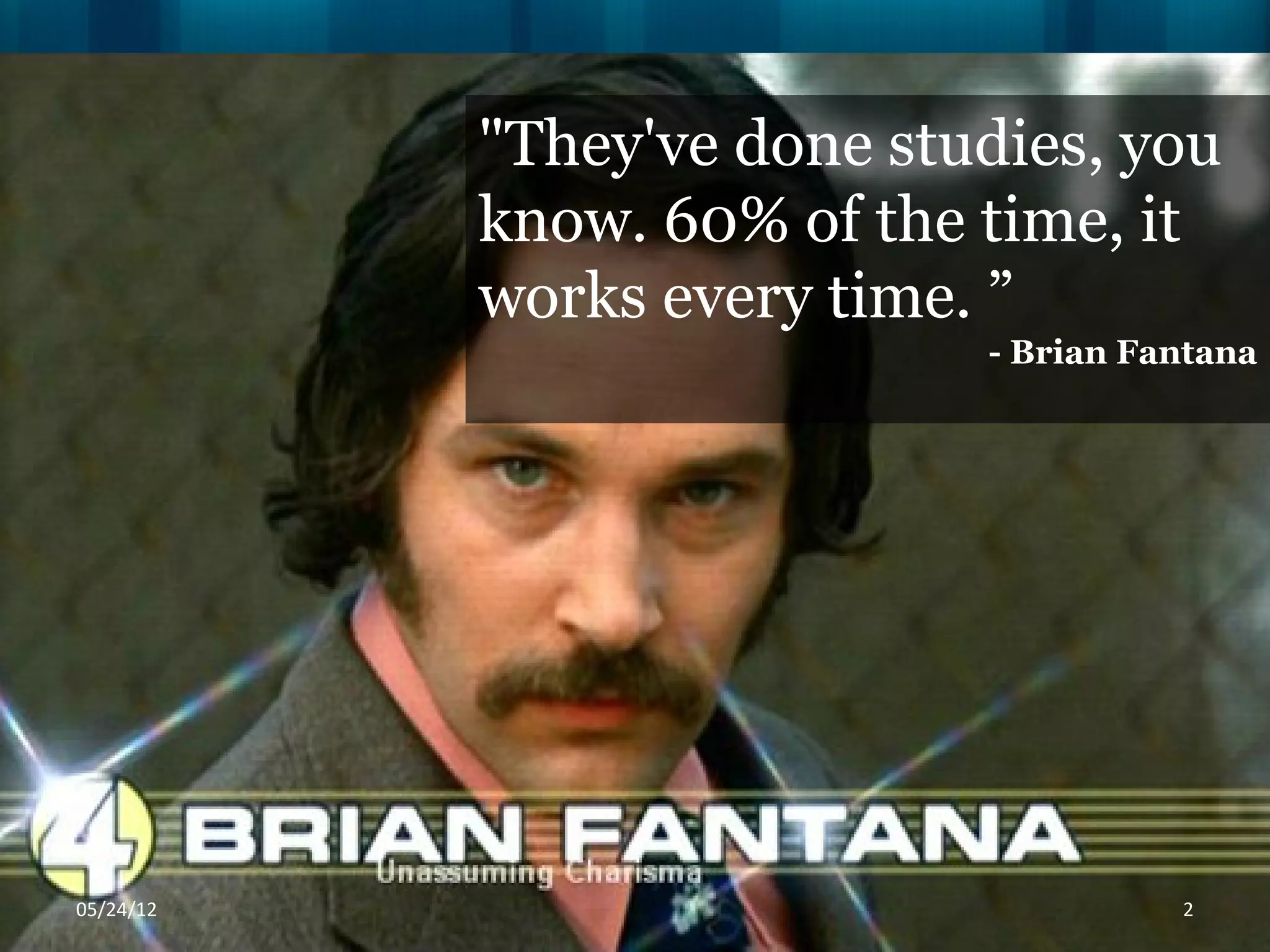
"They've done studies, you
           know. 60% of the time, it
           works every time. ”
                            - Brian Fantana


06/16/12                              2
Surveys Aren’t Objective


They are created by people who are biased and analyze their
       results based on their own (mis)perceptions.

06/16/12                                                  3
Epistemological Dead End?


              No. Awareness that the researcher plays an integral
              role in the process of measuring any given
              phenomena by deciding how to measure is key.

              There are ways to minimize researcher bias by
              creating better questions.
06/16/12                                                      4
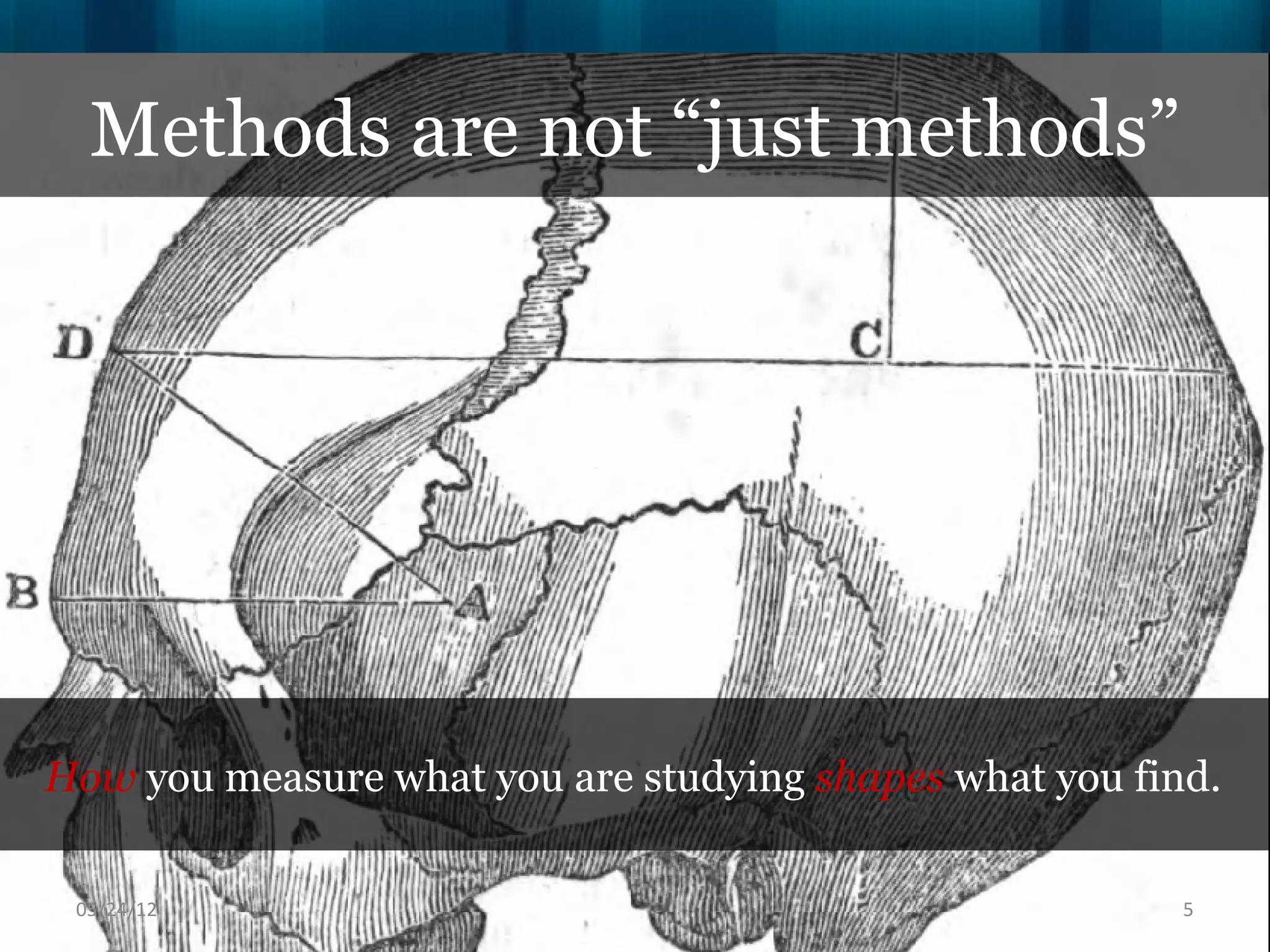
Methods are not “just methods”


How you measure what you are studying shapes what you find.

 06/16/12                                                5
Let’s say you are studying…


              How often teenagers use your website

06/16/12                                             6
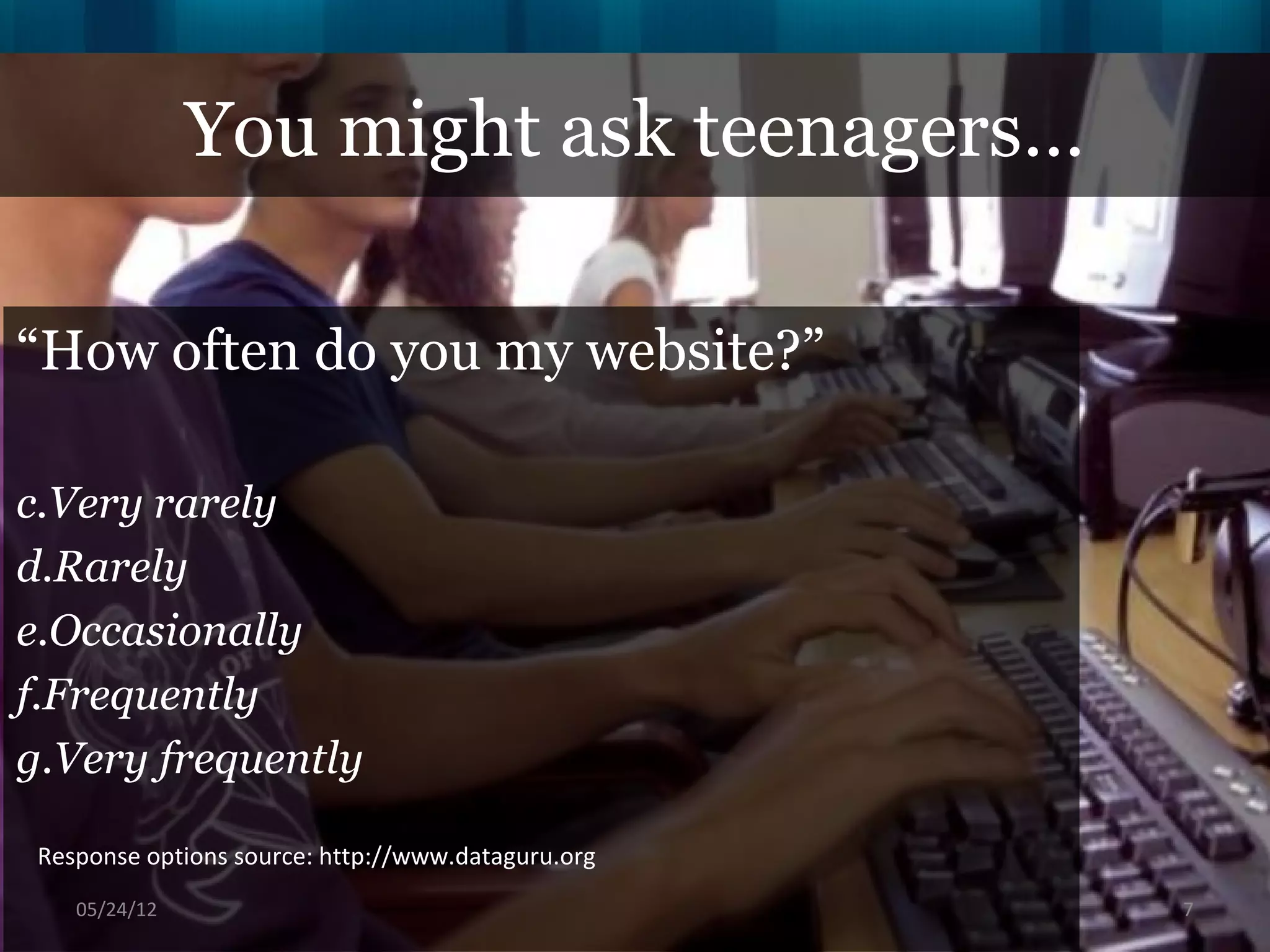
You might ask teenagers…

“How often do you my website?”

c.Very rarely
d.Rarely
e.Occasionally
f.Frequently
g.Very frequently

 Response options source: http://www.dataguru.org
    06/16/12                                        7
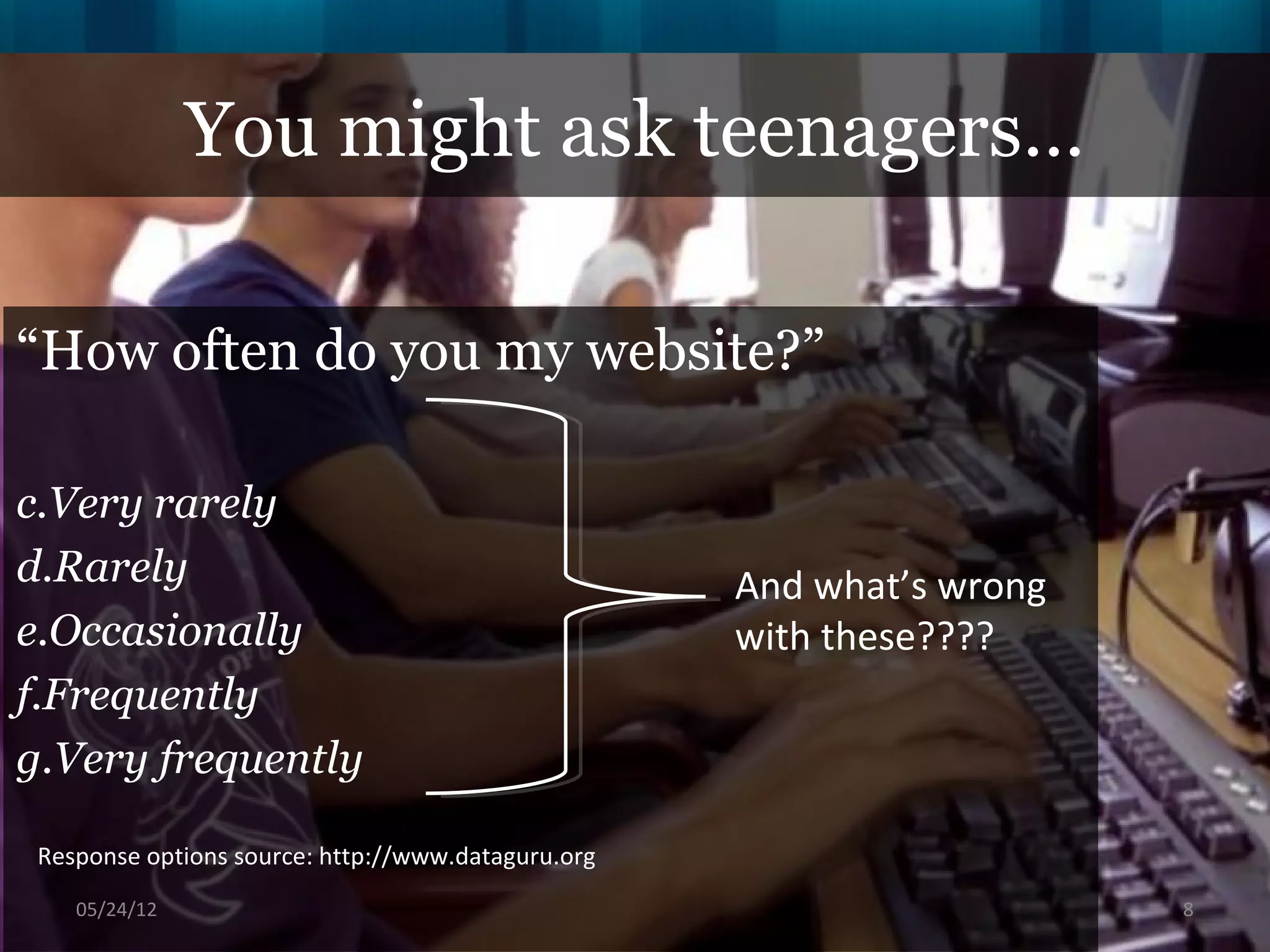
You might ask teenagers…

“How often do you my website?”

c.Very rarely
d.Rarely                                            And what’s wrong
e.Occasionally                                      with these????
f.Frequently
g.Very frequently

 Response options source: http://www.dataguru.org
    06/16/12                                                           8
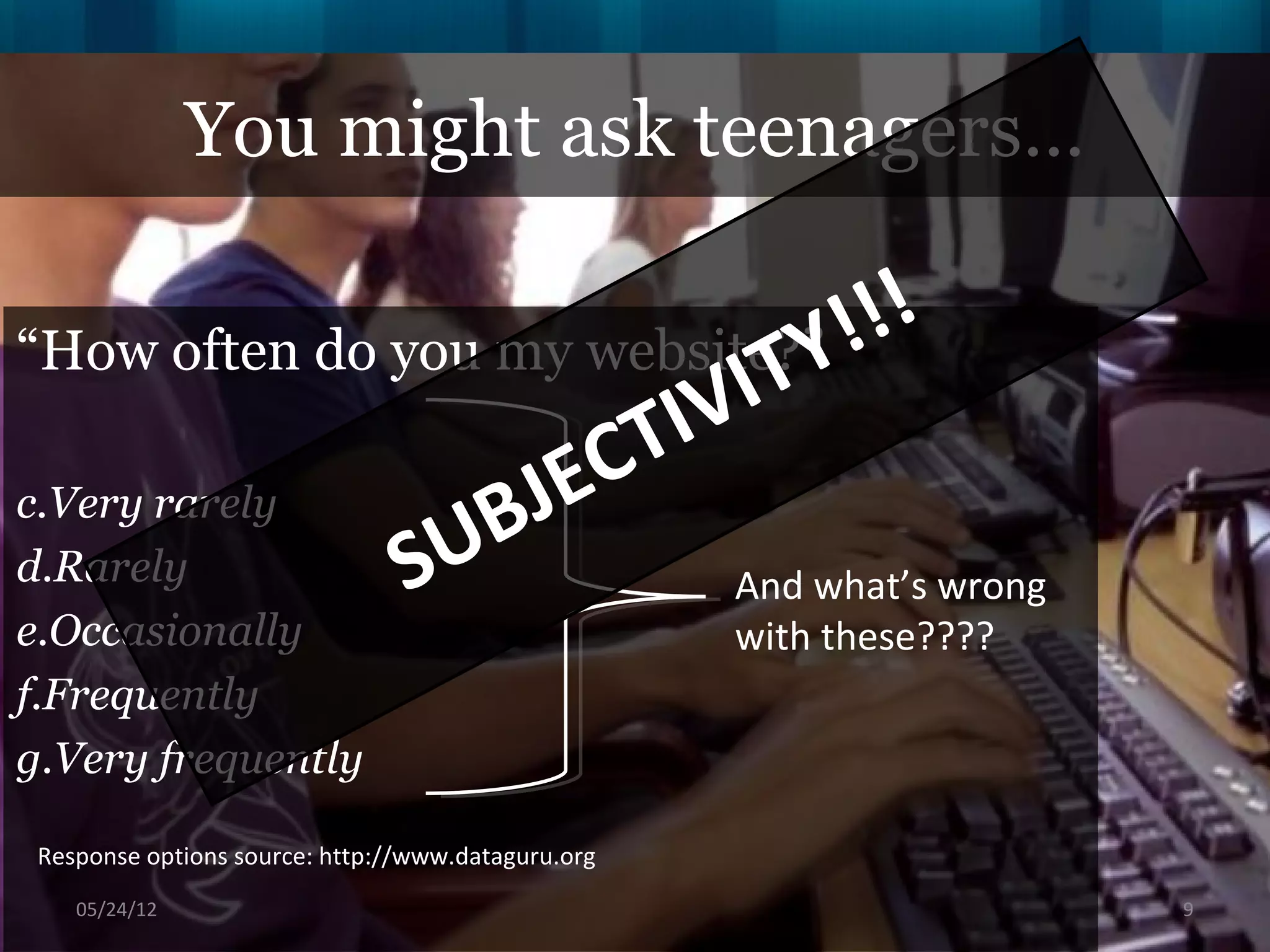
You might ask teenagers…

“How often do you my website?” !  !!
                           VI TY
                     EC TI
c.Very rarely
                  BJ
d.Rarely       SU           And what’s wrong
e.Occasionally                                      with these????
f.Frequently
g.Very frequently

 Response options source: http://www.dataguru.org
    06/16/12                                                         9
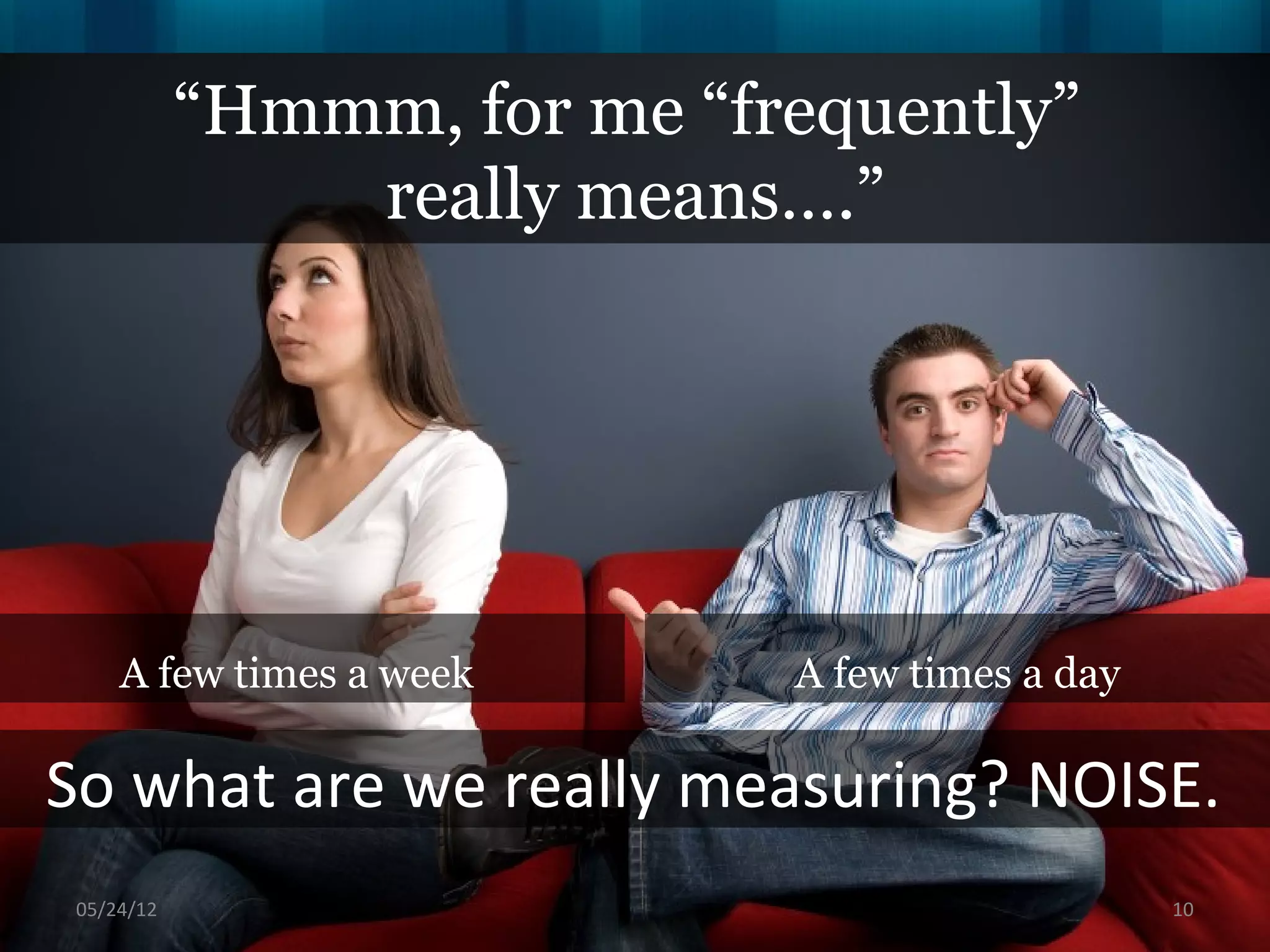
“Hmmm, for me “frequently”
                really means….”


     A few times a week      A few times a day

So what are we really measuring? NOISE.
 06/16/12                                        10
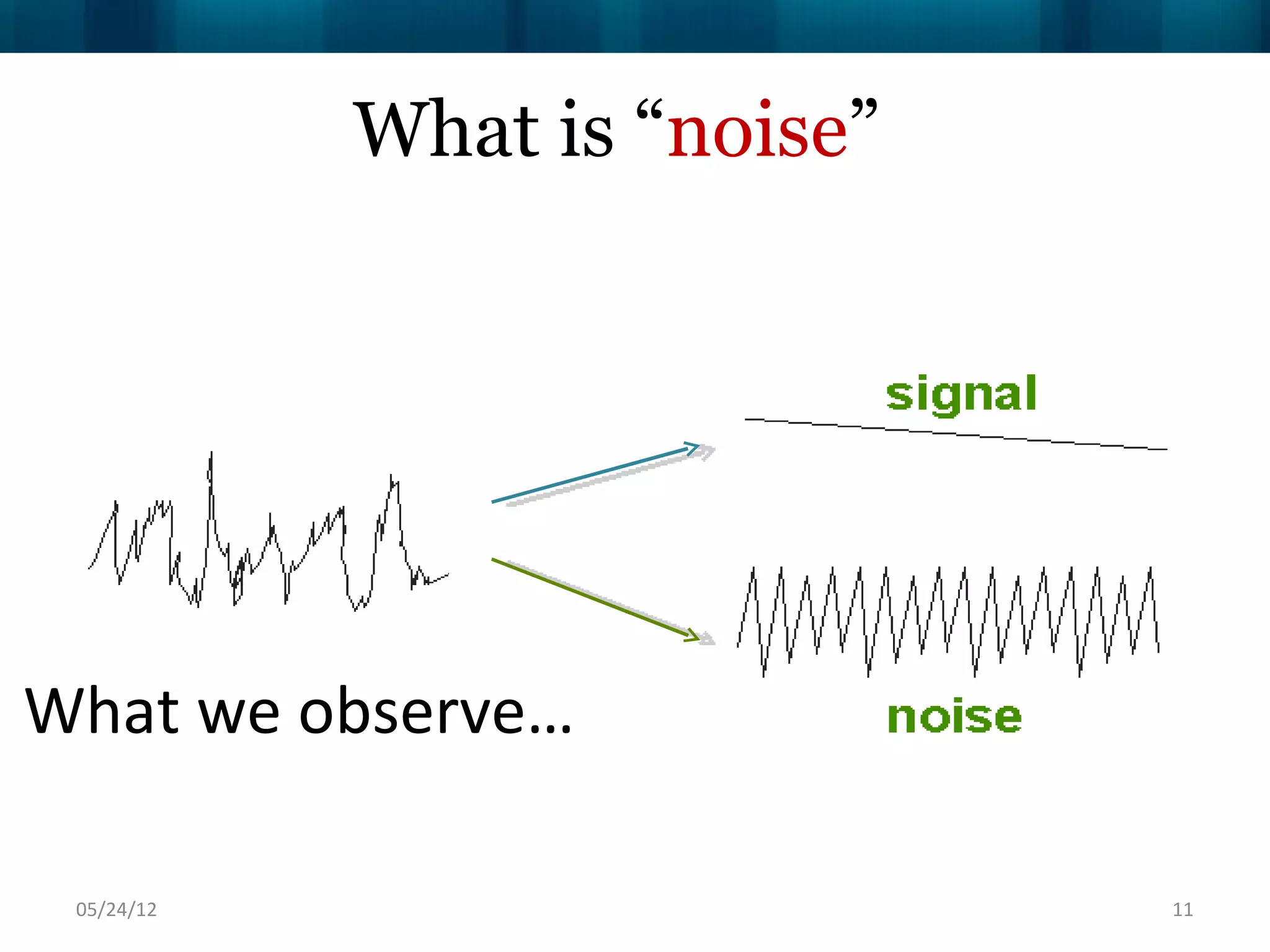
What is “noise”?


What we observe…

 06/16/12                      11
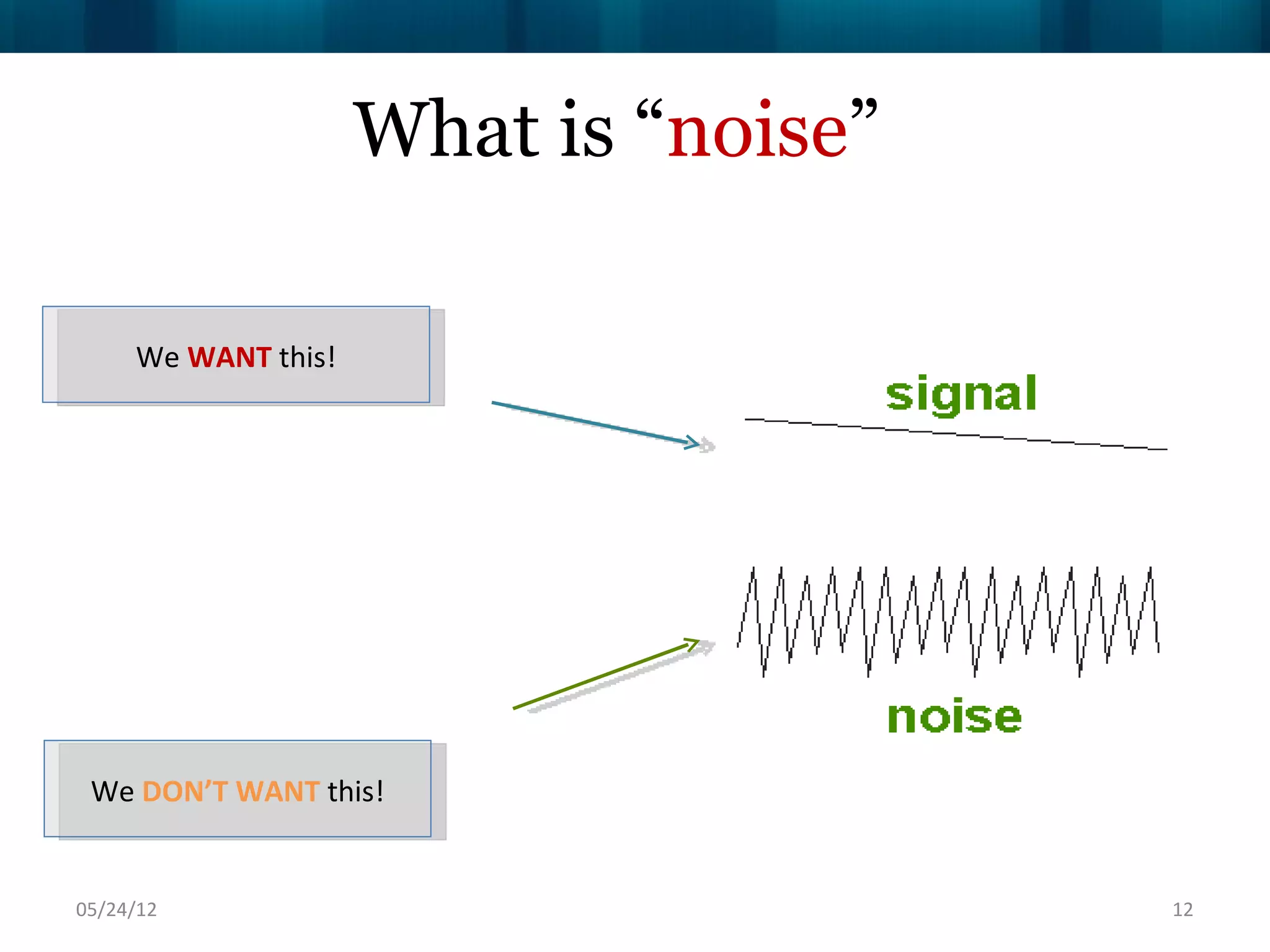
What is “noise”?

     We WANT this!


 We DON’T WANT this!


06/16/12                                12
An imaginary scenario
Let’s really stretch our thinking a bit here to
provide a more concrete understanding of
“noise” in your data.

Imagine you have AT&T phone service and
you’re trying to make a call. The signal isn’t
clearly going through and you end up hearing
everything but the other person’s voice.
Frustrating, right? Thank God this is only a
pretend scenario.
06/16/12                                          13
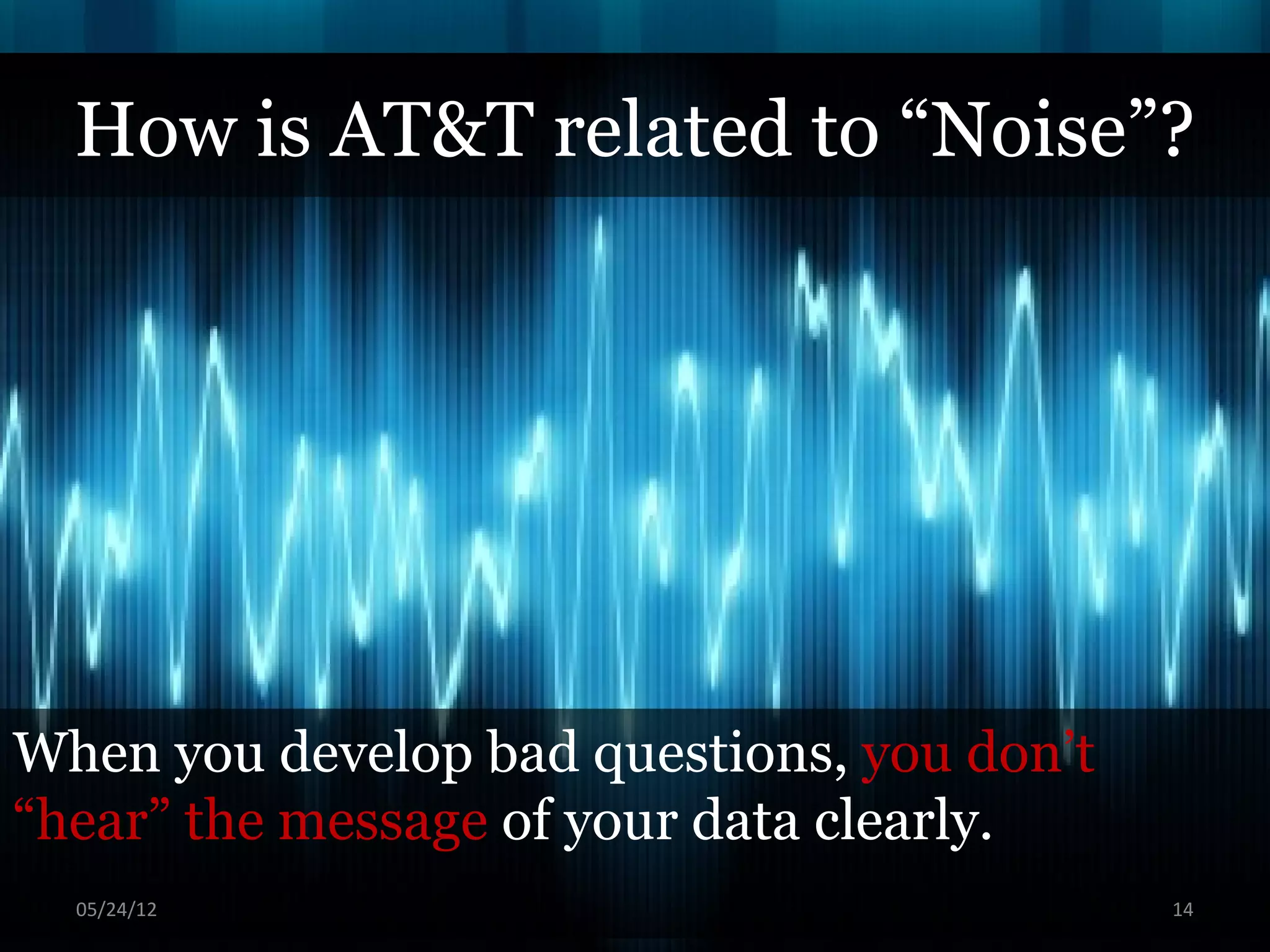
How is AT&T related to “Noise”?


When you develop bad questions, you don’t
“hear” the message of your data clearly.
  06/16/12                                  14
So…why is “noise” bad???
• Badly structured and poorly worded
  questions that obfuscate meaning for
  participants provide bad data.

• Bad data
      – Doesn’t answer your research question
      – Makes it difficult to interpret results
      – Is pretty much useless.

06/16/12                                          15
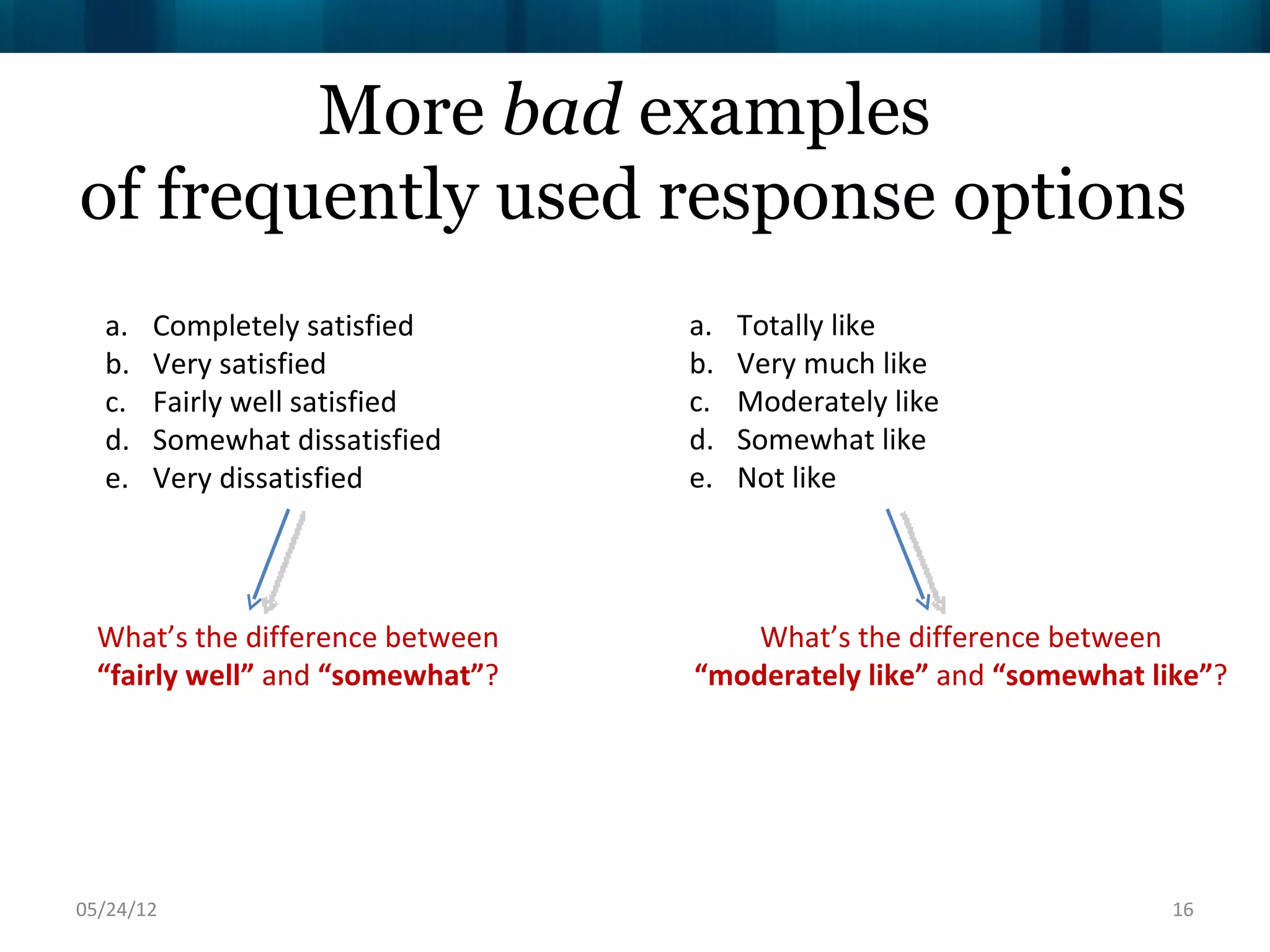
More bad examples
of frequently used response options
  a.   Completely satisfied       a.   Totally like
  b.   Very satisfied             b.   Very much like
  c.   Fairly well satisfied      c.   Moderately like
  d.   Somewhat dissatisfied      d.   Somewhat like
  e.   Very dissatisfied          e.   Not like


  What’s the difference between       What’s the difference between
  “fairly well” and “somewhat”?   “moderately like” and “somewhat like”?


06/16/12                                                            16
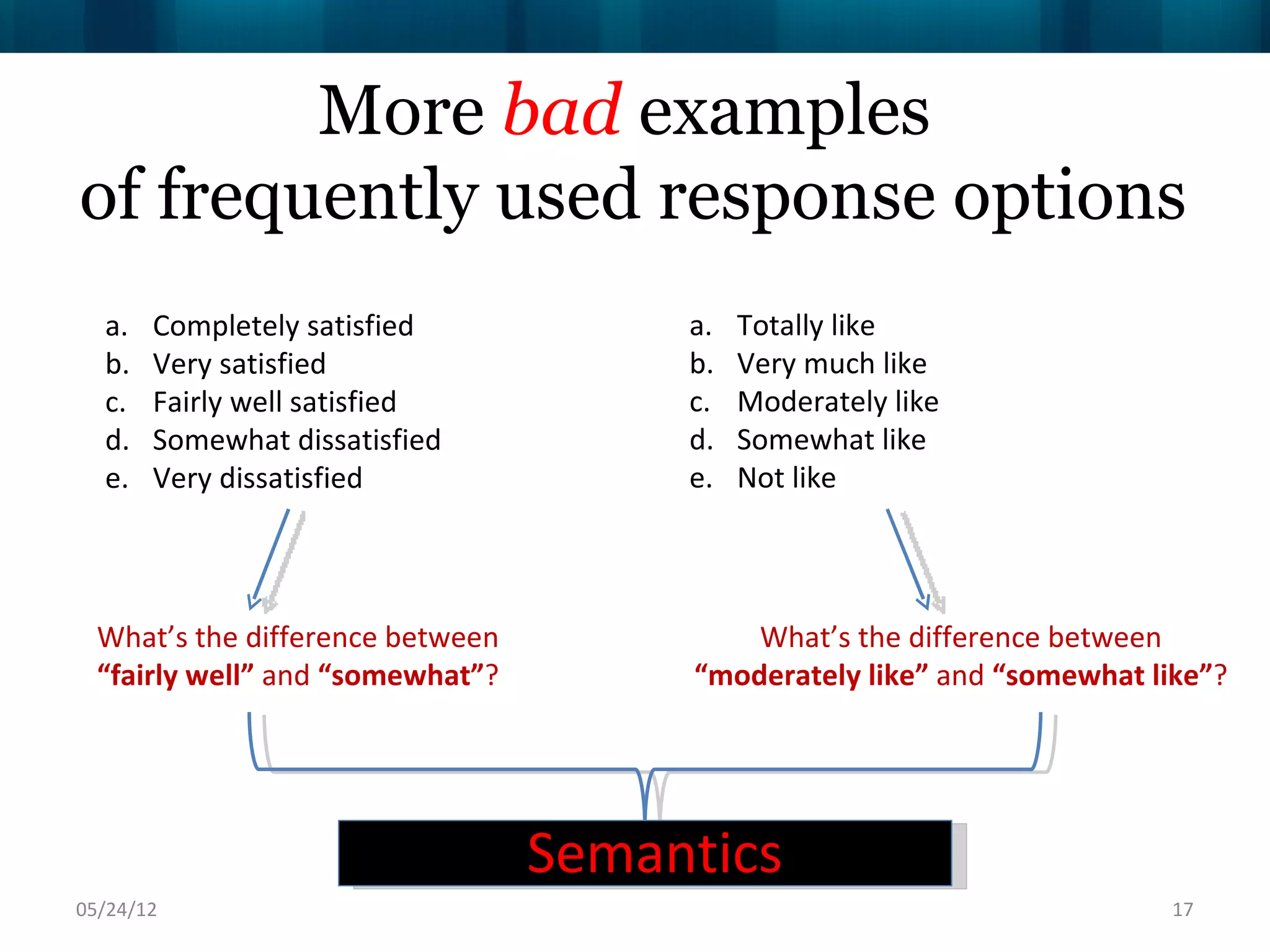
More bad examples
of frequently used response options
  a.   Completely satisfied            a.   Totally like
  b.   Very satisfied                  b.   Very much like
  c.   Fairly well satisfied           c.   Moderately like
  d.   Somewhat dissatisfied           d.   Somewhat like
  e.   Very dissatisfied               e.   Not like


  What’s the difference between            What’s the difference between
  “fairly well” and “somewhat”?        “moderately like” and “somewhat like”?


                                  Semantics
06/16/12                                                                 17
Words like….
 •   Sometimes
 •   Often
 •   Moderately
 •   Very
 •   Not very much


                                          Are subjective
            = they mean different things for different people

 06/16/12                                                 18
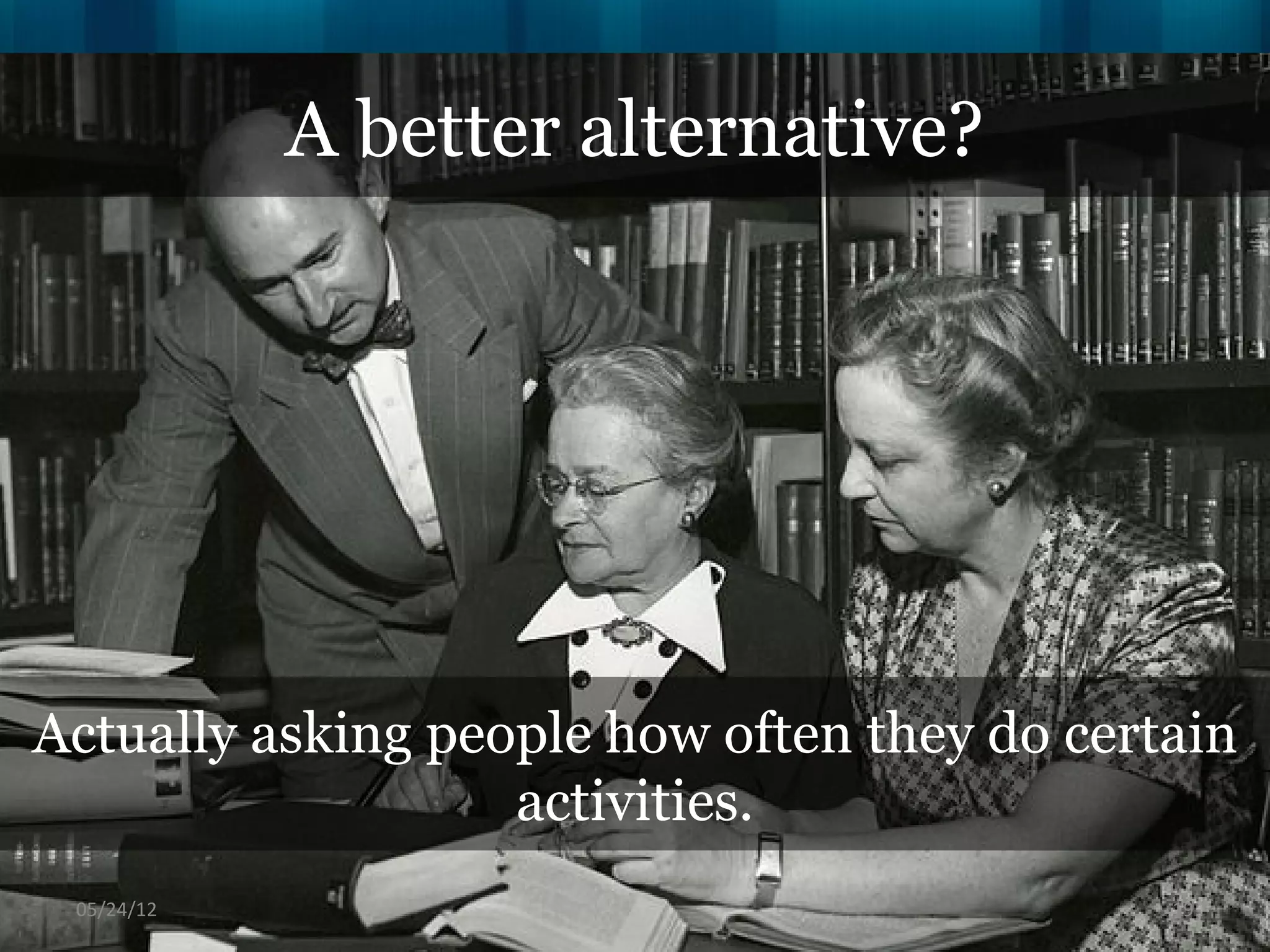
A better alternative?


Actually asking people how often they do certain
                   activities.
 06/16/12                                    19
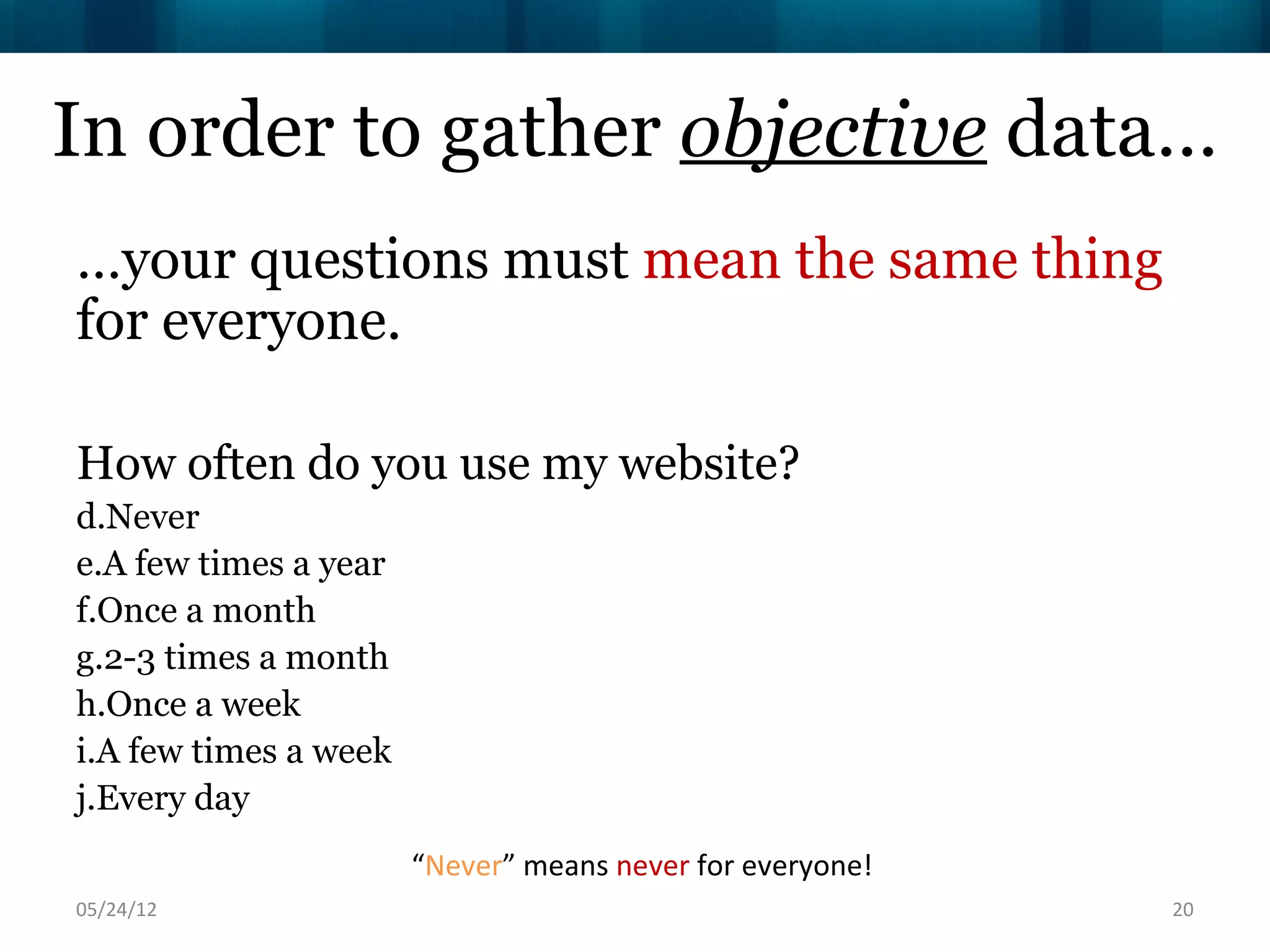
In order to gather objective data…
…your questions must mean the same thing
for everyone.

How often do you use my website?
d.Never
e.A few times a year
f.Once a month
g.2-3 times a month
h.Once a week
i.A few times a week
j.Every day
                       “Never” means never for everyone!
06/16/12                                                   20
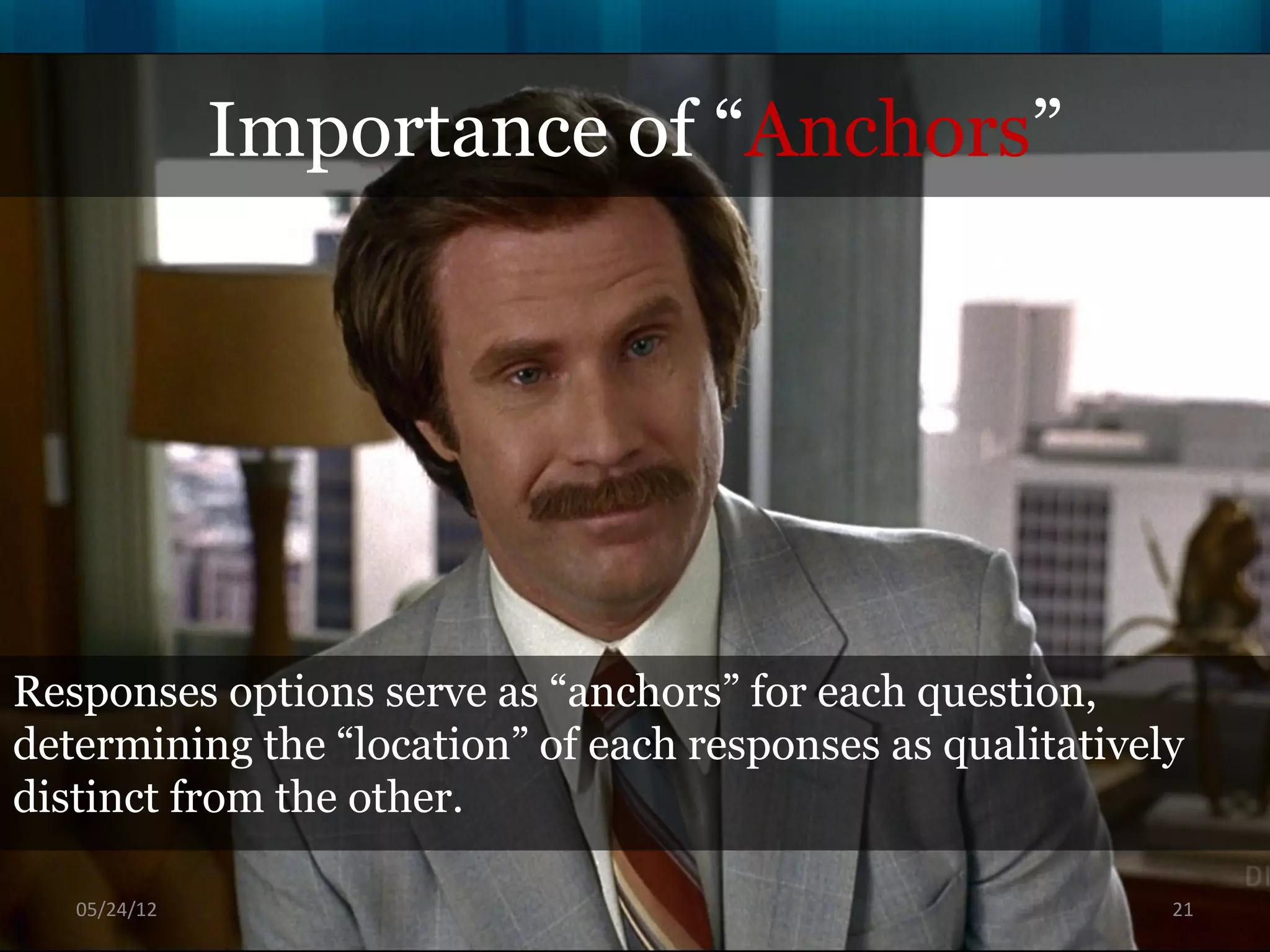
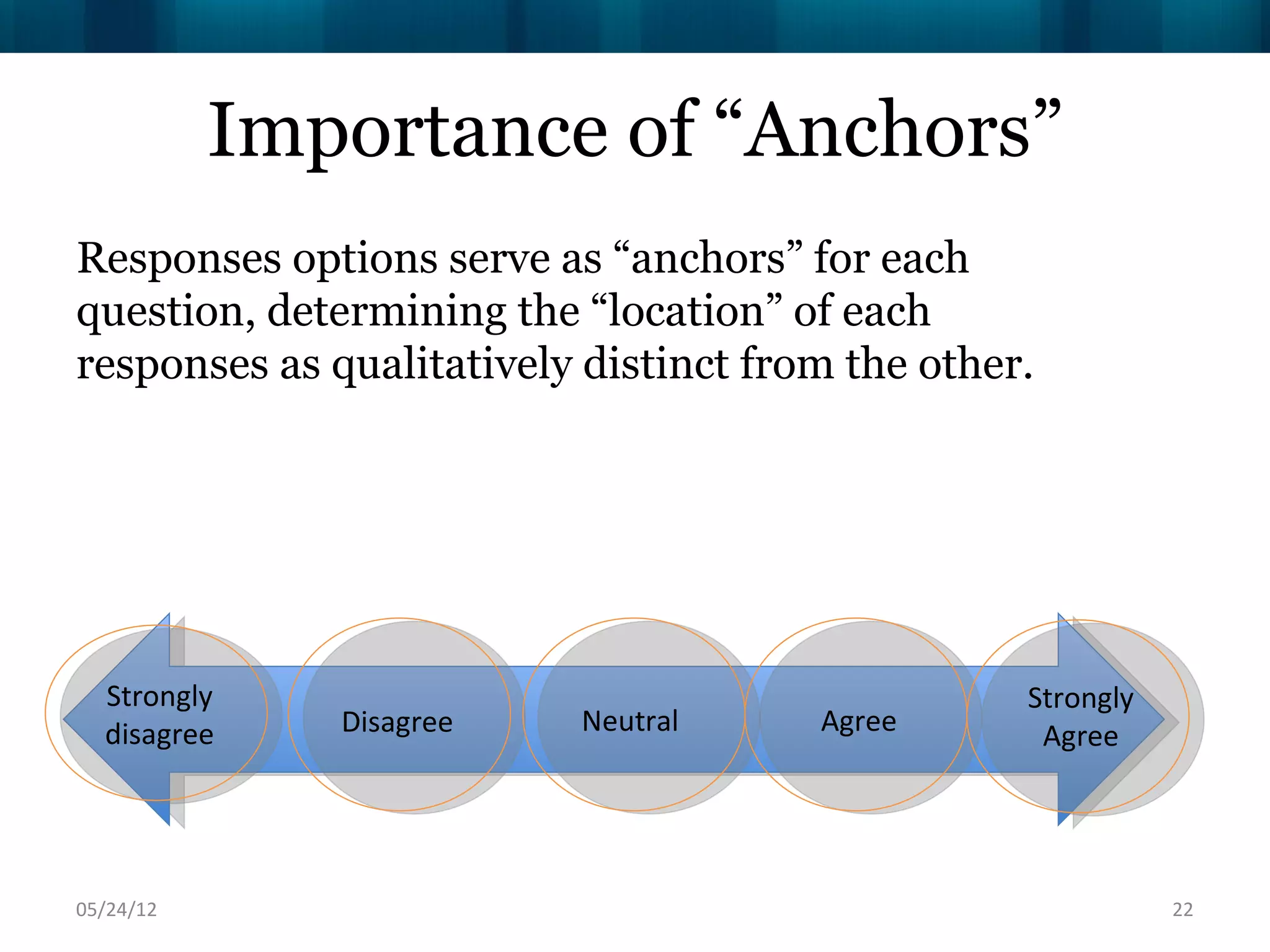
Importance of “Anchors”


Responses options serve as “anchors” for each question,
determining the “location” of each responses as qualitatively
distinct from the other.

   06/16/12                                                 21
Importance of “Anchors”
Responses options serve as “anchors” for each
question, determining the “location” of each
responses as qualitatively distinct from the other.


  Strongly                                        Strongly
  disagree    Disagree    Neutral      Agree       Agree


06/16/12                                                     22
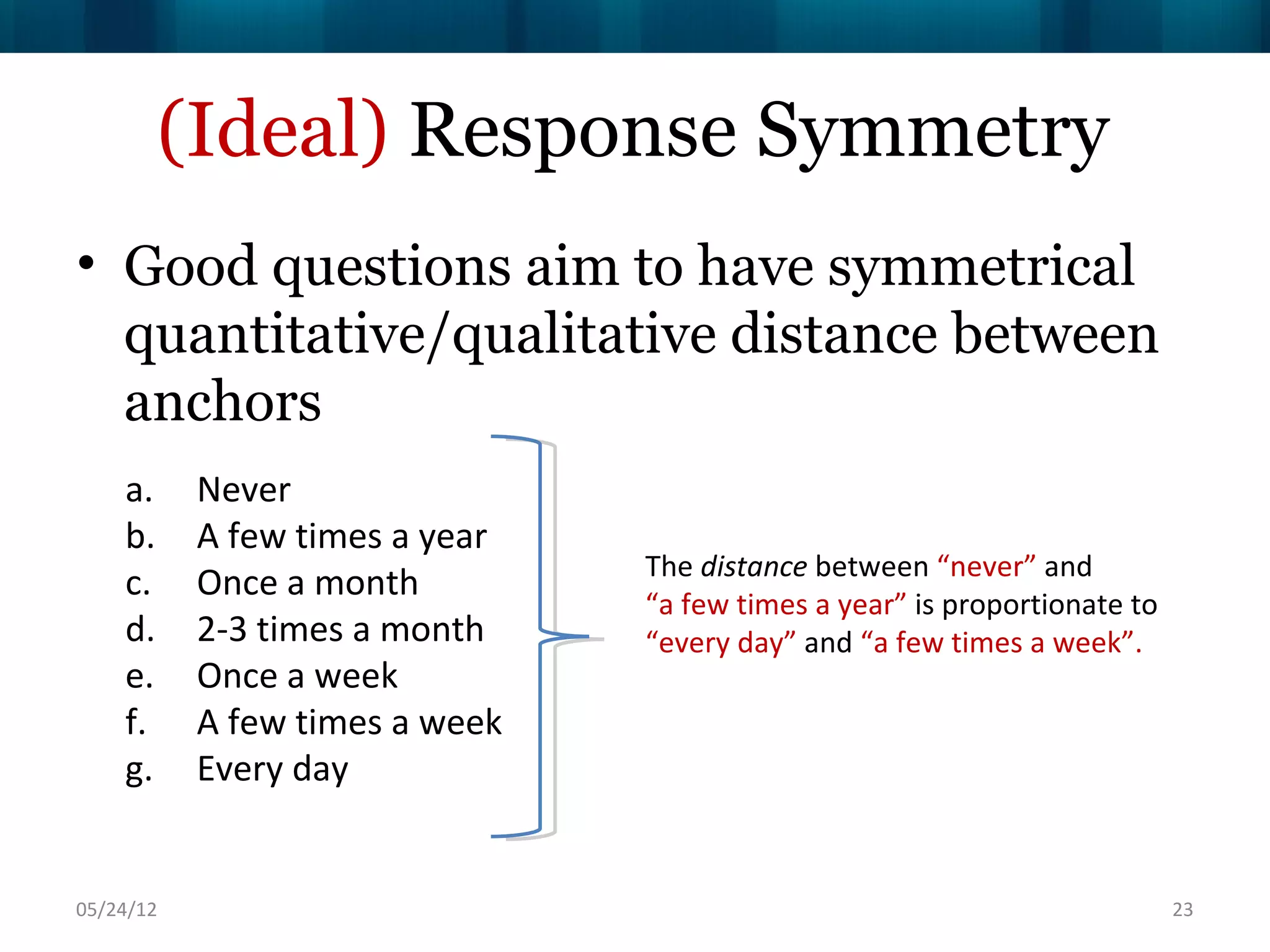
(Ideal) Response Symmetry
• Good questions aim to have symmetrical
  quantitative/qualitative distance between
  anchors
    a.     Never
    b.     A few times a year
                                The distance between “never” and
    c.     Once a month
                                “a few times a year” is proportionate to
    d.     2-3 times a month    “every day” and “a few times a week”.
    e.     Once a week
    f.     A few times a week
    g.     Every day


06/16/12                                                                   23
Adherence to Logic & Linearity


People are accustomed to paradigms that are
        intuitive, and often “linear”.

           Anchors should not be the exception.
06/16/12                                          24
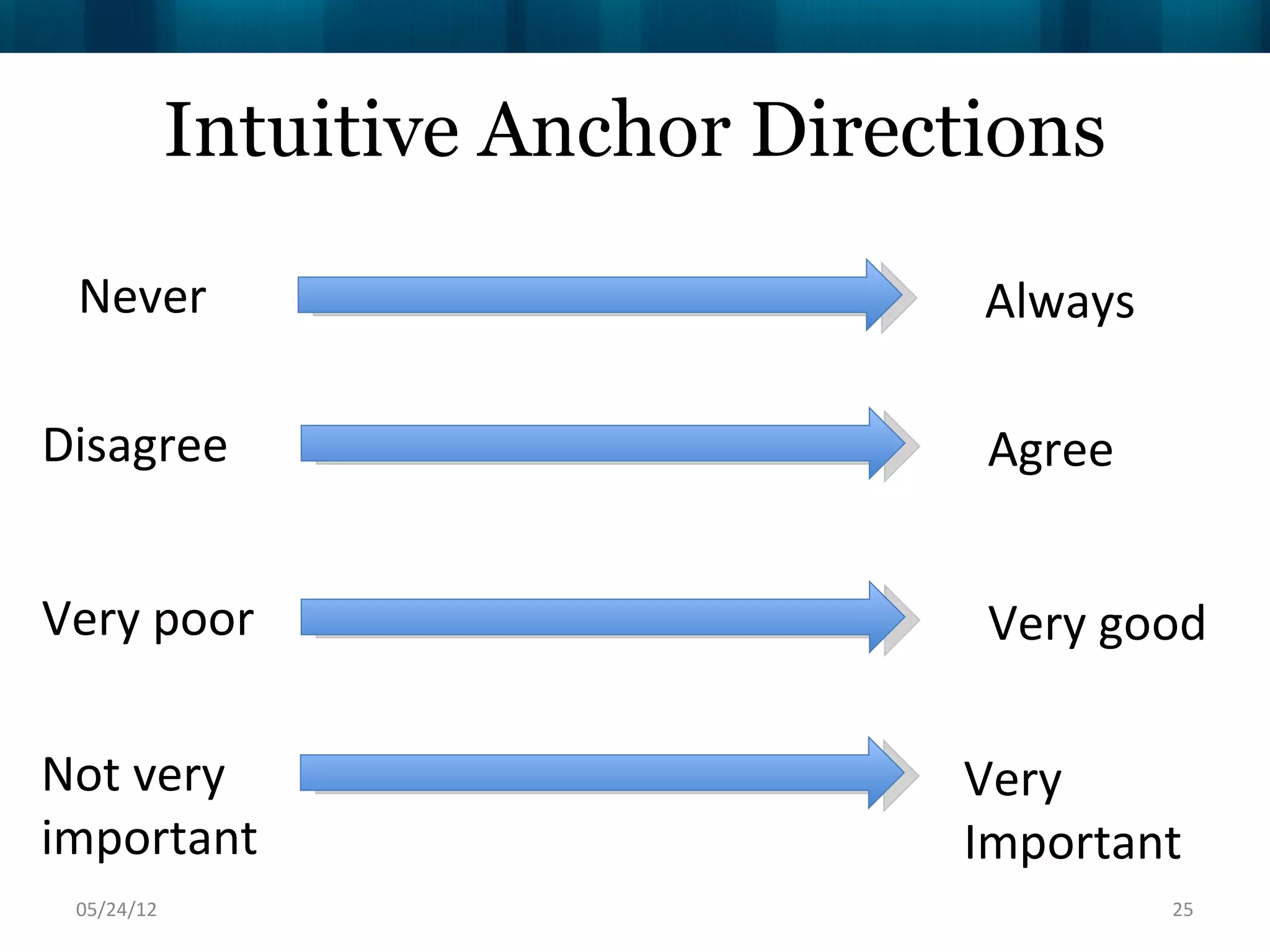
Intuitive Anchor Directions

 Never                             Always

Disagree                           Agree


Very poor                          Very good

Not very                          Very
important                         Important
 06/16/12                                   25
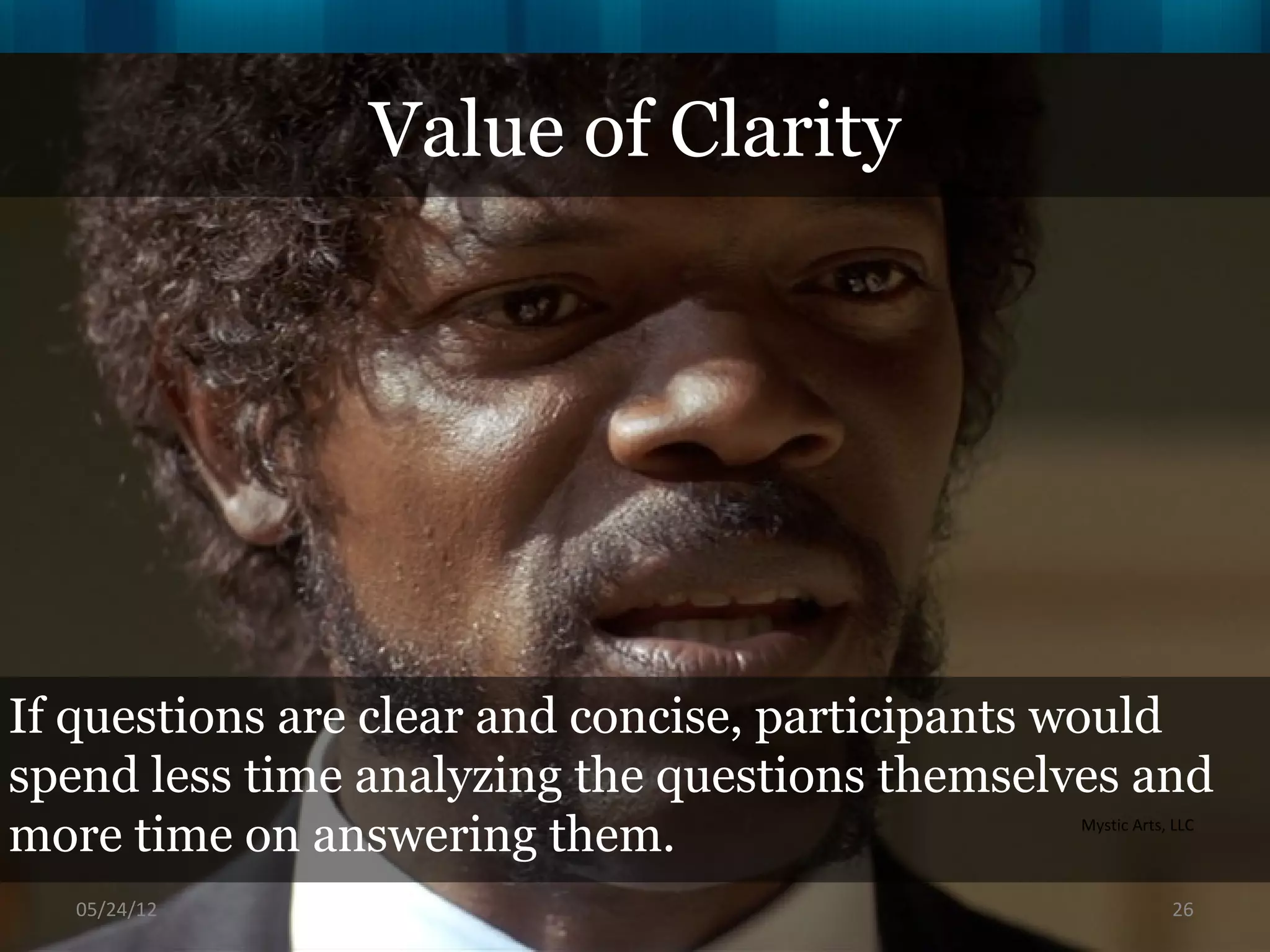
Value of Clarity


If questions are clear and concise, participants would
spend less time analyzing the questions themselves and
more time on answering them.                    Mystic Arts, LLC


   06/16/12                                                 26
So do good questions guarantee valid
             results?
• No. But good questions offer more
  assurance that you are listening to signal
  and not the noise.

• But answering your research question can be
  done in other ways
           • Behavioral Observations
           • Open ended qualitative questions
           • Many more…

06/16/12                                        27
The End.

  So was this presentation simply awesome?


                       a. Hell yeah!
                       b. Definitely!
                       c. Totally rocked!

06/16/12                                     28
Thanks!

Introduction to UX Research: Designing Surveys That Don't Suck!

  • 1.
  • 2.
    "They've done studies,you know. 60% of the time, it works every time. ” - Brian Fantana 06/16/12 2
  • 3.
    Surveys Aren’t Objective Theyare created by people who are biased and analyze their results based on their own (mis)perceptions. 06/16/12 3
  • 4.
    Epistemological Dead End? No. Awareness that the researcher plays an integral role in the process of measuring any given phenomena by deciding how to measure is key. There are ways to minimize researcher bias by creating better questions. 06/16/12 4
  • 5.
    Methods are not“just methods” How you measure what you are studying shapes what you find. 06/16/12 5
  • 6.
    Let’s say youare studying… How often teenagers use your website 06/16/12 6
  • 7.
    You might askteenagers… “How often do you my website?” c.Very rarely d.Rarely e.Occasionally f.Frequently g.Very frequently Response options source: http://www.dataguru.org 06/16/12 7
  • 8.
    You might askteenagers… “How often do you my website?” c.Very rarely d.Rarely And what’s wrong e.Occasionally with these???? f.Frequently g.Very frequently Response options source: http://www.dataguru.org 06/16/12 8
  • 9.
    You might askteenagers… “How often do you my website?” ! !! VI TY EC TI c.Very rarely BJ d.Rarely SU And what’s wrong e.Occasionally with these???? f.Frequently g.Very frequently Response options source: http://www.dataguru.org 06/16/12 9
  • 10.
    “Hmmm, for me“frequently” really means….” A few times a week A few times a day So what are we really measuring? NOISE. 06/16/12 10
  • 11.
    What is “noise”? Whatwe observe… 06/16/12 11
  • 12.
    What is “noise”? We WANT this! We DON’T WANT this! 06/16/12 12
  • 13.
    An imaginary scenario Let’sreally stretch our thinking a bit here to provide a more concrete understanding of “noise” in your data. Imagine you have AT&T phone service and you’re trying to make a call. The signal isn’t clearly going through and you end up hearing everything but the other person’s voice. Frustrating, right? Thank God this is only a pretend scenario. 06/16/12 13
  • 14.
    How is AT&Trelated to “Noise”? When you develop bad questions, you don’t “hear” the message of your data clearly. 06/16/12 14
  • 15.
    So…why is “noise”bad??? • Badly structured and poorly worded questions that obfuscate meaning for participants provide bad data. • Bad data – Doesn’t answer your research question – Makes it difficult to interpret results – Is pretty much useless. 06/16/12 15
  • 16.
    More bad examples offrequently used response options a. Completely satisfied a. Totally like b. Very satisfied b. Very much like c. Fairly well satisfied c. Moderately like d. Somewhat dissatisfied d. Somewhat like e. Very dissatisfied e. Not like What’s the difference between What’s the difference between “fairly well” and “somewhat”? “moderately like” and “somewhat like”? 06/16/12 16
  • 17.
    More bad examples offrequently used response options a. Completely satisfied a. Totally like b. Very satisfied b. Very much like c. Fairly well satisfied c. Moderately like d. Somewhat dissatisfied d. Somewhat like e. Very dissatisfied e. Not like What’s the difference between What’s the difference between “fairly well” and “somewhat”? “moderately like” and “somewhat like”? Semantics 06/16/12 17
  • 18.
    Words like…. • Sometimes • Often • Moderately • Very • Not very much Are subjective = they mean different things for different people 06/16/12 18
  • 19.
    A better alternative? Actuallyasking people how often they do certain activities. 06/16/12 19
  • 20.
    In order togather objective data… …your questions must mean the same thing for everyone. How often do you use my website? d.Never e.A few times a year f.Once a month g.2-3 times a month h.Once a week i.A few times a week j.Every day “Never” means never for everyone! 06/16/12 20
  • 21.
    Importance of “Anchors” Responsesoptions serve as “anchors” for each question, determining the “location” of each responses as qualitatively distinct from the other. 06/16/12 21
  • 22.
    Importance of “Anchors” Responsesoptions serve as “anchors” for each question, determining the “location” of each responses as qualitatively distinct from the other. Strongly Strongly disagree Disagree Neutral Agree Agree 06/16/12 22
  • 23.
    (Ideal) Response Symmetry •Good questions aim to have symmetrical quantitative/qualitative distance between anchors a. Never b. A few times a year The distance between “never” and c. Once a month “a few times a year” is proportionate to d. 2-3 times a month “every day” and “a few times a week”. e. Once a week f. A few times a week g. Every day 06/16/12 23
  • 24.
    Adherence to Logic& Linearity People are accustomed to paradigms that are intuitive, and often “linear”. Anchors should not be the exception. 06/16/12 24
  • 25.
    Intuitive Anchor Directions Never Always Disagree Agree Very poor Very good Not very Very important Important 06/16/12 25
  • 26.
    Value of Clarity Ifquestions are clear and concise, participants would spend less time analyzing the questions themselves and more time on answering them. Mystic Arts, LLC 06/16/12 26
  • 27.
    So do goodquestions guarantee valid results? • No. But good questions offer more assurance that you are listening to signal and not the noise. • But answering your research question can be done in other ways • Behavioral Observations • Open ended qualitative questions • Many more… 06/16/12 27
  • 28.
    The End. So was this presentation simply awesome? a. Hell yeah! b. Definitely! c. Totally rocked! 06/16/12 28
  • 29.