The Consumer Journey
Progress Digital Partner Summit | May 10, 2016
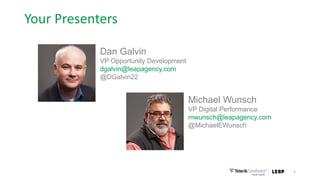
Your Presenters
2
Dan Galvin
VP Opportunity Development
dgalvin@leapagency.com
@DGalvin22
Michael Wunsch
VP Digital Performance
mwunsch@leapagency.com
@MichaelEWunsch
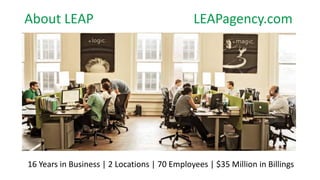
16 Years in Business | 2 Locations | 70 Employees | $35 Million in Billings
About LEAP LEAPagency.com
Diverse Clientele
4
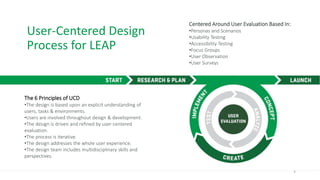
User-Centered Design
Process for LEAP
5
The 6 Principles of UCD
•The design is based upon an explicit understanding of
users, tasks & environments.
•Users are involved throughout design & development.
•The design is driven and refined by user-centered
evaluation.
•The process is iterative.
•The design addresses the whole user experience.
•The design team includes multidisciplinary skills and
perspectives.
Centered Around User Evaluation Based In:
•Personas and Scenarios
•Usability Testing
•Accessibility Testing
•Focus Groups
•User Observation
•User Surveys
Why does any of this matter?
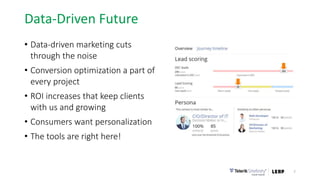
Data-Driven Future
• Data-driven marketing cuts
through the noise
• Conversion optimization a part of
every project
• ROI increases that keep clients
with us and growing
• Consumers want personalization
• The tools are right here!
7
What will we learn today?
The Day at a Glance
Gone are the days of guessing about website behavior and content.
Consumers are demanding personalized content and websites must
have clear objective.
Define personas: We have to know who we are building experiences
for and what matters to them.
Define the journey: Once we know “who” we need to define the
path to the objective.
9
Buyer Personas
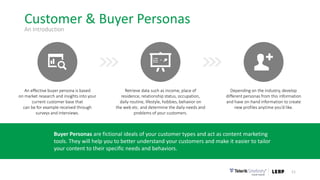
Customer & Buyer Personas
11
An effective buyer persona is based
on market research and insights into your
current customer base that
can be for example received through
surveys and interviews.
Retrieve data such as income, place of
residence, relationship status, occupation,
daily routine, lifestyle, hobbies, behavior on
the web etc. and determine the daily needs and
problems of your customers.
Depending on the industry, develop
different personas from this information
and have on-hand information to create
new profiles anytime you’d like.
=
Buyer Personas are fictional ideals of your customer types and act as content marketing
tools. They will help you to better understand your customers and make it easier to tailor
your content to their specific needs and behaviors.
An Introduction
Customer & Buyer Personas
12
Effectively Using Personas
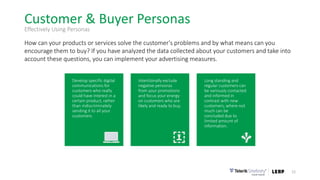
How can your products or services solve the customer's problems and by what means can you
encourage them to buy? If you have analyzed the data collected about your customers and take into
account these questions, you can implement your advertising measures.
Long standing and
regular customers can
be variously contacted
and informed in
contrast with new
customers, where not
much can be
concluded due to
limited amount of
information.
Intentionally exclude
negative personas
from your promotions
and focus your energy
on customers who are
likely and ready to buy.
Develop specific digital
communications for
customers who really
could have interest in a
certain product, rather
than indiscriminately
sending it to all your
customers.
Customer & Buyer Personas
13
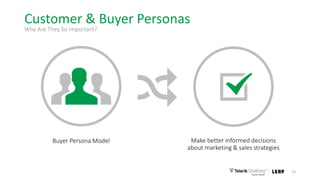
Why Are They So Important?
Buyer Persona Model Make better informed decisions
about marketing & sales strategies
Building Your Persona
Customer & Buyer Personas
15
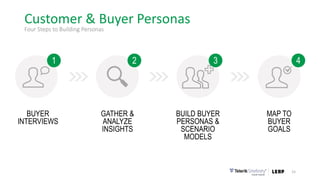
Four Steps to Building Personas
GATHER &
ANALYZE
INSIGHTS
BUYER
INTERVIEWS
BUILD BUYER
PERSONAS &
SCENARIO
MODELS
MAP TO
BUYER
GOALS
21 3 4
Customer & Buyer Personas
16
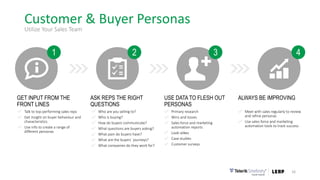
Utilize Your Sales Team
USE DATA TO FLESH OUT
PERSONAS
Primary research
Wins and losses
Sales force and marketing
automation reports
Look-alikes
Case studies
Customer surveys
ASK REPS THE RIGHT
QUESTIONS
Who are you selling to?
Who is buying?
How do buyers communicate?
What questions are buyers asking?
What pain do buyers have?
What are the buyers´ journeys?
What companies do they work for?
GET INPUT FROM THE
FRONT LINES
Talk to top-performing sales reps
Get insight on buyer behaviour and
characteristics
Use info to create a range of
different personas
ALWAYS BE IMPROVING
Meet with sales regularly to review
and refine personas
Use sales force and marketing
automation tools to track success
21 3 4
Customer & Buyer Personas
17
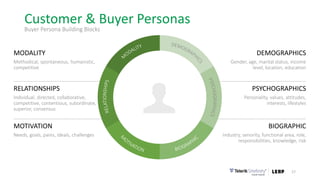
Buyer Persona Building Blocks
MODALITY
Methodical, spontaneous, humanistic,
competitive
MOTIVATION
Needs, goals, pains, ideals, challenges
DEMOGRAPHICS
Gender, age, marital status, income
level, location, education
BIOGRAPHIC
Industry, senority, functional area, role,
responsibilities, knowledge, risk
PSYCHOGRAPHICS
Personality, values, attitudes,
interests, lifestyles
RELATIONSHIPS
Individual, directed, collaborative,
competitive, contentious, subordinate,
superior, consensus
Examples
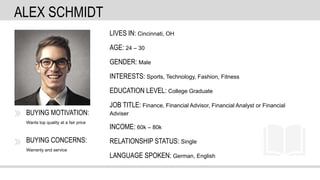
ALEX SCHMIDT
LIVES IN: Cincinnati, OH
AGE: 24 – 30
GENDER: Male
INTERESTS: Sports, Technology, Fashion, Fitness
EDUCATION LEVEL: College Graduate
JOB TITLE: Finance, Financial Advisor, Financial Analyst or Financial
Adviser
INCOME: 60k – 80k
RELATIONSHIP STATUS: Single
LANGUAGE SPOKEN: German, English
BUYING MOTIVATION:
Wants top quality at a fair price
BUYING CONCERNS:
Warranty and service
20
Customer & Buyer Personas
Putting It All Together
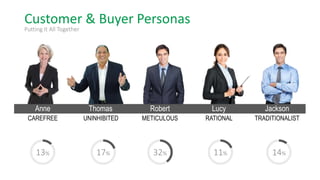
Customer & Buyer Personas
Putting It All Together
Lucy
RATIONAL
11%
Jackson
TRADITIONALIST
14%
Robert
METICULOUS
32%
Anne
CAREFREE
13%
Thomas
UNINHIBITED
17%
22
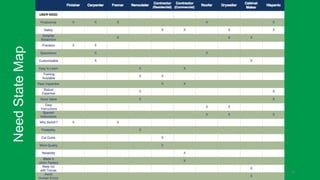
NeedStateMap
Journey Mapping
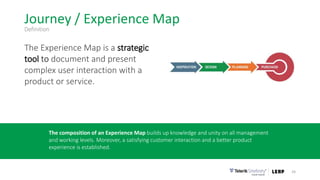
Journey / Experience Map
24
The composition of an Experience Map builds up knowledge and unity on all management
and working levels. Moreover, a satisfying customer interaction and a better product
experience is established.
The Experience Map is a strategic
tool to document and present
complex user interaction with a
product or service.
Definition
Journey / Experience Map
25
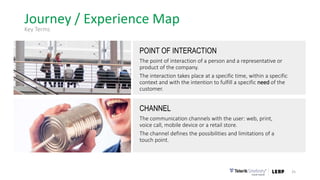
Key Terms
POINT OF INTERACTION
The point of interaction of a person and a representative or
product of the company.
The interaction takes place at a specific time, within a specific
context and with the intention to fulfill a specific need of the
customer.
CHANNEL
The communication channels with the user: web, print,
voice call, mobile device or a retail store.
The channel defines the possibilities and limitations of a
touch point.
Journey / Experience Map
26
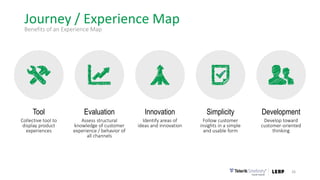
Benefits of an Experience Map
Evaluation
Assess structural
knowledge of customer
experience / behavior of
all channels
Tool
Collective tool to
display product
experiences
Simplicity
Follow customer
insights in a simple
and usable form
Development
Develop toward
customer-oriented
thinking
Innovation
Identify areas of
ideas and innovation
Journey / Experience Map
27
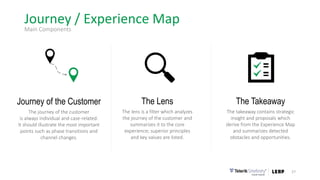
Main Components
The Takeaway
The takeaway contains strategic
insight and proposals which
derive from the Experience Map
and summarizes detected
obstacles and opportunities.
The Lens
The lens is a filter which analyzes
the journey of the customer and
summarizes it to the core
experience; superior principles
and key values are listed.
Journey of the Customer
The journey of the customer
is always individual and case-related.
It should illustrate the most important
points such as phase transitions and
channel changes.
Journey / Experience Map
28
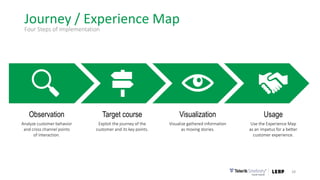
Four Steps of Implementation
Observation
Analyze customer behavior
and cross channel points
of interaction.
Target course
Exploit the journey of the
customer and its key points.
Visualization
Visualize gathered information
as moving stories.
Usage
Use the Experience Map
as an impetus for a better
customer experience.
Journey / Experience Map
29
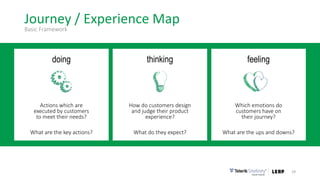
Basic Framework
doing
Actions which are
executed by customers
to meet their needs?
What are the key actions?
thinking
How do customers design
and judge their product
experience?
What do they expect?
feeling
Which emotions do
customers have on
their journey?
What are the ups and downs?
Journey / Experience Map
30
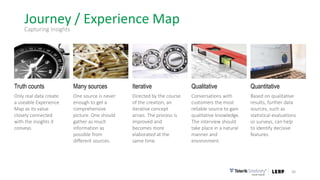
Capturing Insights
Truth counts
Only real data create
a useable Experience
Map as its value
closely connected
with the insights it
conveys.
Quantitative
Based on qualitative
results, further data
sources, such as
statistical evaluations
or surveys, can help
to identify decisive
features.
Qualitative
Conversations with
customers the most
reliable source to gain
qualitative knowledge.
The interview should
take place in a natural
manner and
environment.
Iterative
Directed by the course
of the creation, an
iterative concept
arises. The process is
improved and
becomes more
elaborated at the
same time.
Many sources
One source is never
enough to get a
comprehensive
picture. One should
gather as much
information as
possible from
different sources.
Building Your Map
Journey / Experience Map
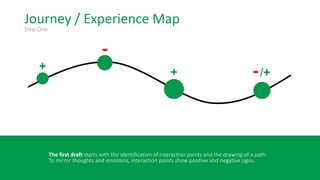
Step One
The first draft starts with the identification of interaction points and the drawing of a path.
To mirror thoughts and emotions, interaction points show positive and negative signs.
-
+
+ /+-
TIP: Start in analytics
33
Journey / Experience Map
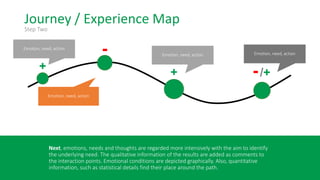
Step Two
Emotion, need, action
Next, emotions, needs and thoughts are regarded more intensively with the aim to identify
the underlying need. The qualitative information of the results are added as comments to
the interaction points. Emotional conditions are depicted graphically. Also, quantitative
information, such as statistical details find their place around the path.
-
+
+ /+-
Journey / Experience Map
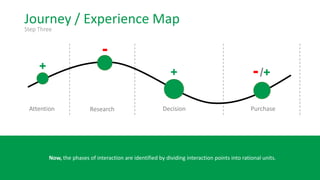
Step Three
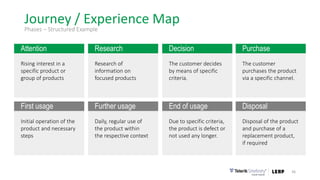
Now, the phases of interaction are identified by dividing interaction points into rational units.
-
+
+ /+-
Attention Research Decision Purchase
Journey / Experience Map
36
Rising interest in a
specific product or
group of products
Attention
Research of
information on
focused products
Research
The customer decides
by means of specific
criteria.
Decision
The customer
purchases the product
via a specific channel.
Purchase
Initial operation of the
product and necessary
steps
First usage
Daily, regular use of
the product within
the respective context
Further usage
Due to specific criteria,
the product is defect or
not used any longer.
End of usage
Disposal of the product
and purchase of a
replacement product,
if required
Disposal
Phases – Structured Example
Journey / Experience Map
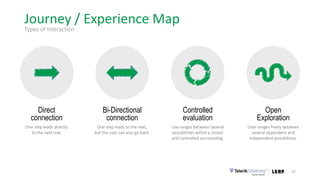
Types of Interaction
Direct
connection
One step leads directly
to the next one.
Bi-Directional
connection
One step leads to the next,
but the user can also go back.
Controlled
evaluation
Use ranges between several
possibilities within a closed
and controlled surrounding.
Open
Exploration
User ranges freely between
several dependent and
independent possibilities.
37
Journey / Experience Map
The last step is the evaluation of possibilities and obstacles for the customer:
Communicative:
• Does the user need a specific content or a specific essential information?
• Is it possible to improve the sorting of available information by means of their relevance for the
customer?
Interactional:
• What prevents the customer from interacting?
• How can the interaction be improved?
Step Five
Putting It All Together
39
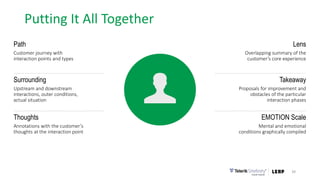
Path
Customer journey with
interaction points and types
Thoughts
Annotations with the customer’s
thoughts at the interaction point
Lens
Overlapping summary of the
customer’s core experience
EMOTION Scale
Mental and emotional
conditions graphically compiled
Takeaway
Proposals for improvement and
obstacles of the particular
interaction phases
Surrounding
Upstream and downstream
interactions, outer conditions,
actual situation
How It Works Together
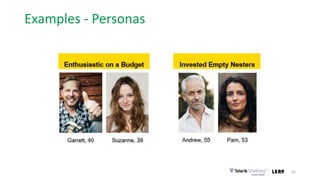
Examples - Personas
41
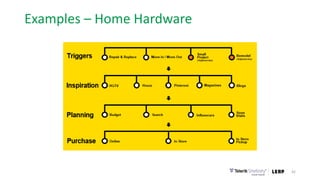
Examples – Home Hardware
42
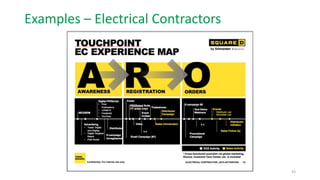
Examples – Electrical Contractors
43
Now What?
Just Do It
• Grab your sales team, talk through your customer, just capture a few
insights
• Gather whatever data exists about your customer
• Find a headshot, give it a name, apply the characteristics (a few is fine)
Boom – you have a persona!
45
Now…
• Apply that person to your web project
• Where do they start (search, ad, direct, social)
• Where do they land (home, landing page, ecom)
• What do they need / want – does your content match
• Can they go different directions
• Are there barriers / have you considered mobile / tablet
• What is the primary objective
Boom, you just created a Journey Map!
46
Finally…
• Establish your KPIs
• How will you measure (analytics, Sitefinity)
• Map to objectives
• Evaluate, wash, rinse repeat
• Be prepared to fail fast but fail smart
47
48
Dan Galvin
VP Opportunity Development
dgalvin@leapagency.com
@DGalvin22
Michael Wunsch
VP Digital Performance
mwunsch@leapagency.com
@MichaelEWunsch

The Consumer Journey

  • 1.
    The Consumer Journey ProgressDigital Partner Summit | May 10, 2016
  • 2.
    Your Presenters 2 Dan Galvin VPOpportunity Development dgalvin@leapagency.com @DGalvin22 Michael Wunsch VP Digital Performance mwunsch@leapagency.com @MichaelEWunsch
  • 3.
    16 Years inBusiness | 2 Locations | 70 Employees | $35 Million in Billings About LEAP LEAPagency.com
  • 4.
  • 5.
    User-Centered Design Process forLEAP 5 The 6 Principles of UCD •The design is based upon an explicit understanding of users, tasks & environments. •Users are involved throughout design & development. •The design is driven and refined by user-centered evaluation. •The process is iterative. •The design addresses the whole user experience. •The design team includes multidisciplinary skills and perspectives. Centered Around User Evaluation Based In: •Personas and Scenarios •Usability Testing •Accessibility Testing •Focus Groups •User Observation •User Surveys
  • 6.
    Why does anyof this matter?
  • 7.
    Data-Driven Future • Data-drivenmarketing cuts through the noise • Conversion optimization a part of every project • ROI increases that keep clients with us and growing • Consumers want personalization • The tools are right here! 7
  • 8.
    What will welearn today?
  • 9.
    The Day ata Glance Gone are the days of guessing about website behavior and content. Consumers are demanding personalized content and websites must have clear objective. Define personas: We have to know who we are building experiences for and what matters to them. Define the journey: Once we know “who” we need to define the path to the objective. 9
  • 10.
  • 11.
    Customer & BuyerPersonas 11 An effective buyer persona is based on market research and insights into your current customer base that can be for example received through surveys and interviews. Retrieve data such as income, place of residence, relationship status, occupation, daily routine, lifestyle, hobbies, behavior on the web etc. and determine the daily needs and problems of your customers. Depending on the industry, develop different personas from this information and have on-hand information to create new profiles anytime you’d like. = Buyer Personas are fictional ideals of your customer types and act as content marketing tools. They will help you to better understand your customers and make it easier to tailor your content to their specific needs and behaviors. An Introduction
  • 12.
    Customer & BuyerPersonas 12 Effectively Using Personas How can your products or services solve the customer's problems and by what means can you encourage them to buy? If you have analyzed the data collected about your customers and take into account these questions, you can implement your advertising measures. Long standing and regular customers can be variously contacted and informed in contrast with new customers, where not much can be concluded due to limited amount of information. Intentionally exclude negative personas from your promotions and focus your energy on customers who are likely and ready to buy. Develop specific digital communications for customers who really could have interest in a certain product, rather than indiscriminately sending it to all your customers.
  • 13.
    Customer & BuyerPersonas 13 Why Are They So Important? Buyer Persona Model Make better informed decisions about marketing & sales strategies
  • 14.
  • 15.
    Customer & BuyerPersonas 15 Four Steps to Building Personas GATHER & ANALYZE INSIGHTS BUYER INTERVIEWS BUILD BUYER PERSONAS & SCENARIO MODELS MAP TO BUYER GOALS 21 3 4
  • 16.
    Customer & BuyerPersonas 16 Utilize Your Sales Team USE DATA TO FLESH OUT PERSONAS Primary research Wins and losses Sales force and marketing automation reports Look-alikes Case studies Customer surveys ASK REPS THE RIGHT QUESTIONS Who are you selling to? Who is buying? How do buyers communicate? What questions are buyers asking? What pain do buyers have? What are the buyers´ journeys? What companies do they work for? GET INPUT FROM THE FRONT LINES Talk to top-performing sales reps Get insight on buyer behaviour and characteristics Use info to create a range of different personas ALWAYS BE IMPROVING Meet with sales regularly to review and refine personas Use sales force and marketing automation tools to track success 21 3 4
  • 17.
    Customer & BuyerPersonas 17 Buyer Persona Building Blocks MODALITY Methodical, spontaneous, humanistic, competitive MOTIVATION Needs, goals, pains, ideals, challenges DEMOGRAPHICS Gender, age, marital status, income level, location, education BIOGRAPHIC Industry, senority, functional area, role, responsibilities, knowledge, risk PSYCHOGRAPHICS Personality, values, attitudes, interests, lifestyles RELATIONSHIPS Individual, directed, collaborative, competitive, contentious, subordinate, superior, consensus
  • 18.
  • 19.
    ALEX SCHMIDT LIVES IN:Cincinnati, OH AGE: 24 – 30 GENDER: Male INTERESTS: Sports, Technology, Fashion, Fitness EDUCATION LEVEL: College Graduate JOB TITLE: Finance, Financial Advisor, Financial Analyst or Financial Adviser INCOME: 60k – 80k RELATIONSHIP STATUS: Single LANGUAGE SPOKEN: German, English BUYING MOTIVATION: Wants top quality at a fair price BUYING CONCERNS: Warranty and service
  • 20.
    20 Customer & BuyerPersonas Putting It All Together
  • 21.
    Customer & BuyerPersonas Putting It All Together Lucy RATIONAL 11% Jackson TRADITIONALIST 14% Robert METICULOUS 32% Anne CAREFREE 13% Thomas UNINHIBITED 17%
  • 22.
  • 23.
  • 24.
    Journey / ExperienceMap 24 The composition of an Experience Map builds up knowledge and unity on all management and working levels. Moreover, a satisfying customer interaction and a better product experience is established. The Experience Map is a strategic tool to document and present complex user interaction with a product or service. Definition
  • 25.
    Journey / ExperienceMap 25 Key Terms POINT OF INTERACTION The point of interaction of a person and a representative or product of the company. The interaction takes place at a specific time, within a specific context and with the intention to fulfill a specific need of the customer. CHANNEL The communication channels with the user: web, print, voice call, mobile device or a retail store. The channel defines the possibilities and limitations of a touch point.
  • 26.
    Journey / ExperienceMap 26 Benefits of an Experience Map Evaluation Assess structural knowledge of customer experience / behavior of all channels Tool Collective tool to display product experiences Simplicity Follow customer insights in a simple and usable form Development Develop toward customer-oriented thinking Innovation Identify areas of ideas and innovation
  • 27.
    Journey / ExperienceMap 27 Main Components The Takeaway The takeaway contains strategic insight and proposals which derive from the Experience Map and summarizes detected obstacles and opportunities. The Lens The lens is a filter which analyzes the journey of the customer and summarizes it to the core experience; superior principles and key values are listed. Journey of the Customer The journey of the customer is always individual and case-related. It should illustrate the most important points such as phase transitions and channel changes.
  • 28.
    Journey / ExperienceMap 28 Four Steps of Implementation Observation Analyze customer behavior and cross channel points of interaction. Target course Exploit the journey of the customer and its key points. Visualization Visualize gathered information as moving stories. Usage Use the Experience Map as an impetus for a better customer experience.
  • 29.
    Journey / ExperienceMap 29 Basic Framework doing Actions which are executed by customers to meet their needs? What are the key actions? thinking How do customers design and judge their product experience? What do they expect? feeling Which emotions do customers have on their journey? What are the ups and downs?
  • 30.
    Journey / ExperienceMap 30 Capturing Insights Truth counts Only real data create a useable Experience Map as its value closely connected with the insights it conveys. Quantitative Based on qualitative results, further data sources, such as statistical evaluations or surveys, can help to identify decisive features. Qualitative Conversations with customers the most reliable source to gain qualitative knowledge. The interview should take place in a natural manner and environment. Iterative Directed by the course of the creation, an iterative concept arises. The process is improved and becomes more elaborated at the same time. Many sources One source is never enough to get a comprehensive picture. One should gather as much information as possible from different sources.
  • 31.
  • 32.
    Journey / ExperienceMap Step One The first draft starts with the identification of interaction points and the drawing of a path. To mirror thoughts and emotions, interaction points show positive and negative signs. - + + /+-
  • 33.
    TIP: Start inanalytics 33
  • 34.
    Journey / ExperienceMap Step Two Emotion, need, action Emotion, need, action Emotion, need, action Emotion, need, action Next, emotions, needs and thoughts are regarded more intensively with the aim to identify the underlying need. The qualitative information of the results are added as comments to the interaction points. Emotional conditions are depicted graphically. Also, quantitative information, such as statistical details find their place around the path. - + + /+-
  • 35.
    Journey / ExperienceMap Step Three Now, the phases of interaction are identified by dividing interaction points into rational units. - + + /+- Attention Research Decision Purchase
  • 36.
    Journey / ExperienceMap 36 Rising interest in a specific product or group of products Attention Research of information on focused products Research The customer decides by means of specific criteria. Decision The customer purchases the product via a specific channel. Purchase Initial operation of the product and necessary steps First usage Daily, regular use of the product within the respective context Further usage Due to specific criteria, the product is defect or not used any longer. End of usage Disposal of the product and purchase of a replacement product, if required Disposal Phases – Structured Example
  • 37.
    Journey / ExperienceMap Types of Interaction Direct connection One step leads directly to the next one. Bi-Directional connection One step leads to the next, but the user can also go back. Controlled evaluation Use ranges between several possibilities within a closed and controlled surrounding. Open Exploration User ranges freely between several dependent and independent possibilities. 37
  • 38.
    Journey / ExperienceMap The last step is the evaluation of possibilities and obstacles for the customer: Communicative: • Does the user need a specific content or a specific essential information? • Is it possible to improve the sorting of available information by means of their relevance for the customer? Interactional: • What prevents the customer from interacting? • How can the interaction be improved? Step Five
  • 39.
    Putting It AllTogether 39 Path Customer journey with interaction points and types Thoughts Annotations with the customer’s thoughts at the interaction point Lens Overlapping summary of the customer’s core experience EMOTION Scale Mental and emotional conditions graphically compiled Takeaway Proposals for improvement and obstacles of the particular interaction phases Surrounding Upstream and downstream interactions, outer conditions, actual situation
  • 40.
    How It WorksTogether
  • 41.
  • 42.
    Examples – HomeHardware 42
  • 43.
  • 44.
  • 45.
    Just Do It •Grab your sales team, talk through your customer, just capture a few insights • Gather whatever data exists about your customer • Find a headshot, give it a name, apply the characteristics (a few is fine) Boom – you have a persona! 45
  • 46.
    Now… • Apply thatperson to your web project • Where do they start (search, ad, direct, social) • Where do they land (home, landing page, ecom) • What do they need / want – does your content match • Can they go different directions • Are there barriers / have you considered mobile / tablet • What is the primary objective Boom, you just created a Journey Map! 46
  • 47.
    Finally… • Establish yourKPIs • How will you measure (analytics, Sitefinity) • Map to objectives • Evaluate, wash, rinse repeat • Be prepared to fail fast but fail smart 47
  • 48.
    48 Dan Galvin VP OpportunityDevelopment dgalvin@leapagency.com @DGalvin22 Michael Wunsch VP Digital Performance mwunsch@leapagency.com @MichaelEWunsch