Switches and Sensors
For integrated control systems

Presemtatiom By Waqar Aziz
waqaraziz370@gmail.com
Contents









Introduction
Magnetic cylinders
Reed switch principle
Sensor principle
QM/45/* range
QM/33,34,134 range
M/40,41,42 range
Inductive proximity
sensors



Cable capacitance
Vacuum electric switch



Vacuum electronic switch



Click the section to advance directly to it
Introduction
 Typical electro-pneumatic systems

consist of:
 magnetic cylinders and solenoid

valves for dynamic power
 reed switches and sensors for
feedback
 electronic logic for control
 Reed switches and solid state

magnetic sensors are fitted to
cylinders to feedback particular
positions of the piston

 Solid state proximity sensors can be

used to replace limit switches, for
detecting the position of
mechanisms or other moving parts
 Reed switches and solid state
sensors are small, fast, easy to fit
and adjust. They simplify
installation on to the machine
application
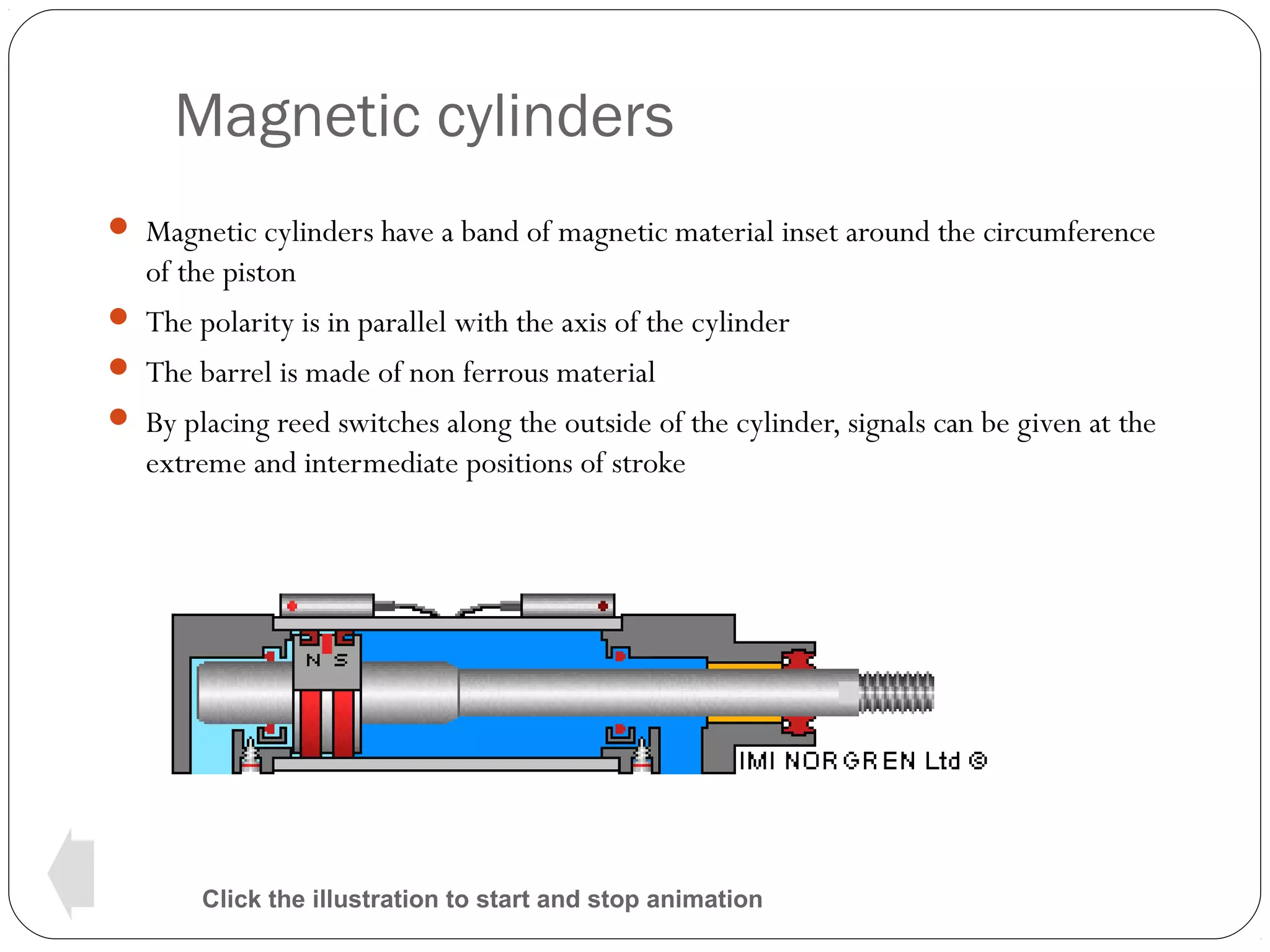
Magnetic cylinders
 Magnetic cylinders have a band of magnetic material inset around the circumference

of the piston
 The polarity is in parallel with the axis of the cylinder
 The barrel is made of non ferrous material
 By placing reed switches along the outside of the cylinder, signals can be given at the
extreme and intermediate positions of stroke

Click the illustration to start and stop animation
Reed switch principle
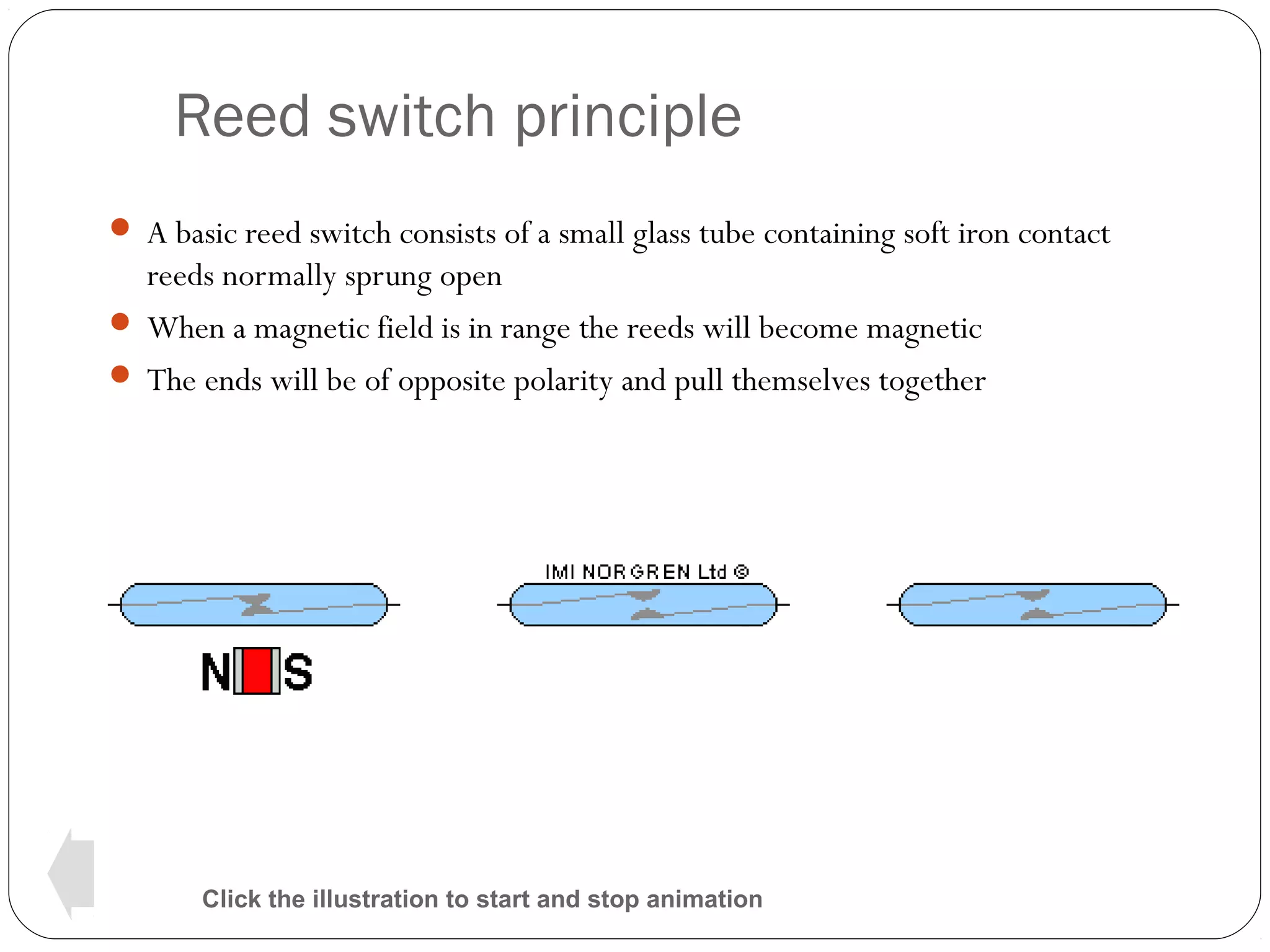
 A basic reed switch consists of a small glass tube containing soft iron contact

reeds normally sprung open
 When a magnetic field is in range the reeds will become magnetic
 The ends will be of opposite polarity and pull themselves together

Click the illustration to start and stop animation
Magnetic sensor principle
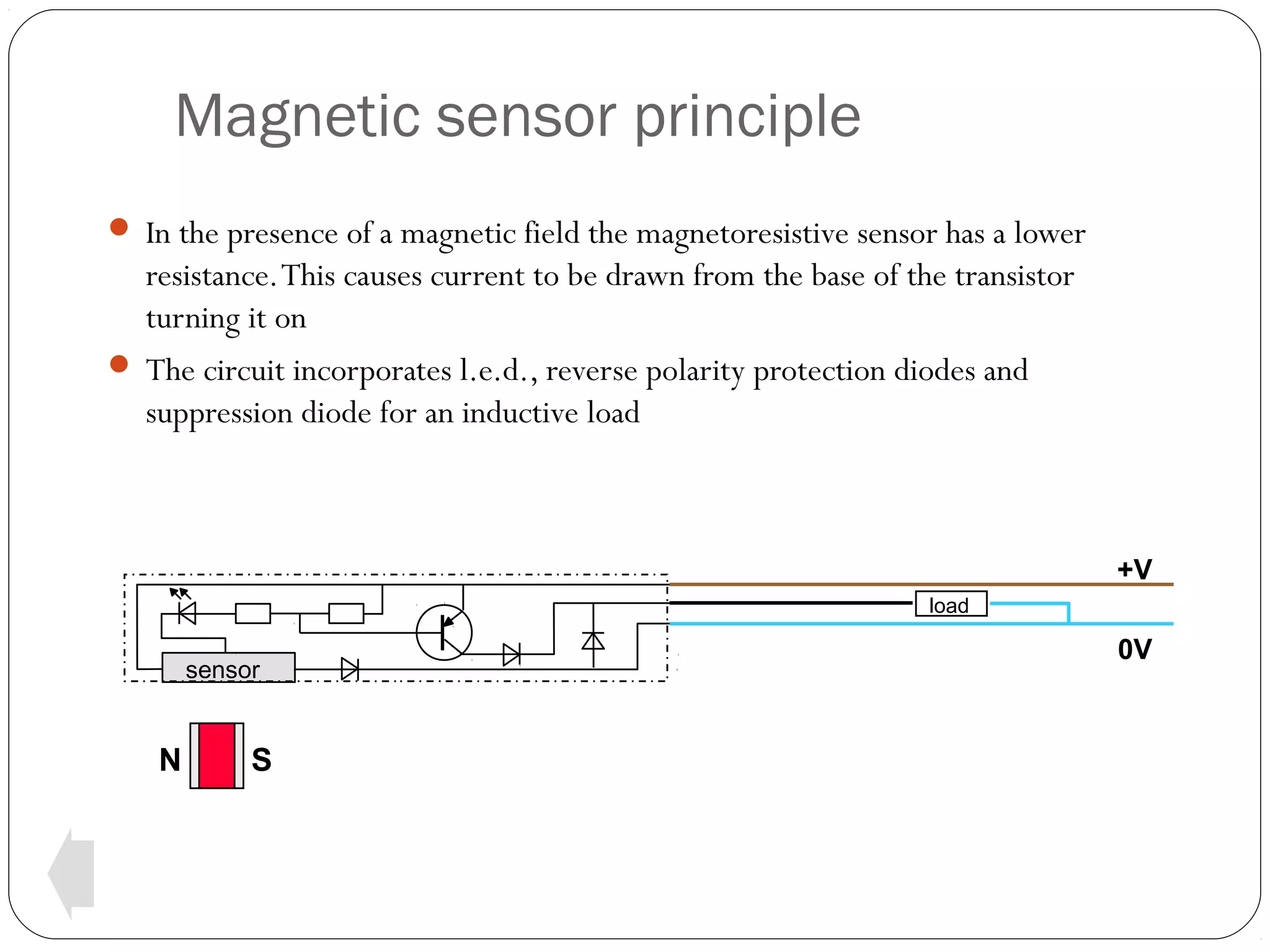
 In the presence of a magnetic field the magnetoresistive sensor has a lower

resistance. This causes current to be drawn from the base of the transistor
turning it on
 The circuit incorporates l.e.d., reverse polarity protection diodes and
suppression diode for an inductive load

+V
load

sensor

N

S

0V
Reed switches and sensor
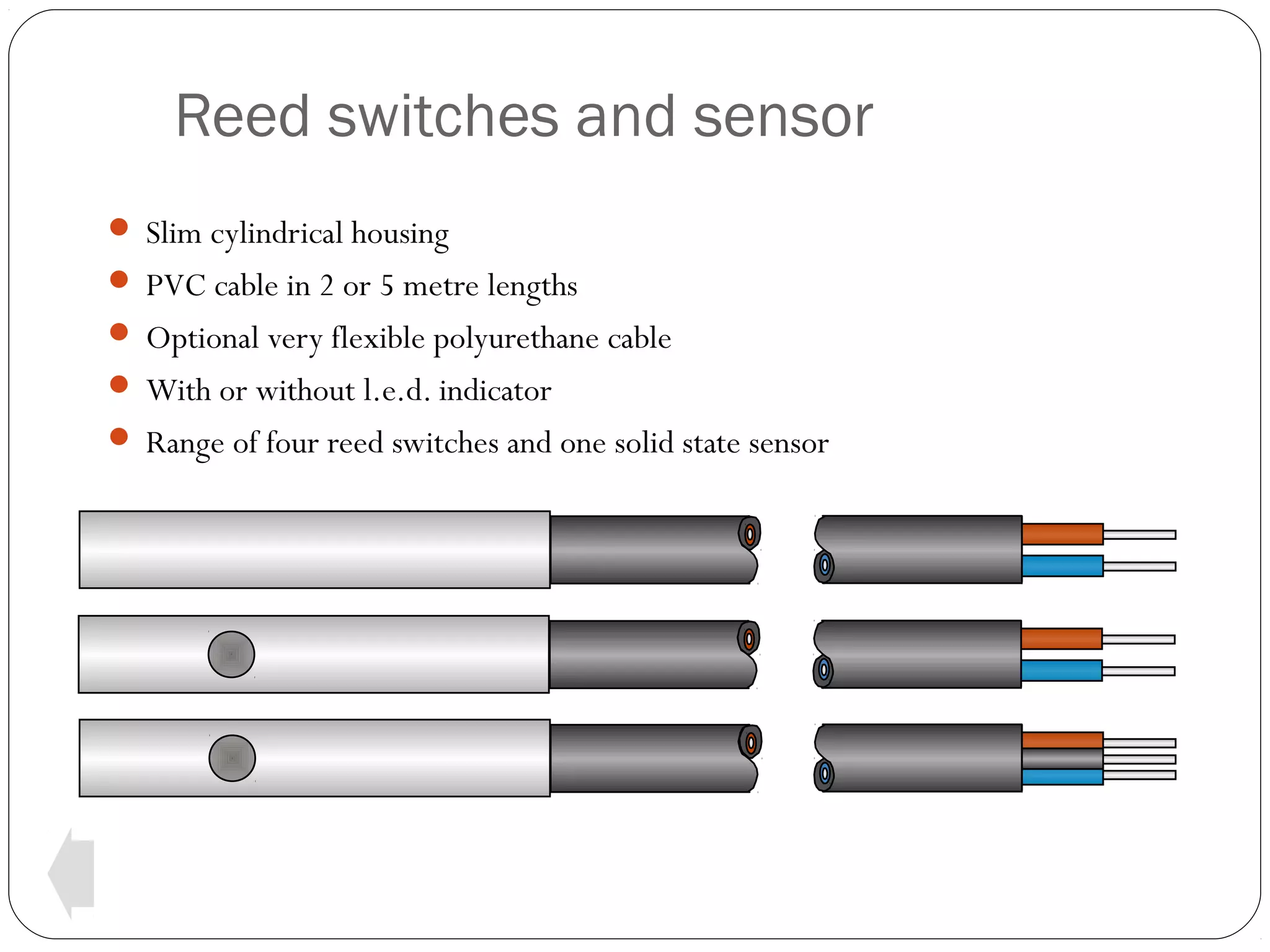
 Slim cylindrical housing
 PVC cable in 2 or 5 metre lengths
 Optional very flexible polyurethane cable
 With or without l.e.d. indicator
 Range of four reed switches and one solid state sensor
Reed switches
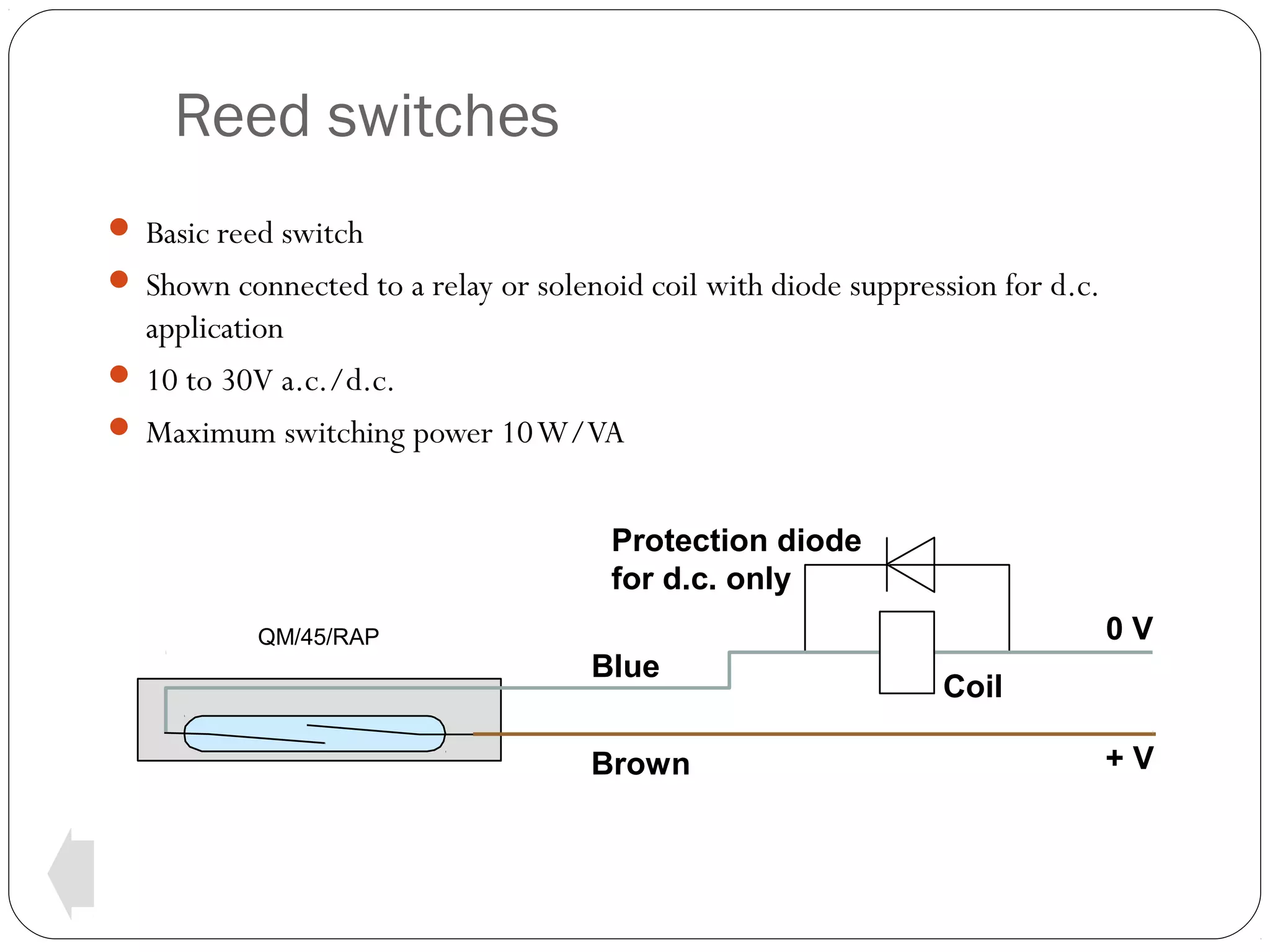
 Basic reed switch
 Shown connected to a relay or solenoid coil with diode suppression for d.c.

application
 10 to 30V a.c./d.c.
 Maximum switching power 10 W/VA
Protection diode
for d.c. only
QM/45/RAP

0V
Blue
Brown

Coil
+V
Reed switches
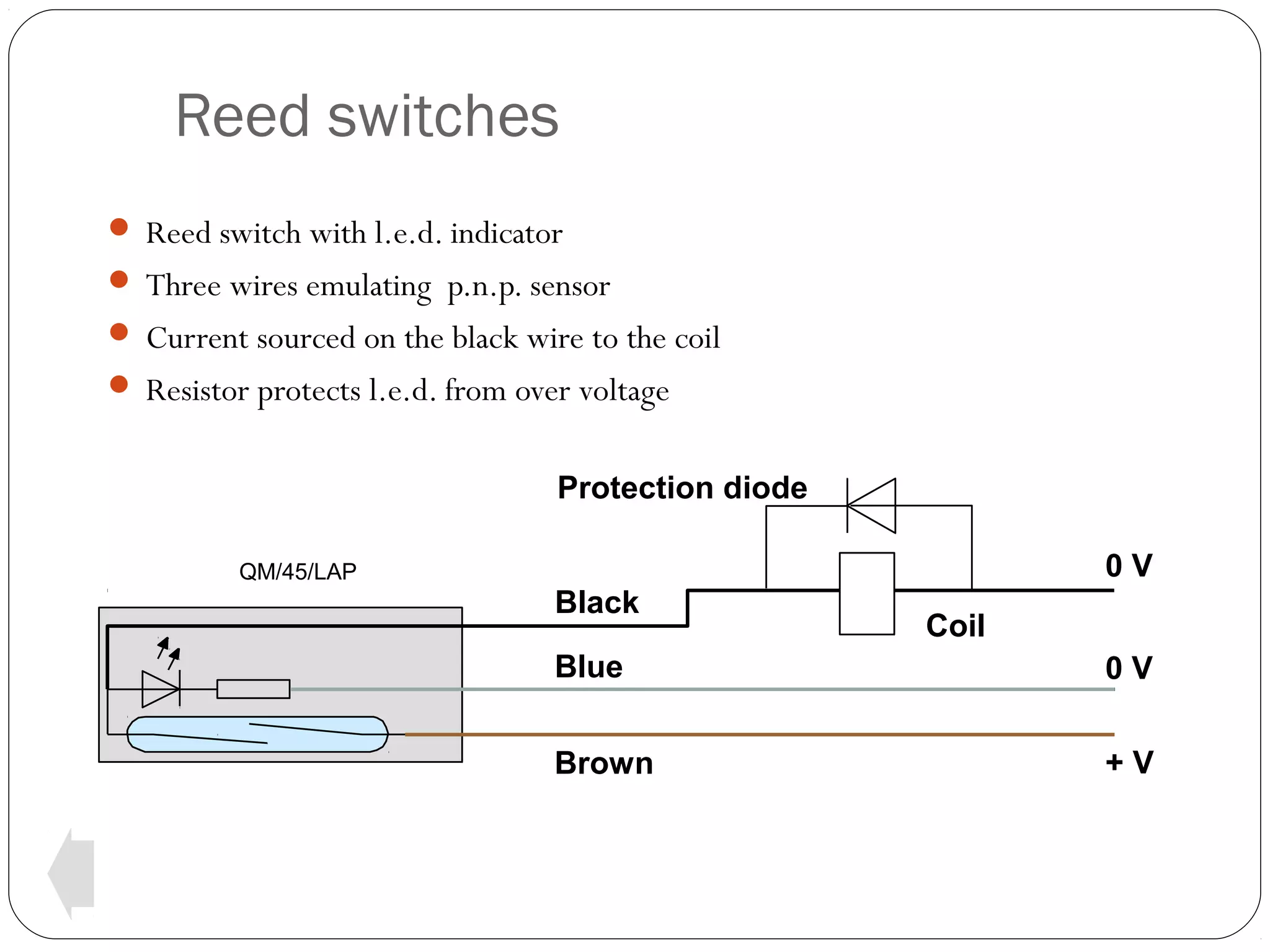
 Reed switch with l.e.d. indicator
 Three wires emulating p.n.p. sensor
 Current sourced on the black wire to the coil
 Resistor protects l.e.d. from over voltage

Protection diode
QM/45/LAP

0V
Black

Coil

Blue

0V

Brown

+V
Reed switches
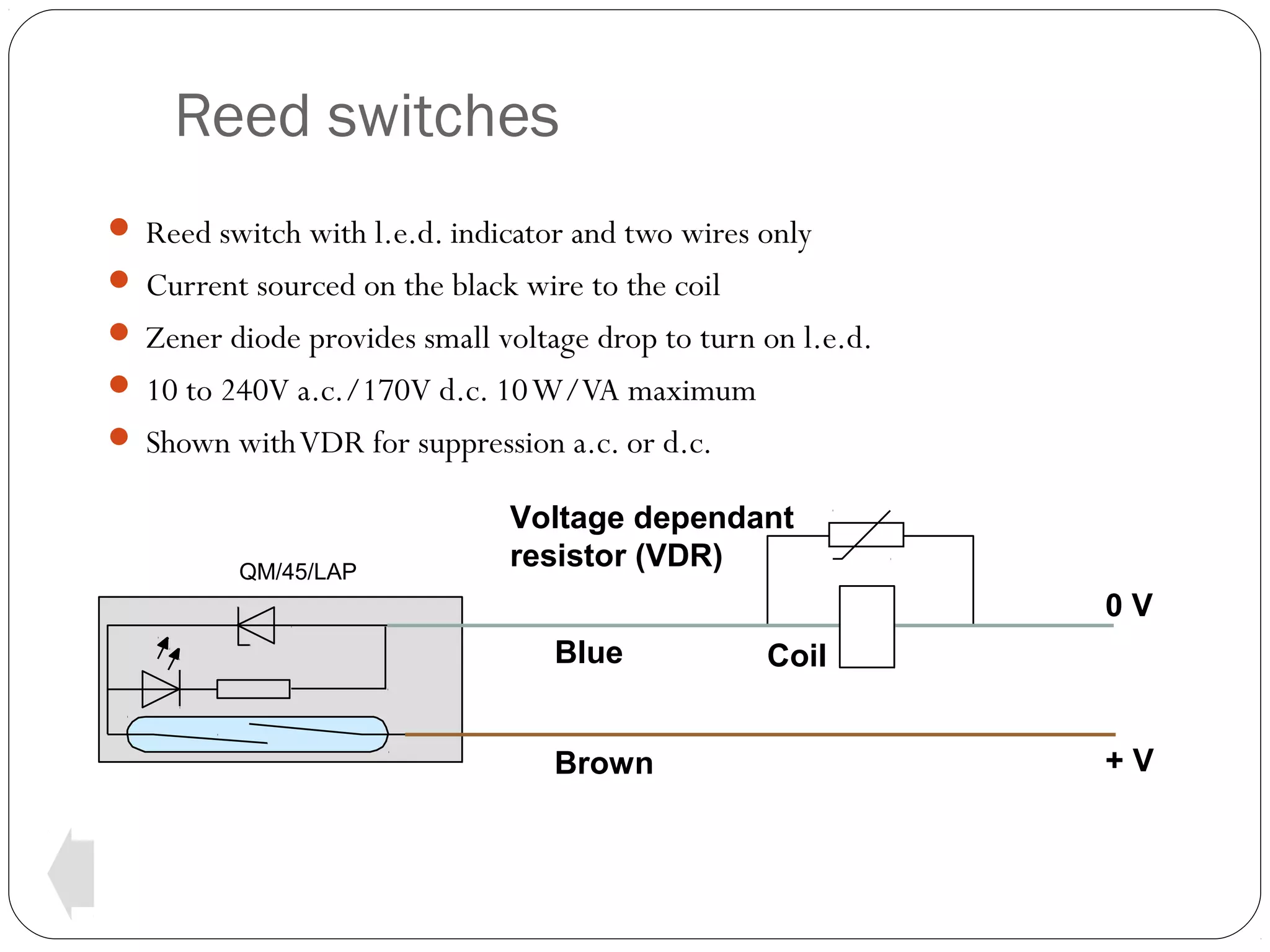
 Reed switch with l.e.d. indicator and two wires only
 Current sourced on the black wire to the coil
 Zener diode provides small voltage drop to turn on l.e.d.
 10 to 240V a.c./170V d.c. 10 W/VA maximum
 Shown with VDR for suppression a.c. or d.c.

QM/45/LAP

Voltage dependant
resistor (VDR)
0V
Blue
Brown

Coil
+V
Reed switches
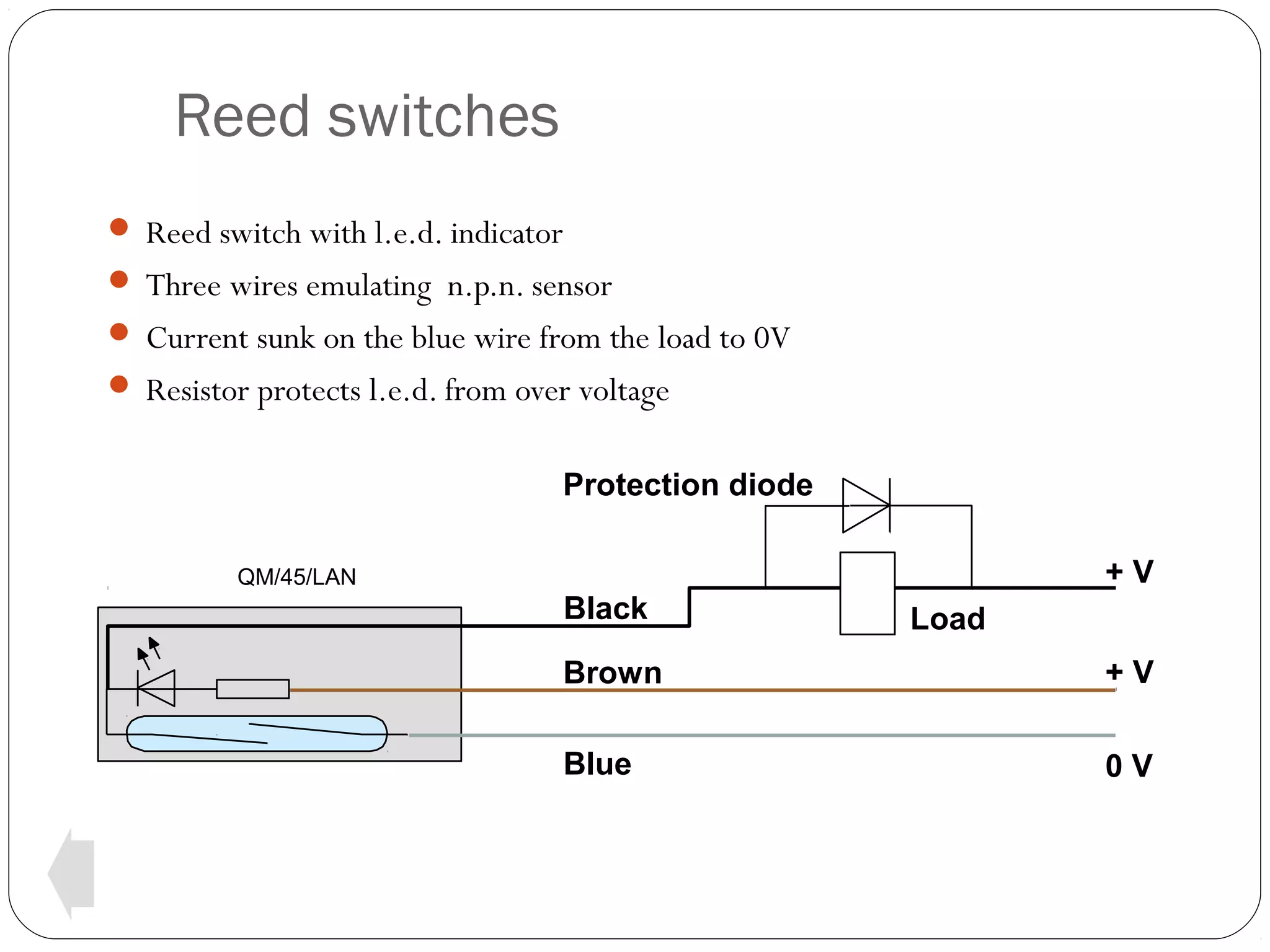
 Reed switch with l.e.d. indicator
 Three wires emulating n.p.n. sensor
 Current sunk on the blue wire from the load to 0V
 Resistor protects l.e.d. from over voltage

Protection diode
+V

QM/45/LAN

Black

Load

Brown

+V

Blue

0V
Solid state switches
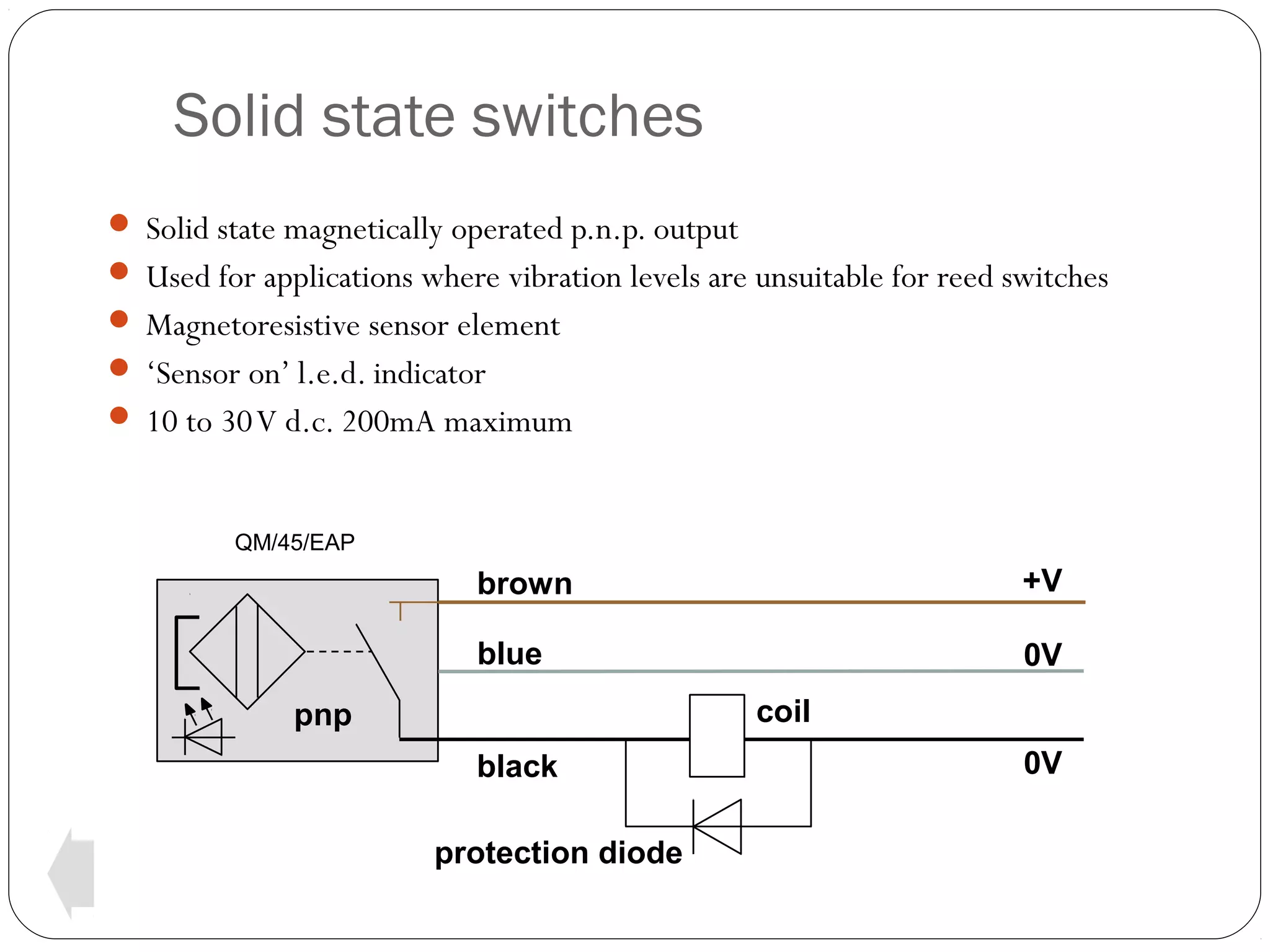
 Solid state magnetically operated p.n.p. output
 Used for applications where vibration levels are unsuitable for reed switches
 Magnetoresistive sensor element
 ‘Sensor on’ l.e.d. indicator
 10 to 30 V d.c. 200mA maximum

QM/45/EAP

brown

+V

blue

0V
coil

pnp
black
protection diode

0V
Reed switches and sensors
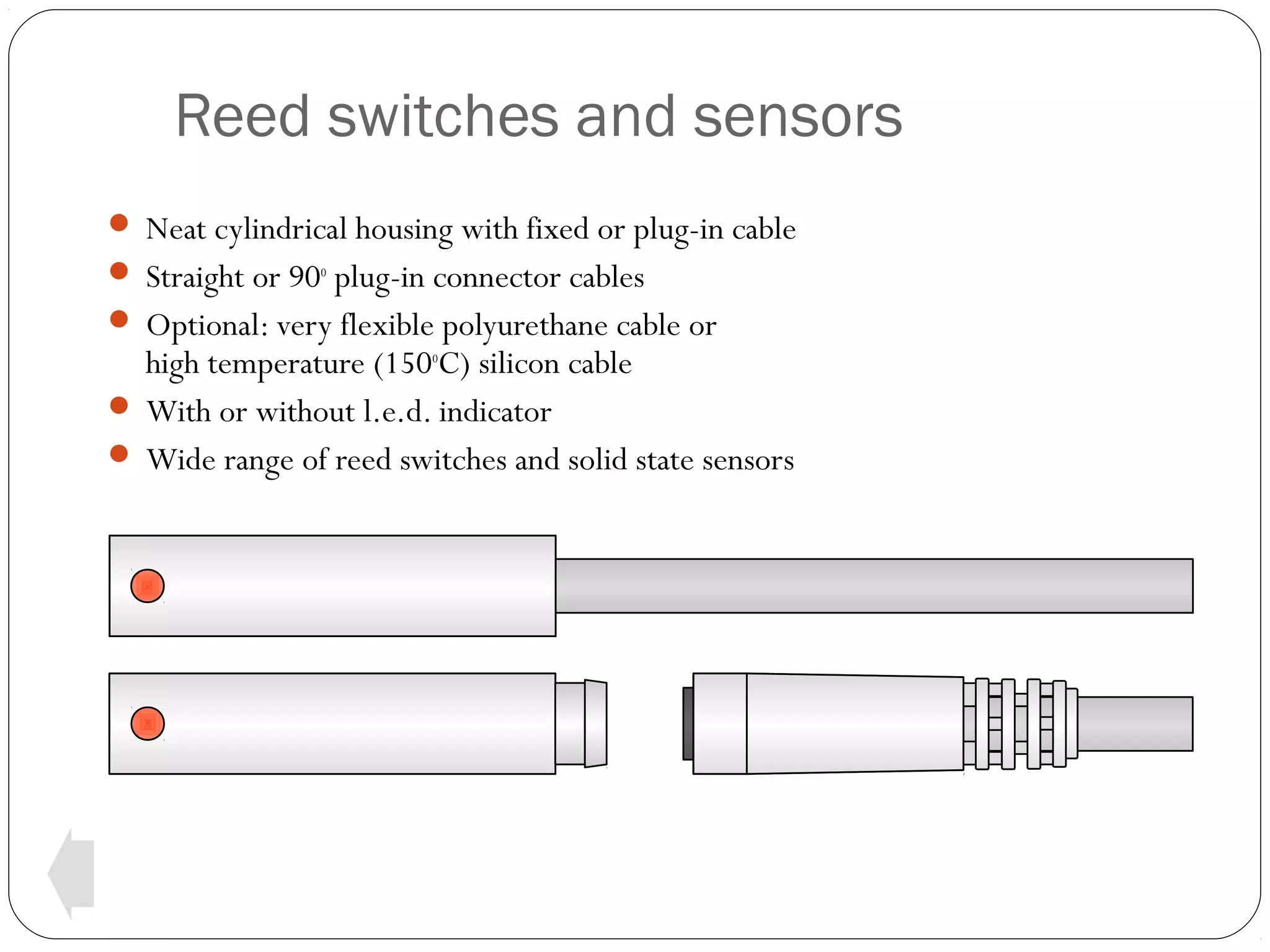
 Neat cylindrical housing with fixed or plug-in cable
 Straight or 90o plug-in connector cables
 Optional: very flexible polyurethane cable or

high temperature (150oC) silicon cable
 With or without l.e.d. indicator
 Wide range of reed switches and solid state sensors
Reed switches
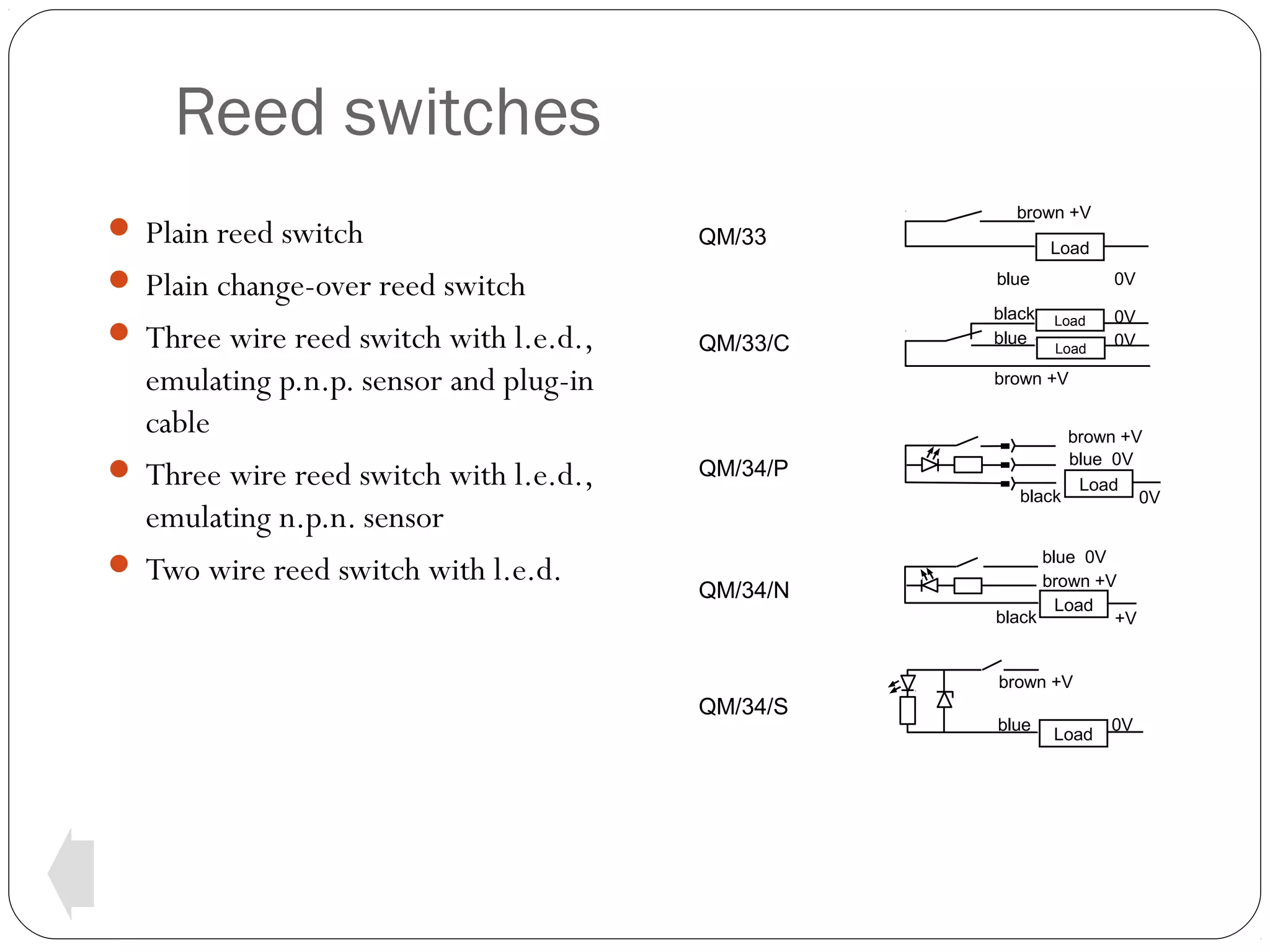
 Plain reed switch

brown +V

QM/33

 Plain change-over reed switch
 Three wire reed switch with l.e.d.,

emulating p.n.p. sensor and plug-in
cable
 Three wire reed switch with l.e.d.,
emulating n.p.n. sensor
 Two wire reed switch with l.e.d.

Load
blue

QM/33/C

black
blue

0V
Load
Load

0V
0V

brown +V

QM/34/P

QM/34/N

brown +V
blue 0V
Load
black
0V
blue 0V
brown +V
Load
black
+V
brown +V

QM/34/S

blue

Load

0V
Solid state sensors
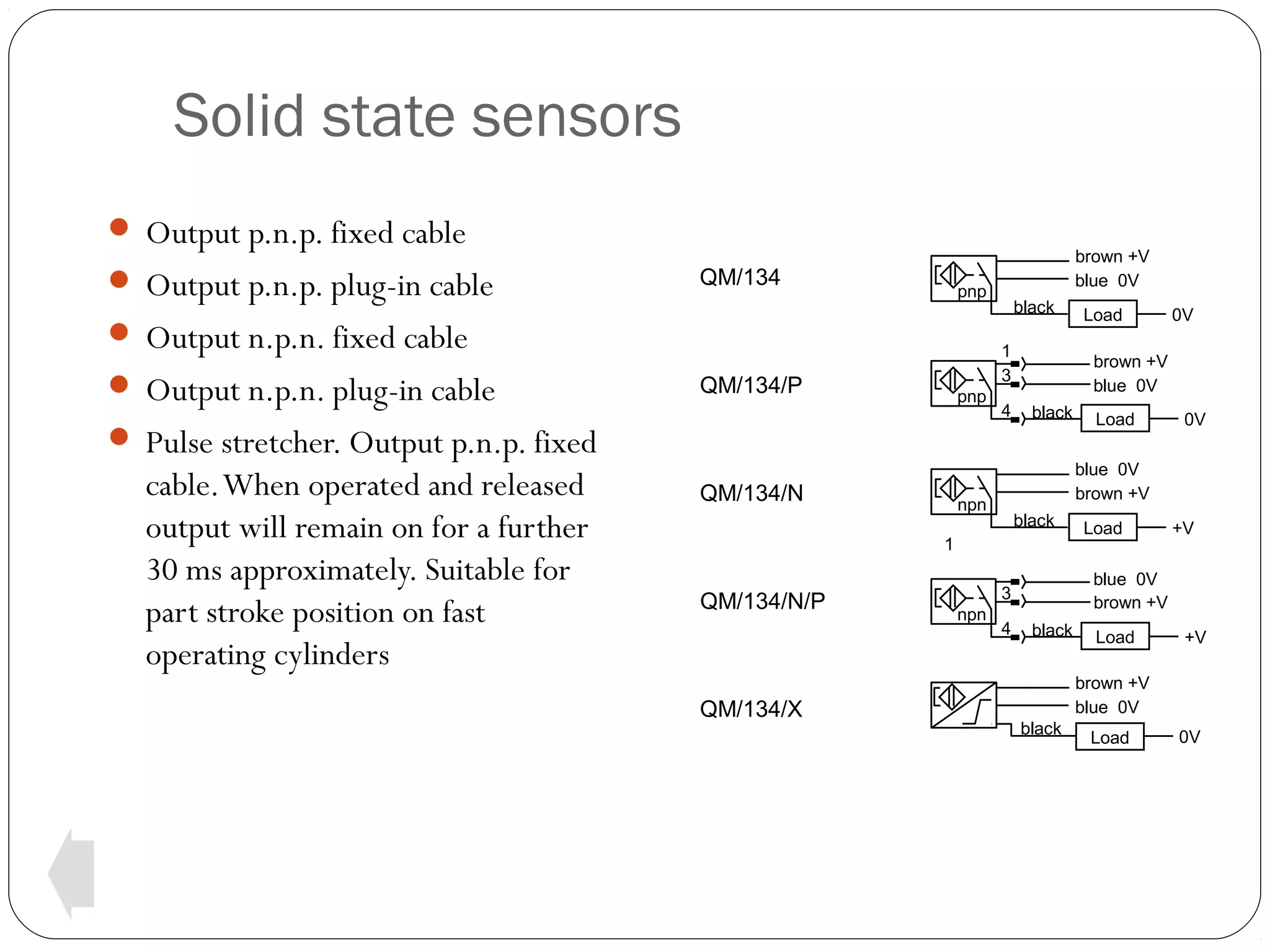
 Output p.n.p. fixed cable
 Output p.n.p. plug-in cable

QM/134

pnp

 Output n.p.n. fixed cable
 Output n.p.n. plug-in cable

brown +V
blue 0V
black
1
3

QM/134/P

pnp

4

QM/134/N

black

npn

black

QM/134/X

0V

4

Load

+V

blue 0V
brown +V

3
npn

Load
blue 0V
brown +V

1

QM/134/N/P

0V

brown +V
blue 0V

 Pulse stretcher. Output p.n.p. fixed

cable. When operated and released
output will remain on for a further
30 ms approximately. Suitable for
part stroke position on fast
operating cylinders

Load

black

Load

+V

brown +V
blue 0V
black

Load

0V
Reed switches and sensors
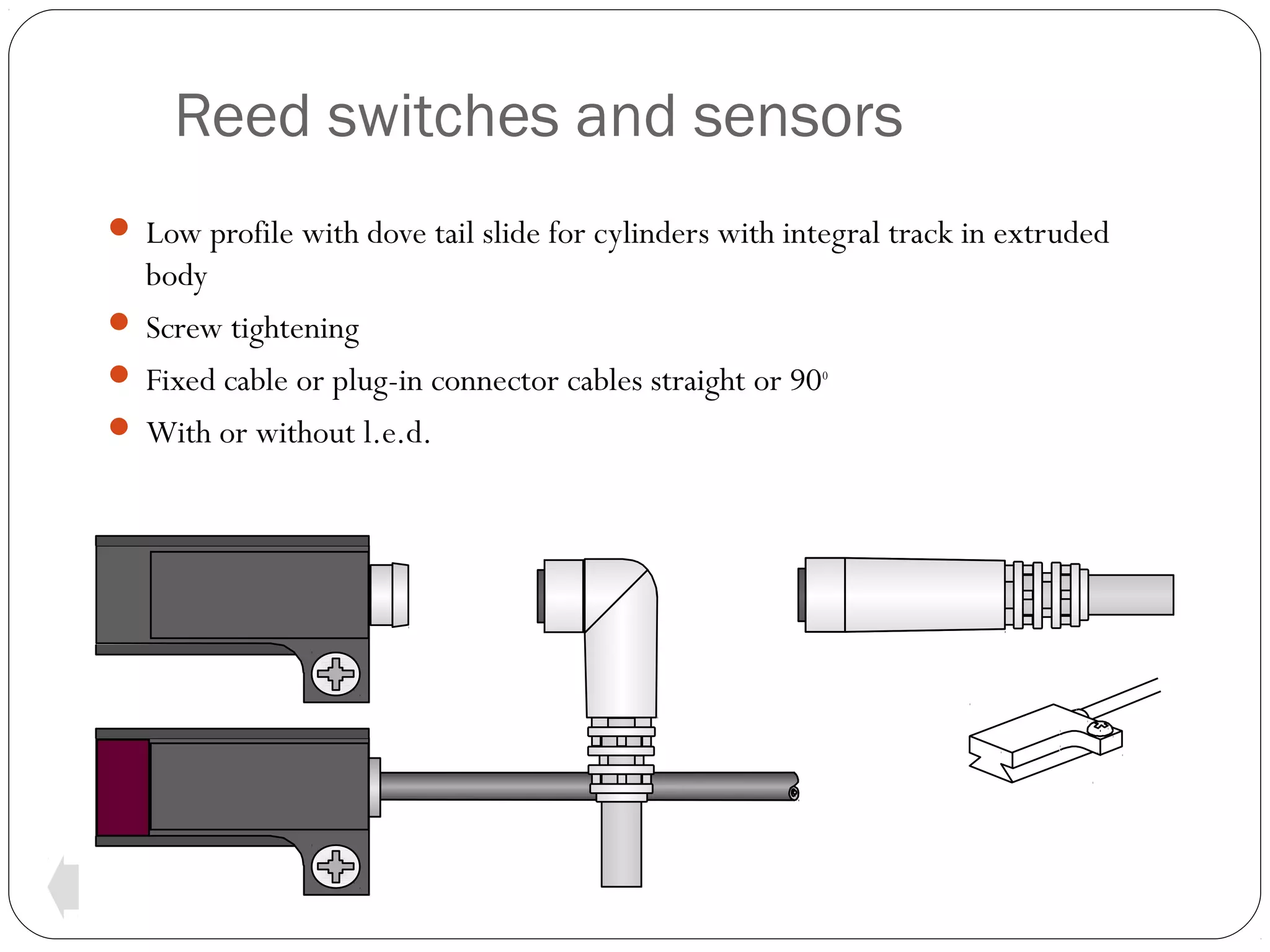
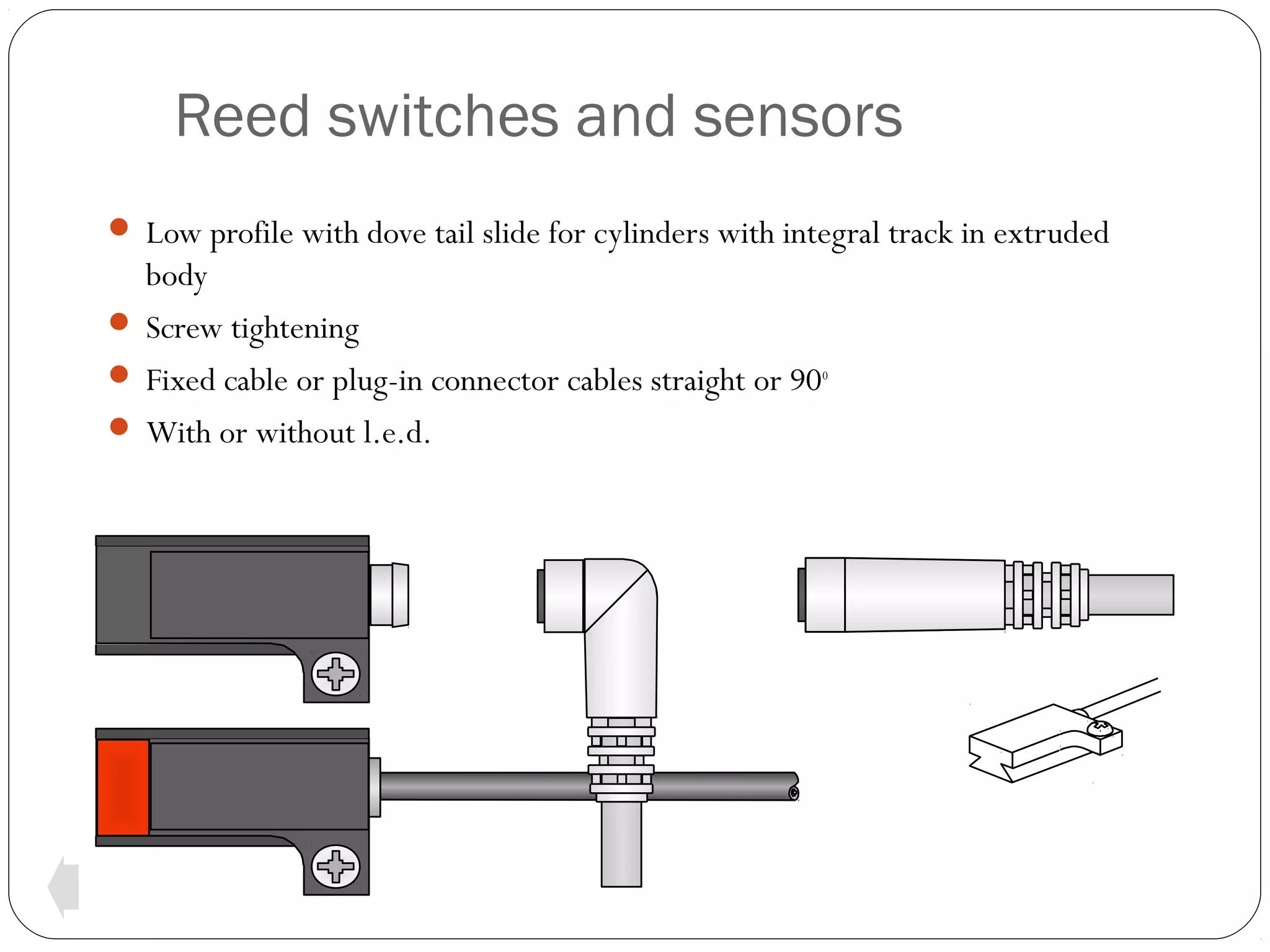
 Low profile with dove tail slide for cylinders with integral track in extruded

body
 Screw tightening
 Fixed cable or plug-in connector cables straight or 90o
 With or without l.e.d.
Reed switches and sensors
 Low profile with dove tail slide for cylinders with integral track in extruded

body
 Screw tightening
 Fixed cable or plug-in connector cables straight or 90o
 With or without l.e.d.
Reed switches
brown
+V

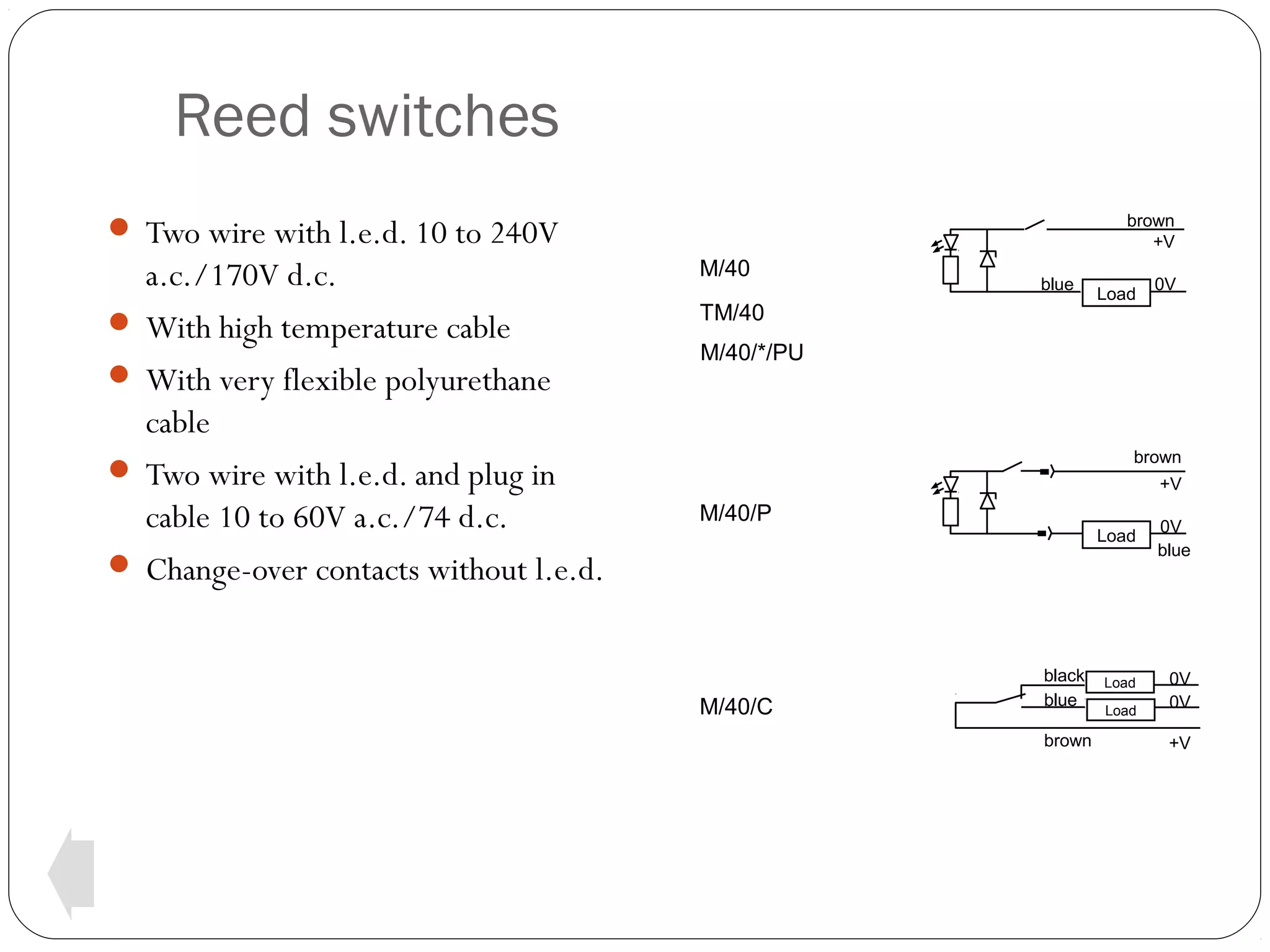
 Two wire with l.e.d. 10 to 240V

a.c./170V d.c.
 With high temperature cable
 With very flexible polyurethane
cable
 Two wire with l.e.d. and plug in
cable 10 to 60V a.c./74 d.c.
 Change-over contacts without l.e.d.

M/40

blue

TM/40

Load

0V

M/40/*/PU

brown
+V

M/40/P
Load

M/40/C

black
blue
brown

Load
Load

0V
blue

0V
0V
+V
Solid state magnetic switches
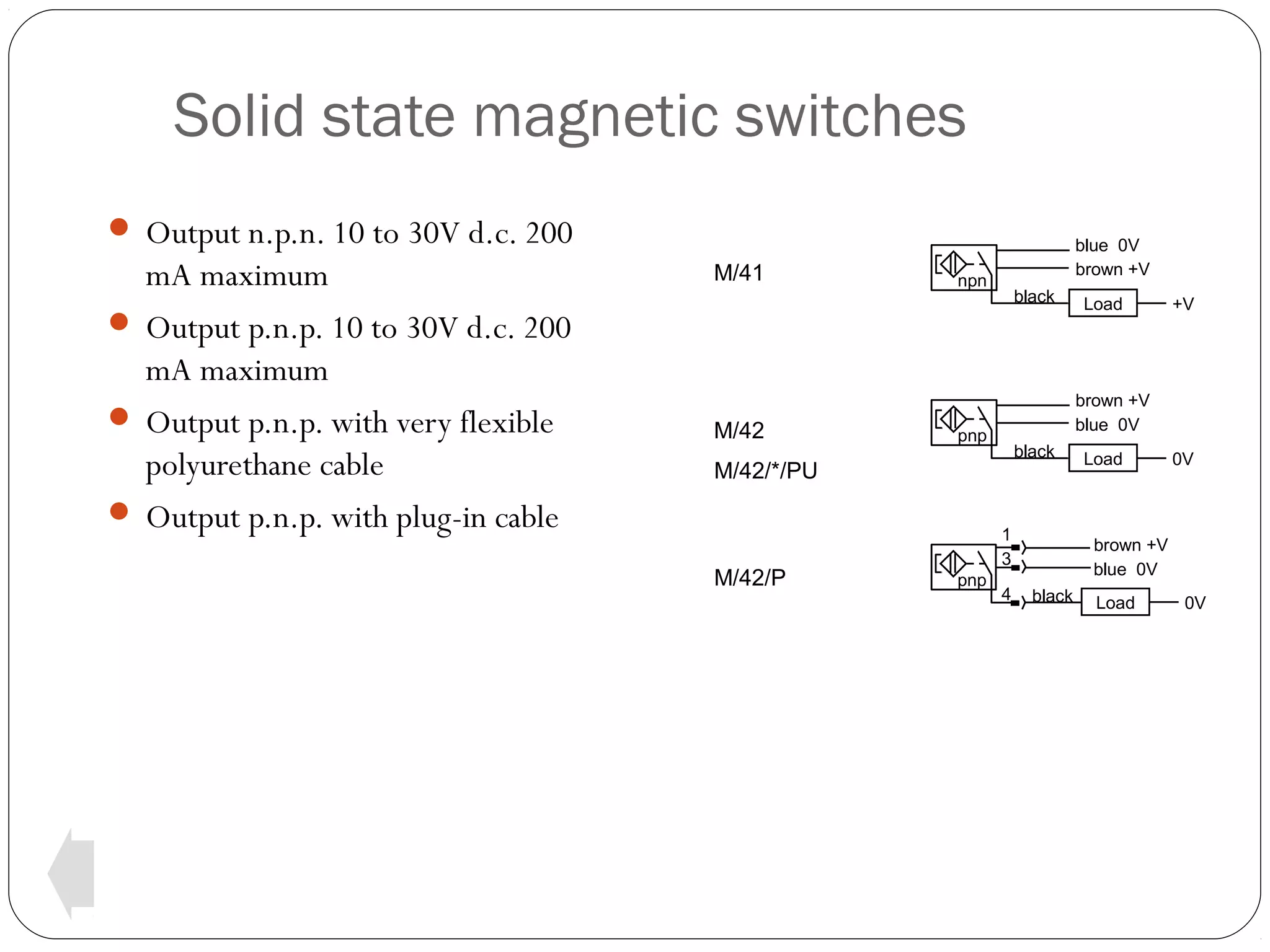
 Output n.p.n. 10 to 30V d.c. 200

mA maximum
 Output p.n.p. 10 to 30V d.c. 200
mA maximum
 Output p.n.p. with very flexible
polyurethane cable
 Output p.n.p. with plug-in cable

M/41

M/42

blue 0V
brown +V

npn

black

pnp

black

1
3
pnp

+V

brown +V
blue 0V

M/42/*/PU

M/42/P

Load

4

Load

0V

brown +V
blue 0V
black

Load

0V
Inductive proximity sensors
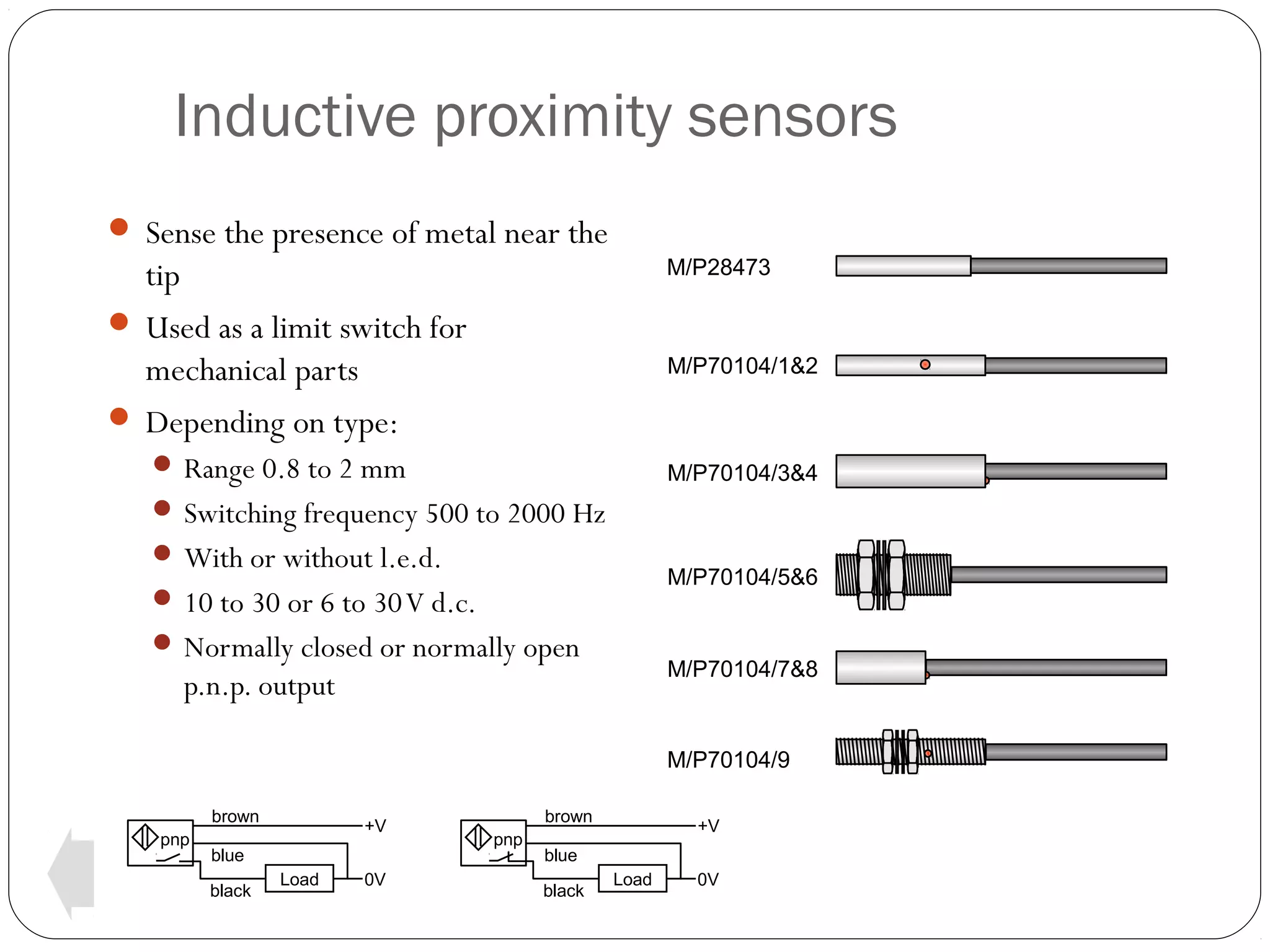
 Sense the presence of metal near the
M/P28473

tip
 Used as a limit switch for
mechanical parts
 Depending on type:

M/P70104/1&2

 Range 0.8 to 2 mm

M/P70104/3&4

 Switching frequency 500 to 2000 Hz
 With or without l.e.d.

M/P70104/5&6

 10 to 30 or 6 to 30 V d.c.
 Normally closed or normally open

M/P70104/7&8

p.n.p. output

M/P70104/9
brown
pnp

+V

blue
black

Load

0V

brown
pnp

+V

blue
black

Load

0V
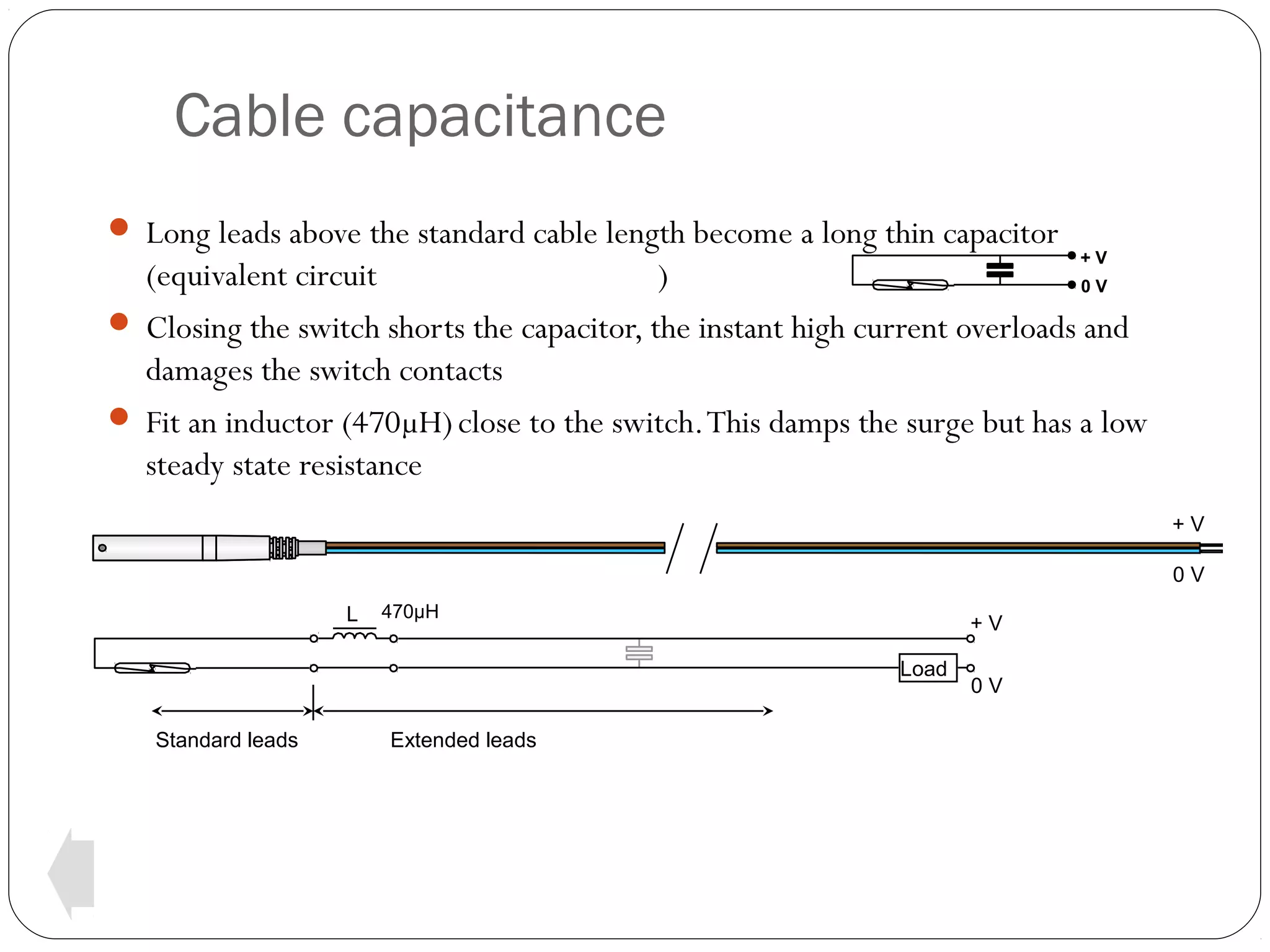
Cable capacitance
 Long leads above the standard cable length become a long thin capacitor

+V

(equivalent circuit
)
0V
 Closing the switch shorts the capacitor, the instant high current overloads and
damages the switch contacts
 Fit an inductor (470µH) close to the switch. This damps the surge but has a low
steady state resistance
+V
0V
L

470µH

+V
Load

Standard leads

Extended leads

0V
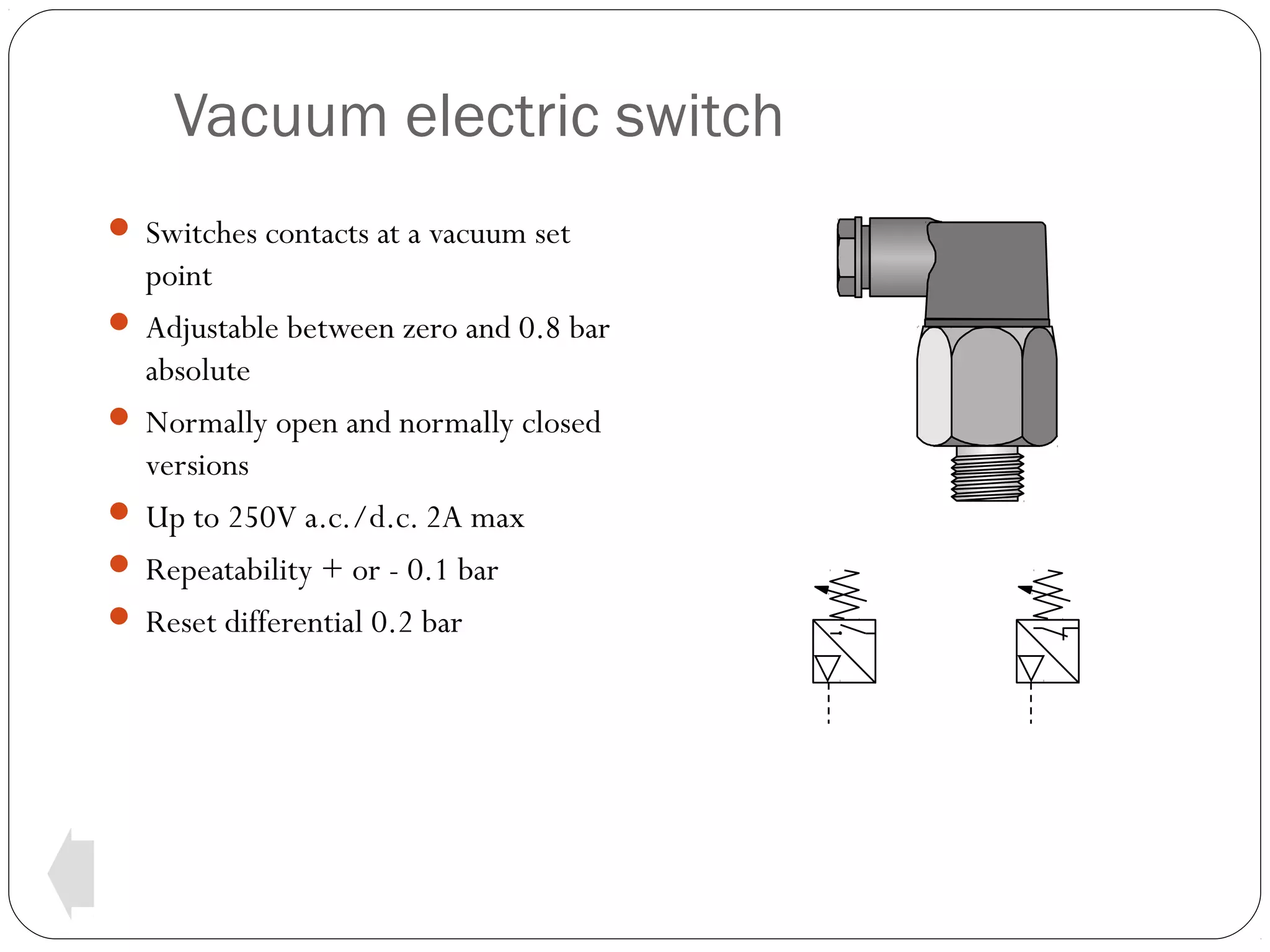
Vacuum electric switch
 Switches contacts at a vacuum set

point
 Adjustable between zero and 0.8 bar
absolute
 Normally open and normally closed
versions
 Up to 250V a.c./d.c. 2A max
 Repeatability + or - 0.1 bar
 Reset differential 0.2 bar
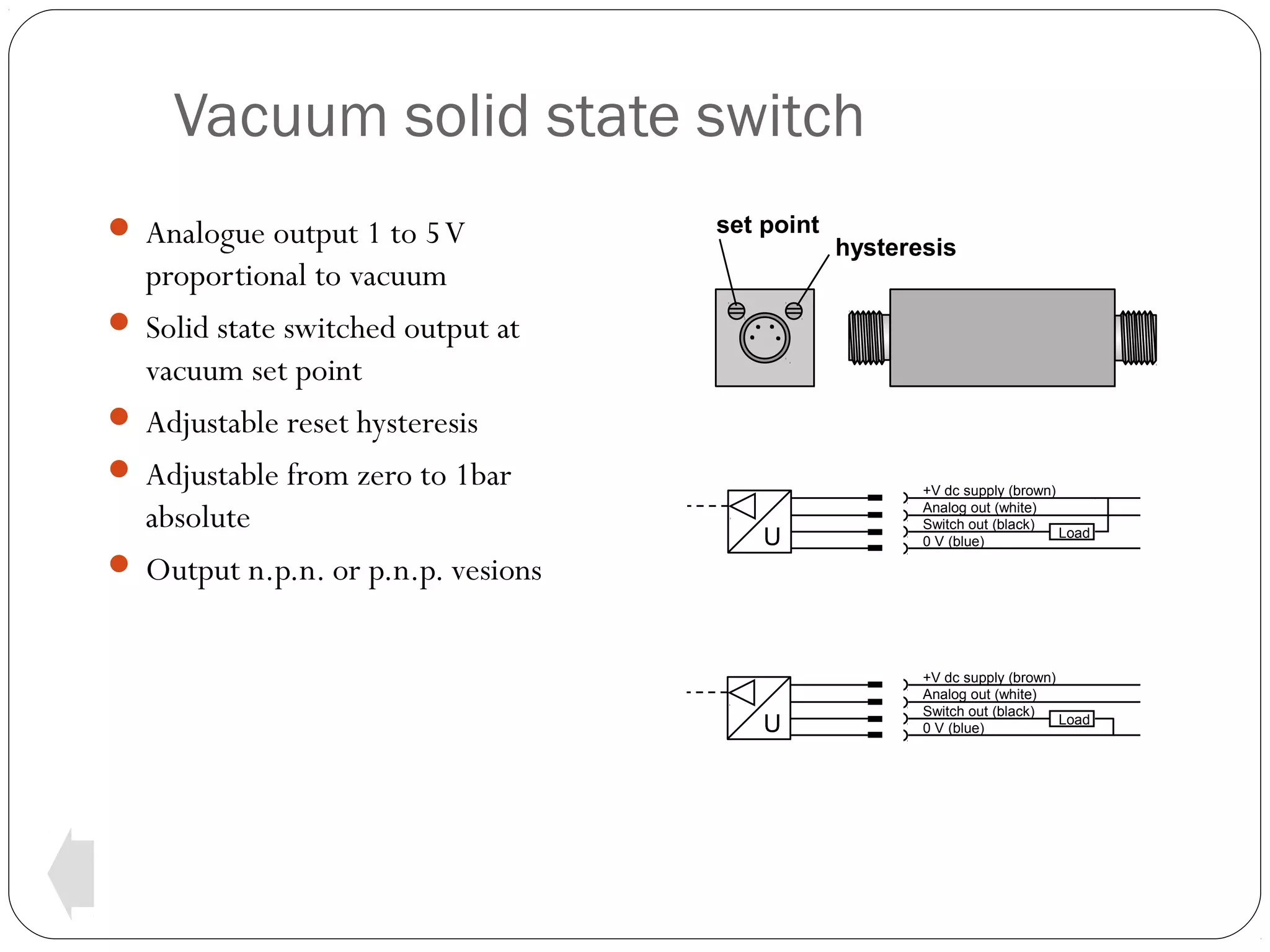
Vacuum solid state switch
 Analogue output 1 to 5 V

proportional to vacuum
 Solid state switched output at
vacuum set point
 Adjustable reset hysteresis
 Adjustable from zero to 1bar
absolute
 Output n.p.n. or p.n.p. vesions

set point

hysteresis

U

+V dc supply (brown)
Analog out (white)
Switch out (black)
Load
0 V (blue)

U

+V dc supply (brown)
Analog out (white)
Switch out (black)
Load
0 V (blue)
End

Switches and sensors

  • 1.
    Switches and Sensors Forintegrated control systems Presemtatiom By Waqar Aziz waqaraziz370@gmail.com
  • 2.
    Contents         Introduction Magnetic cylinders Reed switchprinciple Sensor principle QM/45/* range QM/33,34,134 range M/40,41,42 range Inductive proximity sensors  Cable capacitance Vacuum electric switch  Vacuum electronic switch  Click the section to advance directly to it
  • 3.
    Introduction  Typical electro-pneumaticsystems consist of:  magnetic cylinders and solenoid valves for dynamic power  reed switches and sensors for feedback  electronic logic for control  Reed switches and solid state magnetic sensors are fitted to cylinders to feedback particular positions of the piston  Solid state proximity sensors can be used to replace limit switches, for detecting the position of mechanisms or other moving parts  Reed switches and solid state sensors are small, fast, easy to fit and adjust. They simplify installation on to the machine application
  • 4.
    Magnetic cylinders  Magneticcylinders have a band of magnetic material inset around the circumference of the piston  The polarity is in parallel with the axis of the cylinder  The barrel is made of non ferrous material  By placing reed switches along the outside of the cylinder, signals can be given at the extreme and intermediate positions of stroke Click the illustration to start and stop animation
  • 5.
    Reed switch principle A basic reed switch consists of a small glass tube containing soft iron contact reeds normally sprung open  When a magnetic field is in range the reeds will become magnetic  The ends will be of opposite polarity and pull themselves together Click the illustration to start and stop animation
  • 6.
    Magnetic sensor principle In the presence of a magnetic field the magnetoresistive sensor has a lower resistance. This causes current to be drawn from the base of the transistor turning it on  The circuit incorporates l.e.d., reverse polarity protection diodes and suppression diode for an inductive load +V load sensor N S 0V
  • 7.
    Reed switches andsensor  Slim cylindrical housing  PVC cable in 2 or 5 metre lengths  Optional very flexible polyurethane cable  With or without l.e.d. indicator  Range of four reed switches and one solid state sensor
  • 8.
    Reed switches  Basicreed switch  Shown connected to a relay or solenoid coil with diode suppression for d.c. application  10 to 30V a.c./d.c.  Maximum switching power 10 W/VA Protection diode for d.c. only QM/45/RAP 0V Blue Brown Coil +V
  • 9.
    Reed switches  Reedswitch with l.e.d. indicator  Three wires emulating p.n.p. sensor  Current sourced on the black wire to the coil  Resistor protects l.e.d. from over voltage Protection diode QM/45/LAP 0V Black Coil Blue 0V Brown +V
  • 10.
    Reed switches  Reedswitch with l.e.d. indicator and two wires only  Current sourced on the black wire to the coil  Zener diode provides small voltage drop to turn on l.e.d.  10 to 240V a.c./170V d.c. 10 W/VA maximum  Shown with VDR for suppression a.c. or d.c. QM/45/LAP Voltage dependant resistor (VDR) 0V Blue Brown Coil +V
  • 11.
    Reed switches  Reedswitch with l.e.d. indicator  Three wires emulating n.p.n. sensor  Current sunk on the blue wire from the load to 0V  Resistor protects l.e.d. from over voltage Protection diode +V QM/45/LAN Black Load Brown +V Blue 0V
  • 12.
    Solid state switches Solid state magnetically operated p.n.p. output  Used for applications where vibration levels are unsuitable for reed switches  Magnetoresistive sensor element  ‘Sensor on’ l.e.d. indicator  10 to 30 V d.c. 200mA maximum QM/45/EAP brown +V blue 0V coil pnp black protection diode 0V
  • 13.
    Reed switches andsensors  Neat cylindrical housing with fixed or plug-in cable  Straight or 90o plug-in connector cables  Optional: very flexible polyurethane cable or high temperature (150oC) silicon cable  With or without l.e.d. indicator  Wide range of reed switches and solid state sensors
  • 14.
    Reed switches  Plainreed switch brown +V QM/33  Plain change-over reed switch  Three wire reed switch with l.e.d., emulating p.n.p. sensor and plug-in cable  Three wire reed switch with l.e.d., emulating n.p.n. sensor  Two wire reed switch with l.e.d. Load blue QM/33/C black blue 0V Load Load 0V 0V brown +V QM/34/P QM/34/N brown +V blue 0V Load black 0V blue 0V brown +V Load black +V brown +V QM/34/S blue Load 0V
  • 15.
    Solid state sensors Output p.n.p. fixed cable  Output p.n.p. plug-in cable QM/134 pnp  Output n.p.n. fixed cable  Output n.p.n. plug-in cable brown +V blue 0V black 1 3 QM/134/P pnp 4 QM/134/N black npn black QM/134/X 0V 4 Load +V blue 0V brown +V 3 npn Load blue 0V brown +V 1 QM/134/N/P 0V brown +V blue 0V  Pulse stretcher. Output p.n.p. fixed cable. When operated and released output will remain on for a further 30 ms approximately. Suitable for part stroke position on fast operating cylinders Load black Load +V brown +V blue 0V black Load 0V
  • 16.
    Reed switches andsensors  Low profile with dove tail slide for cylinders with integral track in extruded body  Screw tightening  Fixed cable or plug-in connector cables straight or 90o  With or without l.e.d.
  • 17.
    Reed switches andsensors  Low profile with dove tail slide for cylinders with integral track in extruded body  Screw tightening  Fixed cable or plug-in connector cables straight or 90o  With or without l.e.d.
  • 18.
    Reed switches brown +V  Twowire with l.e.d. 10 to 240V a.c./170V d.c.  With high temperature cable  With very flexible polyurethane cable  Two wire with l.e.d. and plug in cable 10 to 60V a.c./74 d.c.  Change-over contacts without l.e.d. M/40 blue TM/40 Load 0V M/40/*/PU brown +V M/40/P Load M/40/C black blue brown Load Load 0V blue 0V 0V +V
  • 19.
    Solid state magneticswitches  Output n.p.n. 10 to 30V d.c. 200 mA maximum  Output p.n.p. 10 to 30V d.c. 200 mA maximum  Output p.n.p. with very flexible polyurethane cable  Output p.n.p. with plug-in cable M/41 M/42 blue 0V brown +V npn black pnp black 1 3 pnp +V brown +V blue 0V M/42/*/PU M/42/P Load 4 Load 0V brown +V blue 0V black Load 0V
  • 20.
    Inductive proximity sensors Sense the presence of metal near the M/P28473 tip  Used as a limit switch for mechanical parts  Depending on type: M/P70104/1&2  Range 0.8 to 2 mm M/P70104/3&4  Switching frequency 500 to 2000 Hz  With or without l.e.d. M/P70104/5&6  10 to 30 or 6 to 30 V d.c.  Normally closed or normally open M/P70104/7&8 p.n.p. output M/P70104/9 brown pnp +V blue black Load 0V brown pnp +V blue black Load 0V
  • 21.
    Cable capacitance  Longleads above the standard cable length become a long thin capacitor +V (equivalent circuit ) 0V  Closing the switch shorts the capacitor, the instant high current overloads and damages the switch contacts  Fit an inductor (470µH) close to the switch. This damps the surge but has a low steady state resistance +V 0V L 470µH +V Load Standard leads Extended leads 0V
  • 22.
    Vacuum electric switch Switches contacts at a vacuum set point  Adjustable between zero and 0.8 bar absolute  Normally open and normally closed versions  Up to 250V a.c./d.c. 2A max  Repeatability + or - 0.1 bar  Reset differential 0.2 bar
  • 23.
    Vacuum solid stateswitch  Analogue output 1 to 5 V proportional to vacuum  Solid state switched output at vacuum set point  Adjustable reset hysteresis  Adjustable from zero to 1bar absolute  Output n.p.n. or p.n.p. vesions set point hysteresis U +V dc supply (brown) Analog out (white) Switch out (black) Load 0 V (blue) U +V dc supply (brown) Analog out (white) Switch out (black) Load 0 V (blue)
  • 24.