Comprehensive Discussion of
PEDv
2014 Pork Management Conference
June 19, 2014
Dr. Harry Snelson
AASV
Disease Discovery
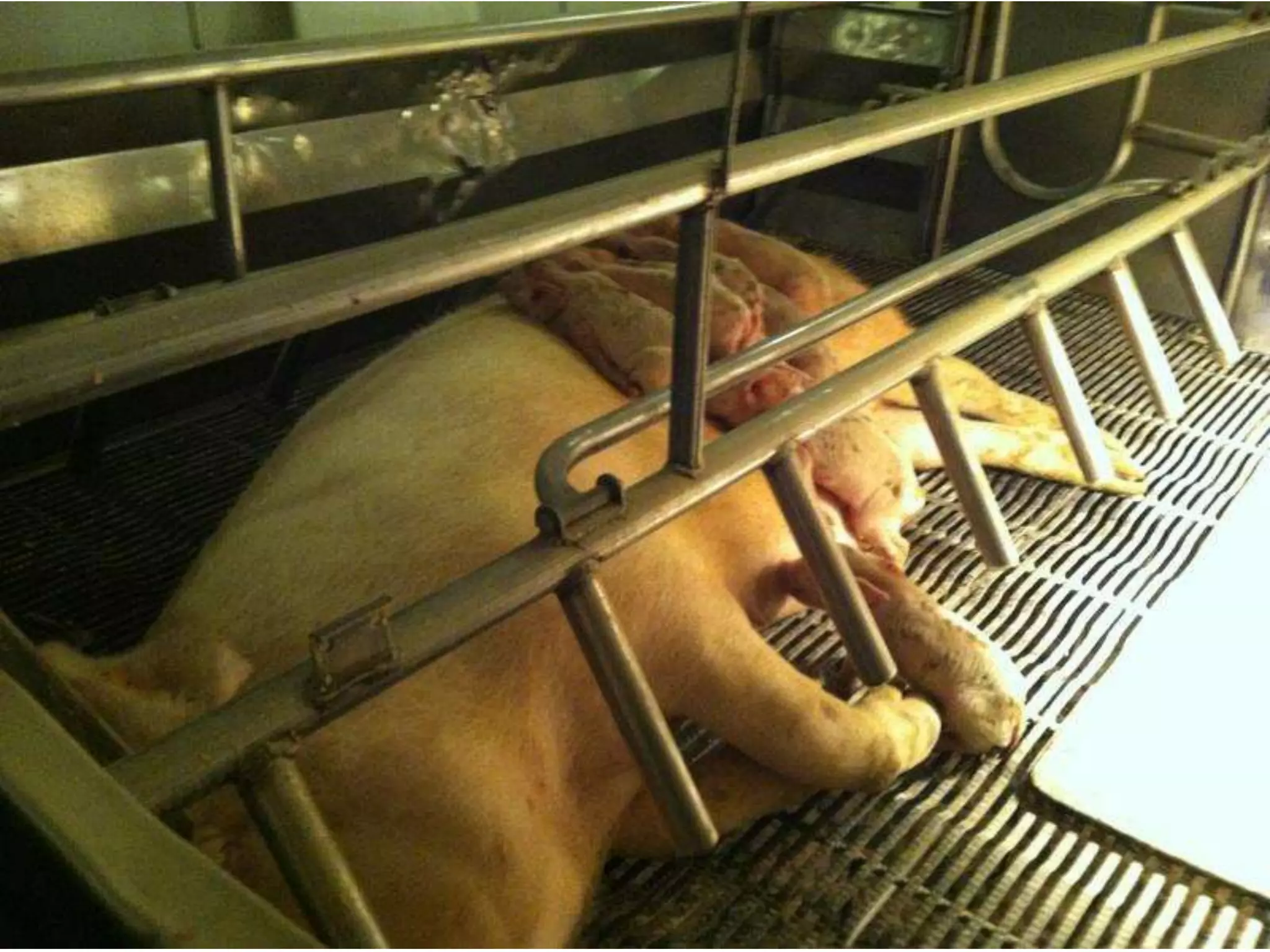
Looks like TGE…
Acts like TGE….
Ain’t TGE
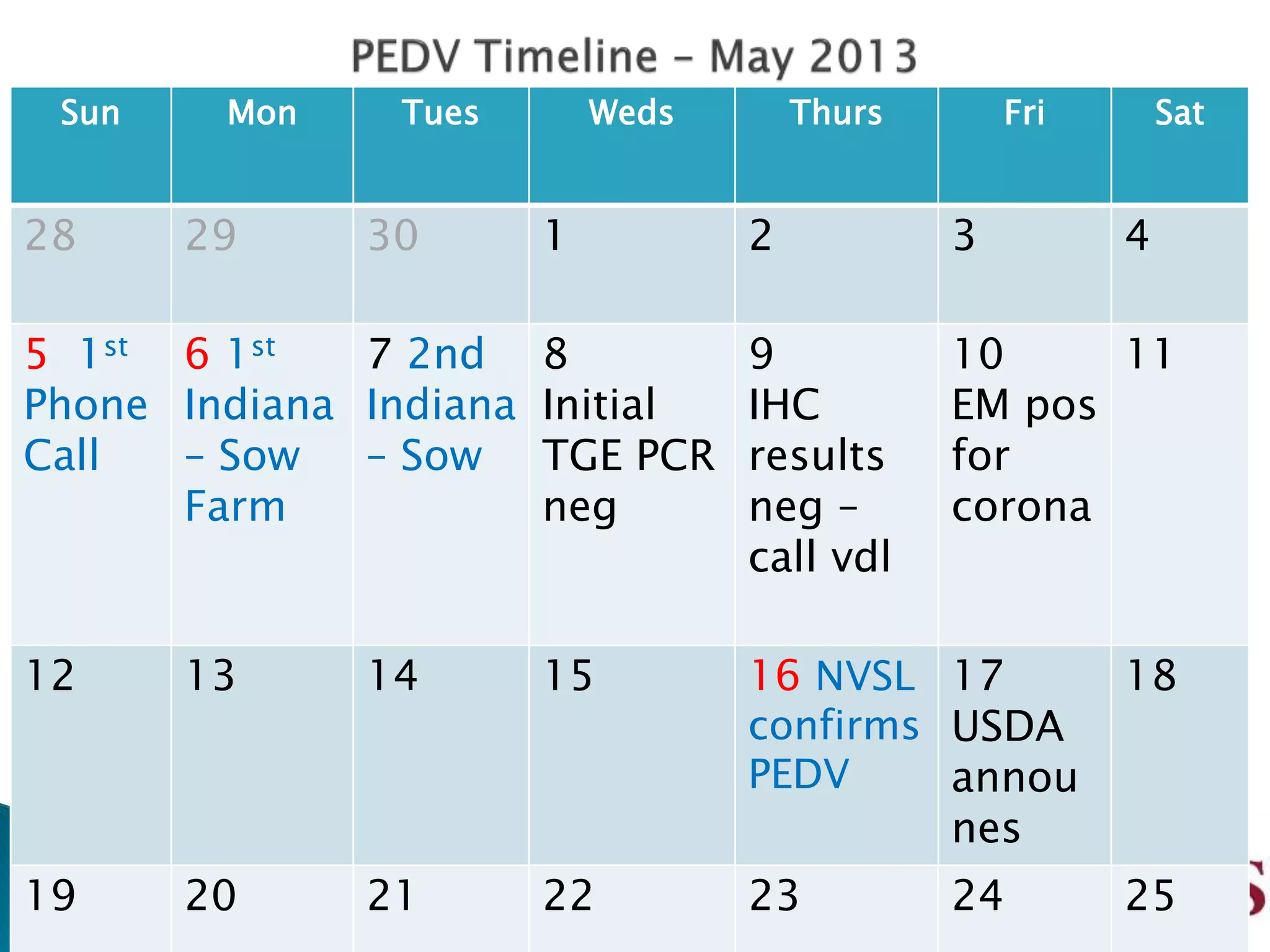
Sun Mon Tues Weds Thurs Fri Sat
28 29 30 1 2 3 4
5 1st
Phone
Call
6 1st
Indiana
– Sow
Farm
7 2nd
Indiana
– Sow
8
Initial
TGE PCR
neg
9
IHC
results
neg –
call vdl
10
EM pos
for
corona
11
12 13 14 15 16 NVSL
confirms
PEDV
17
USDA
annou
nes
18
19 20 21 22 23 24 25
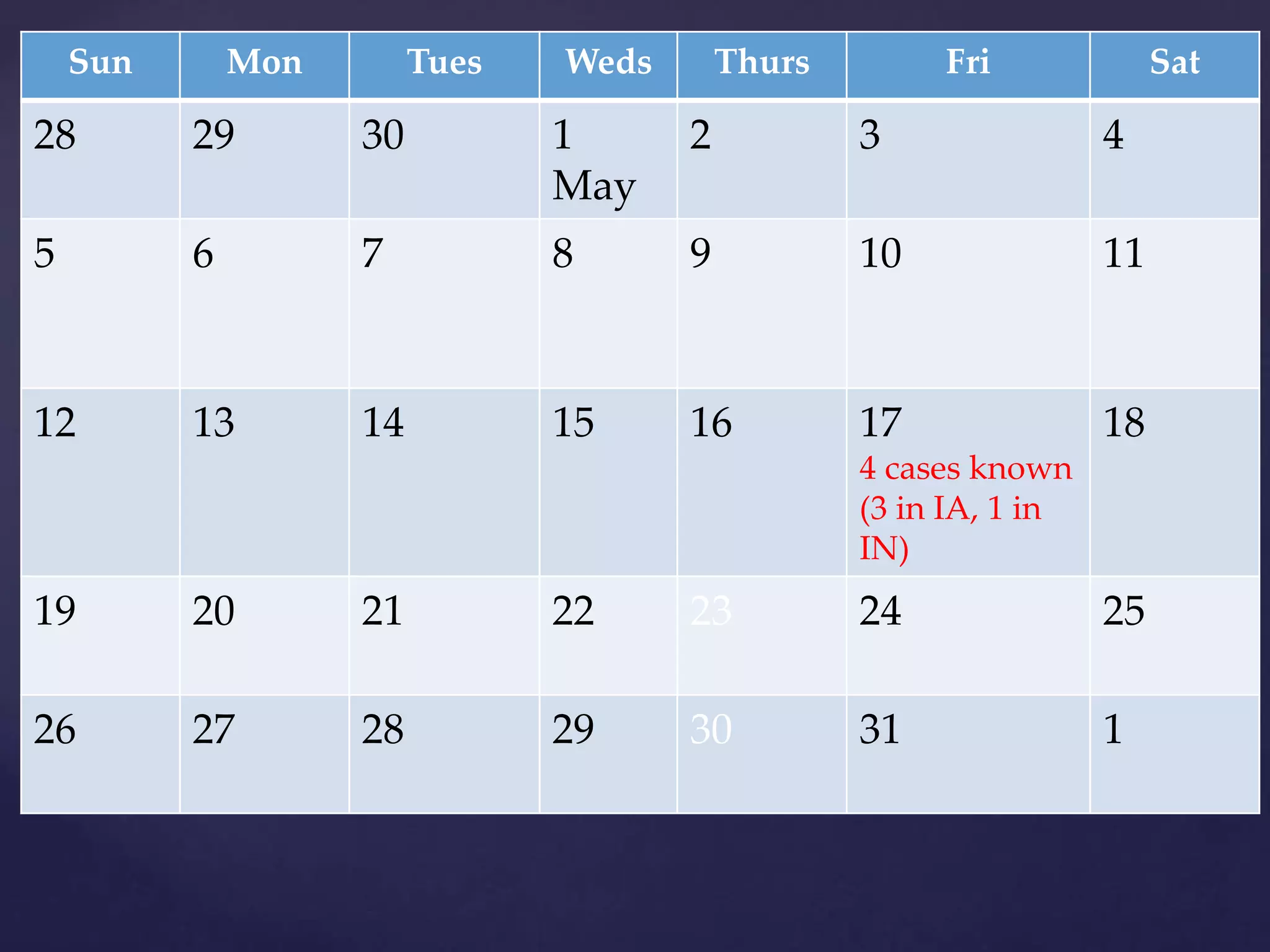
Sun Mon Tues Weds Thurs Fri Sat
28 29 30 1
May
2 3 4
5 6 7 8 9 10 11
12 13 14 15 16 17
4 cases known
(3 in IA, 1 in
IN)
18
19 20 21 22 23 24 25
26 27 28 29 30 31 1
Veterinary Diagnostic Laboratory
Iowa State UniversityOutcome of retrospective testing & on-boarding PEDV PCR
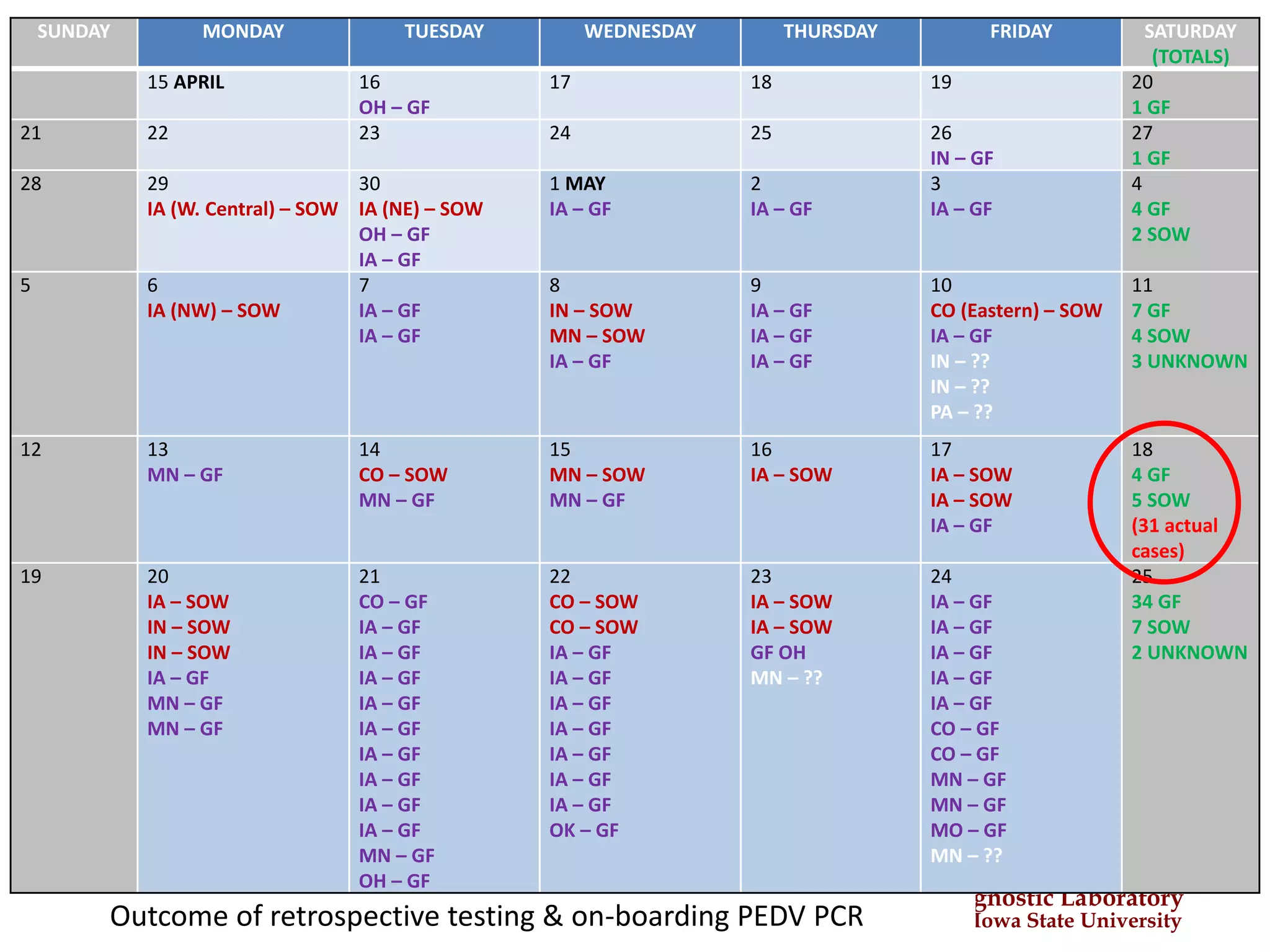
SUNDAY MONDAY TUESDAY WEDNESDAY THURSDAY FRIDAY SATURDAY
(TOTALS)
15 APRIL 16
OH – GF
17 18 19 20
1 GF
21 22 23 24 25 26
IN – GF
27
1 GF
28 29
IA (W. Central) – SOW
30
IA (NE) – SOW
OH – GF
IA – GF
1 MAY
IA – GF
2
IA – GF
3
IA – GF
4
4 GF
2 SOW
5 6
IA (NW) – SOW
7
IA – GF
IA – GF
8
IN – SOW
MN – SOW
IA – GF
9
IA – GF
IA – GF
IA – GF
10
CO (Eastern) – SOW
IA – GF
IN – ??
IN – ??
PA – ??
11
7 GF
4 SOW
3 UNKNOWN
12 13
MN – GF
14
CO – SOW
MN – GF
15
MN – SOW
MN – GF
16
IA – SOW
17
IA – SOW
IA – SOW
IA – GF
18
4 GF
5 SOW
(31 actual
cases)
19 20
IA – SOW
IN – SOW
IN – SOW
IA – GF
MN – GF
MN – GF
21
CO – GF
IA – GF
IA – GF
IA – GF
IA – GF
IA – GF
IA – GF
IA – GF
IA – GF
IA – GF
MN – GF
OH – GF
22
CO – SOW
CO – SOW
IA – GF
IA – GF
IA – GF
IA – GF
IA – GF
IA – GF
IA – GF
OK – GF
23
IA – SOW
IA – SOW
GF OH
MN – ??
24
IA – GF
IA – GF
IA – GF
IA – GF
IA – GF
CO – GF
CO – GF
MN – GF
MN – GF
MO – GF
MN – ??
25
34 GF
7 SOW
2 UNKNOWN
Veterinary Diagnostic Laboratory
Iowa State University
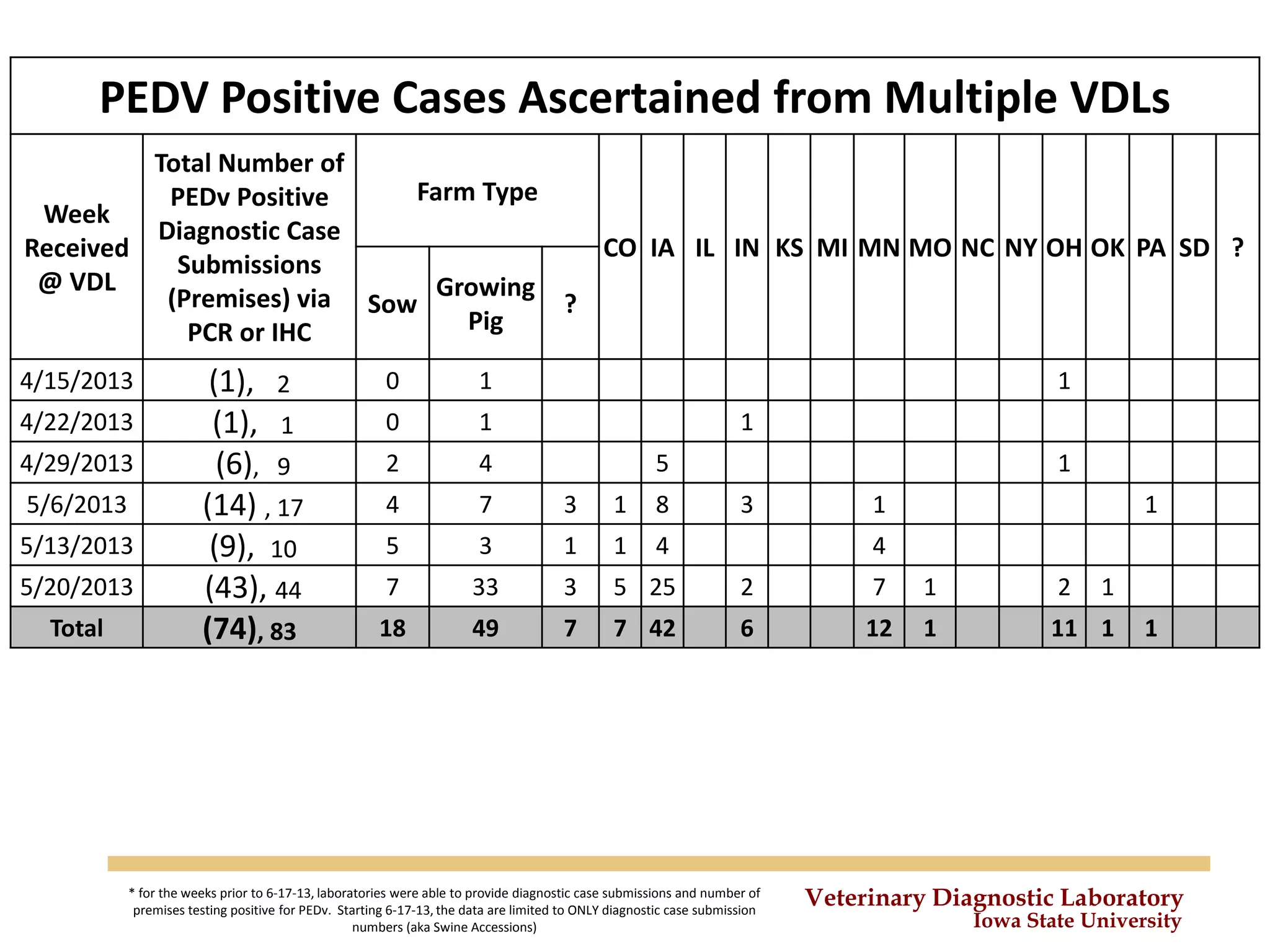
PEDV Positive Cases Ascertained from Multiple VDLs
Week
Received
@ VDL
Total Number of
PEDv Positive
Diagnostic Case
Submissions
(Premises) via
PCR or IHC
Farm Type
CO IA IL IN KS MI MN MO NC NY OH OK PA SD ?
Sow
Growing
Pig
?
4/15/2013 (1), 2 0 1 1
4/22/2013 (1), 1 0 1 1
4/29/2013 (6), 9 2 4 5 1
5/6/2013 (14) , 17 4 7 3 1 8 3 1 1
5/13/2013 (9), 10 5 3 1 1 4 4
5/20/2013 (43), 44 7 33 3 5 25 2 7 1 2 1
Total (74), 83 18 49 7 7 42 6 12 1 11 1 1
* for the weeks prior to 6-17-13, laboratories were able to provide diagnostic case submissions and number of
premises testing positive for PEDv. Starting 6-17-13, the data are limited to ONLY diagnostic case submission
numbers (aka Swine Accessions)
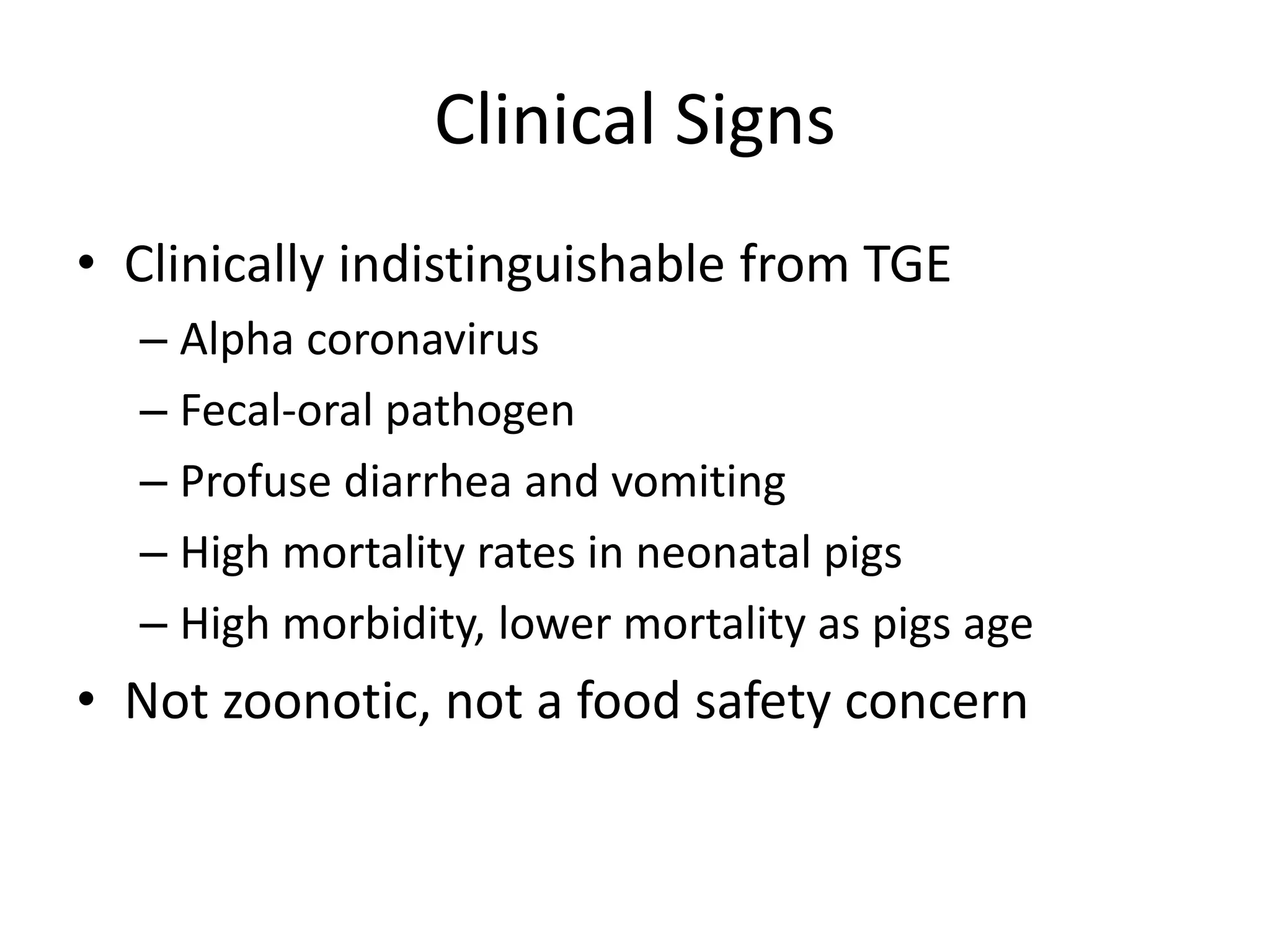
Clinical Signs
• Clinically indistinguishable from TGE
– Alpha coronavirus
– Fecal-oral pathogen
– Profuse diarrhea and vomiting
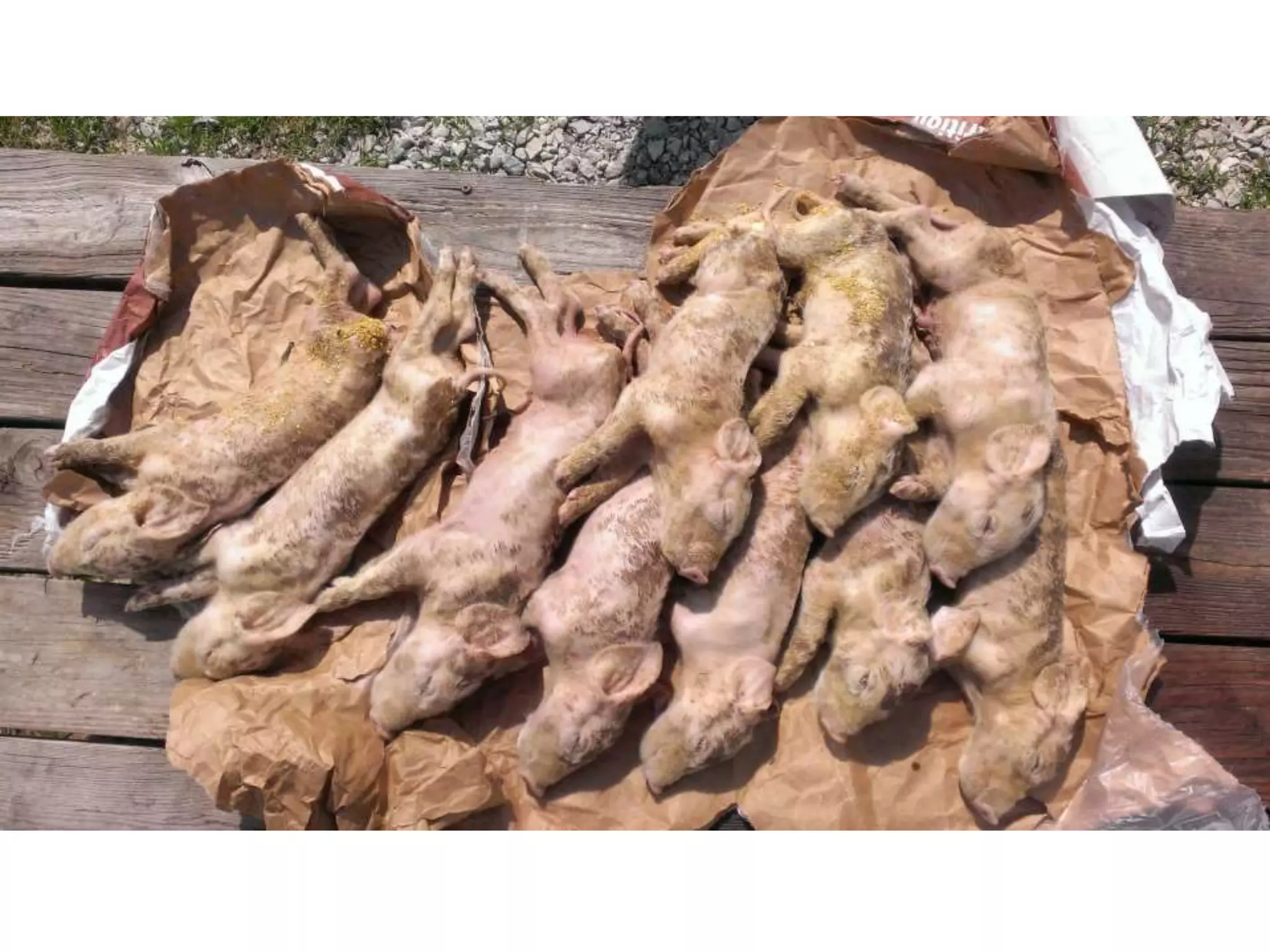
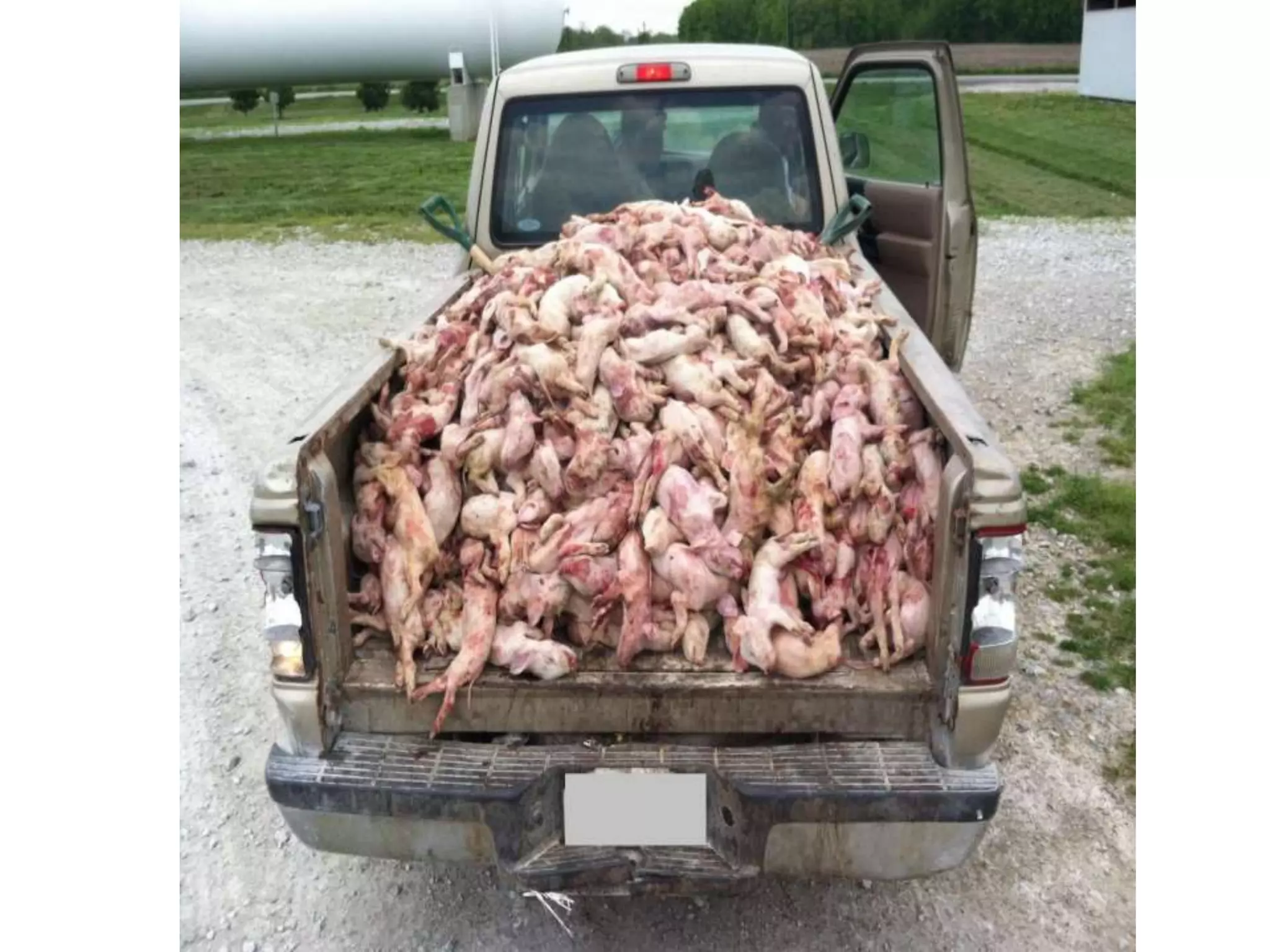
– High mortality rates in neonatal pigs
– High morbidity, lower mortality as pigs age
• Not zoonotic, not a food safety concern
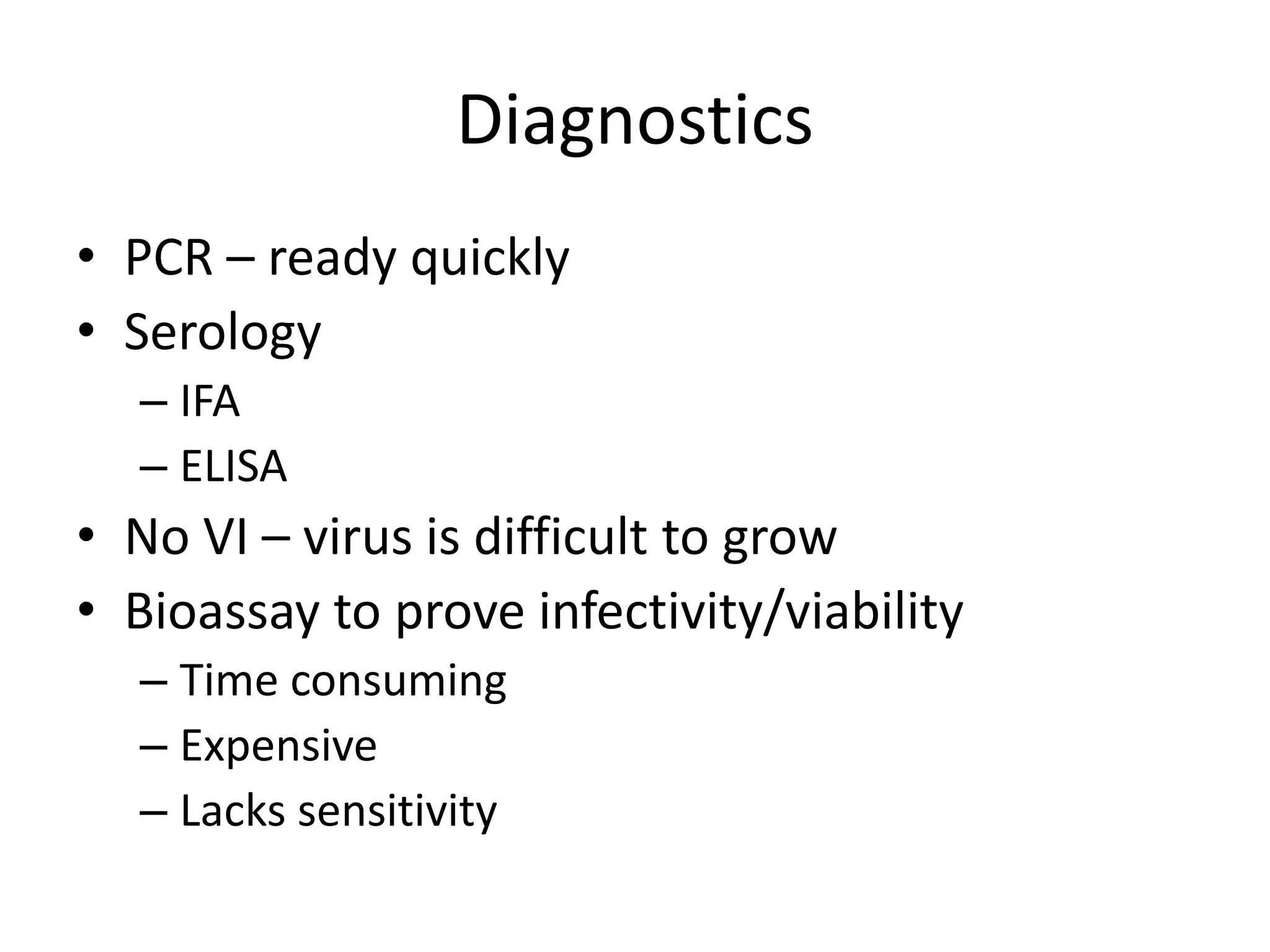
Diagnostics
• PCR – ready quickly
• Serology
– IFA
– ELISA
• No VI – virus is difficult to grow
• Bioassay to prove infectivity/viability
– Time consuming
– Expensive
– Lacks sensitivity
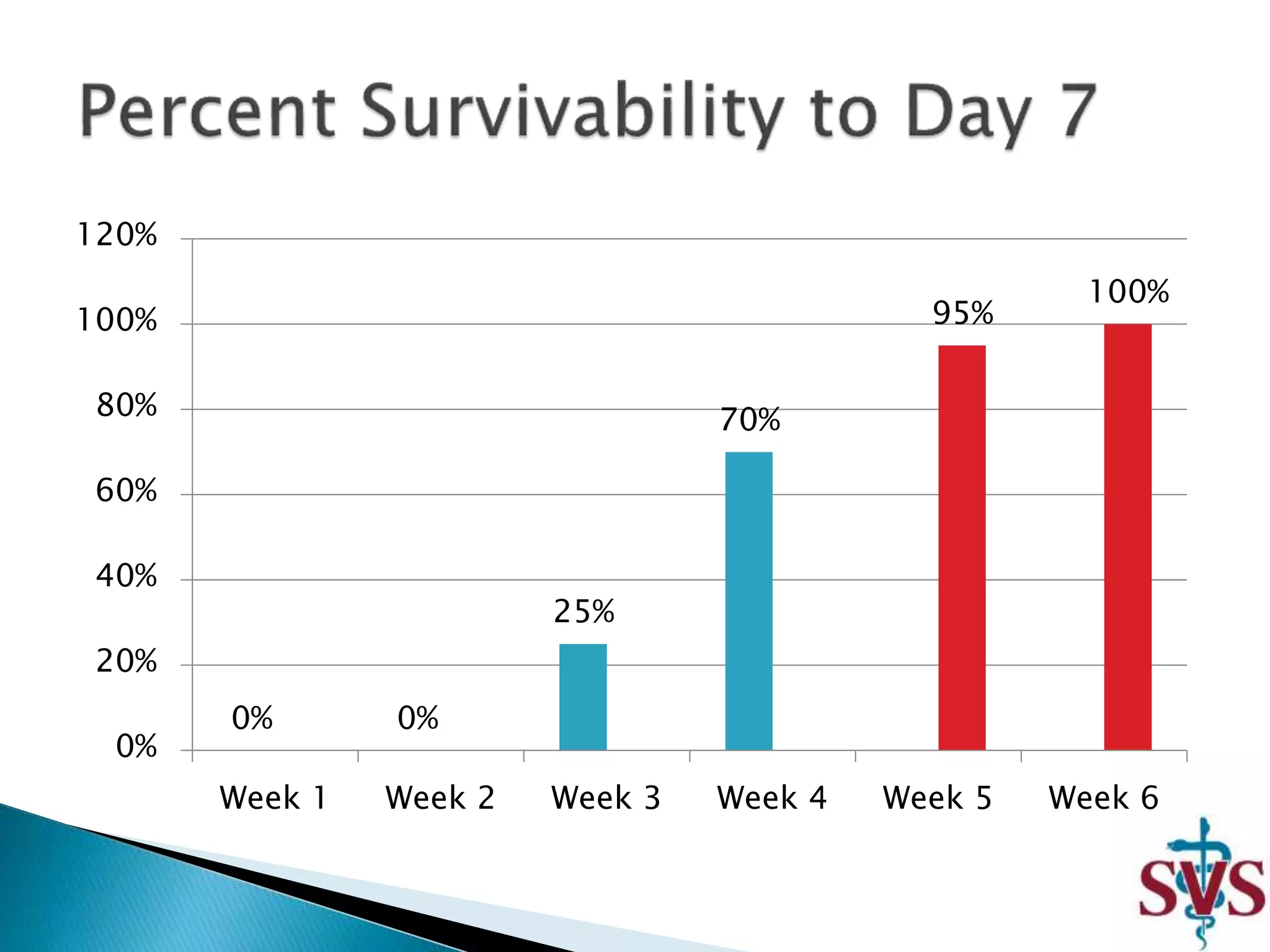
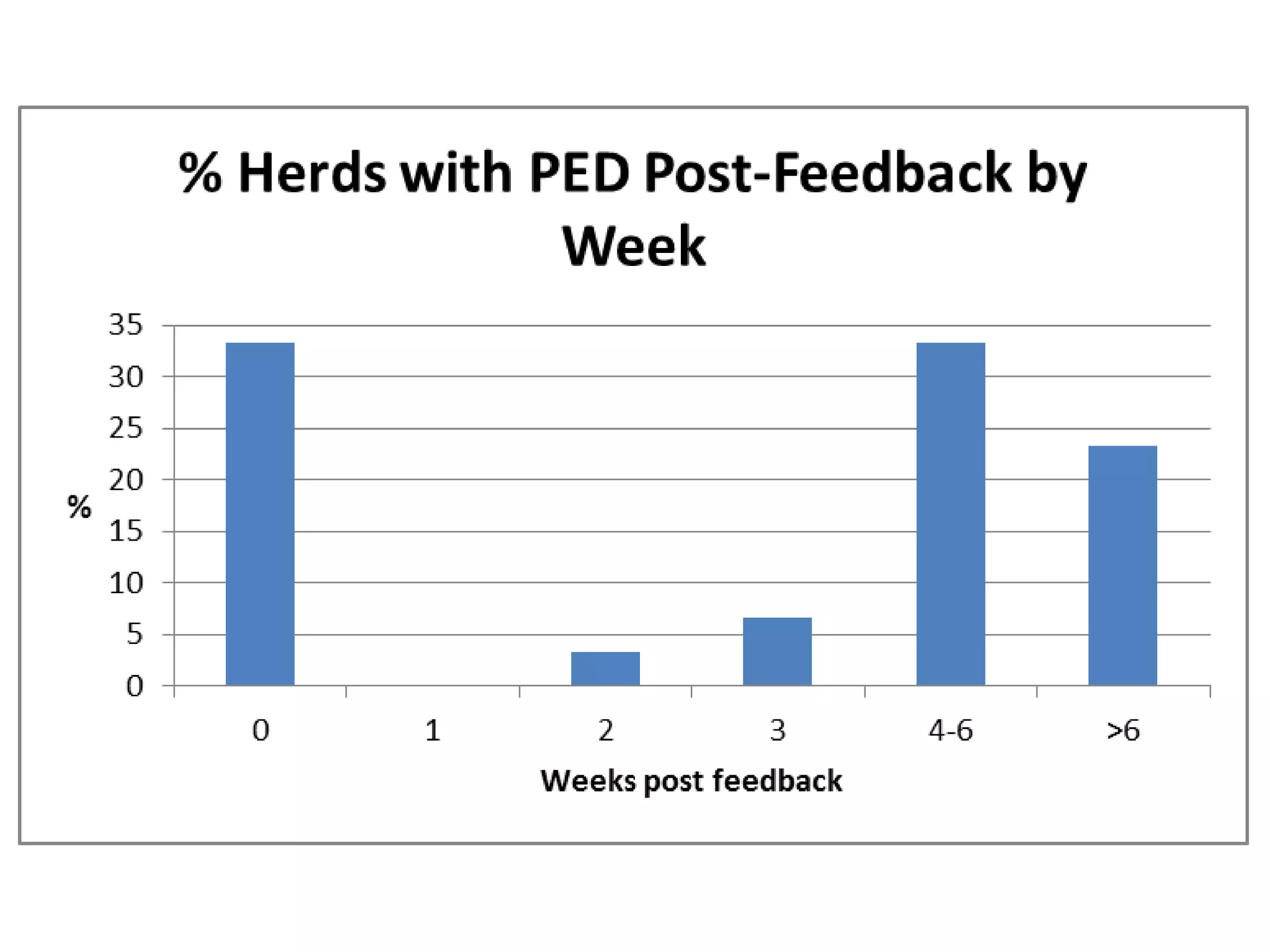
0% 0%
25%
70%
95%
100%
0%
20%
40%
60%
80%
100%
120%
Week 1 Week 2 Week 3 Week 4 Week 5 Week 6
PED virus
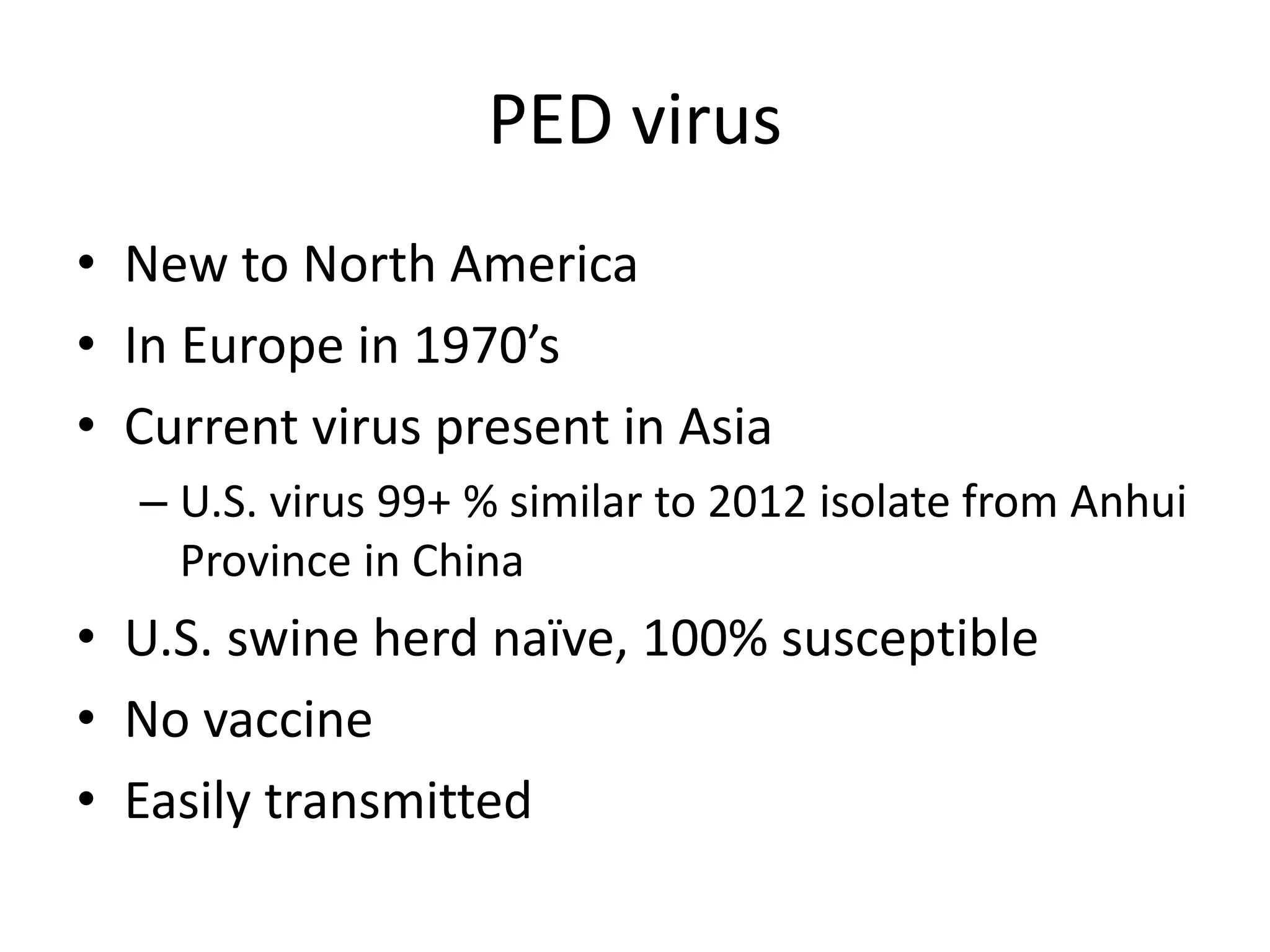
• New to North America
• In Europe in 1970’s
• Current virus present in Asia
– U.S. virus 99+ % similar to 2012 isolate from Anhui
Province in China
• U.S. swine herd naïve, 100% susceptible
• No vaccine
• Easily transmitted
Response
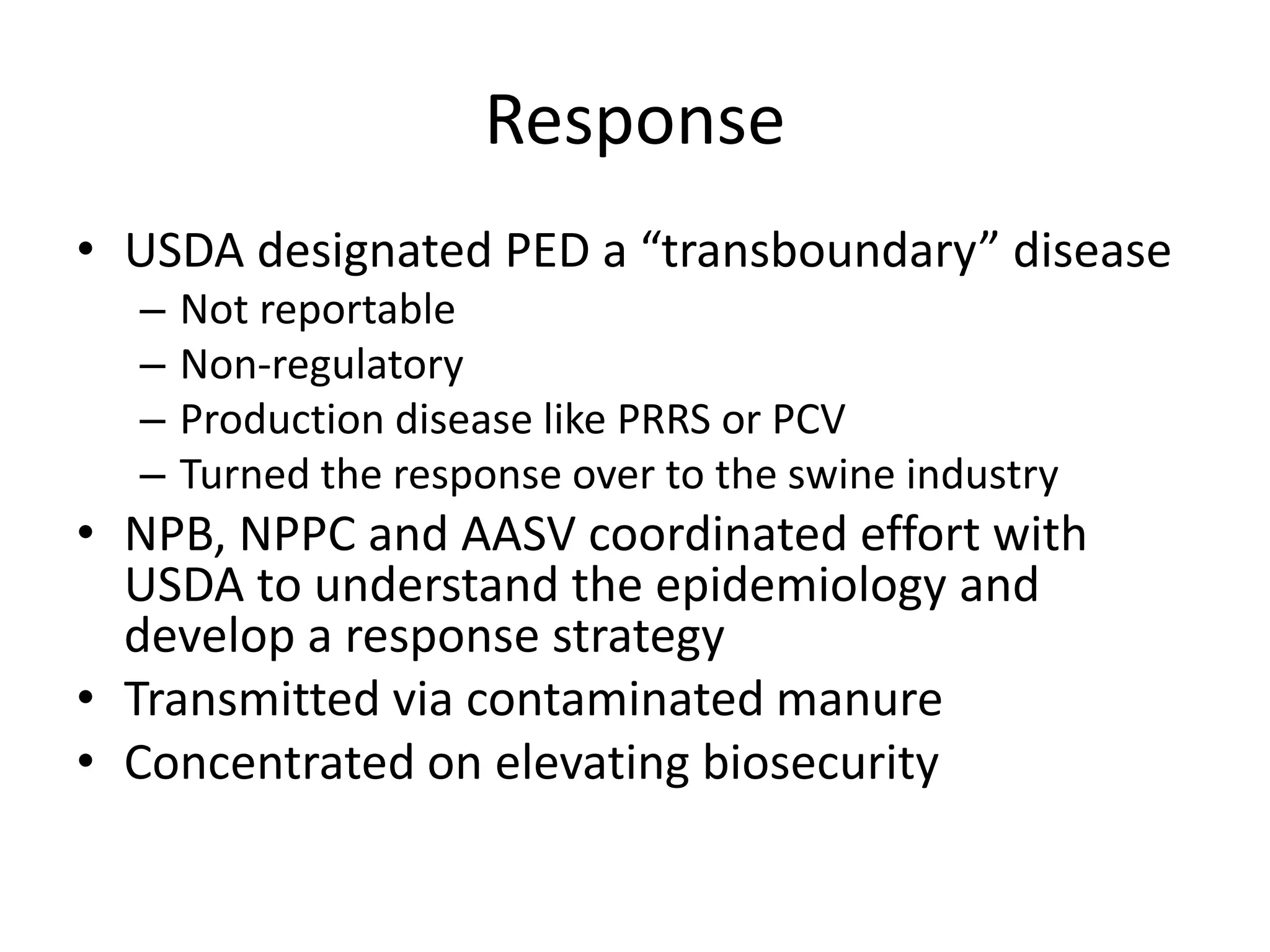
• USDA designated PED a “transboundary” disease
– Not reportable
– Non-regulatory
– Production disease like PRRS or PCV
– Turned the response over to the swine industry
• NPB, NPPC and AASV coordinated effort with
USDA to understand the epidemiology and
develop a response strategy
• Transmitted via contaminated manure
• Concentrated on elevating biosecurity
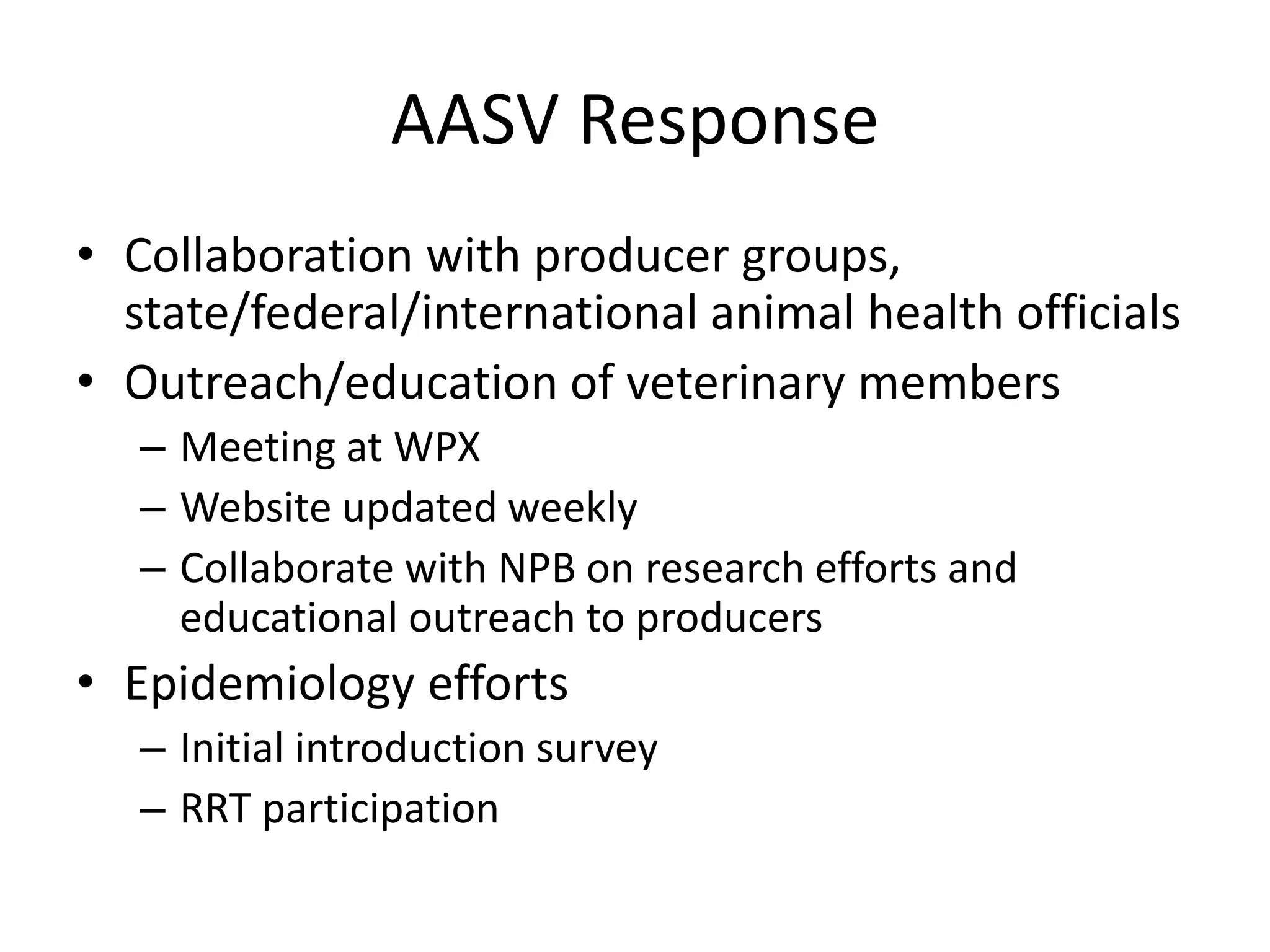
AASV Response
• Collaboration with producer groups,
state/federal/international animal health officials
• Outreach/education of veterinary members
– Meeting at WPX
– Website updated weekly
– Collaborate with NPB on research efforts and
educational outreach to producers
• Epidemiology efforts
– Initial introduction survey
– RRT participation
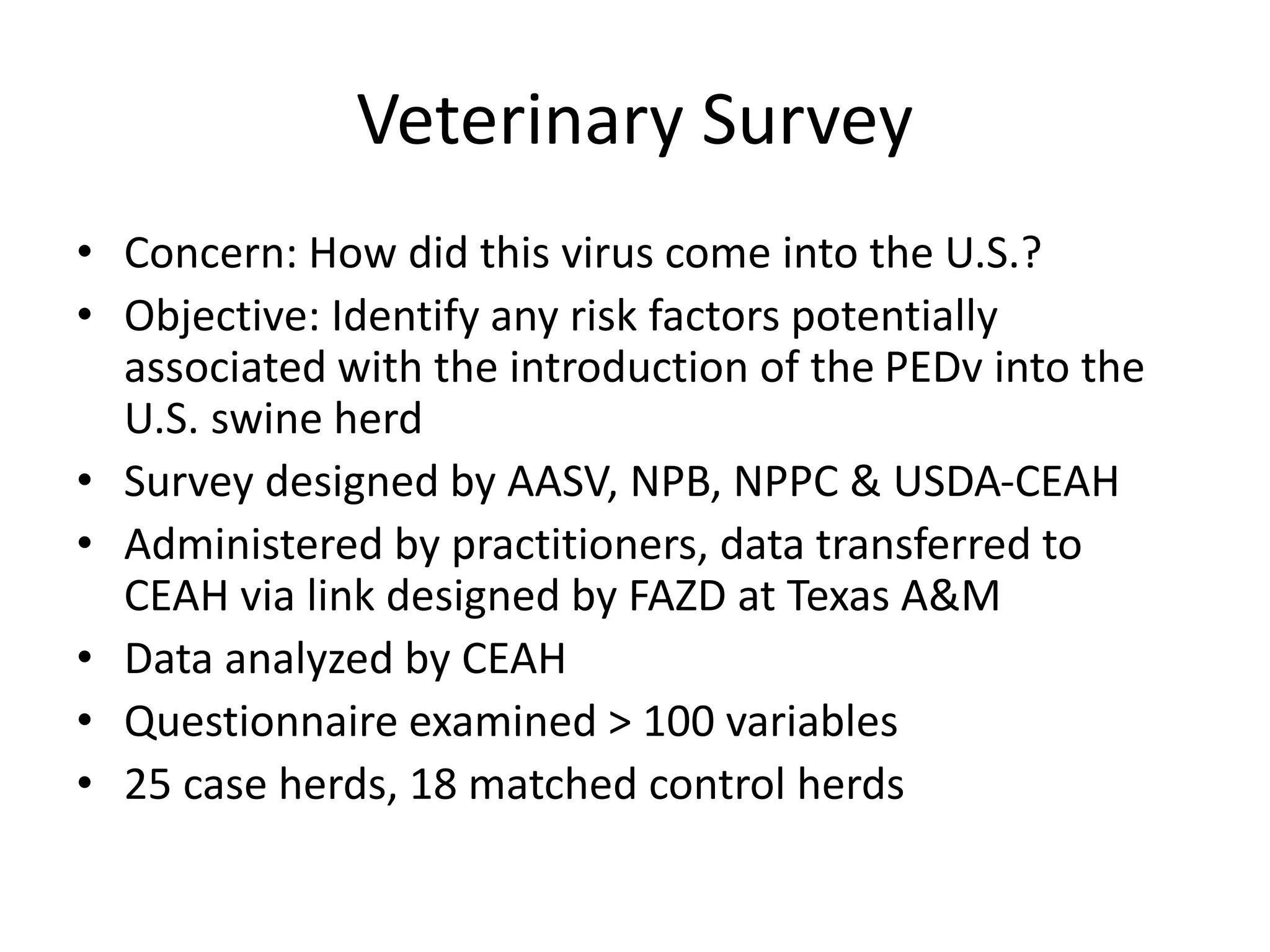
Veterinary Survey
• Concern: How did this virus come into the U.S.?
• Objective: Identify any risk factors potentially
associated with the introduction of the PEDv into the
U.S. swine herd
• Survey designed by AASV, NPB, NPPC & USDA-CEAH
• Administered by practitioners, data transferred to
CEAH via link designed by FAZD at Texas A&M
• Data analyzed by CEAH
• Questionnaire examined > 100 variables
• 25 case herds, 18 matched control herds
Survey Results
• Only seven variables were considered
significantly likely to have some association
with the introduction of PEDv
• These seven risk factors were associated with
the process of feeding the animals.
• Did not implicate any specific finished feed,
feed ingredient, feed manufacturer or
ingredient supplier.
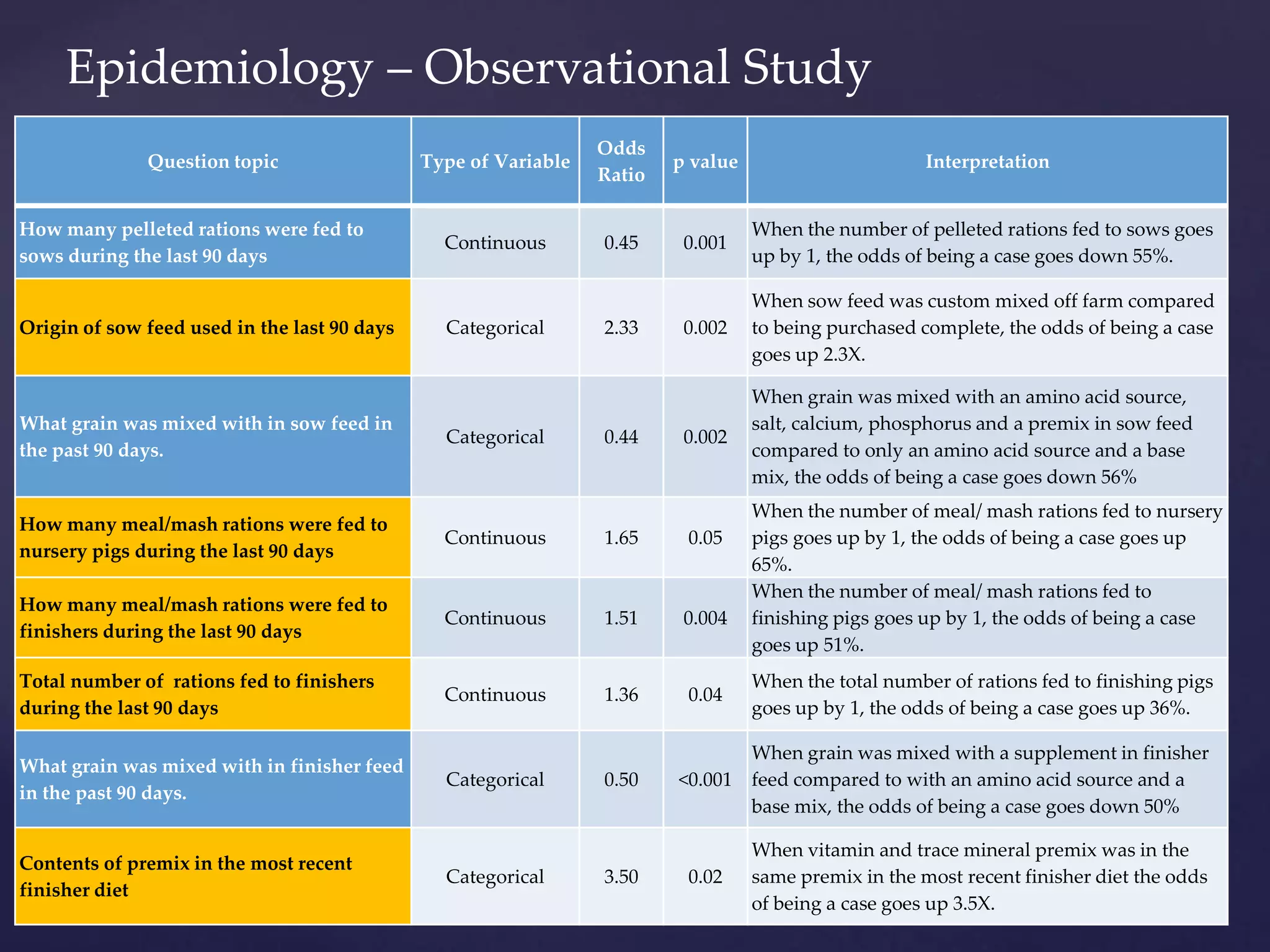
Epidemiology – Observational Study
Question topic Type of Variable
Odds
Ratio
p value Interpretation
How many pelleted rations were fed to
sows during the last 90 days
Continuous 0.45 0.001
When the number of pelleted rations fed to sows goes
up by 1, the odds of being a case goes down 55%.
Origin of sow feed used in the last 90 days Categorical 2.33 0.002
When sow feed was custom mixed off farm compared
to being purchased complete, the odds of being a case
goes up 2.3X.
What grain was mixed with in sow feed in
the past 90 days.
Categorical 0.44 0.002
When grain was mixed with an amino acid source,
salt, calcium, phosphorus and a premix in sow feed
compared to only an amino acid source and a base
mix, the odds of being a case goes down 56%
How many meal/mash rations were fed to
nursery pigs during the last 90 days
Continuous 1.65 0.05
When the number of meal/ mash rations fed to nursery
pigs goes up by 1, the odds of being a case goes up
65%.
How many meal/mash rations were fed to
finishers during the last 90 days
Continuous 1.51 0.004
When the number of meal/ mash rations fed to
finishing pigs goes up by 1, the odds of being a case
goes up 51%.
Total number of rations fed to finishers
during the last 90 days
Continuous 1.36 0.04
When the total number of rations fed to finishing pigs
goes up by 1, the odds of being a case goes up 36%.
What grain was mixed with in finisher feed
in the past 90 days.
Categorical 0.50 <0.001
When grain was mixed with a supplement in finisher
feed compared to with an amino acid source and a
base mix, the odds of being a case goes down 50%
Contents of premix in the most recent
finisher diet
Categorical 3.50 0.02
When vitamin and trace mineral premix was in the
same premix in the most recent finisher diet the odds
of being a case goes up 3.5X.
Response
• Development of 3 working groups
– Biocontainment
• How to limit spread off an infected premises
– Biosecurity Transport
• Review, modify, recommend biosecurity plans for transport,
shows/exhibitions, producers
– Packing Plant
• Recommend biosecurity principles for packing plants, buying
stations, etc
• These working groups have developed a number
of guides targeting biosecurity published on NPB
website
Research
• Pork Board -- $800,000 for PEDv research
– Rapid response to research call
– Research objectives
• Diagnosis
• Pathogenesis
• Environmental stability
• Epidemiology
• surveillance
– Shortened timeline
• 13 days to identify and initiate research projects
• Progress updates every two weeks
• Six month deadline
Research
• NPB, NPPC and AASV funded a study by Dr.
Jim Lowe to look at transmission in harvest
plant lairage.
Lairage Study
• Trailers do become contaminated at packing
plants due in part to movement of drivers
• The more contact that occurs, the higher the
rate of contamination
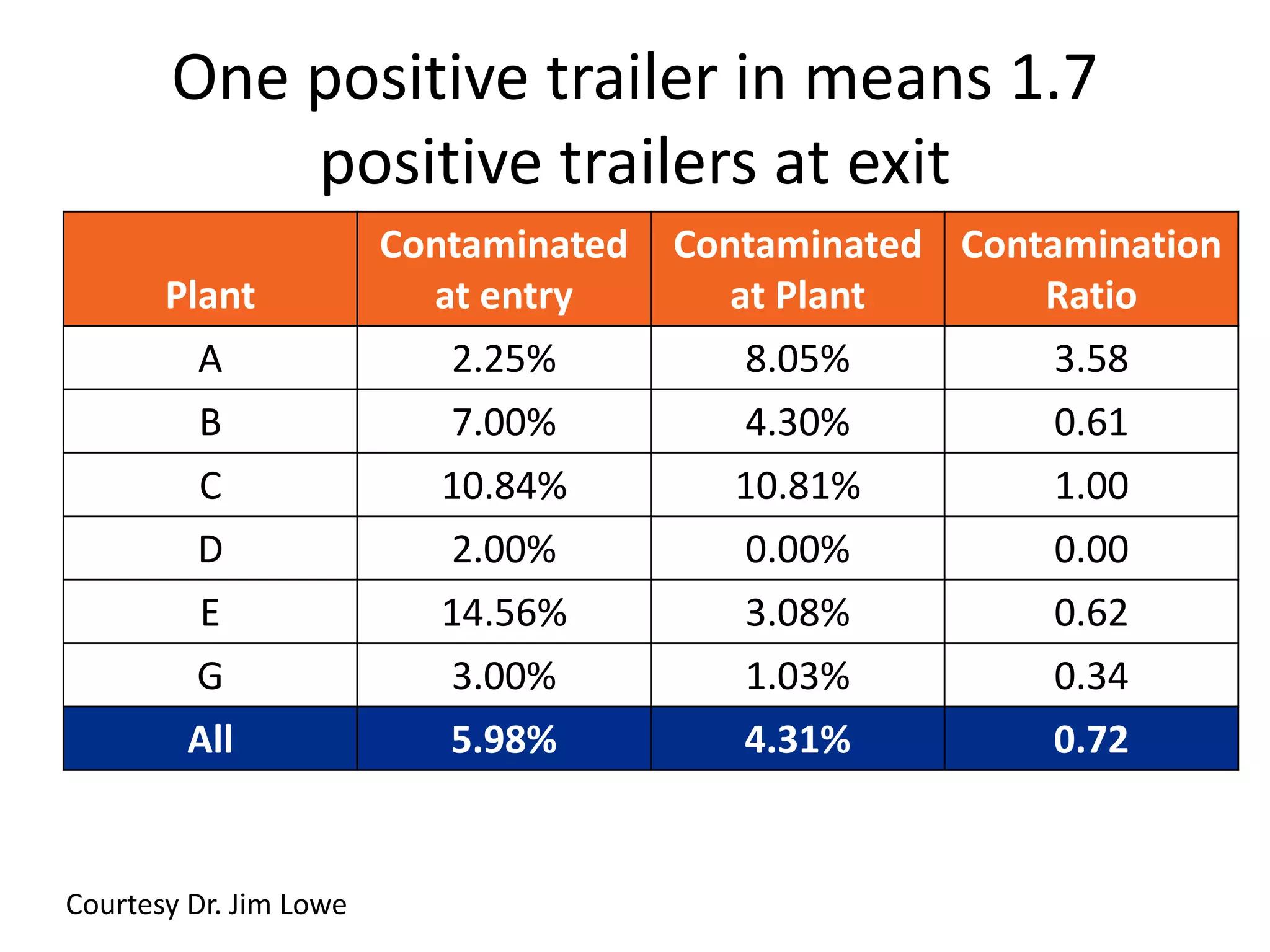
One positive trailer in means 1.7
positive trailers at exit
Plant
Contaminated
at entry
Contaminated
at Plant
Contamination
Ratio
A 2.25% 8.05% 3.58
B 7.00% 4.30% 0.61
C 10.84% 10.81% 1.00
D 2.00% 0.00% 0.00
E 14.56% 3.08% 0.62
G 3.00% 1.03% 0.34
All 5.98% 4.31% 0.72
Courtesy Dr. Jim Lowe
Research
• Dr. Matthew Turner surveyed cull sow buying
stations in NC
– Minimal biosecurity in place
– Virus present, likely transmission occurring
– Willingness on the part of the managers to make
changes
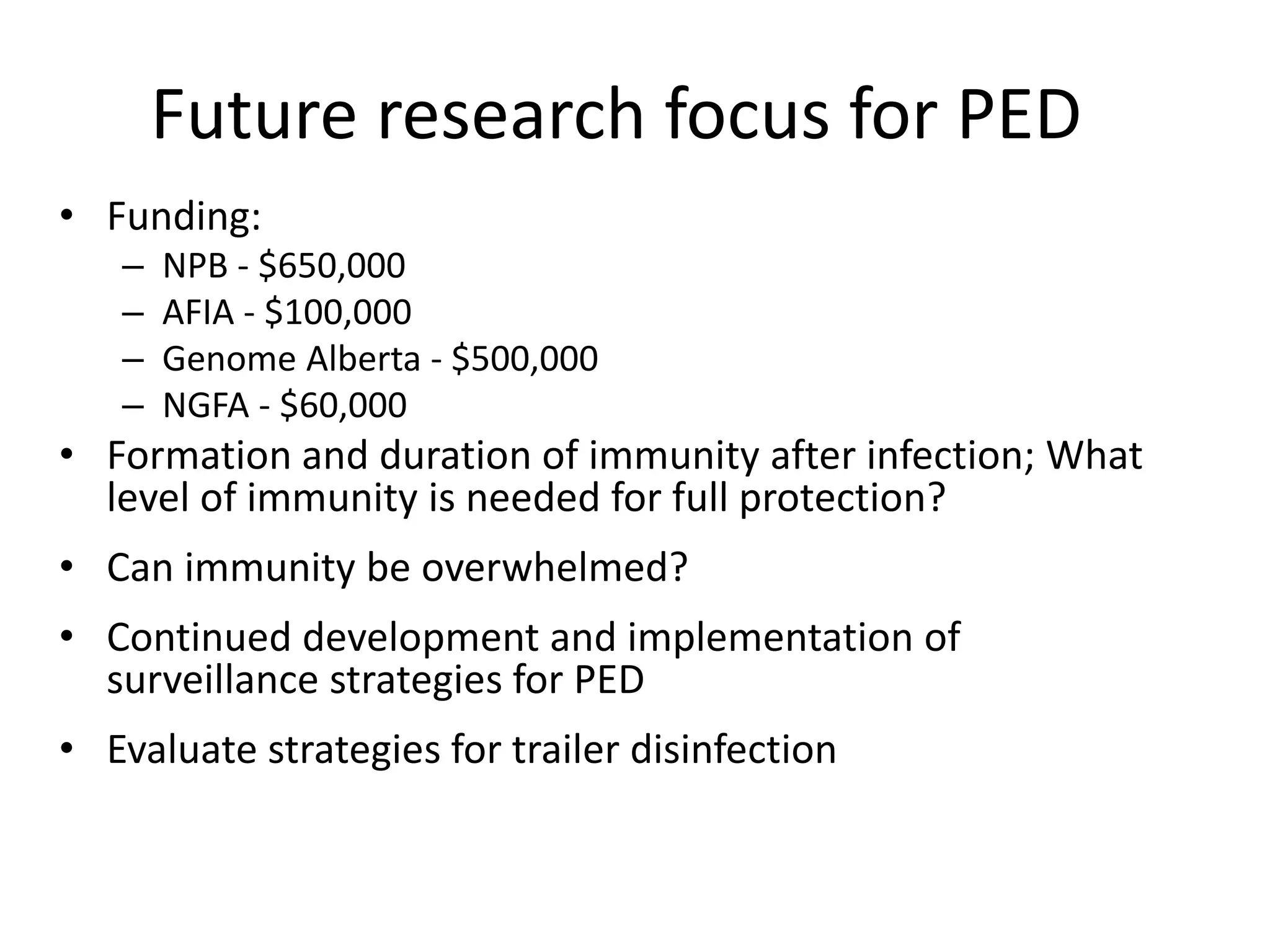
Future research focus for PED
• Funding:
– NPB - $650,000
– AFIA - $100,000
– Genome Alberta - $500,000
– NGFA - $60,000
• Formation and duration of immunity after infection; What
level of immunity is needed for full protection?
• Can immunity be overwhelmed?
• Continued development and implementation of
surveillance strategies for PED
• Evaluate strategies for trailer disinfection
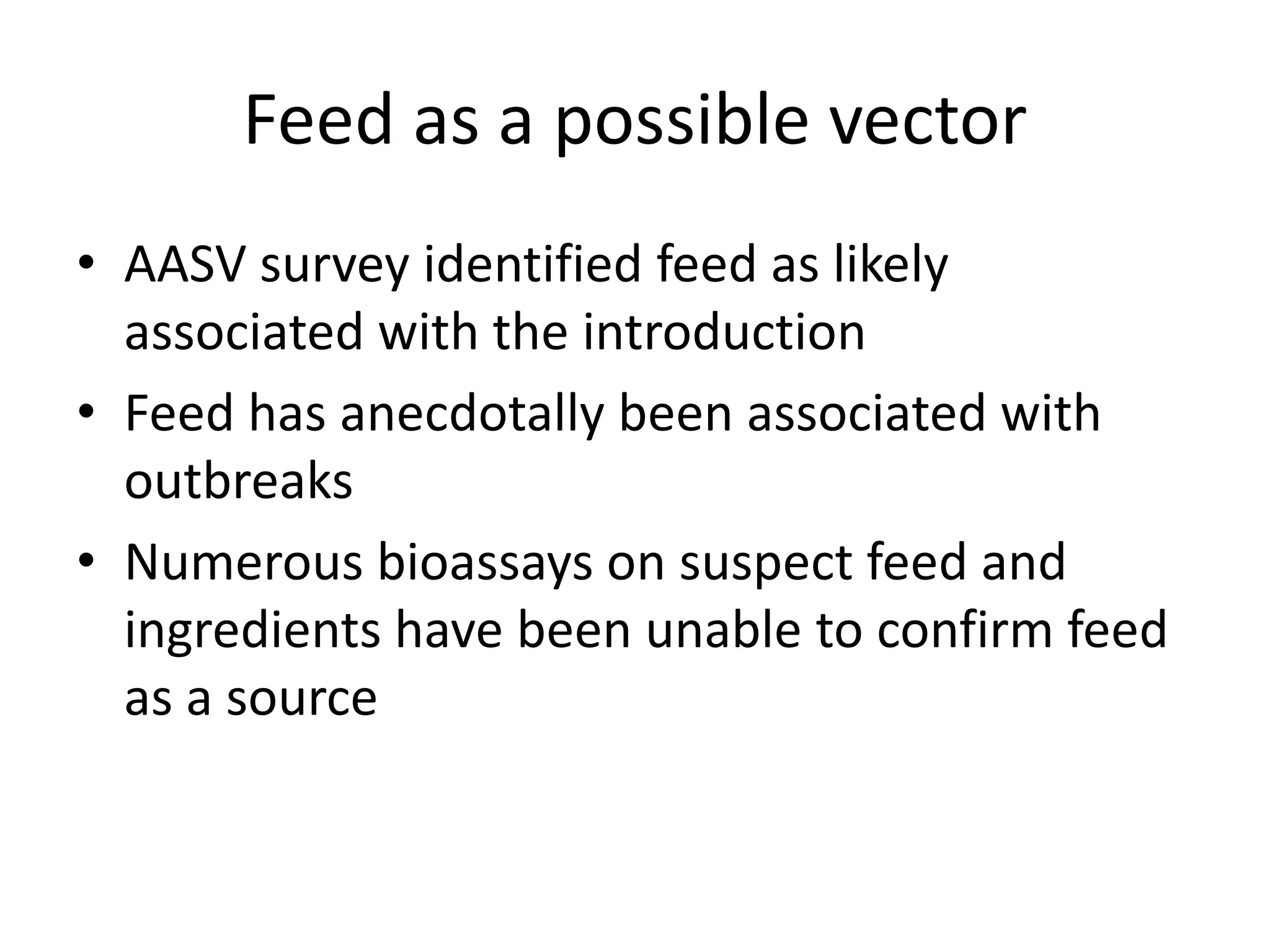
Feed as a possible vector
• AASV survey identified feed as likely
associated with the introduction
• Feed has anecdotally been associated with
outbreaks
• Numerous bioassays on suspect feed and
ingredients have been unable to confirm feed
as a source
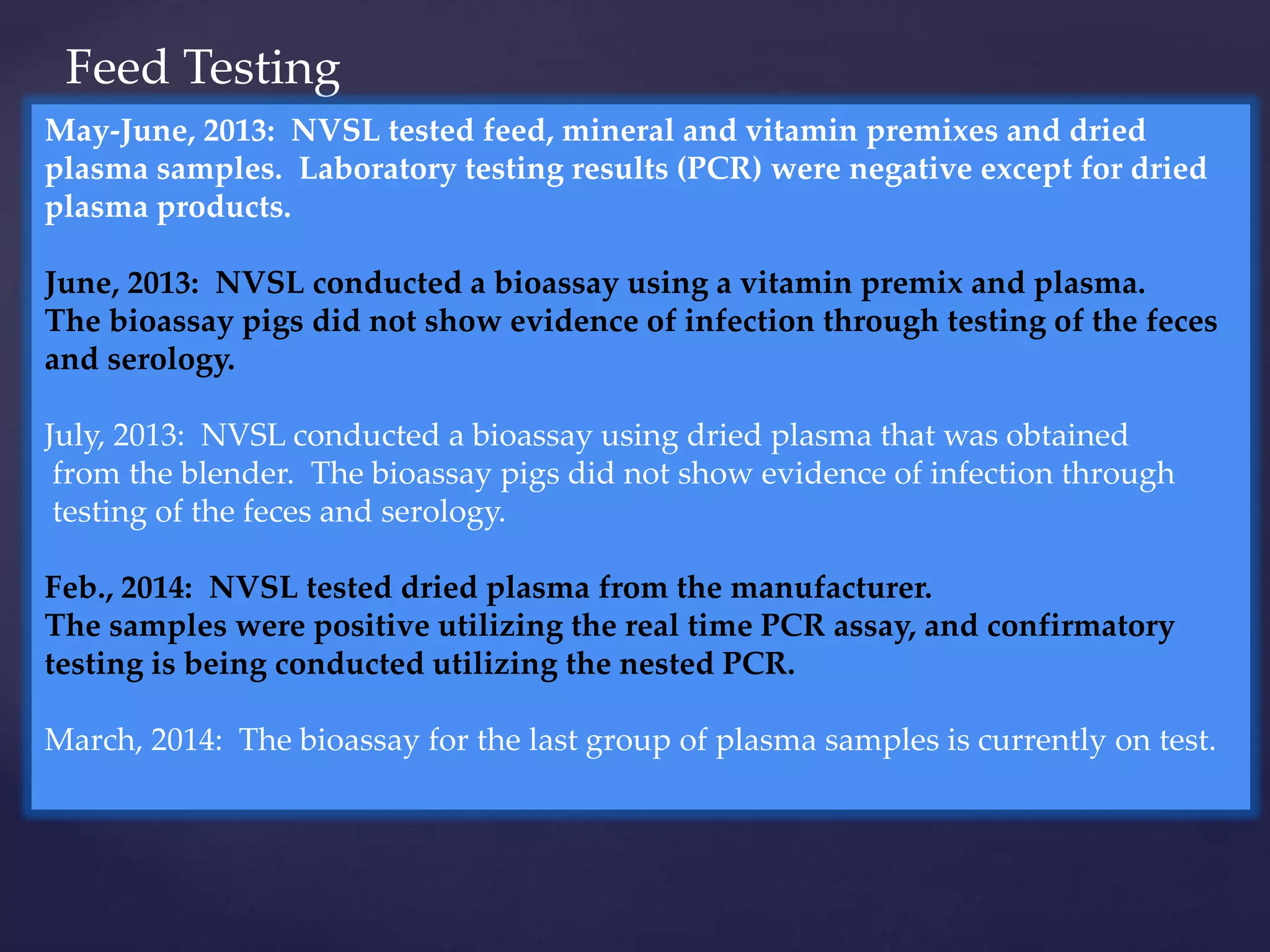
Feed Testing
May-June, 2013: NVSL tested feed, mineral and vitamin premixes and dried
plasma samples. Laboratory testing results (PCR) were negative except for dried
plasma products.
June, 2013: NVSL conducted a bioassay using a vitamin premix and plasma.
The bioassay pigs did not show evidence of infection through testing of the feces
and serology.
July, 2013: NVSL conducted a bioassay using dried plasma that was obtained
from the blender. The bioassay pigs did not show evidence of infection through
testing of the feces and serology.
Feb., 2014: NVSL tested dried plasma from the manufacturer.
The samples were positive utilizing the real time PCR assay, and confirmatory
testing is being conducted utilizing the nested PCR.
March, 2014: The bioassay for the last group of plasma samples is currently on test.
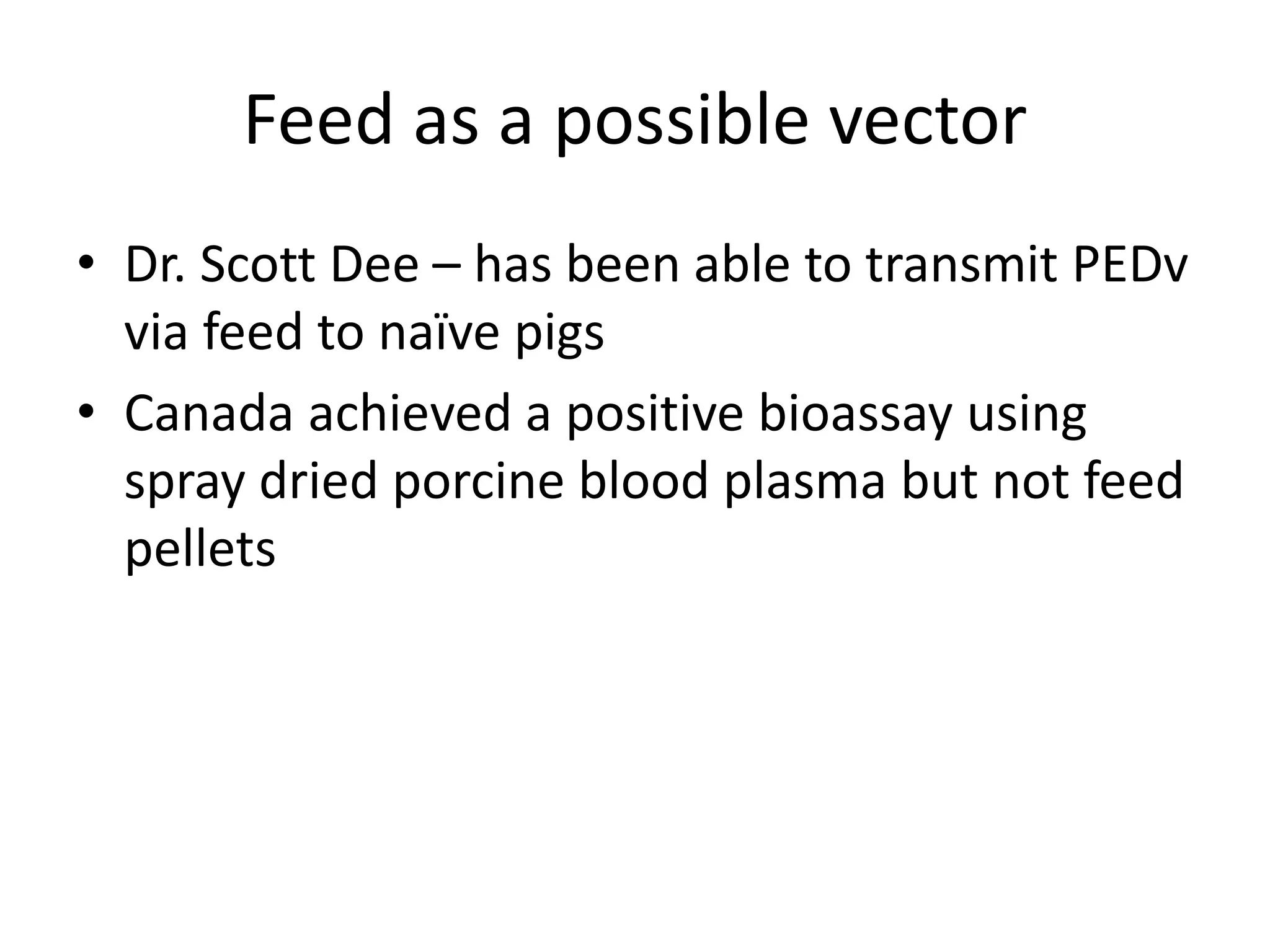
Feed as a possible vector
• Dr. Scott Dee – has been able to transmit PEDv
via feed to naïve pigs
• Canada achieved a positive bioassay using
spray dried porcine blood plasma but not feed
pellets
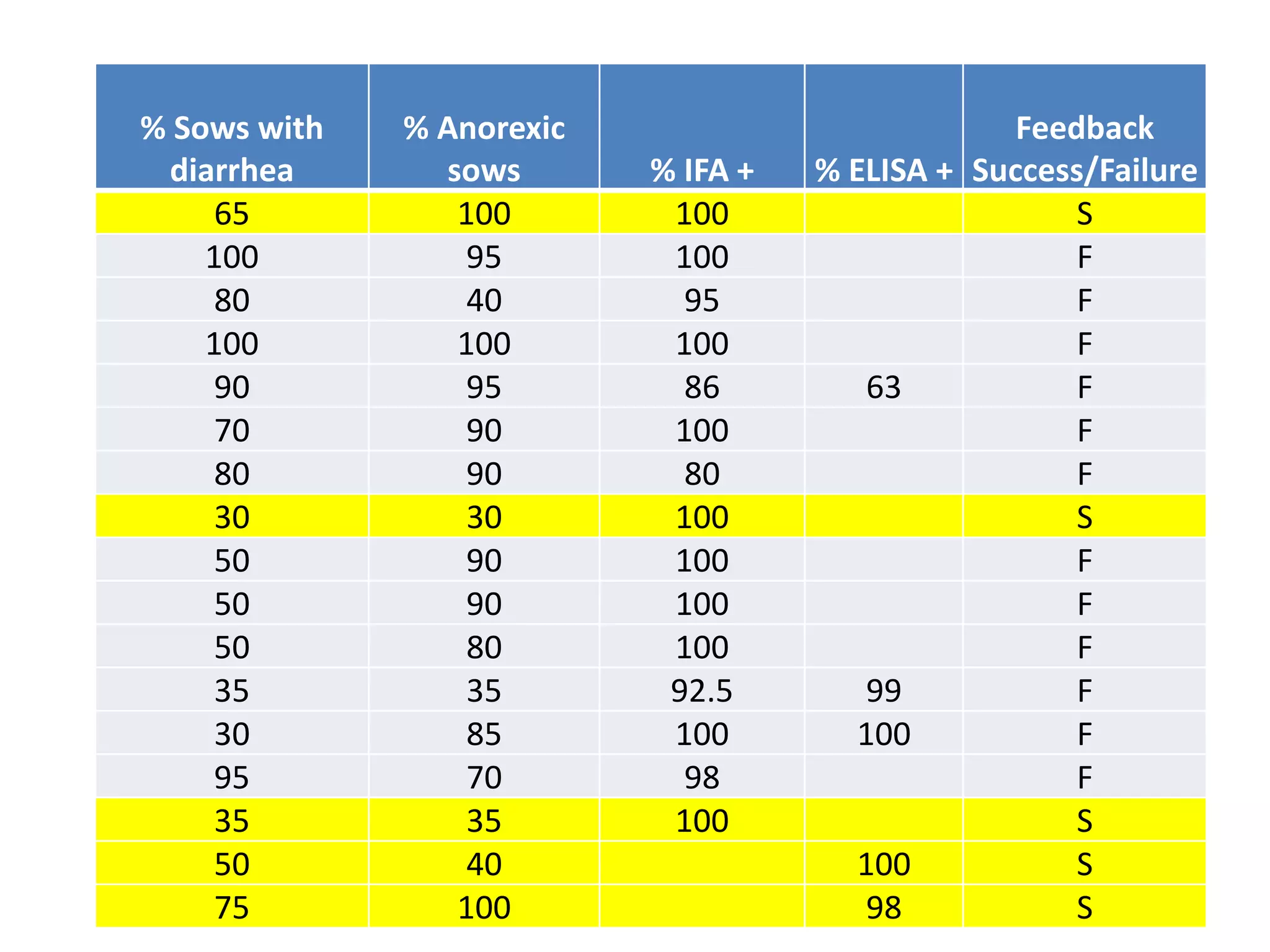
AASV FEEDBACK SURVEY
Preliminary Results
Feedback Survey
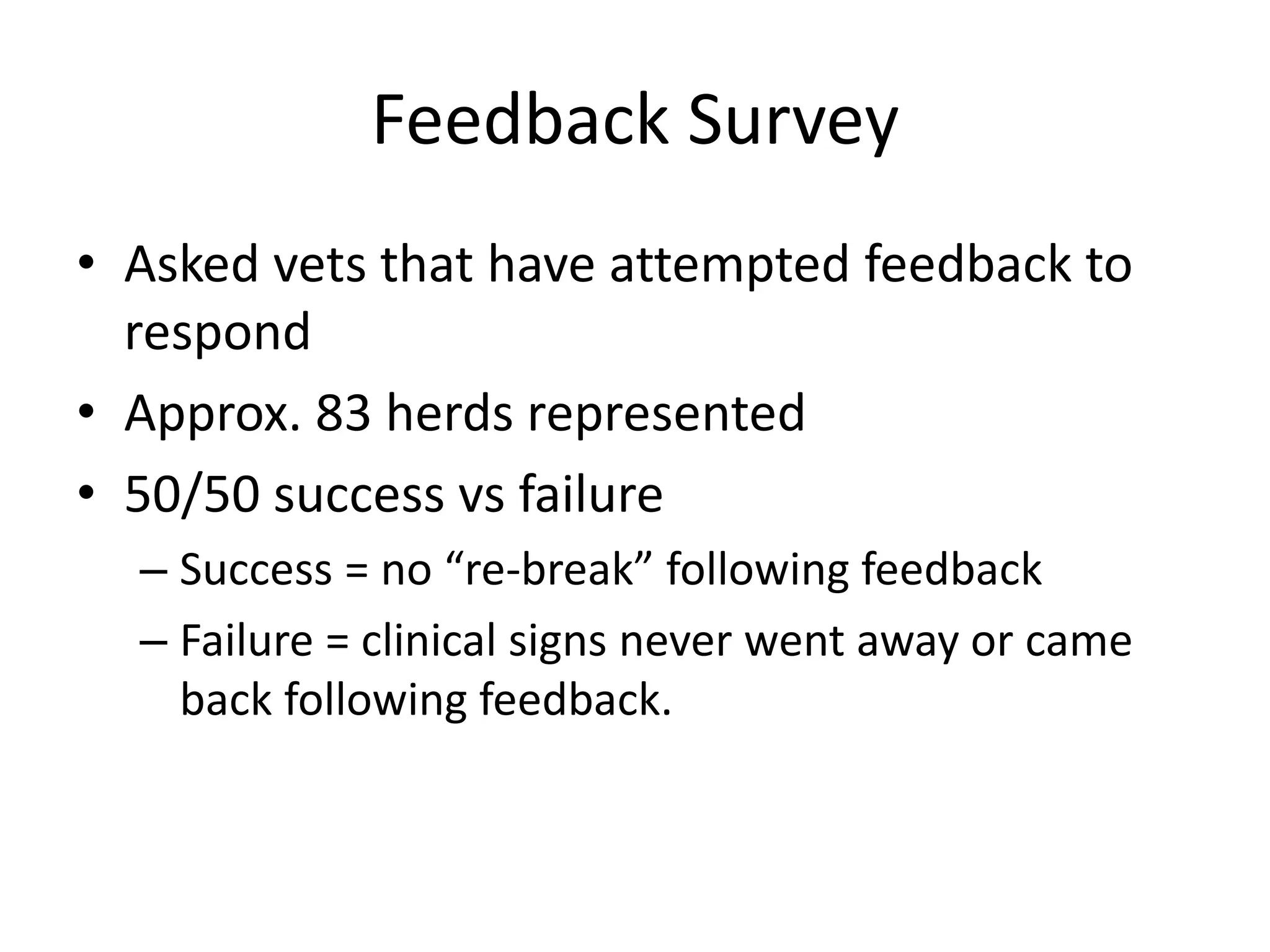
• Asked vets that have attempted feedback to
respond
• Approx. 83 herds represented
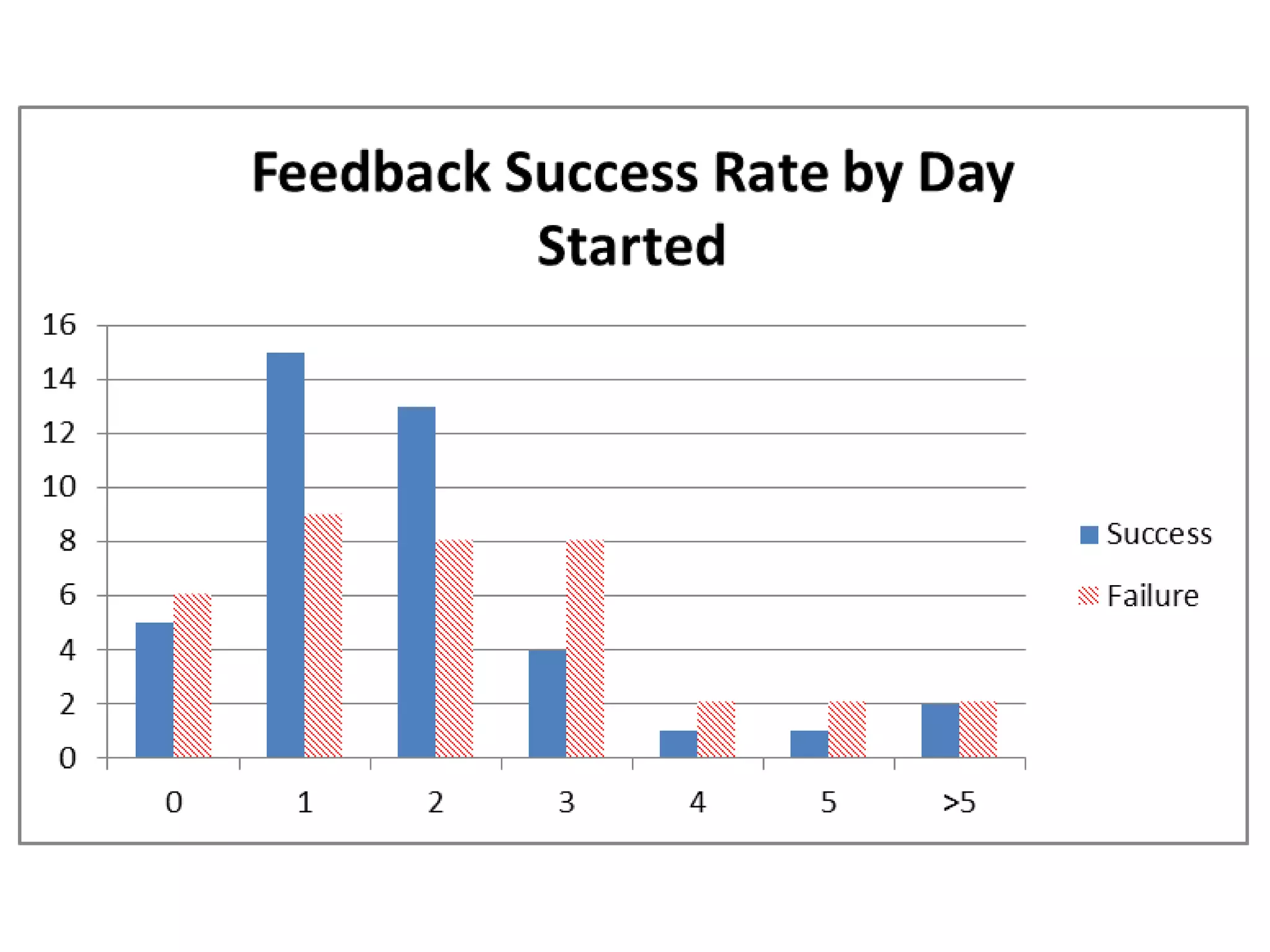
• 50/50 success vs failure
– Success = no “re-break” following feedback
– Failure = clinical signs never went away or came
back following feedback.
% Sows with
diarrhea
% Anorexic
sows % IFA + % ELISA +
Feedback
Success/Failure
65 100 100 S
100 95 100 F
80 40 95 F
100 100 100 F
90 95 86 63 F
70 90 100 F
80 90 80 F
30 30 100 S
50 90 100 F
50 90 100 F
50 80 100 F
35 35 92.5 99 F
30 85 100 100 F
95 70 98 F
35 35 100 S
50 40 100 S
75 100 98 S
Educational Outreach
• AASV.org
• Pork.org
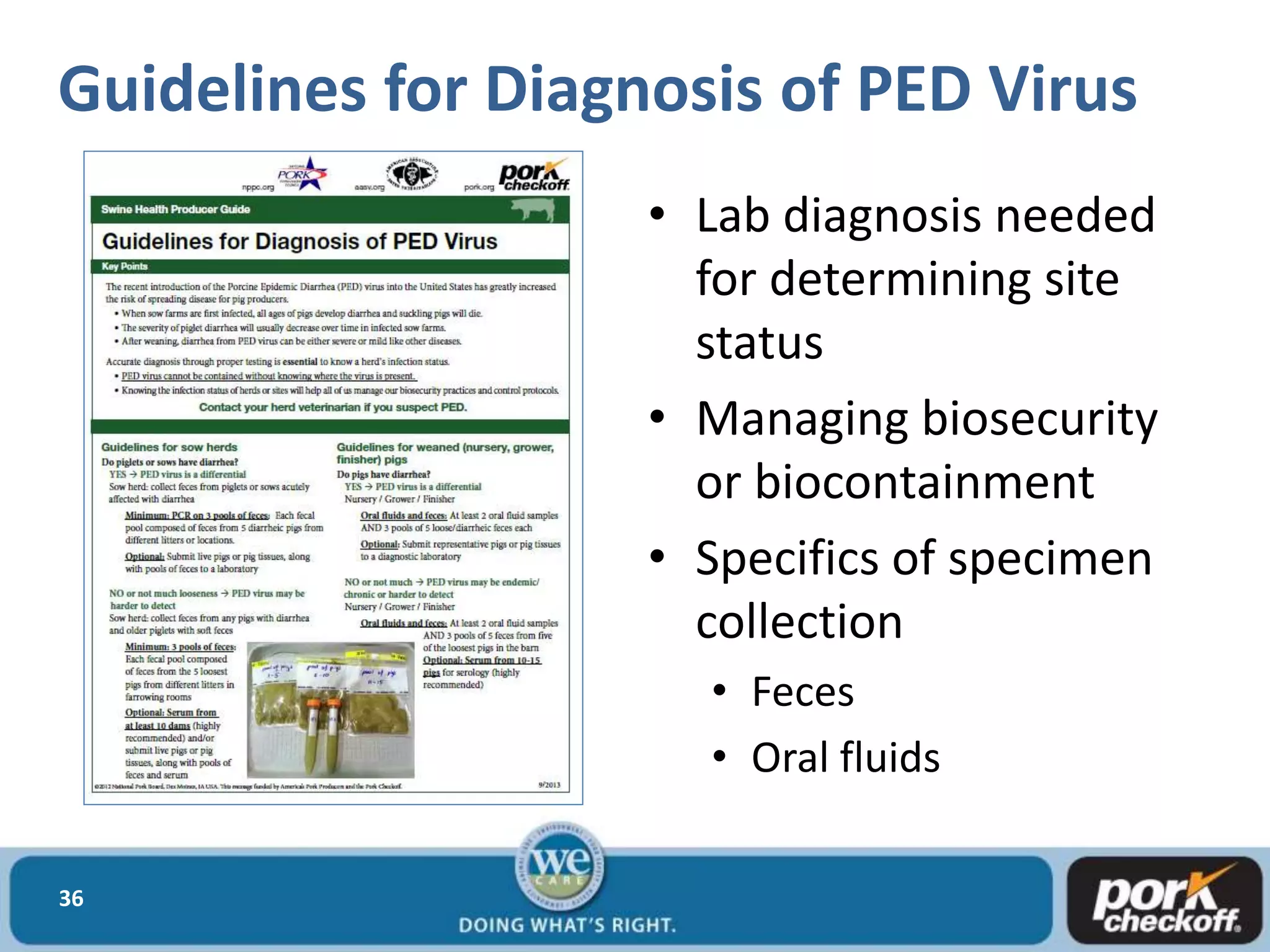
• Lab diagnosis needed
for determining site
status
• Managing biosecurity
or biocontainment
• Specifics of specimen
collection
• Feces
• Oral fluids
36
Guidelines for Diagnosis of PED Virus
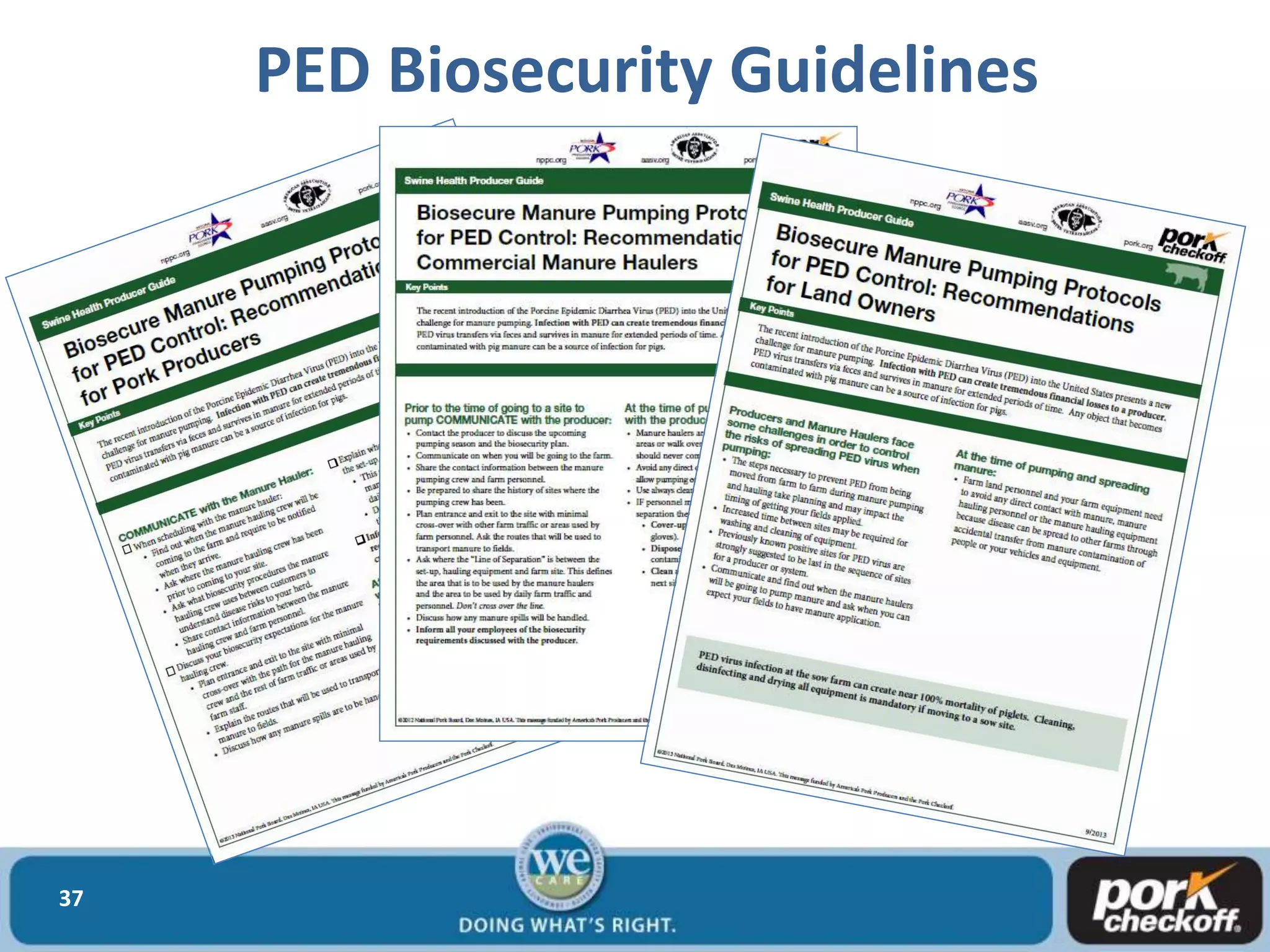
37
PED Biosecurity Guidelines
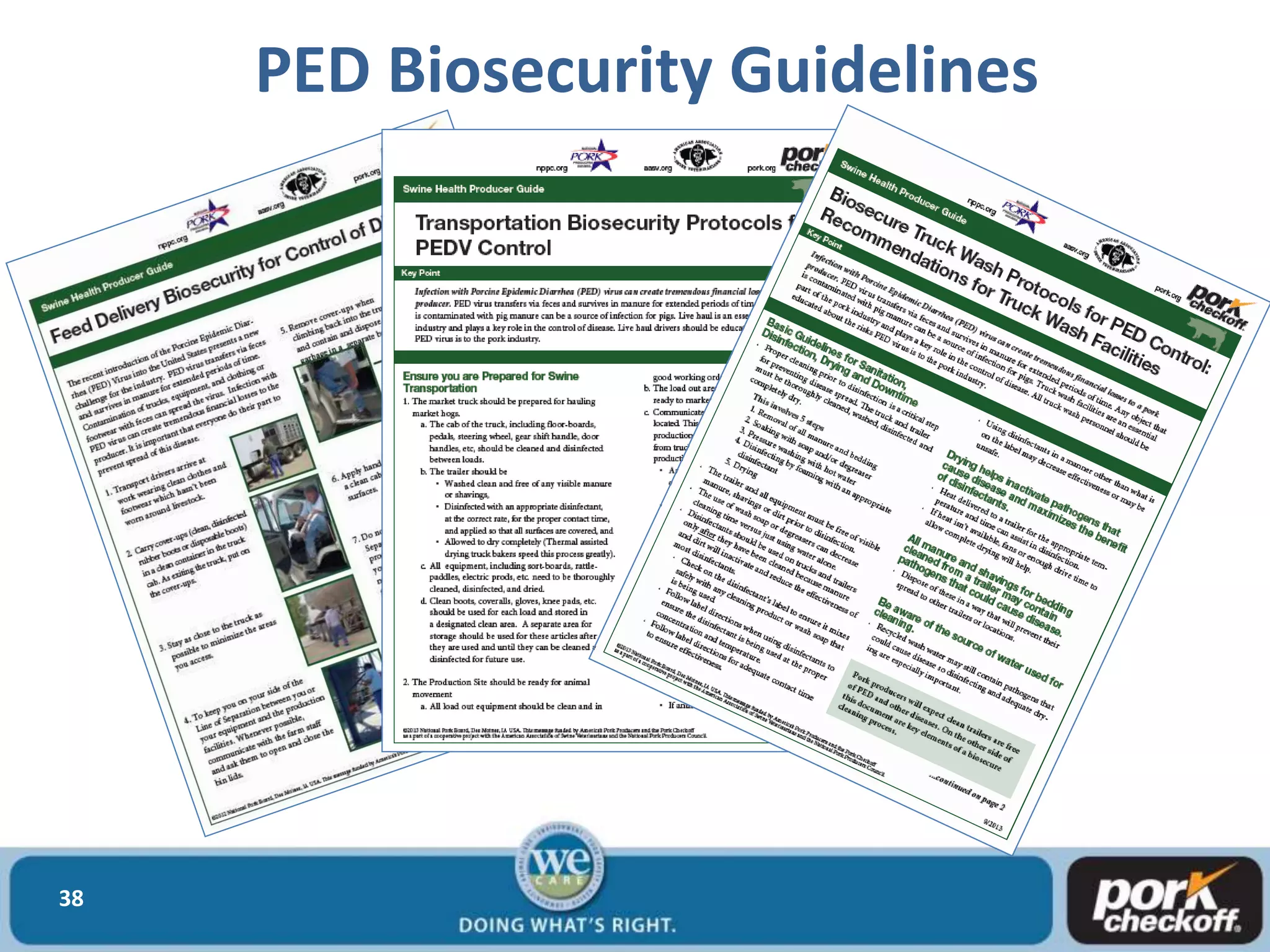
38
PED Biosecurity Guidelines
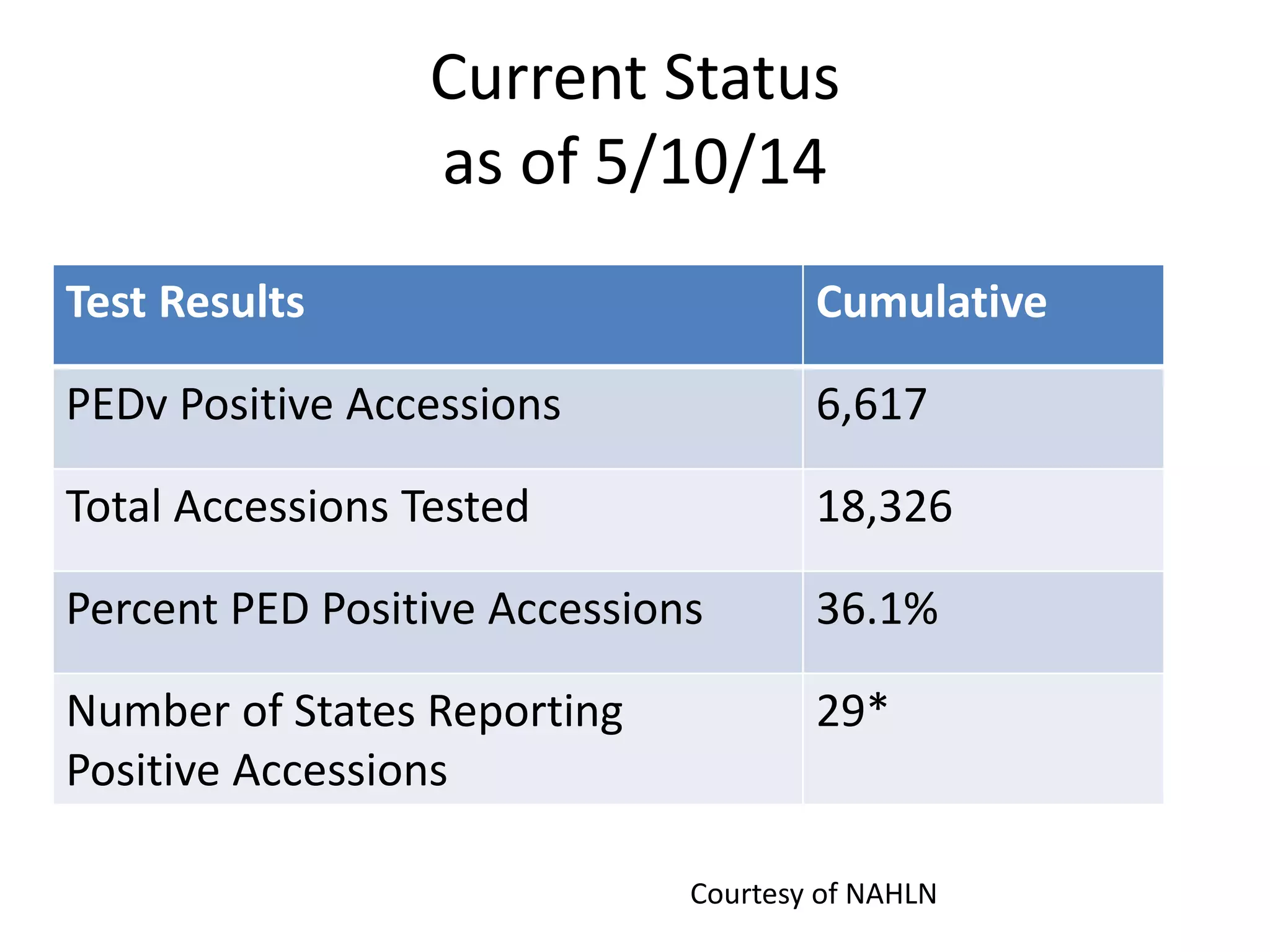
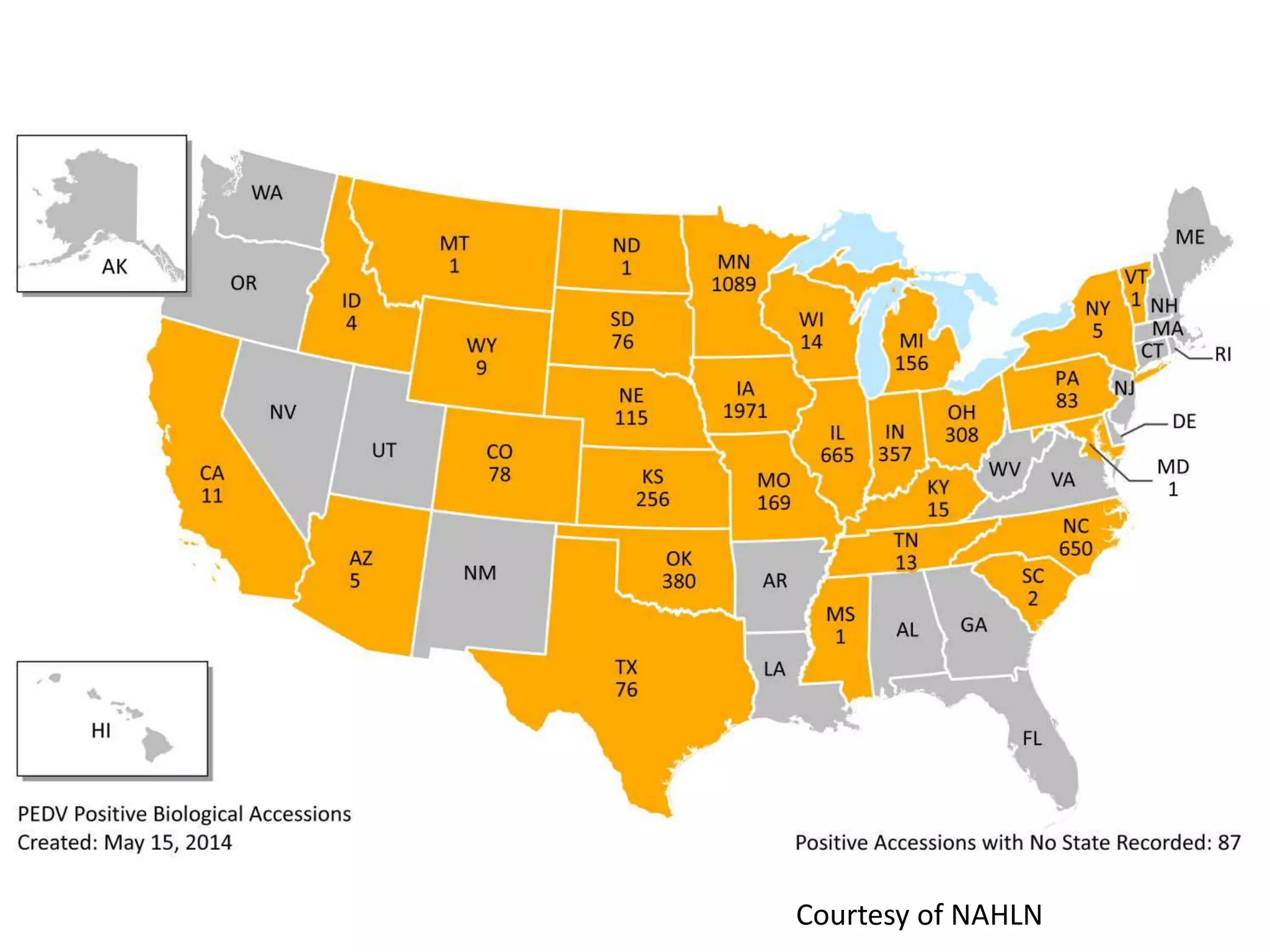
Current Status
as of 5/10/14
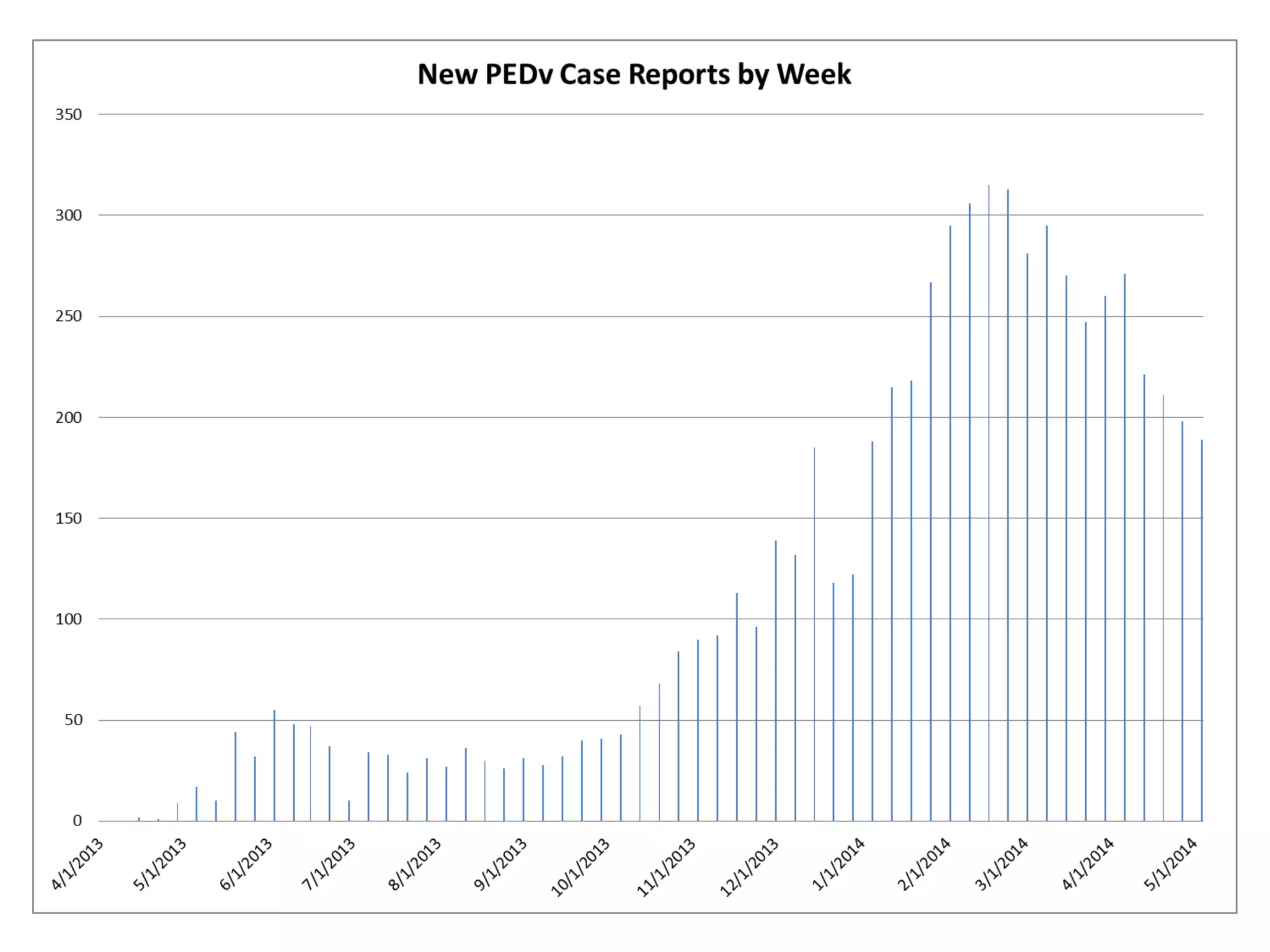
Test Results Cumulative
PEDv Positive Accessions 6,617
Total Accessions Tested 18,326
Percent PED Positive Accessions 36.1%
Number of States Reporting
Positive Accessions
29*
Courtesy of NAHLN
Courtesy of NAHLN
Canadian Experience
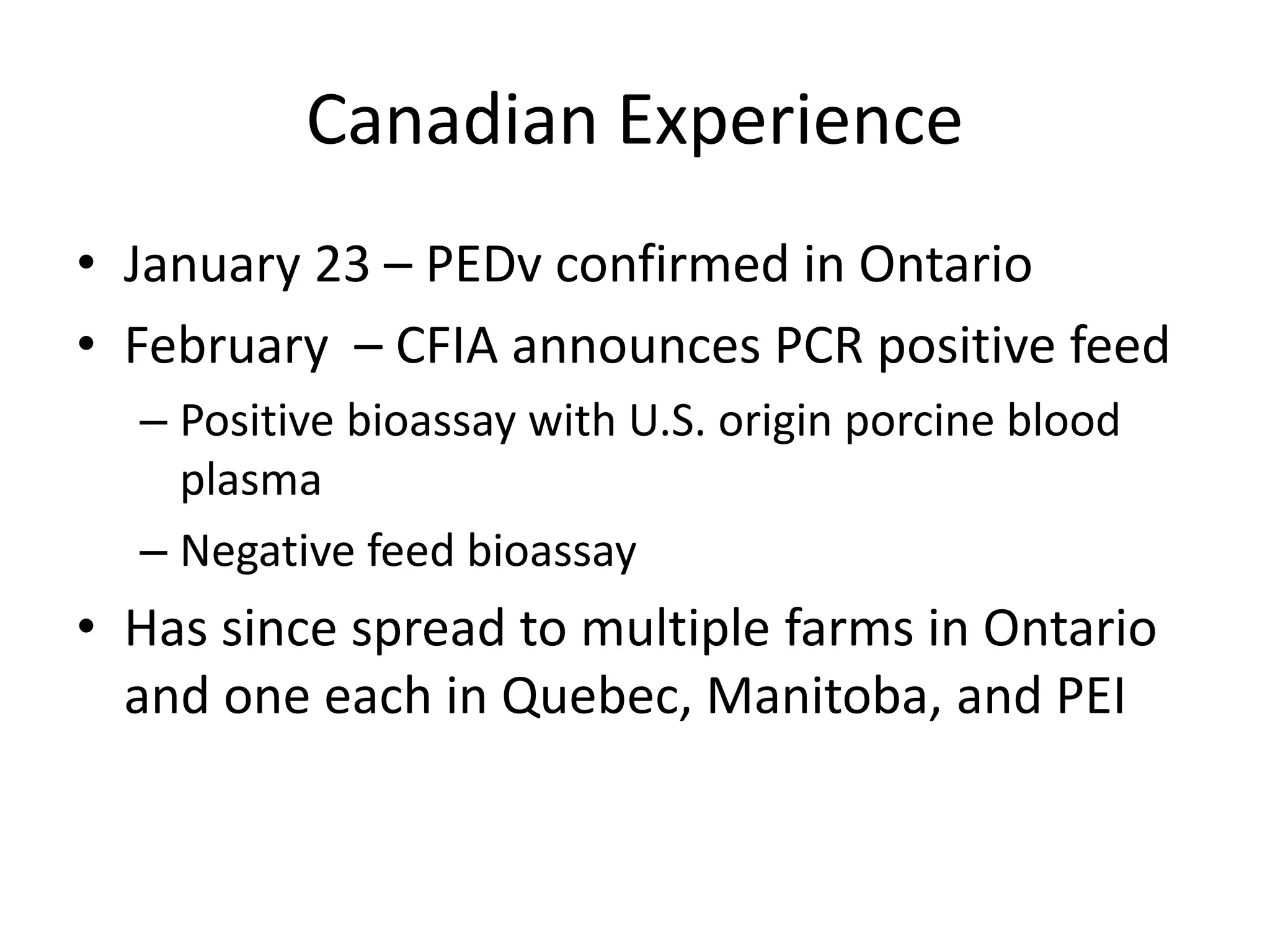
• January 23 – PEDv confirmed in Ontario
• February – CFIA announces PCR positive feed
– Positive bioassay with U.S. origin porcine blood
plasma
– Negative feed bioassay
• Has since spread to multiple farms in Ontario
and one each in Quebec, Manitoba, and PEI
What We’ve Learned
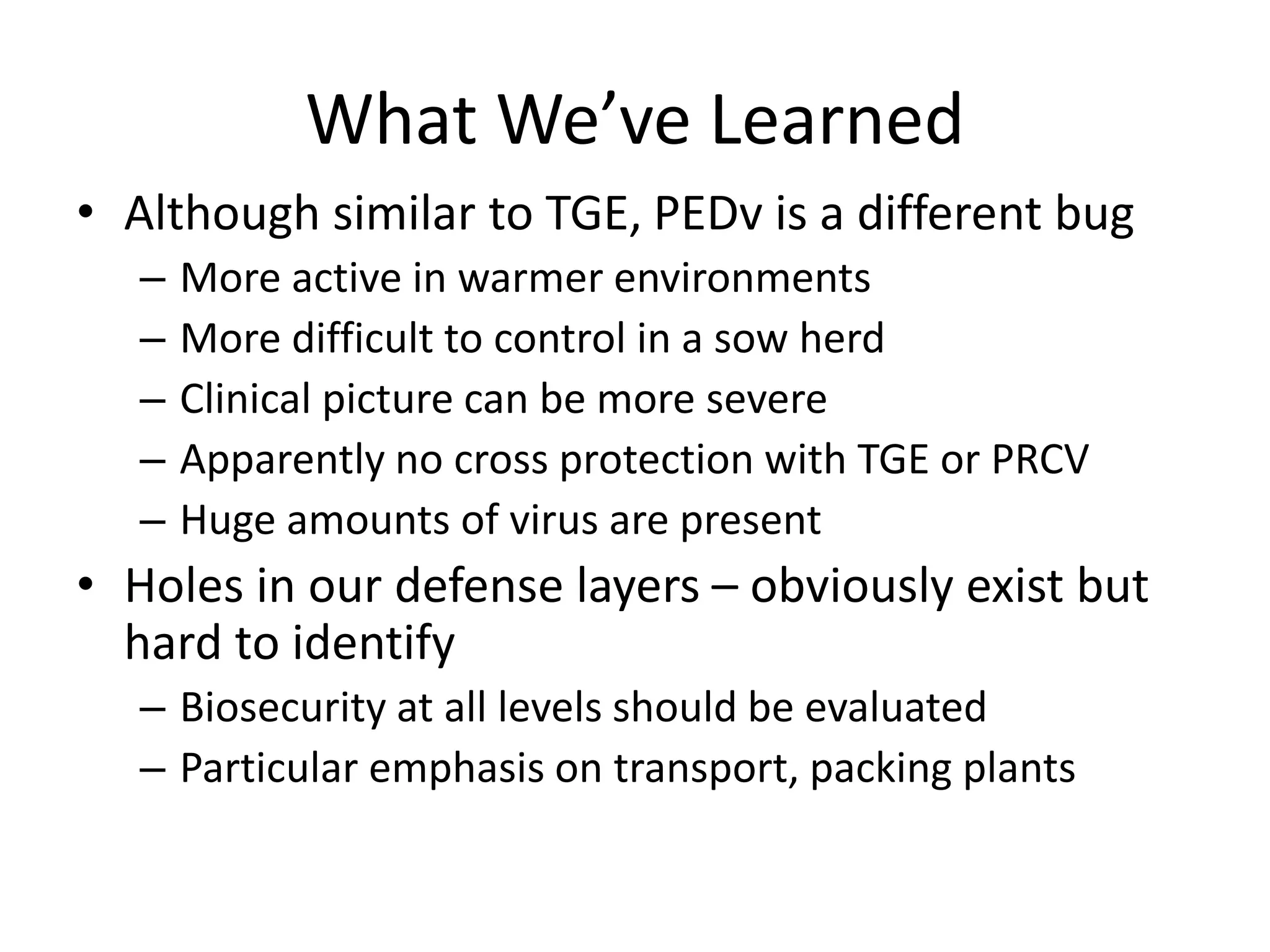
• Although similar to TGE, PEDv is a different bug
– More active in warmer environments
– More difficult to control in a sow herd
– Clinical picture can be more severe
– Apparently no cross protection with TGE or PRCV
– Huge amounts of virus are present
• Holes in our defense layers – obviously exist but
hard to identify
– Biosecurity at all levels should be evaluated
– Particular emphasis on transport, packing plants
What We’ve Learned
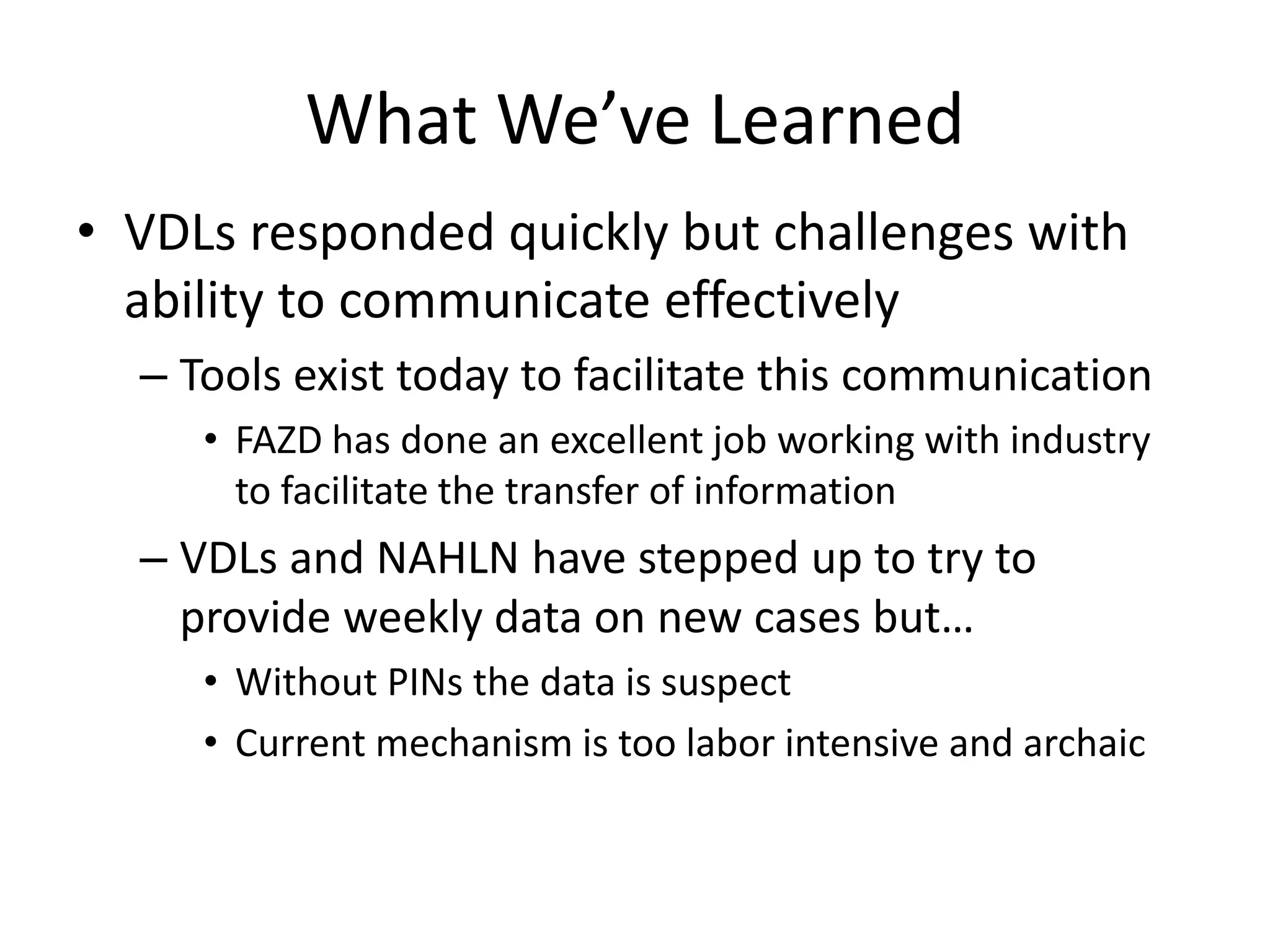
• VDLs responded quickly but challenges with
ability to communicate effectively
– Tools exist today to facilitate this communication
• FAZD has done an excellent job working with industry
to facilitate the transfer of information
– VDLs and NAHLN have stepped up to try to
provide weekly data on new cases but…
• Without PINs the data is suspect
• Current mechanism is too labor intensive and archaic
What We’ve Learned
• The use and ability to capture PINs would
significantly improve data sharing
• Challenges exist with defining roles
government and industry with transboundary
diseases
• We are seeing “rebreaks” in 30 – 40% of herds
• Swine Deltacoronavirus introduction???
Swine Deltacoronavirus
• Clinically looks like TGE/PED but tests negative
– Differential PCR available
• 1st seen in Hong Kong in 2012
• Identified in Ohio in February
• Identified in Canada in March
Acknowledgements
• Dr. Matt Ackerman – Swine Vet Services
• Dr. Rodger Main – ISU VDL
• Dr. Brian McCluskey – USDA CEAH
• Dr. Paul Sundberg -- NPB

Dr. Harry Snelson - PEDV - Lessons Learned

  • 1.
    Comprehensive Discussion of PEDv 2014Pork Management Conference June 19, 2014 Dr. Harry Snelson AASV
  • 2.
    Disease Discovery Looks likeTGE… Acts like TGE…. Ain’t TGE
  • 3.
    Sun Mon TuesWeds Thurs Fri Sat 28 29 30 1 2 3 4 5 1st Phone Call 6 1st Indiana – Sow Farm 7 2nd Indiana – Sow 8 Initial TGE PCR neg 9 IHC results neg – call vdl 10 EM pos for corona 11 12 13 14 15 16 NVSL confirms PEDV 17 USDA annou nes 18 19 20 21 22 23 24 25
  • 4.
    Sun Mon TuesWeds Thurs Fri Sat 28 29 30 1 May 2 3 4 5 6 7 8 9 10 11 12 13 14 15 16 17 4 cases known (3 in IA, 1 in IN) 18 19 20 21 22 23 24 25 26 27 28 29 30 31 1
  • 5.
    Veterinary Diagnostic Laboratory IowaState UniversityOutcome of retrospective testing & on-boarding PEDV PCR SUNDAY MONDAY TUESDAY WEDNESDAY THURSDAY FRIDAY SATURDAY (TOTALS) 15 APRIL 16 OH – GF 17 18 19 20 1 GF 21 22 23 24 25 26 IN – GF 27 1 GF 28 29 IA (W. Central) – SOW 30 IA (NE) – SOW OH – GF IA – GF 1 MAY IA – GF 2 IA – GF 3 IA – GF 4 4 GF 2 SOW 5 6 IA (NW) – SOW 7 IA – GF IA – GF 8 IN – SOW MN – SOW IA – GF 9 IA – GF IA – GF IA – GF 10 CO (Eastern) – SOW IA – GF IN – ?? IN – ?? PA – ?? 11 7 GF 4 SOW 3 UNKNOWN 12 13 MN – GF 14 CO – SOW MN – GF 15 MN – SOW MN – GF 16 IA – SOW 17 IA – SOW IA – SOW IA – GF 18 4 GF 5 SOW (31 actual cases) 19 20 IA – SOW IN – SOW IN – SOW IA – GF MN – GF MN – GF 21 CO – GF IA – GF IA – GF IA – GF IA – GF IA – GF IA – GF IA – GF IA – GF IA – GF MN – GF OH – GF 22 CO – SOW CO – SOW IA – GF IA – GF IA – GF IA – GF IA – GF IA – GF IA – GF OK – GF 23 IA – SOW IA – SOW GF OH MN – ?? 24 IA – GF IA – GF IA – GF IA – GF IA – GF CO – GF CO – GF MN – GF MN – GF MO – GF MN – ?? 25 34 GF 7 SOW 2 UNKNOWN
  • 6.
    Veterinary Diagnostic Laboratory IowaState University PEDV Positive Cases Ascertained from Multiple VDLs Week Received @ VDL Total Number of PEDv Positive Diagnostic Case Submissions (Premises) via PCR or IHC Farm Type CO IA IL IN KS MI MN MO NC NY OH OK PA SD ? Sow Growing Pig ? 4/15/2013 (1), 2 0 1 1 4/22/2013 (1), 1 0 1 1 4/29/2013 (6), 9 2 4 5 1 5/6/2013 (14) , 17 4 7 3 1 8 3 1 1 5/13/2013 (9), 10 5 3 1 1 4 4 5/20/2013 (43), 44 7 33 3 5 25 2 7 1 2 1 Total (74), 83 18 49 7 7 42 6 12 1 11 1 1 * for the weeks prior to 6-17-13, laboratories were able to provide diagnostic case submissions and number of premises testing positive for PEDv. Starting 6-17-13, the data are limited to ONLY diagnostic case submission numbers (aka Swine Accessions)
  • 7.
    Clinical Signs • Clinicallyindistinguishable from TGE – Alpha coronavirus – Fecal-oral pathogen – Profuse diarrhea and vomiting – High mortality rates in neonatal pigs – High morbidity, lower mortality as pigs age • Not zoonotic, not a food safety concern
  • 8.
    Diagnostics • PCR –ready quickly • Serology – IFA – ELISA • No VI – virus is difficult to grow • Bioassay to prove infectivity/viability – Time consuming – Expensive – Lacks sensitivity
  • 12.
  • 13.
    PED virus • Newto North America • In Europe in 1970’s • Current virus present in Asia – U.S. virus 99+ % similar to 2012 isolate from Anhui Province in China • U.S. swine herd naïve, 100% susceptible • No vaccine • Easily transmitted
  • 14.
    Response • USDA designatedPED a “transboundary” disease – Not reportable – Non-regulatory – Production disease like PRRS or PCV – Turned the response over to the swine industry • NPB, NPPC and AASV coordinated effort with USDA to understand the epidemiology and develop a response strategy • Transmitted via contaminated manure • Concentrated on elevating biosecurity
  • 15.
    AASV Response • Collaborationwith producer groups, state/federal/international animal health officials • Outreach/education of veterinary members – Meeting at WPX – Website updated weekly – Collaborate with NPB on research efforts and educational outreach to producers • Epidemiology efforts – Initial introduction survey – RRT participation
  • 16.
    Veterinary Survey • Concern:How did this virus come into the U.S.? • Objective: Identify any risk factors potentially associated with the introduction of the PEDv into the U.S. swine herd • Survey designed by AASV, NPB, NPPC & USDA-CEAH • Administered by practitioners, data transferred to CEAH via link designed by FAZD at Texas A&M • Data analyzed by CEAH • Questionnaire examined > 100 variables • 25 case herds, 18 matched control herds
  • 17.
    Survey Results • Onlyseven variables were considered significantly likely to have some association with the introduction of PEDv • These seven risk factors were associated with the process of feeding the animals. • Did not implicate any specific finished feed, feed ingredient, feed manufacturer or ingredient supplier.
  • 18.
    Epidemiology – ObservationalStudy Question topic Type of Variable Odds Ratio p value Interpretation How many pelleted rations were fed to sows during the last 90 days Continuous 0.45 0.001 When the number of pelleted rations fed to sows goes up by 1, the odds of being a case goes down 55%. Origin of sow feed used in the last 90 days Categorical 2.33 0.002 When sow feed was custom mixed off farm compared to being purchased complete, the odds of being a case goes up 2.3X. What grain was mixed with in sow feed in the past 90 days. Categorical 0.44 0.002 When grain was mixed with an amino acid source, salt, calcium, phosphorus and a premix in sow feed compared to only an amino acid source and a base mix, the odds of being a case goes down 56% How many meal/mash rations were fed to nursery pigs during the last 90 days Continuous 1.65 0.05 When the number of meal/ mash rations fed to nursery pigs goes up by 1, the odds of being a case goes up 65%. How many meal/mash rations were fed to finishers during the last 90 days Continuous 1.51 0.004 When the number of meal/ mash rations fed to finishing pigs goes up by 1, the odds of being a case goes up 51%. Total number of rations fed to finishers during the last 90 days Continuous 1.36 0.04 When the total number of rations fed to finishing pigs goes up by 1, the odds of being a case goes up 36%. What grain was mixed with in finisher feed in the past 90 days. Categorical 0.50 <0.001 When grain was mixed with a supplement in finisher feed compared to with an amino acid source and a base mix, the odds of being a case goes down 50% Contents of premix in the most recent finisher diet Categorical 3.50 0.02 When vitamin and trace mineral premix was in the same premix in the most recent finisher diet the odds of being a case goes up 3.5X.
  • 19.
    Response • Development of3 working groups – Biocontainment • How to limit spread off an infected premises – Biosecurity Transport • Review, modify, recommend biosecurity plans for transport, shows/exhibitions, producers – Packing Plant • Recommend biosecurity principles for packing plants, buying stations, etc • These working groups have developed a number of guides targeting biosecurity published on NPB website
  • 20.
    Research • Pork Board-- $800,000 for PEDv research – Rapid response to research call – Research objectives • Diagnosis • Pathogenesis • Environmental stability • Epidemiology • surveillance – Shortened timeline • 13 days to identify and initiate research projects • Progress updates every two weeks • Six month deadline
  • 21.
    Research • NPB, NPPCand AASV funded a study by Dr. Jim Lowe to look at transmission in harvest plant lairage.
  • 22.
    Lairage Study • Trailersdo become contaminated at packing plants due in part to movement of drivers • The more contact that occurs, the higher the rate of contamination
  • 23.
    One positive trailerin means 1.7 positive trailers at exit Plant Contaminated at entry Contaminated at Plant Contamination Ratio A 2.25% 8.05% 3.58 B 7.00% 4.30% 0.61 C 10.84% 10.81% 1.00 D 2.00% 0.00% 0.00 E 14.56% 3.08% 0.62 G 3.00% 1.03% 0.34 All 5.98% 4.31% 0.72 Courtesy Dr. Jim Lowe
  • 24.
    Research • Dr. MatthewTurner surveyed cull sow buying stations in NC – Minimal biosecurity in place – Virus present, likely transmission occurring – Willingness on the part of the managers to make changes
  • 25.
    Future research focusfor PED • Funding: – NPB - $650,000 – AFIA - $100,000 – Genome Alberta - $500,000 – NGFA - $60,000 • Formation and duration of immunity after infection; What level of immunity is needed for full protection? • Can immunity be overwhelmed? • Continued development and implementation of surveillance strategies for PED • Evaluate strategies for trailer disinfection
  • 26.
    Feed as apossible vector • AASV survey identified feed as likely associated with the introduction • Feed has anecdotally been associated with outbreaks • Numerous bioassays on suspect feed and ingredients have been unable to confirm feed as a source
  • 27.
    Feed Testing May-June, 2013:NVSL tested feed, mineral and vitamin premixes and dried plasma samples. Laboratory testing results (PCR) were negative except for dried plasma products. June, 2013: NVSL conducted a bioassay using a vitamin premix and plasma. The bioassay pigs did not show evidence of infection through testing of the feces and serology. July, 2013: NVSL conducted a bioassay using dried plasma that was obtained from the blender. The bioassay pigs did not show evidence of infection through testing of the feces and serology. Feb., 2014: NVSL tested dried plasma from the manufacturer. The samples were positive utilizing the real time PCR assay, and confirmatory testing is being conducted utilizing the nested PCR. March, 2014: The bioassay for the last group of plasma samples is currently on test.
  • 28.
    Feed as apossible vector • Dr. Scott Dee – has been able to transmit PEDv via feed to naïve pigs • Canada achieved a positive bioassay using spray dried porcine blood plasma but not feed pellets
  • 29.
  • 30.
    Feedback Survey • Askedvets that have attempted feedback to respond • Approx. 83 herds represented • 50/50 success vs failure – Success = no “re-break” following feedback – Failure = clinical signs never went away or came back following feedback.
  • 34.
    % Sows with diarrhea %Anorexic sows % IFA + % ELISA + Feedback Success/Failure 65 100 100 S 100 95 100 F 80 40 95 F 100 100 100 F 90 95 86 63 F 70 90 100 F 80 90 80 F 30 30 100 S 50 90 100 F 50 90 100 F 50 80 100 F 35 35 92.5 99 F 30 85 100 100 F 95 70 98 F 35 35 100 S 50 40 100 S 75 100 98 S
  • 35.
  • 36.
    • Lab diagnosisneeded for determining site status • Managing biosecurity or biocontainment • Specifics of specimen collection • Feces • Oral fluids 36 Guidelines for Diagnosis of PED Virus
  • 37.
  • 38.
  • 39.
    Current Status as of5/10/14 Test Results Cumulative PEDv Positive Accessions 6,617 Total Accessions Tested 18,326 Percent PED Positive Accessions 36.1% Number of States Reporting Positive Accessions 29* Courtesy of NAHLN
  • 40.
  • 42.
    Canadian Experience • January23 – PEDv confirmed in Ontario • February – CFIA announces PCR positive feed – Positive bioassay with U.S. origin porcine blood plasma – Negative feed bioassay • Has since spread to multiple farms in Ontario and one each in Quebec, Manitoba, and PEI
  • 43.
    What We’ve Learned •Although similar to TGE, PEDv is a different bug – More active in warmer environments – More difficult to control in a sow herd – Clinical picture can be more severe – Apparently no cross protection with TGE or PRCV – Huge amounts of virus are present • Holes in our defense layers – obviously exist but hard to identify – Biosecurity at all levels should be evaluated – Particular emphasis on transport, packing plants
  • 44.
    What We’ve Learned •VDLs responded quickly but challenges with ability to communicate effectively – Tools exist today to facilitate this communication • FAZD has done an excellent job working with industry to facilitate the transfer of information – VDLs and NAHLN have stepped up to try to provide weekly data on new cases but… • Without PINs the data is suspect • Current mechanism is too labor intensive and archaic
  • 45.
    What We’ve Learned •The use and ability to capture PINs would significantly improve data sharing • Challenges exist with defining roles government and industry with transboundary diseases • We are seeing “rebreaks” in 30 – 40% of herds • Swine Deltacoronavirus introduction???
  • 46.
    Swine Deltacoronavirus • Clinicallylooks like TGE/PED but tests negative – Differential PCR available • 1st seen in Hong Kong in 2012 • Identified in Ohio in February • Identified in Canada in March
  • 47.
    Acknowledgements • Dr. MattAckerman – Swine Vet Services • Dr. Rodger Main – ISU VDL • Dr. Brian McCluskey – USDA CEAH • Dr. Paul Sundberg -- NPB