The document contains notes on trigonometric graphs and functions. It discusses the amplitude and period of trigonometric graphs, defines radians and relates them to degrees, provides exact values of trigonometric functions at common angles, explains the four quadrants used to measure angles, and gives examples of solving trigonometric equations both graphically and algebraically using properties of the quadrants.
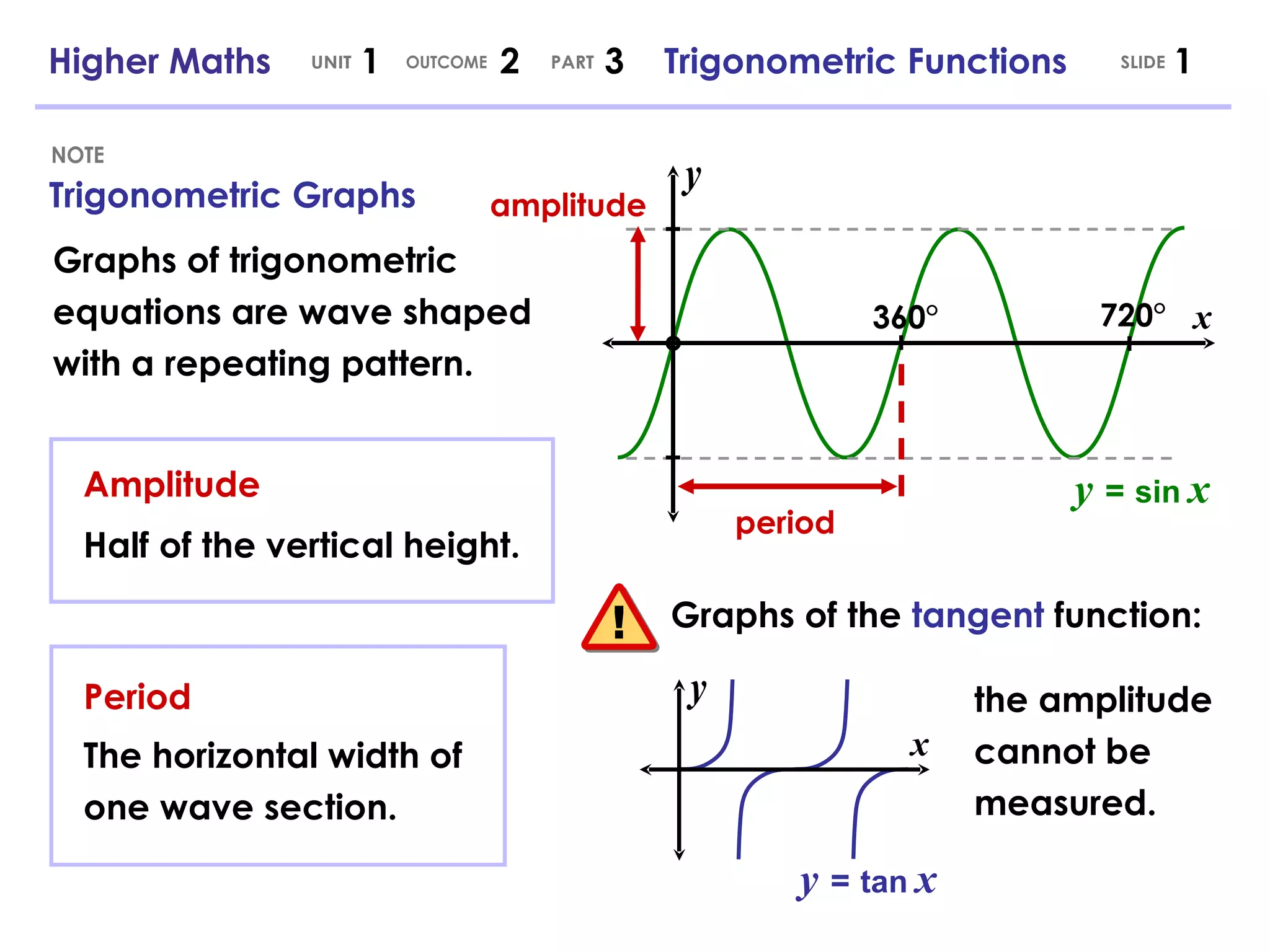
360° Trigonometric GraphsNOTE Higher Maths 1 2 3 Trigonometric Functions UNIT OUTCOME SLIDE PART x y y = sin x Half of the vertical height. Amplitude The horizontal width of one wave section. Period Graphs of trigonometric equations are wave shaped with a repeating pattern. 720° amplitude period y = tan x x y Graphs of the tangent function: the amplitude cannot be measured.
2.
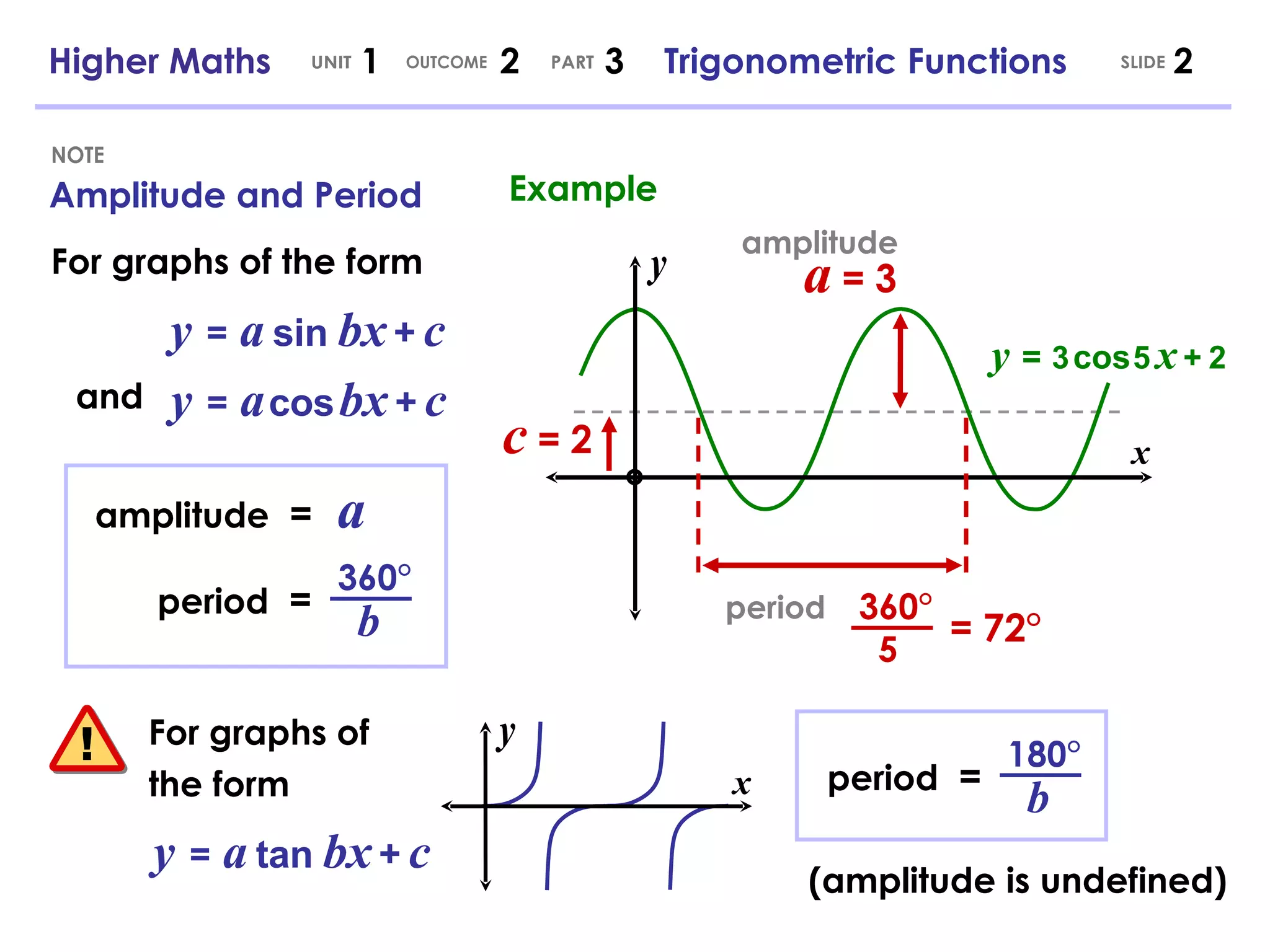
Amplitude and PeriodNOTE Higher Maths 1 2 3 Trigonometric Functions UNIT OUTCOME SLIDE PART x y amplitude y = 3 cos 5 x + 2 For graphs of the form y = a sin bx + c and y = a cos bx + c amplitude = a period = b 360° a = 3 period = 72° 5 360° c = 2 Example For graphs of the form y = a tan bx + c x y period = b 180° (amplitude is undefined)
3.
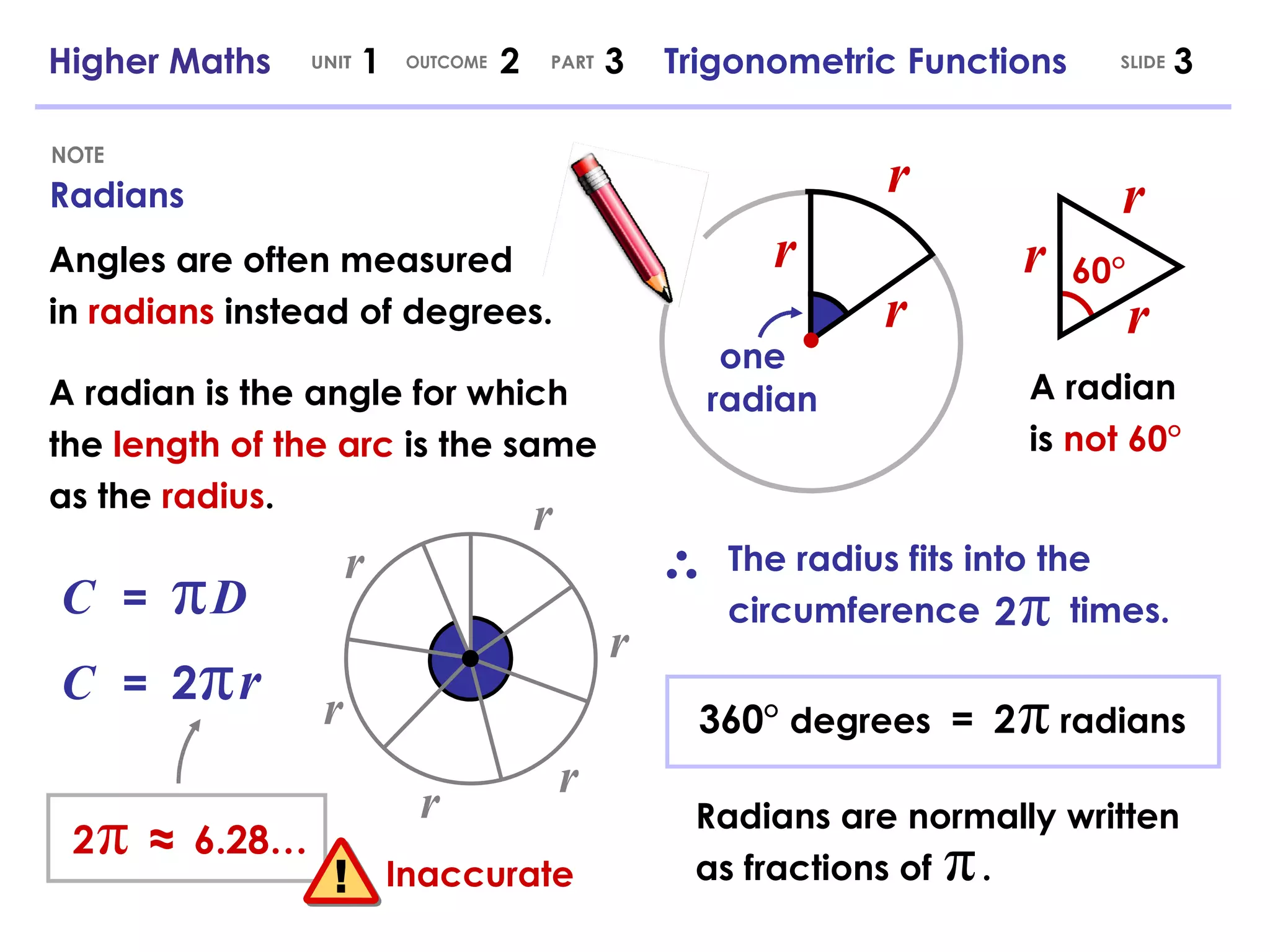
360° degrees = 2 π radians Radians NOTE Higher Maths 1 2 3 Trigonometric Functions UNIT OUTCOME SLIDE PART r r r 60° r r r one radian A radian is not 60° Angles are often measured in radians instead of degrees. A radian is the angle for which the length of the arc is the same as the radius . C = π D C = 2 π r The radius fits into the circumference times. 2 π r r r r r r Radians are normally written as fractions of . π 2 π ≈ 6.28… Inaccurate
4.
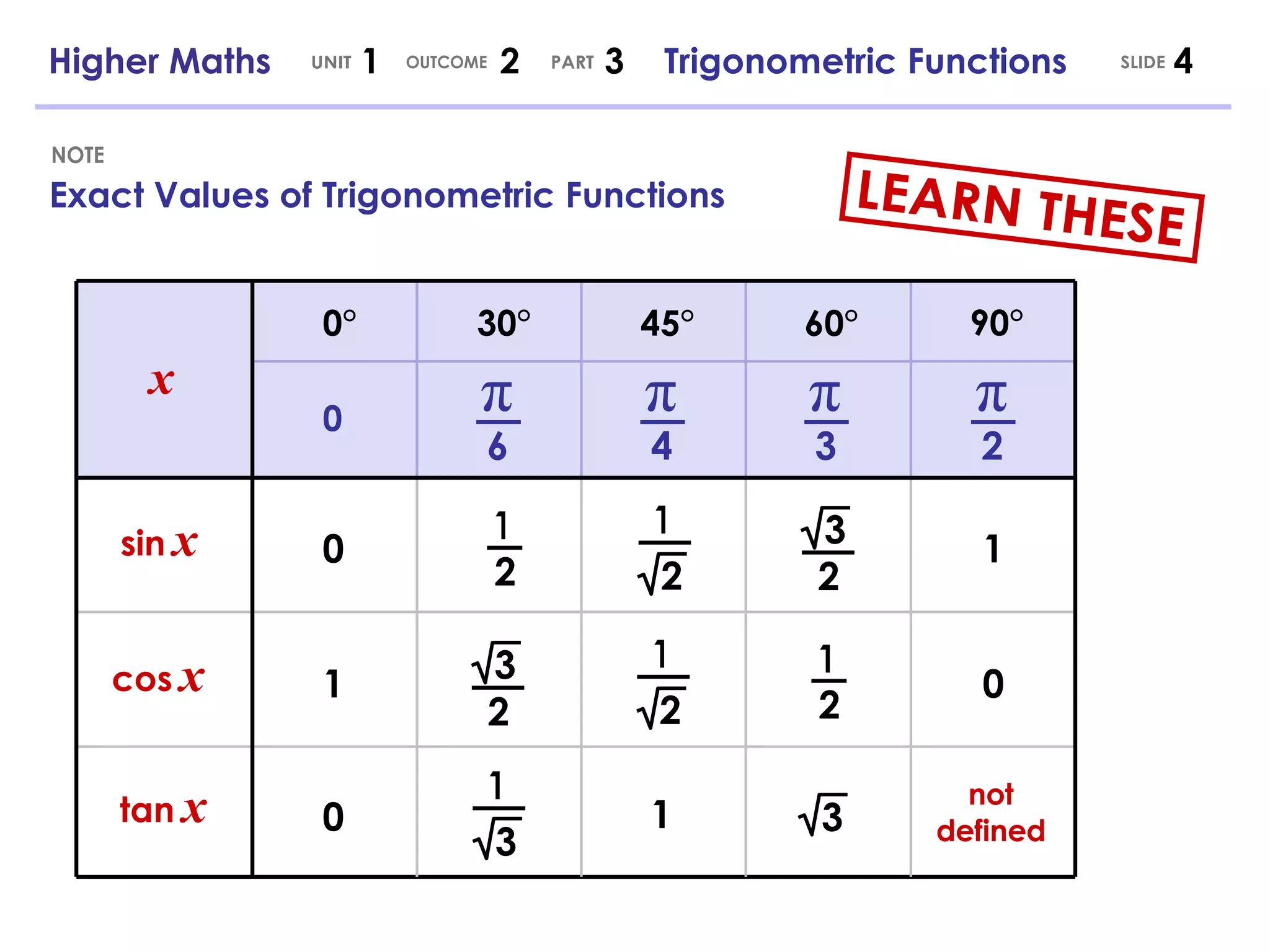
Exact Values ofTrigonometric Functions NOTE Higher Maths 1 2 3 Trigonometric Functions UNIT OUTCOME SLIDE PART sin x x 0° 30° 45° 60° 90° not defined cos x tan x 0 1 0 π 2 π 3 π 4 π 6 0 2 3 1 2 1 3 1 3 2 3 1 2 1 0 2 1 2 1 LEARN THESE
5.
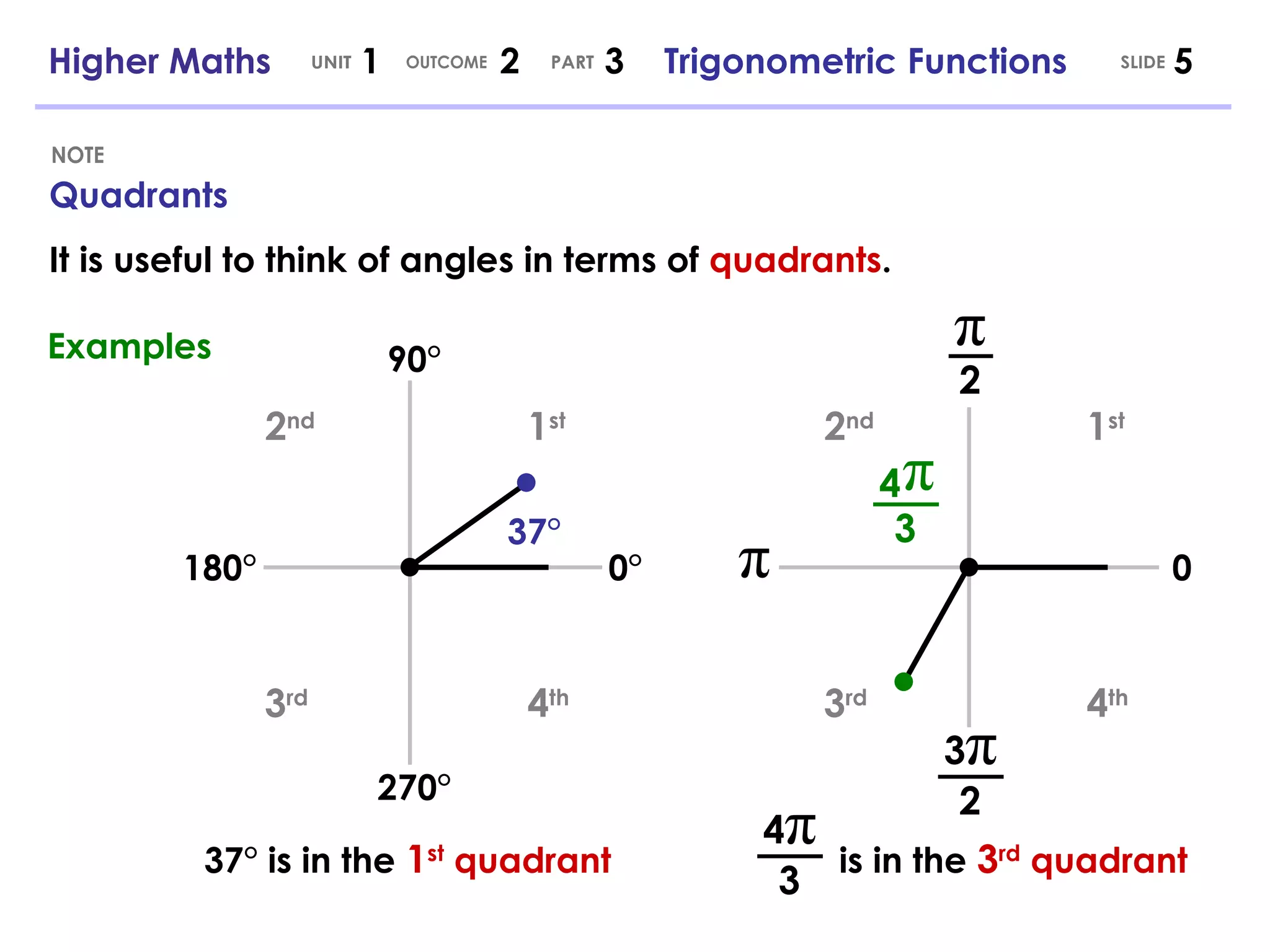
4 π QuadrantsNOTE Higher Maths 1 2 3 Trigonometric Functions UNIT OUTCOME SLIDE PART 1 st 2 nd 4 th 3 rd 180° 0° 90° 270° 37° 1 st 2 nd 4 th 3 rd 0 π 2 π 2 3 π It is useful to think of angles in terms of quadrants . 37° is in the 1 st quadrant is in the 3 rd quadrant 3 Examples π 3 4
6.
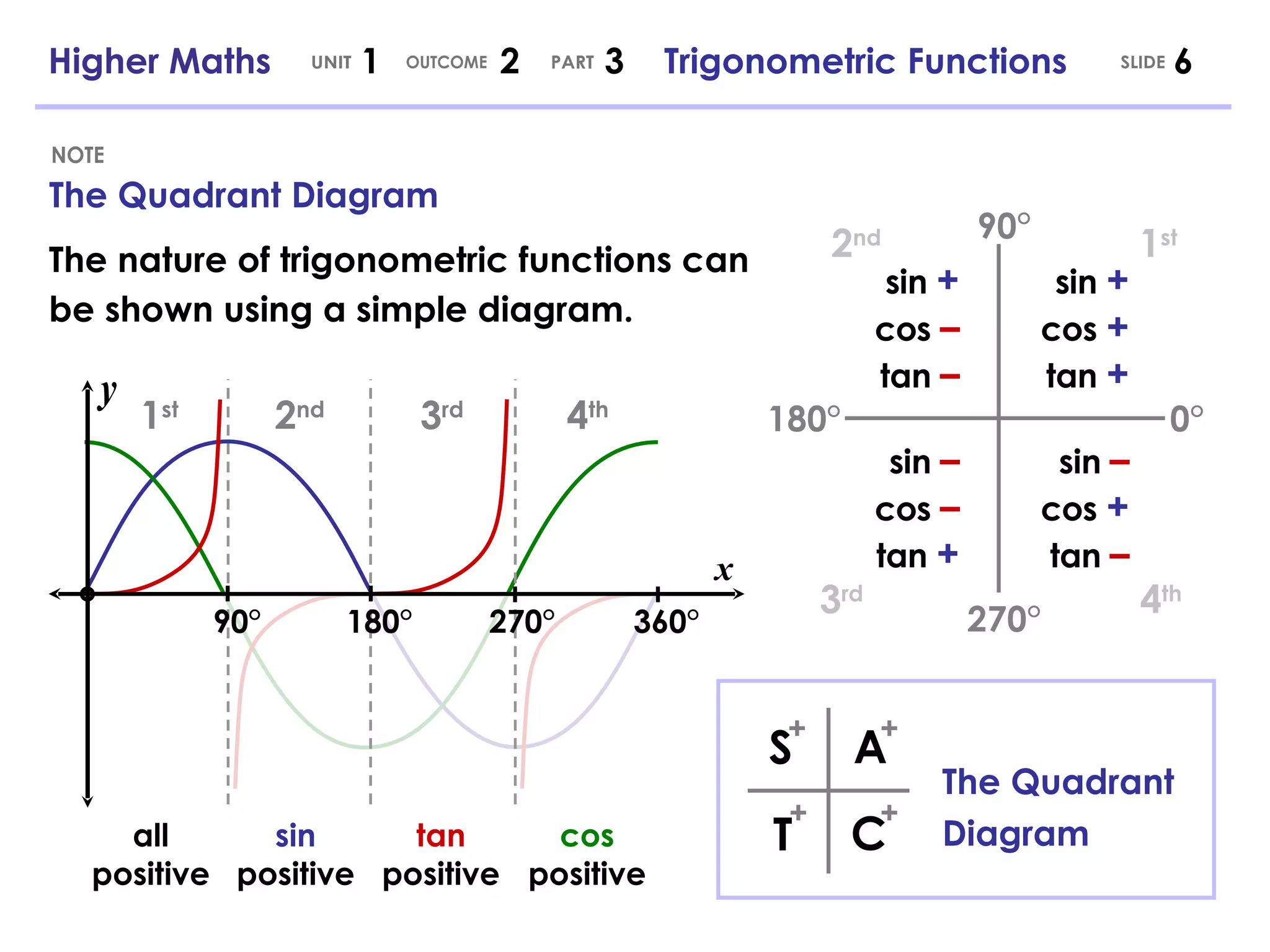
The Quadrant DiagramNOTE Higher Maths 1 2 3 Trigonometric Functions UNIT OUTCOME SLIDE PART y 1 st 2 nd 4 th 3 rd all positive sin positive tan positive cos positive 180° 0° 90° 270° sin + cos + tan + sin + cos – tan – sin – cos + tan – sin – cos – tan + S A T C 1 st 2 nd 3 rd 4 th The Quadrant Diagram The nature of trigonometric functions can be shown using a simple diagram. 360° 270° 180° 90° x + + + +
7.
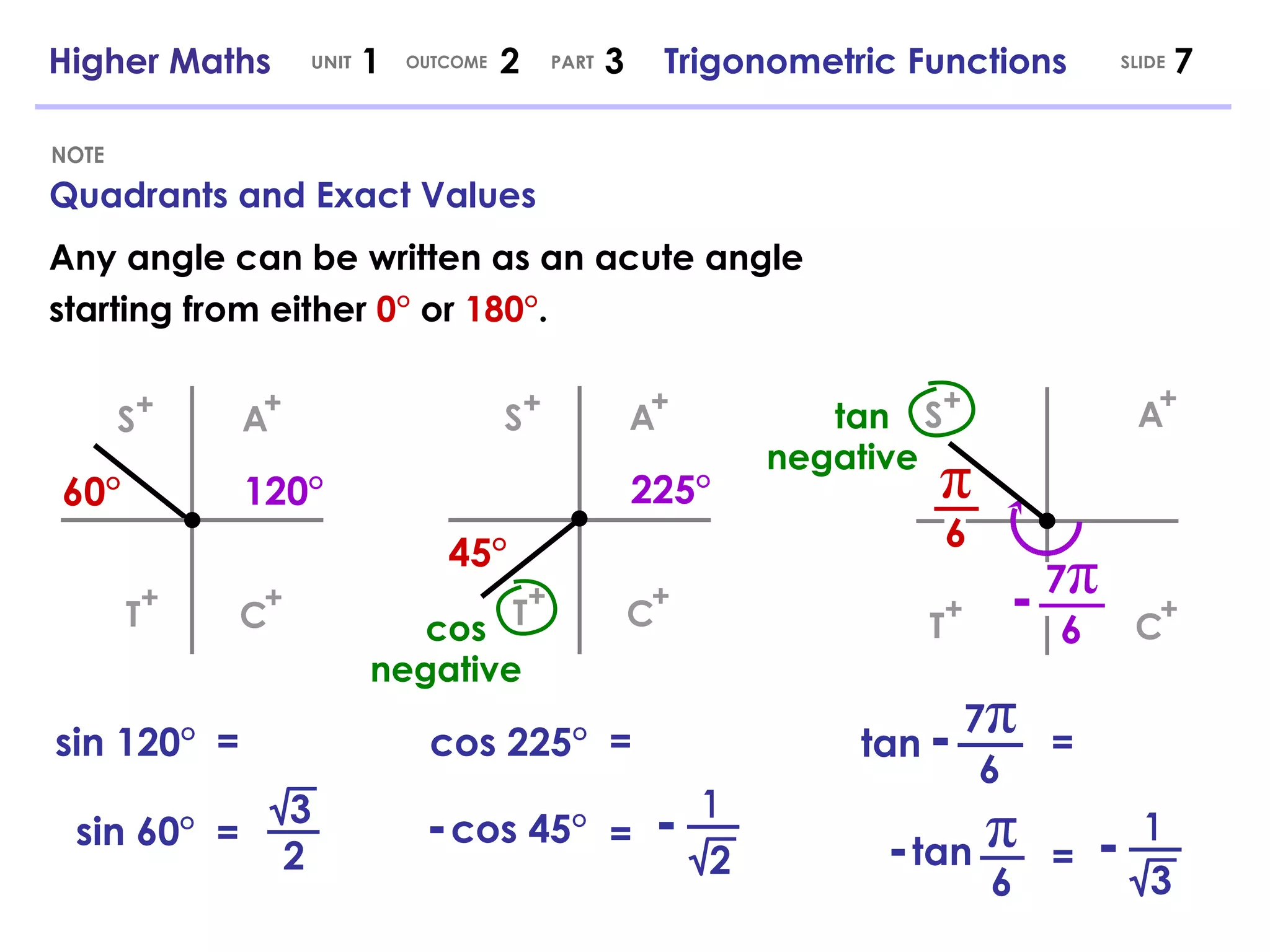
7 π Quadrantsand Exact Values NOTE Higher Maths 1 2 3 Trigonometric Functions UNIT OUTCOME SLIDE PART Any angle can be written as an acute angle starting from either 0° or 180° . 120° 60° sin 120° sin 60° 2 3 = 225° 45° - cos 45° = 1 2 - = cos 225° = π 6 - tan = 1 3 - tan = 6 - 6 - π 6 cos negative tan negative 7 π T + C + A + S + S + A + T + C + S + A + T + C +
8.
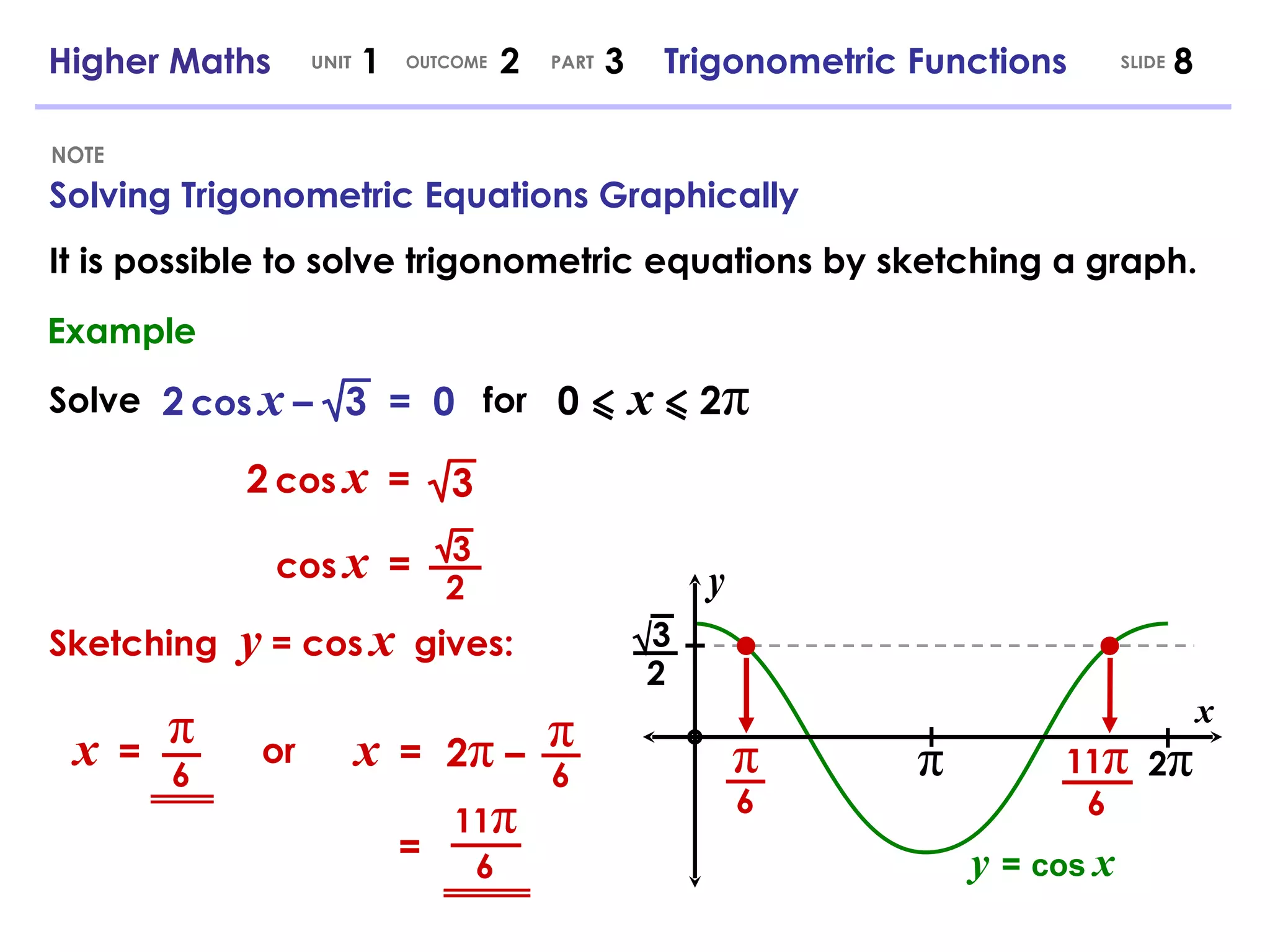
Higher Maths 1 2 3 Trigonometric Functions UNIT OUTCOME SLIDE PART Solving Trigonometric Equations Graphically NOTE It is possible to solve trigonometric equations by sketching a graph. Example Solve 2 cos x – 3 = 0 for 0 x 2 π 2 cos x = 2 3 3 cos x = x = π 6 x y 2 3 √ π 2 π π 6 or x = π 6 2 π – = 11 π 6 11 π 6 Sketching y = cos x gives: y = cos x
9.
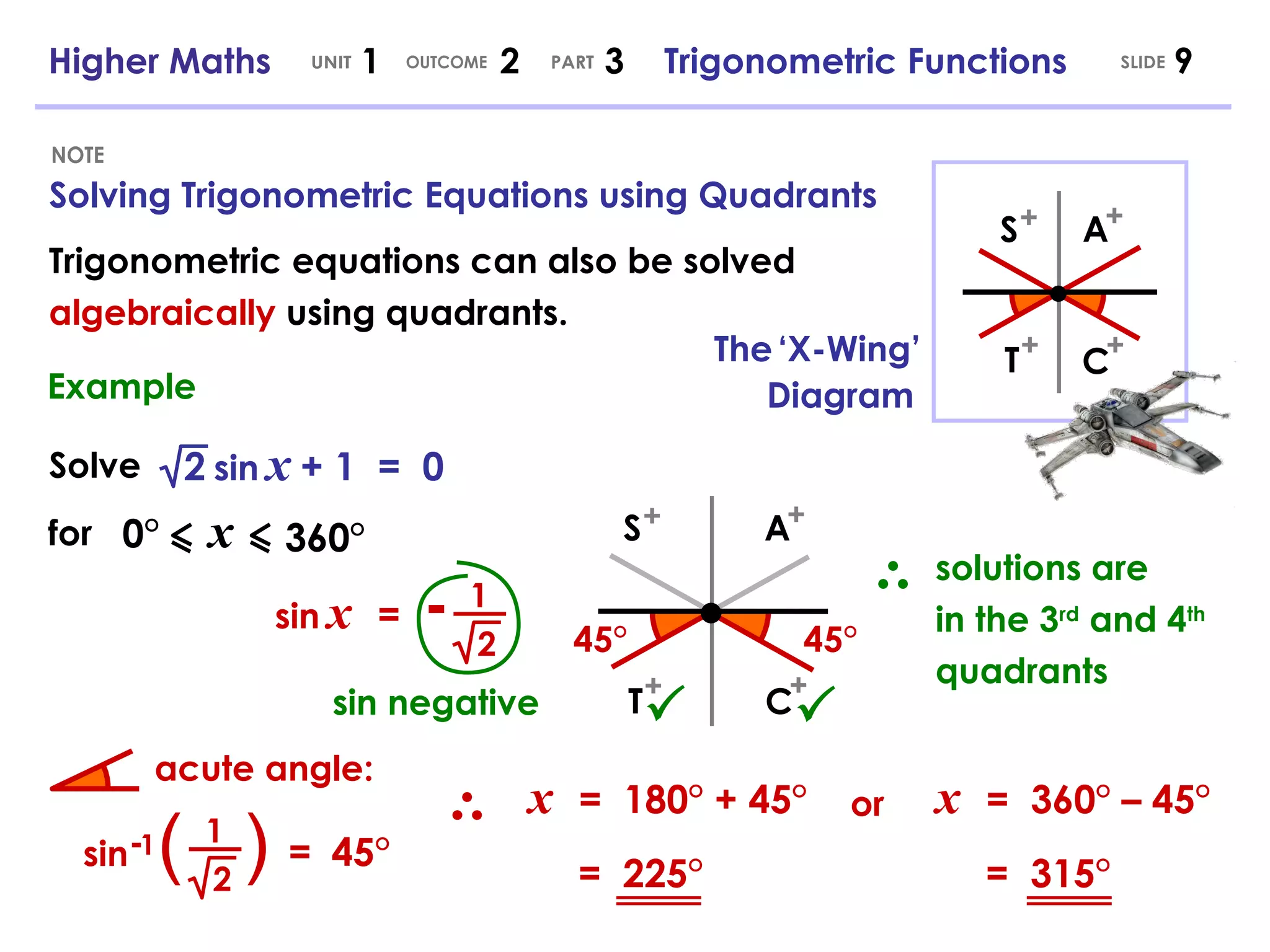
Solving Trigonometric Equationsusing Quadrants NOTE Higher Maths 1 2 3 Trigonometric Functions UNIT OUTCOME SLIDE PART Example Solve 2 sin x + 1 = 0 for 0° x 360° 1 2 sin x = - sin negative solutions are in the 3 rd and 4 th quadrants 45° 45° acute angle: sin ( ) = 45° x = 180° + 45° = 225° x = 360° – 45° = 315° or Trigonometric equations can also be solved algebraically using quadrants. The ‘X-Wing’ Diagram 1 2 A + C + S + T + - 1 S + A + T + C +
10.
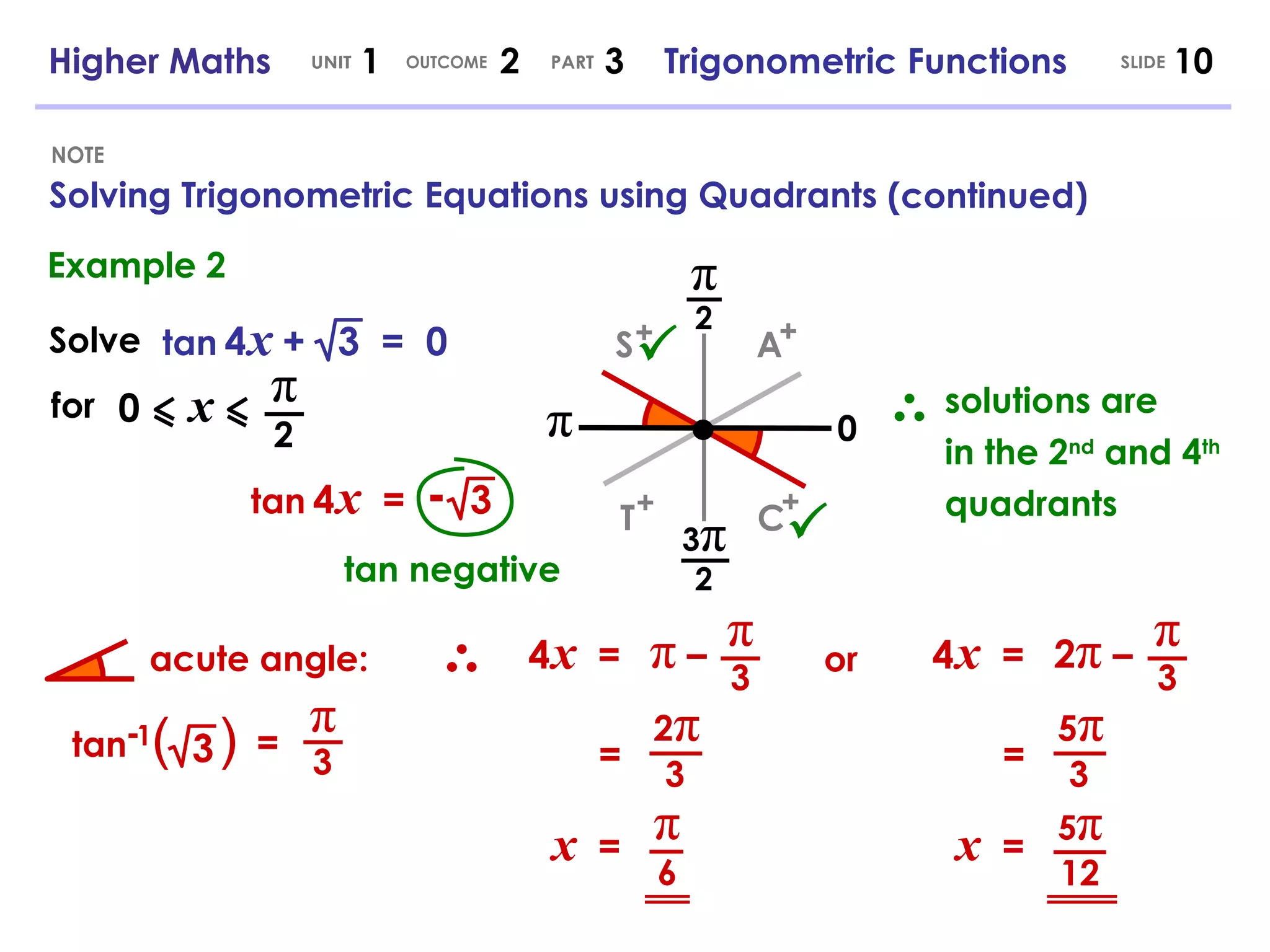
3 NOTE HigherMaths 1 2 3 Trigonometric Functions UNIT OUTCOME SLIDE PART Example 2 Solve tan 4 x + 3 = 0 for 0 x π 2 tan 4 x = 3 - tan negative solutions are in the 2 nd and 4 th quadrants tan ( ) = π 3 4 x = π 3 π – = 2 π 3 x = π 6 or 4 x = π 3 2 π – = 5 π 3 x = 5 π 12 π π 2 3 π 2 0 (continued) Solving Trigonometric Equations using Quadrants acute angle: A + C + S + T + - 1
11.
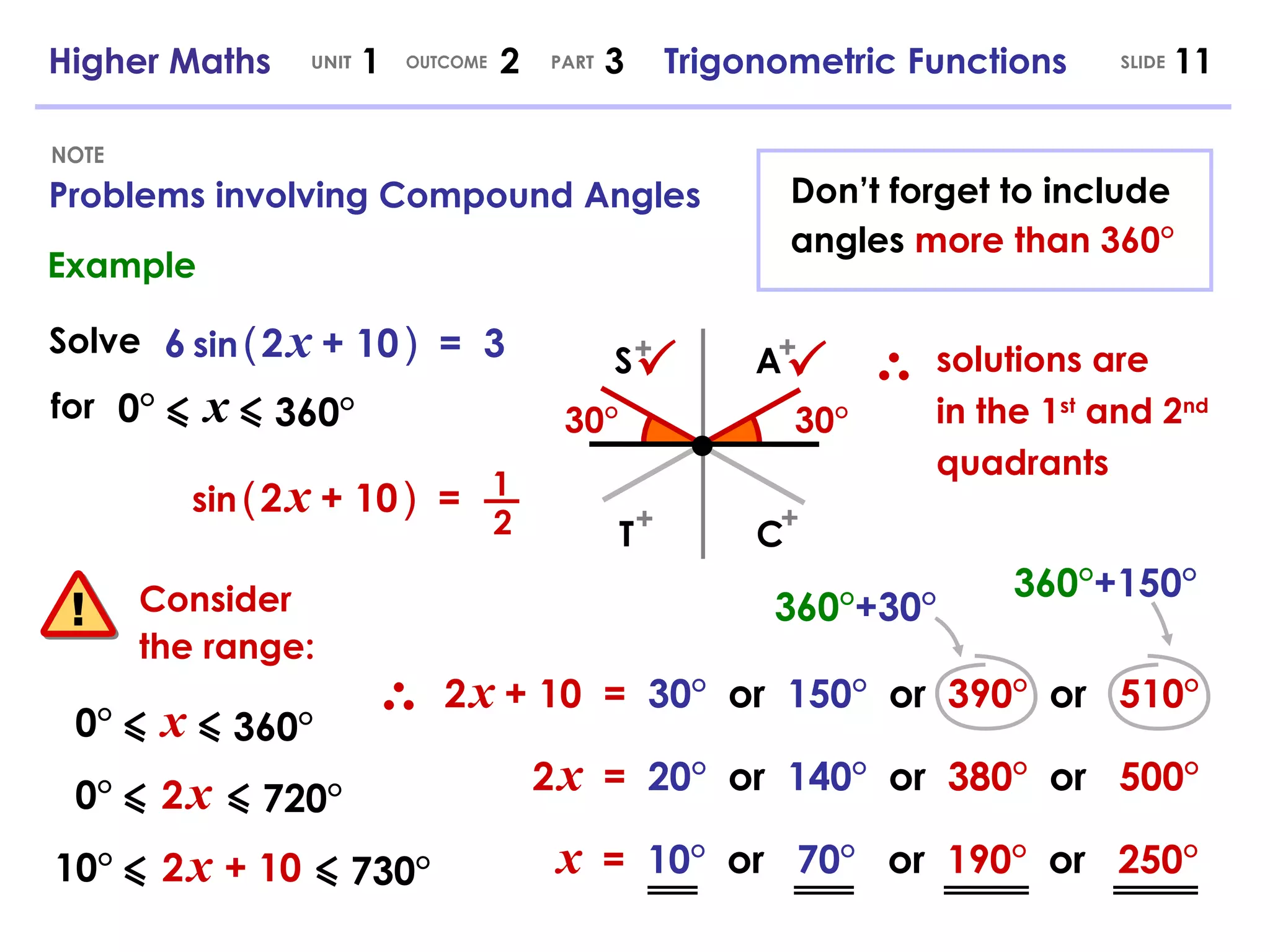
Problems involving CompoundAngles NOTE Higher Maths 1 2 3 Trigonometric Functions UNIT OUTCOME SLIDE PART Solve 6 sin ( 2 x + 10 ) = 3 for 0° x 360° Example sin ( 2 x + 10 ) = 2 1 solutions are in the 1 st and 2 nd quadrants 30° 30° 0° x 360° 0° 2 x 720° 10° 2 x + 10 730° Consider the range: 2 x + 10 = 30° or 150° or 390° or 510° 2 x = 20° or 140° or 380° or 500° x = 10° or 70° or 190° or 250° 360° +30° 360° +150° Don’t forget to include angles more than 360° A + C + S + T +
12.
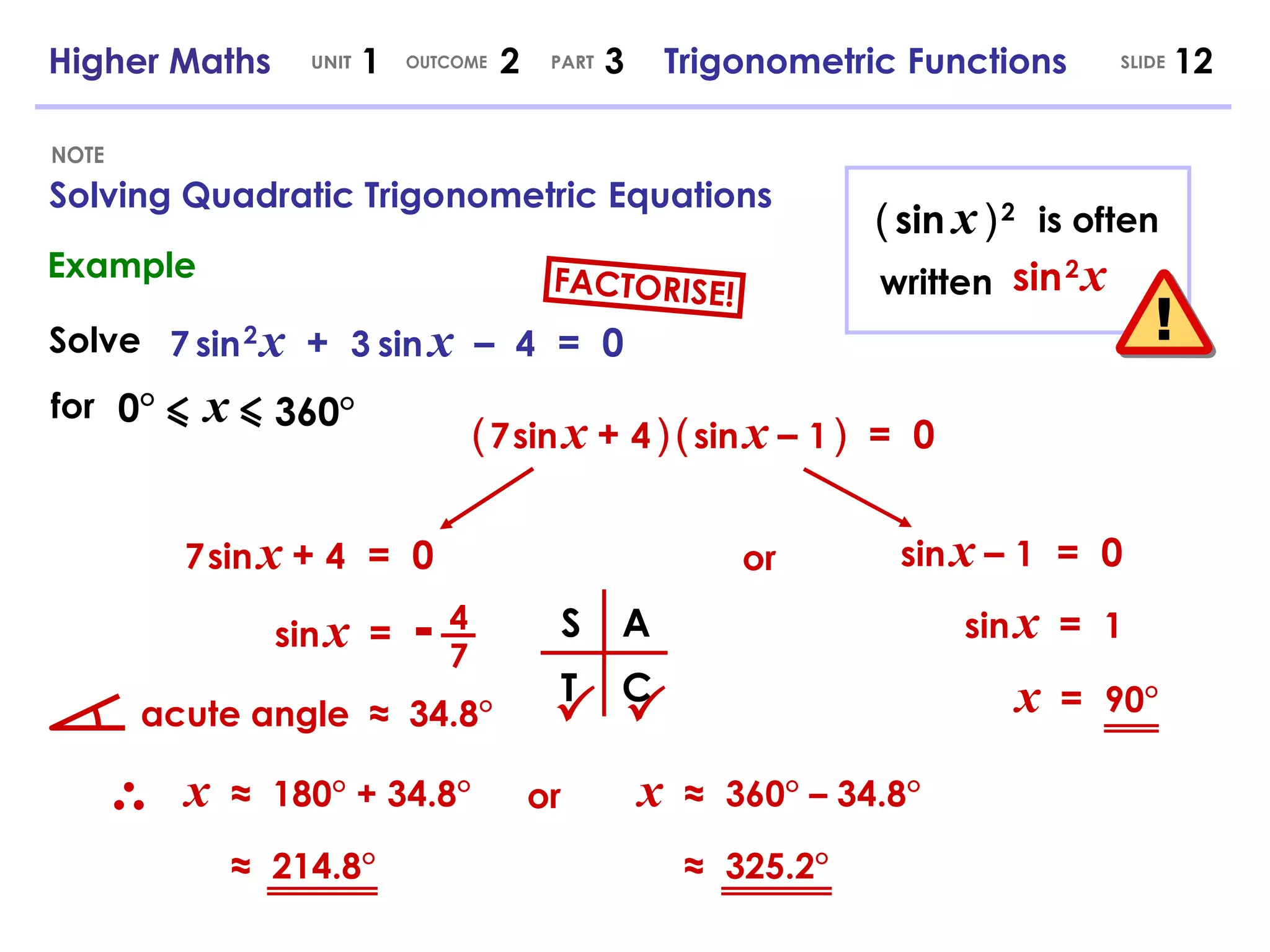
NOTE Higher Maths 1 2 3 Trigonometric Functions UNIT OUTCOME SLIDE PART ( sin x ) 2 sin 2 x is often written Solve 7 sin 2 x + 3 sin x – 4 = 0 for 0° x 360° ( 7 sin x + 4 ) ( sin x – 1 ) = 0 7 sin x + 4 = 0 sin x – 1 = 0 or sin x = 4 - 7 sin x = 1 S A T C acute angle ≈ 34.8° x ≈ 180° + 34.8° ≈ 214.8° or x ≈ 360° – 34.8° ≈ 325.2° x = 90° Example Solving Quadratic Trigonometric Equations FACTORISE!


![Vibe Coding vs. Spec-Driven Development [Free Meetup]](https://cdn.slidesharecdn.com/ss_thumbnails/vibecodingvsspecdrivendevelopment-251209105622-43f455e7-thumbnail.jpg?width=640&height=640&fit=bounds)


