6.1: Types of Nutrition
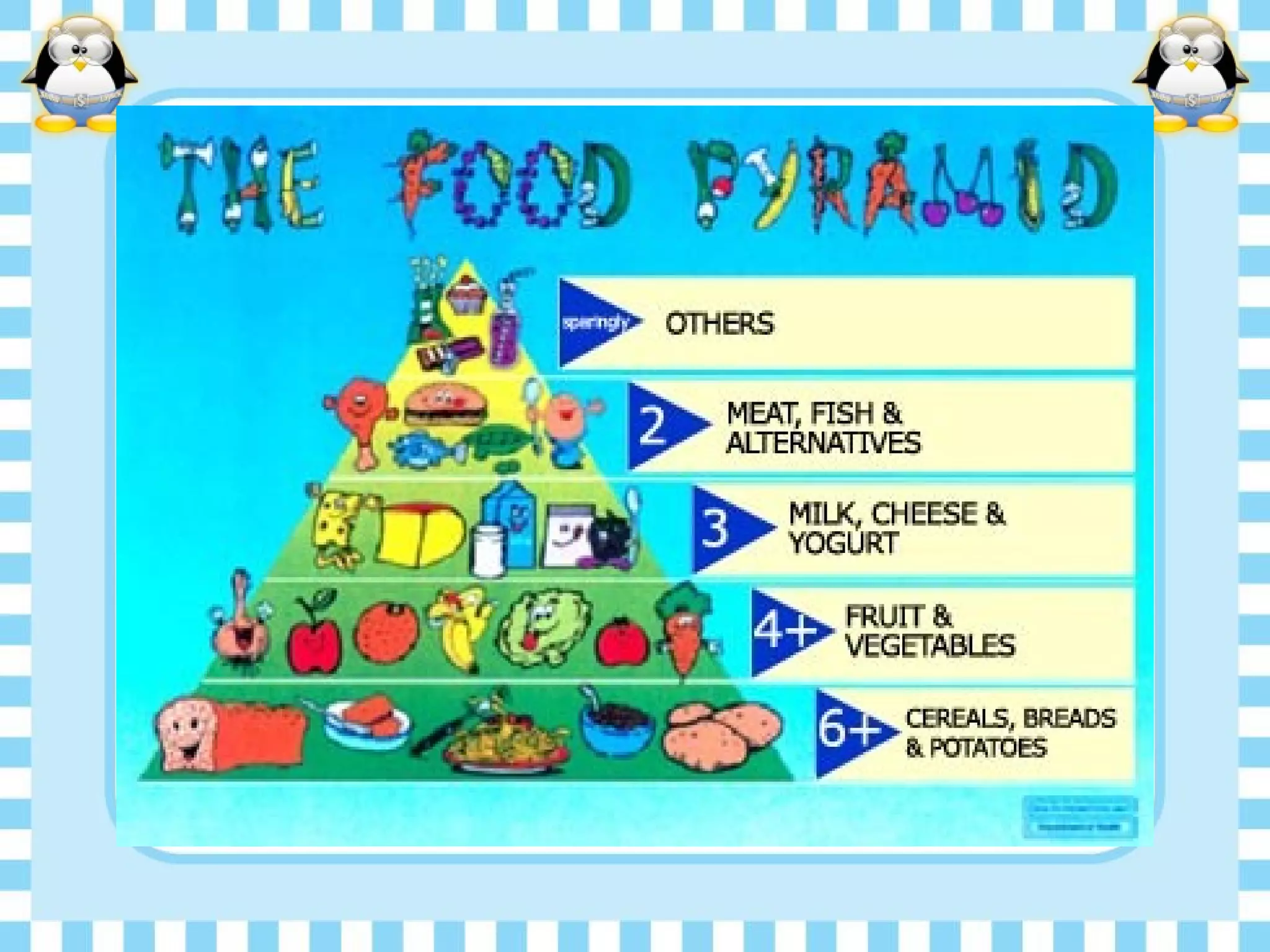
6.2: Balanced Diet
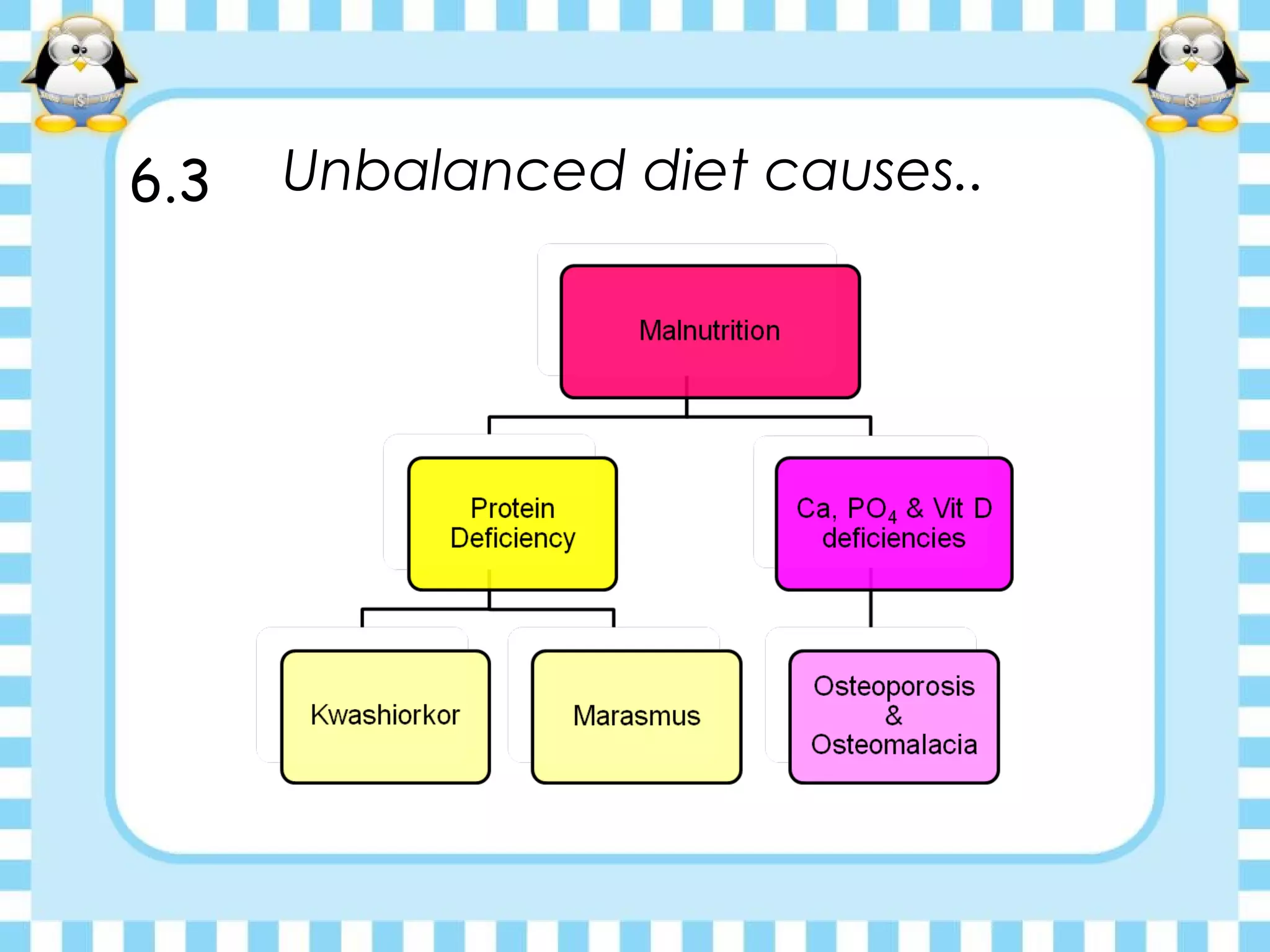
6.3: Malnutrition
6.4:Digestion Process
6.5:Process of Absorption & Assimilation
CHAPTER 6
 6.6: Formation of Faeces & Defecation
 6.7: Good Eating Habits
 6.8:Importance of a Healthy Digestive System
 6.9: Importance of Macronutrient & Micronutrient
in Plant
 6.10: Photosynthesis
 6.11:Mechanism of Photosynthesis
 6.12: The Factors Affecting Photosynthesis
 6.13:Technology used in Food Production
 6.14: Food Processing Technology
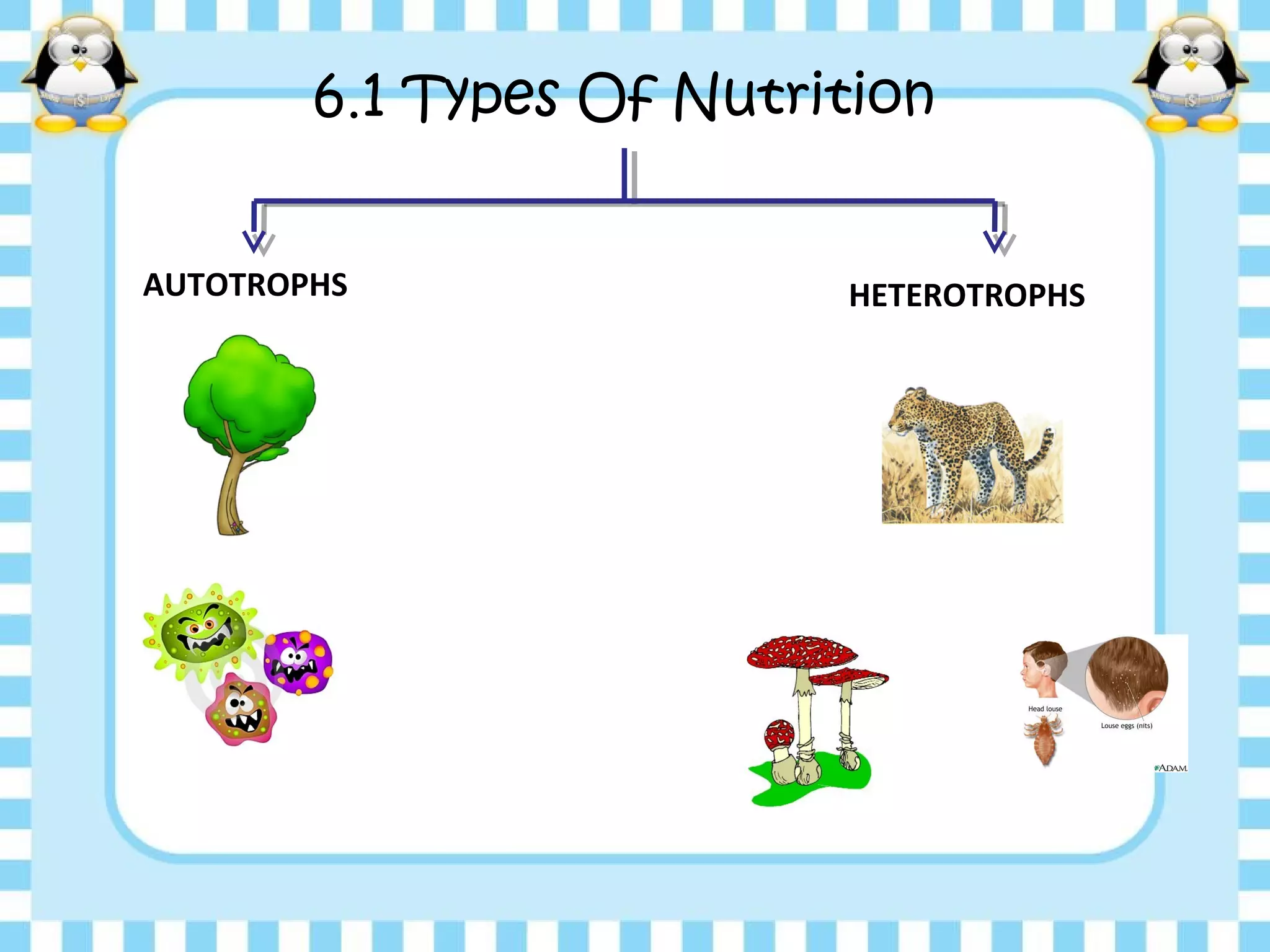
6.1 Types Of Nutrition
AUTOTROPHS HETEROTROPHS
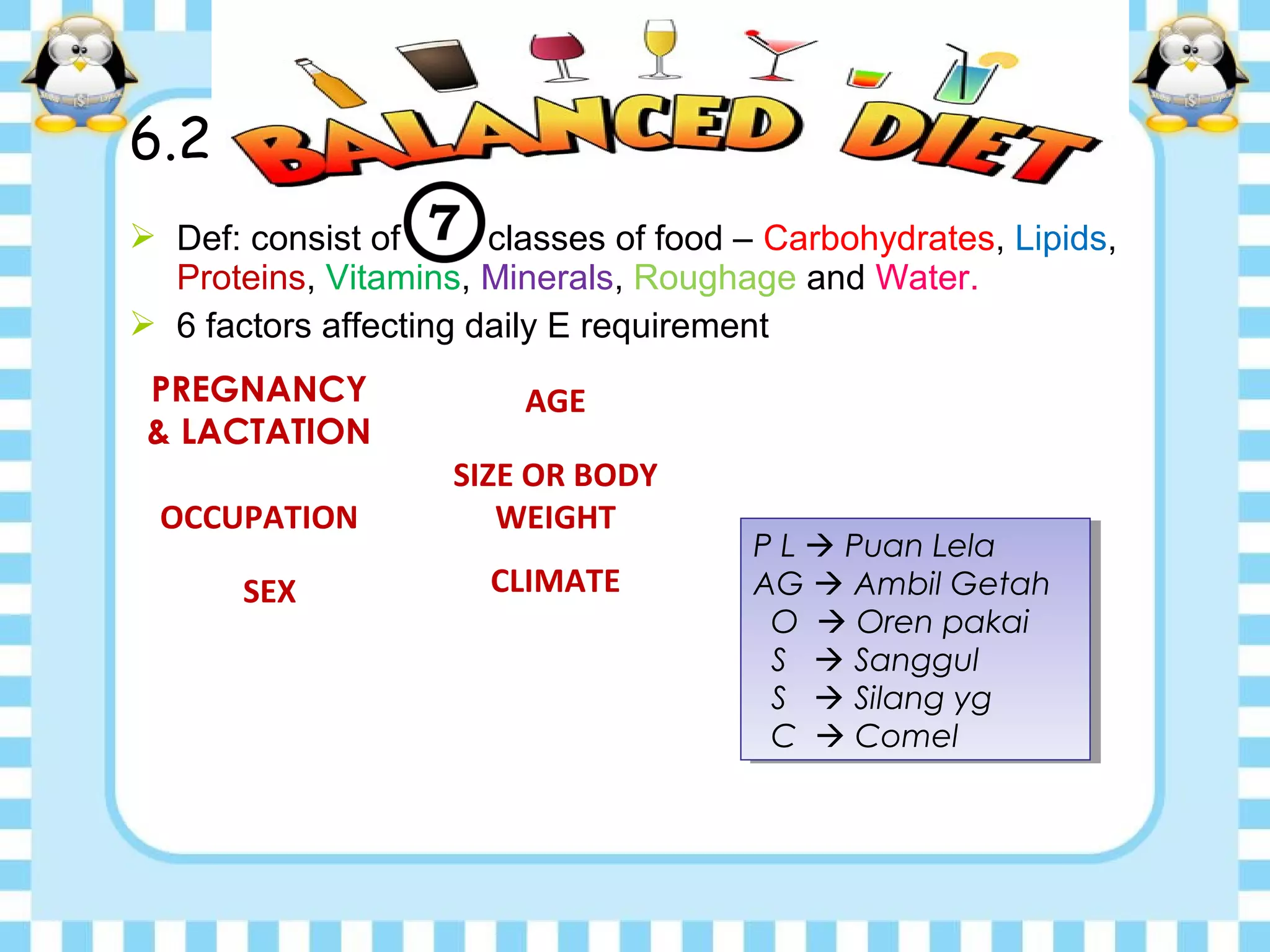
 Def: consist of classes of food – Carbohydrates, Lipids,
Proteins, Vitamins, Minerals, Roughage and Water.
 6 factors affecting daily E requirement
AGE
SEX
OCCUPATION
CLIMATE
PREGNANCY
& LACTATION
SIZE OR BODY
WEIGHT
P L  Puan Lela
AG  Ambil Getah
O  Oren pakai
S  Sanggul
S  Silang yg
C  Comel
P L  Puan Lela
AG  Ambil Getah
O  Oren pakai
S  Sanggul
S  Silang yg
C  Comel
6.2
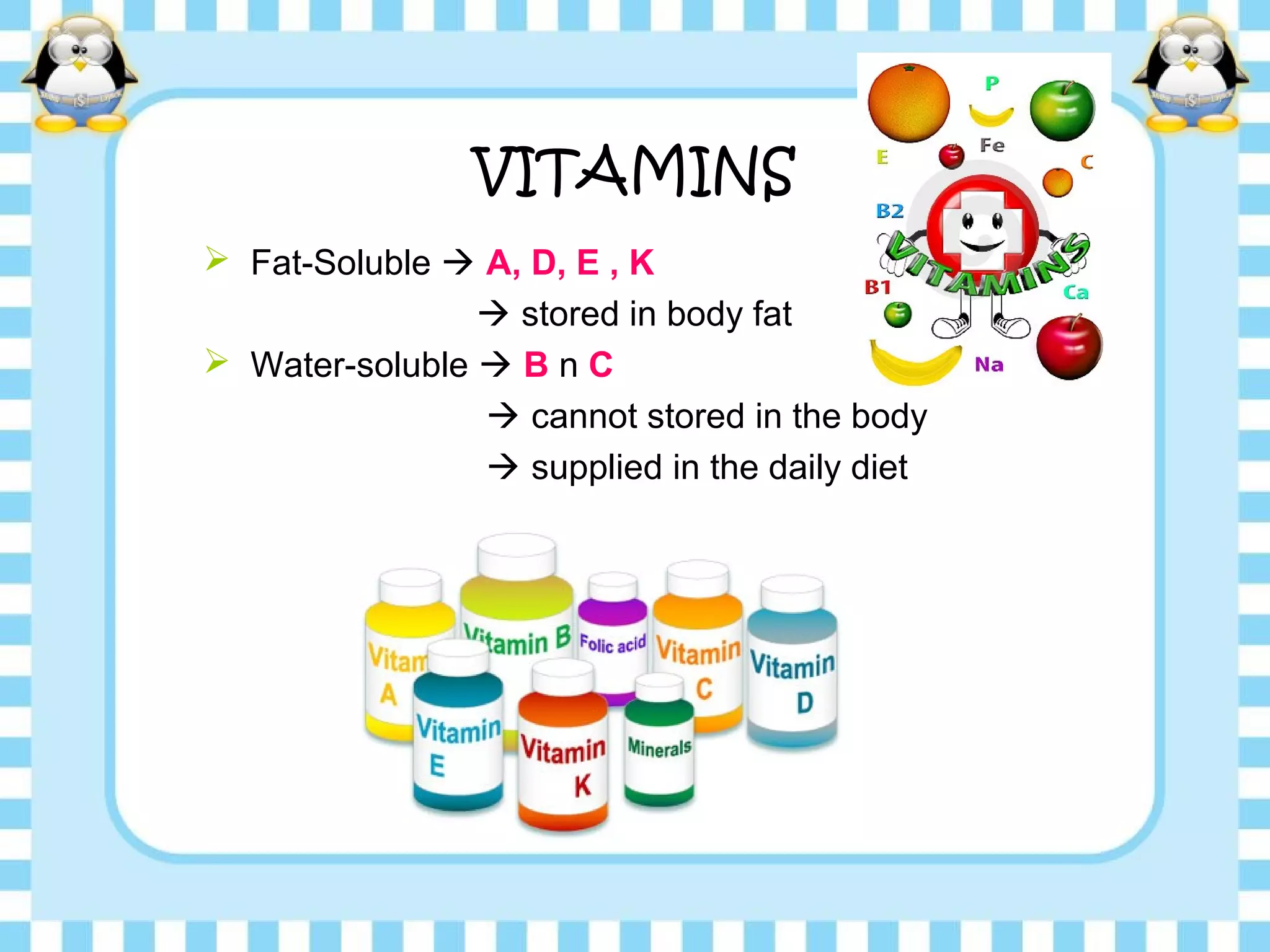
VITAMINS
 Fat-Soluble  A, D, E , K
 stored in body fat
 Water-soluble  B n C
 cannot stored in the body
 supplied in the daily diet
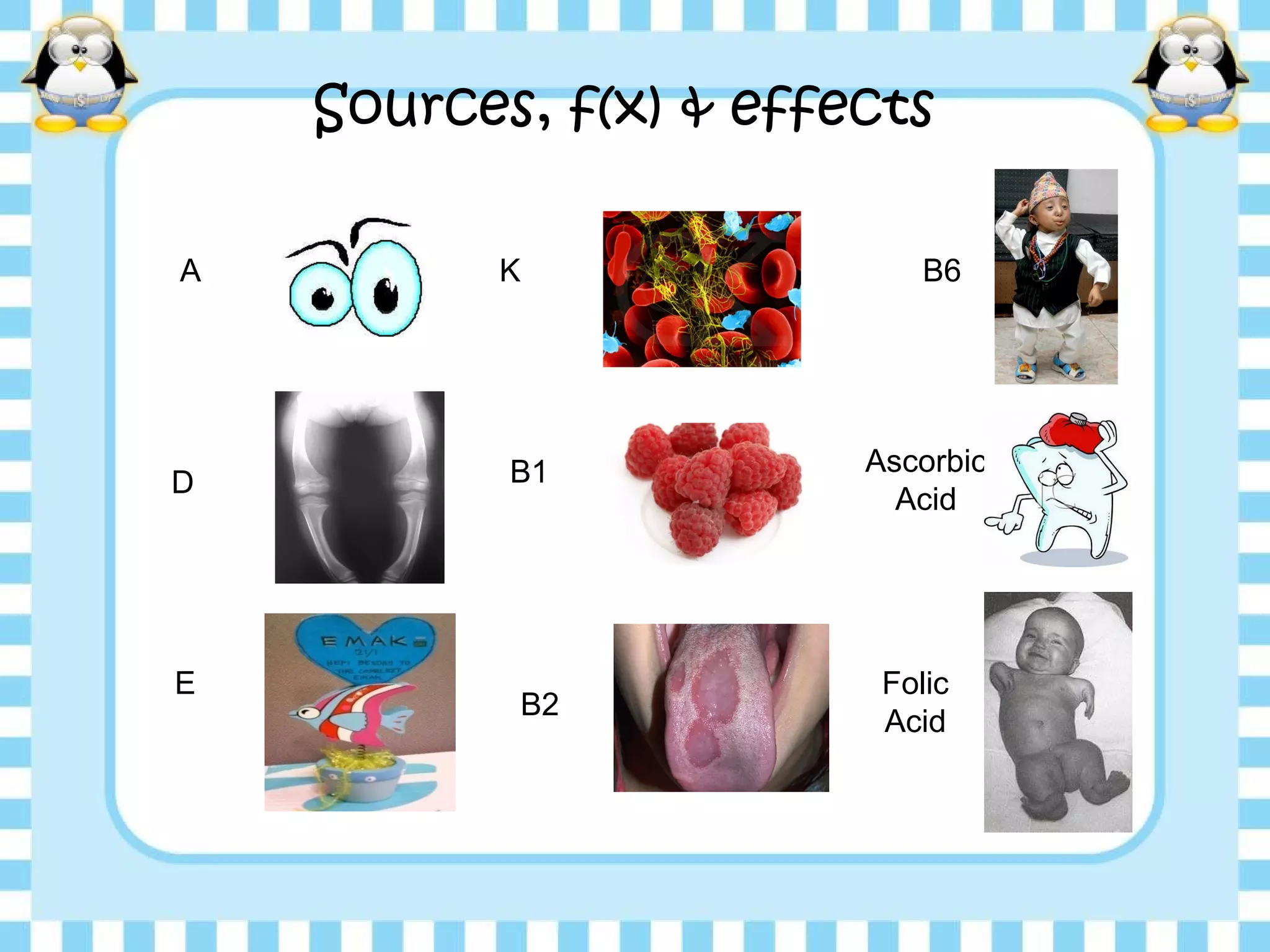
Sources, f(x) & effects
A
D
E
K
B1
B2
B6
Ascorbic
Acid
Folic
Acid
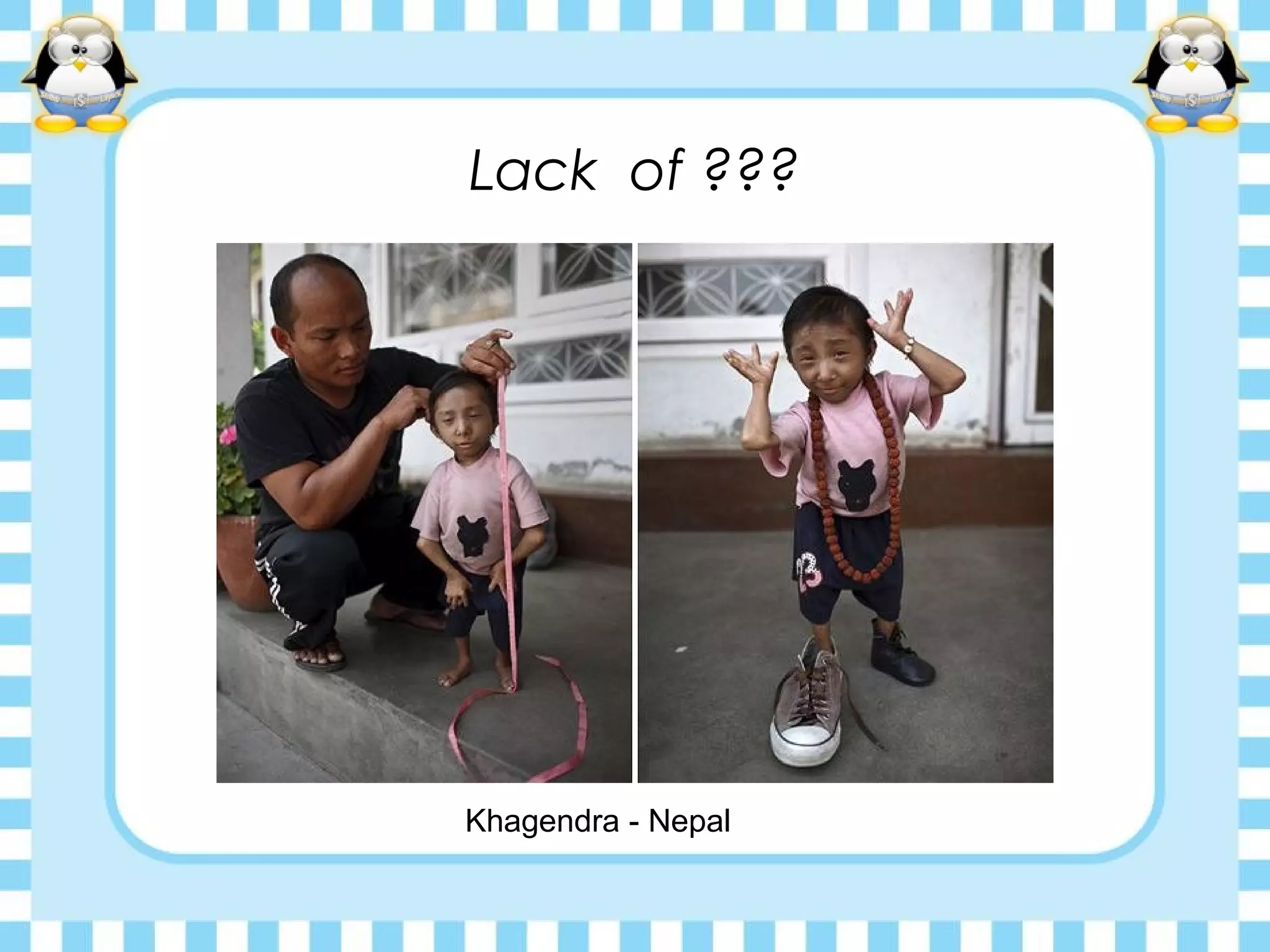
Lack of ???
Khagendra - Nepal
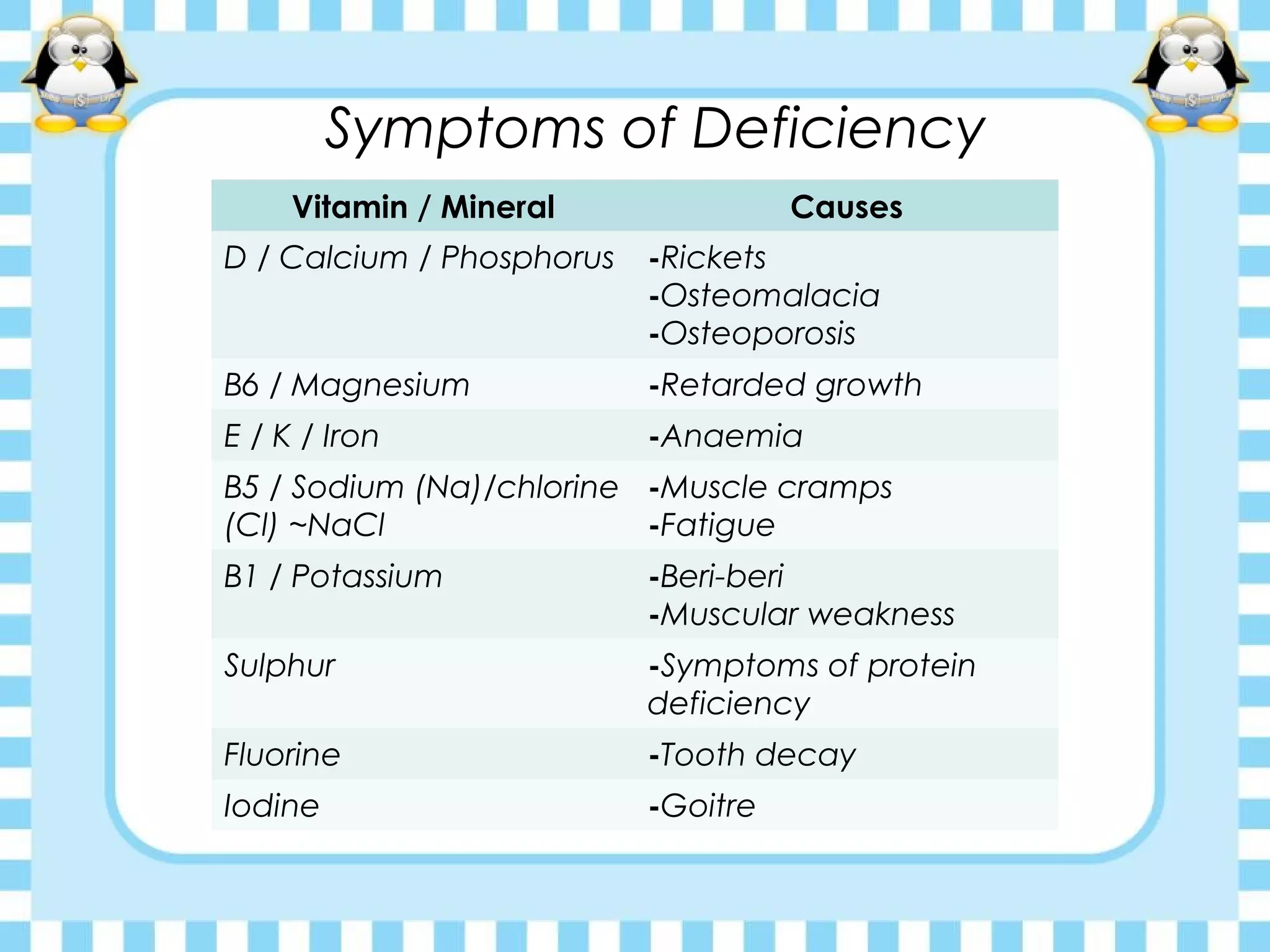
Symptoms of Deficiency
Vitamin / Mineral Causes
D / Calcium / Phosphorus -Rickets
-Osteomalacia
-Osteoporosis
B6 / Magnesium -Retarded growth
E / K / Iron -Anaemia
B5 / Sodium (Na)/chlorine
(Cl) ~NaCl
-Muscle cramps
-Fatigue
B1 / Potassium -Beri-beri
-Muscular weakness
Sulphur -Symptoms of protein
deficiency
Fluorine -Tooth decay
Iodine -Goitre
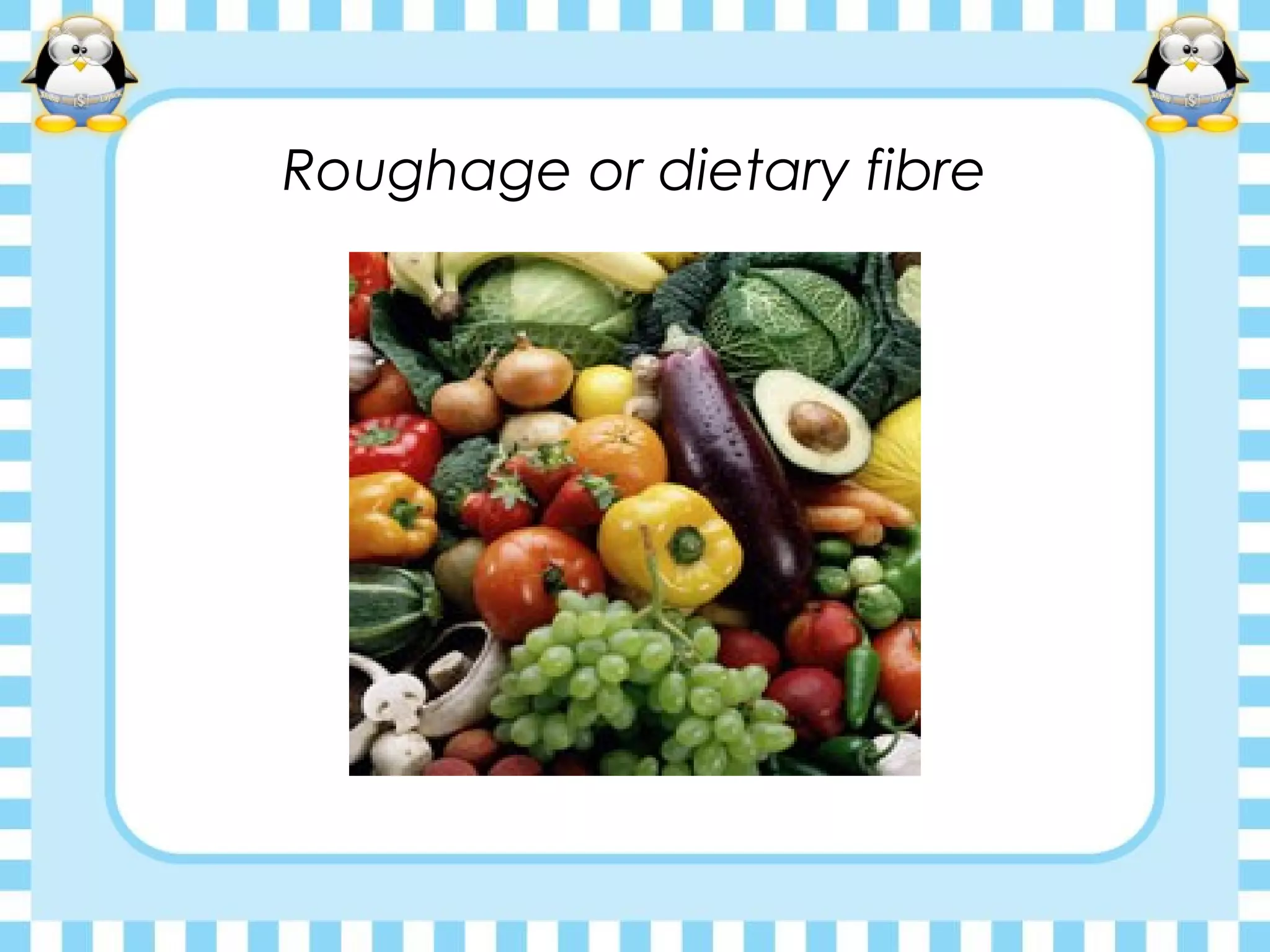
Roughage or dietary fibre
Unbalanced diet causes..6.3
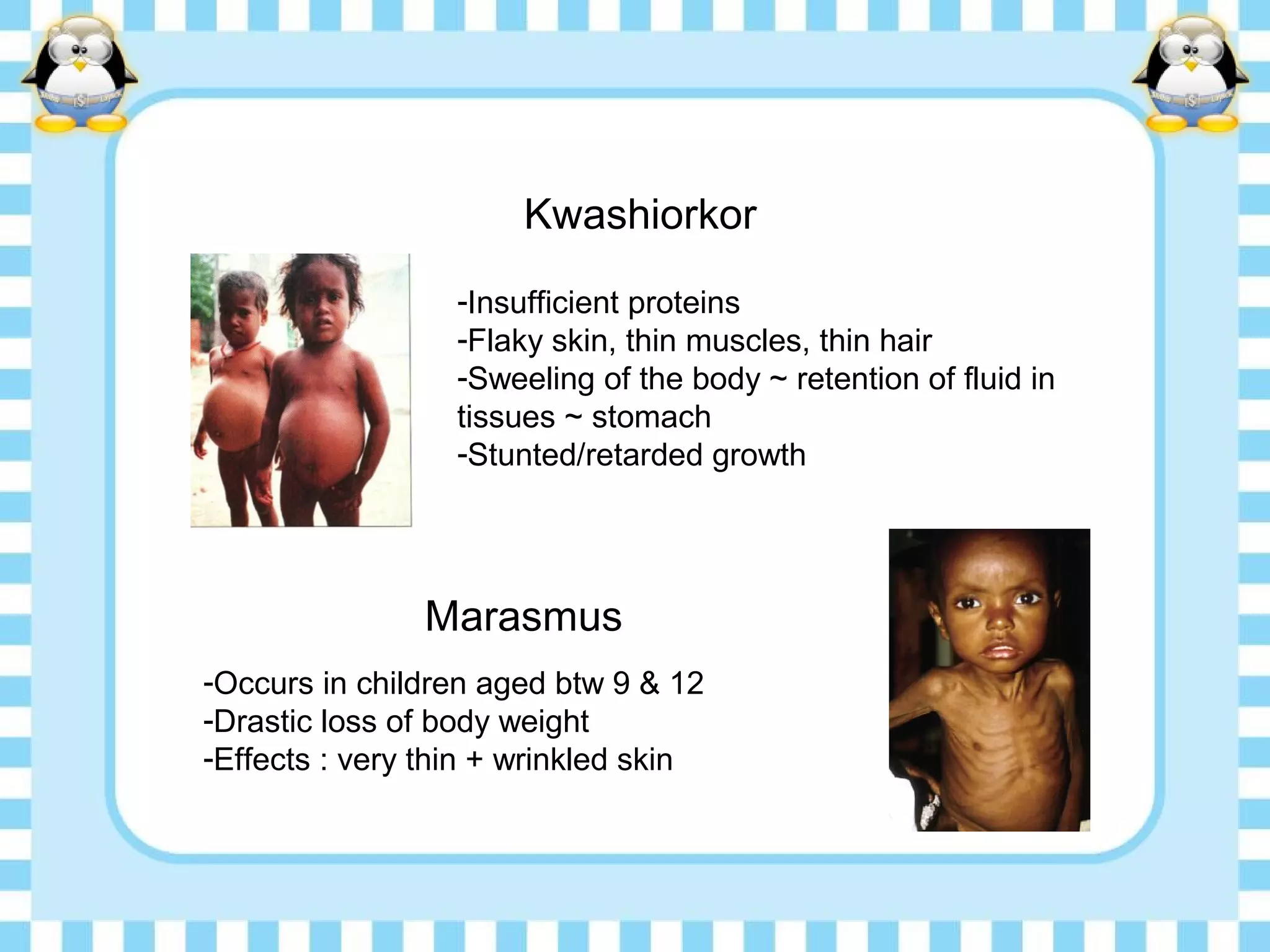
-Insufficient proteins
-Flaky skin, thin muscles, thin hair
-Sweeling of the body ~ retention of fluid in
tissues ~ stomach
-Stunted/retarded growth
Kwashiorkor
Marasmus
-Occurs in children aged btw 9 & 12
-Drastic loss of body weight
-Effects : very thin + wrinkled skin
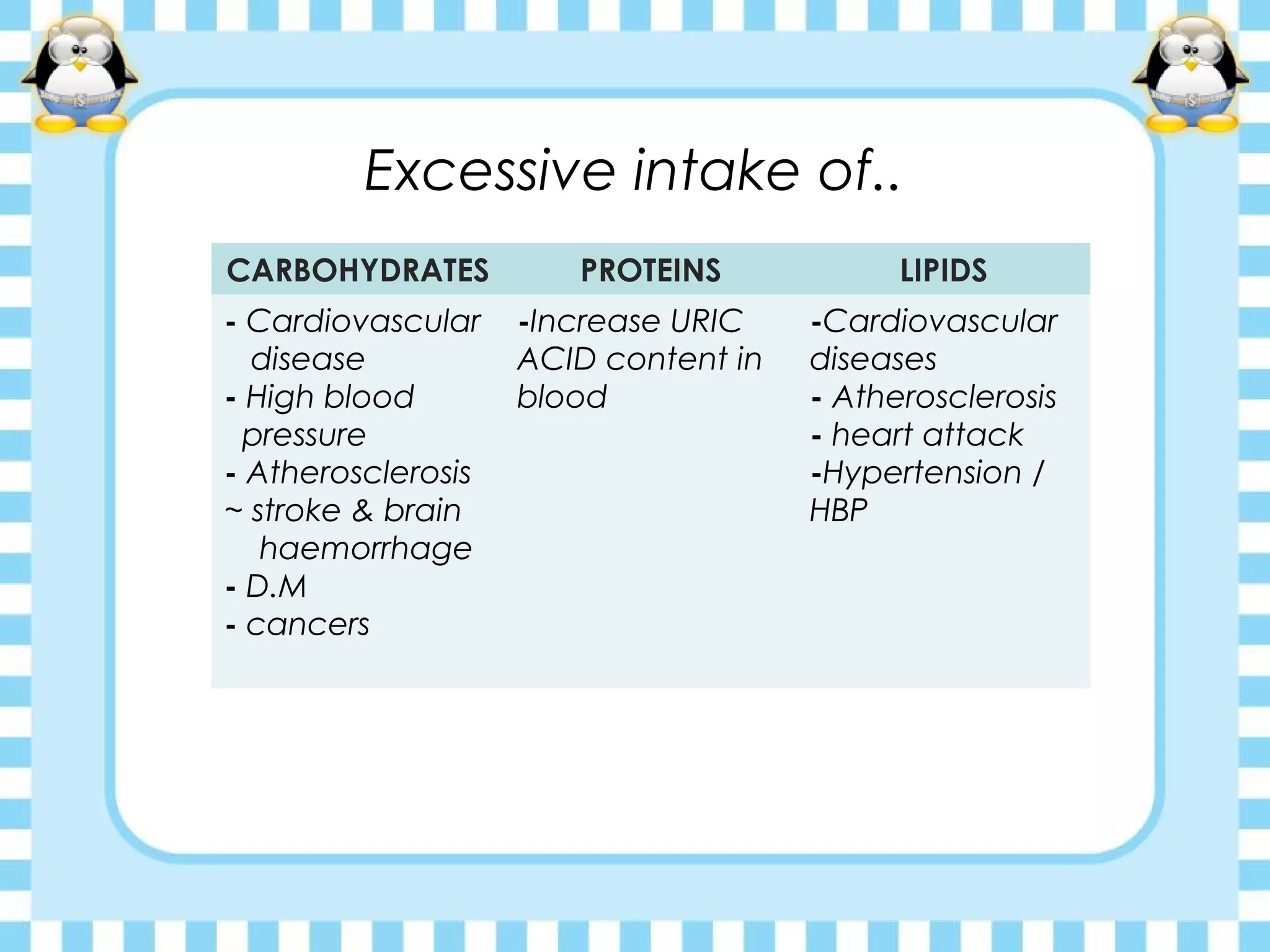
Excessive intake of..
CARBOHYDRATES PROTEINS LIPIDS
- Cardiovascular
disease
- High blood
pressure
- Atherosclerosis
~ stroke & brain
haemorrhage
- D.M
- cancers
-Increase URIC
ACID content in
blood
-Cardiovascular
diseases
- Atherosclerosis
- heart attack
-Hypertension /
HBP
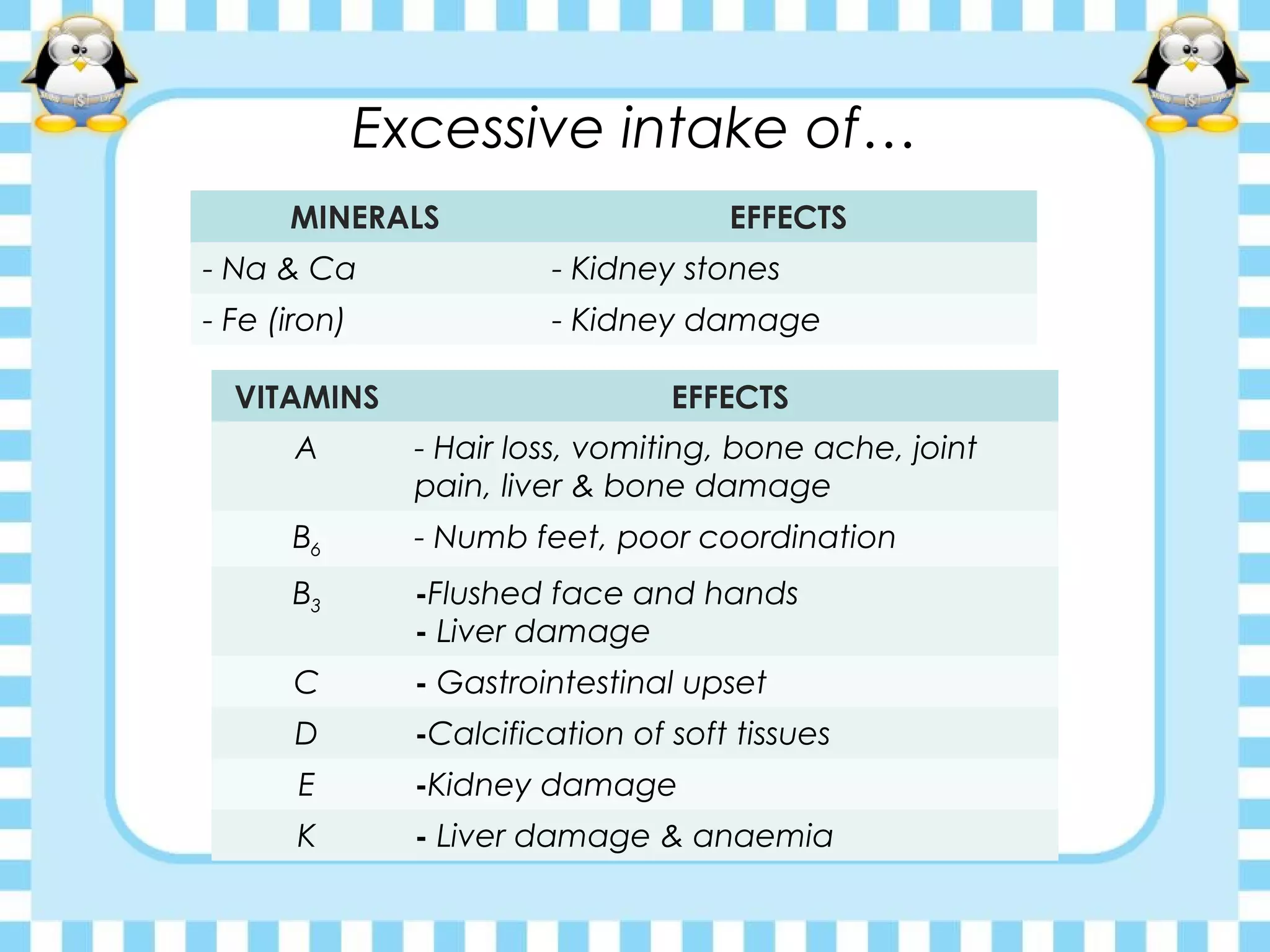
Excessive intake of…
MINERALS EFFECTS
- Na & Ca - Kidney stones
- Fe (iron) - Kidney damage
VITAMINS EFFECTS
A - Hair loss, vomiting, bone ache, joint
pain, liver & bone damage
B6 - Numb feet, poor coordination
B3 -Flushed face and hands
- Liver damage
C - Gastrointestinal upset
D -Calcification of soft tissues
E -Kidney damage
K - Liver damage & anaemia
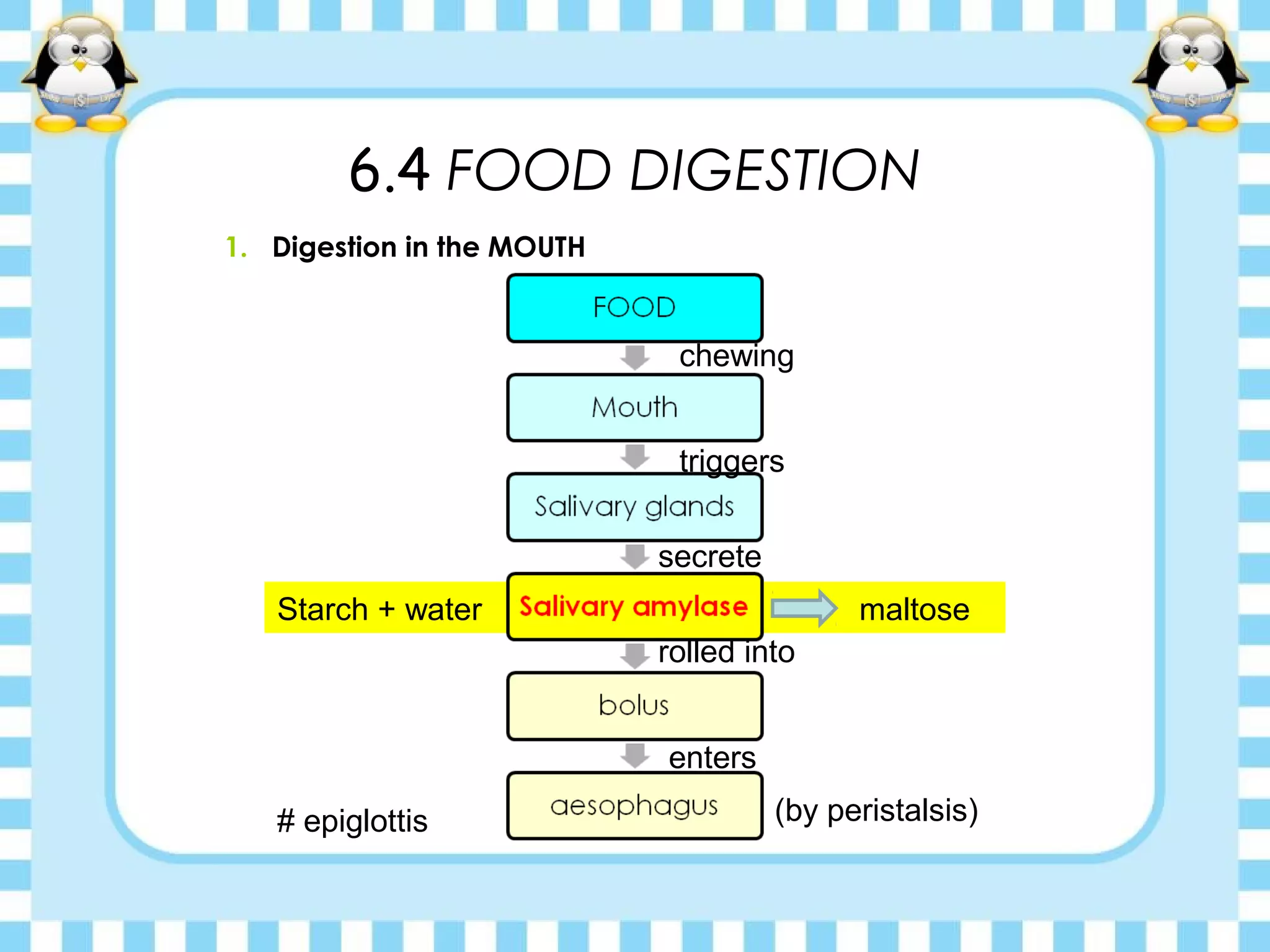
Starch + water
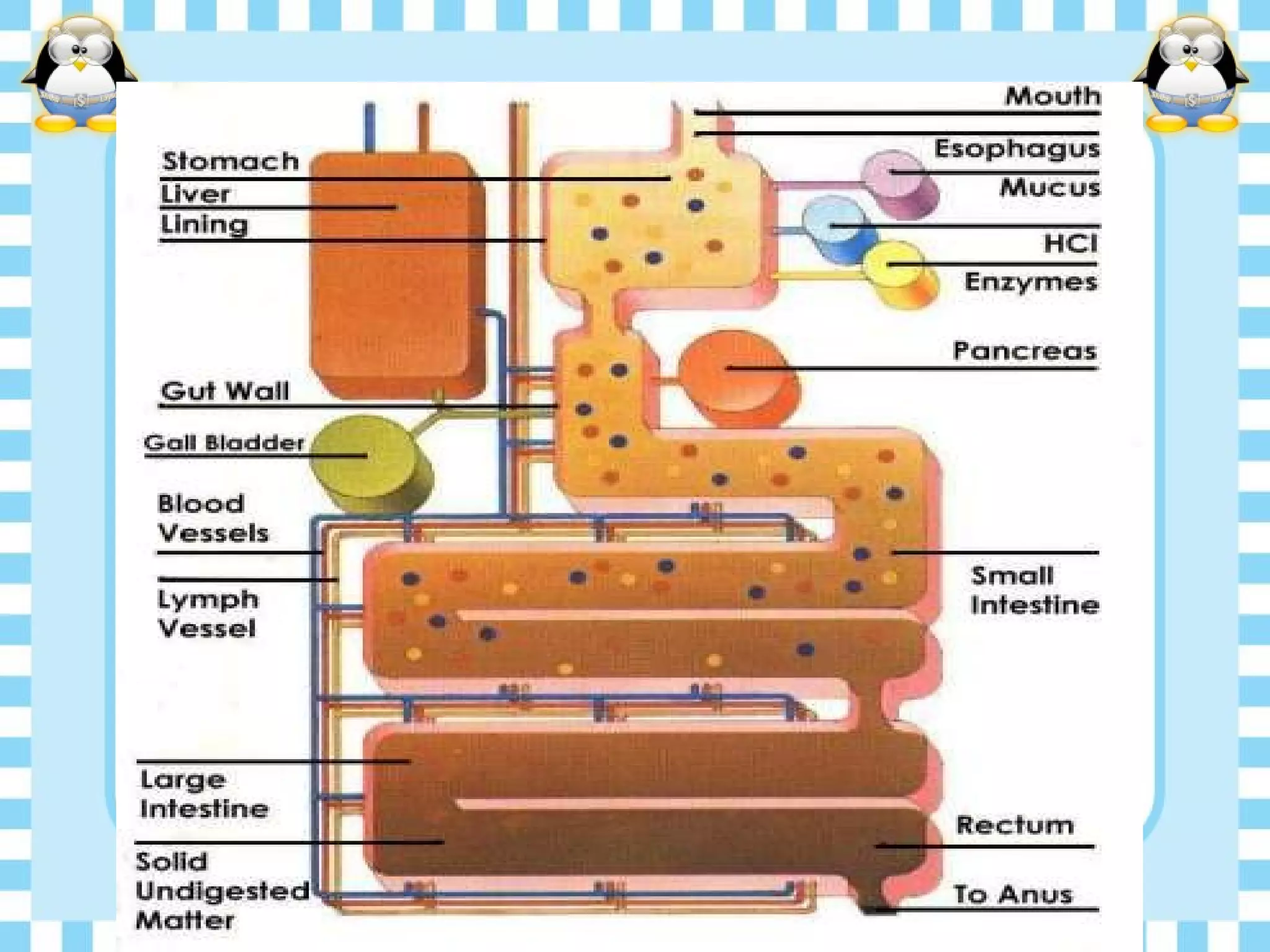
6.4 FOOD DIGESTION
1. Digestion in the MOUTH
maltose
secrete
chewing
triggers
rolled into
enters
(by peristalsis)# epiglottis
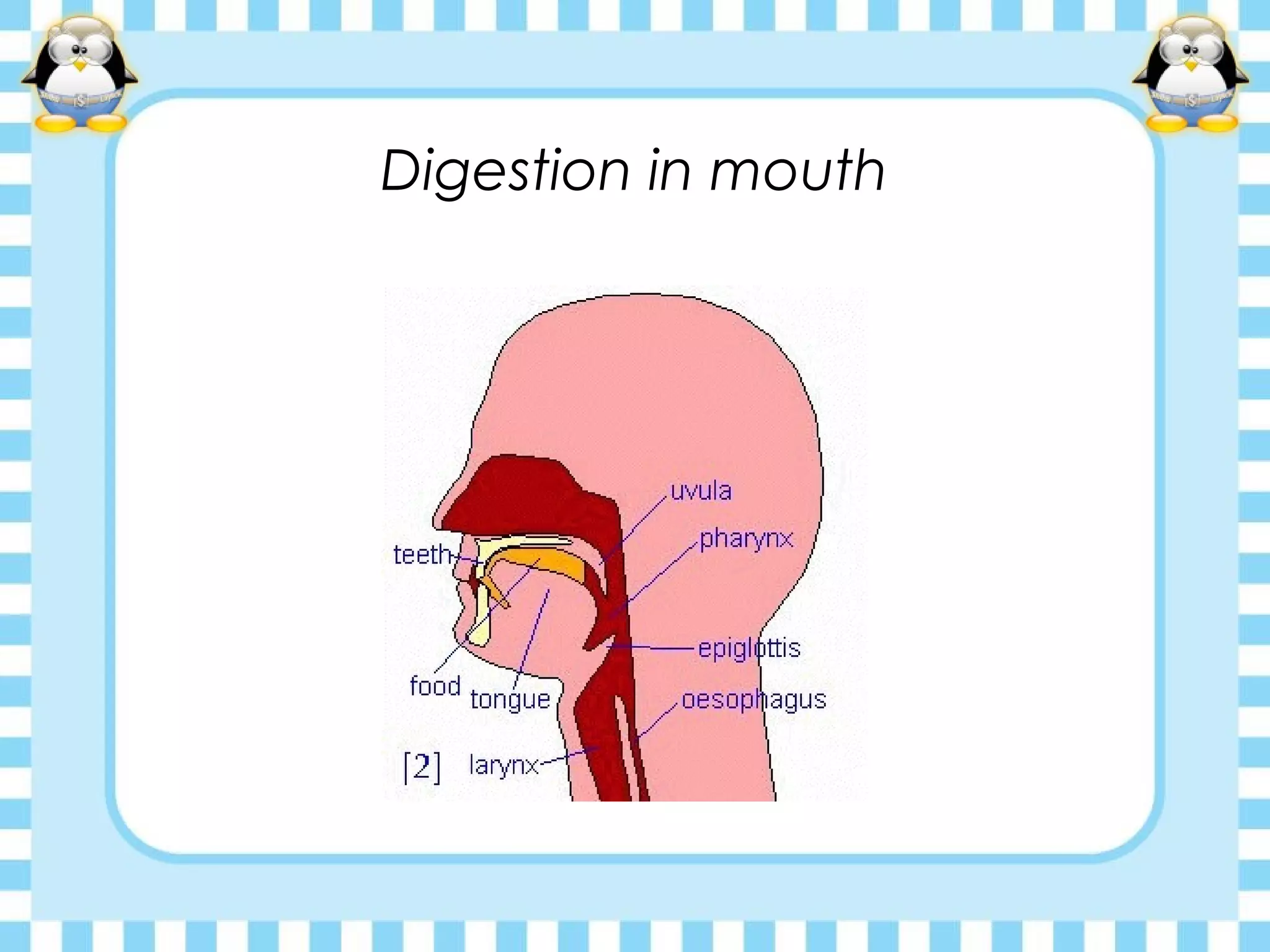
Digestion in mouth
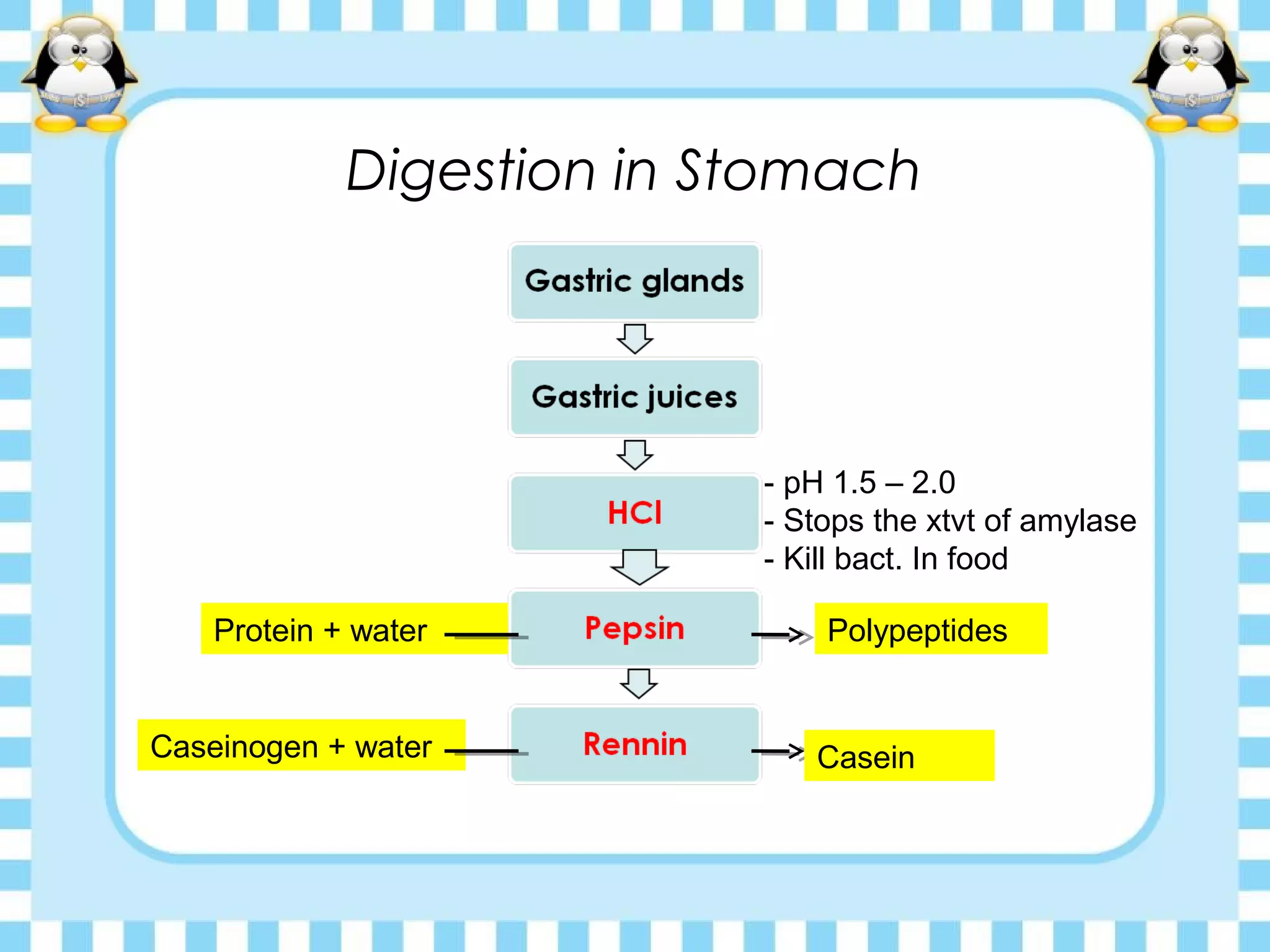
Digestion in Stomach
- pH 1.5 – 2.0
- Stops the xtvt of amylase
- Kill bact. In food
Protein + water Polypeptides
Caseinogen + water Casein
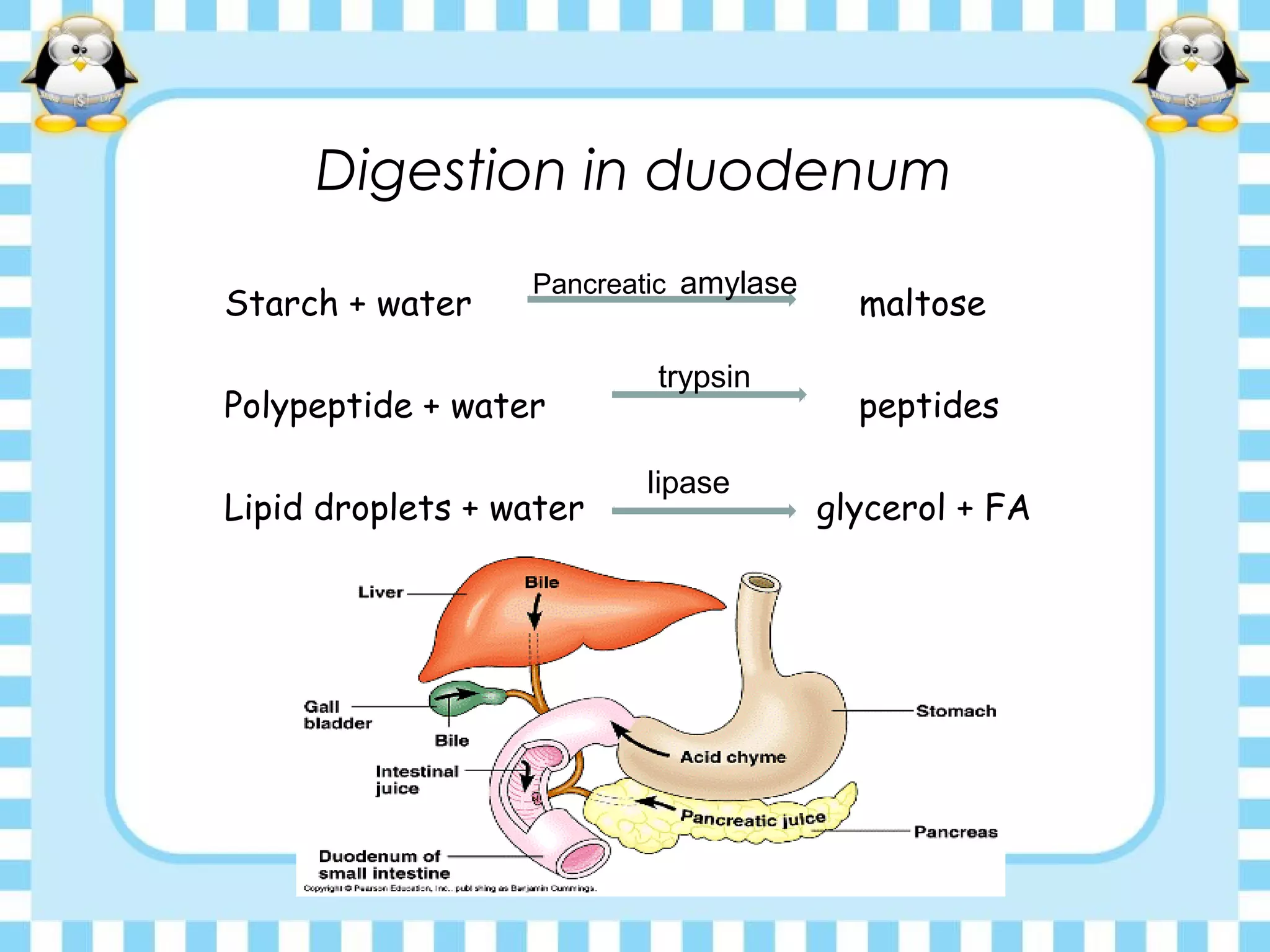
Digestion in duodenum
Starch + water maltose
Polypeptide + water peptides
Lipid droplets + water glycerol + FA
Pancreatic amylase
trypsin
lipase
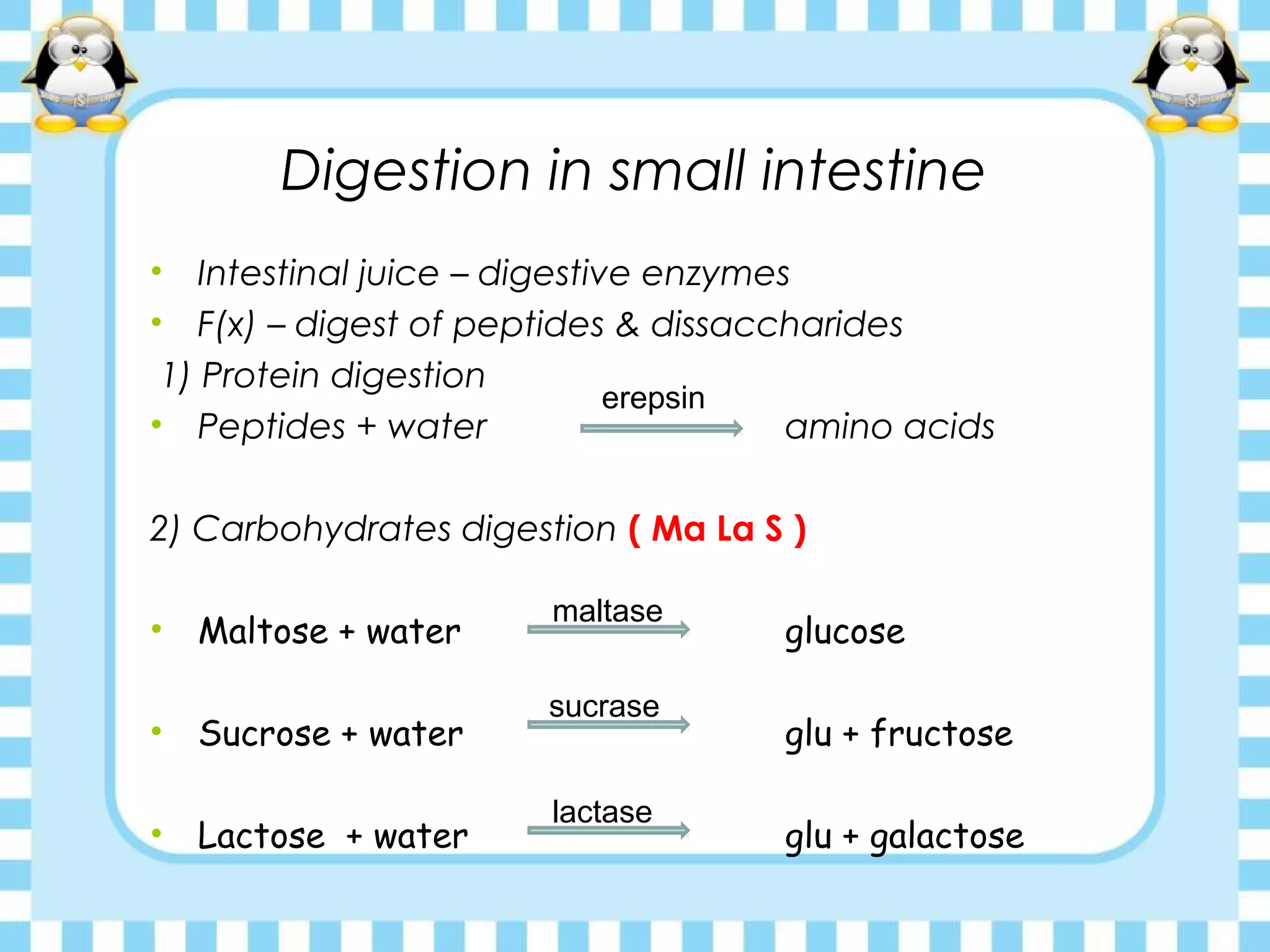
Digestion in small intestine
• Intestinal juice – digestive enzymes
• F(x) – digest of peptides & dissaccharides
1) Protein digestion
• Peptides + water amino acids
2) Carbohydrates digestion ( Ma La S )
• Maltose + water glucose
• Sucrose + water glu + fructose
• Lactose + water glu + galactose
erepsin
maltase
sucrase
lactase
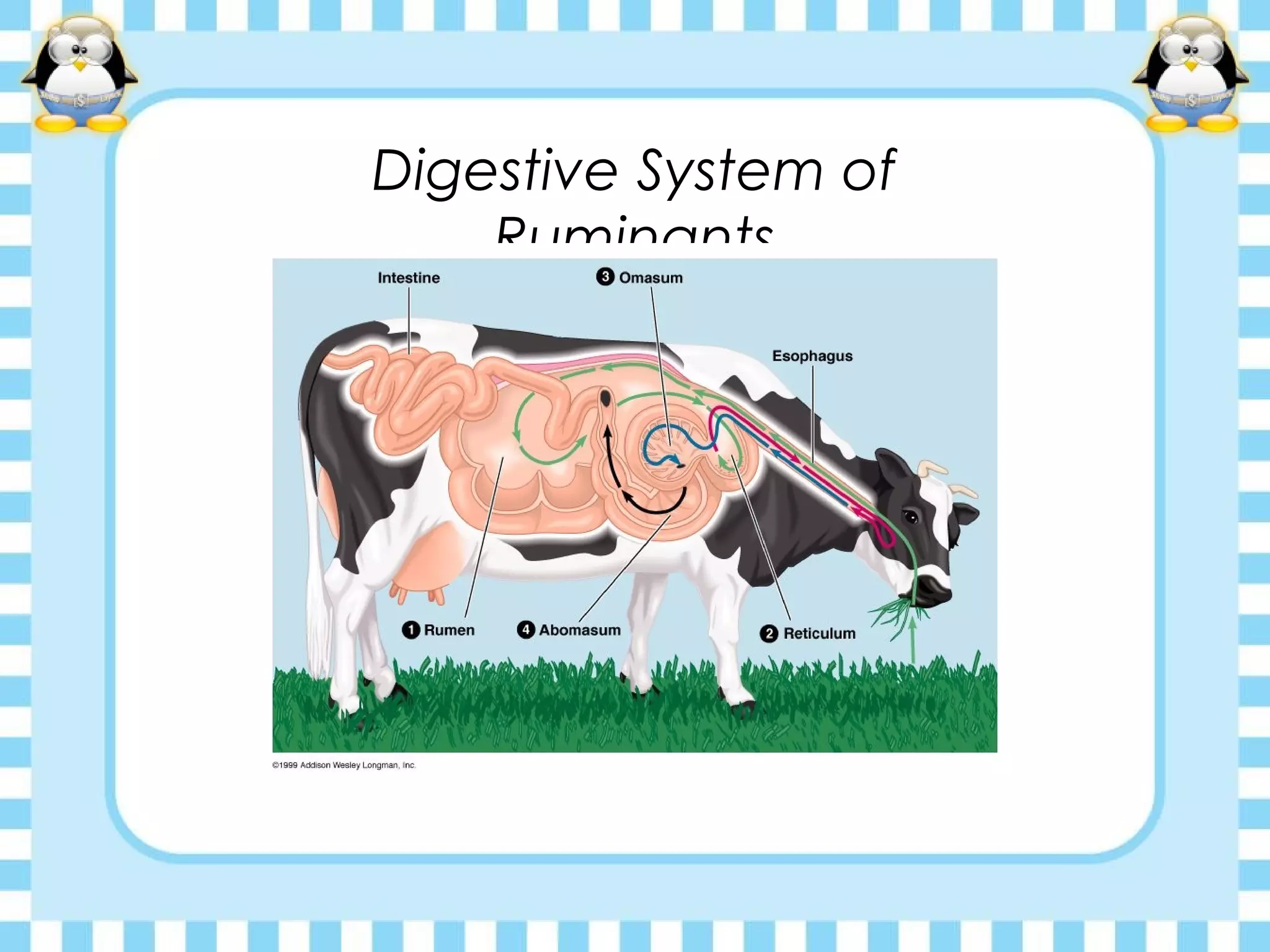
Digestive System of
Ruminants
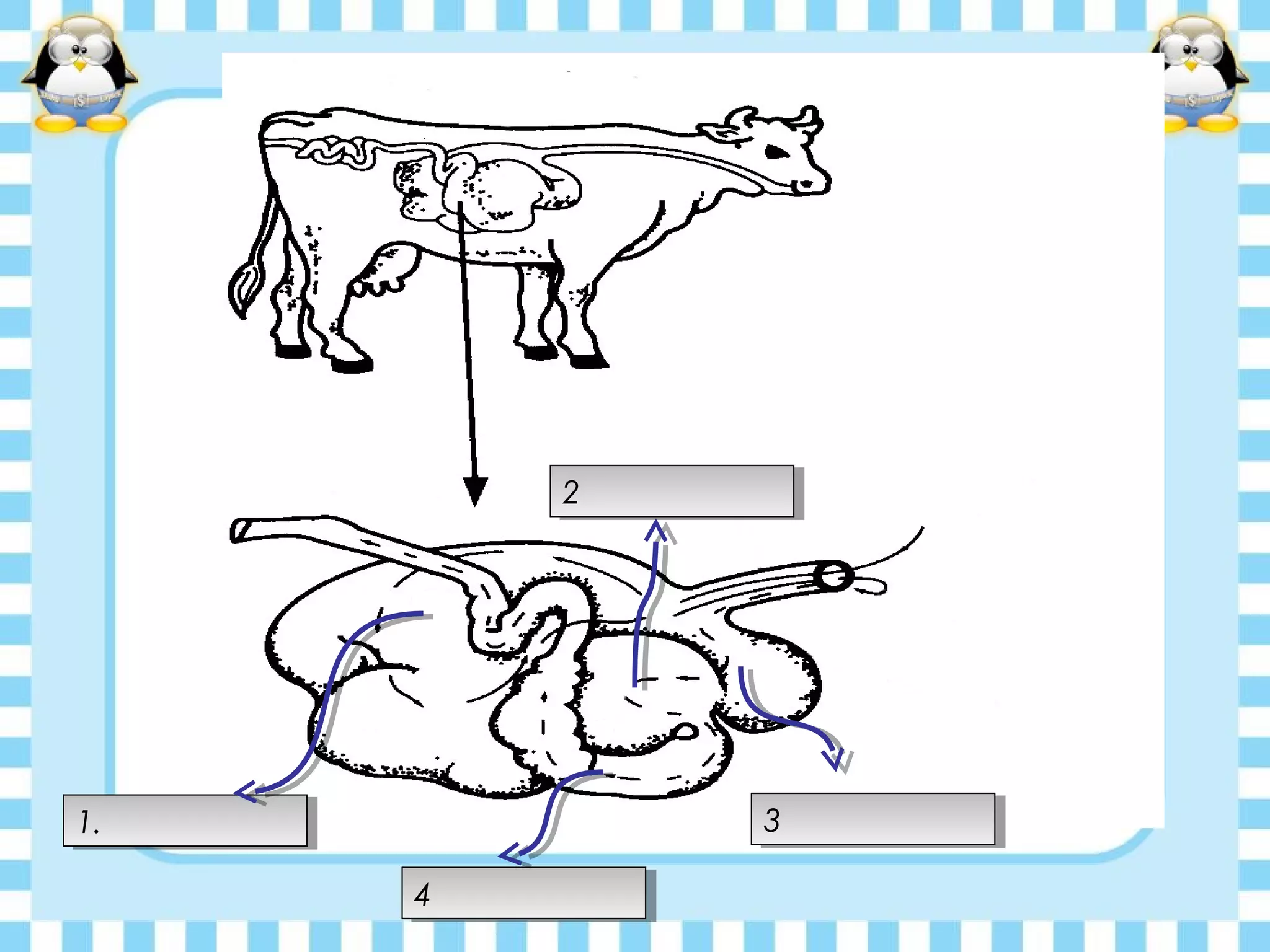
1.1.
22
44
33
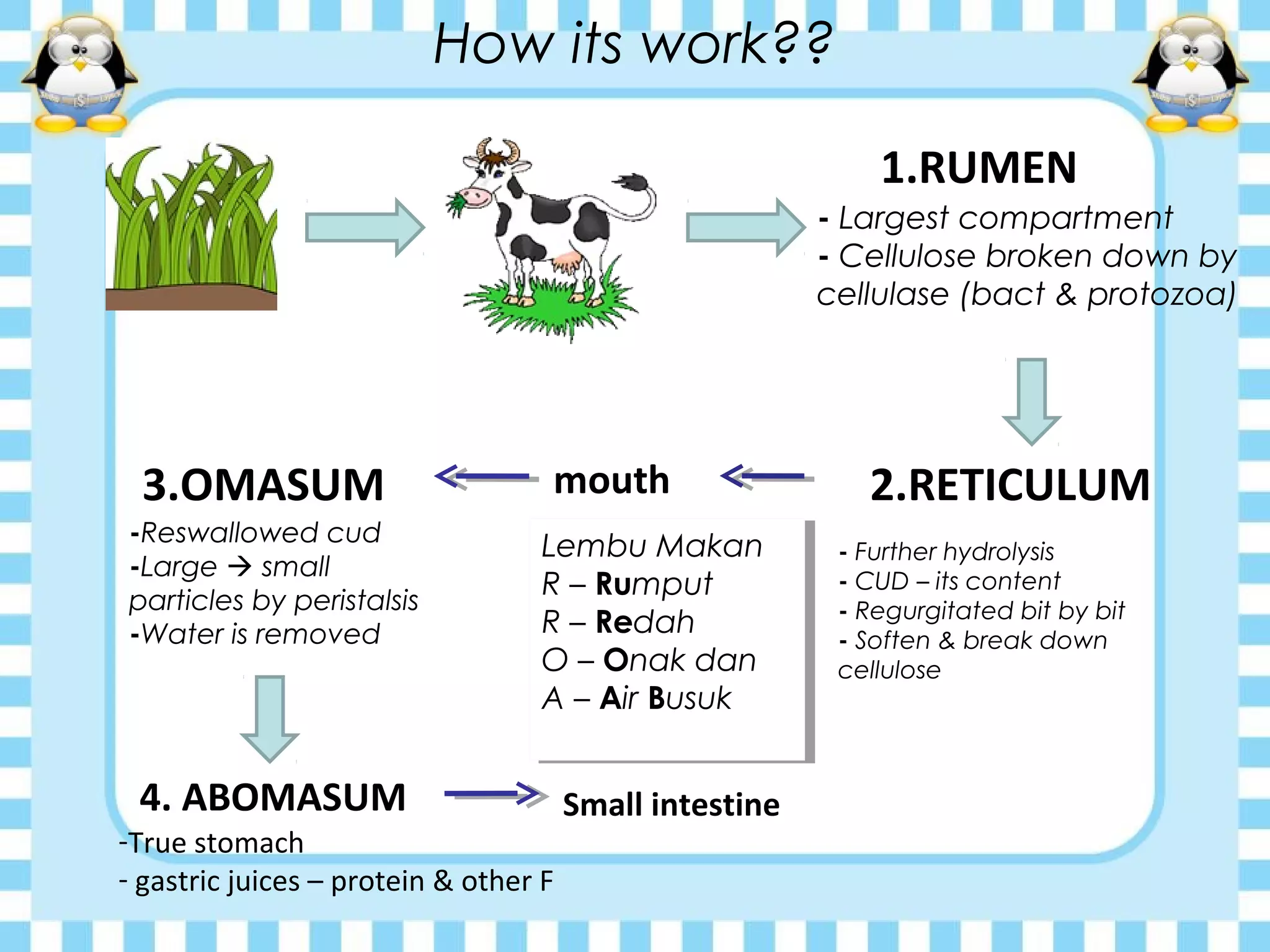
How its work??
1.RUMEN
- Largest compartment
- Cellulose broken down by
cellulase (bact & protozoa)
2.RETICULUM
- Further hydrolysis
- CUD – its content
- Regurgitated bit by bit
- Soften & break down
cellulose
mouth3.OMASUM
-Reswallowed cud
-Large  small
particles by peristalsis
-Water is removed
4. ABOMASUM
-True stomach
- gastric juices – protein & other F
Small intestine
Lembu Makan
R – Rumput
R – Redah
O – Onak dan
A – Air Busuk
Lembu Makan
R – Rumput
R – Redah
O – Onak dan
A – Air Busuk
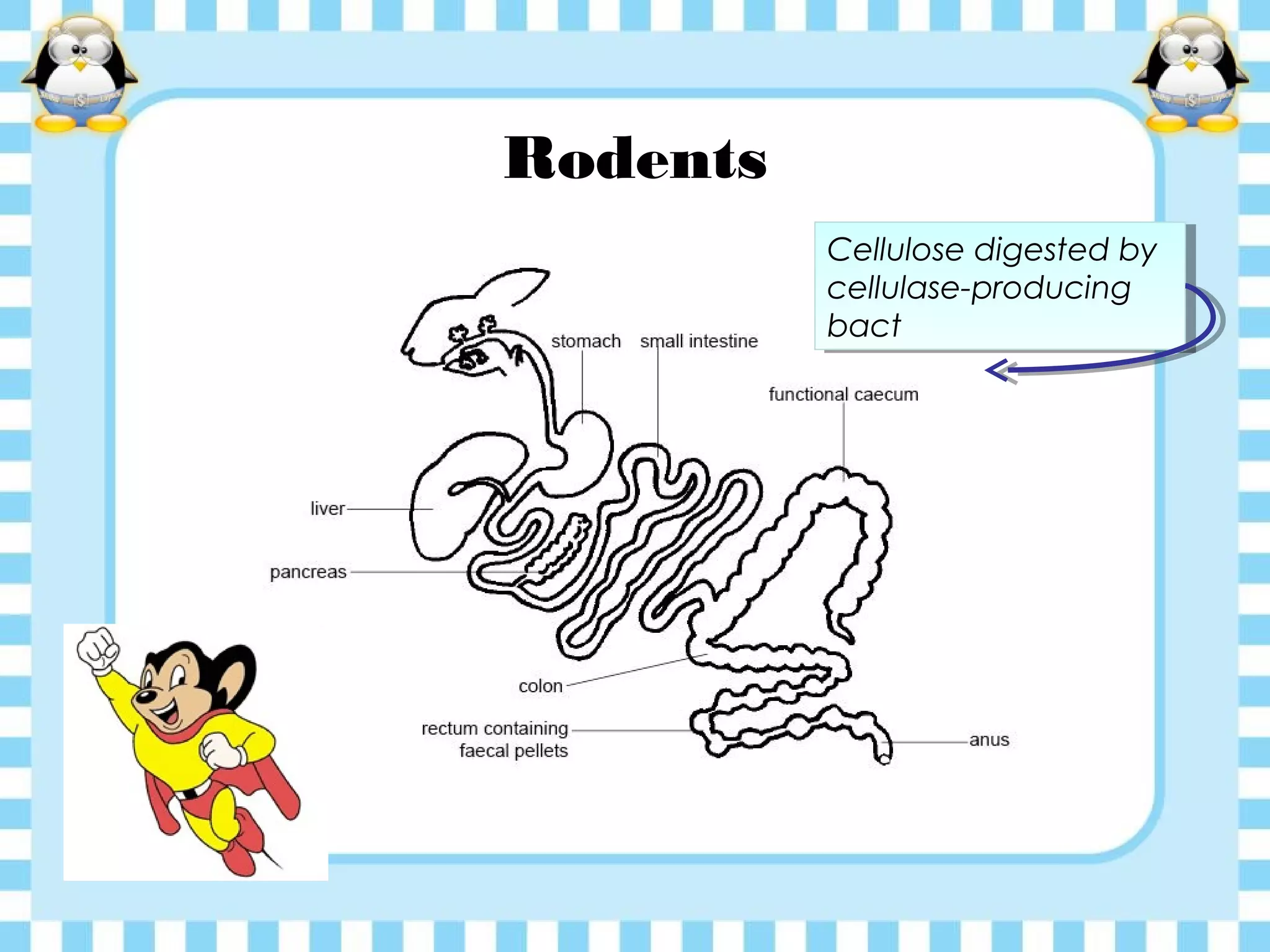
Rodents
Cellulose digested by
cellulase-producing
bact
Cellulose digested by
cellulase-producing
bact
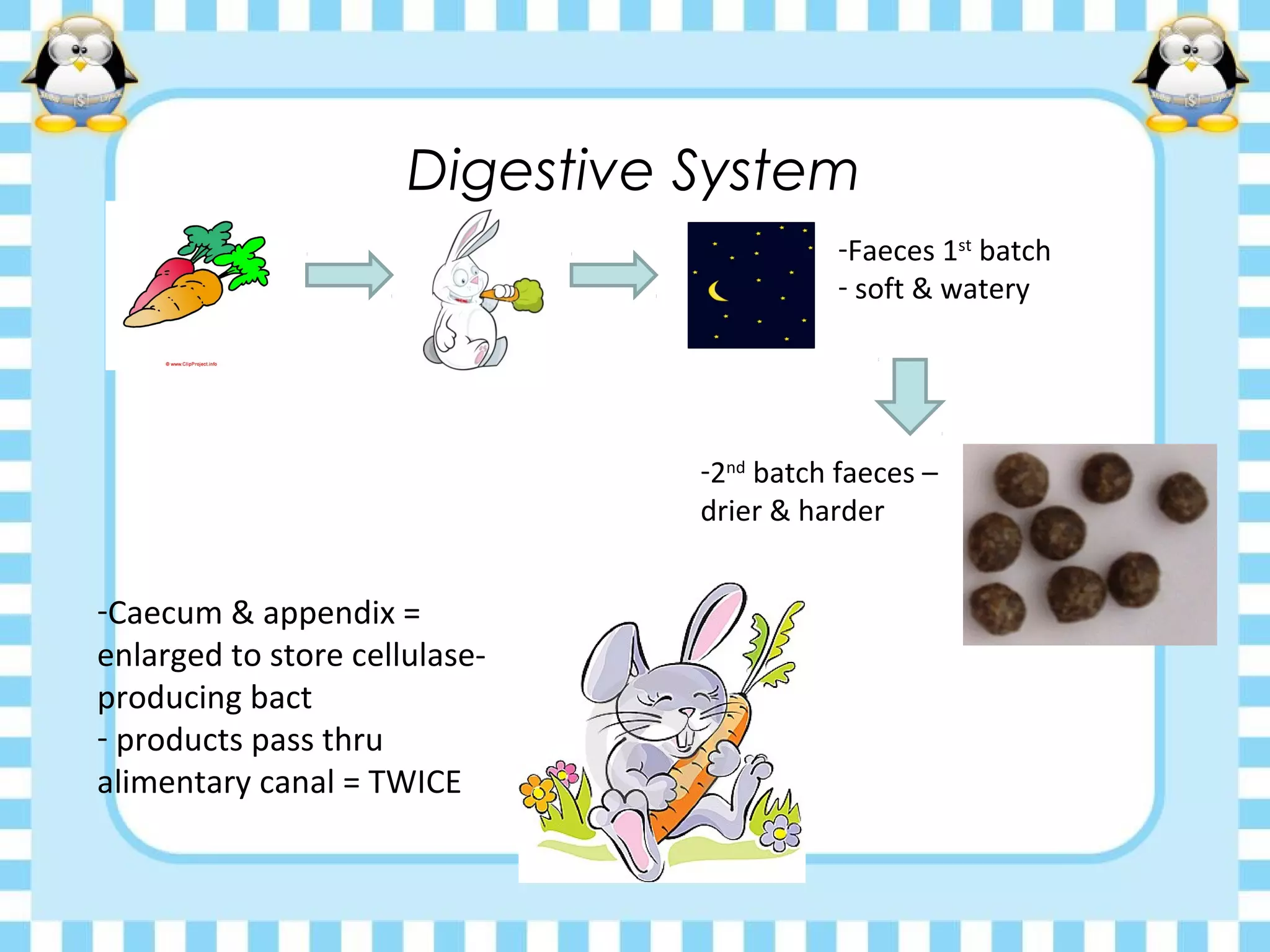
Digestive System
-Faeces 1st
batch
- soft & watery
-2nd
batch faeces –
drier & harder
-Caecum & appendix =
enlarged to store cellulase-
producing bact
- products pass thru
alimentary canal = TWICE
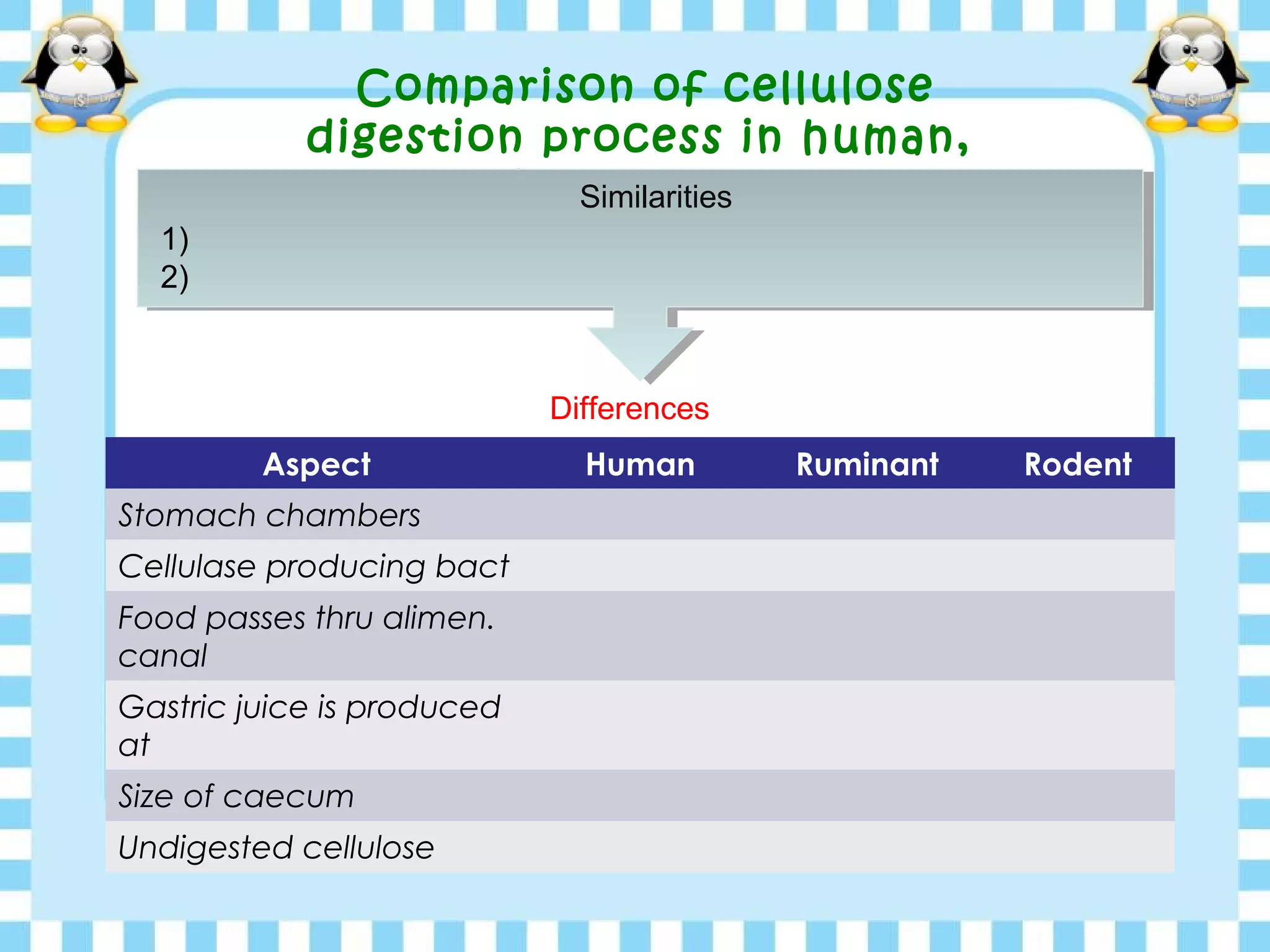
Comparison of cellulose
digestion process in human,
ruminant & rodentSimilarities
1)
2)
Differences
Aspect Human Ruminant Rodent
Stomach chambers
Cellulase producing bact
Food passes thru alimen.
canal
Gastric juice is produced
at
Size of caecum
Undigested cellulose
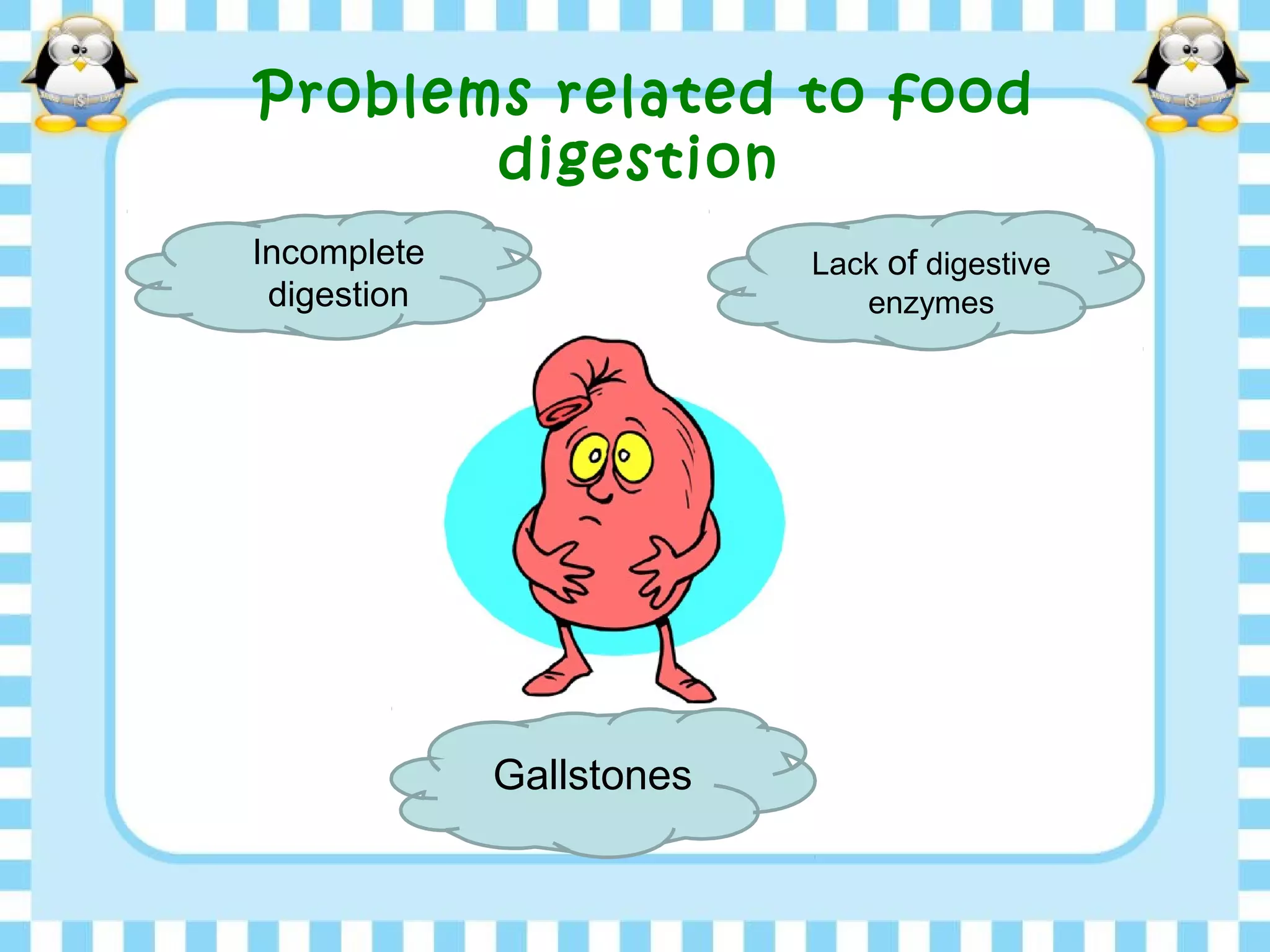
Problems related to food
digestion
Incomplete
digestion
Lack of digestive
enzymes
Gallstones
6.5 Absorption & Assimilation
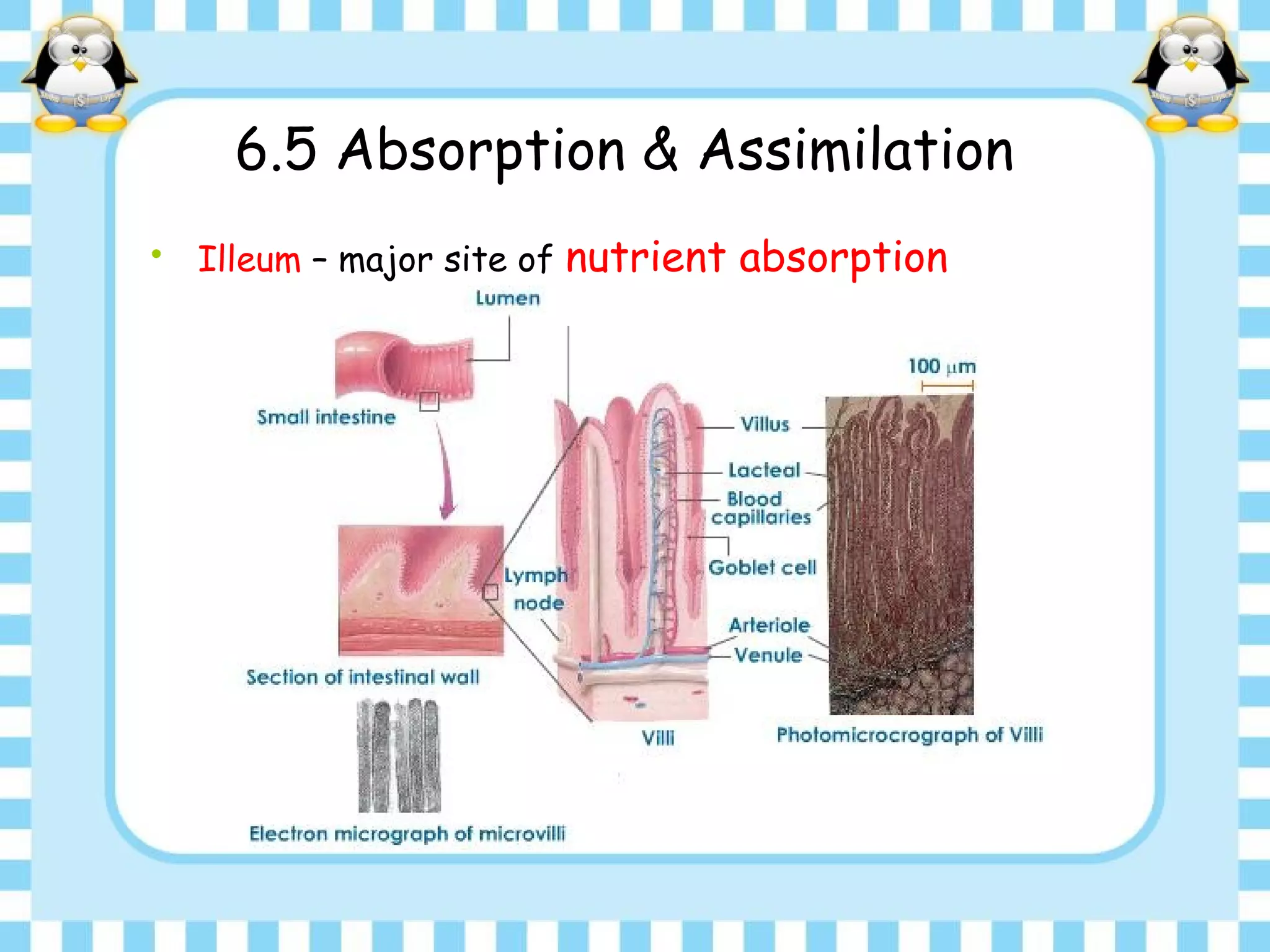
• Illeum – major site of nutrient absorption
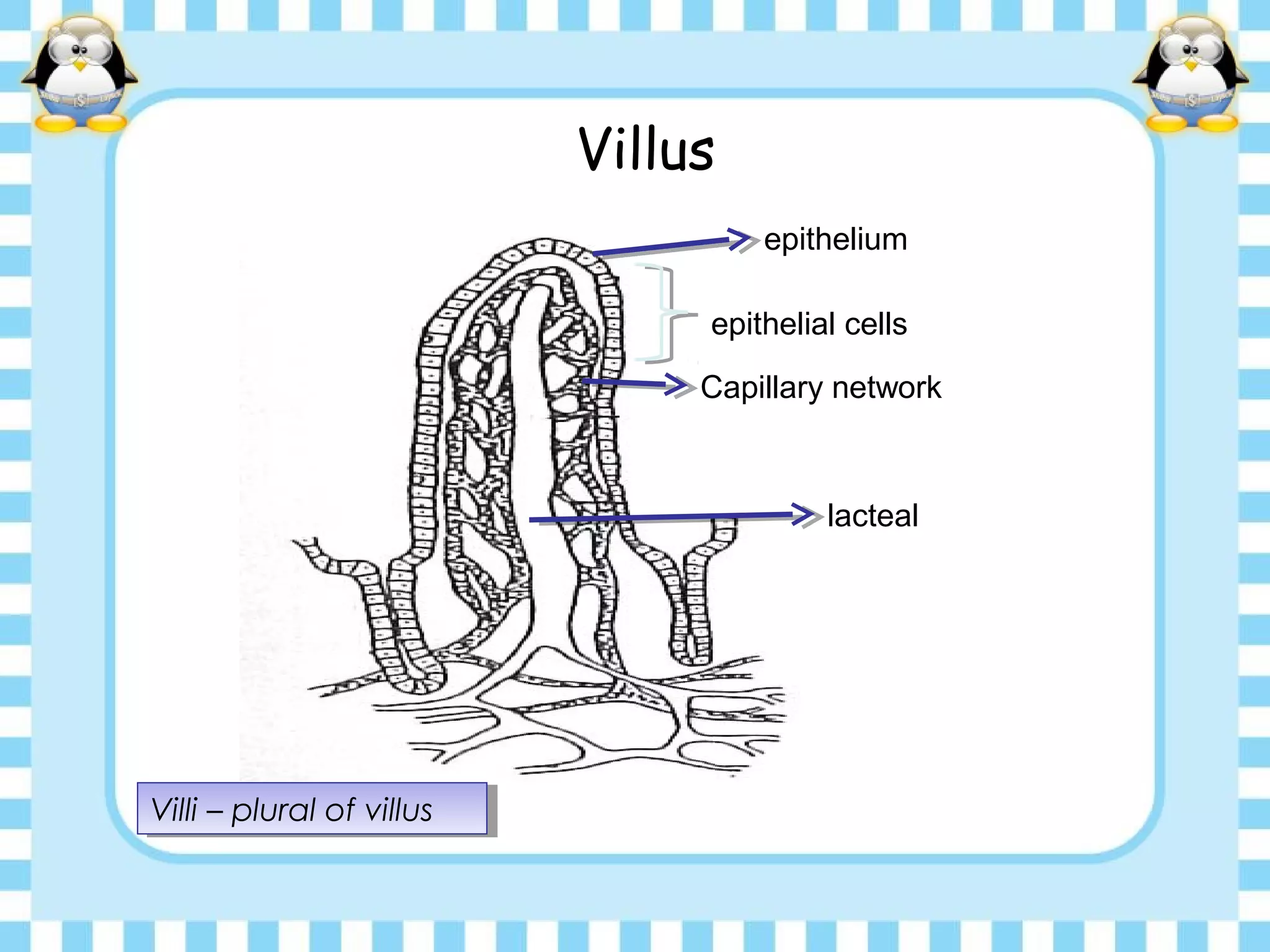
Villus
epithelium
lacteal
Capillary network
epithelial cells
Villi – plural of villusVilli – plural of villus
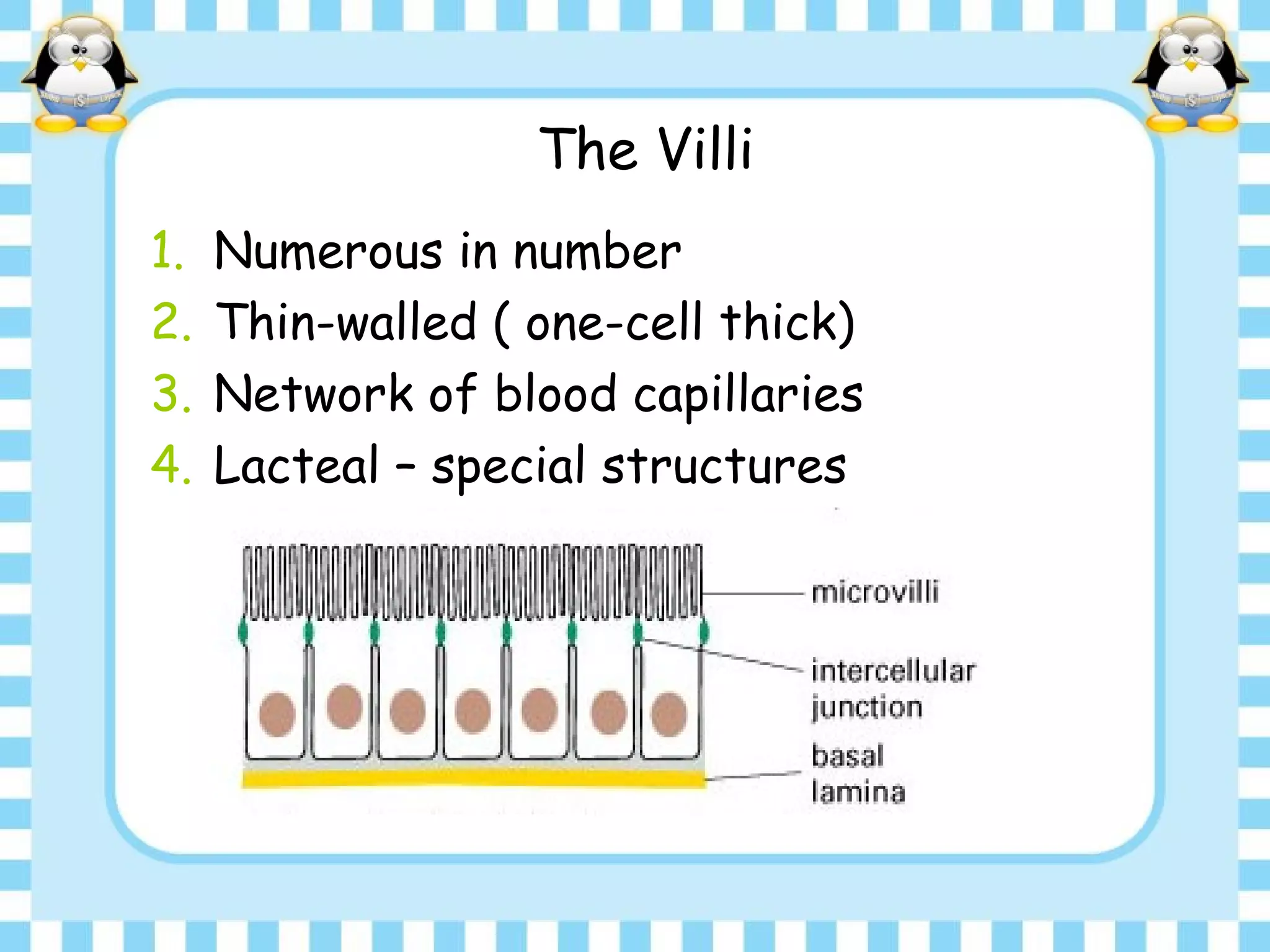
The Villi
1. Numerous in number
2. Thin-walled ( one-cell thick)
3. Network of blood capillaries
4. Lacteal – special structures
Absorption of digested food
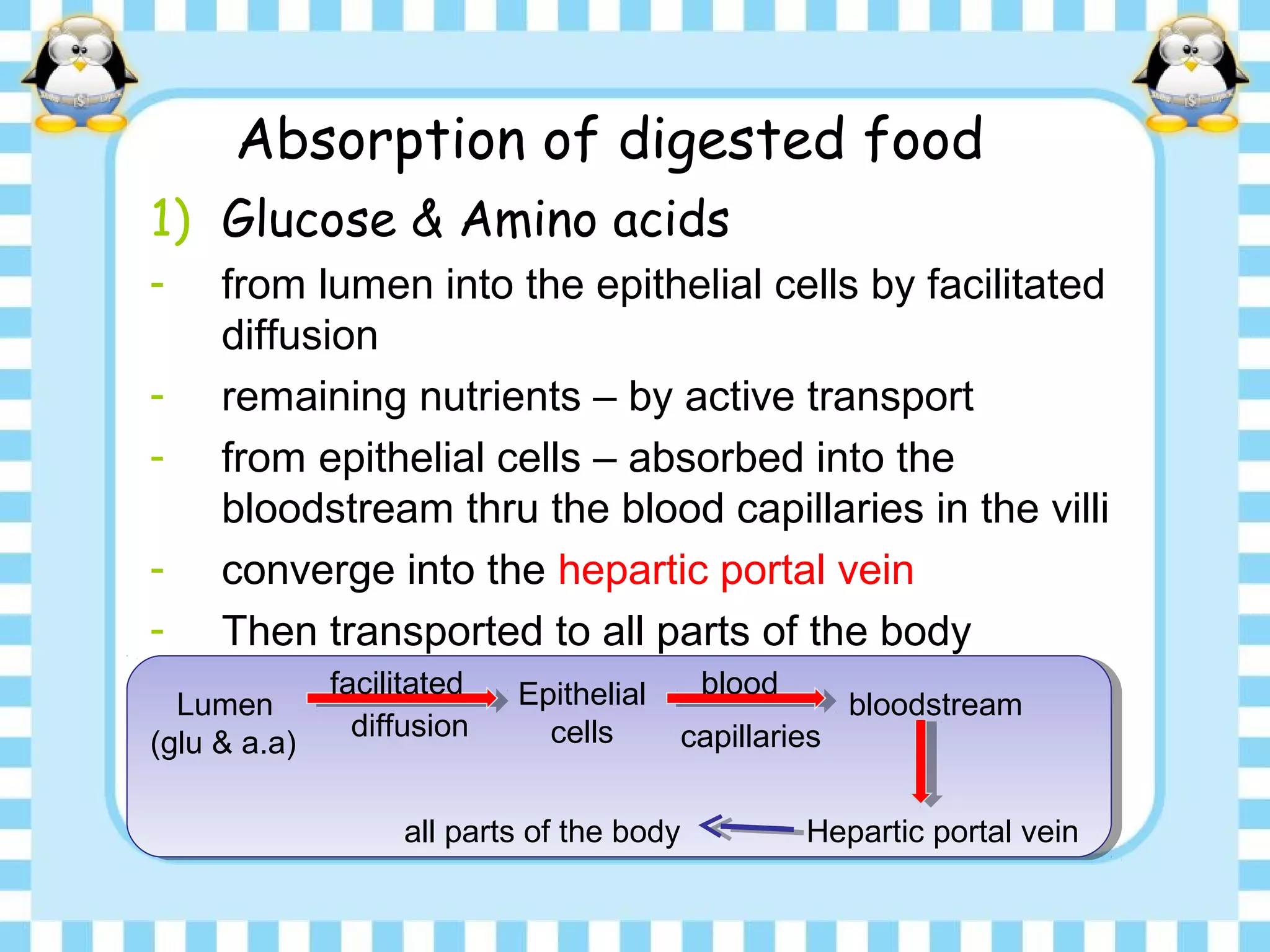
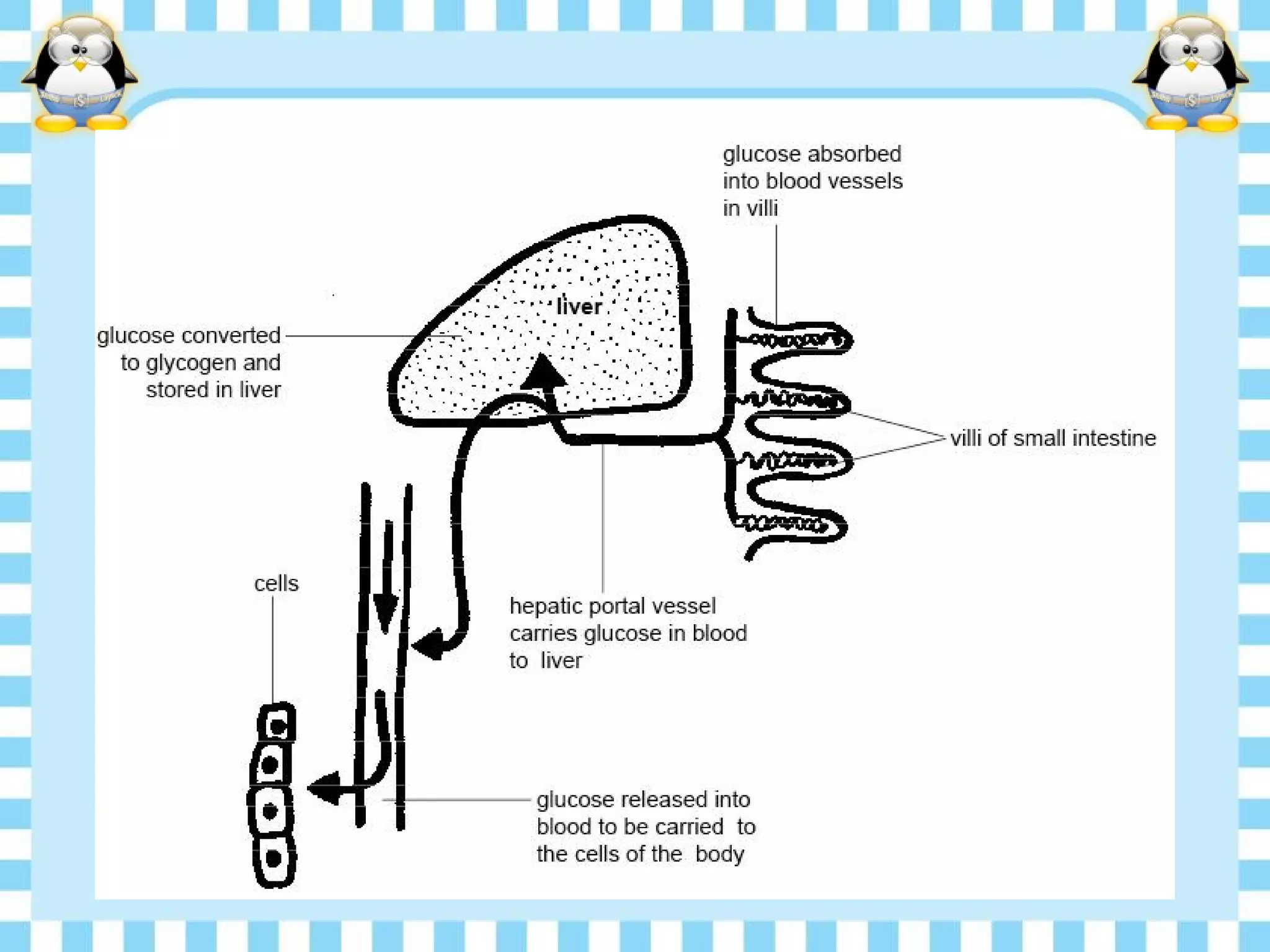
1) Glucose & Amino acids
- from lumen into the epithelial cells by facilitated
diffusion
- remaining nutrients – by active transport
- from epithelial cells – absorbed into the
bloodstream thru the blood capillaries in the villi
- converge into the hepartic portal vein
- Then transported to all parts of the body
Lumen
(glu & a.a)
facilitated
diffusion
Epithelial
cells
bloodstream
Hepartic portal vein
blood
capillaries
all parts of the body
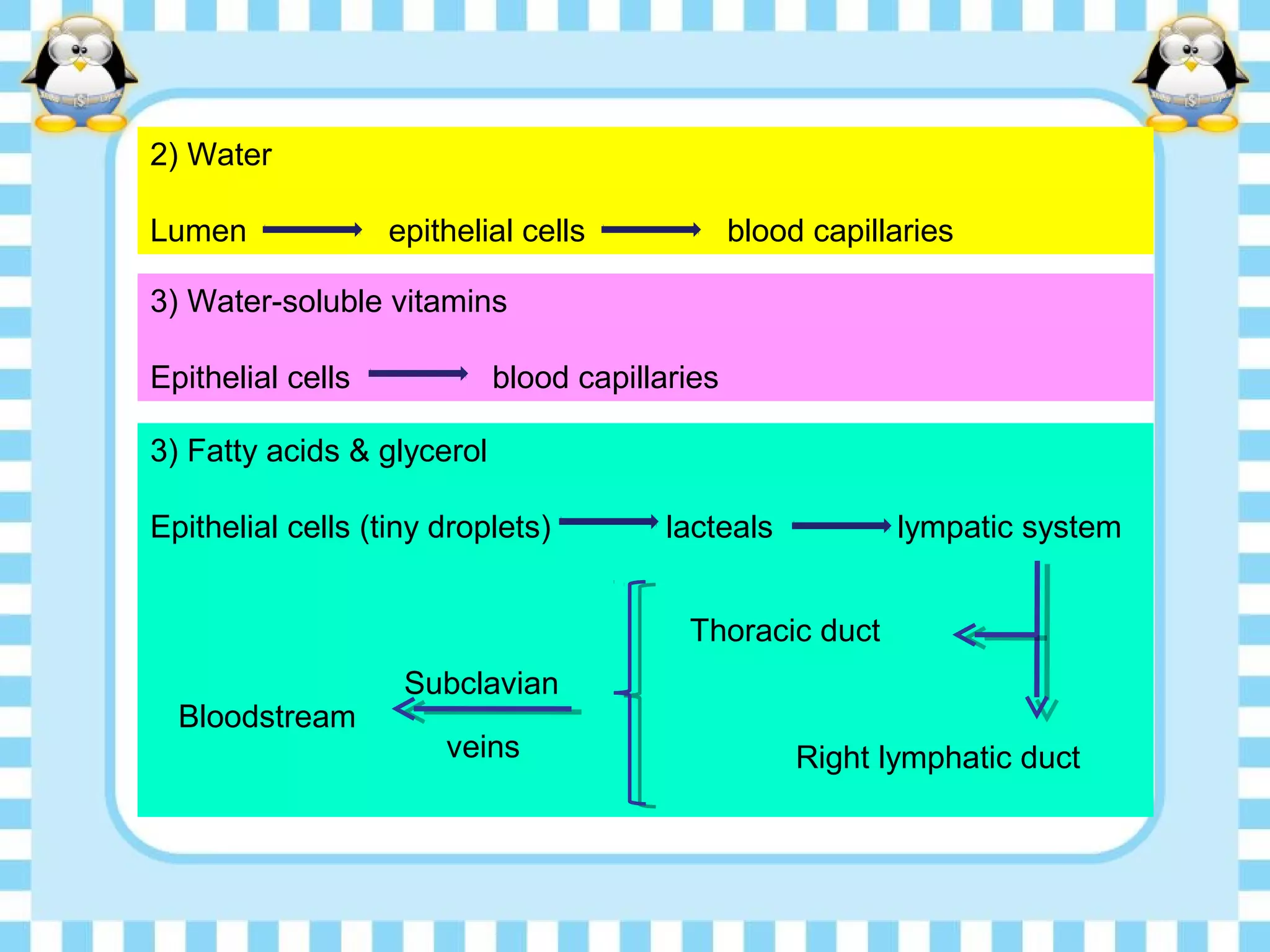
2) Water
Lumen epithelial cells blood capillaries
3) Water-soluble vitamins
Epithelial cells blood capillaries
3) Fatty acids & glycerol
Epithelial cells (tiny droplets) lacteals lympatic system
Right lymphatic duct
Thoracic duct
Bloodstream
Subclavian
veins
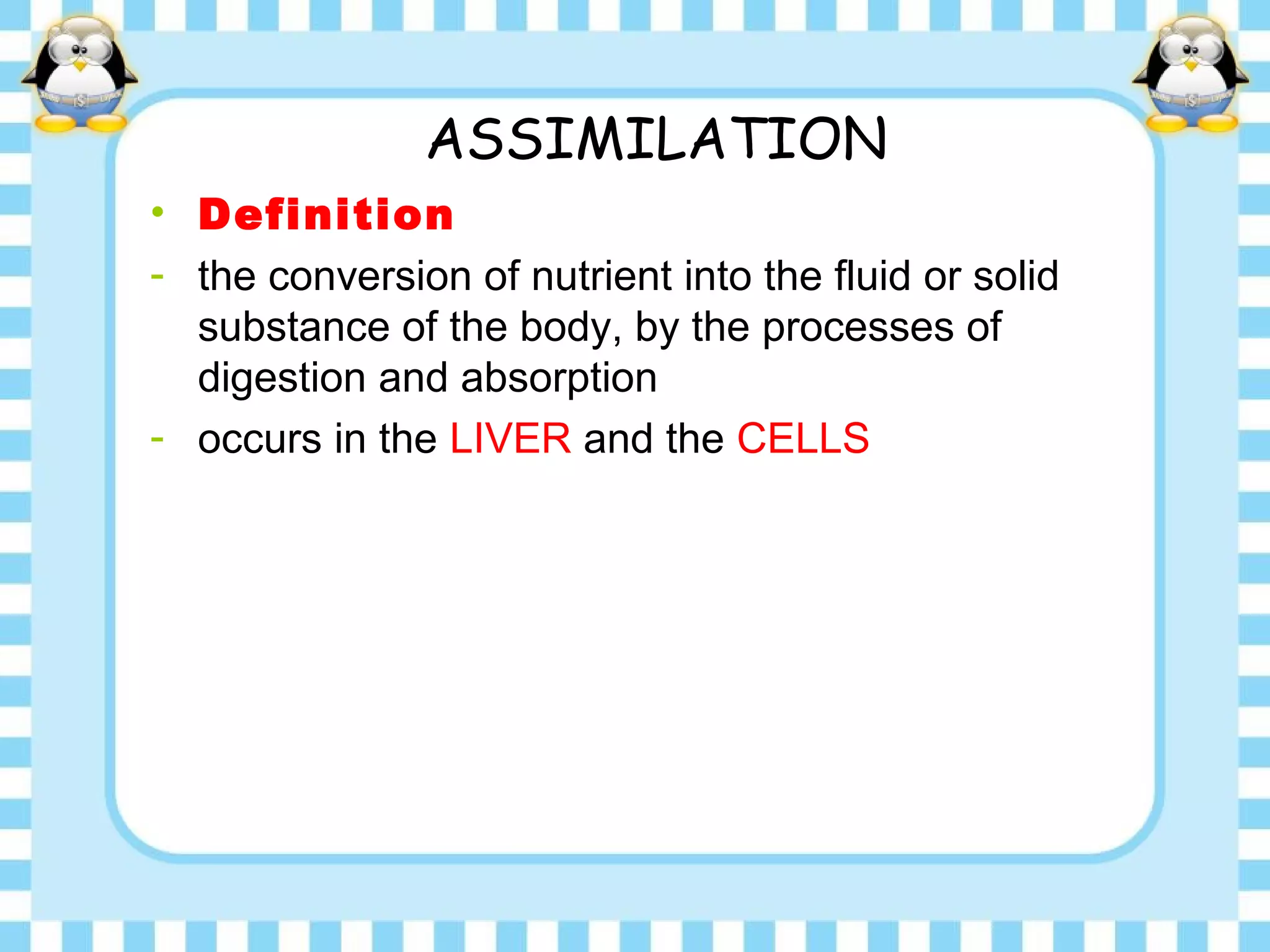
ASSIMILATION
• Definition
- the conversion of nutrient into the fluid or solid
substance of the body, by the processes of
digestion and absorption
- occurs in the LIVER and the CELLS
Assimilation in the LIVER
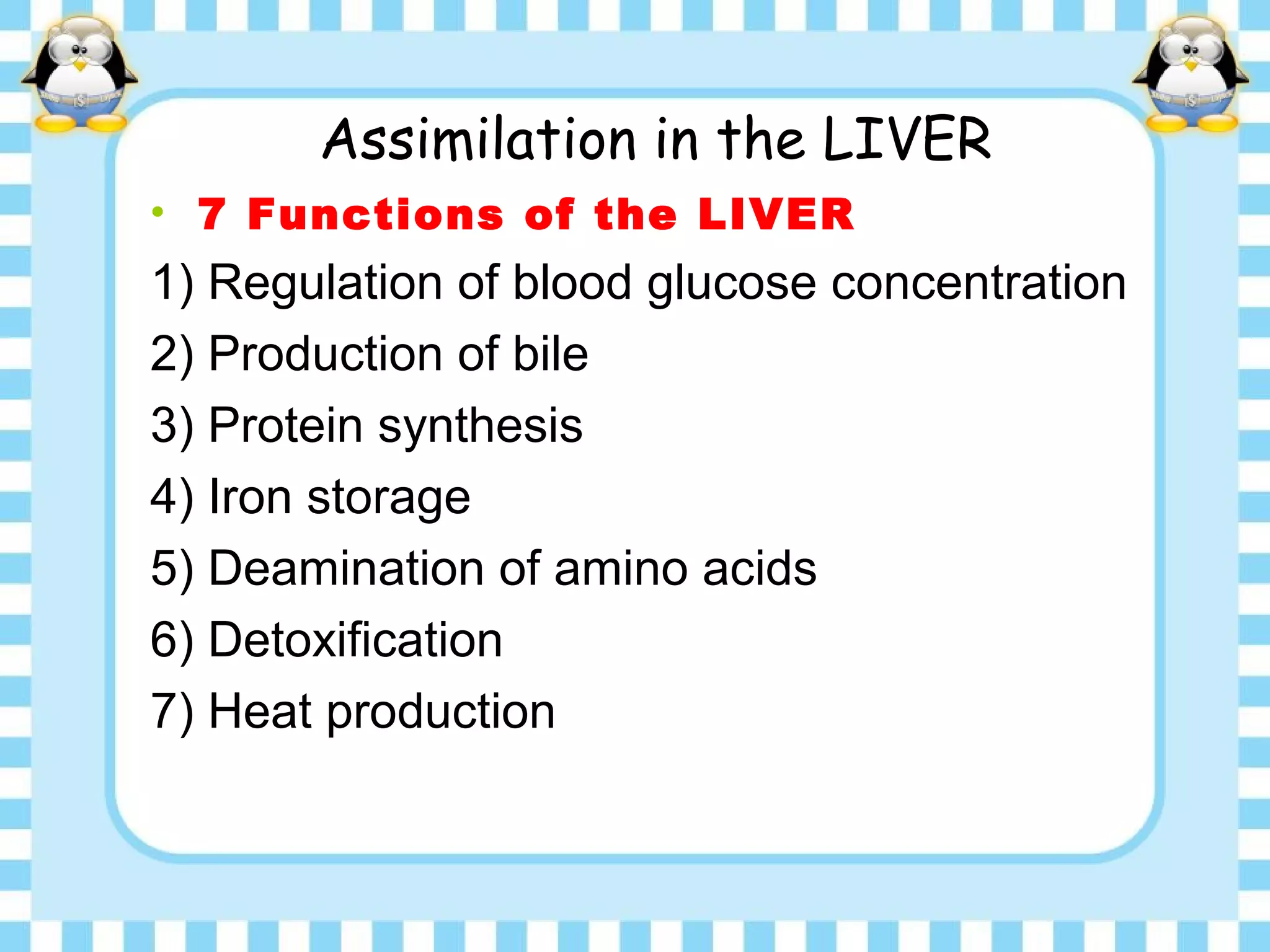
• 7 Functions of the LIVER
1) Regulation of blood glucose concentration
2) Production of bile
3) Protein synthesis
4) Iron storage
5) Deamination of amino acids
6) Detoxification
7) Heat production
Assimilation in the LIVER
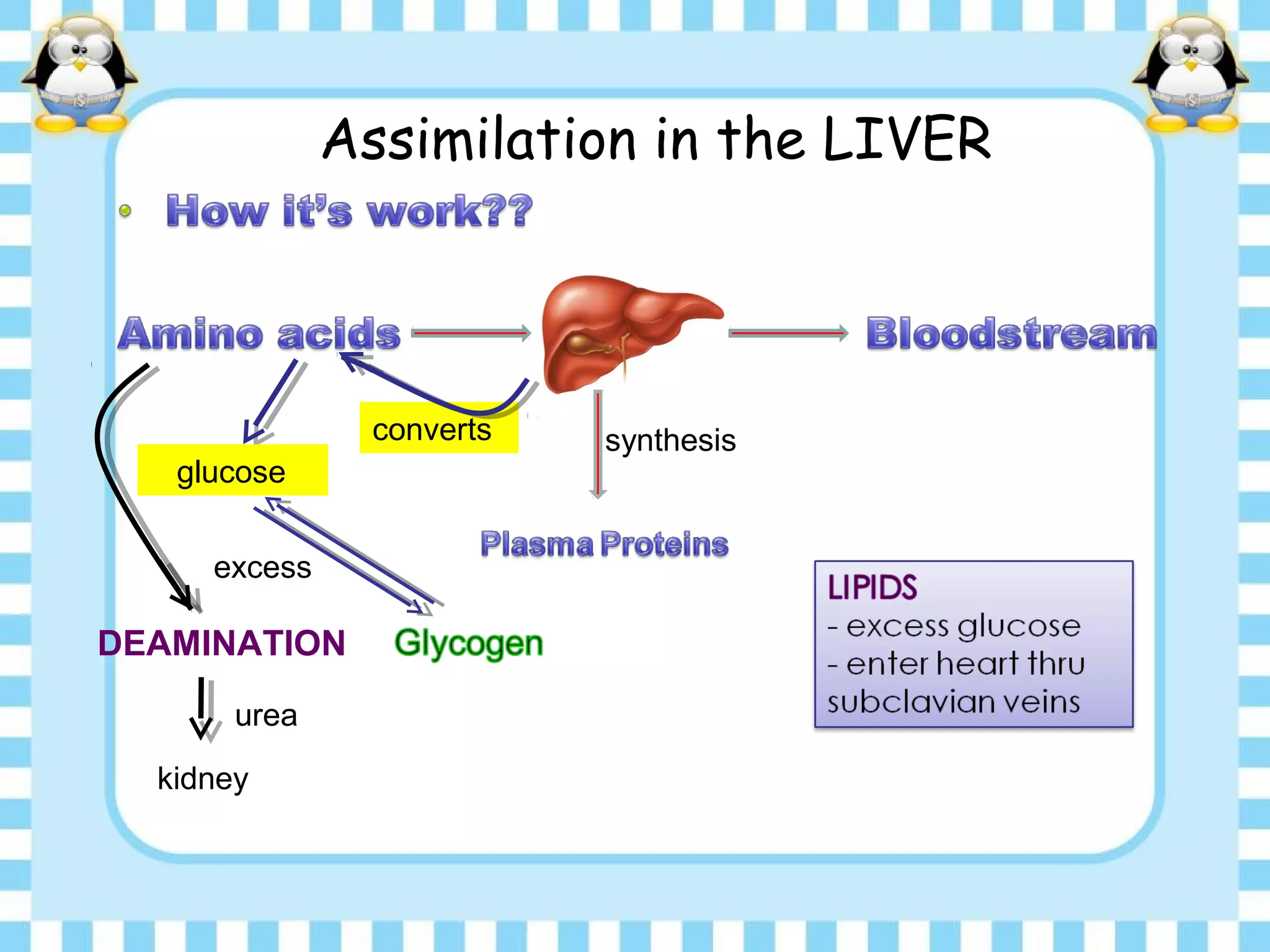
synthesisconverts
glucose
excess
DEAMINATION
urea
kidney
Assimilation in the CELLS
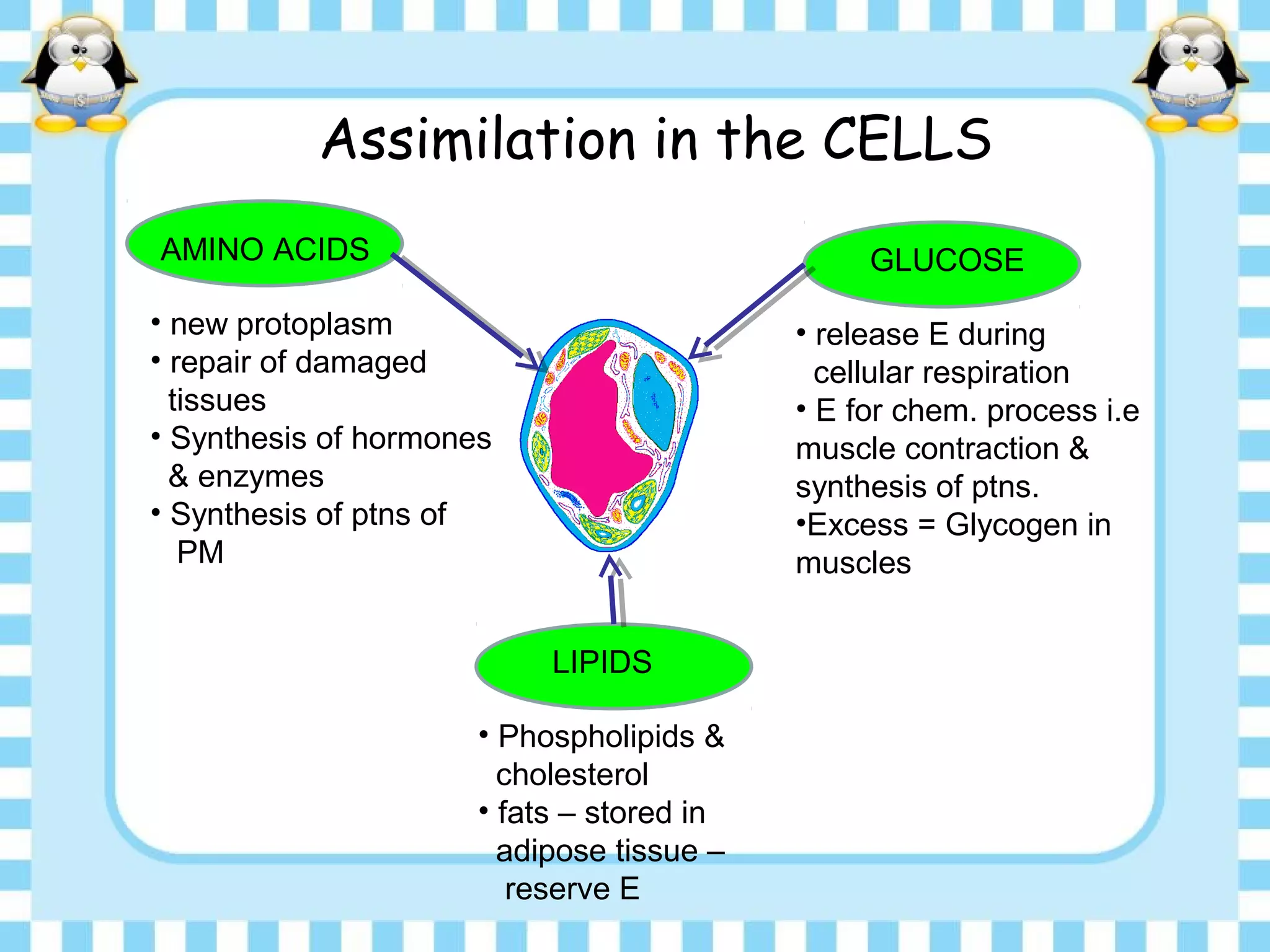
AMINO ACIDS GLUCOSE
AMINO ACIDSLIPIDS
• new protoplasm
• repair of damaged
tissues
• Synthesis of hormones
& enzymes
• Synthesis of ptns of
PM
• Phospholipids &
cholesterol
• fats – stored in
adipose tissue –
reserve E
• release E during
cellular respiration
• E for chem. process i.e
muscle contraction &
synthesis of ptns.
•Excess = Glycogen in
muscles
Formation of Faeces
• Contents of intestinal:
1) Mixture of water
2) Undigested food substances
3) Dead cells
4) Dead bacteria
5) Indigestible fibre (cellulose)
• Colon
- large intestinal
- Reabsorbs almost 90% of water & minerals into the
bloodstream
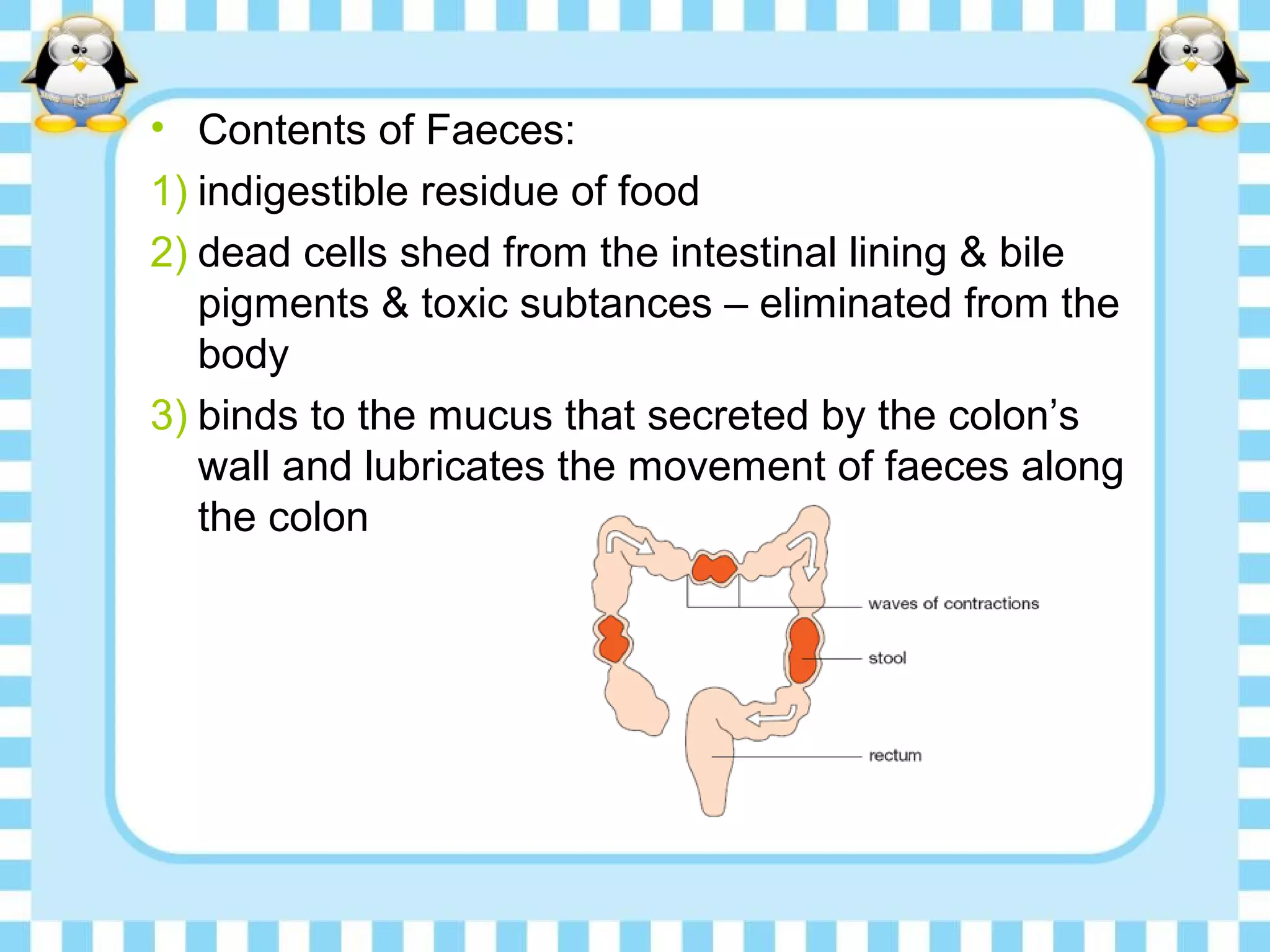
• Contents of Faeces:
1) indigestible residue of food
2) dead cells shed from the intestinal lining & bile
pigments & toxic subtances – eliminated from the
body
3) binds to the mucus that secreted by the colon’s
wall and lubricates the movement of faeces along
the colon
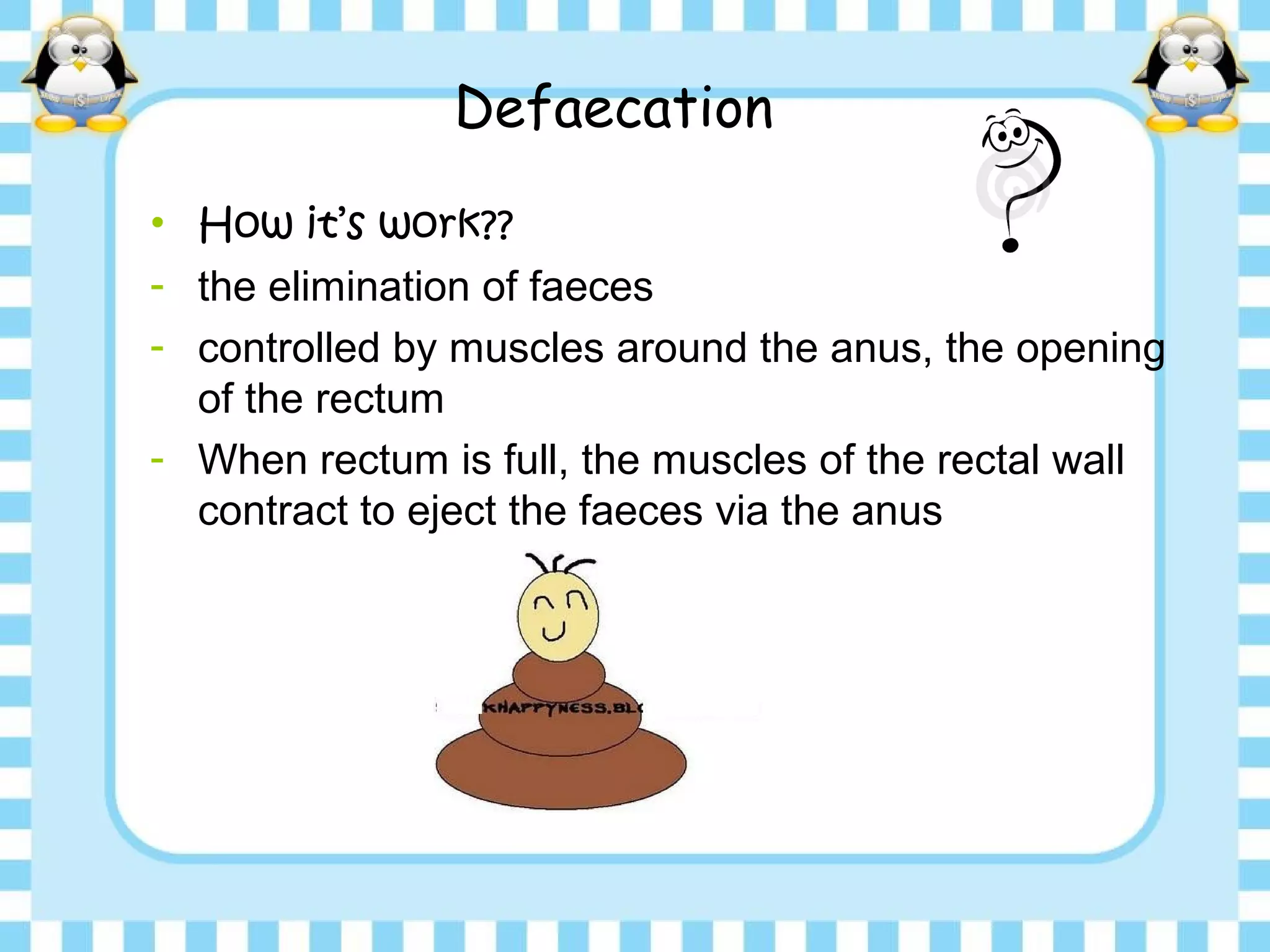
Defaecation
• How it’s work??
- the elimination of faeces
- controlled by muscles around the anus, the opening
of the rectum
- When rectum is full, the muscles of the rectal wall
contract to eject the faeces via the anus
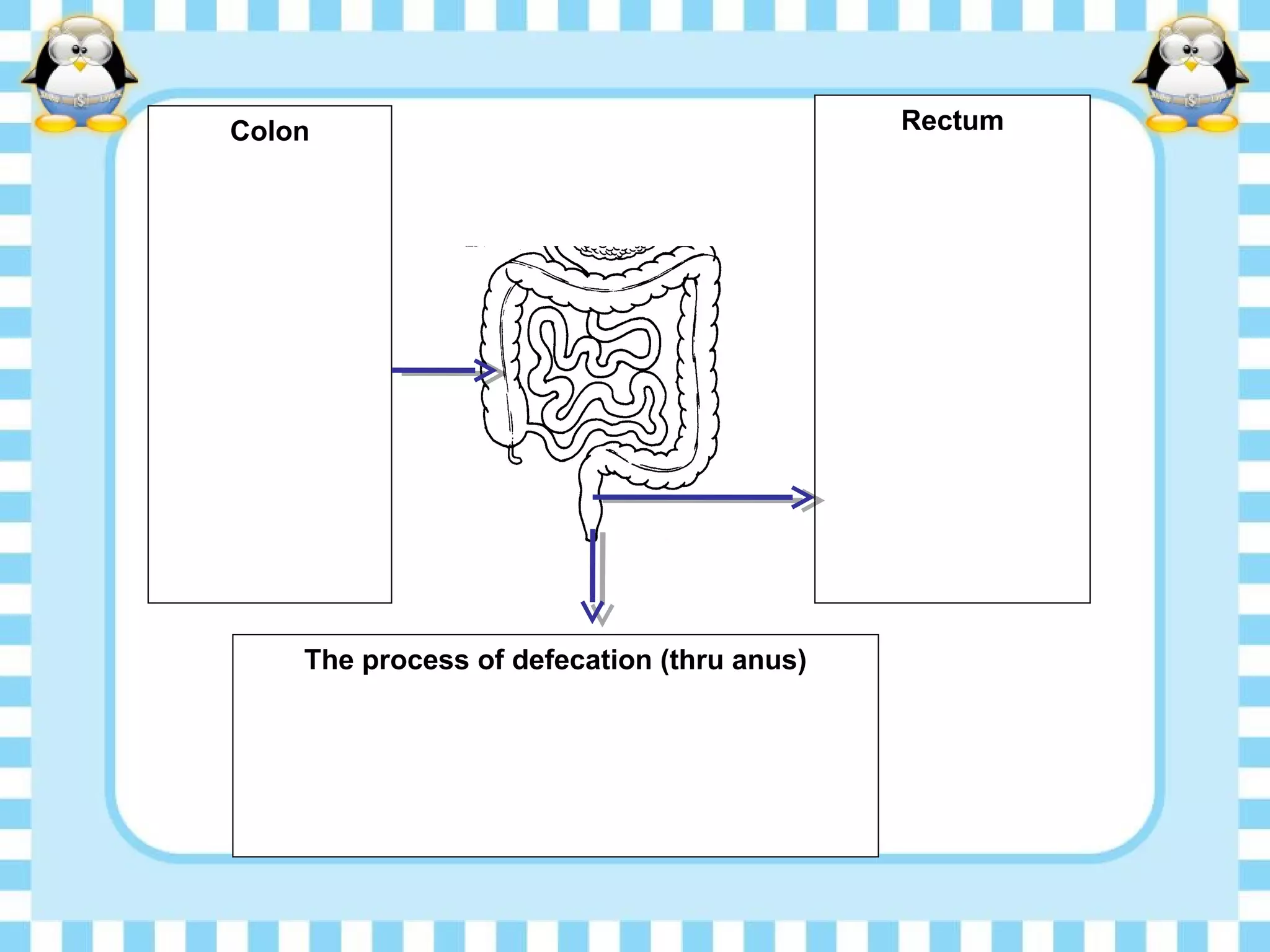
Rectum
The process of defecation (thru anus)
Colon
6.7 Evaluating Eating Habits
Bad Eating
Habits
Gastritis
Anorexia nervosa Bulimia
Obesity
6.8 The Importance Of A
Healthy Digestive System
6.9 The Importance Of
Macronutrient & Micronutrient
in Plant
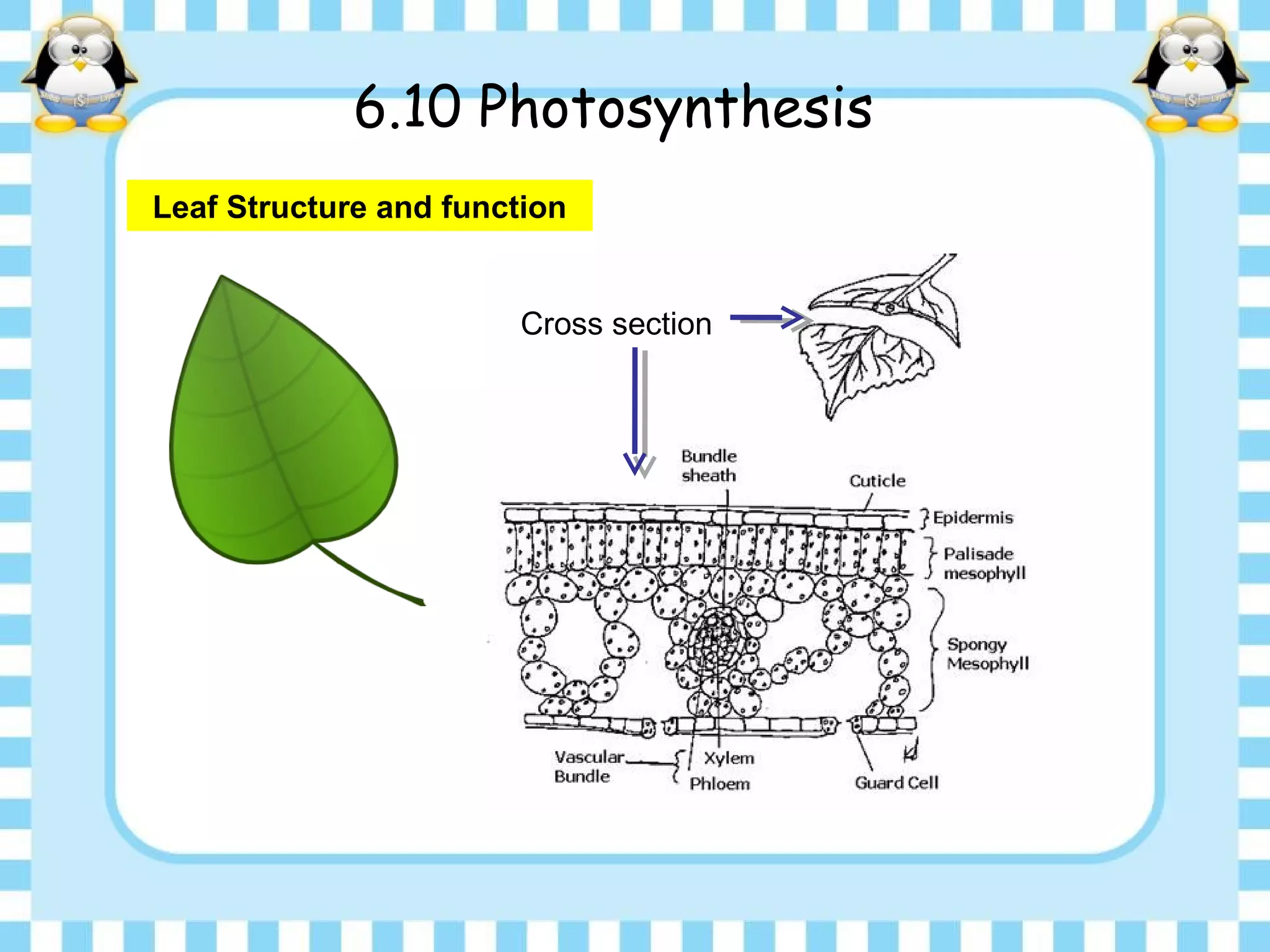
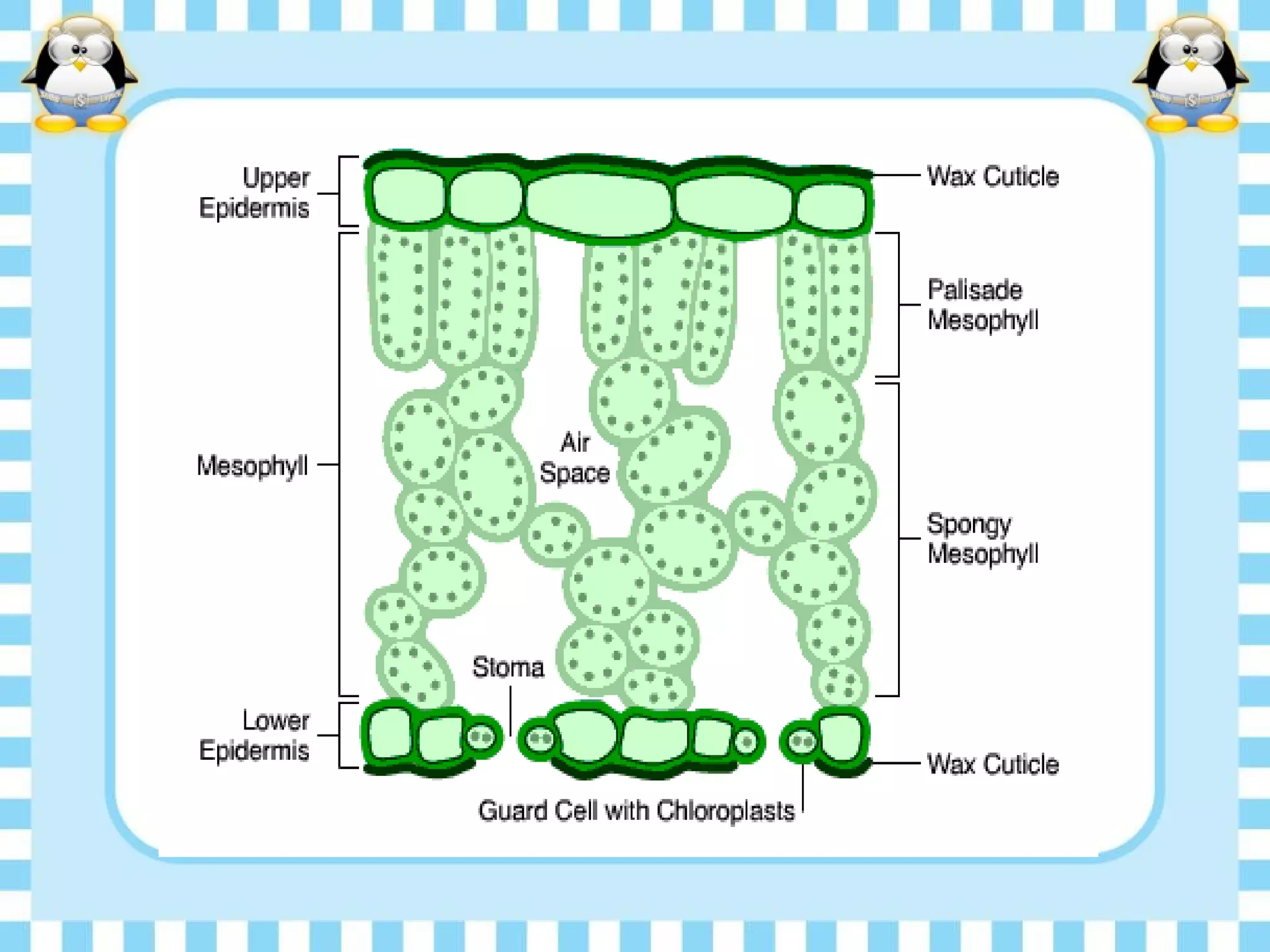
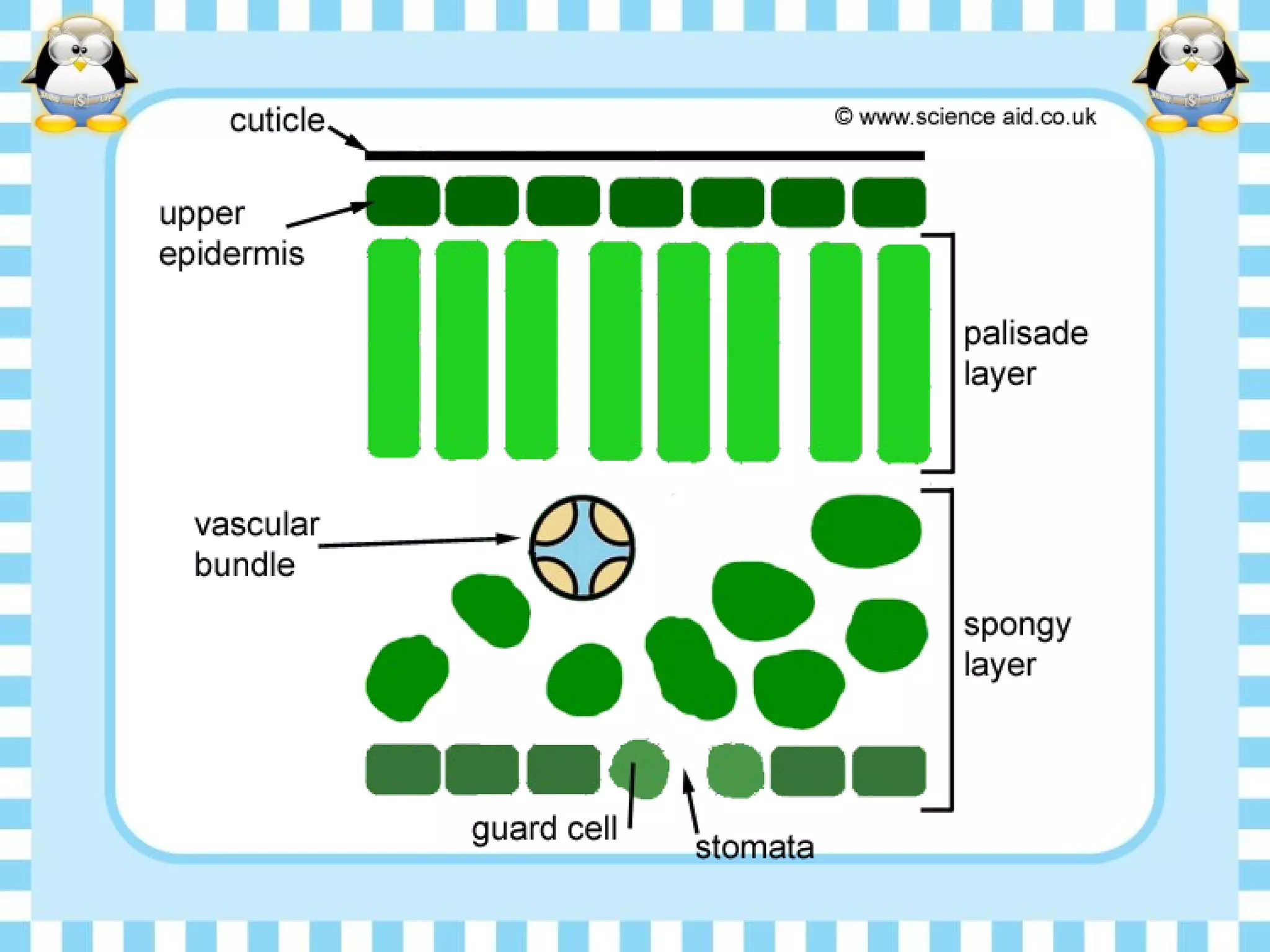
6.10 Photosynthesis
Leaf Structure and function
Cross section
1) CUTICLE

Chapter 6.nutrition full

  • 1.
    6.1: Types ofNutrition 6.2: Balanced Diet 6.3: Malnutrition 6.4:Digestion Process 6.5:Process of Absorption & Assimilation CHAPTER 6
  • 2.
     6.6: Formationof Faeces & Defecation  6.7: Good Eating Habits  6.8:Importance of a Healthy Digestive System  6.9: Importance of Macronutrient & Micronutrient in Plant  6.10: Photosynthesis  6.11:Mechanism of Photosynthesis  6.12: The Factors Affecting Photosynthesis  6.13:Technology used in Food Production  6.14: Food Processing Technology
  • 3.
    6.1 Types OfNutrition AUTOTROPHS HETEROTROPHS
  • 4.
     Def: consistof classes of food – Carbohydrates, Lipids, Proteins, Vitamins, Minerals, Roughage and Water.  6 factors affecting daily E requirement AGE SEX OCCUPATION CLIMATE PREGNANCY & LACTATION SIZE OR BODY WEIGHT P L  Puan Lela AG  Ambil Getah O  Oren pakai S  Sanggul S  Silang yg C  Comel P L  Puan Lela AG  Ambil Getah O  Oren pakai S  Sanggul S  Silang yg C  Comel 6.2
  • 5.
    VITAMINS  Fat-Soluble A, D, E , K  stored in body fat  Water-soluble  B n C  cannot stored in the body  supplied in the daily diet
  • 6.
    Sources, f(x) &effects A D E K B1 B2 B6 Ascorbic Acid Folic Acid
  • 7.
  • 8.
    Symptoms of Deficiency Vitamin/ Mineral Causes D / Calcium / Phosphorus -Rickets -Osteomalacia -Osteoporosis B6 / Magnesium -Retarded growth E / K / Iron -Anaemia B5 / Sodium (Na)/chlorine (Cl) ~NaCl -Muscle cramps -Fatigue B1 / Potassium -Beri-beri -Muscular weakness Sulphur -Symptoms of protein deficiency Fluorine -Tooth decay Iodine -Goitre
  • 9.
  • 11.
  • 12.
    -Insufficient proteins -Flaky skin,thin muscles, thin hair -Sweeling of the body ~ retention of fluid in tissues ~ stomach -Stunted/retarded growth Kwashiorkor Marasmus -Occurs in children aged btw 9 & 12 -Drastic loss of body weight -Effects : very thin + wrinkled skin
  • 13.
    Excessive intake of.. CARBOHYDRATESPROTEINS LIPIDS - Cardiovascular disease - High blood pressure - Atherosclerosis ~ stroke & brain haemorrhage - D.M - cancers -Increase URIC ACID content in blood -Cardiovascular diseases - Atherosclerosis - heart attack -Hypertension / HBP
  • 14.
    Excessive intake of… MINERALSEFFECTS - Na & Ca - Kidney stones - Fe (iron) - Kidney damage VITAMINS EFFECTS A - Hair loss, vomiting, bone ache, joint pain, liver & bone damage B6 - Numb feet, poor coordination B3 -Flushed face and hands - Liver damage C - Gastrointestinal upset D -Calcification of soft tissues E -Kidney damage K - Liver damage & anaemia
  • 15.
    Starch + water 6.4FOOD DIGESTION 1. Digestion in the MOUTH maltose secrete chewing triggers rolled into enters (by peristalsis)# epiglottis
  • 16.
  • 17.
    Digestion in Stomach -pH 1.5 – 2.0 - Stops the xtvt of amylase - Kill bact. In food Protein + water Polypeptides Caseinogen + water Casein
  • 18.
    Digestion in duodenum Starch+ water maltose Polypeptide + water peptides Lipid droplets + water glycerol + FA Pancreatic amylase trypsin lipase
  • 19.
    Digestion in smallintestine • Intestinal juice – digestive enzymes • F(x) – digest of peptides & dissaccharides 1) Protein digestion • Peptides + water amino acids 2) Carbohydrates digestion ( Ma La S ) • Maltose + water glucose • Sucrose + water glu + fructose • Lactose + water glu + galactose erepsin maltase sucrase lactase
  • 22.
  • 23.
  • 24.
    How its work?? 1.RUMEN -Largest compartment - Cellulose broken down by cellulase (bact & protozoa) 2.RETICULUM - Further hydrolysis - CUD – its content - Regurgitated bit by bit - Soften & break down cellulose mouth3.OMASUM -Reswallowed cud -Large  small particles by peristalsis -Water is removed 4. ABOMASUM -True stomach - gastric juices – protein & other F Small intestine Lembu Makan R – Rumput R – Redah O – Onak dan A – Air Busuk Lembu Makan R – Rumput R – Redah O – Onak dan A – Air Busuk
  • 25.
  • 26.
    Digestive System -Faeces 1st batch -soft & watery -2nd batch faeces – drier & harder -Caecum & appendix = enlarged to store cellulase- producing bact - products pass thru alimentary canal = TWICE
  • 27.
    Comparison of cellulose digestionprocess in human, ruminant & rodentSimilarities 1) 2) Differences Aspect Human Ruminant Rodent Stomach chambers Cellulase producing bact Food passes thru alimen. canal Gastric juice is produced at Size of caecum Undigested cellulose
  • 28.
    Problems related tofood digestion Incomplete digestion Lack of digestive enzymes Gallstones
  • 29.
    6.5 Absorption &Assimilation • Illeum – major site of nutrient absorption
  • 30.
    Villus epithelium lacteal Capillary network epithelial cells Villi– plural of villusVilli – plural of villus
  • 31.
    The Villi 1. Numerousin number 2. Thin-walled ( one-cell thick) 3. Network of blood capillaries 4. Lacteal – special structures
  • 32.
    Absorption of digestedfood 1) Glucose & Amino acids - from lumen into the epithelial cells by facilitated diffusion - remaining nutrients – by active transport - from epithelial cells – absorbed into the bloodstream thru the blood capillaries in the villi - converge into the hepartic portal vein - Then transported to all parts of the body Lumen (glu & a.a) facilitated diffusion Epithelial cells bloodstream Hepartic portal vein blood capillaries all parts of the body
  • 33.
    2) Water Lumen epithelialcells blood capillaries 3) Water-soluble vitamins Epithelial cells blood capillaries 3) Fatty acids & glycerol Epithelial cells (tiny droplets) lacteals lympatic system Right lymphatic duct Thoracic duct Bloodstream Subclavian veins
  • 34.
    ASSIMILATION • Definition - theconversion of nutrient into the fluid or solid substance of the body, by the processes of digestion and absorption - occurs in the LIVER and the CELLS
  • 35.
    Assimilation in theLIVER • 7 Functions of the LIVER 1) Regulation of blood glucose concentration 2) Production of bile 3) Protein synthesis 4) Iron storage 5) Deamination of amino acids 6) Detoxification 7) Heat production
  • 36.
    Assimilation in theLIVER synthesisconverts glucose excess DEAMINATION urea kidney
  • 37.
    Assimilation in theCELLS AMINO ACIDS GLUCOSE AMINO ACIDSLIPIDS • new protoplasm • repair of damaged tissues • Synthesis of hormones & enzymes • Synthesis of ptns of PM • Phospholipids & cholesterol • fats – stored in adipose tissue – reserve E • release E during cellular respiration • E for chem. process i.e muscle contraction & synthesis of ptns. •Excess = Glycogen in muscles
  • 39.
    Formation of Faeces •Contents of intestinal: 1) Mixture of water 2) Undigested food substances 3) Dead cells 4) Dead bacteria 5) Indigestible fibre (cellulose) • Colon - large intestinal - Reabsorbs almost 90% of water & minerals into the bloodstream
  • 40.
    • Contents ofFaeces: 1) indigestible residue of food 2) dead cells shed from the intestinal lining & bile pigments & toxic subtances – eliminated from the body 3) binds to the mucus that secreted by the colon’s wall and lubricates the movement of faeces along the colon
  • 41.
    Defaecation • How it’swork?? - the elimination of faeces - controlled by muscles around the anus, the opening of the rectum - When rectum is full, the muscles of the rectal wall contract to eject the faeces via the anus
  • 42.
    Rectum The process ofdefecation (thru anus) Colon
  • 43.
    6.7 Evaluating EatingHabits Bad Eating Habits Gastritis Anorexia nervosa Bulimia Obesity
  • 44.
    6.8 The ImportanceOf A Healthy Digestive System 6.9 The Importance Of Macronutrient & Micronutrient in Plant
  • 45.
    6.10 Photosynthesis Leaf Structureand function Cross section
  • 48.