Knowledge Management
 in Theory and Practice
             KIMIZ DALKIR
     BUTTERWORTH-HEINEMANN (2005)
 PRESENTED BY: ANDREA EDWARDES-EVANS &
             TANYA HEWITT
Introduction

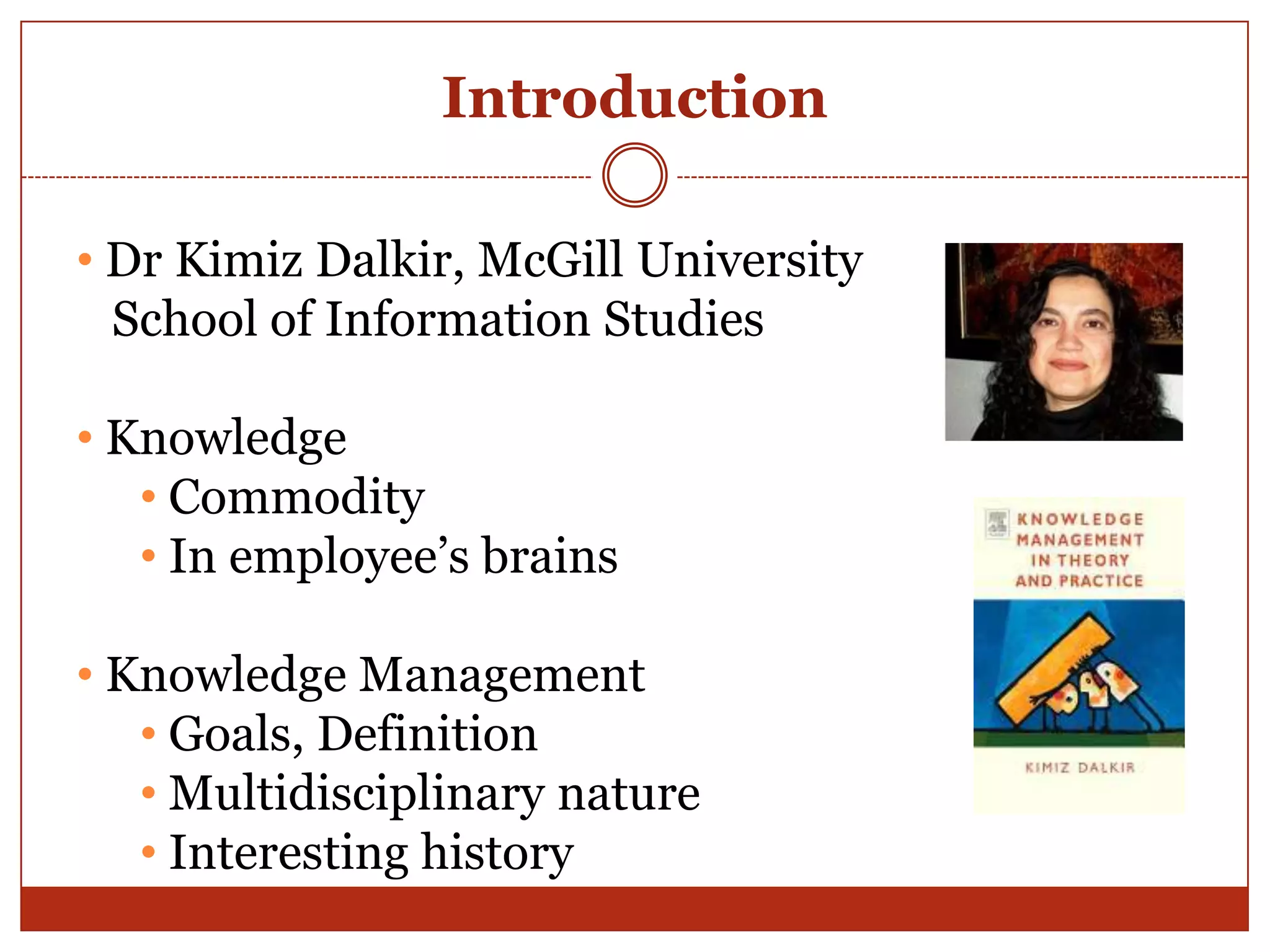
• Dr Kimiz Dalkir, McGill University
  School of Information Studies

• Knowledge
   • Commodity
   • In employee‟s brains

• Knowledge Management
   • Goals, Definition
   • Multidisciplinary nature
   • Interesting history
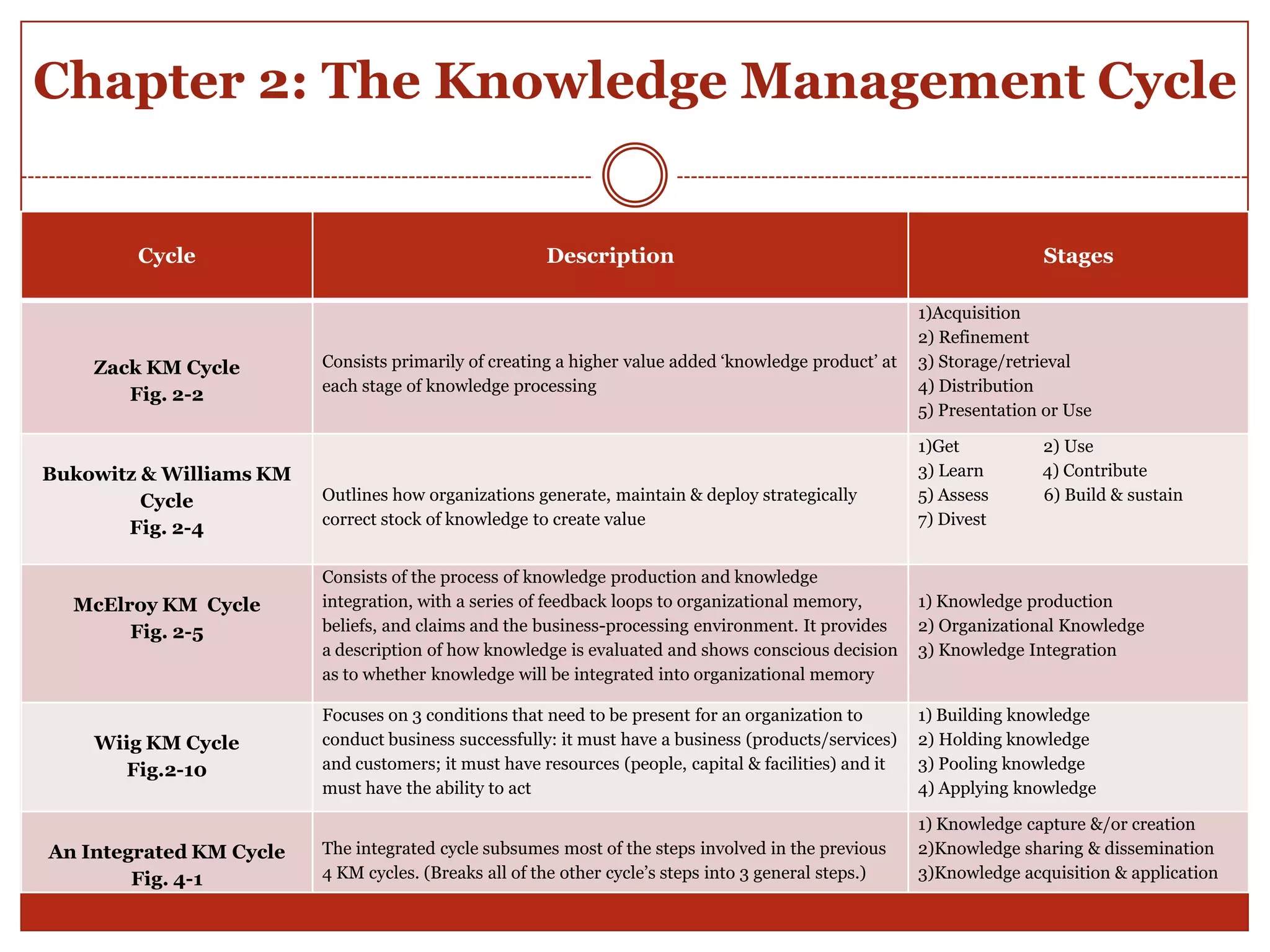
Chapter 2: The Knowledge Management Cycle


        Cycle                                         Description                                                     Stages

                                                                                                       1)Acquisition
                                                                                                       2) Refinement
    Zack KM Cycle        Consists primarily of creating a higher value added „knowledge product‟ at    3) Storage/retrieval
                         each stage of knowledge processing                                            4) Distribution
       Fig. 2-2
                                                                                                       5) Presentation or Use

                                                                                                       1)Get          2) Use
Bukowitz & Williams KM                                                                                 3) Learn       4) Contribute
         Cycle           Outlines how organizations generate, maintain & deploy strategically          5) Assess      6) Build & sustain
                         correct stock of knowledge to create value                                    7) Divest
       Fig. 2-4

                         Consists of the process of knowledge production and knowledge
  McElroy KM Cycle       integration, with a series of feedback loops to organizational memory,        1) Knowledge production
       Fig. 2-5          beliefs, and claims and the business-processing environment. It provides      2) Organizational Knowledge
                         a description of how knowledge is evaluated and shows conscious decision      3) Knowledge Integration
                         as to whether knowledge will be integrated into organizational memory

                         Focuses on 3 conditions that need to be present for an organization to        1) Building knowledge
    Wiig KM Cycle        conduct business successfully: it must have a business (products/services)    2) Holding knowledge
      Fig.2-10           and customers; it must have resources (people, capital & facilities) and it   3) Pooling knowledge
                         must have the ability to act                                                  4) Applying knowledge

                                                                                                       1) Knowledge capture &/or creation
An Integrated KM Cycle   The integrated cycle subsumes most of the steps involved in the previous      2)Knowledge sharing & dissemination
        Fig. 4-1         4 KM cycles. (Breaks all of the other cycle‟s steps into 3 general steps.)    3)Knowledge acquisition & application
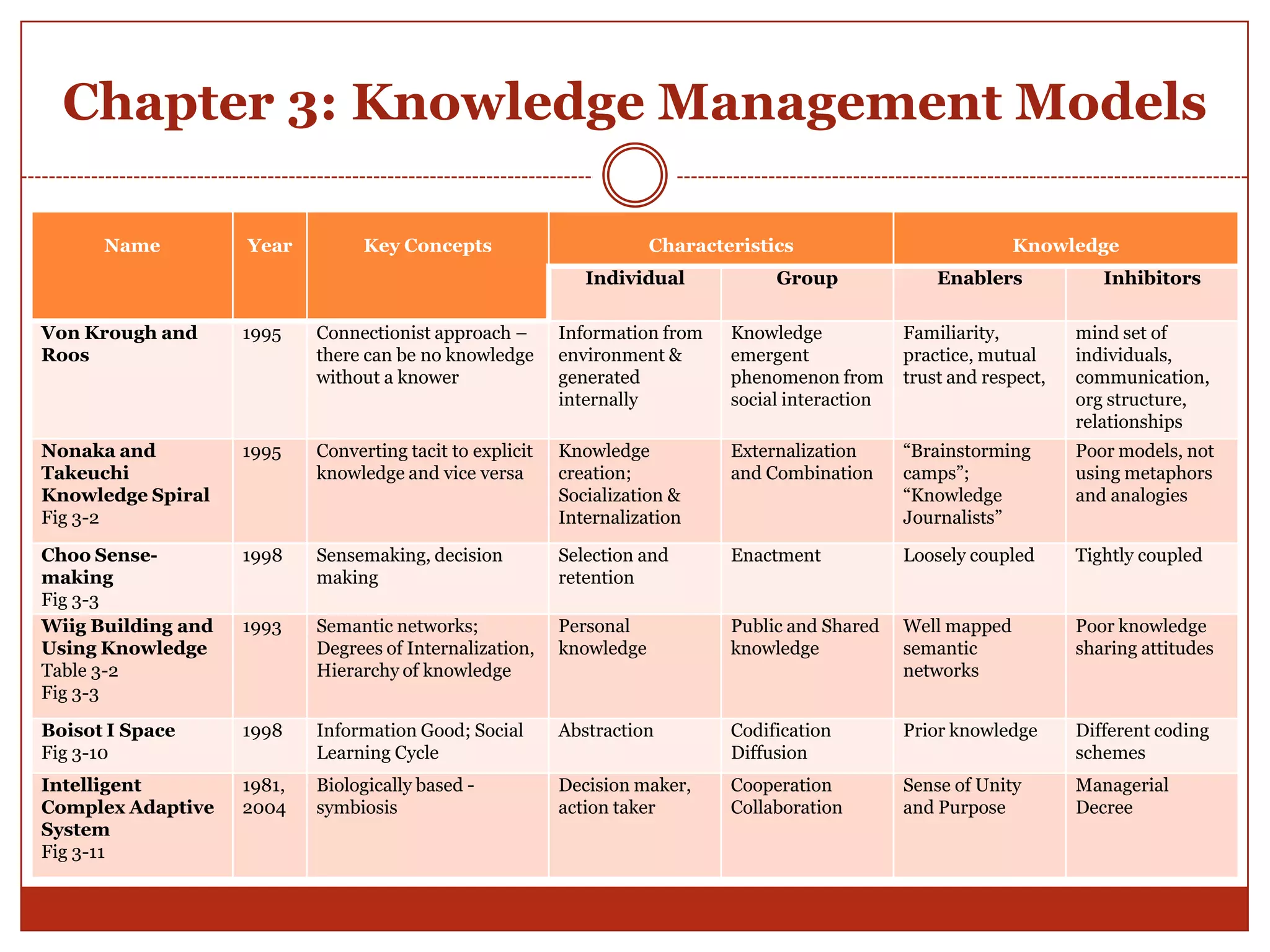
Chapter 3: Knowledge Management Models

      Name          Year          Key Concepts                         Characteristics                            Knowledge
                                                              Individual            Group               Enablers            Inhibitors

Von Krough and      1995    Connectionist approach –       Information from    Knowledge            Familiarity,         mind set of
Roos                        there can be no knowledge      environment &       emergent             practice, mutual     individuals,
                            without a knower               generated           phenomenon from      trust and respect,   communication,
                                                           internally          social interaction                        org structure,
                                                                                                                         relationships
Nonaka and          1995    Converting tacit to explicit   Knowledge           Externalization      “Brainstorming       Poor models, not
Takeuchi                    knowledge and vice versa       creation;           and Combination      camps”;              using metaphors
Knowledge Spiral                                           Socialization &                          “Knowledge           and analogies
Fig 3-2                                                    Internalization                          Journalists”

Choo Sense-         1998    Sensemaking, decision          Selection and       Enactment            Loosely coupled      Tightly coupled
making                      making                         retention
Fig 3-3
Wiig Building and   1993    Semantic networks;             Personal            Public and Shared    Well mapped          Poor knowledge
Using Knowledge             Degrees of Internalization,    knowledge           knowledge            semantic             sharing attitudes
Table 3-2                   Hierarchy of knowledge                                                  networks
Fig 3-3

Boisot I Space      1998    Information Good; Social       Abstraction         Codification         Prior knowledge      Different coding
Fig 3-10                    Learning Cycle                                     Diffusion                                 schemes
Intelligent         1981,   Biologically based -           Decision maker,     Cooperation          Sense of Unity       Managerial
Complex Adaptive    2004    symbiosis                      action taker        Collaboration        and Purpose          Decree
System
Fig 3-11
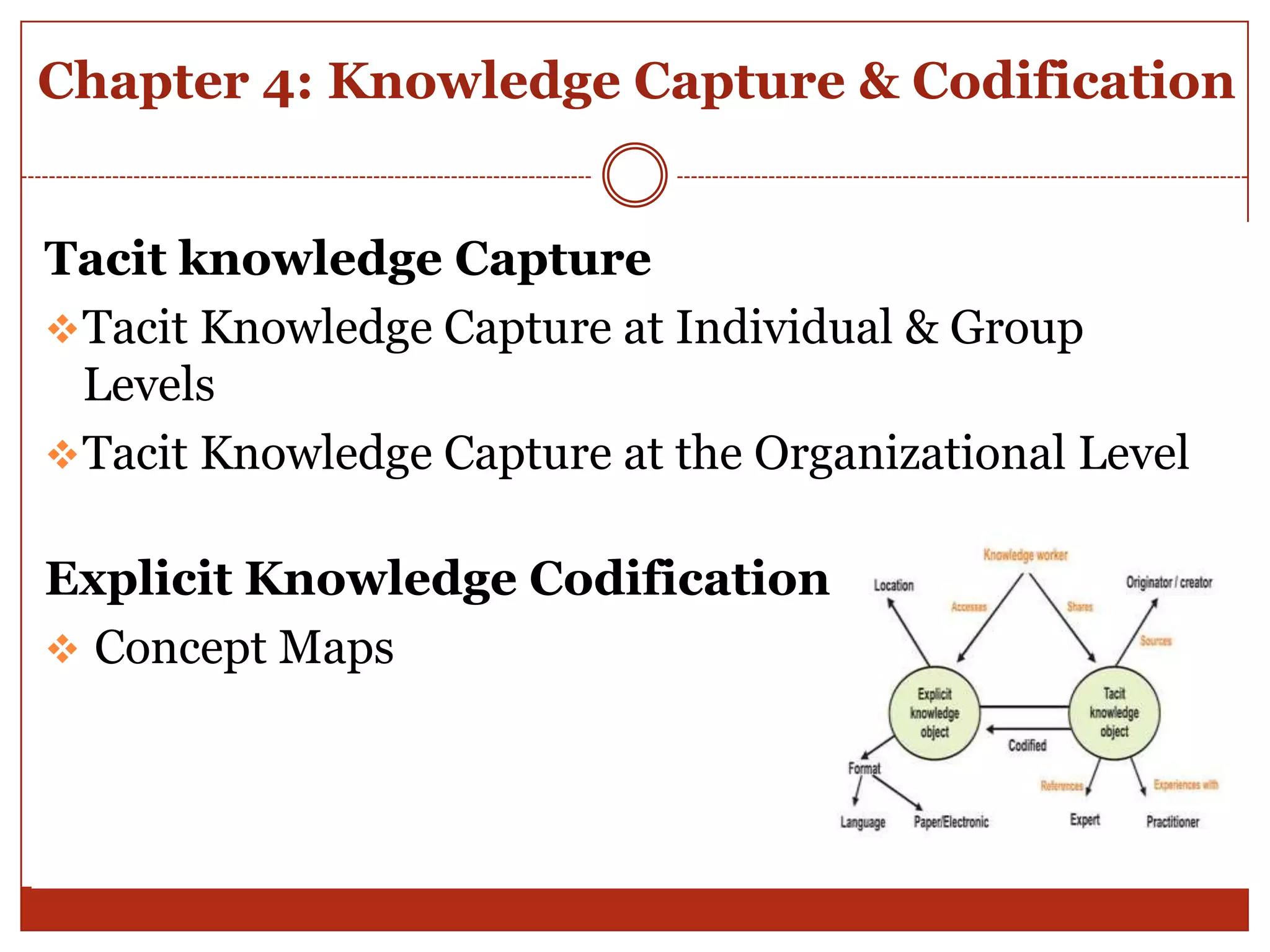
Chapter 4: Knowledge Capture & Codification


Tacit knowledge Capture
 Tacit Knowledge Capture at Individual & Group
  Levels
 Tacit Knowledge Capture at the Organizational Level


Explicit Knowledge Codification
 Concept Maps
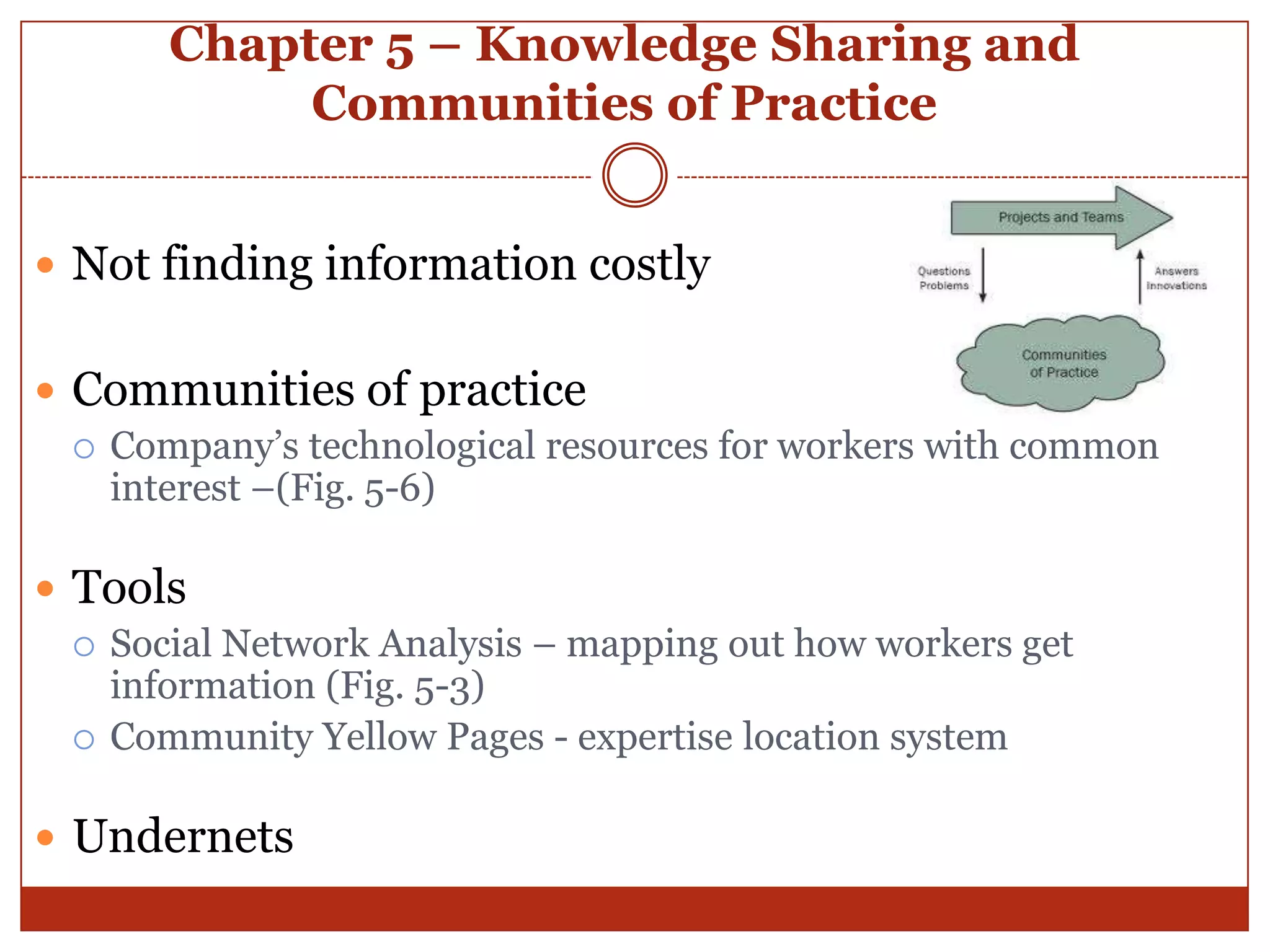
Chapter 5 – Knowledge Sharing and
            Communities of Practice


 Not finding information costly


 Communities of practice
   Company‟s technological resources for workers with common
    interest –(Fig. 5-6)

 Tools
   Social Network Analysis – mapping out how workers get
    information (Fig. 5-3)
   Community Yellow Pages - expertise location system


 Undernets
Chapter 6:    Knowledge Application at the
Knowledge     Individual Level
Application   • Characteristics of Individual Knowledge
                Workers
              • Blooms Taxonomy of Learning
                Objectives
              • Task Analysis – EPSS


              Knowledge Application at the Group &
              Organizational Level
              • Knowledge Reuse
              • Knowledge Repositories
Chapter 7:      Definition of organizational
                   culture
 The Role of
Organizational    Not consciously created
   Culture        Cultural diagnosis
                               KM success
                               depends on:
                               TRUST
                               SHARING
                               LEADERS
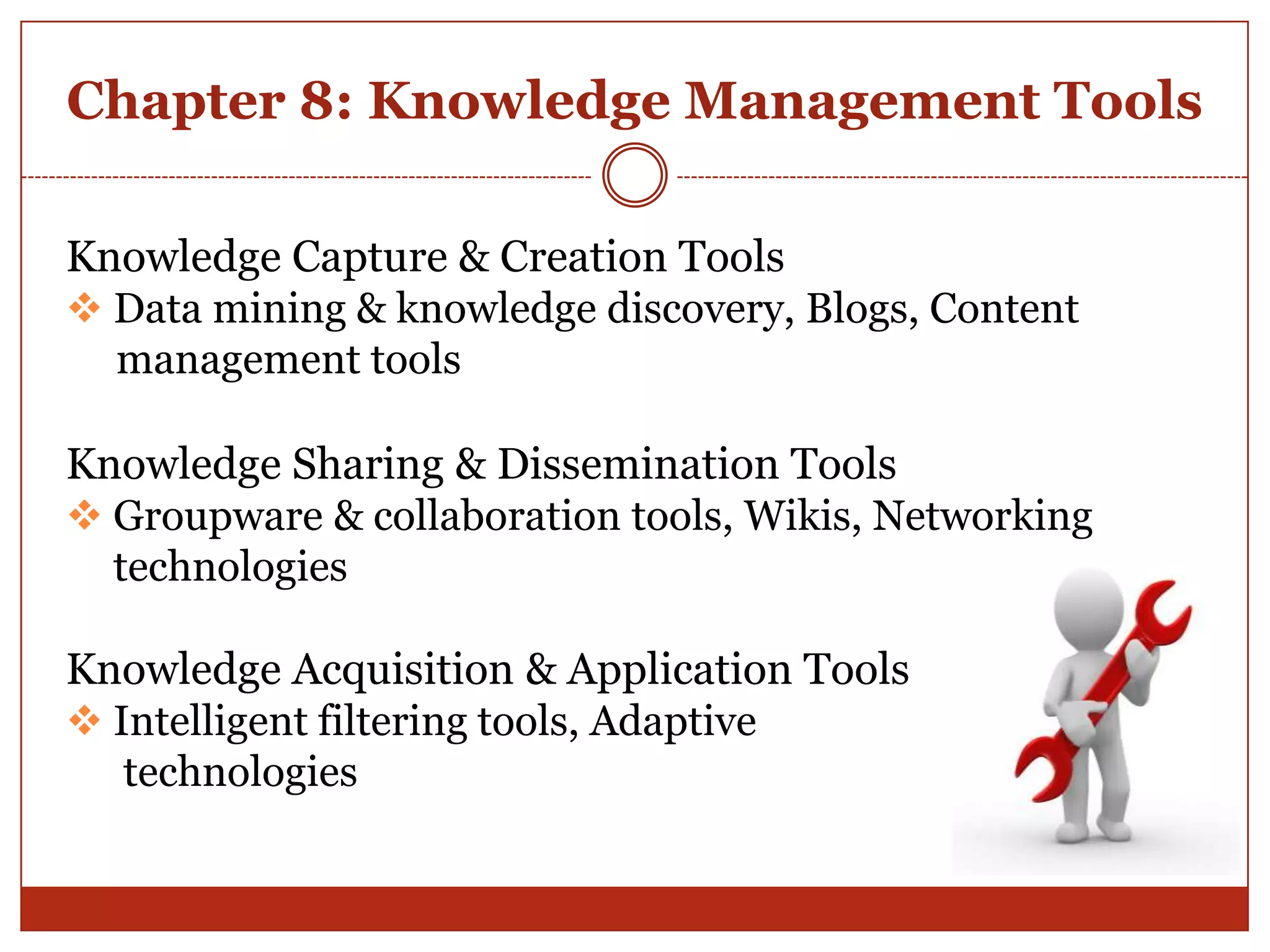
Chapter 8: Knowledge Management Tools

Knowledge Capture & Creation Tools
 Data mining & knowledge discovery, Blogs, Content
  management tools

Knowledge Sharing & Dissemination Tools
 Groupware & collaboration tools, Wikis, Networking
  technologies

Knowledge Acquisition & Application Tools
 Intelligent filtering tools, Adaptive
   technologies
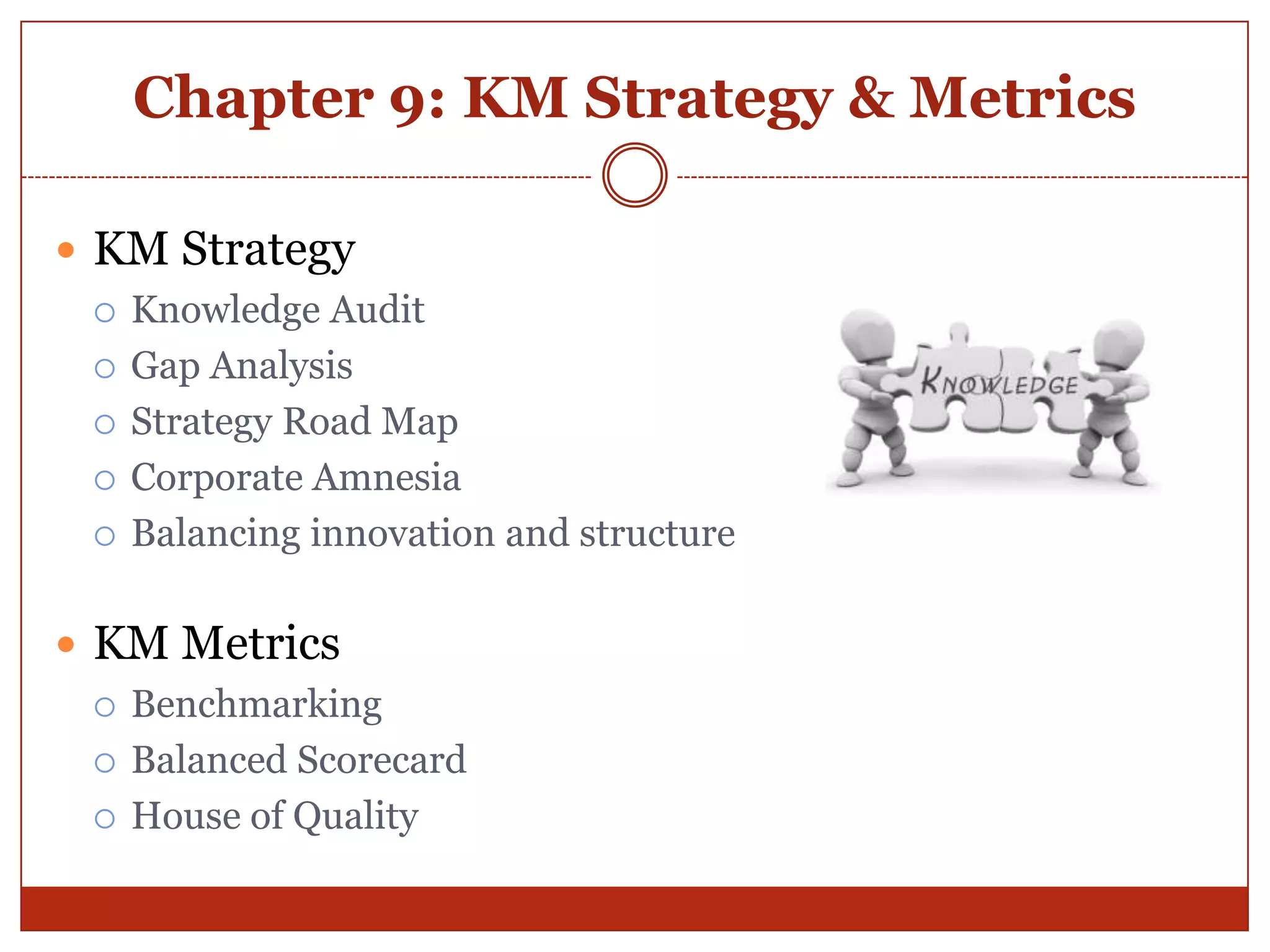
Chapter 9: KM Strategy & Metrics

 KM Strategy
   Knowledge Audit

   Gap Analysis

   Strategy Road Map

   Corporate Amnesia

   Balancing innovation and structure


 KM Metrics
   Benchmarking

   Balanced Scorecard

   House of Quality
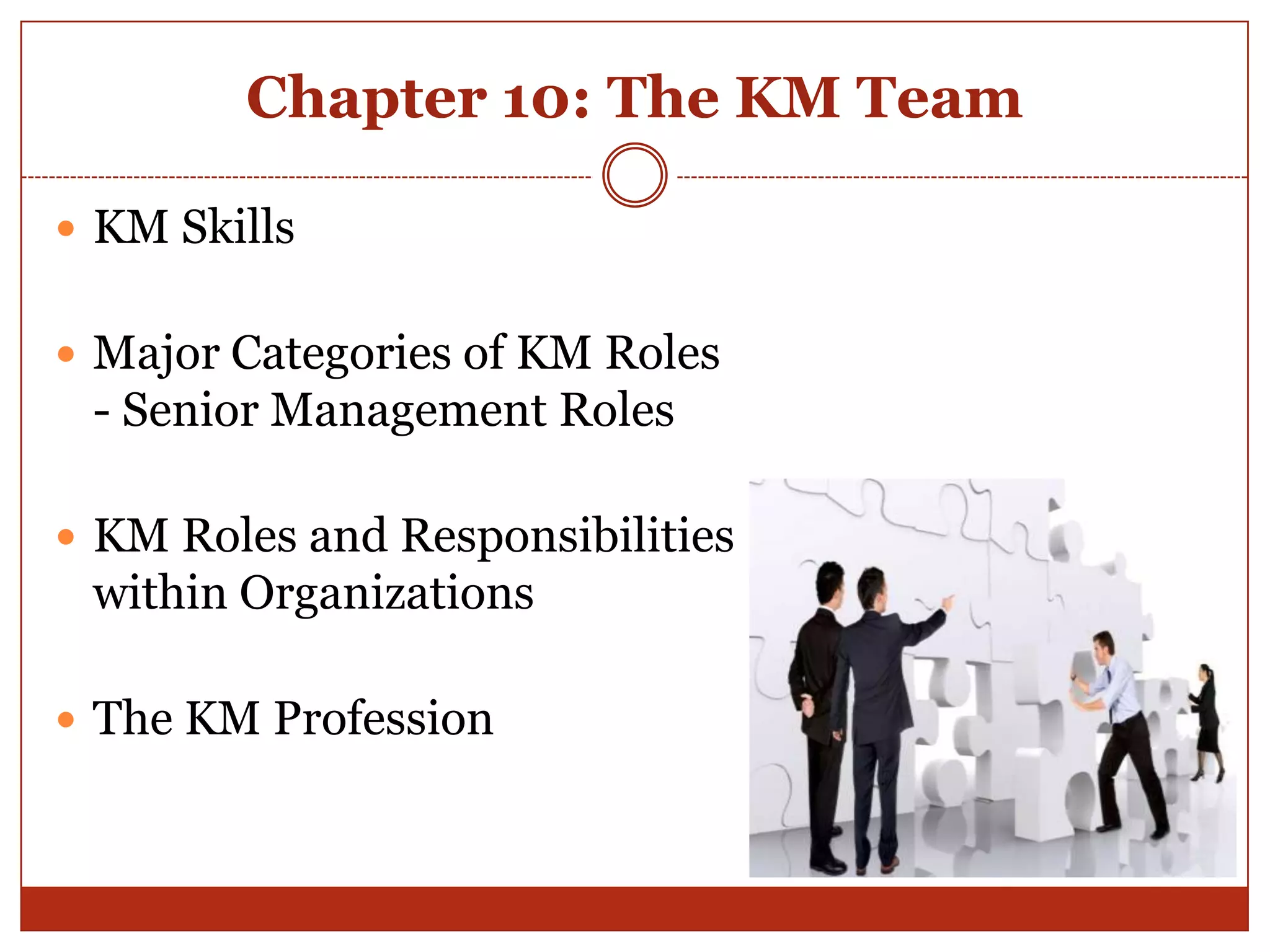
Chapter 10: The KM Team

 KM Skills


 Major Categories of KM Roles
 - Senior Management Roles

 KM Roles and Responsibilities
 within Organizations

 The KM Profession
Chapter 11: Future Challenges of KM


 No all inclusive vendor solutions
 Information Politics
 Incentives
 Knowledge Based Assets
 The social nature of KM
Additional Websites and Sources

http://kimizdalkir.com , http://www.mcgill.ca/sis/people/faculty/dalkir/– the author & her work
http://www.teamware.com - Groupware and collaboration tools
http://en.wikipedia.org/wiki/Wiki - example of a wiki
http://www.tfpl.com – is a specialist recruitment, advisory, training and research services company
http://www.tfpl.com/resources/skills_map.cfm
http://www.tfpl.com/skills_development/skills_toolkit.cfm
www.kmci.org – certificate in knowledge and information management
http://www.iep.edu/e/ethics.htm - internet encyclopedia of philosophy (on ethics)
http://www.dkms.com/papers/Doing_KM.pdf - Doing Knowledge Management by Firestone & McElroy
http://www.orgnet.com – Social Networking Analysis company (though none are very good Dr Dalkir
states)
http://www.kmworld.com/ - “Covering the latest in Content, Document and Knowledge Management”
    VERY comprehensive – publishers of KMWorld magazine – completely digital and accessible!
http://www.sopheon.com/HOME.aspx - KM company with white papers, newsletter, KM products
    (specifically yellow pages)
http://www.knowledgeshop.com.au/Home/ - the advisor's advisor
http://www.iasplus.com/standard/ias38.htm - intangible assets standard
http://www.apqc.org/ - American Productivity and Quality Center – pioneer of benchmarking
http://www.qpr.com/solutions/balanced-scorecard-solution.htm - balanced scorecard product
http://www.qfdi.org/ - Quality Function Deployment Institute “the only comprehensive quality system
    aimed specifically satisfying the customer”
http://www.best-in-class.com/Database - measurement success stories
Points for Discussion


 Tacit knowledge transfer vs. real work


 Physical layout of the workspace – planning for
 socialization

 Knowledge hoarding – what to do?


 Crafting ideal incentives

Knowledge management in theory and practice

  • 1.
    Knowledge Management inTheory and Practice KIMIZ DALKIR BUTTERWORTH-HEINEMANN (2005) PRESENTED BY: ANDREA EDWARDES-EVANS & TANYA HEWITT
  • 2.
    Introduction • Dr KimizDalkir, McGill University School of Information Studies • Knowledge • Commodity • In employee‟s brains • Knowledge Management • Goals, Definition • Multidisciplinary nature • Interesting history
  • 3.
    Chapter 2: TheKnowledge Management Cycle Cycle Description Stages 1)Acquisition 2) Refinement Zack KM Cycle Consists primarily of creating a higher value added „knowledge product‟ at 3) Storage/retrieval each stage of knowledge processing 4) Distribution Fig. 2-2 5) Presentation or Use 1)Get 2) Use Bukowitz & Williams KM 3) Learn 4) Contribute Cycle Outlines how organizations generate, maintain & deploy strategically 5) Assess 6) Build & sustain correct stock of knowledge to create value 7) Divest Fig. 2-4 Consists of the process of knowledge production and knowledge McElroy KM Cycle integration, with a series of feedback loops to organizational memory, 1) Knowledge production Fig. 2-5 beliefs, and claims and the business-processing environment. It provides 2) Organizational Knowledge a description of how knowledge is evaluated and shows conscious decision 3) Knowledge Integration as to whether knowledge will be integrated into organizational memory Focuses on 3 conditions that need to be present for an organization to 1) Building knowledge Wiig KM Cycle conduct business successfully: it must have a business (products/services) 2) Holding knowledge Fig.2-10 and customers; it must have resources (people, capital & facilities) and it 3) Pooling knowledge must have the ability to act 4) Applying knowledge 1) Knowledge capture &/or creation An Integrated KM Cycle The integrated cycle subsumes most of the steps involved in the previous 2)Knowledge sharing & dissemination Fig. 4-1 4 KM cycles. (Breaks all of the other cycle‟s steps into 3 general steps.) 3)Knowledge acquisition & application
  • 4.
    Chapter 3: KnowledgeManagement Models Name Year Key Concepts Characteristics Knowledge Individual Group Enablers Inhibitors Von Krough and 1995 Connectionist approach – Information from Knowledge Familiarity, mind set of Roos there can be no knowledge environment & emergent practice, mutual individuals, without a knower generated phenomenon from trust and respect, communication, internally social interaction org structure, relationships Nonaka and 1995 Converting tacit to explicit Knowledge Externalization “Brainstorming Poor models, not Takeuchi knowledge and vice versa creation; and Combination camps”; using metaphors Knowledge Spiral Socialization & “Knowledge and analogies Fig 3-2 Internalization Journalists” Choo Sense- 1998 Sensemaking, decision Selection and Enactment Loosely coupled Tightly coupled making making retention Fig 3-3 Wiig Building and 1993 Semantic networks; Personal Public and Shared Well mapped Poor knowledge Using Knowledge Degrees of Internalization, knowledge knowledge semantic sharing attitudes Table 3-2 Hierarchy of knowledge networks Fig 3-3 Boisot I Space 1998 Information Good; Social Abstraction Codification Prior knowledge Different coding Fig 3-10 Learning Cycle Diffusion schemes Intelligent 1981, Biologically based - Decision maker, Cooperation Sense of Unity Managerial Complex Adaptive 2004 symbiosis action taker Collaboration and Purpose Decree System Fig 3-11
  • 5.
    Chapter 4: KnowledgeCapture & Codification Tacit knowledge Capture  Tacit Knowledge Capture at Individual & Group Levels  Tacit Knowledge Capture at the Organizational Level Explicit Knowledge Codification  Concept Maps
  • 6.
    Chapter 5 –Knowledge Sharing and Communities of Practice  Not finding information costly  Communities of practice  Company‟s technological resources for workers with common interest –(Fig. 5-6)  Tools  Social Network Analysis – mapping out how workers get information (Fig. 5-3)  Community Yellow Pages - expertise location system  Undernets
  • 7.
    Chapter 6: Knowledge Application at the Knowledge Individual Level Application • Characteristics of Individual Knowledge Workers • Blooms Taxonomy of Learning Objectives • Task Analysis – EPSS Knowledge Application at the Group & Organizational Level • Knowledge Reuse • Knowledge Repositories
  • 8.
    Chapter 7:  Definition of organizational culture The Role of Organizational  Not consciously created Culture  Cultural diagnosis  KM success depends on: TRUST SHARING LEADERS
  • 9.
    Chapter 8: KnowledgeManagement Tools Knowledge Capture & Creation Tools  Data mining & knowledge discovery, Blogs, Content management tools Knowledge Sharing & Dissemination Tools  Groupware & collaboration tools, Wikis, Networking technologies Knowledge Acquisition & Application Tools  Intelligent filtering tools, Adaptive technologies
  • 10.
    Chapter 9: KMStrategy & Metrics  KM Strategy  Knowledge Audit  Gap Analysis  Strategy Road Map  Corporate Amnesia  Balancing innovation and structure  KM Metrics  Benchmarking  Balanced Scorecard  House of Quality
  • 11.
    Chapter 10: TheKM Team  KM Skills  Major Categories of KM Roles - Senior Management Roles  KM Roles and Responsibilities within Organizations  The KM Profession
  • 12.
    Chapter 11: FutureChallenges of KM  No all inclusive vendor solutions  Information Politics  Incentives  Knowledge Based Assets  The social nature of KM
  • 13.
    Additional Websites andSources http://kimizdalkir.com , http://www.mcgill.ca/sis/people/faculty/dalkir/– the author & her work http://www.teamware.com - Groupware and collaboration tools http://en.wikipedia.org/wiki/Wiki - example of a wiki http://www.tfpl.com – is a specialist recruitment, advisory, training and research services company http://www.tfpl.com/resources/skills_map.cfm http://www.tfpl.com/skills_development/skills_toolkit.cfm www.kmci.org – certificate in knowledge and information management http://www.iep.edu/e/ethics.htm - internet encyclopedia of philosophy (on ethics) http://www.dkms.com/papers/Doing_KM.pdf - Doing Knowledge Management by Firestone & McElroy http://www.orgnet.com – Social Networking Analysis company (though none are very good Dr Dalkir states) http://www.kmworld.com/ - “Covering the latest in Content, Document and Knowledge Management” VERY comprehensive – publishers of KMWorld magazine – completely digital and accessible! http://www.sopheon.com/HOME.aspx - KM company with white papers, newsletter, KM products (specifically yellow pages) http://www.knowledgeshop.com.au/Home/ - the advisor's advisor http://www.iasplus.com/standard/ias38.htm - intangible assets standard http://www.apqc.org/ - American Productivity and Quality Center – pioneer of benchmarking http://www.qpr.com/solutions/balanced-scorecard-solution.htm - balanced scorecard product http://www.qfdi.org/ - Quality Function Deployment Institute “the only comprehensive quality system aimed specifically satisfying the customer” http://www.best-in-class.com/Database - measurement success stories
  • 14.
    Points for Discussion Tacit knowledge transfer vs. real work  Physical layout of the workspace – planning for socialization  Knowledge hoarding – what to do?  Crafting ideal incentives

Editor's Notes

  • #2 2nd edition of her book 2011