Thorium - Securing the resources  Hari Tulsidas Nuclear Fuel Cycle and Materials Section
Thorium – the future of energy Advantages, challenges Past experience, the downturn Present hunger for energy, climatic concerns Booming nuclear waste issues How long with uranium resources last? Renewed interest in thorium IAEA activities in Th fuel cycle  ThDEPO Planned activities
Bunch of advantages Large  resources  of thorium Self sustained  equilibrium thorium fuel cycle  Intrinsic  proliferation resistance   Better thermo-physical properties and  chemical stability   High burn – up  capability Lesser long lived  minor actinides   Superior  plutonium incineration   Attractive in  accelerated driven systems  and energy amplifiers
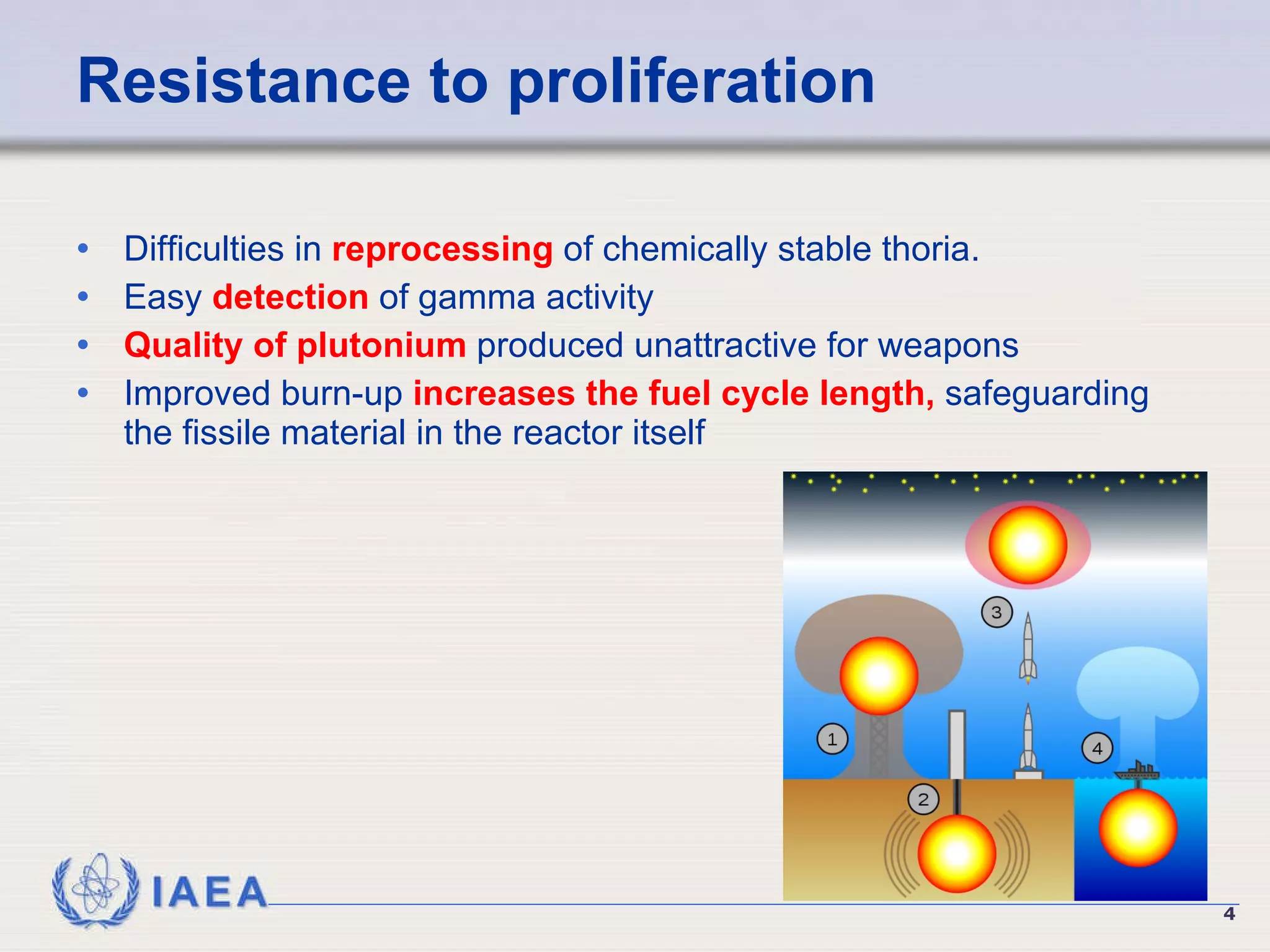
Resistance to proliferation Difficulties in  reprocessing  of chemically stable thoria. Easy  detection  of gamma activity Quality of plutonium  produced unattractive for weapons Improved burn-up  increases the fuel cycle length,  safeguarding the fissile material in the reactor itself
Some challenges too …  Needs  fissile material  to start with Fuel cycle infrastructure to be developed -  mining, milling, fuel fabrication, transport and reprocessing Re-cycling of U 233  requires  automated and remote  fuel fabrication and handling in adequately shielded facility Reprocessing of Th  fuels is not yet established Large investment for Th  fuel development, qualification and characterization
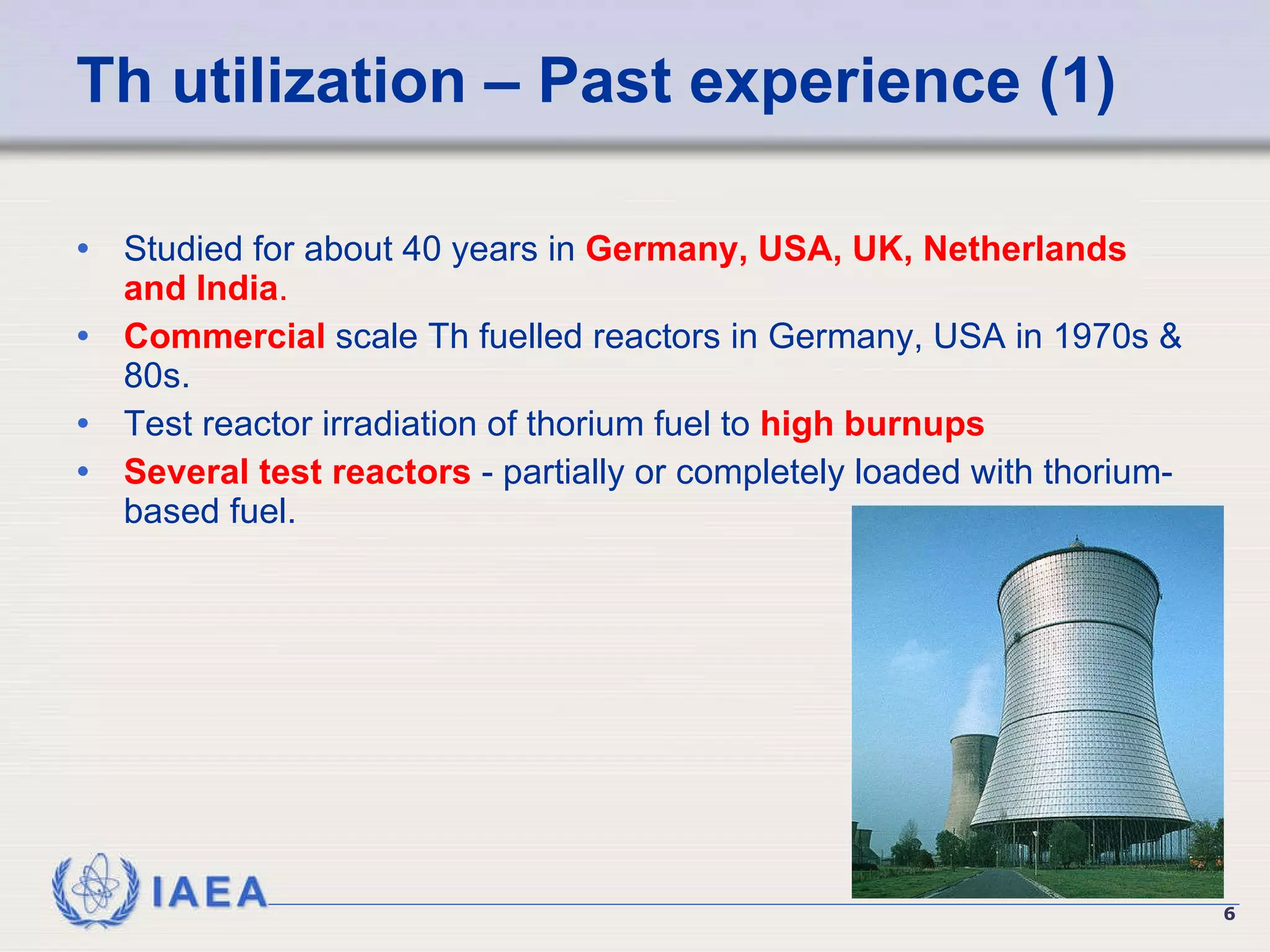
Th utilization – Past experience (1) Studied for about 40 years in  Germany, USA, UK, Netherlands and India .   Commercial  scale Th fuelled reactors  in Germany, USA in 1970s & 80s. Test reactor irradiation of thorium fuel to  high burnups   Several test reactors  - partially or completely loaded with thorium-based fuel.
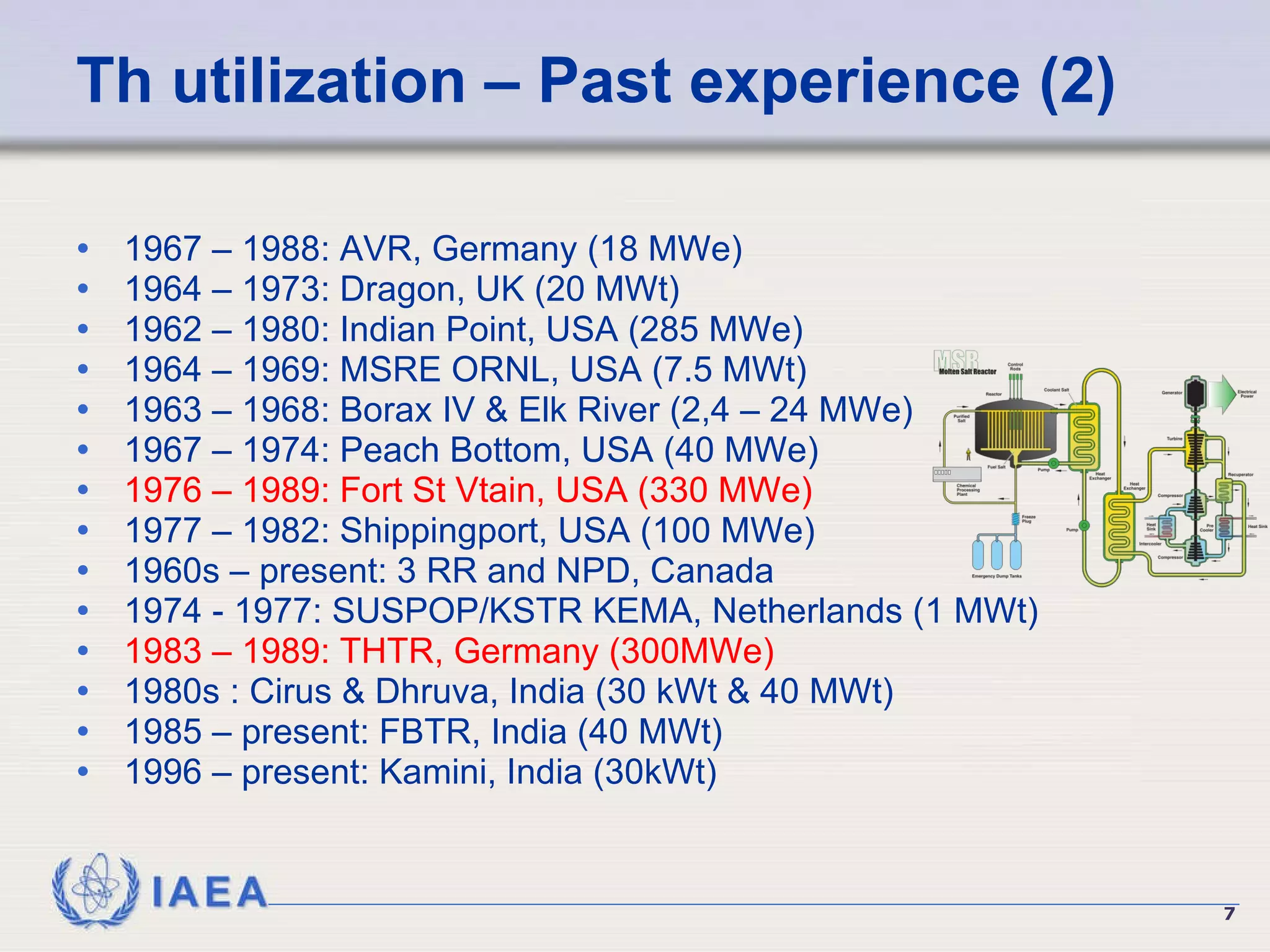
Th utilization – Past experience (2)  1967 – 1988: AVR, Germany (18 MWe) 1964 – 1973: Dragon, UK (20 MWt) 1962 – 1980: Indian Point, USA (285 MWe) 1964 – 1969: MSRE ORNL, USA (7.5 MWt) 1963 – 1968: Borax IV & Elk River (2,4 – 24 MWe) 1967 – 1974: Peach Bottom, USA (40 MWe) 1976 – 1989: Fort St Vtain, USA (330 MWe) 1977 – 1982: Shippingport, USA (100 MWe) 1960s – present: 3 RR and NPD, Canada 1974 - 1977: SUSPOP/KSTR KEMA, Netherlands (1 MWt) 1983 – 1989: THTR, Germany (300MWe) 1980s : Cirus & Dhruva, India (30 kWt & 40 MWt) 1985 – present: FBTR, India (40 MWt) 1996 – present: Kamini, India (30kWt)
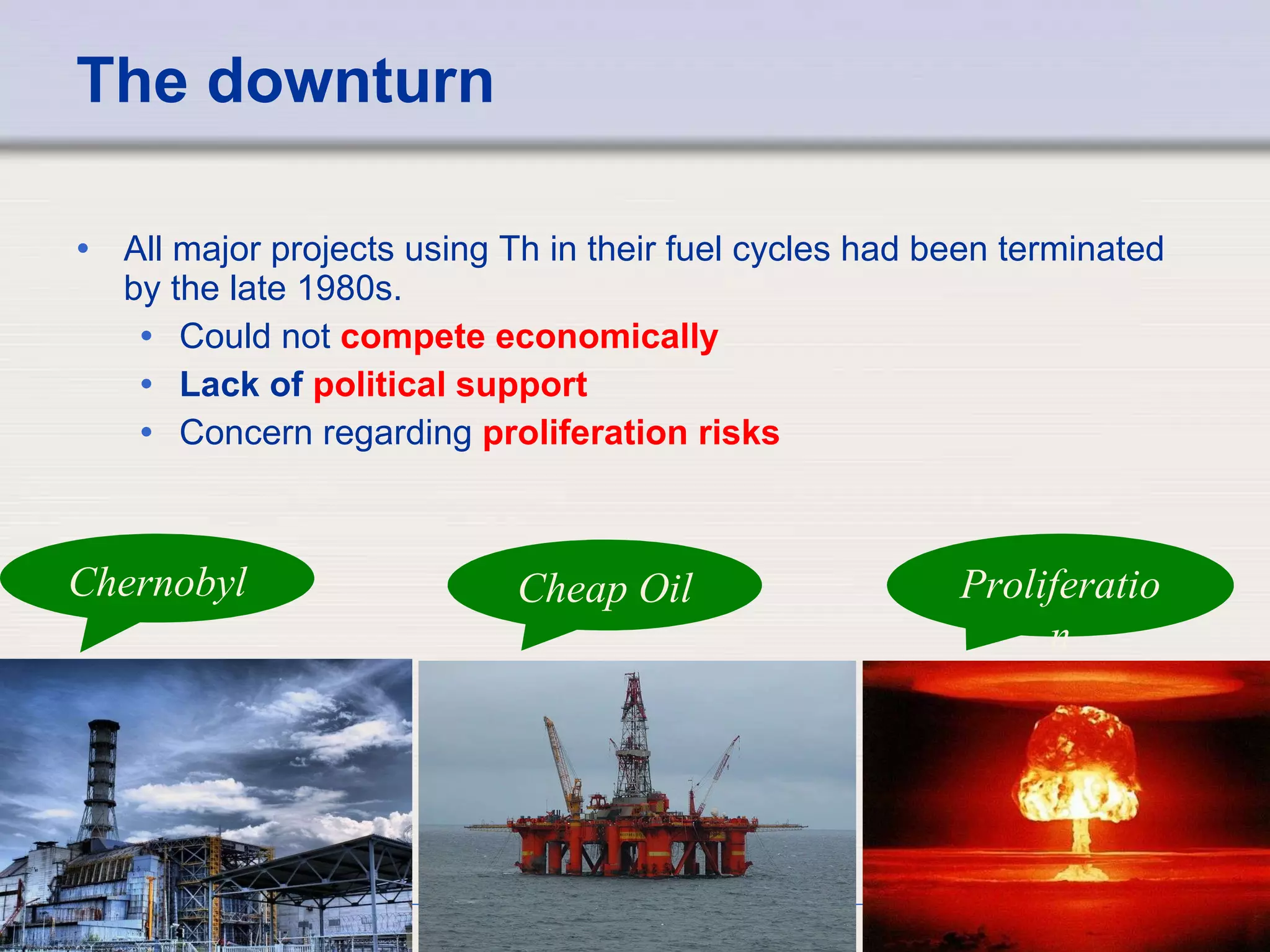
The downturn All major projects using Th in their fuel cycles had been terminated by the late 1980s.  Could not  compete economically   Lack of  political support   Concern regarding  proliferation risks Chernobyl Cheap Oil Proliferation
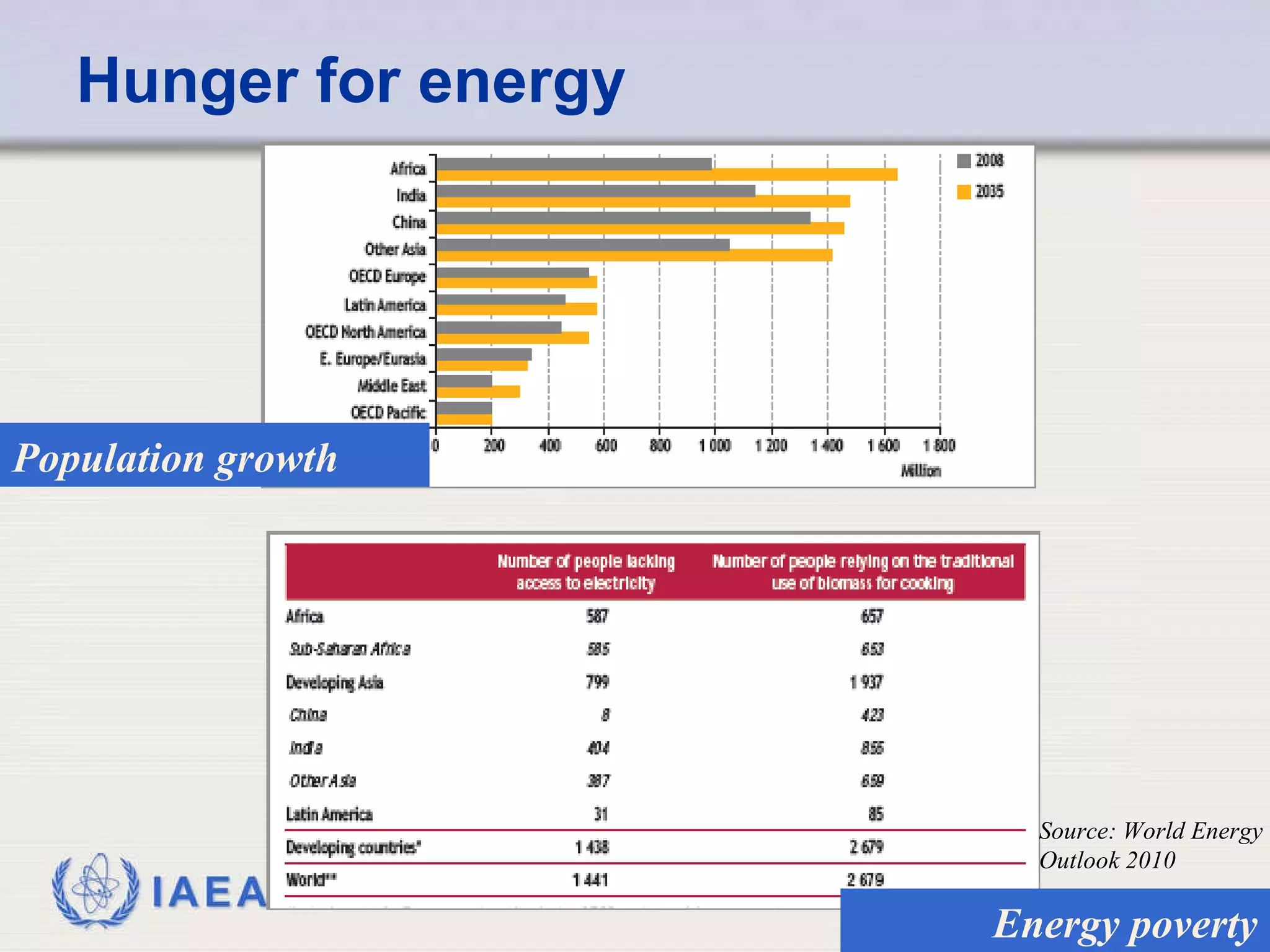
Hunger for energy Population growth Energy poverty Source: World Energy Outlook 2010
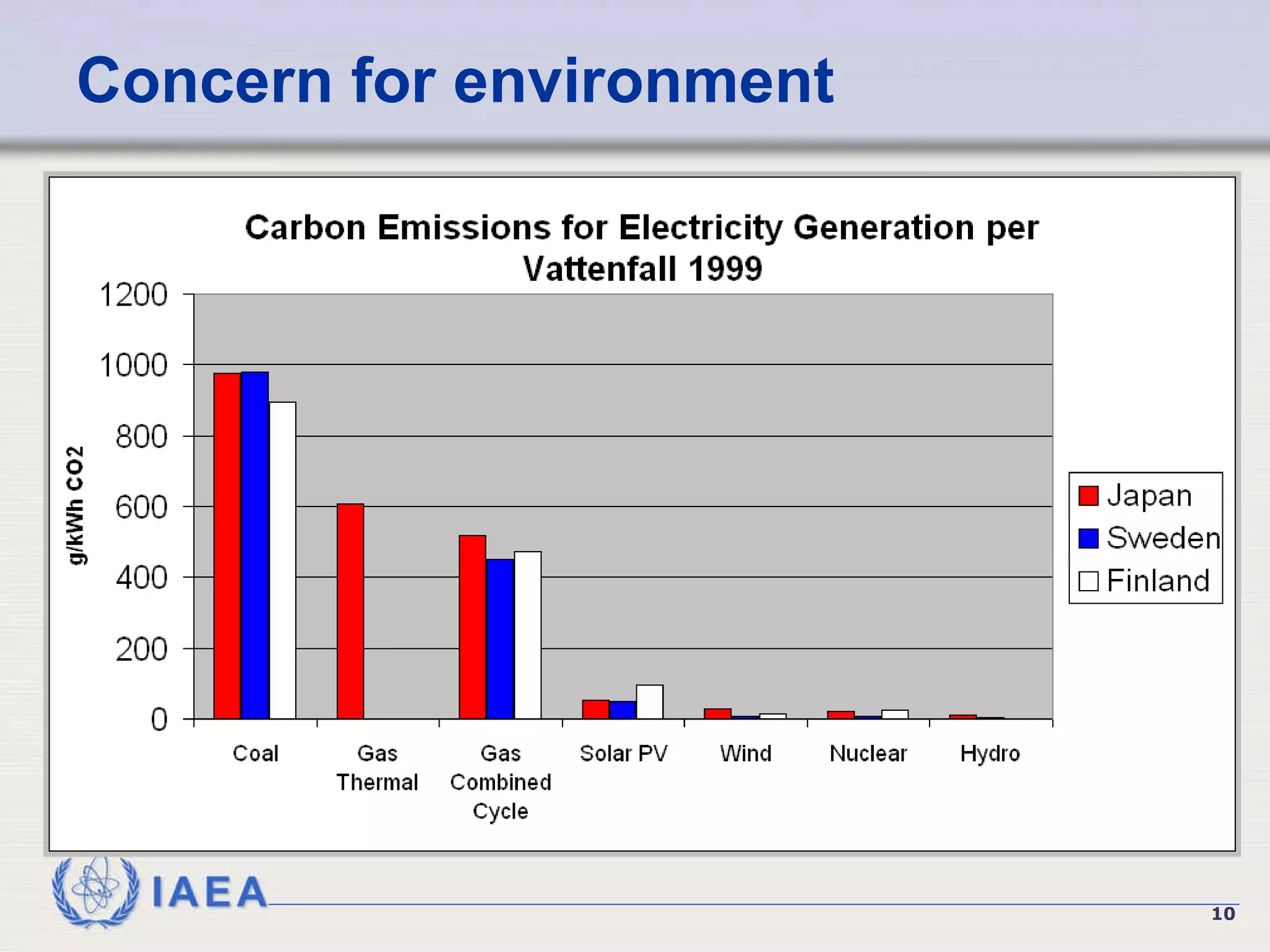
Concern for environment
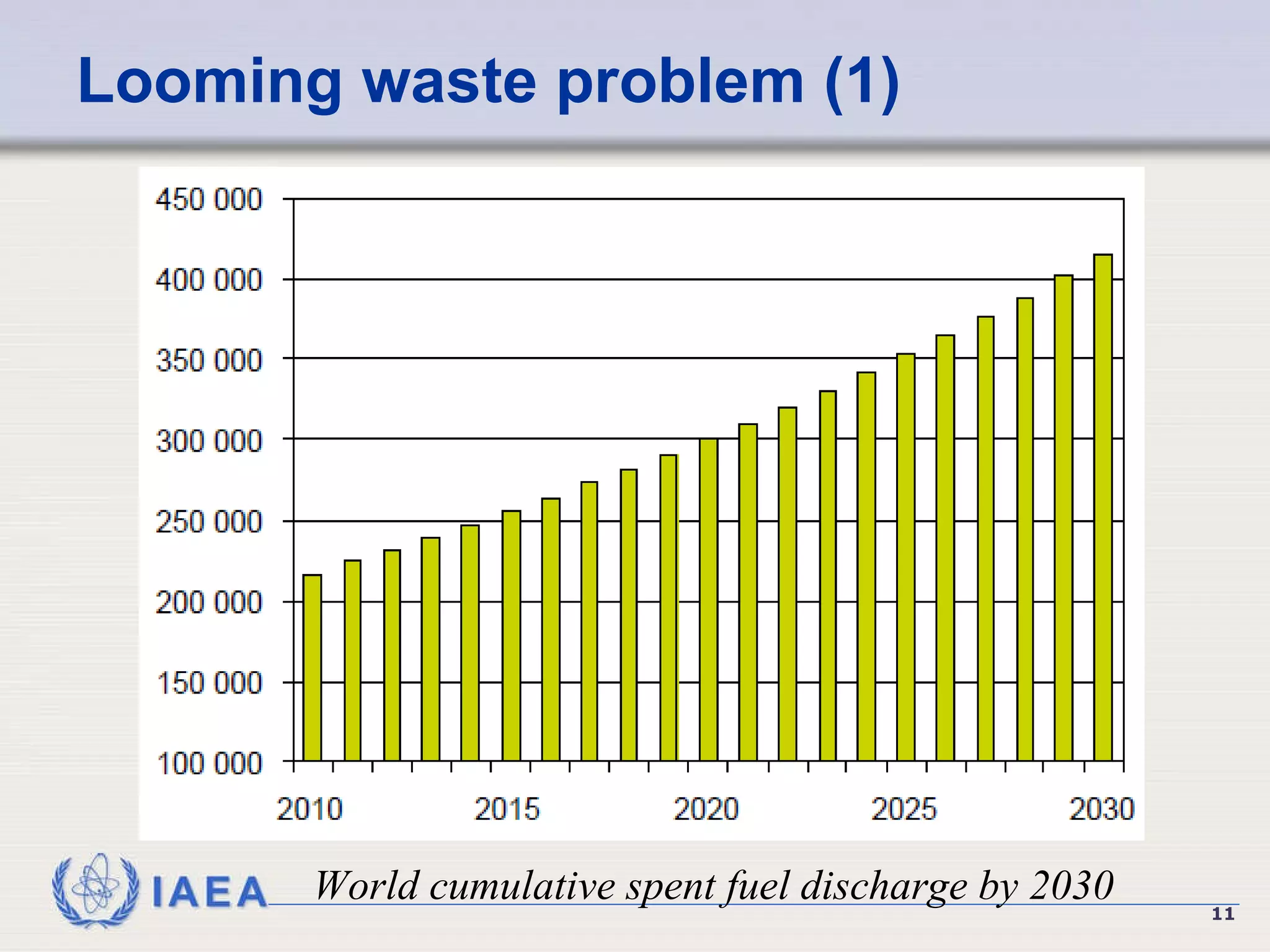
Looming waste problem (1) World cumulative spent fuel discharge by 2030
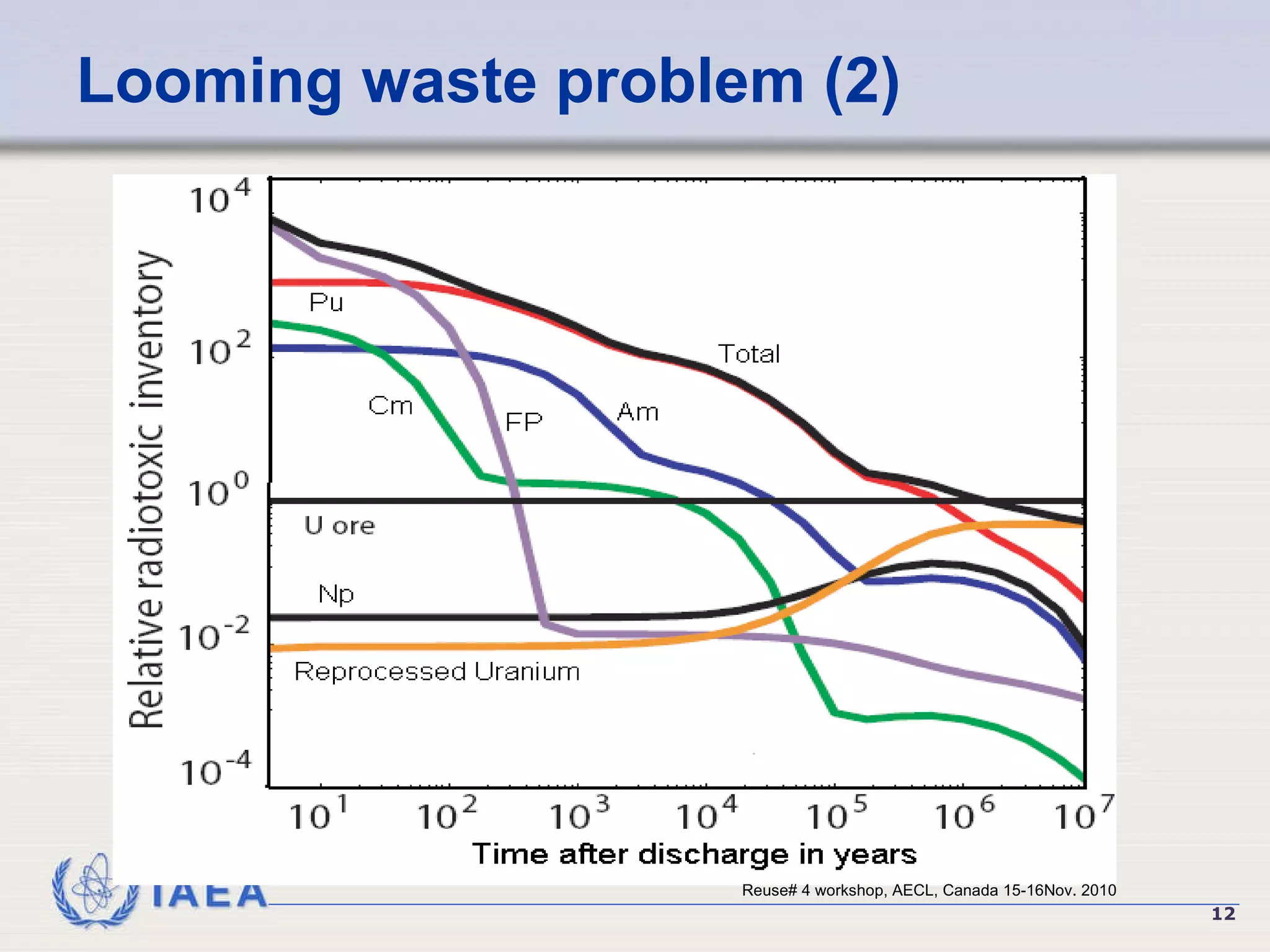
Looming waste problem (2) Reuse# 4 workshop, AECL, Canada 15-16Nov. 2010
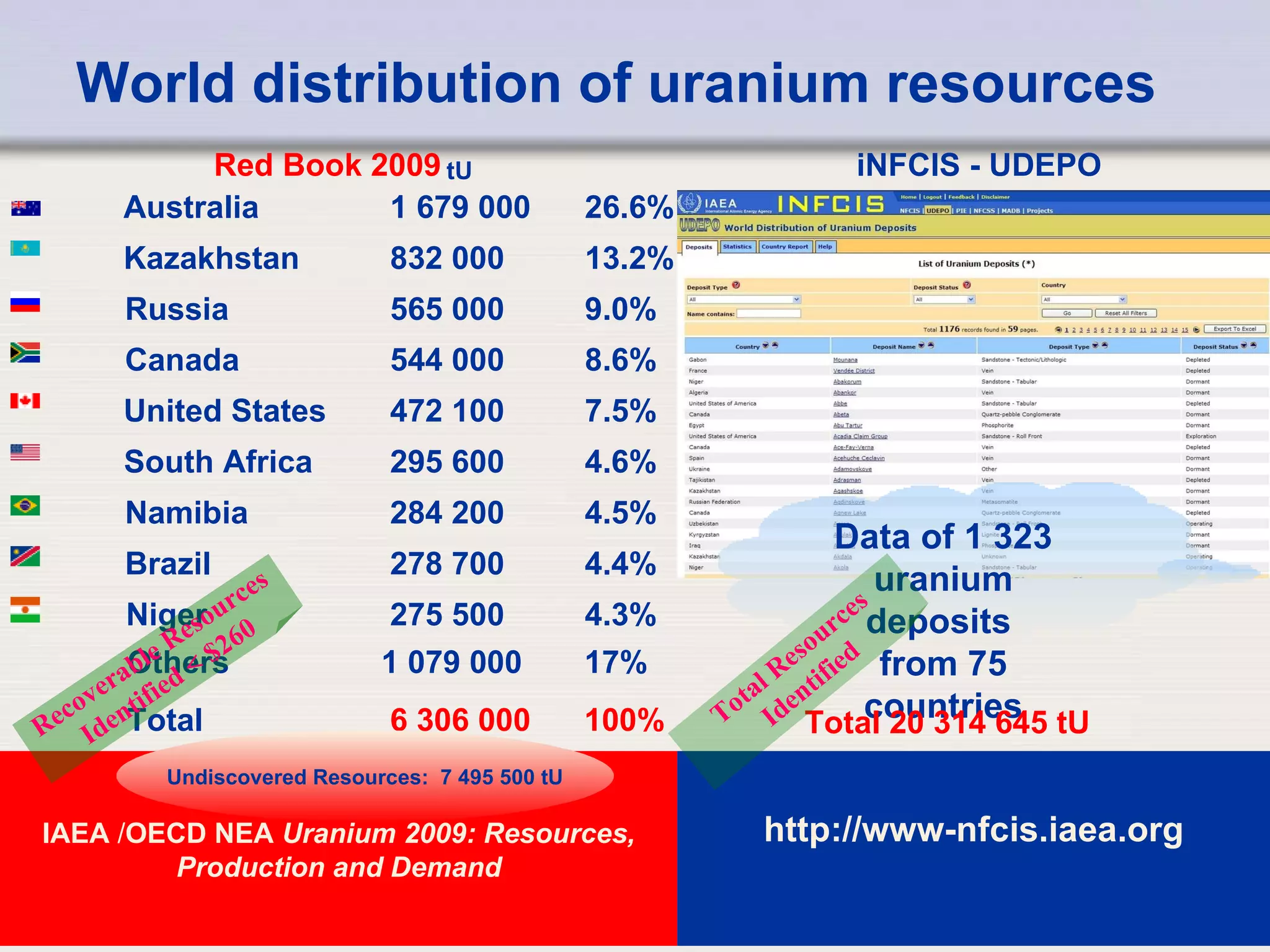
World distribution of uranium resources   IAEA   / OECD NEA  Uranium 2009: Resources, Production and Demand Others   1 079 000  17% Total  6 306 000  100% iNFCIS - UDEPO Data of 1 323 uranium deposits  from 75 countries http://www-nfcis.iaea.org Total 20 314 645 tU tU Red Book 2009 Undiscovered Resources:  7 495 500 tU Recoverable Resources Identified < $260 Total Resources Identified 4.3% 275 500       Niger 4.4% 278 700       Brazil 4.5% 284 200       Namibia 4.6% 295 600       South Africa 7.5% 472 100       United States 8.6% 544 000       Canada 9.0% 565 000       Russia 13.2% 832 000       Kazakhstan 26.6% 1 679 000       Australia
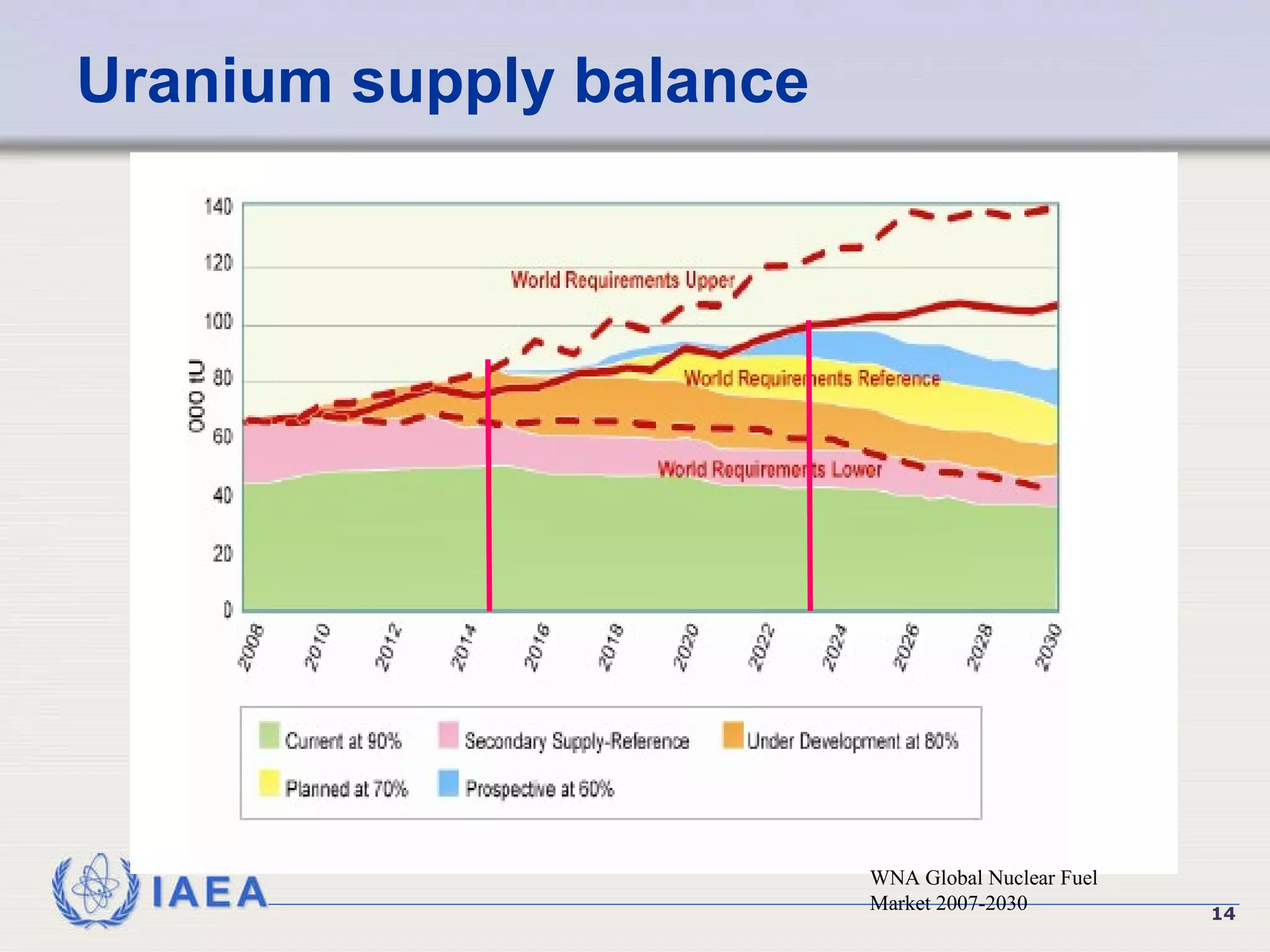
Uranium supply balance WNA Global Nuclear Fuel Market 2007-2030
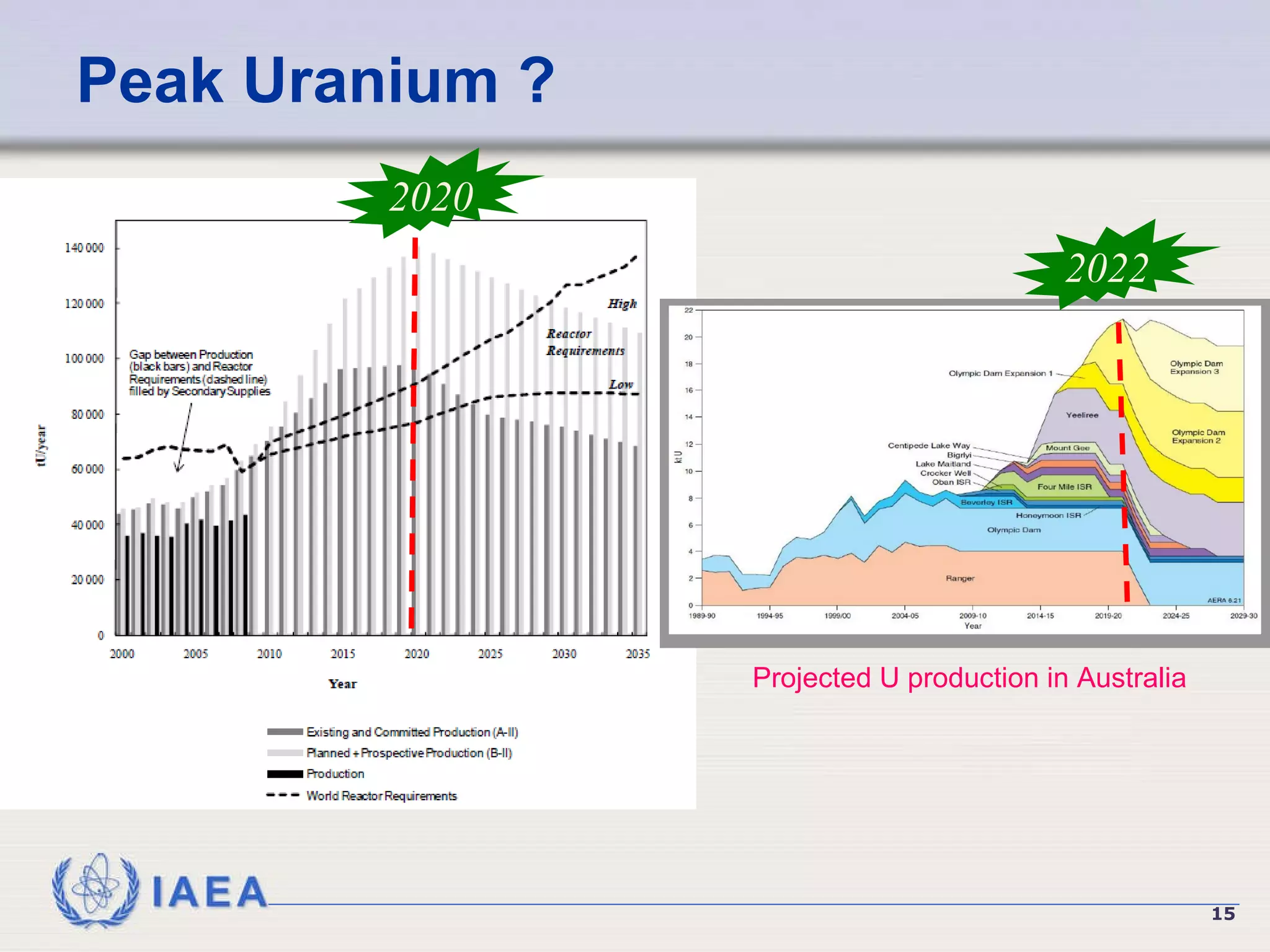
Peak Uranium ? Projected U production in Australia 2020 2022
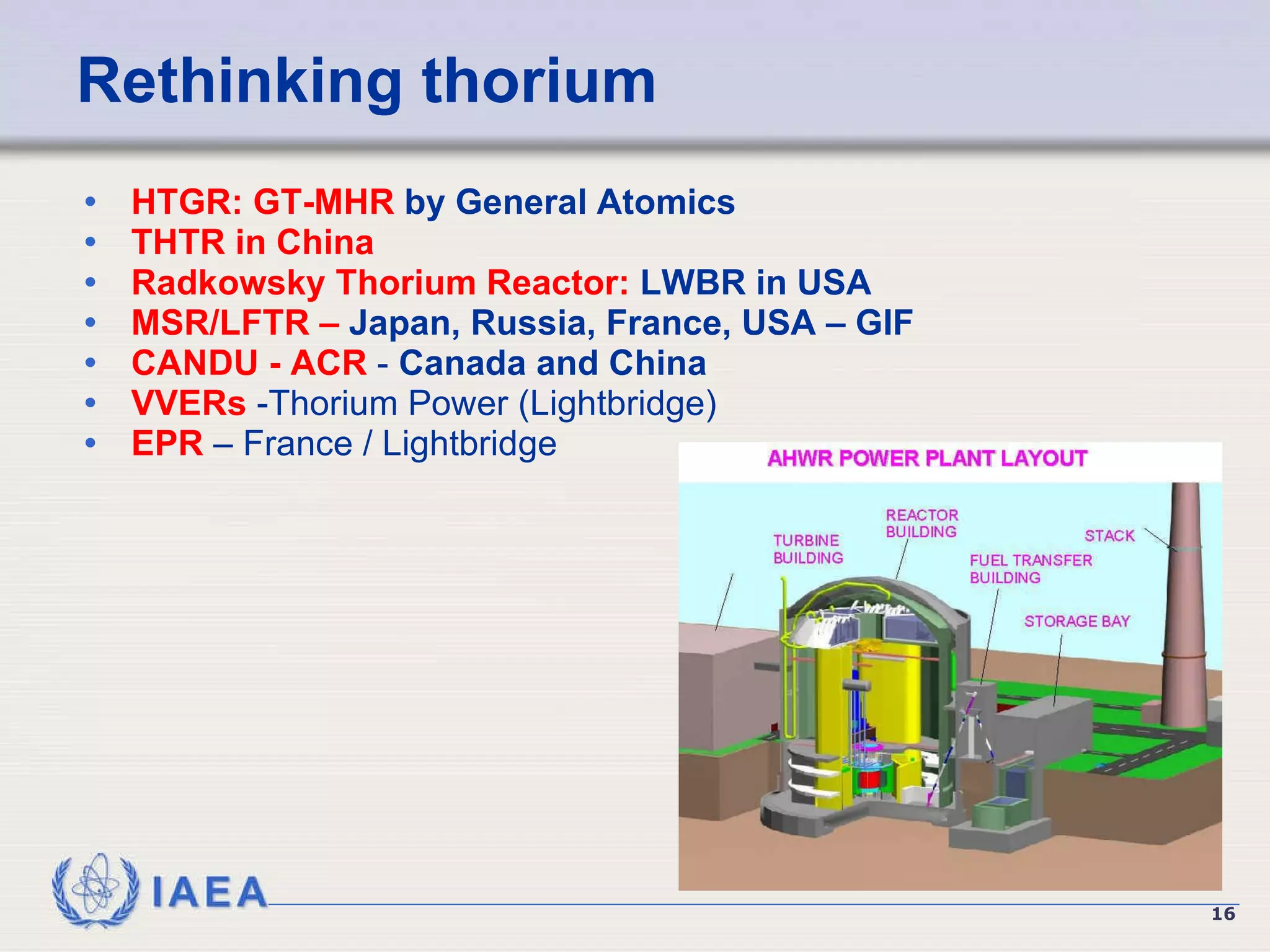
Rethinking thorium HTGR: GT-MHR  by General Atomics THTR in China Radkowsky Thorium Reactor:  LWBR in USA MSR/LFTR –  Japan, Russia, France, USA – GIF CANDU - ACR  -  Canada and China   VVERs  -Thorium Power (Lightbridge) EPR  – France / Lightbridge
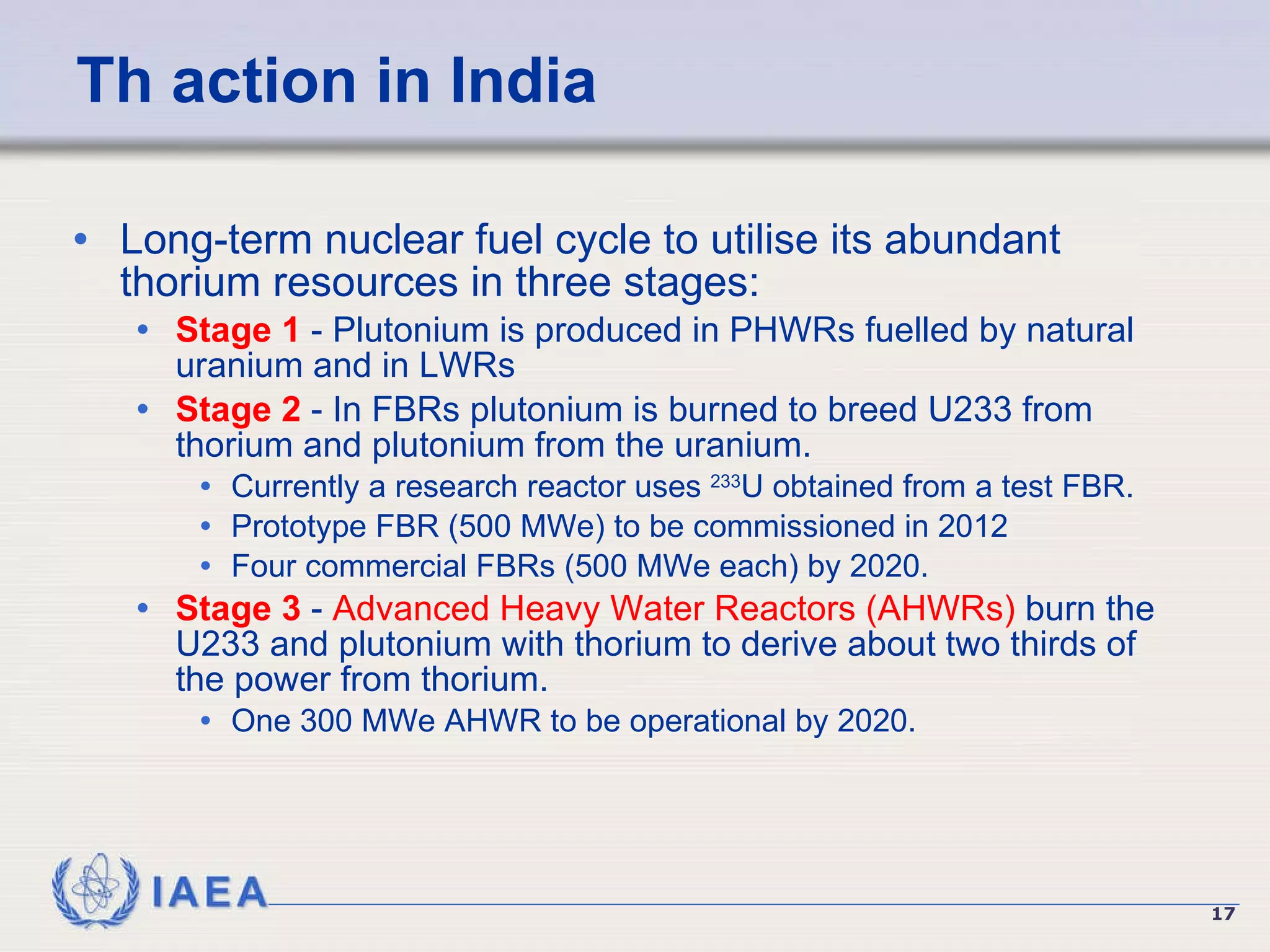
Th action in India Long-term nuclear fuel cycle to utilise its abundant thorium resources in three stages: Stage 1  - Plutonium is produced in PHWRs fuelled by natural uranium and in LWRs Stage 2  - In FBRs plutonium is burned to breed U233 from thorium and plutonium from the uranium.  Currently a research reactor uses  233 U obtained from a test FBR. Prototype FBR (500 MWe) to be commissioned in 2012  Four commercial FBRs (500 MWe each) by 2020. Stage 3  -  Advanced Heavy Water Reactors (AHWRs)  burn the U233 and plutonium with thorium to derive about two thirds of the power from thorium.  One 300 MWe AHWR to be operational by 2020.
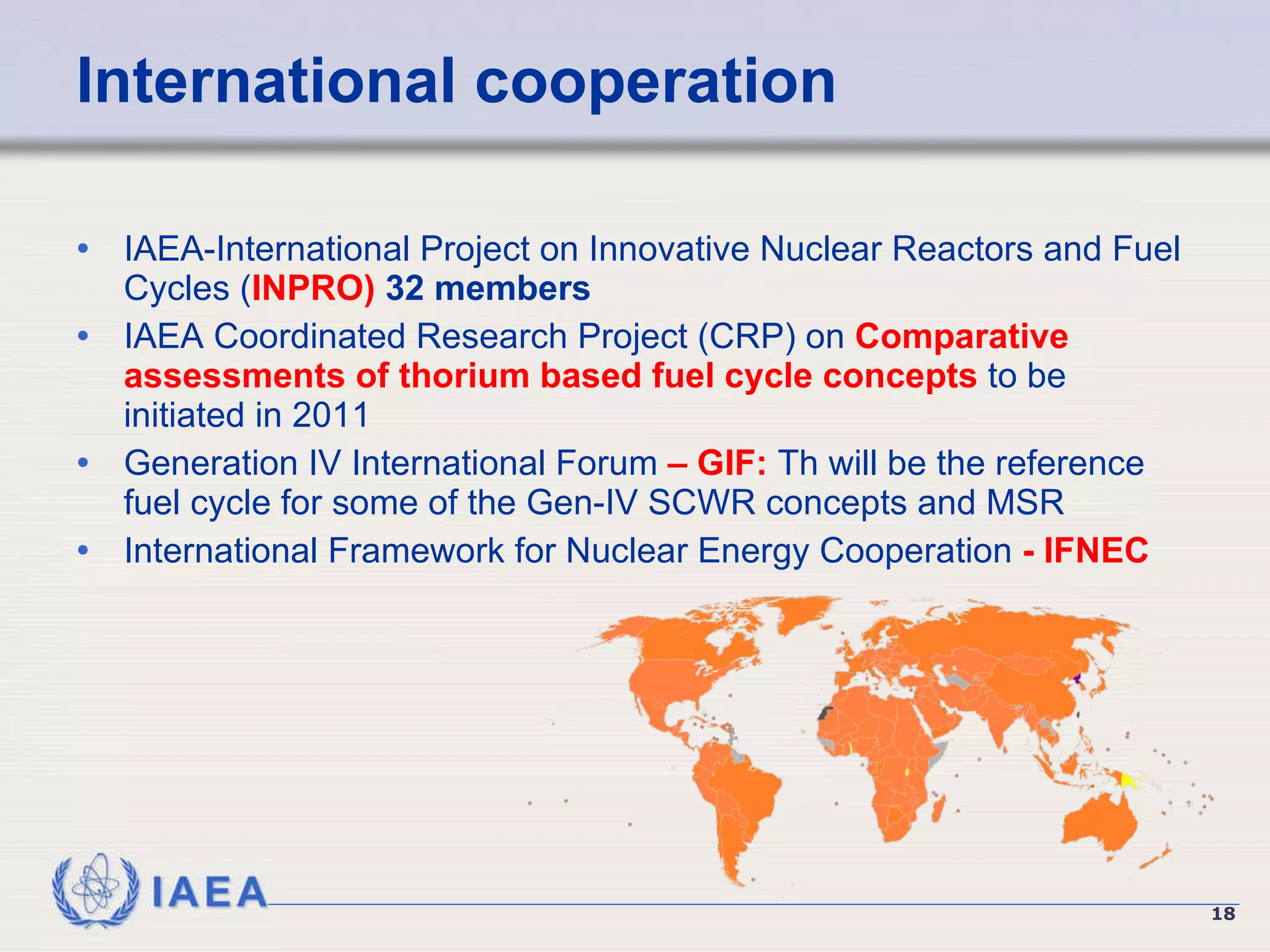
International cooperation IAEA-International Project on Innovative Nuclear Reactors and Fuel Cycles ( INPRO)  32 members IAEA  Coordinated Research Project   (CRP)  on  Comparative assessments of thorium based fuel cycle concepts  to be initiated in 2011   Generation IV International Forum  – GIF:  Th will be the reference fuel cycle for some of the Gen-IV SCWR concepts and MSR  International Framework for Nuclear Energy Cooperation  - IFNEC
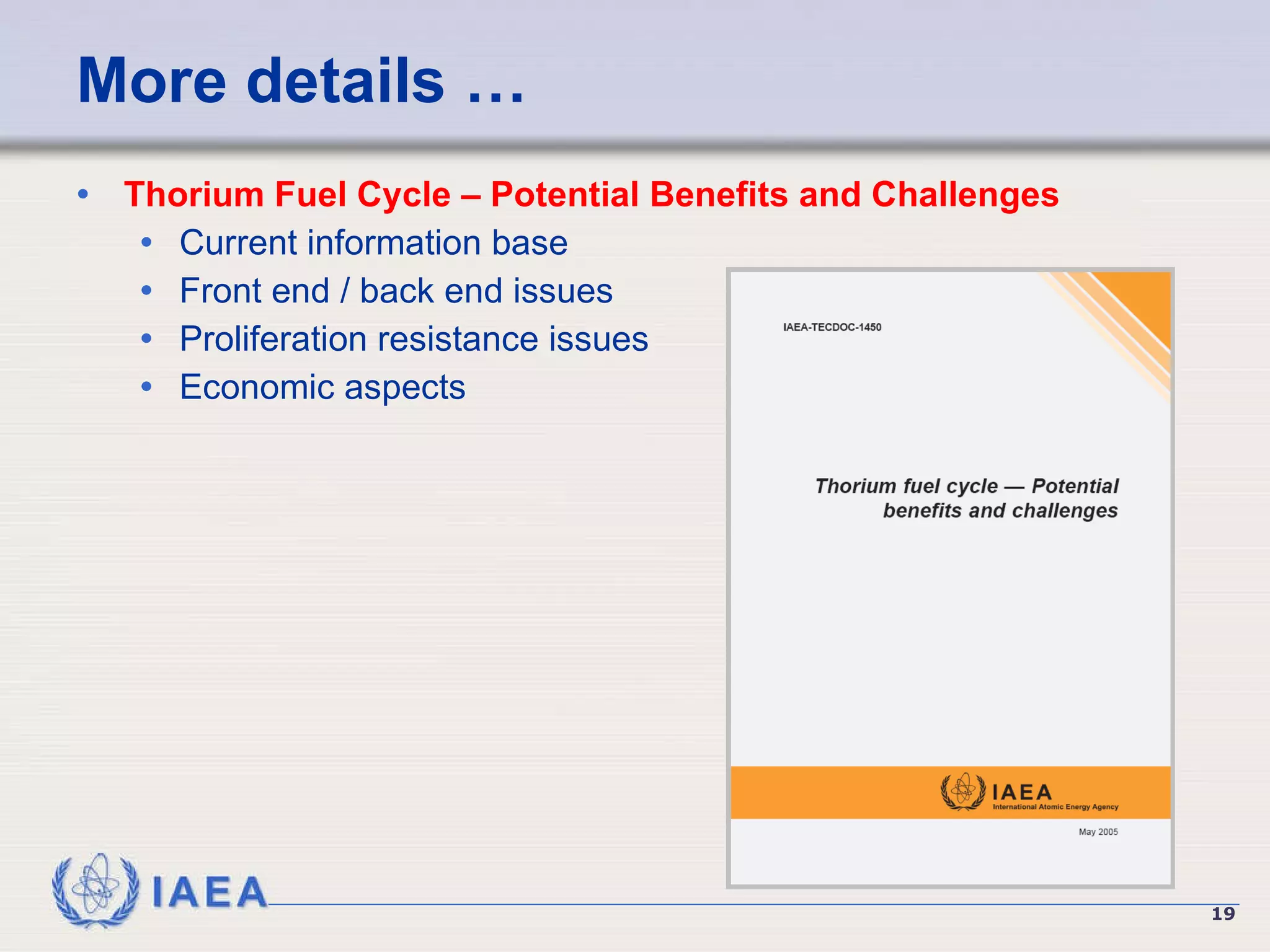
More details … Thorium Fuel Cycle – Potential Benefits and Challenges Current information base Front end / back end issues Proliferation resistance issues Economic aspects
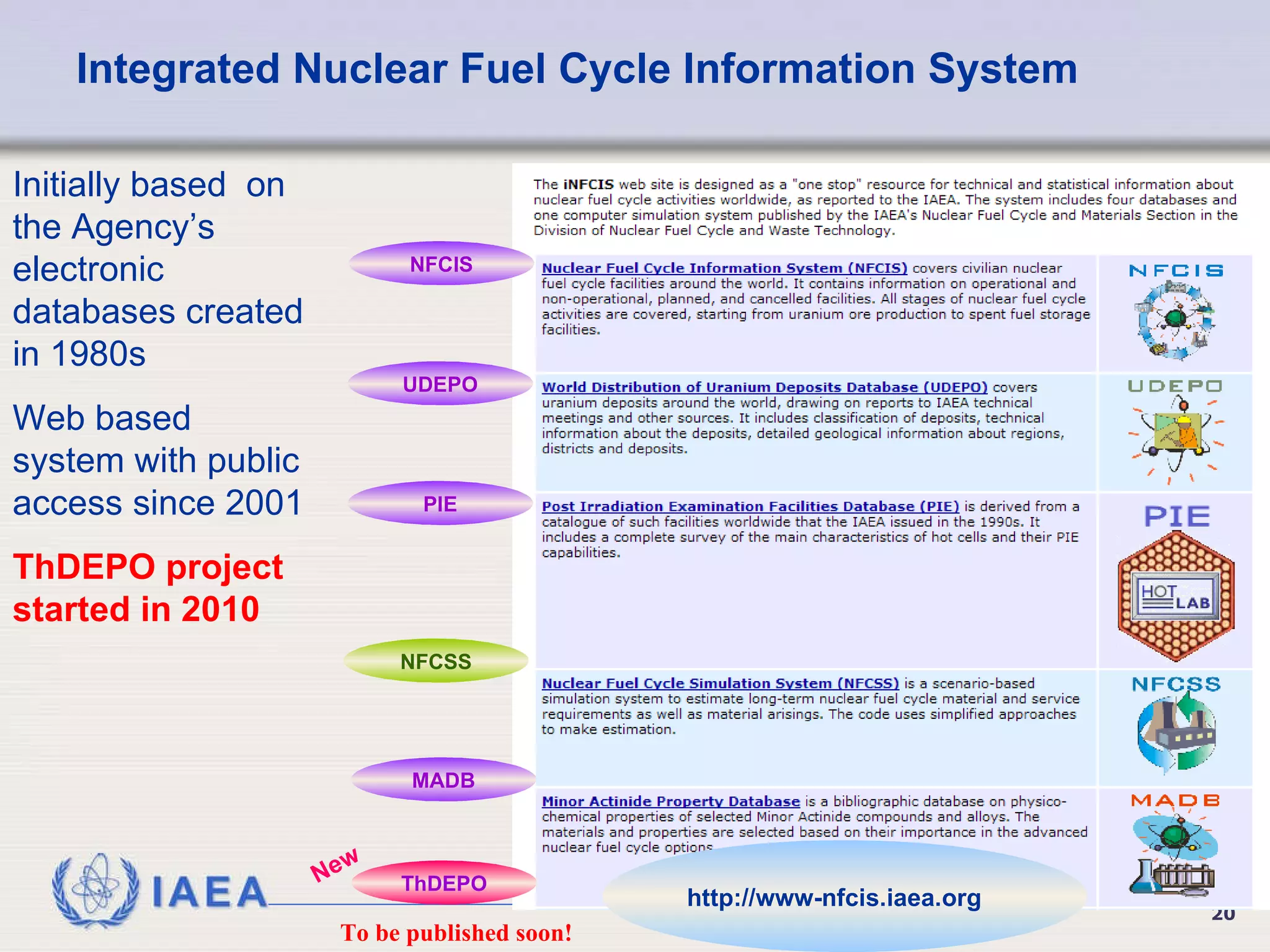
Integrated Nuclear Fuel Cycle Information System Initially based  on the Agency’s electronic databases created in 1980s Web based system with public access since 2001 ThDEPO project started in 2010   http://www-nfcis.iaea.org NFCIS UDEPO PIE NFCSS MADB ThDEPO New To be published soon!
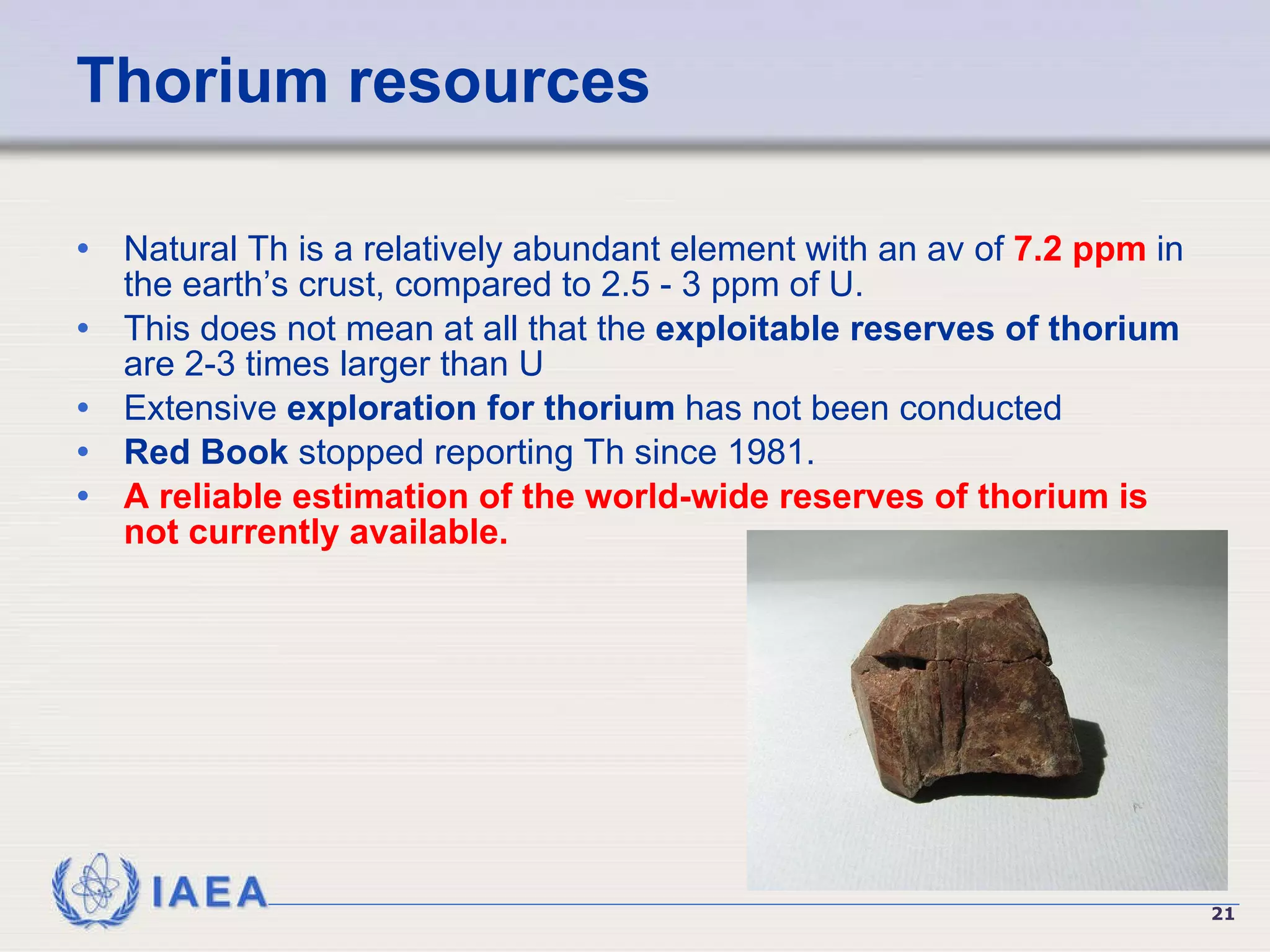
Thorium resources Natural Th is a relatively abundant element with an av of  7.2 ppm  in the earth’s crust, compared to 2.5 - 3 ppm of U. This does not mean at all that the  exploitable reserves of thorium  are 2-3 times larger than U Extensive  exploration for thorium  has not been conducted   Red Book  stopped reporting Th since 1981. A reliable estimation of the world-wide reserves of thorium is not currently available.
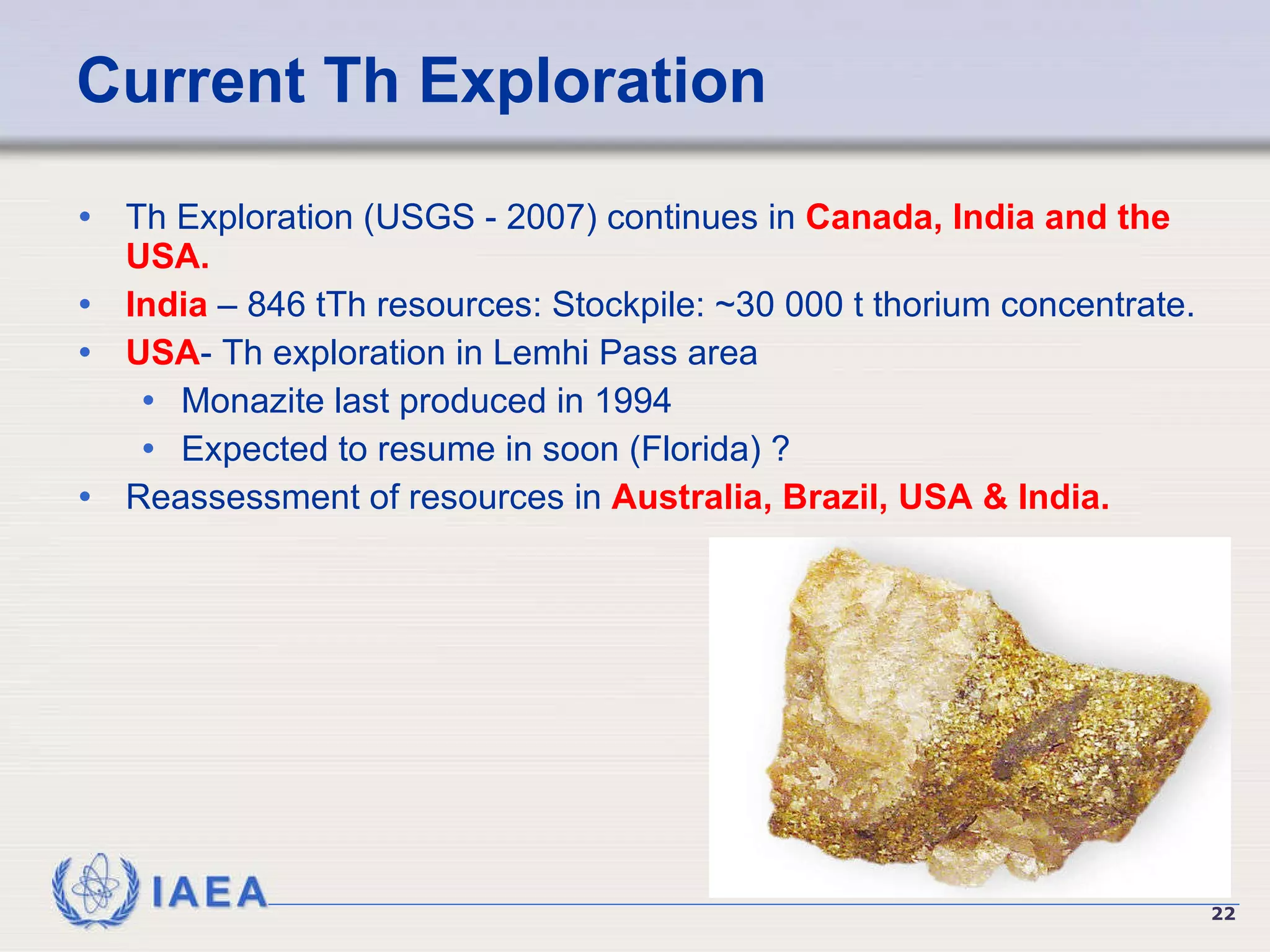
Current Th Exploration Th Exploration (USGS - 2007) continues in  Canada, India and the USA. India  – 846 tTh resources: Stockpile: ~30 000 t thorium concentrate. USA - Th exploration in Lemhi Pass area Monazite last produced in 1994 Expected to resume in soon (Florida) ? Reassessment of resources in  Australia, Brazil, USA & India.
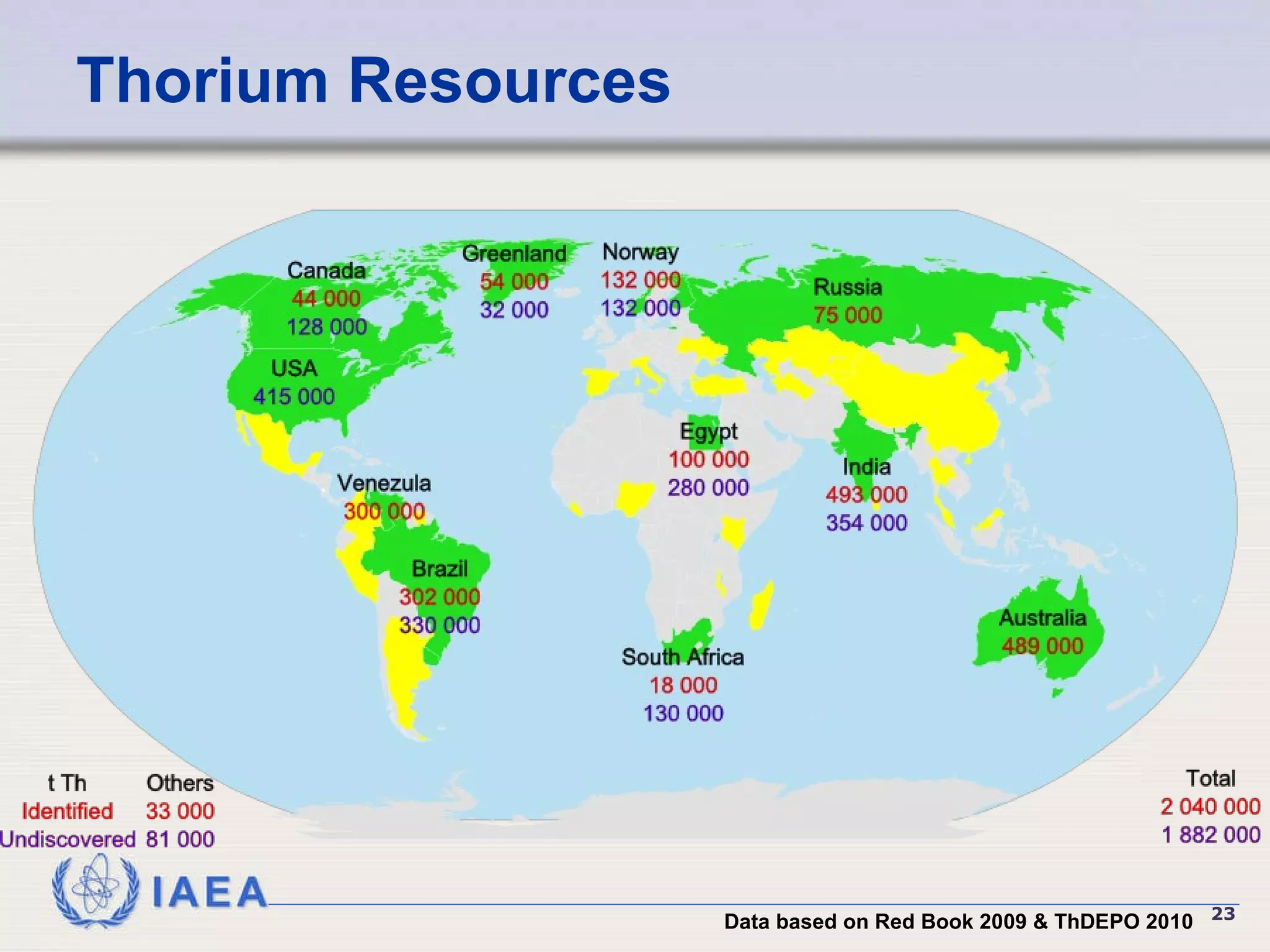
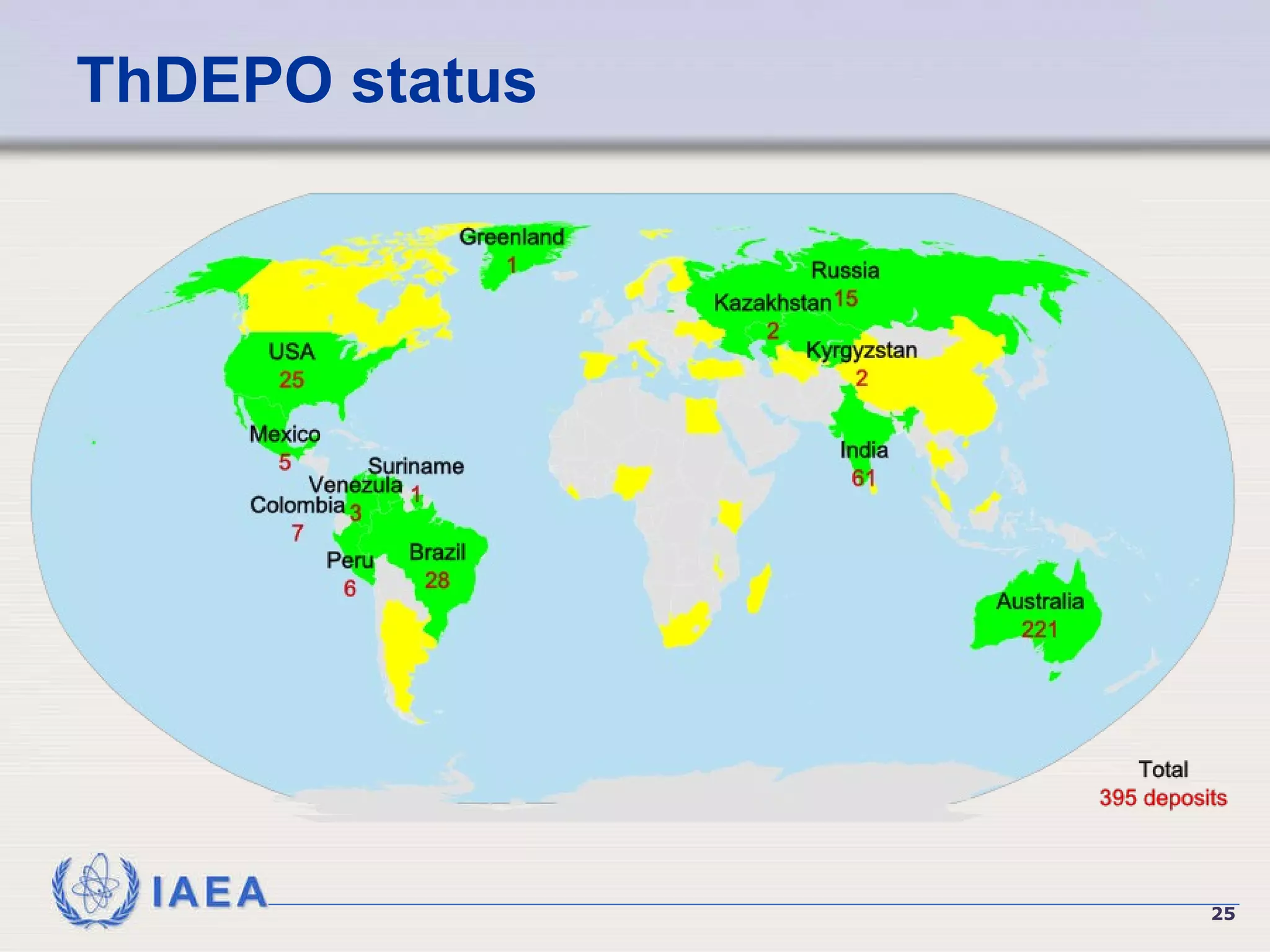
Thorium Resources Data based on Red Book 2009 & ThDEPO 2010
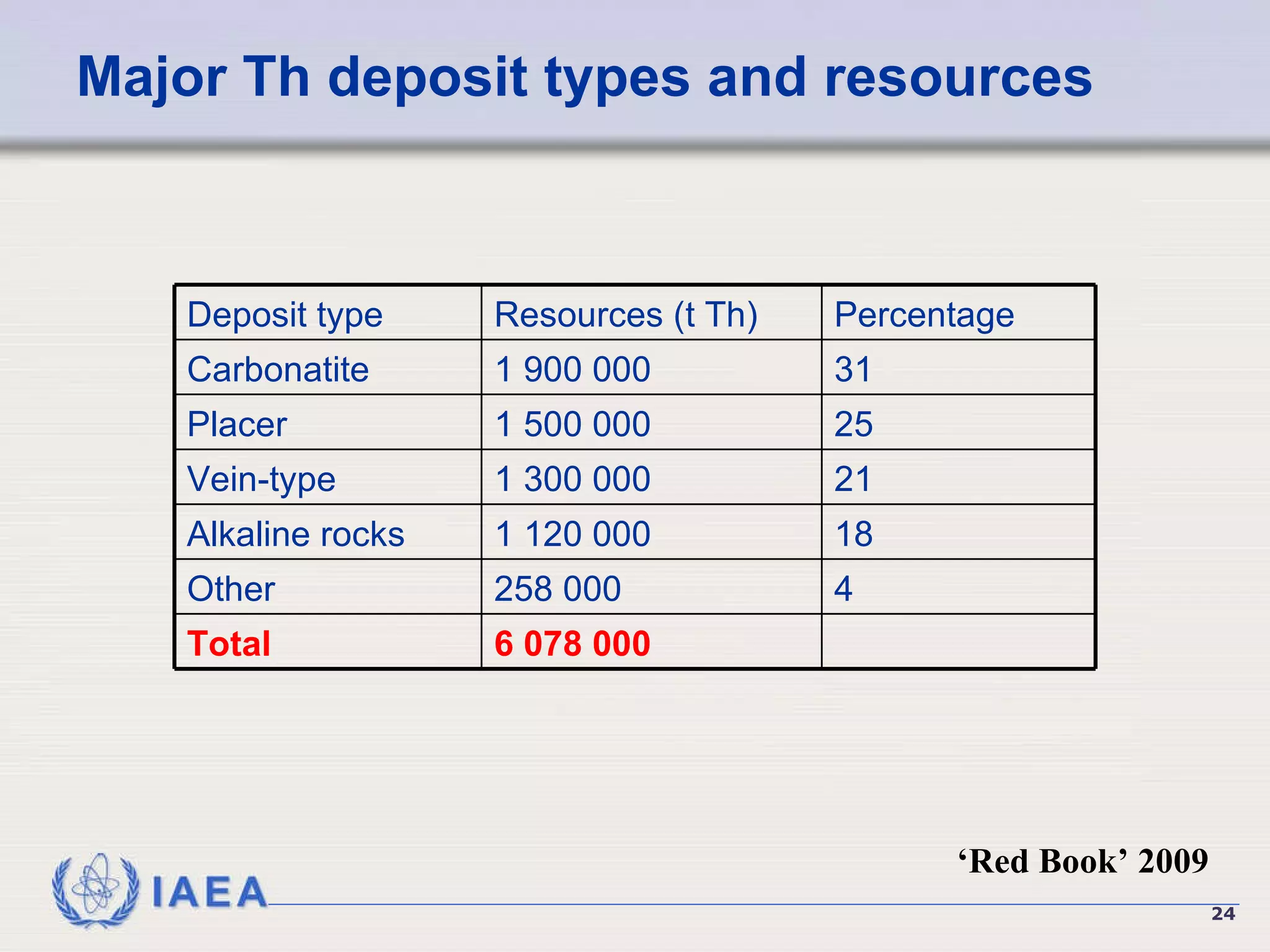
Major Th deposit types and resources ‘ Red Book’ 2009 6 078 000 Total 4 258 000 Other 18 1 120 000 Alkaline rocks 21 1 300 000 Vein-type 25 1 500 000 Placer 31 1 900 000 Carbonatite Percentage Resources (t Th) Deposit type
ThDEPO status
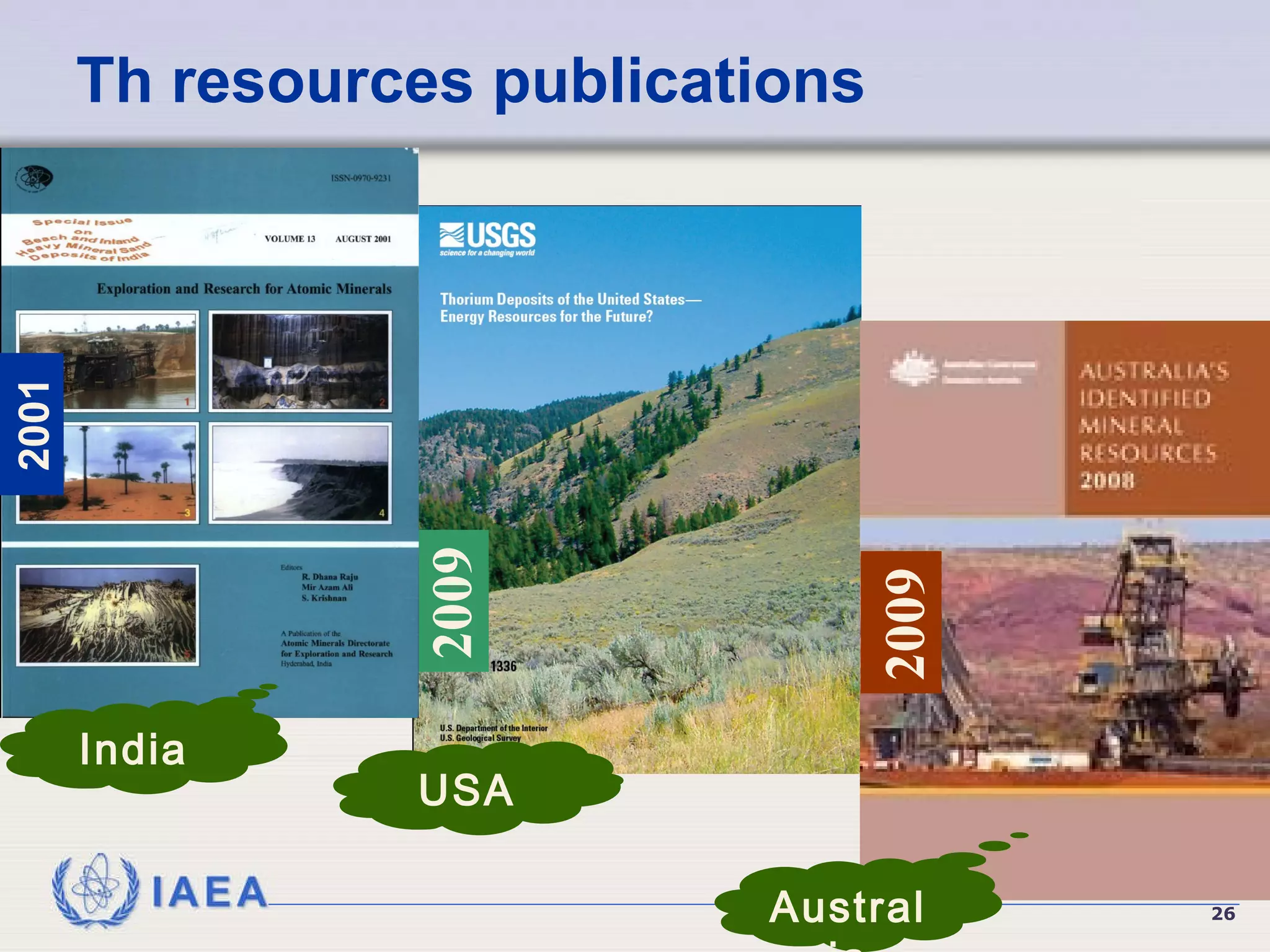
Th resources publications 2009 USA 2009 2001 India Australia
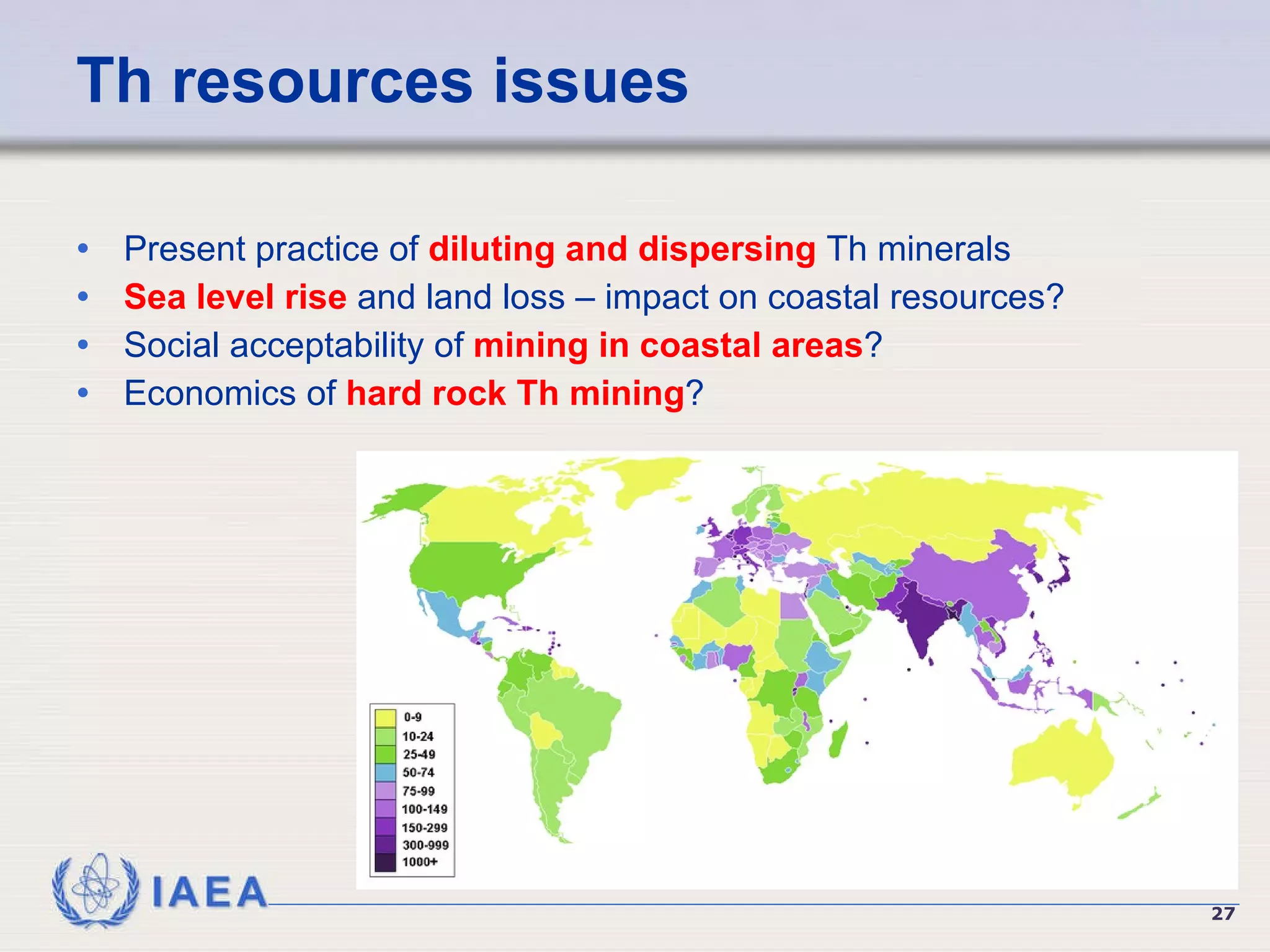
Th resources issues Present practice of  diluting and dispersing  Th minerals Sea level rise  and land loss – impact on coastal resources? Social acceptability of  mining in coastal areas ? Economics of  hard rock Th mining ?
ThDEPO planned activities Collect all the  available resources data  from published sources / unpublished reports Critically  evaluate and  publish  data in ThDEPO Preserve the  fast disappearing knowledge base  on Th reserves. Highlight  gaps in knowledge. Identify issues  in development of Th resources. Identify associated work that should be carried our –  CRPs, Tech Documents, Meetings Promote  International Cooperation  in Th resources development.
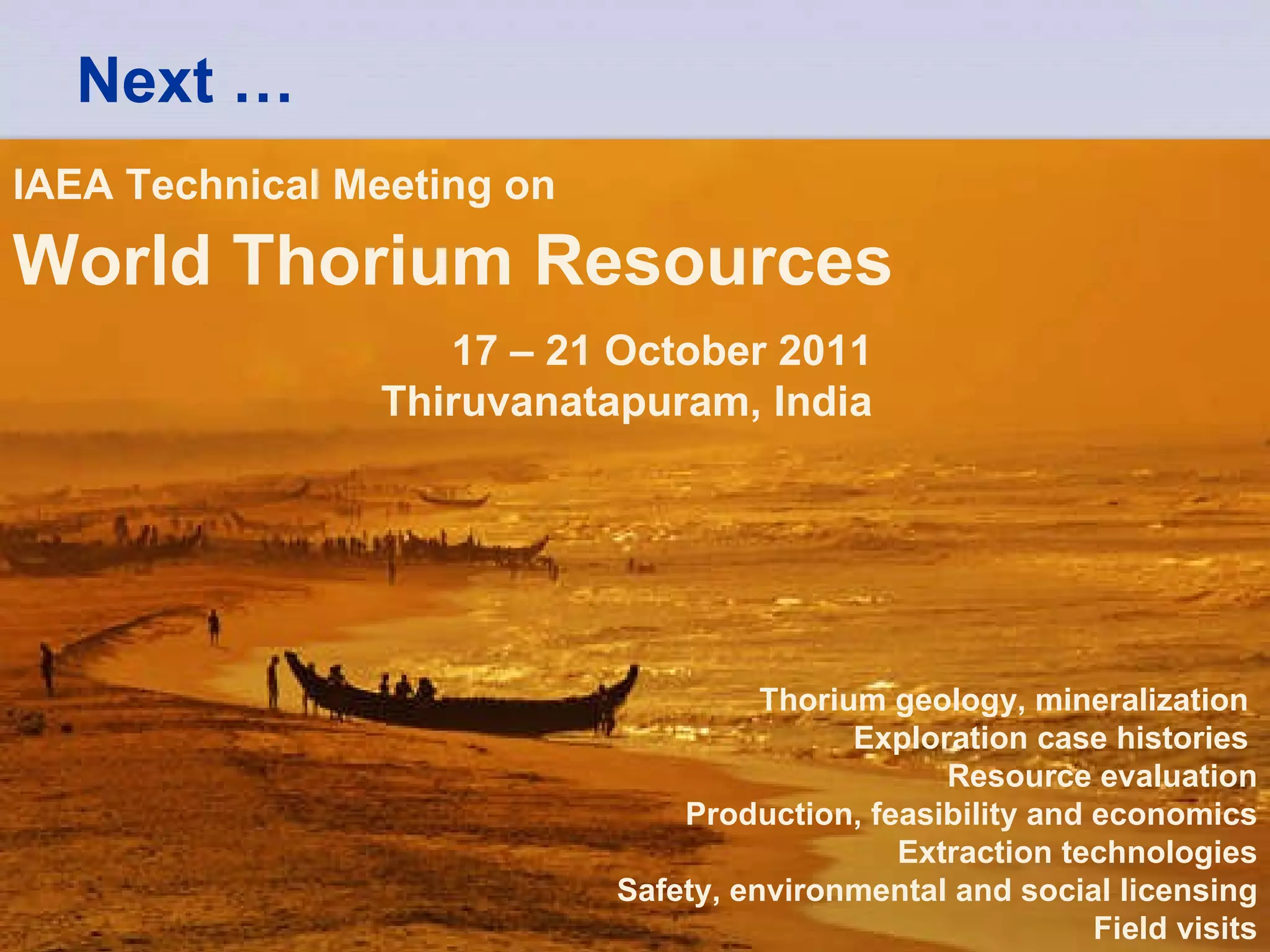
Next … IAEA Technical Meeting on   World Thorium Resources 17 – 21 October 2011 Thiruvanatapuram, India Thorium geology, mineralization  Exploration case histories   Resource evaluation Production, feasibility and economics Extraction technologies Safety, environmental and social licensing Field visits
You can reach me at … Thank you Harikrishnan Tulsidas Nuclear Technology Specialist Nuclear Fuel Cycle and Materials Section International Atomic Energy Agency Tel: (+431)  2600  22758  Fax: (+431)  26007 22758 Room  A26 19  Email:   [email_address]

Thorium - Securing the resources

  • 1.
    Thorium - Securingthe resources Hari Tulsidas Nuclear Fuel Cycle and Materials Section
  • 2.
    Thorium – thefuture of energy Advantages, challenges Past experience, the downturn Present hunger for energy, climatic concerns Booming nuclear waste issues How long with uranium resources last? Renewed interest in thorium IAEA activities in Th fuel cycle ThDEPO Planned activities
  • 3.
    Bunch of advantagesLarge resources of thorium Self sustained equilibrium thorium fuel cycle Intrinsic proliferation resistance Better thermo-physical properties and chemical stability High burn – up capability Lesser long lived minor actinides Superior plutonium incineration Attractive in accelerated driven systems and energy amplifiers
  • 4.
    Resistance to proliferationDifficulties in reprocessing of chemically stable thoria. Easy detection of gamma activity Quality of plutonium produced unattractive for weapons Improved burn-up increases the fuel cycle length, safeguarding the fissile material in the reactor itself
  • 5.
    Some challenges too… Needs fissile material to start with Fuel cycle infrastructure to be developed - mining, milling, fuel fabrication, transport and reprocessing Re-cycling of U 233 requires automated and remote fuel fabrication and handling in adequately shielded facility Reprocessing of Th fuels is not yet established Large investment for Th fuel development, qualification and characterization
  • 6.
    Th utilization –Past experience (1) Studied for about 40 years in Germany, USA, UK, Netherlands and India . Commercial scale Th fuelled reactors in Germany, USA in 1970s & 80s. Test reactor irradiation of thorium fuel to high burnups Several test reactors - partially or completely loaded with thorium-based fuel.
  • 7.
    Th utilization –Past experience (2) 1967 – 1988: AVR, Germany (18 MWe) 1964 – 1973: Dragon, UK (20 MWt) 1962 – 1980: Indian Point, USA (285 MWe) 1964 – 1969: MSRE ORNL, USA (7.5 MWt) 1963 – 1968: Borax IV & Elk River (2,4 – 24 MWe) 1967 – 1974: Peach Bottom, USA (40 MWe) 1976 – 1989: Fort St Vtain, USA (330 MWe) 1977 – 1982: Shippingport, USA (100 MWe) 1960s – present: 3 RR and NPD, Canada 1974 - 1977: SUSPOP/KSTR KEMA, Netherlands (1 MWt) 1983 – 1989: THTR, Germany (300MWe) 1980s : Cirus & Dhruva, India (30 kWt & 40 MWt) 1985 – present: FBTR, India (40 MWt) 1996 – present: Kamini, India (30kWt)
  • 8.
    The downturn Allmajor projects using Th in their fuel cycles had been terminated by the late 1980s. Could not compete economically Lack of political support Concern regarding proliferation risks Chernobyl Cheap Oil Proliferation
  • 9.
    Hunger for energyPopulation growth Energy poverty Source: World Energy Outlook 2010
  • 10.
  • 11.
    Looming waste problem(1) World cumulative spent fuel discharge by 2030
  • 12.
    Looming waste problem(2) Reuse# 4 workshop, AECL, Canada 15-16Nov. 2010
  • 13.
    World distribution ofuranium resources IAEA / OECD NEA Uranium 2009: Resources, Production and Demand Others 1 079 000 17% Total 6 306 000 100% iNFCIS - UDEPO Data of 1 323 uranium deposits from 75 countries http://www-nfcis.iaea.org Total 20 314 645 tU tU Red Book 2009 Undiscovered Resources: 7 495 500 tU Recoverable Resources Identified < $260 Total Resources Identified 4.3% 275 500       Niger 4.4% 278 700       Brazil 4.5% 284 200       Namibia 4.6% 295 600       South Africa 7.5% 472 100       United States 8.6% 544 000       Canada 9.0% 565 000       Russia 13.2% 832 000       Kazakhstan 26.6% 1 679 000       Australia
  • 14.
    Uranium supply balanceWNA Global Nuclear Fuel Market 2007-2030
  • 15.
    Peak Uranium ?Projected U production in Australia 2020 2022
  • 16.
    Rethinking thorium HTGR:GT-MHR by General Atomics THTR in China Radkowsky Thorium Reactor: LWBR in USA MSR/LFTR – Japan, Russia, France, USA – GIF CANDU - ACR - Canada and China VVERs -Thorium Power (Lightbridge) EPR – France / Lightbridge
  • 17.
    Th action inIndia Long-term nuclear fuel cycle to utilise its abundant thorium resources in three stages: Stage 1 - Plutonium is produced in PHWRs fuelled by natural uranium and in LWRs Stage 2 - In FBRs plutonium is burned to breed U233 from thorium and plutonium from the uranium. Currently a research reactor uses 233 U obtained from a test FBR. Prototype FBR (500 MWe) to be commissioned in 2012 Four commercial FBRs (500 MWe each) by 2020. Stage 3 - Advanced Heavy Water Reactors (AHWRs) burn the U233 and plutonium with thorium to derive about two thirds of the power from thorium. One 300 MWe AHWR to be operational by 2020.
  • 18.
    International cooperation IAEA-InternationalProject on Innovative Nuclear Reactors and Fuel Cycles ( INPRO) 32 members IAEA Coordinated Research Project (CRP) on Comparative assessments of thorium based fuel cycle concepts to be initiated in 2011 Generation IV International Forum – GIF: Th will be the reference fuel cycle for some of the Gen-IV SCWR concepts and MSR International Framework for Nuclear Energy Cooperation - IFNEC
  • 19.
    More details …Thorium Fuel Cycle – Potential Benefits and Challenges Current information base Front end / back end issues Proliferation resistance issues Economic aspects
  • 20.
    Integrated Nuclear FuelCycle Information System Initially based on the Agency’s electronic databases created in 1980s Web based system with public access since 2001 ThDEPO project started in 2010 http://www-nfcis.iaea.org NFCIS UDEPO PIE NFCSS MADB ThDEPO New To be published soon!
  • 21.
    Thorium resources NaturalTh is a relatively abundant element with an av of 7.2 ppm in the earth’s crust, compared to 2.5 - 3 ppm of U. This does not mean at all that the exploitable reserves of thorium are 2-3 times larger than U Extensive exploration for thorium has not been conducted Red Book stopped reporting Th since 1981. A reliable estimation of the world-wide reserves of thorium is not currently available.
  • 22.
    Current Th ExplorationTh Exploration (USGS - 2007) continues in Canada, India and the USA. India – 846 tTh resources: Stockpile: ~30 000 t thorium concentrate. USA - Th exploration in Lemhi Pass area Monazite last produced in 1994 Expected to resume in soon (Florida) ? Reassessment of resources in Australia, Brazil, USA & India.
  • 23.
    Thorium Resources Databased on Red Book 2009 & ThDEPO 2010
  • 24.
    Major Th deposittypes and resources ‘ Red Book’ 2009 6 078 000 Total 4 258 000 Other 18 1 120 000 Alkaline rocks 21 1 300 000 Vein-type 25 1 500 000 Placer 31 1 900 000 Carbonatite Percentage Resources (t Th) Deposit type
  • 25.
  • 26.
    Th resources publications2009 USA 2009 2001 India Australia
  • 27.
    Th resources issuesPresent practice of diluting and dispersing Th minerals Sea level rise and land loss – impact on coastal resources? Social acceptability of mining in coastal areas ? Economics of hard rock Th mining ?
  • 28.
    ThDEPO planned activitiesCollect all the available resources data from published sources / unpublished reports Critically evaluate and publish data in ThDEPO Preserve the fast disappearing knowledge base on Th reserves. Highlight gaps in knowledge. Identify issues in development of Th resources. Identify associated work that should be carried our – CRPs, Tech Documents, Meetings Promote International Cooperation in Th resources development.
  • 29.
    Next … IAEATechnical Meeting on World Thorium Resources 17 – 21 October 2011 Thiruvanatapuram, India Thorium geology, mineralization Exploration case histories Resource evaluation Production, feasibility and economics Extraction technologies Safety, environmental and social licensing Field visits
  • 30.
    You can reachme at … Thank you Harikrishnan Tulsidas Nuclear Technology Specialist Nuclear Fuel Cycle and Materials Section International Atomic Energy Agency Tel: (+431) 2600 22758 Fax: (+431) 26007 22758 Room A26 19 Email: [email_address]