This work was performed under the auspices of the U.S. Department
of Energy by Lawrence Livermore National Laboratory under contract
DE-AC52-07NA27344. Lawrence Livermore National Security, LLC
Reactor Plutonium Utility in Nuclear
Explosives*
Bruce T. Goodwin, PhD
Associate Director-at-Large for National Security & Policy Research
November 6, 2015*drawn from the work of Robert Selden
LLNL-PRES-801535
LL-NSO-U-2015-######_2Lawrence Livermore National Laboratory
Outline
Bottom Line Up Front
Plutonium Description
Critical Mass
Radioactivity & Heat
Neutron Background
A Nuclear Explosive
Conclusions
Summary
LL-NSO-U-2015-######_3Lawrence Livermore National Laboratory
Bottom line up front
• “A potential proliferating state or subnational group using designs and
technologies no more sophisticated than those used in first-generation
nuclear weapons could build a nuclear weapon from reactor grade
plutonium that would have an assured, reliable yield of one or a few
kilotons (and a probable yield significantly higher than that)” *
• “An advanced nuclear weapon states such as the United States and
Russia, using modern designs, could produce weapons from reactor
grade plutonium having reliable explosive yields, weight, and other
characteristics generally comparable to those of weapons made from
weapons grade plutonium” *
* Quoted from: US Department of Energy Publication “Nonproliferation and Arms Control Assessment of Weapons-Usable Fissile
Material Storage and Excess Plutonium Disposition Alternatives, January 1997 http://www.osti.gov/scitech/biblio/425259
LL-NSO-U-2015-######_4Lawrence Livermore National Laboratory
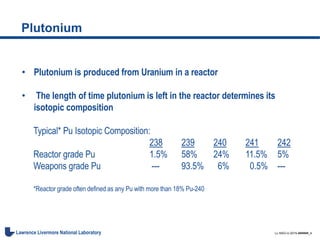
Plutonium
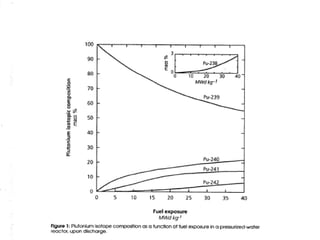
• Plutonium is produced from Uranium in a reactor
• The length of time plutonium is left in the reactor determines its
isotopic composition
Typical* Pu Isotopic Composition:
238 239 240 241 242
Reactor grade Pu 1.5% 58% 24% 11.5% 5%
Weapons grade Pu --- 93.5% 6% 0.5% ---
*Reactor grade often defined as any Pu with more than 18% Pu-240
LL-NSO-U-2015-######_5Lawrence Livermore National Laboratory
LL-NSO-U-2015-######_6Lawrence Livermore National Laboratory
Properties of Fissile Materials
• There are three aspects of fissile material important in nuclear
explosives
• Fissile material reactivity
Critical Mass
• Ease of handling
Radioactivity and Heat Generation
• Neutron background
Spontaneous fission rate
LL-NSO-U-2015-######_7Lawrence Livermore National Laboratory
Nuclear Reactivity
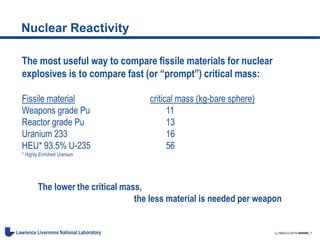
The most useful way to compare fissile materials for nuclear
explosives is to compare fast (or “prompt”) critical mass:
Fissile material critical mass (kg-bare sphere)
Weapons grade Pu 11
Reactor grade Pu 13
Uranium 233 16
HEU* 93.5% U-235 56
* Highly Enriched Uranium
The lower the critical mass,
the less material is needed per weapon
LL-NSO-U-2015-######_8Lawrence Livermore National Laboratory
Nuclear Reactivity - continued
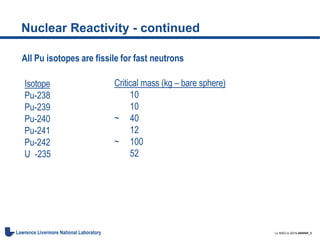
All Pu isotopes are fissile for fast neutrons
Isotope
Pu-238
Pu-239
Pu-240
Pu-241
Pu-242
U -235
Critical mass (kg – bare sphere)
10
10
~ 40
12
~ 100
52
LL-NSO-U-2015-######_9Lawrence Livermore National Laboratory
Nuclear Reactivity - continued
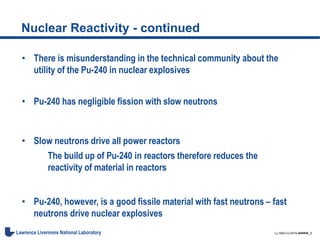
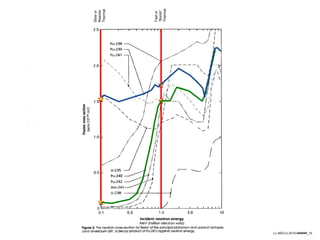
• There is misunderstanding in the technical community about the
utility of the Pu-240 in nuclear explosives
• Pu-240 has negligible fission with slow neutrons
• Slow neutrons drive all power reactors
The build up of Pu-240 in reactors therefore reduces the
reactivity of material in reactors
• Pu-240, however, is a good fissile material with fast neutrons – fast
neutrons drive nuclear explosives
From Carson Mark
Slowor
Reactor
Thermal
Fastor
“Bomb”
Thermal
LL-NSO-U-2015-######_10
LL-NSO-U-2015-######_11Lawrence Livermore National Laboratory
Handling
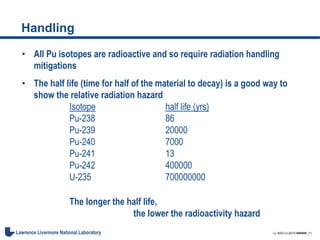
• All Pu isotopes are radioactive and so require radiation handling
mitigations
• The half life (time for half of the material to decay) is a good way to
show the relative radiation hazard
Isotope half life (yrs)
Pu-238 86
Pu-239 20000
Pu-240 7000
Pu-241 13
Pu-242 400000
U-235 700000000
The longer the half life,
the lower the radioactivity hazard
LL-NSO-U-2015-######_12Lawrence Livermore National Laboratory
Handling - continued
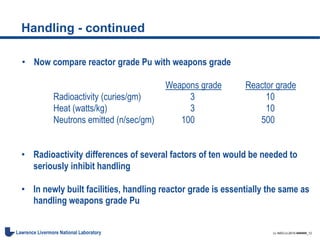
• Now compare reactor grade Pu with weapons grade
Weapons grade Reactor grade
Radioactivity (curies/gm) 3 10
Heat (watts/kg) 3 10
Neutrons emitted (n/sec/gm) 100 500
• Radioactivity differences of several factors of ten would be needed to
seriously inhibit handling
• In newly built facilities, handling reactor grade is essentially the same as
handling weapons grade Pu
LL-NSO-U-2015-######_13Lawrence Livermore National Laboratory
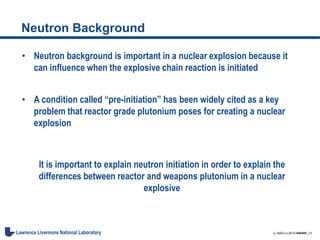
Neutron Background
• Neutron background is important in a nuclear explosion because it
can influence when the explosive chain reaction is initiated
• A condition called “pre-initiation” has been widely cited as a key
problem that reactor grade plutonium poses for creating a nuclear
explosion
It is important to explain neutron initiation in order to explain the
differences between reactor and weapons plutonium in a nuclear
explosive
LL-NSO-U-2015-######_14Lawrence Livermore National Laboratory
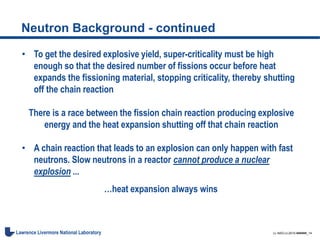
Neutron Background - continued
• To get the desired explosive yield, super-criticality must be high
enough so that the desired number of fissions occur before heat
expands the fissioning material, stopping criticality, thereby shutting
off the chain reaction
There is a race between the fission chain reaction producing explosive
energy and the heat expansion shutting off that chain reaction
• A chain reaction that leads to an explosion can only happen with fast
neutrons. Slow neutrons in a reactor cannot produce a nuclear
explosion ...
…heat expansion always wins
LL-NSO-U-2015-######_15Lawrence Livermore National Laboratory
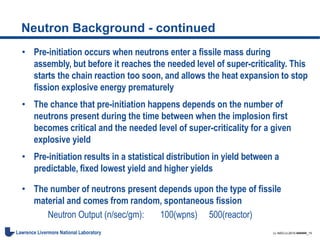
Neutron Background - continued
• Pre-initiation occurs when neutrons enter a fissile mass during
assembly, but before it reaches the needed level of super-criticality. This
starts the chain reaction too soon, and allows the heat expansion to stop
fission explosive energy prematurely
• The chance that pre-initiation happens depends on the number of
neutrons present during the time between when the implosion first
becomes critical and the needed level of super-criticality for a given
explosive yield
• Pre-initiation results in a statistical distribution in yield between a
predictable, fixed lowest yield and higher yields
• The number of neutrons present depends upon the type of fissile
material and comes from random, spontaneous fission
Neutron Output (n/sec/gm): 100(wpns) 500(reactor)
LL-NSO-U-2015-######_16Lawrence Livermore National Laboratory
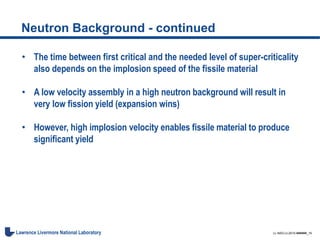
Neutron Background - continued
• The time between first critical and the needed level of super-criticality
also depends on the implosion speed of the fissile material
• A low velocity assembly in a high neutron background will result in
very low fission yield (expansion wins)
• However, high implosion velocity enables fissile material to produce
significant yield
LL-NSO-U-2015-######_17Lawrence Livermore National Laboratory
Conclusion
• A militarily useful first generation nuclear explosive using reactor
grade plutonium can be designed to produce nuclear yield in the multi-
kiloton range.
• A first generation nuclear explosive is very large, unsophisticated,
and would use weapons grade plutonium
• A nominal explosion yield would be ~ 20 kilotons
• With reactor grade plutonium, the yield would be more than 1 kiloton
• This would have a destructive radius greater than 1/3 that of the
Hiroshima explosion
LL-NSO-U-2015-######_18Lawrence Livermore National Laboratory
Summary
• All plutonium isotopes can be used directly in nuclear explosives
In fact, in 1962, the US tested a nuclear explosive made with
reactor grade plutonium
• “Denatured” plutonium (that is, Pu which is unsuitable for nuclear
explosives) does not exist!
• High Pu-240 isotope content in a nuclear weapon is an
engineering complication, not an impediment
LL-NSO-U-2015-######_19Lawrence Livermore National Laboratory
What this means
• “A potential proliferating state or subnational group using designs and
technologies no more sophisticated than those used in first-generation
nuclear weapons could build a nuclear weapon from reactor grade
plutonium that would have an assured, reliable yield of one or a few
kilotons (and a probable yield significantly higher than that)” *
• “An advanced nuclear weapon states such as the United States and
Russia, using modern designs, could produce weapons from reactor
grade plutonium having reliable explosive yields, weight, and other
characteristics generally comparable to those of weapons made from
weapons grade plutonium” *
* Quoted from: US Department of Energy Publication “Nonproliferation and Arms Control Assessment of Weapons-Usable Fissile
Material Storage and Excess Plutonium Disposition Alternatives, January 1997 http://www.osti.gov/scitech/biblio/425259

Reactor pu bg 6_nov2015

  • 1.
    This work wasperformed under the auspices of the U.S. Department of Energy by Lawrence Livermore National Laboratory under contract DE-AC52-07NA27344. Lawrence Livermore National Security, LLC Reactor Plutonium Utility in Nuclear Explosives* Bruce T. Goodwin, PhD Associate Director-at-Large for National Security & Policy Research November 6, 2015*drawn from the work of Robert Selden LLNL-PRES-801535
  • 2.
    LL-NSO-U-2015-######_2Lawrence Livermore NationalLaboratory Outline Bottom Line Up Front Plutonium Description Critical Mass Radioactivity & Heat Neutron Background A Nuclear Explosive Conclusions Summary
  • 3.
    LL-NSO-U-2015-######_3Lawrence Livermore NationalLaboratory Bottom line up front • “A potential proliferating state or subnational group using designs and technologies no more sophisticated than those used in first-generation nuclear weapons could build a nuclear weapon from reactor grade plutonium that would have an assured, reliable yield of one or a few kilotons (and a probable yield significantly higher than that)” * • “An advanced nuclear weapon states such as the United States and Russia, using modern designs, could produce weapons from reactor grade plutonium having reliable explosive yields, weight, and other characteristics generally comparable to those of weapons made from weapons grade plutonium” * * Quoted from: US Department of Energy Publication “Nonproliferation and Arms Control Assessment of Weapons-Usable Fissile Material Storage and Excess Plutonium Disposition Alternatives, January 1997 http://www.osti.gov/scitech/biblio/425259
  • 4.
    LL-NSO-U-2015-######_4Lawrence Livermore NationalLaboratory Plutonium • Plutonium is produced from Uranium in a reactor • The length of time plutonium is left in the reactor determines its isotopic composition Typical* Pu Isotopic Composition: 238 239 240 241 242 Reactor grade Pu 1.5% 58% 24% 11.5% 5% Weapons grade Pu --- 93.5% 6% 0.5% --- *Reactor grade often defined as any Pu with more than 18% Pu-240
  • 5.
  • 6.
    LL-NSO-U-2015-######_6Lawrence Livermore NationalLaboratory Properties of Fissile Materials • There are three aspects of fissile material important in nuclear explosives • Fissile material reactivity Critical Mass • Ease of handling Radioactivity and Heat Generation • Neutron background Spontaneous fission rate
  • 7.
    LL-NSO-U-2015-######_7Lawrence Livermore NationalLaboratory Nuclear Reactivity The most useful way to compare fissile materials for nuclear explosives is to compare fast (or “prompt”) critical mass: Fissile material critical mass (kg-bare sphere) Weapons grade Pu 11 Reactor grade Pu 13 Uranium 233 16 HEU* 93.5% U-235 56 * Highly Enriched Uranium The lower the critical mass, the less material is needed per weapon
  • 8.
    LL-NSO-U-2015-######_8Lawrence Livermore NationalLaboratory Nuclear Reactivity - continued All Pu isotopes are fissile for fast neutrons Isotope Pu-238 Pu-239 Pu-240 Pu-241 Pu-242 U -235 Critical mass (kg – bare sphere) 10 10 ~ 40 12 ~ 100 52
  • 9.
    LL-NSO-U-2015-######_9Lawrence Livermore NationalLaboratory Nuclear Reactivity - continued • There is misunderstanding in the technical community about the utility of the Pu-240 in nuclear explosives • Pu-240 has negligible fission with slow neutrons • Slow neutrons drive all power reactors The build up of Pu-240 in reactors therefore reduces the reactivity of material in reactors • Pu-240, however, is a good fissile material with fast neutrons – fast neutrons drive nuclear explosives
  • 10.
  • 11.
    LL-NSO-U-2015-######_11Lawrence Livermore NationalLaboratory Handling • All Pu isotopes are radioactive and so require radiation handling mitigations • The half life (time for half of the material to decay) is a good way to show the relative radiation hazard Isotope half life (yrs) Pu-238 86 Pu-239 20000 Pu-240 7000 Pu-241 13 Pu-242 400000 U-235 700000000 The longer the half life, the lower the radioactivity hazard
  • 12.
    LL-NSO-U-2015-######_12Lawrence Livermore NationalLaboratory Handling - continued • Now compare reactor grade Pu with weapons grade Weapons grade Reactor grade Radioactivity (curies/gm) 3 10 Heat (watts/kg) 3 10 Neutrons emitted (n/sec/gm) 100 500 • Radioactivity differences of several factors of ten would be needed to seriously inhibit handling • In newly built facilities, handling reactor grade is essentially the same as handling weapons grade Pu
  • 13.
    LL-NSO-U-2015-######_13Lawrence Livermore NationalLaboratory Neutron Background • Neutron background is important in a nuclear explosion because it can influence when the explosive chain reaction is initiated • A condition called “pre-initiation” has been widely cited as a key problem that reactor grade plutonium poses for creating a nuclear explosion It is important to explain neutron initiation in order to explain the differences between reactor and weapons plutonium in a nuclear explosive
  • 14.
    LL-NSO-U-2015-######_14Lawrence Livermore NationalLaboratory Neutron Background - continued • To get the desired explosive yield, super-criticality must be high enough so that the desired number of fissions occur before heat expands the fissioning material, stopping criticality, thereby shutting off the chain reaction There is a race between the fission chain reaction producing explosive energy and the heat expansion shutting off that chain reaction • A chain reaction that leads to an explosion can only happen with fast neutrons. Slow neutrons in a reactor cannot produce a nuclear explosion ... …heat expansion always wins
  • 15.
    LL-NSO-U-2015-######_15Lawrence Livermore NationalLaboratory Neutron Background - continued • Pre-initiation occurs when neutrons enter a fissile mass during assembly, but before it reaches the needed level of super-criticality. This starts the chain reaction too soon, and allows the heat expansion to stop fission explosive energy prematurely • The chance that pre-initiation happens depends on the number of neutrons present during the time between when the implosion first becomes critical and the needed level of super-criticality for a given explosive yield • Pre-initiation results in a statistical distribution in yield between a predictable, fixed lowest yield and higher yields • The number of neutrons present depends upon the type of fissile material and comes from random, spontaneous fission Neutron Output (n/sec/gm): 100(wpns) 500(reactor)
  • 16.
    LL-NSO-U-2015-######_16Lawrence Livermore NationalLaboratory Neutron Background - continued • The time between first critical and the needed level of super-criticality also depends on the implosion speed of the fissile material • A low velocity assembly in a high neutron background will result in very low fission yield (expansion wins) • However, high implosion velocity enables fissile material to produce significant yield
  • 17.
    LL-NSO-U-2015-######_17Lawrence Livermore NationalLaboratory Conclusion • A militarily useful first generation nuclear explosive using reactor grade plutonium can be designed to produce nuclear yield in the multi- kiloton range. • A first generation nuclear explosive is very large, unsophisticated, and would use weapons grade plutonium • A nominal explosion yield would be ~ 20 kilotons • With reactor grade plutonium, the yield would be more than 1 kiloton • This would have a destructive radius greater than 1/3 that of the Hiroshima explosion
  • 18.
    LL-NSO-U-2015-######_18Lawrence Livermore NationalLaboratory Summary • All plutonium isotopes can be used directly in nuclear explosives In fact, in 1962, the US tested a nuclear explosive made with reactor grade plutonium • “Denatured” plutonium (that is, Pu which is unsuitable for nuclear explosives) does not exist! • High Pu-240 isotope content in a nuclear weapon is an engineering complication, not an impediment
  • 19.
    LL-NSO-U-2015-######_19Lawrence Livermore NationalLaboratory What this means • “A potential proliferating state or subnational group using designs and technologies no more sophisticated than those used in first-generation nuclear weapons could build a nuclear weapon from reactor grade plutonium that would have an assured, reliable yield of one or a few kilotons (and a probable yield significantly higher than that)” * • “An advanced nuclear weapon states such as the United States and Russia, using modern designs, could produce weapons from reactor grade plutonium having reliable explosive yields, weight, and other characteristics generally comparable to those of weapons made from weapons grade plutonium” * * Quoted from: US Department of Energy Publication “Nonproliferation and Arms Control Assessment of Weapons-Usable Fissile Material Storage and Excess Plutonium Disposition Alternatives, January 1997 http://www.osti.gov/scitech/biblio/425259