Thorium – an alternative nuclear fuel cycle
5th Smart Grids & Clean Power Conference,
Cambridge, 5 June 2013
www.cir-strategy.com/events/cleanpower
Kevin Hesketh, Senior Research Fellow
Outline
•  General Principles of the thorium fuel cycle
•  Sustainability
•  Economics
•  Radiotoxicity
•  Proliferation resistance
•  Advantages and disadvantages
•  An industrial view
Fertile thorium
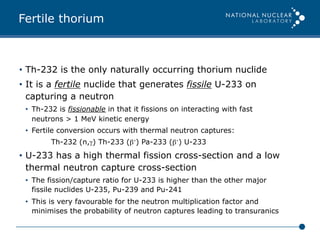
•  Th-232 is the only naturally occurring thorium nuclide
•  It is a fertile nuclide that generates fissile U-233 on
capturing a neutron
•  Th-232 is fissionable in that it fissions on interacting with fast
neutrons > 1 MeV kinetic energy
•  Fertile conversion occurs with thermal neutron captures:
Th-232 (n,γ) Th-233 (β-) Pa-233 (β-) U-233
•  U-233 has a high thermal fission cross-section and a low
thermal neutron capture cross-section
•  The fission/capture ratio for U-233 is higher than the other major
fissile nuclides U-235, Pu-239 and Pu-241
•  This is very favourable for the neutron multiplication factor and
minimises the probability of neutron captures leading to transuranics
Thorium fuel cycles
•  Once-through fuel cycle with Th-232 as alternative
fertile material to U-238 with U-235 or Pu-239 driver
•  U-233 fissioned in-situ without reprocessing/recycle
•  Modest reduction in uranium demand and sustainability
•  Recycle strategy with reprocessing/recycle of U-233
•  Much improved sustainability analogous to U/Pu breeding
cycle
•  But some technical difficulties to overcome
•  Th-232 breeder requires long residence time
U fuel cycle for comparison
Neutron balance in a thermal reactor
• For U-235 fissions average number of fission
neutrons ν ~ 2.4
• Only about 0.6 to 0.7 neutrons available for
fertile captures of U-238 to Pu-239
• Conversion ratio of ~0.6-0.7 means U-235
thermal reactors cannot operate as breeder
reactors
General Principles
Thermal breeder
•  The neutron balance for U-233 is more favourable and a
conversion ratio just above 1.0 is possible in a thermal
reactor
•  This is a breeding system
•  Not ideal, but much better than other fuels
•  Not possible with U/Pu fuel cycle
Fast breeder
•  Fast breeder technology is less mature
Sustainability
•  Thorium abundance higher than uranium
•  Thorium demand lower - no isotopic enrichment
•  Thorium economically extractable reserves not so well defined
•  India plans to implement U-233 breeding in fast reactors and to
burn it in Advanced Heavy Water Reactors (AHWR)
•  Rate of expansion of thorium fuel cycle will be limited by the
slow conversion rate
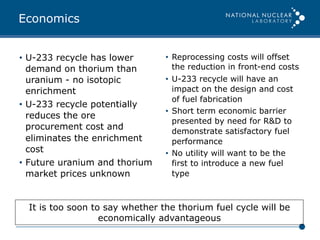
Economics
•  U-233 recycle has lower
demand on thorium than
uranium - no isotopic
enrichment
•  U-233 recycle potentially
reduces the ore
procurement cost and
eliminates the enrichment
cost
•  Future uranium and thorium
market prices unknown
•  Reprocessing costs will offset
the reduction in front-end costs
•  U-233 recycle will have an
impact on the design and cost
of fuel fabrication
•  Short term economic barrier
presented by need for R&D to
demonstrate satisfactory fuel
performance
•  No utility will want to be the
first to introduce a new fuel
type
It is too soon to say whether the thorium fuel cycle will be
economically advantageous
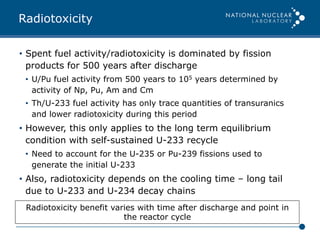
Radiotoxicity
•  Spent fuel activity/radiotoxicity is dominated by fission
products for 500 years after discharge
•  U/Pu fuel activity from 500 years to 105 years determined by
activity of Np, Pu, Am and Cm
•  Th/U-233 fuel activity has only trace quantities of transuranics
and lower radiotoxicity during this period
•  However, this only applies to the long term equilibrium
condition with self-sustained U-233 recycle
•  Need to account for the U-235 or Pu-239 fissions used to
generate the initial U-233
•  Also, radiotoxicity depends on the cooling time – long tail
due to U-233 and U-234 decay chains
Radiotoxicity benefit varies with time after discharge and point in
the reactor cycle
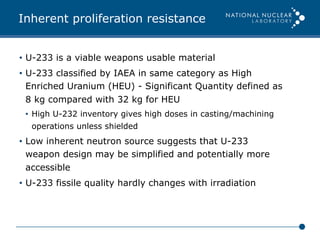
Inherent proliferation resistance
•  U-233 is a viable weapons usable material
•  U-233 classified by IAEA in same category as High
Enriched Uranium (HEU) - Significant Quantity defined as
8 kg compared with 32 kg for HEU
•  High U-232 inventory gives high doses in casting/machining
operations unless shielded
•  Low inherent neutron source suggests that U-233
weapon design may be simplified and potentially more
accessible
•  U-233 fissile quality hardly changes with irradiation
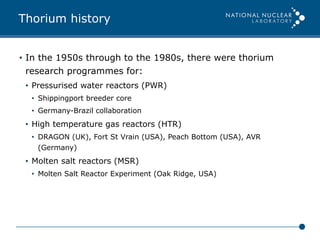
Thorium history
•  In the 1950s through to the 1980s, there were thorium
research programmes for:
•  Pressurised water reactors (PWR)
•  Shippingport breeder core
•  Germany-Brazil collaboration
•  High temperature gas reactors (HTR)
•  DRAGON (UK), Fort St Vrain (USA), Peach Bottom (USA), AVR
(Germany)
•  Molten salt reactors (MSR)
•  Molten Salt Reactor Experiment (Oak Ridge, USA)
Why did thorium research stall?
•  Thorium cycle requires neutrons from uranium or plutonium
fissions to get started
•  U/Pu fuel cycle already established
•  Barrier to entry for a new system
•  Technological issues
•  THOREX reprocessing and fabrication of U-233 fuels
Advantages of Th fuel cycle
•  Thorium is more abundant than uranium
•  Combined with a breeding cycle thorium is potentially a
major energy resource
•  Low inventories of transuranics and low radiotoxicity after
500 years’ cooling
•  Almost zero inventory of weapons usable plutonium
•  Theoretical low cost compared with uranium fuel cycle
•  ThO2 properties generally more favourable than UO2
(thermal conductivity; single oxidation state)
•  ThO2 is potentially a more stable matrix for geological
disposal than UO2
Disadvantages of Th fuel cycle
•  Th-232 needs to be converted to U-233 using neutrons
from another source
•  The conversion rate is very low, so the time taken to build up
usable amounts of U-233 are very long
•  Reprocessing thorium fuel is less straightforward than
with the uranium-plutonium fuel cycle
•  The THOREX process has been demonstrated at small
scale, but will require R&D to develop it to commercial
readiness
•  U-233 recycle is complicated by presence of ppm
quantities of U-232 - radiologically significant for fuel
fabrication at ppb
•  U-233 is weapons useable material with a low fissile
mass and low spontaneous neutron source
Current research
•  India
•  Synergistic fuel cycle involving fast reactor and
Advanced Heavy Water Reactors (AHWR)
•  Fast reactor will breed U-233 in a thorium
blanket
•  U-233 will be recycled into AHWR fuel
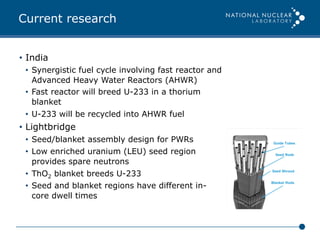
•  Lightbridge
•  Seed/blanket assembly design for PWRs
•  Low enriched uranium (LEU) seed region
provides spare neutrons
•  ThO2 blanket breeds U-233
•  Seed and blanket regions have different in-
core dwell times
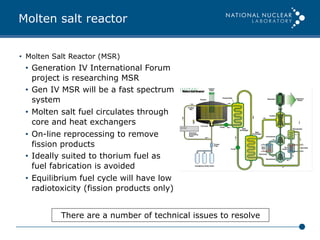
Molten salt reactor
•  Molten Salt Reactor (MSR)
•  Generation IV International Forum
project is researching MSR
•  Gen IV MSR will be a fast spectrum
system
•  Molten salt fuel circulates through
core and heat exchangers
•  On-line reprocessing to remove
fission products
•  Ideally suited to thorium fuel as
fuel fabrication is avoided
•  Equilibrium fuel cycle will have low
radiotoxicity (fission products only)
There are a number of technical issues to resolve
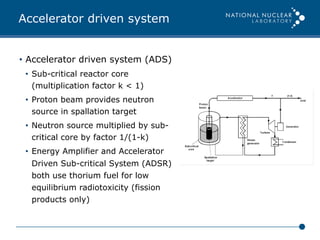
Accelerator driven system
•  Accelerator driven system (ADS)
•  Sub-critical reactor core
(multiplication factor k < 1)
•  Proton beam provides neutron
source in spallation target
•  Neutron source multiplied by sub-
critical core by factor 1/(1-k)
•  Energy Amplifier and Accelerator
Driven Sub-critical System (ADSR)
both use thorium fuel for low
equilibrium radiotoxicity (fission
products only)
Pu/Th MOX
•  AREVA are investigating PuO2/ThO2 MOX fuel for the
eventual disposition of PWR MOX fuel assemblies
•  PWR MOX fuel currently not reprocessed in France
•  Held in long term storage pending eventual recycle in SFR fleet
•  Requirement to cover all contingency that SFR fleet is not built
•  Recycle of Pu from MOX fuel preferred over disposal
•  PuO2/ThO2 MOX is another option with potential advantage of
low development cost and high stability as a final waste form
R&D requirements
•  Fuel materials properties (unirradiated and irradiated)
•  Fuel irradiation behaviour
•  THOREX reprocessing
•  Waste management/disposal
•  U-233 fuel fabrication
•  Systems development
•  Engineering design
•  Materials
•  Liquid salt chemistry and properties
•  MSR fuel and fuel cycle
•  Systems integration and assessment
•  Safety
•  Scenario modelling
Summary
•  Thorium is a valuable strategic alternative to uranium
•  Sustainability is a main driver
•  Radiotoxicity benefit is real, but modest
•  Long term equilibrium radiotoxicity a simplistic measure
•  Inherent proliferation resistance not proven for thorium
•  Economics of thorium not known at present
•  Minimum 15-20 year timescale for commercial
deployment
An industrial view
•  Thorium fuels offer theoretical advantages and
disadvantages
•  Balance between advantages and disadvantages not yet
established
•  This balance will be context dependent
•  Significant development required before industrial
implementation with long timescales
•  A clear case will need to be presented which identifies the
problem that a thorium fuelled reactor will solve and
evidence presented to demonstrate that thorium is the best
solution
•  More research is needed – and should be commissioned

Sgcp13hesketh

  • 1.
    Thorium – analternative nuclear fuel cycle 5th Smart Grids & Clean Power Conference, Cambridge, 5 June 2013 www.cir-strategy.com/events/cleanpower Kevin Hesketh, Senior Research Fellow
  • 2.
    Outline •  General Principlesof the thorium fuel cycle •  Sustainability •  Economics •  Radiotoxicity •  Proliferation resistance •  Advantages and disadvantages •  An industrial view
  • 3.
    Fertile thorium •  Th-232is the only naturally occurring thorium nuclide •  It is a fertile nuclide that generates fissile U-233 on capturing a neutron •  Th-232 is fissionable in that it fissions on interacting with fast neutrons > 1 MeV kinetic energy •  Fertile conversion occurs with thermal neutron captures: Th-232 (n,γ) Th-233 (β-) Pa-233 (β-) U-233 •  U-233 has a high thermal fission cross-section and a low thermal neutron capture cross-section •  The fission/capture ratio for U-233 is higher than the other major fissile nuclides U-235, Pu-239 and Pu-241 •  This is very favourable for the neutron multiplication factor and minimises the probability of neutron captures leading to transuranics
  • 4.
    Thorium fuel cycles • Once-through fuel cycle with Th-232 as alternative fertile material to U-238 with U-235 or Pu-239 driver •  U-233 fissioned in-situ without reprocessing/recycle •  Modest reduction in uranium demand and sustainability •  Recycle strategy with reprocessing/recycle of U-233 •  Much improved sustainability analogous to U/Pu breeding cycle •  But some technical difficulties to overcome •  Th-232 breeder requires long residence time
  • 5.
    U fuel cyclefor comparison Neutron balance in a thermal reactor • For U-235 fissions average number of fission neutrons ν ~ 2.4 • Only about 0.6 to 0.7 neutrons available for fertile captures of U-238 to Pu-239 • Conversion ratio of ~0.6-0.7 means U-235 thermal reactors cannot operate as breeder reactors
  • 6.
    General Principles Thermal breeder • The neutron balance for U-233 is more favourable and a conversion ratio just above 1.0 is possible in a thermal reactor •  This is a breeding system •  Not ideal, but much better than other fuels •  Not possible with U/Pu fuel cycle Fast breeder •  Fast breeder technology is less mature
  • 7.
    Sustainability •  Thorium abundancehigher than uranium •  Thorium demand lower - no isotopic enrichment •  Thorium economically extractable reserves not so well defined •  India plans to implement U-233 breeding in fast reactors and to burn it in Advanced Heavy Water Reactors (AHWR) •  Rate of expansion of thorium fuel cycle will be limited by the slow conversion rate
  • 8.
    Economics •  U-233 recyclehas lower demand on thorium than uranium - no isotopic enrichment •  U-233 recycle potentially reduces the ore procurement cost and eliminates the enrichment cost •  Future uranium and thorium market prices unknown •  Reprocessing costs will offset the reduction in front-end costs •  U-233 recycle will have an impact on the design and cost of fuel fabrication •  Short term economic barrier presented by need for R&D to demonstrate satisfactory fuel performance •  No utility will want to be the first to introduce a new fuel type It is too soon to say whether the thorium fuel cycle will be economically advantageous
  • 9.
    Radiotoxicity •  Spent fuelactivity/radiotoxicity is dominated by fission products for 500 years after discharge •  U/Pu fuel activity from 500 years to 105 years determined by activity of Np, Pu, Am and Cm •  Th/U-233 fuel activity has only trace quantities of transuranics and lower radiotoxicity during this period •  However, this only applies to the long term equilibrium condition with self-sustained U-233 recycle •  Need to account for the U-235 or Pu-239 fissions used to generate the initial U-233 •  Also, radiotoxicity depends on the cooling time – long tail due to U-233 and U-234 decay chains Radiotoxicity benefit varies with time after discharge and point in the reactor cycle
  • 10.
    Inherent proliferation resistance • U-233 is a viable weapons usable material •  U-233 classified by IAEA in same category as High Enriched Uranium (HEU) - Significant Quantity defined as 8 kg compared with 32 kg for HEU •  High U-232 inventory gives high doses in casting/machining operations unless shielded •  Low inherent neutron source suggests that U-233 weapon design may be simplified and potentially more accessible •  U-233 fissile quality hardly changes with irradiation
  • 11.
    Thorium history •  Inthe 1950s through to the 1980s, there were thorium research programmes for: •  Pressurised water reactors (PWR) •  Shippingport breeder core •  Germany-Brazil collaboration •  High temperature gas reactors (HTR) •  DRAGON (UK), Fort St Vrain (USA), Peach Bottom (USA), AVR (Germany) •  Molten salt reactors (MSR) •  Molten Salt Reactor Experiment (Oak Ridge, USA)
  • 12.
    Why did thoriumresearch stall? •  Thorium cycle requires neutrons from uranium or plutonium fissions to get started •  U/Pu fuel cycle already established •  Barrier to entry for a new system •  Technological issues •  THOREX reprocessing and fabrication of U-233 fuels
  • 13.
    Advantages of Thfuel cycle •  Thorium is more abundant than uranium •  Combined with a breeding cycle thorium is potentially a major energy resource •  Low inventories of transuranics and low radiotoxicity after 500 years’ cooling •  Almost zero inventory of weapons usable plutonium •  Theoretical low cost compared with uranium fuel cycle •  ThO2 properties generally more favourable than UO2 (thermal conductivity; single oxidation state) •  ThO2 is potentially a more stable matrix for geological disposal than UO2
  • 14.
    Disadvantages of Thfuel cycle •  Th-232 needs to be converted to U-233 using neutrons from another source •  The conversion rate is very low, so the time taken to build up usable amounts of U-233 are very long •  Reprocessing thorium fuel is less straightforward than with the uranium-plutonium fuel cycle •  The THOREX process has been demonstrated at small scale, but will require R&D to develop it to commercial readiness •  U-233 recycle is complicated by presence of ppm quantities of U-232 - radiologically significant for fuel fabrication at ppb •  U-233 is weapons useable material with a low fissile mass and low spontaneous neutron source
  • 15.
    Current research •  India • Synergistic fuel cycle involving fast reactor and Advanced Heavy Water Reactors (AHWR) •  Fast reactor will breed U-233 in a thorium blanket •  U-233 will be recycled into AHWR fuel •  Lightbridge •  Seed/blanket assembly design for PWRs •  Low enriched uranium (LEU) seed region provides spare neutrons •  ThO2 blanket breeds U-233 •  Seed and blanket regions have different in- core dwell times
  • 16.
    Molten salt reactor • Molten Salt Reactor (MSR) •  Generation IV International Forum project is researching MSR •  Gen IV MSR will be a fast spectrum system •  Molten salt fuel circulates through core and heat exchangers •  On-line reprocessing to remove fission products •  Ideally suited to thorium fuel as fuel fabrication is avoided •  Equilibrium fuel cycle will have low radiotoxicity (fission products only) There are a number of technical issues to resolve
  • 17.
    Accelerator driven system • Accelerator driven system (ADS) •  Sub-critical reactor core (multiplication factor k < 1) •  Proton beam provides neutron source in spallation target •  Neutron source multiplied by sub- critical core by factor 1/(1-k) •  Energy Amplifier and Accelerator Driven Sub-critical System (ADSR) both use thorium fuel for low equilibrium radiotoxicity (fission products only)
  • 18.
    Pu/Th MOX •  AREVAare investigating PuO2/ThO2 MOX fuel for the eventual disposition of PWR MOX fuel assemblies •  PWR MOX fuel currently not reprocessed in France •  Held in long term storage pending eventual recycle in SFR fleet •  Requirement to cover all contingency that SFR fleet is not built •  Recycle of Pu from MOX fuel preferred over disposal •  PuO2/ThO2 MOX is another option with potential advantage of low development cost and high stability as a final waste form
  • 19.
    R&D requirements •  Fuelmaterials properties (unirradiated and irradiated) •  Fuel irradiation behaviour •  THOREX reprocessing •  Waste management/disposal •  U-233 fuel fabrication •  Systems development •  Engineering design •  Materials •  Liquid salt chemistry and properties •  MSR fuel and fuel cycle •  Systems integration and assessment •  Safety •  Scenario modelling
  • 20.
    Summary •  Thorium isa valuable strategic alternative to uranium •  Sustainability is a main driver •  Radiotoxicity benefit is real, but modest •  Long term equilibrium radiotoxicity a simplistic measure •  Inherent proliferation resistance not proven for thorium •  Economics of thorium not known at present •  Minimum 15-20 year timescale for commercial deployment
  • 21.
    An industrial view • Thorium fuels offer theoretical advantages and disadvantages •  Balance between advantages and disadvantages not yet established •  This balance will be context dependent •  Significant development required before industrial implementation with long timescales •  A clear case will need to be presented which identifies the problem that a thorium fuelled reactor will solve and evidence presented to demonstrate that thorium is the best solution •  More research is needed – and should be commissioned