



Ontario University Council on E-Learning
        Summer Institute 2012
MOOCs, Walled Gardens, Analytics
        and Networks:
 Multi-generation pedagogical
         innovations
             Terry Anderson
The world is moving so fast that there are days
when the person who says it can’t be done,
keeps getting interrupted by the person doing it.
anonymous


Personally, I’m always ready to learn,
Although I do not always like to be taught
Winston Churchill
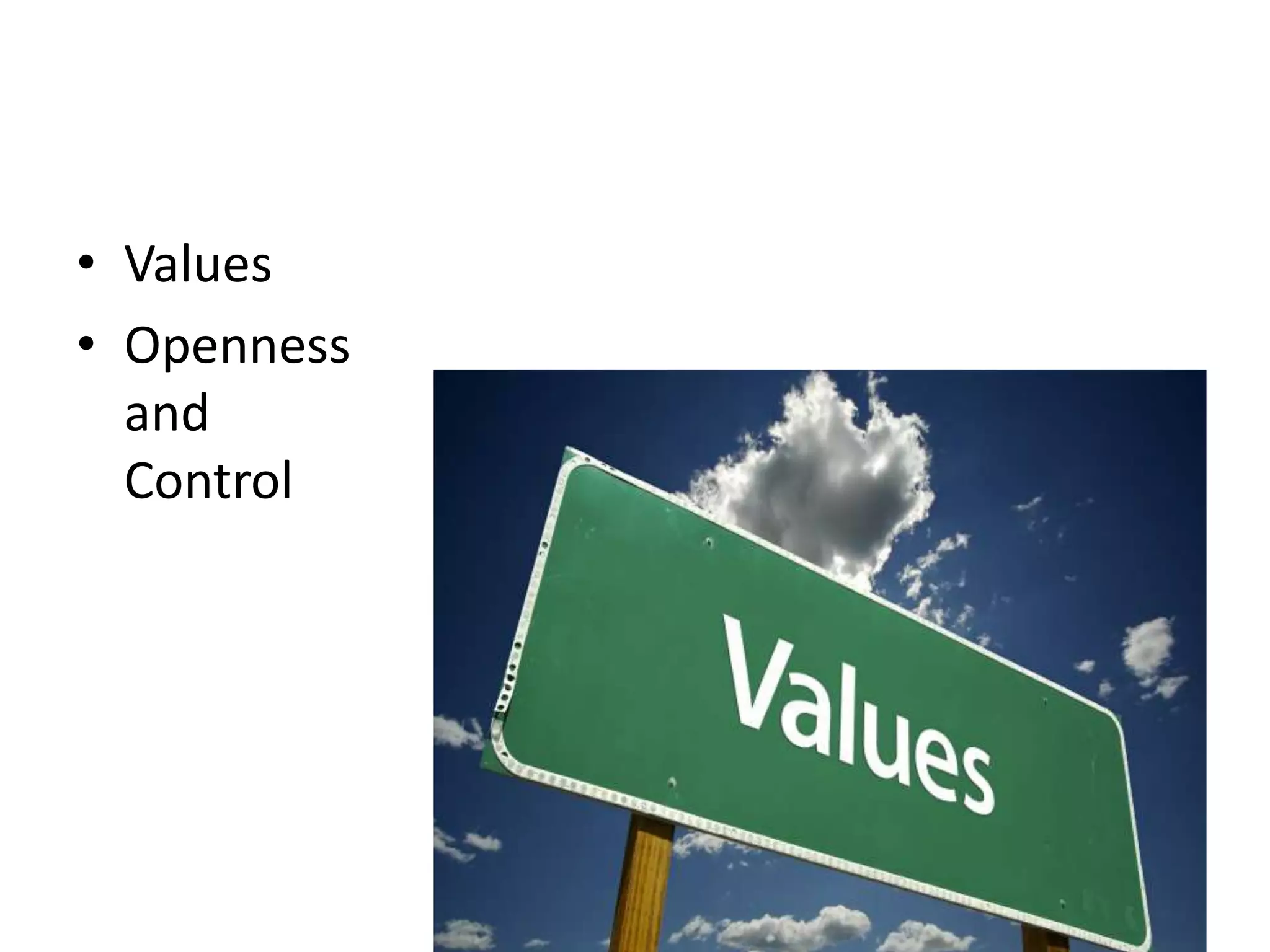
• Values
• Openness
  and
  Control
Values
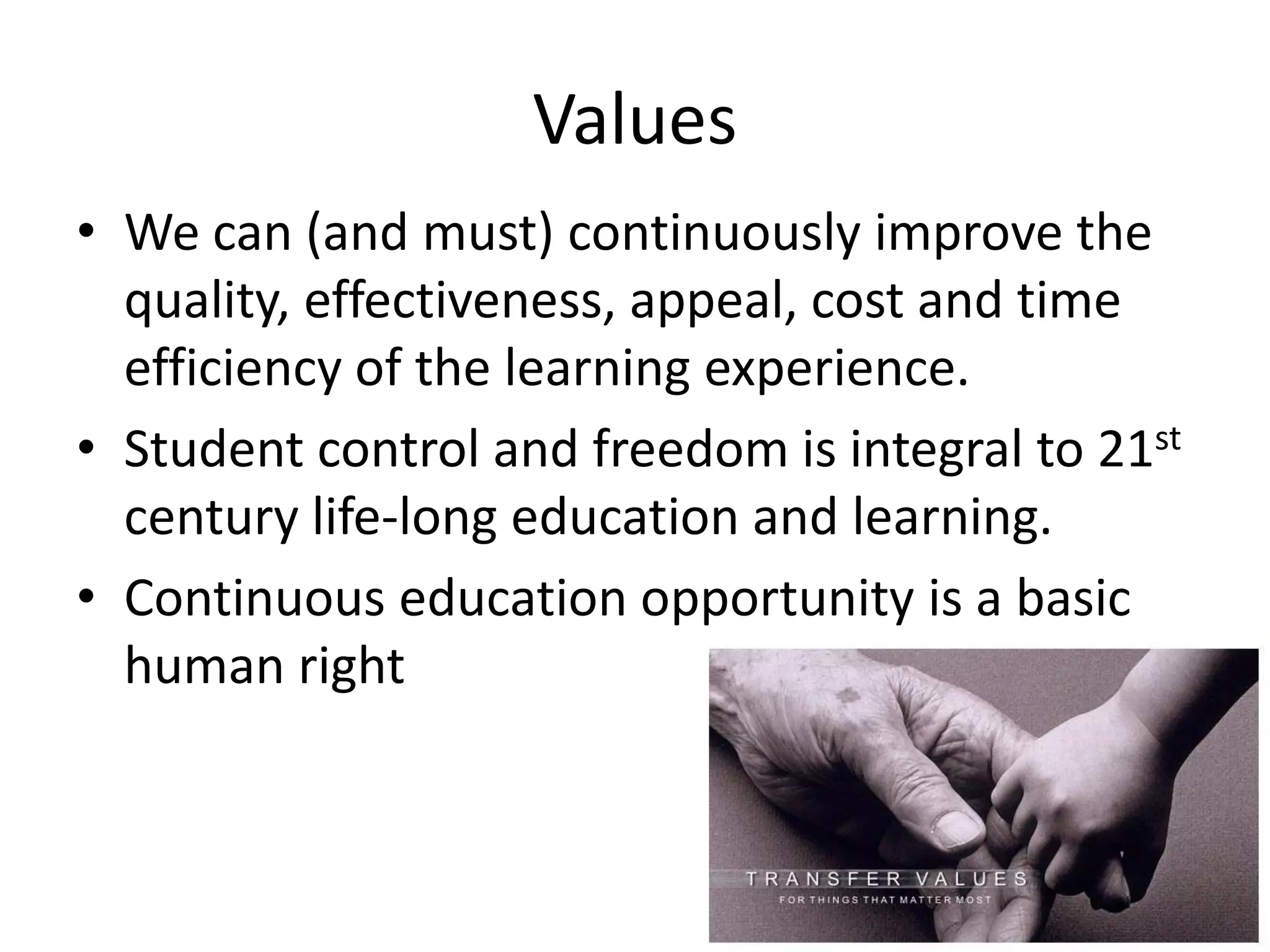
• We can (and must) continuously improve the
  quality, effectiveness, appeal, cost and time
  efficiency of the learning experience.
• Student control and freedom is integral to 21st
  century life-long education and learning.
• Continuous education opportunity is a basic
  human right
Age of Open
Definitions of Open on the Web
              (From Google)
• affording unobstructed entrance and exit; not shut or
  closed;
• affording free passage or access;
• open to or in view of all;
• accessible to all;
• assailable: not defended or capable of being defended
• loose: (of textures) full of small openings or gaps;
• start to operate or function
• not brought to a conclusion;
• not sealed or having been unsealed
“Something there is that
  doesn’t love a a wall,
  that wants it down”
   American Poet, Robert Frost


           Photo by Cudiaco
Three Generations of
            Ed. Tech. Pedagogy
          Anderson &Dropn 2011

1. Behaviourist/Cognitive
   – Self Paced, Individual
   Study
2. Constructivist – Groups
3. Connectivist –
   Networks, & Sets
1. Behavioural/Cognitive Pedagogies
• “tell ‘em what you’re
  gonna tell ‘em,
• tell ‘em
• then tell ‘em what you
  told ‘em”


Direct Instruction
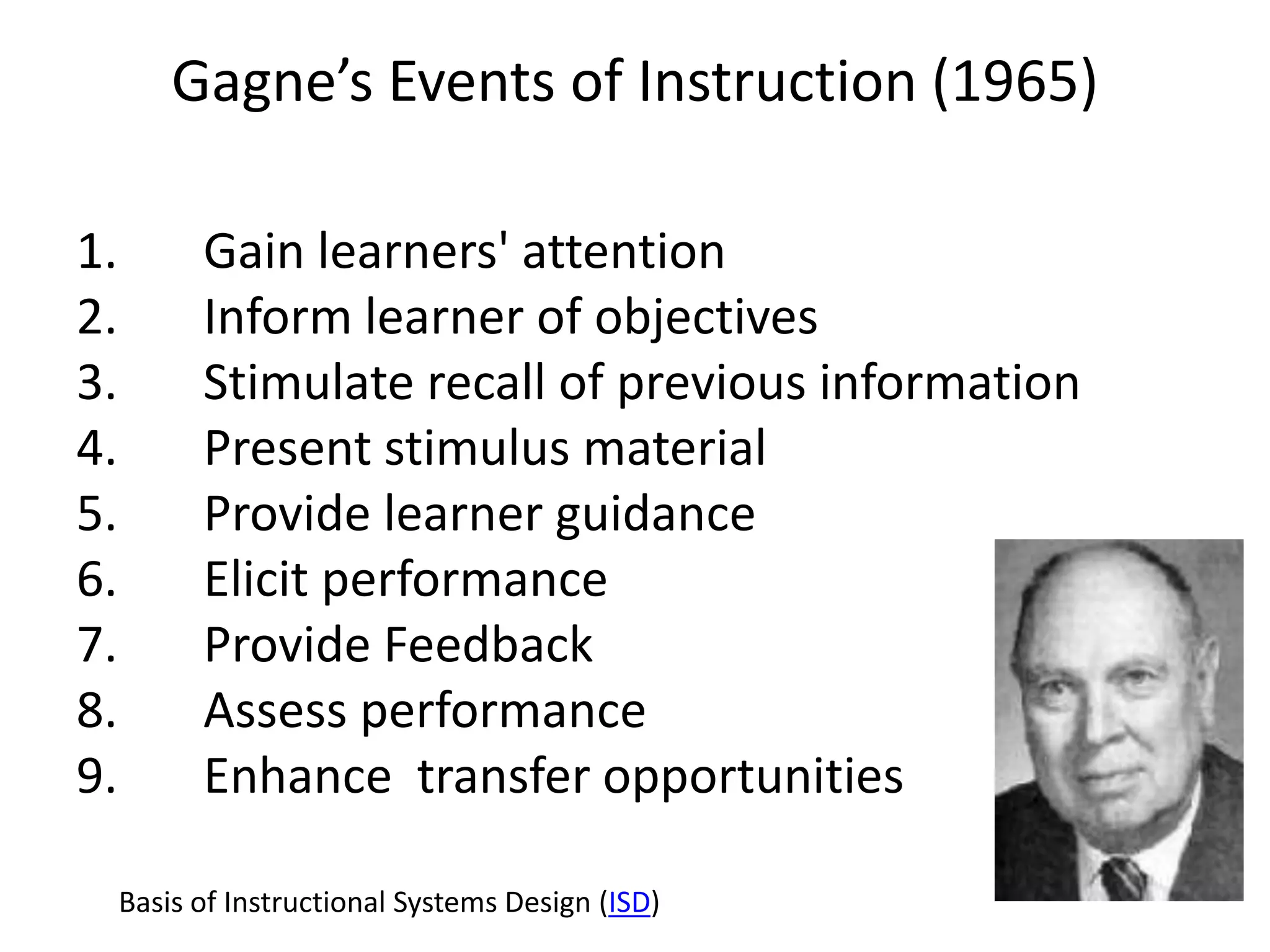
Gagne’s Events of Instruction (1965)

1.         Gain learners' attention
2.         Inform learner of objectives
3.         Stimulate recall of previous information
4.         Present stimulus material
5.         Provide learner guidance
6.         Elicit performance
7.         Provide Feedback
8.         Assess performance
9.         Enhance transfer opportunities

     Basis of Instructional Systems Design (ISD)
Enhanced by the “cognitive
                     revolution”
•    Chunking
•    Cognitive Load
•    Working Memory
•    Multiple Representations
•    Split-attention effect
•    Variability Effect
•    Multi-media effect
      – (Sorden, 2005)
    “learning as acquiring and using conceptual and cognitive structures”
    Greeno, Collins and Resnick, 1996
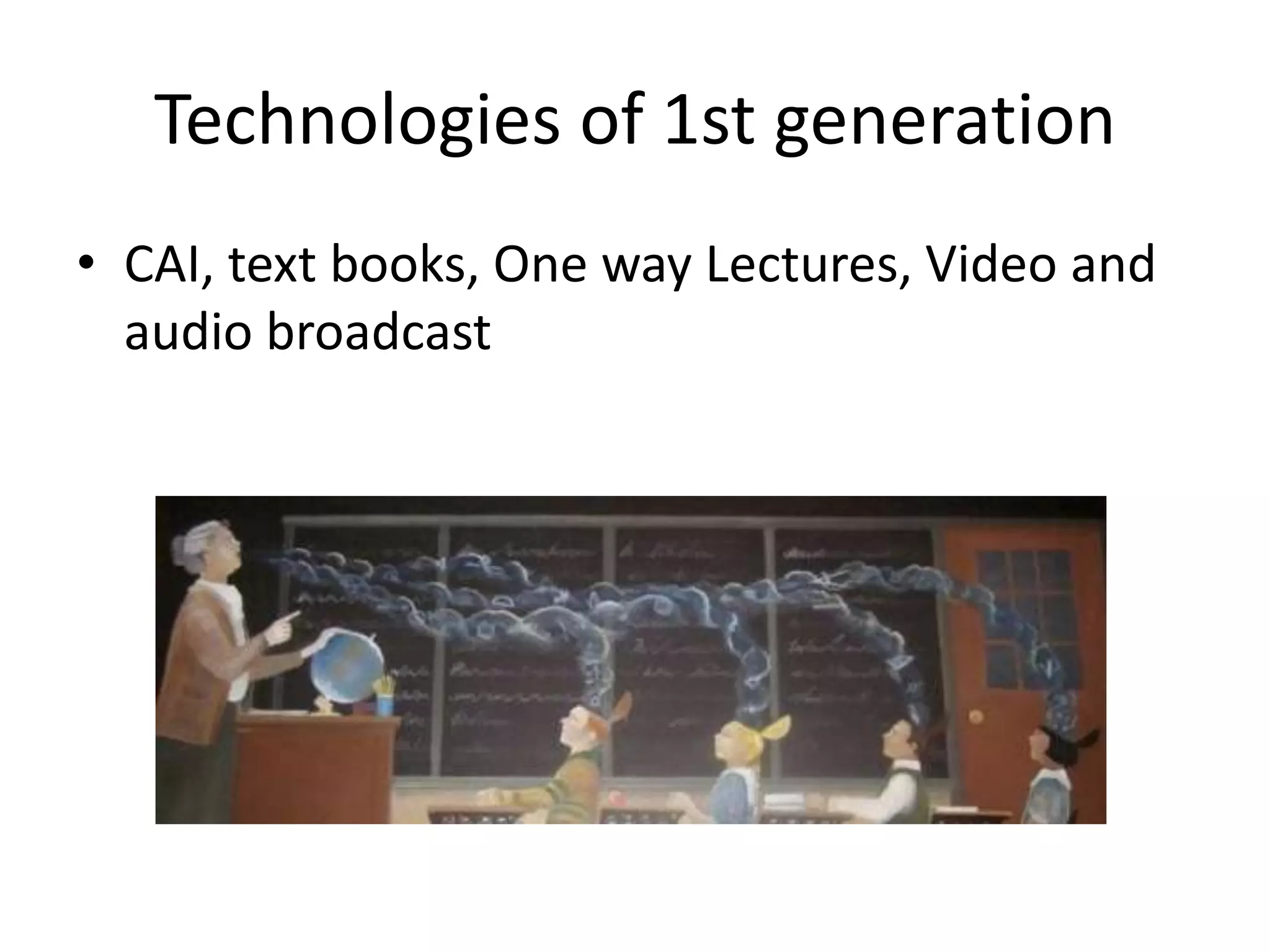
Technologies of 1st generation
• CAI, text books, One way Lectures, Video and
  audio broadcast
Behaviourist/Cognitive Knowledge Is:
• Logically coherent, existing independent of
  perspective
• Largely context free
• Capable of being transmitted
• Assumes closed systems with discoverable
  relationships between inputs and outputs
• Readily defined through learning objectives
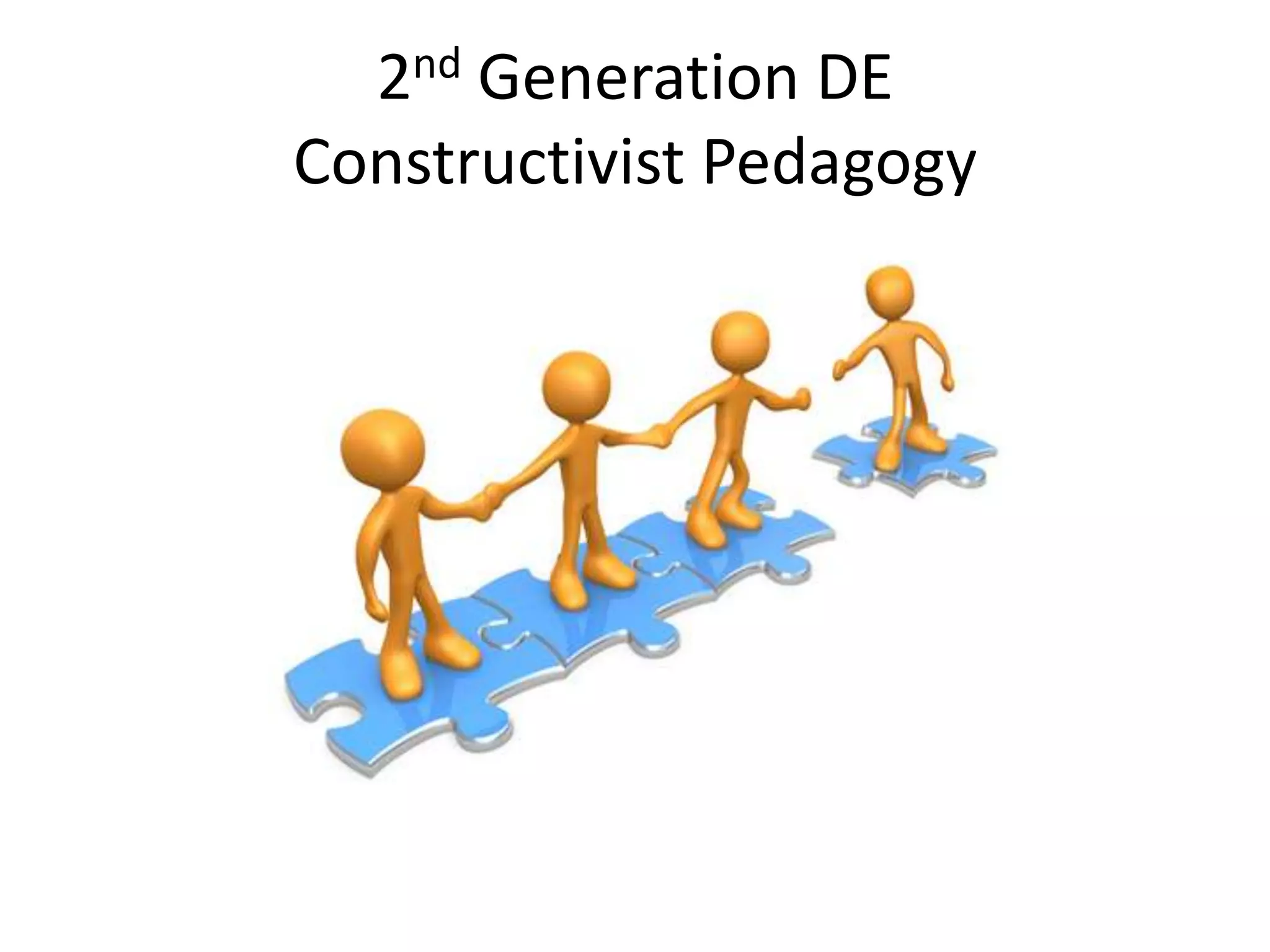
2nd Generation DE
Constructivist Pedagogy
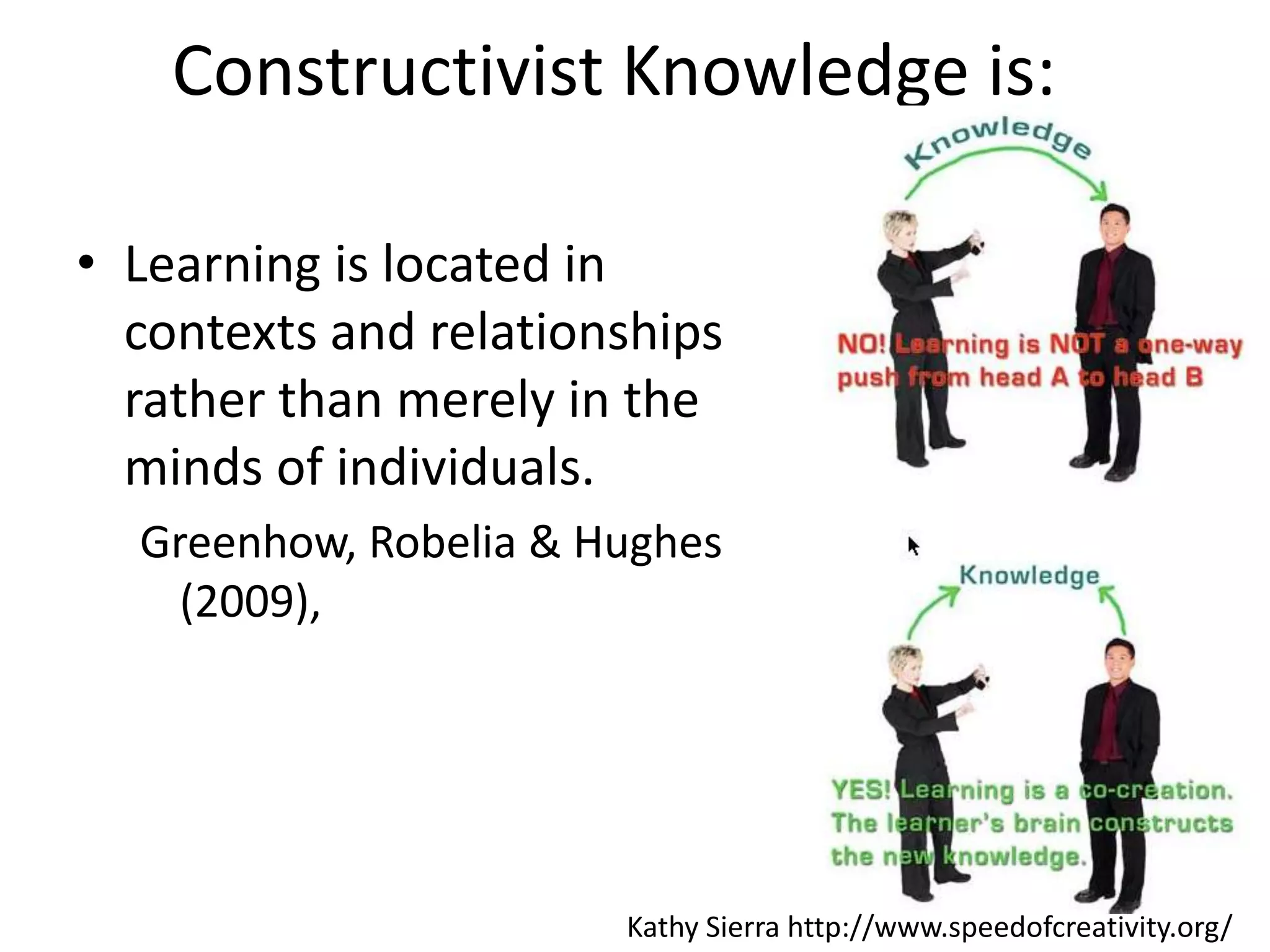
Constructivist Knowledge is:

• Learning is located in
  contexts and relationships
  rather than merely in the
  minds of individuals.
  Greenhow, Robelia & Hughes
    (2009),


                       Kathy Sierra http://www.speedofcreativity.org/
Constructivist learning is based on
      Group Learning Providing:

• Motivation/synchronization
• Feedback
• Alternate and conflicting viewpoints
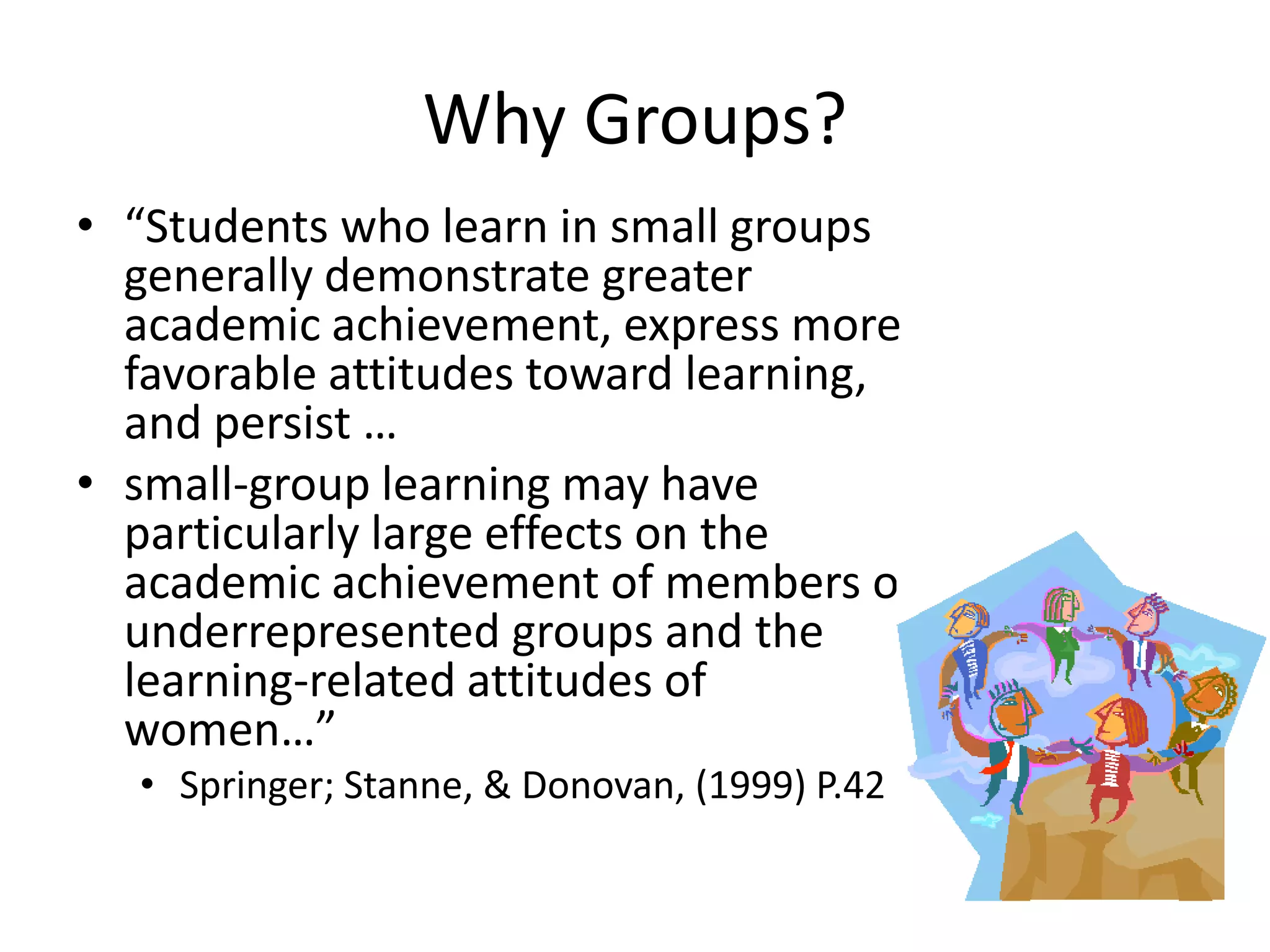
Why Groups?
• “Students who learn in small groups
  generally demonstrate greater
  academic achievement, express more
  favorable attitudes toward learning,
  and persist …
• small-group learning may have
  particularly large effects on the
  academic achievement of members of
  underrepresented groups and the
  learning-related attitudes of
  women…”
  • Springer; Stanne, & Donovan, (1999) P.42
2nd generation Adoption
• Rapid Growth in traditional institutions
• Requires minimal faculty and systems change
• Perceived as more work and time consuming
  than F2F
• Not scaleable,
• Increases access, but maintains cost, staffing
  and roles.
• Not disruptive
Technologies of 2nd generation
           Social Constructivism
•   LMS
•   Threaded Discussion, VoiceThread(asynch)
•   Web conferencing, Immersive worlds (synch)
•   Project and group management and
    notification tools
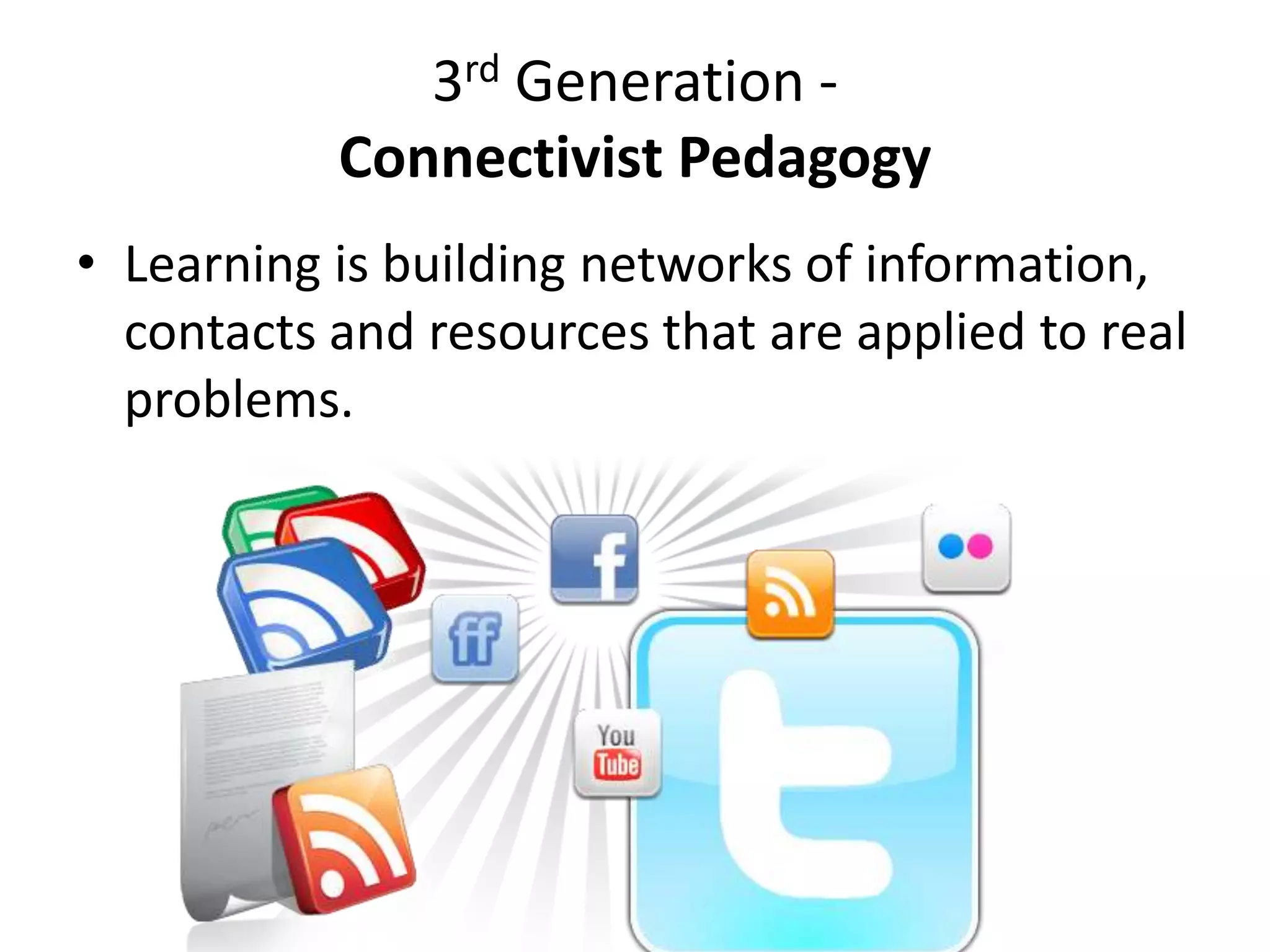
3rd Generation -
           Connectivist Pedagogy
• Learning is building networks of information,
  contacts and resources that are applied to real
  problems.
Connectivist Learning Principles
          George Siemens, 2004
• Learning is a process of connecting specialized nodes or
    information sources.
• Learning may reside in non-human appliances.
• Capacity to know is more critical than what is currently known.
• Nurturing and maintaining connections is needed to facilitate
    continual learning.
• Ability to see connections between fields, ideas, and concepts
    is a core skill.
• Currency (accurate, up-to-date knowledge)
is the intent of all connectivist learning activities.
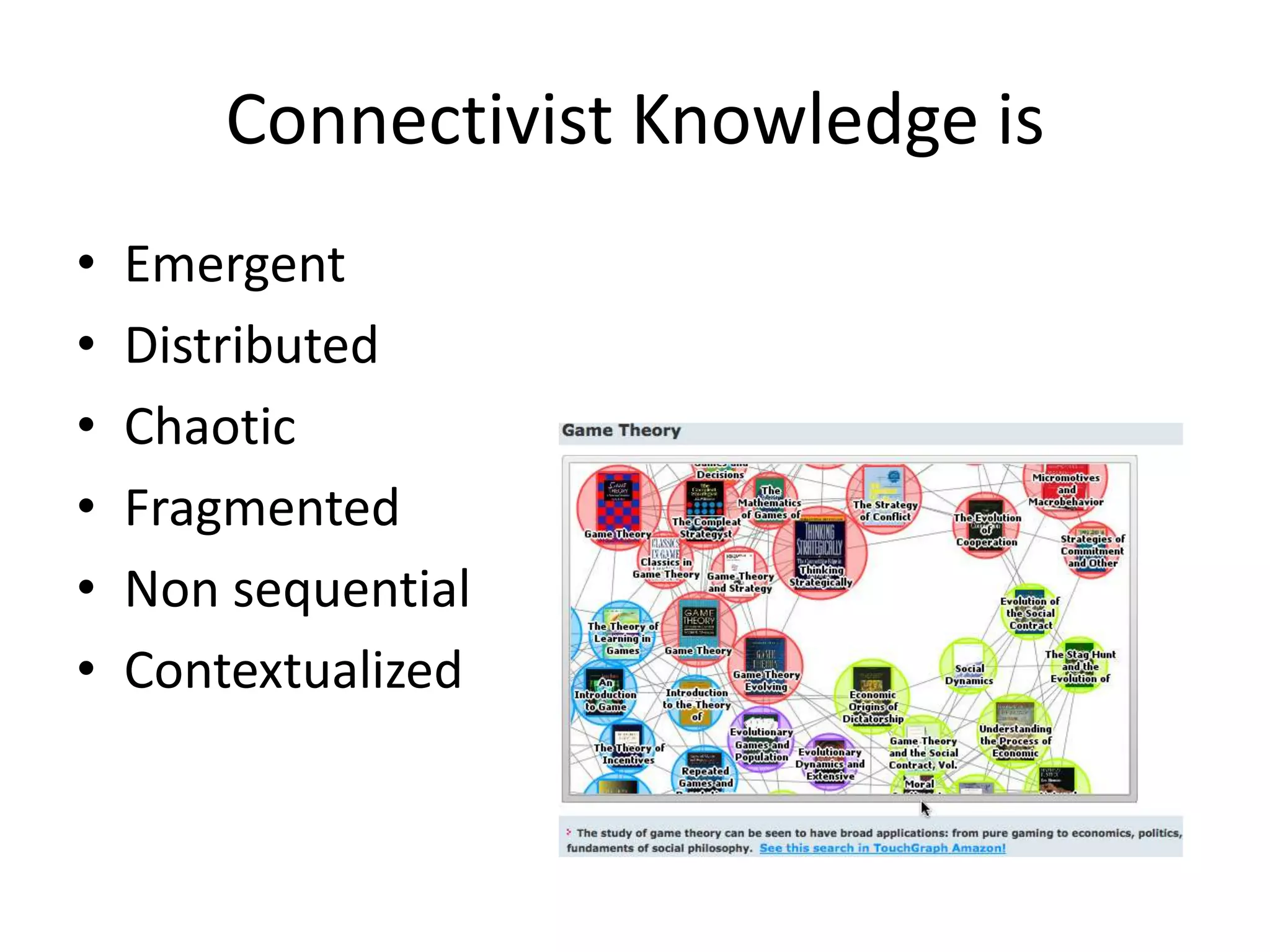
Connectivist Knowledge is
•   Emergent
•   Distributed
•   Chaotic
•   Fragmented
•   Non sequential
•   Contextualized
Networks add diversity to learning
“People who live in
  the intersection of
  social worlds are at
  higher risk of having
  good ideas” Burt,
  2005, p. 90
Connectivist Learning is Emergent

the very uncertainty and lack of predictability
 of learning outcomes will be the key factor
 that adds value to a learning community
emergent systems will provide the necessary
 triggers to enhance knowledge and
 understanding
Special Issue of IRRODL on Emergence 2011
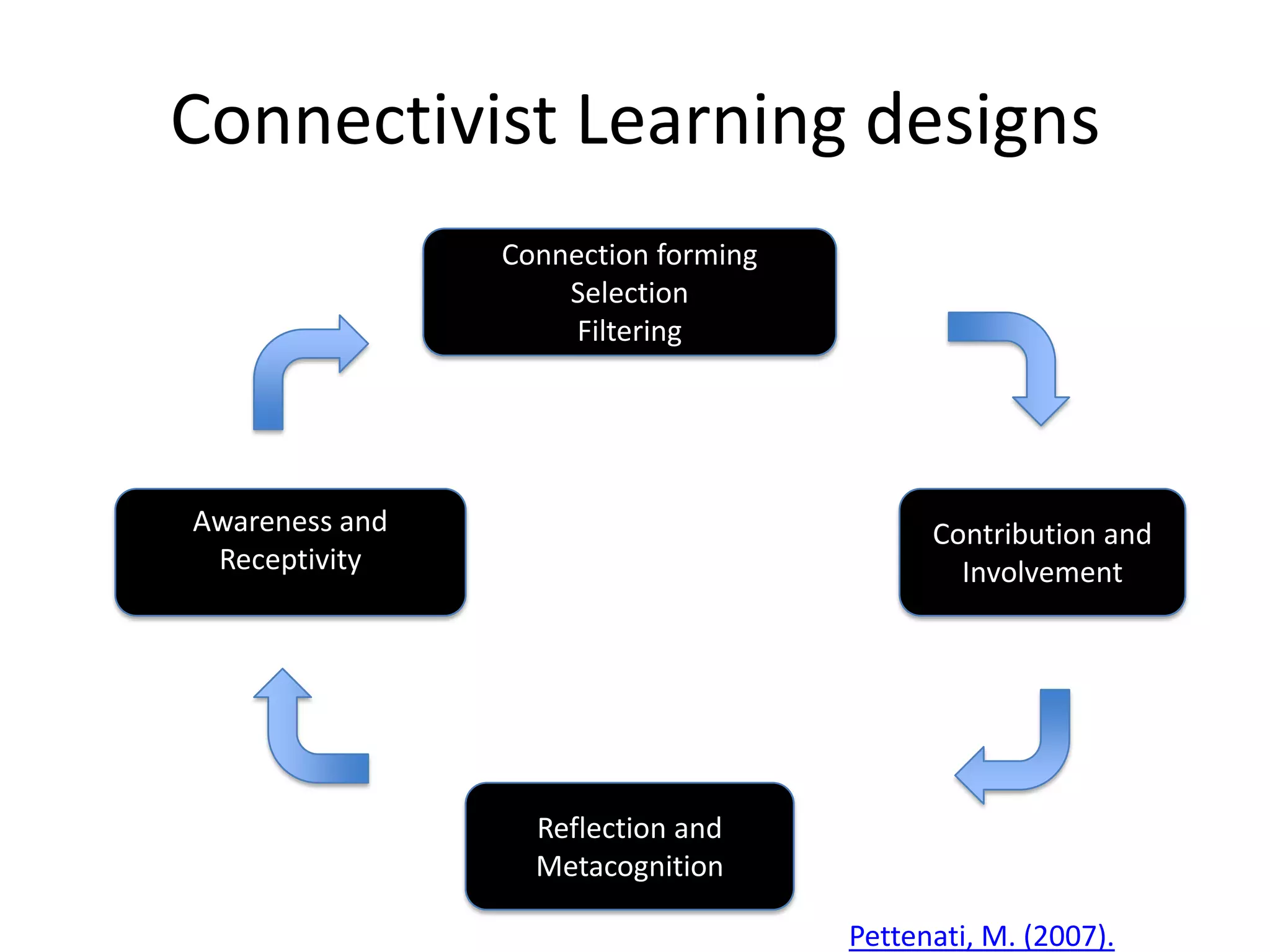
Connectivist Learning designs
                Connection forming
                    Selection
                     Filtering


Awareness and                              Contribution and
 Receptivity                                 Involvement


                  Reflection and
                  Metacognition

                                     Pettenati, M. (2007).
Special Issue of IRRODL on
          Connectivism 2011


• Editors George Siemens and GrainneConole

  Free Subscriptions at www.irrodl.org
Part 2
         Recent Developments in all
             Three Generations

•   Open Educational Resources
•   Learning Analytics
•   MOOCs
•   Walled Social Networks
•   Disaggregated/low costs Schools
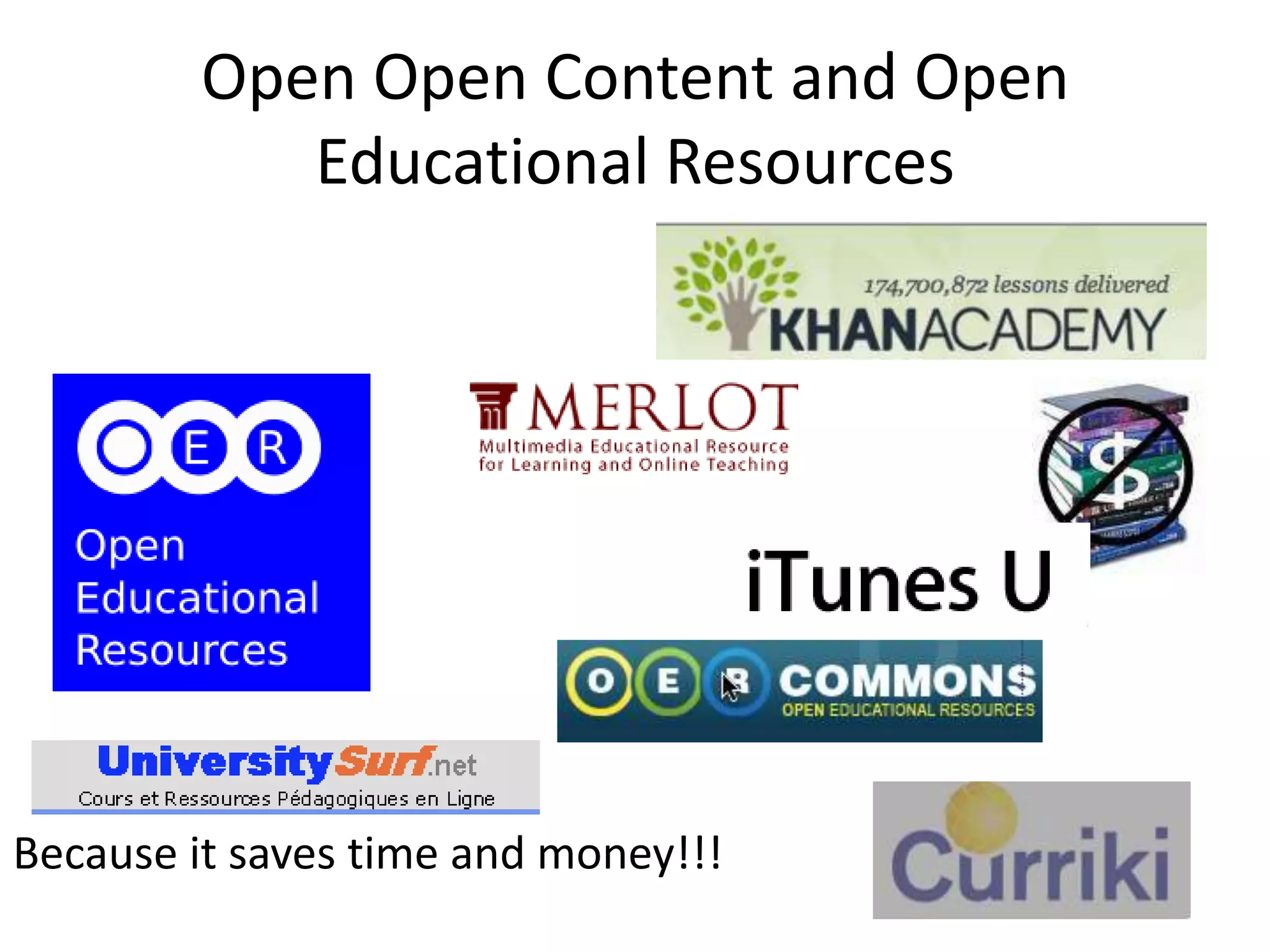
Open Open Content and Open
            Educational Resources


Because it saves time and money!!!
Where is Canada and OER’s
• COULD be useful for all 3 generations
• Driver of 1st generation costs
• No Federal programs or initiatives,
• BCCampus only provincialproduction and
  distribution activity
• Falling badly behind USA, EU and developing
  countries
2nd International Conference on Learning
                         Analytics and Knowledge 2012


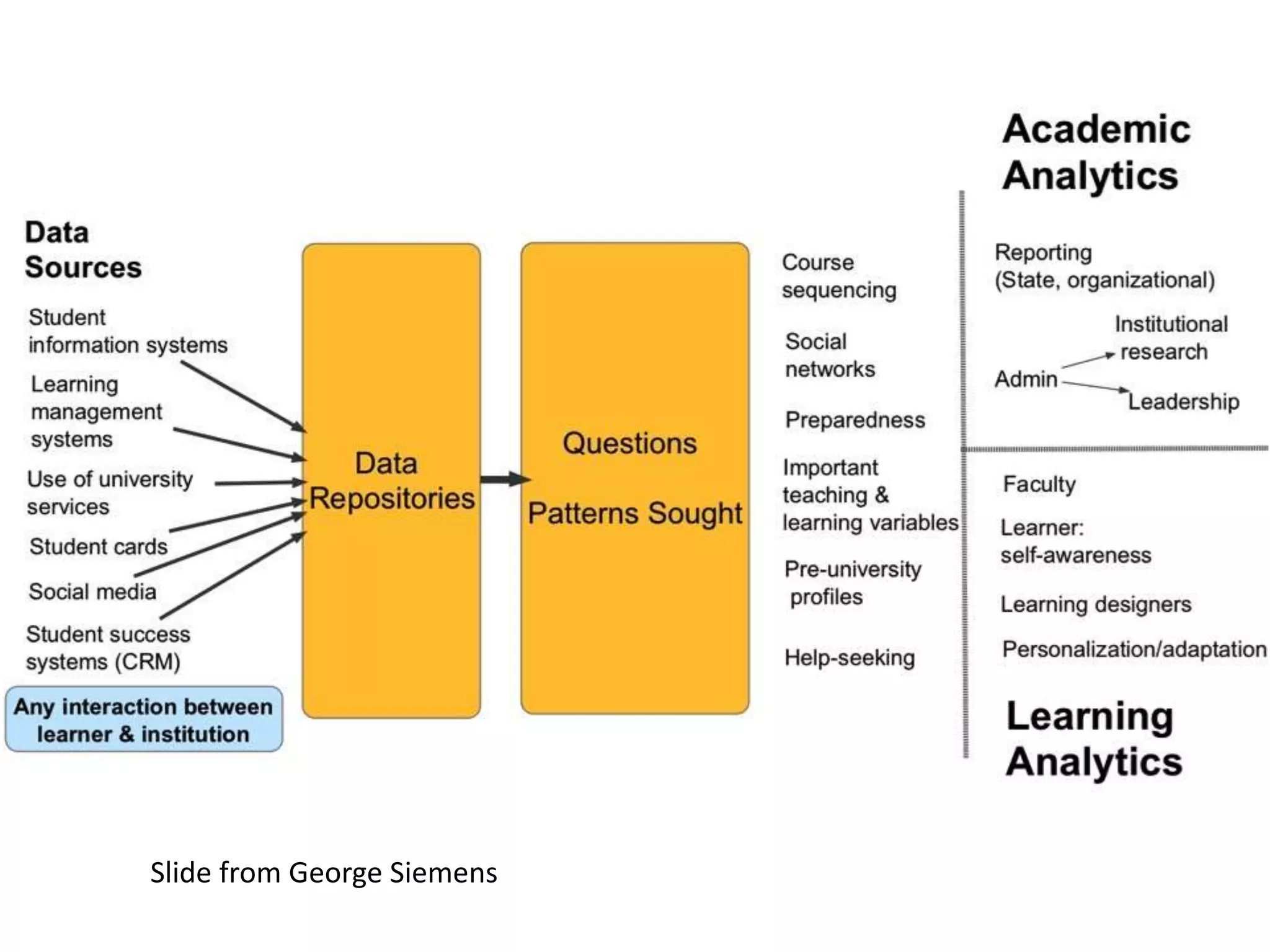
             Learning Analytics
• Learning analytics is the measurement,
  collection, analysis and reporting of data
  about learners and their contexts, for
  purposes of understanding and optimizing
  learning and the environments in which it
  occurs. Wikipedia 2012
Slide from George Siemens
Analytics Affordances
• Part of big data movement in industry
• Rio Salado College
  – Can determine those likely to drop out within 8
    days of registration
• American Public University
  – Continually monitoring 178 student variables
• Especially useful to combat high drop out
  associated with 1 and 3rd generation
Two Genre’s of Moocs
• OrigionalSeimen’s – Downes
  – Connectivist pedagogy “knowledge is actuated
    through the process of a learner connecting to and
    feeding information into a learning community”Kop&
    Hill 2008
  – Aggregates distributed posts, no centre
  – Large enrollment, many ‘lurkers’ no formal
    assessment
  – Heavy involvement and communication with
    ‘teacher/facilitator”
  – Ex Change12, CCK08, EduMoo
Teacher Role
• Connectivism model
   – amplifying (to draw attention to important ideas/concepts),
   – curating (arrange readings and resources so as to give help for
     the understanding of new concepts),
   – way finding (assist participants to use social networking for their
     doubts),
   – aggregating (clarify discussions and content via extracting
     patterns),
   – filtering (help participants to be able to exclude non useful
     information in the networks),
   – modeling ( show successful information and interaction
     patterns),
   – staying present (Cormier & Siemens (2010)
AI-Stanford MOOC
• Structured learning activities, instructivist cognitive
  behaviourist pedagogy
• Heavy content interaction, little to no teacher-student
  interaction
• Centralized admin via LMS/analytics engines
• 2001 Stanford AI course 160,000 registered, 25,000
  completed all exercises, -85% drop out?
• some accreditation by institutions – not Stanford
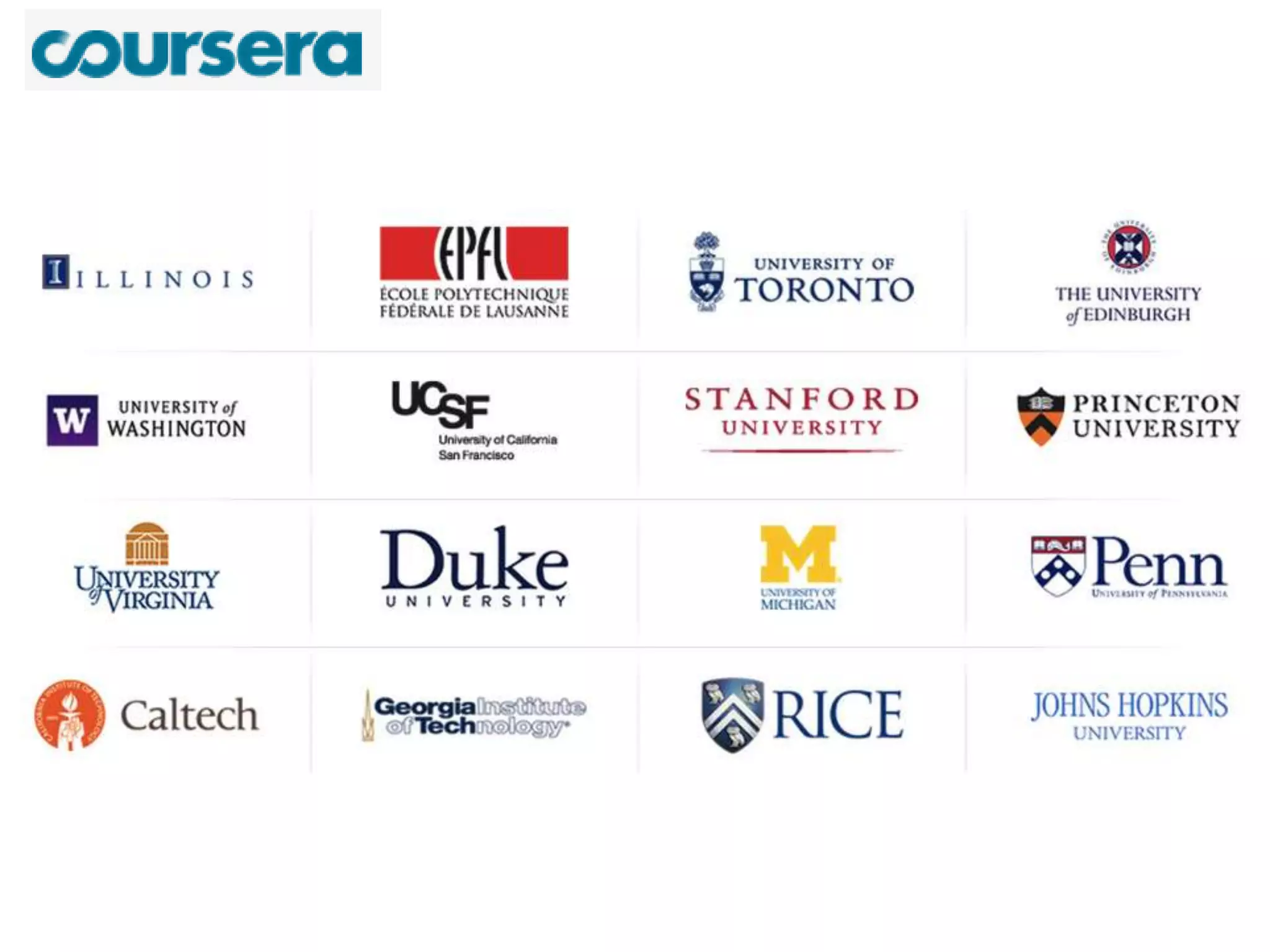
• Udacity, Coursera spin offs
• MITx – adds assessment and certificate of completion from
  MIT/Harvard
• Questions of authenticity
Teacher Role:
     Cognitive/Behaviourist model
• Selecting/writing Content
• Creating exercises
• Creating assessments – machine and teacher
  marked
Both Modes
• Low cost
• Scalable
• “The students who drop out early do not add
  substantially to the cost of delivering the
  course. The most expensive students are the
  ones who stick around long enough to take
  the final, and those are the ones most likely to
  pay for a certificate”. Daphne Koller
Why would you or your institution
     sponsor a MOOC??
Walled Garden Network
• Next generation LMS??
• Combines best of PLE and LMS
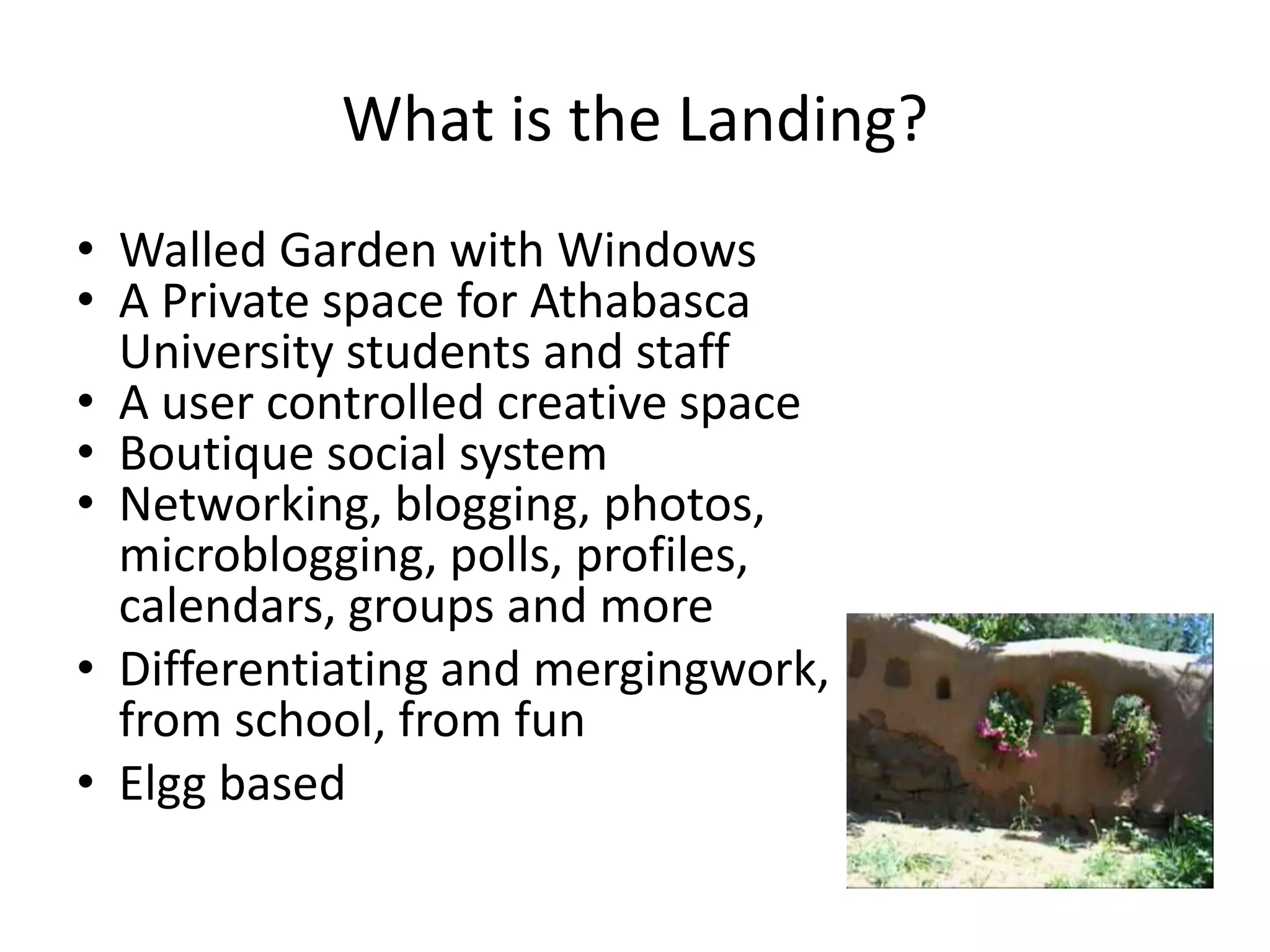
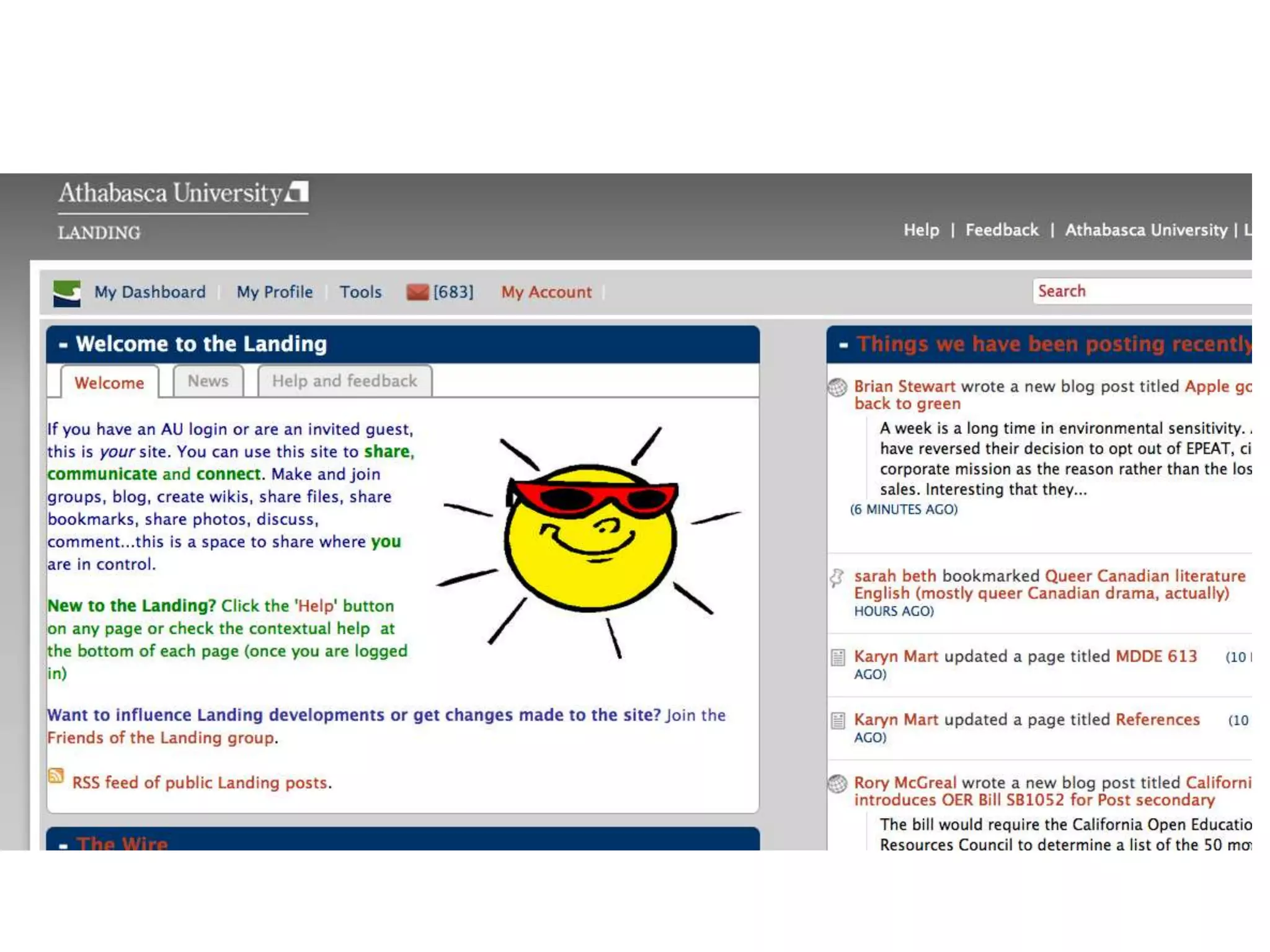
What is the Landing?
• Walled Garden with Windows
• A Private space for Athabasca
  University students and staff
• A user controlled creative space
• Boutique social system
• Networking, blogging, photos,
  microblogging, polls, profiles,
  calendars, groups and more
• Differentiating and mergingwork,
  from school, from fun
• Elgg based
LMS
• Group based (connectivist model)
• Interaction confined to group level
• Posts owned by institution – no ownership
• Lack of persistence
• No participation by alumni, visitors, non
  enrolled faculty or students
• Maximizes security/trust and control
Landing
•   User controlled – minimal status or roles
•   User initiated activities
•   User owned
•   Maximizes flexibility, control and ownership
•   A “soft” system that users can adapt to
    emergent needs.
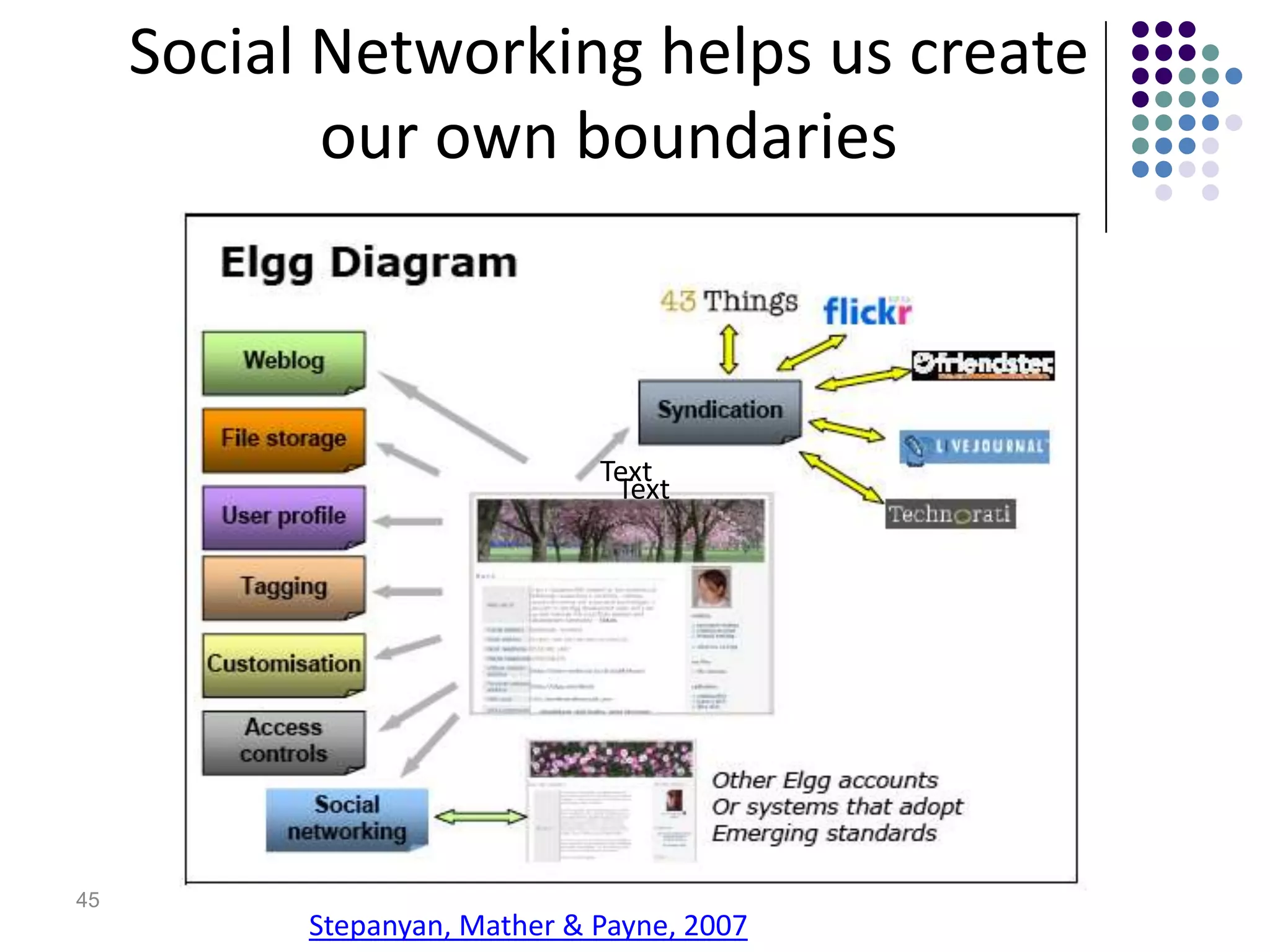
Social Networking helps us create
            our own boundaries


                               Text
                                Text


45
           Stepanyan, Mather & Payne, 2007
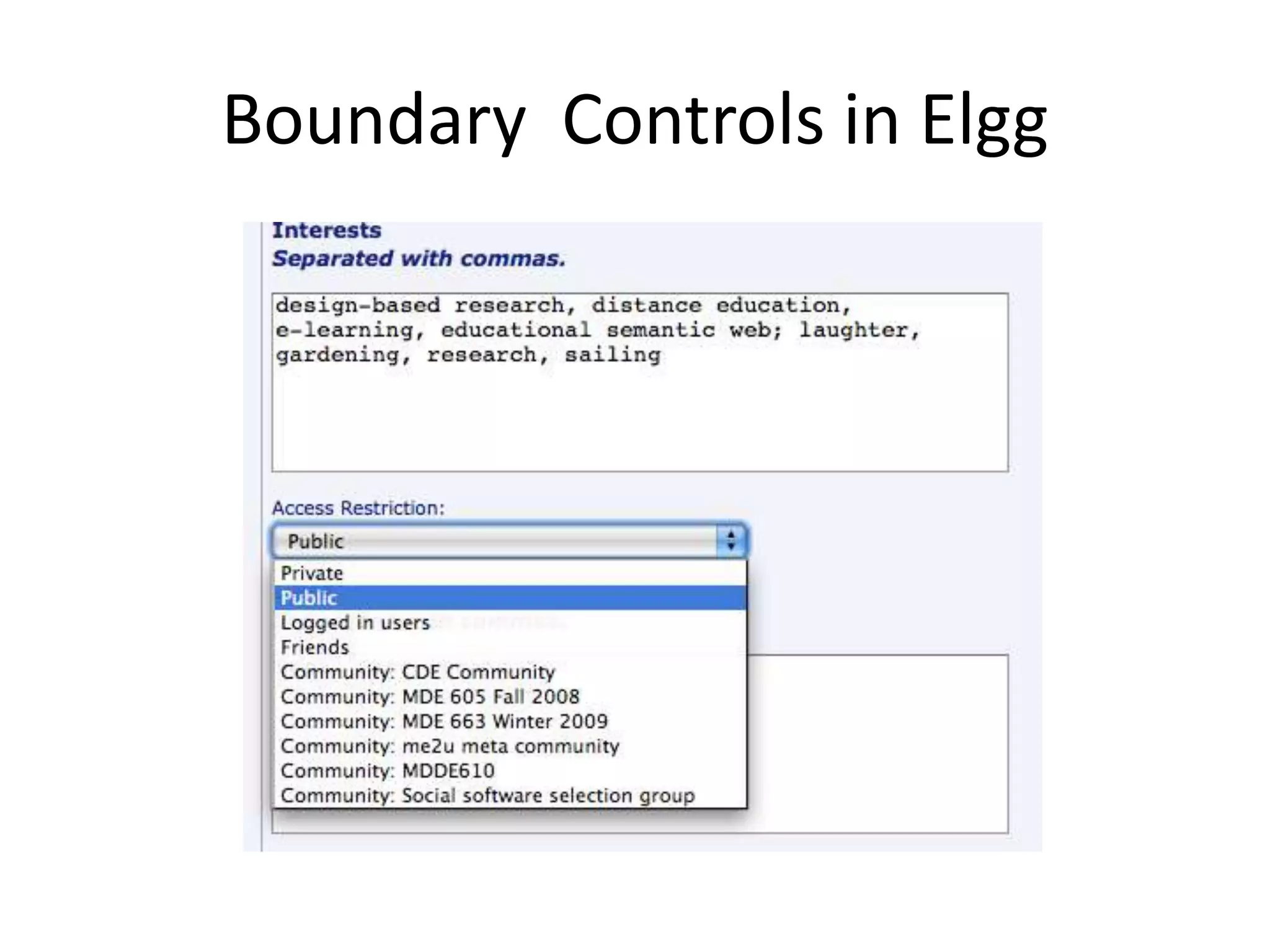
Boundary Controls in Elgg
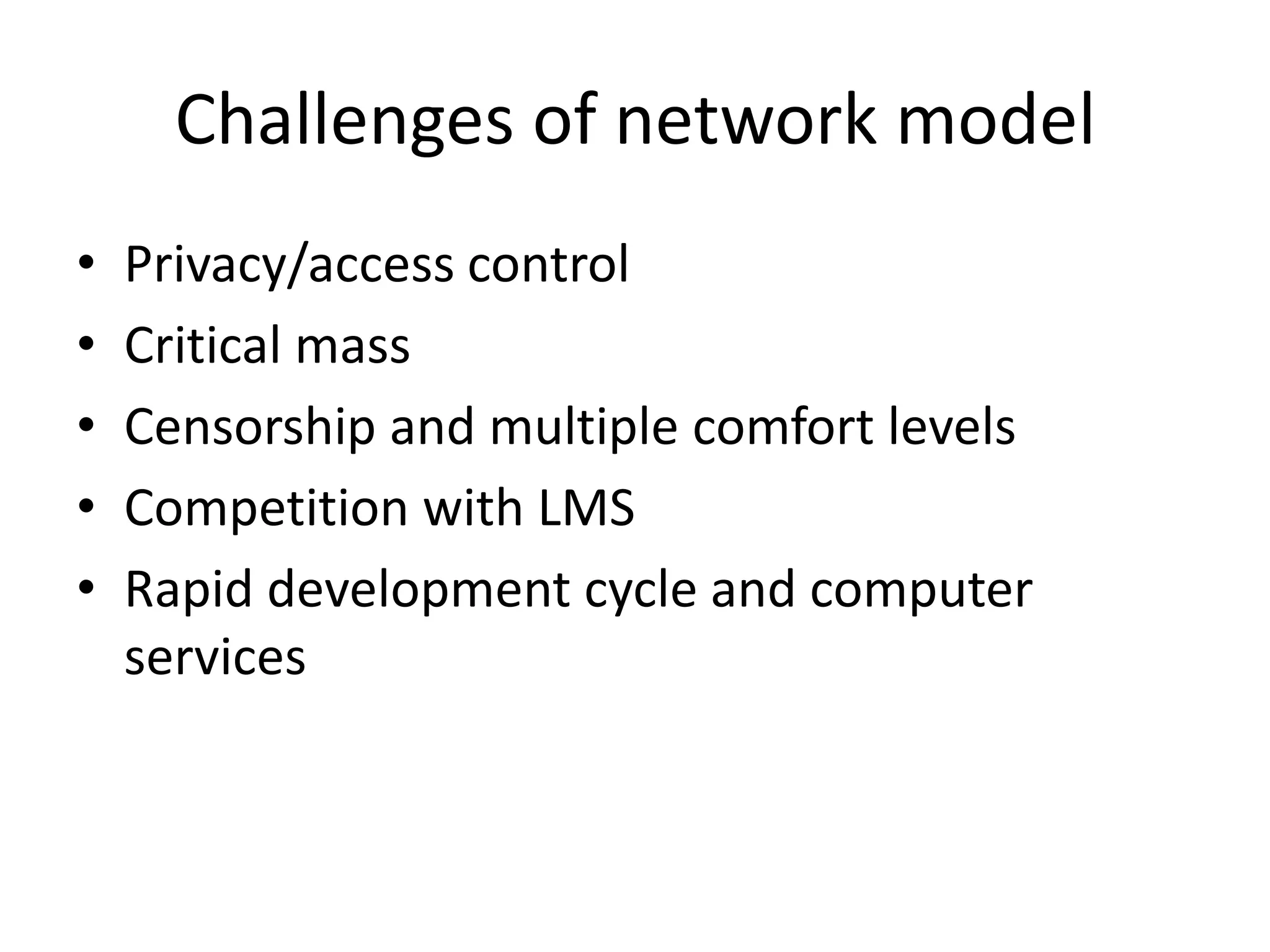
Challenges of network model
•   Privacy/access control
•   Critical mass
•   Censorship and multiple comfort levels
•   Competition with LMS
•   Rapid development cycle and computer
    services
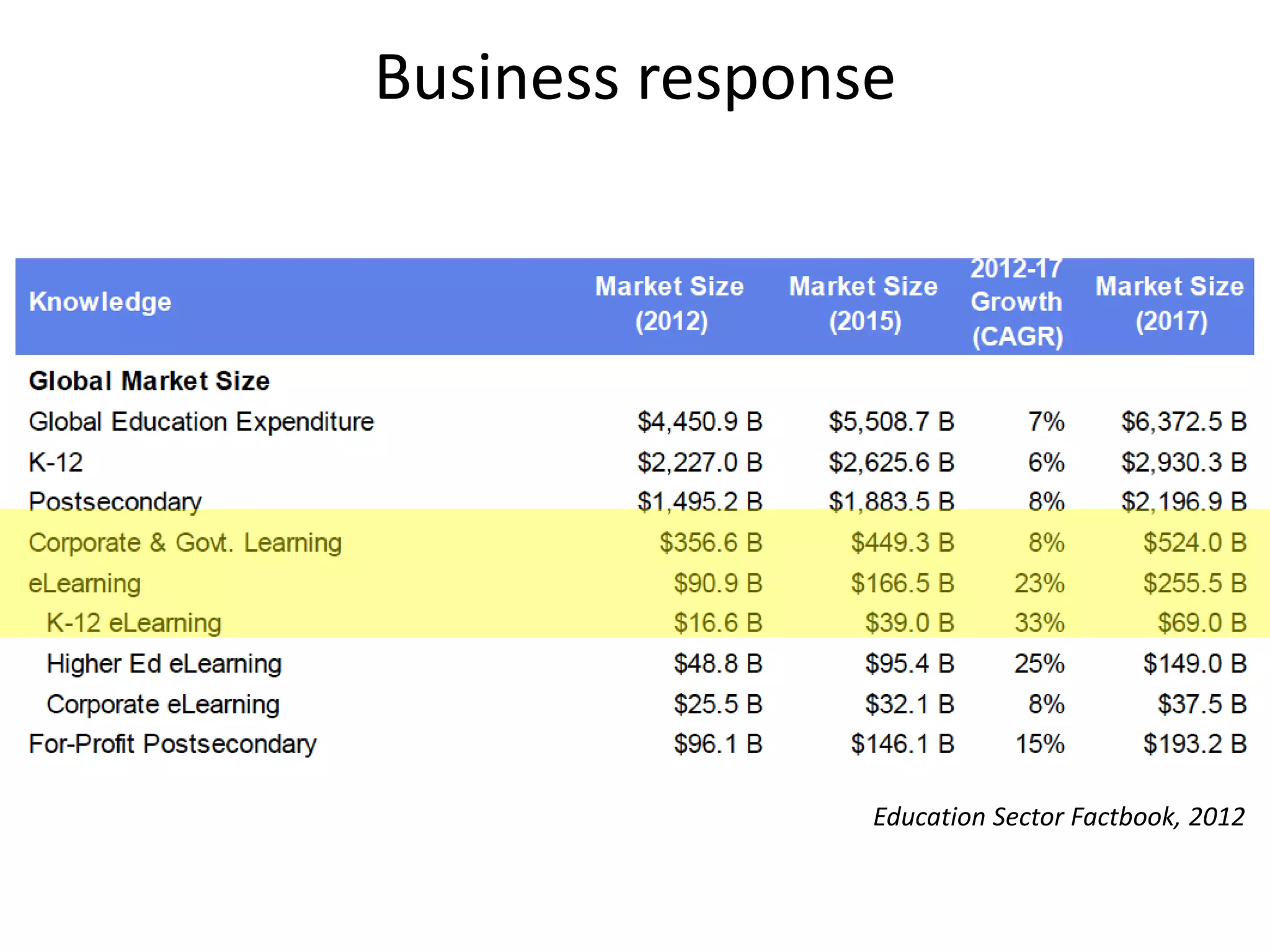
Business response


                Education Sector Factbook, 2012
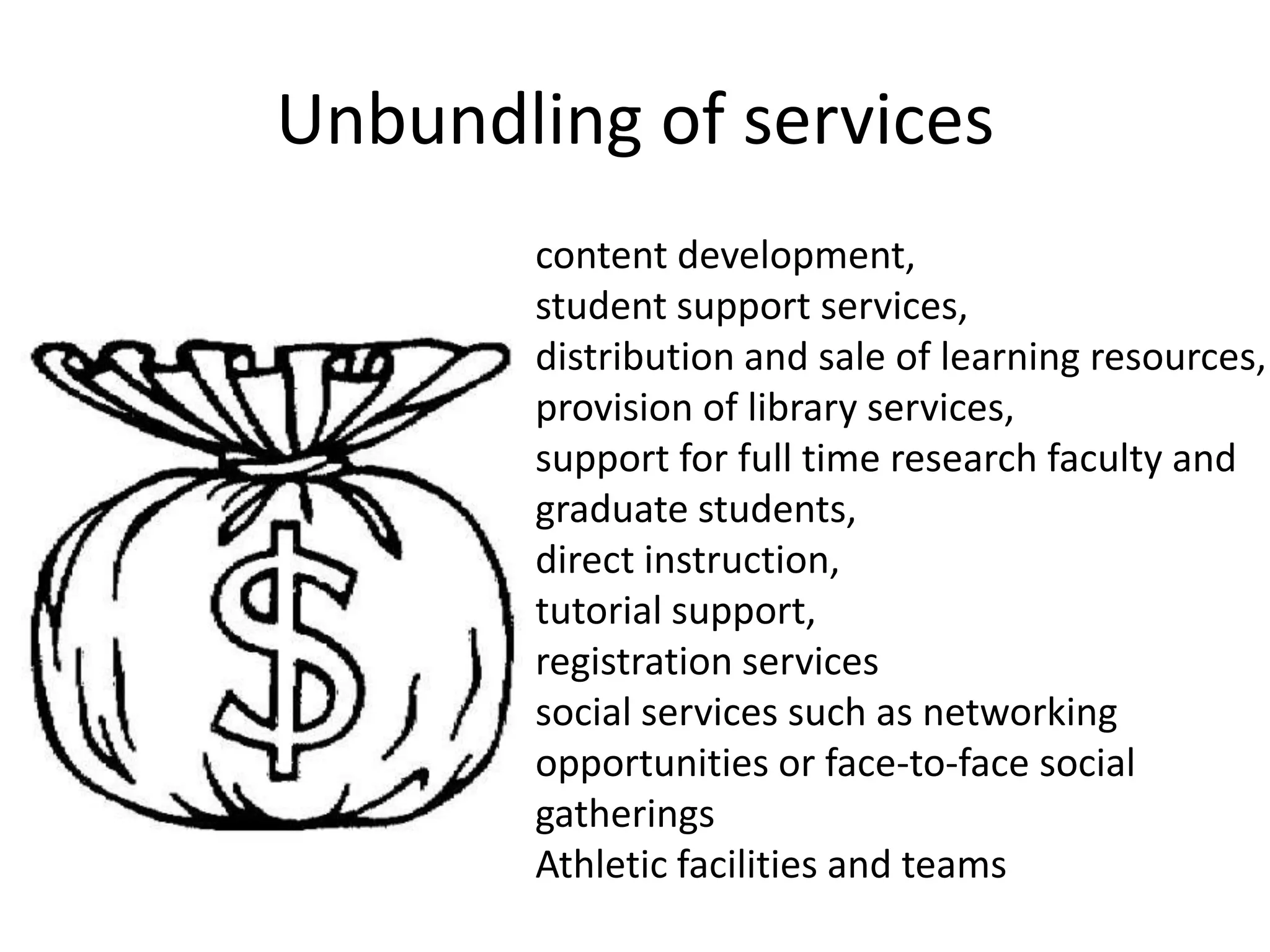
Unbundling of services
       content development,
       student support services,
       distribution and sale of learning resources,
       provision of library services,
       support for full time research faculty and
       graduate students,
       direct instruction,
       tutorial support,
       registration services
       social services such as networking
       opportunities or face-to-face social
       gatherings
       Athletic facilities and teams
Institutional responses
• Publishers in the Education Business
  – “Northern Arizona University has inked a deal with
    Pearson to co-develop three fully online
    baccalaureate degree programs based on the
    increasingly popular and somewhat controversial
    “competency based” model of higher education.
Full-time tuition is set at a fixed monthly fee of $199
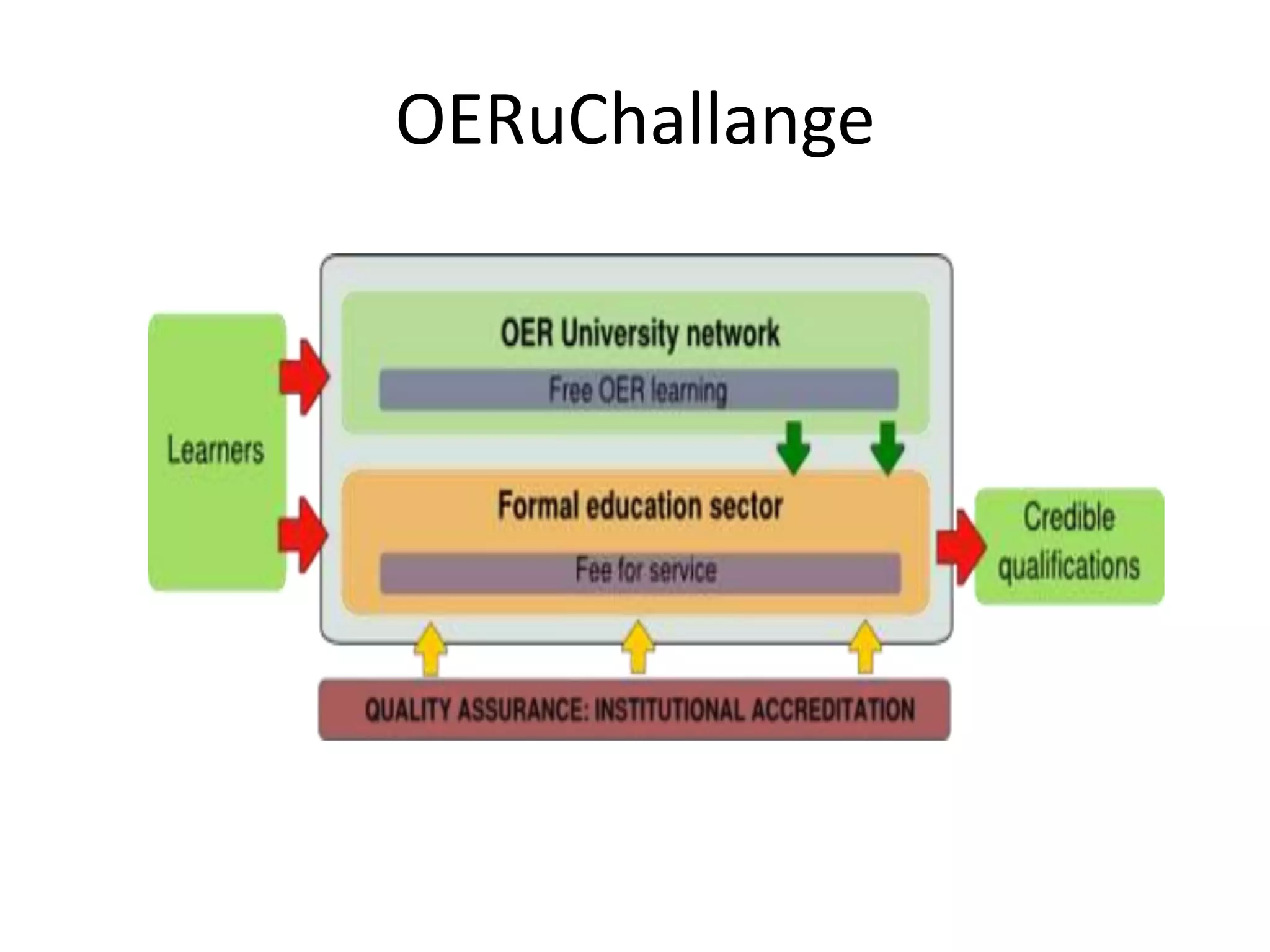
OERuChallange
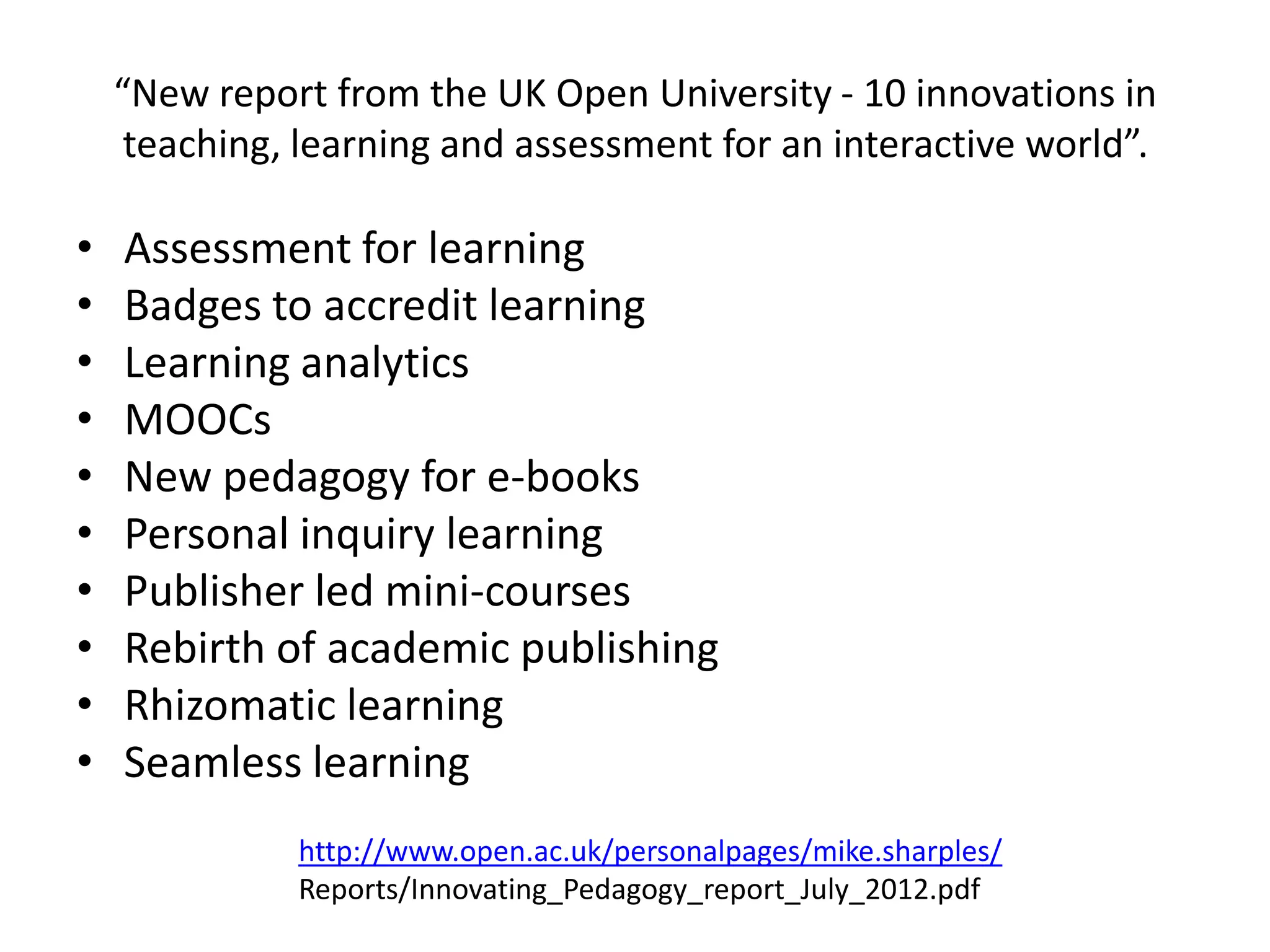
“New report from the UK Open University - 10 innovations in
     teaching, learning and assessment for an interactive world”.

•   Assessment for learning
•   Badges to accredit learning
•   Learning analytics
•   MOOCs
•   New pedagogy for e-books
•   Personal inquiry learning
•   Publisher led mini-courses
•   Rebirth of academic publishing
•   Rhizomatic learning
•   Seamless learning
              http://www.open.ac.uk/personalpages/mike.sharples/
              Reports/Innovating_Pedagogy_report_July_2012.pdf
• https://landing.athabascau.ca

• terrya@athabascau.ca
• Terrya.edublogs.org

Generations and Change - Ont University Council 2012

  • 1.
    Ontario University Councilon E-Learning Summer Institute 2012 MOOCs, Walled Gardens, Analytics and Networks: Multi-generation pedagogical innovations Terry Anderson
  • 2.
    The world ismoving so fast that there are days when the person who says it can’t be done, keeps getting interrupted by the person doing it. anonymous Personally, I’m always ready to learn, Although I do not always like to be taught Winston Churchill
  • 3.
  • 4.
    Values • We can(and must) continuously improve the quality, effectiveness, appeal, cost and time efficiency of the learning experience. • Student control and freedom is integral to 21st century life-long education and learning. • Continuous education opportunity is a basic human right
  • 5.
  • 6.
    Definitions of Openon the Web (From Google) • affording unobstructed entrance and exit; not shut or closed; • affording free passage or access; • open to or in view of all; • accessible to all; • assailable: not defended or capable of being defended • loose: (of textures) full of small openings or gaps; • start to operate or function • not brought to a conclusion; • not sealed or having been unsealed
  • 7.
    “Something there isthat doesn’t love a a wall, that wants it down” American Poet, Robert Frost Photo by Cudiaco
  • 8.
    Three Generations of Ed. Tech. Pedagogy Anderson &Dropn 2011 1. Behaviourist/Cognitive – Self Paced, Individual Study 2. Constructivist – Groups 3. Connectivist – Networks, & Sets
  • 9.
    1. Behavioural/Cognitive Pedagogies •“tell ‘em what you’re gonna tell ‘em, • tell ‘em • then tell ‘em what you told ‘em” Direct Instruction
  • 10.
    Gagne’s Events ofInstruction (1965) 1. Gain learners' attention 2. Inform learner of objectives 3. Stimulate recall of previous information 4. Present stimulus material 5. Provide learner guidance 6. Elicit performance 7. Provide Feedback 8. Assess performance 9. Enhance transfer opportunities Basis of Instructional Systems Design (ISD)
  • 11.
    Enhanced by the“cognitive revolution” • Chunking • Cognitive Load • Working Memory • Multiple Representations • Split-attention effect • Variability Effect • Multi-media effect – (Sorden, 2005) “learning as acquiring and using conceptual and cognitive structures” Greeno, Collins and Resnick, 1996
  • 12.
    Technologies of 1stgeneration • CAI, text books, One way Lectures, Video and audio broadcast
  • 13.
    Behaviourist/Cognitive Knowledge Is: •Logically coherent, existing independent of perspective • Largely context free • Capable of being transmitted • Assumes closed systems with discoverable relationships between inputs and outputs • Readily defined through learning objectives
  • 14.
  • 15.
    Constructivist Knowledge is: •Learning is located in contexts and relationships rather than merely in the minds of individuals. Greenhow, Robelia & Hughes (2009), Kathy Sierra http://www.speedofcreativity.org/
  • 16.
    Constructivist learning isbased on Group Learning Providing: • Motivation/synchronization • Feedback • Alternate and conflicting viewpoints
  • 17.
    Why Groups? • “Studentswho learn in small groups generally demonstrate greater academic achievement, express more favorable attitudes toward learning, and persist … • small-group learning may have particularly large effects on the academic achievement of members of underrepresented groups and the learning-related attitudes of women…” • Springer; Stanne, & Donovan, (1999) P.42
  • 18.
    2nd generation Adoption •Rapid Growth in traditional institutions • Requires minimal faculty and systems change • Perceived as more work and time consuming than F2F • Not scaleable, • Increases access, but maintains cost, staffing and roles. • Not disruptive
  • 19.
    Technologies of 2ndgeneration Social Constructivism • LMS • Threaded Discussion, VoiceThread(asynch) • Web conferencing, Immersive worlds (synch) • Project and group management and notification tools
  • 20.
    3rd Generation - Connectivist Pedagogy • Learning is building networks of information, contacts and resources that are applied to real problems.
  • 21.
    Connectivist Learning Principles George Siemens, 2004 • Learning is a process of connecting specialized nodes or information sources. • Learning may reside in non-human appliances. • Capacity to know is more critical than what is currently known. • Nurturing and maintaining connections is needed to facilitate continual learning. • Ability to see connections between fields, ideas, and concepts is a core skill. • Currency (accurate, up-to-date knowledge) is the intent of all connectivist learning activities.
  • 22.
    Connectivist Knowledge is • Emergent • Distributed • Chaotic • Fragmented • Non sequential • Contextualized
  • 23.
    Networks add diversityto learning “People who live in the intersection of social worlds are at higher risk of having good ideas” Burt, 2005, p. 90
  • 24.
    Connectivist Learning isEmergent the very uncertainty and lack of predictability of learning outcomes will be the key factor that adds value to a learning community emergent systems will provide the necessary triggers to enhance knowledge and understanding Special Issue of IRRODL on Emergence 2011
  • 25.
    Connectivist Learning designs Connection forming Selection Filtering Awareness and Contribution and Receptivity Involvement Reflection and Metacognition Pettenati, M. (2007).
  • 26.
    Special Issue ofIRRODL on Connectivism 2011 • Editors George Siemens and GrainneConole Free Subscriptions at www.irrodl.org
  • 27.
    Part 2 Recent Developments in all Three Generations • Open Educational Resources • Learning Analytics • MOOCs • Walled Social Networks • Disaggregated/low costs Schools
  • 28.
    Open Open Contentand Open Educational Resources Because it saves time and money!!!
  • 29.
    Where is Canadaand OER’s • COULD be useful for all 3 generations • Driver of 1st generation costs • No Federal programs or initiatives, • BCCampus only provincialproduction and distribution activity • Falling badly behind USA, EU and developing countries
  • 30.
    2nd International Conferenceon Learning Analytics and Knowledge 2012 Learning Analytics • Learning analytics is the measurement, collection, analysis and reporting of data about learners and their contexts, for purposes of understanding and optimizing learning and the environments in which it occurs. Wikipedia 2012
  • 31.
  • 33.
    Analytics Affordances • Partof big data movement in industry • Rio Salado College – Can determine those likely to drop out within 8 days of registration • American Public University – Continually monitoring 178 student variables • Especially useful to combat high drop out associated with 1 and 3rd generation
  • 34.
    Two Genre’s ofMoocs • OrigionalSeimen’s – Downes – Connectivist pedagogy “knowledge is actuated through the process of a learner connecting to and feeding information into a learning community”Kop& Hill 2008 – Aggregates distributed posts, no centre – Large enrollment, many ‘lurkers’ no formal assessment – Heavy involvement and communication with ‘teacher/facilitator” – Ex Change12, CCK08, EduMoo
  • 35.
    Teacher Role • Connectivismmodel – amplifying (to draw attention to important ideas/concepts), – curating (arrange readings and resources so as to give help for the understanding of new concepts), – way finding (assist participants to use social networking for their doubts), – aggregating (clarify discussions and content via extracting patterns), – filtering (help participants to be able to exclude non useful information in the networks), – modeling ( show successful information and interaction patterns), – staying present (Cormier & Siemens (2010)
  • 36.
    AI-Stanford MOOC • Structuredlearning activities, instructivist cognitive behaviourist pedagogy • Heavy content interaction, little to no teacher-student interaction • Centralized admin via LMS/analytics engines • 2001 Stanford AI course 160,000 registered, 25,000 completed all exercises, -85% drop out? • some accreditation by institutions – not Stanford • Udacity, Coursera spin offs • MITx – adds assessment and certificate of completion from MIT/Harvard • Questions of authenticity
  • 37.
    Teacher Role: Cognitive/Behaviourist model • Selecting/writing Content • Creating exercises • Creating assessments – machine and teacher marked
  • 38.
    Both Modes • Lowcost • Scalable • “The students who drop out early do not add substantially to the cost of delivering the course. The most expensive students are the ones who stick around long enough to take the final, and those are the ones most likely to pay for a certificate”. Daphne Koller
  • 39.
    Why would youor your institution sponsor a MOOC??
  • 40.
    Walled Garden Network •Next generation LMS?? • Combines best of PLE and LMS
  • 41.
    What is theLanding? • Walled Garden with Windows • A Private space for Athabasca University students and staff • A user controlled creative space • Boutique social system • Networking, blogging, photos, microblogging, polls, profiles, calendars, groups and more • Differentiating and mergingwork, from school, from fun • Elgg based
  • 42.
    LMS • Group based(connectivist model) • Interaction confined to group level • Posts owned by institution – no ownership • Lack of persistence • No participation by alumni, visitors, non enrolled faculty or students • Maximizes security/trust and control
  • 43.
    Landing • User controlled – minimal status or roles • User initiated activities • User owned • Maximizes flexibility, control and ownership • A “soft” system that users can adapt to emergent needs.
  • 45.
    Social Networking helpsus create our own boundaries Text Text 45 Stepanyan, Mather & Payne, 2007
  • 46.
  • 47.
    Challenges of networkmodel • Privacy/access control • Critical mass • Censorship and multiple comfort levels • Competition with LMS • Rapid development cycle and computer services
  • 48.
    Business response Education Sector Factbook, 2012
  • 49.
    Unbundling of services content development, student support services, distribution and sale of learning resources, provision of library services, support for full time research faculty and graduate students, direct instruction, tutorial support, registration services social services such as networking opportunities or face-to-face social gatherings Athletic facilities and teams
  • 50.
    Institutional responses • Publishersin the Education Business – “Northern Arizona University has inked a deal with Pearson to co-develop three fully online baccalaureate degree programs based on the increasingly popular and somewhat controversial “competency based” model of higher education.
  • 51.
    Full-time tuition isset at a fixed monthly fee of $199
  • 53.
  • 54.
    “New report fromthe UK Open University - 10 innovations in teaching, learning and assessment for an interactive world”. • Assessment for learning • Badges to accredit learning • Learning analytics • MOOCs • New pedagogy for e-books • Personal inquiry learning • Publisher led mini-courses • Rebirth of academic publishing • Rhizomatic learning • Seamless learning http://www.open.ac.uk/personalpages/mike.sharples/ Reports/Innovating_Pedagogy_report_July_2012.pdf
  • 55.

Editor's Notes

  • #13 Transmission model, often augmented with some tutor interaction
  • #33 http://www.educause.edu/EDUCAUSE+Review/EDUCAUSEReviewMagazineVolume46/ResearchandDataServicesforHigh/238391
  • #49 http://gsvadvisors.com/wordpress/wp-content/uploads/2012/04/GSV-EDU-Factbook-Apr-13-2012.pdf