Information Literacy for the Google Generation Teresa S. Welsh, Ph.D. [email_address]
Questions to be addressed: What is information literacy? Why is IL important? What research is related to information literacy? What learning theory is related to IL? How can IL research & theory inform teaching? How can IL be assessed? 12  October 2011 Jackson Preparatory School
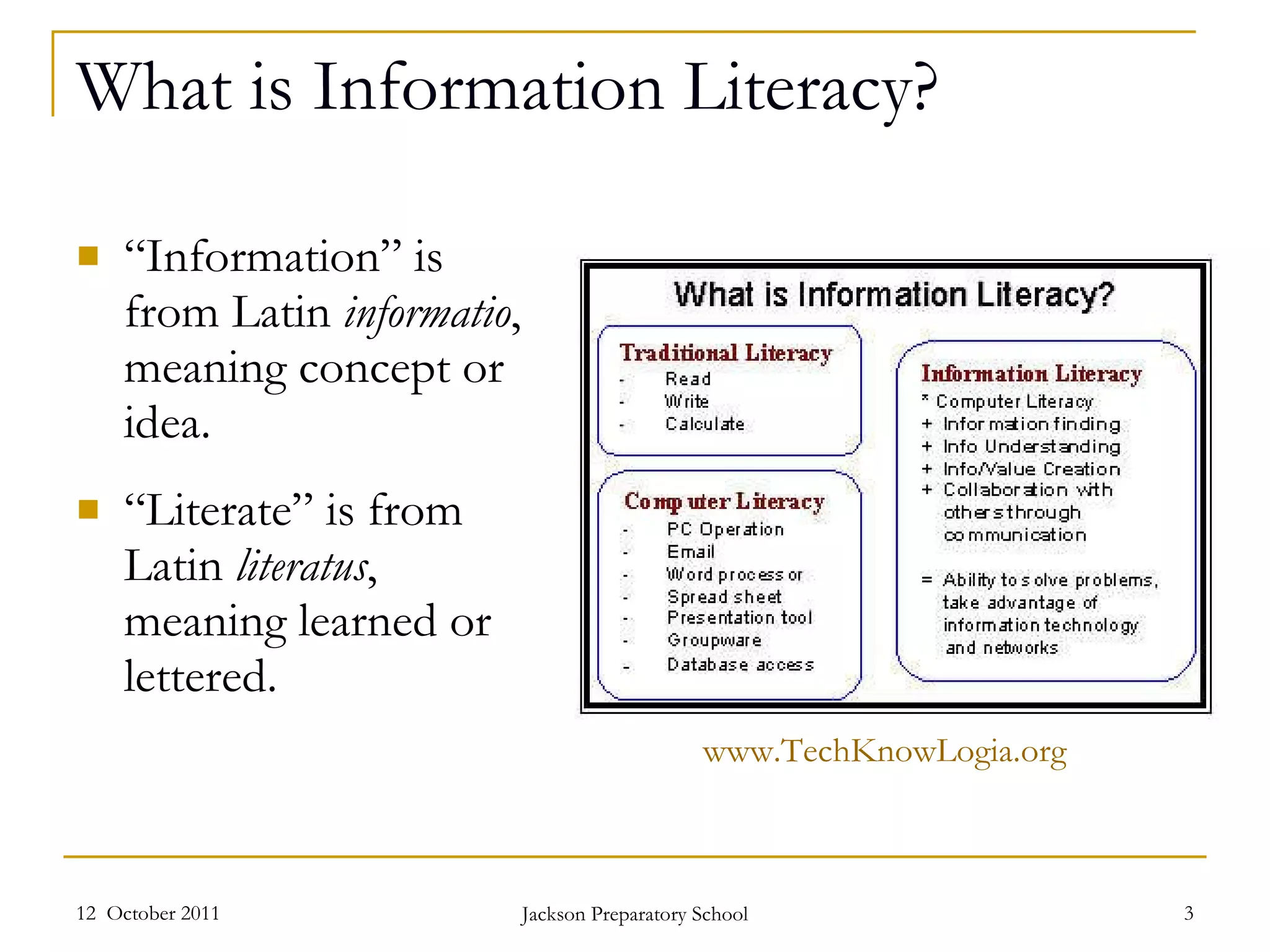
What is Information Literacy? “ Information” is from Latin  informatio , meaning concept or idea.  “ Literate” is from Latin  literatus , meaning learned or lettered.  12  October 2011 Jackson Preparatory School www.TechKnowLogia.org
Information Literacy: A Meta-Literacy National Council of Teachers of English (NCTE): “21st century demands that a literate person possess a wide range of abilities and competencies,  many literacies .” Develop proficiency  with technology tools Build relationships  with others to pose and solve problems collaboratively, cross-culturally Design and share information  to meet a variety of purposes Manage, analyze, synthesize  multiple streams of simultaneous information Create, critique, analyze, and evaluate  multi-media texts Attend to ethical responsibilities  required by complex environments.   12  October 2011 Jackson Preparatory School
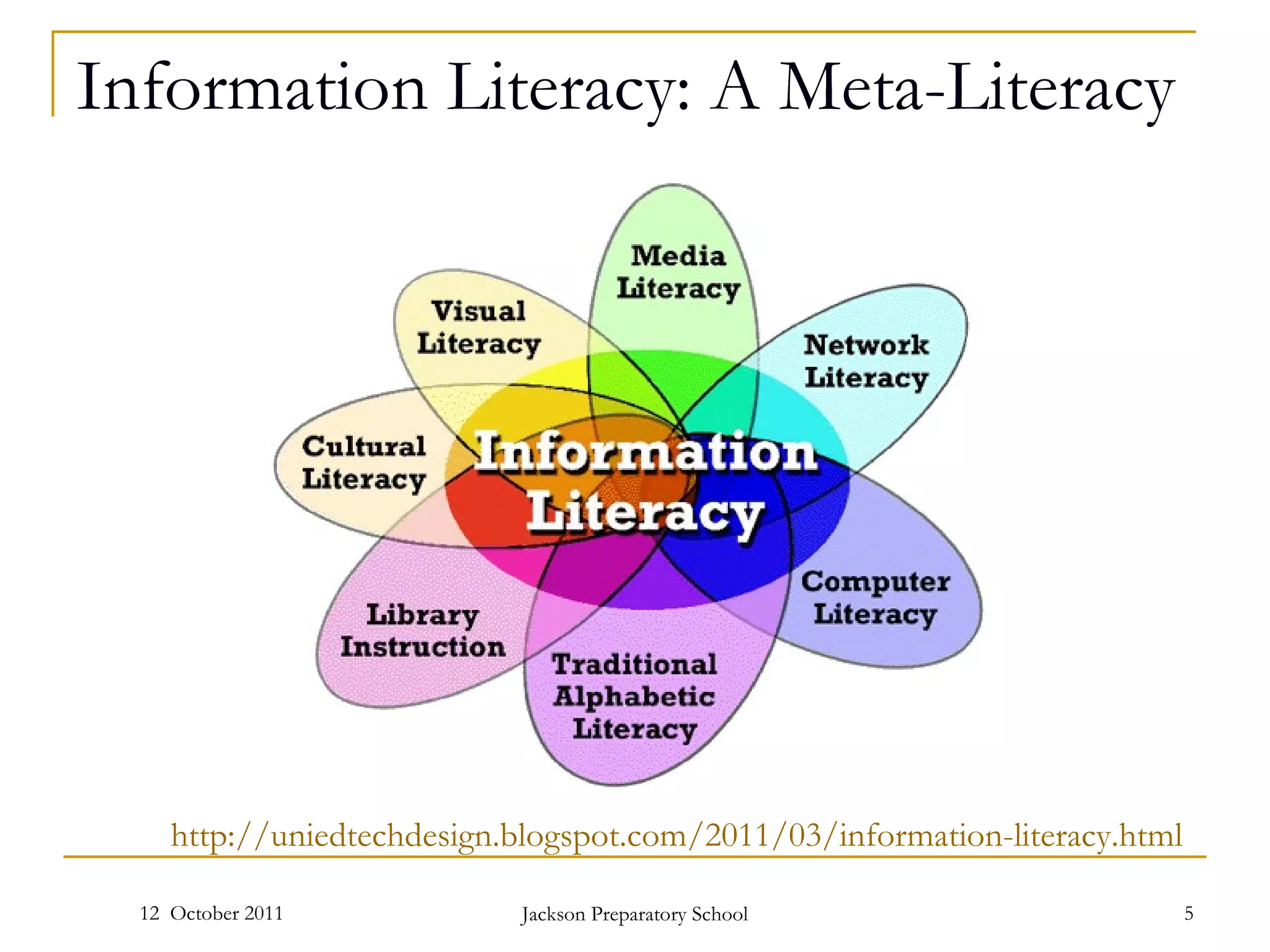
Information Literacy: A Meta-Literacy 12  October 2011 Jackson Preparatory School http://uniedtechdesign.blogspot.com/2011/03/information-literacy.html
How is Info Literacy defined by LIS? ALA, ACRL: IL is “a set of abilities requiring individuals to recognize when information is needed and have the ability to locate, evaluate, and use effectively the needed information.” Determine  the extent of information needed  Access  the needed information effectively and efficiently  Evaluate  information and its sources critically  Incorporate  selected information into one's knowledge base  Use  information effectively to accomplish a specific purpose  Understand  the economic, legal, and social issues and use information ethically and legally.    12  October 2011 Jackson Preparatory School
According to ALA, information literacy is “increasingly important in the contemporary environment of rapid technological change and proliferating information resources…”  “Information literacy forms the basis for lifelong learning and is common to  all disciplines , to  all learning environments , and to  all levels of education .” 12  October 2011 Jackson Preparatory School Why is Information Literacy important?
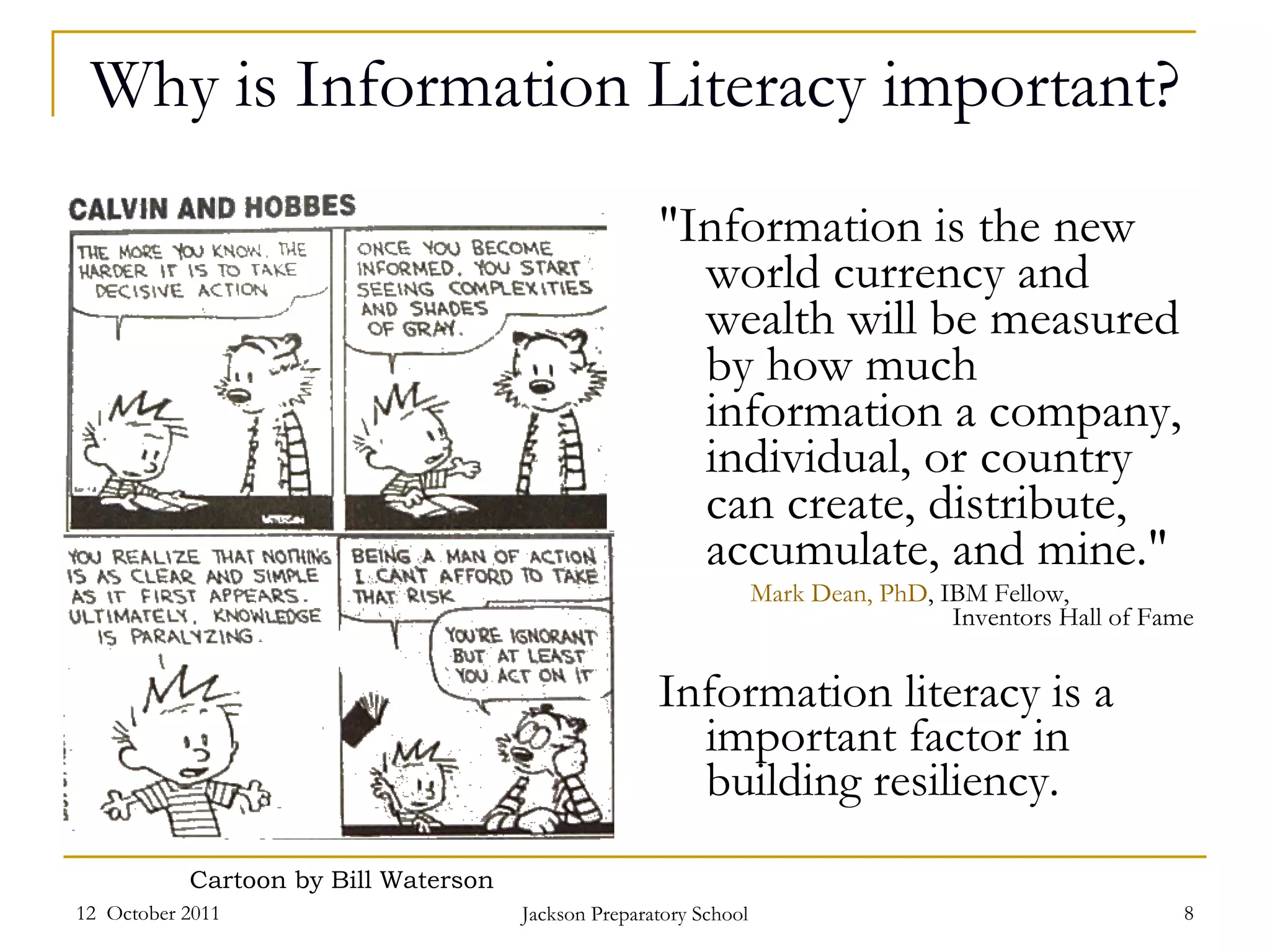
Why is Information Literacy important? "Information is the new world currency and wealth will be measured by how much information a company, individual, or country can create, distribute, accumulate, and mine."   Mark Dean, PhD , IBM Fellow,  Inventors Hall of Fame Information literacy is a important factor in building resiliency. 12  October 2011 Jackson Preparatory School Cartoon by Bill Waterson
How do teachers/librarians build resiliency? 1. Support and encourage education 2. Value students, exhibit friendliness 3. Provide rules that are consistent and clear 4. Provide rules, programs, services developed with student input 5. Promote service to others, “required helpfulness” 6. Provide information on health, education, employment, recreation  7. Provide opportunities to develop, practice life skills:  cooperation, leadership, decision-making, problem-solving, impulse control 8. Help develop talents, hobbies, and interests 9. Provide opportunities to be sociable 10. Promote reading. 12  October 2011 Jackson Preparatory School Dr. Jami Jones ( www.askdrjami.org )
Research: The Google Generation Research on Google Generation (those born after 1993) conducted by CIBER (UCL Centre for Information Behaviour & Evaluation of Research) indicates: Online searching tends to be shallow, information-skimming, not in-depth searching 60% visit a site once only and view each Web page only a few seconds Prefer quick information in form of easily-digested short chunks rather than full-text. 12  October 2011 Jackson Preparatory School Information Behaviour of the Researcher of the Future.  London: CIBER, 2008.
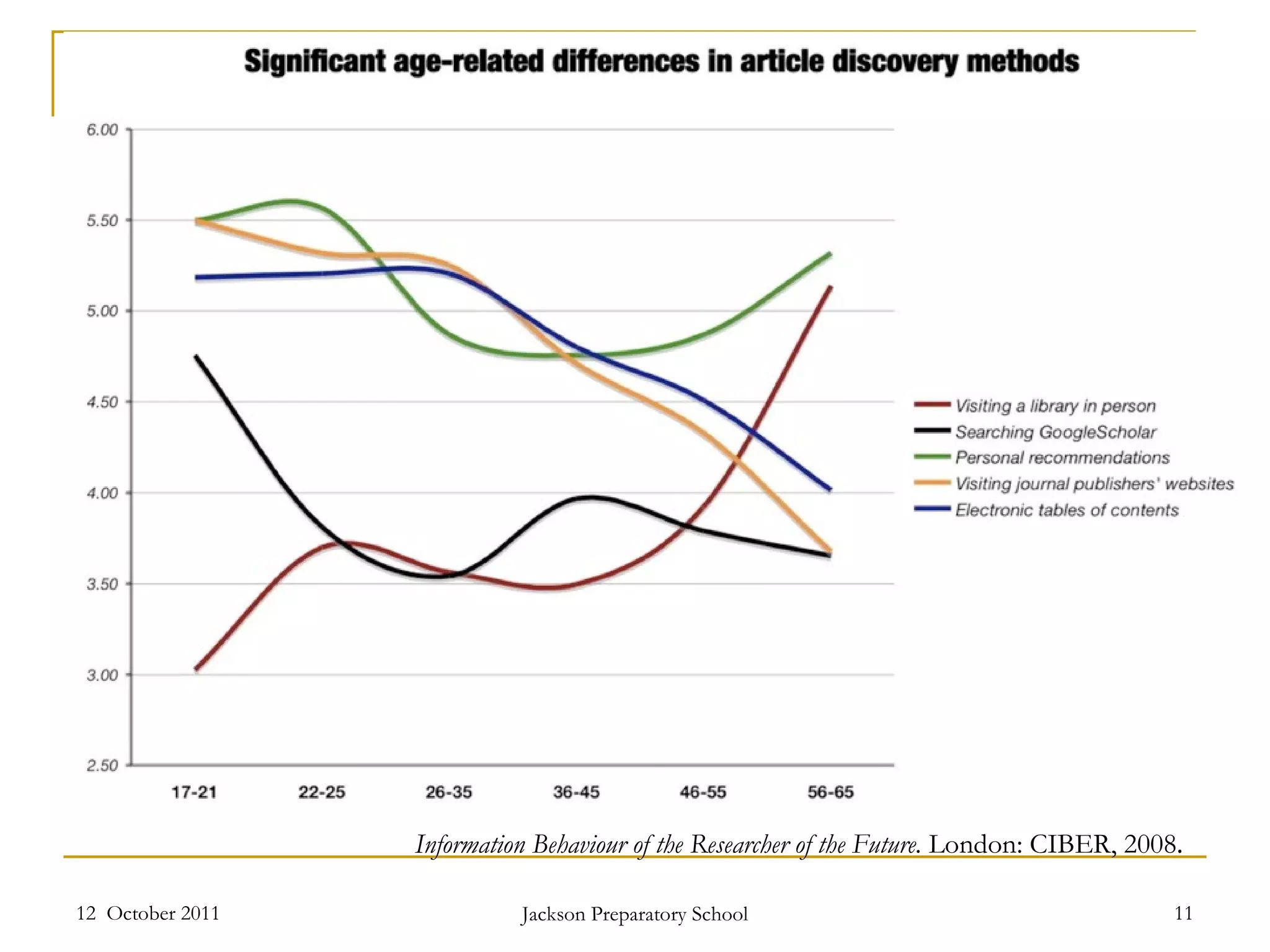
12  October 2011 Jackson Preparatory School Information Behaviour of the Researcher of the Future.  London: CIBER, 2008 .
Kent State Library Research: TRAILS T ool for  R eal-Time  A ssessment of  I nformation  L iteracy  S kills (free online assessment for grades 3, 6, 9 or 12) Boswell (2007) TRAILS study: Greatest weaknesses of students in  evaluating information  and in using  Boolean search techniques . Supported by CIBER research (2008): Little time spent in evaluating information, either for relevance, accuracy or authority Poor understanding of information needs so students find it difficult to develop effective search strategies. 12  October 2011 Jackson Preparatory School http://www.trails-9.org/   http://www.ucl.ac.uk/infostudies/research/ciber/downloads/
Evaluating Information: Source Types Primary Sources  – first-hand information Original documents or images, eye-witness accounts Original research from scholarly, peer-reviewed sources Raw data, government reports such as census data. Secondary Sources  – second-hand information Not primary or original, after-the-fact  Analyzes, interprets primary-source information Textbooks, encyclopedias, non-fiction books Tertiary Sources  – little info, points to other sources Guides, directories, bibliographies 12  October 2011 Jackson Preparatory School
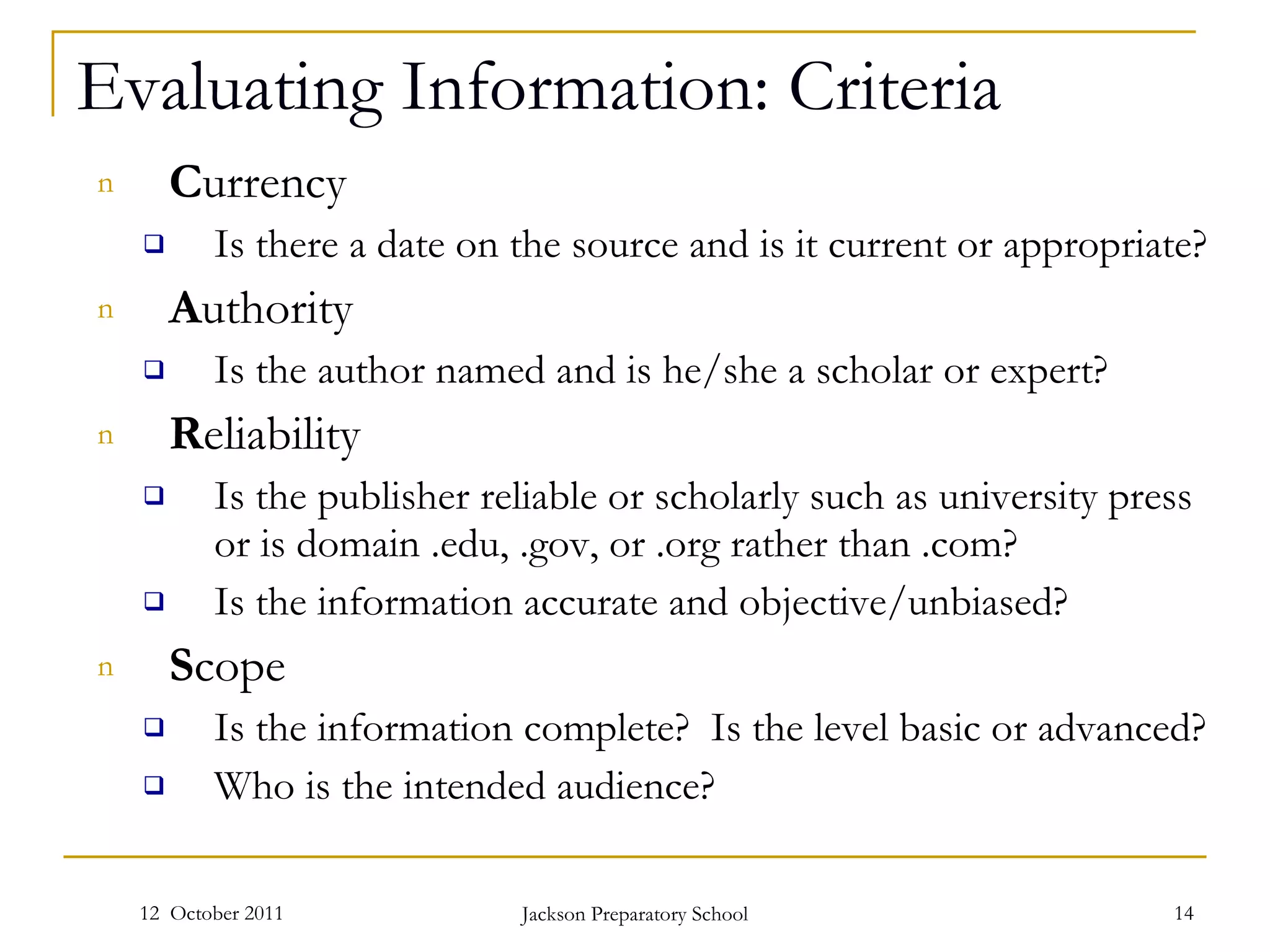
Evaluating Information: Criteria C urrency Is there a date on the source and is it current or appropriate? A uthority Is the author named and is he/she a scholar or expert? R eliability Is the publisher reliable or scholarly such as university press or is domain .edu, .gov, or .org rather than .com? Is the information accurate and objective/unbiased?  S cope Is the information complete?  Is the level basic or advanced? Who is the intended audience? 12  October 2011 Jackson Preparatory School
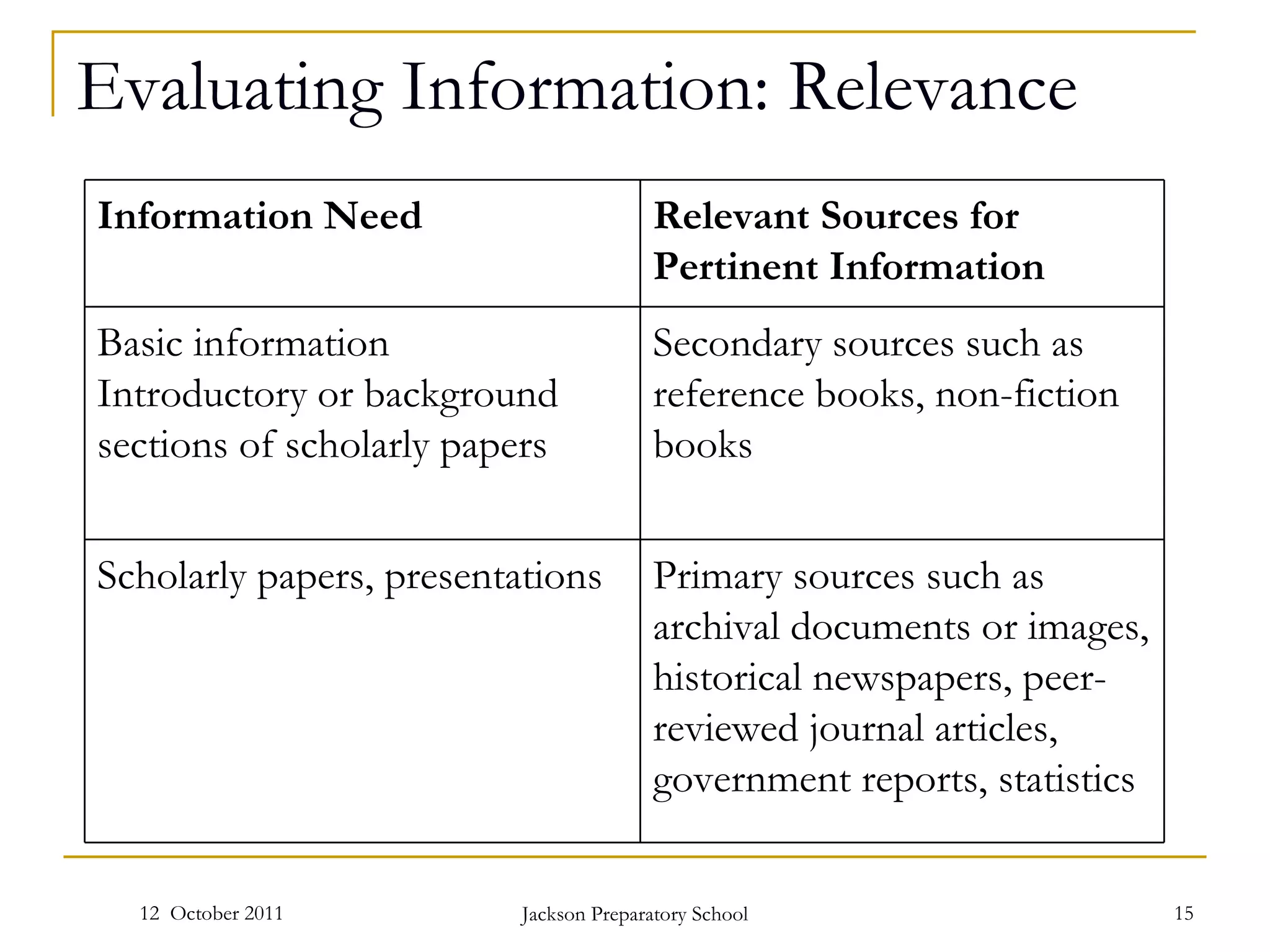
Evaluating Information: Relevance 12  October 2011 Jackson Preparatory School Information Need Relevant Sources for Pertinent Information Basic information  Introductory or background sections of scholarly papers Secondary sources such as reference books, non-fiction books  Scholarly papers, presentations Primary sources such as archival documents or images, historical newspapers, peer-reviewed journal articles, government reports, statistics
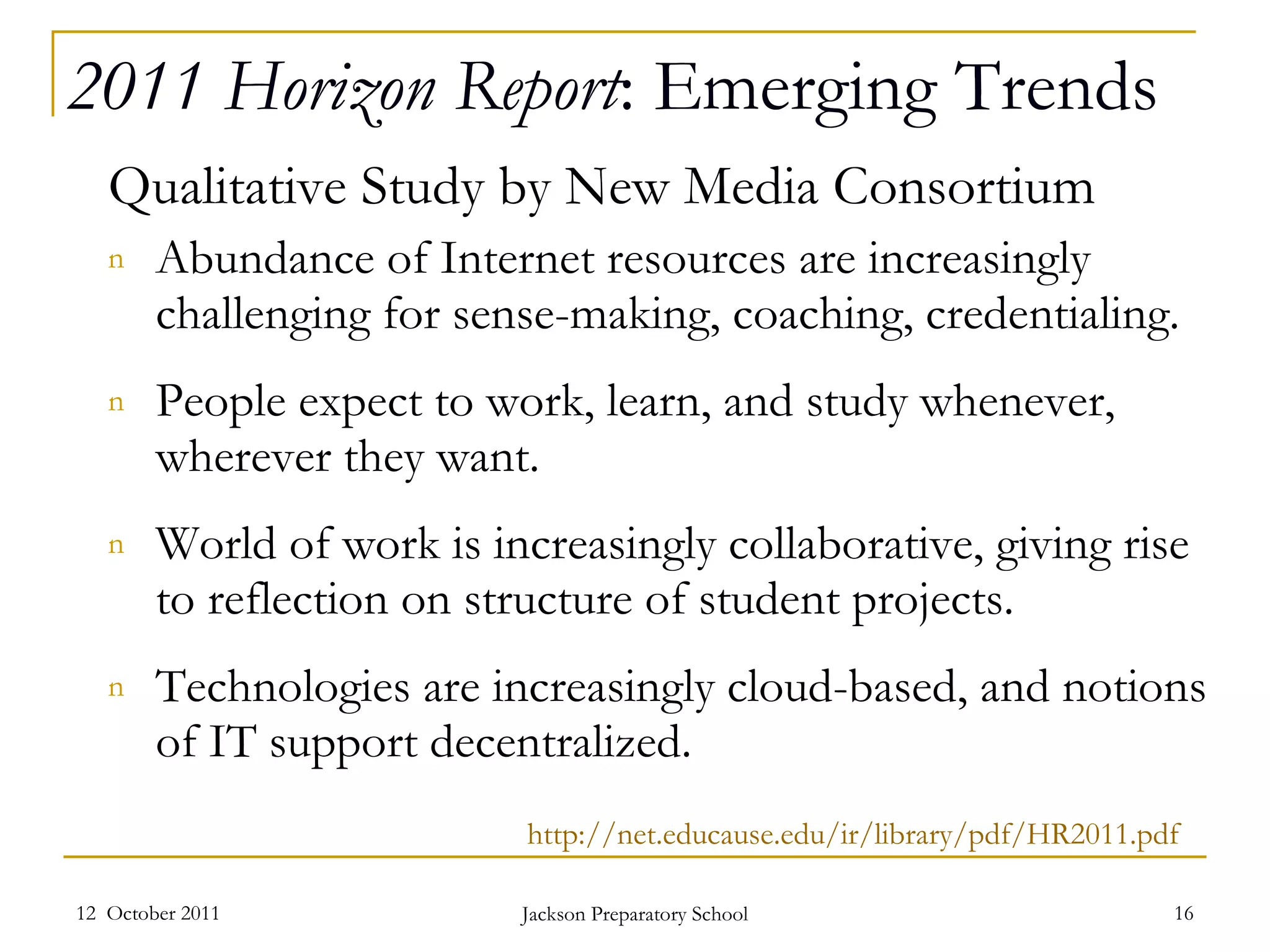
2011 Horizon Report : Emerging Trends Qualitative Study by New Media Consortium Abundance of Internet resources are increasingly challenging for sense-making, coaching, credentialing.  People expect to work, learn, and study whenever, wherever they want.  World of work is increasingly collaborative, giving rise to reflection on structure of student projects.  Technologies are increasingly cloud-based, and notions of IT support decentralized.  12  October 2011 Jackson Preparatory School http://net.educause.edu/ir/library/pdf/HR2011.pdf
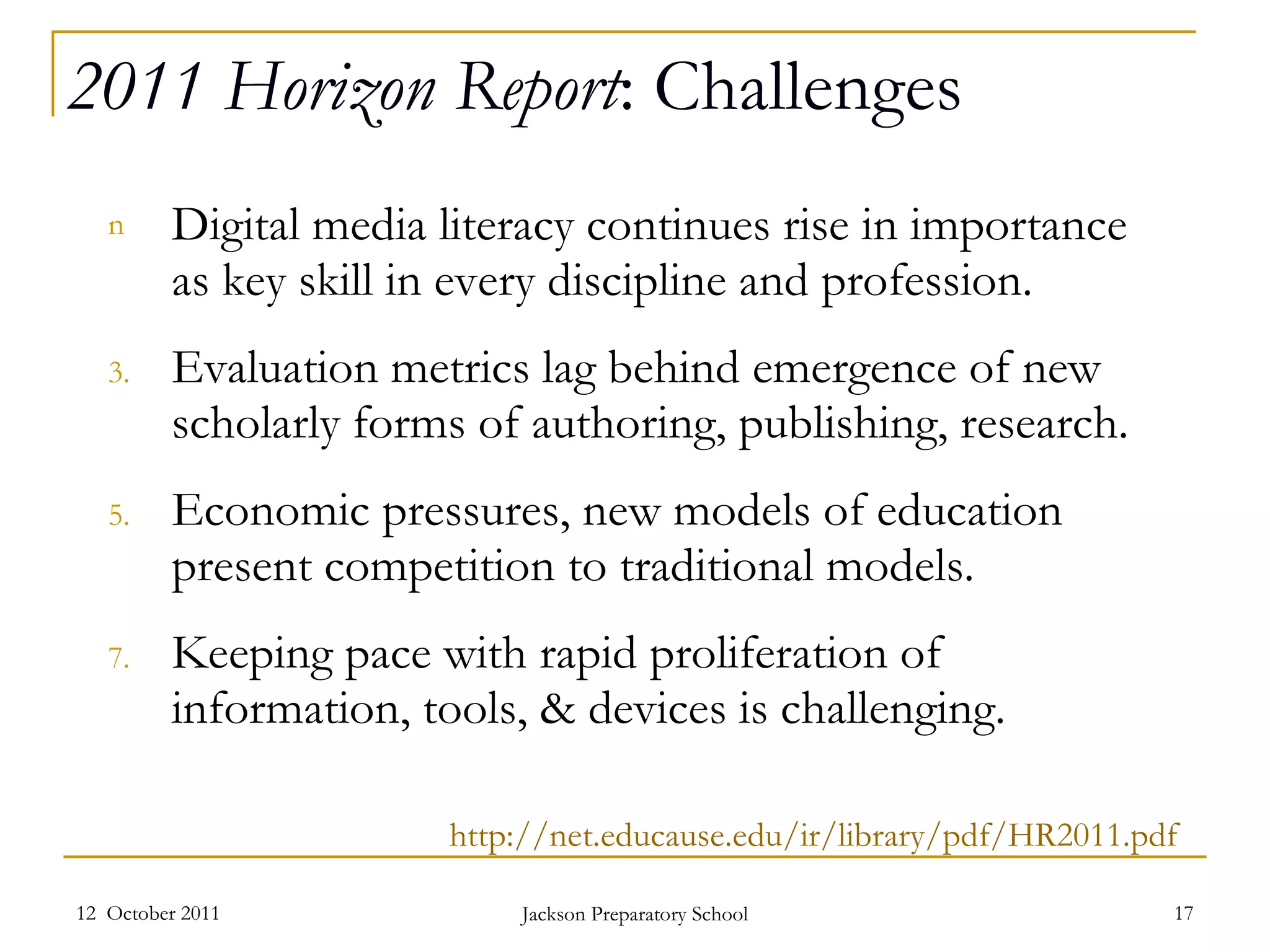
2011 Horizon Report : Challenges Digital media literacy continues rise in importance as key skill in every discipline and profession. Evaluation metrics lag behind emergence of new scholarly forms of authoring, publishing, research.  Economic pressures, new models of education present competition to traditional models.  Keeping pace with rapid proliferation of information, tools, & devices is challenging.  12  October 2011 Jackson Preparatory School http://net.educause.edu/ir/library/pdf/HR2011.pdf
2011 Horizon Report : Tech Adoption Now : 1 year or less: e-books ( NetLibrary ,  ebrary ) Mobiles (i-Phone, Android smart phone, i-Pad) Near-term  future: 2-3 Years Augmented reality: “computer-assisted contextual layer of information over the real world, creating a reality that is enhanced or augmented.”  ( http ://www.layar.com / ) Game-based learning  ( http://gaming.psu.edu / ). 12  October 2011 Jackson Preparatory School http://net.educause.edu/ir/library/pdf/HR2011.pdf
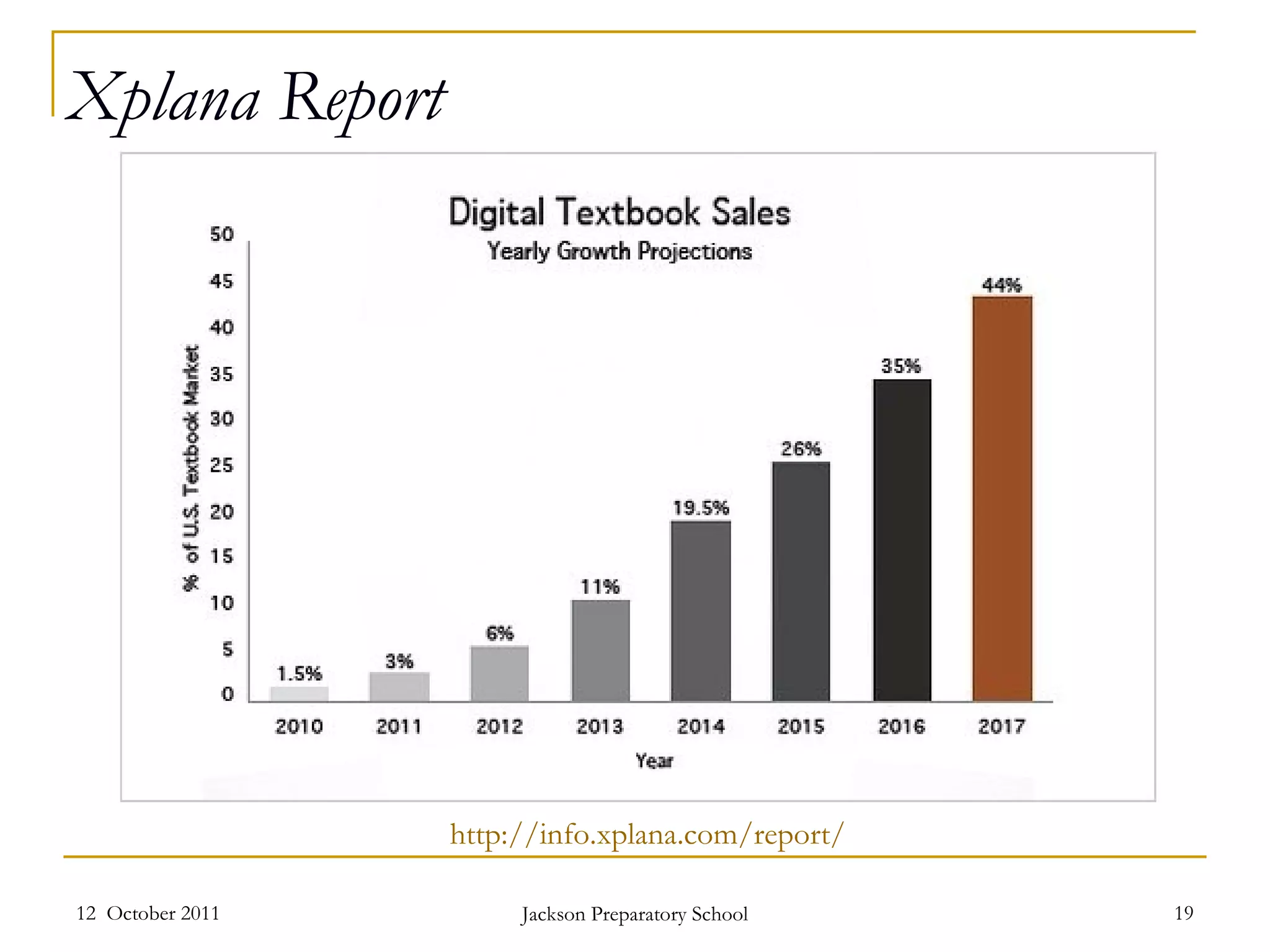
12  October 2011 Jackson Preparatory School http://info.xplana.com/report/   Xplana Report
2011 Horizon Report : Tech Adoption Longer-term  future: 4-5 Years Gesture-based computing (Kinect, SixthSense, Tamper) Haptics touch-surface technology such as Mudpad ( http :// hci.rwth-aachen.de/mudpad )  Eye movement technology such as EyeDraw ( http ://www.cs.uoregon.edu/research/cm-hci/EyeDraw / )  Analytics: new data-gathering tools and analytic techniques to study student engagement, performance, progress  ( http://www. google.com/analytics ). 12  October 2011 Jackson Preparatory School http://net.educause.edu/ir/library/pdf/HR2011.pdf
Learning Theory:  Connectivism Learning: Process of connecting specialized nodes/information sources Rests in diversity of opinions May reside in non-human appliances Requires nurturing, maintaining connections Requires accurate, up-to-date knowledge Includes decision-making. Capacity to know is more critical than what is known. Core skill is ability to see connections between ideas, concepts  (Siemens, 2004). 12  October 2011 Jackson Preparatory School
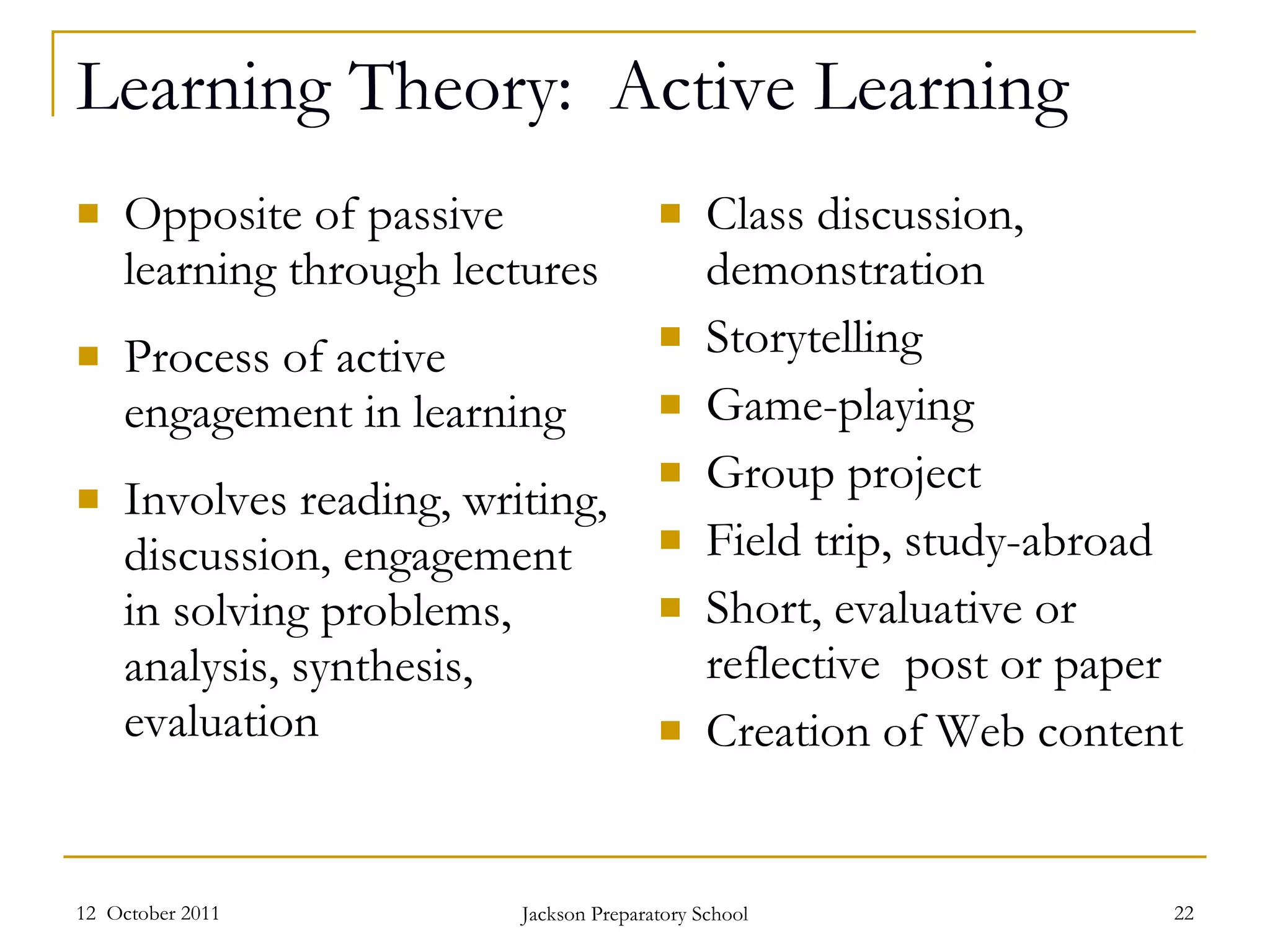
Learning Theory:  Active Learning Opposite of passive learning through lectures Process of active engagement in learning Involves reading, writing, discussion, engagement in solving problems, analysis, synthesis, evaluation Class discussion, demonstration Storytelling Game-playing Group project Field trip, study-abroad Short, evaluative or reflective  post or paper Creation of Web content 12  October 2011 Jackson Preparatory School
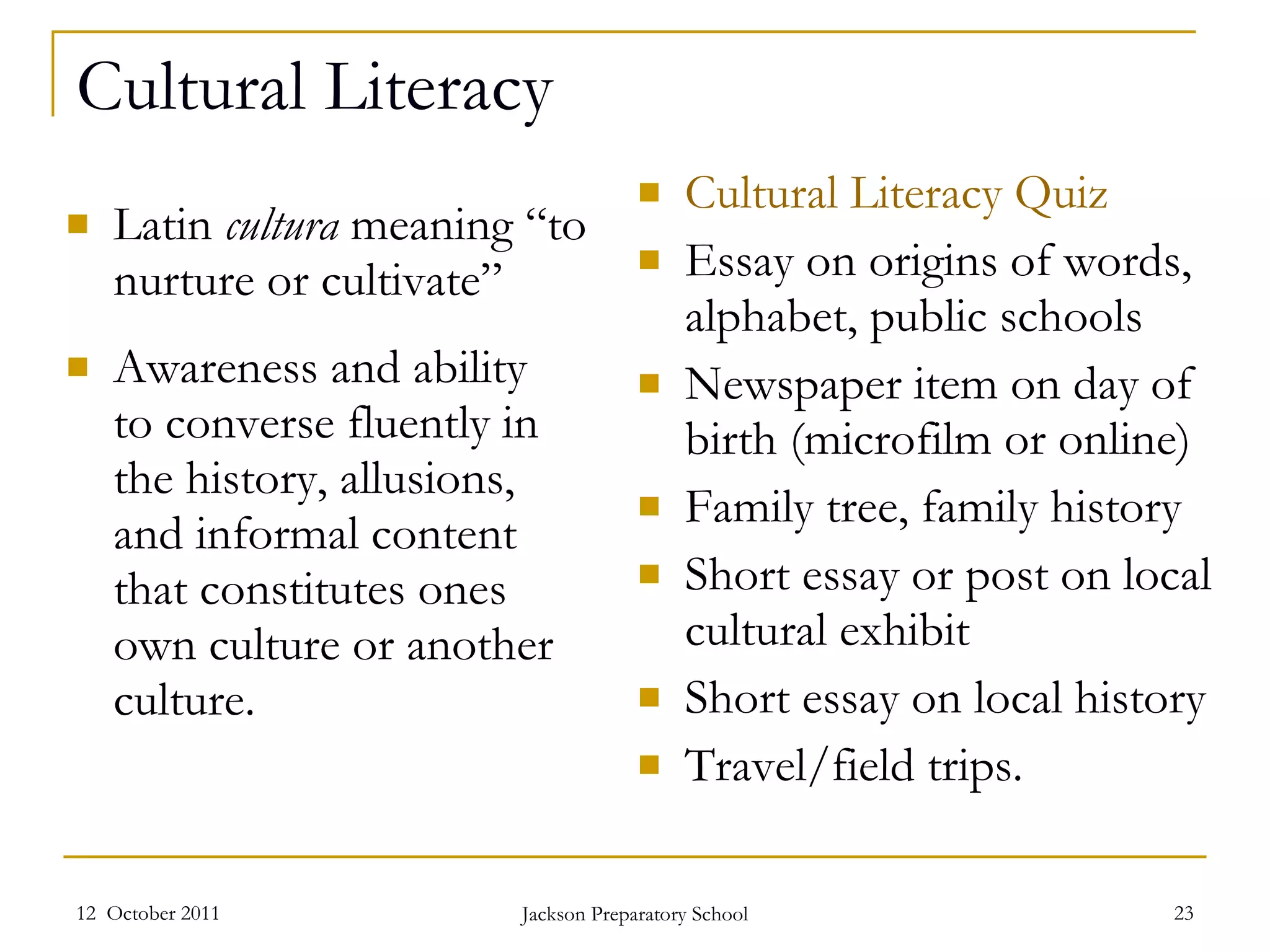
Cultural Literacy Latin  cultura  meaning “to nurture or cultivate” Awareness and ability  to converse fluently in the history, allusions, and informal content that constitutes ones own culture or another culture.  Cultural Literacy Quiz Essay on origins of words, alphabet, public schools Newspaper item on day of birth (microfilm or online) Family tree, family history Short essay or post on local cultural exhibit Short essay on local history Travel/field trips. 12  October 2011 Jackson Preparatory School
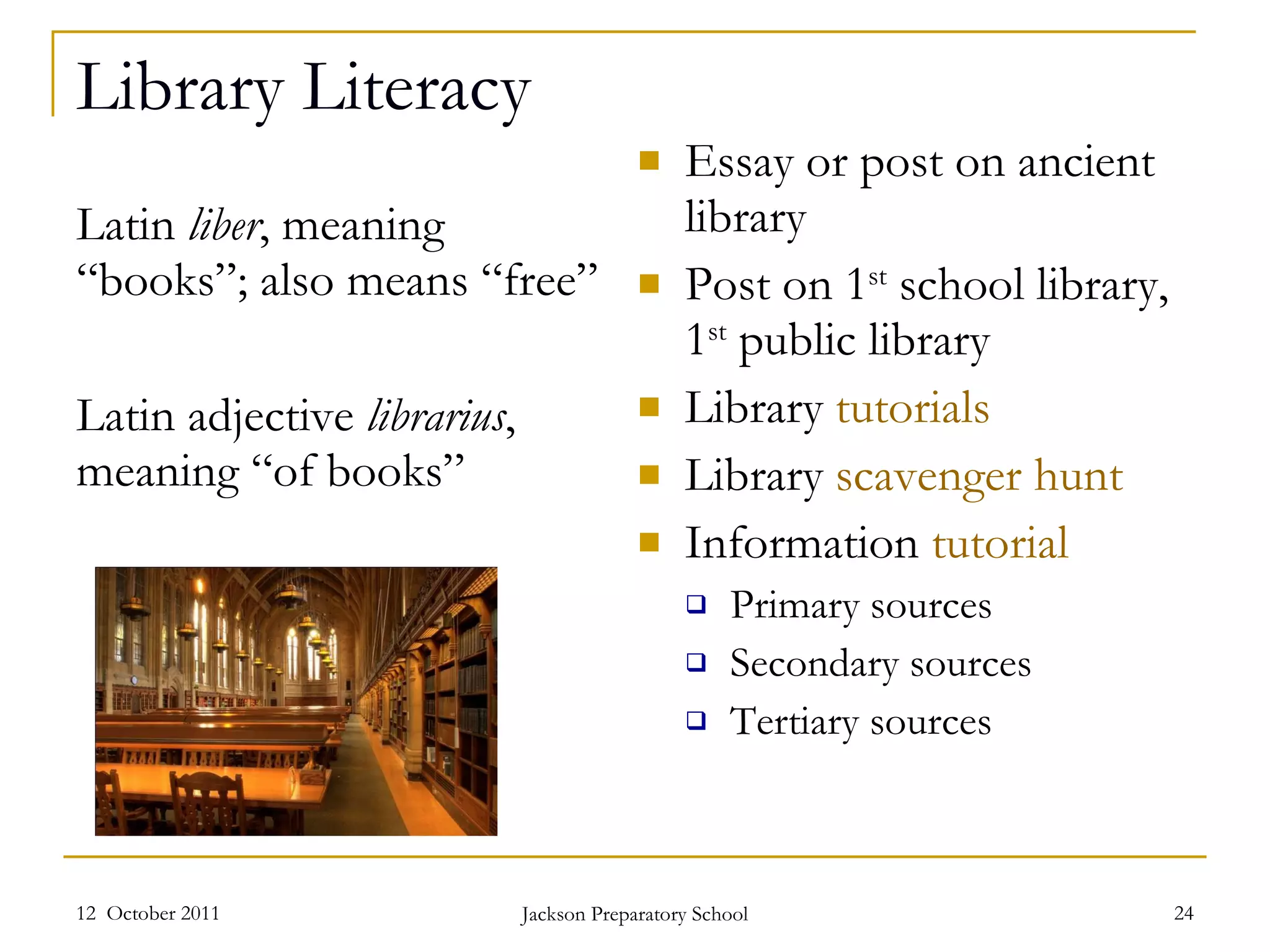
Library Literacy Latin  liber , meaning “books”; also means “free” Latin adjective  librarius ,  meaning “of books” Essay or post on ancient library Post on 1 st  school library, 1 st  public library  Library  tutorials Library  scavenger hunt Information  tutorial Primary sources Secondary sources Tertiary sources 12  October 2011 Jackson Preparatory School
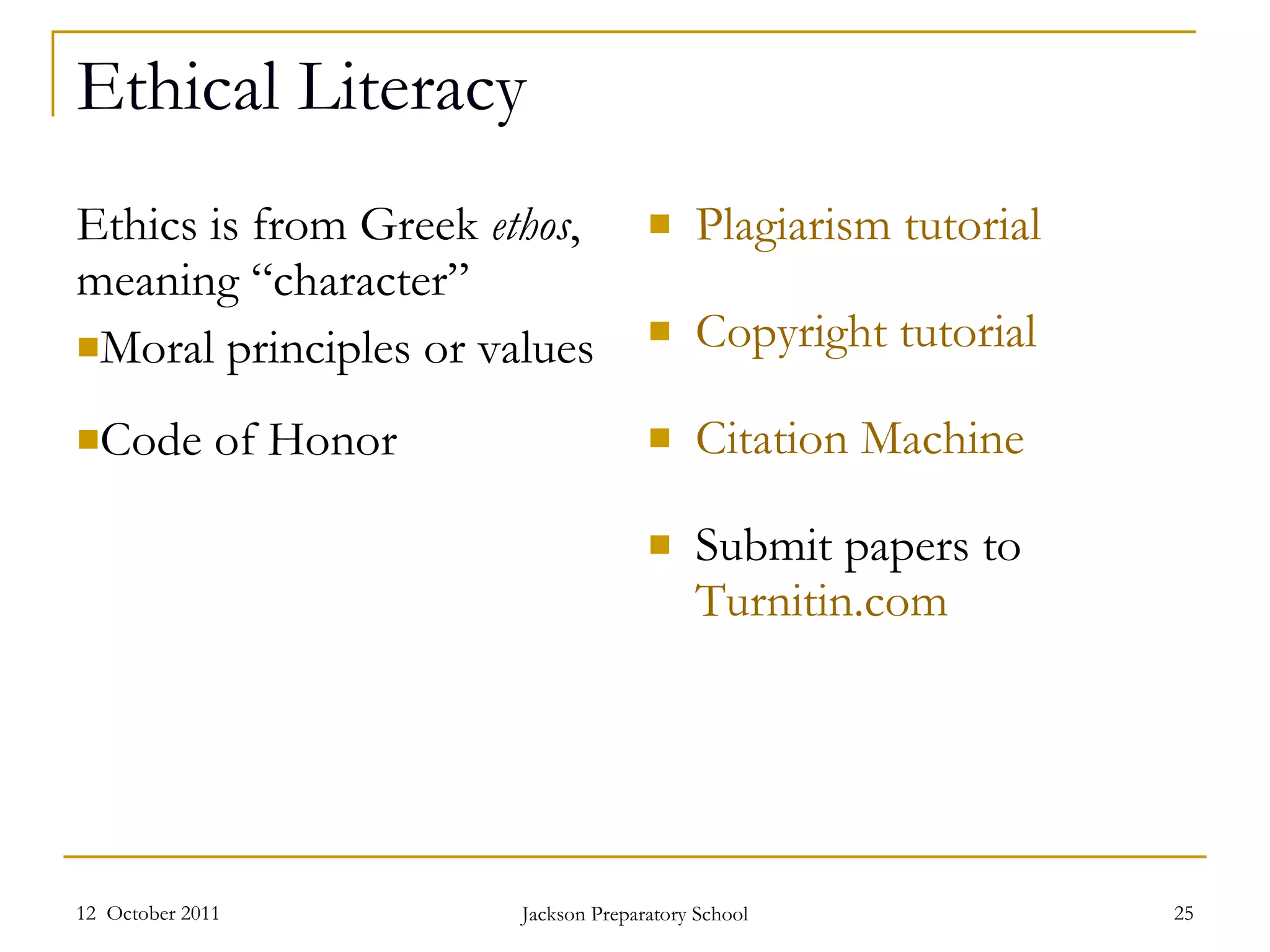
Ethical Literacy Ethics is from Greek  ethos , meaning “character” Moral principles or values Code of Honor Plagiarism tutorial Copyright tutorial Citation Machine Submit papers to  Turnitin.com 12  October 2011 Jackson Preparatory School
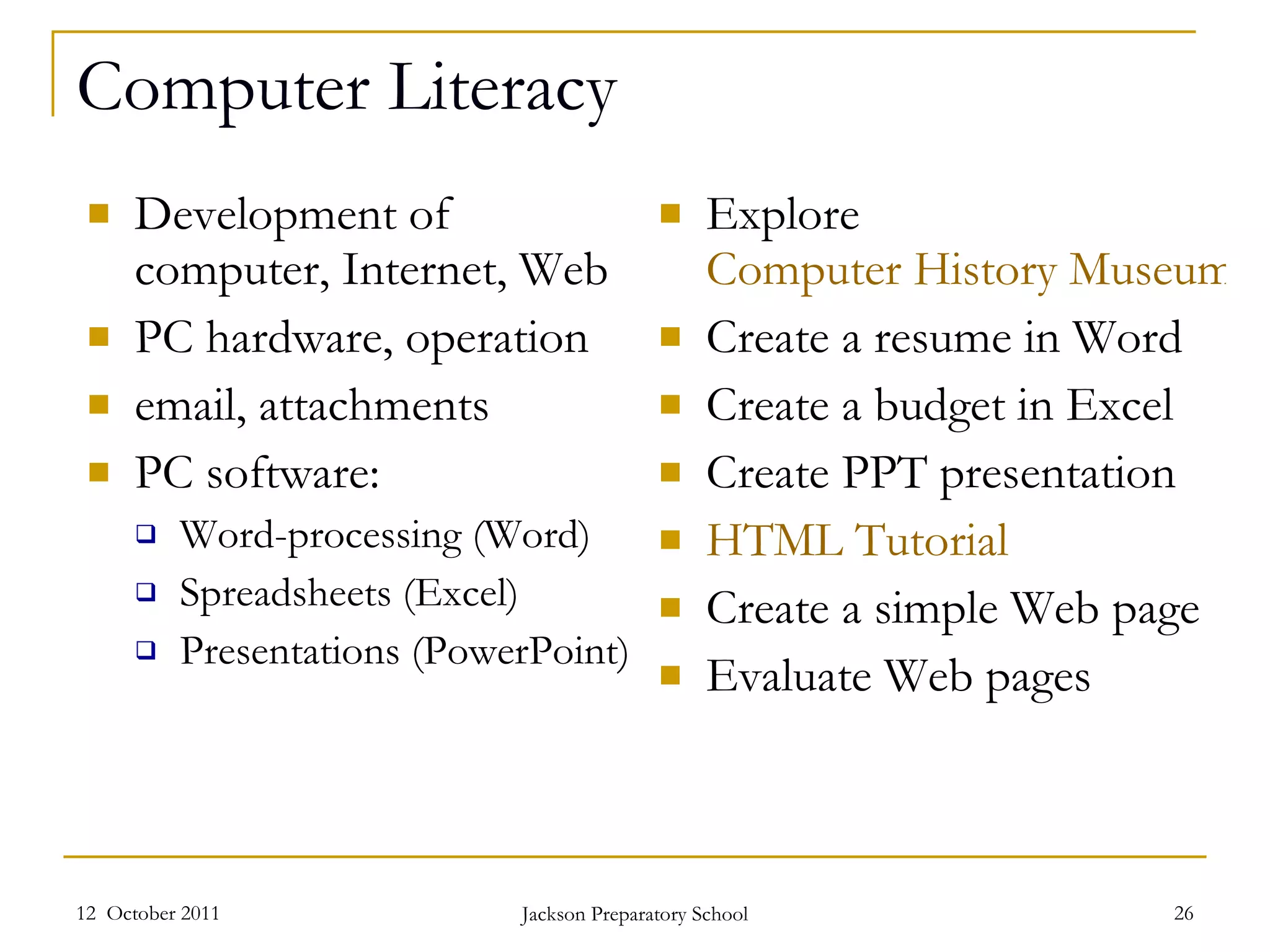
Computer Literacy Development of computer, Internet, Web PC hardware, operation email, attachments PC software: Word-processing (Word) Spreadsheets (Excel) Presentations (PowerPoint) Explore  Computer History Museum Create a resume in Word Create a budget in Excel Create PPT presentation HTML Tutorial Create a simple Web page Evaluate Web pages 12  October 2011 Jackson Preparatory School
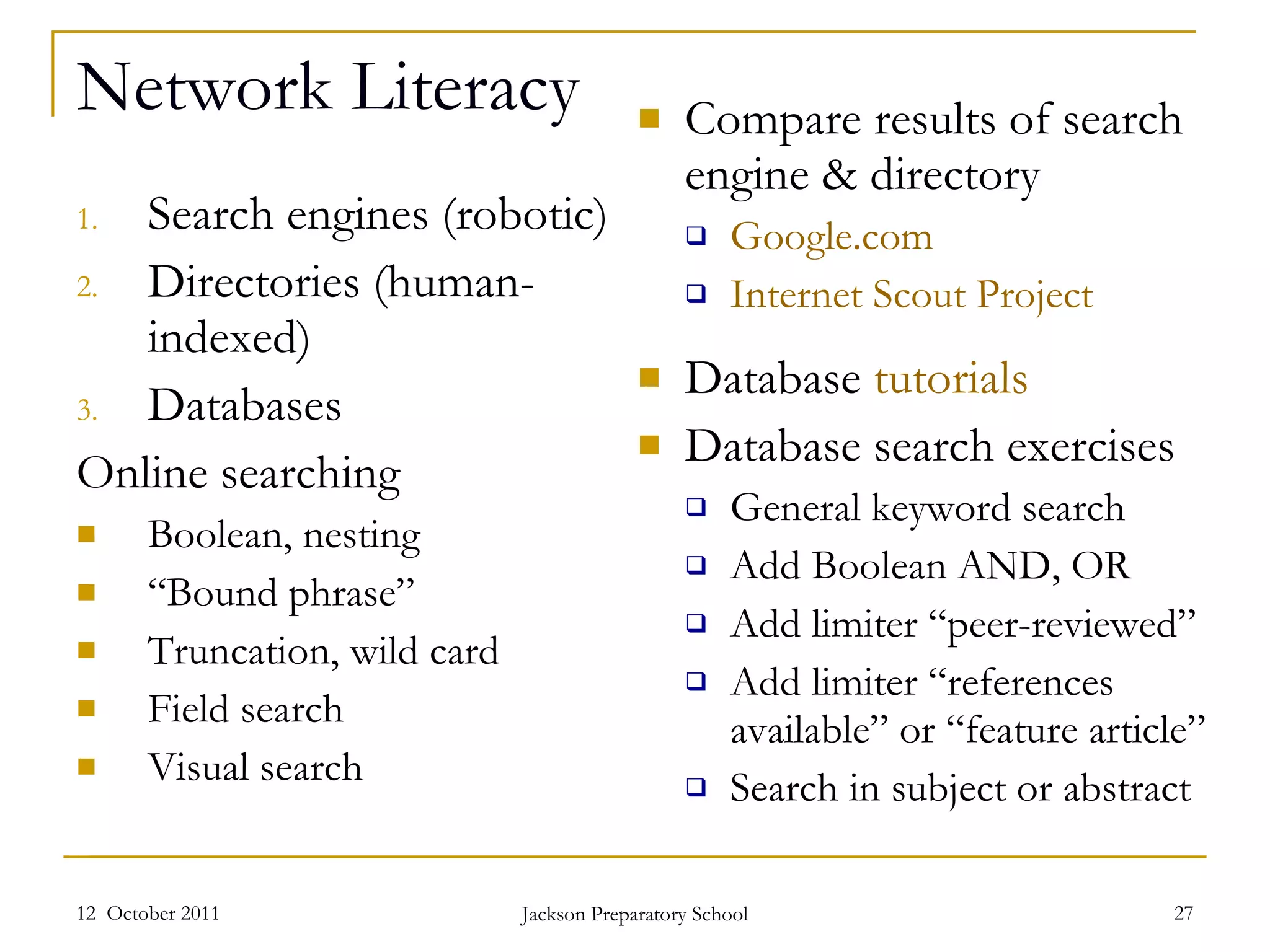
Network Literacy Search engines (robotic) Directories (human-indexed) Databases  Online searching Boolean, nesting “ Bound phrase” Truncation, wild card Field search Visual search Compare results of search engine & directory Google.com Internet Scout Project Database  tutorials Database search exercises General keyword search Add Boolean AND, OR Add limiter “peer-reviewed” Add limiter “references available” or “feature article” Search in subject or abstract  12  October 2011 Jackson Preparatory School
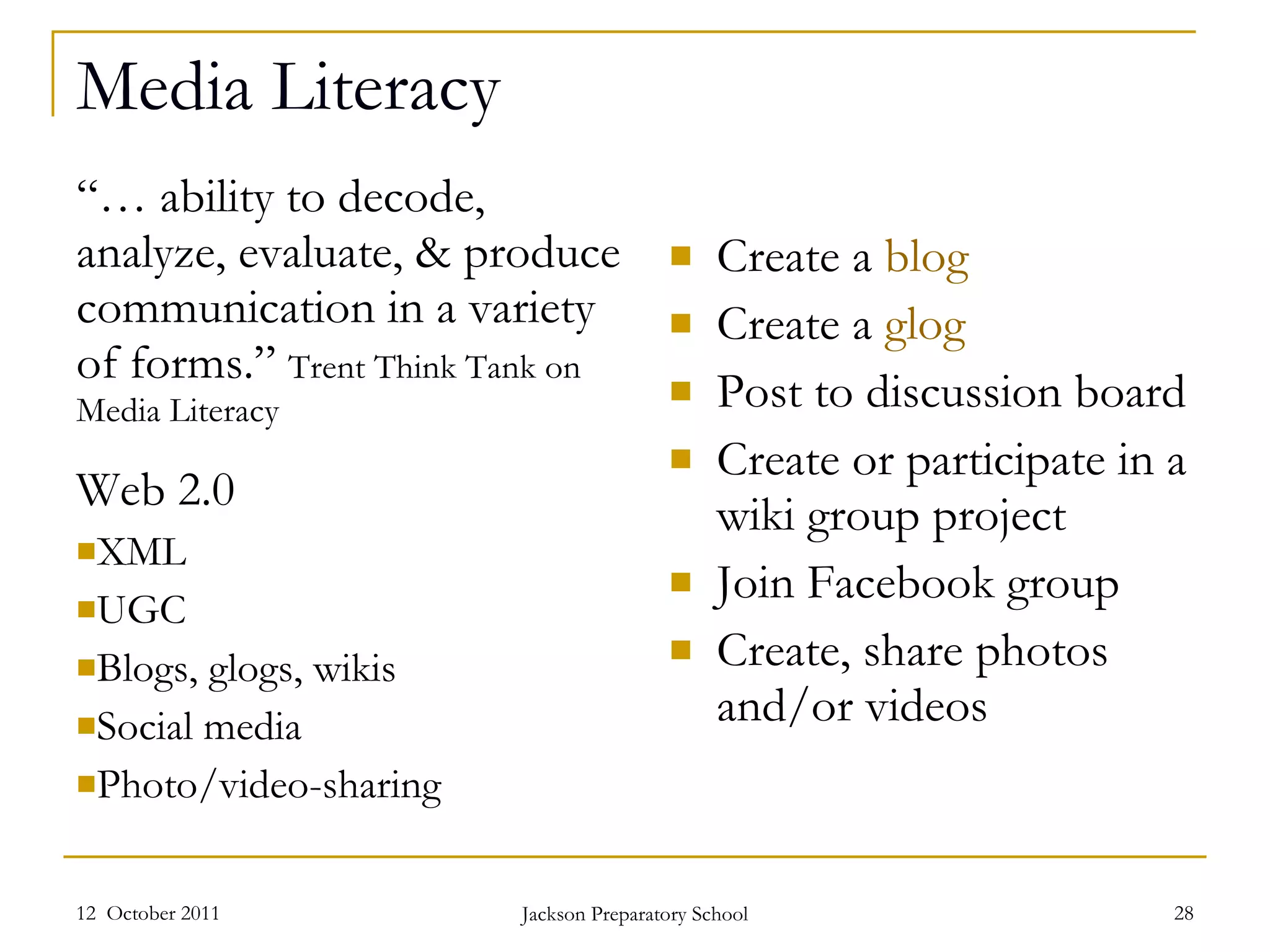
Media Literacy “…  ability to decode, analyze, evaluate, & produce communication in a variety of forms.”  Trent Think Tank on Media Literacy Web 2.0 XML UGC Blogs, glogs, wikis Social media Photo/video-sharing Create a  blog Create a  glog Post to discussion board Create or participate in a wiki group project Join Facebook group Create, share photos and/or videos 12  October 2011 Jackson Preparatory School
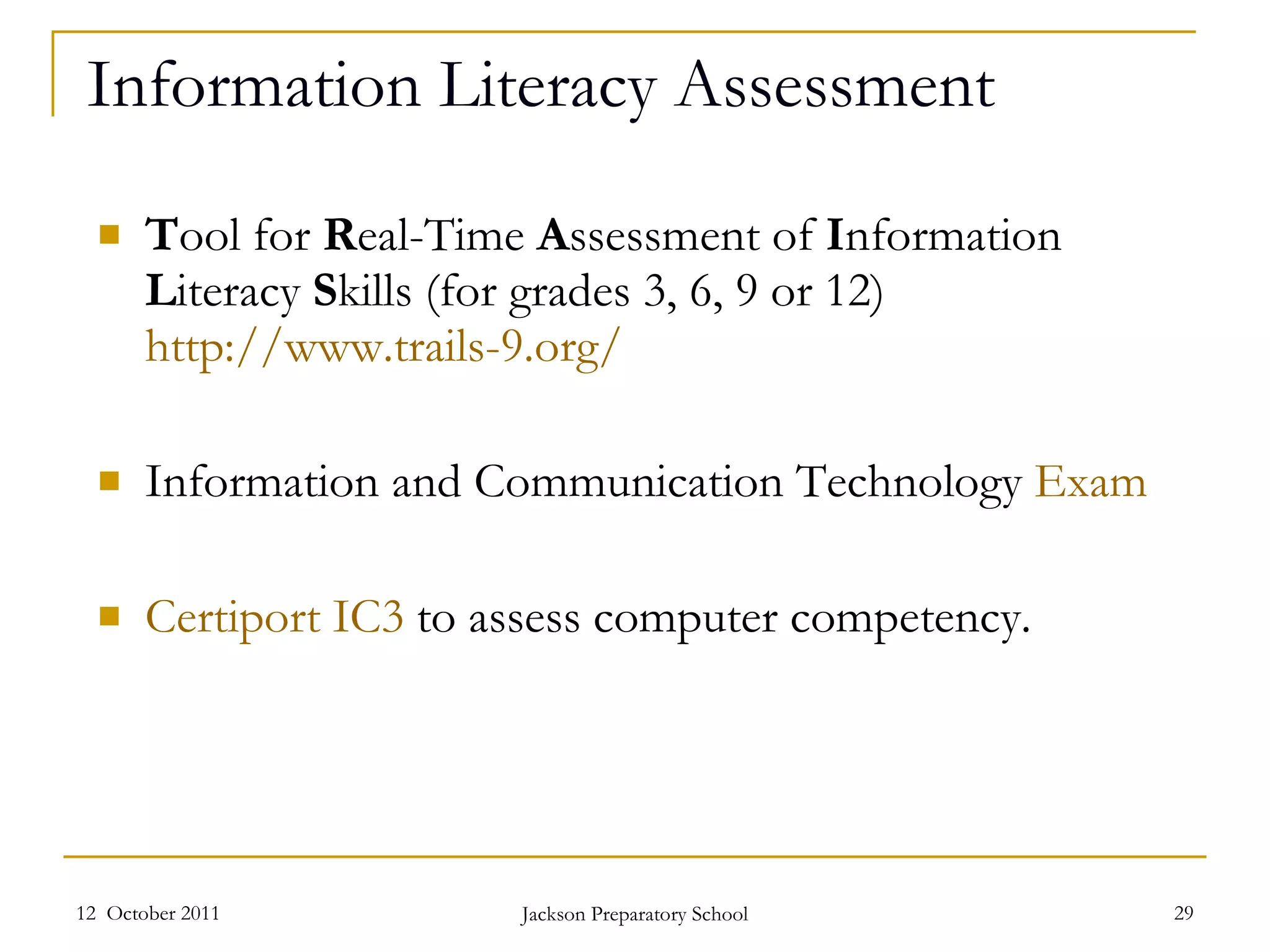
Information Literacy Assessment T ool for  R eal-Time  A ssessment of  I nformation  L iteracy  S kills (for grades 3, 6, 9 or 12)  http://www.trails-9.org /   Information and Communication Technology  E xam  Certiport IC3  to assess computer competency. 12  October 2011 Jackson Preparatory School
Information Literacy Assessment Walsh (2009) identified 9 commonly used types of assessments for information literacy skills: Bibliographic analysis Essays Final grades Multiple choice surveys Observation Portfolios Quiz/test Self-assessment Simulation.  12  October 2011 Jackson Preparatory School
Information Literacy Resources Elementary & Middle School Literacy Resources http://www.slimekids.com /   Teen Literacy Resources http:// www.nicksenger.com/blog/resources   Educational Games http://www.nobelprize.org/educational /   Library Skills Games http:// library.stjosephsea.org/quia.htm   12  October 2011 Jackson Preparatory School
Bibliography CIBER (2008). Information Behaviour of the Researcher of the Future: Google Generation Project.  London: CIBER.  http://www.ucl.ac.uk/infostudies/research/ciber/downloads/   National Council of Teachers of English. (2008). “NCTE’s Definition of 21 st  Century Literacies”.  http://www.ncte.org/announce/129117.htm?source=gs Johnson, L., Smith, R., Willis, H., Levine, A., and Haywood, K., (2011).  The 2011 Horizon Report.  Austin, Texas: The New Media Consortium.  http://www.nmc.org/pdf/2011-Horizon-Report.pdf   Welsh, T.S., & Wright, M. S. (2010).  Information literacy in the digital age: an evidence-based approach . Oxford, Chandos.  http://neal-schuman.com/blog/2010/08/23/new-book-gives-readers-the-tools-they-need-to-evaluate-and-understand-information-through-a-digital-lens/   12  October 2011 Jackson Preparatory School
Thank you  for your attention. Please email me at: [email_address]   12  October 2011 Jackson Preparatory School

Information Literacy for the Google Generation

  • 1.
    Information Literacy forthe Google Generation Teresa S. Welsh, Ph.D. [email_address]
  • 2.
    Questions to beaddressed: What is information literacy? Why is IL important? What research is related to information literacy? What learning theory is related to IL? How can IL research & theory inform teaching? How can IL be assessed? 12 October 2011 Jackson Preparatory School
  • 3.
    What is InformationLiteracy? “ Information” is from Latin informatio , meaning concept or idea. “ Literate” is from Latin literatus , meaning learned or lettered. 12 October 2011 Jackson Preparatory School www.TechKnowLogia.org
  • 4.
    Information Literacy: AMeta-Literacy National Council of Teachers of English (NCTE): “21st century demands that a literate person possess a wide range of abilities and competencies, many literacies .” Develop proficiency with technology tools Build relationships with others to pose and solve problems collaboratively, cross-culturally Design and share information to meet a variety of purposes Manage, analyze, synthesize multiple streams of simultaneous information Create, critique, analyze, and evaluate multi-media texts Attend to ethical responsibilities required by complex environments.   12 October 2011 Jackson Preparatory School
  • 5.
    Information Literacy: AMeta-Literacy 12 October 2011 Jackson Preparatory School http://uniedtechdesign.blogspot.com/2011/03/information-literacy.html
  • 6.
    How is InfoLiteracy defined by LIS? ALA, ACRL: IL is “a set of abilities requiring individuals to recognize when information is needed and have the ability to locate, evaluate, and use effectively the needed information.” Determine the extent of information needed Access the needed information effectively and efficiently Evaluate information and its sources critically Incorporate selected information into one's knowledge base Use information effectively to accomplish a specific purpose Understand the economic, legal, and social issues and use information ethically and legally.   12 October 2011 Jackson Preparatory School
  • 7.
    According to ALA,information literacy is “increasingly important in the contemporary environment of rapid technological change and proliferating information resources…” “Information literacy forms the basis for lifelong learning and is common to all disciplines , to all learning environments , and to all levels of education .” 12 October 2011 Jackson Preparatory School Why is Information Literacy important?
  • 8.
    Why is InformationLiteracy important? "Information is the new world currency and wealth will be measured by how much information a company, individual, or country can create, distribute, accumulate, and mine." Mark Dean, PhD , IBM Fellow, Inventors Hall of Fame Information literacy is a important factor in building resiliency. 12 October 2011 Jackson Preparatory School Cartoon by Bill Waterson
  • 9.
    How do teachers/librariansbuild resiliency? 1. Support and encourage education 2. Value students, exhibit friendliness 3. Provide rules that are consistent and clear 4. Provide rules, programs, services developed with student input 5. Promote service to others, “required helpfulness” 6. Provide information on health, education, employment, recreation 7. Provide opportunities to develop, practice life skills: cooperation, leadership, decision-making, problem-solving, impulse control 8. Help develop talents, hobbies, and interests 9. Provide opportunities to be sociable 10. Promote reading. 12 October 2011 Jackson Preparatory School Dr. Jami Jones ( www.askdrjami.org )
  • 10.
    Research: The GoogleGeneration Research on Google Generation (those born after 1993) conducted by CIBER (UCL Centre for Information Behaviour & Evaluation of Research) indicates: Online searching tends to be shallow, information-skimming, not in-depth searching 60% visit a site once only and view each Web page only a few seconds Prefer quick information in form of easily-digested short chunks rather than full-text. 12 October 2011 Jackson Preparatory School Information Behaviour of the Researcher of the Future. London: CIBER, 2008.
  • 11.
    12 October2011 Jackson Preparatory School Information Behaviour of the Researcher of the Future. London: CIBER, 2008 .
  • 12.
    Kent State LibraryResearch: TRAILS T ool for R eal-Time A ssessment of I nformation L iteracy S kills (free online assessment for grades 3, 6, 9 or 12) Boswell (2007) TRAILS study: Greatest weaknesses of students in evaluating information and in using Boolean search techniques . Supported by CIBER research (2008): Little time spent in evaluating information, either for relevance, accuracy or authority Poor understanding of information needs so students find it difficult to develop effective search strategies. 12 October 2011 Jackson Preparatory School http://www.trails-9.org/ http://www.ucl.ac.uk/infostudies/research/ciber/downloads/
  • 13.
    Evaluating Information: SourceTypes Primary Sources – first-hand information Original documents or images, eye-witness accounts Original research from scholarly, peer-reviewed sources Raw data, government reports such as census data. Secondary Sources – second-hand information Not primary or original, after-the-fact Analyzes, interprets primary-source information Textbooks, encyclopedias, non-fiction books Tertiary Sources – little info, points to other sources Guides, directories, bibliographies 12 October 2011 Jackson Preparatory School
  • 14.
    Evaluating Information: CriteriaC urrency Is there a date on the source and is it current or appropriate? A uthority Is the author named and is he/she a scholar or expert? R eliability Is the publisher reliable or scholarly such as university press or is domain .edu, .gov, or .org rather than .com? Is the information accurate and objective/unbiased? S cope Is the information complete? Is the level basic or advanced? Who is the intended audience? 12 October 2011 Jackson Preparatory School
  • 15.
    Evaluating Information: Relevance12 October 2011 Jackson Preparatory School Information Need Relevant Sources for Pertinent Information Basic information Introductory or background sections of scholarly papers Secondary sources such as reference books, non-fiction books Scholarly papers, presentations Primary sources such as archival documents or images, historical newspapers, peer-reviewed journal articles, government reports, statistics
  • 16.
    2011 Horizon Report: Emerging Trends Qualitative Study by New Media Consortium Abundance of Internet resources are increasingly challenging for sense-making, coaching, credentialing. People expect to work, learn, and study whenever, wherever they want. World of work is increasingly collaborative, giving rise to reflection on structure of student projects. Technologies are increasingly cloud-based, and notions of IT support decentralized. 12 October 2011 Jackson Preparatory School http://net.educause.edu/ir/library/pdf/HR2011.pdf
  • 17.
    2011 Horizon Report: Challenges Digital media literacy continues rise in importance as key skill in every discipline and profession. Evaluation metrics lag behind emergence of new scholarly forms of authoring, publishing, research. Economic pressures, new models of education present competition to traditional models. Keeping pace with rapid proliferation of information, tools, & devices is challenging. 12 October 2011 Jackson Preparatory School http://net.educause.edu/ir/library/pdf/HR2011.pdf
  • 18.
    2011 Horizon Report: Tech Adoption Now : 1 year or less: e-books ( NetLibrary , ebrary ) Mobiles (i-Phone, Android smart phone, i-Pad) Near-term future: 2-3 Years Augmented reality: “computer-assisted contextual layer of information over the real world, creating a reality that is enhanced or augmented.” ( http ://www.layar.com / ) Game-based learning ( http://gaming.psu.edu / ). 12 October 2011 Jackson Preparatory School http://net.educause.edu/ir/library/pdf/HR2011.pdf
  • 19.
    12 October2011 Jackson Preparatory School http://info.xplana.com/report/ Xplana Report
  • 20.
    2011 Horizon Report: Tech Adoption Longer-term future: 4-5 Years Gesture-based computing (Kinect, SixthSense, Tamper) Haptics touch-surface technology such as Mudpad ( http :// hci.rwth-aachen.de/mudpad ) Eye movement technology such as EyeDraw ( http ://www.cs.uoregon.edu/research/cm-hci/EyeDraw / ) Analytics: new data-gathering tools and analytic techniques to study student engagement, performance, progress ( http://www. google.com/analytics ). 12 October 2011 Jackson Preparatory School http://net.educause.edu/ir/library/pdf/HR2011.pdf
  • 21.
    Learning Theory: Connectivism Learning: Process of connecting specialized nodes/information sources Rests in diversity of opinions May reside in non-human appliances Requires nurturing, maintaining connections Requires accurate, up-to-date knowledge Includes decision-making. Capacity to know is more critical than what is known. Core skill is ability to see connections between ideas, concepts (Siemens, 2004). 12 October 2011 Jackson Preparatory School
  • 22.
    Learning Theory: Active Learning Opposite of passive learning through lectures Process of active engagement in learning Involves reading, writing, discussion, engagement in solving problems, analysis, synthesis, evaluation Class discussion, demonstration Storytelling Game-playing Group project Field trip, study-abroad Short, evaluative or reflective post or paper Creation of Web content 12 October 2011 Jackson Preparatory School
  • 23.
    Cultural Literacy Latin cultura meaning “to nurture or cultivate” Awareness and ability to converse fluently in the history, allusions, and informal content that constitutes ones own culture or another culture. Cultural Literacy Quiz Essay on origins of words, alphabet, public schools Newspaper item on day of birth (microfilm or online) Family tree, family history Short essay or post on local cultural exhibit Short essay on local history Travel/field trips. 12 October 2011 Jackson Preparatory School
  • 24.
    Library Literacy Latin liber , meaning “books”; also means “free” Latin adjective librarius , meaning “of books” Essay or post on ancient library Post on 1 st school library, 1 st public library Library tutorials Library scavenger hunt Information tutorial Primary sources Secondary sources Tertiary sources 12 October 2011 Jackson Preparatory School
  • 25.
    Ethical Literacy Ethicsis from Greek ethos , meaning “character” Moral principles or values Code of Honor Plagiarism tutorial Copyright tutorial Citation Machine Submit papers to Turnitin.com 12 October 2011 Jackson Preparatory School
  • 26.
    Computer Literacy Developmentof computer, Internet, Web PC hardware, operation email, attachments PC software: Word-processing (Word) Spreadsheets (Excel) Presentations (PowerPoint) Explore Computer History Museum Create a resume in Word Create a budget in Excel Create PPT presentation HTML Tutorial Create a simple Web page Evaluate Web pages 12 October 2011 Jackson Preparatory School
  • 27.
    Network Literacy Searchengines (robotic) Directories (human-indexed) Databases Online searching Boolean, nesting “ Bound phrase” Truncation, wild card Field search Visual search Compare results of search engine & directory Google.com Internet Scout Project Database tutorials Database search exercises General keyword search Add Boolean AND, OR Add limiter “peer-reviewed” Add limiter “references available” or “feature article” Search in subject or abstract 12 October 2011 Jackson Preparatory School
  • 28.
    Media Literacy “… ability to decode, analyze, evaluate, & produce communication in a variety of forms.” Trent Think Tank on Media Literacy Web 2.0 XML UGC Blogs, glogs, wikis Social media Photo/video-sharing Create a blog Create a glog Post to discussion board Create or participate in a wiki group project Join Facebook group Create, share photos and/or videos 12 October 2011 Jackson Preparatory School
  • 29.
    Information Literacy AssessmentT ool for R eal-Time A ssessment of I nformation L iteracy S kills (for grades 3, 6, 9 or 12) http://www.trails-9.org / Information and Communication Technology E xam Certiport IC3 to assess computer competency. 12 October 2011 Jackson Preparatory School
  • 30.
    Information Literacy AssessmentWalsh (2009) identified 9 commonly used types of assessments for information literacy skills: Bibliographic analysis Essays Final grades Multiple choice surveys Observation Portfolios Quiz/test Self-assessment Simulation. 12 October 2011 Jackson Preparatory School
  • 31.
    Information Literacy ResourcesElementary & Middle School Literacy Resources http://www.slimekids.com / Teen Literacy Resources http:// www.nicksenger.com/blog/resources Educational Games http://www.nobelprize.org/educational / Library Skills Games http:// library.stjosephsea.org/quia.htm 12 October 2011 Jackson Preparatory School
  • 32.
    Bibliography CIBER (2008).Information Behaviour of the Researcher of the Future: Google Generation Project. London: CIBER. http://www.ucl.ac.uk/infostudies/research/ciber/downloads/ National Council of Teachers of English. (2008). “NCTE’s Definition of 21 st Century Literacies”. http://www.ncte.org/announce/129117.htm?source=gs Johnson, L., Smith, R., Willis, H., Levine, A., and Haywood, K., (2011). The 2011 Horizon Report. Austin, Texas: The New Media Consortium. http://www.nmc.org/pdf/2011-Horizon-Report.pdf Welsh, T.S., & Wright, M. S. (2010). Information literacy in the digital age: an evidence-based approach . Oxford, Chandos. http://neal-schuman.com/blog/2010/08/23/new-book-gives-readers-the-tools-they-need-to-evaluate-and-understand-information-through-a-digital-lens/ 12 October 2011 Jackson Preparatory School
  • 33.
    Thank you for your attention. Please email me at: [email_address] 12 October 2011 Jackson Preparatory School

Editor's Notes

  • #17 Produced by the New Media Consortium (NMC) in collaboration with partners such as the EDUCAUSE Learning Initiative (ELI).
  • #18 Produced by the New Media Consortium (NMC) in collaboration with partners such as the EDUCAUSE Learning Initiative (ELI).
  • #19 Produced by the New Media Consortium (NMC) in collaboration with partners such as the EDUCAUSE Learning Initiative (ELI).
  • #21 Produced by the New Media Consortium (NMC) in collaboration with partners such as the EDUCAUSE Learning Initiative (ELI).