There are three possible solutions to a system of linear equations in two variables:
One solution: the graphs intersect at a single point, giving the solution coordinates.
No solution: the graphs are parallel lines, making the system inconsistent.
Infinitely many solutions: the graphs are the same line, making the equations dependent.
The substitution method for solving systems involves: 1) solving one equation for a variable, 2) substituting into the other equation, 3) solving the new equation, and 4) back-substituting to find the remaining variable.
Systems of Equations
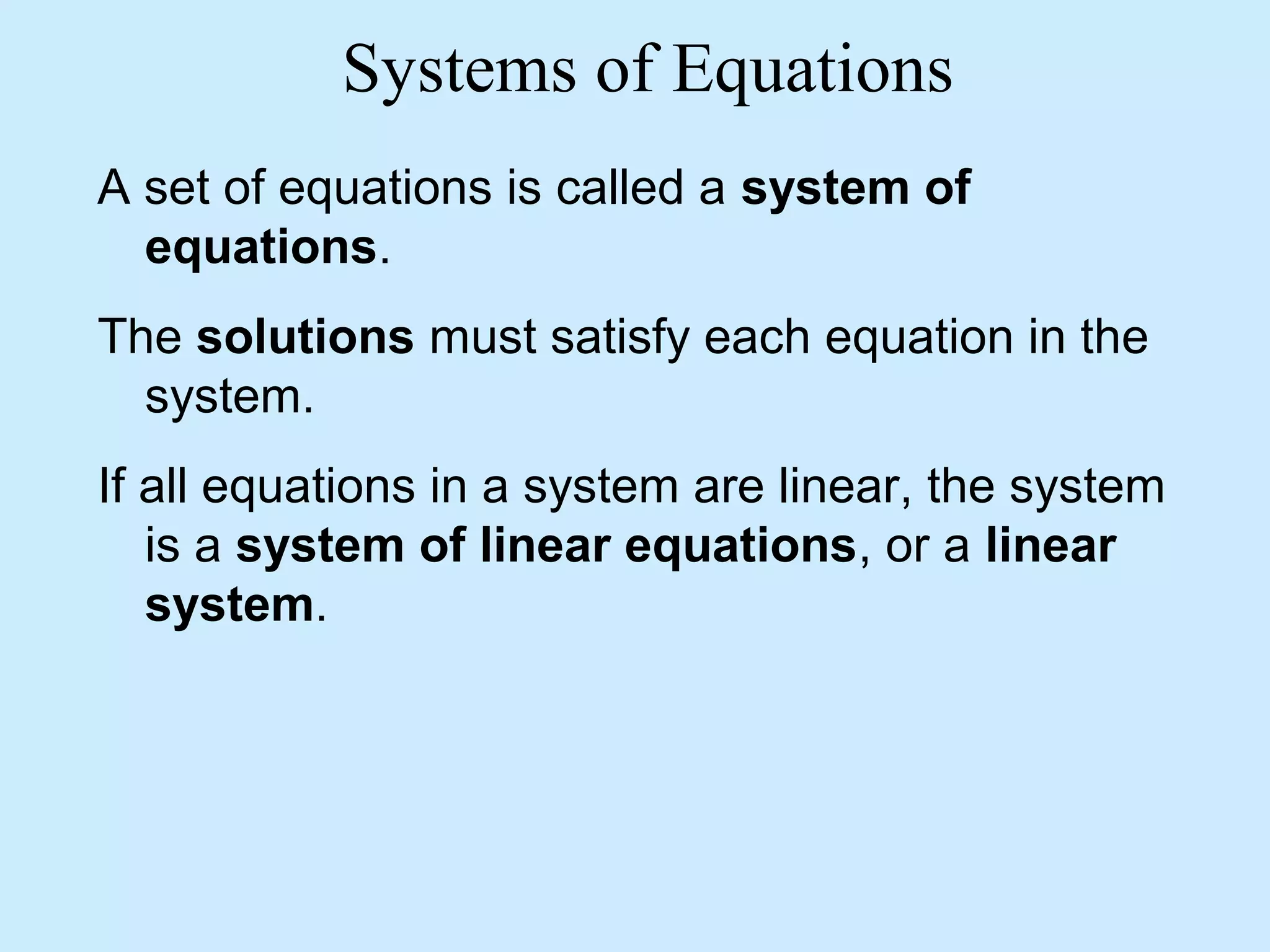
Aset of equations is called a system of
equations.
The solutions must satisfy each equation in the
system.
If all equations in a system are linear, the system
is a system of linear equations, or a linear
system.
3.
3
Systems of LinearEquations:
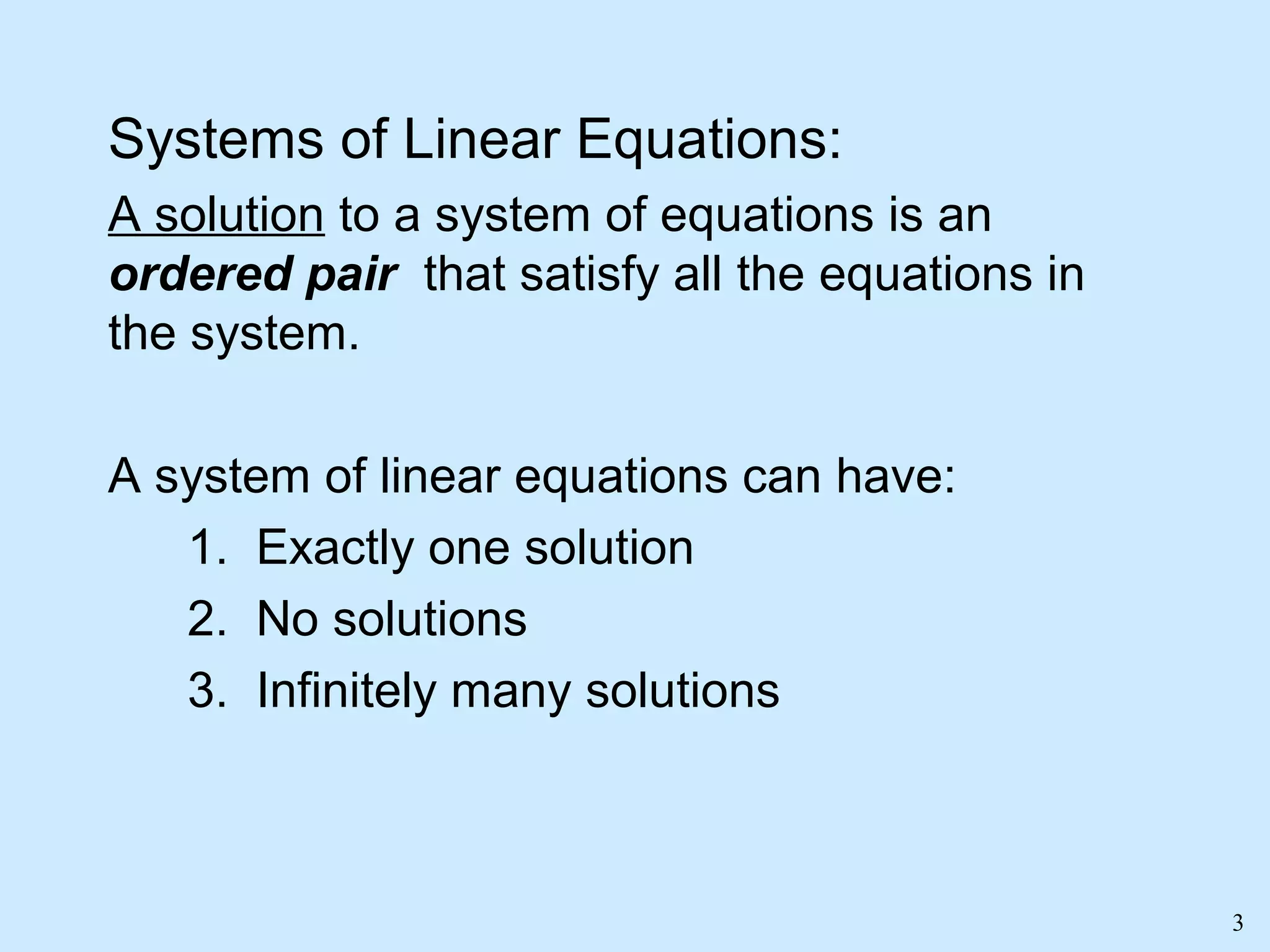
A solution to a system of equations is an
ordered pair that satisfy all the equations in
the system.
A system of linear equations can have:
1. Exactly one solution
2. No solutions
3. Infinitely many solutions
4.
4
Systems of LinearEquations:
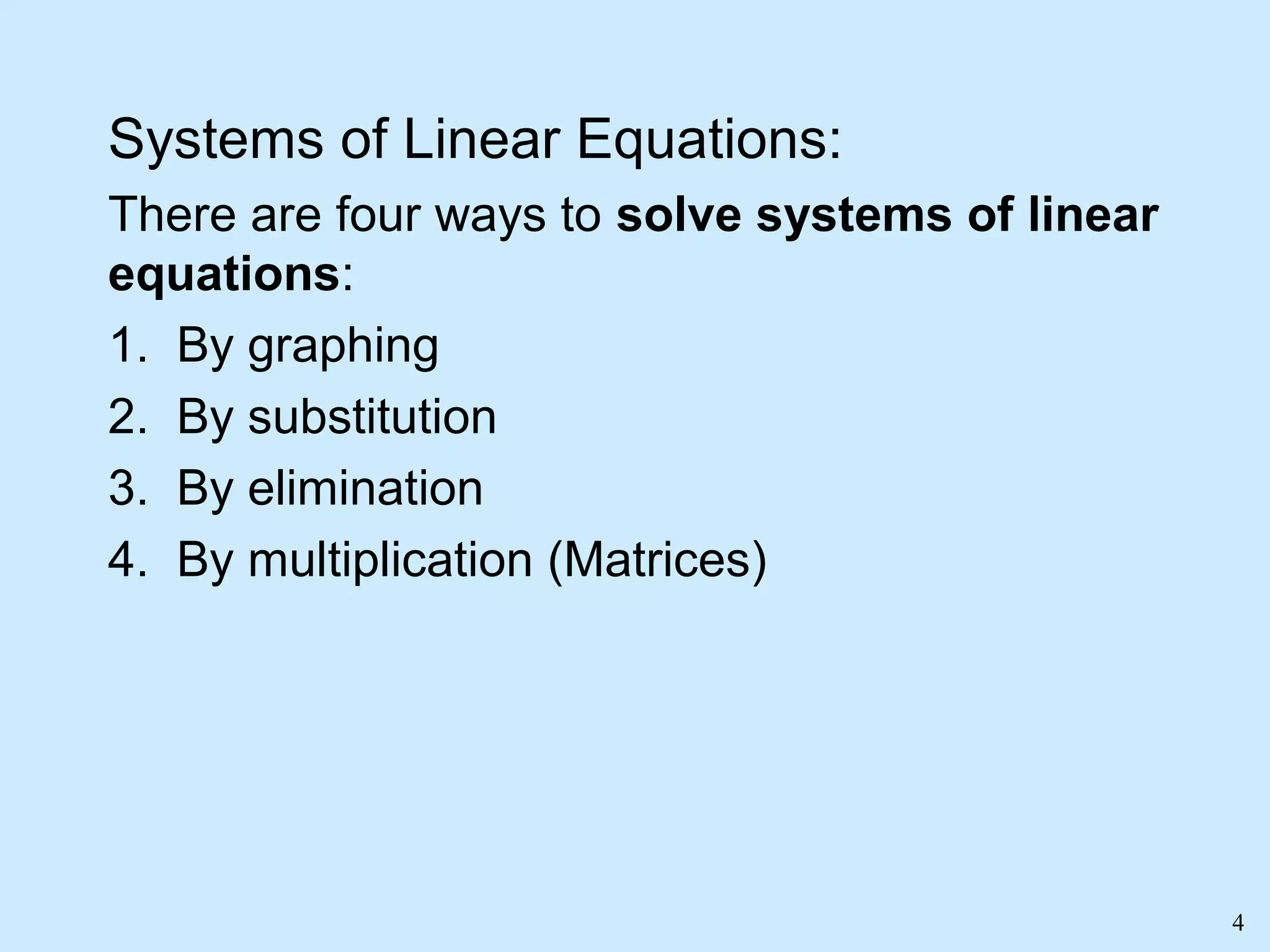
There are four ways to solve systems of linear
equations:
1. By graphing
2. By substitution
3. By elimination
4. By multiplication (Matrices)
5.
5
Solving Systems byGraphing:
When solving a system by graphing:
1. Find ordered pairs that satisfy each of the
equations.
2. Plot the ordered pairs and sketch the
graphs of both equations on the same axis.
3. The coordinates of the point or points of
intersection of the graphs are the solution or
solutions to the system of equations.
6.
6
Solving Systems byGraphing:
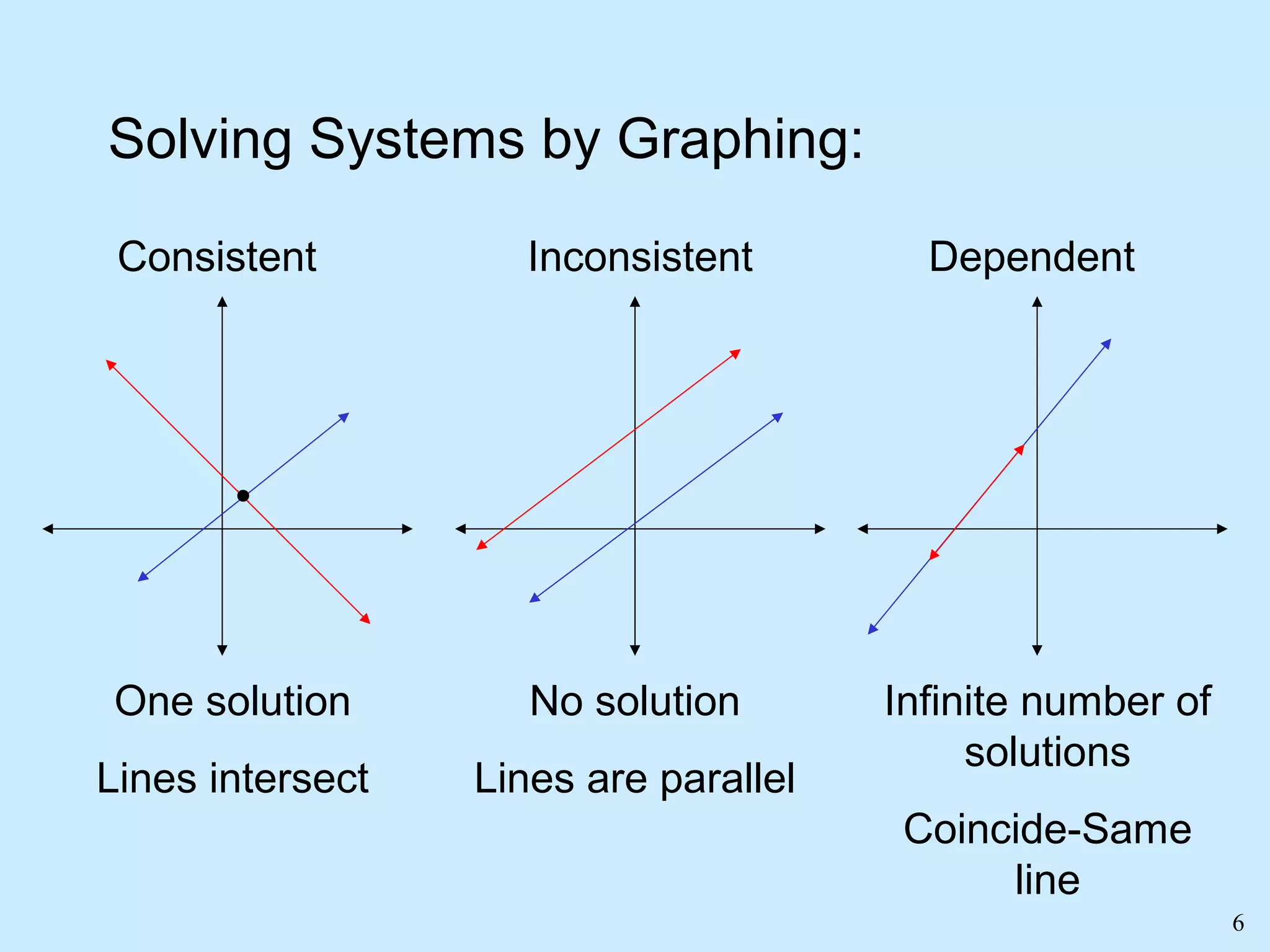
Consistent DependentInconsistent
One solution
Lines intersect
No solution
Lines are parallel
Infinite number of
solutions
Coincide-Same
line
7.
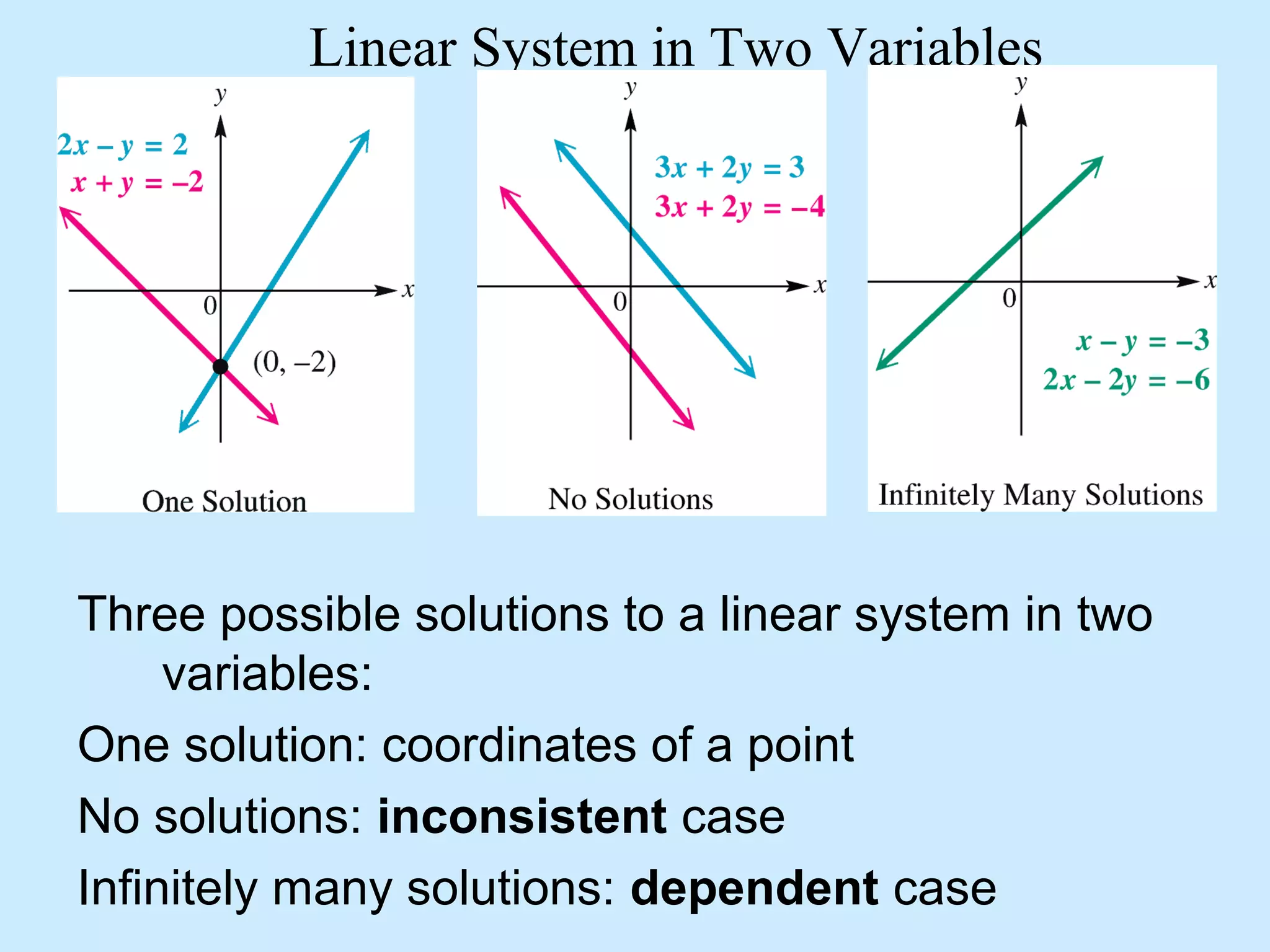
Three possible solutionsto a linear system in two
variables:
One solution: coordinates of a point
No solutions: inconsistent case
Infinitely many solutions: dependent case
Linear System in Two Variables
8.
8
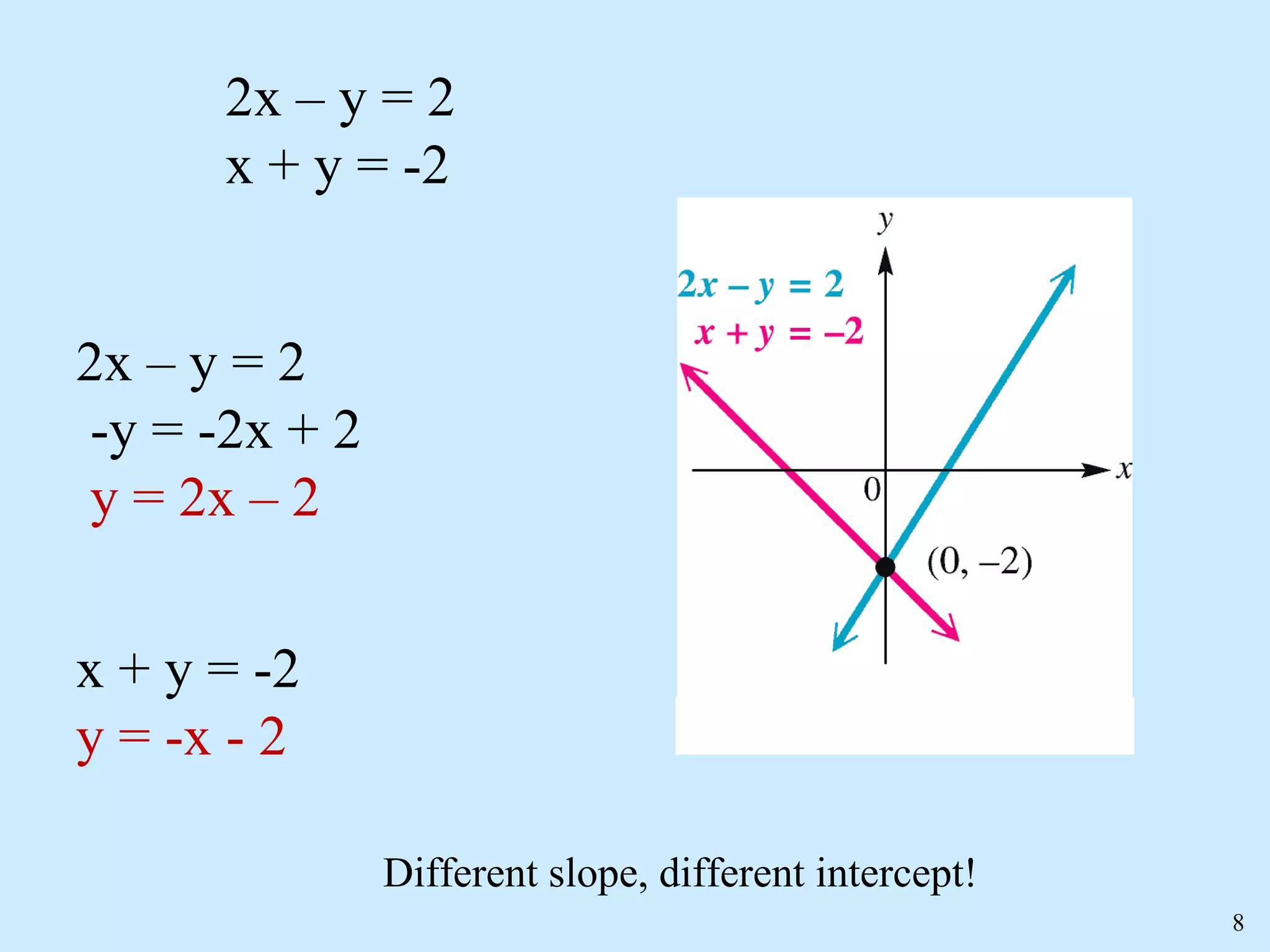
2x – y= 2
x + y = -2
2x – y = 2
-y = -2x + 2
y = 2x – 2
x + y = -2
y = -x - 2
Different slope, different intercept!
9.
9
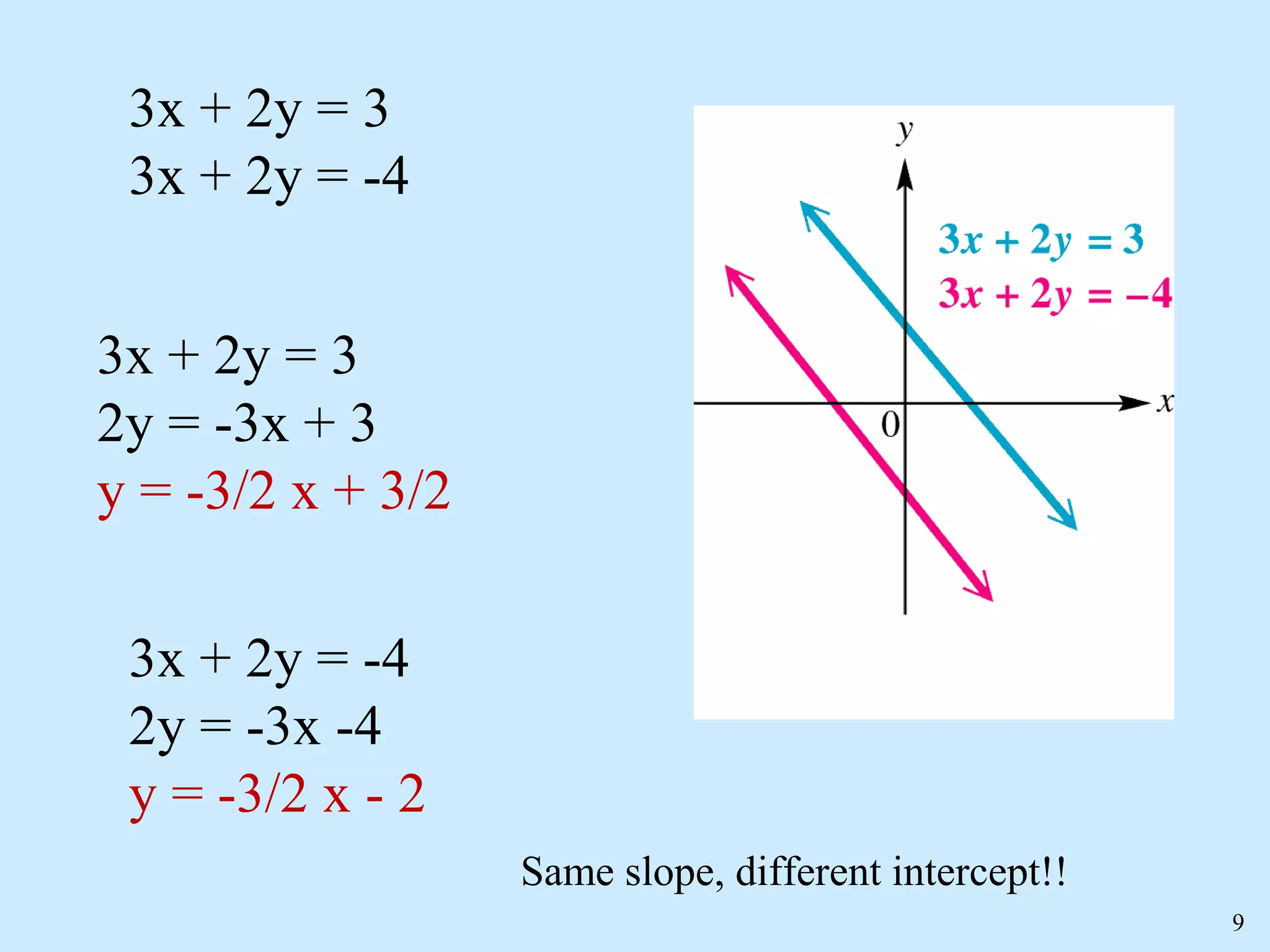
3x + 2y= 3
3x + 2y = -4
3x + 2y = 3
2y = -3x + 3
y = -3/2 x + 3/2
3x + 2y = -4
2y = -3x -4
y = -3/2 x - 2
Same slope, different intercept!!
10.
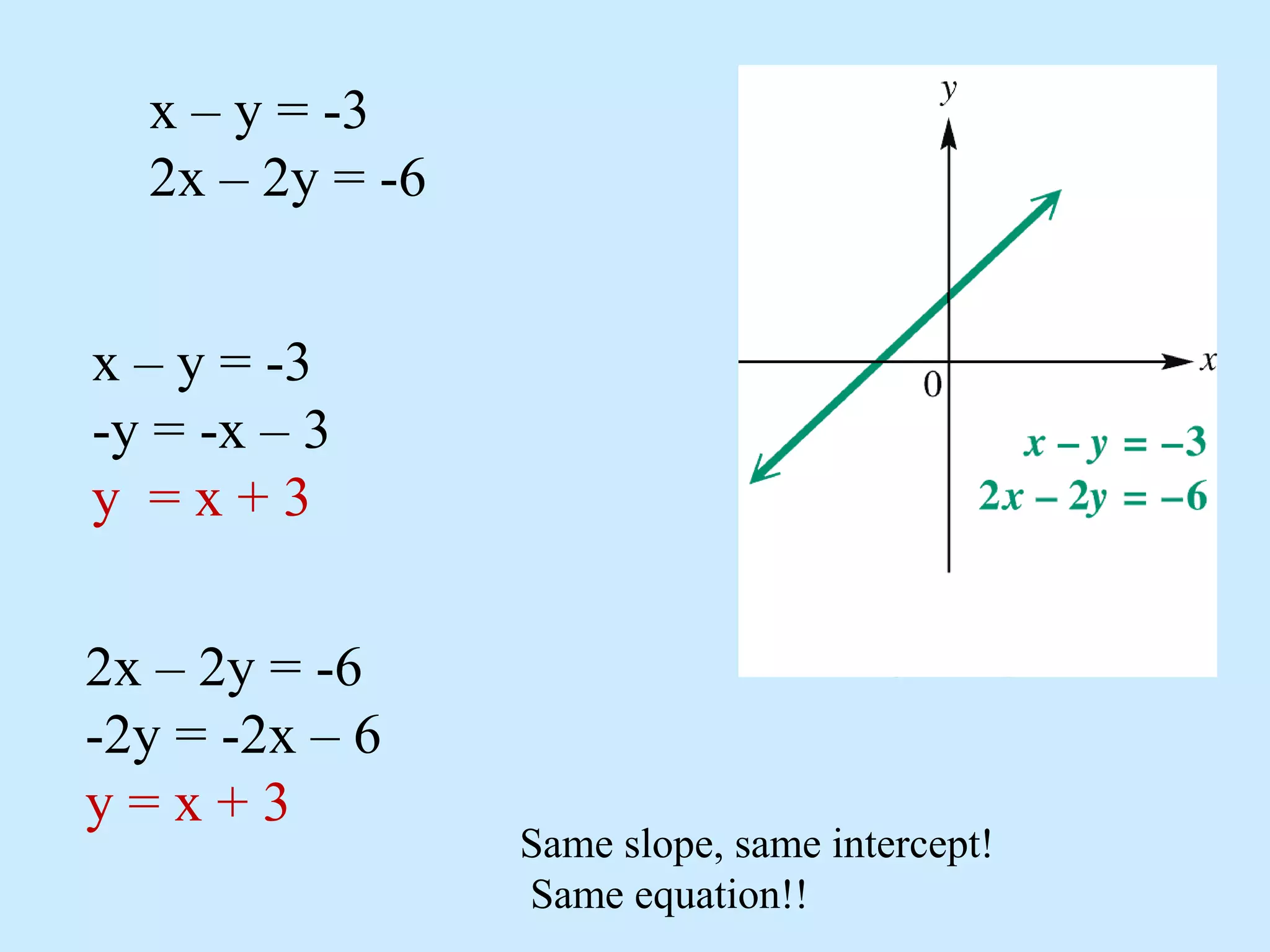
x – y= -3
2x – 2y = -6
x – y = -3
-y = -x – 3
y = x + 3
2x – 2y = -6
-2y = -2x – 6
y = x + 3
Same slope, same intercept!
Same equation!!
11.
11
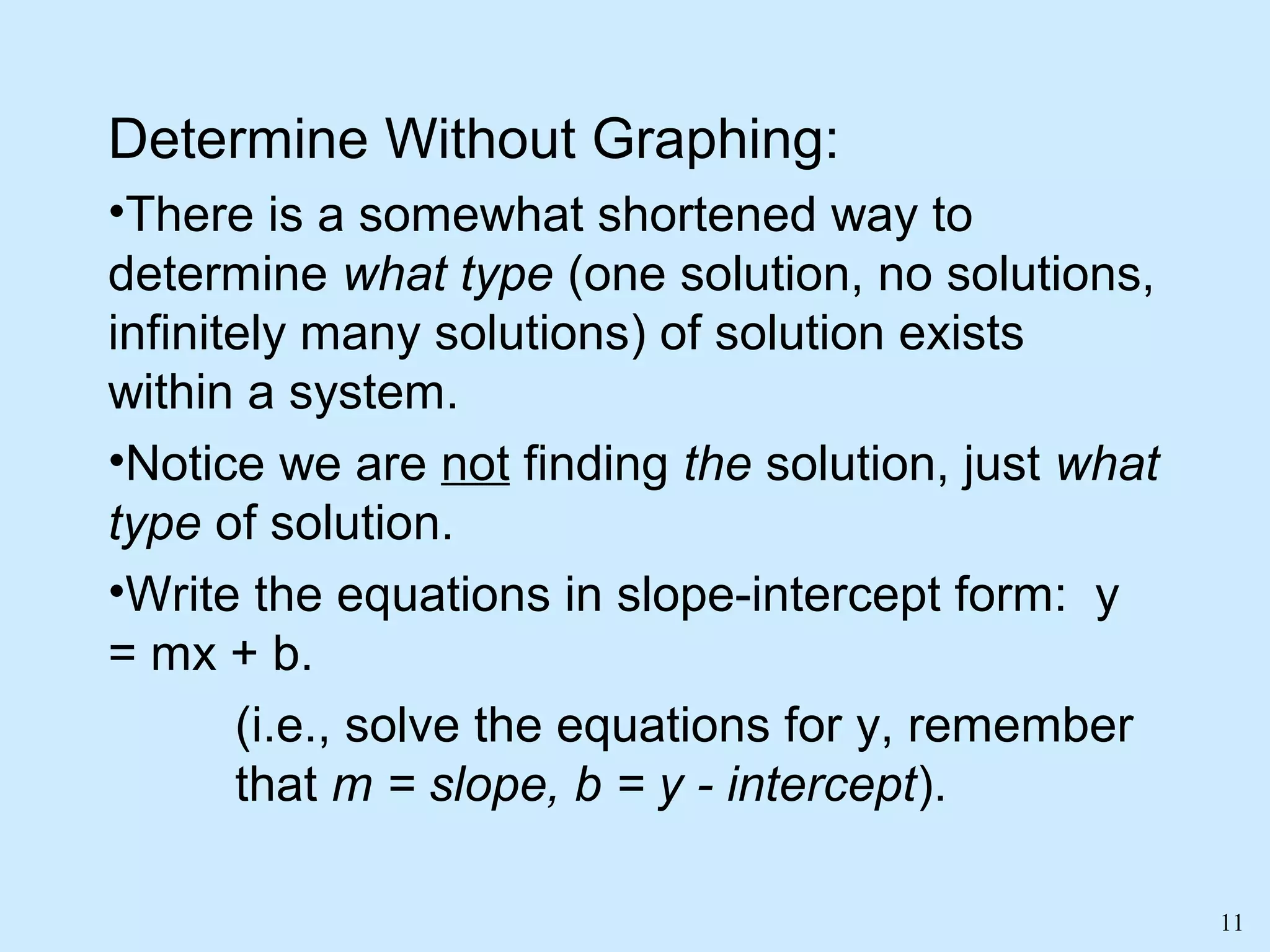
Determine Without Graphing:
•Thereis a somewhat shortened way to
determine what type (one solution, no solutions,
infinitely many solutions) of solution exists
within a system.
•Notice we are not finding the solution, just what
type of solution.
•Write the equations in slope-intercept form: y
= mx + b.
(i.e., solve the equations for y, remember
that m = slope, b = y - intercept).
12.
12
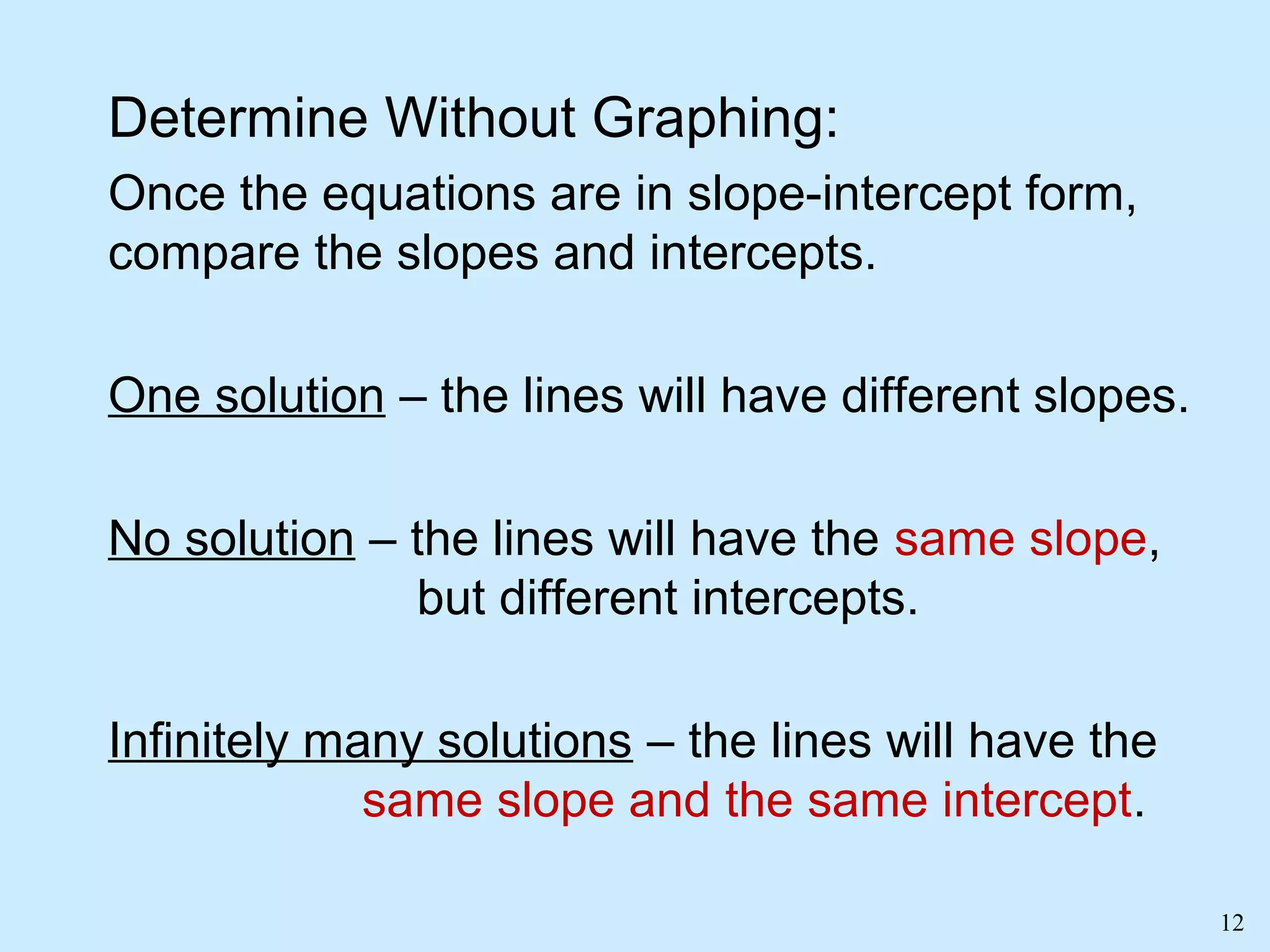
Determine Without Graphing:
Oncethe equations are in slope-intercept form,
compare the slopes and intercepts.
One solution – the lines will have different slopes.
No solution – the lines will have the same slope,
but different intercepts.
Infinitely many solutions – the lines will have the
same slope and the same intercept.
13.
13
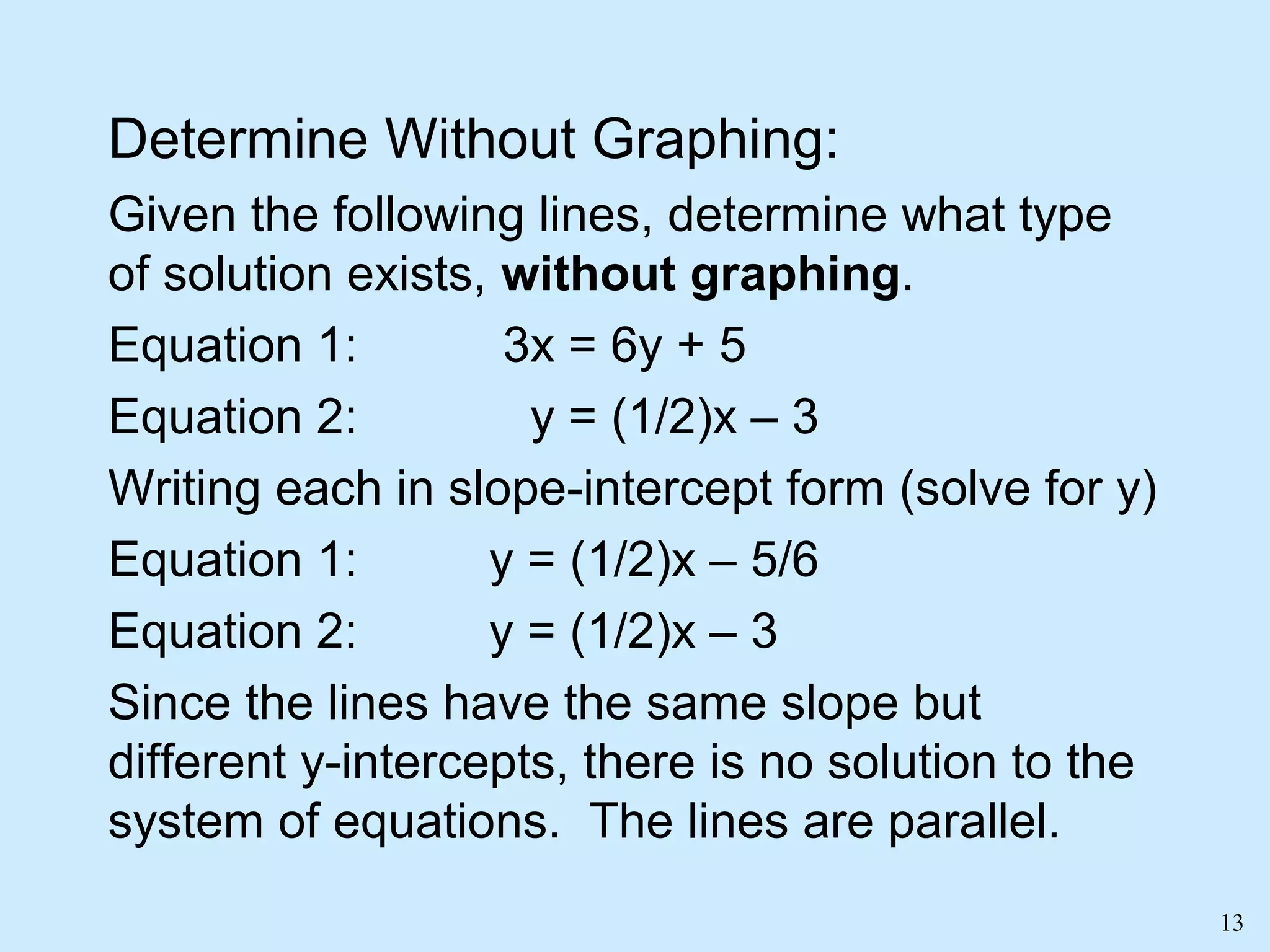
Determine Without Graphing:
Giventhe following lines, determine what type
of solution exists, without graphing.
Equation 1: 3x = 6y + 5
Equation 2: y = (1/2)x – 3
Writing each in slope-intercept form (solve for y)
Equation 1: y = (1/2)x – 5/6
Equation 2: y = (1/2)x – 3
Since the lines have the same slope but
different y-intercepts, there is no solution to the
system of equations. The lines are parallel.
14.
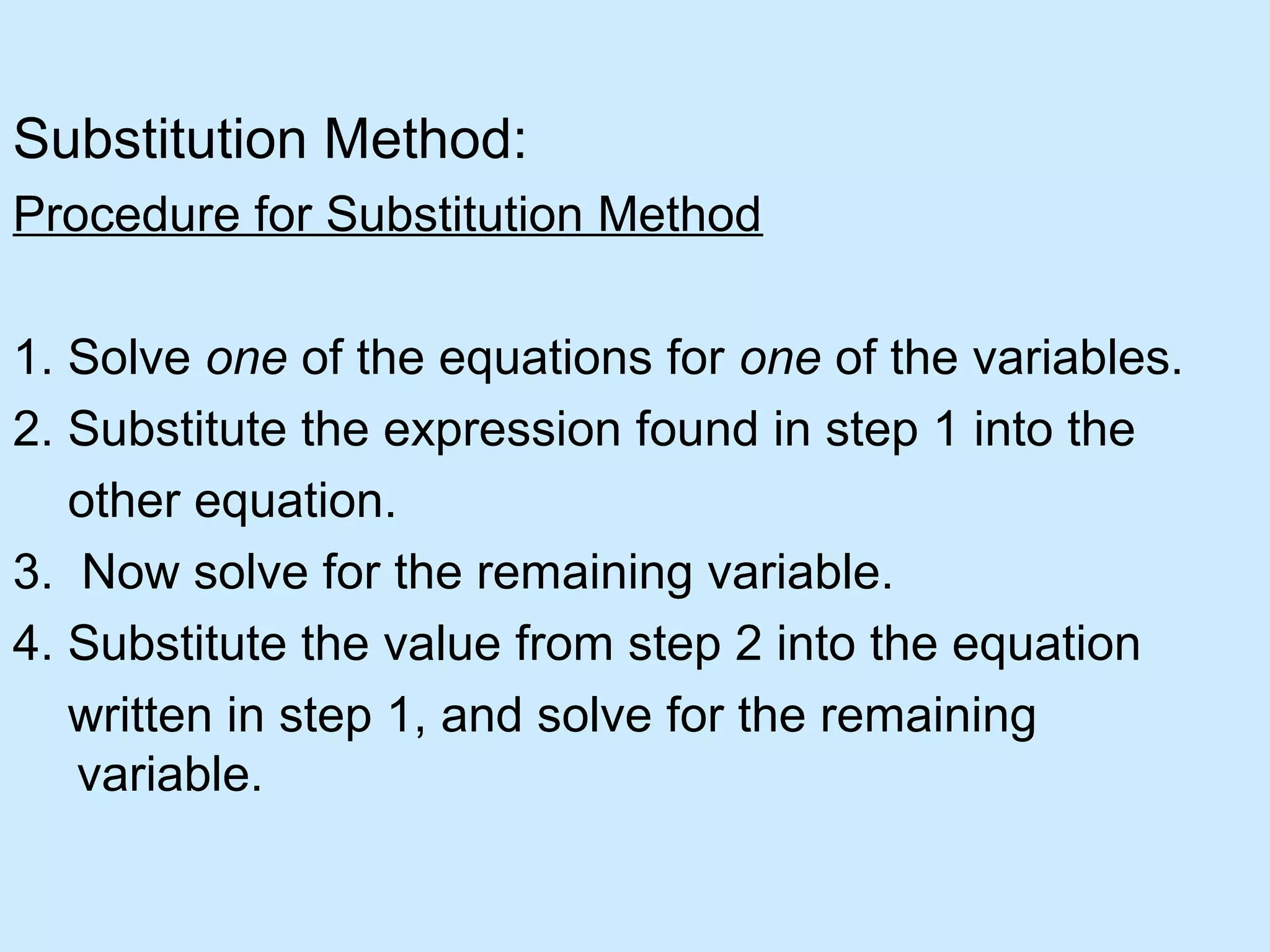
Substitution Method:
Procedure forSubstitution Method
1. Solve one of the equations for one of the variables.
2. Substitute the expression found in step 1 into the
other equation.
3. Now solve for the remaining variable.
4. Substitute the value from step 2 into the equation
written in step 1, and solve for the remaining
variable.
15.
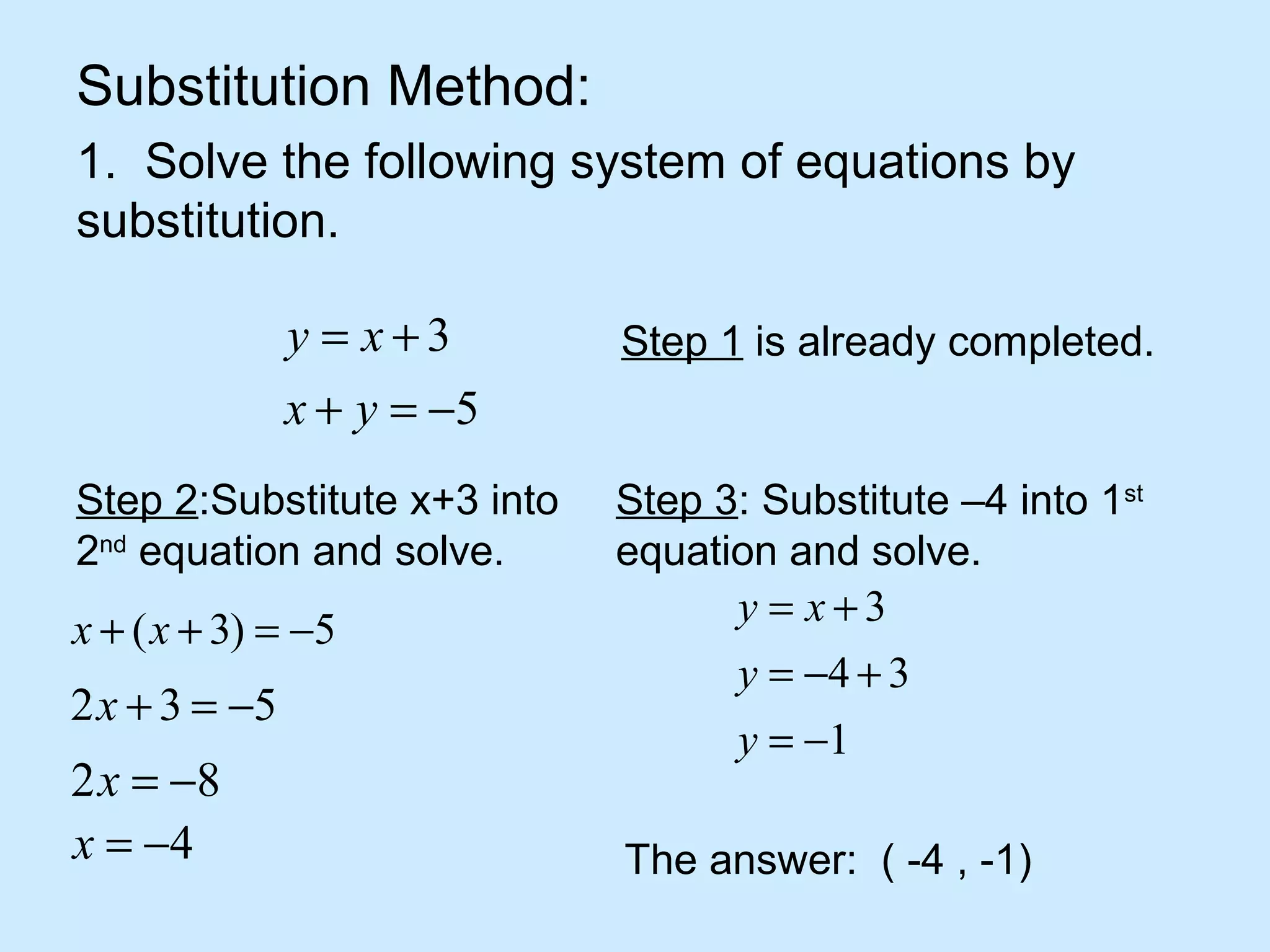
Substitution Method:
1. Solvethe following system of equations by
substitution.
5
3
−=+
+=
yx
xy
5)3( −=++ xx
532 −=+x
82 −=x
4−=x
Step 1 is already completed.
Step 2:Substitute x+3 into
2nd
equation and solve.
Step 3: Substitute –4 into 1st
equation and solve.
1
34
3
−=
+−=
+=
y
y
xy
The answer: ( -4 , -1)
16.
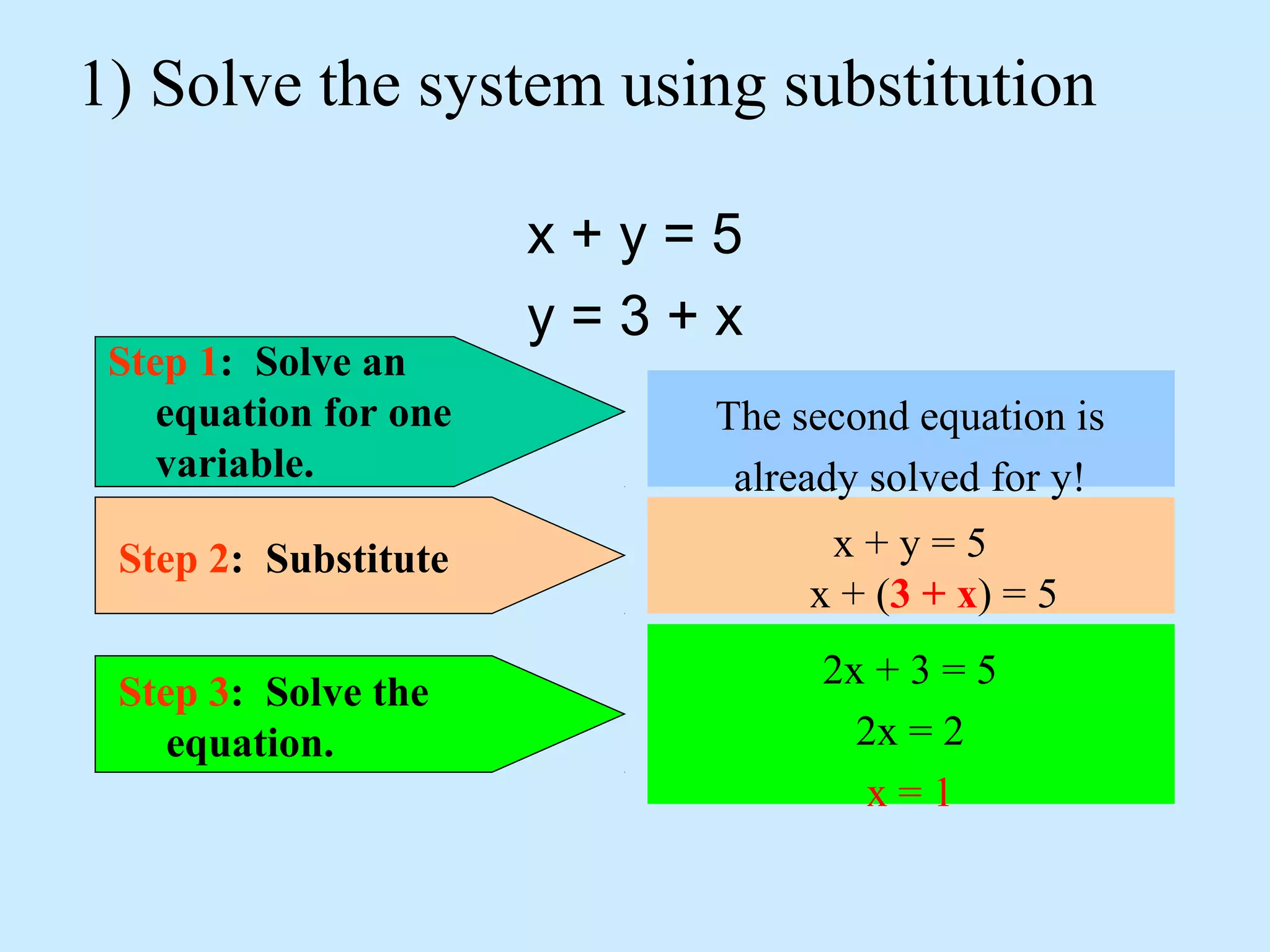
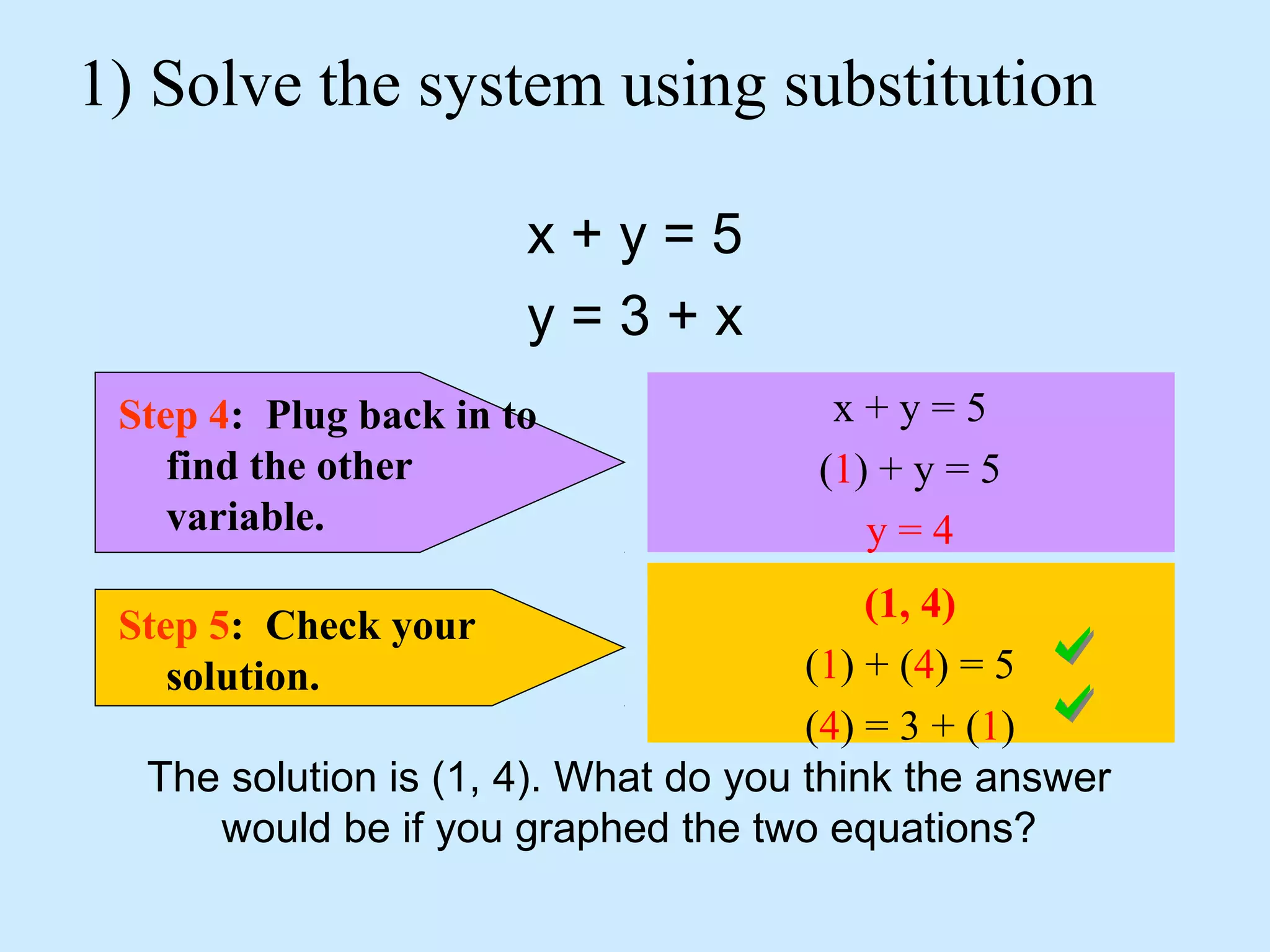
1) Solve thesystem using substitution
x + y = 5
y = 3 + x
Step 1: Solve an
equation for one
variable.
Step 2: Substitute
The second equation is
already solved for y!
x + y = 5
x + (3 + x) = 5
Step 3: Solve the
equation.
2x + 3 = 5
2x = 2
x = 1
17.
1) Solve thesystem using substitution
x + y = 5
y = 3 + x
Step 4: Plug back in to
find the other
variable.
x + y = 5
(1) + y = 5
y = 4
Step 5: Check your
solution.
(1, 4)
(1) + (4) = 5
(4) = 3 + (1)
The solution is (1, 4). What do you think the answer
would be if you graphed the two equations?
18.
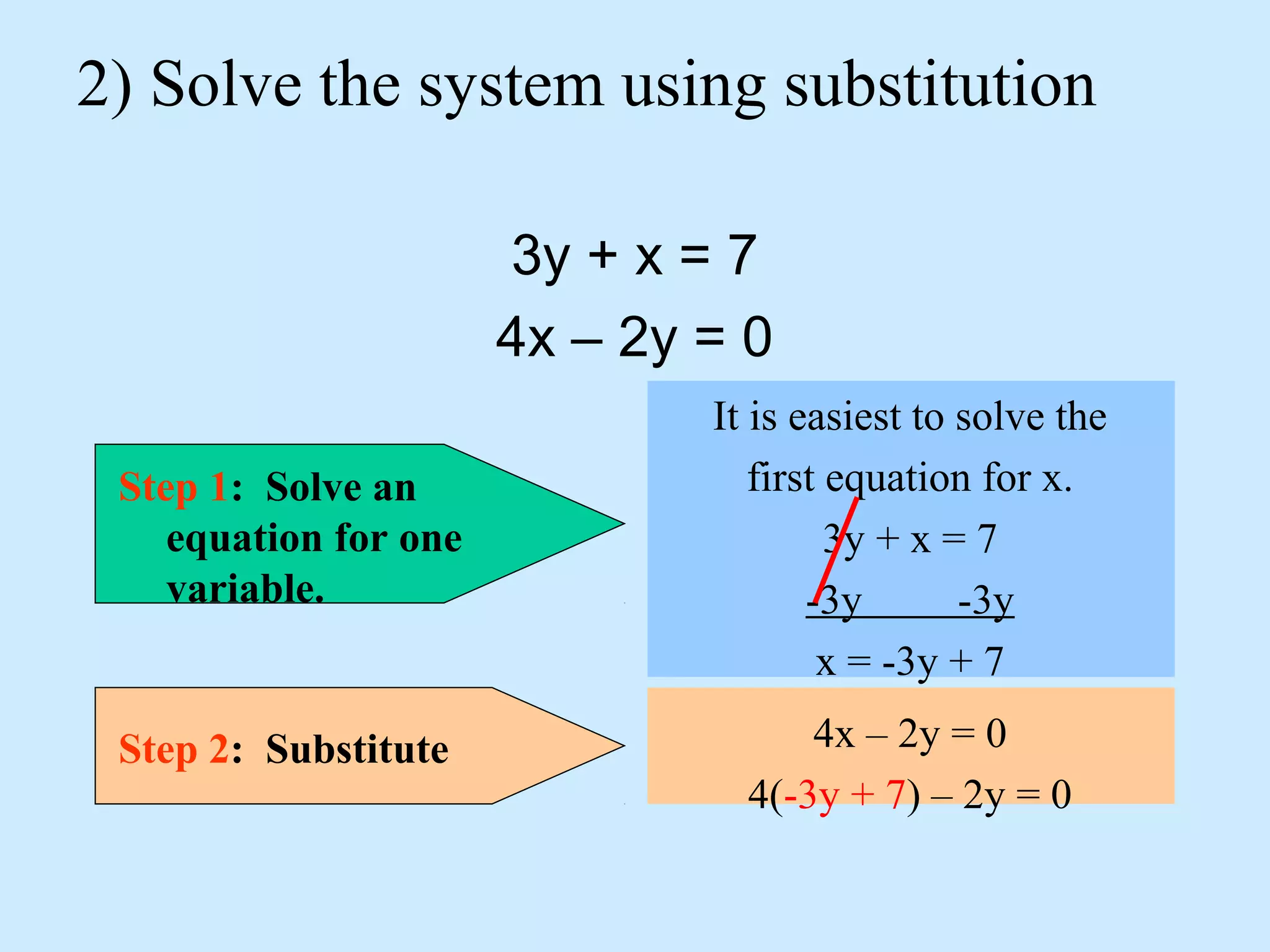
2) Solve thesystem using substitution
3y + x = 7
4x – 2y = 0
Step 1: Solve an
equation for one
variable.
Step 2: Substitute
It is easiest to solve the
first equation for x.
3y + x = 7
-3y -3y
x = -3y + 7
4x – 2y = 0
4(-3y + 7) – 2y = 0
19.
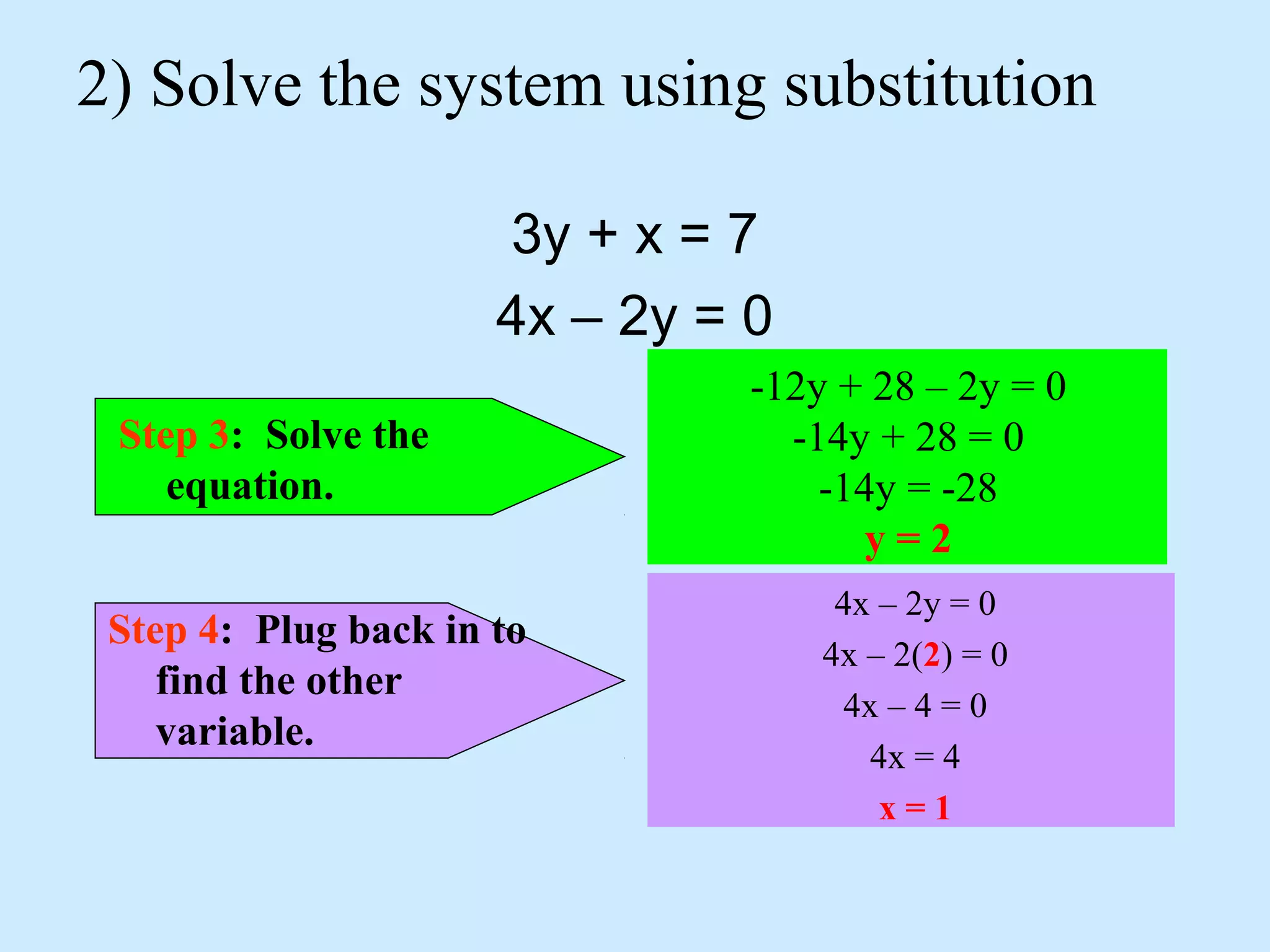
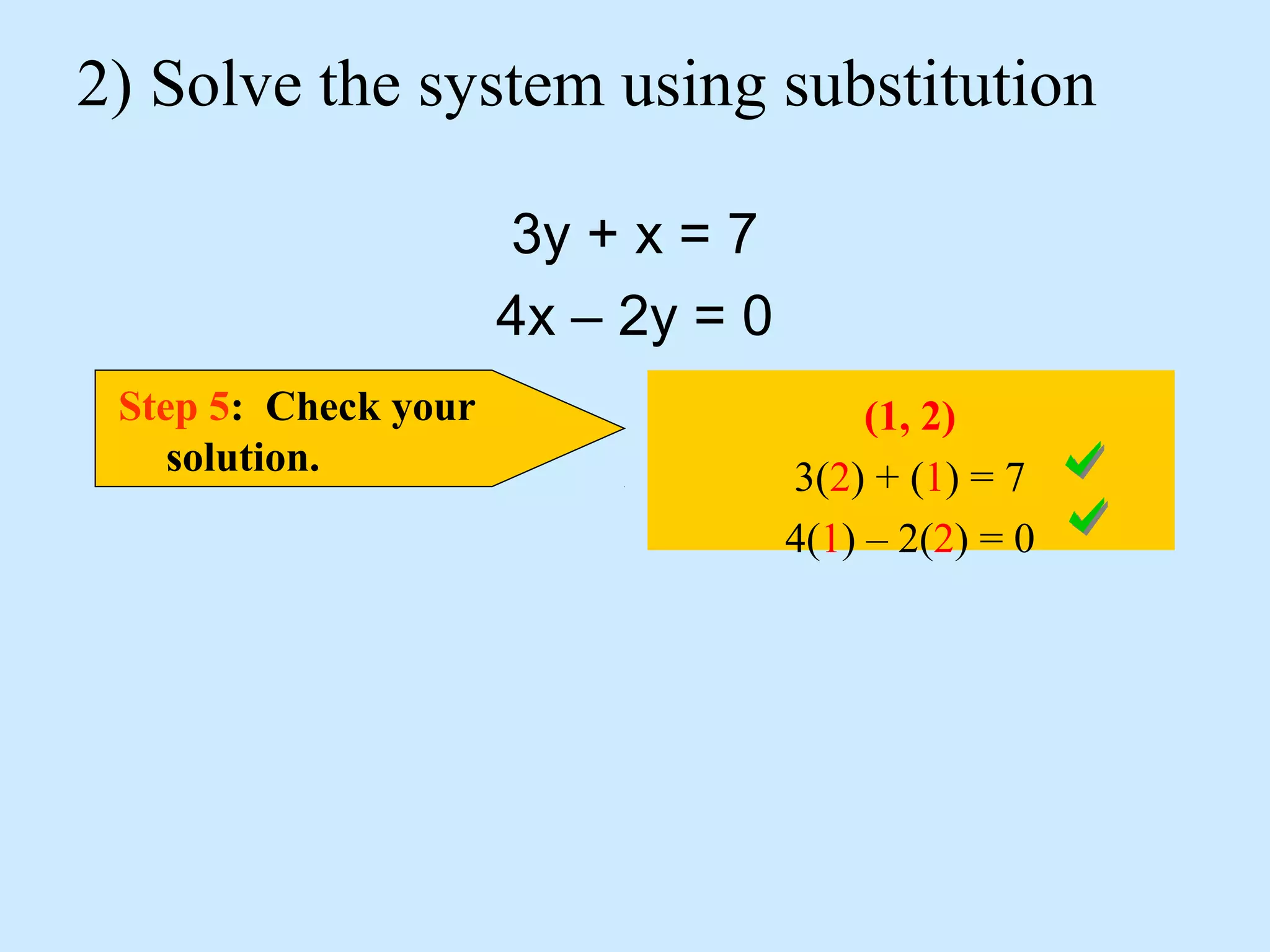
2) Solve thesystem using substitution
3y + x = 7
4x – 2y = 0
Step 4: Plug back in to
find the other
variable.
4x – 2y = 0
4x – 2(2) = 0
4x – 4 = 0
4x = 4
x = 1
Step 3: Solve the
equation.
-12y + 28 – 2y = 0
-14y + 28 = 0
-14y = -28
y = 2
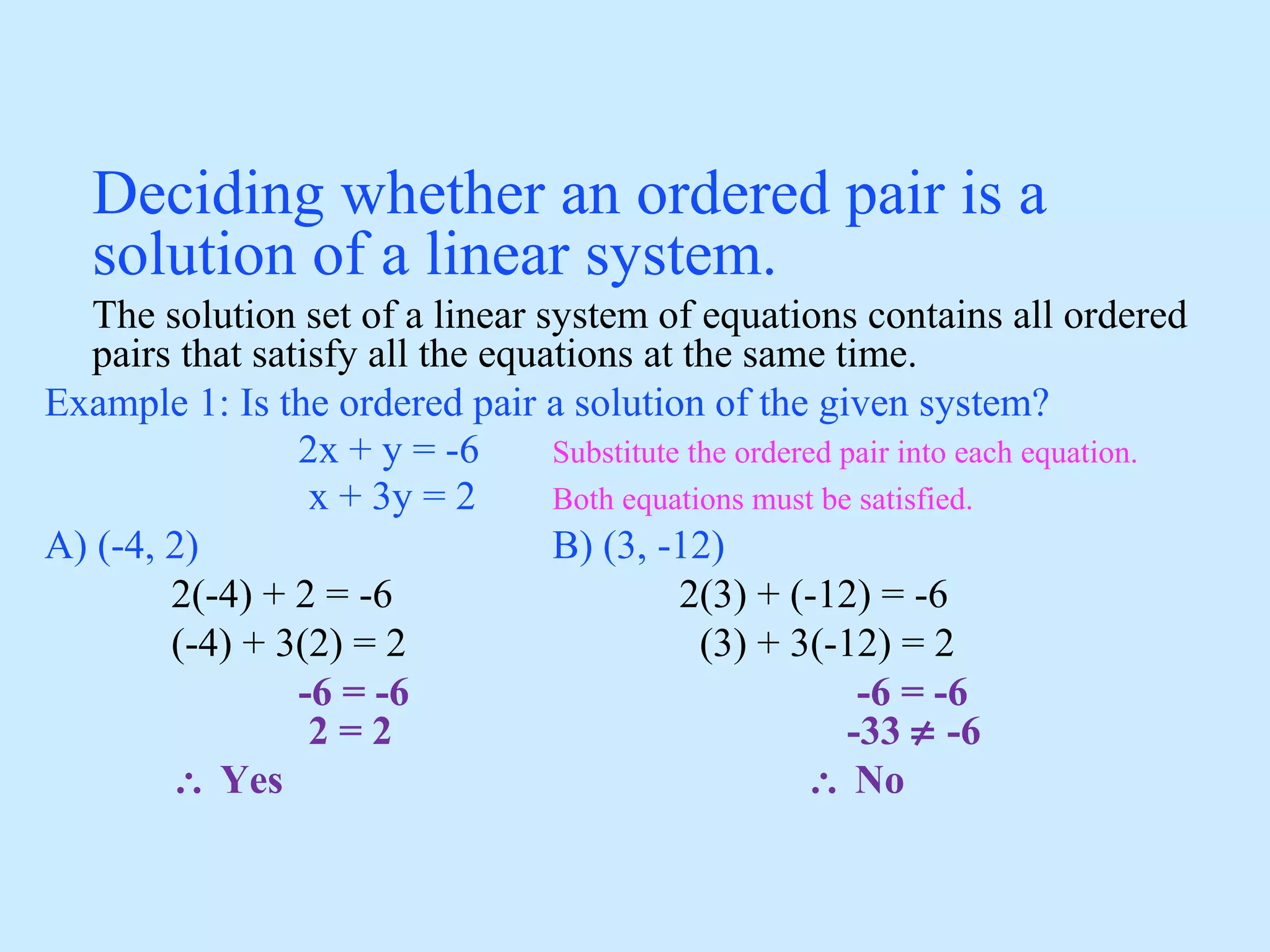
Deciding whether anordered pair is a
solution of a linear system.
The solution set of a linear system of equations contains all ordered
pairs that satisfy all the equations at the same time.
Example 1: Is the ordered pair a solution of the given system?
2x + y = -6 Substitute the ordered pair into each equation.
x + 3y = 2 Both equations must be satisfied.
A) (-4, 2) B) (3, -12)
2(-4) + 2 = -6 2(3) + (-12) = -6
(-4) + 3(2) = 2 (3) + 3(-12) = 2
-6 = -6 -6 = -6
2 = 2 -33 ≠ -6
∴ Yes ∴ No
22.
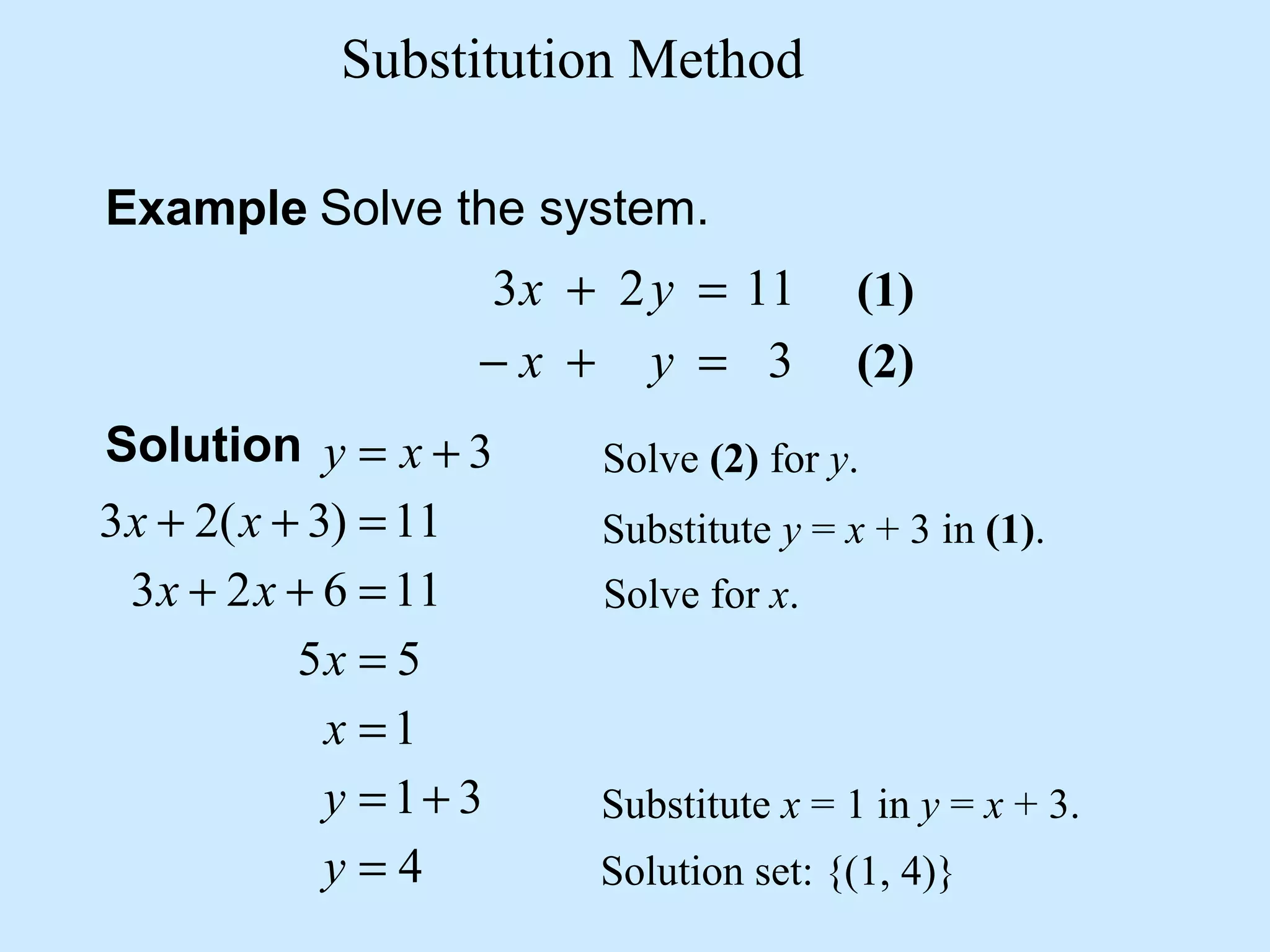
Substitution Method
Example Solvethe system.
Solution
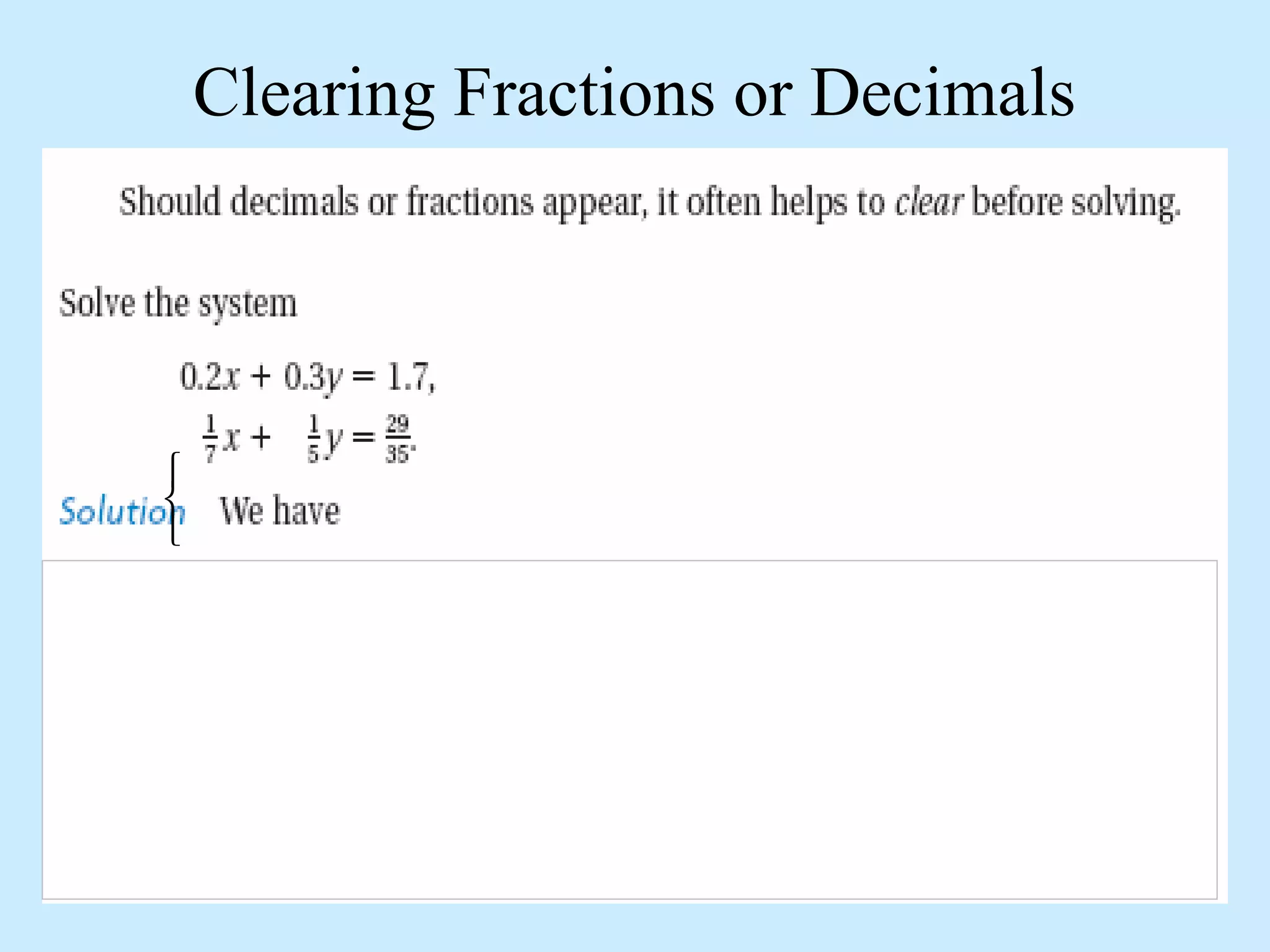
4
31
1
55
11623
11)3(23
3
=
+=
=
=
=++
=++
+=
y
y
x
x
xx
xx
xy Solve (2) for y.
Substitute y = x + 3 in (1).
Solve for x.
Substitute x = 1 in y = x + 3.
Solution set: {(1, 4)}
3
1123
=+−
=+
yx
yx (1)
(2)
23.
Systems of LinearEquations in Two Variables
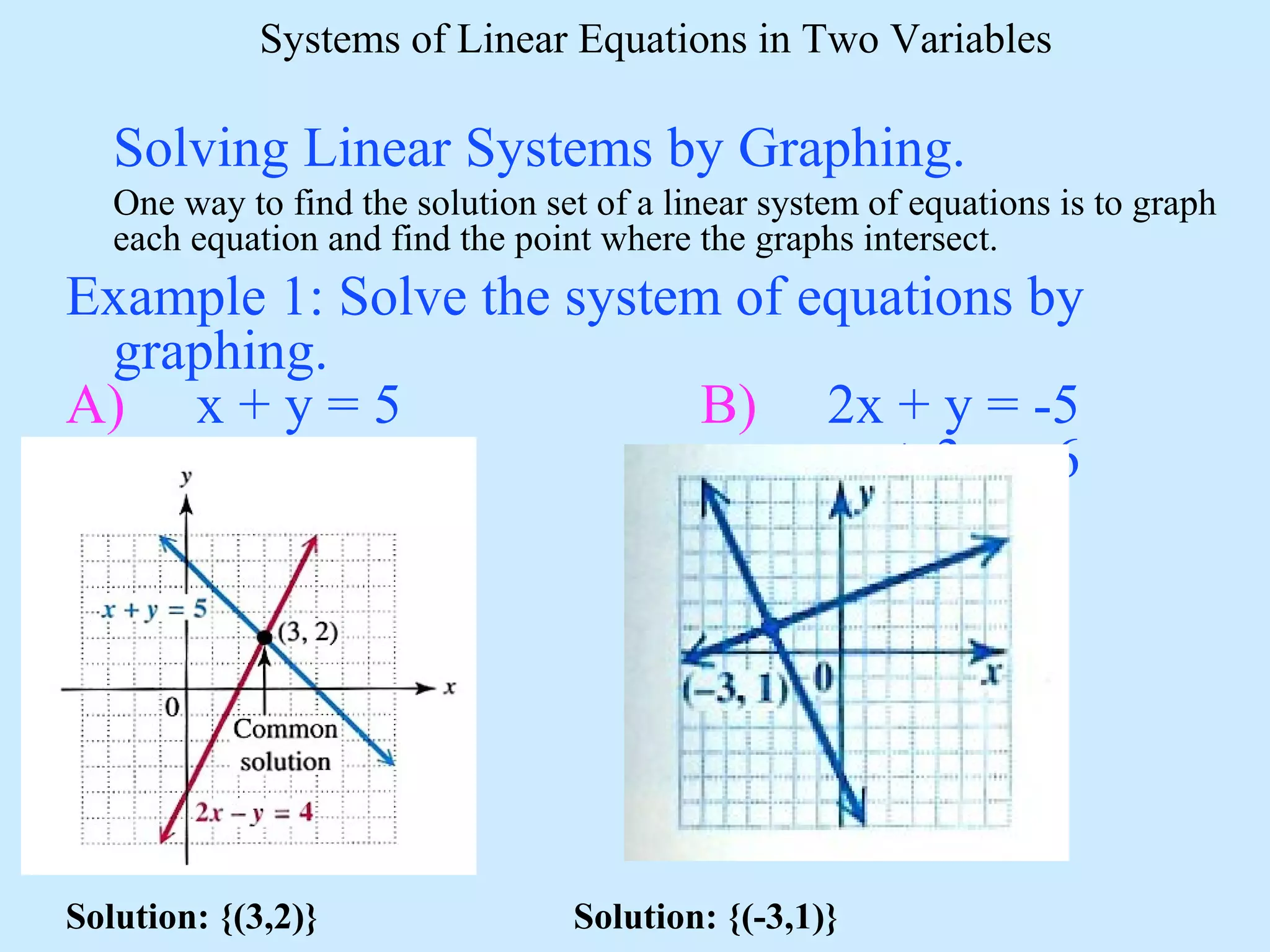
Solving Linear Systems by Graphing.
One way to find the solution set of a linear system of equations is to graph
each equation and find the point where the graphs intersect.
Example 1: Solve the system of equations by
graphing.
A) x + y = 5 B) 2x + y = -5
2x - y = 4 -x + 3y = 6
Solution: {(3,2)} Solution: {(-3,1)}
24.
Systems of LinearEquations in Two Variables
Solving Linear Systems by Graphing.
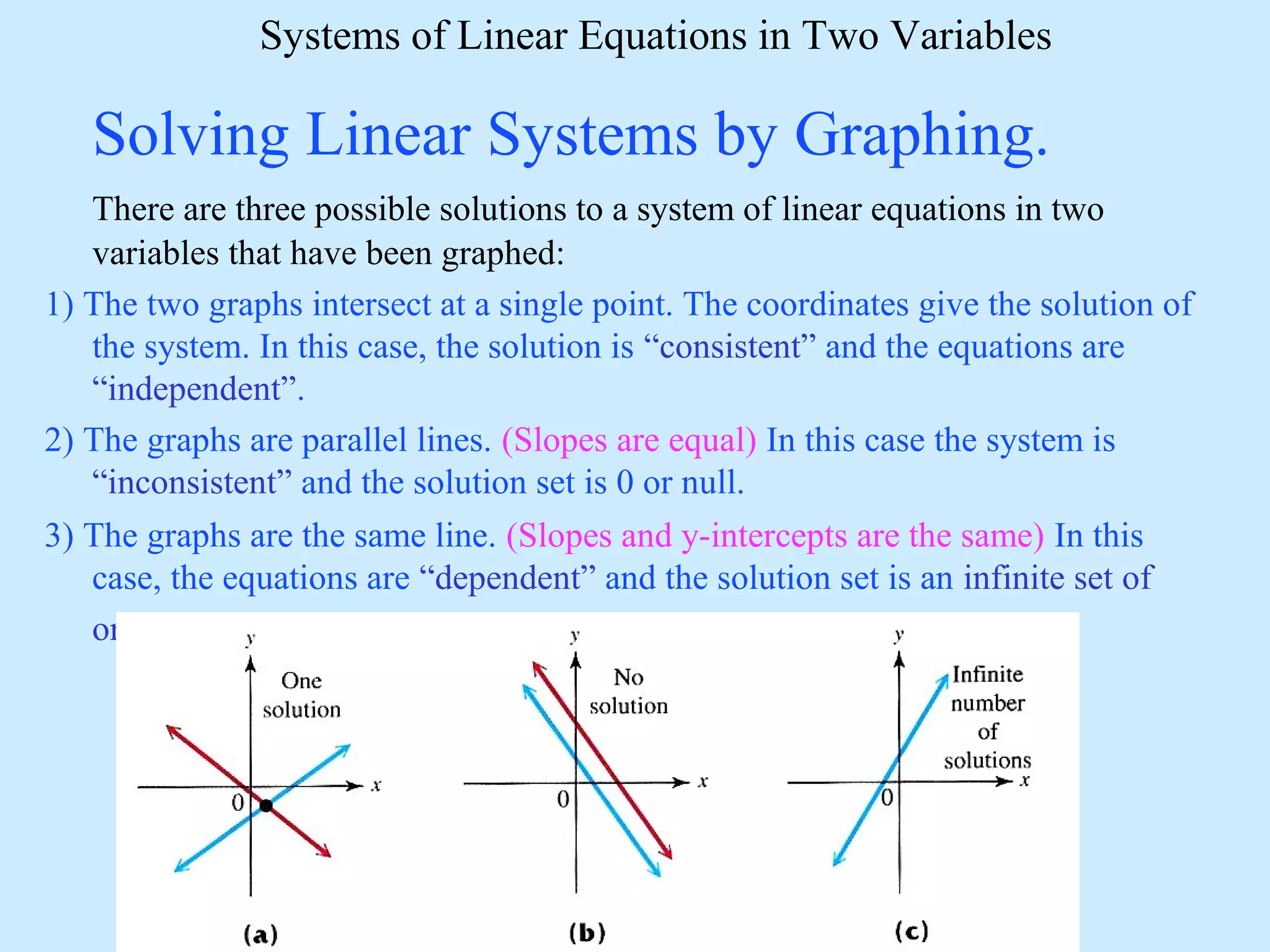
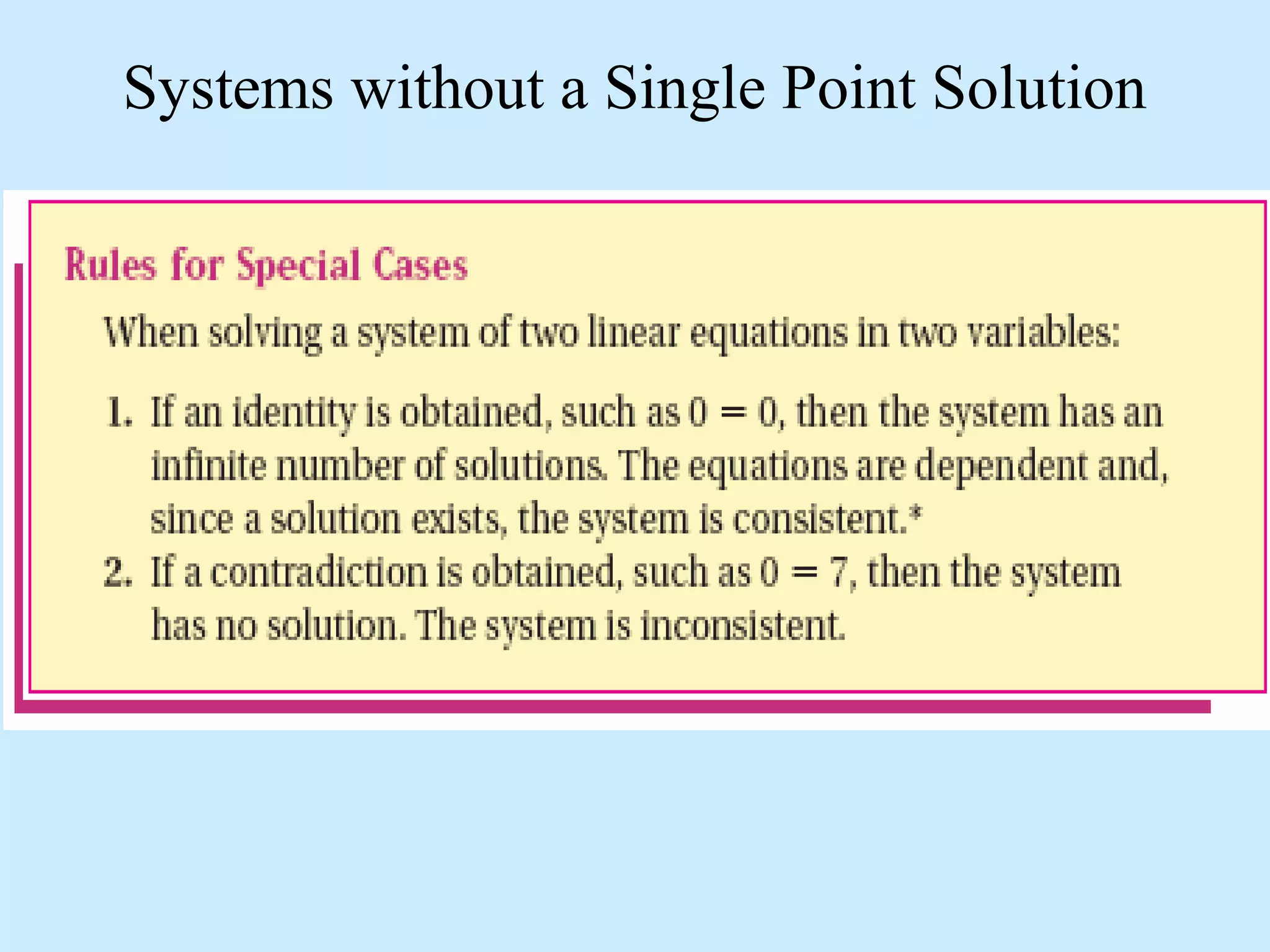
There are three possible solutions to a system of linear equations in two
variables that have been graphed:
1) The two graphs intersect at a single point. The coordinates give the solution of
the system. In this case, the solution is “consistent” and the equations are
“independent”.
2) The graphs are parallel lines. (Slopes are equal) In this case the system is
“inconsistent” and the solution set is 0 or null.
3) The graphs are the same line. (Slopes and y-intercepts are the same) In this
case, the equations are “dependent” and the solution set is an infinite set of
ordered pairs.
25.
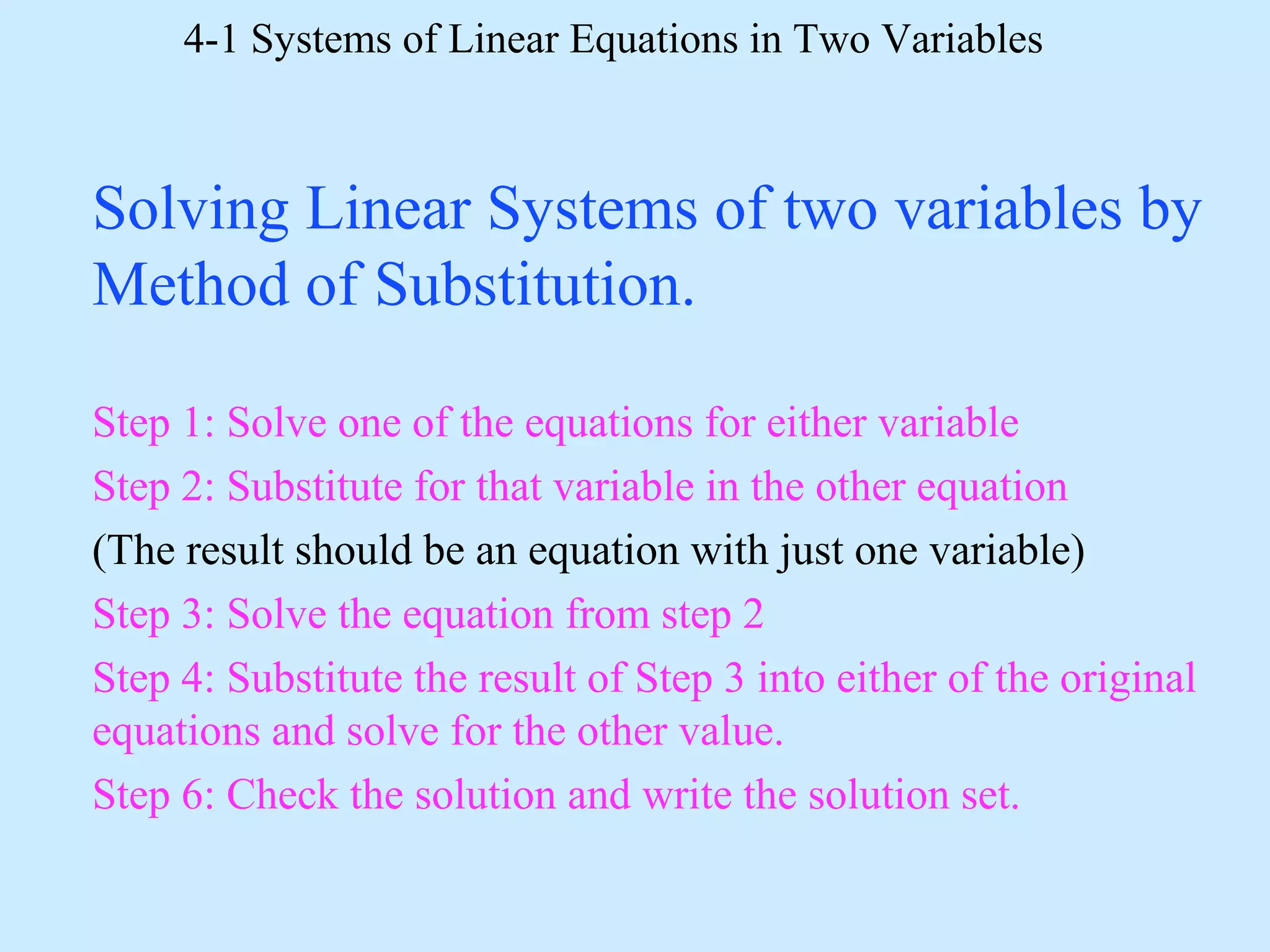
4-1 Systems ofLinear Equations in Two Variables
Solving Linear Systems of two variables by
Method of Substitution.
Step 1: Solve one of the equations for either variable
Step 2: Substitute for that variable in the other equation
(The result should be an equation with just one variable)
Step 3: Solve the equation from step 2
Step 4: Substitute the result of Step 3 into either of the original
equations and solve for the other value.
Step 6: Check the solution and write the solution set.
26.
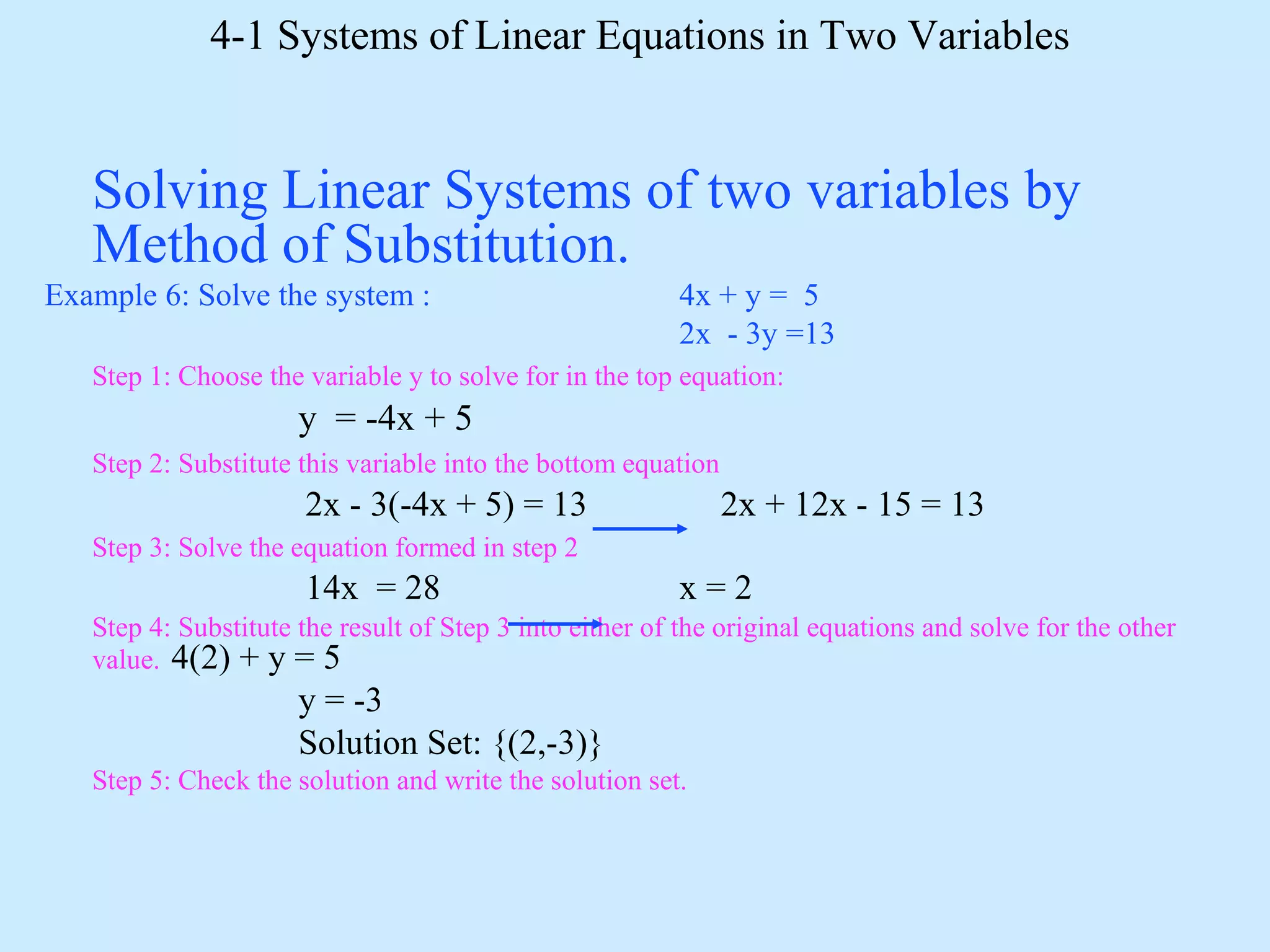
4-1 Systems ofLinear Equations in Two Variables
Solving Linear Systems of two variables by
Method of Substitution.
Example 6: Solve the system : 4x + y = 5
2x - 3y =13
Step 1: Choose the variable y to solve for in the top equation:
y = -4x + 5
Step 2: Substitute this variable into the bottom equation
2x - 3(-4x + 5) = 13 2x + 12x - 15 = 13
Step 3: Solve the equation formed in step 2
14x = 28 x = 2
Step 4: Substitute the result of Step 3 into either of the original equations and solve for the other
value. 4(2) + y = 5
y = -3
Solution Set: {(2,-3)}
Step 5: Check the solution and write the solution set.
27.
Systems of LinearEquations in Two Variables
Solving Linear Systems of two variables by
Method of Substitution.
Example 7:
Solve the system :
y = -2x + 2
-2x + 5(-2x + 2) = 22 -2x - 10x + 10 = 22
-12x = 12
x = -1 2(-1) + y = 2
y = 4
Solution Set: {(-1,4)}
1 1 1
2 4 2
2
1 1 1
rewrite as 4[ ] 2 2
2 4 2
: 2 2
-2 5 2
5 2
2
2
x y
x y
x y x y
Solve x y
x y
⇒ + = ⇒ + =
+
+
=
+
=
=
=
+
−
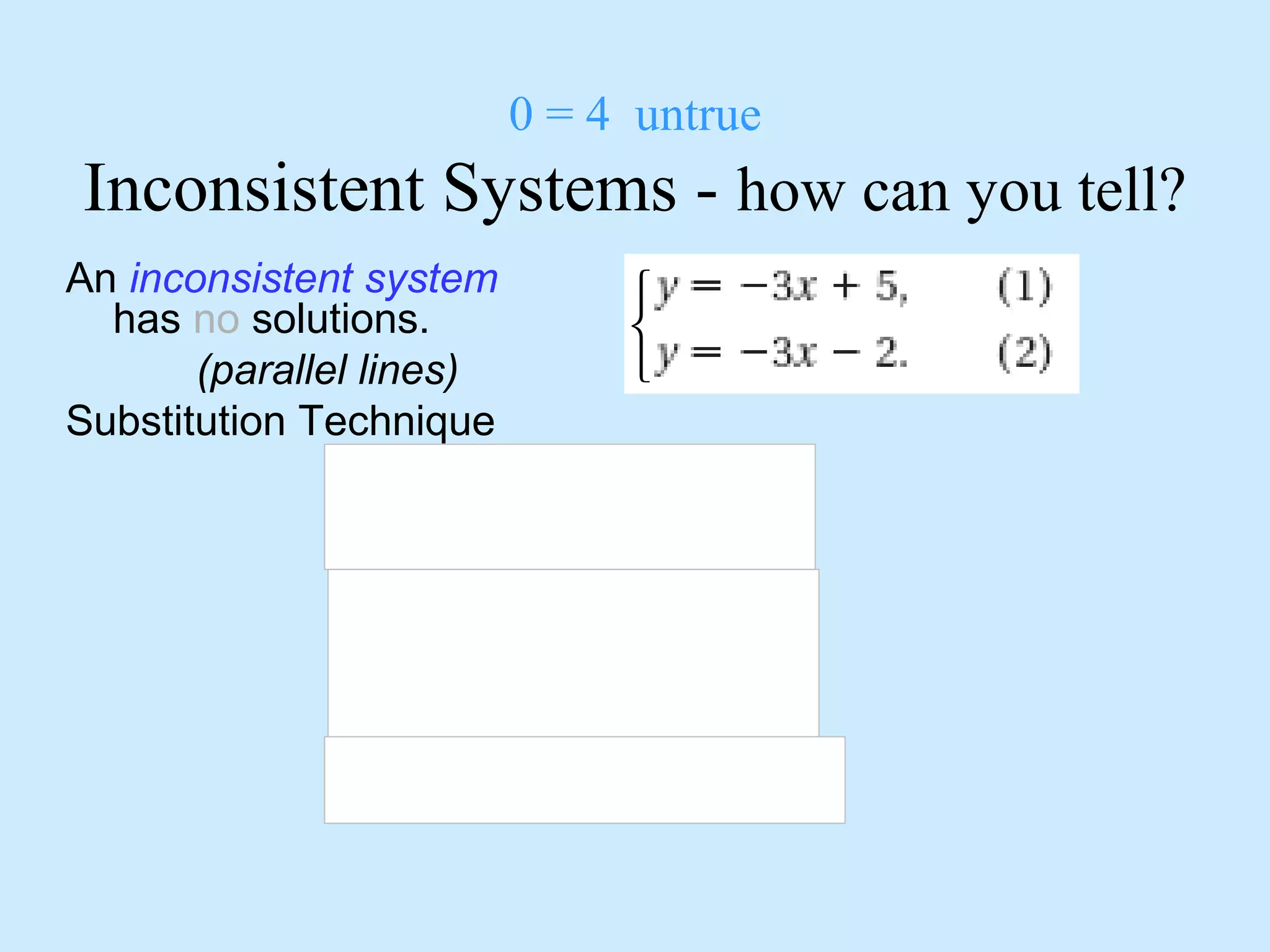
0 = 4untrue
Inconsistent Systems - how can you tell?
An inconsistent system
has no solutions.
(parallel lines)
Substitution Technique
ntinconsiste
xx
xx
xyB
xyA
07
22
25
33
2353
23)(
53)(
=
++
−=
++
−−=+−
−−=
+−=
33.
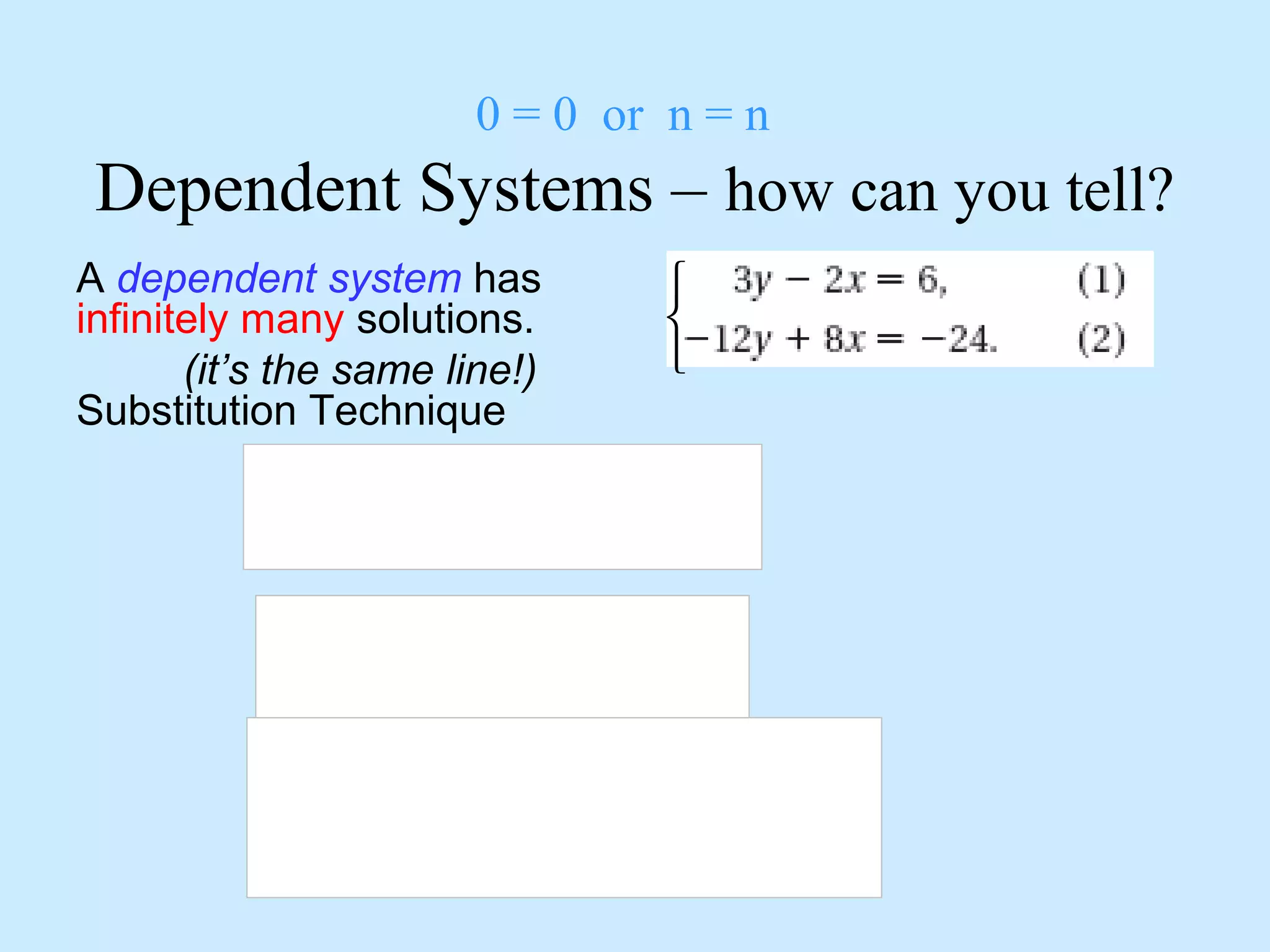
0 = 0or n = n
Dependent Systems – how can you tell?
A dependent system has
infinitely many solutions.
(it’s the same line!)
Substitution Technique
dependent
yy
yyA
yx
yxB
xyB
xyA
66
6633
6)3(23)(
3
24128)(
24812)(
623)(
2
3
2
3
=
=+−
=−−
−=
−=
−=+−
=−
![Systems of Linear Equations in Two Variables
Solving Linear Systems of two variables by
Method of Substitution.
Example 7:
Solve the system :
y = -2x + 2
-2x + 5(-2x + 2) = 22 -2x - 10x + 10 = 22
-12x = 12
x = -1 2(-1) + y = 2
y = 4
Solution Set: {(-1,4)}
1 1 1
2 4 2
2
1 1 1
rewrite as 4[ ] 2 2
2 4 2
: 2 2
-2 5 2
5 2
2
2
x y
x y
x y x y
Solve x y
x y
⇒ + = ⇒ + =
+
+
=
+
=
=
=
+
−](https://image.slidesharecdn.com/solvingsystemsoflinearequations-130926104114-phpapp01/75/Solving-systems-of-Linear-Equations-27-2048.jpg)


![Vibe Coding vs. Spec-Driven Development [Free Meetup]](https://cdn.slidesharecdn.com/ss_thumbnails/vibecodingvsspecdrivendevelopment-251209105622-43f455e7-thumbnail.jpg?width=640&height=640&fit=bounds)


