SYSTEMS OF LINEAREQUATIONS
A system of linear equations consists of two or
more linear equations.
This section focuses on only two equations at a
time.
The solution of a system of linear equations in two
variables is any ordered pair that solves both of the
linear equations.
3.
FINDING A SOLUTIONBY GRAPHING
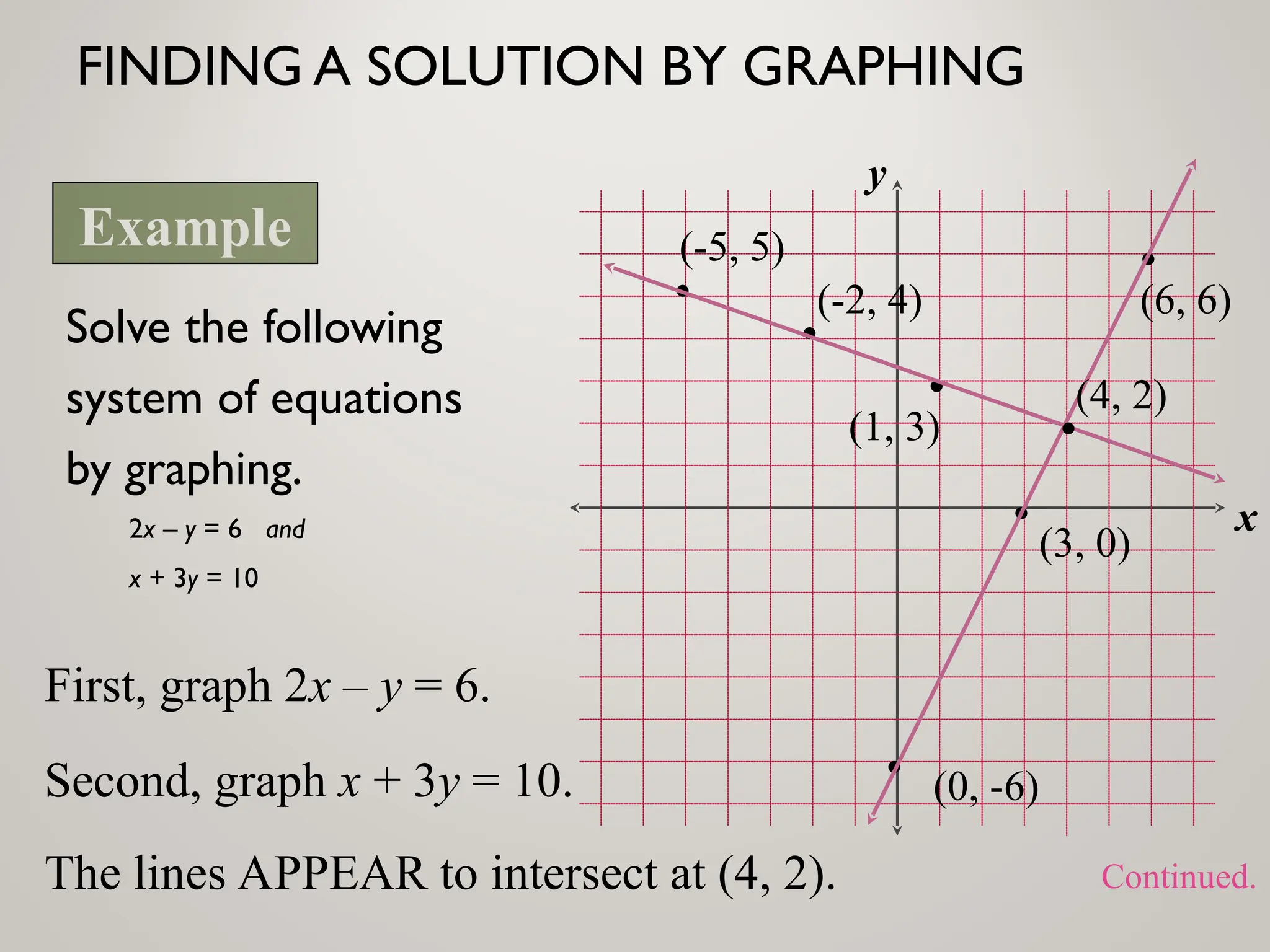
Solve the following
system of equations
by graphing.
2x – y = 6 and
x + 3y = 10
x
y
First, graph 2x – y = 6.
(0, -6)
(3, 0)
(6, 6)
Second, graph x + 3y = 10.
(1, 3)
(-2, 4)
(-5, 5)
The lines APPEAR to intersect at (4, 2).
(4, 2)
Example
Continued.
4.
SOLUTION OF ASYSTEM
Determine whether the given point is a solution of the following
system.
point: (– 3, 1)
system: x – y = – 4 and 2x + 10y = 4
•Plug the values into the equations.
First equation: – 3 – 1 = – 4 true
Second equation: 2(– 3) + 10(1) = – 6 + 10 = 4 true
•Since the point (– 3, 1) produces a true statement in both
equations, it is a solution.
Example
5.
SOLUTION OF ASYSTEM
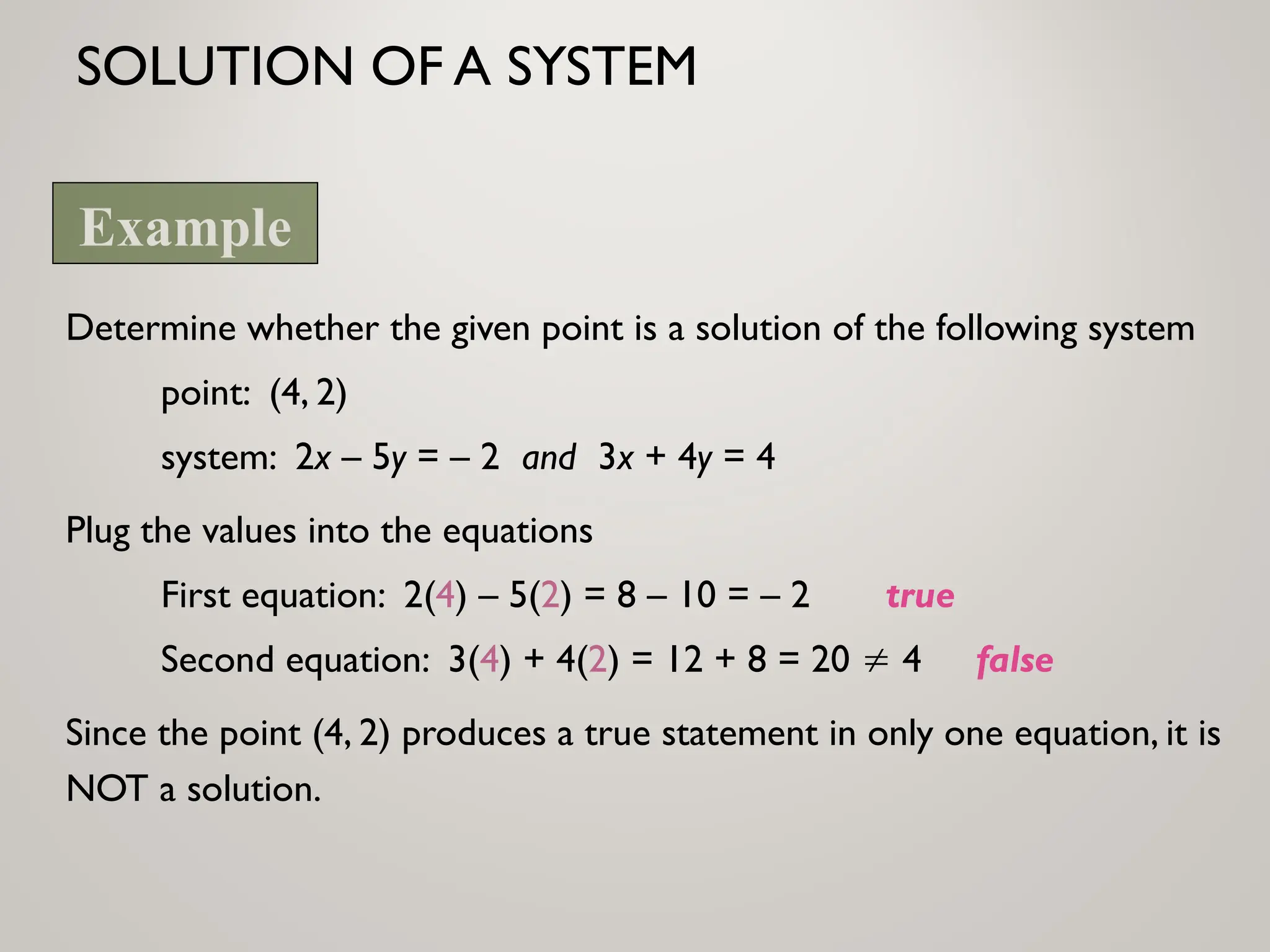
Determine whether the given point is a solution of the following system
point: (4, 2)
system: 2x – 5y = – 2 and 3x + 4y = 4
Plug the values into the equations
First equation: 2(4) – 5(2) = 8 – 10 = – 2 true
Second equation: 3(4) + 4(2) = 12 + 8 = 20 4 false
Since the point (4, 2) produces a true statement in only one equation, it is
NOT a solution.
Example
6.
TYPES OF SYSTEMS
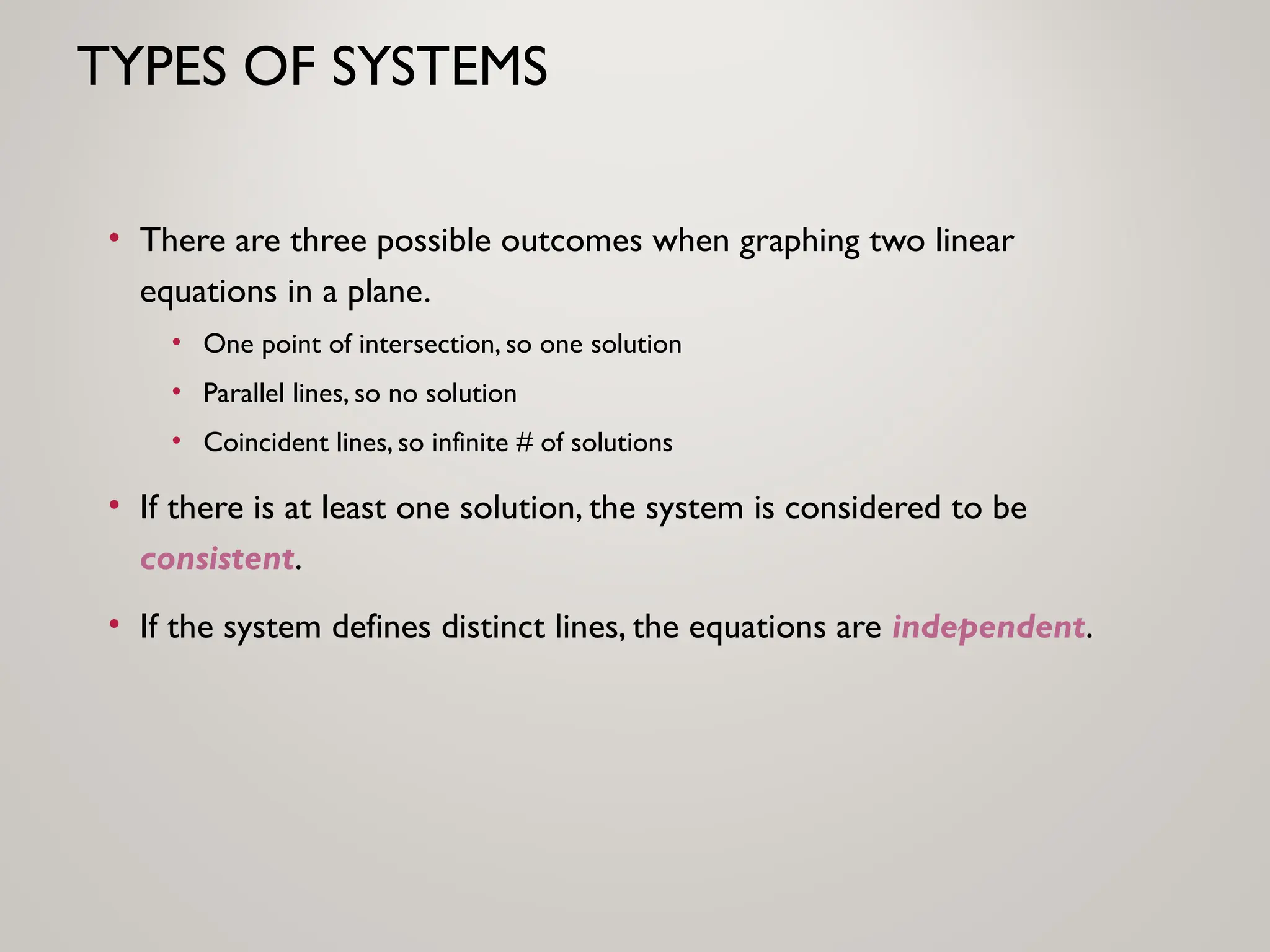
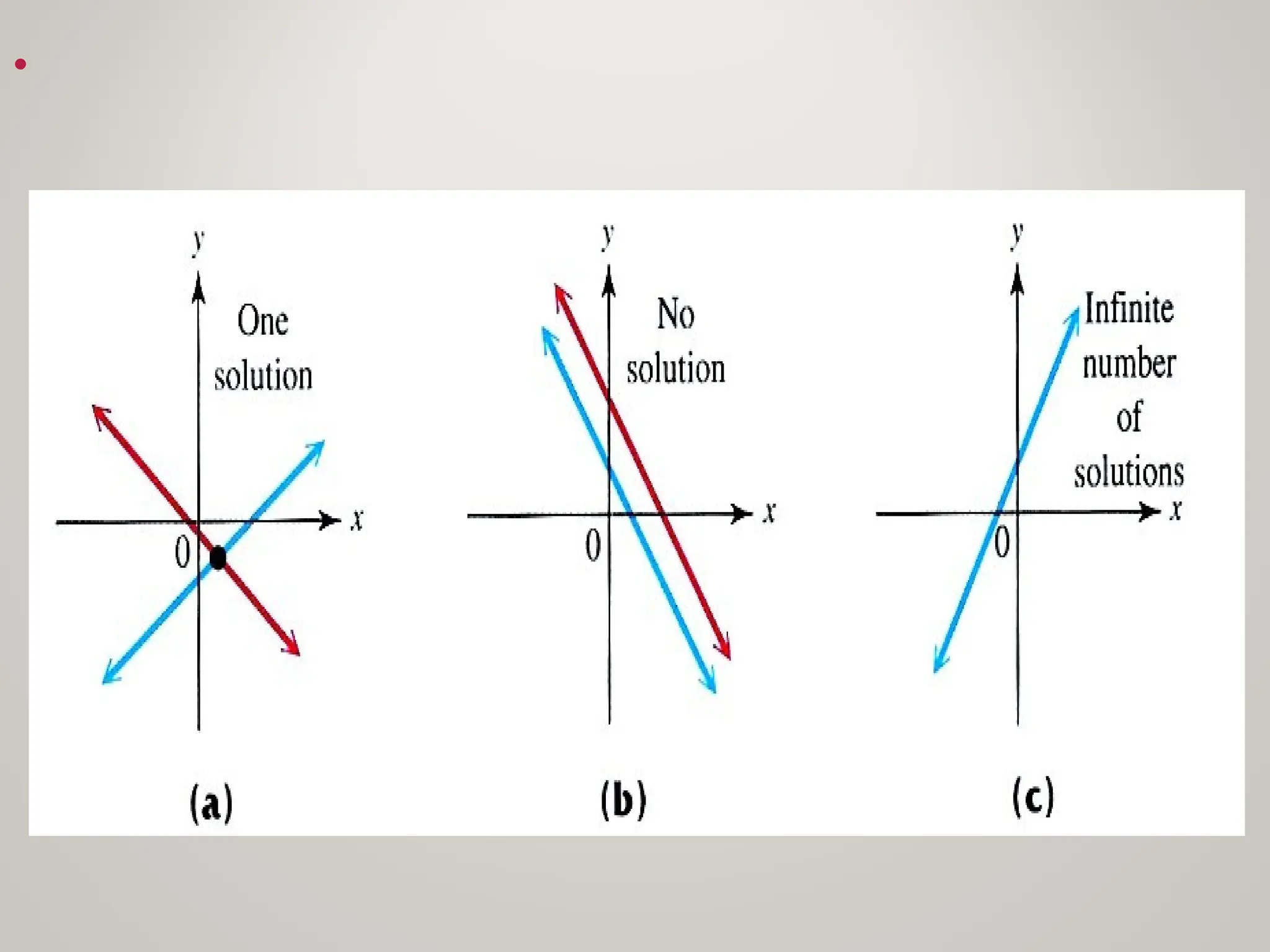
•There are three possible outcomes when graphing two linear
equations in a plane.
• One point of intersection, so one solution
• Parallel lines, so no solution
• Coincident lines, so infinite # of solutions
• If there is at least one solution, the system is considered to be
consistent.
• If the system defines distinct lines, the equations are independent.
THE SUBSTITUTION METHOD
Anothermethod (beside getting lucky with trial and error) that can be
used to solve systems of equations is called the substitution method.
You solve one equation for one of the variables, then substitute the new
form of the equation into the other equation for the solved variable.
10.
THE SUBSTITUTION METHOD
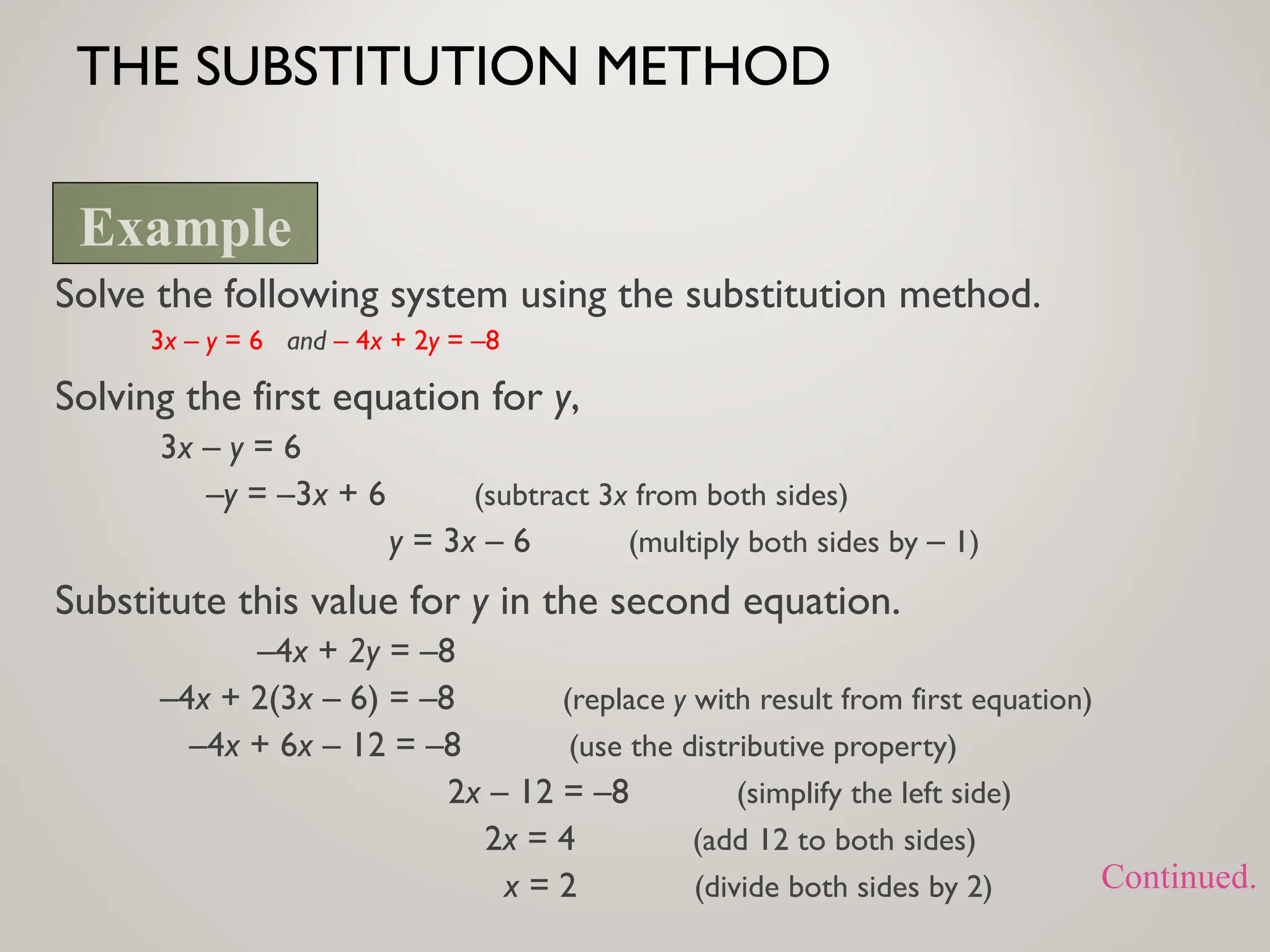
Solvethe following system using the substitution method.
3x – y = 6 and – 4x + 2y = –8
Solving the first equation for y,
3x – y = 6
–y = –3x + 6 (subtract 3x from both sides)
y = 3x – 6 (multiply both sides by – 1)
Substitute this value for y in the second equation.
–4x + 2y = –8
–4x + 2(3x – 6) = –8 (replace y with result from first equation)
–4x + 6x – 12 = –8 (use the distributive property)
2x – 12 = –8 (simplify the left side)
2x = 4 (add 12 to both sides)
x = 2 (divide both sides by 2)
Example
Continued.
11.
THE SUBSTITUTION METHOD
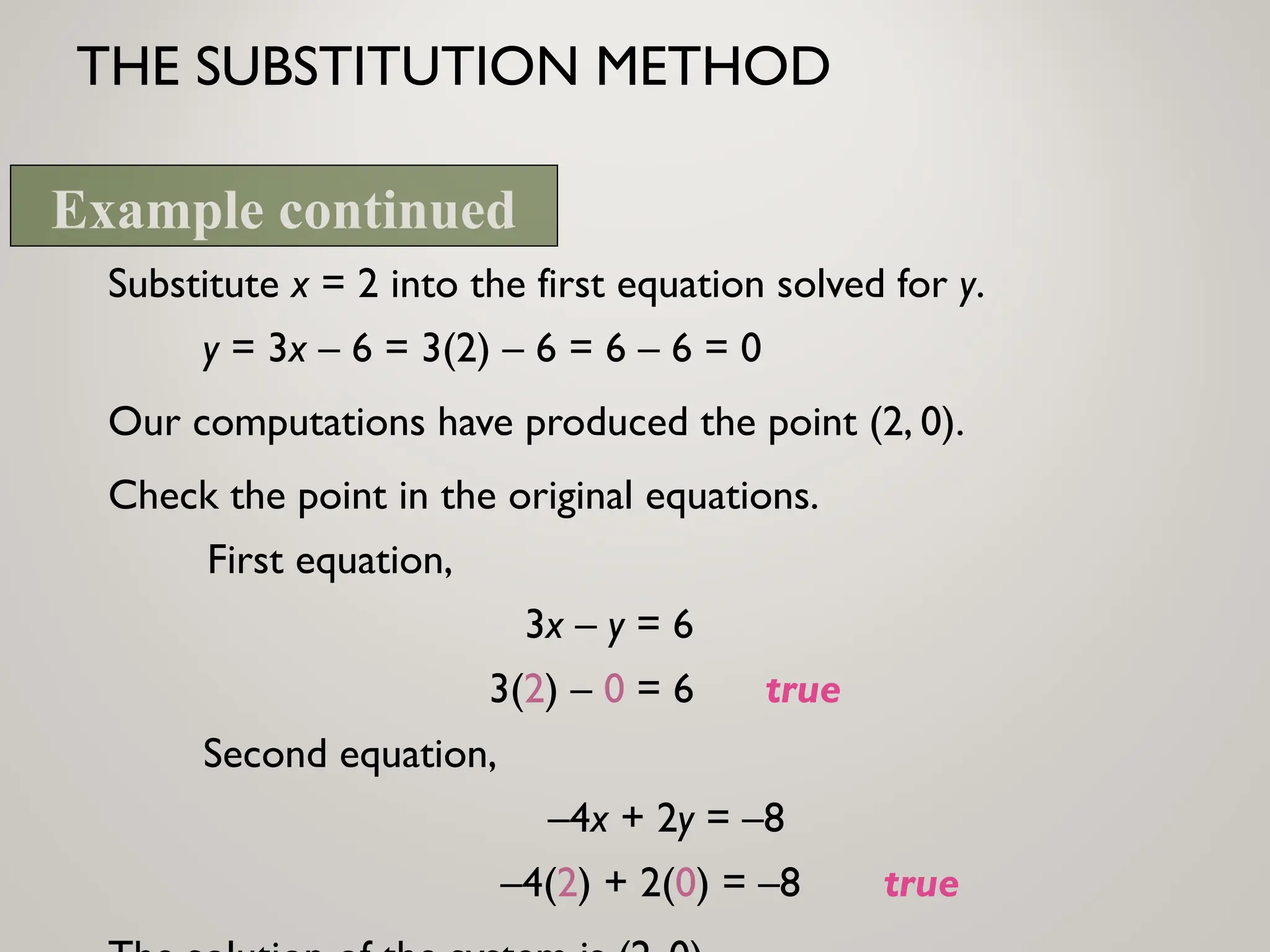
Substitutex = 2 into the first equation solved for y.
y = 3x – 6 = 3(2) – 6 = 6 – 6 = 0
Our computations have produced the point (2, 0).
Check the point in the original equations.
First equation,
3x – y = 6
3(2) – 0 = 6 true
Second equation,
–4x + 2y = –8
–4(2) + 2(0) = –8 true
Example continued
12.
THE SUBSTITUTION METHOD
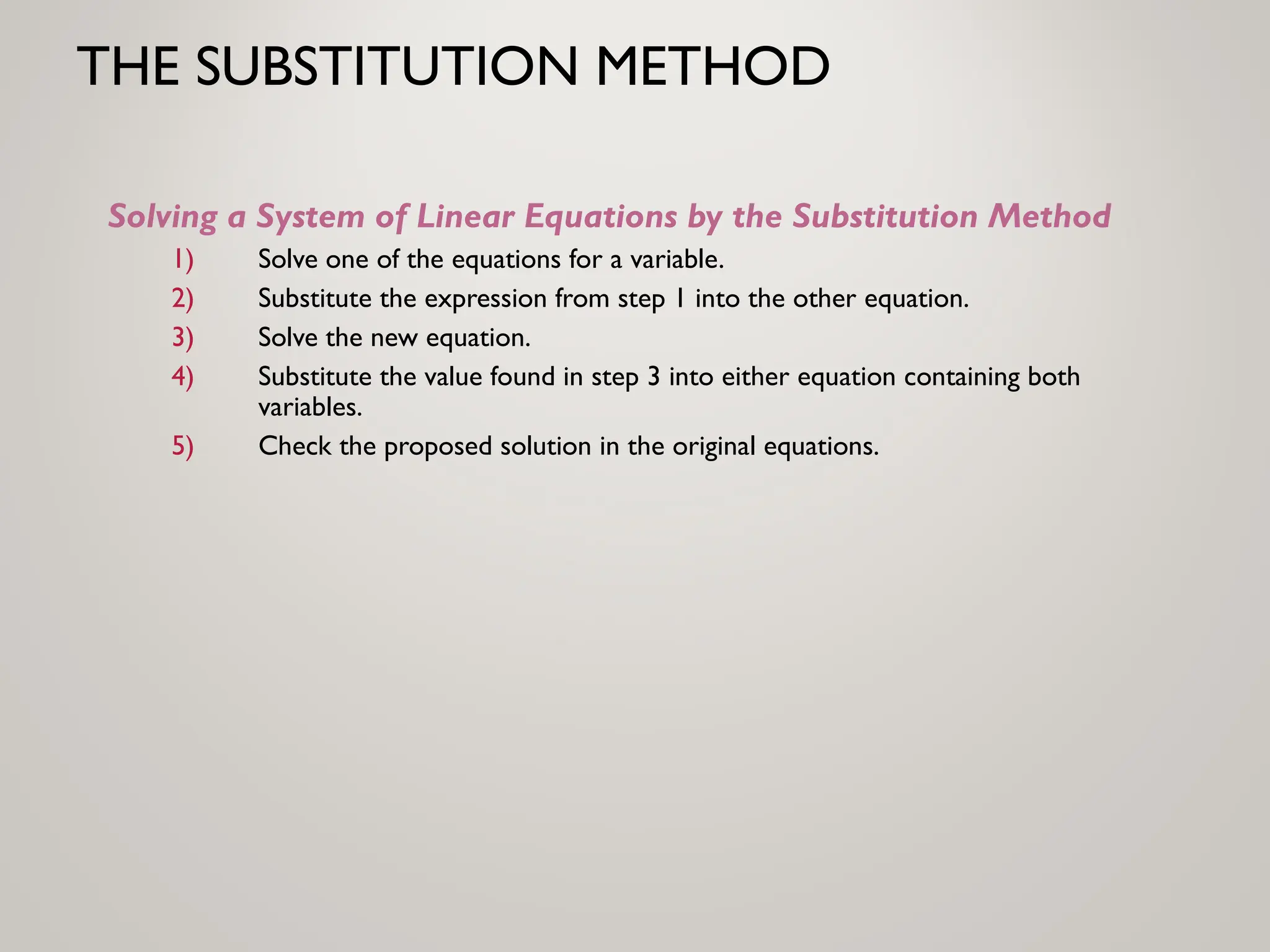
Solvinga System of Linear Equations by the Substitution Method
1) Solve one of the equations for a variable.
2) Substitute the expression from step 1 into the other equation.
3) Solve the new equation.
4) Substitute the value found in step 3 into either equation containing both
variables.
5) Check the proposed solution in the original equations.
13.
THE SUBSTITUTION METHOD
Solvethe following system of equations using the
substitution method.
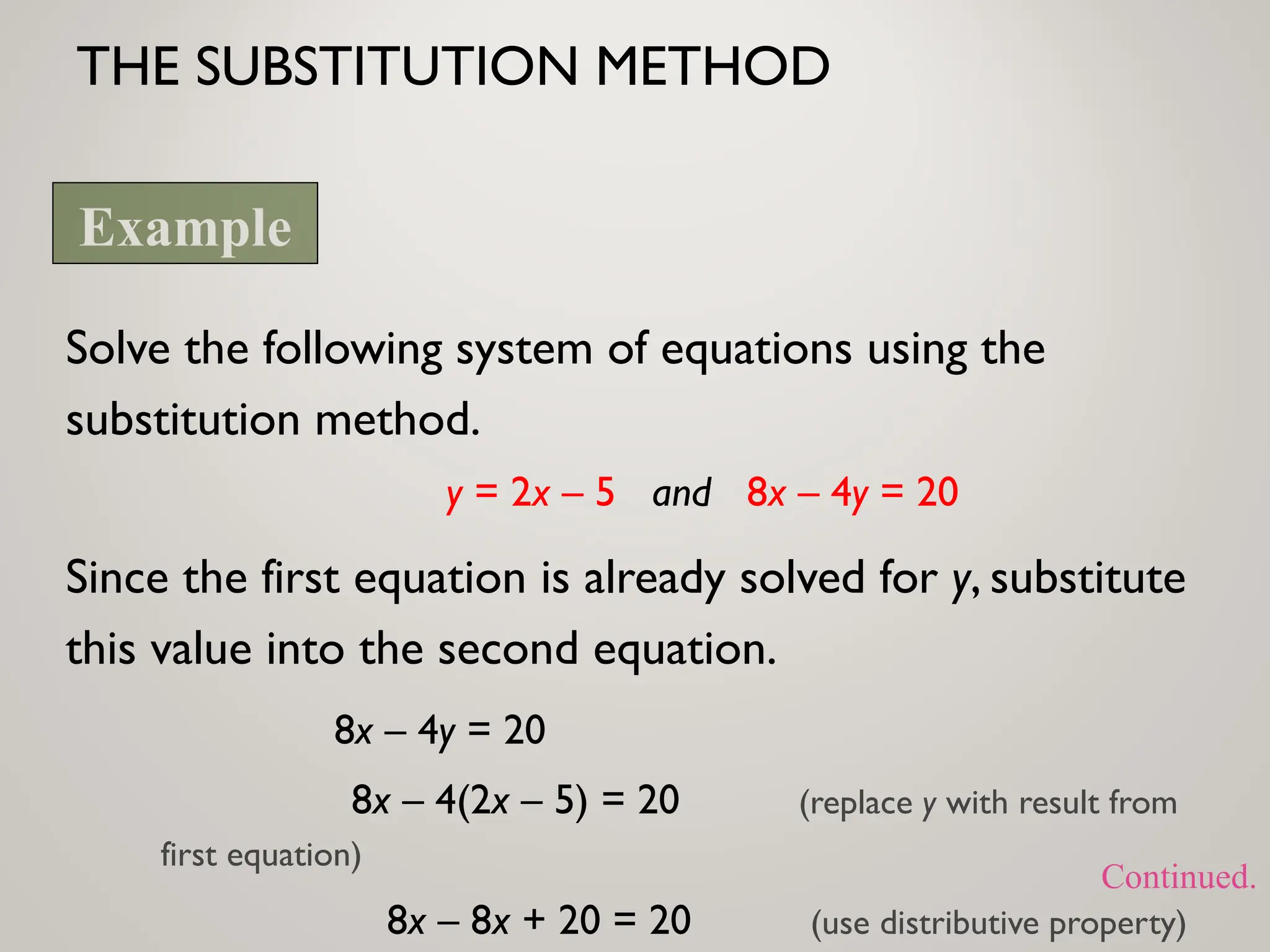
y = 2x – 5 and 8x – 4y = 20
Since the first equation is already solved for y, substitute
this value into the second equation.
8x – 4y = 20
8x – 4(2x – 5) = 20 (replace y with result from
first equation)
8x – 8x + 20 = 20 (use distributive property)
Example
Continued.
14.
THE SUBSTITUTION METHOD
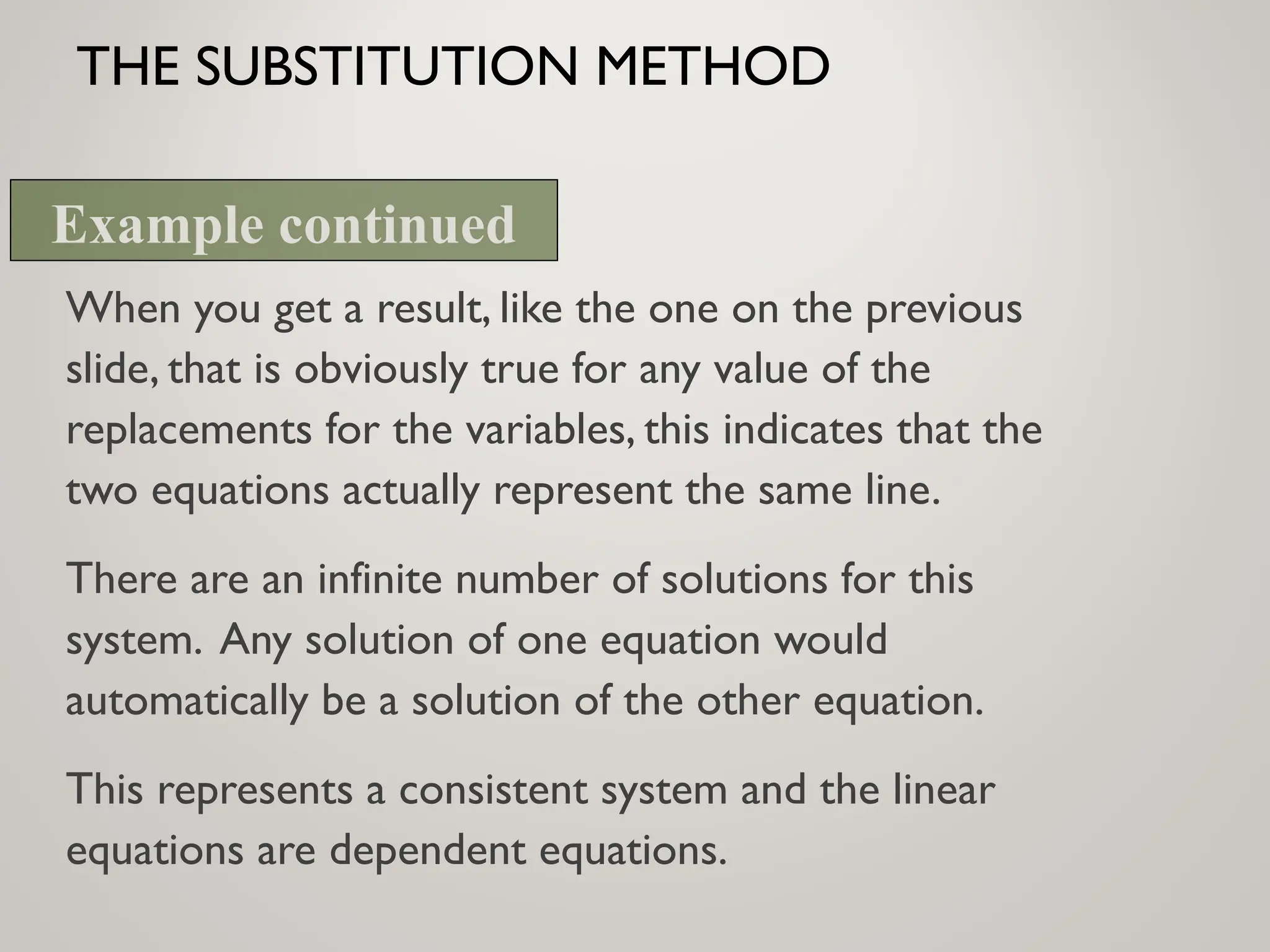
Whenyou get a result, like the one on the previous
slide, that is obviously true for any value of the
replacements for the variables, this indicates that the
two equations actually represent the same line.
There are an infinite number of solutions for this
system. Any solution of one equation would
automatically be a solution of the other equation.
This represents a consistent system and the linear
equations are dependent equations.
Example continued
15.
THE SUBSTITUTION METHOD
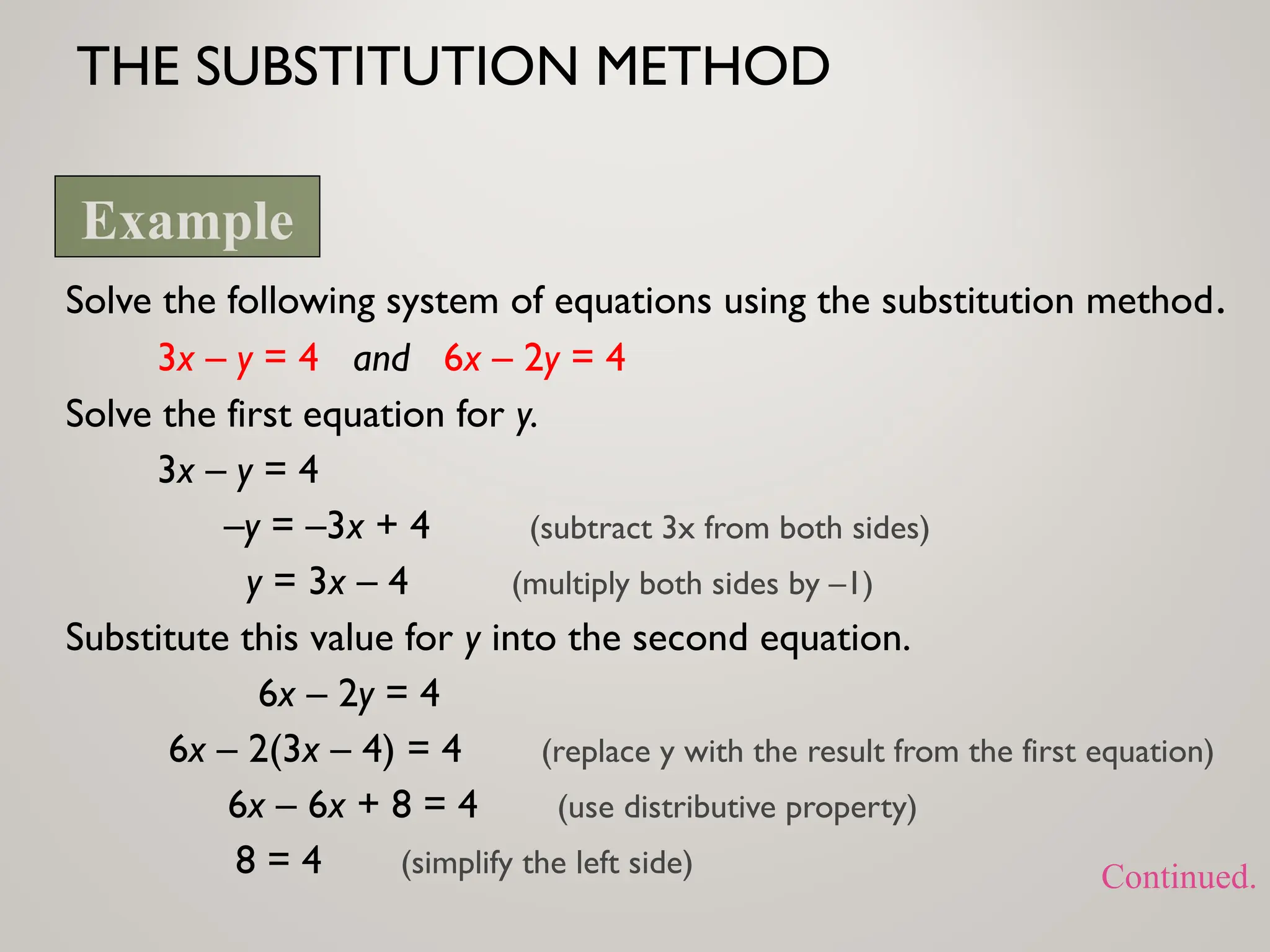
Solvethe following system of equations using the substitution method.
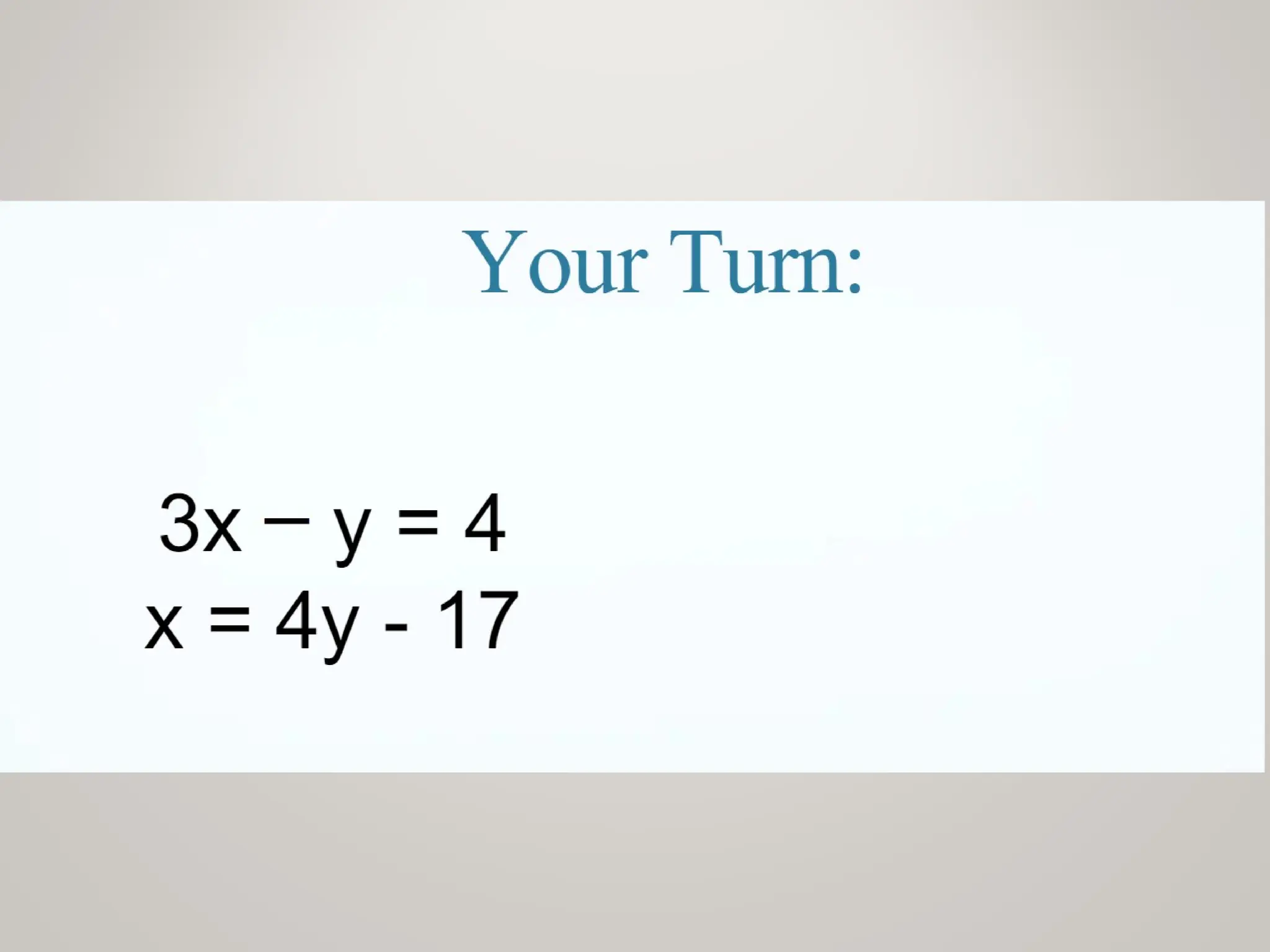
3x – y = 4 and 6x – 2y = 4
Solve the first equation for y.
3x – y = 4
–y = –3x + 4 (subtract 3x from both sides)
y = 3x – 4 (multiply both sides by –1)
Substitute this value for y into the second equation.
6x – 2y = 4
6x – 2(3x – 4) = 4 (replace y with the result from the first equation)
6x – 6x + 8 = 4 (use distributive property)
8 = 4 (simplify the left side)
Example
Continued.
16.
THE SUBSTITUTION METHOD
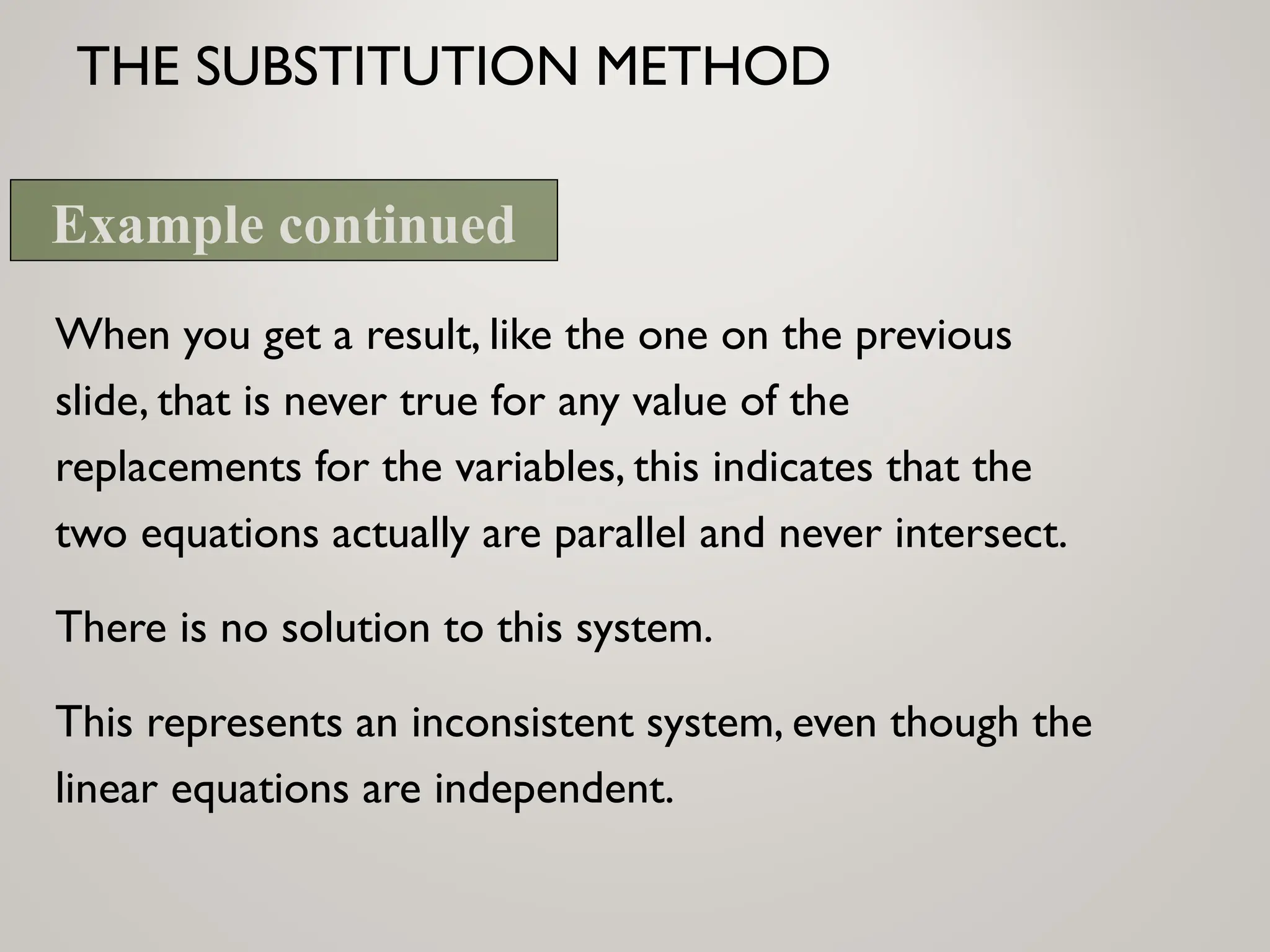
Whenyou get a result, like the one on the previous
slide, that is never true for any value of the
replacements for the variables, this indicates that the
two equations actually are parallel and never intersect.
There is no solution to this system.
This represents an inconsistent system, even though the
linear equations are independent.
Example continued
THE ELIMINATION METHOD
Anothermethod that can be used to solve systems of equations is called
the addition or elimination method.
You multiply both equations by numbers that will allow you to combine
the two equations and eliminate one of the variables.
20.
THE ELIMINATION METHOD
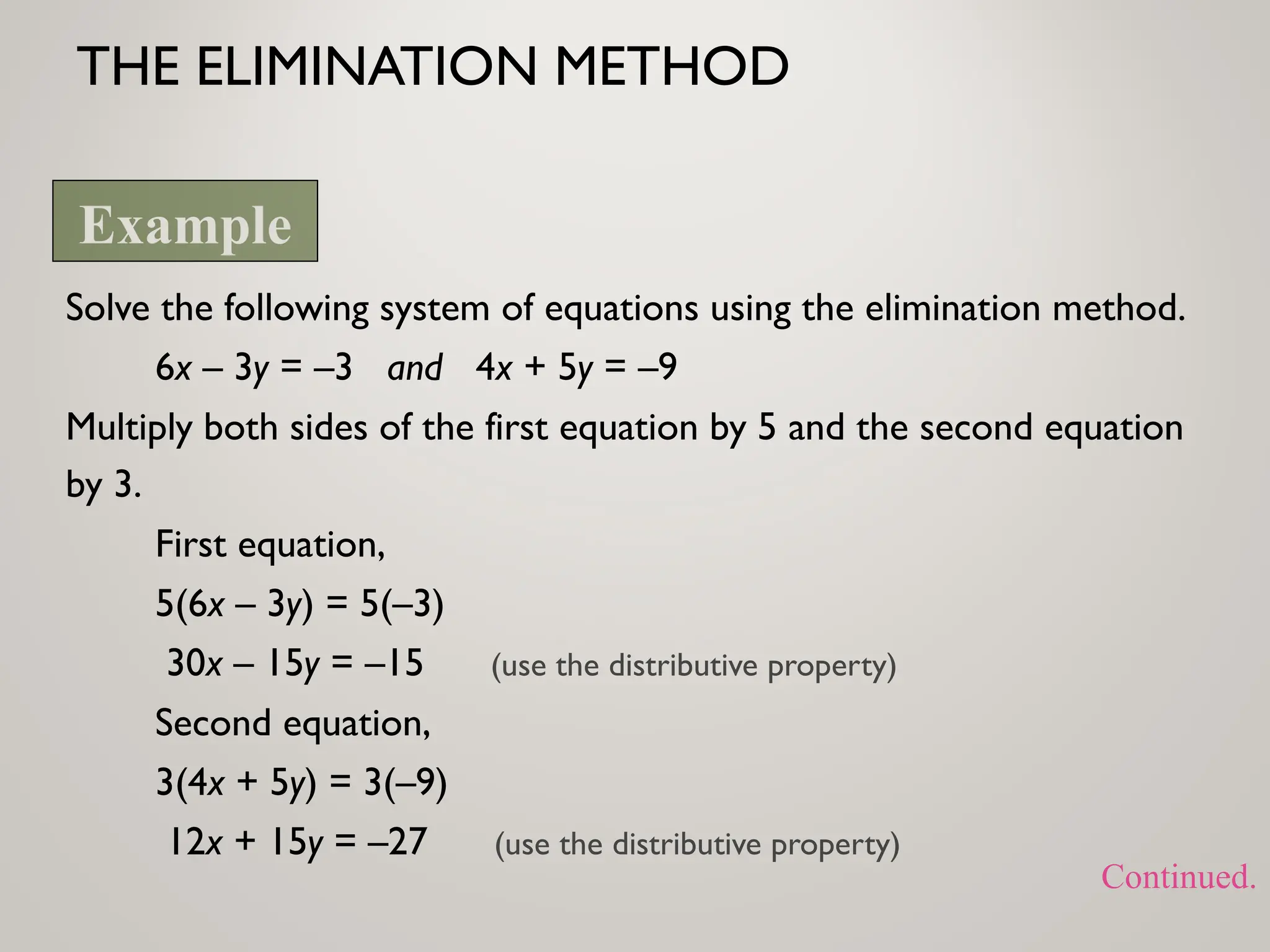
Solvethe following system of equations using the elimination method.
6x – 3y = –3 and 4x + 5y = –9
Multiply both sides of the first equation by 5 and the second equation
by 3.
First equation,
5(6x – 3y) = 5(–3)
30x – 15y = –15 (use the distributive property)
Second equation,
3(4x + 5y) = 3(–9)
12x + 15y = –27 (use the distributive property)
Example
Continued.
21.
THE ELIMINATION METHOD
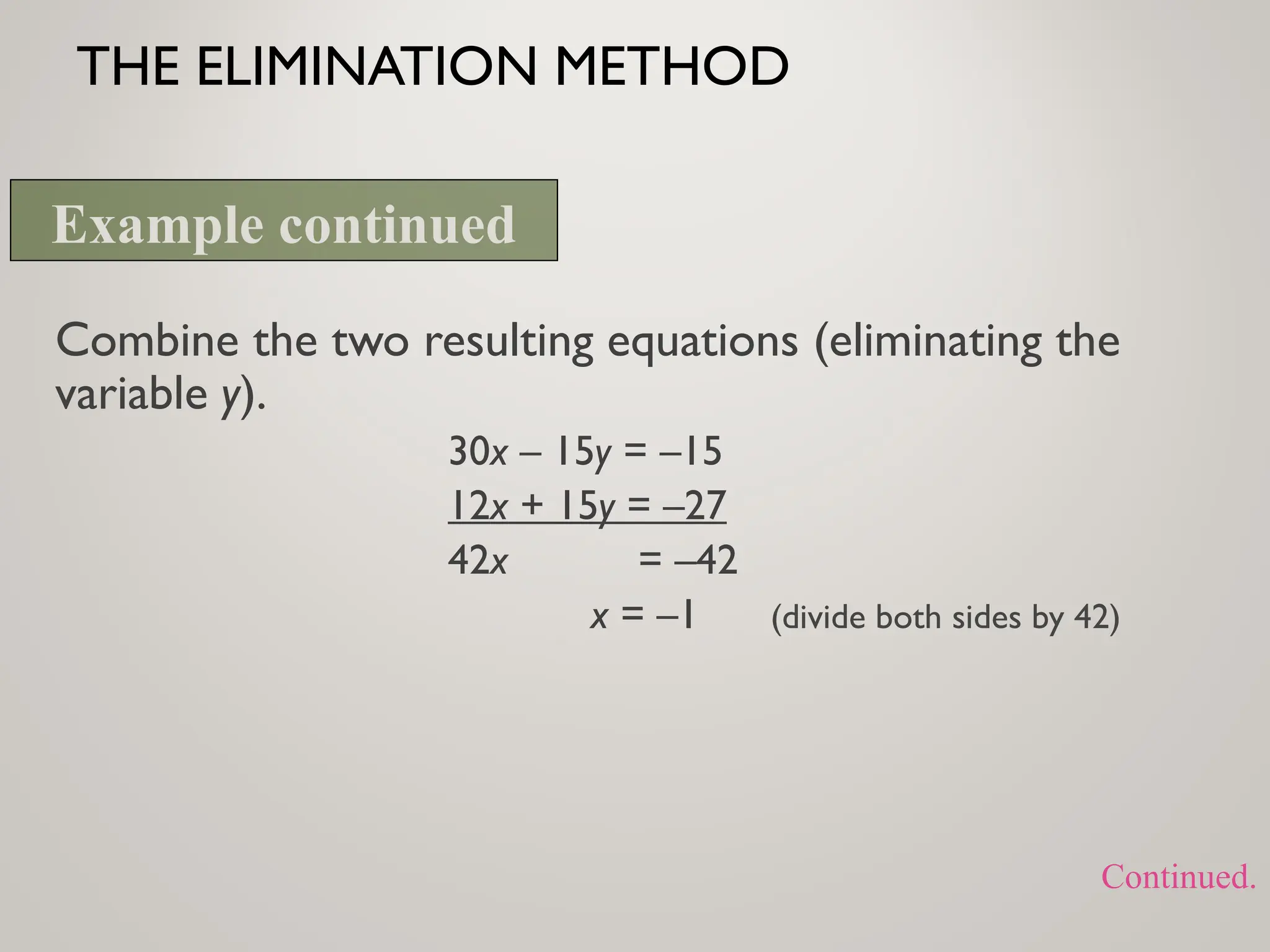
Combinethe two resulting equations (eliminating the
variable y).
30x – 15y = –15
12x + 15y = –27
42x = –42
x = –1 (divide both sides by 42)
Example continued
Continued.
22.
THE ELIMINATION METHOD
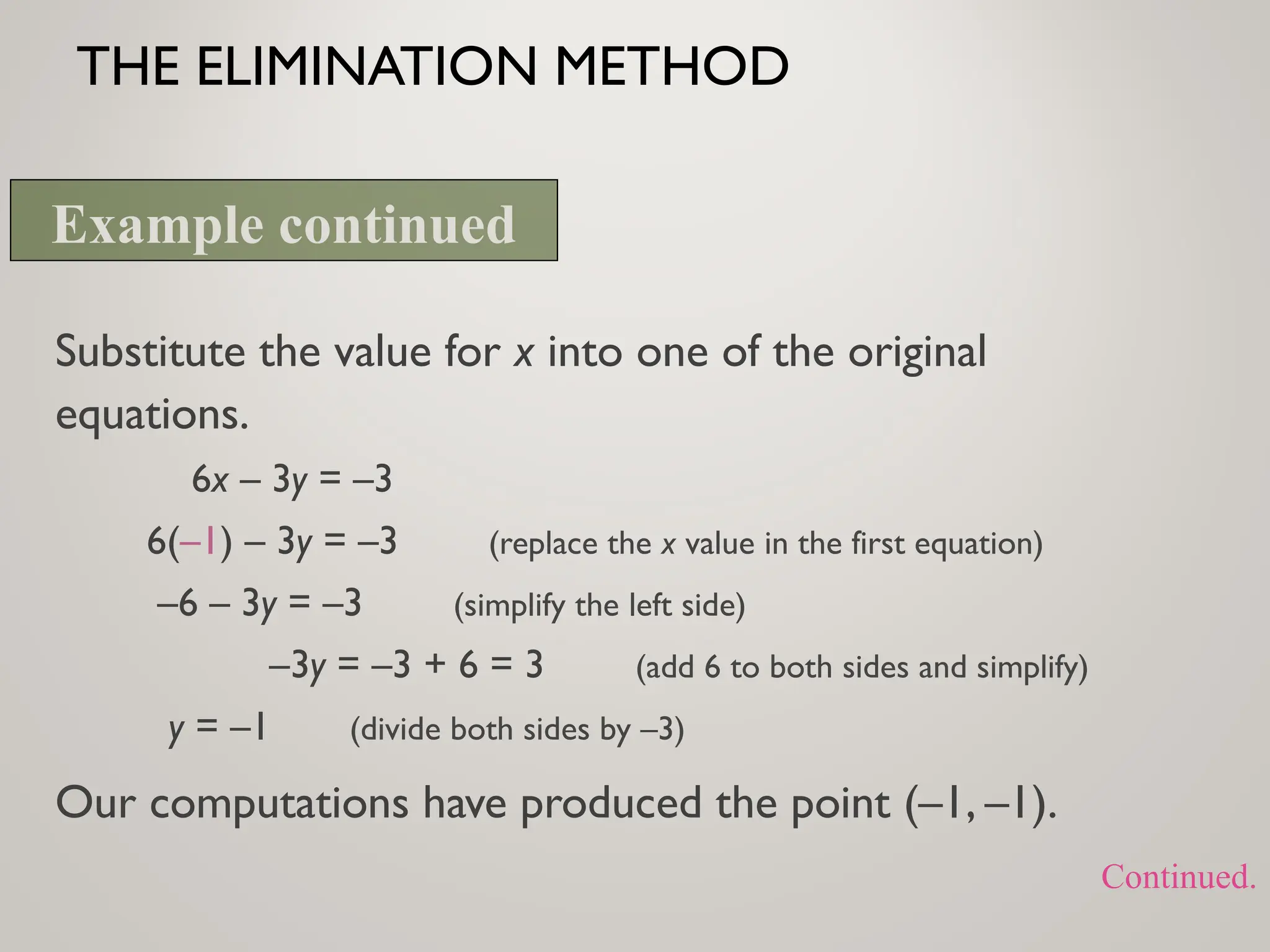
Substitutethe value for x into one of the original
equations.
6x – 3y = –3
6(–1) – 3y = –3 (replace the x value in the first equation)
–6 – 3y = –3 (simplify the left side)
–3y = –3 + 6 = 3 (add 6 to both sides and simplify)
y = –1 (divide both sides by –3)
Our computations have produced the point (–1, –1).
Example continued
Continued.
23.
THE ELIMINATION METHOD
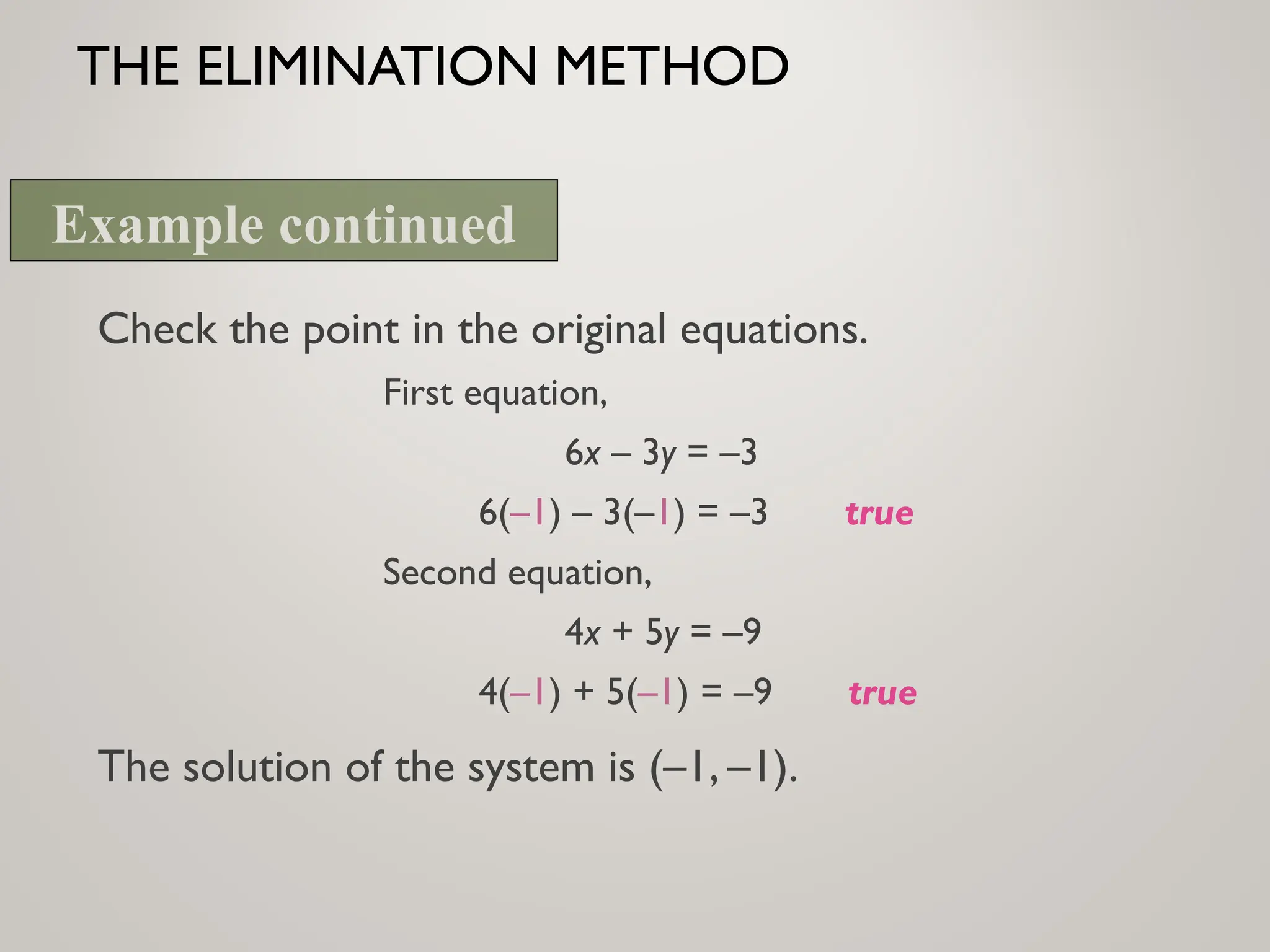
Checkthe point in the original equations.
First equation,
6x – 3y = –3
6(–1) – 3(–1) = –3 true
Second equation,
4x + 5y = –9
4(–1) + 5(–1) = –9 true
The solution of the system is (–1, –1).
Example continued
24.
THE ELIMINATION METHOD
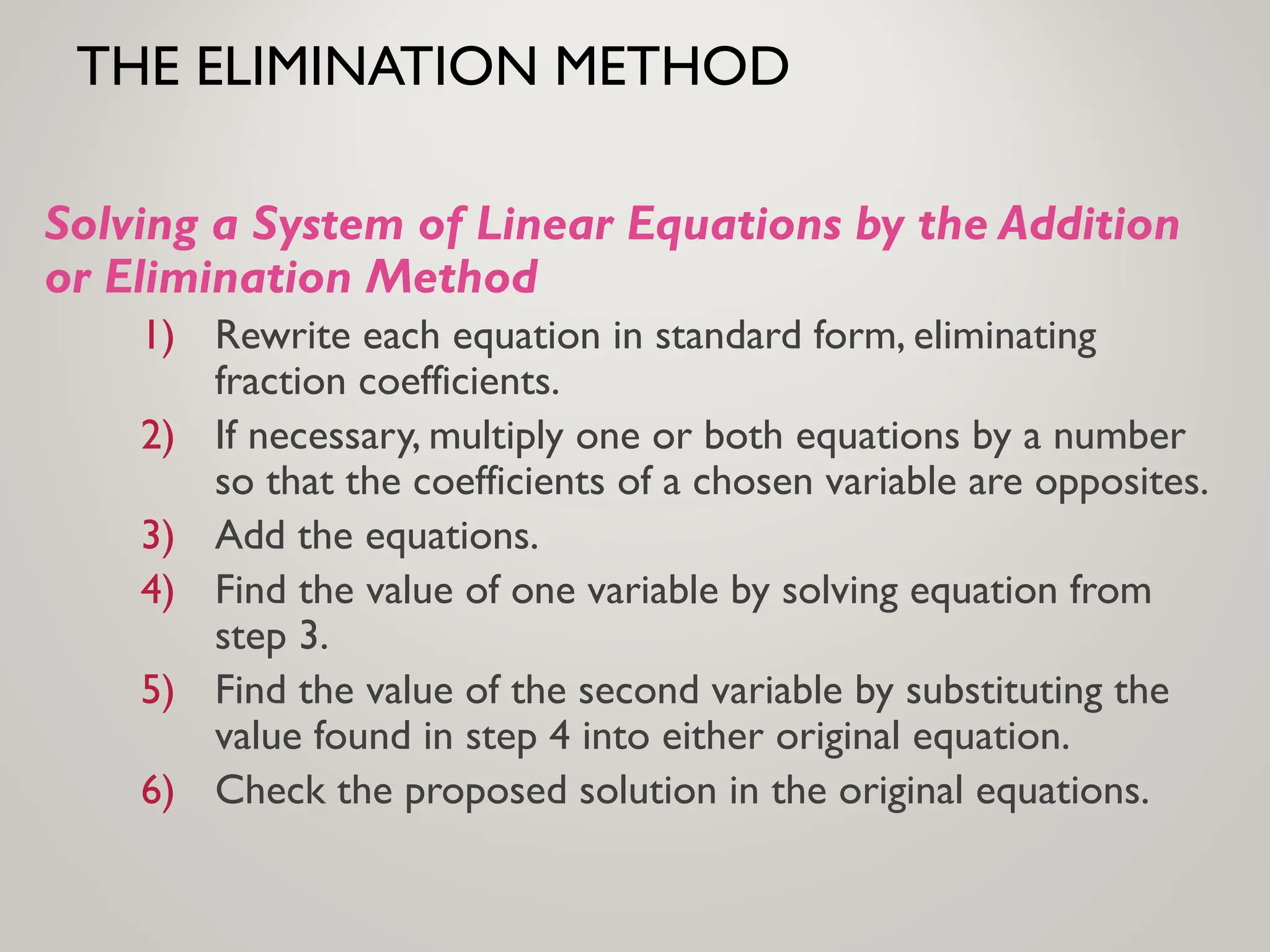
Solvinga System of Linear Equations by the Addition
or Elimination Method
1) Rewrite each equation in standard form, eliminating
fraction coefficients.
2) If necessary, multiply one or both equations by a number
so that the coefficients of a chosen variable are opposites.
3) Add the equations.
4) Find the value of one variable by solving equation from
step 3.
5) Find the value of the second variable by substituting the
value found in step 4 into either original equation.
6) Check the proposed solution in the original equations.
25.
THE ELIMINATION METHOD
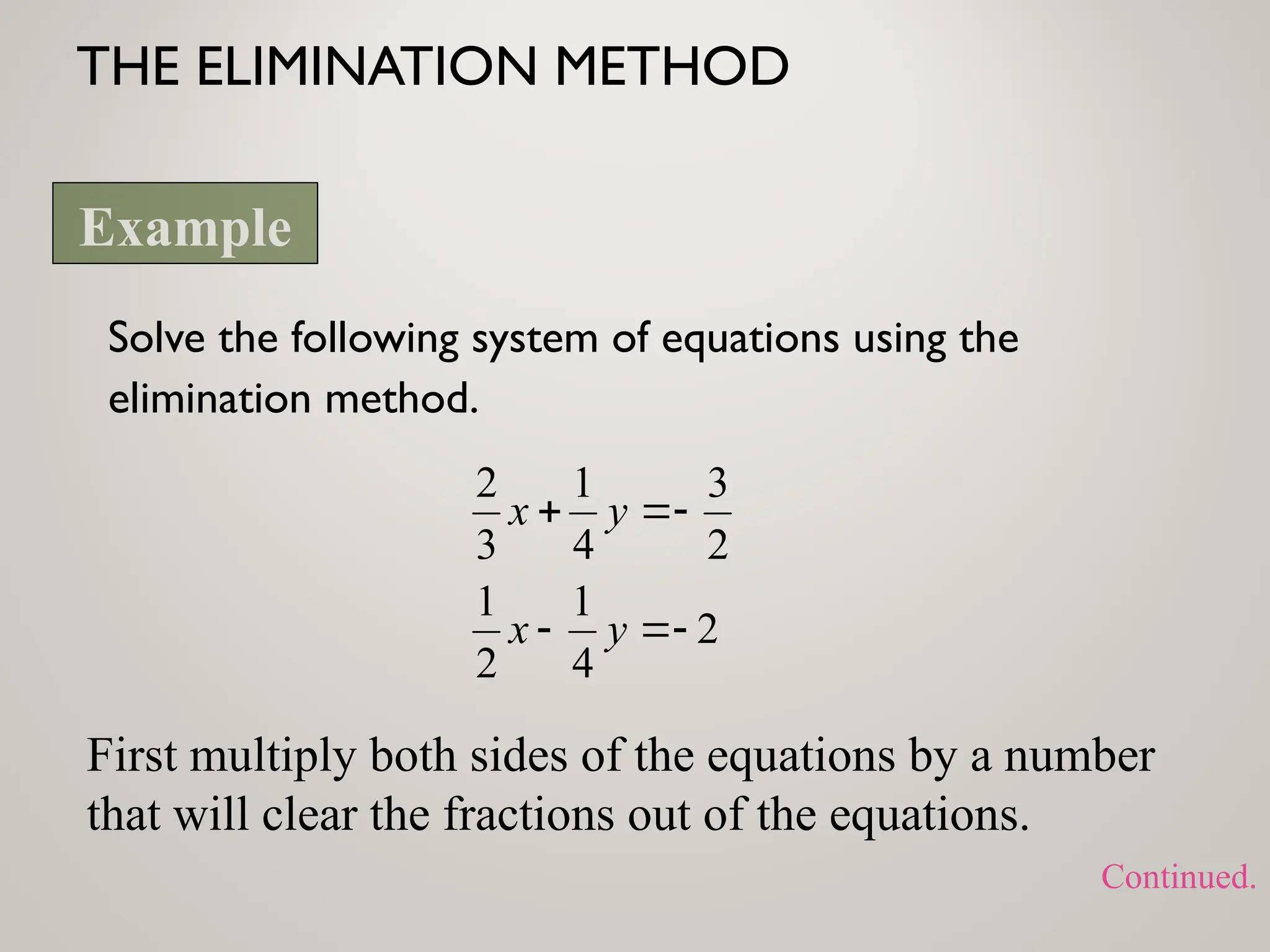
Solvethe following system of equations using the
elimination method.
2
4
1
2
1
2
3
4
1
3
2
y
x
y
x
First multiply both sides of the equations by a number
that will clear the fractions out of the equations.
Example
Continued.
26.
THE ELIMINATION METHOD
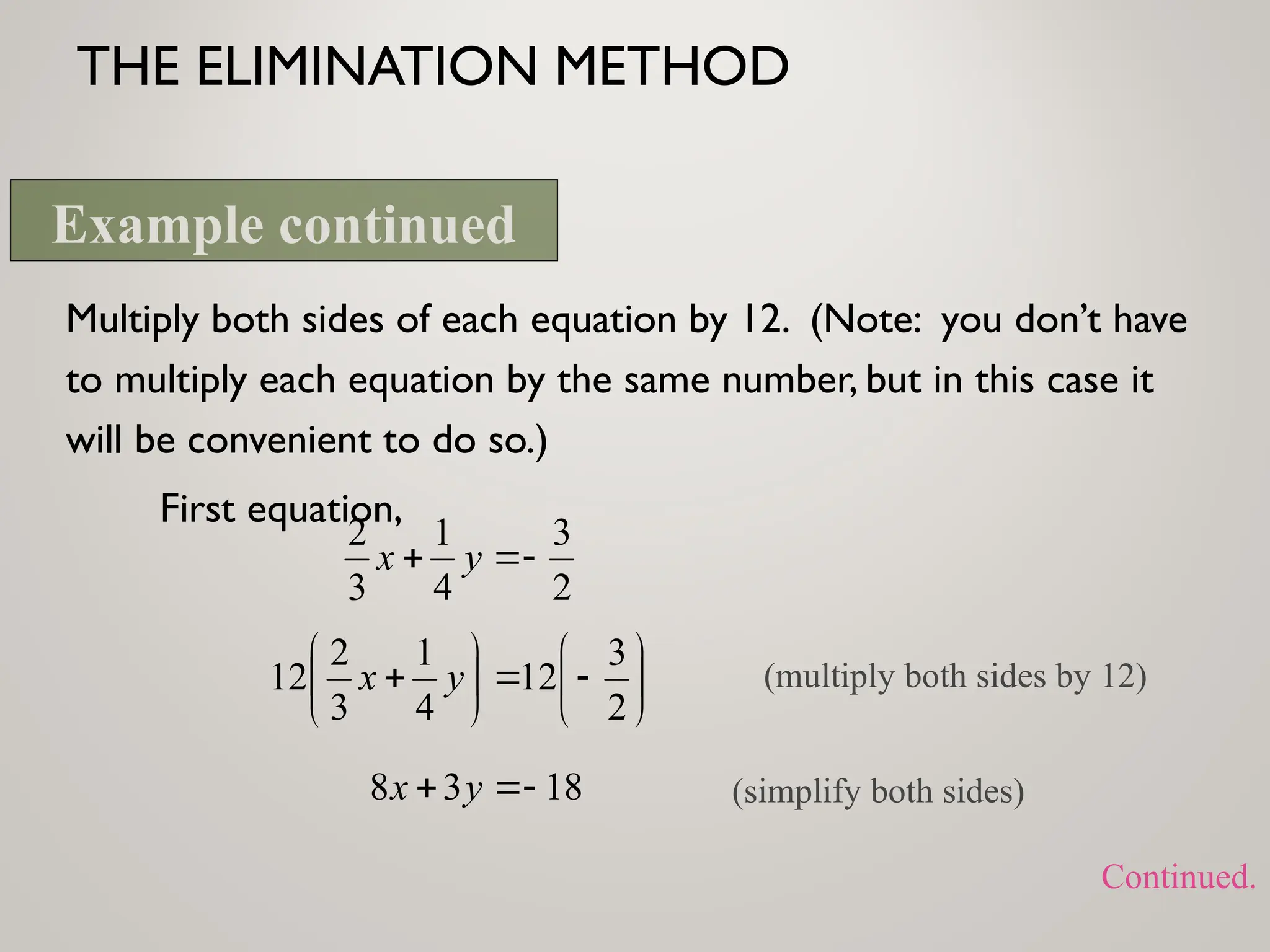
Multiplyboth sides of each equation by 12. (Note: you don’t have
to multiply each equation by the same number, but in this case it
will be convenient to do so.)
First equation,
2
3
4
1
3
2
y
x
2
3
12
4
1
3
2
12 y
x (multiply both sides by 12)
18
3
8
y
x (simplify both sides)
Example continued
Continued.
27.
THE ELIMINATION METHOD
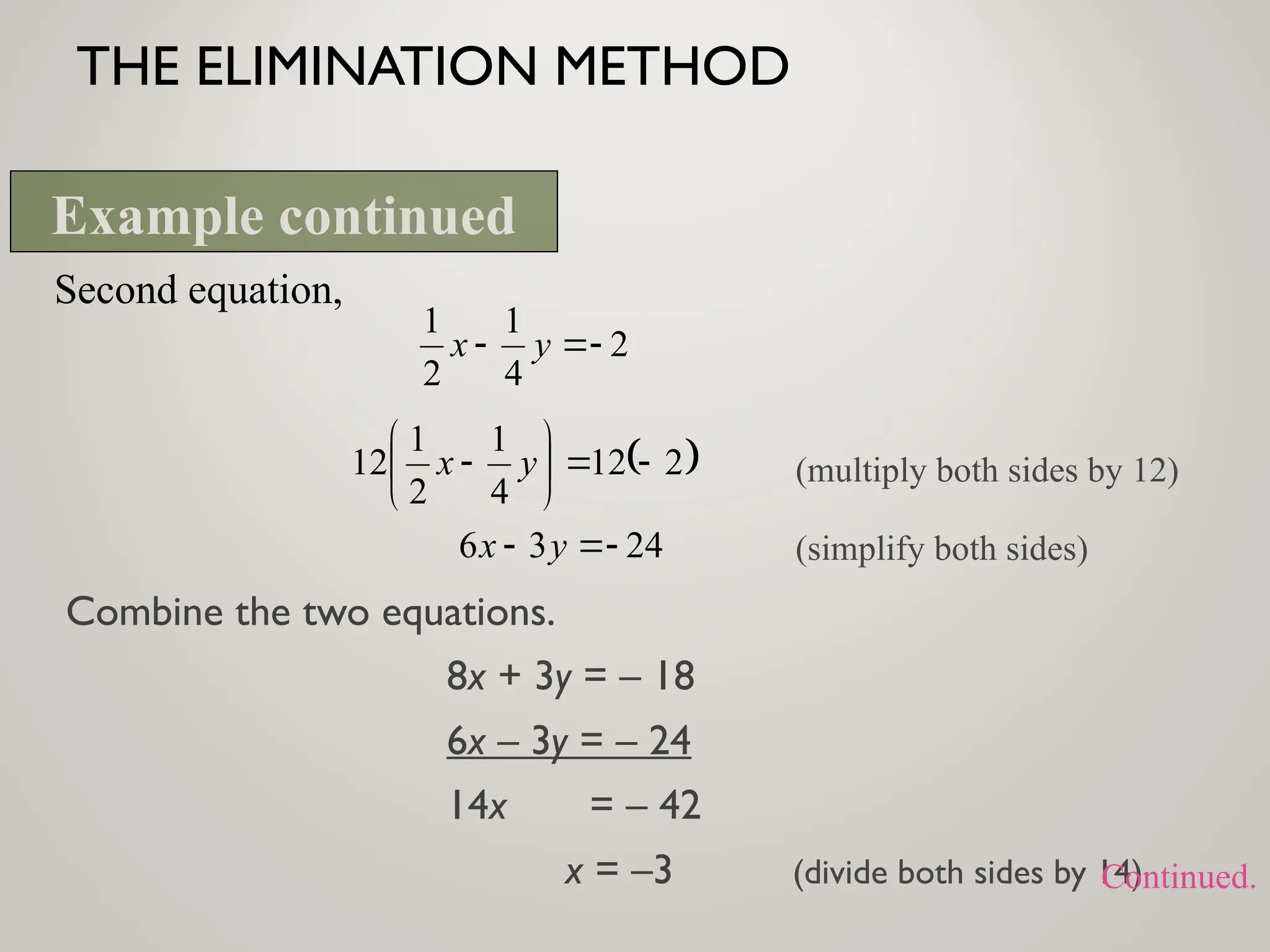
Combinethe two equations.
8x + 3y = – 18
6x – 3y = – 24
14x = – 42
x = –3 (divide both sides by 14)
Second equation,
2
4
1
2
1
y
x
2
12
4
1
2
1
12
y
x (multiply both sides by 12)
(simplify both sides)
24
3
6
y
x
Example continued
Continued.
28.
THE ELIMINATION METHOD
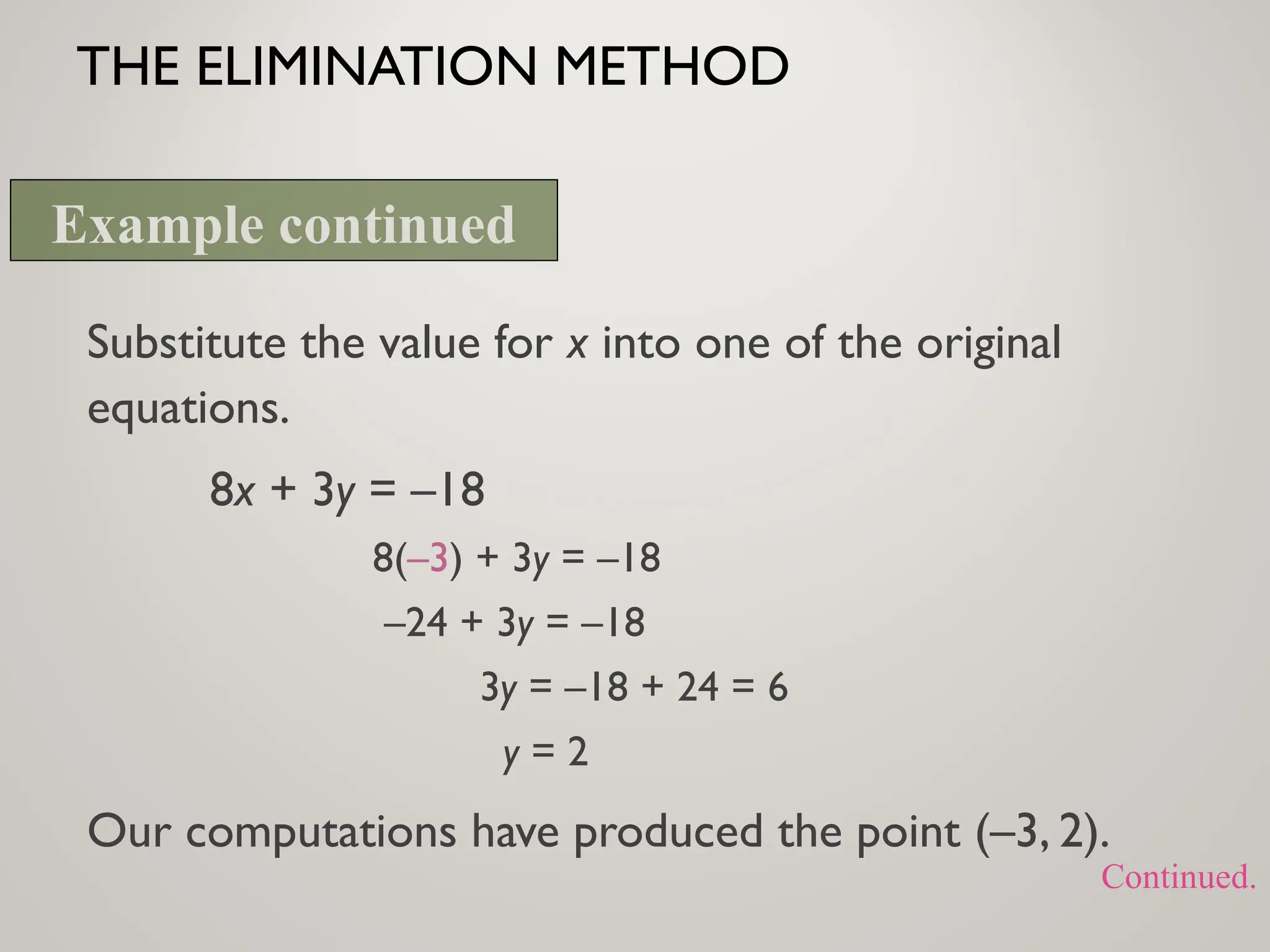
Substitutethe value for x into one of the original
equations.
8x + 3y = –18
8(–3) + 3y = –18
–24 + 3y = –18
3y = –18 + 24 = 6
y = 2
Our computations have produced the point (–3, 2).
Example continued
Continued.
29.
THE ELIMINATION METHOD
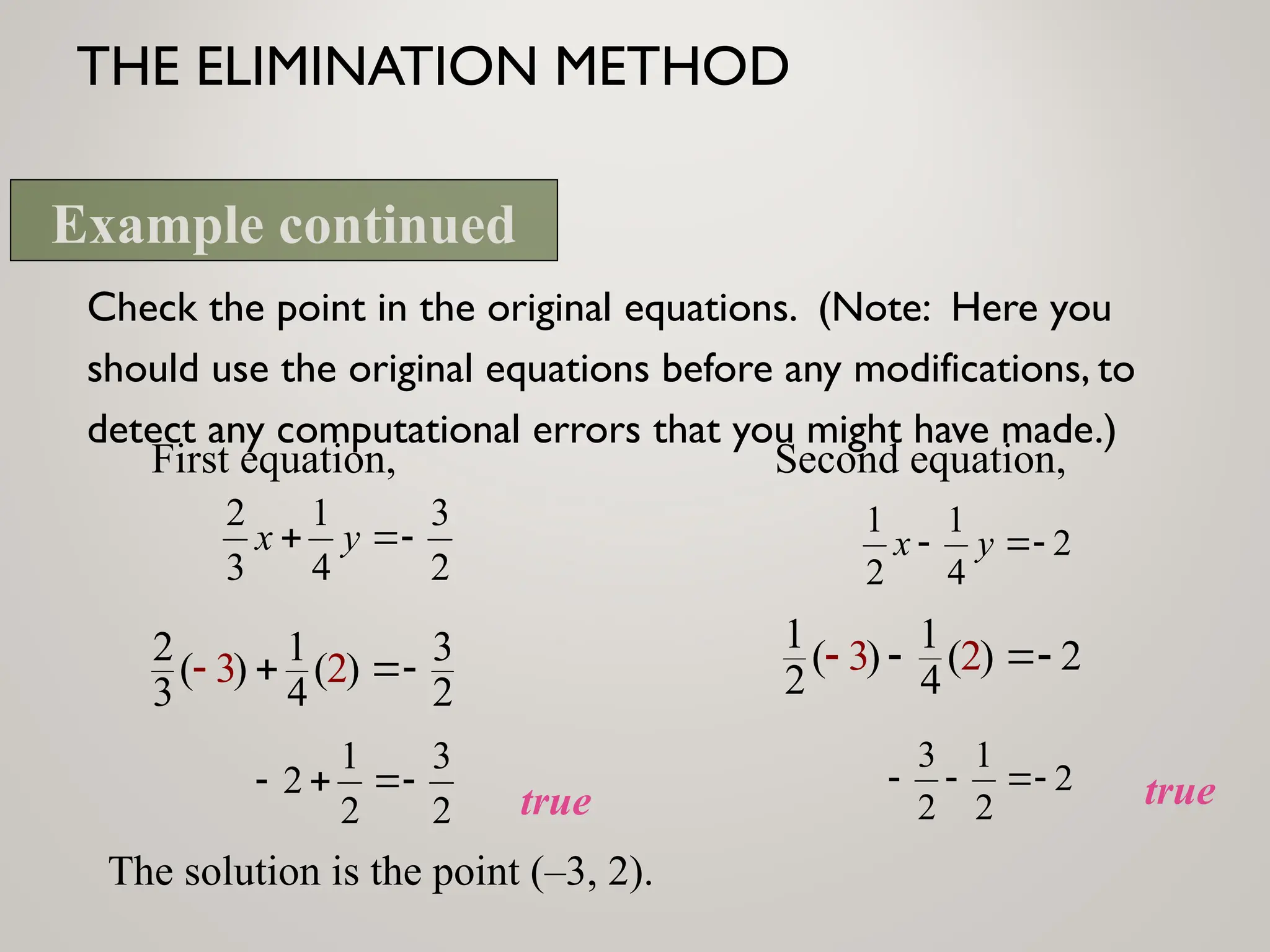
Checkthe point in the original equations. (Note: Here you
should use the original equations before any modifications, to
detect any computational errors that you might have made.)
First equation,
2
3
4
1
3
2
y
x
2 1 3
( ) ( )
3 4 2
3 2
2
3
2
1
2
true
Second equation,
2
4
1
2
1
y
x
1 1
( ) ( ) 2
2 4
3 2
2
2
1
2
3
true
The solution is the point (–3, 2).
Example continued