Systems of Equations and
Inequalities
Chapter 7
Aim #7.1: How do we solve systems of
linear equations?
• All equations in the form of Ax+ By = C form a
straight line when graphed.
• Two such equations are or a linear system.
systems of equations
• A solution to a system of a linear equations in
two variables is an ordered pair that satisfies
both equations.
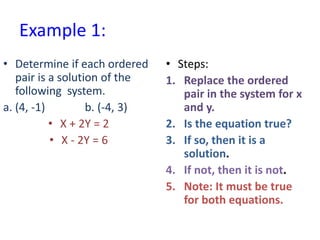
Example 1:
• Determine if each ordered
pair is a solution of the
following system.
a. (4, -1) b. (-4, 3)
• X + 2Y = 2
• X - 2Y = 6
• Steps:
1. Replace the ordered
pair in the system for x
and y.
2. Is the equation true?
3. If so, then it is a
solution.
4. If not, then it is not.
5. Note: It must be true
for both equations.
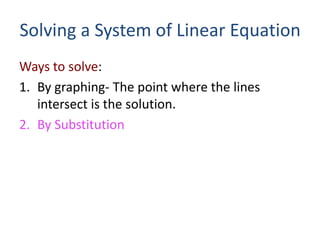
Solving a System of Linear Equation
Ways to solve:
1. By graphing- The point where the lines
intersect is the solution.
2. By Substitution
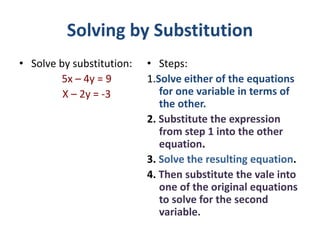
Solving by Substitution
• Solve by substitution:
5x – 4y = 9
X – 2y = -3
• Steps:
1.Solve either of the equations
for one variable in terms of
the other.
2. Substitute the expression
from step 1 into the other
equation.
3. Solve the resulting equation.
4. Then substitute the vale into
one of the original equations
to solve for the second
variable.
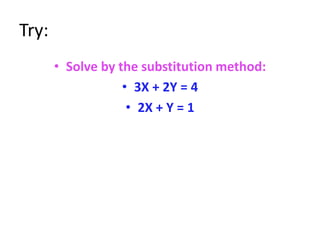
Try:
• Solve by the substitution method:
• 3X + 2Y = 4
• 2X + Y = 1
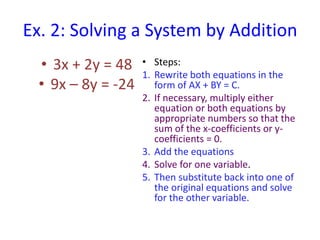
Solving a System of Linear Equation
Ways to solve:
1.By graphing- The point where the lines
intersect is the solution.
2.By Substitution
3.By Elimination
Ex. 2: Solving a System by Addition
• 3x + 2y = 48
• 9x – 8y = -24
• Steps:
1. Rewrite both equations in the
form of AX + BY = C.
2. If necessary, multiply either
equation or both equations by
appropriate numbers so that the
sum of the x-coefficients or y-
coefficients = 0.
3. Add the equations
4. Solve for one variable.
5. Then substitute back into one of
the original equations and solve
for the other variable.
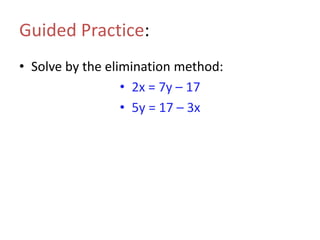
Guided Practice:
• Solve by the elimination method:
• 2x = 7y – 17
• 5y = 17 – 3x
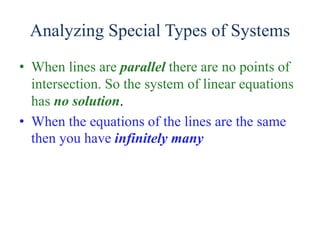
Analyzing Special Types of Systems
• When lines are parallel there are no points of
intersection. So the system of linear equations
has no solution.
• When the equations of the lines are the same
then you have infinitely many
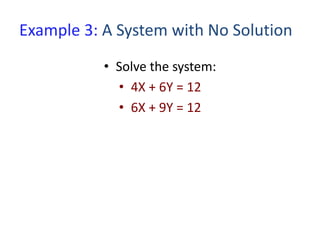
Example 3: A System with No Solution
• Solve the system:
• 4X + 6Y = 12
• 6X + 9Y = 12
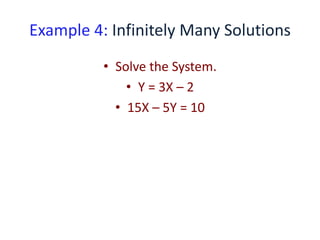
Example 4: Infinitely Many Solutions
• Solve the System.
• Y = 3X – 2
• 15X – 5Y = 10
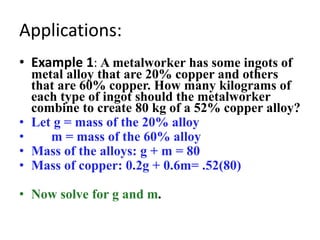
Applications:
• Example 1: A metalworker has some ingots of
metal alloy that are 20% copper and others
that are 60% copper. How many kilograms of
each type of ingot should the metalworker
combine to create 80 kg of a 52% copper alloy?
• Let g = mass of the 20% alloy
• m = mass of the 60% alloy
• Mass of the alloys: g + m = 80
• Mass of copper: 0.2g + 0.6m= .52(80)
• Now solve for g and m.
Break- Even Problems
• Suppose a model airplane club publishes a newsletter.
Expenses are $.90 for printing and mailing each copy,
plus $600 total for research writing. The price of the
newsletter is $1.50 per copy. How many copies of the
newsletter must the club sell to break even?
• Let x = the number of copies
• y = the amount of dollars of expenses or income
Expenses are printing costs plus research and writing.
y = 0.9x + 600
Income is price times copies sold.
y = 1.5x
To find out how many copies you need to sell solve for x.
Summary:
Answer in complete sentences.
• 3- What are three ways to solve systems of
equations?
• 2- Identify 2 elimination strategies.
• 1-Solve:
Suppose an antique car club publishes a
newsletter. Expenses are $.35 for printing and
mailing each copy, plus $770 total for research
and writing. The price of the newsletter is $.55
per copy. How many copies of the newsletter
must the club sell to break even?
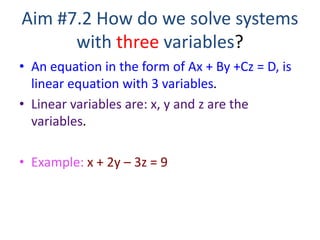
Aim #7.2 How do we solve systems
with three variables?
• An equation in the form of Ax + By +Cz = D, is
linear equation with 3 variables.
• Linear variables are: x, y and z are the
variables.
• Example: x + 2y – 3z = 9
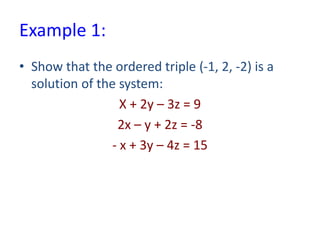
Example 1:
• Show that the ordered triple (-1, 2, -2) is a
solution of the system:
X + 2y – 3z = 9
2x – y + 2z = -8
- x + 3y – 4z = 15
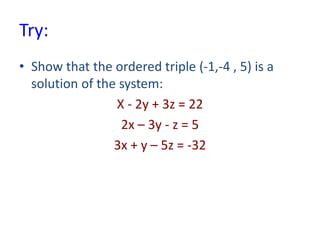
Try:
• Show that the ordered triple (-1,-4 , 5) is a
solution of the system:
X - 2y + 3z = 22
2x – 3y - z = 5
3x + y – 5z = -32
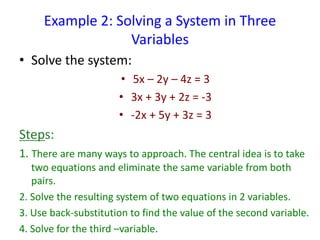
Example 2: Solving a System in Three
Variables
• Solve the system:
• 5x – 2y – 4z = 3
• 3x + 3y + 2z = -3
• -2x + 5y + 3z = 3
Steps:
1. There are many ways to approach. The central idea is to take
two equations and eliminate the same variable from both
pairs.
2. Solve the resulting system of two equations in 2 variables.
3. Use back-substitution to find the value of the second variable.
4. Solve for the third –variable.
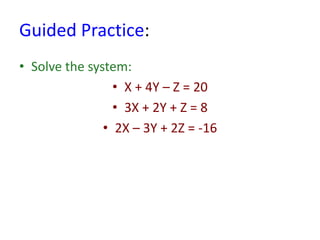
Guided Practice:
• Solve the system:
• X + 4Y – Z = 20
• 3X + 2Y + Z = 8
• 2X – 3Y + 2Z = -16
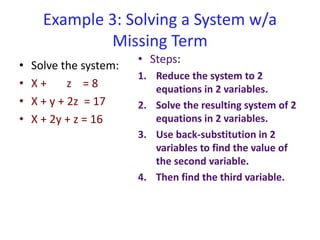
Example 3: Solving a System w/a
Missing Term
• Solve the system:
• X + z = 8
• X + y + 2z = 17
• X + 2y + z = 16
• Steps:
1. Reduce the system to 2
equations in 2 variables.
2. Solve the resulting system of 2
equations in 2 variables.
3. Use back-substitution in 2
variables to find the value of
the second variable.
4. Then find the third variable.
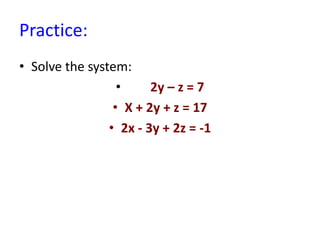
Practice:
• Solve the system:
• 2y – z = 7
• X + 2y + z = 17
• 2x - 3y + 2z = -1
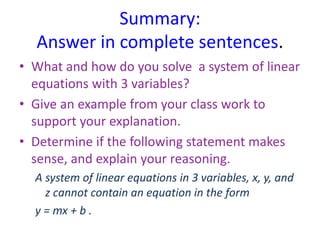
Summary:
Answer in complete sentences.
• What and how do you solve a system of linear
equations with 3 variables?
• Give an example from your class work to
support your explanation.
• Determine if the following statement makes
sense, and explain your reasoning.
A system of linear equations in 3 variables, x, y, and
z cannot contain an equation in the form
y = mx + b .
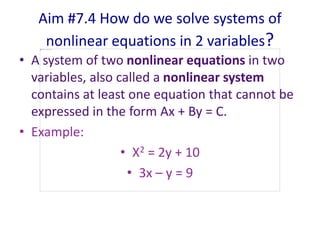
Aim #7.4 How do we solve systems of
nonlinear equations in 2 variables?
• A system of two nonlinear equations in two
variables, also called a nonlinear system
contains at least one equation that cannot be
expressed in the form Ax + By = C.
• Example:
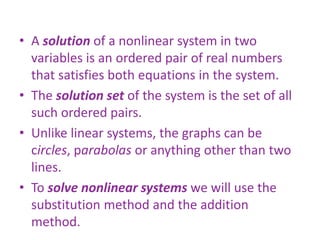
• X2 = 2y + 10
• 3x – y = 9
• A solution of a nonlinear system in two
variables is an ordered pair of real numbers
that satisfies both equations in the system.
• The solution set of the system is the set of all
such ordered pairs.
• Unlike linear systems, the graphs can be
circles, parabolas or anything other than two
lines.
• To solve nonlinear systems we will use the
substitution method and the addition
method.
Example 1: Solving a Nonlinear System by
the Substitution Method
• Solve:
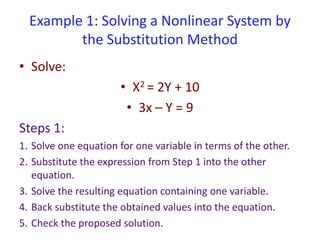
• X2 = 2Y + 10
• 3x – Y = 9
Steps 1:
1. Solve one equation for one variable in terms of the other.
2. Substitute the expression from Step 1 into the other
equation.
3. Solve the resulting equation containing one variable.
4. Back substitute the obtained values into the equation.
5. Check the proposed solution.
Guided Practice:
• Solve by the substitution method:
• X2 = y -1
• 4x – y = -1
Example 2:
• Solve by the substitution method:
• X – Y = 3
• (X – 2)2 + (Y + 3)2 = 4
• (Note: This is a circle, with the center at (2, -3)
and radius 2.)
Practice:
• Solve by the substitution method:
X + 2Y = 0
(X – 1)2 + (Y - 1)2 = 5
Example 3: Solving a Nonlinear System using
the Addition Method
• Solve the system:
4x2 + y2= 13
X2 + y2 = 10
Guided Practice:
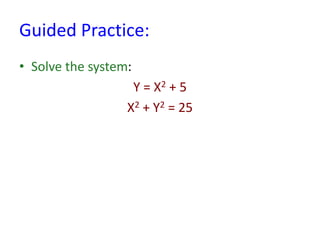
• Solve the system:
Y = X2 + 5
X2 + Y2 = 25
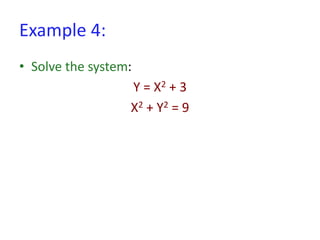
Example 4:
• Solve the system:
Y = X2 + 3
X2 + Y2 = 9
Guided Practice:
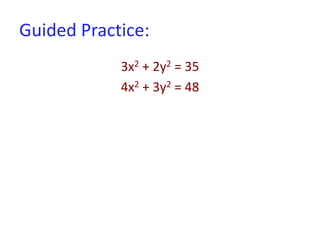
3x2 + 2y2 = 35
4x2 + 3y2 = 48
Summary:
Answer in complete sentences.
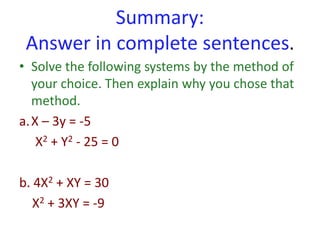
• Solve the following systems by the method of
your choice. Then explain why you chose that
method.
a.X – 3y = -5
X2 + Y2 - 25 = 0
b. 4X2 + XY = 30
X2 + 3XY = -9
Aim #7.5: How do we solve system
of inequalities?
• Graphing a linear Inequality in Two Variables
• Graph 2x – 3y > 6
• Steps:
1. Replace Inequality with = sign and graph the linear
equation.
2. Choose a test point from one of the half planes and
not from the line. Substitutes its coordinates into the
inequality.
3. Then shade the plane that meets the conditions.
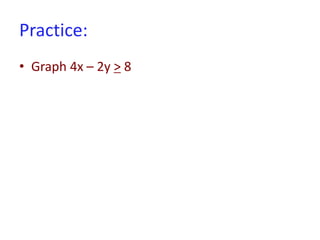
Practice:
• Graph 4x – 2y > 8
Example 2:
Graph the inequality in Two Variables
• Graph
Example 3:
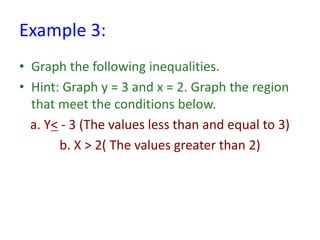
• Graph the following inequalities.
• Hint: Graph y = 3 and x = 2. Graph the region
that meet the conditions below.
a. Y< - 3 (The values less than and equal to 3)
b. X > 2( The values greater than 2)
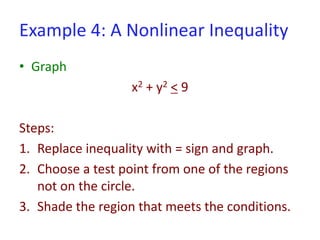
Example 4: A Nonlinear Inequality
• Graph
x2 + y2 < 9
Steps:
1. Replace inequality with = sign and graph.
2. Choose a test point from one of the regions
not on the circle.
3. Shade the region that meets the conditions.
Practice:
• Graph x2 + y2 >16
Example 5:Graphing Systems of Linear
Inequalities
• Graph the solution set of the system.
• Steps:
1. Replace each inequality symbol with an equal sign.
Graph using the x and y-intercepts of each equation.
2. Note the first equation the line should be ..?
Whereas the second equation’s line should be…?
3. Test points in each region to see which section is a
solution to both inequalities.
Practice:
• Graph the solution set of the system below.
Example 6: Graphing System of
Inequalities
• Graph the solution set of the equation:
• Steps:
1. Graph the first inequality. Note it’s a solid parabola.
2. Then graph the second inequality.
3. Note the points of intersection of the inequalities.
4. Now test points and shade the region that makes
the inequalities true.
Practice:
• Graph the system of inequalities.
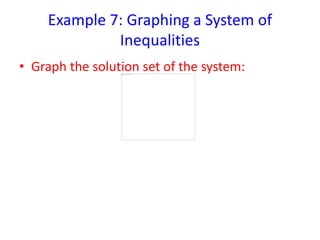
Example 7: Graphing a System of
Inequalities
• Graph the solution set of the system:
Summary:
Answer in complete sentences.
• What is a linear inequality in two variables?
Provide an example with your description.
• How do you determine if an ordered pair is a
solution of an inequality in two variables x
and y?
• What is the difference between a dash and a
solid line in graphing an inequality?
• What is a system of linear inequalities?

chapter 7.ppt functions and its relation to mathematics

  • 1.
    Systems of Equationsand Inequalities Chapter 7
  • 2.
    Aim #7.1: Howdo we solve systems of linear equations? • All equations in the form of Ax+ By = C form a straight line when graphed. • Two such equations are or a linear system. systems of equations • A solution to a system of a linear equations in two variables is an ordered pair that satisfies both equations.
  • 3.
    Example 1: • Determineif each ordered pair is a solution of the following system. a. (4, -1) b. (-4, 3) • X + 2Y = 2 • X - 2Y = 6 • Steps: 1. Replace the ordered pair in the system for x and y. 2. Is the equation true? 3. If so, then it is a solution. 4. If not, then it is not. 5. Note: It must be true for both equations.
  • 4.
    Solving a Systemof Linear Equation Ways to solve: 1. By graphing- The point where the lines intersect is the solution. 2. By Substitution
  • 5.
    Solving by Substitution •Solve by substitution: 5x – 4y = 9 X – 2y = -3 • Steps: 1.Solve either of the equations for one variable in terms of the other. 2. Substitute the expression from step 1 into the other equation. 3. Solve the resulting equation. 4. Then substitute the vale into one of the original equations to solve for the second variable.
  • 6.
    Try: • Solve bythe substitution method: • 3X + 2Y = 4 • 2X + Y = 1
  • 7.
    Solving a Systemof Linear Equation Ways to solve: 1.By graphing- The point where the lines intersect is the solution. 2.By Substitution 3.By Elimination
  • 8.
    Ex. 2: Solvinga System by Addition • 3x + 2y = 48 • 9x – 8y = -24 • Steps: 1. Rewrite both equations in the form of AX + BY = C. 2. If necessary, multiply either equation or both equations by appropriate numbers so that the sum of the x-coefficients or y- coefficients = 0. 3. Add the equations 4. Solve for one variable. 5. Then substitute back into one of the original equations and solve for the other variable.
  • 9.
    Guided Practice: • Solveby the elimination method: • 2x = 7y – 17 • 5y = 17 – 3x
  • 10.
    Analyzing Special Typesof Systems • When lines are parallel there are no points of intersection. So the system of linear equations has no solution. • When the equations of the lines are the same then you have infinitely many
  • 11.
    Example 3: ASystem with No Solution • Solve the system: • 4X + 6Y = 12 • 6X + 9Y = 12
  • 12.
    Example 4: InfinitelyMany Solutions • Solve the System. • Y = 3X – 2 • 15X – 5Y = 10
  • 13.
    Applications: • Example 1:A metalworker has some ingots of metal alloy that are 20% copper and others that are 60% copper. How many kilograms of each type of ingot should the metalworker combine to create 80 kg of a 52% copper alloy? • Let g = mass of the 20% alloy • m = mass of the 60% alloy • Mass of the alloys: g + m = 80 • Mass of copper: 0.2g + 0.6m= .52(80) • Now solve for g and m.
  • 14.
    Break- Even Problems •Suppose a model airplane club publishes a newsletter. Expenses are $.90 for printing and mailing each copy, plus $600 total for research writing. The price of the newsletter is $1.50 per copy. How many copies of the newsletter must the club sell to break even? • Let x = the number of copies • y = the amount of dollars of expenses or income Expenses are printing costs plus research and writing. y = 0.9x + 600 Income is price times copies sold. y = 1.5x To find out how many copies you need to sell solve for x.
  • 15.
    Summary: Answer in completesentences. • 3- What are three ways to solve systems of equations? • 2- Identify 2 elimination strategies. • 1-Solve: Suppose an antique car club publishes a newsletter. Expenses are $.35 for printing and mailing each copy, plus $770 total for research and writing. The price of the newsletter is $.55 per copy. How many copies of the newsletter must the club sell to break even?
  • 16.
    Aim #7.2 Howdo we solve systems with three variables? • An equation in the form of Ax + By +Cz = D, is linear equation with 3 variables. • Linear variables are: x, y and z are the variables. • Example: x + 2y – 3z = 9
  • 17.
    Example 1: • Showthat the ordered triple (-1, 2, -2) is a solution of the system: X + 2y – 3z = 9 2x – y + 2z = -8 - x + 3y – 4z = 15
  • 18.
    Try: • Show thatthe ordered triple (-1,-4 , 5) is a solution of the system: X - 2y + 3z = 22 2x – 3y - z = 5 3x + y – 5z = -32
  • 19.
    Example 2: Solvinga System in Three Variables • Solve the system: • 5x – 2y – 4z = 3 • 3x + 3y + 2z = -3 • -2x + 5y + 3z = 3 Steps: 1. There are many ways to approach. The central idea is to take two equations and eliminate the same variable from both pairs. 2. Solve the resulting system of two equations in 2 variables. 3. Use back-substitution to find the value of the second variable. 4. Solve for the third –variable.
  • 20.
    Guided Practice: • Solvethe system: • X + 4Y – Z = 20 • 3X + 2Y + Z = 8 • 2X – 3Y + 2Z = -16
  • 21.
    Example 3: Solvinga System w/a Missing Term • Solve the system: • X + z = 8 • X + y + 2z = 17 • X + 2y + z = 16 • Steps: 1. Reduce the system to 2 equations in 2 variables. 2. Solve the resulting system of 2 equations in 2 variables. 3. Use back-substitution in 2 variables to find the value of the second variable. 4. Then find the third variable.
  • 22.
    Practice: • Solve thesystem: • 2y – z = 7 • X + 2y + z = 17 • 2x - 3y + 2z = -1
  • 23.
    Summary: Answer in completesentences. • What and how do you solve a system of linear equations with 3 variables? • Give an example from your class work to support your explanation. • Determine if the following statement makes sense, and explain your reasoning. A system of linear equations in 3 variables, x, y, and z cannot contain an equation in the form y = mx + b .
  • 24.
    Aim #7.4 Howdo we solve systems of nonlinear equations in 2 variables? • A system of two nonlinear equations in two variables, also called a nonlinear system contains at least one equation that cannot be expressed in the form Ax + By = C. • Example: • X2 = 2y + 10 • 3x – y = 9
  • 25.
    • A solutionof a nonlinear system in two variables is an ordered pair of real numbers that satisfies both equations in the system. • The solution set of the system is the set of all such ordered pairs. • Unlike linear systems, the graphs can be circles, parabolas or anything other than two lines. • To solve nonlinear systems we will use the substitution method and the addition method.
  • 26.
    Example 1: Solvinga Nonlinear System by the Substitution Method • Solve: • X2 = 2Y + 10 • 3x – Y = 9 Steps 1: 1. Solve one equation for one variable in terms of the other. 2. Substitute the expression from Step 1 into the other equation. 3. Solve the resulting equation containing one variable. 4. Back substitute the obtained values into the equation. 5. Check the proposed solution.
  • 27.
    Guided Practice: • Solveby the substitution method: • X2 = y -1 • 4x – y = -1
  • 28.
    Example 2: • Solveby the substitution method: • X – Y = 3 • (X – 2)2 + (Y + 3)2 = 4 • (Note: This is a circle, with the center at (2, -3) and radius 2.)
  • 29.
    Practice: • Solve bythe substitution method: X + 2Y = 0 (X – 1)2 + (Y - 1)2 = 5
  • 30.
    Example 3: Solvinga Nonlinear System using the Addition Method • Solve the system: 4x2 + y2= 13 X2 + y2 = 10
  • 31.
    Guided Practice: • Solvethe system: Y = X2 + 5 X2 + Y2 = 25
  • 32.
    Example 4: • Solvethe system: Y = X2 + 3 X2 + Y2 = 9
  • 33.
    Guided Practice: 3x2 +2y2 = 35 4x2 + 3y2 = 48
  • 34.
    Summary: Answer in completesentences. • Solve the following systems by the method of your choice. Then explain why you chose that method. a.X – 3y = -5 X2 + Y2 - 25 = 0 b. 4X2 + XY = 30 X2 + 3XY = -9
  • 35.
    Aim #7.5: Howdo we solve system of inequalities? • Graphing a linear Inequality in Two Variables • Graph 2x – 3y > 6 • Steps: 1. Replace Inequality with = sign and graph the linear equation. 2. Choose a test point from one of the half planes and not from the line. Substitutes its coordinates into the inequality. 3. Then shade the plane that meets the conditions.
  • 36.
  • 37.
    Example 2: Graph theinequality in Two Variables • Graph
  • 38.
    Example 3: • Graphthe following inequalities. • Hint: Graph y = 3 and x = 2. Graph the region that meet the conditions below. a. Y< - 3 (The values less than and equal to 3) b. X > 2( The values greater than 2)
  • 39.
    Example 4: ANonlinear Inequality • Graph x2 + y2 < 9 Steps: 1. Replace inequality with = sign and graph. 2. Choose a test point from one of the regions not on the circle. 3. Shade the region that meets the conditions.
  • 40.
  • 41.
    Example 5:Graphing Systemsof Linear Inequalities • Graph the solution set of the system. • Steps: 1. Replace each inequality symbol with an equal sign. Graph using the x and y-intercepts of each equation. 2. Note the first equation the line should be ..? Whereas the second equation’s line should be…? 3. Test points in each region to see which section is a solution to both inequalities.
  • 42.
    Practice: • Graph thesolution set of the system below.
  • 43.
    Example 6: GraphingSystem of Inequalities • Graph the solution set of the equation: • Steps: 1. Graph the first inequality. Note it’s a solid parabola. 2. Then graph the second inequality. 3. Note the points of intersection of the inequalities. 4. Now test points and shade the region that makes the inequalities true.
  • 44.
    Practice: • Graph thesystem of inequalities.
  • 45.
    Example 7: Graphinga System of Inequalities • Graph the solution set of the system:
  • 46.
    Summary: Answer in completesentences. • What is a linear inequality in two variables? Provide an example with your description. • How do you determine if an ordered pair is a solution of an inequality in two variables x and y? • What is the difference between a dash and a solid line in graphing an inequality? • What is a system of linear inequalities?
Editor's Notes