Integration Learning  Objectives : In this chapter, you will learn about the concept of indefinite integral Learning Outcomes: Determine integrals by reversing differentiation
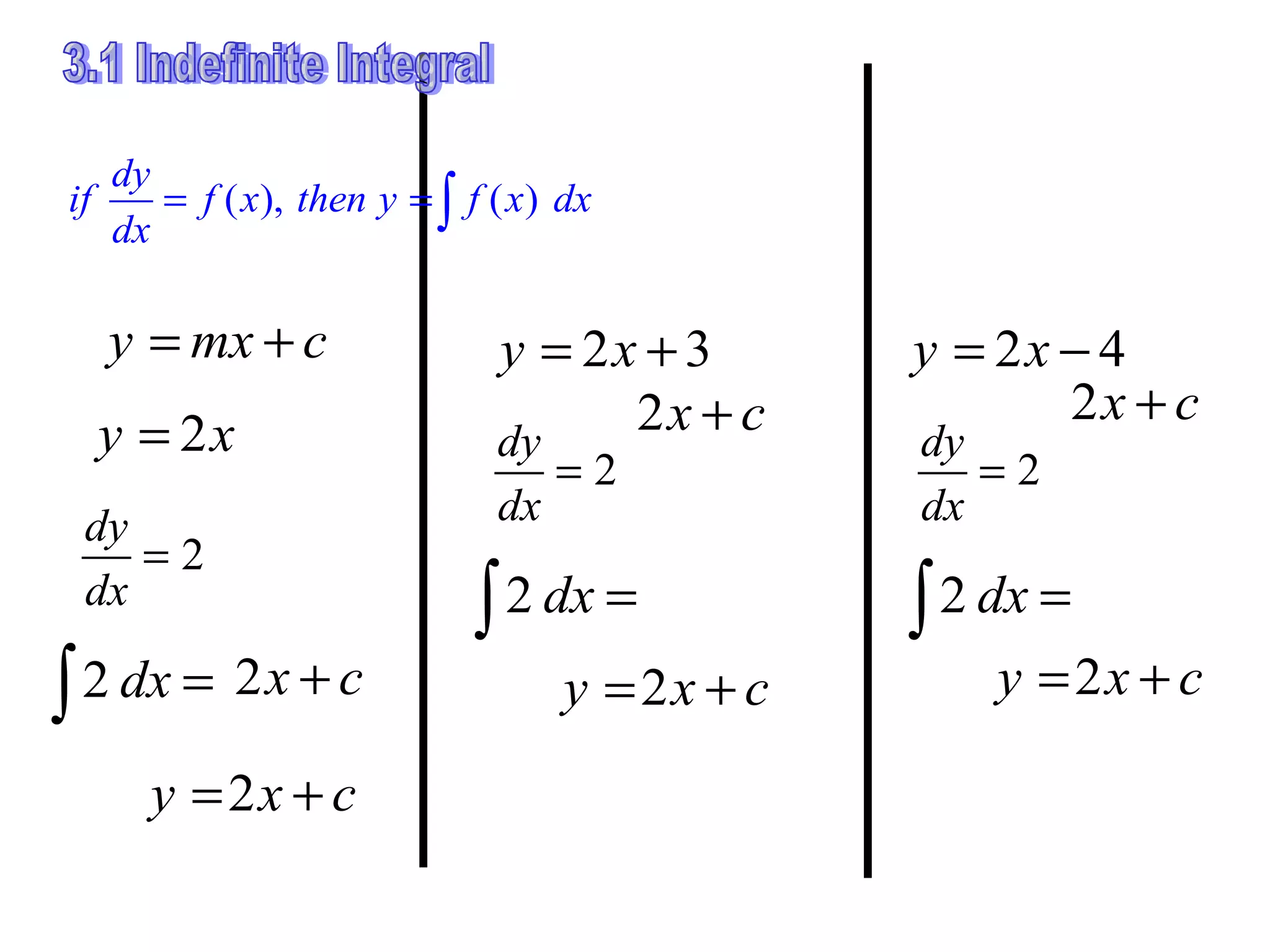
3.1 Indefinite Integral
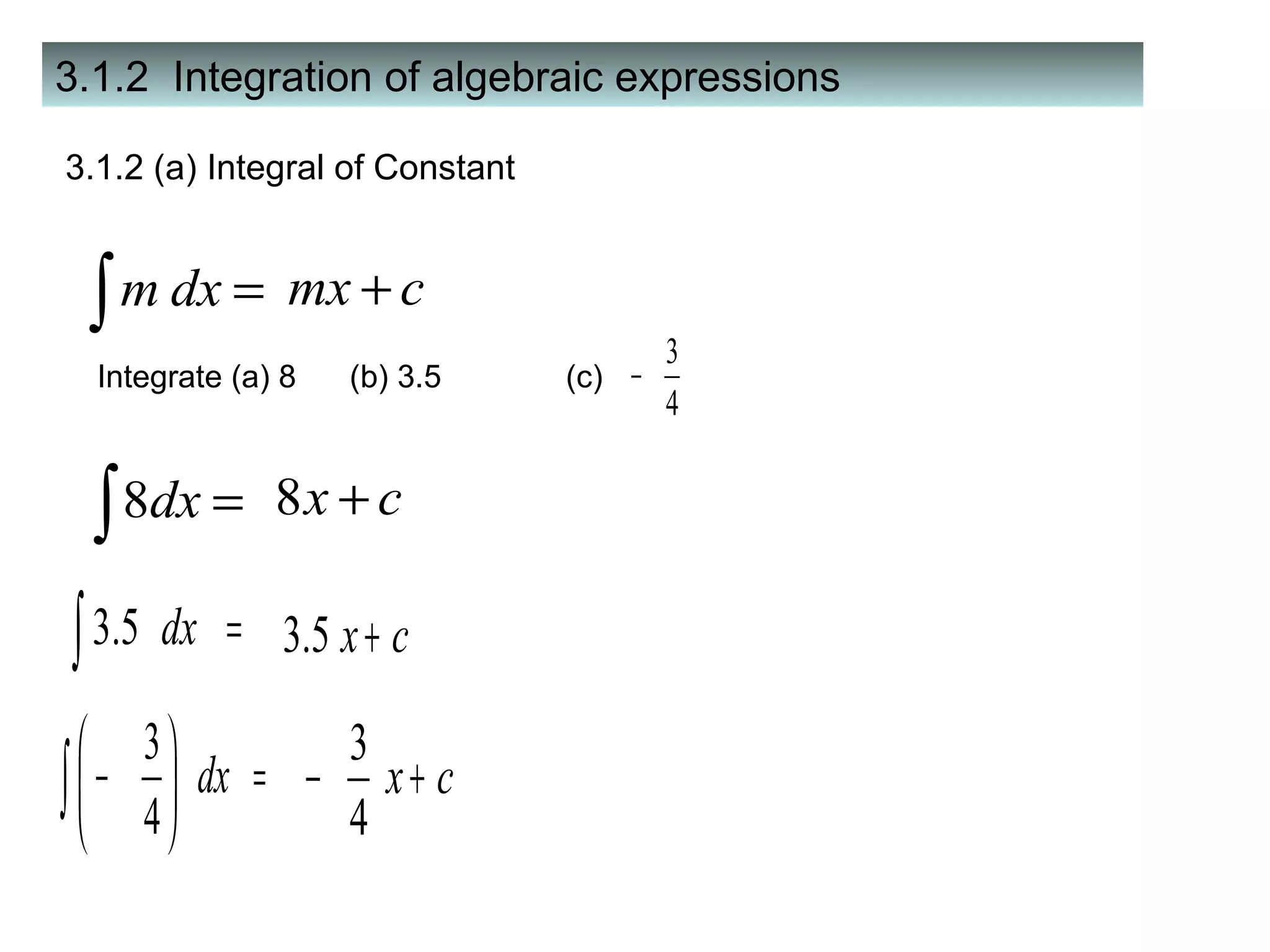
3.1.2  Integration of algebraic expressions Integrate (a) 8  (b) 3.5  (c)  3.1.2 (a) Integral of Constant
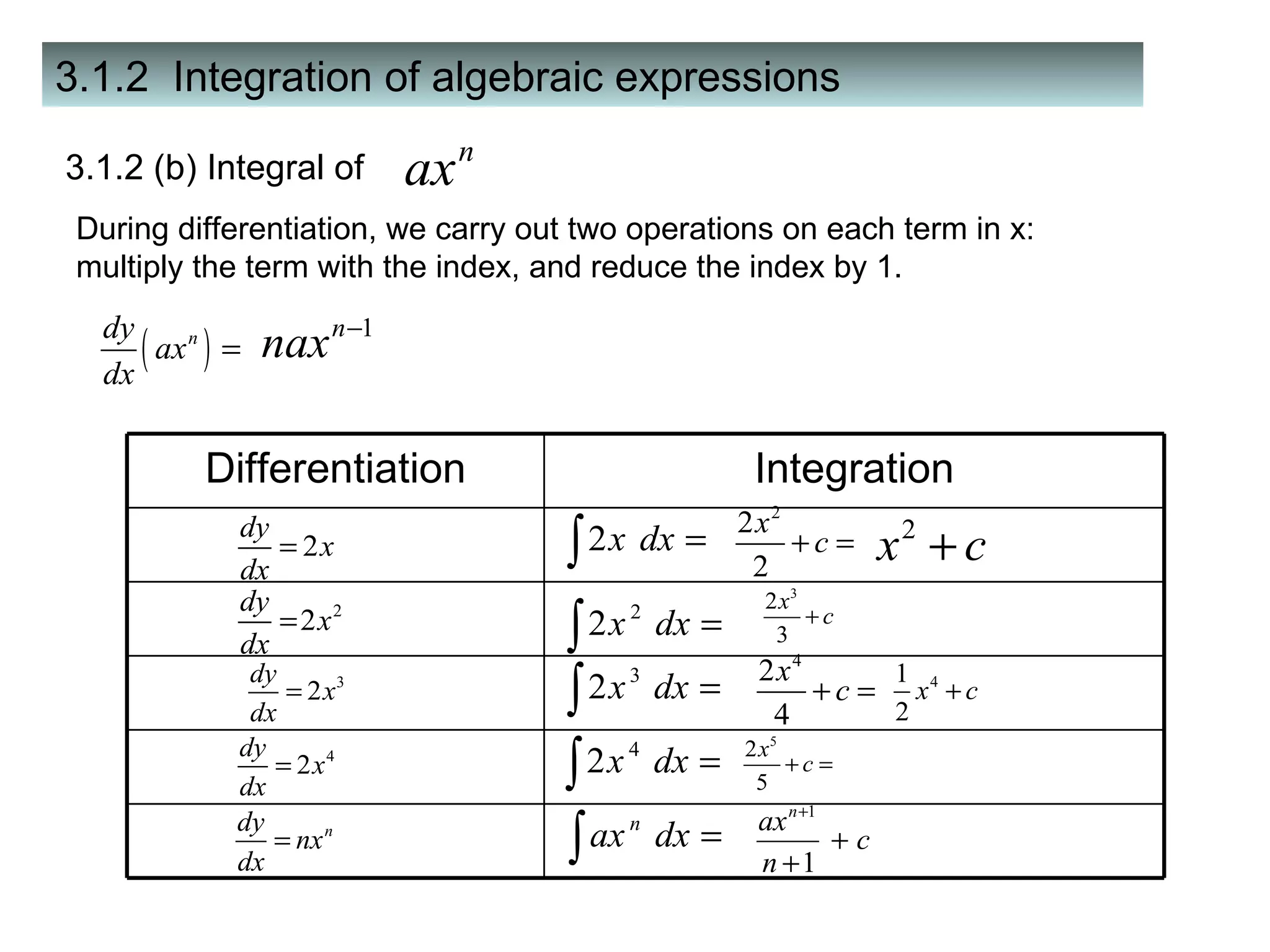
3.1.2  Integration of algebraic expressions During differentiation, we carry out two operations on each term in x: multiply the term with the index, and reduce the index by 1. 3.1.2 (b) Integral of  Differentiation Integration
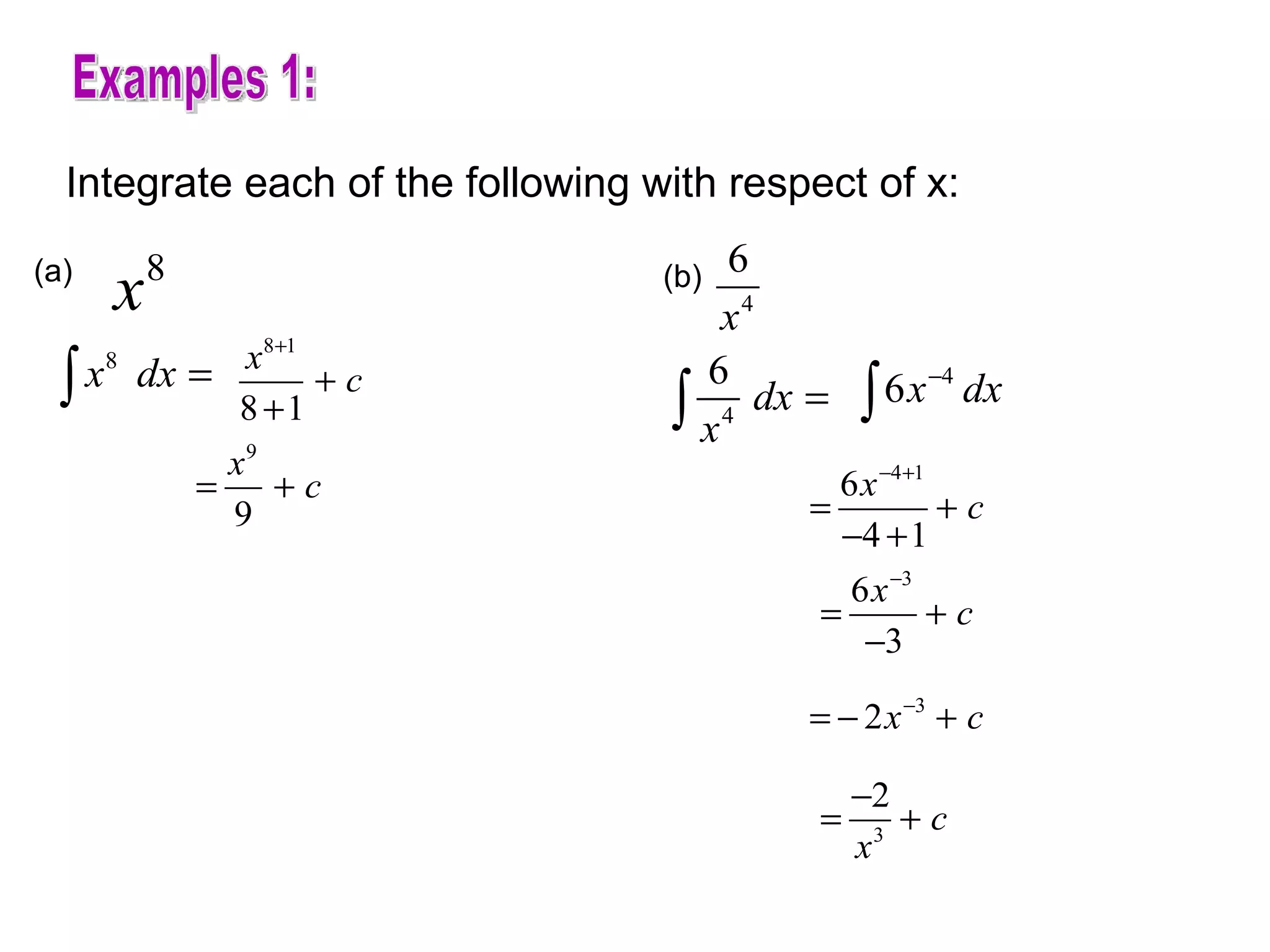
Examples 1: Integrate each of the following with respect of x: (a)  (b)
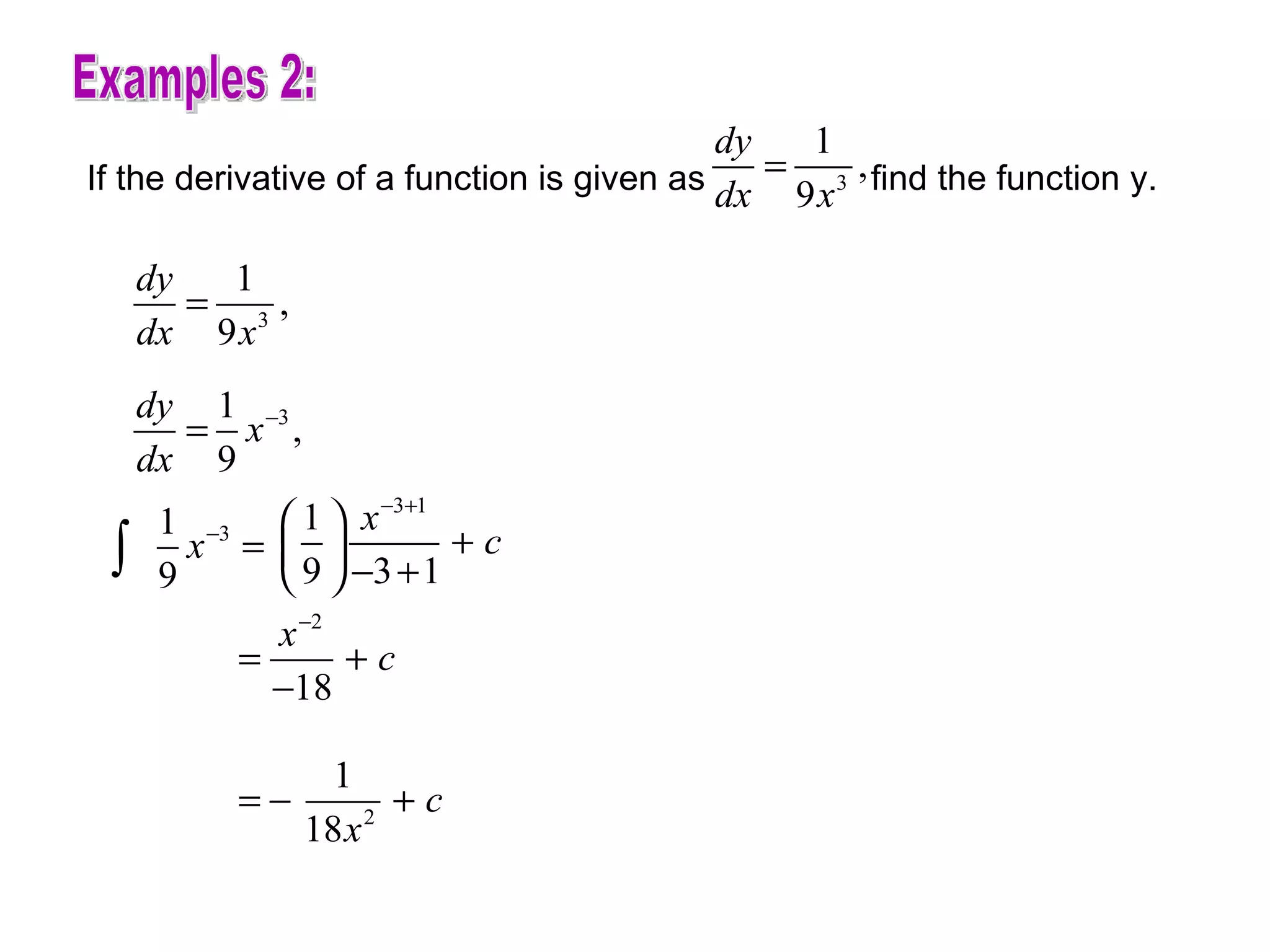
Examples 2: If the derivative of a function is given as  find the function y.
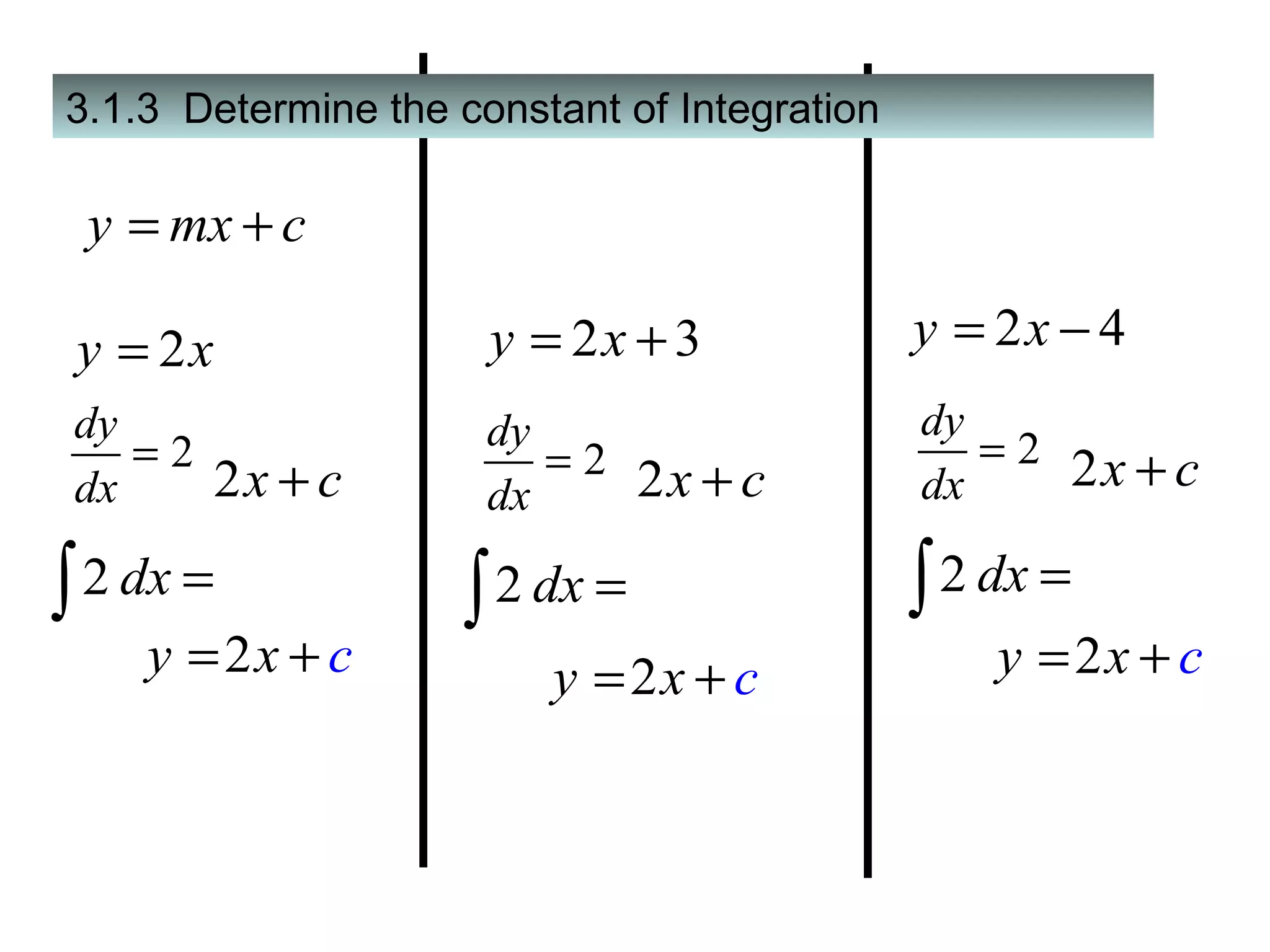
3.1.3  Determine the constant of Integration
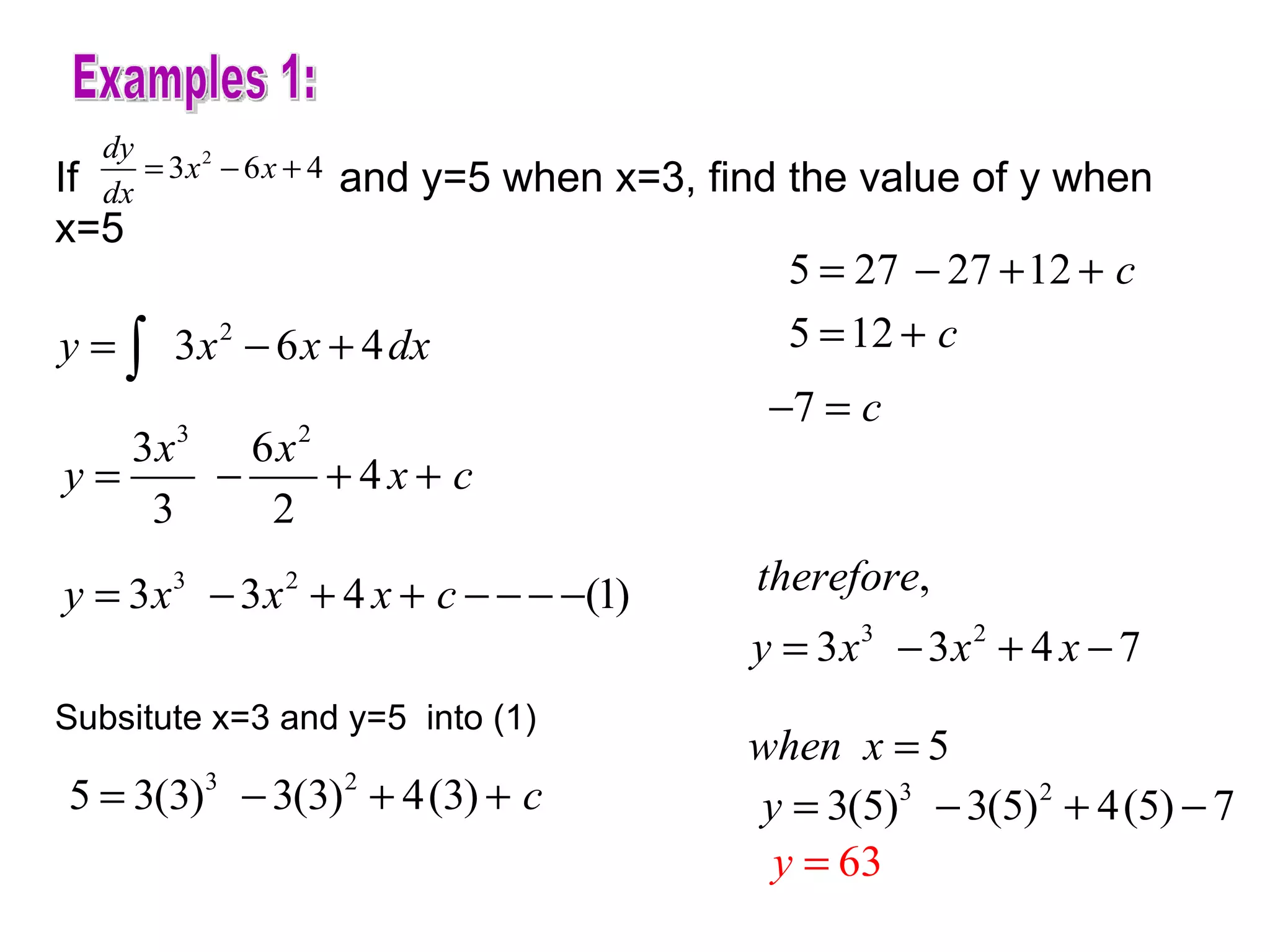
Examples 1: Subsitute x=3 and y=5  into (1) If  and y=5 when x=3, find the value of y when x=5
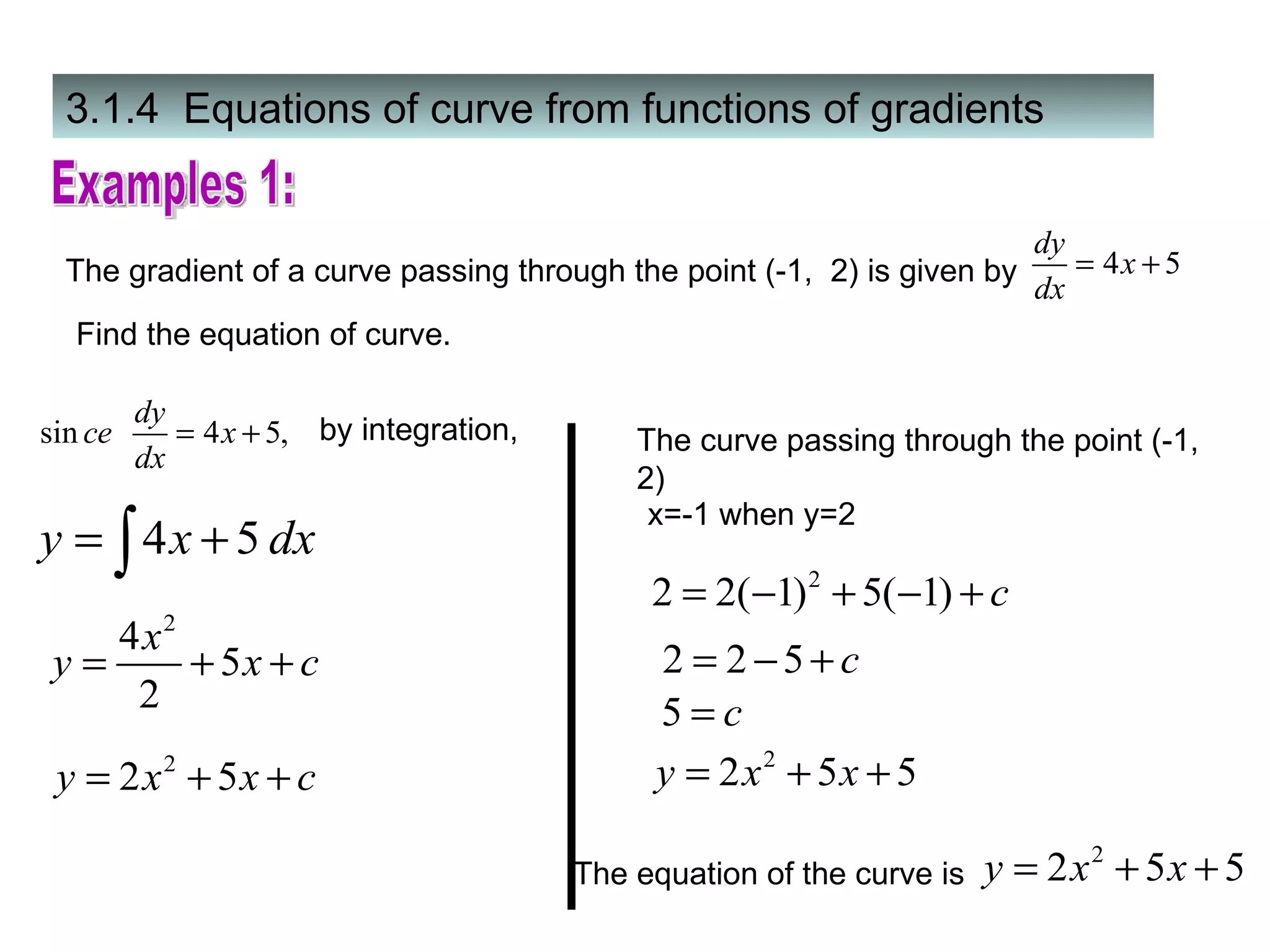
3.1.4  Equations of curve from functions of gradients Examples 1: Find the equation of curve. by integration, The curve passing through the point (-1,  2) x=-1 when y=2 The equation of the curve is  The gradient of a curve passing through the point (-1,  2) is given by
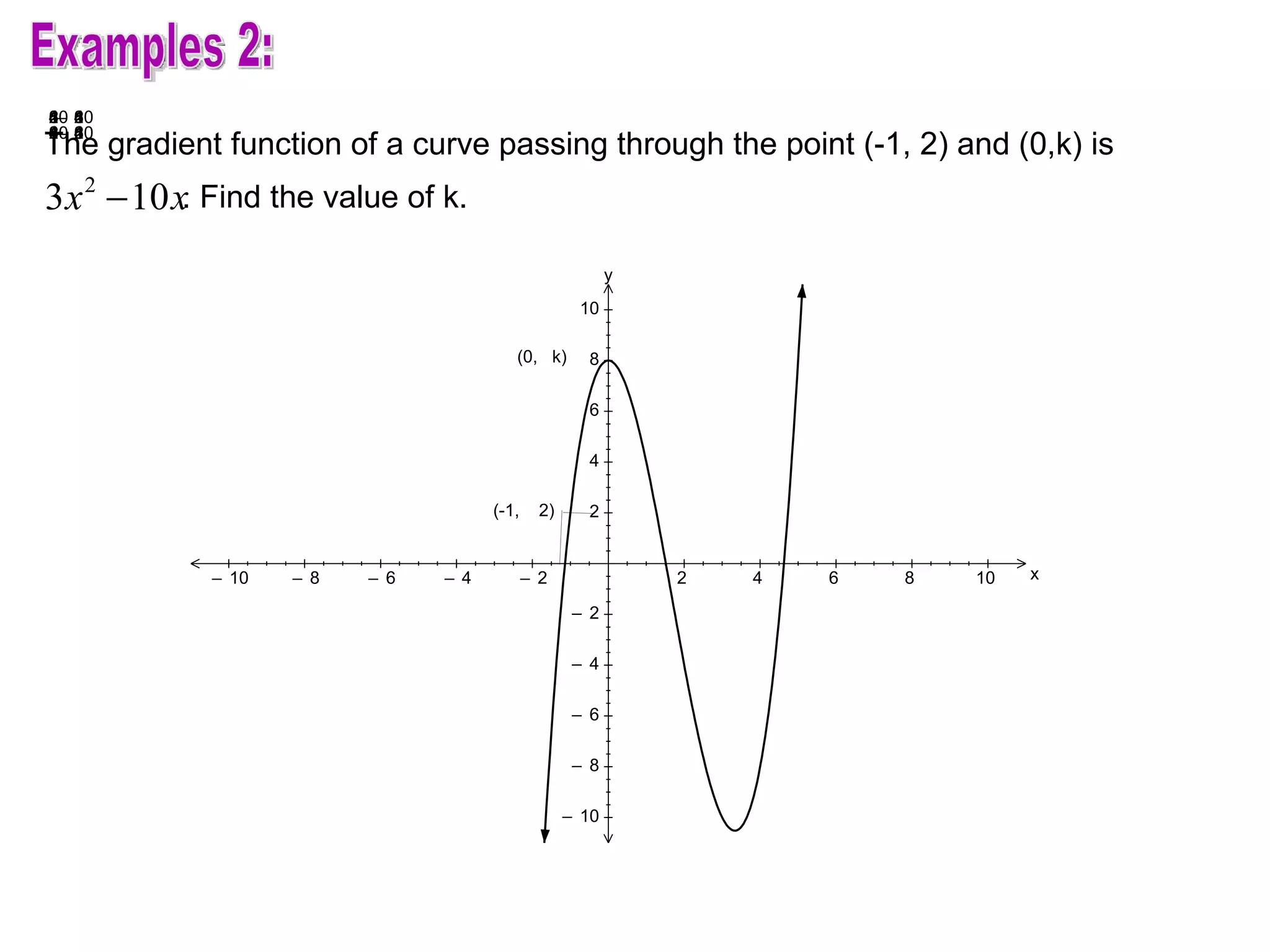
Examples 2: . Find the value of k. The gradient function of a curve passing through the point (-1, 2) and (0,k) is
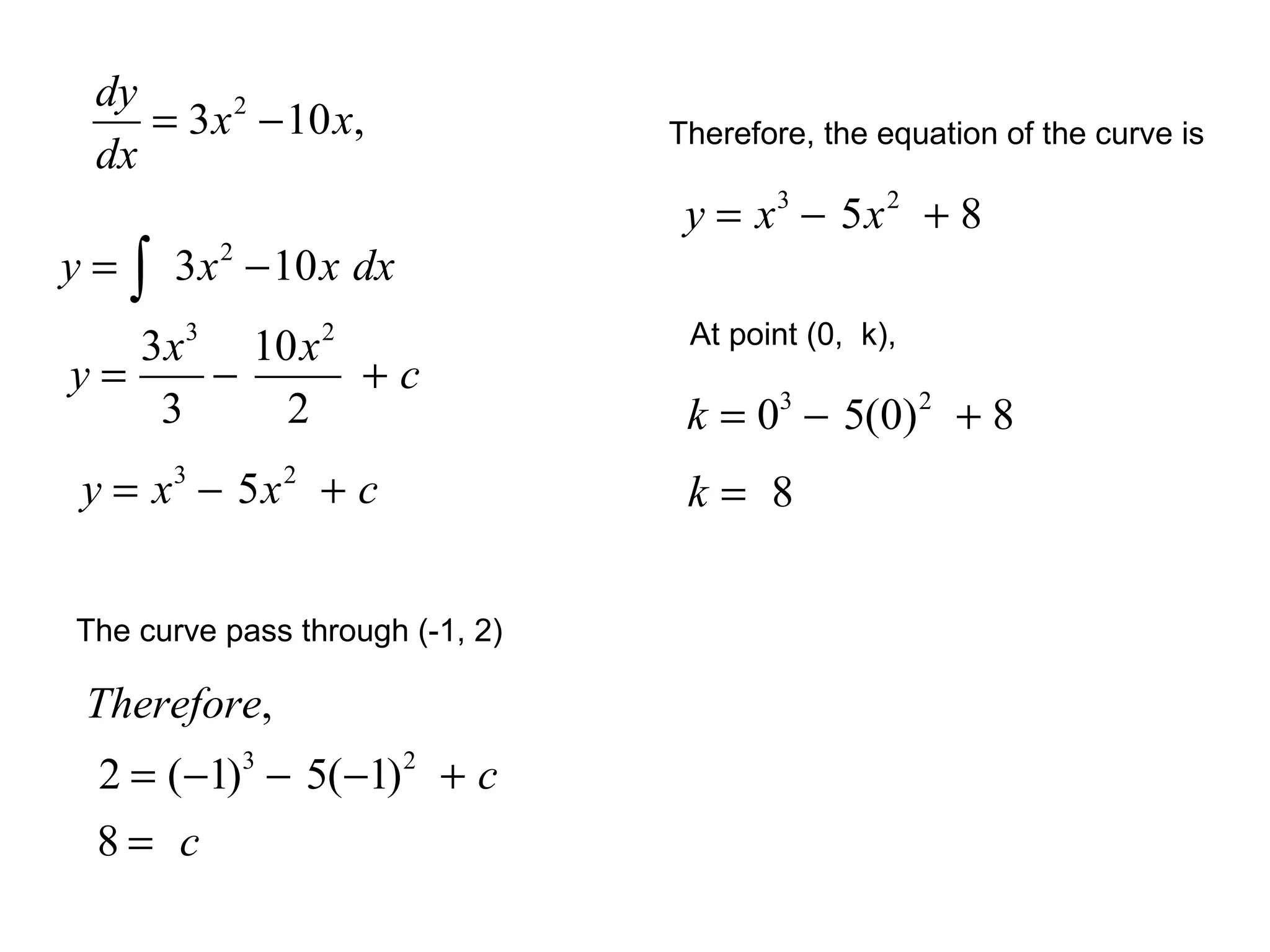
The curve pass through (-1, 2) Therefore, the equation of the curve is  At point (0,  k),
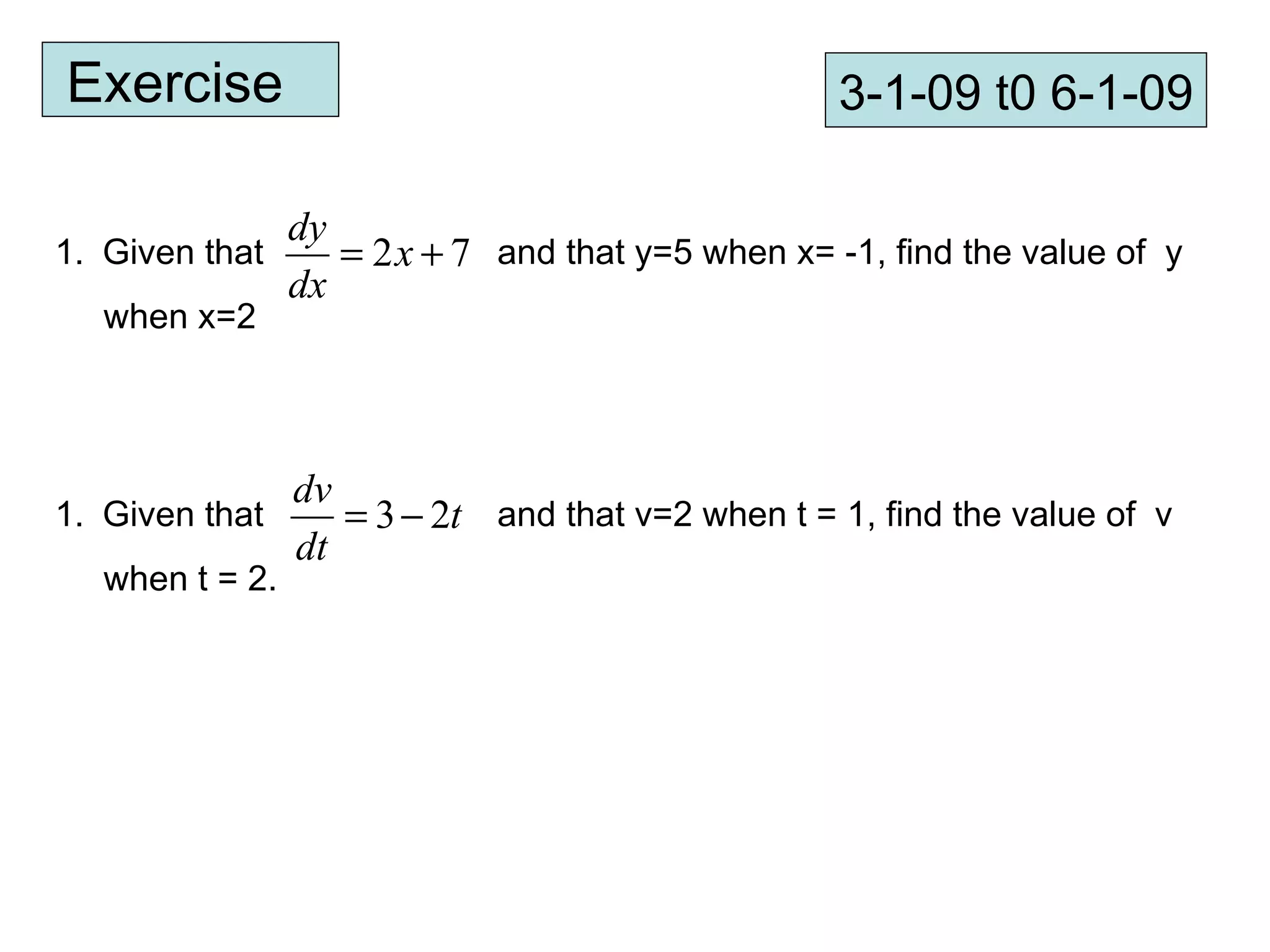
Exercise  3-1-09 t0 6-1-09 Given that  and that y=5 when x= -1, find the value of  y  when x=2 Given that  and that v=2 when t = 1, find the value of  v  when t = 2.
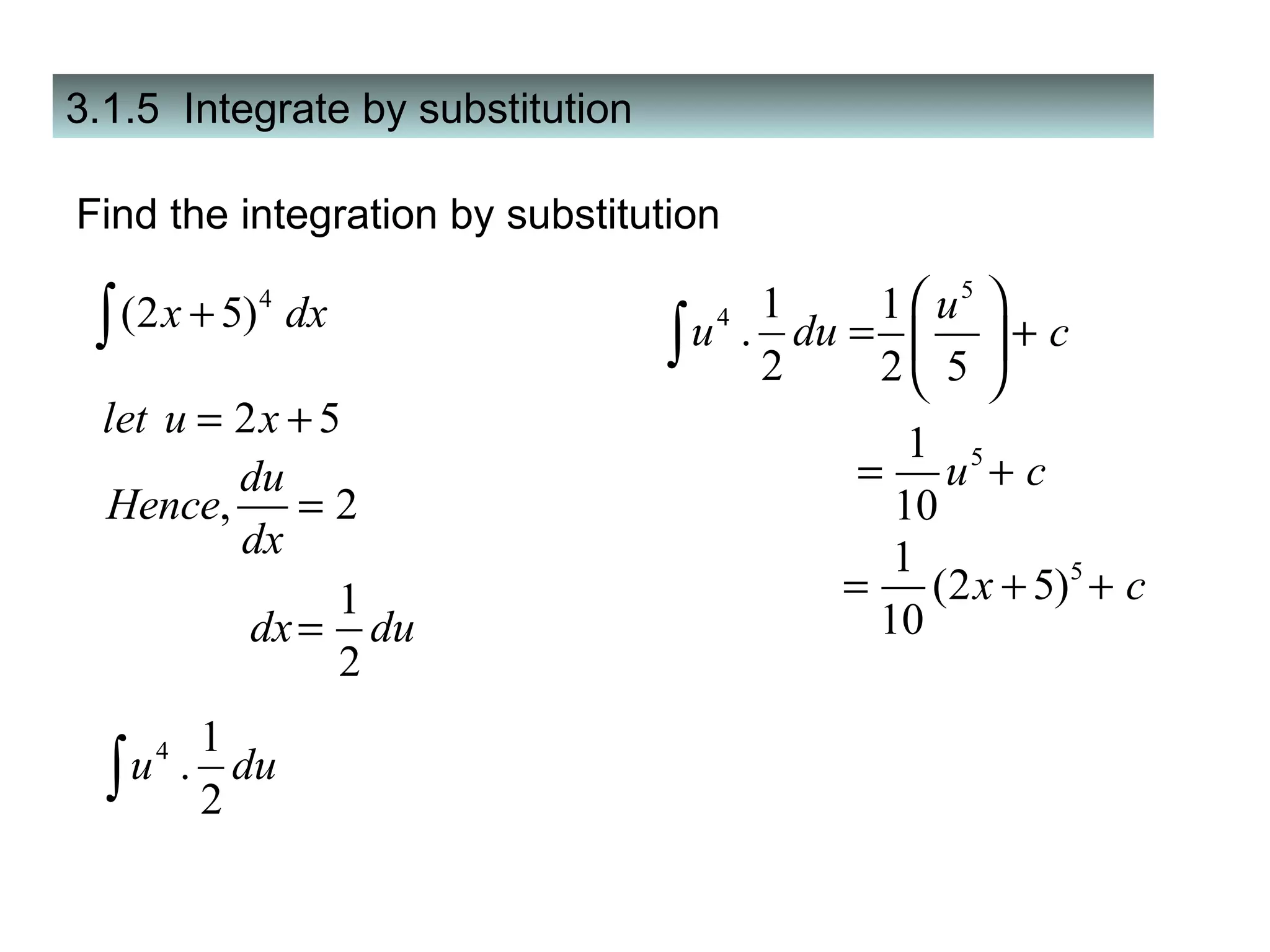
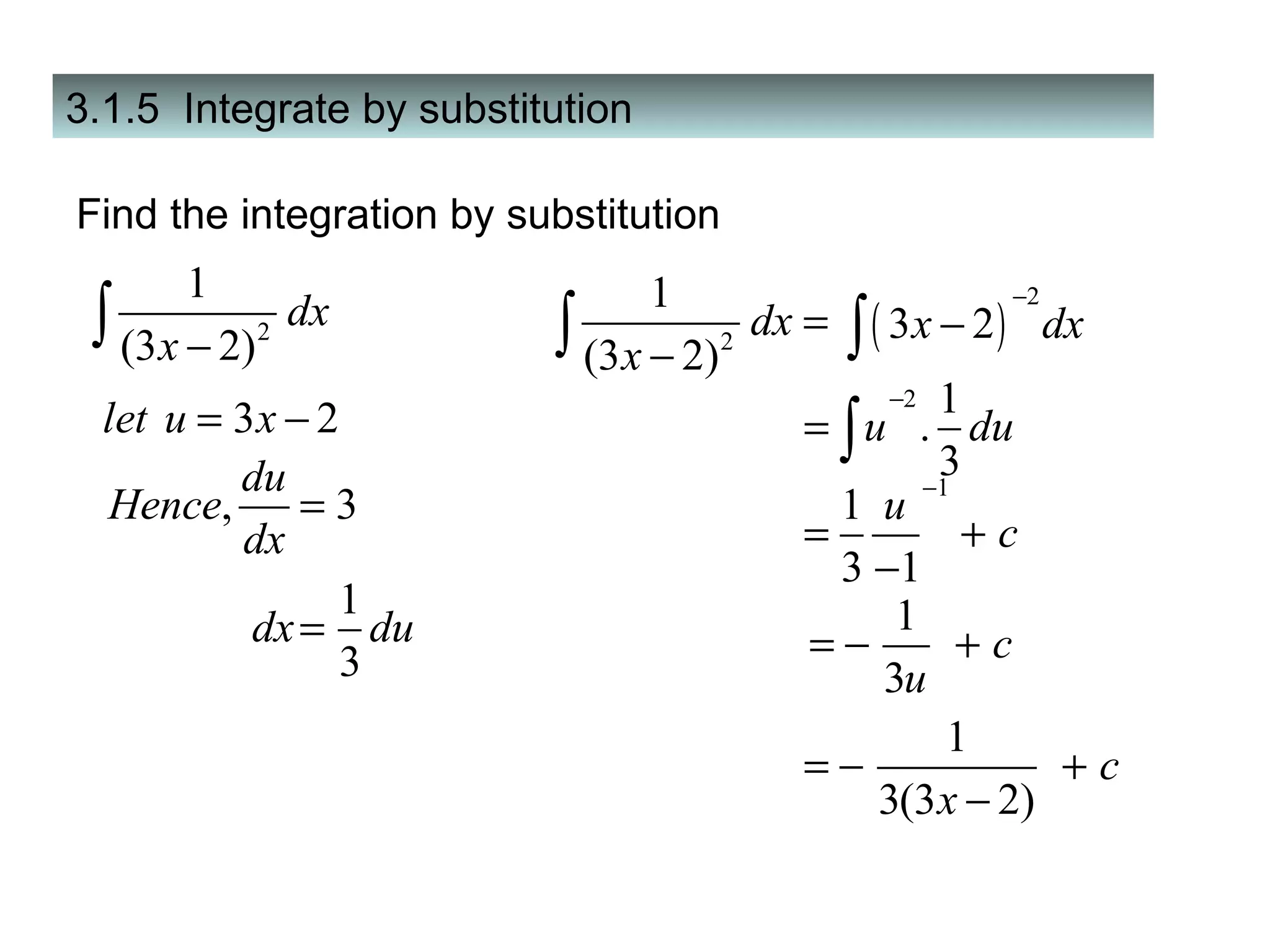
3.1.5  Integrate by substitution Find the integration by substitution
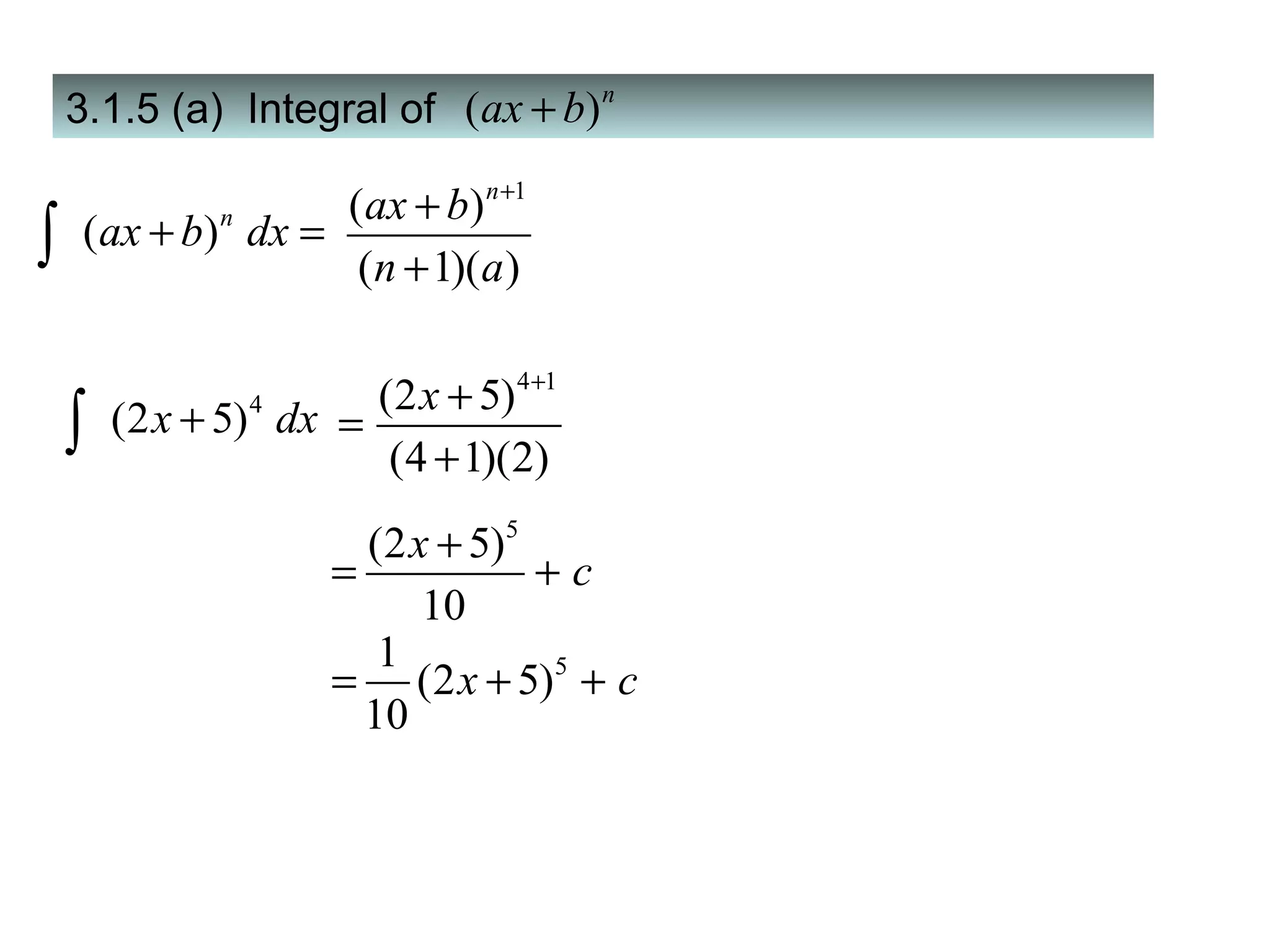
3.1.5 (a)  Integral of
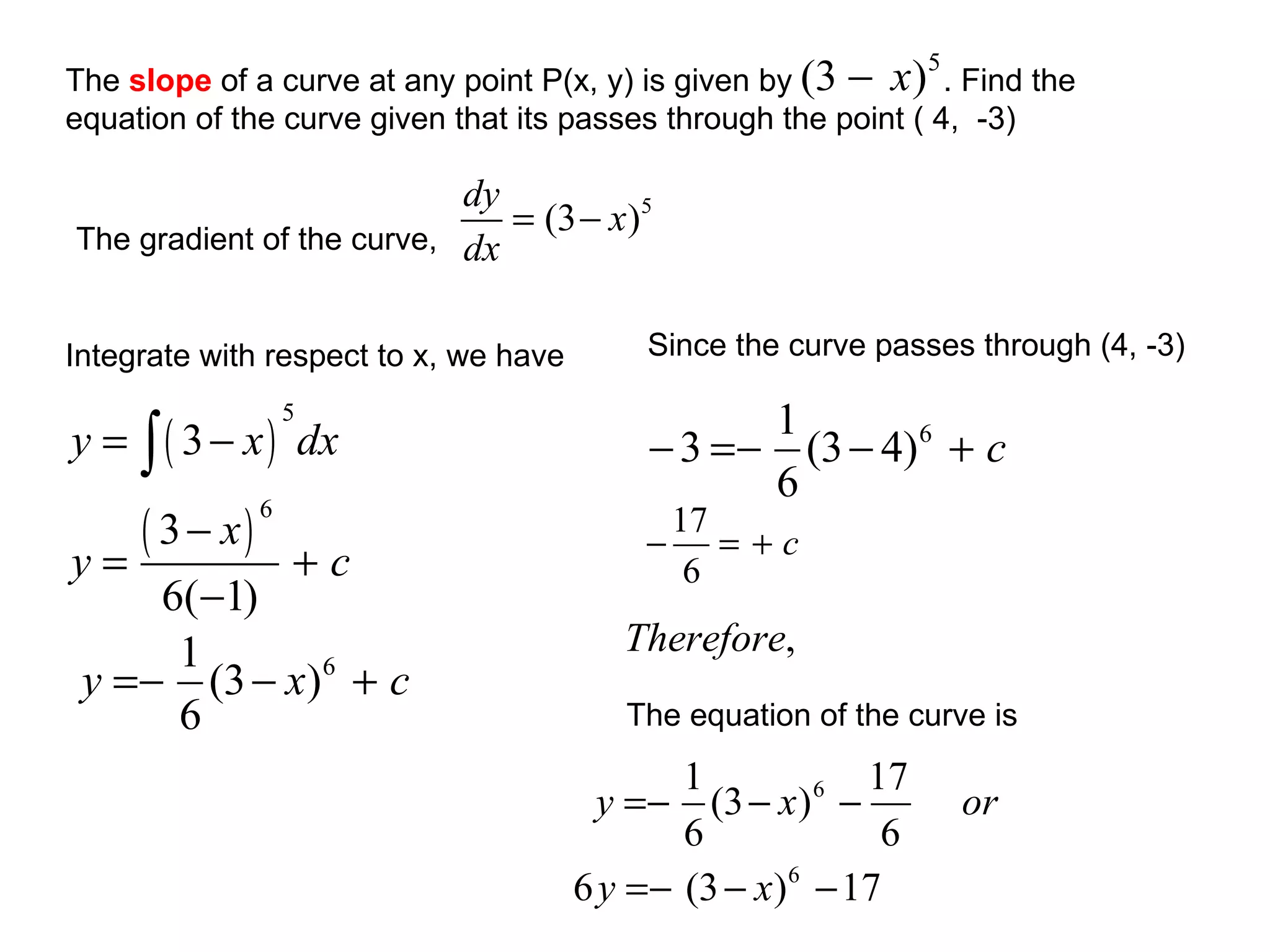
The gradient of the curve,  Integrate with respect to x, we have  Since the curve passes through (4, -3) The equation of the curve is  The  slope  of a curve at any point P(x, y) is given by  . Find the equation of the curve given that its passes through the point ( 4,  -3)
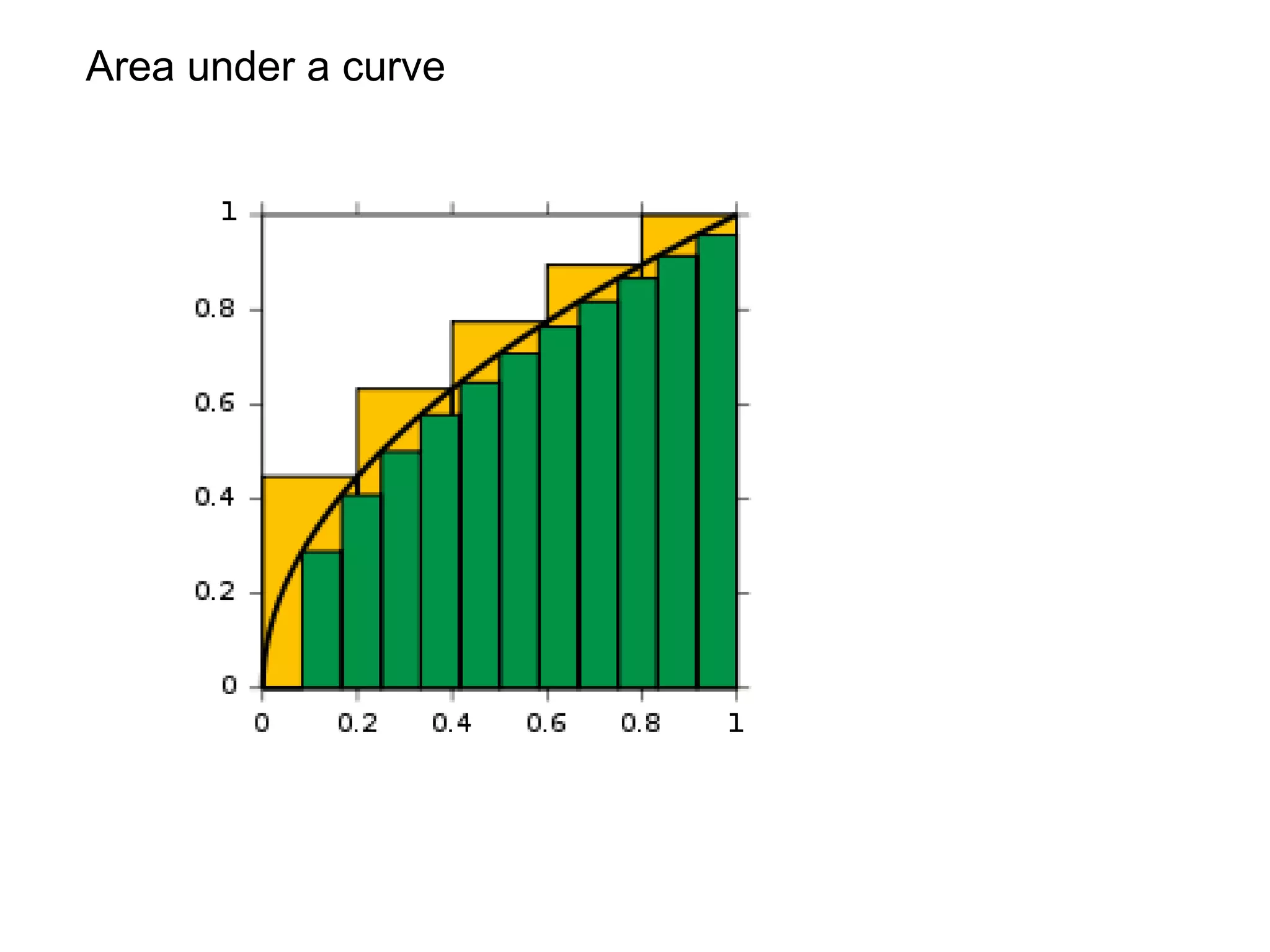
Area under a curve
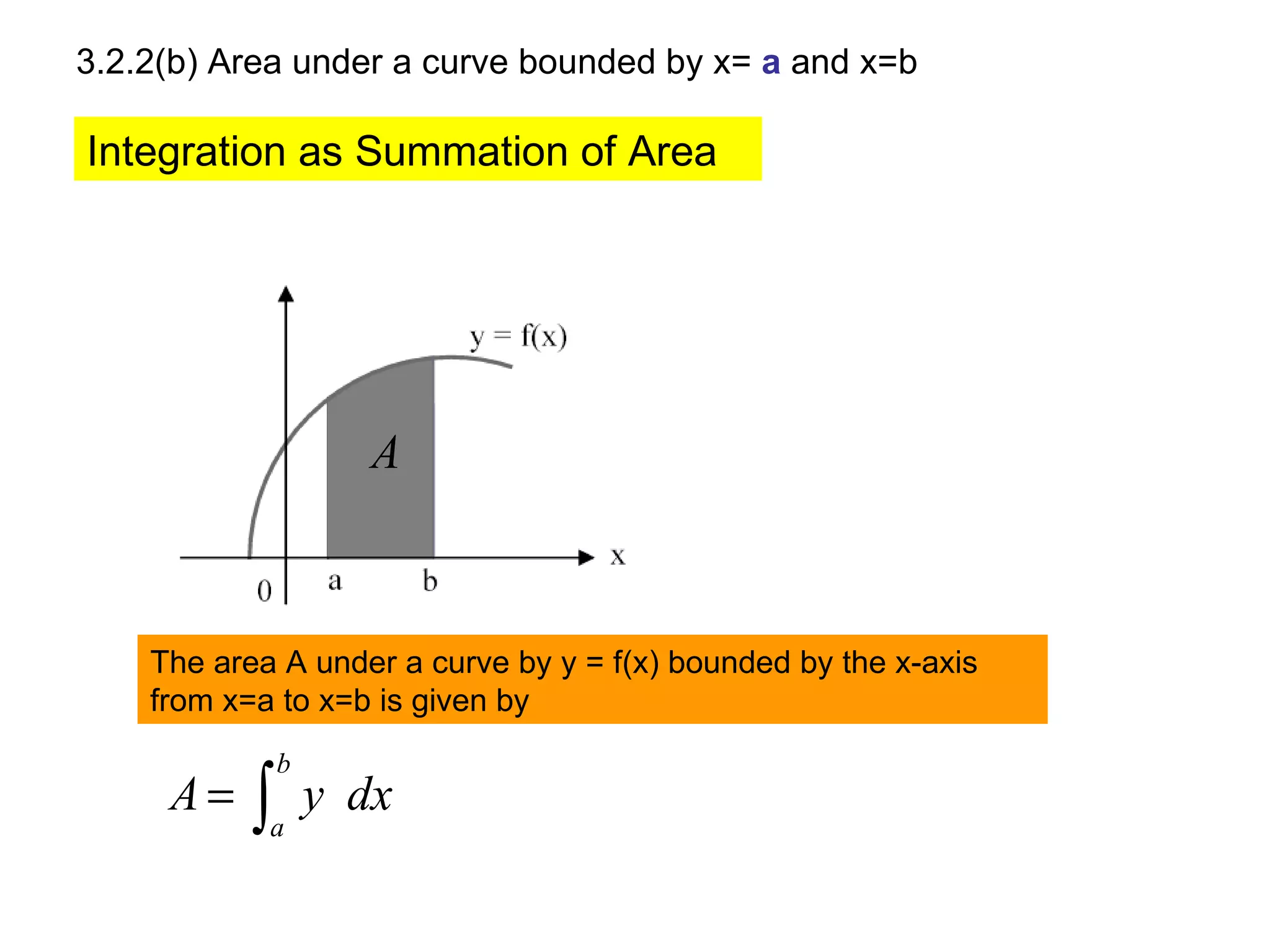
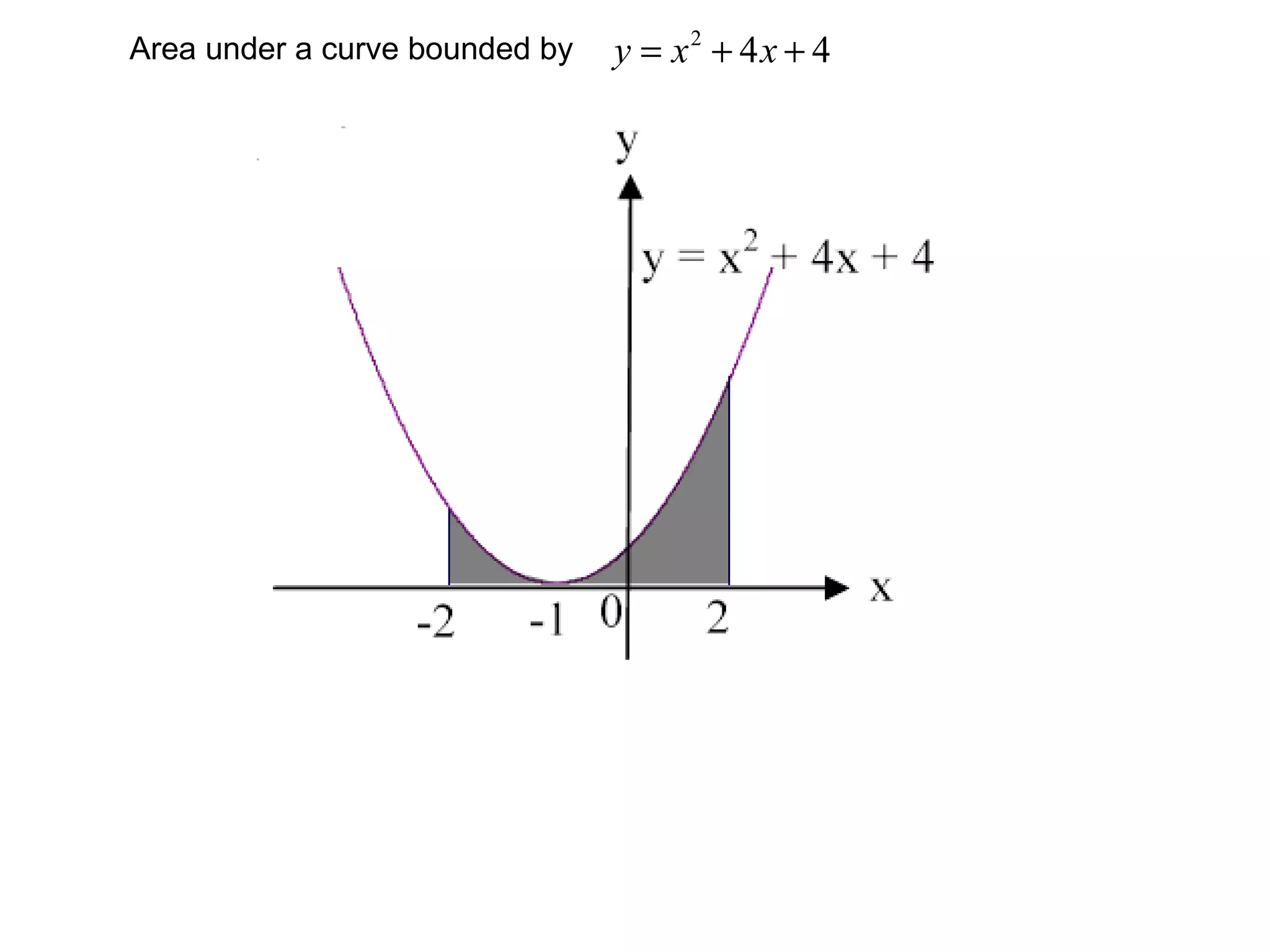
3.2.2(b) Area under a curve bounded by x=  a  and x=b The area A under a curve by y = f(x) bounded by the x-axis from x=a to x=b is given by Integration as Summation of Area
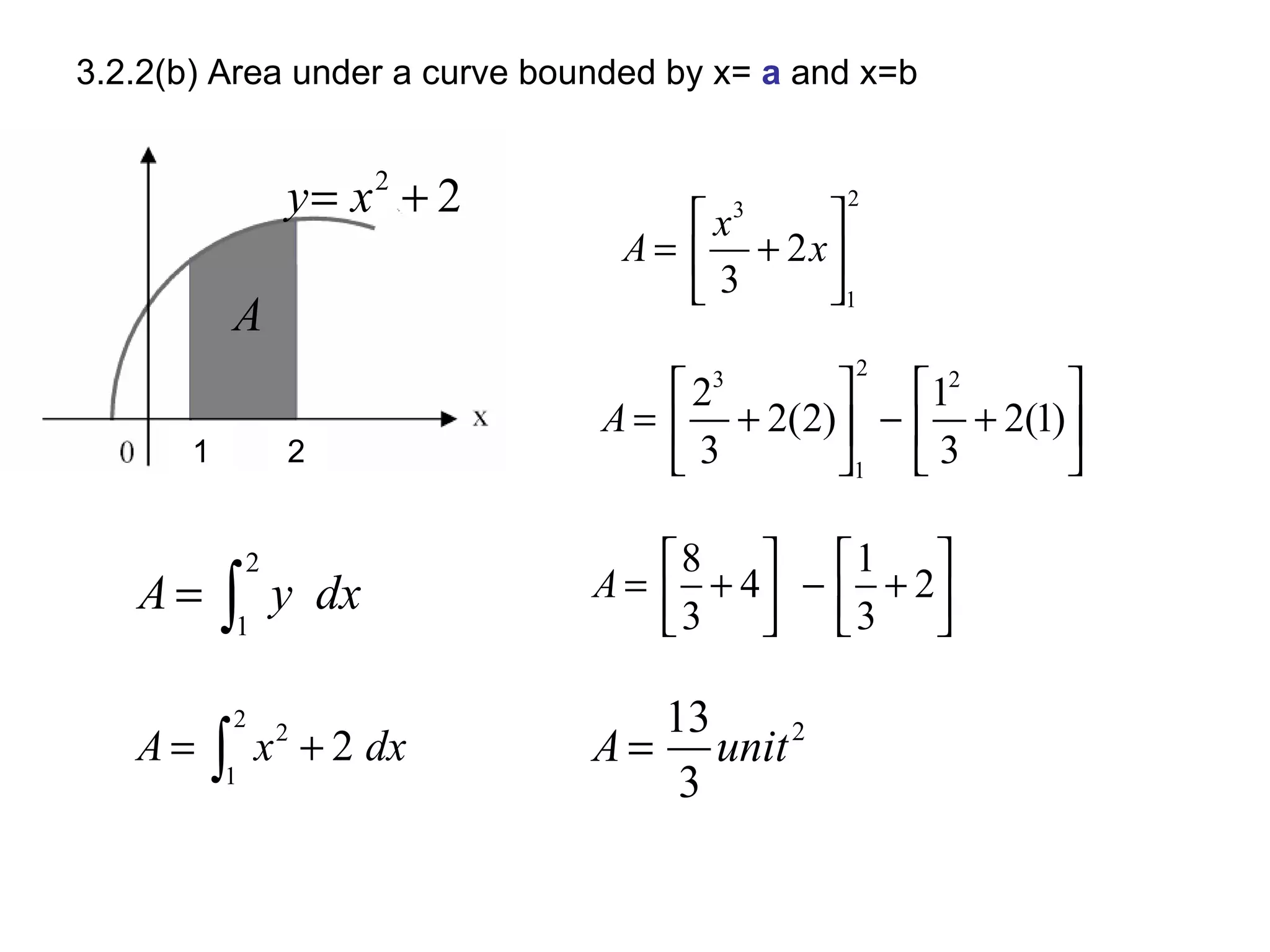
3.2.2(b) Area under a curve bounded by x=  a  and x=b 1 2
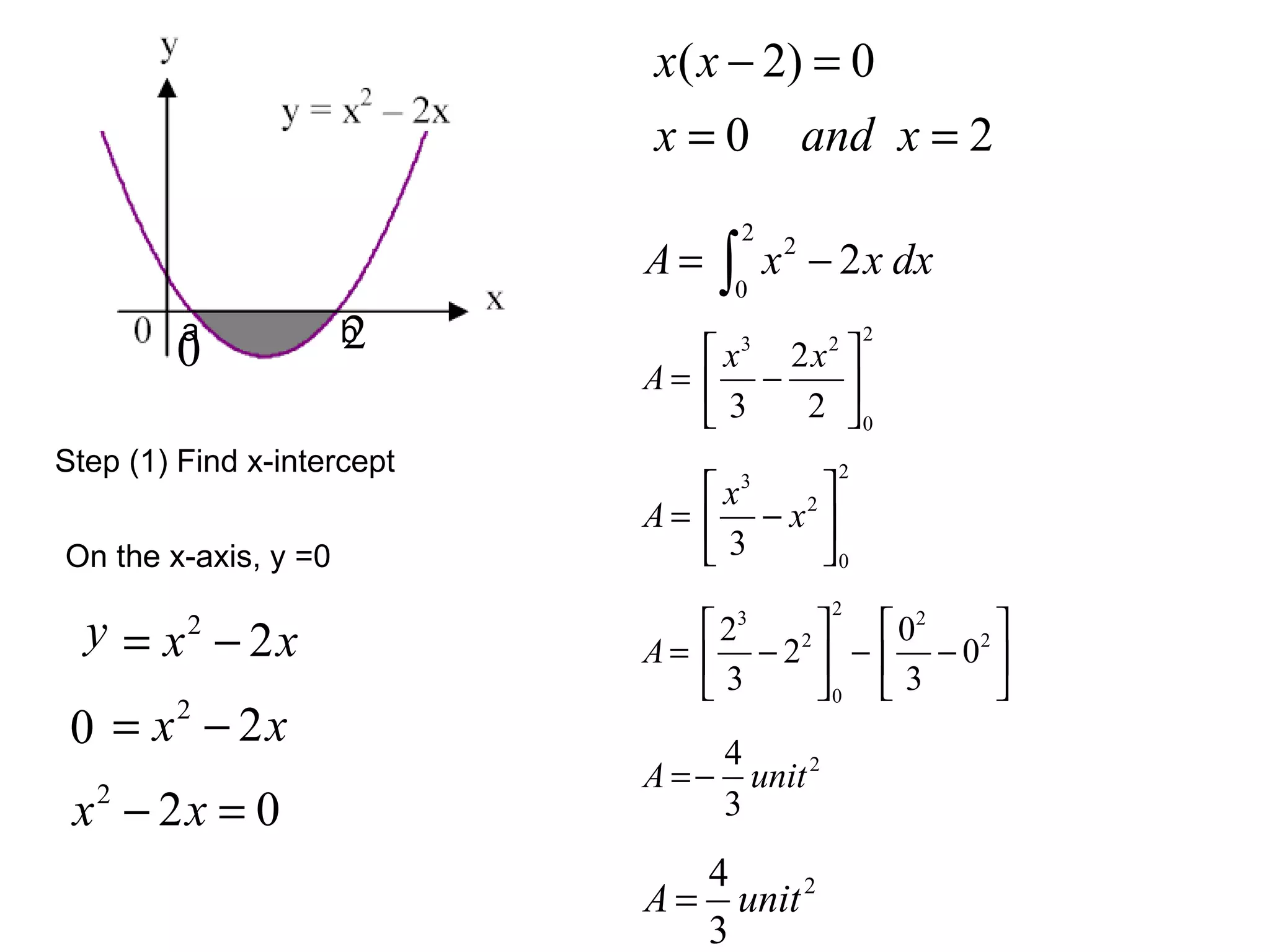
Step (1) Find x-intercept a b On the x-axis, y =0
Area under a curve bounded by
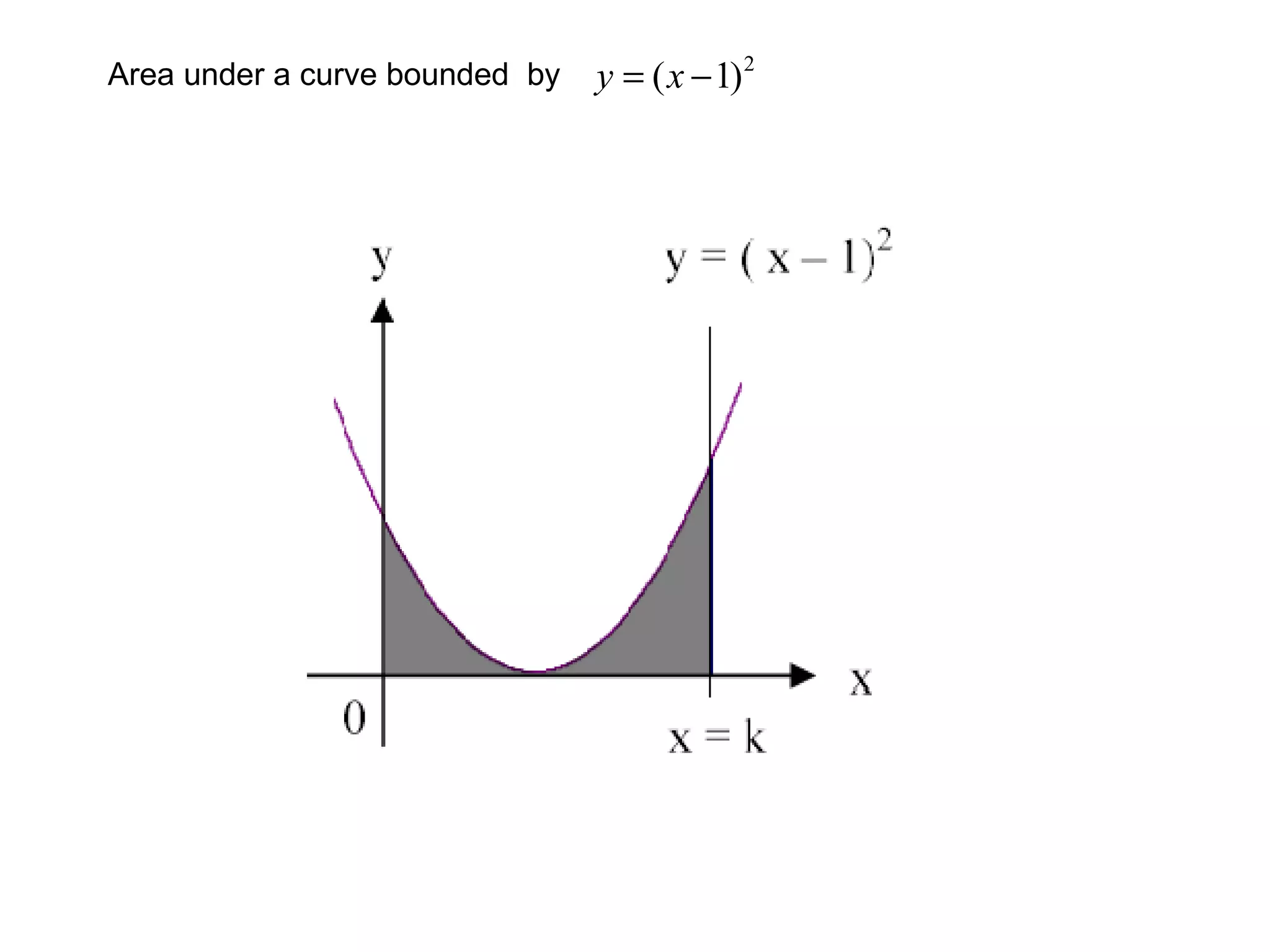
Area under a curve bounded  by
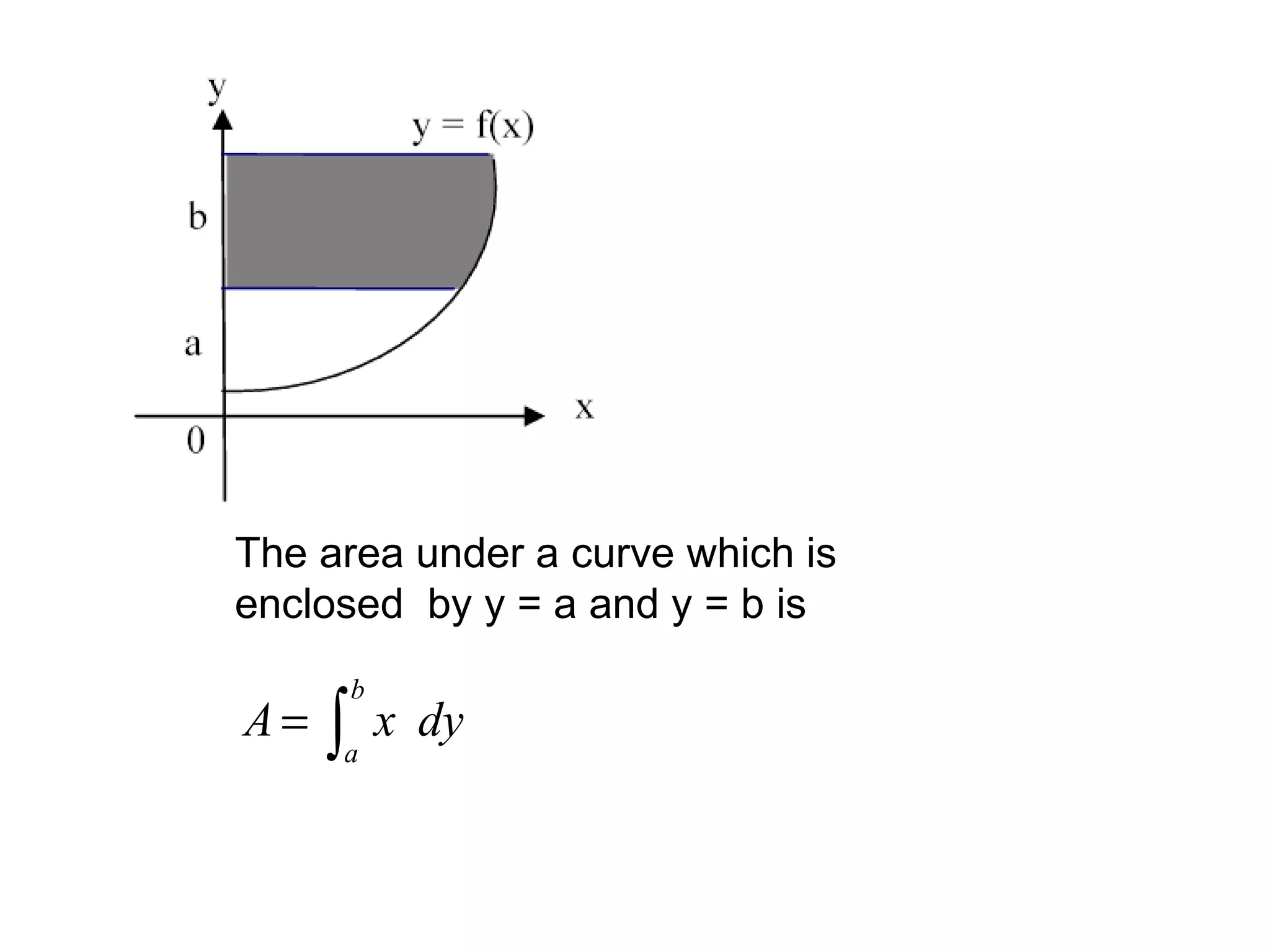
The area under a curve which is enclosed  by y = a and y = b is
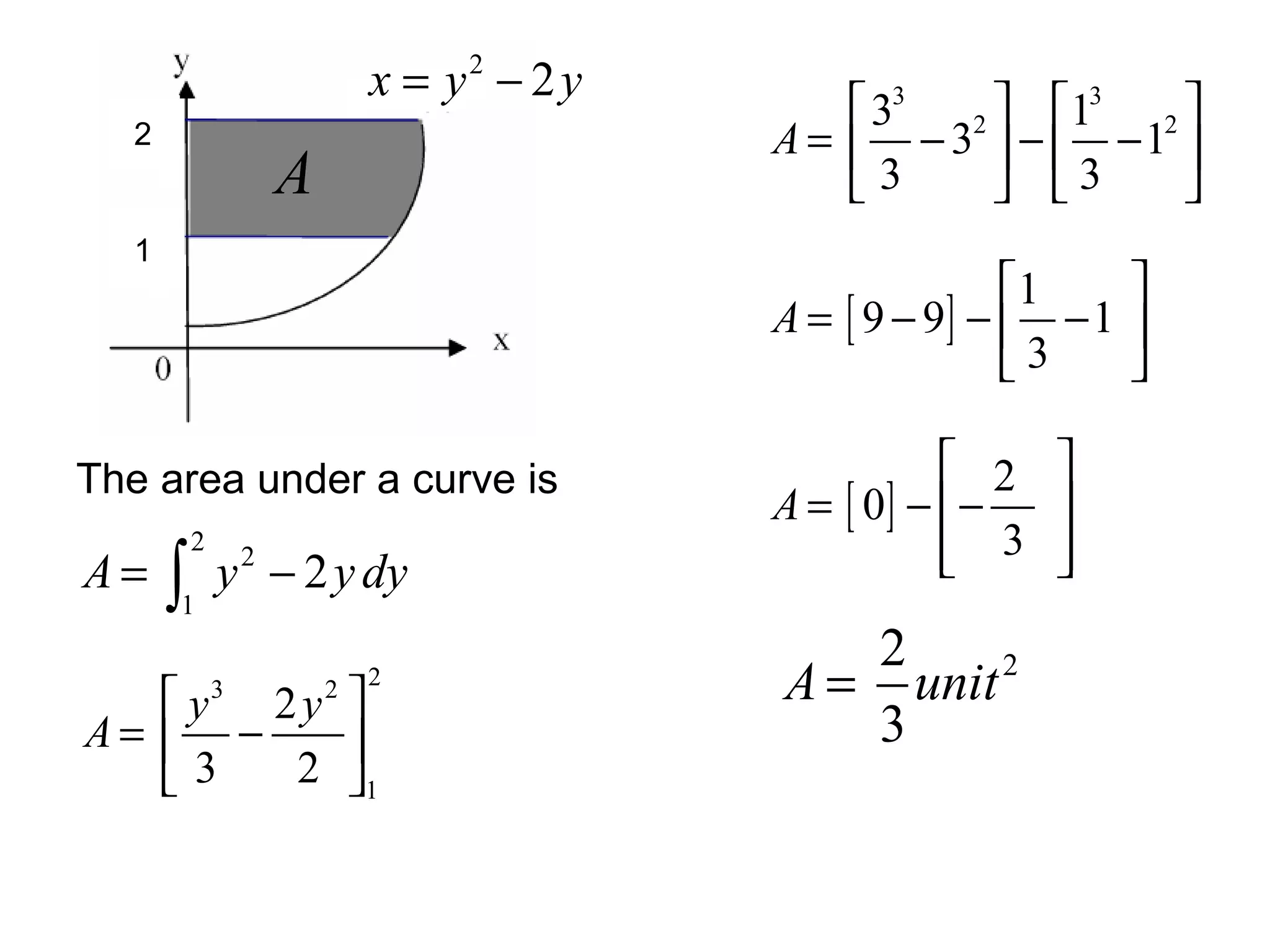
The area under a curve is  1 2
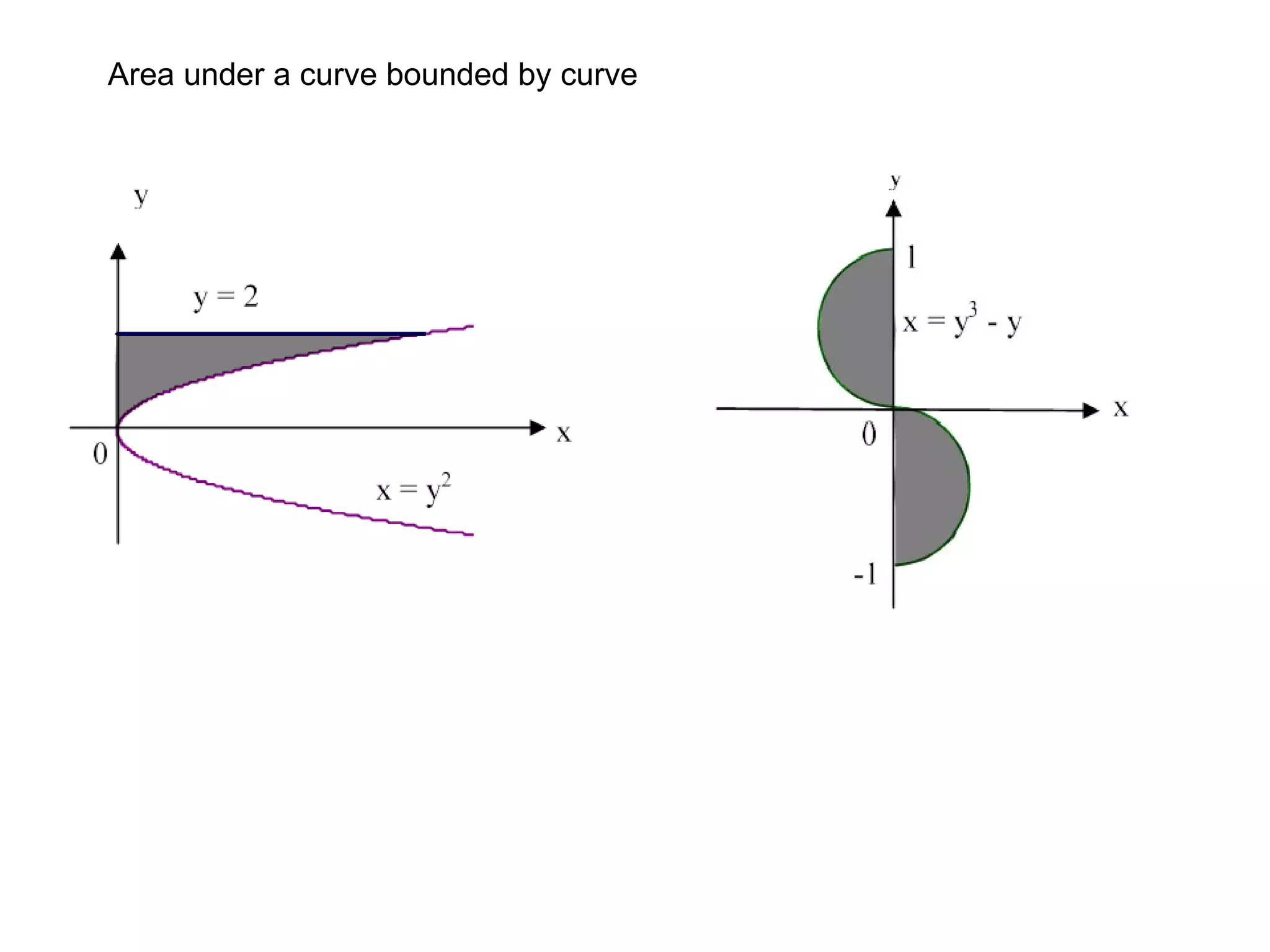
Area under a curve bounded by curve
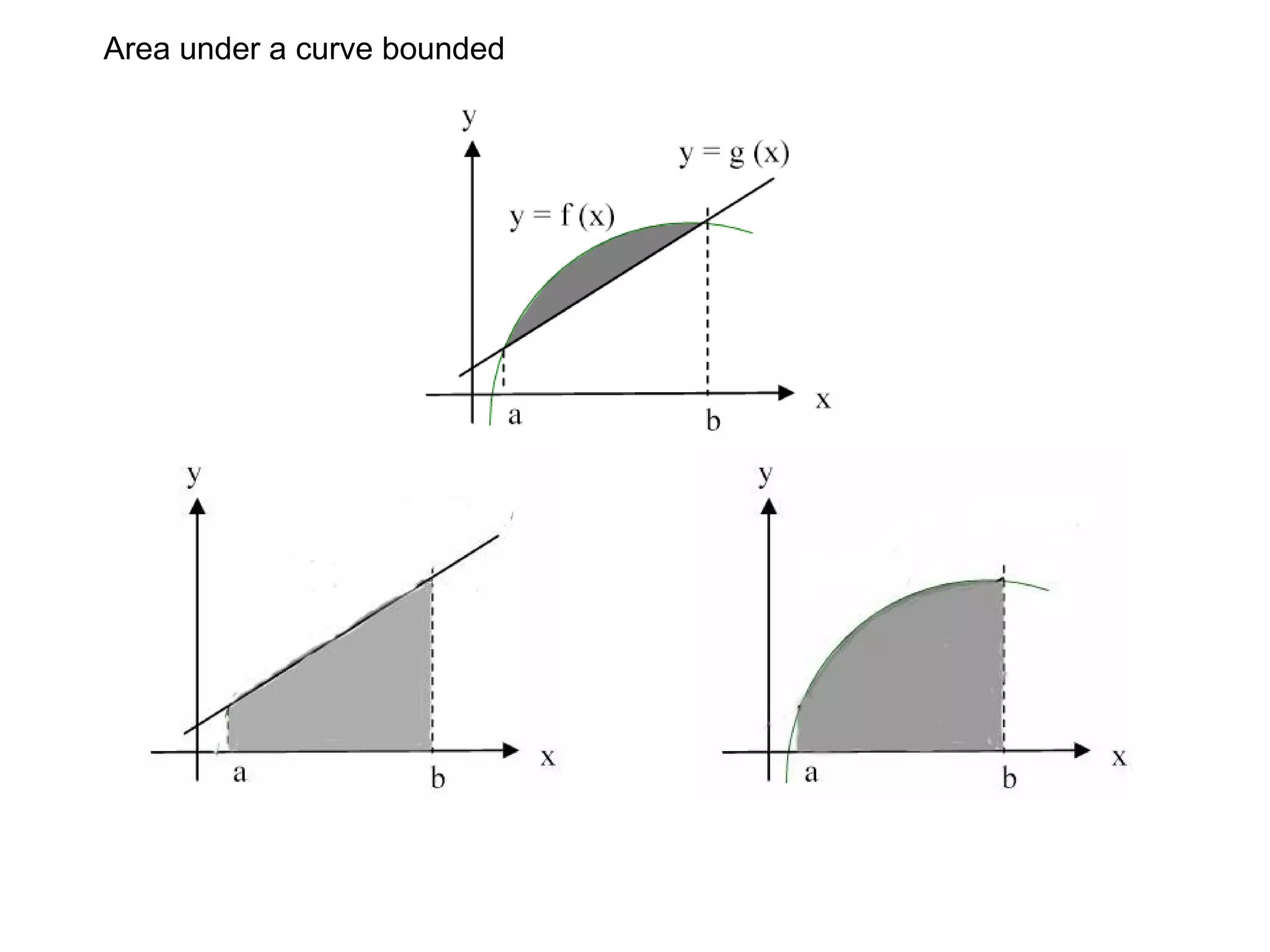
Area under a curve bounded
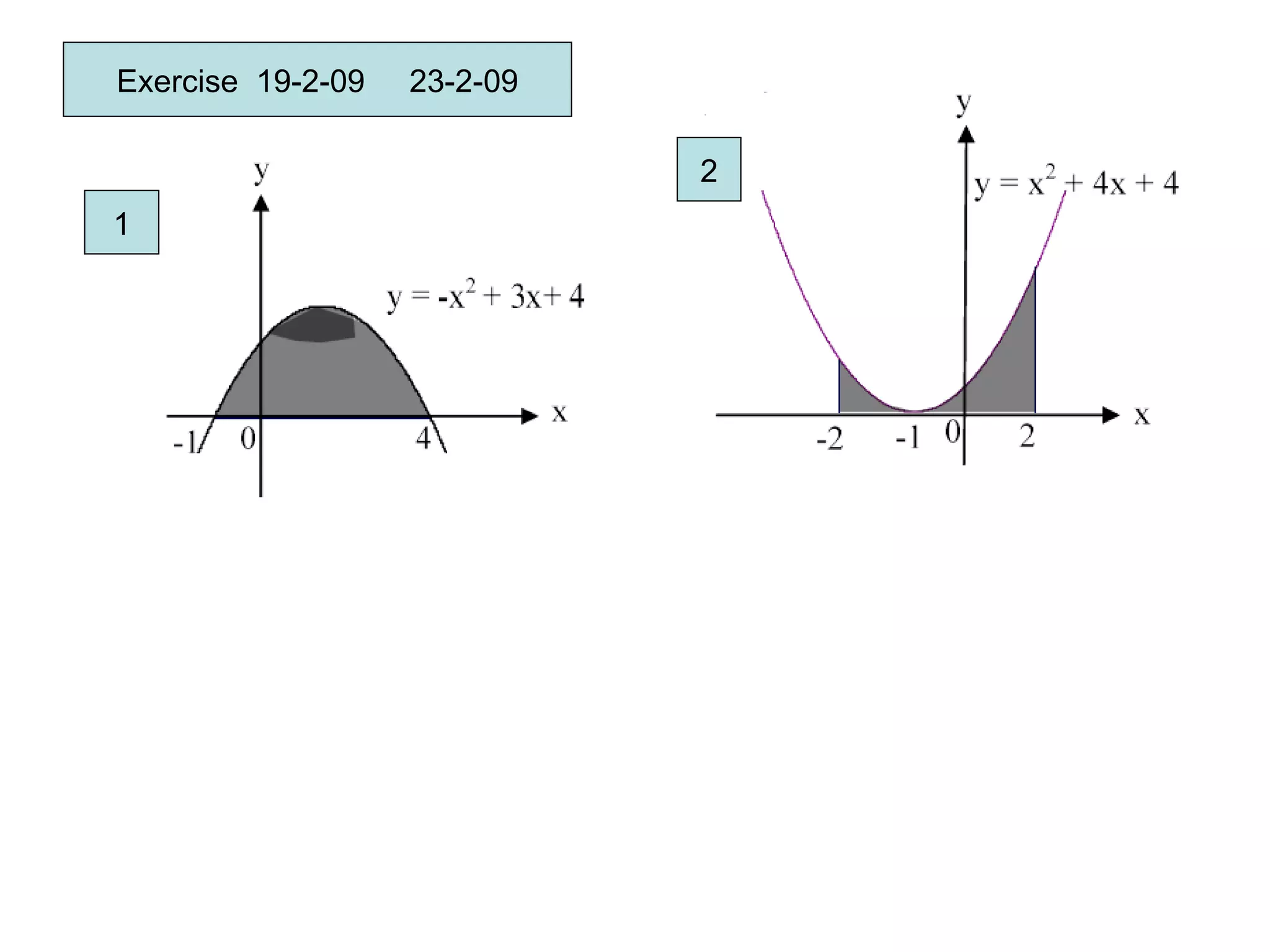
Exercise  19-2-09  23-2-09 1 2
Exercise Text Book Page 71   23-2-09 10- ( a)  ( b )  ( c ) 11- ( a)  ( b )  ( c ) 12- ( a)  ( b )
Exercise Text Book Page 72   13- ( a)  ( b )  ( c ) 14 17 ( a )  (b )  ( c )
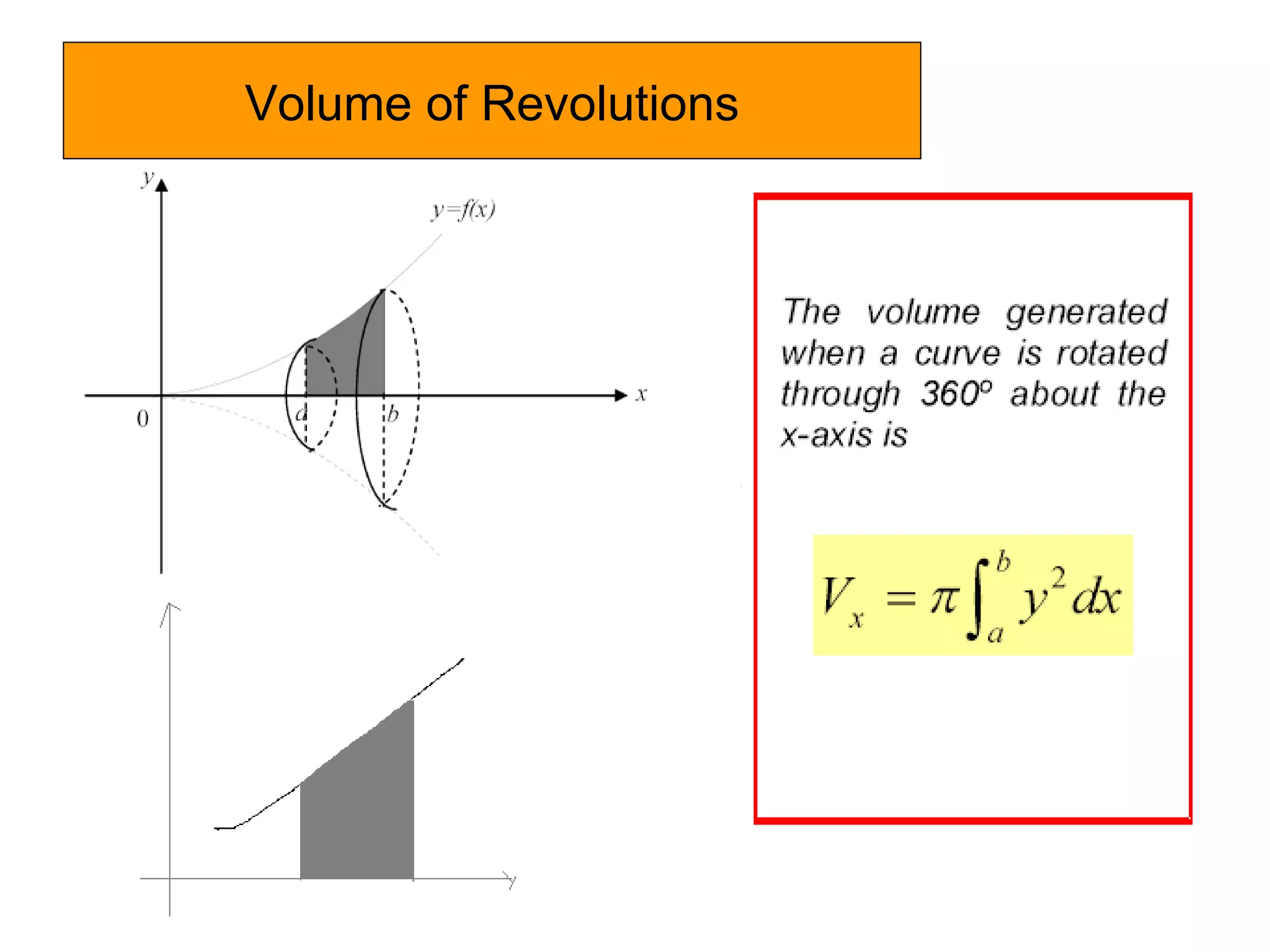
Volume of Revolutions
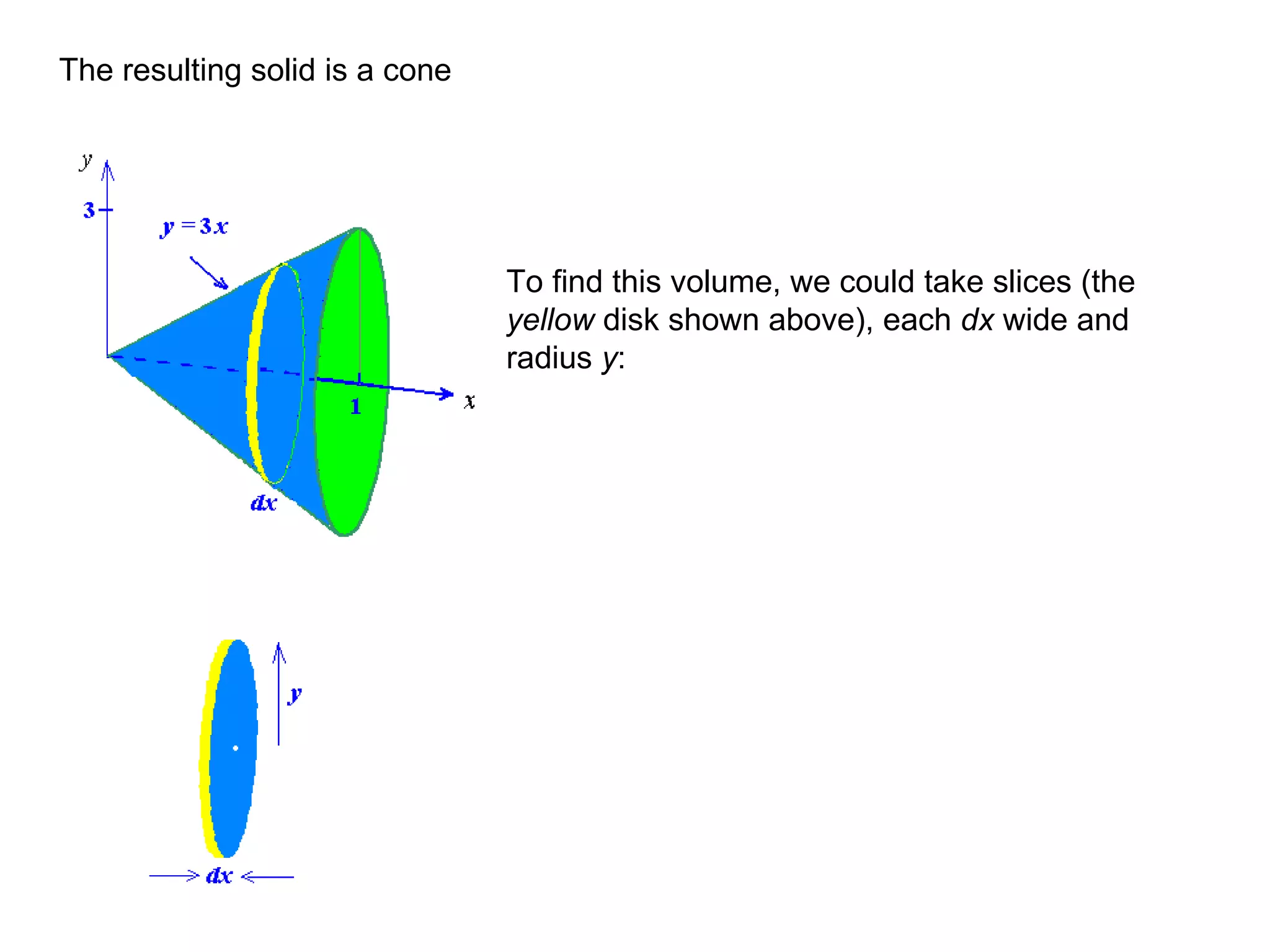
The resulting solid is a cone To find this volume, we could take slices (the  yellow  disk shown above), each  dx  wide and radius  y :
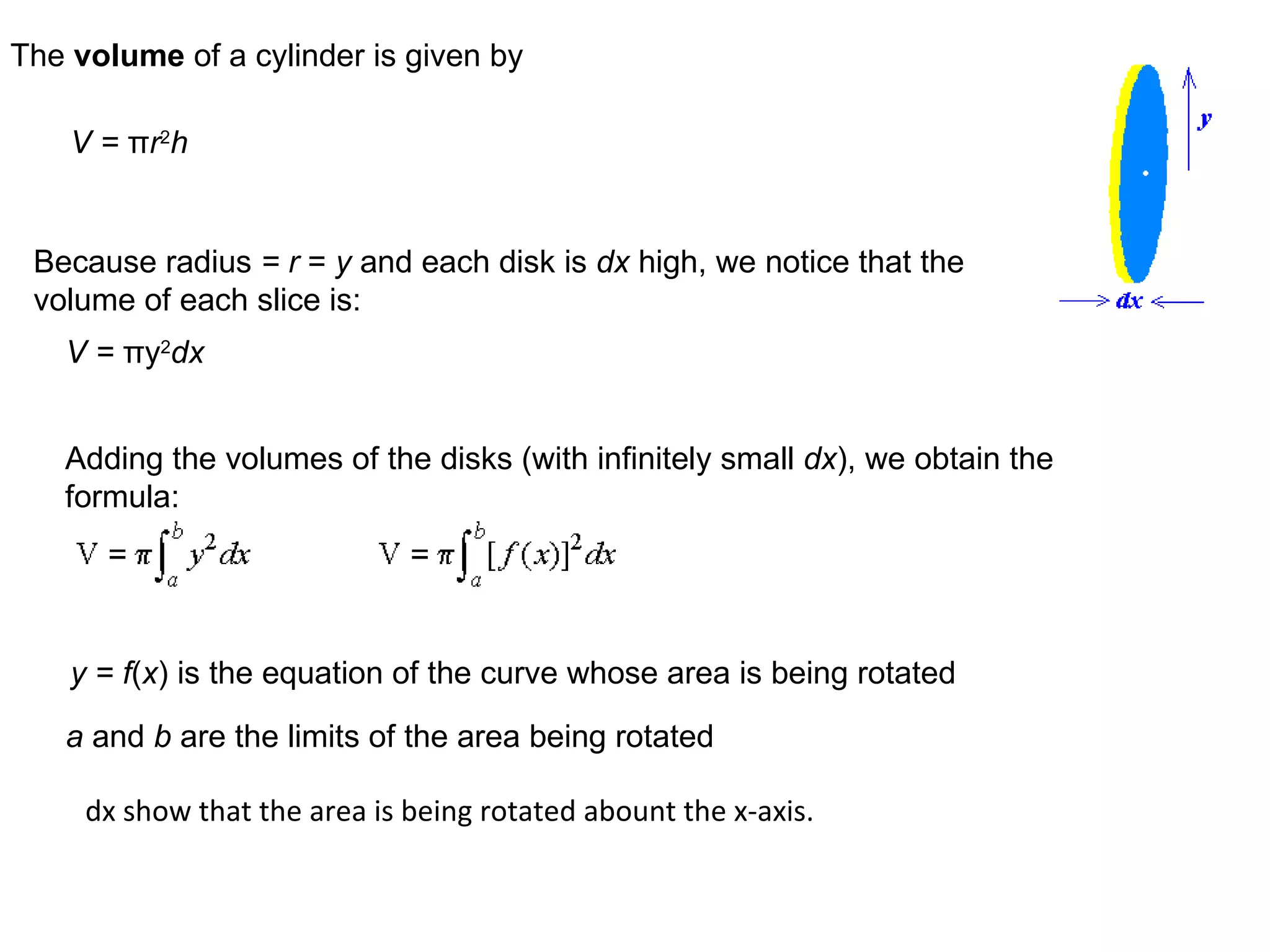
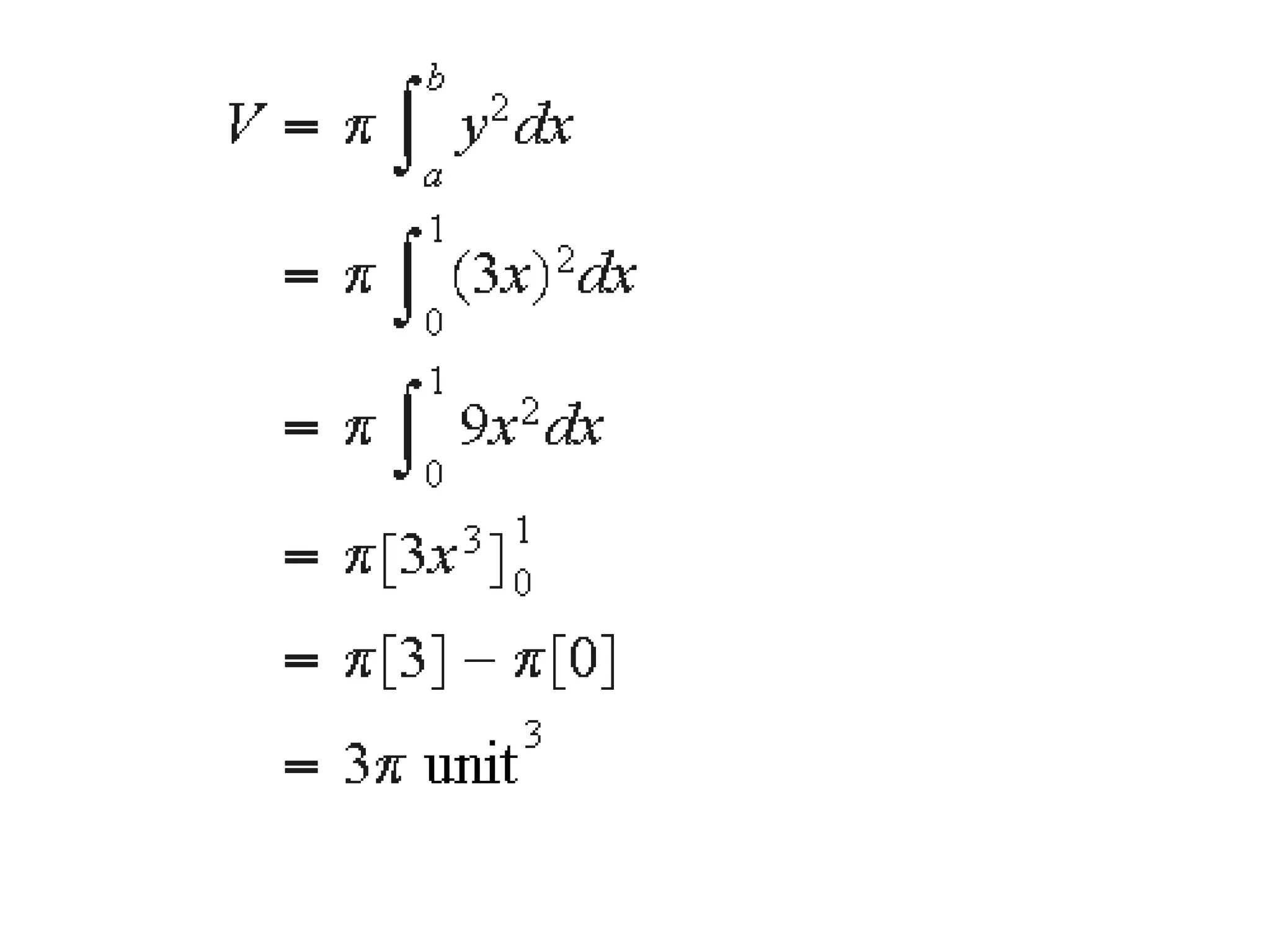
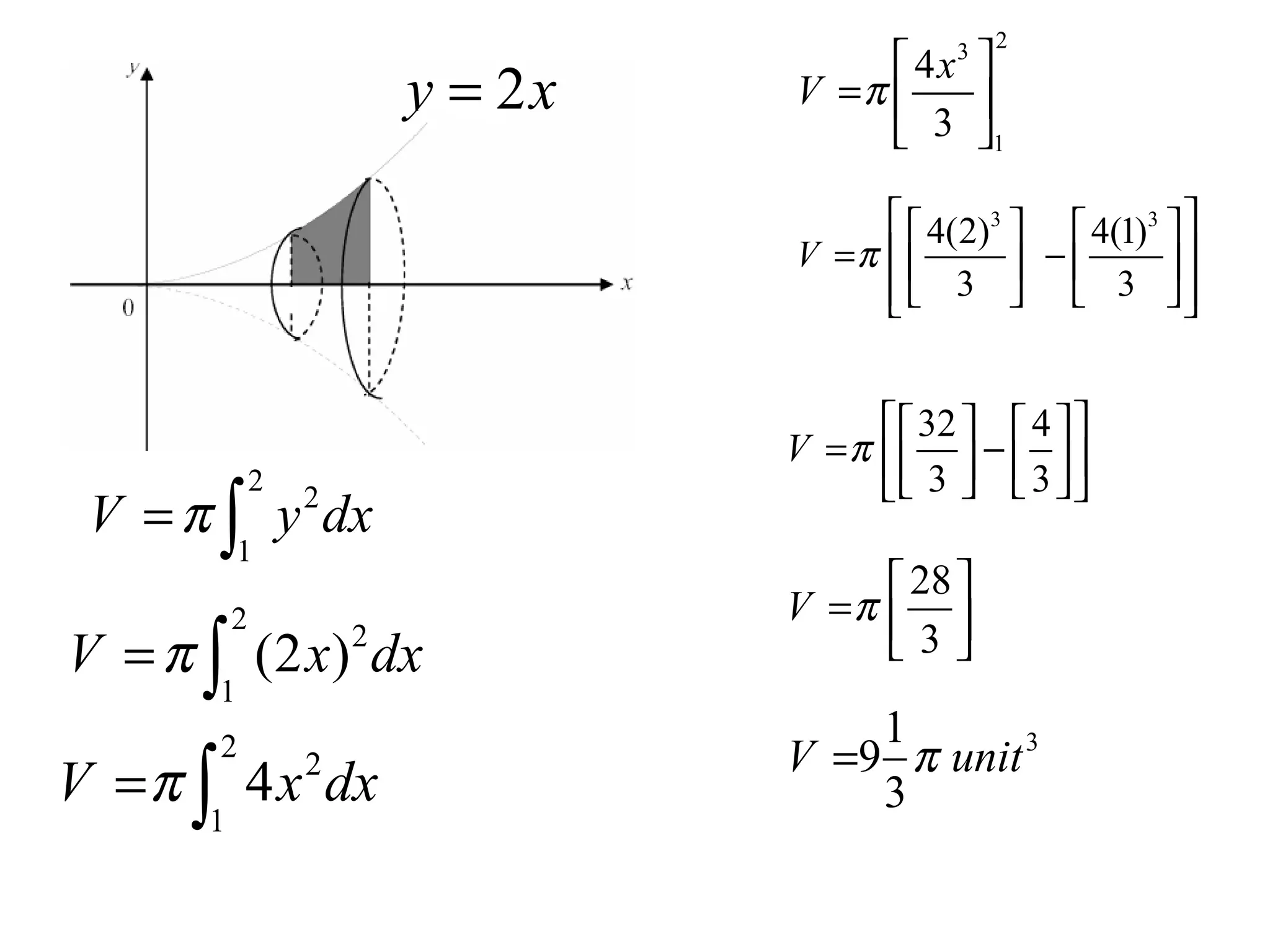
The  volume  of a cylinder is given by V =  π r 2 h Because radius  = r  =  y  and each disk is  dx  high, we notice that the volume of each slice is: V =  π y 2 dx Adding the volumes of the disks (with infinitely small  dx ), we obtain the formula: y = f ( x )   is the equation of the curve whose area is being rotated a  and  b  are the limits of the area being rotated dx show that the area is being rotated abount the x-axis.
 
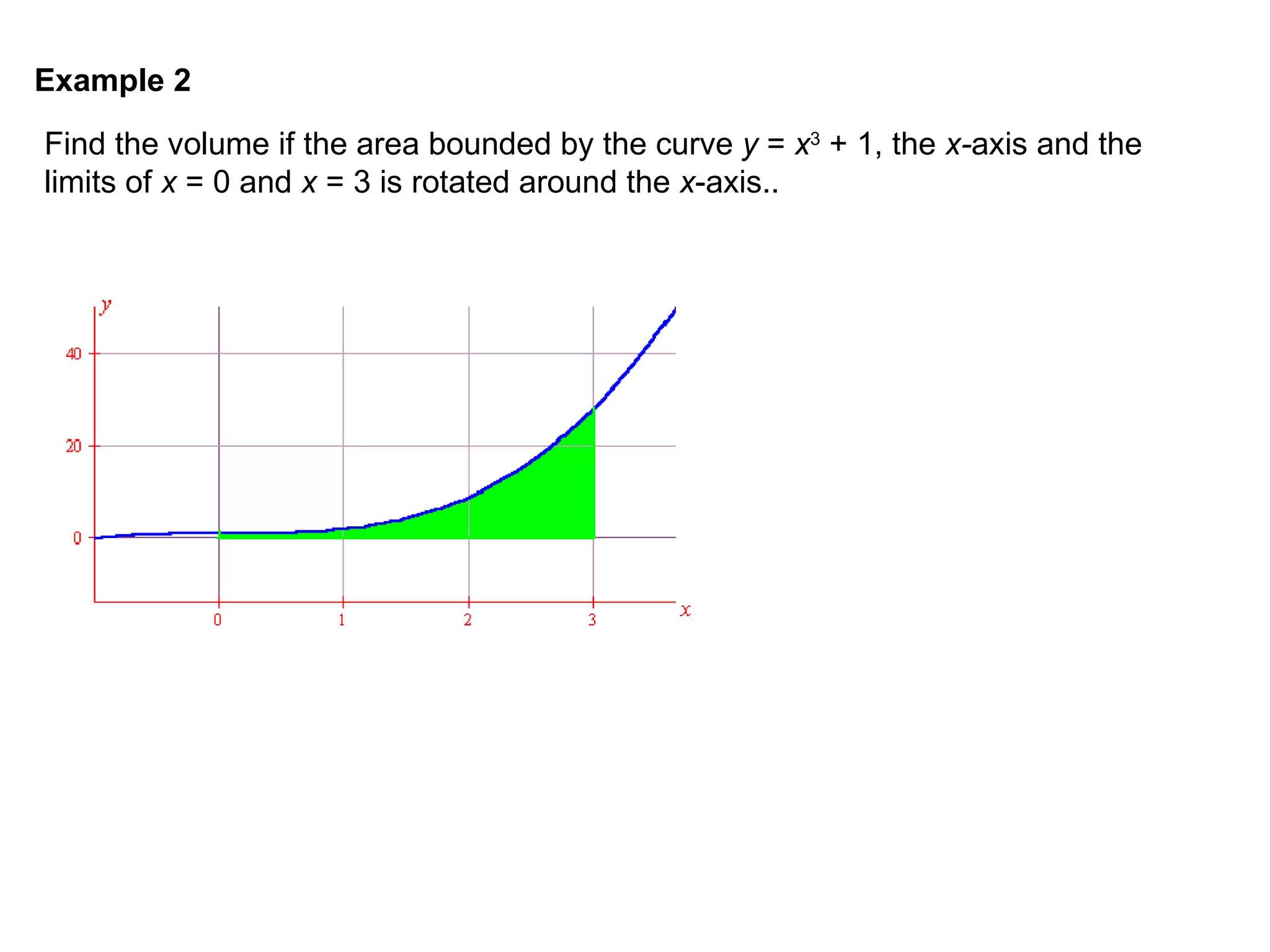
Example 2 Find the volume if the area bounded by the curve  y  =  x 3  + 1, the  x- axis and the limits of  x  = 0 and  x  = 3 is rotated around the  x -axis..
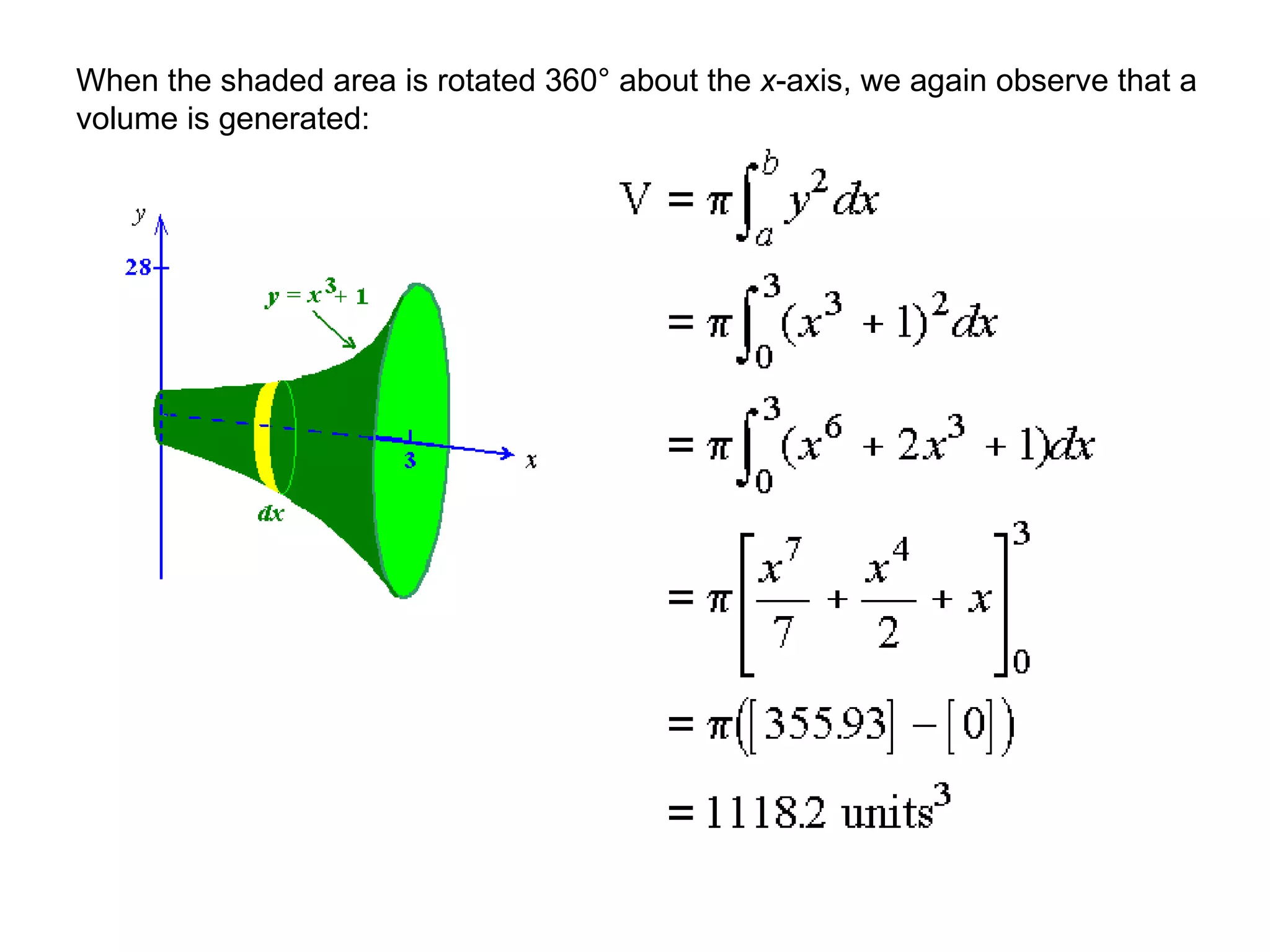
When the shaded area is rotated 360° about the  x -axis, we again observe that a volume is generated:
 

Integration

  • 1.
    Integration Learning Objectives : In this chapter, you will learn about the concept of indefinite integral Learning Outcomes: Determine integrals by reversing differentiation
  • 2.
  • 3.
    3.1.2 Integrationof algebraic expressions Integrate (a) 8 (b) 3.5 (c) 3.1.2 (a) Integral of Constant
  • 4.
    3.1.2 Integrationof algebraic expressions During differentiation, we carry out two operations on each term in x: multiply the term with the index, and reduce the index by 1. 3.1.2 (b) Integral of Differentiation Integration
  • 5.
    Examples 1: Integrateeach of the following with respect of x: (a) (b)
  • 6.
    Examples 2: Ifthe derivative of a function is given as find the function y.
  • 7.
    3.1.3 Determinethe constant of Integration
  • 8.
    Examples 1: Subsitutex=3 and y=5 into (1) If and y=5 when x=3, find the value of y when x=5
  • 9.
    3.1.4 Equationsof curve from functions of gradients Examples 1: Find the equation of curve. by integration, The curve passing through the point (-1, 2) x=-1 when y=2 The equation of the curve is The gradient of a curve passing through the point (-1, 2) is given by
  • 10.
    Examples 2: .Find the value of k. The gradient function of a curve passing through the point (-1, 2) and (0,k) is
  • 11.
    The curve passthrough (-1, 2) Therefore, the equation of the curve is At point (0, k),
  • 12.
    Exercise 3-1-09t0 6-1-09 Given that and that y=5 when x= -1, find the value of y when x=2 Given that and that v=2 when t = 1, find the value of v when t = 2.
  • 13.
    3.1.5 Integrateby substitution Find the integration by substitution
  • 14.
    3.1.5 Integrateby substitution Find the integration by substitution
  • 15.
    3.1.5 (a) Integral of
  • 16.
    The gradient ofthe curve, Integrate with respect to x, we have Since the curve passes through (4, -3) The equation of the curve is The slope of a curve at any point P(x, y) is given by . Find the equation of the curve given that its passes through the point ( 4, -3)
  • 17.
  • 18.
    3.2.2(b) Area undera curve bounded by x= a and x=b The area A under a curve by y = f(x) bounded by the x-axis from x=a to x=b is given by Integration as Summation of Area
  • 19.
    3.2.2(b) Area undera curve bounded by x= a and x=b 1 2
  • 20.
    Step (1) Findx-intercept a b On the x-axis, y =0
  • 21.
    Area under acurve bounded by
  • 22.
    Area under acurve bounded by
  • 23.
    The area undera curve which is enclosed by y = a and y = b is
  • 24.
    The area undera curve is 1 2
  • 25.
    Area under acurve bounded by curve
  • 26.
    Area under acurve bounded
  • 27.
    Exercise 19-2-09 23-2-09 1 2
  • 28.
    Exercise Text BookPage 71 23-2-09 10- ( a) ( b ) ( c ) 11- ( a) ( b ) ( c ) 12- ( a) ( b )
  • 29.
    Exercise Text BookPage 72 13- ( a) ( b ) ( c ) 14 17 ( a ) (b ) ( c )
  • 30.
  • 31.
    The resulting solidis a cone To find this volume, we could take slices (the yellow disk shown above), each dx wide and radius y :
  • 32.
    The volume of a cylinder is given by V = π r 2 h Because radius = r = y and each disk is dx high, we notice that the volume of each slice is: V = π y 2 dx Adding the volumes of the disks (with infinitely small dx ), we obtain the formula: y = f ( x ) is the equation of the curve whose area is being rotated a and b are the limits of the area being rotated dx show that the area is being rotated abount the x-axis.
  • 33.
  • 34.
    Example 2 Findthe volume if the area bounded by the curve y = x 3 + 1, the x- axis and the limits of x = 0 and x = 3 is rotated around the x -axis..
  • 35.
    When the shadedarea is rotated 360° about the x -axis, we again observe that a volume is generated:
  • 36.