Digital Modulation
Lectures
1
Change which part of the
Carrier?
Carrier: A sin[ωt +ϕ]
 A = const
 ω = const
 ϕ = const
Amplitude modulation
(AM)
 A = A(t) – carries information
 ω = const
 ϕ = const
Frequency modulation
(FM)
 A = const
 ω = ω(t)– carries information
 ϕ = const
Phase modulation (PM)
 A = const
 ω = const
 ϕ = ϕ(t) – carries information
2
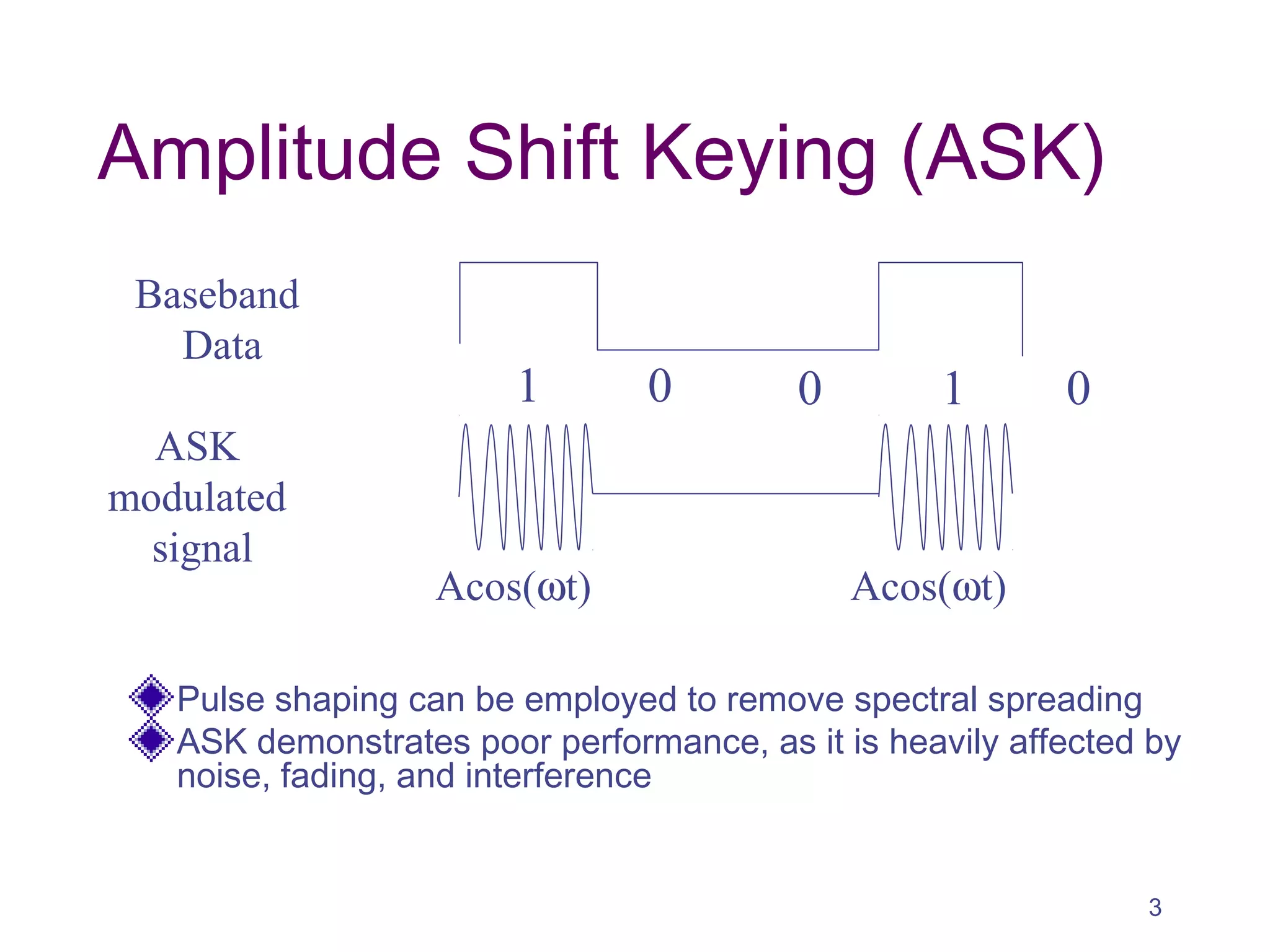
Amplitude Shift Keying (ASK)
Pulse shaping can be employed to remove spectral spreading
ASK demonstrates poor performance, as it is heavily affected by
noise, fading, and interference
Baseband
Data
ASK
modulated
signal
1 10 0 0
Acos(ωt) Acos(ωt)
3
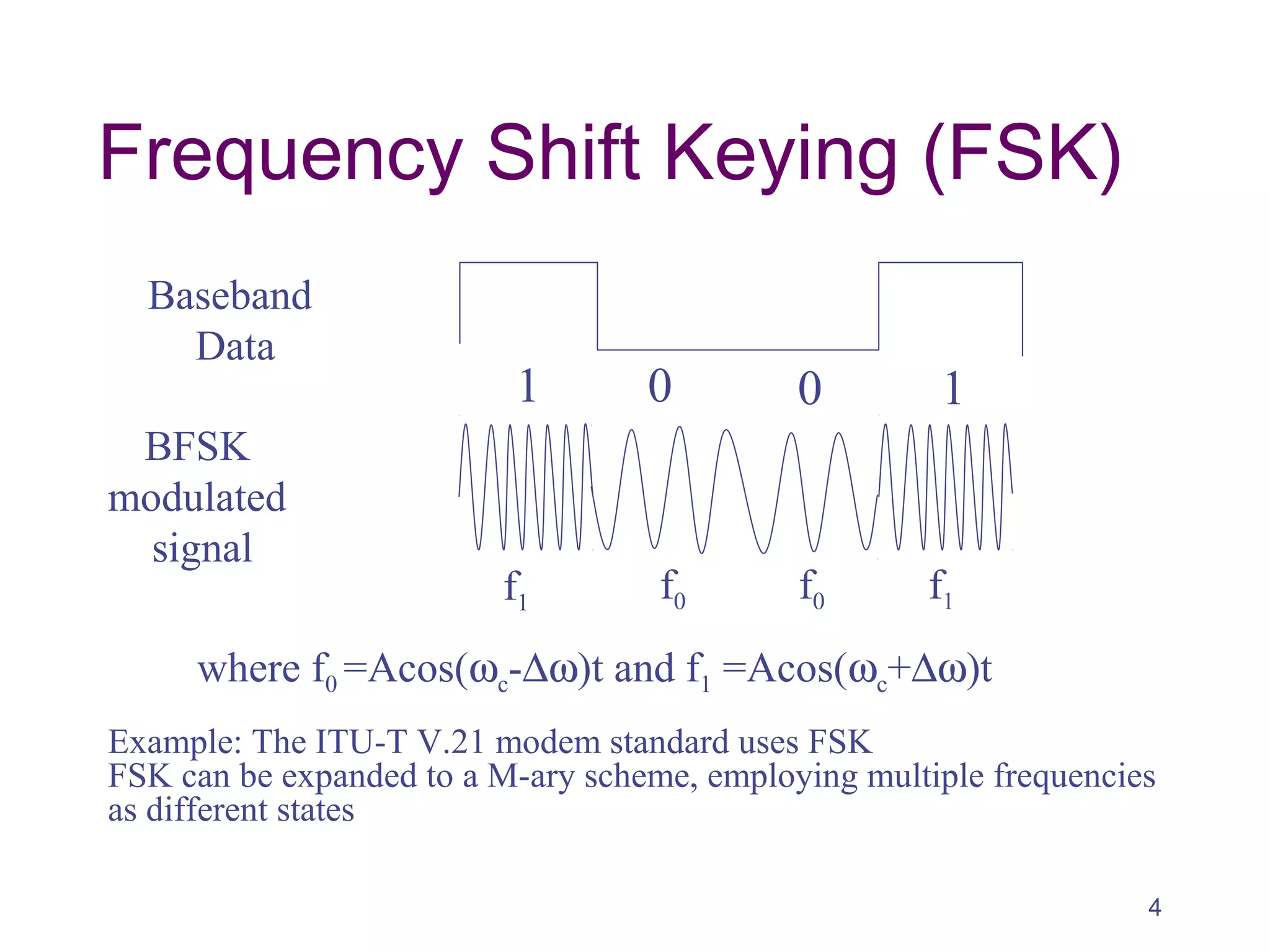
Frequency Shift Keying (FSK)
Example: The ITU-T V.21 modem standard uses FSK
FSK can be expanded to a M-ary scheme, employing multiple frequencies
as different states
Baseband
Data
BFSK
modulated
signal
1 10 0
where f0 =Acos(ωc-∆ω)t and f1 =Acos(ωc+∆ω)t
f0 f0f1 f1
4
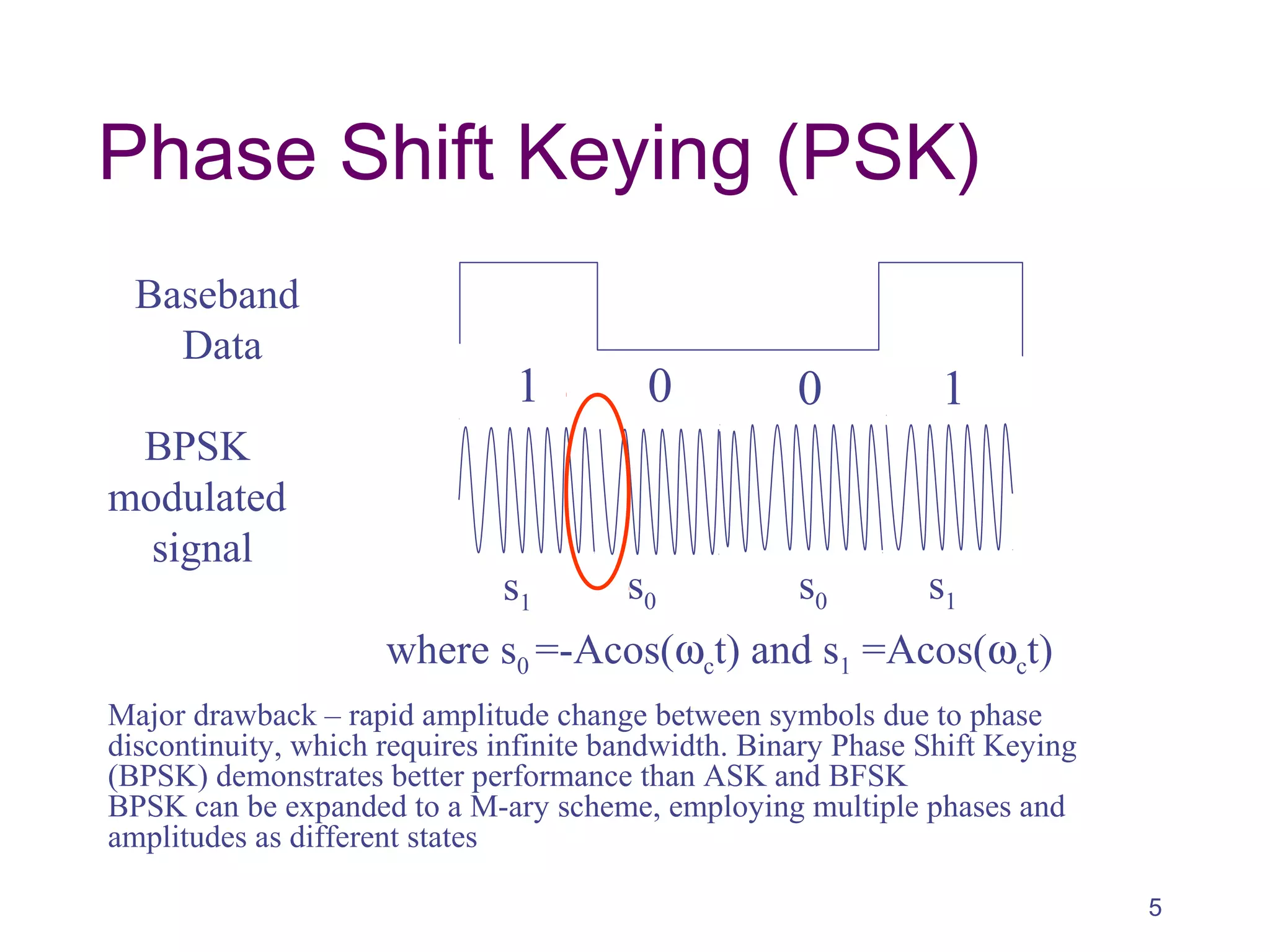
Phase Shift Keying (PSK)
Major drawback – rapid amplitude change between symbols due to phase
discontinuity, which requires infinite bandwidth. Binary Phase Shift Keying
(BPSK) demonstrates better performance than ASK and BFSK
BPSK can be expanded to a M-ary scheme, employing multiple phases and
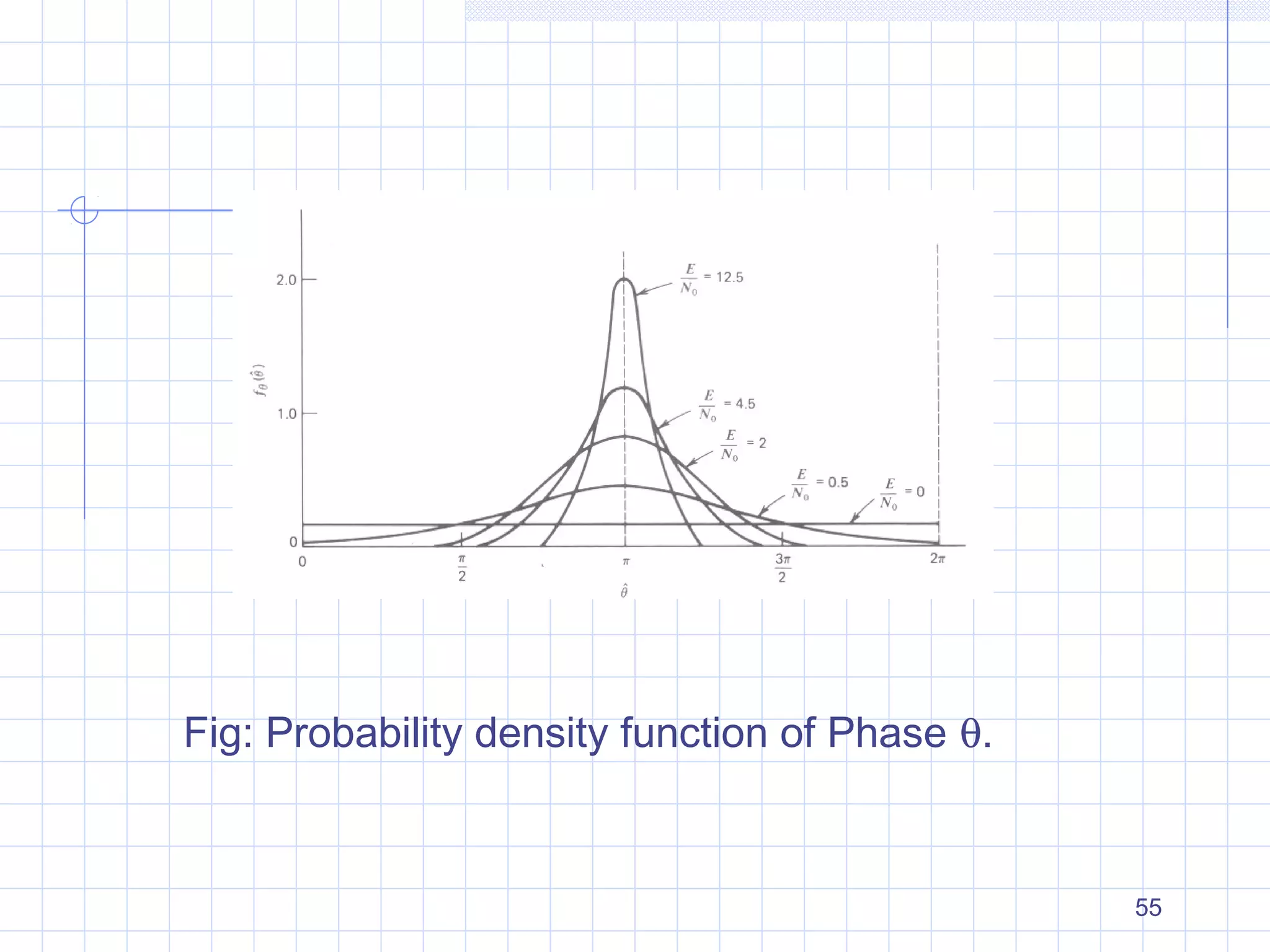
amplitudes as different states
Baseband
Data
BPSK
modulated
signal
1 10 0
where s0 =-Acos(ωct) and s1 =Acos(ωct)
s0 s0s1 s1
5
6 of 30
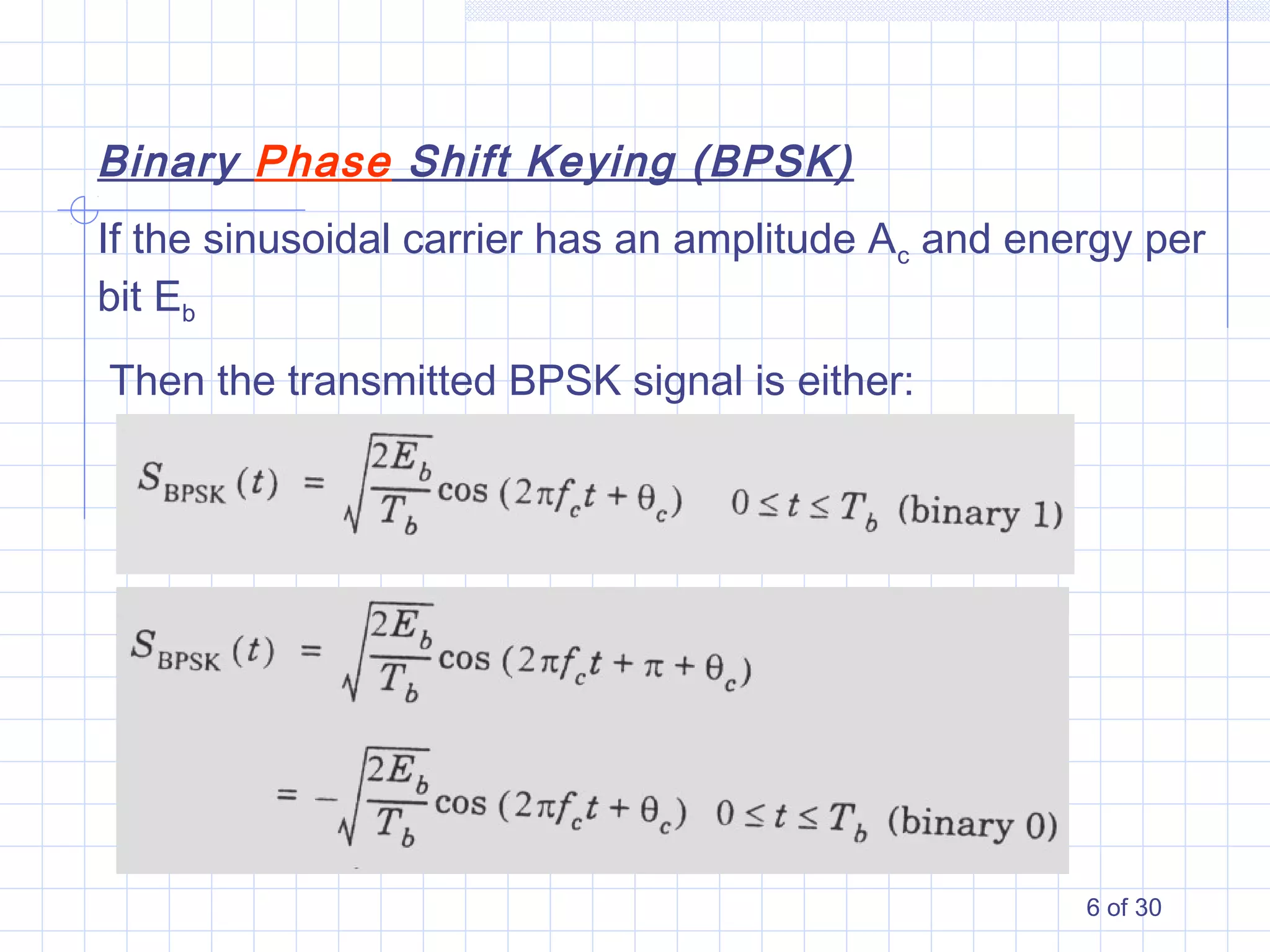
Binary Phase Shift Keying (BPSK)
If the sinusoidal carrier has an amplitude Ac and energy per
bit Eb
Then the transmitted BPSK signal is either:
7 of 82
Linear Modulation Techniques:
Digital modulation can be broadly classified as:
1. Linear (change Amplitude or phase)
2. Non linear modulation techniques (change
frequency).
Linear Modulation Techniques:
• The amplitude /phase of the transmitted signal s(t),
varies linearly with the modulating digital signal, m(t).
• These are bandwidth efficient (because it doesn’t
change frequency) and hence are very attractive for
use in wireless communication systems where there
is an increasing demand to accommodate more and
more users within a limited spectrum.
8 of 30
• Linear Modulation schemes have
very good spectral efficiency,
•However, they must be transmitted
using linear RF amplifiers which
have poor power efficiency.
Pros & Cons
9 of 30
Note
“Phase modulation” can be regarded as
“amplitude” modulation because it can
really change “envelope”;
Thus both of them belong to “linear
modulation”!
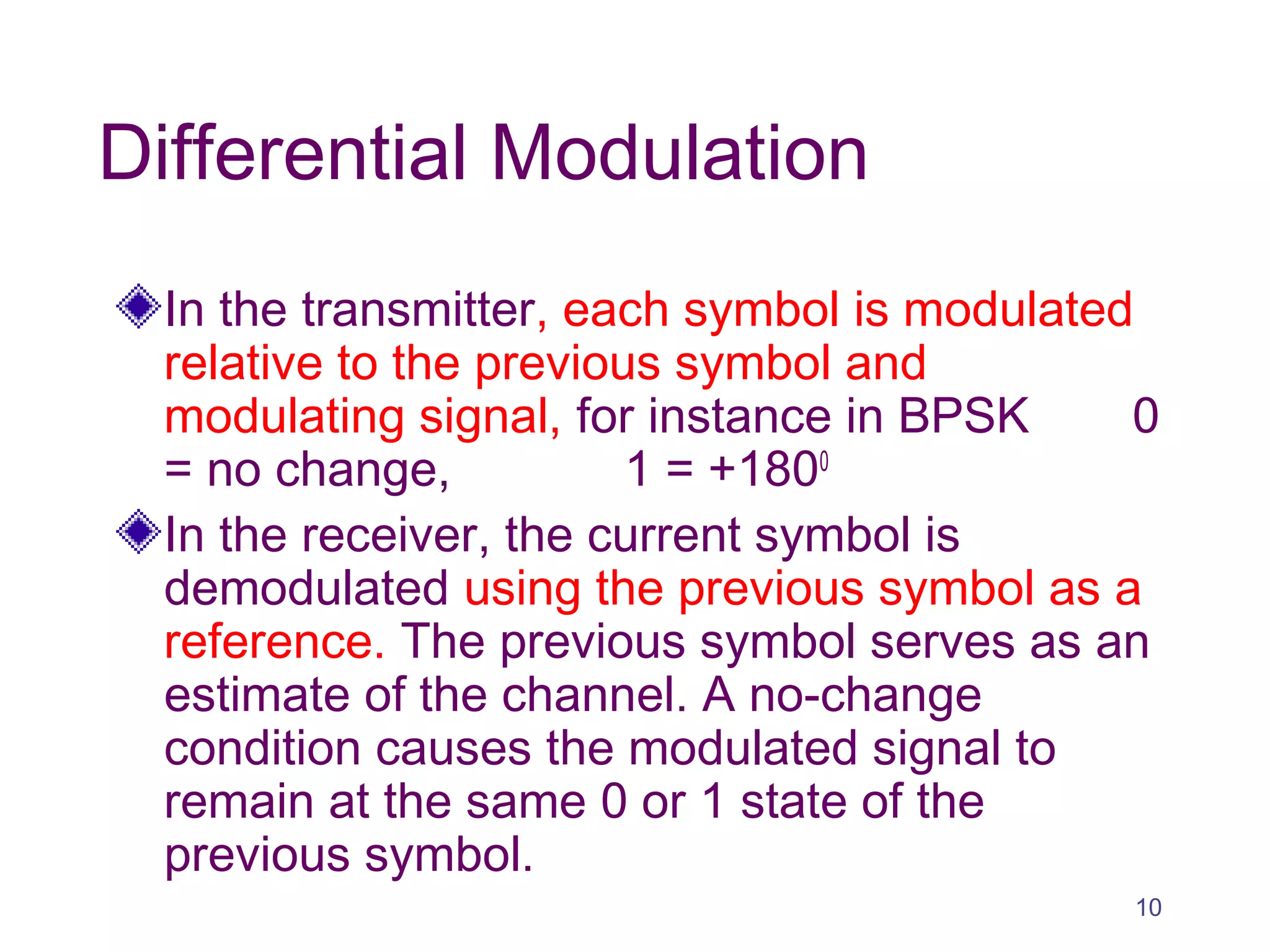
Differential Modulation
In the transmitter, each symbol is modulated
relative to the previous symbol and
modulating signal, for instance in BPSK 0
= no change, 1 = +1800
In the receiver, the current symbol is
demodulated using the previous symbol as a
reference. The previous symbol serves as an
estimate of the channel. A no-change
condition causes the modulated signal to
remain at the same 0 or 1 state of the
previous symbol.
10
11 of 30
12 of 30
13 of 30
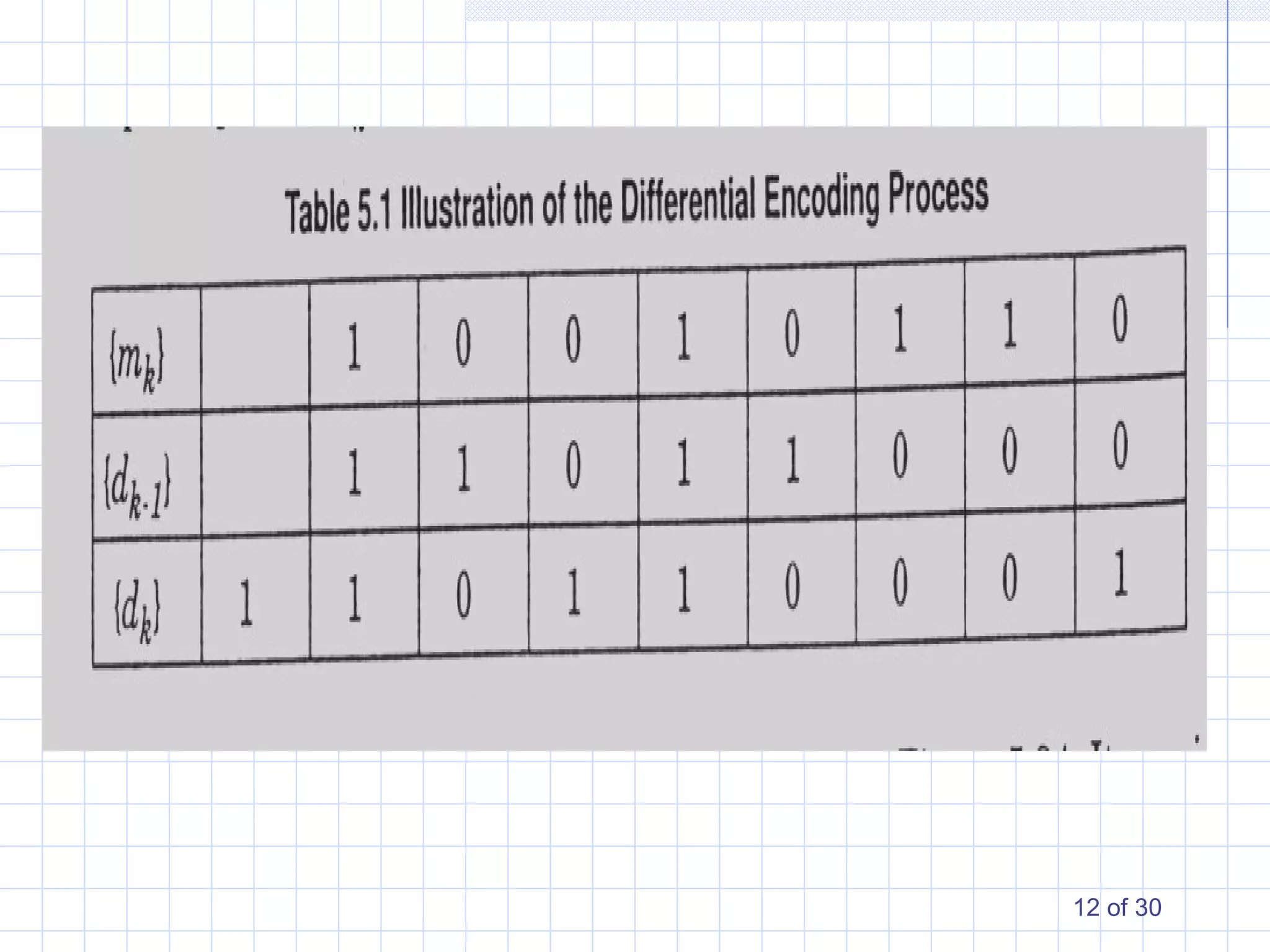
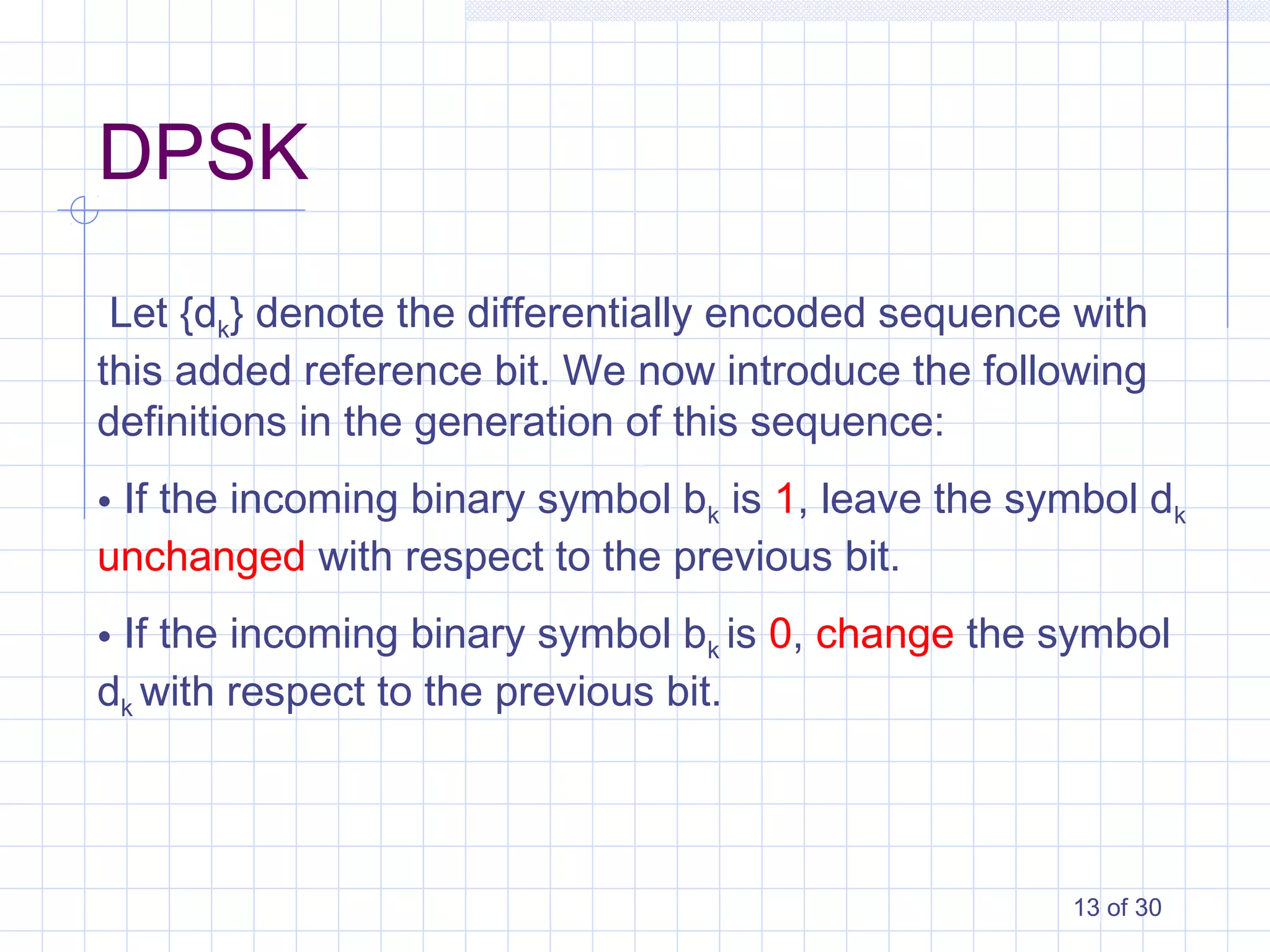
Let {dk} denote the differentially encoded sequence with
this added reference bit. We now introduce the following
definitions in the generation of this sequence:
• If the incoming binary symbol bk is 1, leave the symbol dk
unchanged with respect to the previous bit.
• If the incoming binary symbol bk is 0, change the symbol
dk with respect to the previous bit.
DPSK
14 of 30
• to send symbol 0, we advance the phase of the current
signal waveform by 180 degrees,
• to send symbol 1, we leave the phase of the current
signal waveform unchanged.
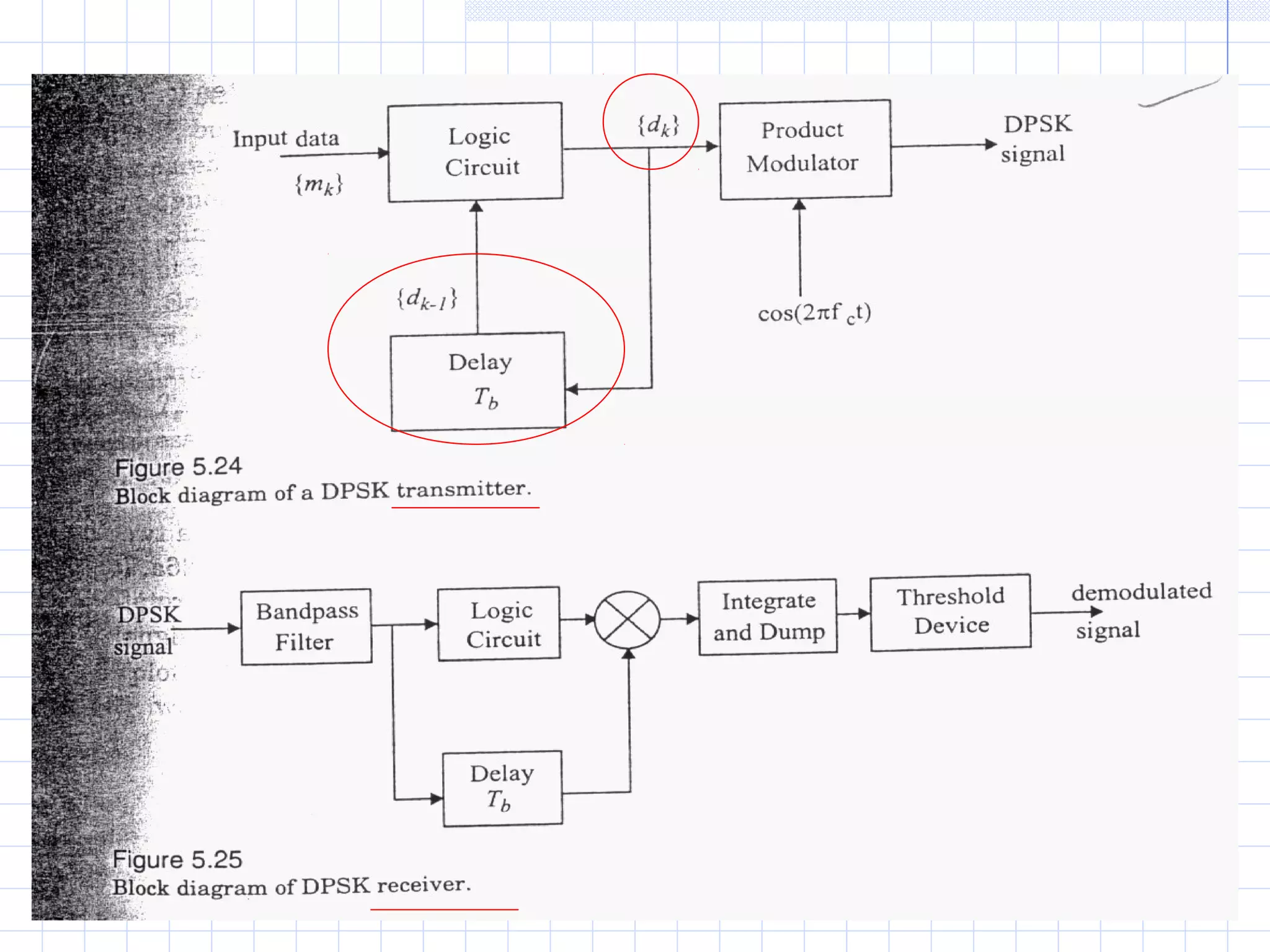
Generation of DPSK:
• The differential encoding process at the transmitter
input starts with an arbitrary first bit, serving as
reference.
DPSK
15 of 30
Differential Phase Shift Keying (DPSK):
• DPSK is a non coherent form of phase shift keying which
avoids the need for a coherent reference signal at the
receiver.
Advantage:
• Non coherent receivers are easy and cheap to build,
hence widely used in wireless communications.
•DPSK eliminates the need for a coherent reference signal
at the receiver by combining two basic operations at the
transmitter:
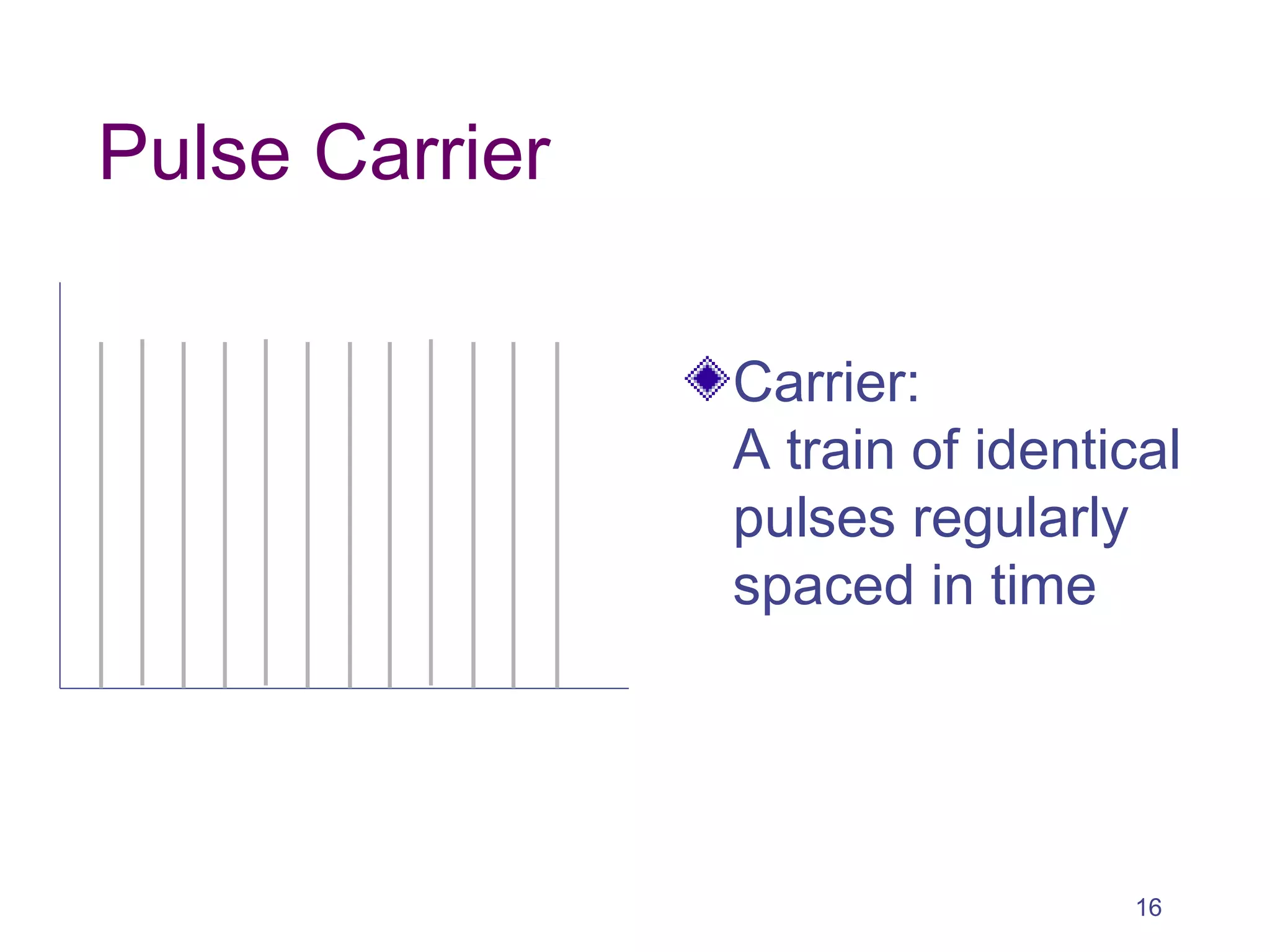
Pulse Carrier
Carrier:
A train of identical
pulses regularly
spaced in time
16
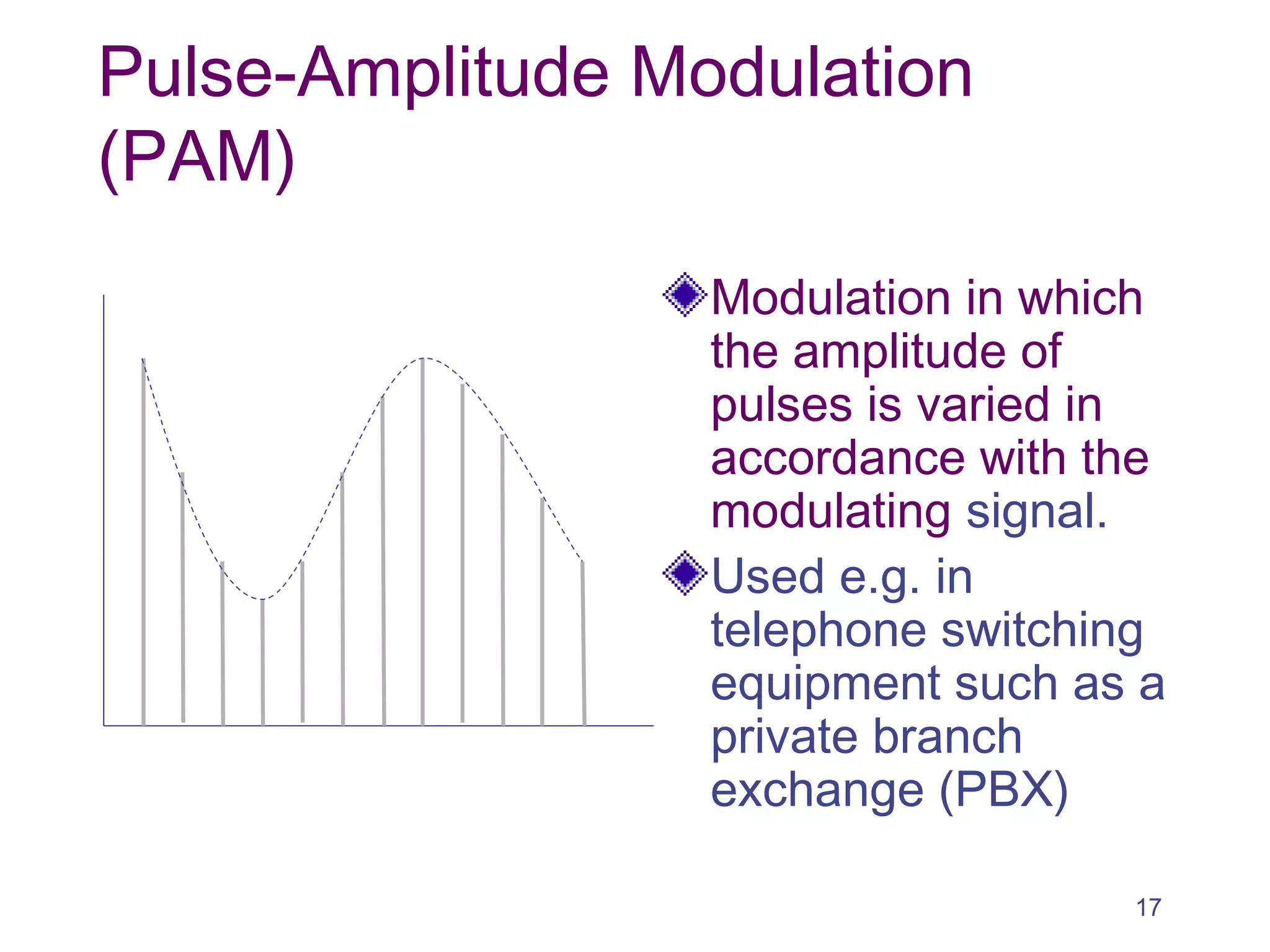
Pulse-Amplitude Modulation
(PAM)
Modulation in which
the amplitude of
pulses is varied in
accordance with the
modulating signal.
Used e.g. in
telephone switching
equipment such as a
private branch
exchange (PBX)
17
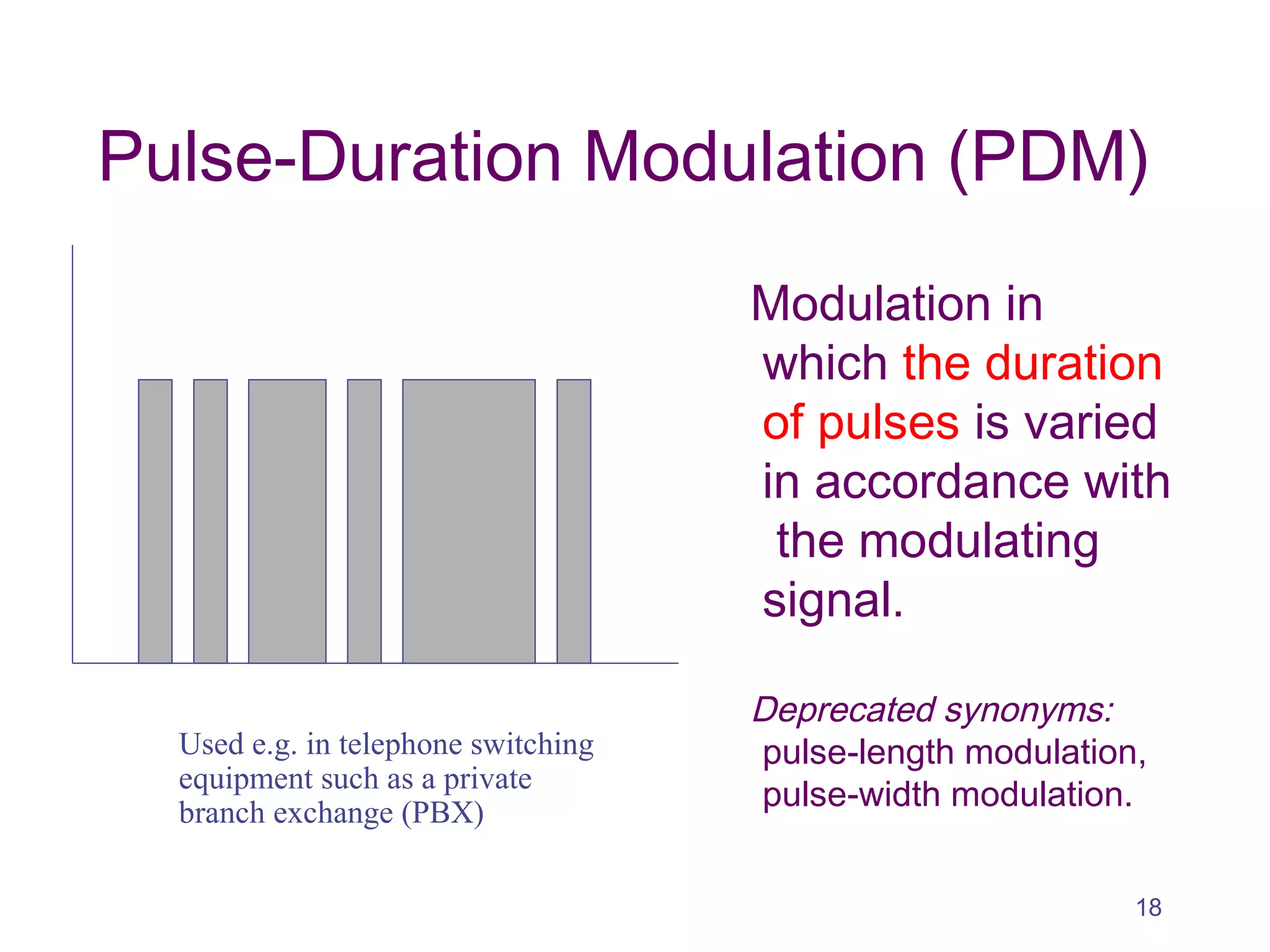
Pulse-Duration Modulation (PDM)
Modulation in
which the duration
of pulses is varied
in accordance with
the modulating
signal.
Deprecated synonyms:
pulse-length modulation,
pulse-width modulation.
Used e.g. in telephone switching
equipment such as a private
branch exchange (PBX)
18
Demodulation & Detection
Demodulation
 Is process of removing the carrier signal to
obtain the original signal waveform
Detection – extracts the symbols from
the waveform
 Coherent detection
 Non-coherent detection
19
Coherent Detection
An estimate of the channel phase and
attenuation is recovered. It is then possible to
reproduce the transmitted signal and
demodulate.
Requires a replica carrier wave of the same
frequency and phase at the receiver.
Also known as synchronous detection (I.e.
carrier recovery)
20
Coherent Detection 2
Carrier recovery methods include
 Pilot Tone (such as Transparent Tone in Band)
 Less power in the information bearing signal, High peak-
to-mean power ratio
 Carrier recovery from the information signal
 E.g. Costas loop
Applicable to
 Phase Shift Keying (PSK)
 Frequency Shift Keying (FSK)
 Amplitude Shift Keying (ASK)
21
Non-Coherent Detection
Requires no reference wave; does not exploit
phase reference information (envelope
detection)
 Differential Phase Shift Keying (DPSK)
 Frequency Shift Keying (FSK)
 Amplitude Shift Keying (ASK)
 Non coherent detection is less complex than
coherent detection (easier to implement), but has
worse performance.
22
QPSK
Quadrature Phase Shift Keying (QPSK)
can be interpreted as two independent
BPSK systems (one on the I-channel
and one on Q-channel), and thus the
same performance but twice the
bandwidth (spectrum) efficiency.
23
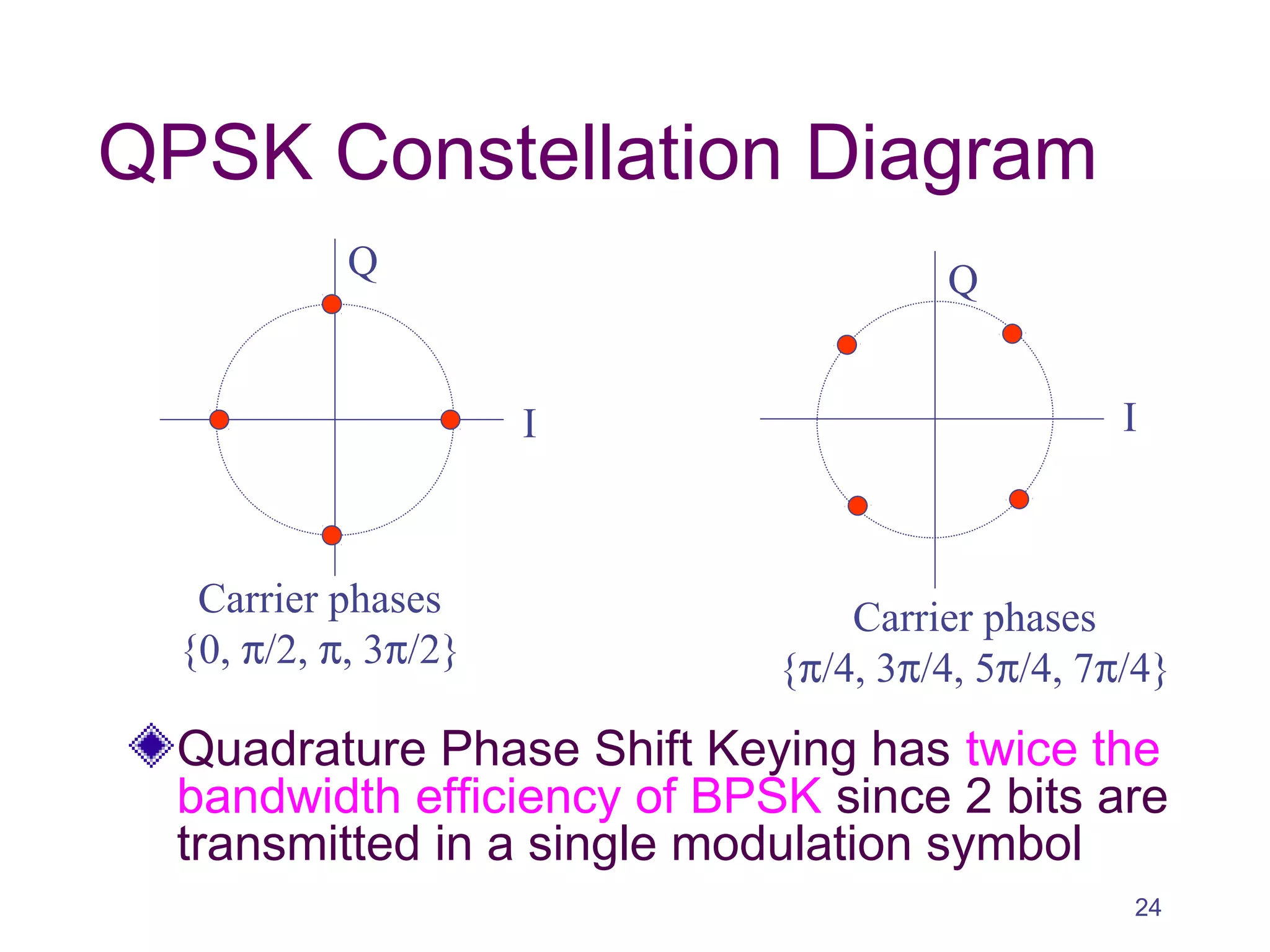
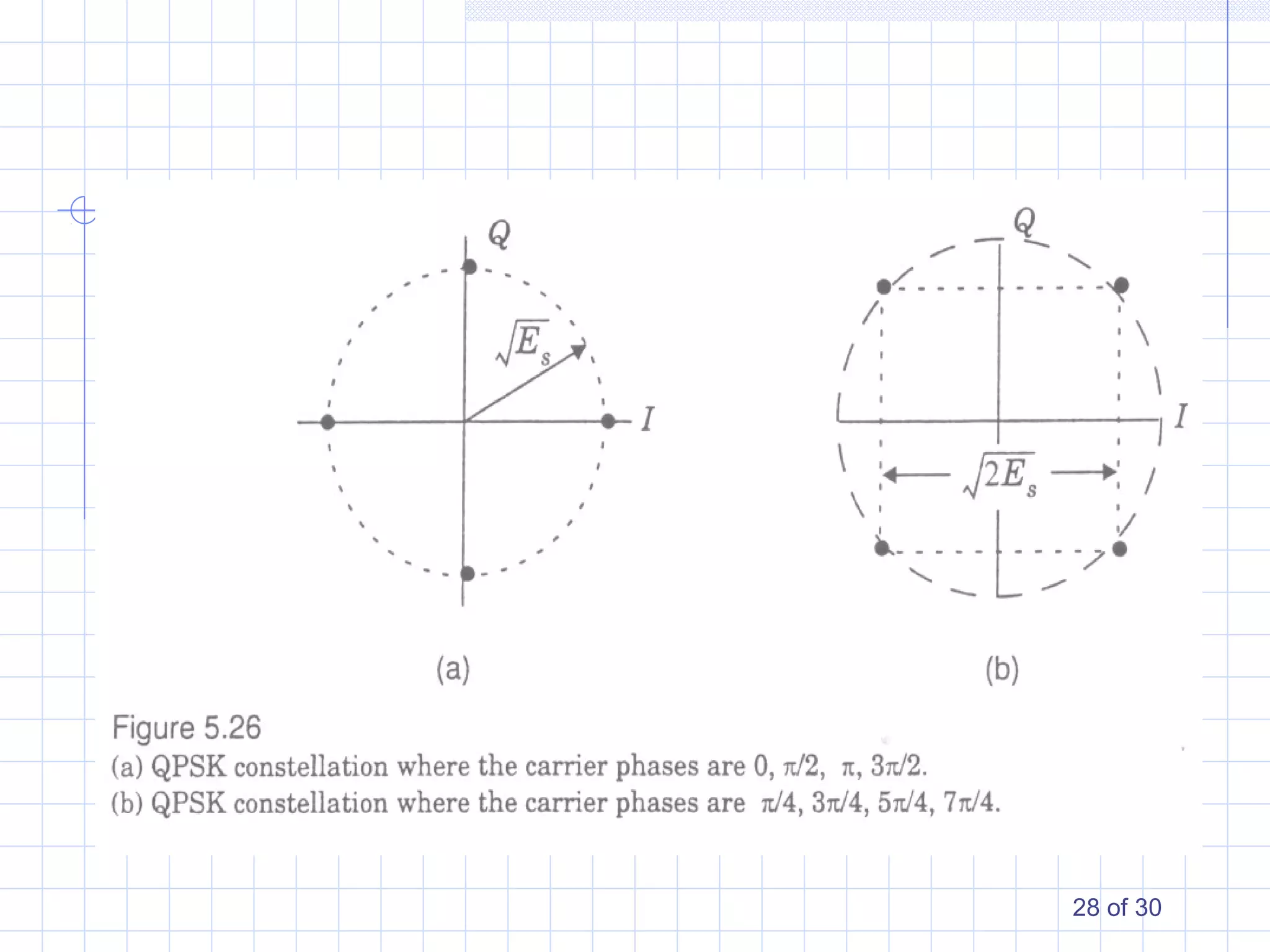
QPSK Constellation Diagram
Quadrature Phase Shift Keying has twice the
bandwidth efficiency of BPSK since 2 bits are
transmitted in a single modulation symbol
Carrier phases
{0, π/2, π, 3π/2}
Carrier phases
{π/4, 3π/4, 5π/4, 7π/4}
Q
I I
Q
24
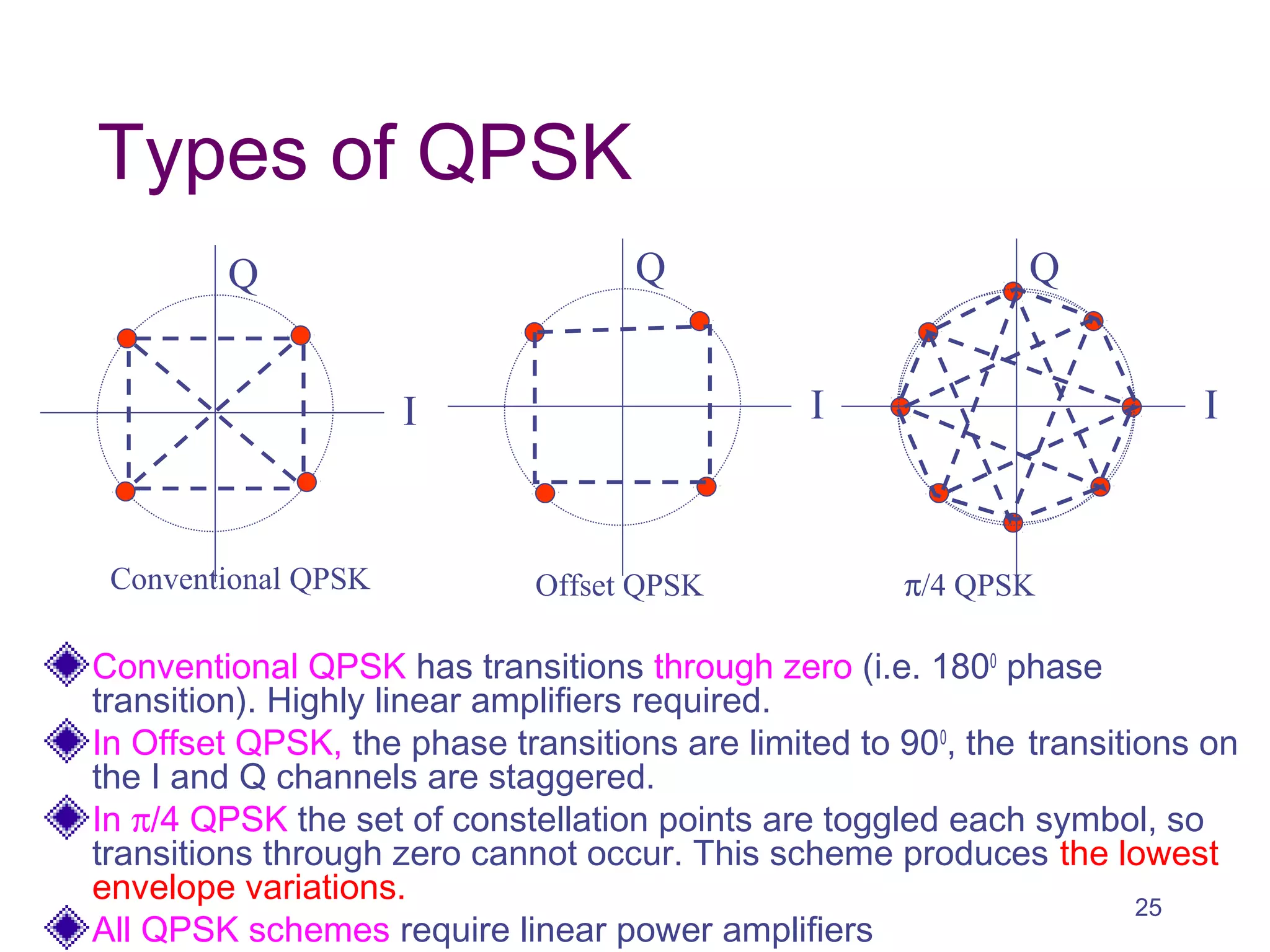
Types of QPSK
Conventional QPSK has transitions through zero (i.e. 1800
phase
transition). Highly linear amplifiers required.
In Offset QPSK, the phase transitions are limited to 900
, the transitions on
the I and Q channels are staggered.
In π/4 QPSK the set of constellation points are toggled each symbol, so
transitions through zero cannot occur. This scheme produces the lowest
envelope variations.
All QPSK schemes require linear power amplifiers
I
Q
I
Q
I
Q
Conventional QPSK π/4 QPSKOffset QPSK
25
26 of 30
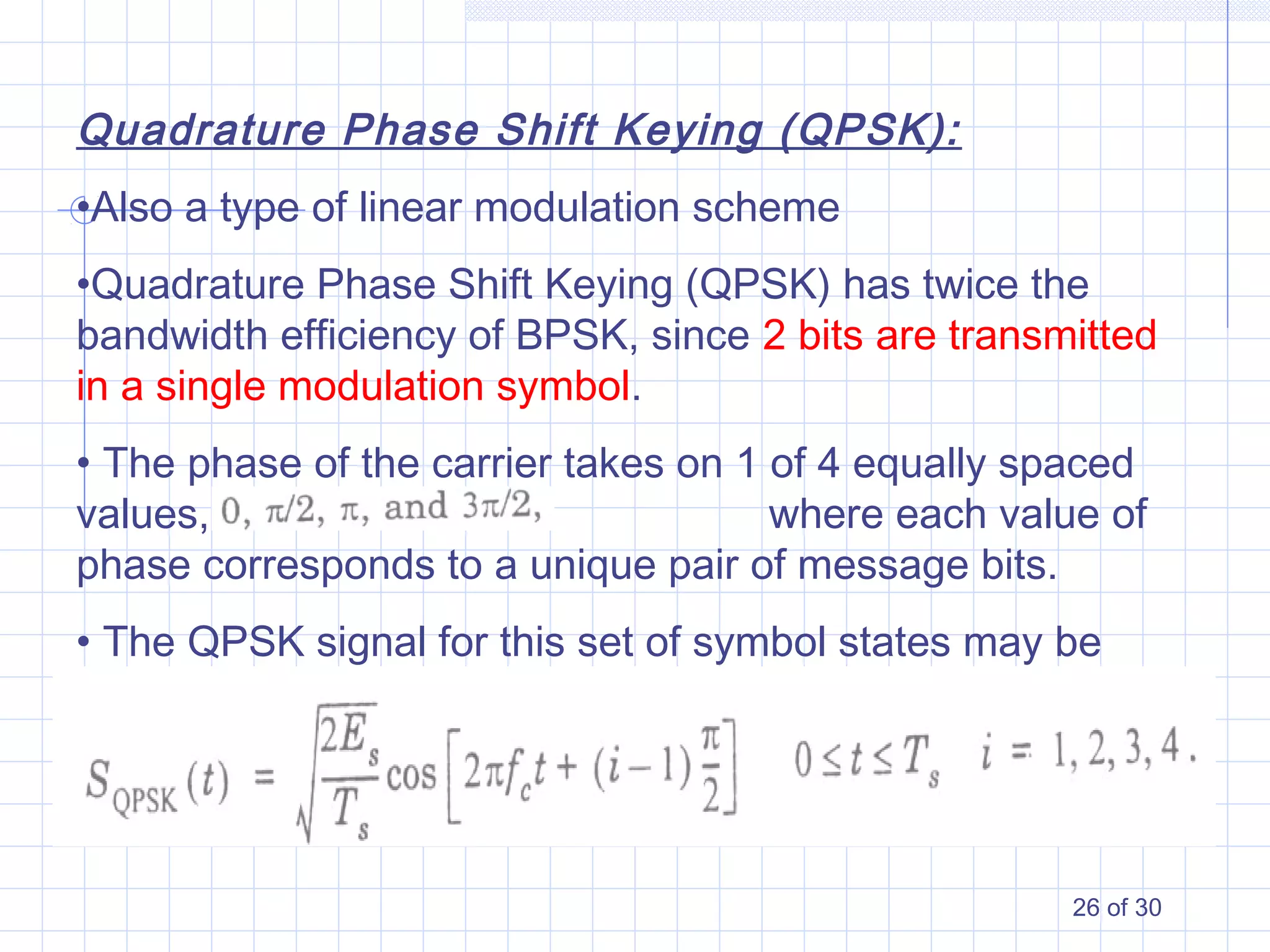
Quadrature Phase Shift Keying (QPSK):
•Also a type of linear modulation scheme
•Quadrature Phase Shift Keying (QPSK) has twice the
bandwidth efficiency of BPSK, since 2 bits are transmitted
in a single modulation symbol.
• The phase of the carrier takes on 1 of 4 equally spaced
values, such as where each value of
phase corresponds to a unique pair of message bits.
• The QPSK signal for this set of symbol states may be
defined as:
27 of 30
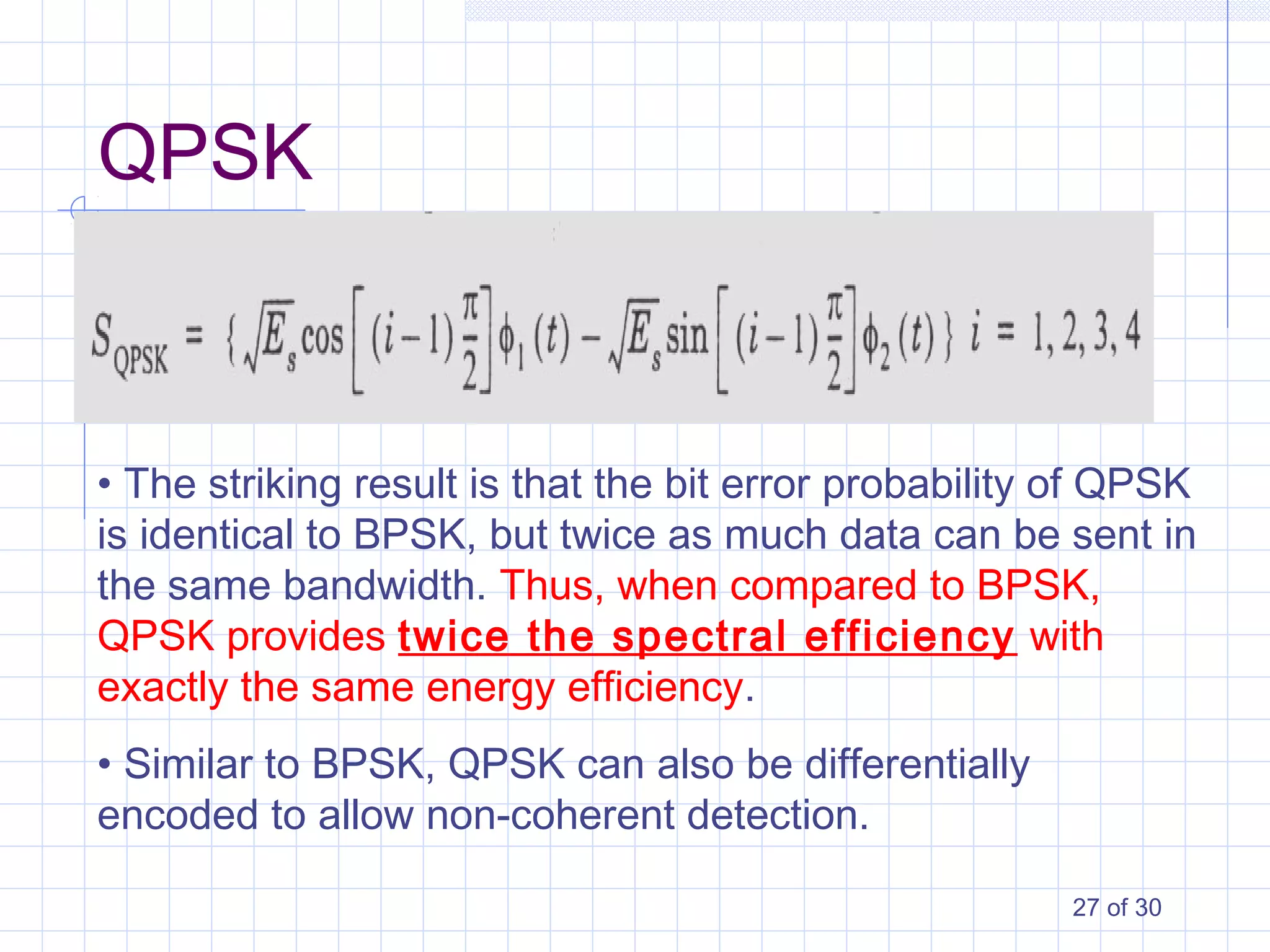
• The striking result is that the bit error probability of QPSK
is identical to BPSK, but twice as much data can be sent in
the same bandwidth. Thus, when compared to BPSK,
QPSK provides twice the spectral efficiency with
exactly the same energy efficiency.
• Similar to BPSK, QPSK can also be differentially
encoded to allow non-coherent detection.
QPSK
28 of 30
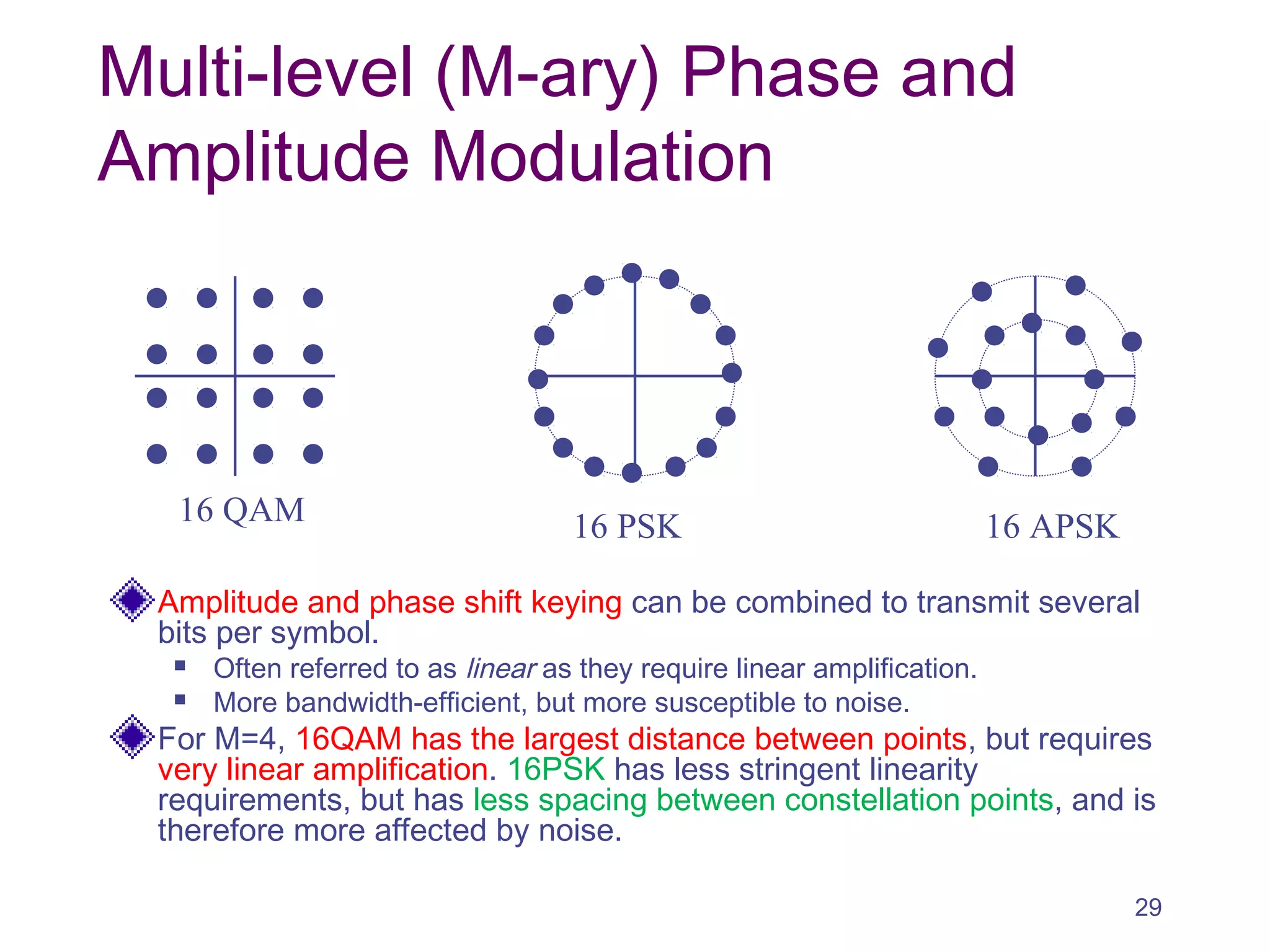
Multi-level (M-ary) Phase and
Amplitude Modulation
Amplitude and phase shift keying can be combined to transmit several
bits per symbol.
 Often referred to as linear as they require linear amplification.
 More bandwidth-efficient, but more susceptible to noise.
For M=4, 16QAM has the largest distance between points, but requires
very linear amplification. 16PSK has less stringent linearity
requirements, but has less spacing between constellation points, and is
therefore more affected by noise.
16 QAM 16 APSK16 PSK
29
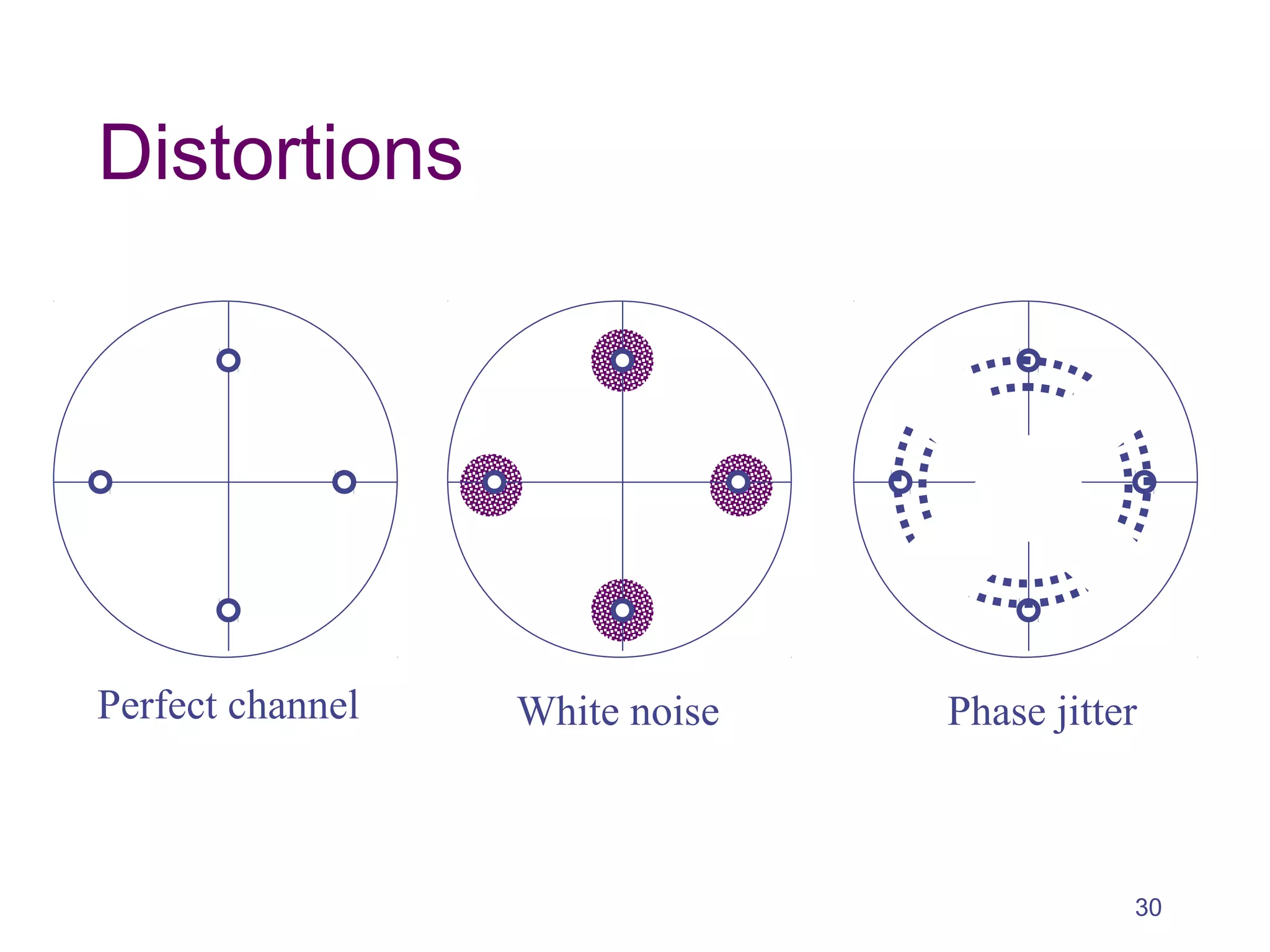
Distortions
Perfect channel White noise Phase jitter
30
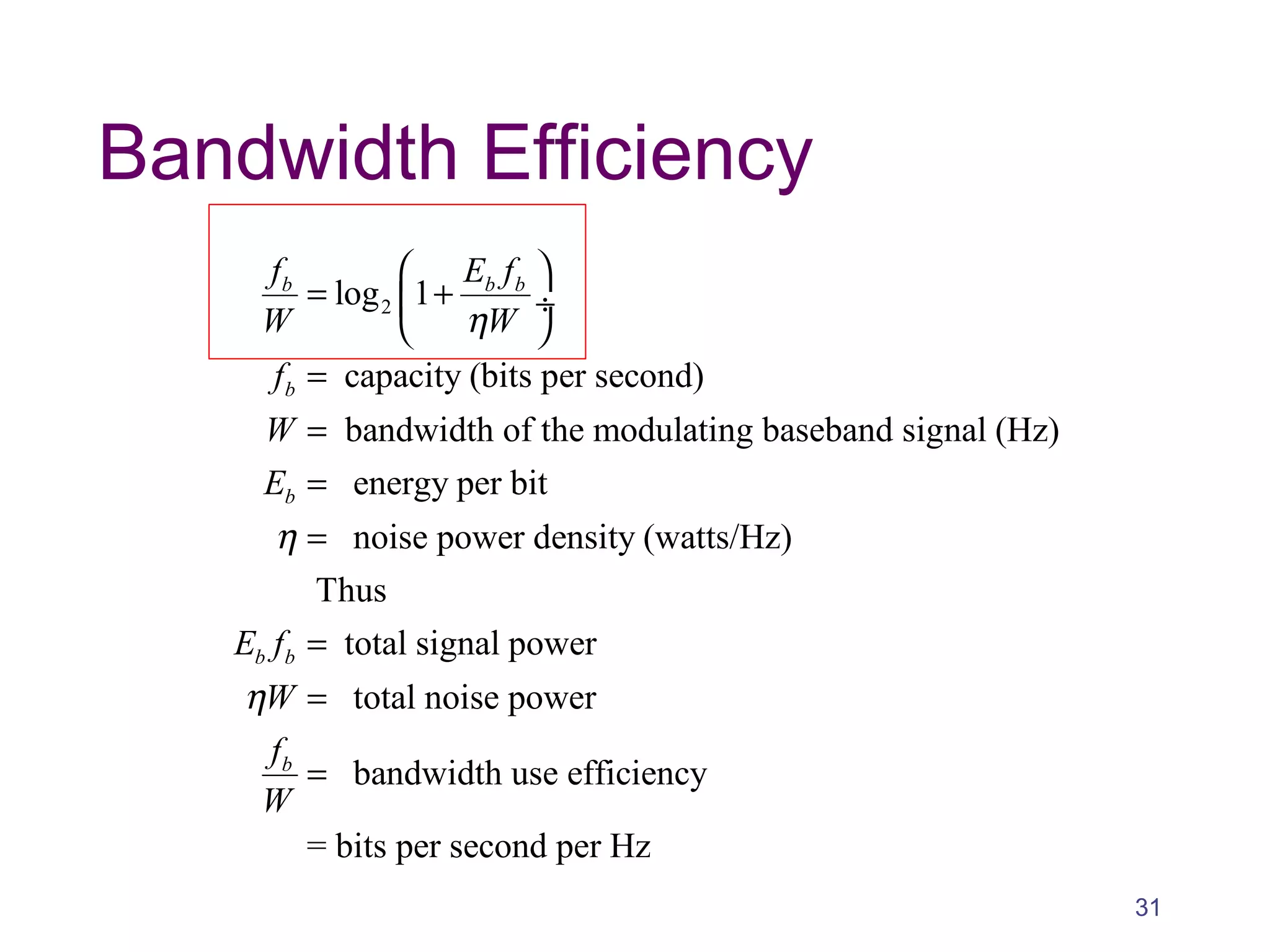
Bandwidth Efficiency
2log 1
capacity (bits per second)
bandwidth of the modulating baseband signal (Hz)
energy per bit
noise power density (watts/Hz)
Thus
total signal power
total noise
b b b
b
b
b b
f E f
W W
f
W
E
E f
W
η
η
η
 
= + ÷
 
=
=
=
=
=
= power
bandwidth use efficiency
= bits per second per Hz
bf
W
=
31
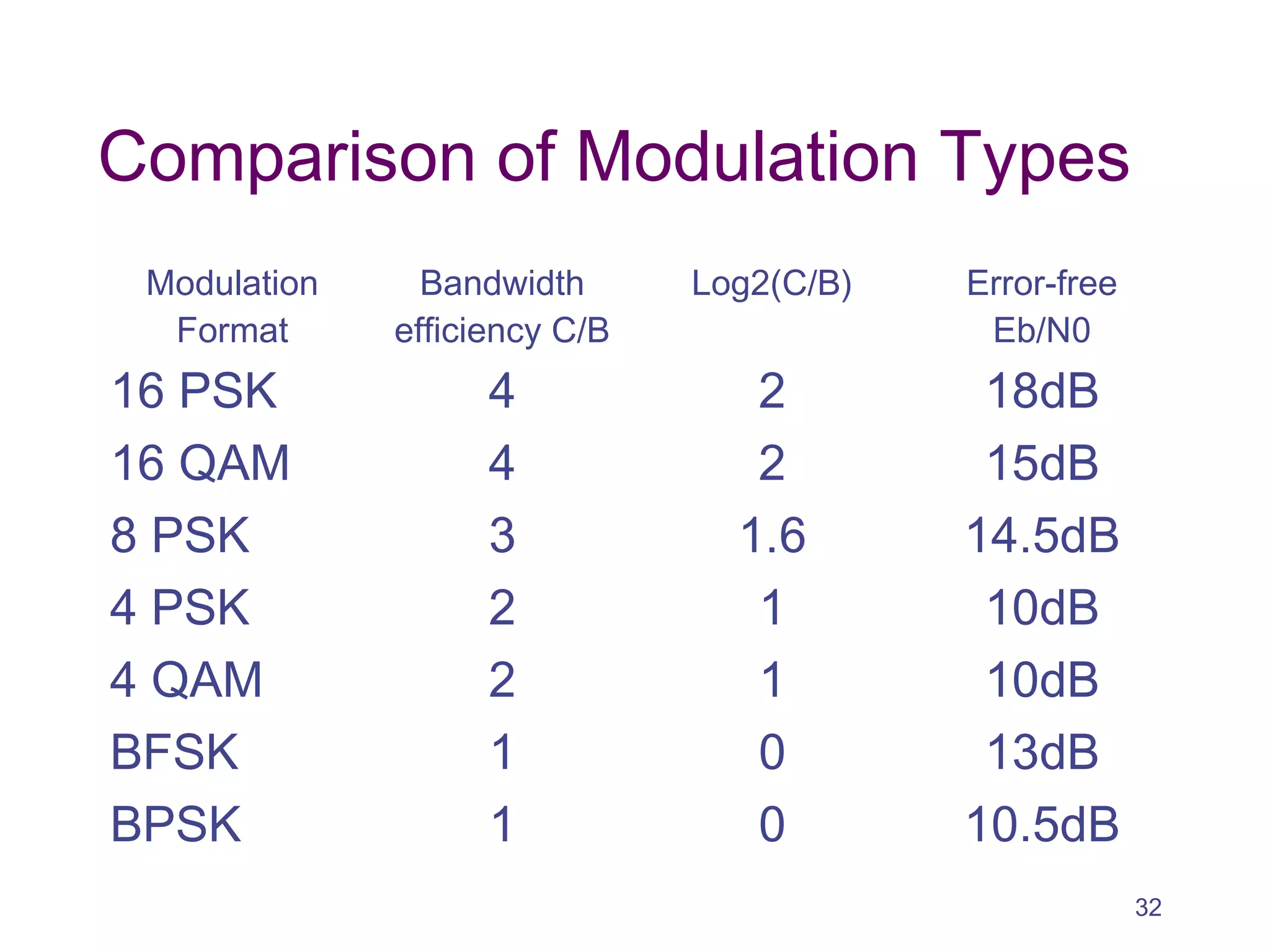
Comparison of Modulation Types
Modulation
Format
Bandwidth
efficiency C/B
Log2(C/B) Error-free
Eb/N0
16 PSK 4 2 18dB
16 QAM 4 2 15dB
8 PSK 3 1.6 14.5dB
4 PSK 2 1 10dB
4 QAM 2 1 10dB
BFSK 1 0 13dB
BPSK 1 0 10.5dB
32
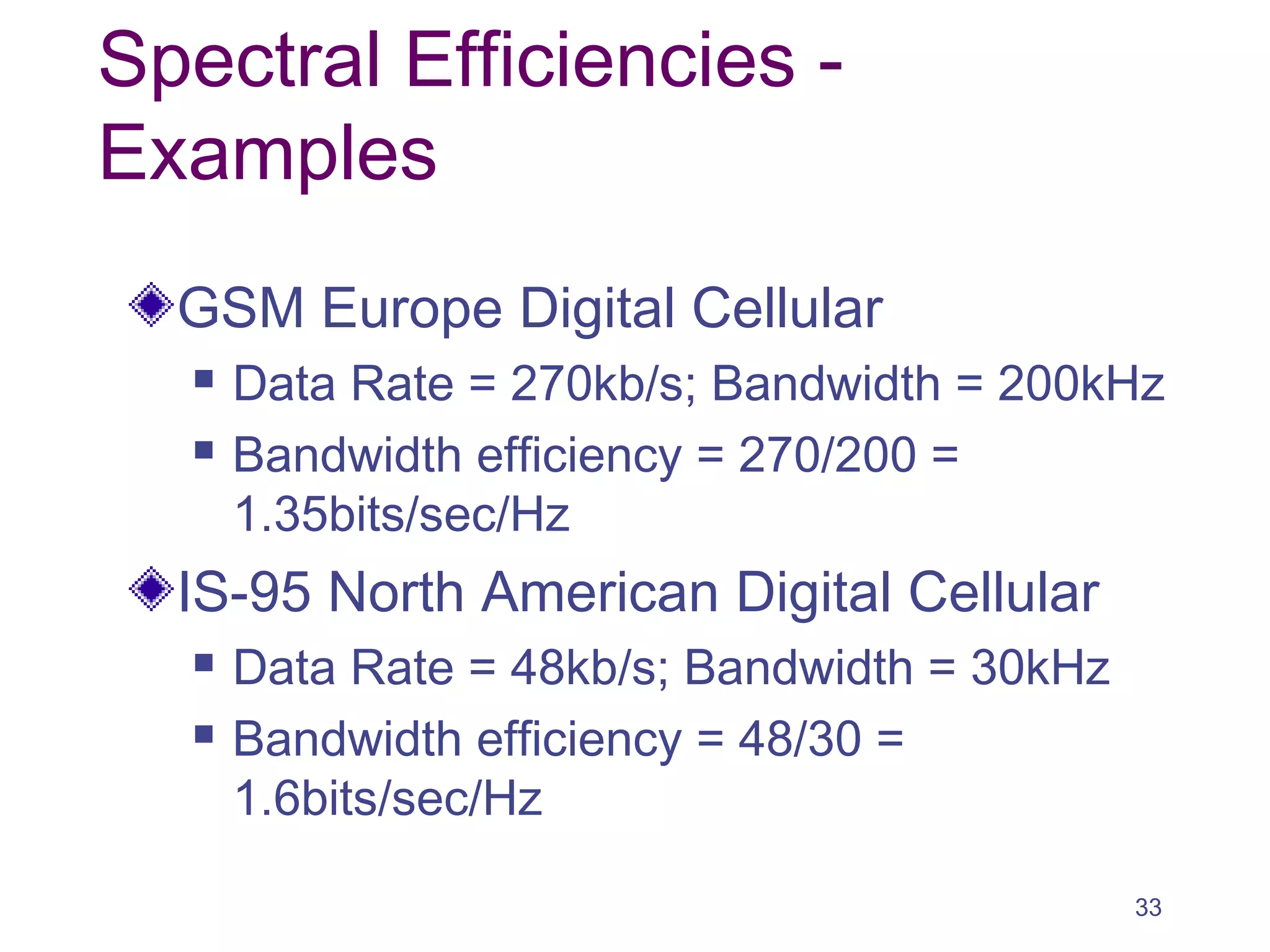
Spectral Efficiencies -
Examples
GSM Europe Digital Cellular
 Data Rate = 270kb/s; Bandwidth = 200kHz
 Bandwidth efficiency = 270/200 =
1.35bits/sec/Hz
IS-95 North American Digital Cellular
 Data Rate = 48kb/s; Bandwidth = 30kHz
 Bandwidth efficiency = 48/30 =
1.6bits/sec/Hz
33
34 of 30
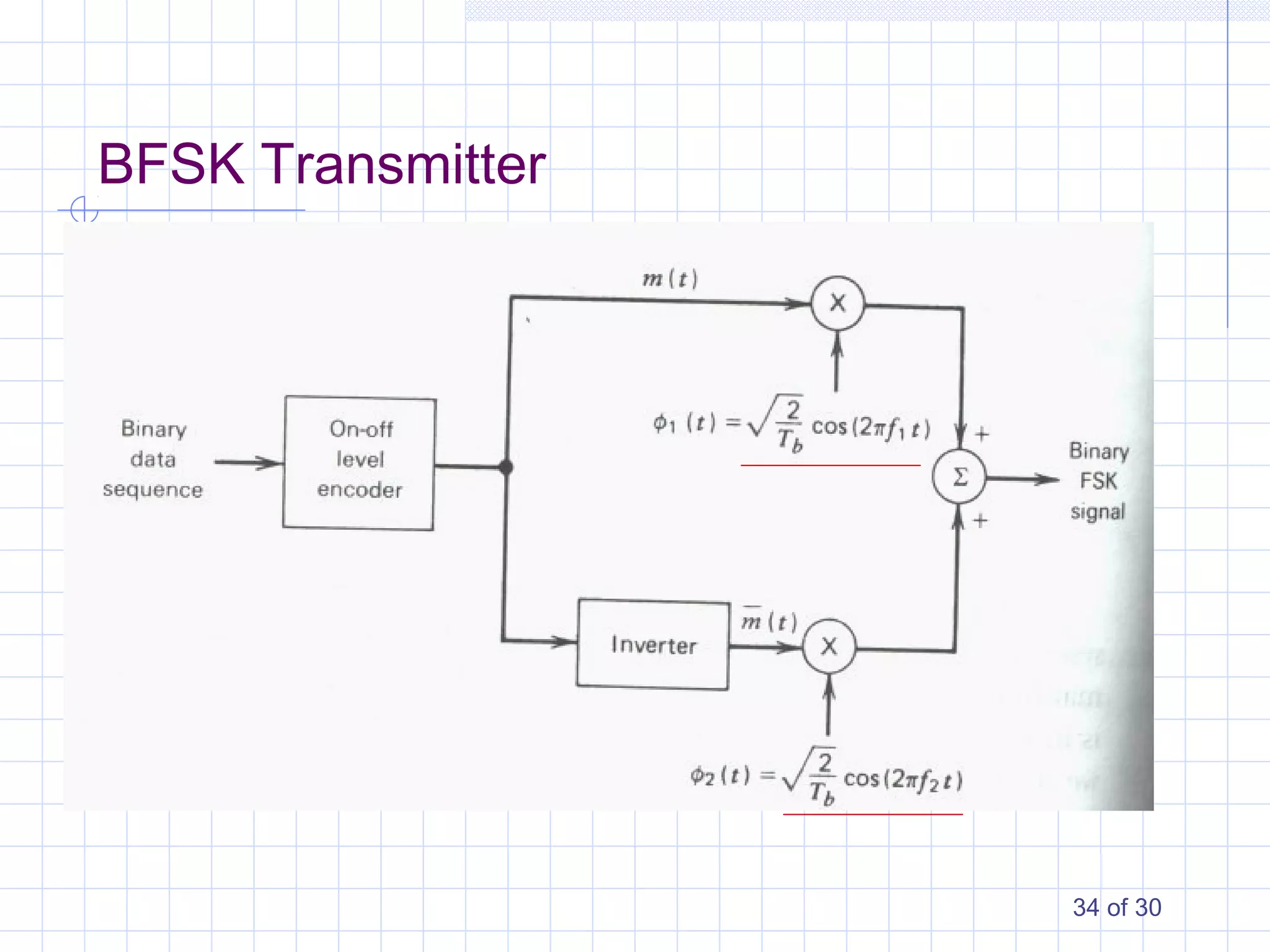
BFSK Transmitter
35 of 30
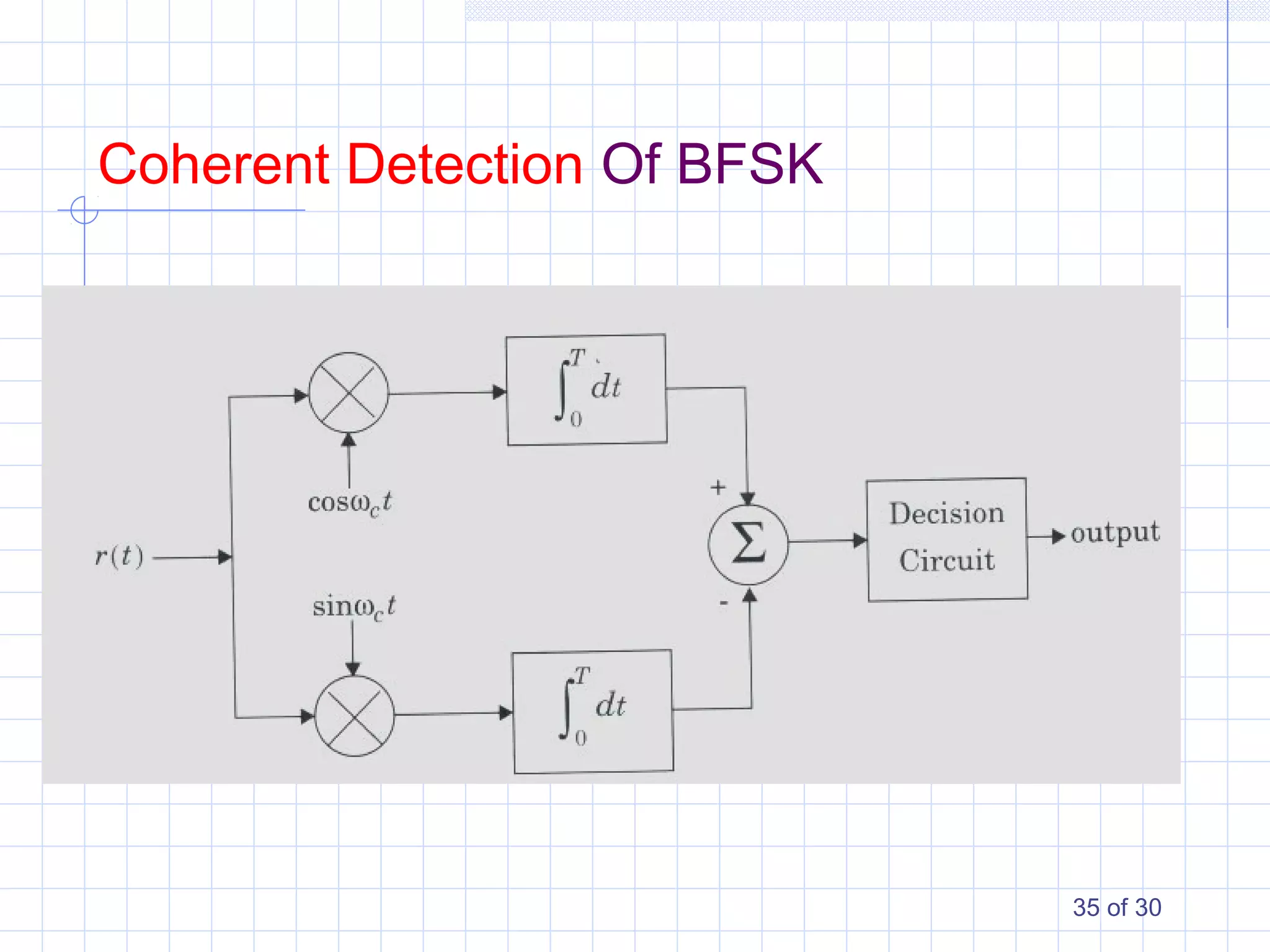
Coherent Detection Of BFSK
36 of 30
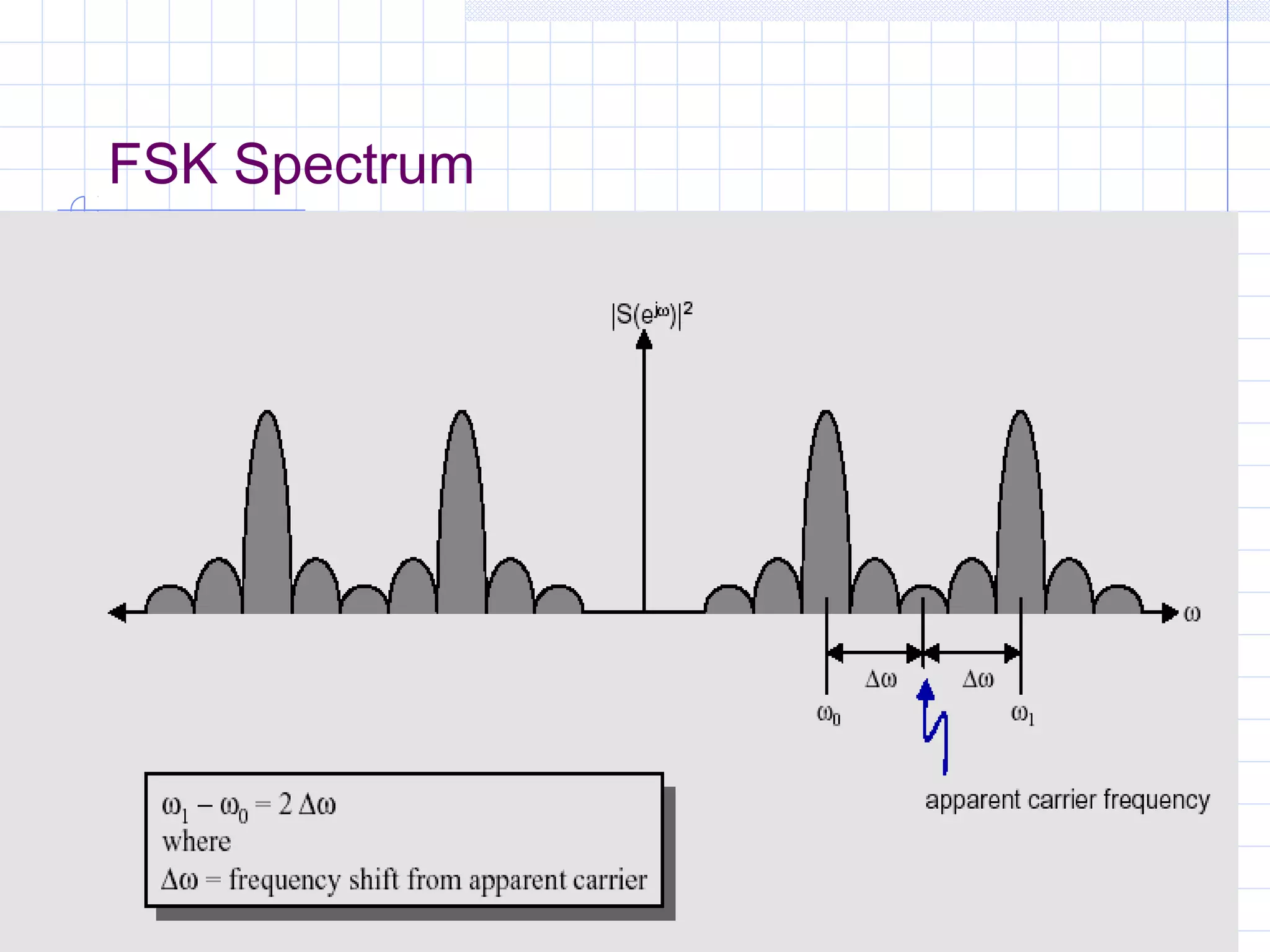
FSK Spectrum
37 of 30
Minimum Shift Keying (MSK)
MSK is a continuous phase-frequency shift keying;
Why MSK?
-- Exploitation of Phase Information besides frequency.
38 of 30
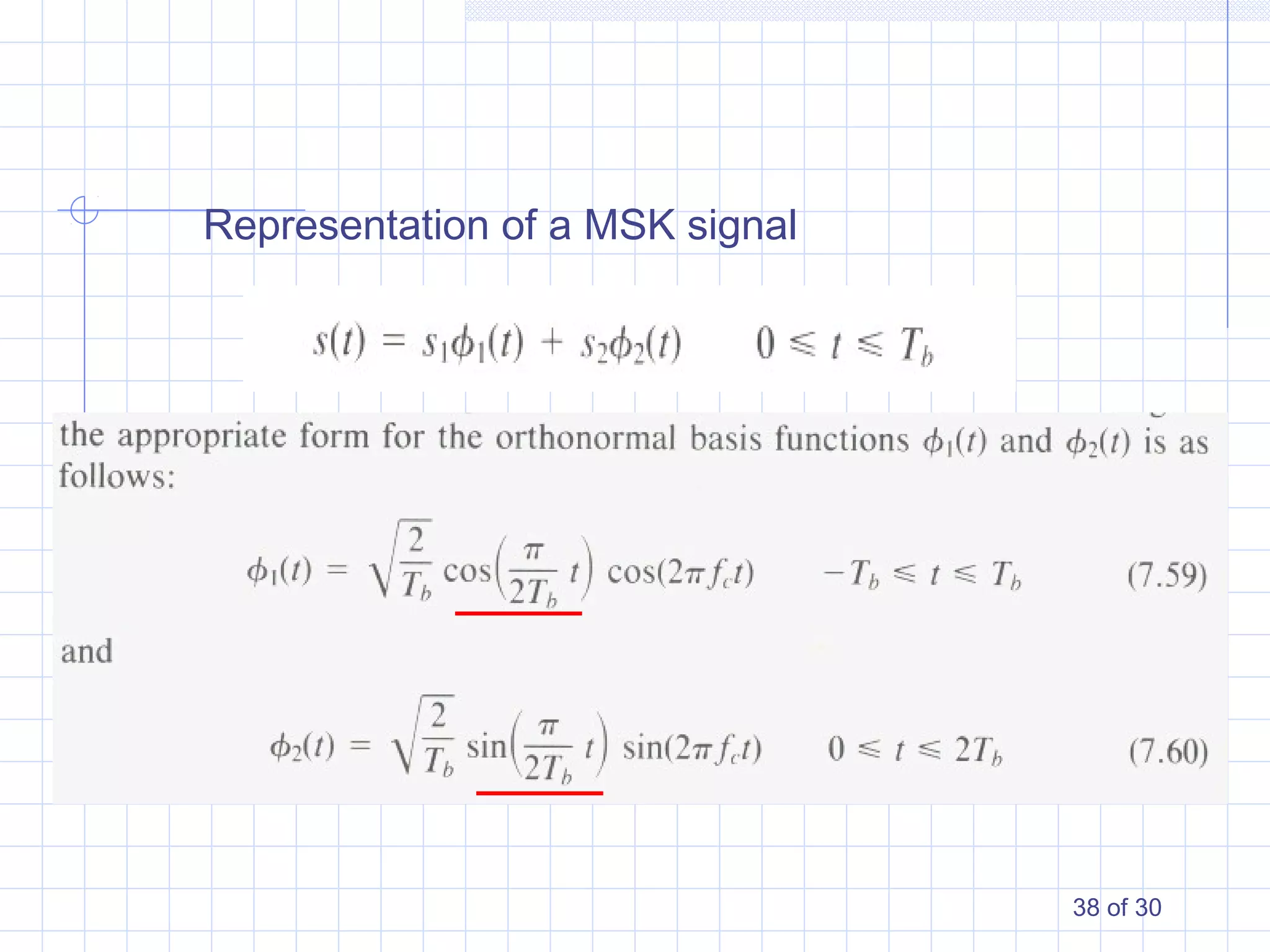
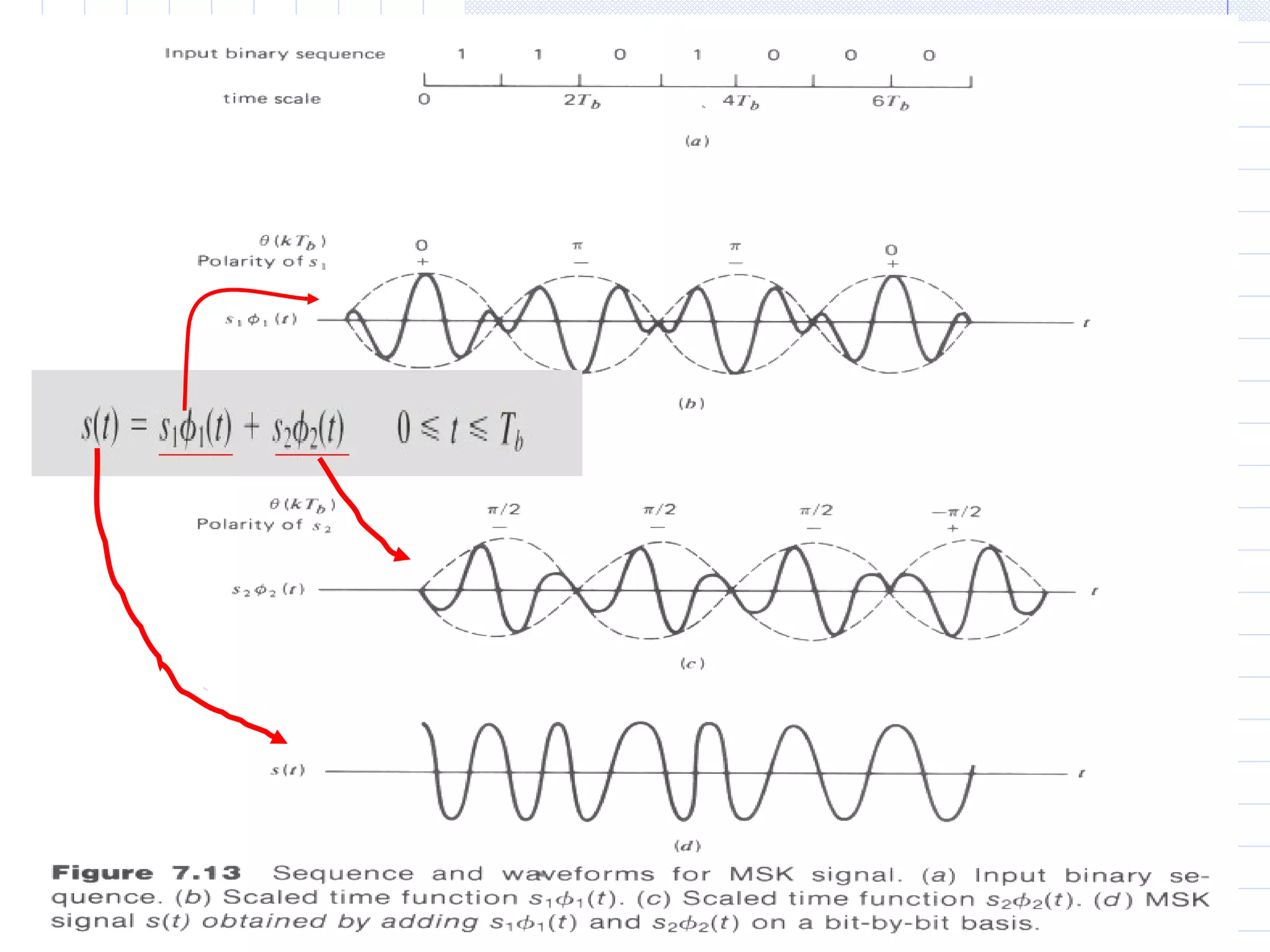
Representation of a MSK signal
39 of 30
40 of 30
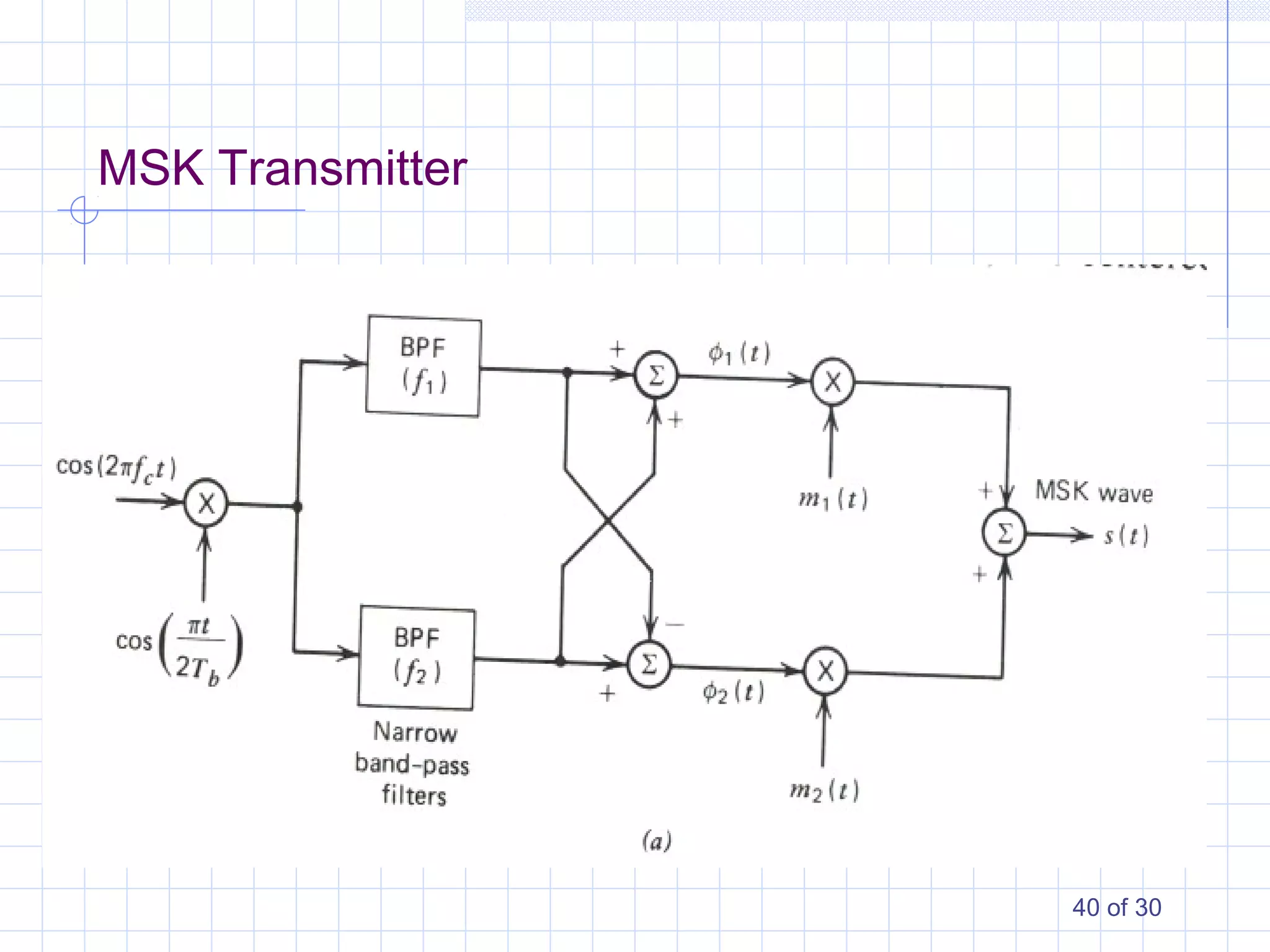
MSK Transmitter
41 of 30
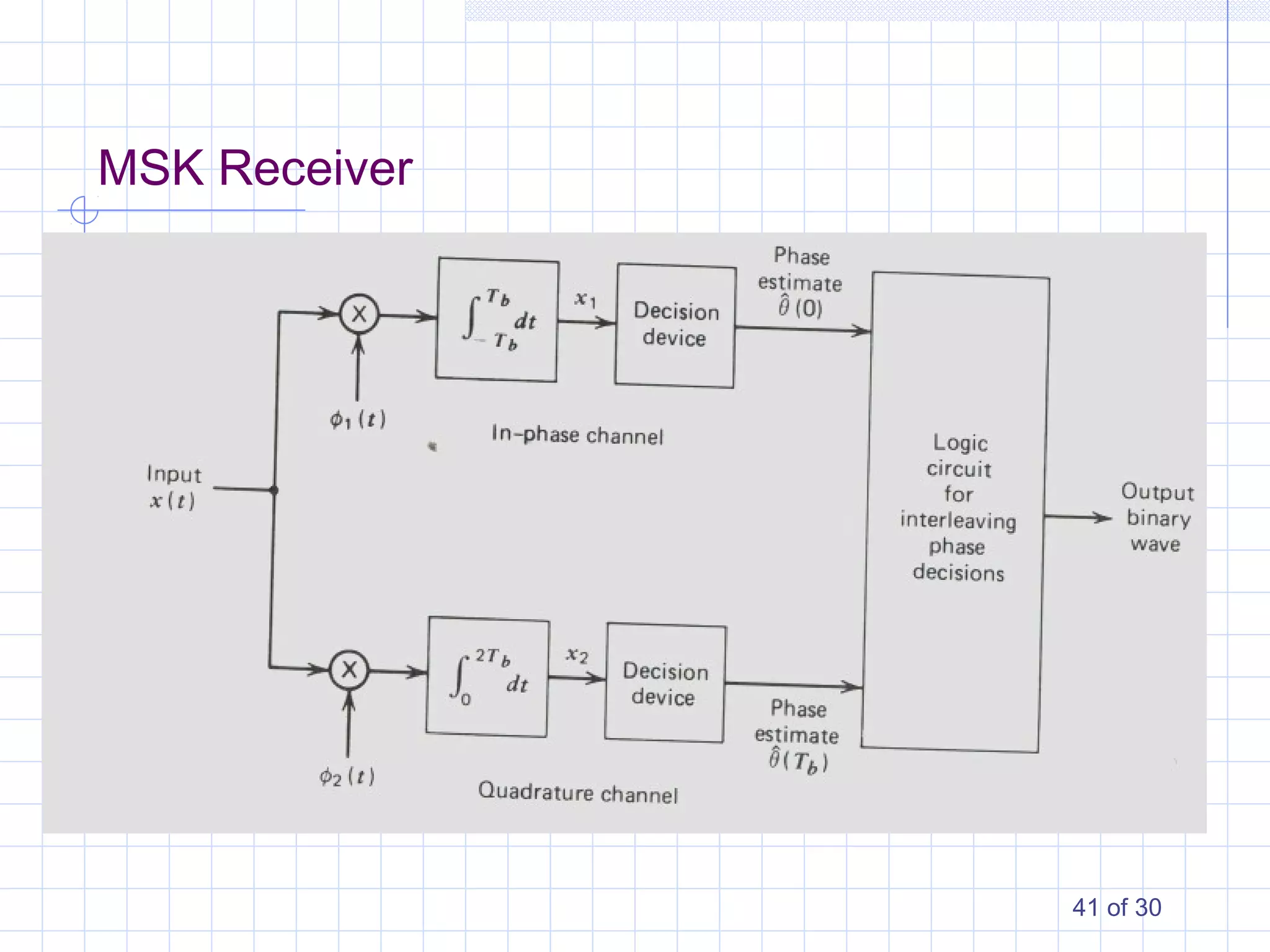
MSK Receiver
42
M-ary
Combined Linear and nonlinear (Constant Envelope)
Modulation Techniques
43
Topics :
What is M-ary modulation?
Various M-ary modulation Techniques:
M-ary Phase Shift Keying (MPSK)
M-ary Quadrature Amplitude Modulation
(QAM)
M-ary Frequency Shift Keying (MFSK)
44
Definition:
In this modulation Technique the digital data is sent by
varying both the envelope and phase(or frequency) of an
RF carrier.
These modulation techniques map base band data into four
or more possible RF carrier signals. Hence, these
modulation techniques are called M-ary modulation.
45
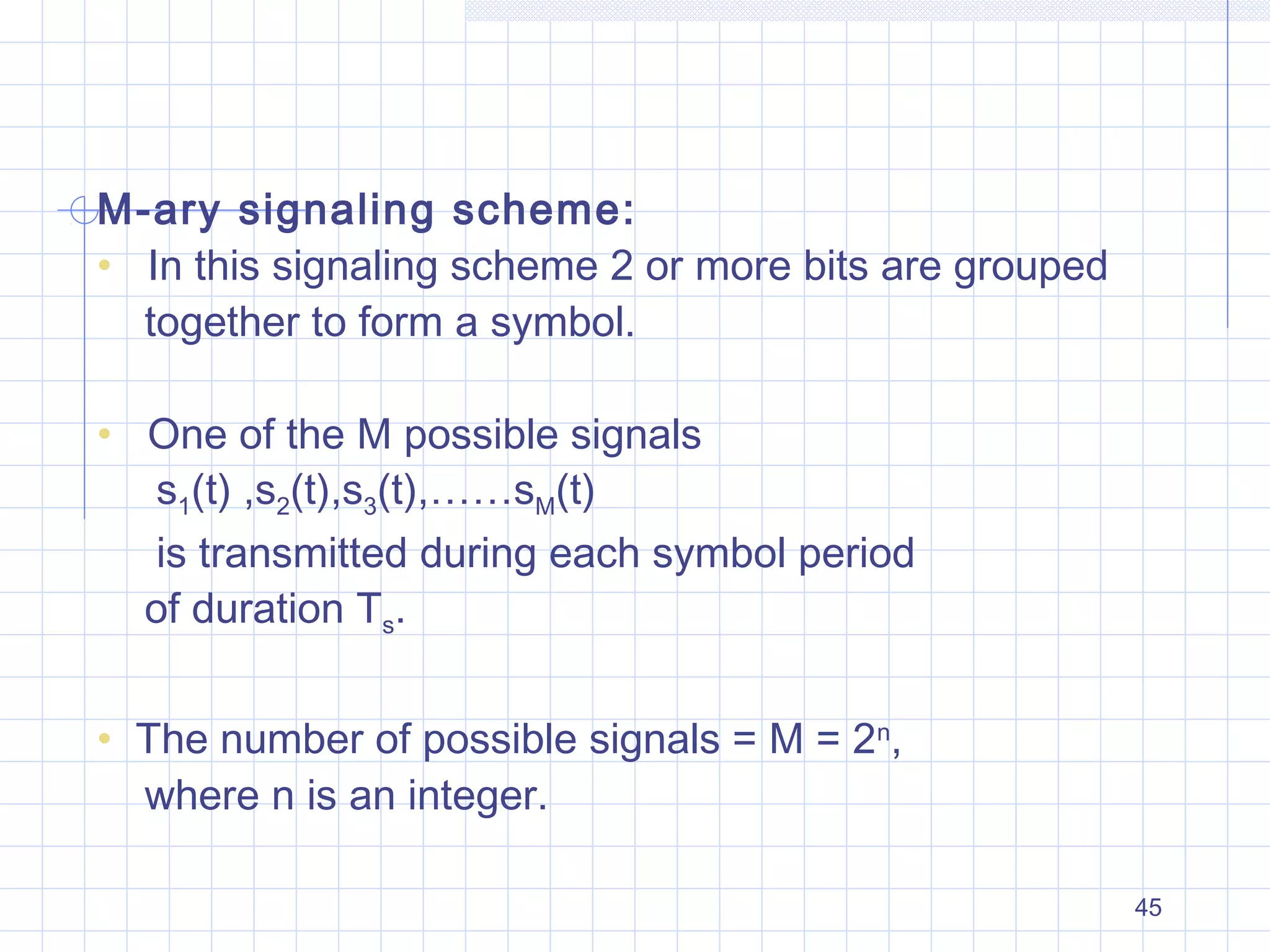
M-ary signaling scheme:
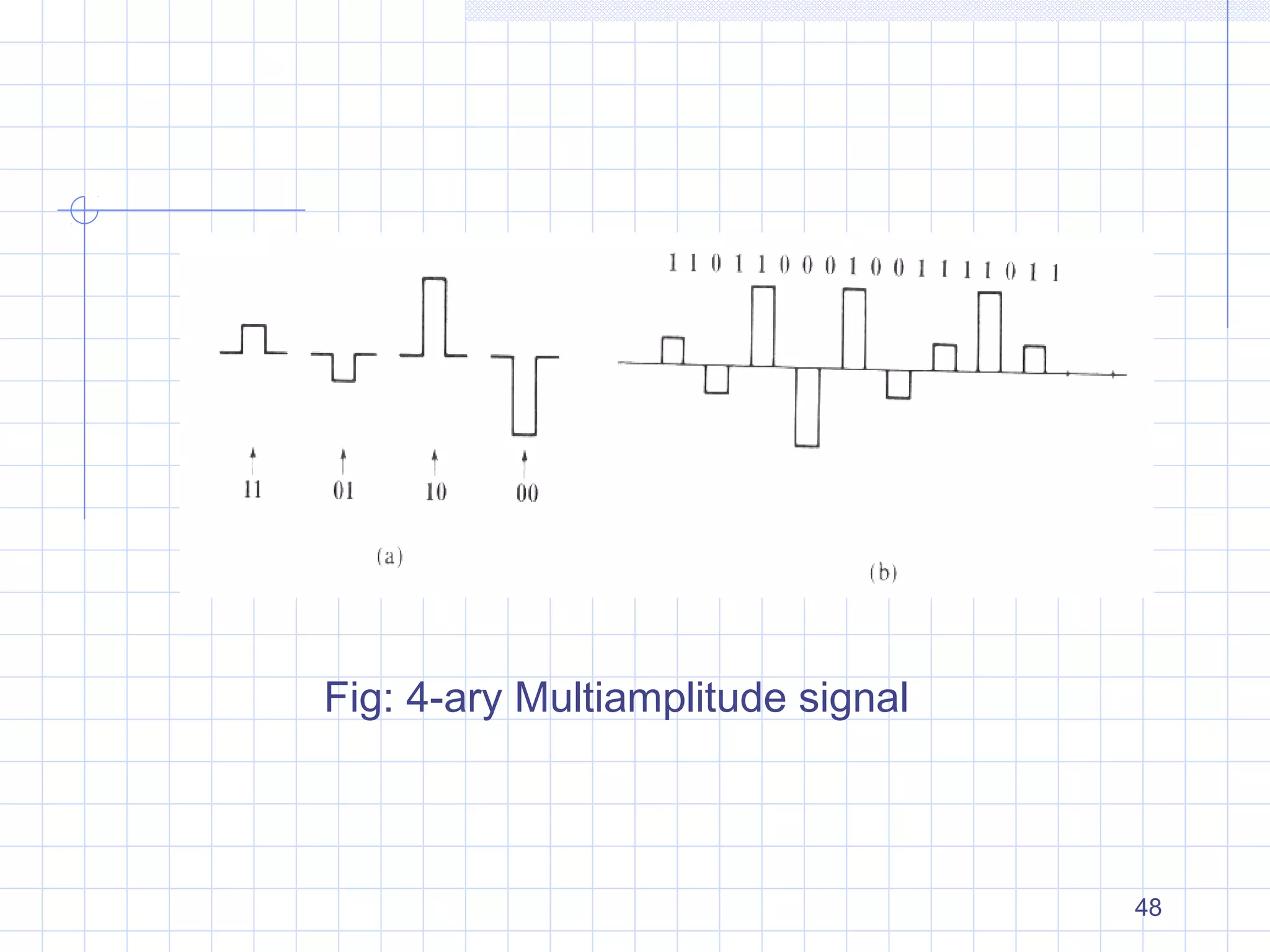
• In this signaling scheme 2 or more bits are grouped
together to form a symbol.
• One of the M possible signals
s1(t) ,s2(t),s3(t),……sM(t)
is transmitted during each symbol period
of duration Ts.
• The number of possible signals = M = 2n
,
where n is an integer.
46
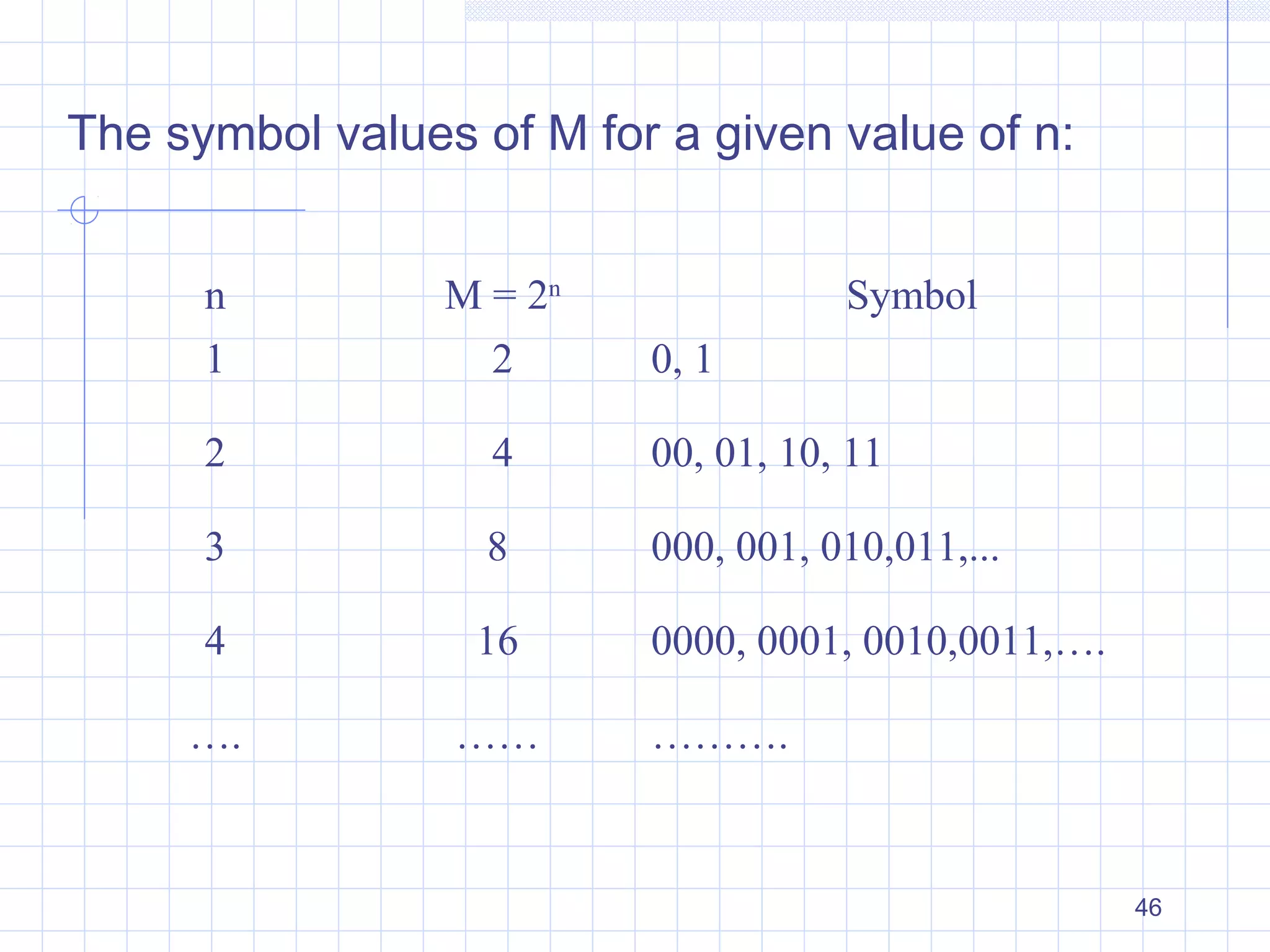
n M = 2n
Symbol
1 2 0, 1
2 4 00, 01, 10, 11
3 8 000, 001, 010,011,...
4 16 0000, 0001, 0010,0011,….
…. …… ……….
The symbol values of M for a given value of n:
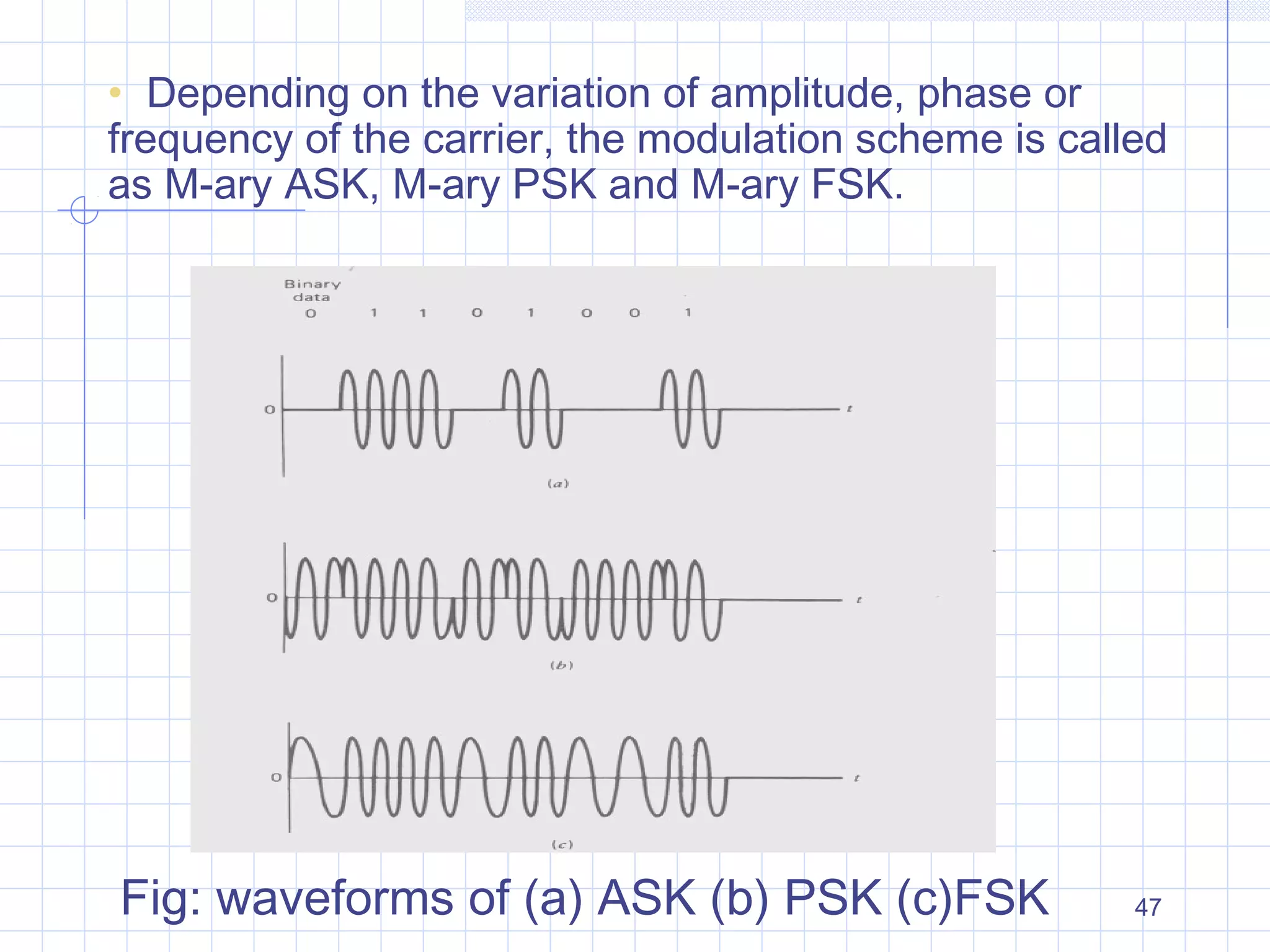
47Fig: waveforms of (a) ASK (b) PSK (c)FSK
• Depending on the variation of amplitude, phase or
frequency of the carrier, the modulation scheme is called
as M-ary ASK, M-ary PSK and M-ary FSK.
48
Fig: 4-ary Multiamplitude signal
49
M-ary Phase Shift Keying(MPSK)
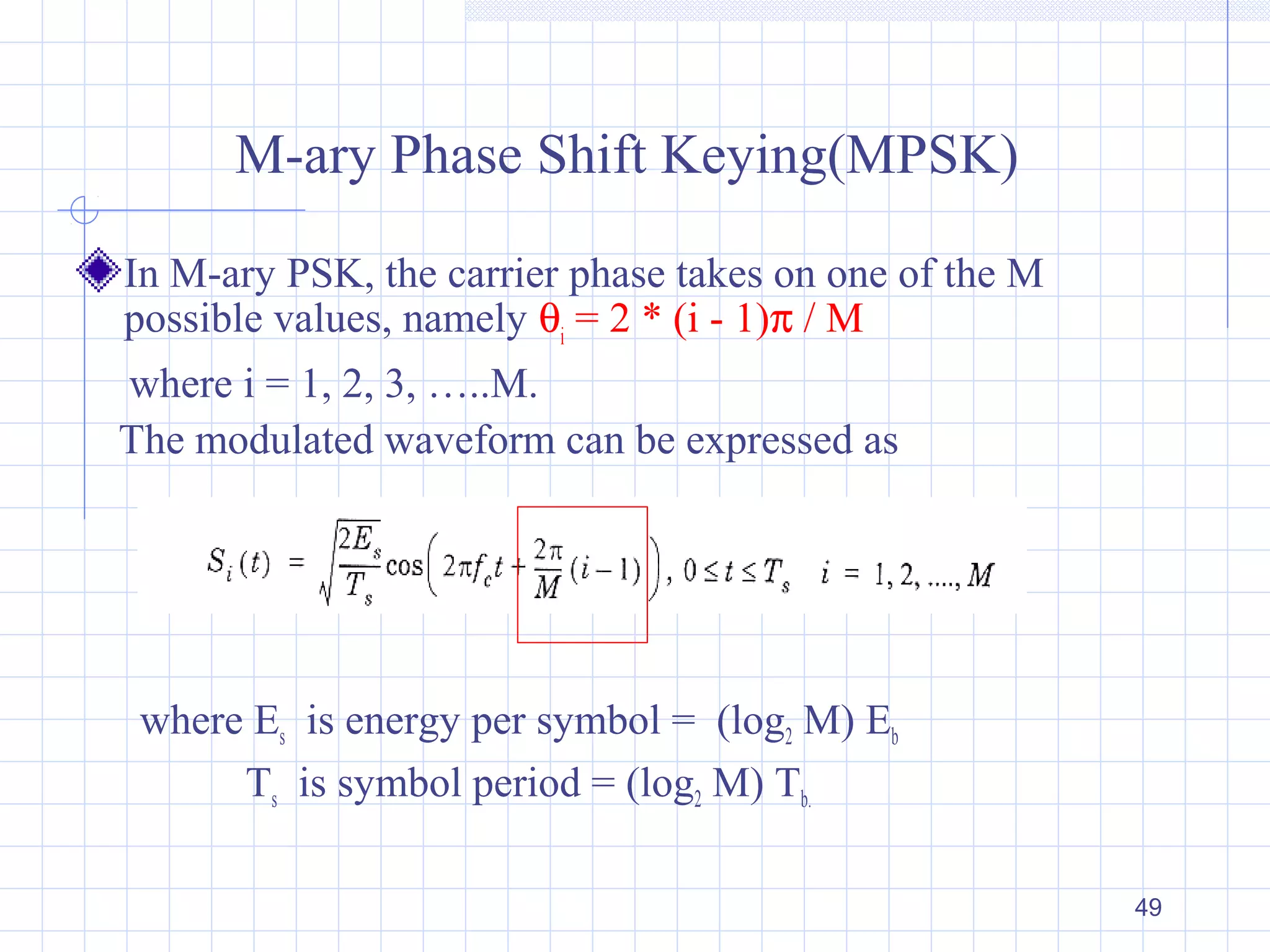
In M-ary PSK, the carrier phase takes on one of the M
possible values, namely θi
= 2 * (i - 1)π / M
where i = 1, 2, 3, …..M.
The modulated waveform can be expressed as
where Es is energy per symbol = (log2 M) Eb
Ts is symbol period = (log2 M) Tb.
50
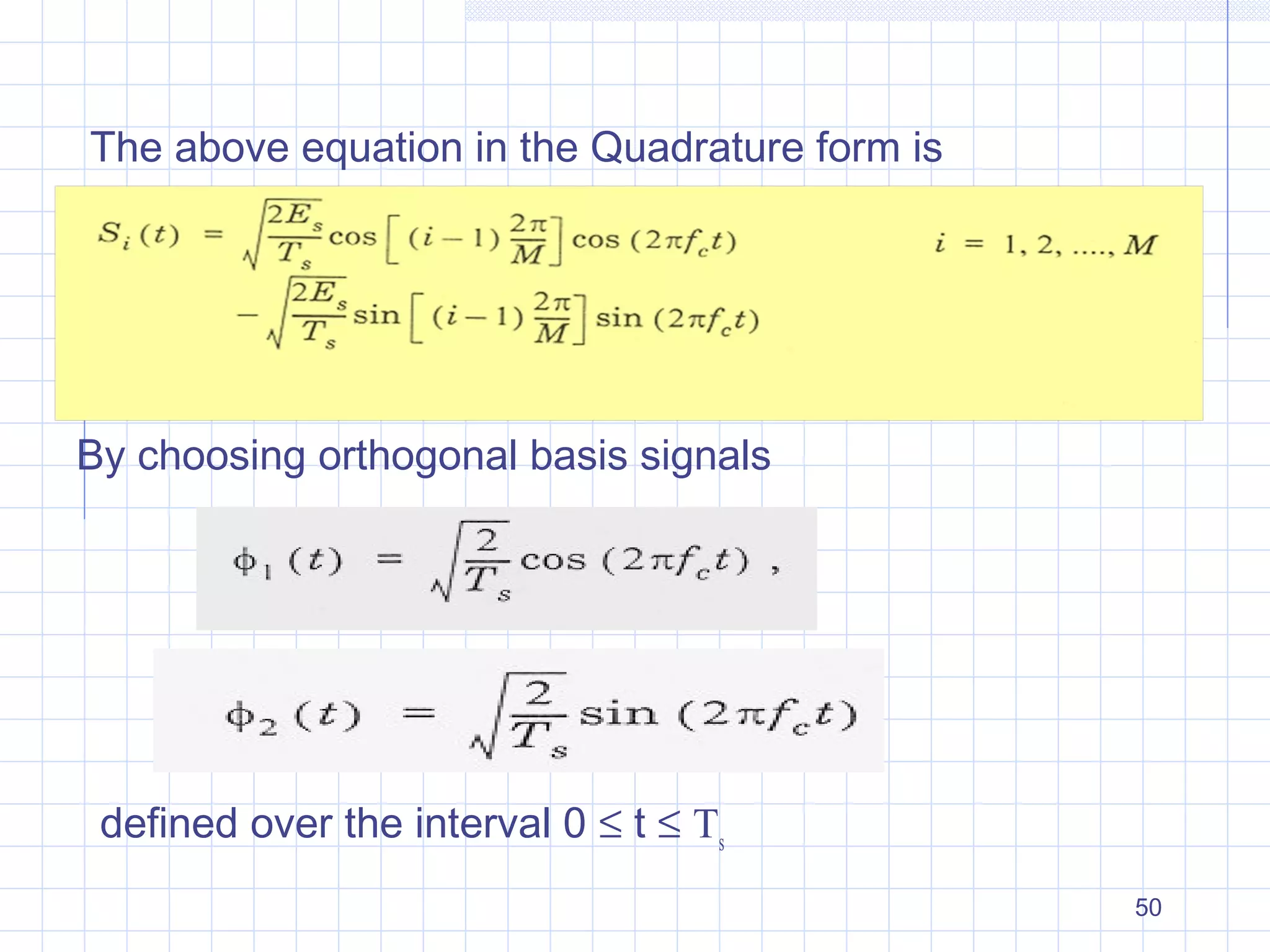
The above equation in the Quadrature form is
By choosing orthogonal basis signals
defined over the interval 0 ≤ t ≤ Ts
51
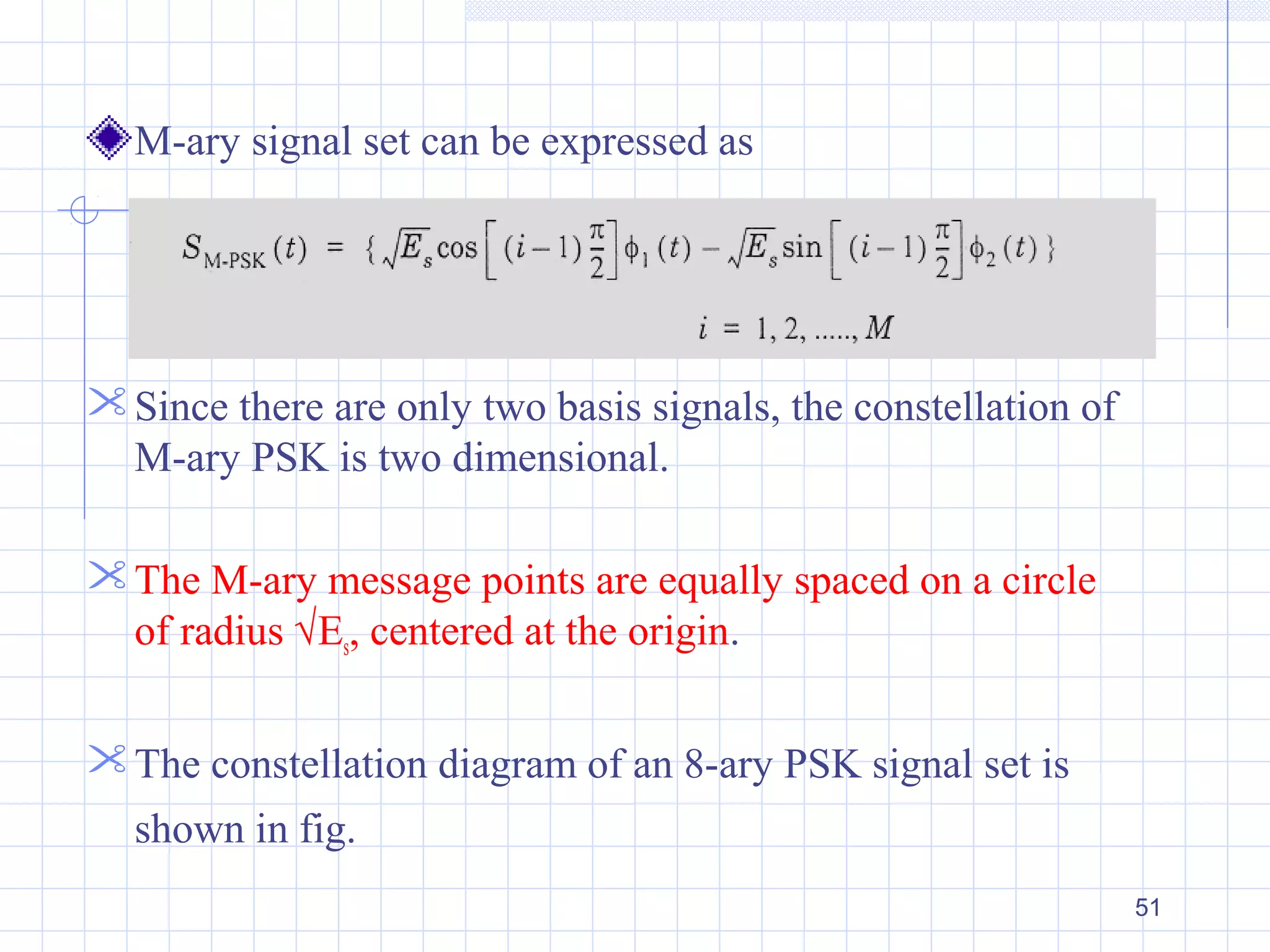
M-ary signal set can be expressed as
Since there are only two basis signals, the constellation of
M-ary PSK is two dimensional.
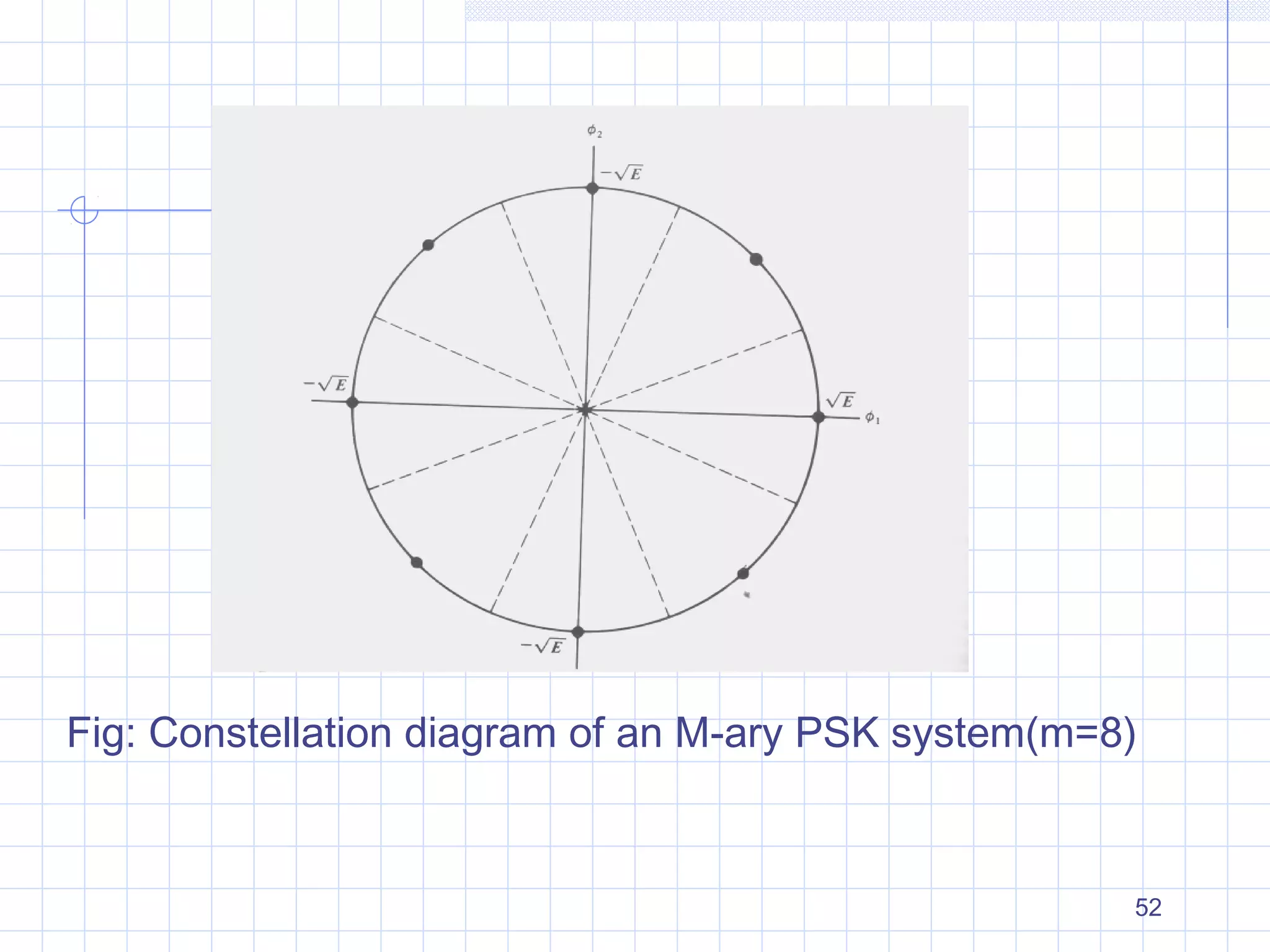
The M-ary message points are equally spaced on a circle
of radius √Es, centered at the origin.
The constellation diagram of an 8-ary PSK signal set is
shown in fig.
52
Fig: Constellation diagram of an M-ary PSK system(m=8)
53
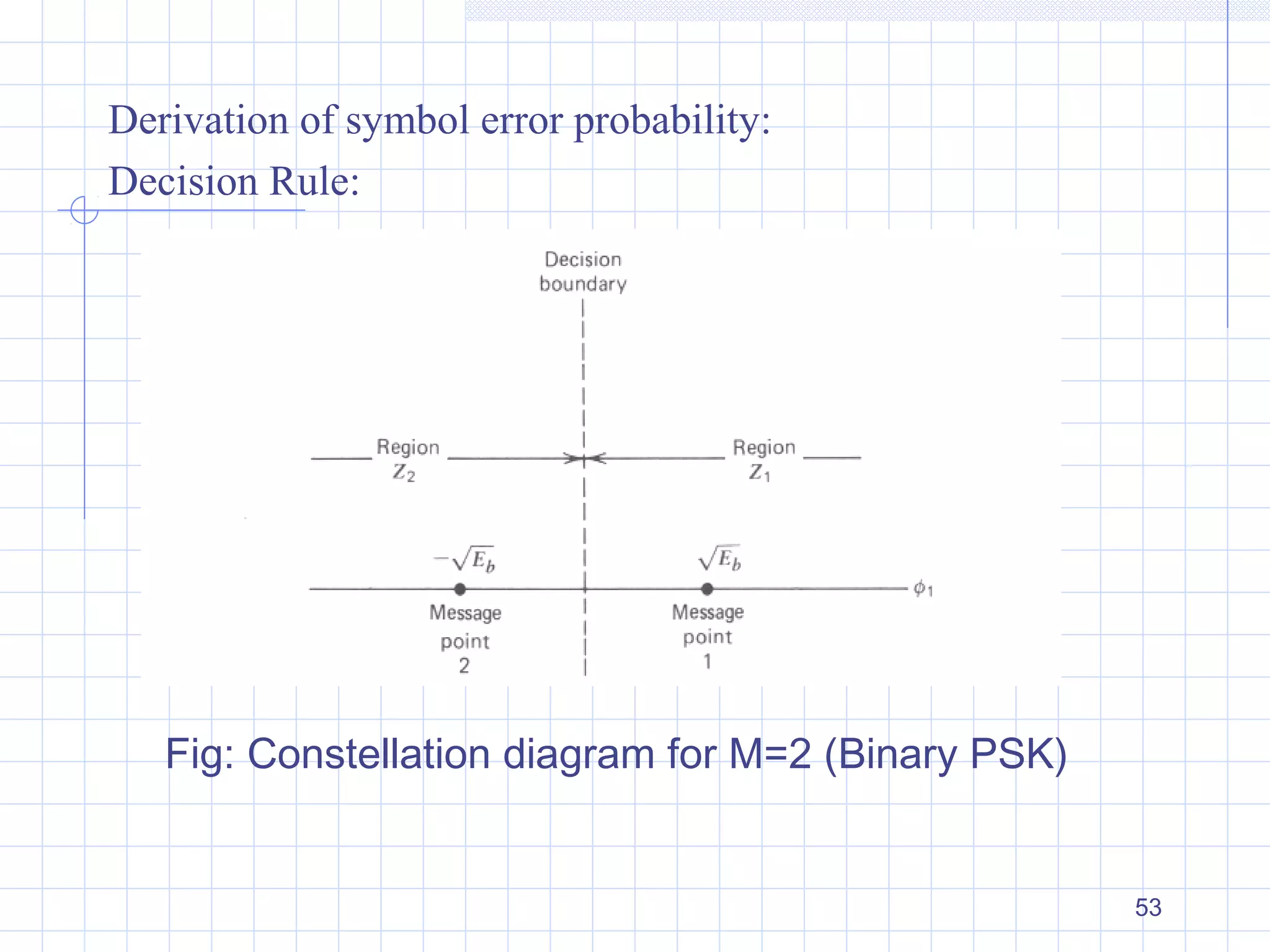
Derivation of symbol error probability:
Decision Rule:
Fig: Constellation diagram for M=2 (Binary PSK)
54
If a symbol (0,0,0) is transmitted, it is clear
that if an error occurs, the transmitted signal is most
likely to be mistaken for (0,0,1) and (1,1,1) and the
signal being mistaken for (1,1,0) is remote.
The decision pertaining to (0,0,0) is bounded by θ = -
π/8(below φ1(t)- axis) to θ = + π/8 ( above φ2(t)- axis)
The probability of correct reception is…
55
Fig: Probability density function of Phase θ.
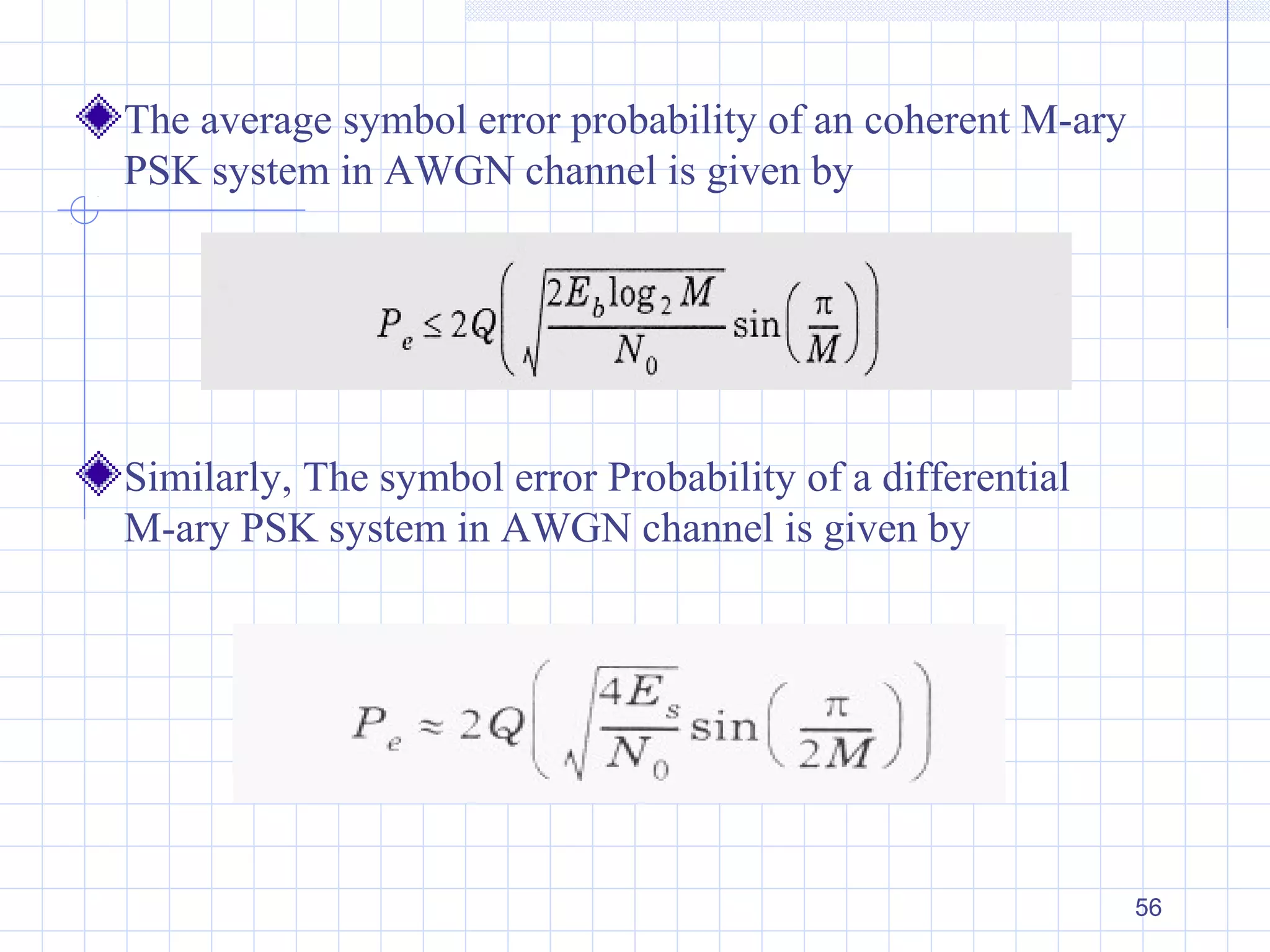
56
The average symbol error probability of an coherent M-ary
PSK system in AWGN channel is given by
Similarly, The symbol error Probability of a differential
M-ary PSK system in AWGN channel is given by
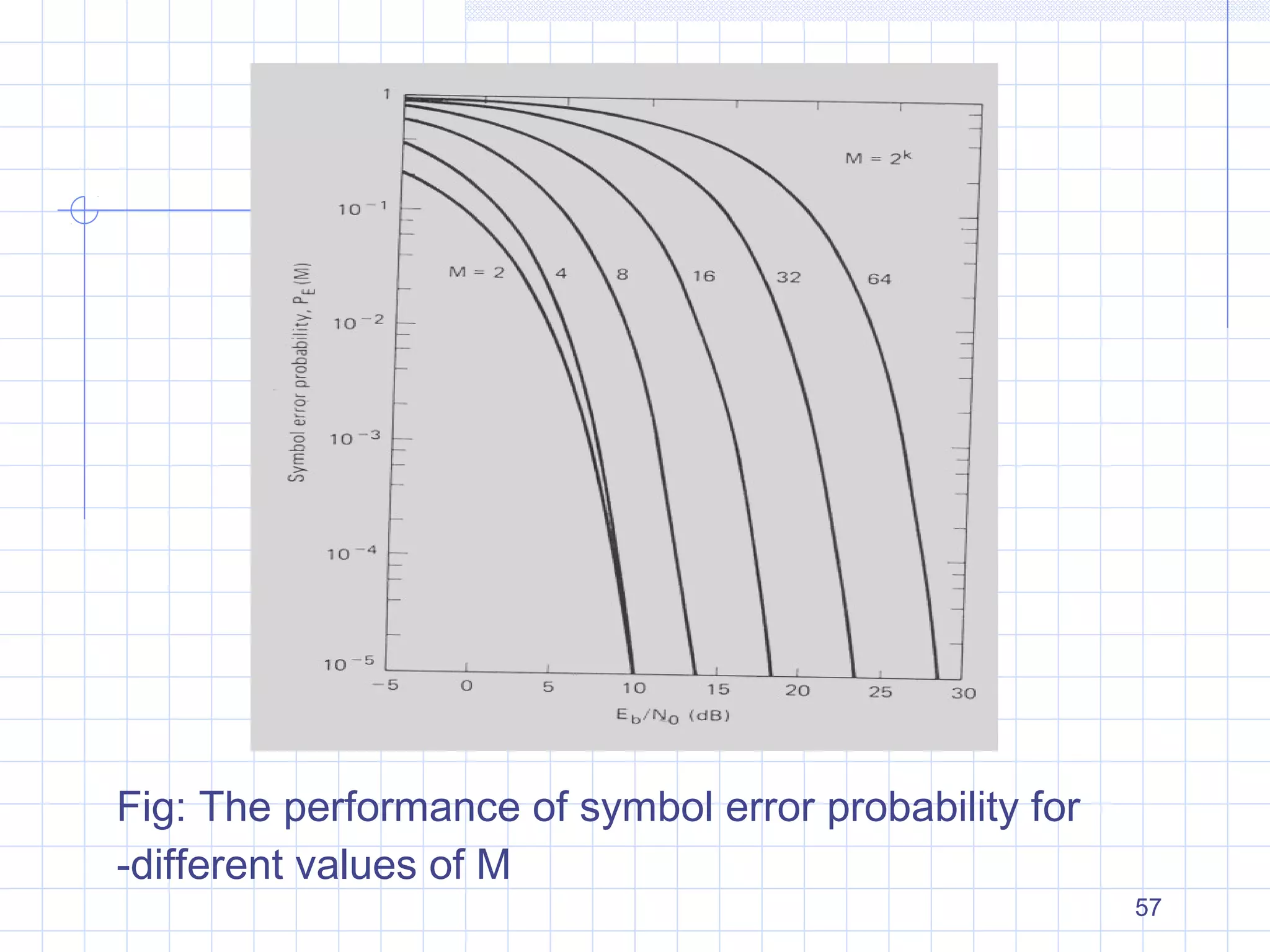
57
Fig: The performance of symbol error probability for
-different values of M
58
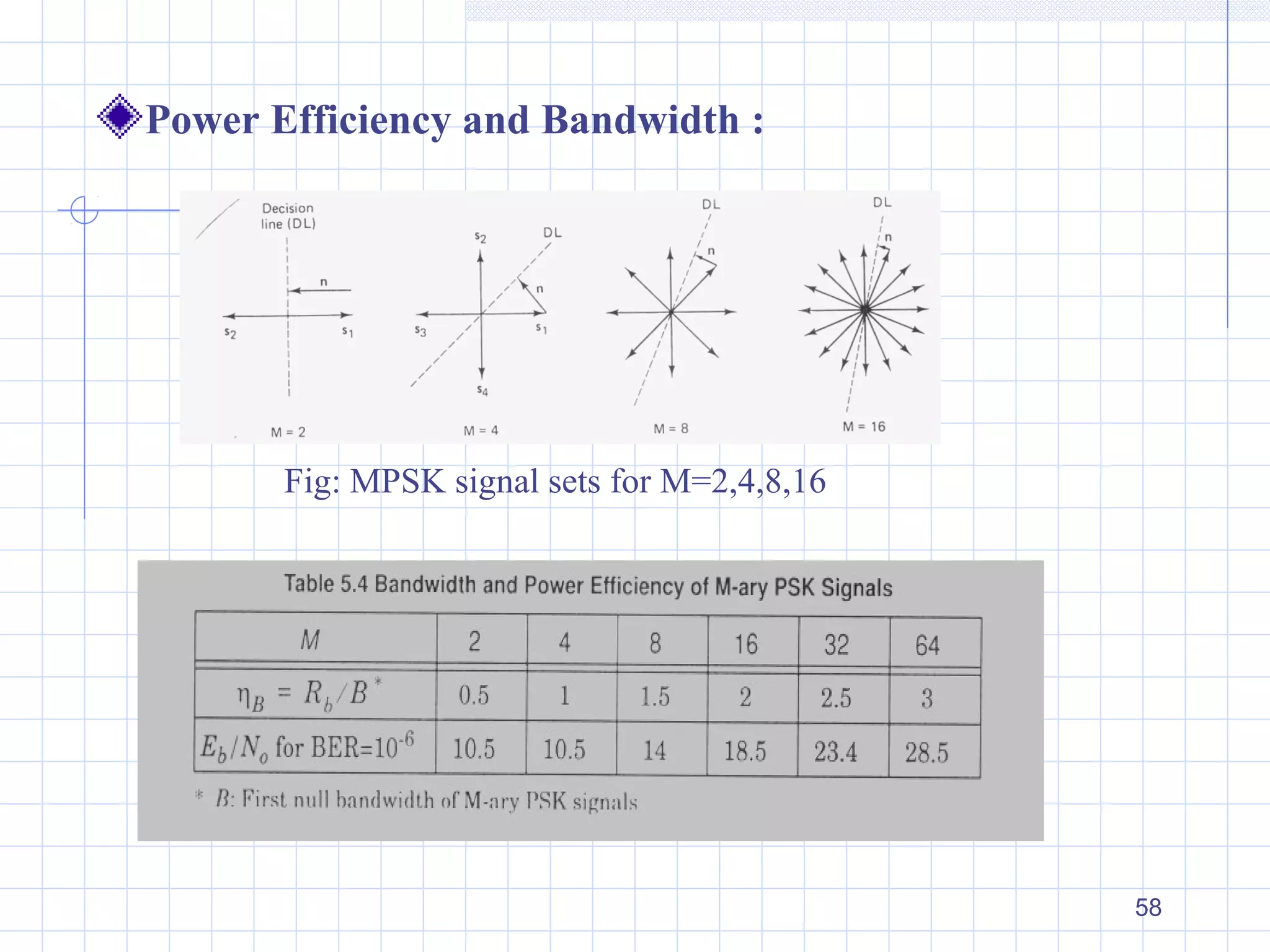
Power Efficiency and Bandwidth :
Fig: MPSK signal sets for M=2,4,8,16
59
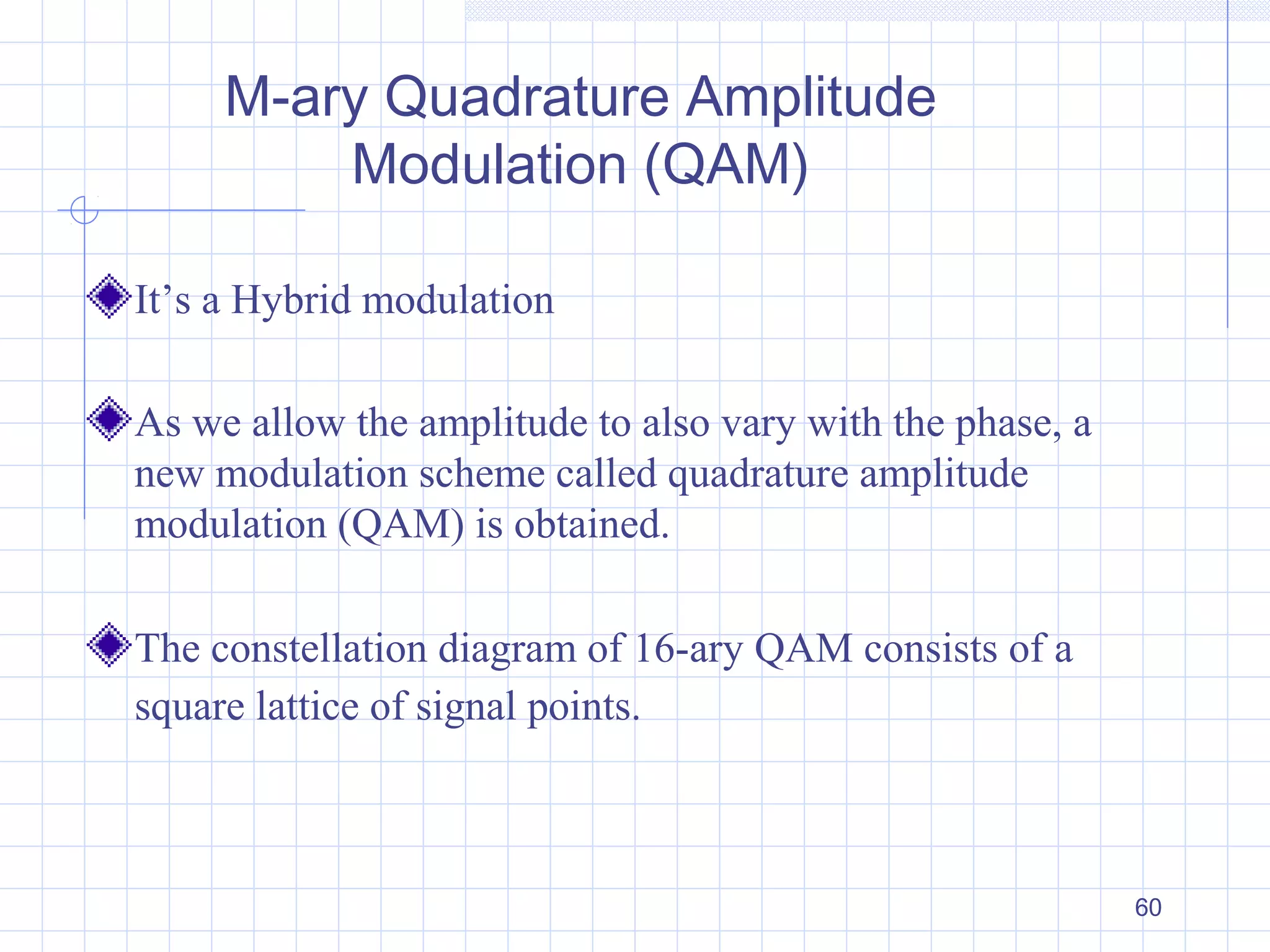
Power efficiency:
Increasing M implies that the constellation is more densely
packed, and hence the power efficiency (noise tolerance) is
increased.
Bandwidth Efficiency:
The first null bandwidth of M-ary PSK signals decrease as
M increases while Rb is held constant.
Therefore, as the value of M increases, the bandwidth
efficiency also increases.
60
M-ary Quadrature Amplitude
Modulation (QAM)
It’s a Hybrid modulation
As we allow the amplitude to also vary with the phase, a
new modulation scheme called quadrature amplitude
modulation (QAM) is obtained.
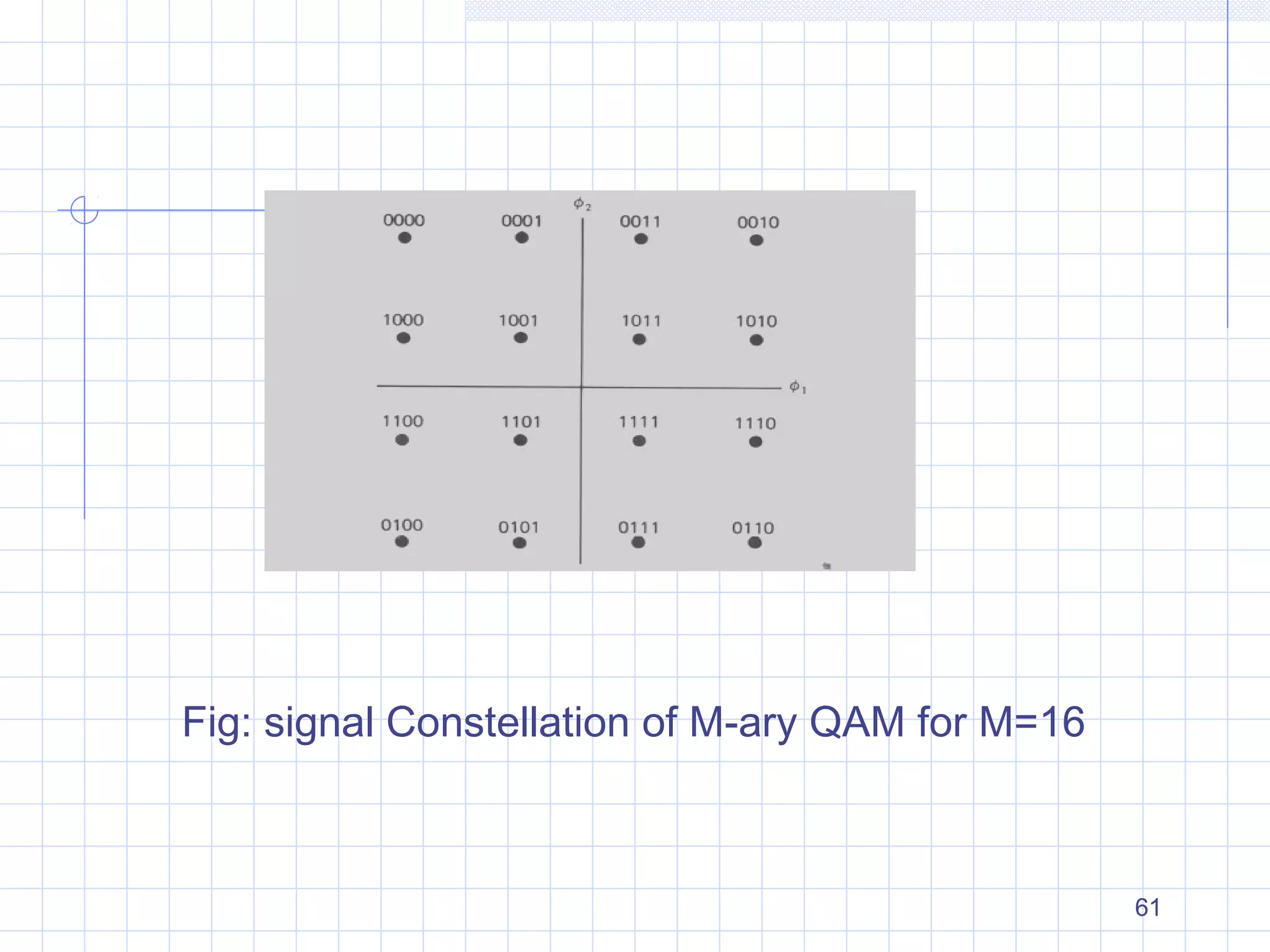
The constellation diagram of 16-ary QAM consists of a
square lattice of signal points.
61
Fig: signal Constellation of M-ary QAM for M=16
62
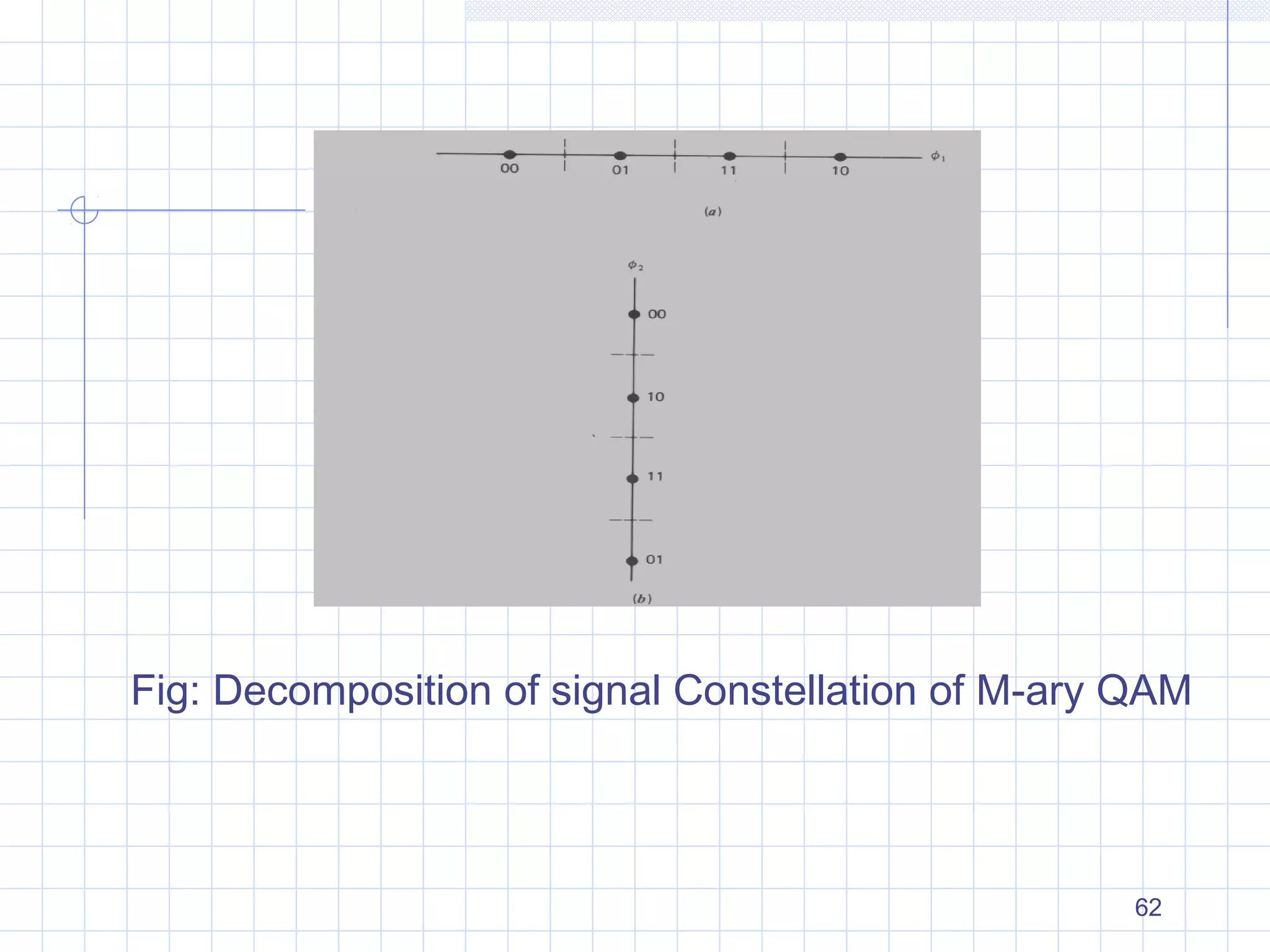
Fig: Decomposition of signal Constellation of M-ary QAM
63
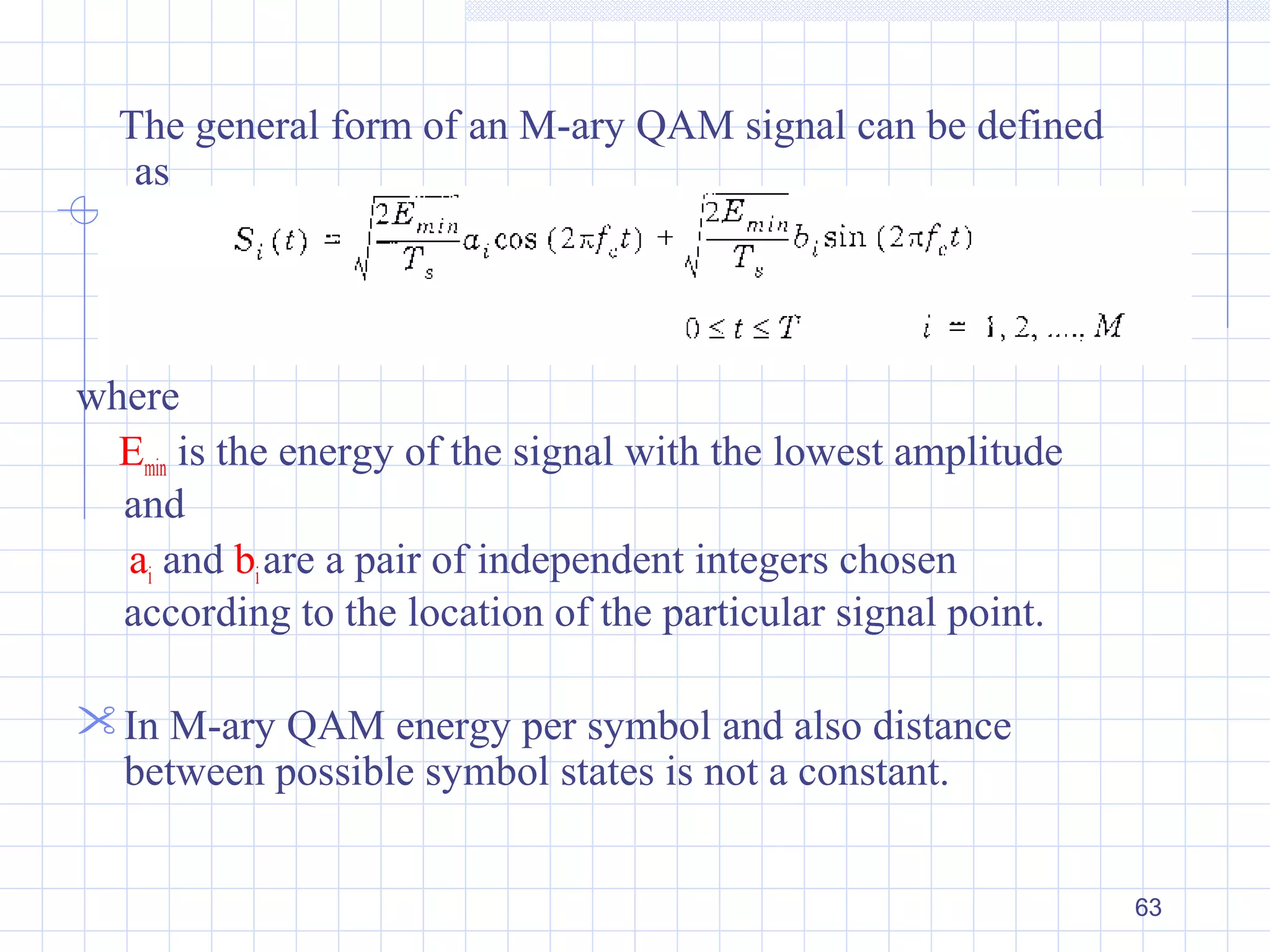
The general form of an M-ary QAM signal can be defined
as
where
Emin is the energy of the signal with the lowest amplitude
and
ai and biare a pair of independent integers chosen
according to the location of the particular signal point.
In M-ary QAM energy per symbol and also distance
between possible symbol states is not a constant.
64
It reasons that particular values of Si (t) will be detected with higher
probability than others.
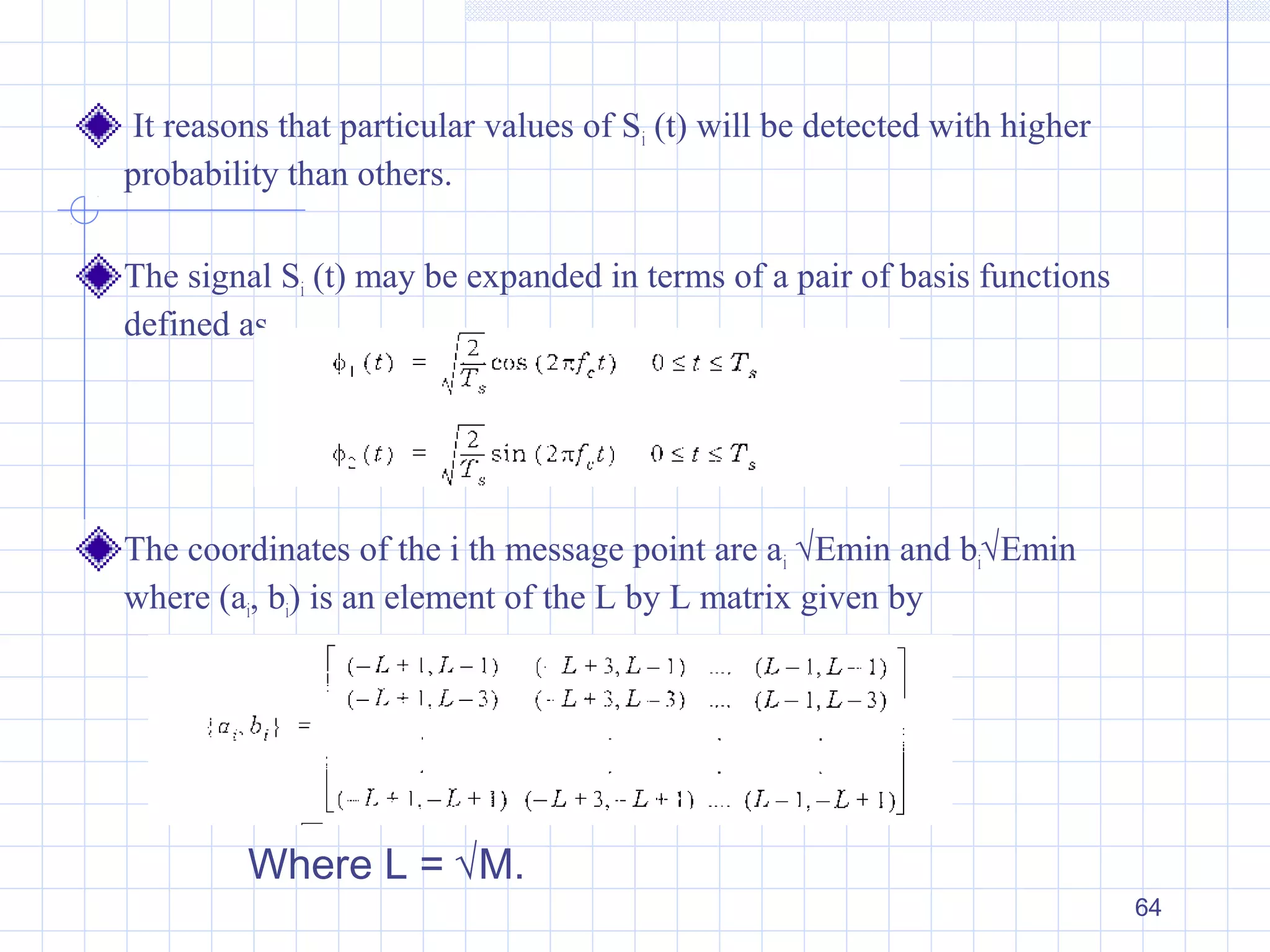
The signal Si (t) may be expanded in terms of a pair of basis functions
defined as
The coordinates of the i th message point are ai √Emin and bi√Emin
where (ai, bi) is an element of the L by L matrix given by
Where L = √M.
65
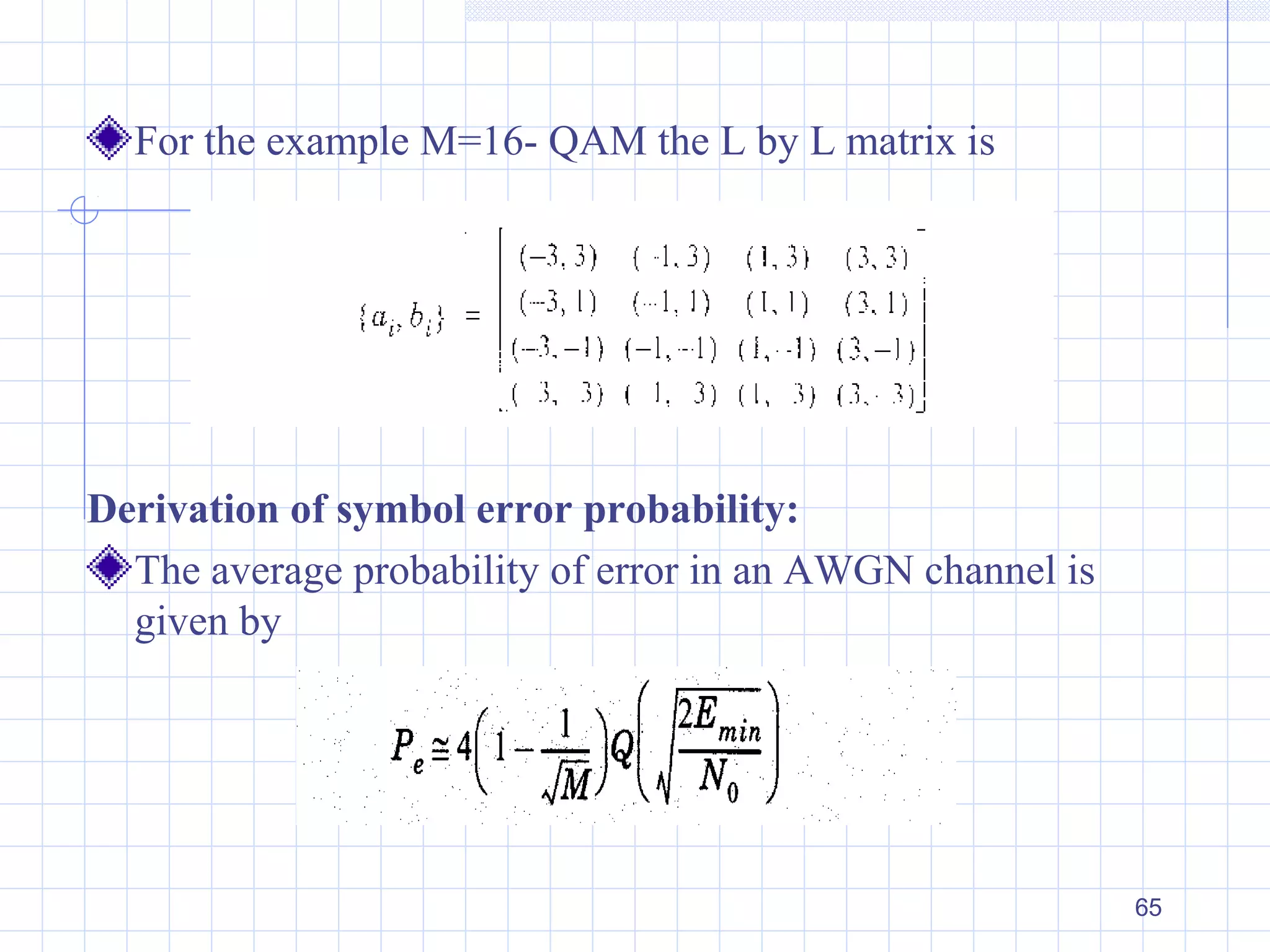
For the example M=16- QAM the L by L matrix is
Derivation of symbol error probability:
The average probability of error in an AWGN channel is
given by
66
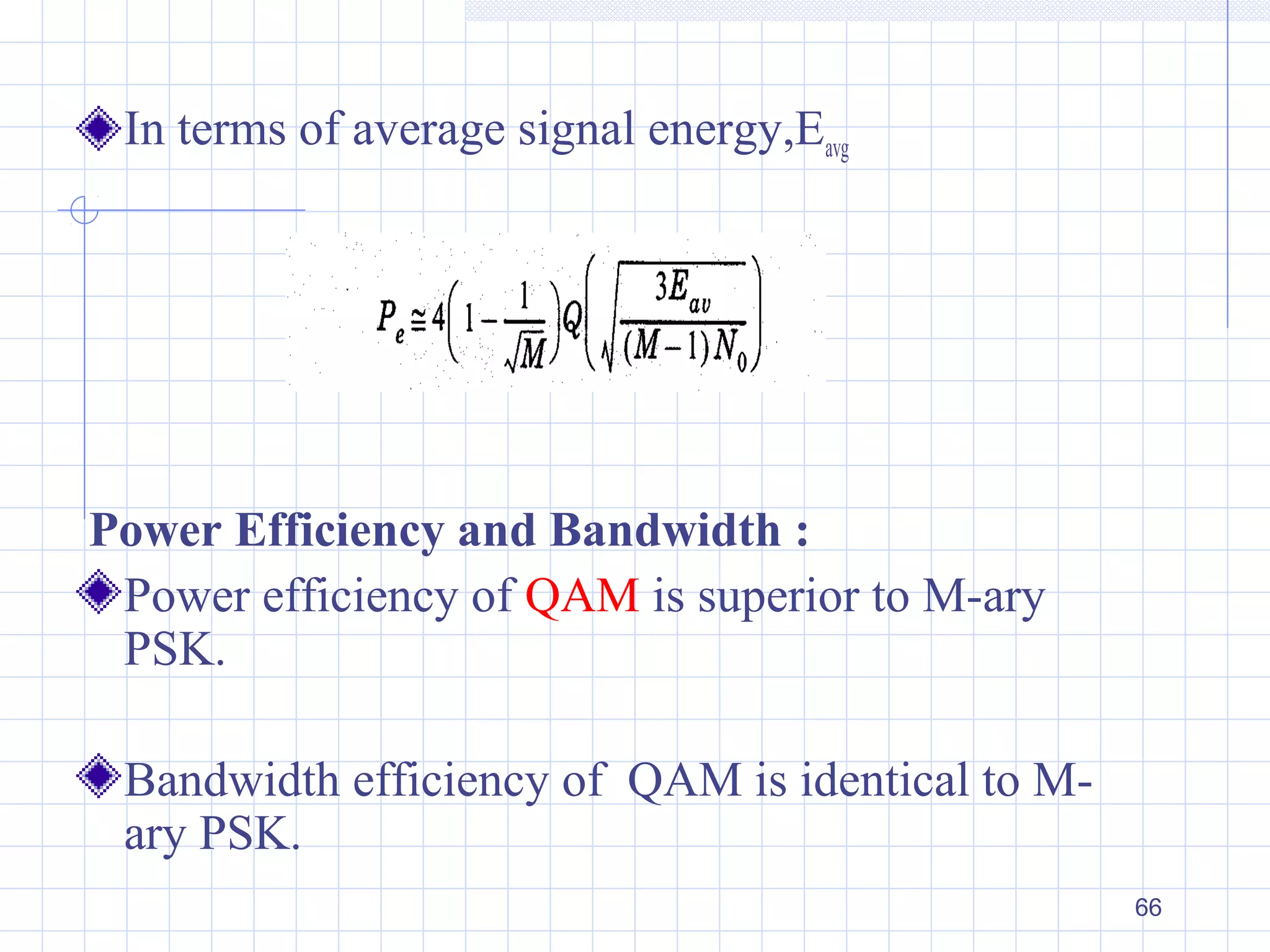
In terms of average signal energy,Eavg
Power Efficiency and Bandwidth :
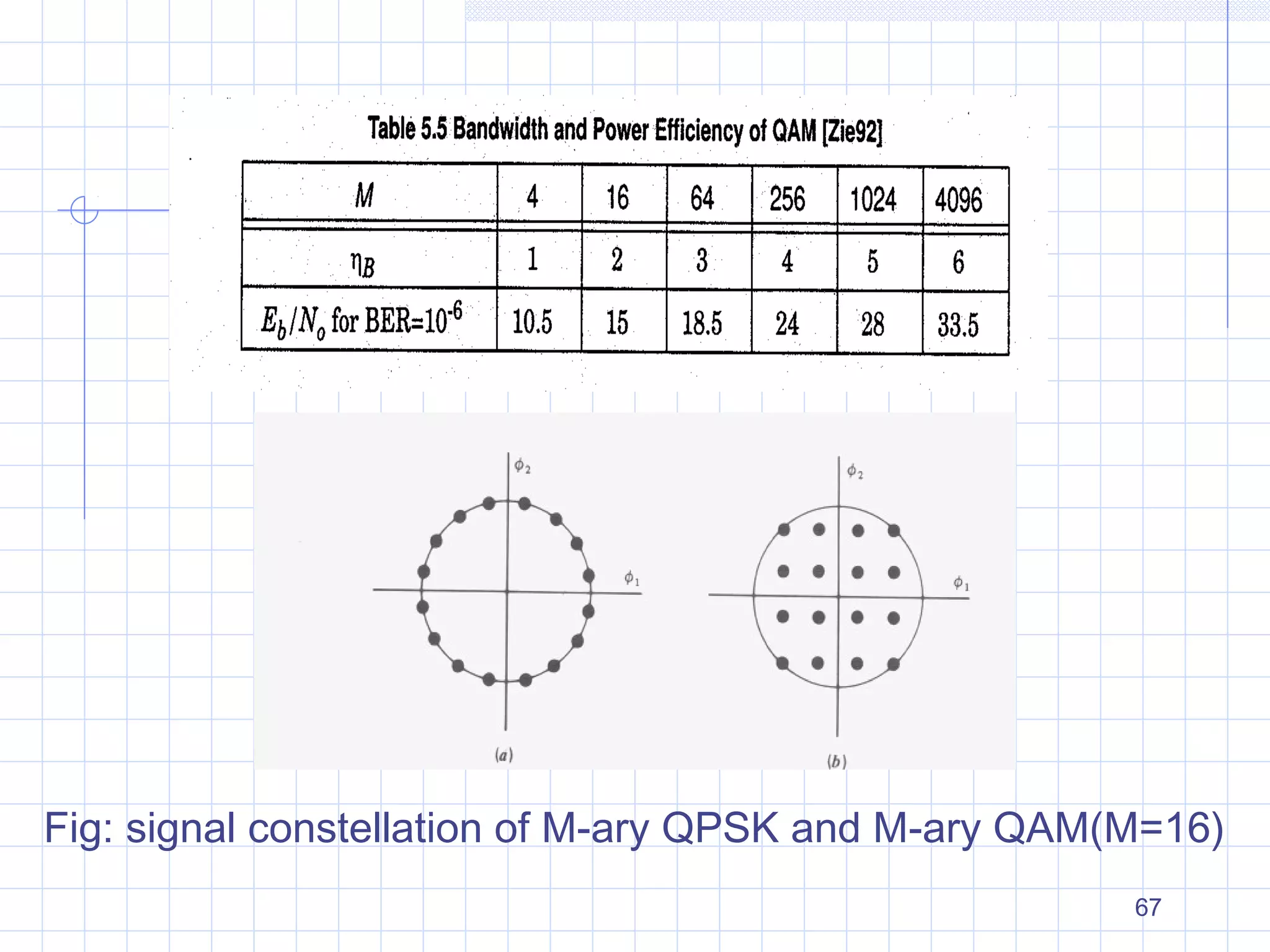
Power efficiency of QAM is superior to M-ary
PSK.
Bandwidth efficiency of QAM is identical to M-
ary PSK.
67
Fig: signal constellation of M-ary QPSK and M-ary QAM(M=16)
68
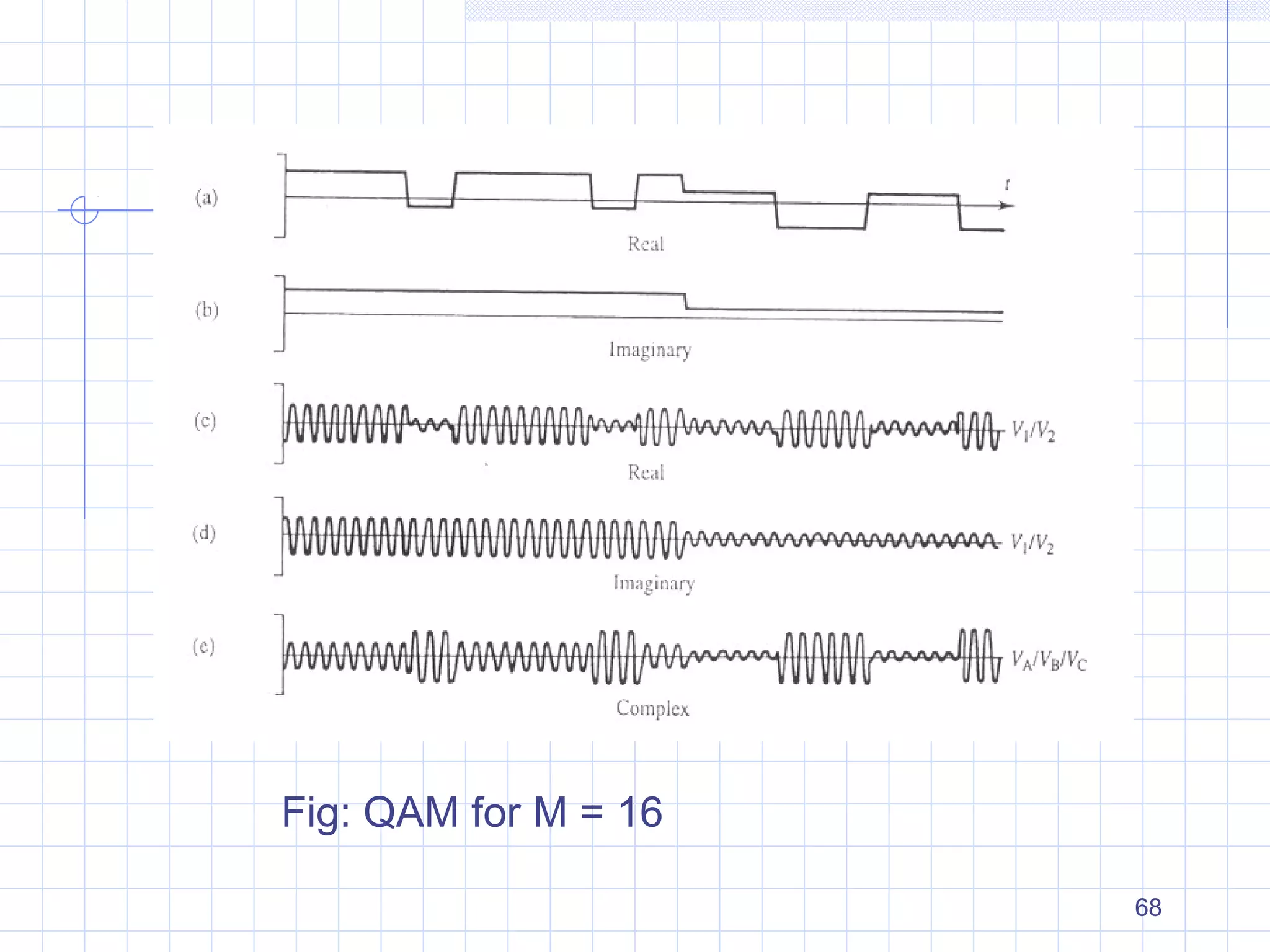
Fig: QAM for M = 16
69
M-ary Frequency Shift
Keying(MFSK)
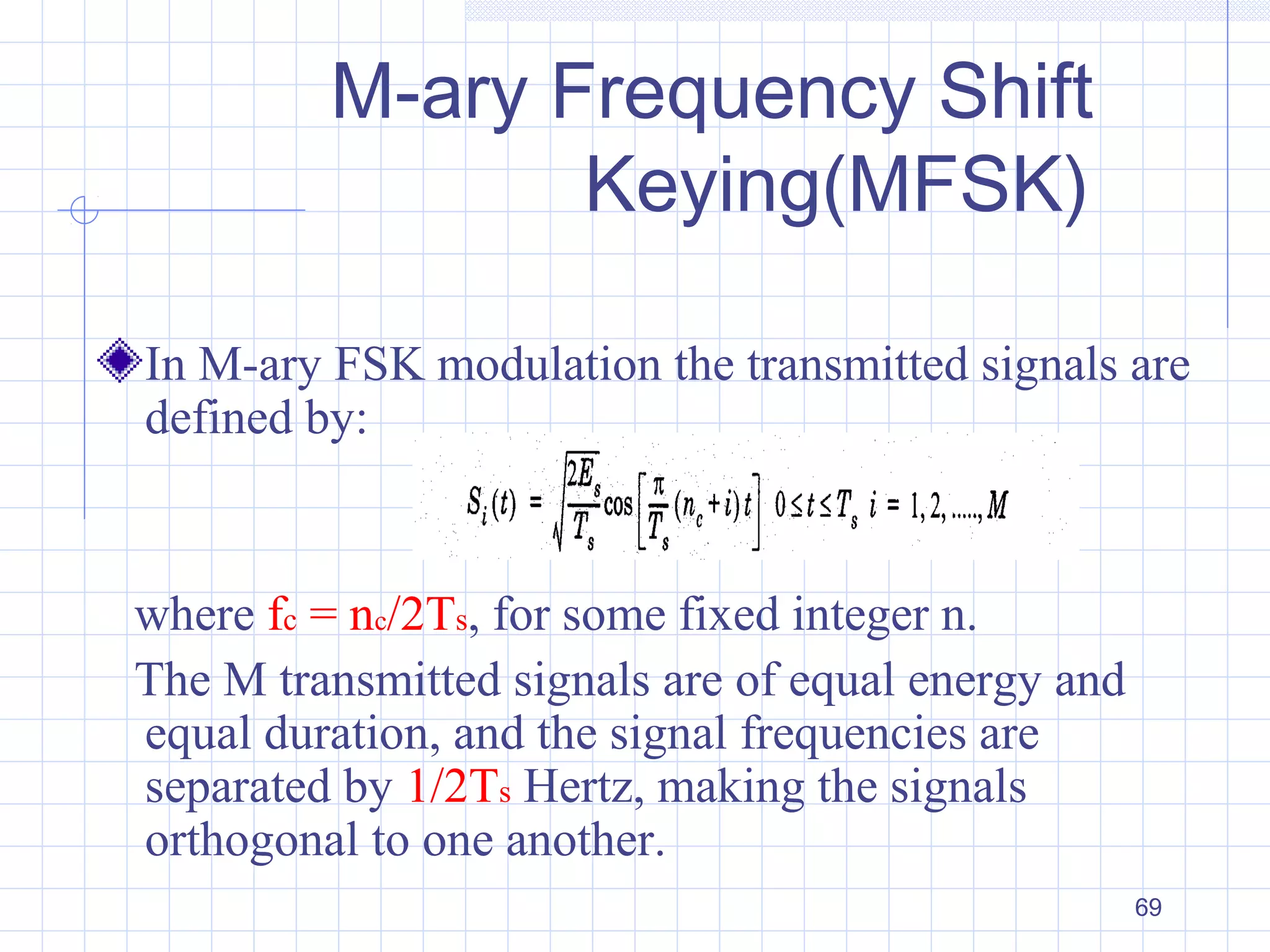
In M-ary FSK modulation the transmitted signals are
defined by:
where fc = nc/2Ts, for some fixed integer n.
The M transmitted signals are of equal energy and
equal duration, and the signal frequencies are
separated by 1/2Ts Hertz, making the signals
orthogonal to one another.
70
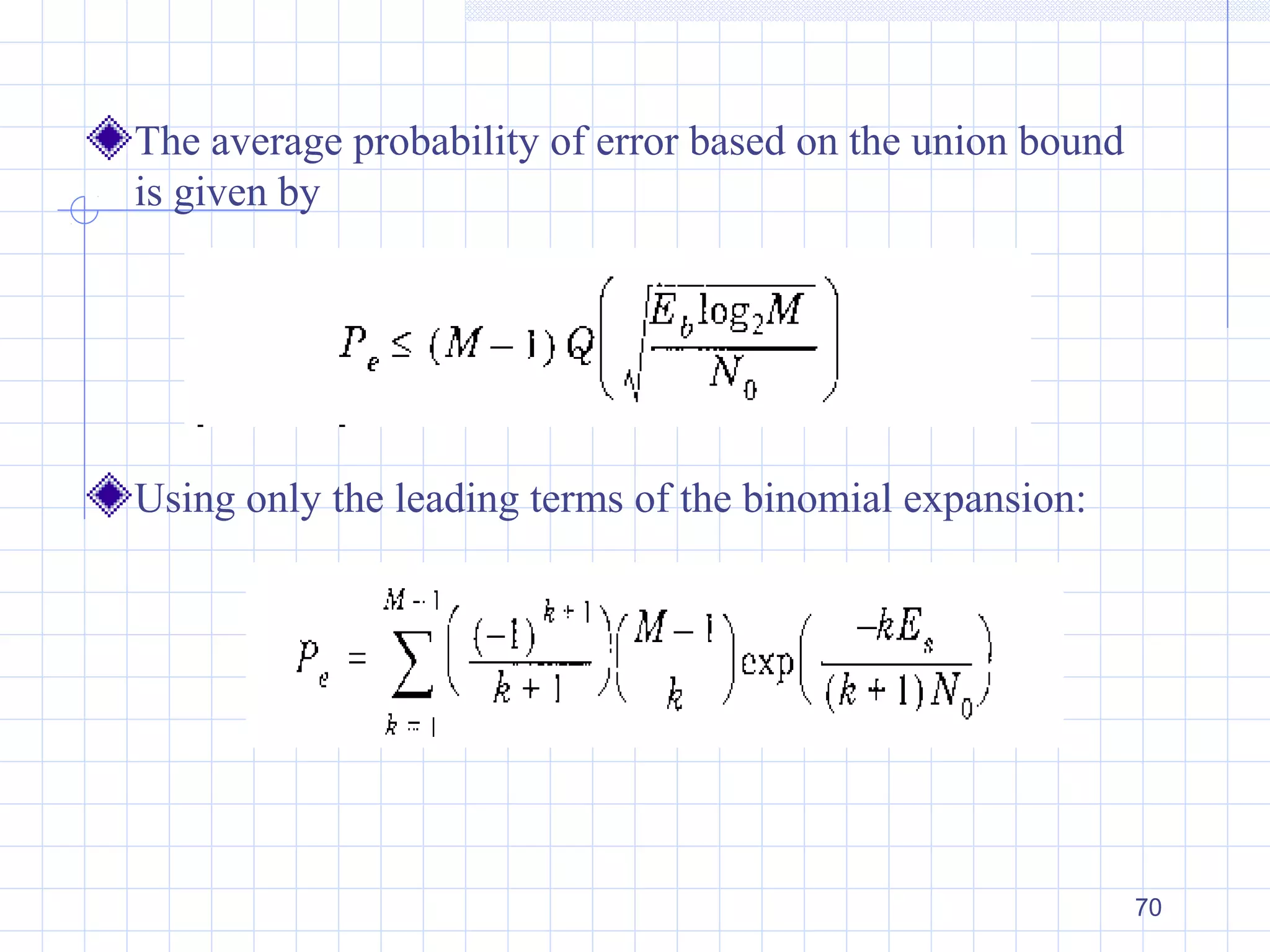
The average probability of error based on the union bound
is given by
Using only the leading terms of the binomial expansion:
71
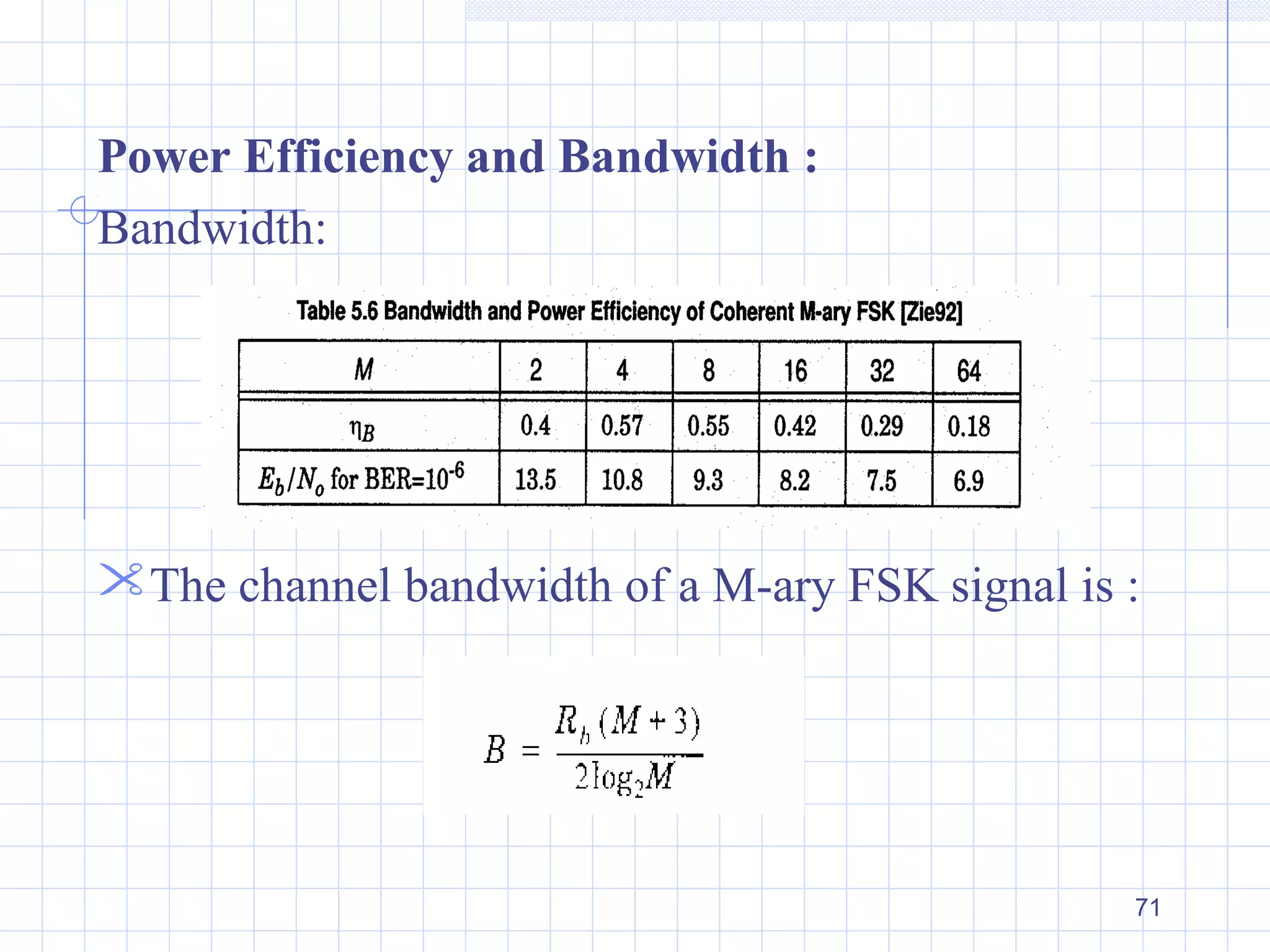
Power Efficiency and Bandwidth :
Bandwidth:
The channel bandwidth of a M-ary FSK signal is :
72
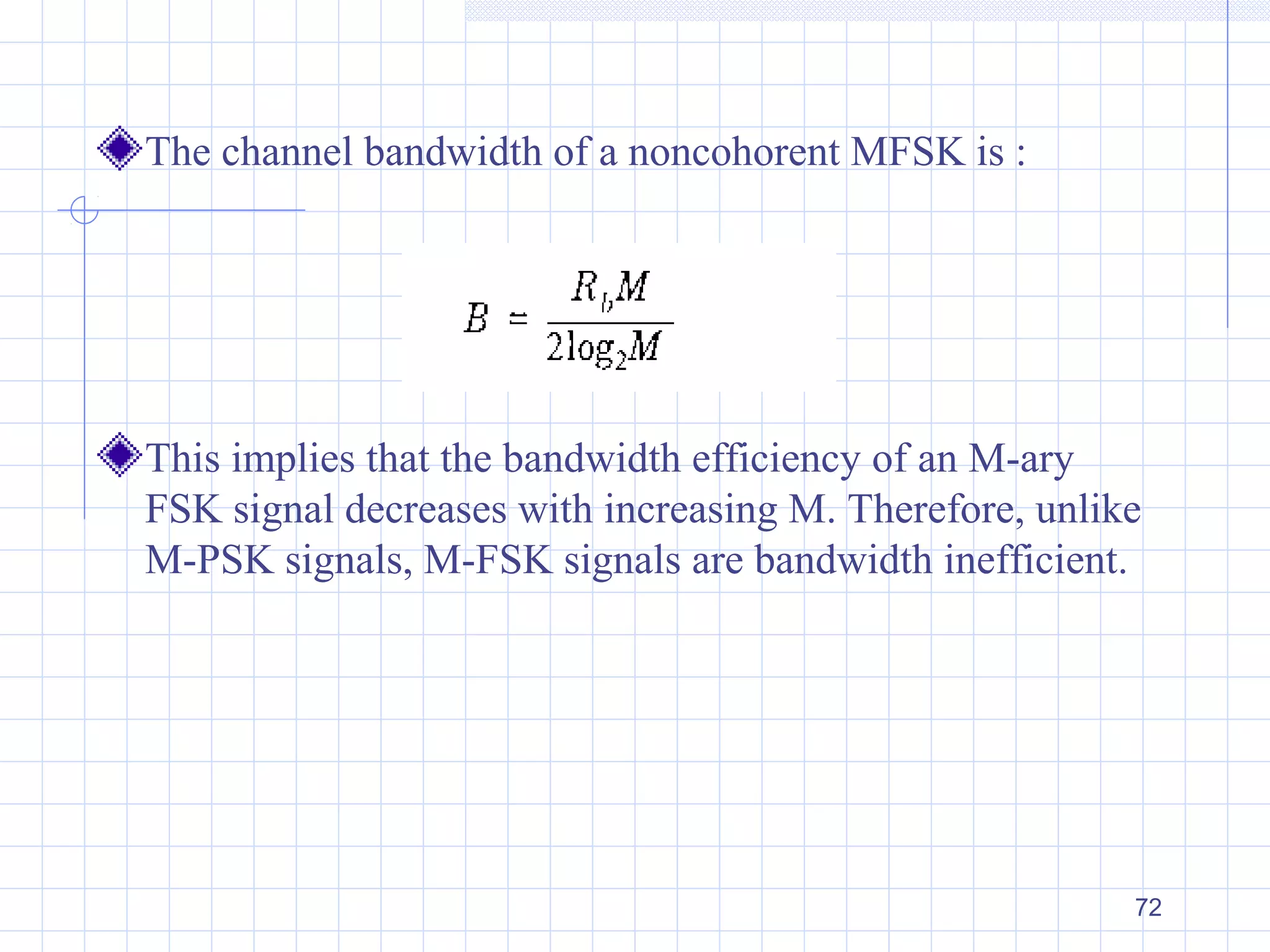
The channel bandwidth of a noncohorent MFSK is :
This implies that the bandwidth efficiency of an M-ary
FSK signal decreases with increasing M. Therefore, unlike
M-PSK signals, M-FSK signals are bandwidth inefficient.

Modulation

  • 1.
  • 2.
    Change which partof the Carrier? Carrier: A sin[ωt +ϕ]  A = const  ω = const  ϕ = const Amplitude modulation (AM)  A = A(t) – carries information  ω = const  ϕ = const Frequency modulation (FM)  A = const  ω = ω(t)– carries information  ϕ = const Phase modulation (PM)  A = const  ω = const  ϕ = ϕ(t) – carries information 2
  • 3.
    Amplitude Shift Keying(ASK) Pulse shaping can be employed to remove spectral spreading ASK demonstrates poor performance, as it is heavily affected by noise, fading, and interference Baseband Data ASK modulated signal 1 10 0 0 Acos(ωt) Acos(ωt) 3
  • 4.
    Frequency Shift Keying(FSK) Example: The ITU-T V.21 modem standard uses FSK FSK can be expanded to a M-ary scheme, employing multiple frequencies as different states Baseband Data BFSK modulated signal 1 10 0 where f0 =Acos(ωc-∆ω)t and f1 =Acos(ωc+∆ω)t f0 f0f1 f1 4
  • 5.
    Phase Shift Keying(PSK) Major drawback – rapid amplitude change between symbols due to phase discontinuity, which requires infinite bandwidth. Binary Phase Shift Keying (BPSK) demonstrates better performance than ASK and BFSK BPSK can be expanded to a M-ary scheme, employing multiple phases and amplitudes as different states Baseband Data BPSK modulated signal 1 10 0 where s0 =-Acos(ωct) and s1 =Acos(ωct) s0 s0s1 s1 5
  • 6.
    6 of 30 BinaryPhase Shift Keying (BPSK) If the sinusoidal carrier has an amplitude Ac and energy per bit Eb Then the transmitted BPSK signal is either:
  • 7.
    7 of 82 LinearModulation Techniques: Digital modulation can be broadly classified as: 1. Linear (change Amplitude or phase) 2. Non linear modulation techniques (change frequency). Linear Modulation Techniques: • The amplitude /phase of the transmitted signal s(t), varies linearly with the modulating digital signal, m(t). • These are bandwidth efficient (because it doesn’t change frequency) and hence are very attractive for use in wireless communication systems where there is an increasing demand to accommodate more and more users within a limited spectrum.
  • 8.
    8 of 30 •Linear Modulation schemes have very good spectral efficiency, •However, they must be transmitted using linear RF amplifiers which have poor power efficiency. Pros & Cons
  • 9.
    9 of 30 Note “Phasemodulation” can be regarded as “amplitude” modulation because it can really change “envelope”; Thus both of them belong to “linear modulation”!
  • 10.
    Differential Modulation In thetransmitter, each symbol is modulated relative to the previous symbol and modulating signal, for instance in BPSK 0 = no change, 1 = +1800 In the receiver, the current symbol is demodulated using the previous symbol as a reference. The previous symbol serves as an estimate of the channel. A no-change condition causes the modulated signal to remain at the same 0 or 1 state of the previous symbol. 10
  • 11.
  • 12.
  • 13.
    13 of 30 Let{dk} denote the differentially encoded sequence with this added reference bit. We now introduce the following definitions in the generation of this sequence: • If the incoming binary symbol bk is 1, leave the symbol dk unchanged with respect to the previous bit. • If the incoming binary symbol bk is 0, change the symbol dk with respect to the previous bit. DPSK
  • 14.
    14 of 30 •to send symbol 0, we advance the phase of the current signal waveform by 180 degrees, • to send symbol 1, we leave the phase of the current signal waveform unchanged. Generation of DPSK: • The differential encoding process at the transmitter input starts with an arbitrary first bit, serving as reference. DPSK
  • 15.
    15 of 30 DifferentialPhase Shift Keying (DPSK): • DPSK is a non coherent form of phase shift keying which avoids the need for a coherent reference signal at the receiver. Advantage: • Non coherent receivers are easy and cheap to build, hence widely used in wireless communications. •DPSK eliminates the need for a coherent reference signal at the receiver by combining two basic operations at the transmitter:
  • 16.
    Pulse Carrier Carrier: A trainof identical pulses regularly spaced in time 16
  • 17.
    Pulse-Amplitude Modulation (PAM) Modulation inwhich the amplitude of pulses is varied in accordance with the modulating signal. Used e.g. in telephone switching equipment such as a private branch exchange (PBX) 17
  • 18.
    Pulse-Duration Modulation (PDM) Modulationin which the duration of pulses is varied in accordance with the modulating signal. Deprecated synonyms: pulse-length modulation, pulse-width modulation. Used e.g. in telephone switching equipment such as a private branch exchange (PBX) 18
  • 19.
    Demodulation & Detection Demodulation Is process of removing the carrier signal to obtain the original signal waveform Detection – extracts the symbols from the waveform  Coherent detection  Non-coherent detection 19
  • 20.
    Coherent Detection An estimateof the channel phase and attenuation is recovered. It is then possible to reproduce the transmitted signal and demodulate. Requires a replica carrier wave of the same frequency and phase at the receiver. Also known as synchronous detection (I.e. carrier recovery) 20
  • 21.
    Coherent Detection 2 Carrierrecovery methods include  Pilot Tone (such as Transparent Tone in Band)  Less power in the information bearing signal, High peak- to-mean power ratio  Carrier recovery from the information signal  E.g. Costas loop Applicable to  Phase Shift Keying (PSK)  Frequency Shift Keying (FSK)  Amplitude Shift Keying (ASK) 21
  • 22.
    Non-Coherent Detection Requires noreference wave; does not exploit phase reference information (envelope detection)  Differential Phase Shift Keying (DPSK)  Frequency Shift Keying (FSK)  Amplitude Shift Keying (ASK)  Non coherent detection is less complex than coherent detection (easier to implement), but has worse performance. 22
  • 23.
    QPSK Quadrature Phase ShiftKeying (QPSK) can be interpreted as two independent BPSK systems (one on the I-channel and one on Q-channel), and thus the same performance but twice the bandwidth (spectrum) efficiency. 23
  • 24.
    QPSK Constellation Diagram QuadraturePhase Shift Keying has twice the bandwidth efficiency of BPSK since 2 bits are transmitted in a single modulation symbol Carrier phases {0, π/2, π, 3π/2} Carrier phases {π/4, 3π/4, 5π/4, 7π/4} Q I I Q 24
  • 25.
    Types of QPSK ConventionalQPSK has transitions through zero (i.e. 1800 phase transition). Highly linear amplifiers required. In Offset QPSK, the phase transitions are limited to 900 , the transitions on the I and Q channels are staggered. In π/4 QPSK the set of constellation points are toggled each symbol, so transitions through zero cannot occur. This scheme produces the lowest envelope variations. All QPSK schemes require linear power amplifiers I Q I Q I Q Conventional QPSK π/4 QPSKOffset QPSK 25
  • 26.
    26 of 30 QuadraturePhase Shift Keying (QPSK): •Also a type of linear modulation scheme •Quadrature Phase Shift Keying (QPSK) has twice the bandwidth efficiency of BPSK, since 2 bits are transmitted in a single modulation symbol. • The phase of the carrier takes on 1 of 4 equally spaced values, such as where each value of phase corresponds to a unique pair of message bits. • The QPSK signal for this set of symbol states may be defined as:
  • 27.
    27 of 30 •The striking result is that the bit error probability of QPSK is identical to BPSK, but twice as much data can be sent in the same bandwidth. Thus, when compared to BPSK, QPSK provides twice the spectral efficiency with exactly the same energy efficiency. • Similar to BPSK, QPSK can also be differentially encoded to allow non-coherent detection. QPSK
  • 28.
  • 29.
    Multi-level (M-ary) Phaseand Amplitude Modulation Amplitude and phase shift keying can be combined to transmit several bits per symbol.  Often referred to as linear as they require linear amplification.  More bandwidth-efficient, but more susceptible to noise. For M=4, 16QAM has the largest distance between points, but requires very linear amplification. 16PSK has less stringent linearity requirements, but has less spacing between constellation points, and is therefore more affected by noise. 16 QAM 16 APSK16 PSK 29
  • 30.
    Distortions Perfect channel Whitenoise Phase jitter 30
  • 31.
    Bandwidth Efficiency 2log 1 capacity(bits per second) bandwidth of the modulating baseband signal (Hz) energy per bit noise power density (watts/Hz) Thus total signal power total noise b b b b b b b f E f W W f W E E f W η η η   = + ÷   = = = = = = power bandwidth use efficiency = bits per second per Hz bf W = 31
  • 32.
    Comparison of ModulationTypes Modulation Format Bandwidth efficiency C/B Log2(C/B) Error-free Eb/N0 16 PSK 4 2 18dB 16 QAM 4 2 15dB 8 PSK 3 1.6 14.5dB 4 PSK 2 1 10dB 4 QAM 2 1 10dB BFSK 1 0 13dB BPSK 1 0 10.5dB 32
  • 33.
    Spectral Efficiencies - Examples GSMEurope Digital Cellular  Data Rate = 270kb/s; Bandwidth = 200kHz  Bandwidth efficiency = 270/200 = 1.35bits/sec/Hz IS-95 North American Digital Cellular  Data Rate = 48kb/s; Bandwidth = 30kHz  Bandwidth efficiency = 48/30 = 1.6bits/sec/Hz 33
  • 34.
    34 of 30 BFSKTransmitter
  • 35.
    35 of 30 CoherentDetection Of BFSK
  • 36.
    36 of 30 FSKSpectrum
  • 37.
    37 of 30 MinimumShift Keying (MSK) MSK is a continuous phase-frequency shift keying; Why MSK? -- Exploitation of Phase Information besides frequency.
  • 38.
    38 of 30 Representationof a MSK signal
  • 39.
  • 40.
    40 of 30 MSKTransmitter
  • 41.
    41 of 30 MSKReceiver
  • 42.
    42 M-ary Combined Linear andnonlinear (Constant Envelope) Modulation Techniques
  • 43.
    43 Topics : What isM-ary modulation? Various M-ary modulation Techniques: M-ary Phase Shift Keying (MPSK) M-ary Quadrature Amplitude Modulation (QAM) M-ary Frequency Shift Keying (MFSK)
  • 44.
    44 Definition: In this modulationTechnique the digital data is sent by varying both the envelope and phase(or frequency) of an RF carrier. These modulation techniques map base band data into four or more possible RF carrier signals. Hence, these modulation techniques are called M-ary modulation.
  • 45.
    45 M-ary signaling scheme: •In this signaling scheme 2 or more bits are grouped together to form a symbol. • One of the M possible signals s1(t) ,s2(t),s3(t),……sM(t) is transmitted during each symbol period of duration Ts. • The number of possible signals = M = 2n , where n is an integer.
  • 46.
    46 n M =2n Symbol 1 2 0, 1 2 4 00, 01, 10, 11 3 8 000, 001, 010,011,... 4 16 0000, 0001, 0010,0011,…. …. …… ………. The symbol values of M for a given value of n:
  • 47.
    47Fig: waveforms of(a) ASK (b) PSK (c)FSK • Depending on the variation of amplitude, phase or frequency of the carrier, the modulation scheme is called as M-ary ASK, M-ary PSK and M-ary FSK.
  • 48.
  • 49.
    49 M-ary Phase ShiftKeying(MPSK) In M-ary PSK, the carrier phase takes on one of the M possible values, namely θi = 2 * (i - 1)π / M where i = 1, 2, 3, …..M. The modulated waveform can be expressed as where Es is energy per symbol = (log2 M) Eb Ts is symbol period = (log2 M) Tb.
  • 50.
    50 The above equationin the Quadrature form is By choosing orthogonal basis signals defined over the interval 0 ≤ t ≤ Ts
  • 51.
    51 M-ary signal setcan be expressed as Since there are only two basis signals, the constellation of M-ary PSK is two dimensional. The M-ary message points are equally spaced on a circle of radius √Es, centered at the origin. The constellation diagram of an 8-ary PSK signal set is shown in fig.
  • 52.
    52 Fig: Constellation diagramof an M-ary PSK system(m=8)
  • 53.
    53 Derivation of symbolerror probability: Decision Rule: Fig: Constellation diagram for M=2 (Binary PSK)
  • 54.
    54 If a symbol(0,0,0) is transmitted, it is clear that if an error occurs, the transmitted signal is most likely to be mistaken for (0,0,1) and (1,1,1) and the signal being mistaken for (1,1,0) is remote. The decision pertaining to (0,0,0) is bounded by θ = - π/8(below φ1(t)- axis) to θ = + π/8 ( above φ2(t)- axis) The probability of correct reception is…
  • 55.
    55 Fig: Probability densityfunction of Phase θ.
  • 56.
    56 The average symbolerror probability of an coherent M-ary PSK system in AWGN channel is given by Similarly, The symbol error Probability of a differential M-ary PSK system in AWGN channel is given by
  • 57.
    57 Fig: The performanceof symbol error probability for -different values of M
  • 58.
    58 Power Efficiency andBandwidth : Fig: MPSK signal sets for M=2,4,8,16
  • 59.
    59 Power efficiency: Increasing Mimplies that the constellation is more densely packed, and hence the power efficiency (noise tolerance) is increased. Bandwidth Efficiency: The first null bandwidth of M-ary PSK signals decrease as M increases while Rb is held constant. Therefore, as the value of M increases, the bandwidth efficiency also increases.
  • 60.
    60 M-ary Quadrature Amplitude Modulation(QAM) It’s a Hybrid modulation As we allow the amplitude to also vary with the phase, a new modulation scheme called quadrature amplitude modulation (QAM) is obtained. The constellation diagram of 16-ary QAM consists of a square lattice of signal points.
  • 61.
    61 Fig: signal Constellationof M-ary QAM for M=16
  • 62.
    62 Fig: Decomposition ofsignal Constellation of M-ary QAM
  • 63.
    63 The general formof an M-ary QAM signal can be defined as where Emin is the energy of the signal with the lowest amplitude and ai and biare a pair of independent integers chosen according to the location of the particular signal point. In M-ary QAM energy per symbol and also distance between possible symbol states is not a constant.
  • 64.
    64 It reasons thatparticular values of Si (t) will be detected with higher probability than others. The signal Si (t) may be expanded in terms of a pair of basis functions defined as The coordinates of the i th message point are ai √Emin and bi√Emin where (ai, bi) is an element of the L by L matrix given by Where L = √M.
  • 65.
    65 For the exampleM=16- QAM the L by L matrix is Derivation of symbol error probability: The average probability of error in an AWGN channel is given by
  • 66.
    66 In terms ofaverage signal energy,Eavg Power Efficiency and Bandwidth : Power efficiency of QAM is superior to M-ary PSK. Bandwidth efficiency of QAM is identical to M- ary PSK.
  • 67.
    67 Fig: signal constellationof M-ary QPSK and M-ary QAM(M=16)
  • 68.
  • 69.
    69 M-ary Frequency Shift Keying(MFSK) InM-ary FSK modulation the transmitted signals are defined by: where fc = nc/2Ts, for some fixed integer n. The M transmitted signals are of equal energy and equal duration, and the signal frequencies are separated by 1/2Ts Hertz, making the signals orthogonal to one another.
  • 70.
    70 The average probabilityof error based on the union bound is given by Using only the leading terms of the binomial expansion:
  • 71.
    71 Power Efficiency andBandwidth : Bandwidth: The channel bandwidth of a M-ary FSK signal is :
  • 72.
    72 The channel bandwidthof a noncohorent MFSK is : This implies that the bandwidth efficiency of an M-ary FSK signal decreases with increasing M. Therefore, unlike M-PSK signals, M-FSK signals are bandwidth inefficient.

Editor's Notes

  • #32 From Shannon Theorem