



KKU_Biomech_M1_L4

  Musculoskeletal system


                                                       Lesson (4)
Dr / Shimaa Essa
Lecturer of physical therapy , faculty of community,
King Khalid university
Upon successful completion of this lesson you
  would be able to:

  1- Identify dimensions of movement.
  2- Comprehend Directional Terms Used in
  Describing Anatomy.
  3- Identify cardinal and parallel planes and
  axes where body movements take place.
  4- Distinguish between Planes and axes.
Introduction
The plane : is the surface on which the
movement occurs or takes place.

The axis : is the line around which the
movement takes place.

Axis is the singular and axes are the plural noun.
Any movement occurs in a plane around an axis.
Axis of the same plane makes an angle
perpendicular to that plane.
Dimensions of Movement
• 0 Dimension - point.
• 1 Dimension - line.
• 2 Dimensions - plane.
• 3 Dimensions - cube, sphere.
• 4 Dimensions - 3 Dimensions + time.
Movement occurs in all 4 dimensions (time
  and space).
Directional Terms Used in
Describing Anatomy
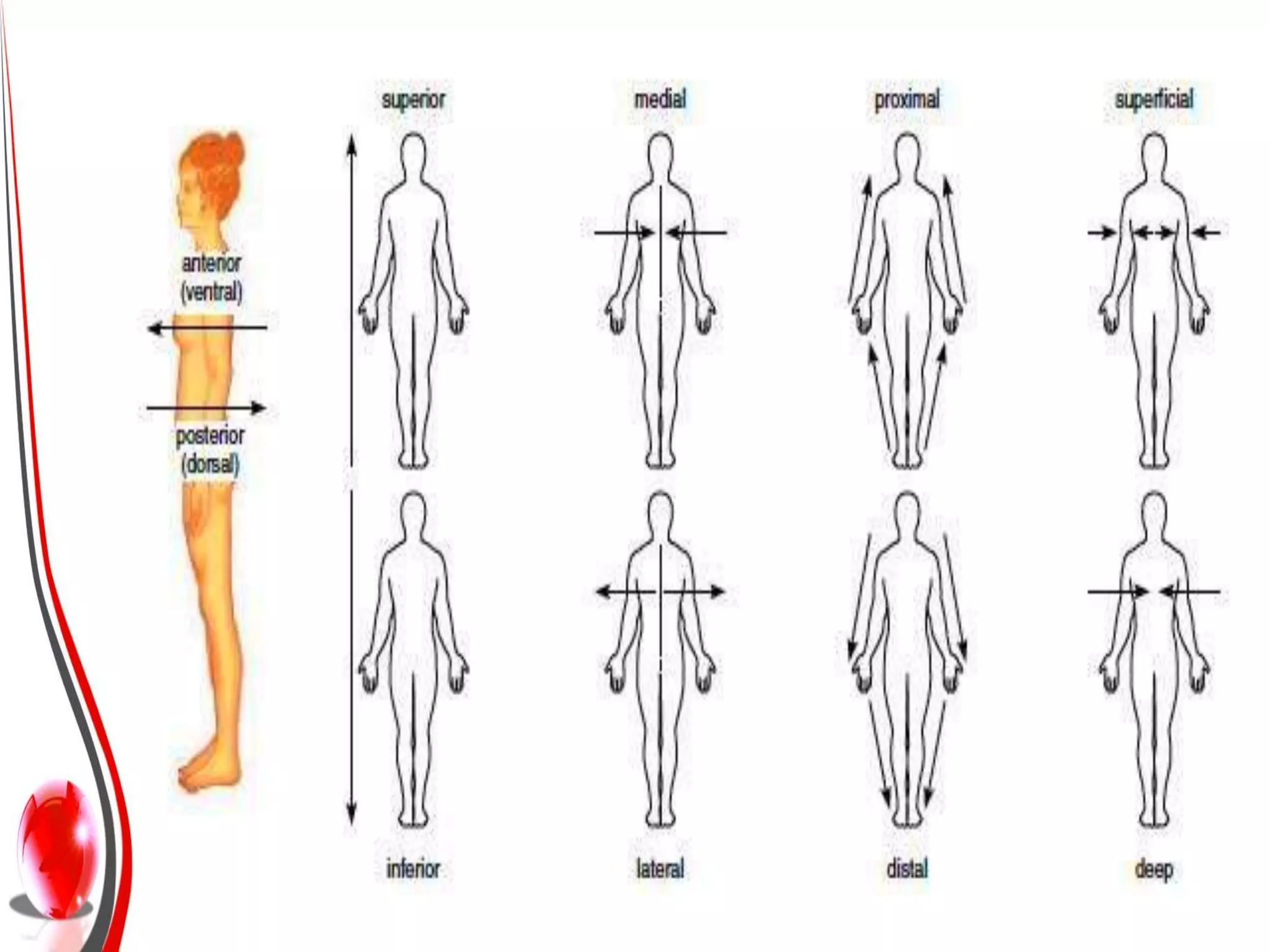
• SUPERIOR – Directed upwards or towards
  the head
• INFERIOR – Directed downwards or
  towards the feet
• ANTERIOR – Directed towards the front of
  the body
• POSTERIOR – Directed towards the back
  of the body
Directional Terms Used in
Describing Anatomy
• MEDIAL – Nearer the midline of the body
• LATERAL – Farther from the midline of the body
• PROXIMAL – Nearer to the attachment of a limb
  to the trunk
• DISTAL – Farther from the attachment of the
  limb to the trunk
• SUPERFICIAL – Located on or near the surface
  of the body
• DEEP – Away from the surface of the body
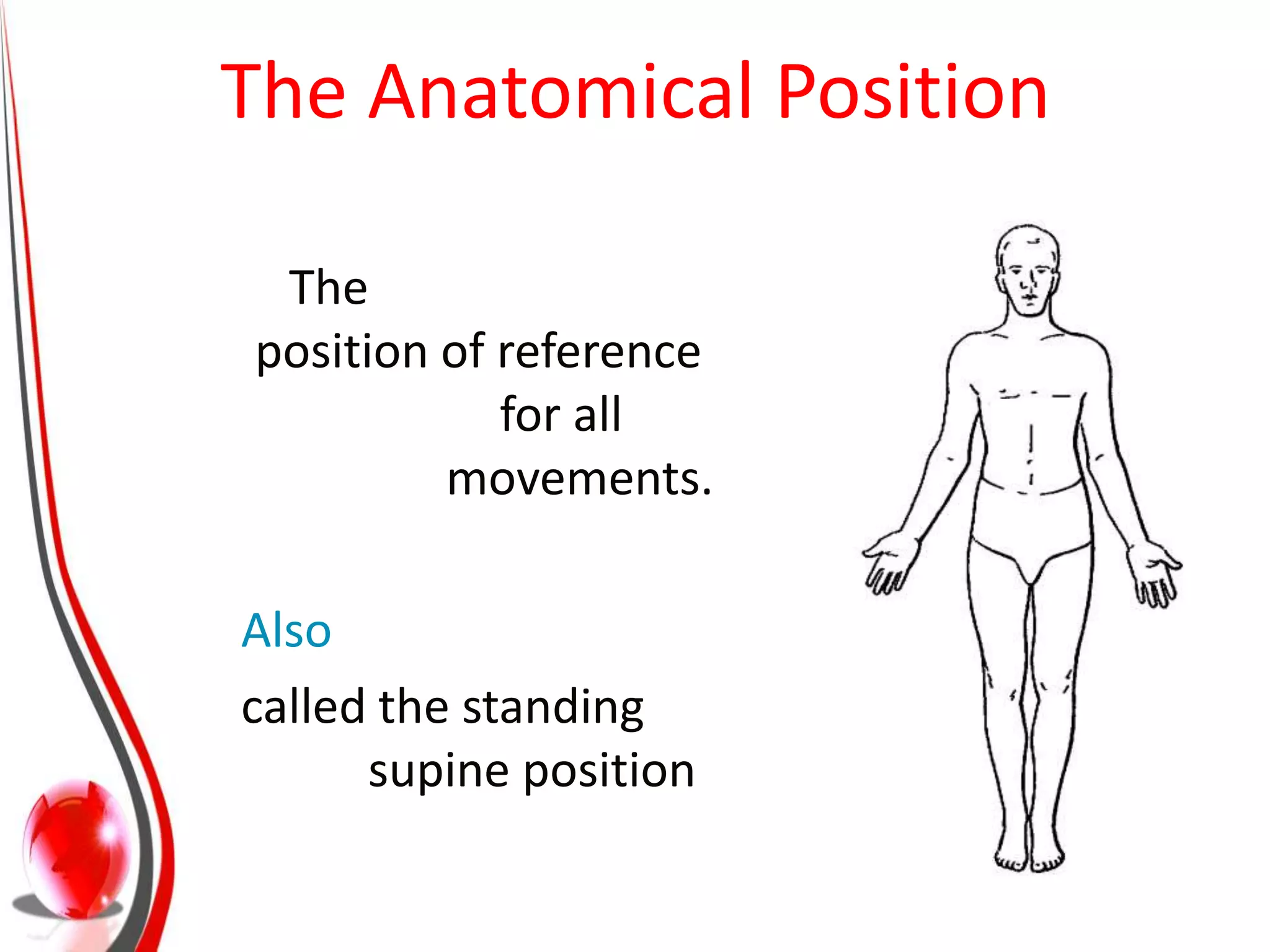
The Anatomical Position

 The
position of reference
            for all
         movements.

Also
called the standing
      supine position
1- Cardinal plane       3 imaginary perpendicular
  reference planes that divide the body in half by mass
And represent where the axial skeleton movements
  take place

2- Parallel Plane.
Is an imaginary surface where the movement of
   appendicular skeleton take place

3- Diagonal plane.
Is a plane other than cardinal or parallel planes, Where
   movement occurs in a diagonal pattern
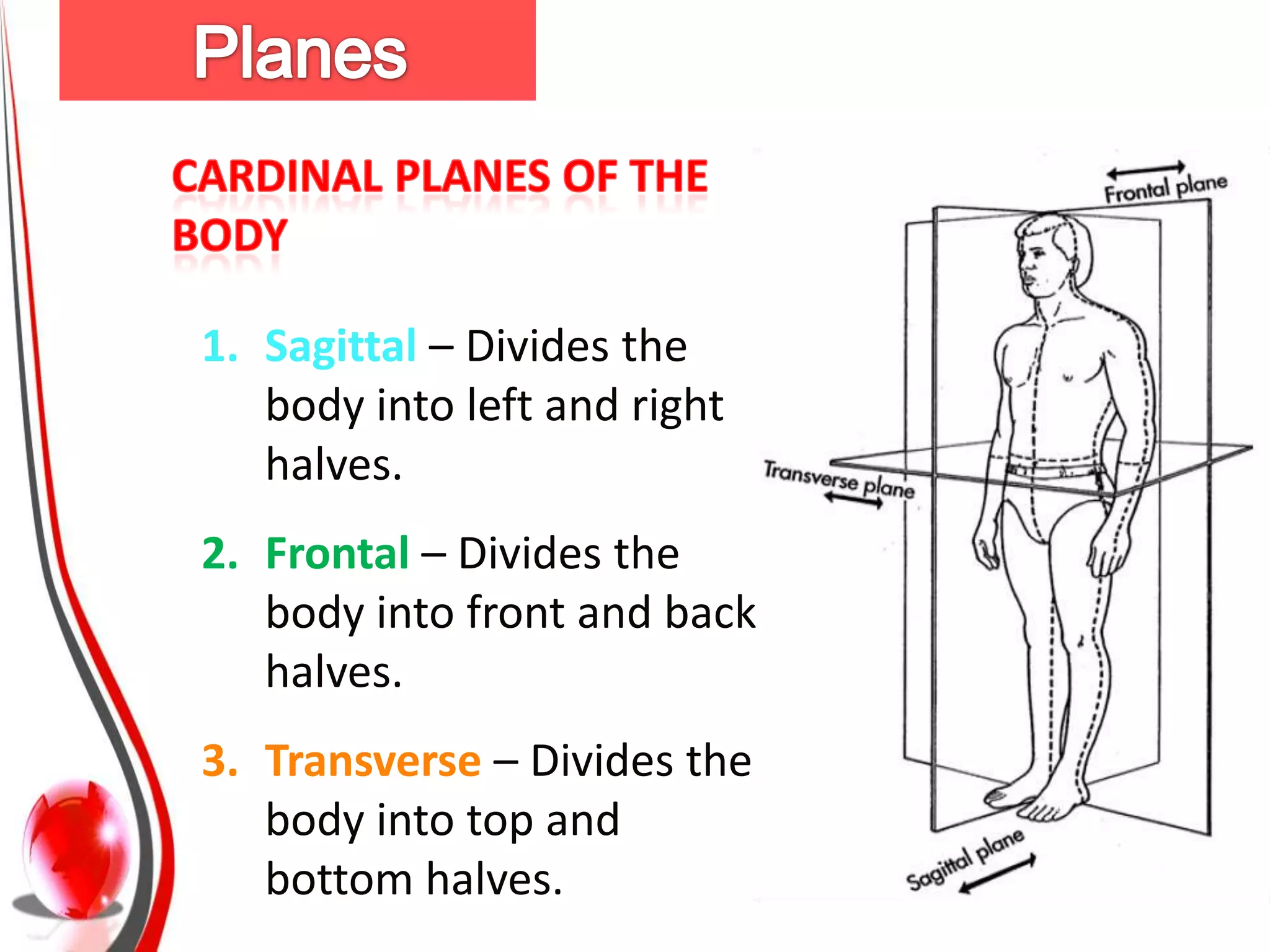
1. Sagittal – Divides the
   body into left and right
   halves.
2. Frontal – Divides the
   body into front and back
   halves.
3. Transverse – Divides the
   body into top and
   bottom halves.
Sagittal Plane Movements
(Forward & Backward Movements)
 • Whole Body – Forward and backward
   movement such as front or back flips
 • Segmental
   – Flexion
   – Extension
   – Hyperextension
   – Dorsiflexion
                       Ankle
   – Plantar flexion
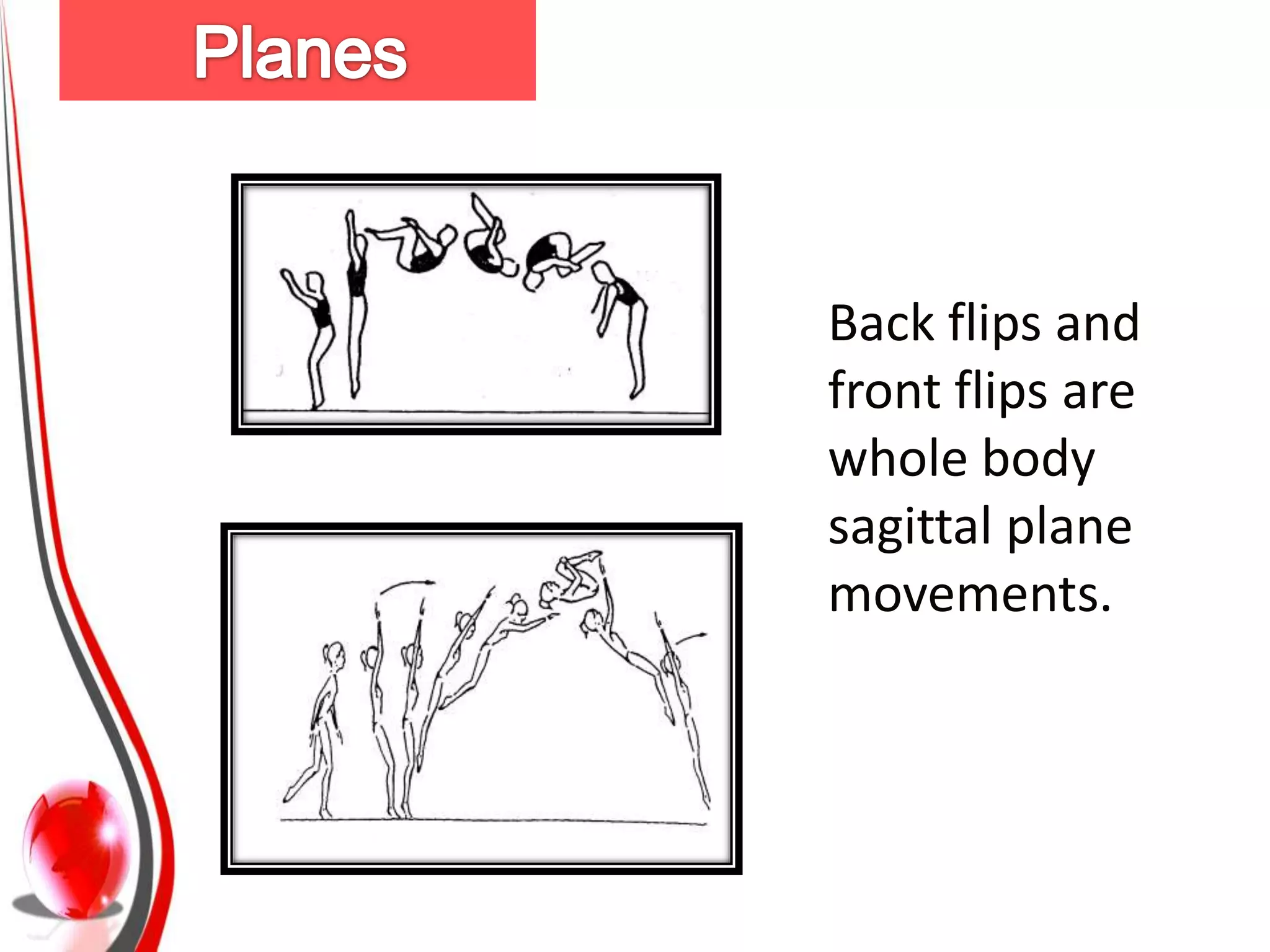
Back flips and
front flips are
whole body
sagittal plane
movements.
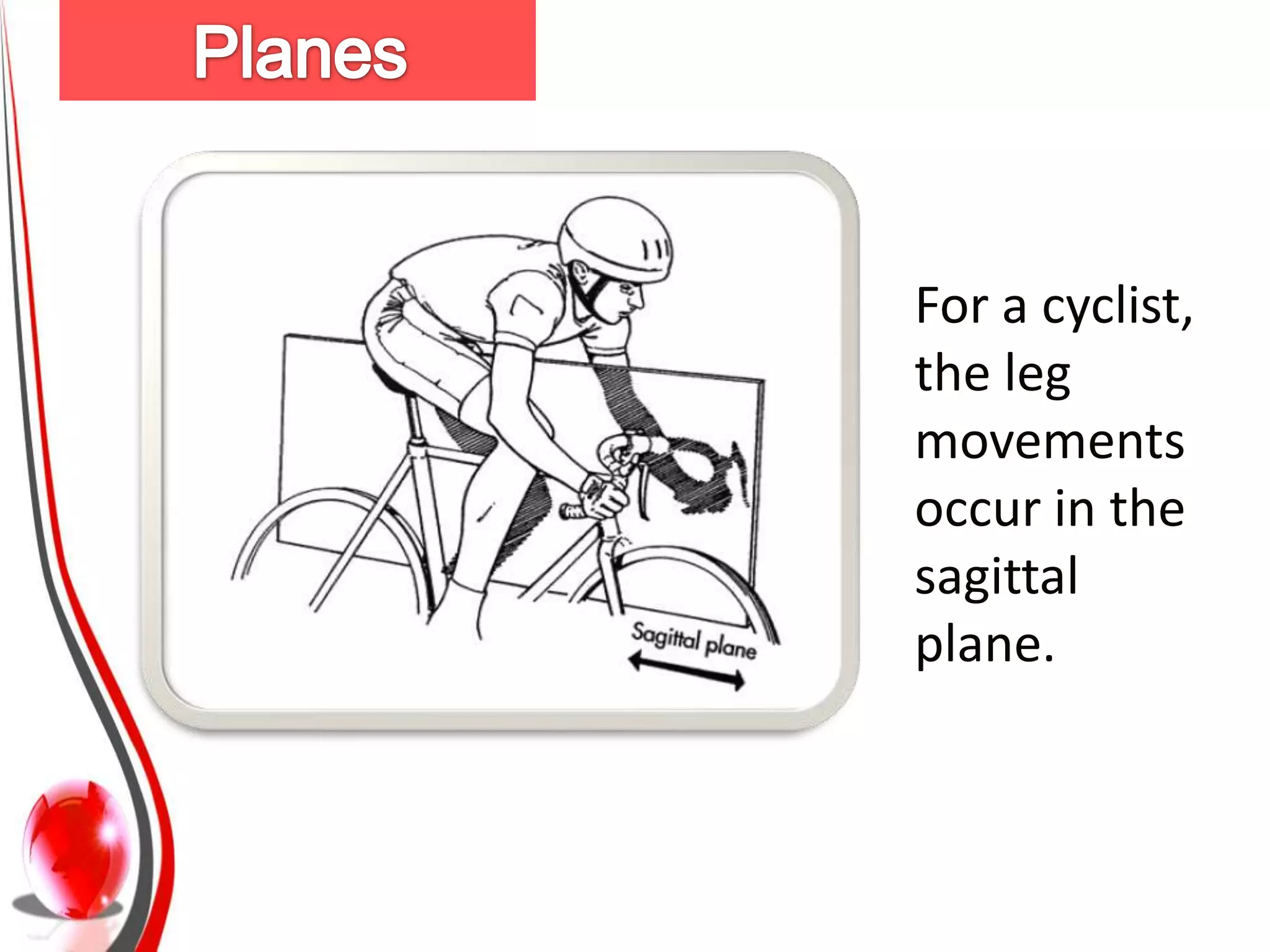
For a cyclist,
the leg
movements
occur in the
sagittal
plane.
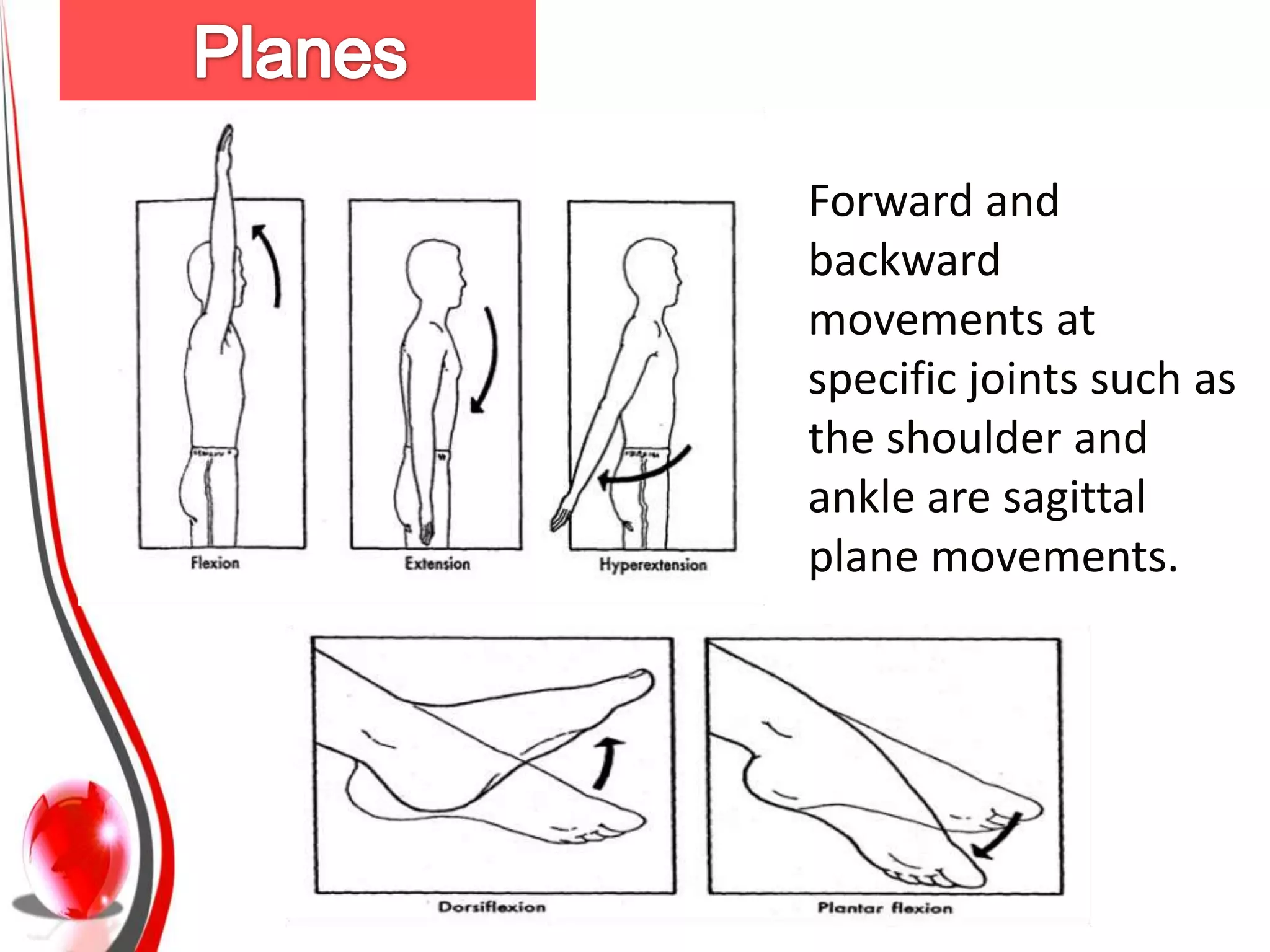
Forward and
backward
movements at
specific joints such as
the shoulder and
ankle are sagittal
plane movements.
Frontal Plane Movements
(Sideward & Vertical Movements)

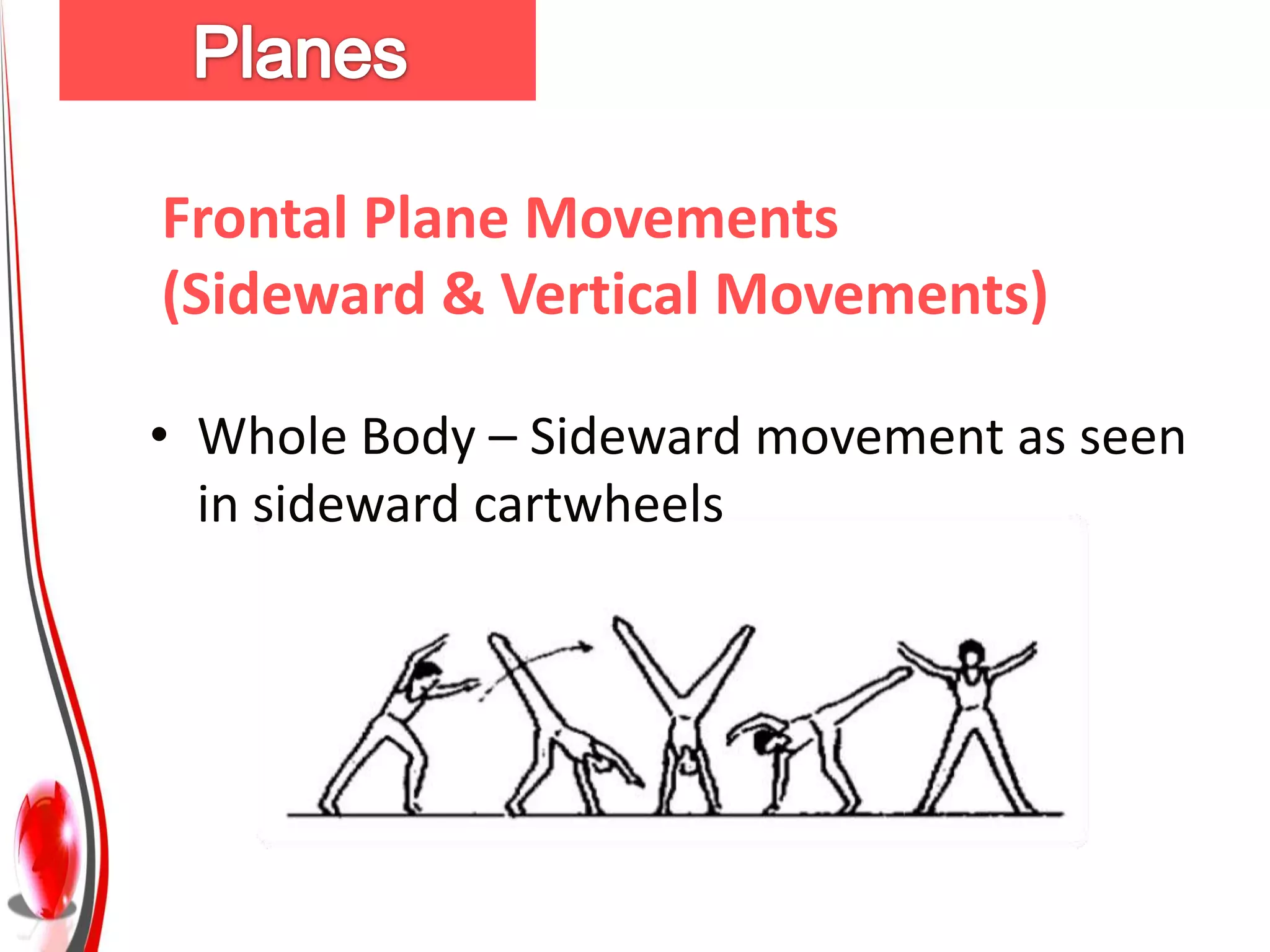
• Whole Body – Sideward movement as seen
  in sideward cartwheels
Frontal Plane Movements
(Sideward & Vertical Movements)
• Segmental
   – Abduction
   – Adduction
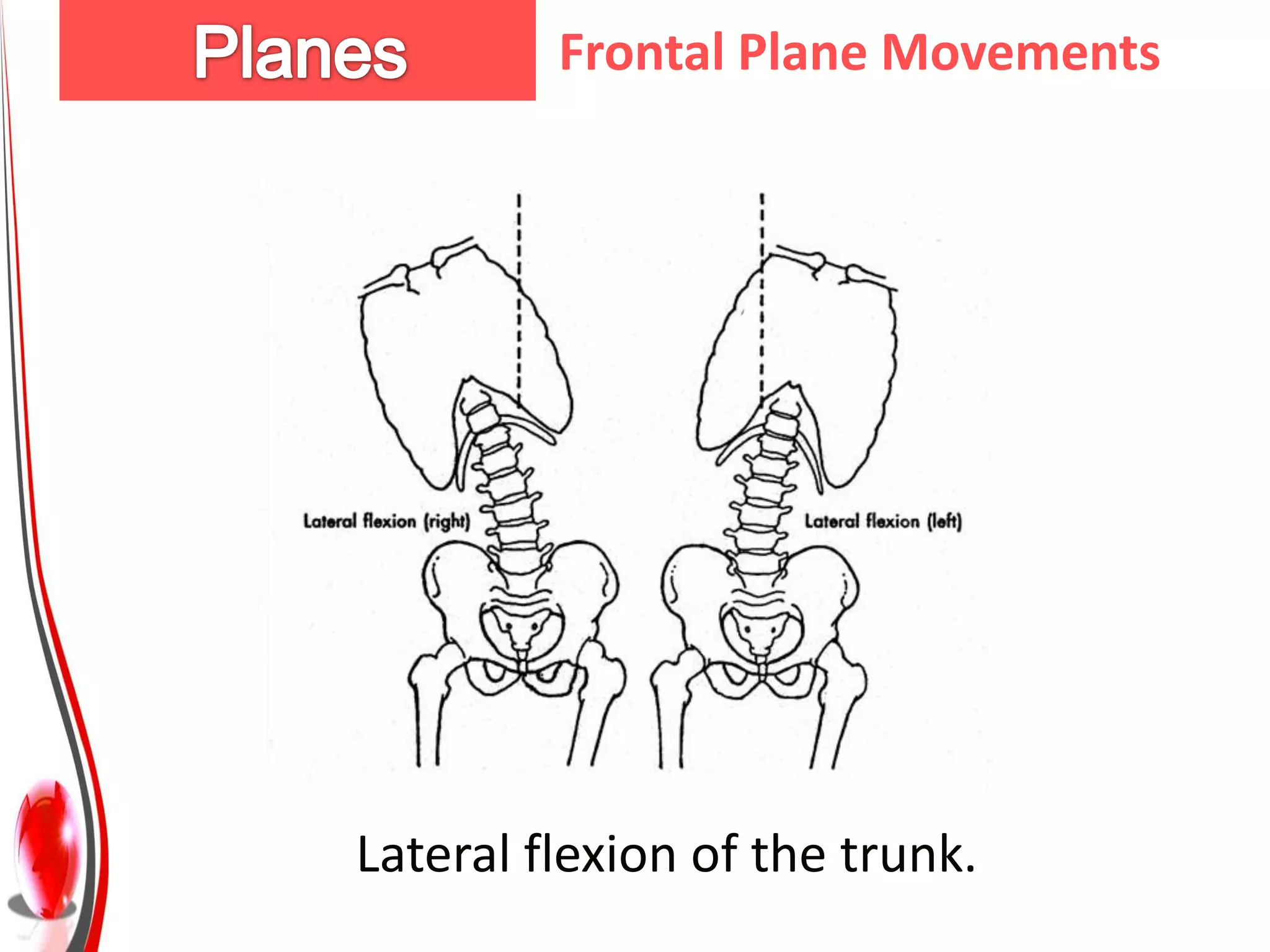
   – Lateral flexion
   – Elevation and depression of the shoulder girdle
     (or scapula)
   – Upward and downward rotation of the
     shoulder girdle (or scapula)
   – Radial deviation
   – Ulnar deviation
                            Wrist
Frontal Plane Movements


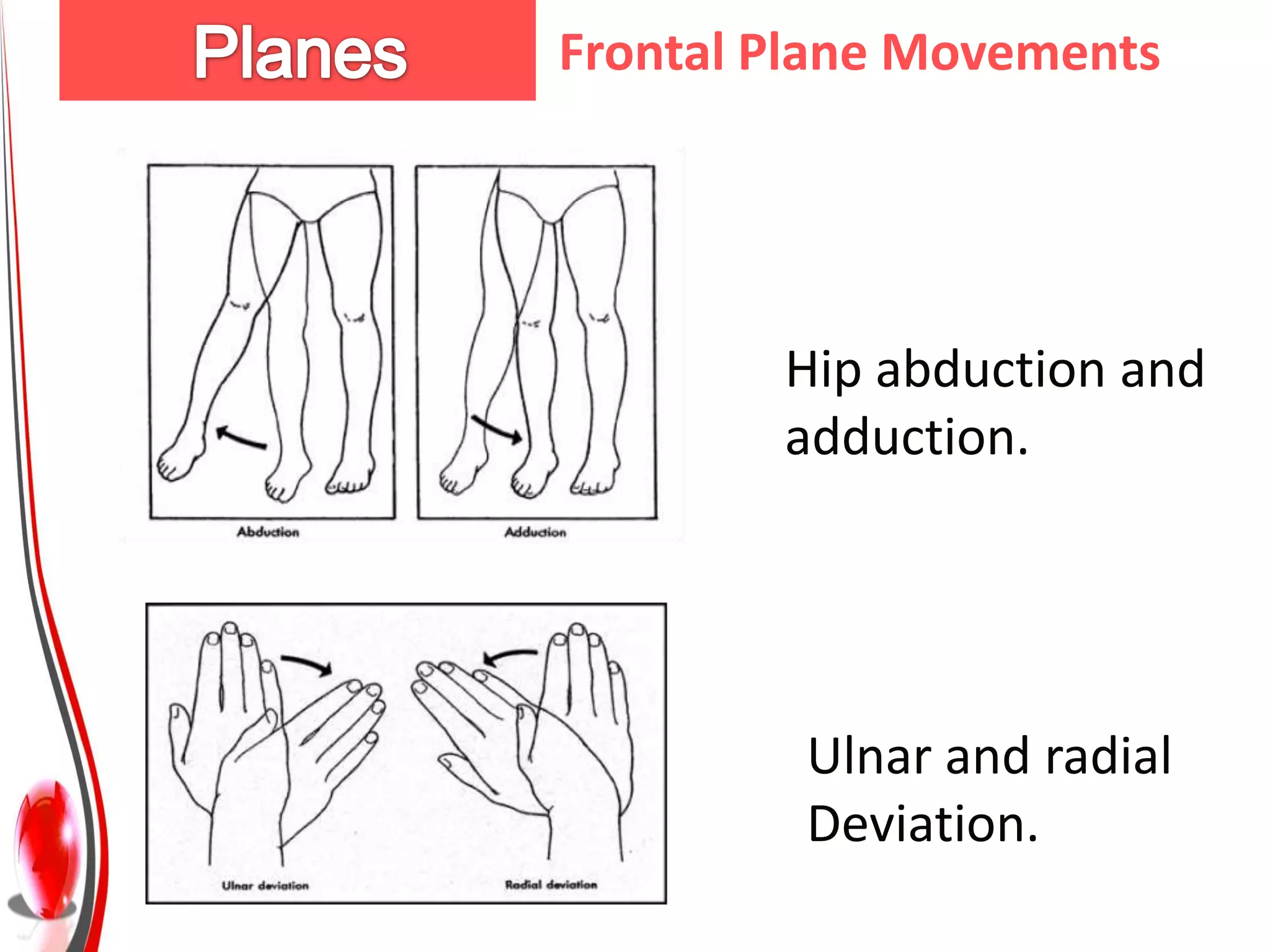
        Hip abduction and
        adduction.


         Ulnar and radial
         Deviation.
Frontal Plane Movements


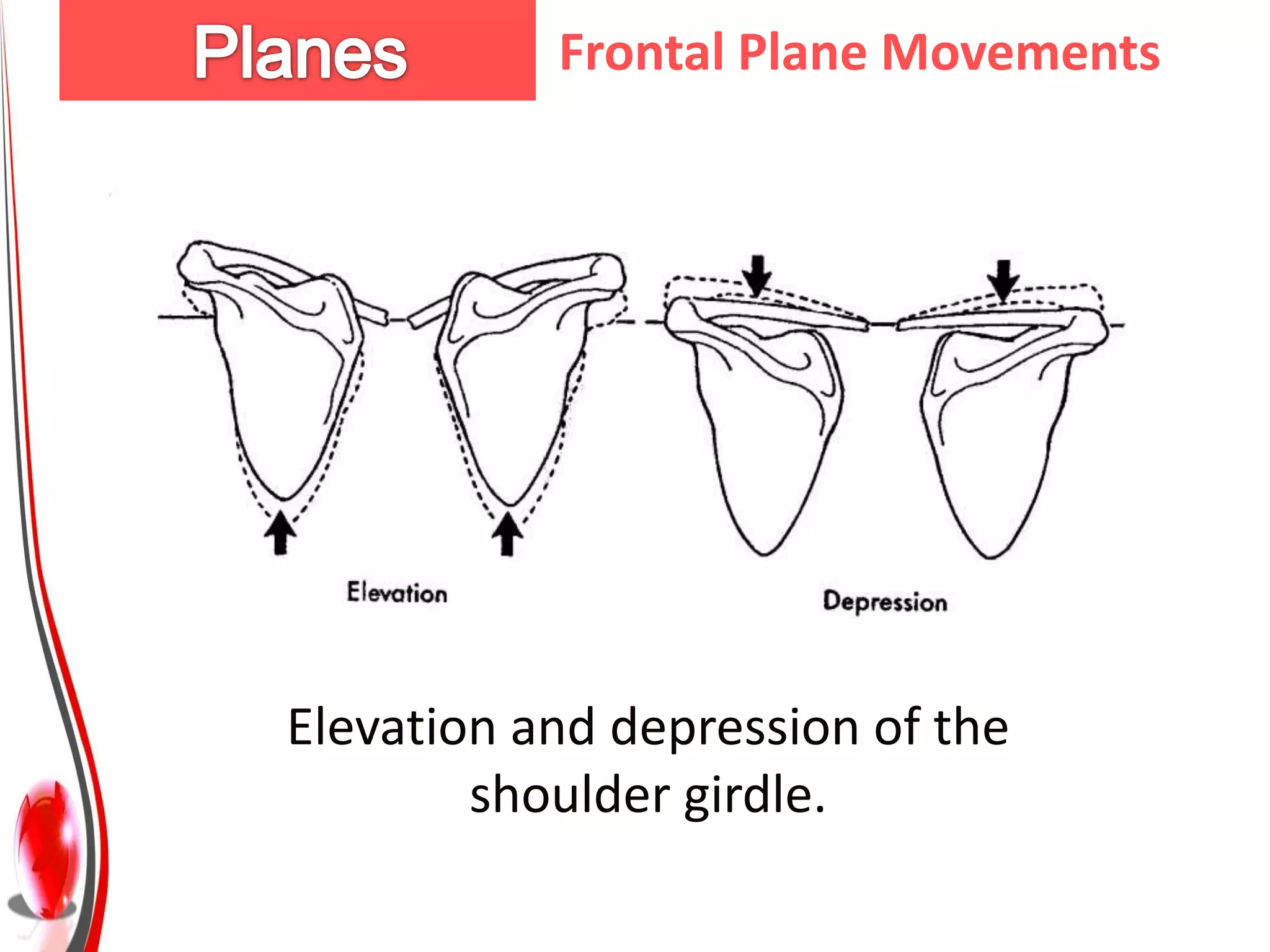
Elevation and depression of the
        shoulder girdle.
Frontal Plane Movements


Lateral flexion of the trunk.
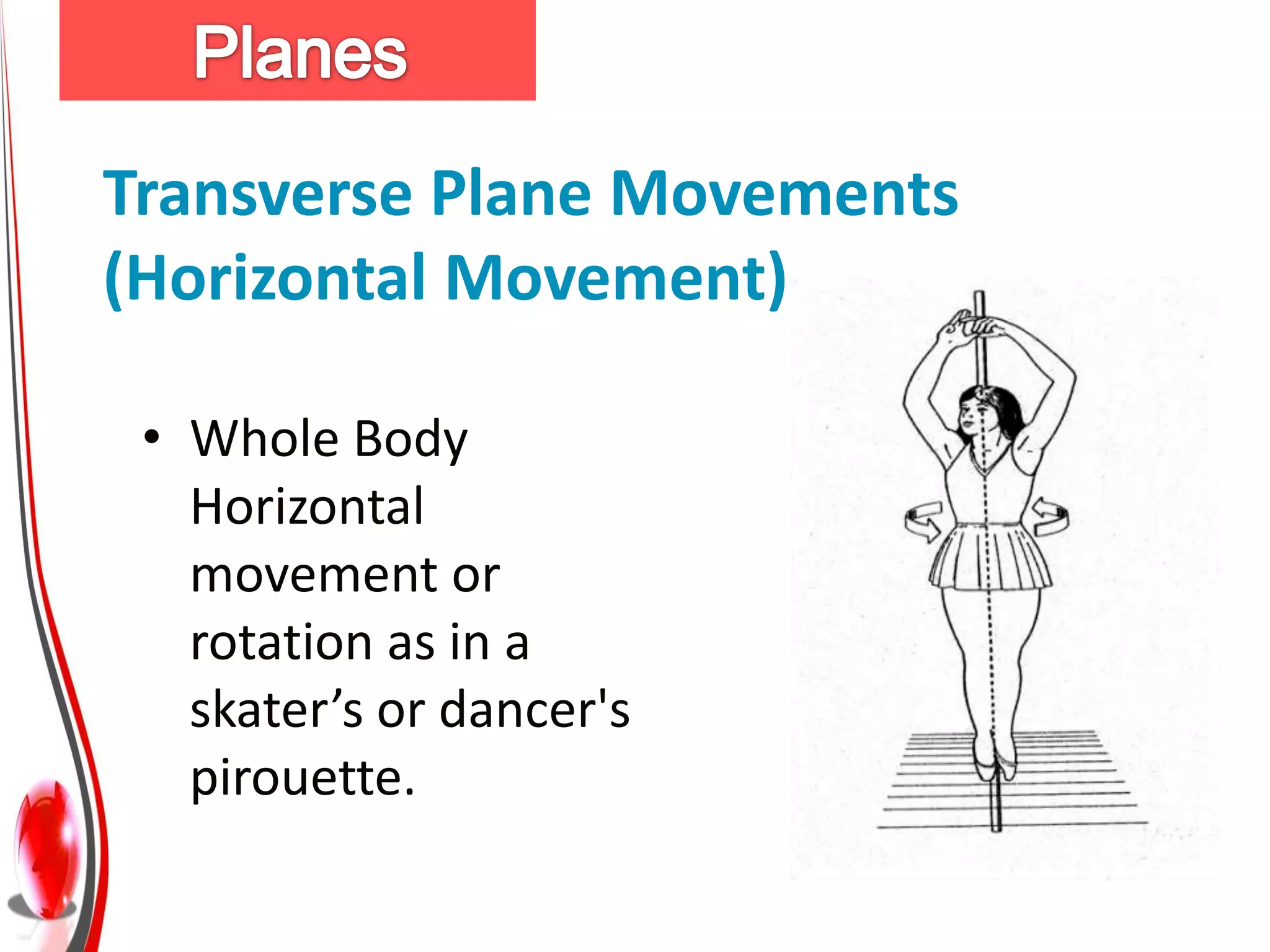
Transverse Plane Movements
(Horizontal Movement)

 • Whole Body
   Horizontal
   movement or
   rotation as in a
   skater’s or dancer's
   pirouette.
Transverse Plane Movements

Transverse Plane Movements
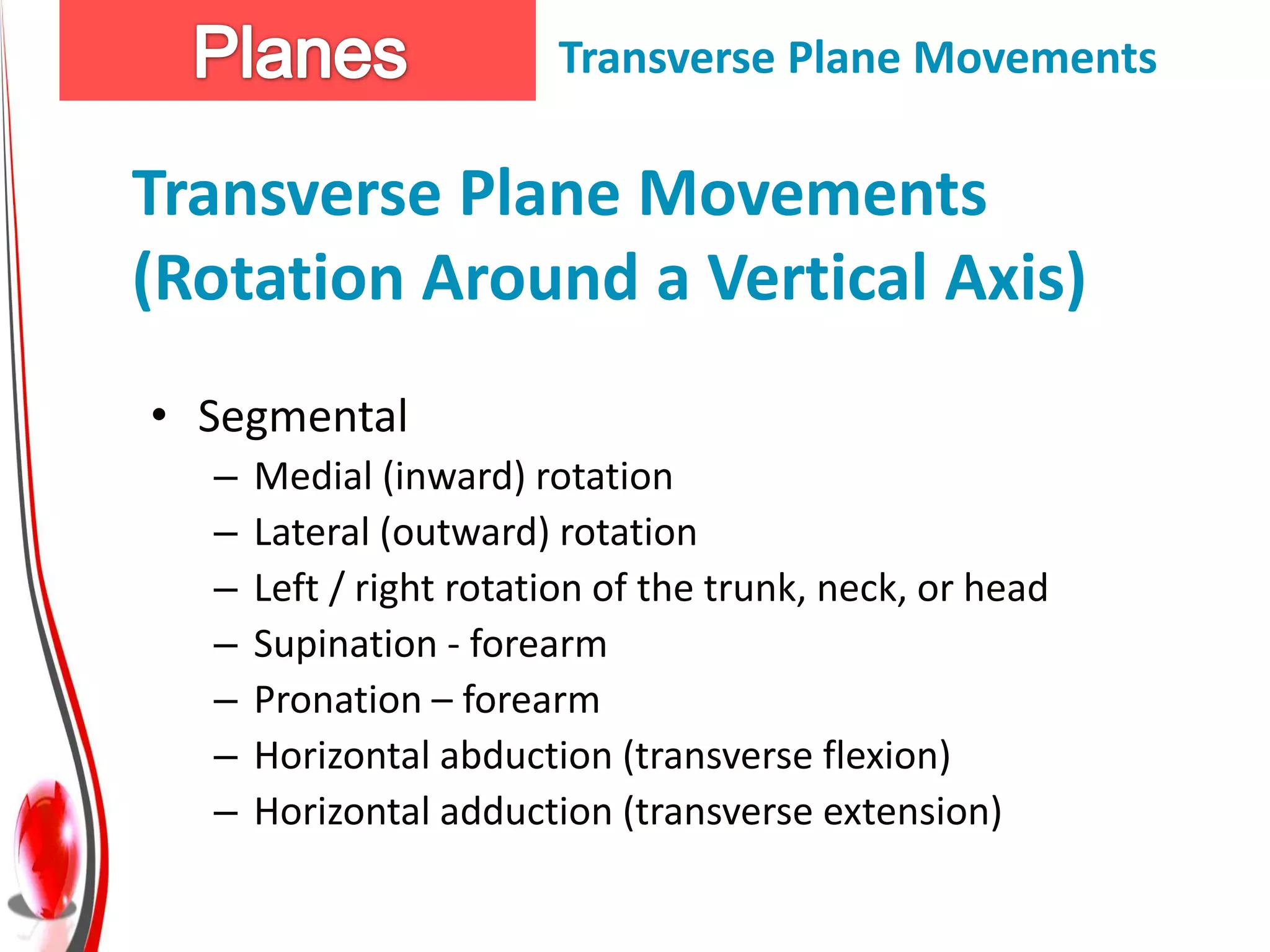
(Rotation Around a Vertical Axis)
• Segmental
  –   Medial (inward) rotation
  –   Lateral (outward) rotation
  –   Left / right rotation of the trunk, neck, or head
  –   Supination - forearm
  –   Pronation – forearm
  –   Horizontal abduction (transverse flexion)
  –   Horizontal adduction (transverse extension)
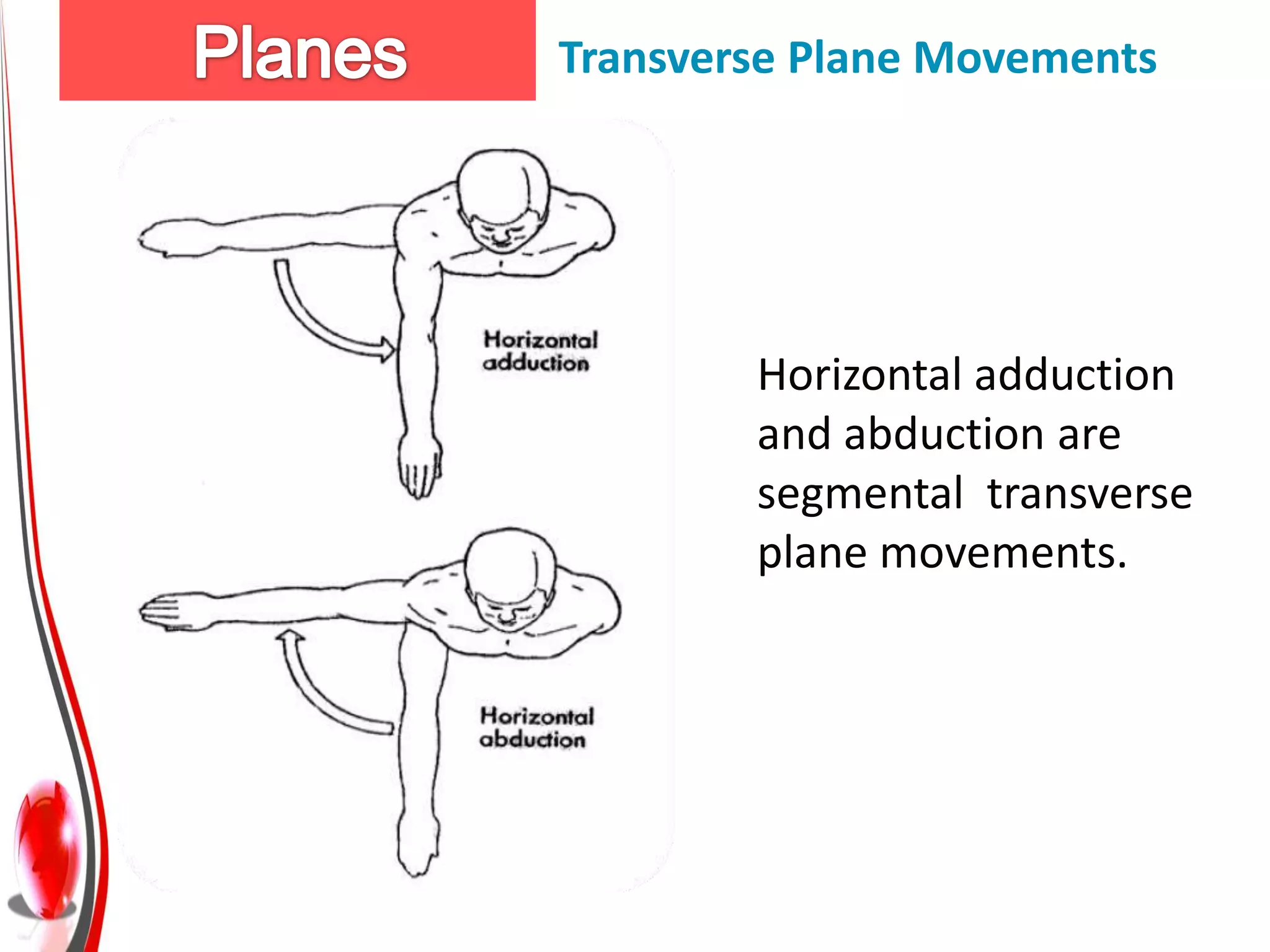
Transverse Plane Movements


        Horizontal adduction
        and abduction are
        segmental transverse
        plane movements.
Diagonal plane movements

Diagonal plane movements

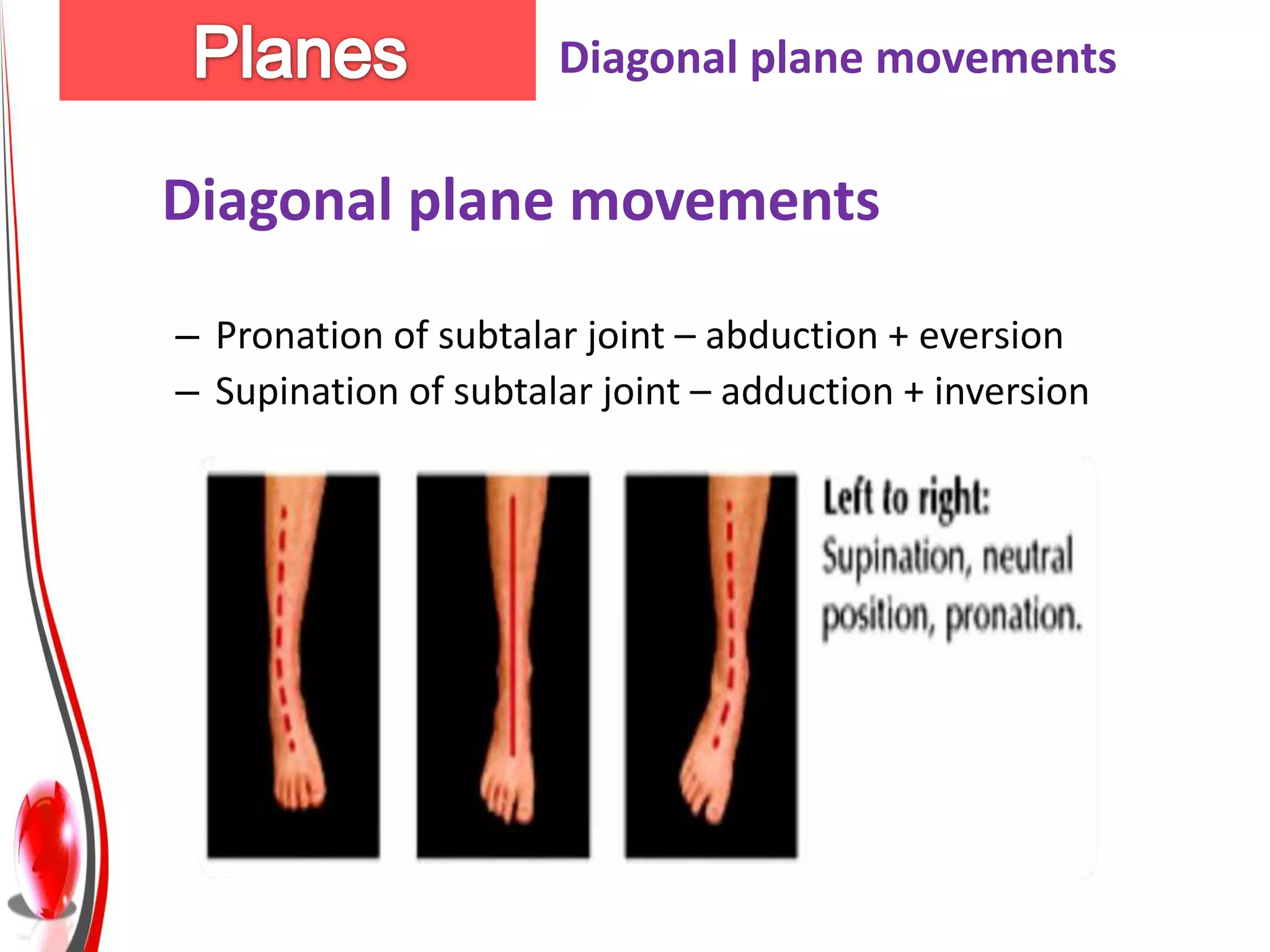
– Pronation of subtalar joint – abduction + eversion
– Supination of subtalar joint – adduction + inversion
Anatomical Reference Axes
(Axes is plural for axis)
• An imaginary axis of rotation that passes
  through a joint to which it is attached
  – Frontal or (mediolateral) axis- X-Axis
  – Sagittal or (anterioposterior) axis- Z-Axis
  – Longitudinal axis- Y-Axis

  Movement, both whole body and segmental,
   takes place in the cardinal planes and around
   the cardinal axes.
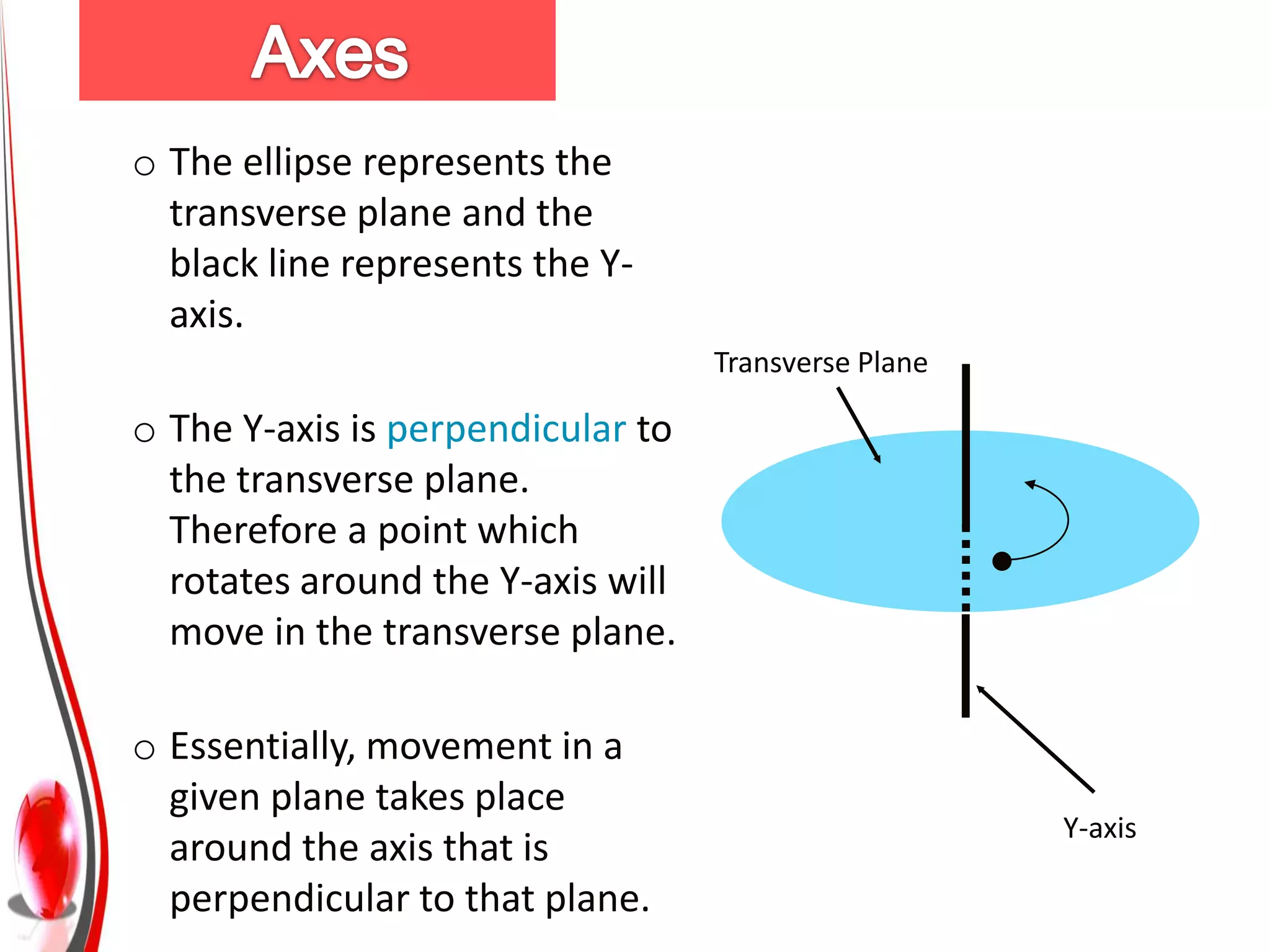
o The ellipse represents the
  transverse plane and the
  black line represents the Y-
  axis.
                                   Transverse Plane

o The Y-axis is perpendicular to
  the transverse plane.
  Therefore a point which
  rotates around the Y-axis will
  move in the transverse plane.

o Essentially, movement in a
  given plane takes place
                                                      Y-axis
  around the axis that is
  perpendicular to that plane.
X-Axis
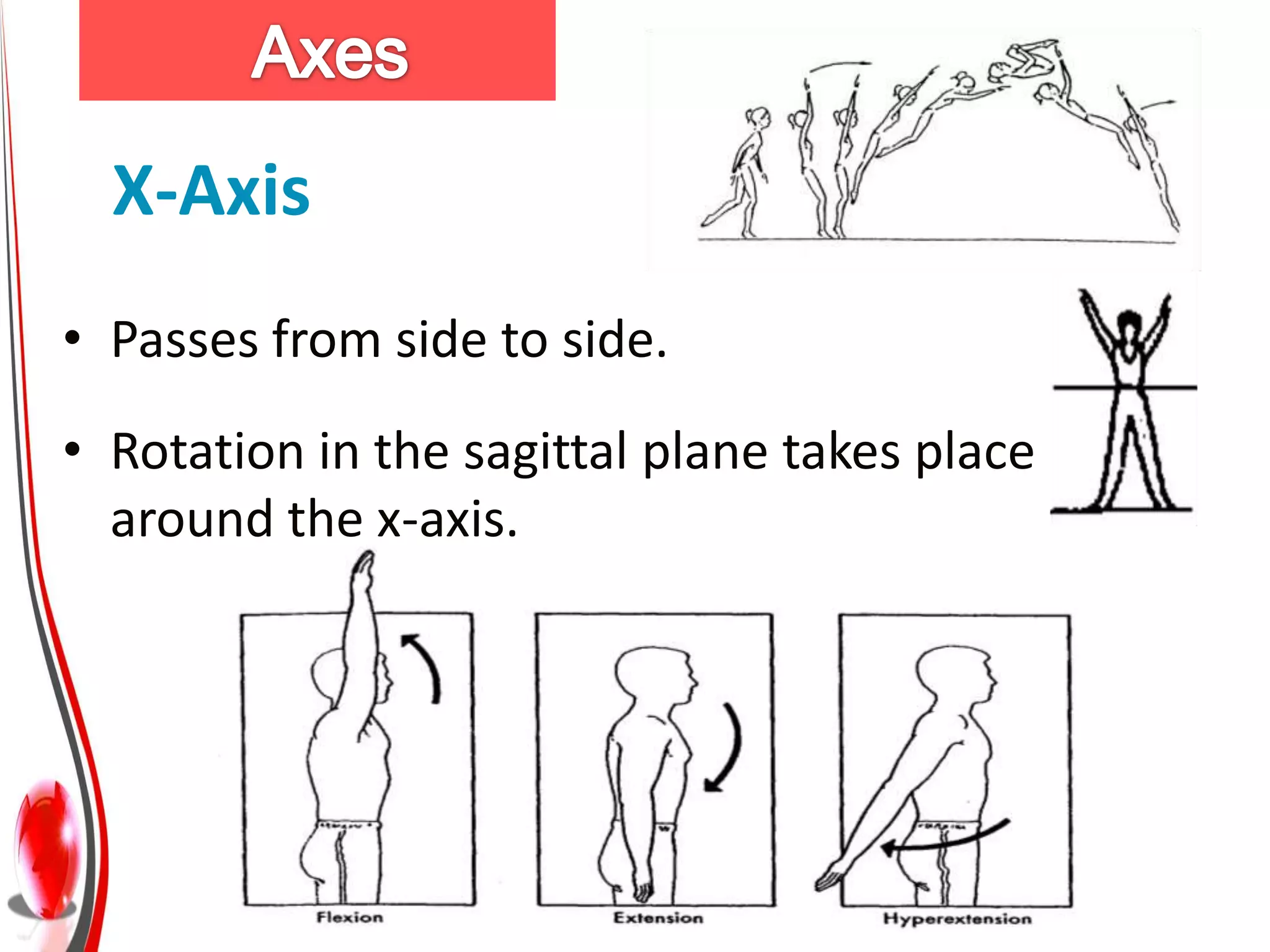
• Passes from side to side.
• Rotation in the sagittal plane takes place
  around the x-axis.
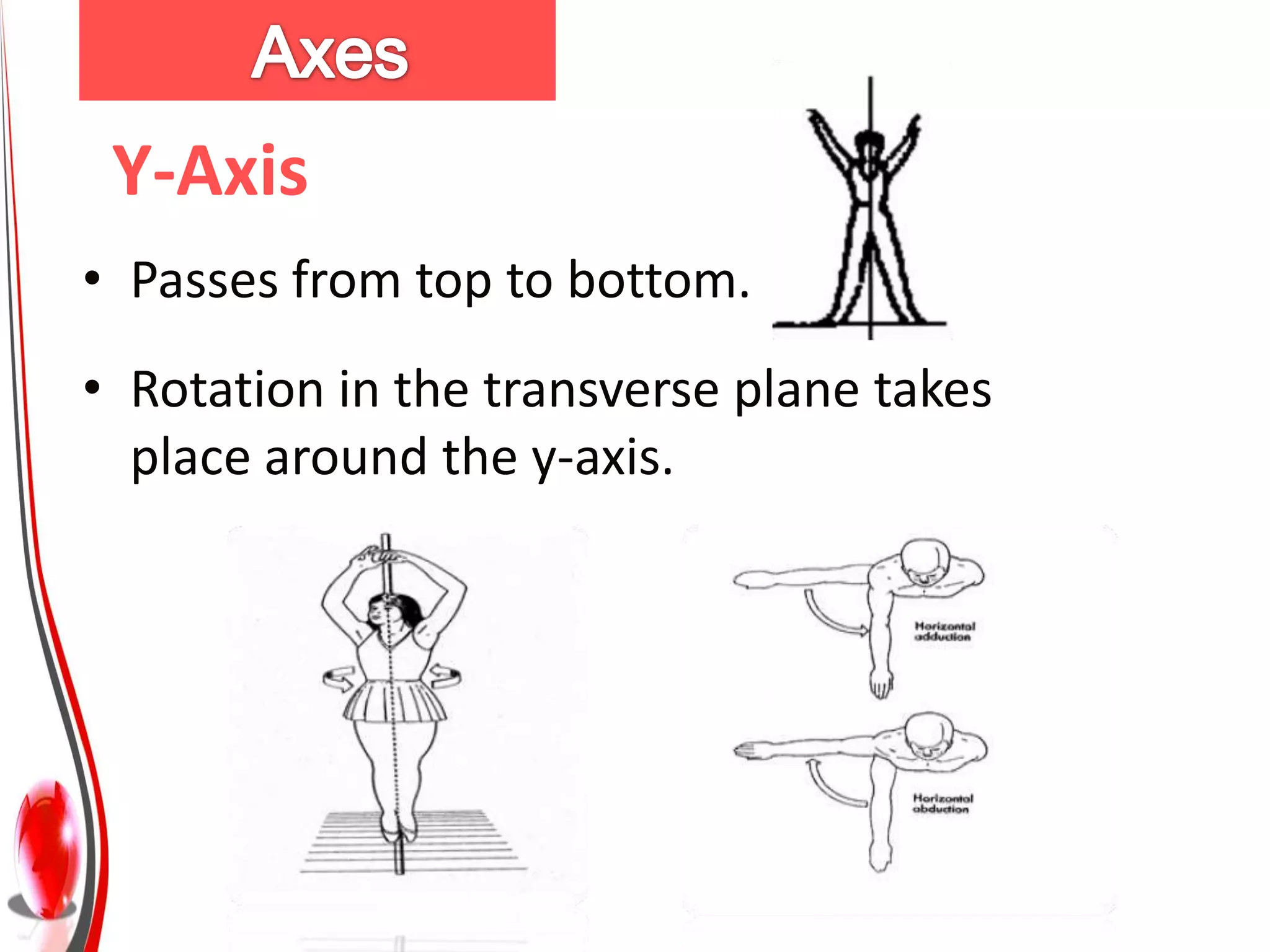
Y-Axis
• Passes from top to bottom.
• Rotation in the transverse plane takes
  place around the y-axis.
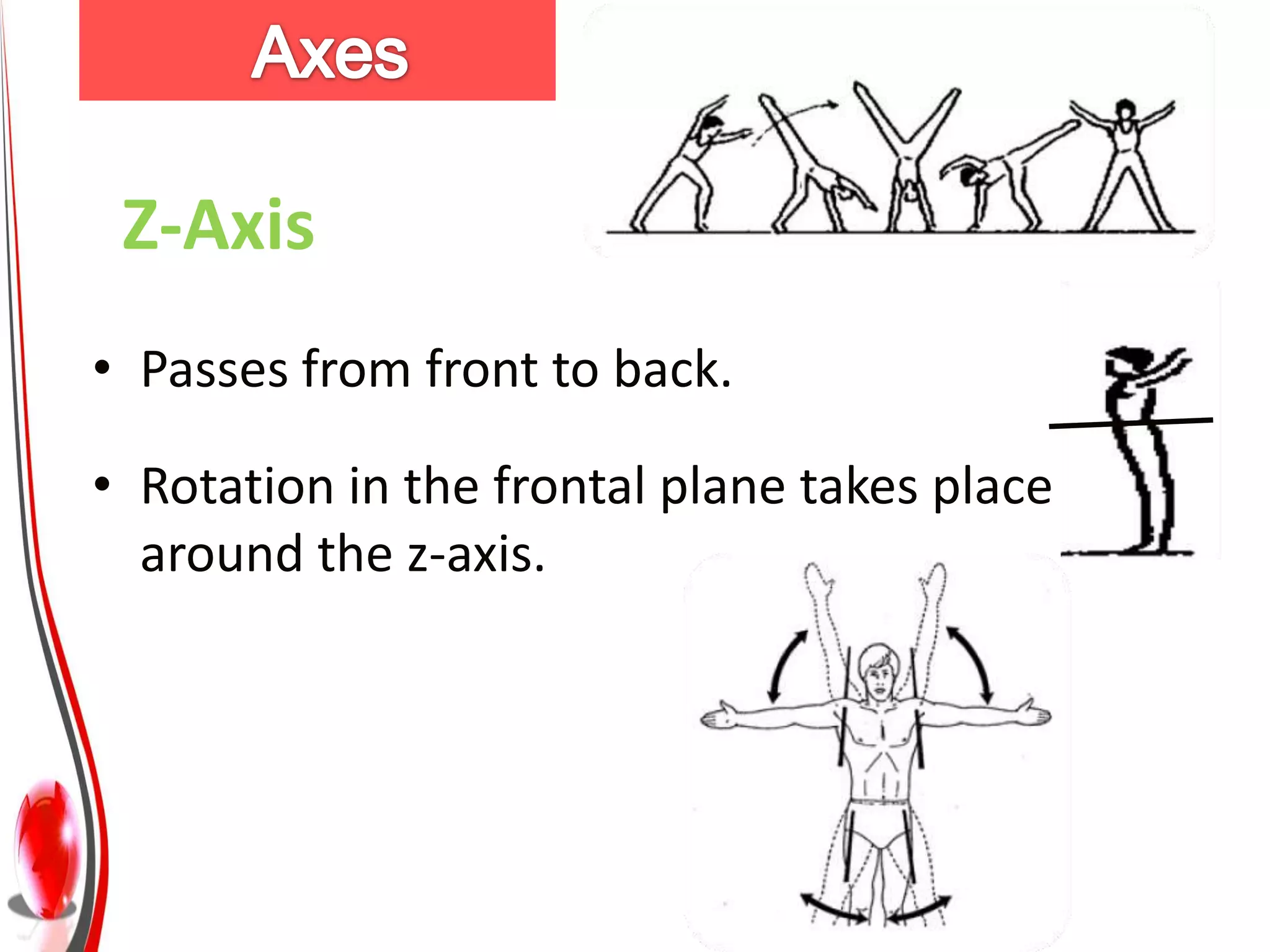
Z-Axis
• Passes from front to back.

• Rotation in the frontal plane takes place
  around the z-axis.
Summary of
Planes & Axes
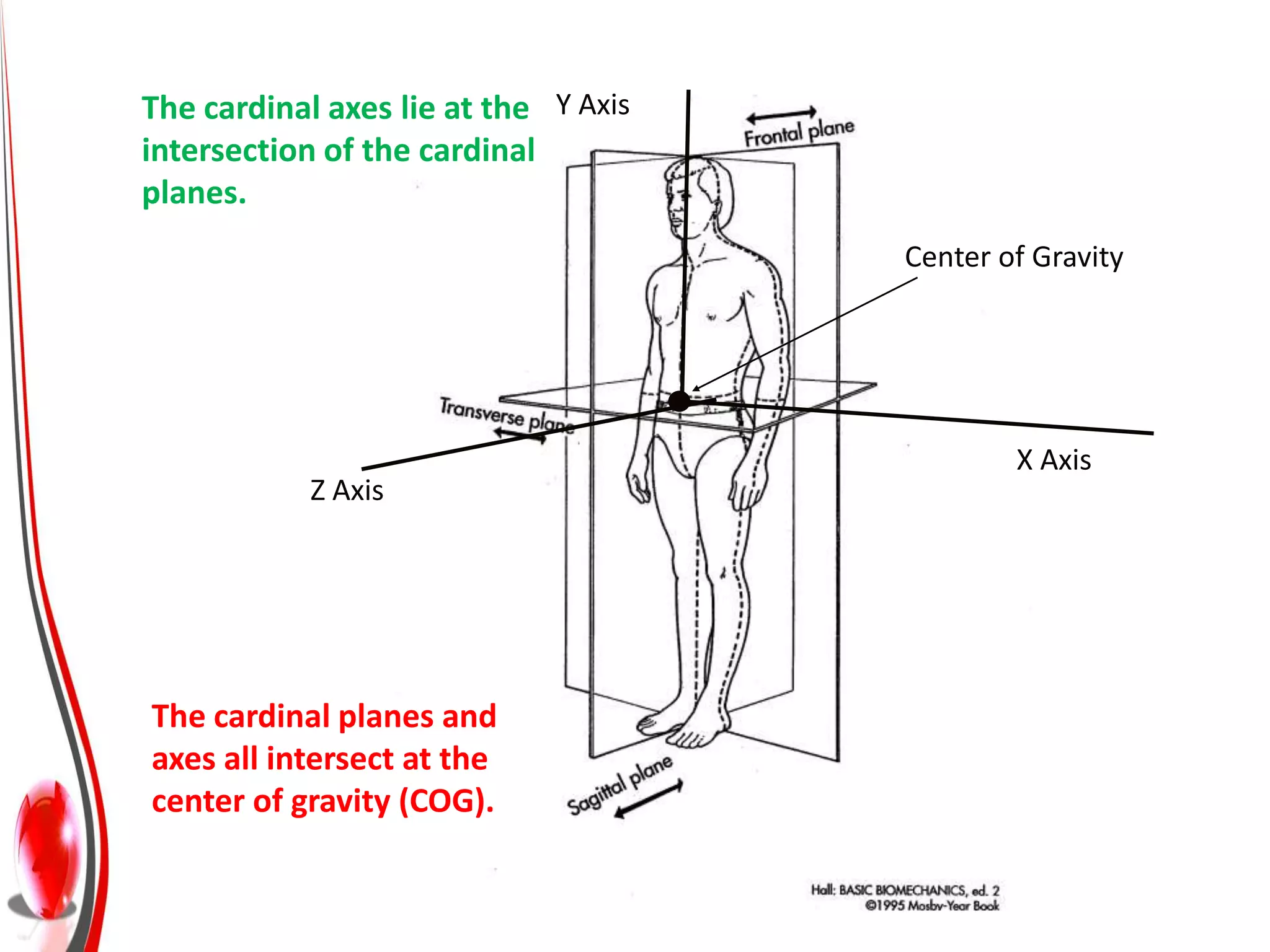
The cardinal axes lie at the Y Axis
intersection of the cardinal
planes.
                                      Center of Gravity


                                              X Axis
            Z Axis


The cardinal planes and
axes all intersect at the
center of gravity (COG).
Planes & axes

Planes & axes

  • 1.
    KKU_Biomech_M1_L4 Musculoskeletalsystem Lesson (4) Dr / Shimaa Essa Lecturer of physical therapy , faculty of community, King Khalid university
  • 2.
    Upon successful completionof this lesson you would be able to: 1- Identify dimensions of movement. 2- Comprehend Directional Terms Used in Describing Anatomy. 3- Identify cardinal and parallel planes and axes where body movements take place. 4- Distinguish between Planes and axes.
  • 3.
    Introduction The plane :is the surface on which the movement occurs or takes place. The axis : is the line around which the movement takes place. Axis is the singular and axes are the plural noun. Any movement occurs in a plane around an axis. Axis of the same plane makes an angle perpendicular to that plane.
  • 4.
    Dimensions of Movement •0 Dimension - point. • 1 Dimension - line. • 2 Dimensions - plane. • 3 Dimensions - cube, sphere. • 4 Dimensions - 3 Dimensions + time. Movement occurs in all 4 dimensions (time and space).
  • 5.
    Directional Terms Usedin Describing Anatomy • SUPERIOR – Directed upwards or towards the head • INFERIOR – Directed downwards or towards the feet • ANTERIOR – Directed towards the front of the body • POSTERIOR – Directed towards the back of the body
  • 6.
    Directional Terms Usedin Describing Anatomy • MEDIAL – Nearer the midline of the body • LATERAL – Farther from the midline of the body • PROXIMAL – Nearer to the attachment of a limb to the trunk • DISTAL – Farther from the attachment of the limb to the trunk • SUPERFICIAL – Located on or near the surface of the body • DEEP – Away from the surface of the body
  • 9.
    The Anatomical Position The position of reference for all movements. Also called the standing supine position
  • 10.
    1- Cardinal plane 3 imaginary perpendicular reference planes that divide the body in half by mass And represent where the axial skeleton movements take place 2- Parallel Plane. Is an imaginary surface where the movement of appendicular skeleton take place 3- Diagonal plane. Is a plane other than cardinal or parallel planes, Where movement occurs in a diagonal pattern
  • 11.
    1. Sagittal –Divides the body into left and right halves. 2. Frontal – Divides the body into front and back halves. 3. Transverse – Divides the body into top and bottom halves.
  • 12.
    Sagittal Plane Movements (Forward& Backward Movements) • Whole Body – Forward and backward movement such as front or back flips • Segmental – Flexion – Extension – Hyperextension – Dorsiflexion Ankle – Plantar flexion
  • 13.
    Back flips and frontflips are whole body sagittal plane movements.
  • 14.
    For a cyclist, theleg movements occur in the sagittal plane.
  • 15.
    Forward and backward movements at specificjoints such as the shoulder and ankle are sagittal plane movements.
  • 16.
    Frontal Plane Movements (Sideward& Vertical Movements) • Whole Body – Sideward movement as seen in sideward cartwheels
  • 17.
    Frontal Plane Movements (Sideward& Vertical Movements) • Segmental – Abduction – Adduction – Lateral flexion – Elevation and depression of the shoulder girdle (or scapula) – Upward and downward rotation of the shoulder girdle (or scapula) – Radial deviation – Ulnar deviation Wrist
  • 18.
    Frontal Plane Movements Hip abduction and adduction. Ulnar and radial Deviation.
  • 19.
    Frontal Plane Movements Elevationand depression of the shoulder girdle.
  • 20.
    Frontal Plane Movements Lateralflexion of the trunk.
  • 21.
    Transverse Plane Movements (HorizontalMovement) • Whole Body Horizontal movement or rotation as in a skater’s or dancer's pirouette.
  • 22.
    Transverse Plane Movements TransversePlane Movements (Rotation Around a Vertical Axis) • Segmental – Medial (inward) rotation – Lateral (outward) rotation – Left / right rotation of the trunk, neck, or head – Supination - forearm – Pronation – forearm – Horizontal abduction (transverse flexion) – Horizontal adduction (transverse extension)
  • 23.
    Transverse Plane Movements Horizontal adduction and abduction are segmental transverse plane movements.
  • 24.
    Diagonal plane movements Diagonalplane movements – Pronation of subtalar joint – abduction + eversion – Supination of subtalar joint – adduction + inversion
  • 25.
    Anatomical Reference Axes (Axesis plural for axis) • An imaginary axis of rotation that passes through a joint to which it is attached – Frontal or (mediolateral) axis- X-Axis – Sagittal or (anterioposterior) axis- Z-Axis – Longitudinal axis- Y-Axis Movement, both whole body and segmental, takes place in the cardinal planes and around the cardinal axes.
  • 26.
    o The ellipserepresents the transverse plane and the black line represents the Y- axis. Transverse Plane o The Y-axis is perpendicular to the transverse plane. Therefore a point which rotates around the Y-axis will move in the transverse plane. o Essentially, movement in a given plane takes place Y-axis around the axis that is perpendicular to that plane.
  • 27.
    X-Axis • Passes fromside to side. • Rotation in the sagittal plane takes place around the x-axis.
  • 28.
    Y-Axis • Passes fromtop to bottom. • Rotation in the transverse plane takes place around the y-axis.
  • 29.
    Z-Axis • Passes fromfront to back. • Rotation in the frontal plane takes place around the z-axis.
  • 30.
  • 31.
    The cardinal axeslie at the Y Axis intersection of the cardinal planes. Center of Gravity X Axis Z Axis The cardinal planes and axes all intersect at the center of gravity (COG).