AXIS AND PLANE
BY:- Abhishek Sahoo
Guided by :- dr. rituparna Mohanty
INTRODUCTION
 WHATISPLANE?
A plane is an imaginary flat surface along which a movement
takes place .
 WHATISAXIS?
An axis is a imaginary line about which movement takes
place .
 RELATIONSHIPOFAXISANDPLANE:-
An axis & plane perpendicular to each other .`
PLANE
PLANE:-
A plane is an imaginary flat surface along which a movement takes
place.
PLANES OF MOVEMENT:-
There are 3 planes of movement
I. Sagittal plane
II. Frontal plane
III. Transverse plane
PLANE
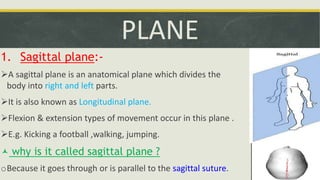
1. Sagittal plane:-
A sagittal plane is an anatomical plane which divides the
body into right and left parts.
It is also known as Longitudinal plane.
Flexion & extension types of movement occur in this plane .
E.g. Kicking a football ,walking, jumping.
 why is it called sagittal plane ?
oBecause it goes through or is parallel to the sagittal suture..
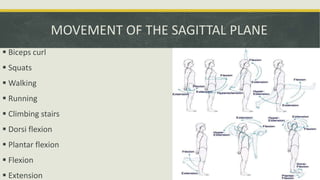
MOVEMENT OF THE SAGITTAL PLANE
 Biceps curl
 Squats
 Walking
 Running
 Climbing stairs
 Dorsi flexion
 Plantar flexion
 Flexion
 Extension
PLANE
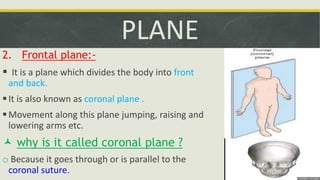
2. Frontal plane:-
 It is a plane which divides the body into front
and back.
It is also known as coronal plane .
Movement along this plane jumping, raising and
lowering arms etc.
 why is it called coronal plane ?
o Because it goes through or is parallel to the
coronal suture.
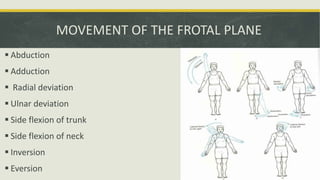
MOVEMENT OF THE FROTAL PLANE
 Abduction
 Adduction
 Radial deviation
 Ulnar deviation
 Side flexion of trunk
 Side flexion of neck
 Inversion
 Eversion
PLANE
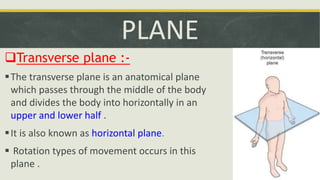
Transverse plane :-
The transverse plane is an anatomical plane
which passes through the middle of the body
and divides the body into horizontally in an
upper and lower half .
It is also known as horizontal plane.
 Rotation types of movement occurs in this
plane .
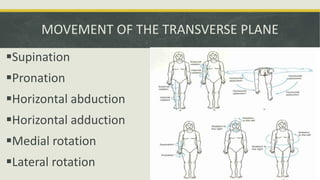
MOVEMENT OF THE TRANSVERSE PLANE
Supination
Pronation
Horizontal abduction
Horizontal adduction
Medial rotation
Lateral rotation
AXIS
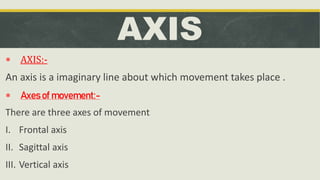
 AXIS:-
An axis is a imaginary line about which movement takes place .
 Axes of movement:-
There are three axes of movement
I. Frontal axis
II. Sagittal axis
III. Vertical axis
AXIS
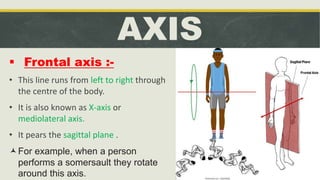
 Frontal axis :-
• This line runs from left to right through
the centre of the body.
• It is also known as X-axis or
mediolateral axis.
• It pears the sagittal plane .
For example, when a person
performs a somersault they rotate
around this axis.
AXIS
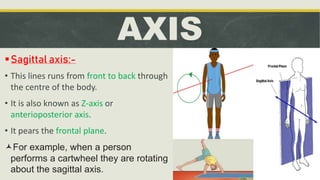
Sagittal axis:-
• This lines runs from front to back through
the centre of the body.
• It is also known as Z-axis or
anterioposterior axis.
• It pears the frontal plane.
For example, when a person
performs a cartwheel they are rotating
about the sagittal axis.
AXIS
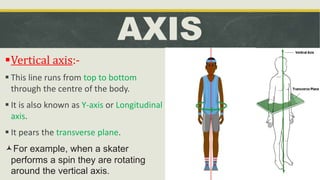
Vertical axis:-
 This line runs from top to bottom
through the centre of the body.
 It is also known as Y-axis or Longitudinal
axis.
 It pears the transverse plane.
For example, when a skater
performs a spin they are rotating
around the vertical axis.
AXIS AND PLANE .pptx

AXIS AND PLANE .pptx

  • 1.
    AXIS AND PLANE BY:-Abhishek Sahoo Guided by :- dr. rituparna Mohanty
  • 2.
    INTRODUCTION  WHATISPLANE? A planeis an imaginary flat surface along which a movement takes place .  WHATISAXIS? An axis is a imaginary line about which movement takes place .  RELATIONSHIPOFAXISANDPLANE:- An axis & plane perpendicular to each other .`
  • 3.
    PLANE PLANE:- A plane isan imaginary flat surface along which a movement takes place. PLANES OF MOVEMENT:- There are 3 planes of movement I. Sagittal plane II. Frontal plane III. Transverse plane
  • 4.
    PLANE 1. Sagittal plane:- Asagittal plane is an anatomical plane which divides the body into right and left parts. It is also known as Longitudinal plane. Flexion & extension types of movement occur in this plane . E.g. Kicking a football ,walking, jumping.  why is it called sagittal plane ? oBecause it goes through or is parallel to the sagittal suture..
  • 5.
    MOVEMENT OF THESAGITTAL PLANE  Biceps curl  Squats  Walking  Running  Climbing stairs  Dorsi flexion  Plantar flexion  Flexion  Extension
  • 6.
    PLANE 2. Frontal plane:- It is a plane which divides the body into front and back. It is also known as coronal plane . Movement along this plane jumping, raising and lowering arms etc.  why is it called coronal plane ? o Because it goes through or is parallel to the coronal suture.
  • 7.
    MOVEMENT OF THEFROTAL PLANE  Abduction  Adduction  Radial deviation  Ulnar deviation  Side flexion of trunk  Side flexion of neck  Inversion  Eversion
  • 8.
    PLANE Transverse plane :- Thetransverse plane is an anatomical plane which passes through the middle of the body and divides the body into horizontally in an upper and lower half . It is also known as horizontal plane.  Rotation types of movement occurs in this plane .
  • 9.
    MOVEMENT OF THETRANSVERSE PLANE Supination Pronation Horizontal abduction Horizontal adduction Medial rotation Lateral rotation
  • 10.
    AXIS  AXIS:- An axisis a imaginary line about which movement takes place .  Axes of movement:- There are three axes of movement I. Frontal axis II. Sagittal axis III. Vertical axis
  • 11.
    AXIS  Frontal axis:- • This line runs from left to right through the centre of the body. • It is also known as X-axis or mediolateral axis. • It pears the sagittal plane . For example, when a person performs a somersault they rotate around this axis.
  • 12.
    AXIS Sagittal axis:- • Thislines runs from front to back through the centre of the body. • It is also known as Z-axis or anterioposterior axis. • It pears the frontal plane. For example, when a person performs a cartwheel they are rotating about the sagittal axis.
  • 13.
    AXIS Vertical axis:-  Thisline runs from top to bottom through the centre of the body.  It is also known as Y-axis or Longitudinal axis.  It pears the transverse plane. For example, when a skater performs a spin they are rotating around the vertical axis.