REFERENCE SYSTEM FOR
MOVEMENT ANALYSIS
BY
CHANDRAKANT BARIK
NIS COACH
KALINGA STADIUM COMPLEX IN-CHARGE
CONTENT
• Center of gravity
• Anatomical Position
• Standard standing position
• Body’s Direction
• Axes and planes
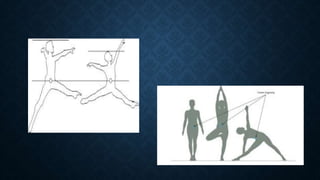
CENTER OF GRAVITY
ANATOMICAL POSITION
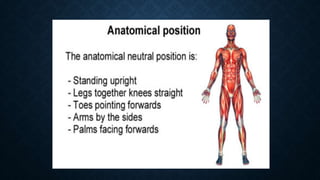
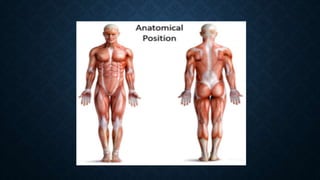
• A person is said to be standing in an anatomical position, if his arms hang at the
sides of the body, palms of the hands turned forward and feet perpendicular to the
lower legs.
• This position is the point of reference for analysis of the movements of the body.
STANDARD STANDING POSITION
• A person is said to be standing in standard standing position, if his arms hang at
the sides of the body, palms of the hands facing body and feet perpendicular to the
lower legs.
AXES AND PLANES
PLANES
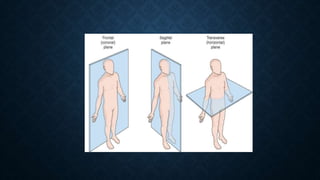
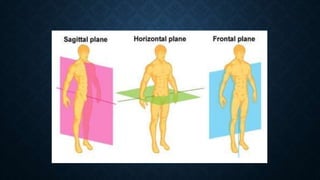
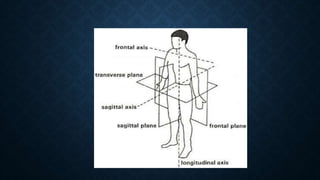
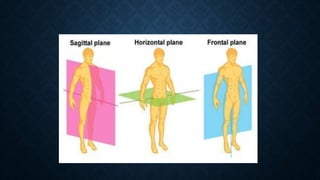
• They are imaginary 2 dimensional surface passing through the body and are useful
in describing the basic movements
• There are 3 planes in the body
• Each plane being perpendicular to the other two planes
• Types of planes
• 1-Frontal plane
• 2-Sagittal plane
• 3-Horizontal plane
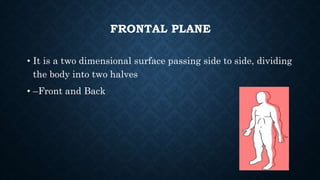
• It is a two dimensional surface passing side to side, dividing
the body into two halves
• –Front and Back
FRONTAL PLANE
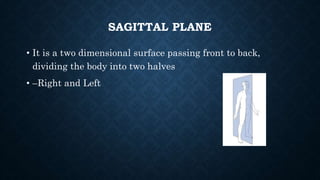
SAGITTAL PLANE
• It is a two dimensional surface passing front to back,
dividing the body into two halves
• –Right and Left
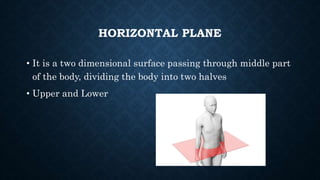
HORIZONTAL PLANE
• It is a two dimensional surface passing through middle part
of the body, dividing the body into two halves
• Upper and Lower
AXES
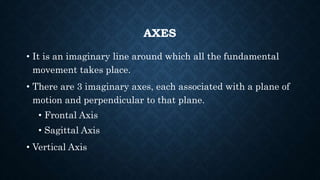
• It is an imaginary line around which all the fundamental
movement takes place.
• There are 3 imaginary axes, each associated with a plane of
motion and perpendicular to that plane.
• Frontal Axis
• Sagittal Axis
• Vertical Axis
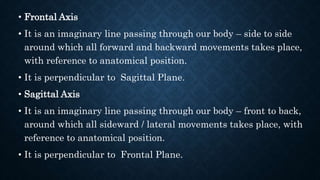
• Frontal Axis
• It is an imaginary line passing through our body – side to side
around which all forward and backward movements takes place,
with reference to anatomical position.
• It is perpendicular to Sagittal Plane.
• Sagittal Axis
• It is an imaginary line passing through our body – front to back,
around which all sideward / lateral movements takes place, with
reference to anatomical position.
• It is perpendicular to Frontal Plane.
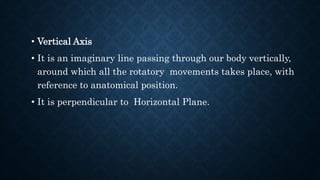
• Vertical Axis
• It is an imaginary line passing through our body vertically,
around which all the rotatory movements takes place, with
reference to anatomical position.
• It is perpendicular to Horizontal Plane.
THANK YOU

Reference System for Movement Analysis.pptx

  • 1.
    REFERENCE SYSTEM FOR MOVEMENTANALYSIS BY CHANDRAKANT BARIK NIS COACH KALINGA STADIUM COMPLEX IN-CHARGE
  • 2.
    CONTENT • Center ofgravity • Anatomical Position • Standard standing position • Body’s Direction • Axes and planes
  • 3.
  • 5.
    ANATOMICAL POSITION • Aperson is said to be standing in an anatomical position, if his arms hang at the sides of the body, palms of the hands turned forward and feet perpendicular to the lower legs. • This position is the point of reference for analysis of the movements of the body.
  • 9.
    STANDARD STANDING POSITION •A person is said to be standing in standard standing position, if his arms hang at the sides of the body, palms of the hands facing body and feet perpendicular to the lower legs.
  • 10.
  • 11.
    PLANES • They areimaginary 2 dimensional surface passing through the body and are useful in describing the basic movements • There are 3 planes in the body • Each plane being perpendicular to the other two planes • Types of planes • 1-Frontal plane • 2-Sagittal plane • 3-Horizontal plane
  • 12.
    • It isa two dimensional surface passing side to side, dividing the body into two halves • –Front and Back FRONTAL PLANE
  • 13.
    SAGITTAL PLANE • Itis a two dimensional surface passing front to back, dividing the body into two halves • –Right and Left
  • 14.
    HORIZONTAL PLANE • Itis a two dimensional surface passing through middle part of the body, dividing the body into two halves • Upper and Lower
  • 17.
    AXES • It isan imaginary line around which all the fundamental movement takes place. • There are 3 imaginary axes, each associated with a plane of motion and perpendicular to that plane. • Frontal Axis • Sagittal Axis • Vertical Axis
  • 18.
    • Frontal Axis •It is an imaginary line passing through our body – side to side around which all forward and backward movements takes place, with reference to anatomical position. • It is perpendicular to Sagittal Plane. • Sagittal Axis • It is an imaginary line passing through our body – front to back, around which all sideward / lateral movements takes place, with reference to anatomical position. • It is perpendicular to Frontal Plane.
  • 19.
    • Vertical Axis •It is an imaginary line passing through our body vertically, around which all the rotatory movements takes place, with reference to anatomical position. • It is perpendicular to Horizontal Plane.
  • 22.