Syphilis and neurosyphilis 101
T. Pallidum
Stages of syphilis
Primary Syphilis
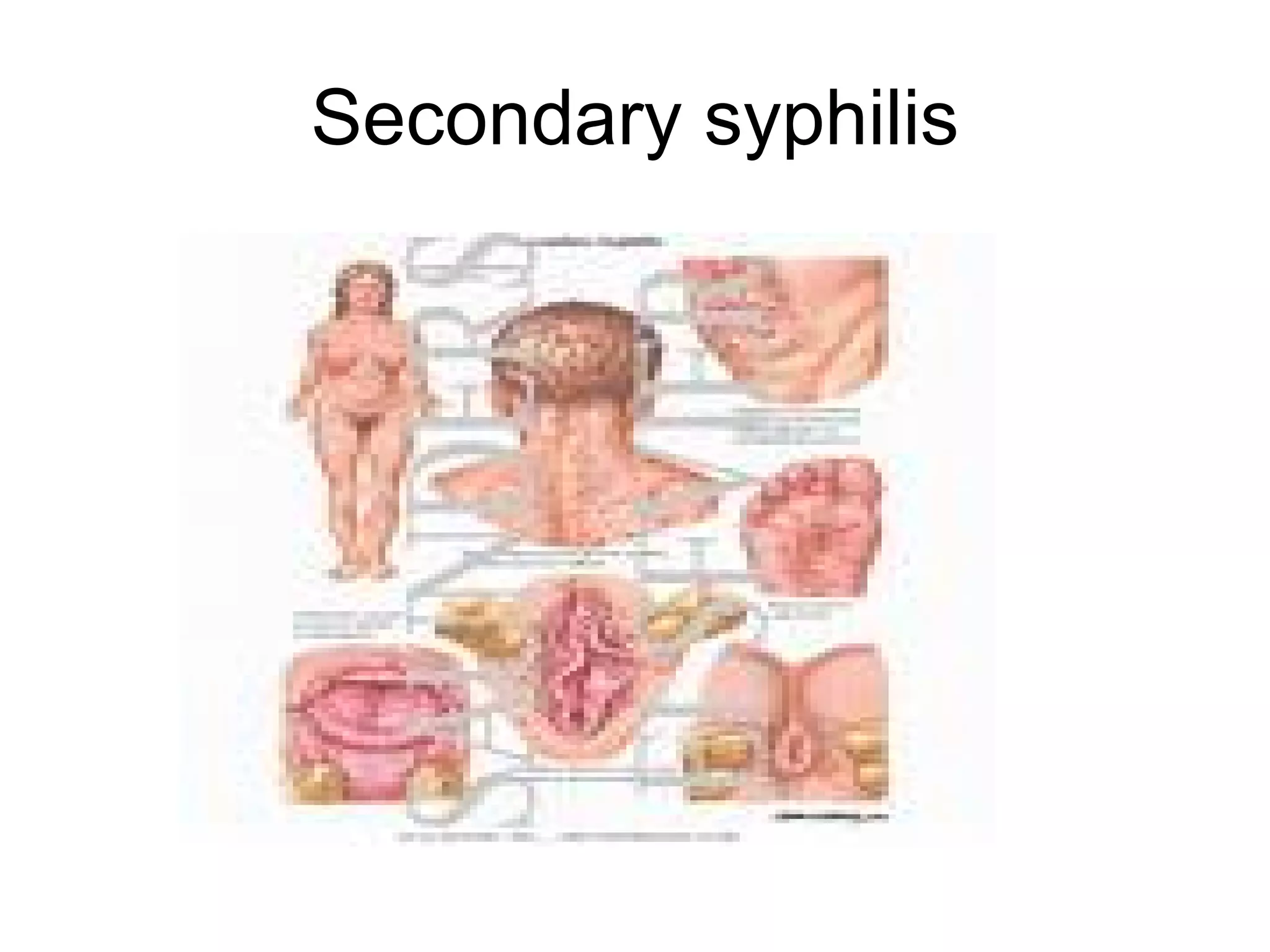
Secondary syphilis
Tertiary syphilis
Congenital syphilis
The manifestations of early congenital syphilis most often occur within the first 3 to 7 weeks after birth and result from active, disseminated fetal infection and the subsequent inflammatory response. Hepatosplenomegaly/hepatitis, jaundice, lesions on the skin and/or in the mouth (Fig. 5), rhinitis, inflammation of long bones (osteochondritis, perichondritis), adenopathy, and hematologic disturbances (anemia, thrombocytopenia) are typical early manifestations of congenital syphilis. Low birth weight and failure to thrive also may occur. Necrotizing funisitis--an inflammation of the umbilical cord characterized by spiral stripes of red and blue discoloration resembling a "barber's pole"--is a specific sign of congenital syphilis.[1]
Bones in Congenital syphilis
 
Prevalnce rate in PA
types of neurosyphilis There are four clinical types of neurosyphilis: Asymptomatic neurosyphilis  Meningovascular syphilis  General paresis [23]   Tabes   dorsalis
Asymptomatic and meningeal neurosyphilis The late forms of neurosyphilis (tabes dorsalis and general paresis) are seen much less frequently since the advent of antibiotics. The most common manifestations today are asymptomatic or symptomatic meningitis. Acute syphilitic  meningitis  usually occurs within the first year of infection; 10% of cases are diagnosed at the time of the secondary rash. Patients present with headache, meningeal irritation, and  cranial nerve  abnormalities, especially the  optic nerve ,  facial nerve , and the  vestibulocochlear  nerve .
Meningeovascular syphilis Meningovascular syphilis occurs a few months to 10 years (average, 7 years) after the primary syphilis infection. Meningovascular syphilis can be associated with  prodromal  symptoms lasting weeks to months before focal deficits are identifiable. Prodromal symptoms include unilateral numbness,  paresthesias , upper or lower extremity weakness,  headache ,  vertigo ,  insomnia , and psychiatric abnormalities such as personality changes. The focal deficits initially are intermittent or progress slowly over a few days. However, it can also present as an infectious  arteritis  and cause an  ischemic   stroke , an outcome more commonly seen in younger patients.  Angiography  may be able to demonstrate areas of narrowing in the blood vessels or total occlusion
General Paralysis on Insane General paresis, otherwise known as general paresis of the insane, is a severe manifestation of neurosyphilis. It is a chronic  dementia  which ultimately results in death in as little as 2-3 years. Patients generally have progressive personality changes, memory loss, and poor judgment. More rarely, they can have  psychosis ,  depression , or  mania
Common neurological signs Neurological  complications at this stage can be diverse. In some patients, manifestations include  generalized paresis of the insane  which results in personality changes, changes in emotional affect, hyperactive reflexes, and  Argyll-Robertson pupil . This is a diagnostic sign in which the small and irregular pupils constrict in response to focusing the eyes, but not to light.  Tabes   dorsalis , also known as  locomotor  ataxia , a disorder of the  spinal cord , often results in a characteristic shuffling gait.
Signs of tabes dorsalis Symptoms may not appear for some decades after the initial infection and include:  weakness , diminished reflexes, paresthesias including morbid cutaneous sensations having no objective cause, shooting and burning pains, pricking sensations, and formication (a sensation like that produced by small insects crawling over skin), and hypesthesias (abnormally diminished cutaneous, especially tactile, sensory modalities), unsteady gait ( locomotor  ataxia ), progressive degeneration of the joints,  loss of coordination , episodes of intense pain and disturbed sensation (including  glossodynia ), ,  dementia ,  deafness ,  visual impairment , and impaired response to light. The skeletal musculature is hypotonic due to destruction of the sensory limb of the spindle reflex. The deep tendon reflexes are also diminished or absent
Prognosis of tabes dorsalis If left untreated, tabes dorsalis can lead to  paralysis ,  dementia , and  blindness . Existing nerve damage cannot be reversed
General paralysis of Insane The onset of psychiatric symptoms of general paresis can be insidious, first noticed by family and friends rather than the patient. These include loss of ambition at work, memory lapses, irritability, unusual giddiness, apathy, withdrawal, and a decline in attention to personal affairs. Later, patients may present with mental changes simulating schizophrenia, euphoric mania, paranoia, toxic psychosis, or presenile dementias. Presenile dementia is most common, manifesting with depression, confusion, and severe impairment of memory and judgment
Late stage of General Paralysis In the late stages of the disease, occurring generally within 5 years of the onset of symptoms, almost all patients with general paresis are demented, often with periodic convulsions and progressive vegetative degeneration until they die. The mnemonic PARESIS captures these signs, as follows: personality, affect, reflexes (hyperactive), eye (eg, Argyll Robertson pupils), sensorium (eg, illusions, delusions, hallucinations), intellect (eg, decreased recent memory, orientation, calculations, judgment, insight), and speech.
Neurosyphilis
Meningeal neurosyphilis
Diagnosis of neurosyphilis Certain physical signs and symptoms in neurosyphilis may cause suspicion of a somatoform disorder; they include lancinating pain, transient hemiparesis, transient sensory deficit, paresthesias, headache, ataxia, dysphasias, and multiple sclerosis–like symptoms. The paretic patient may exhibit histrionic behavior with grandiosity, raising suspicion of a primary conversion disorder rather than a neuro-organic etiology. To summarize, the typical neuropsychiatric presentations of neurosyphilis include delirium, mania, hallucinosis or psychosis, dementia, and depression
Tests of neurosyphilis In neurosyphilis, it is important to test the spinal fluid for signs of syphilis. Tests to look for problems with the nervous system may include: Lumbar puncture  and a  CSF fluid analysis   Cranial CT scan   MRI  scan of the brain, brainstem, or spinal cord  Cerebral angiogram
CSF changes in neurosyphilis The CSF is characterized by lymphocytic pleocytosis, elevation of protein levels, elevation of immunoglobulin G index, and reactive VDRL test result. Check the serum fluorescent treponemal antibody absorption (FTA-ABS) test
treatment Penicillin and their different preparations. Oral penicillin

Syphilis and Neurosyphilis 101

  • 1.
  • 2.
  • 3.
  • 4.
  • 5.
  • 6.
  • 7.
  • 8.
    The manifestations ofearly congenital syphilis most often occur within the first 3 to 7 weeks after birth and result from active, disseminated fetal infection and the subsequent inflammatory response. Hepatosplenomegaly/hepatitis, jaundice, lesions on the skin and/or in the mouth (Fig. 5), rhinitis, inflammation of long bones (osteochondritis, perichondritis), adenopathy, and hematologic disturbances (anemia, thrombocytopenia) are typical early manifestations of congenital syphilis. Low birth weight and failure to thrive also may occur. Necrotizing funisitis--an inflammation of the umbilical cord characterized by spiral stripes of red and blue discoloration resembling a "barber's pole"--is a specific sign of congenital syphilis.[1]
  • 9.
  • 10.
  • 11.
  • 12.
    types of neurosyphilisThere are four clinical types of neurosyphilis: Asymptomatic neurosyphilis Meningovascular syphilis General paresis [23] Tabes dorsalis
  • 13.
    Asymptomatic and meningealneurosyphilis The late forms of neurosyphilis (tabes dorsalis and general paresis) are seen much less frequently since the advent of antibiotics. The most common manifestations today are asymptomatic or symptomatic meningitis. Acute syphilitic meningitis usually occurs within the first year of infection; 10% of cases are diagnosed at the time of the secondary rash. Patients present with headache, meningeal irritation, and cranial nerve abnormalities, especially the optic nerve , facial nerve , and the vestibulocochlear nerve .
  • 14.
    Meningeovascular syphilis Meningovascularsyphilis occurs a few months to 10 years (average, 7 years) after the primary syphilis infection. Meningovascular syphilis can be associated with prodromal symptoms lasting weeks to months before focal deficits are identifiable. Prodromal symptoms include unilateral numbness, paresthesias , upper or lower extremity weakness, headache , vertigo , insomnia , and psychiatric abnormalities such as personality changes. The focal deficits initially are intermittent or progress slowly over a few days. However, it can also present as an infectious arteritis and cause an ischemic stroke , an outcome more commonly seen in younger patients. Angiography may be able to demonstrate areas of narrowing in the blood vessels or total occlusion
  • 15.
    General Paralysis onInsane General paresis, otherwise known as general paresis of the insane, is a severe manifestation of neurosyphilis. It is a chronic dementia which ultimately results in death in as little as 2-3 years. Patients generally have progressive personality changes, memory loss, and poor judgment. More rarely, they can have psychosis , depression , or mania
  • 16.
    Common neurological signsNeurological complications at this stage can be diverse. In some patients, manifestations include generalized paresis of the insane which results in personality changes, changes in emotional affect, hyperactive reflexes, and Argyll-Robertson pupil . This is a diagnostic sign in which the small and irregular pupils constrict in response to focusing the eyes, but not to light. Tabes dorsalis , also known as locomotor ataxia , a disorder of the spinal cord , often results in a characteristic shuffling gait.
  • 17.
    Signs of tabesdorsalis Symptoms may not appear for some decades after the initial infection and include: weakness , diminished reflexes, paresthesias including morbid cutaneous sensations having no objective cause, shooting and burning pains, pricking sensations, and formication (a sensation like that produced by small insects crawling over skin), and hypesthesias (abnormally diminished cutaneous, especially tactile, sensory modalities), unsteady gait ( locomotor ataxia ), progressive degeneration of the joints, loss of coordination , episodes of intense pain and disturbed sensation (including glossodynia ), , dementia , deafness , visual impairment , and impaired response to light. The skeletal musculature is hypotonic due to destruction of the sensory limb of the spindle reflex. The deep tendon reflexes are also diminished or absent
  • 18.
    Prognosis of tabesdorsalis If left untreated, tabes dorsalis can lead to paralysis , dementia , and blindness . Existing nerve damage cannot be reversed
  • 19.
    General paralysis ofInsane The onset of psychiatric symptoms of general paresis can be insidious, first noticed by family and friends rather than the patient. These include loss of ambition at work, memory lapses, irritability, unusual giddiness, apathy, withdrawal, and a decline in attention to personal affairs. Later, patients may present with mental changes simulating schizophrenia, euphoric mania, paranoia, toxic psychosis, or presenile dementias. Presenile dementia is most common, manifesting with depression, confusion, and severe impairment of memory and judgment
  • 20.
    Late stage ofGeneral Paralysis In the late stages of the disease, occurring generally within 5 years of the onset of symptoms, almost all patients with general paresis are demented, often with periodic convulsions and progressive vegetative degeneration until they die. The mnemonic PARESIS captures these signs, as follows: personality, affect, reflexes (hyperactive), eye (eg, Argyll Robertson pupils), sensorium (eg, illusions, delusions, hallucinations), intellect (eg, decreased recent memory, orientation, calculations, judgment, insight), and speech.
  • 21.
  • 22.
  • 23.
    Diagnosis of neurosyphilisCertain physical signs and symptoms in neurosyphilis may cause suspicion of a somatoform disorder; they include lancinating pain, transient hemiparesis, transient sensory deficit, paresthesias, headache, ataxia, dysphasias, and multiple sclerosis–like symptoms. The paretic patient may exhibit histrionic behavior with grandiosity, raising suspicion of a primary conversion disorder rather than a neuro-organic etiology. To summarize, the typical neuropsychiatric presentations of neurosyphilis include delirium, mania, hallucinosis or psychosis, dementia, and depression
  • 24.
    Tests of neurosyphilisIn neurosyphilis, it is important to test the spinal fluid for signs of syphilis. Tests to look for problems with the nervous system may include: Lumbar puncture and a CSF fluid analysis Cranial CT scan MRI scan of the brain, brainstem, or spinal cord Cerebral angiogram
  • 25.
    CSF changes inneurosyphilis The CSF is characterized by lymphocytic pleocytosis, elevation of protein levels, elevation of immunoglobulin G index, and reactive VDRL test result. Check the serum fluorescent treponemal antibody absorption (FTA-ABS) test
  • 26.
    treatment Penicillin andtheir different preparations. Oral penicillin