CVP & PCWP MONITORING
Sultan Qaboos University Hospital, Muscat
AGENDA
 Cardiac cycle
 CVP
 PAP
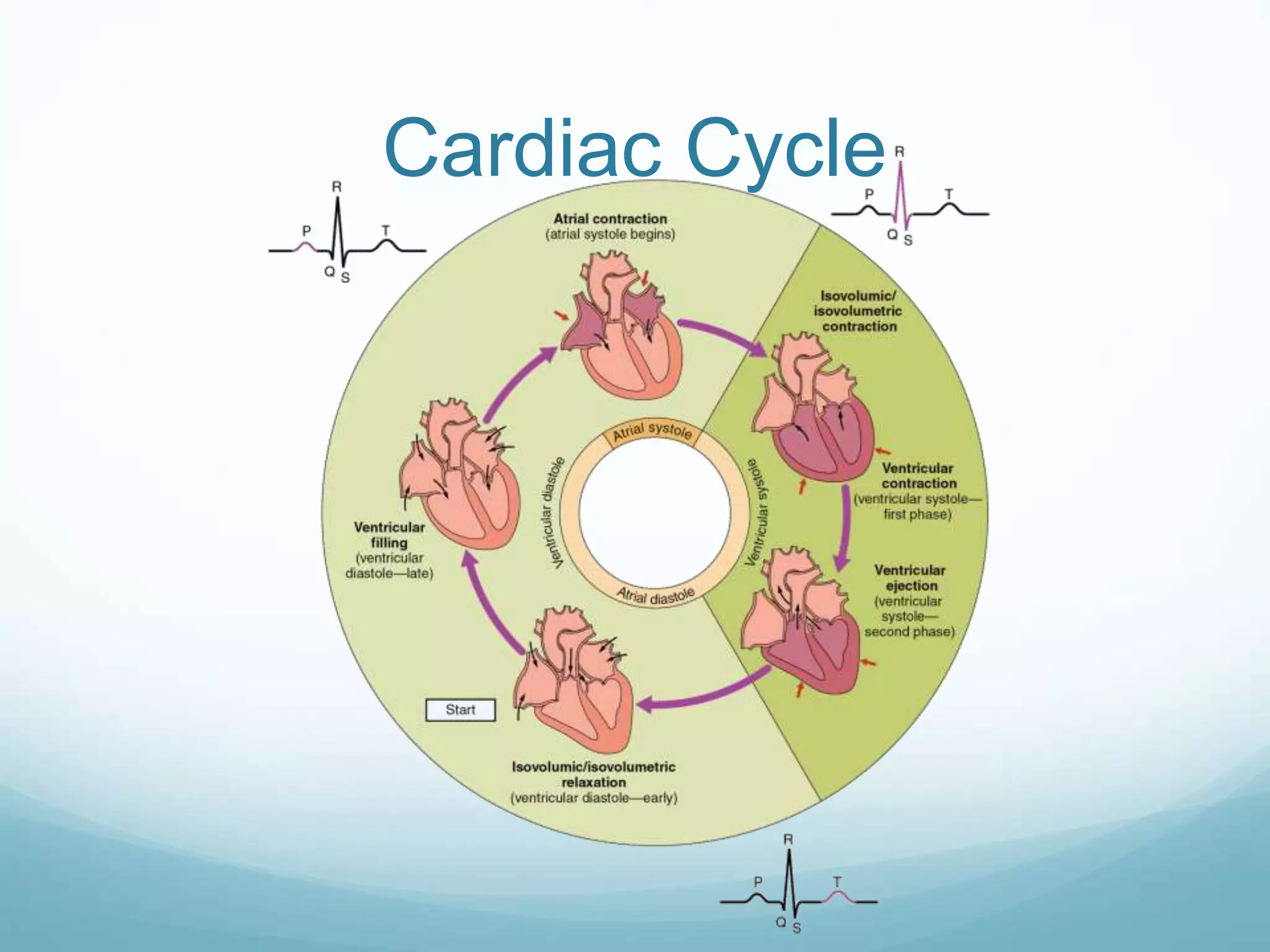
Cardiac Cycle
 The series of electrical and mechanical events that
constitute a single heart beat
Cardiac Cycle
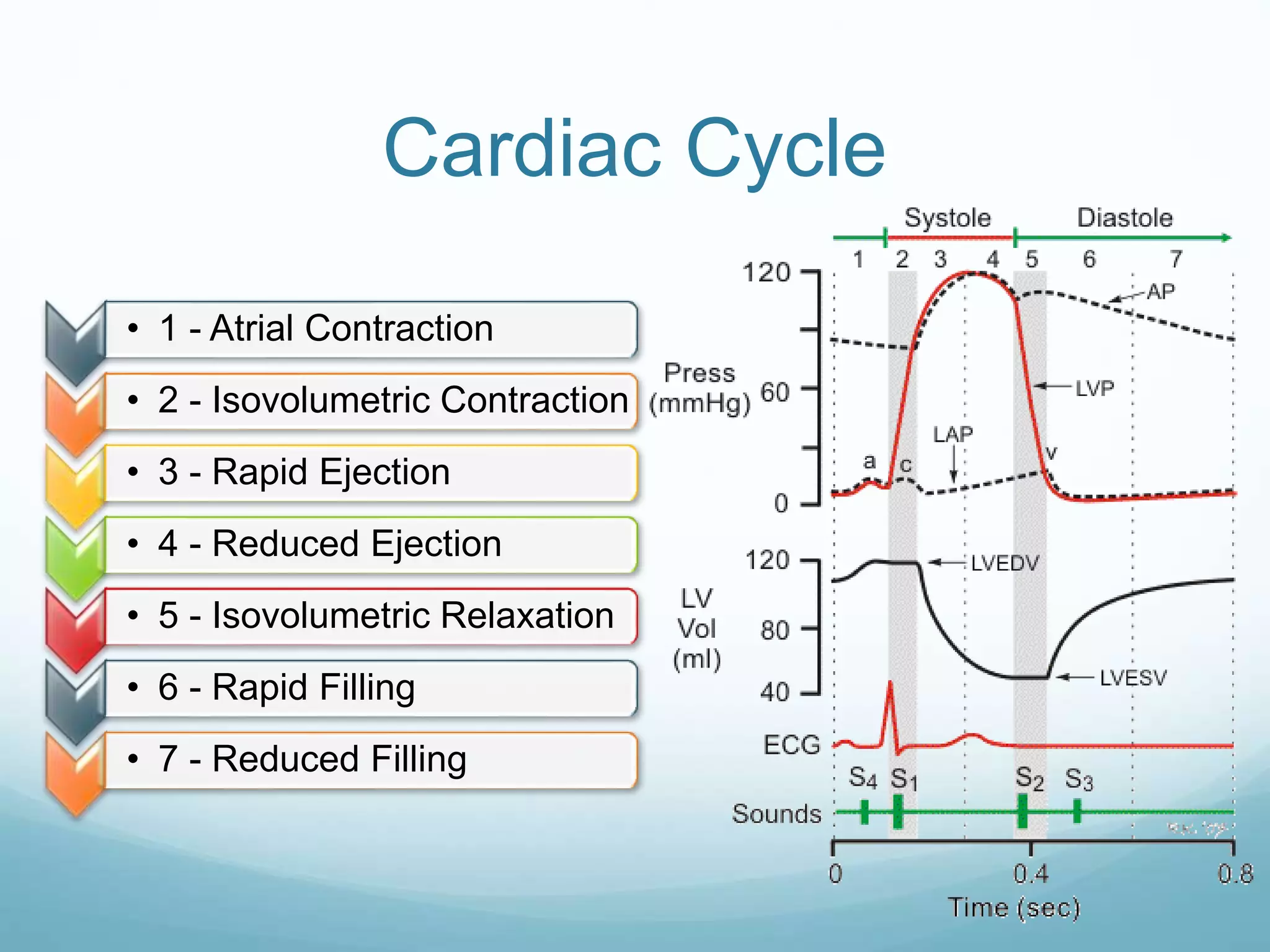
Cardiac Cycle
• 1 - Atrial Contraction
• 2 - Isovolumetric Contraction
• 3 - Rapid Ejection
• 4 - Reduced Ejection
• 5 - Isovolumetric Relaxation
• 6 - Rapid Filling
• 7 - Reduced Filling
Central Venous Pressure
 Venous pressure is a term that represents the average
blood pressure within the venous compartment.
 The term "central venous pressure" (CVP) describes
the pressure in the thoracic vena cava near the right
atrium
 therefore CVP and right atrial pressure are essentially the
same
Central Venous Pressure
 CVP is a major determinant of the filling pressure and
therefore the preload of the right ventricle, which
regulates stroke volume
Central Venous Pressure
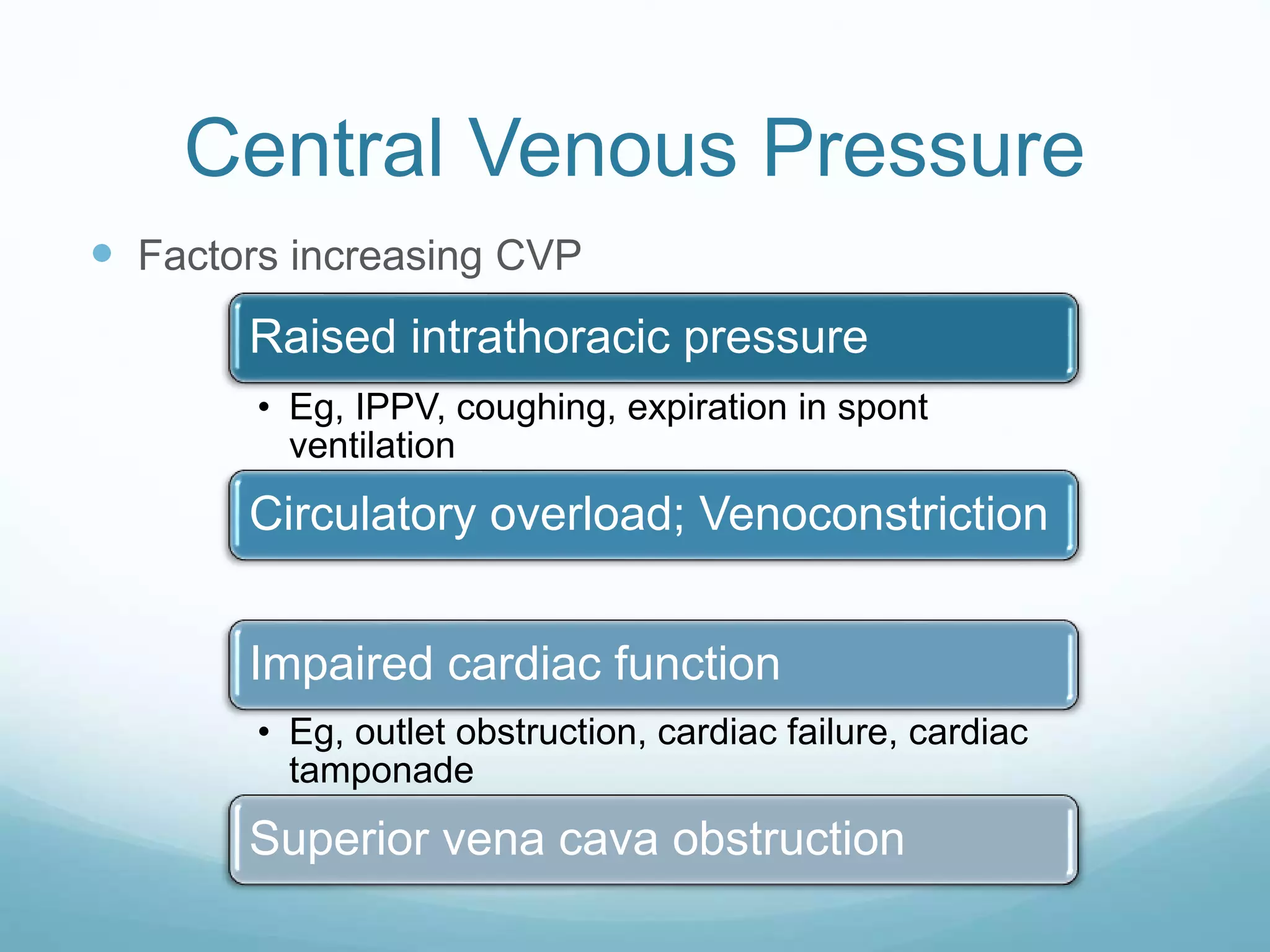
 Factors increasing CVP
Raised intrathoracic pressure
• Eg, IPPV, coughing, expiration in spont
ventilation
Circulatory overload; Venoconstriction
Impaired cardiac function
• Eg, outlet obstruction, cardiac failure, cardiac
tamponade
Superior vena cava obstruction
Central Venous Pressure
 Factors decreasing CVP
Reduced intrathoracic pressure
• Eg, inpiration in spont ventilation
Hypovolemia
Venodilatation
• Eg, septic shock
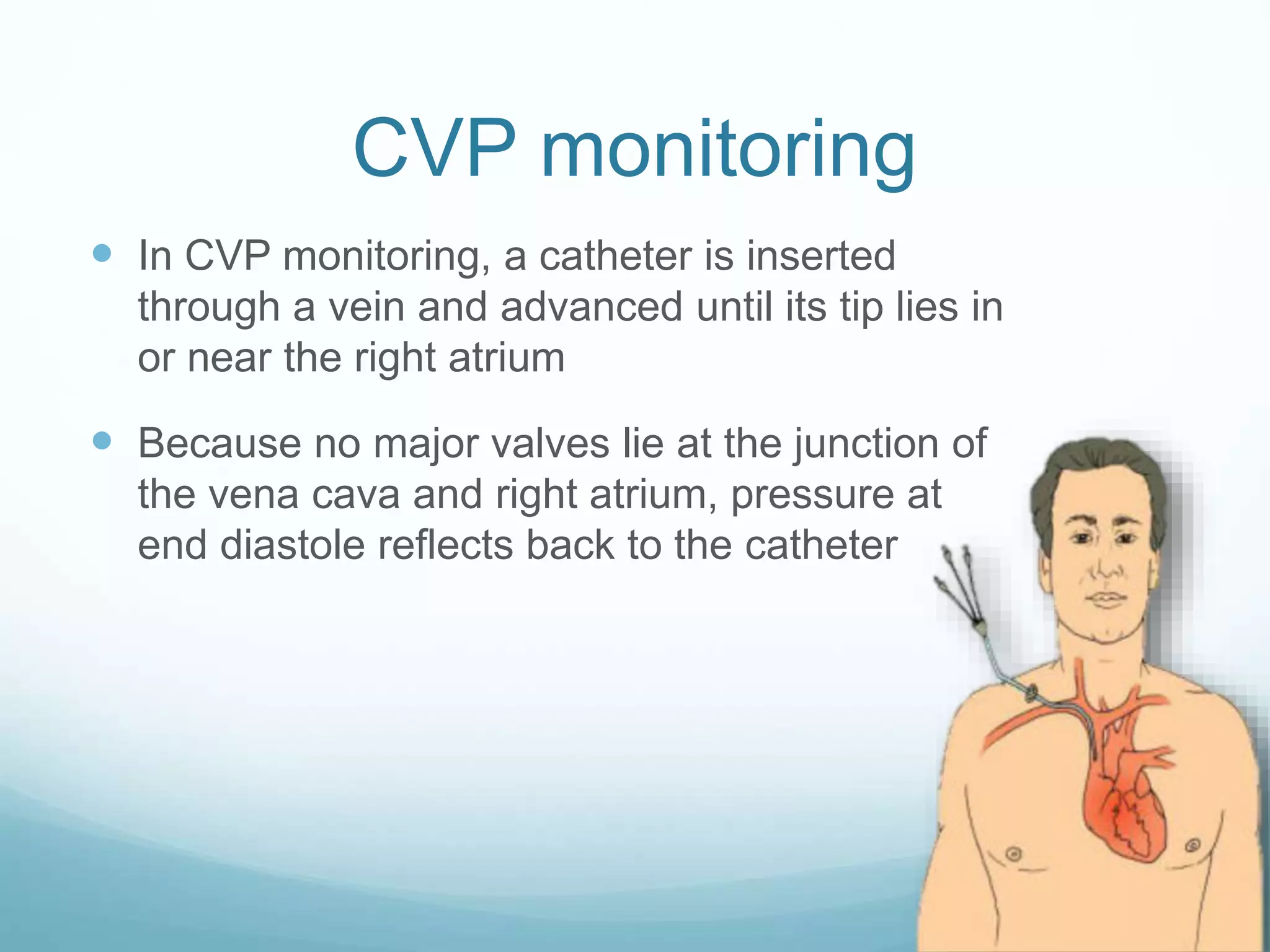
CVP monitoring
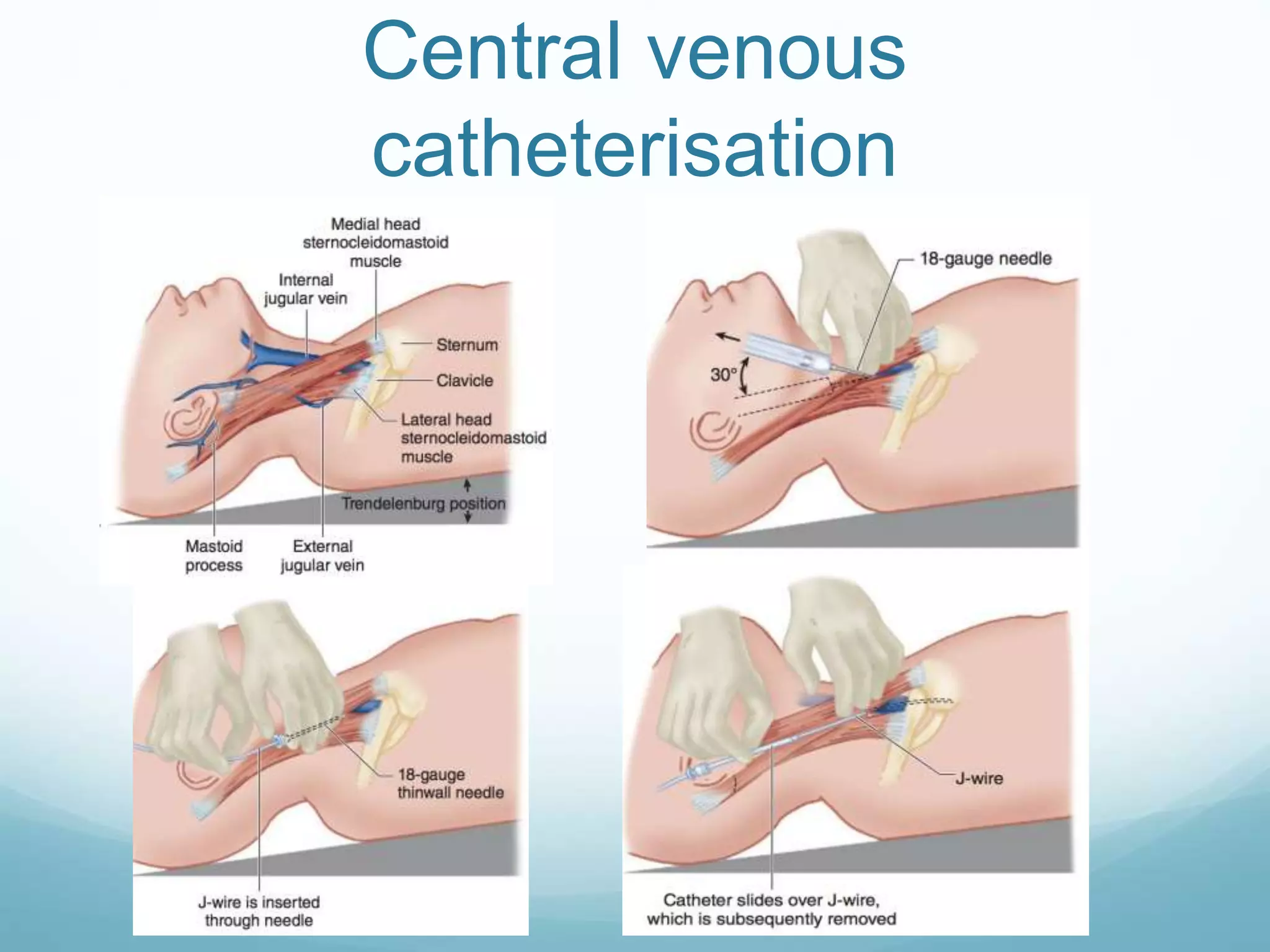
 In CVP monitoring, a catheter is inserted
through a vein and advanced until its tip lies in
or near the right atrium
 Because no major valves lie at the junction of
the vena cava and right atrium, pressure at
end diastole reflects back to the catheter
CVP monitoring
 When connected to a manometer, the catheter
measures central venous pressure (CVP), an index of
right ventricular function
 CVP monitoring helps to assess cardiac function, to
evaluate venous return to the heart, and to indirectly
gauge how well the heart is pumping
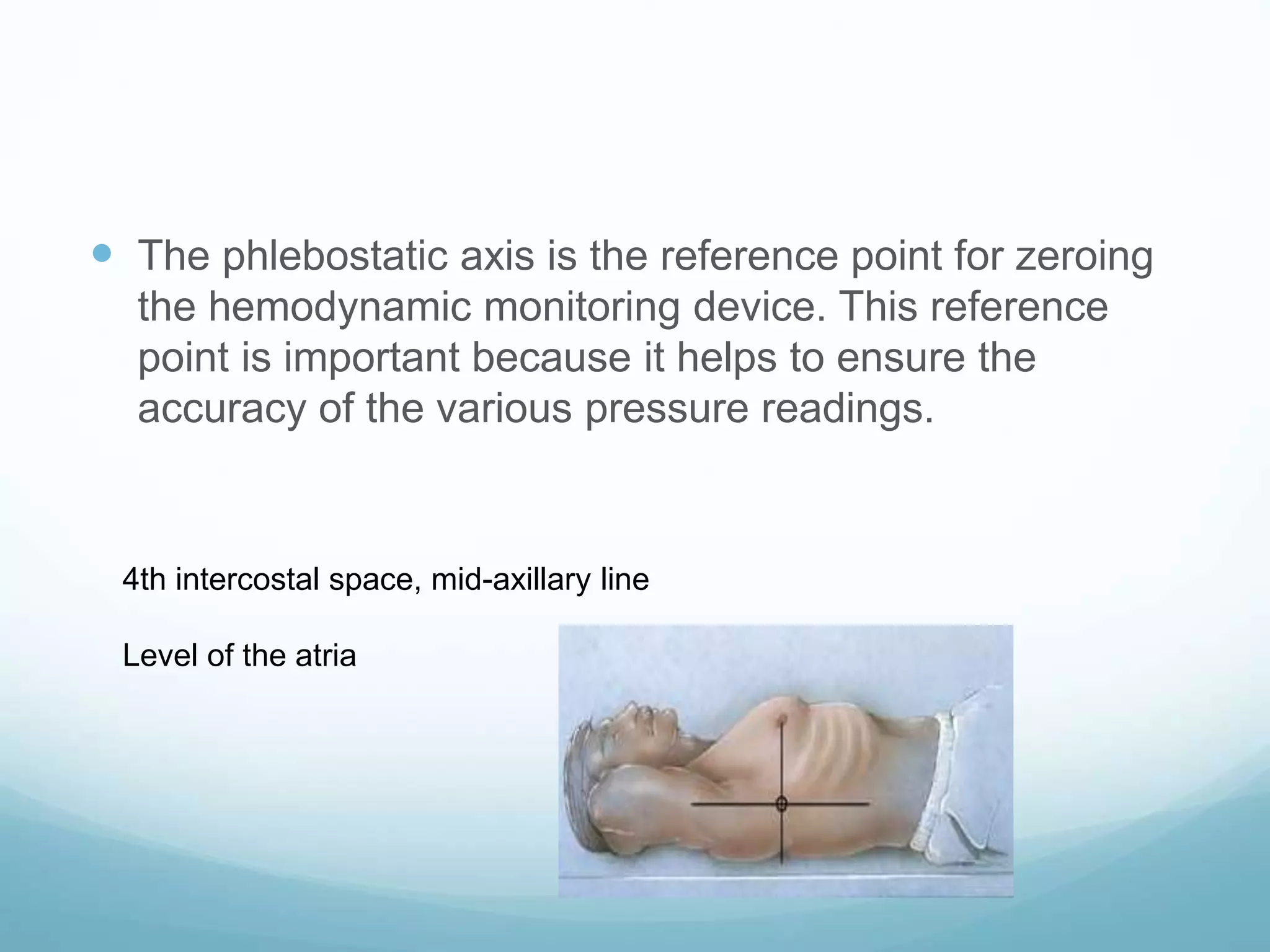
 The phlebostatic axis is the reference point for zeroing
the hemodynamic monitoring device. This reference
point is important because it helps to ensure the
accuracy of the various pressure readings.
4th intercostal space, mid-axillary line
Level of the atria
Central venous
catheterisation
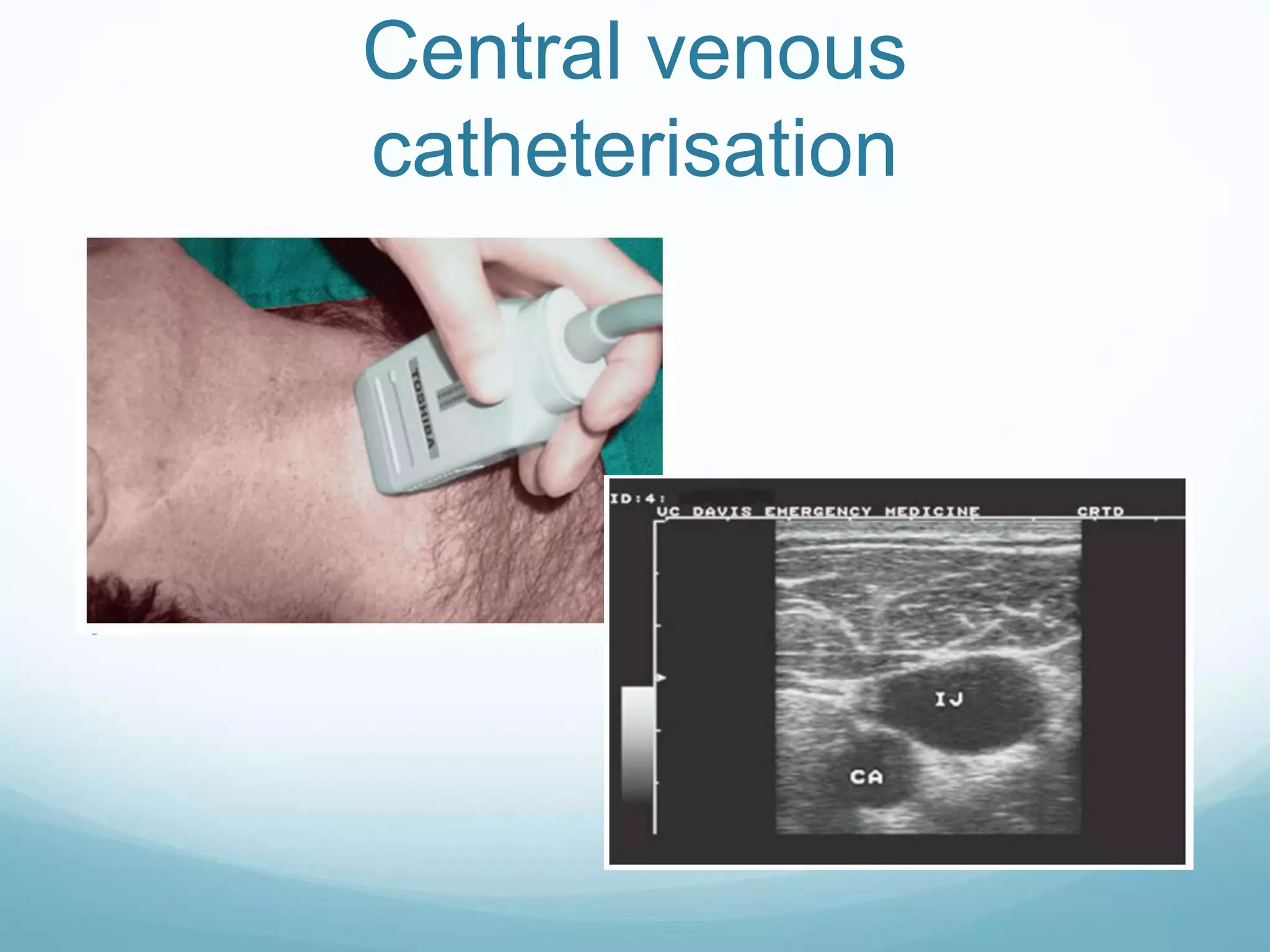
Central venous
catheterisation
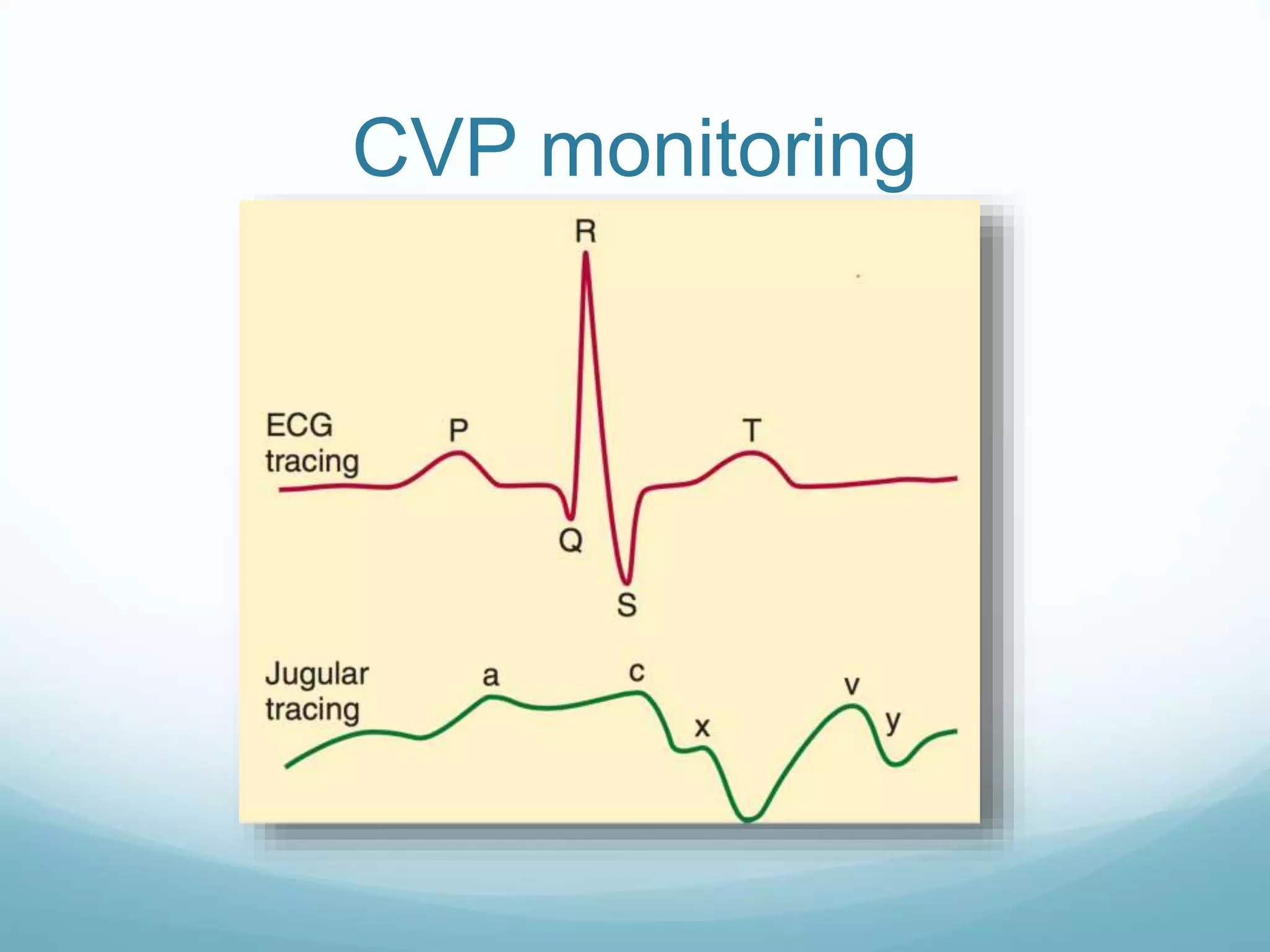
CVP monitoring
CVP monitoring
CVP waves
Waveform Phase of cardiac
cycle
Mechanism
a wave End diastole Atrial contraction
c wave Early systole Isometric ventricular contraction;
Tricuspid motion towards RA
x descent Mid systole Atrial relaxation; descent of base
v wave Late systole Systolic filling of atrium
y descent Early diastole Early ventricular filling
h wave Mid- to late diastole Diastolic plateau
CVP waves
CVP waves
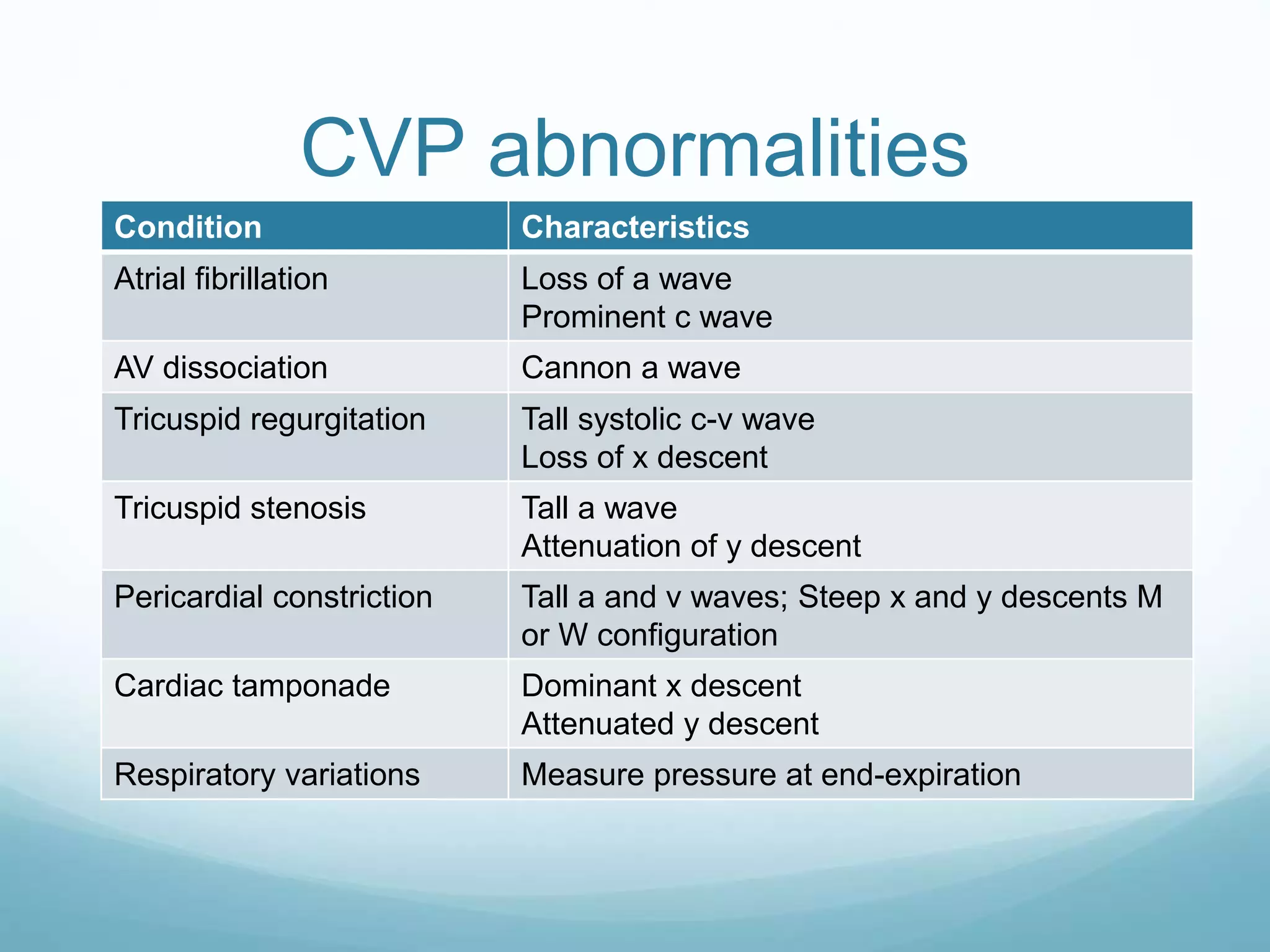
CVP abnormalities
Condition Characteristics
Atrial fibrillation Loss of a wave
Prominent c wave
AV dissociation Cannon a wave
Tricuspid regurgitation Tall systolic c-v wave
Loss of x descent
Tricuspid stenosis Tall a wave
Attenuation of y descent
Pericardial constriction Tall a and v waves; Steep x and y descents M
or W configuration
Cardiac tamponade Dominant x descent
Attenuated y descent
Respiratory variations Measure pressure at end-expiration
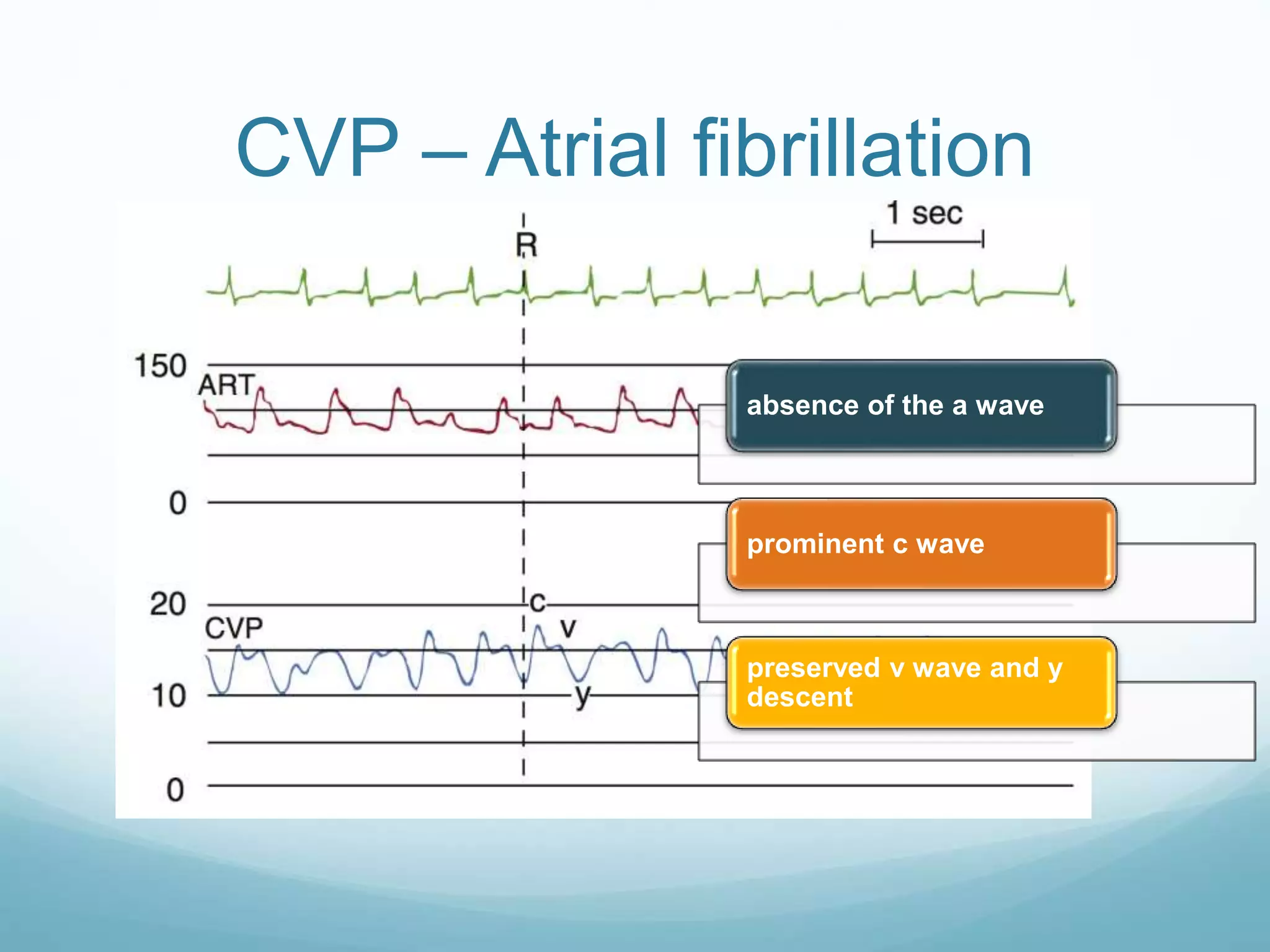
CVP – Atrial fibrillation
absence of the a wave
prominent c wave
preserved v wave and y
descent
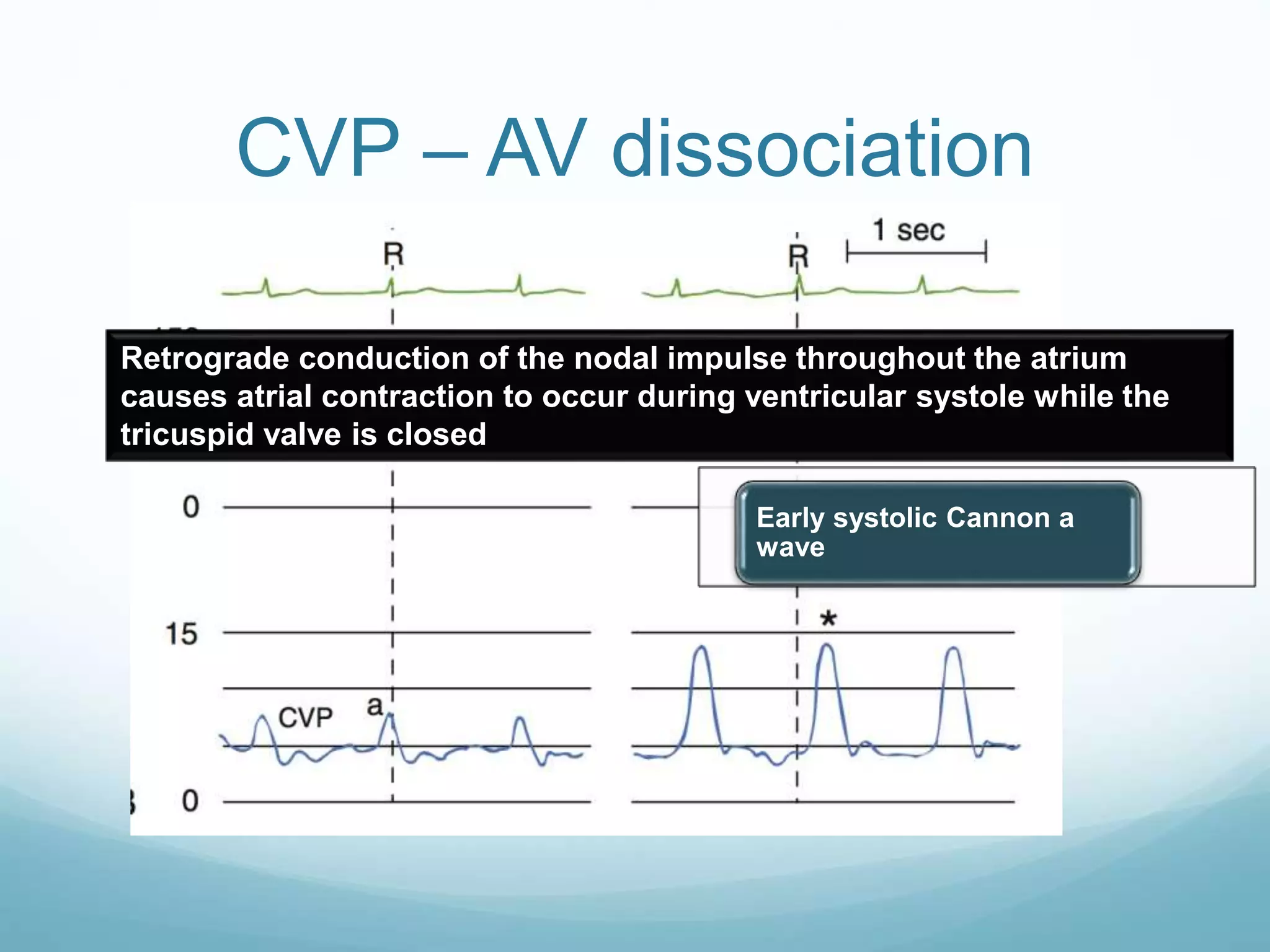
CVP – AV dissociation
Early systolic Cannon a
wave
Retrograde conduction of the nodal impulse throughout the atrium
causes atrial contraction to occur during ventricular systole while the
tricuspid valve is closed
CVP – Tricuspid regurgitation
Tall systolic c-v wave
Loss of x descent
In this example, the a wave is not seen because of atrial fibrillation
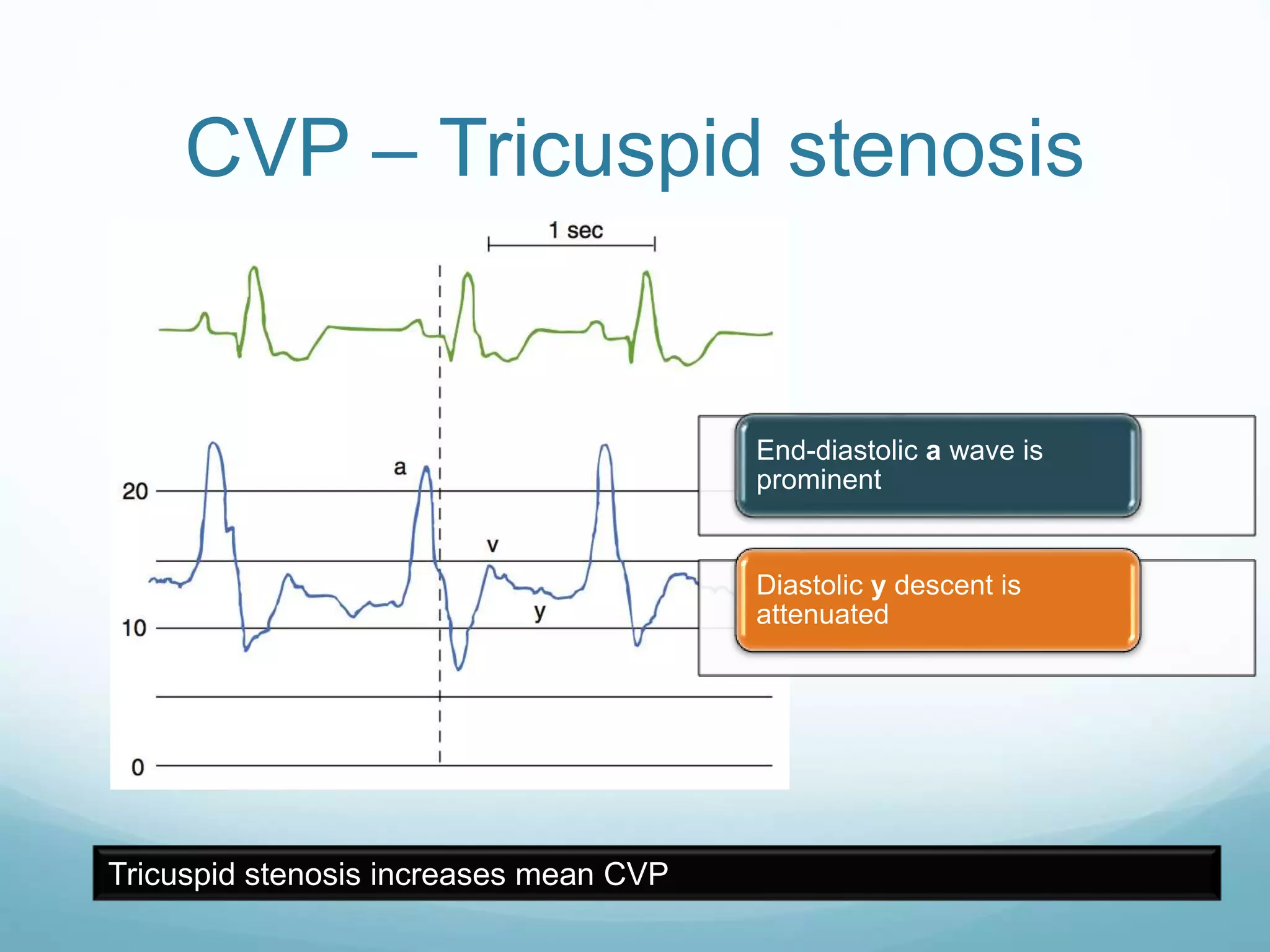
CVP – Tricuspid stenosis
End-diastolic a wave is
prominent
Diastolic y descent is
attenuated
Tricuspid stenosis increases mean CVP
CVP & Intrathoracic pressure
 CVP measurement is influenced by
changes in intrathoracic pressure.
 It fluctuates with respiration.
 Decreases in spontaneous
inspiration.
 Increases in positive pressure
ventilation.
CVP & Intrathoracic pressure
 CVP should be taken at the end expiration.
 PEEP applied to the airway at the end of exhalation,
may be partially transmitted to the intrathoracic
structures ► measured CVP will be higher.
CVP as hemodynamic
monitor
CVP & PEEP
PA catheterisation
 The pulmonary artery (PA) catheter (or Swan- Ganz
catheter) was introduced into routine practice in
operating rooms and intensive care units in the 1970s
 The catheter provides measurements of both CO and
PA occlusion pressures and was used to guide
hemodynamic therapy, especially when patients
became unstable
PA catheterisation
 The pulmonary artery (PA) catheter (or Swan- Ganz
catheter) was introduced into routine practice in
operating rooms and intensive care units in the 1970s
 The catheter provides measurements of both CO and
PA occlusion pressures and was used to guide
hemodynamic therapy, especially when patients
became unstable
 Perioperative intensive care; Cardiac anesthesia
Reduced SVR
Stroke Volume
PAWP / LVEDP
Inotropes Volume admin
Vasopressors
PA catheter
 PA catheter can be used to
guide goal-directed
hemodynamic therapy to
ensure organ perfusion in
shock states
7 - 9 FR catheter
4 lumens
110-cm long
Polyvinylchloride body
Pressure guidance is used to ascertain the localization of
the PA catheter in the venous circulation and the heart
Upon entry into the right atrium, the central venous pressure
tracing is noted
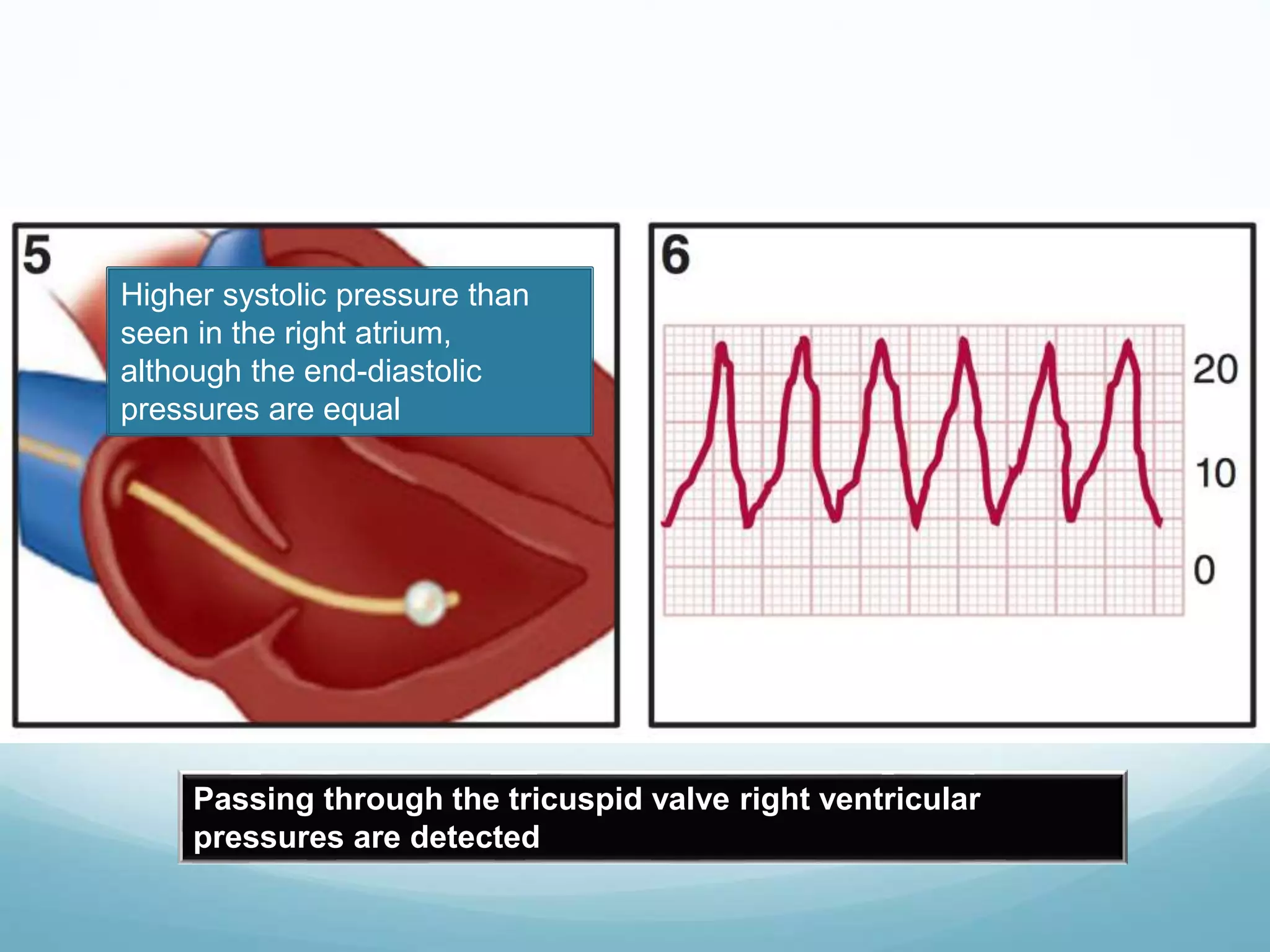
Passing through the tricuspid valve right ventricular
pressures are detected
Higher systolic pressure than
seen in the right atrium,
although the end-diastolic
pressures are equal
At 35 to 50 cm depending upon patient size, the catheter will
pass from the right ventricle through the pulmonic valve into
the pulmonary artery
A diastolic step-up compared
with ventricular pressure
When indicated the balloon- tipped catheter will wedge or
occlude a pulmonary artery branch.
Similar morphology to right atrial pressure, although the a-c and v
waves appear later in the cardiac cycle relative to ECG
PA pressure equilibrates with that of the left atrium which,
barring any mitral valve pathology, should be a reflection of
left ventricular end-diastolic pressure
From a right internal jugular vein puncture site, the right atrium
should be reached when the PAC is inserted 20 to 25 cm, the right
ventricle at 30 to 35 cm, the pulmonary artery at 40 to 45 cm, and the
wedge position at 45 to 55 cm.
0
30
0
120
PAWP a-c and v waves appear to occur later in the cardiac cycle
compared with CVP trace
PA catheter: Uses
 There is no consensus on standards for PA catheter
use
 PA catheters should only be used when a specific
clinical question regarding a patient’s hemodynamic
status can not be satisfactorily investigated by clinical
or noninvasive assessments
 …. when the clinician is in need of knowing an in-depth
and continuous assessment of hemodynamics in order
to properly guide changes in the management of a
patient
PA catheter: Measurements
Parameter Normal range Relevance
CVP 0-6mmHg Volume status & RV function;
correlates with RVEDP
RVP 20-30 / 0-6mmHg RV function and volume
PAP 20-30 / 6-10 mmHg State of PVR and RV function
PAWP 4-12mmHg LV function; correlates with LVEDP
Stroke vol. 60-80ml
SV index 33-47ml/beat/m2 SV adjusted to body surface area
(BSA)
PA catheter: Measurements
Parameter Normal range
Cardiac Output 4 – 8 L/min
Cardiac Index 2.5 – 4 L/min/m2
Pulmonary Vascular Resistance 20-120 dynes/sec/cm5
Systemic Vascular Resistance 750-1500 dynes/sec/cm5
RV stroke work
LV stroke work
SvO2 (Mixed Venous O2
saturation)
60 -75%
PA catheter: Contraindications
• Known pulmonary hypertension
• Unstable arrhythmias
• Anticoagulation therapy
• Bleeding disorder
• Prior pneumonectomy
• Pacemakers
• Prosthetic heart valves
https://www.facebook.com/saneeshpj
saneeshpj@yahoo.com

CVP Pulmonary artery wedge pressure monitoring: Physiology

  • 1.
    CVP & PCWPMONITORING Sultan Qaboos University Hospital, Muscat
  • 2.
  • 4.
    Cardiac Cycle  Theseries of electrical and mechanical events that constitute a single heart beat
  • 5.
  • 6.
    Cardiac Cycle • 1- Atrial Contraction • 2 - Isovolumetric Contraction • 3 - Rapid Ejection • 4 - Reduced Ejection • 5 - Isovolumetric Relaxation • 6 - Rapid Filling • 7 - Reduced Filling
  • 8.
    Central Venous Pressure Venous pressure is a term that represents the average blood pressure within the venous compartment.  The term "central venous pressure" (CVP) describes the pressure in the thoracic vena cava near the right atrium  therefore CVP and right atrial pressure are essentially the same
  • 9.
    Central Venous Pressure CVP is a major determinant of the filling pressure and therefore the preload of the right ventricle, which regulates stroke volume
  • 10.
  • 11.
    Central Venous Pressure Factors increasing CVP Raised intrathoracic pressure • Eg, IPPV, coughing, expiration in spont ventilation Circulatory overload; Venoconstriction Impaired cardiac function • Eg, outlet obstruction, cardiac failure, cardiac tamponade Superior vena cava obstruction
  • 12.
    Central Venous Pressure Factors decreasing CVP Reduced intrathoracic pressure • Eg, inpiration in spont ventilation Hypovolemia Venodilatation • Eg, septic shock
  • 13.
    CVP monitoring  InCVP monitoring, a catheter is inserted through a vein and advanced until its tip lies in or near the right atrium  Because no major valves lie at the junction of the vena cava and right atrium, pressure at end diastole reflects back to the catheter
  • 14.
    CVP monitoring  Whenconnected to a manometer, the catheter measures central venous pressure (CVP), an index of right ventricular function  CVP monitoring helps to assess cardiac function, to evaluate venous return to the heart, and to indirectly gauge how well the heart is pumping
  • 15.
     The phlebostaticaxis is the reference point for zeroing the hemodynamic monitoring device. This reference point is important because it helps to ensure the accuracy of the various pressure readings. 4th intercostal space, mid-axillary line Level of the atria
  • 16.
  • 17.
  • 18.
  • 19.
  • 20.
    CVP waves Waveform Phaseof cardiac cycle Mechanism a wave End diastole Atrial contraction c wave Early systole Isometric ventricular contraction; Tricuspid motion towards RA x descent Mid systole Atrial relaxation; descent of base v wave Late systole Systolic filling of atrium y descent Early diastole Early ventricular filling h wave Mid- to late diastole Diastolic plateau
  • 21.
  • 22.
  • 23.
    CVP abnormalities Condition Characteristics Atrialfibrillation Loss of a wave Prominent c wave AV dissociation Cannon a wave Tricuspid regurgitation Tall systolic c-v wave Loss of x descent Tricuspid stenosis Tall a wave Attenuation of y descent Pericardial constriction Tall a and v waves; Steep x and y descents M or W configuration Cardiac tamponade Dominant x descent Attenuated y descent Respiratory variations Measure pressure at end-expiration
  • 24.
    CVP – Atrialfibrillation absence of the a wave prominent c wave preserved v wave and y descent
  • 25.
    CVP – AVdissociation Early systolic Cannon a wave Retrograde conduction of the nodal impulse throughout the atrium causes atrial contraction to occur during ventricular systole while the tricuspid valve is closed
  • 26.
    CVP – Tricuspidregurgitation Tall systolic c-v wave Loss of x descent In this example, the a wave is not seen because of atrial fibrillation
  • 27.
    CVP – Tricuspidstenosis End-diastolic a wave is prominent Diastolic y descent is attenuated Tricuspid stenosis increases mean CVP
  • 28.
    CVP & Intrathoracicpressure  CVP measurement is influenced by changes in intrathoracic pressure.  It fluctuates with respiration.  Decreases in spontaneous inspiration.  Increases in positive pressure ventilation.
  • 29.
    CVP & Intrathoracicpressure  CVP should be taken at the end expiration.  PEEP applied to the airway at the end of exhalation, may be partially transmitted to the intrathoracic structures ► measured CVP will be higher.
  • 30.
  • 31.
  • 33.
    PA catheterisation  Thepulmonary artery (PA) catheter (or Swan- Ganz catheter) was introduced into routine practice in operating rooms and intensive care units in the 1970s  The catheter provides measurements of both CO and PA occlusion pressures and was used to guide hemodynamic therapy, especially when patients became unstable
  • 34.
    PA catheterisation  Thepulmonary artery (PA) catheter (or Swan- Ganz catheter) was introduced into routine practice in operating rooms and intensive care units in the 1970s  The catheter provides measurements of both CO and PA occlusion pressures and was used to guide hemodynamic therapy, especially when patients became unstable  Perioperative intensive care; Cardiac anesthesia
  • 35.
    Reduced SVR Stroke Volume PAWP/ LVEDP Inotropes Volume admin Vasopressors
  • 36.
    PA catheter  PAcatheter can be used to guide goal-directed hemodynamic therapy to ensure organ perfusion in shock states 7 - 9 FR catheter 4 lumens 110-cm long Polyvinylchloride body
  • 38.
    Pressure guidance isused to ascertain the localization of the PA catheter in the venous circulation and the heart Upon entry into the right atrium, the central venous pressure tracing is noted
  • 39.
    Passing through thetricuspid valve right ventricular pressures are detected Higher systolic pressure than seen in the right atrium, although the end-diastolic pressures are equal
  • 40.
    At 35 to50 cm depending upon patient size, the catheter will pass from the right ventricle through the pulmonic valve into the pulmonary artery A diastolic step-up compared with ventricular pressure
  • 41.
    When indicated theballoon- tipped catheter will wedge or occlude a pulmonary artery branch. Similar morphology to right atrial pressure, although the a-c and v waves appear later in the cardiac cycle relative to ECG
  • 42.
    PA pressure equilibrateswith that of the left atrium which, barring any mitral valve pathology, should be a reflection of left ventricular end-diastolic pressure
  • 43.
    From a rightinternal jugular vein puncture site, the right atrium should be reached when the PAC is inserted 20 to 25 cm, the right ventricle at 30 to 35 cm, the pulmonary artery at 40 to 45 cm, and the wedge position at 45 to 55 cm.
  • 44.
  • 45.
    0 120 PAWP a-c andv waves appear to occur later in the cardiac cycle compared with CVP trace
  • 46.
    PA catheter: Uses There is no consensus on standards for PA catheter use  PA catheters should only be used when a specific clinical question regarding a patient’s hemodynamic status can not be satisfactorily investigated by clinical or noninvasive assessments  …. when the clinician is in need of knowing an in-depth and continuous assessment of hemodynamics in order to properly guide changes in the management of a patient
  • 47.
    PA catheter: Measurements ParameterNormal range Relevance CVP 0-6mmHg Volume status & RV function; correlates with RVEDP RVP 20-30 / 0-6mmHg RV function and volume PAP 20-30 / 6-10 mmHg State of PVR and RV function PAWP 4-12mmHg LV function; correlates with LVEDP Stroke vol. 60-80ml SV index 33-47ml/beat/m2 SV adjusted to body surface area (BSA)
  • 48.
    PA catheter: Measurements ParameterNormal range Cardiac Output 4 – 8 L/min Cardiac Index 2.5 – 4 L/min/m2 Pulmonary Vascular Resistance 20-120 dynes/sec/cm5 Systemic Vascular Resistance 750-1500 dynes/sec/cm5 RV stroke work LV stroke work SvO2 (Mixed Venous O2 saturation) 60 -75%
  • 49.
    PA catheter: Contraindications •Known pulmonary hypertension • Unstable arrhythmias • Anticoagulation therapy • Bleeding disorder • Prior pneumonectomy • Pacemakers • Prosthetic heart valves
  • 53.