Preoperative Patient Education
Saneesh P J
in Thoracic Surgery
Introduction
 Modern-day health care
Scientifically perfect
Emotionally or
psychologically
unsatisfied patients
Surgeon
Anesthetist
Physicians
Nurses
Resp
Therapists
Others
Patient
Coordinated activity
Initial visit
•Recommendation for surgery
•Sufficient time is allocated
•Questions are encouraged
Subsequent visit
•Review the planned procedure
•Additional questions are answered
•Preop anesthesia clinic visit
Content of preoperative teaching
Related to surgery (or thoracic surgery) in general
Issues related to a specific operation
Content of preoperative teaching
General preoperative education
Respiratory hygiene
Pain
Smoking cessation
Diet and nutrition
Wound care and drains
Postdischarge social issues
Contact numbers
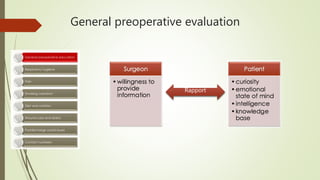
General preoperative evaluation
Rapport
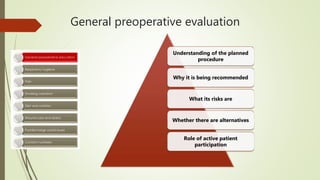
General preoperative evaluation
Understanding of the planned
procedure
Why it is being recommended
What its risks are
Whether there are alternatives
Role of active patient
participation
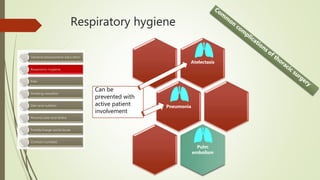
Respiratory hygiene
Atelectasis
Pneumonia
Pulm
embolism
Can be
prevented with
active patient
involvement
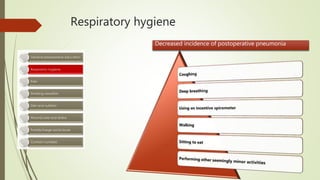
Respiratory hygiene
Decreased incidence of postoperative pneumonia
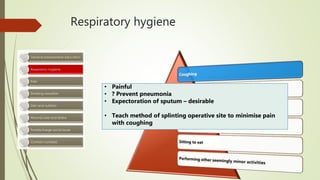
Respiratory hygiene
• Painful
• ? Prevent pneumonia
• Expectoration of sputum – desirable
• Teach method of splinting operative site to minimise pain
with coughing
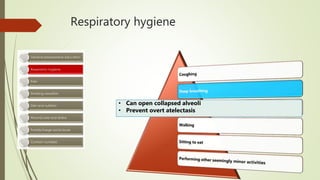
Respiratory hygiene
• Can open collapsed alveoli
• Prevent overt atelectasis
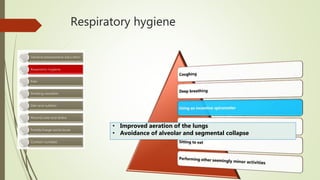
Respiratory hygiene
• Improved aeration of the lungs
• Avoidance of alveolar and segmental collapse
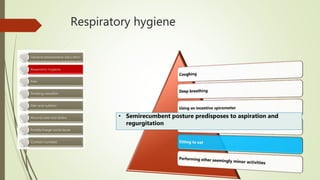
Respiratory hygiene
• Semirecumbent posture predisposes to aspiration and
regurgitation
Respiratory hygiene
• Setting expectations is important
• Far more effective preoperatively than
postoperatively when breathing is compromised by
pain
• Baseline spirometry readings
• Easy to convince target values in postop
period
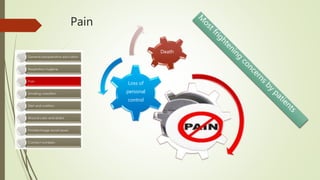
Pain
Loss of
personal
control
Death
Pain
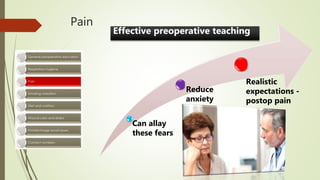
Can allay
these fears
Reduce
anxiety
Realistic
expectations -
postop pain
Effective preoperative teaching
Pain
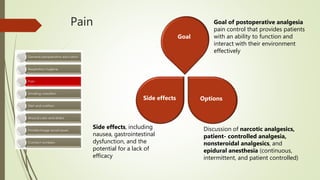
Discussion of narcotic analgesics,
patient- controlled analgesia,
nonsteroidal analgesics, and
epidural anesthesia (continuous,
intermittent, and patient controlled)
Side effects, including
nausea, gastrointestinal
dysfunction, and the
potential for a lack of
efficacy
Goal of postoperative analgesia
pain control that provides patients
with an ability to function and
interact with their environment
effectively
Goal
OptionsSide effects
Pain
Effective preoperative counseling
Sets the expectations
Can be reinforced in the postopeative period
Smoking cessation
Thoracic surgery mostly deals with smoking related pathology
May/may not quit smoking
• addictive qualities of nicotine outweigh the intellectual knowledge that
smoking is harmful
May use smoking as a method of coping with anxiety and fear
Cigarette smoking impairs the mucociliary clearance mechanisms of the
tracheobronchial tree and may predispose to postoperative pulmonary
complications.
Smoking cessation
The optimal time for smoking cessation is unclear
Most surgeons encourage patients to stop smoking in preparation for thoracic
surgery.
Whether surgery should be denied to patients who continue to smoke is
controversial.
Every effort should be made preoperatively to persuade the patient to stop
smoking.
Diet and Nutrition
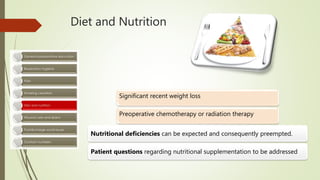
Significant recent weight loss
Preoperative chemotherapy or radiation therapy
Nutritional deficiencies can be expected and consequently preempted.
Patient questions regarding nutritional supplementation to be addressed
Wound care & Drains
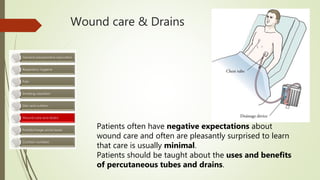
Patients often have negative expectations about
wound care and often are pleasantly surprised to learn
that care is usually minimal.
Patients should be taught about the uses and benefits
of percutaneous tubes and drains.
Post-discharge social issues
Family involvement in postoperative convalescence
Job-related concerns
Expectations regarding physical limitations, including appetite, sleep irregularity etc
Cultural sensitivity and family dynamics may play crucial roles in
effecting a smooth post- operative recovery.
Contact numbers
Provide patients with a reliable method of contacting the surgeon
or his or her designee.
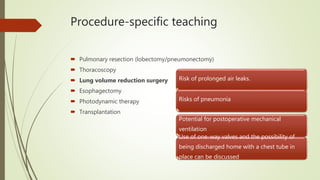
Procedure-specific teaching
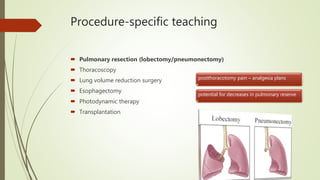
 Pulmonary resection (lobectomy/pneumonectomy)
 Thoracoscopy
 Lung volume reduction surgery
 Esophagectomy
 Photodynamic therapy
 Transplantation
postthoracotomy pain – analgesia plans
potential for decreases in pulmonary reserve
Procedure-specific teaching
 Pulmonary resection (lobectomy/pneumonectomy)
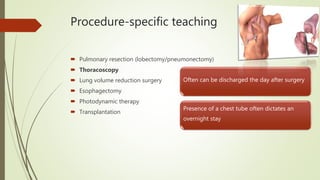
 Thoracoscopy
 Lung volume reduction surgery
 Esophagectomy
 Photodynamic therapy
 Transplantation
Often can be discharged the day after surgery
Presence of a chest tube often dictates an
overnight stay
Procedure-specific teaching
 Pulmonary resection (lobectomy/pneumonectomy)
 Thoracoscopy
 Lung volume reduction surgery
 Esophagectomy
 Photodynamic therapy
 Transplantation
Risk of prolonged air leaks.
Risks of pneumonia
Potential for postoperative mechanical
ventilation
Use of one-way valves and the possibility of
being discharged home with a chest tube in
place can be discussed
Procedure-specific teaching
 Pulmonary resection (lobectomy/pneumonectomy)
 Thoracoscopy
 Lung volume reduction surgery
 Esophagectomy
 Photodynamic therapy
 Transplantation
Prolonged cutaneous photosensitivity
Procedure-specific teaching
 Pulmonary resection (lobectomy/pneumonectomy)
 Thoracoscopy
 Lung volume reduction surgery
 Esophagectomy
 Photodynamic therapy
 Transplantation
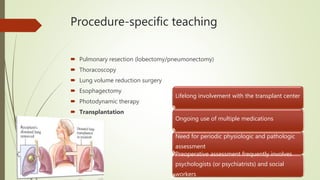
Lifelong involvement with the transplant center
Ongoing use of multiple medications
Need for periodic physiologic and pathologic
assessment
Preoperative assessment frequently involves
psychologists (or psychiatrists) and social
workers
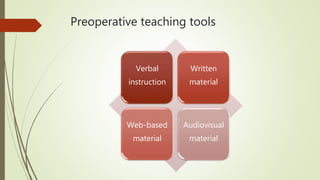
Preoperative teaching tools
Verbal
instruction
Written
material
Web-based
material
Audiovisual
material
Verbal instructions
Verbal
instruction
Written
material
Web-based
material
Audiovisual
material
Basic questions that they
are reluctant to discuss
with the surgeon
Multiple factors, such as
language barriers,
learning disabilities, and
cultural barriers
The cornerstone tool to
pre-operative teaching
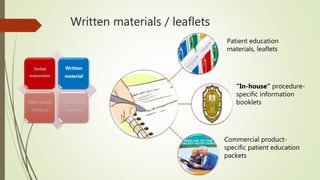
Written materials / leaflets
Verbal
instruction
Written
material
Web-based
material
Audiovisual
material
Commercial product-
specific patient education
packets
“In-house” procedure-
specific information
booklets
Patient education
materials, leaflets
Web-based materials
Verbal
instruction
Written
material
Web-based
material
Audiovisual
material
Help to choose right,
authentic sources
Pharma websites also
can help familiarize with
specific products or
procedures
Websites of authorised
organisations can be of
great help
Audiovisual materials
Verbal
instruction
Written
material
Web-
based
material
Audiovisual
material
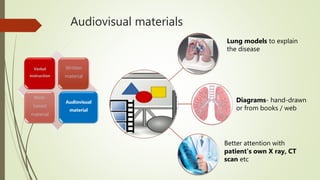
Better attention with
patient’s own X ray, CT
scan etc
Diagrams- hand-drawn
or from books / web
Lung models to explain
the disease
Summary
The goal of patient teaching is to
improve patients’ understanding of their disease process
and the operation
ensure their active participation in the treating process
The additional goal of obtaining informed consent is
an ingrained component to the current physician-
patient relationship.
Summary
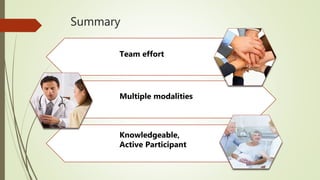
Team effort
Knowledgeable,
Active Participant
Multiple modalities
Thank you

Preoperative preparation for thoracic surgery