Describing Data:
                    Frequency Tables, Frequency
                    Distributions, and Graphic
                    Presentation


                    Chapter 2


McGraw-Hill/Irwin             Copyright © 2012 by The McGraw-Hill Companies, Inc. All rights reserved.
LEARNING OBJECTIVES
 LO1 Make a frequency table for a set of data.
 LO2 Organize data into a bar chart.
 LO3 Present a set of data in a pie chart.
 LO4 Create a frequency distribution for a
     data set.
 LO5 Understand a relative frequency
     distribution.
 LO6 Present data from a frequency
     distribution in a histogram or frequency
     polygon.

                                                 2-2
Describing Data with                                LO1 Make a frequency
                                                    table for a set of data
Charts, Tables and Graphs
- Example
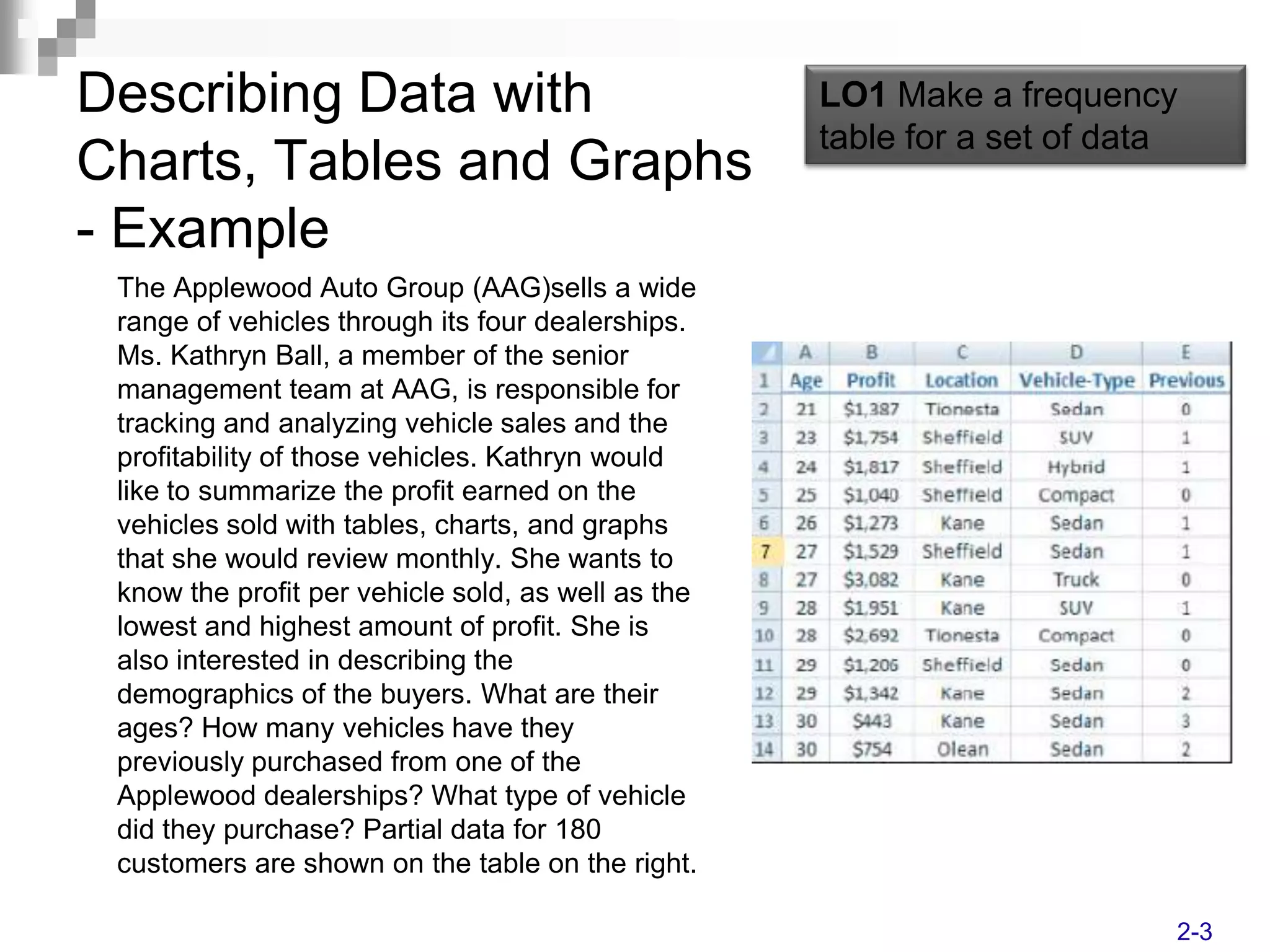
 The Applewood Auto Group (AAG)sells a wide
 range of vehicles through its four dealerships.
 Ms. Kathryn Ball, a member of the senior
 management team at AAG, is responsible for
 tracking and analyzing vehicle sales and the
 profitability of those vehicles. Kathryn would
 like to summarize the profit earned on the
 vehicles sold with tables, charts, and graphs
 that she would review monthly. She wants to
 know the profit per vehicle sold, as well as the
 lowest and highest amount of profit. She is
 also interested in describing the
 demographics of the buyers. What are their
 ages? How many vehicles have they
 previously purchased from one of the
 Applewood dealerships? What type of vehicle
 did they purchase? Partial data for 180
 customers are shown on the table on the right.

                                                                          2-3
LO2

Frequency Table
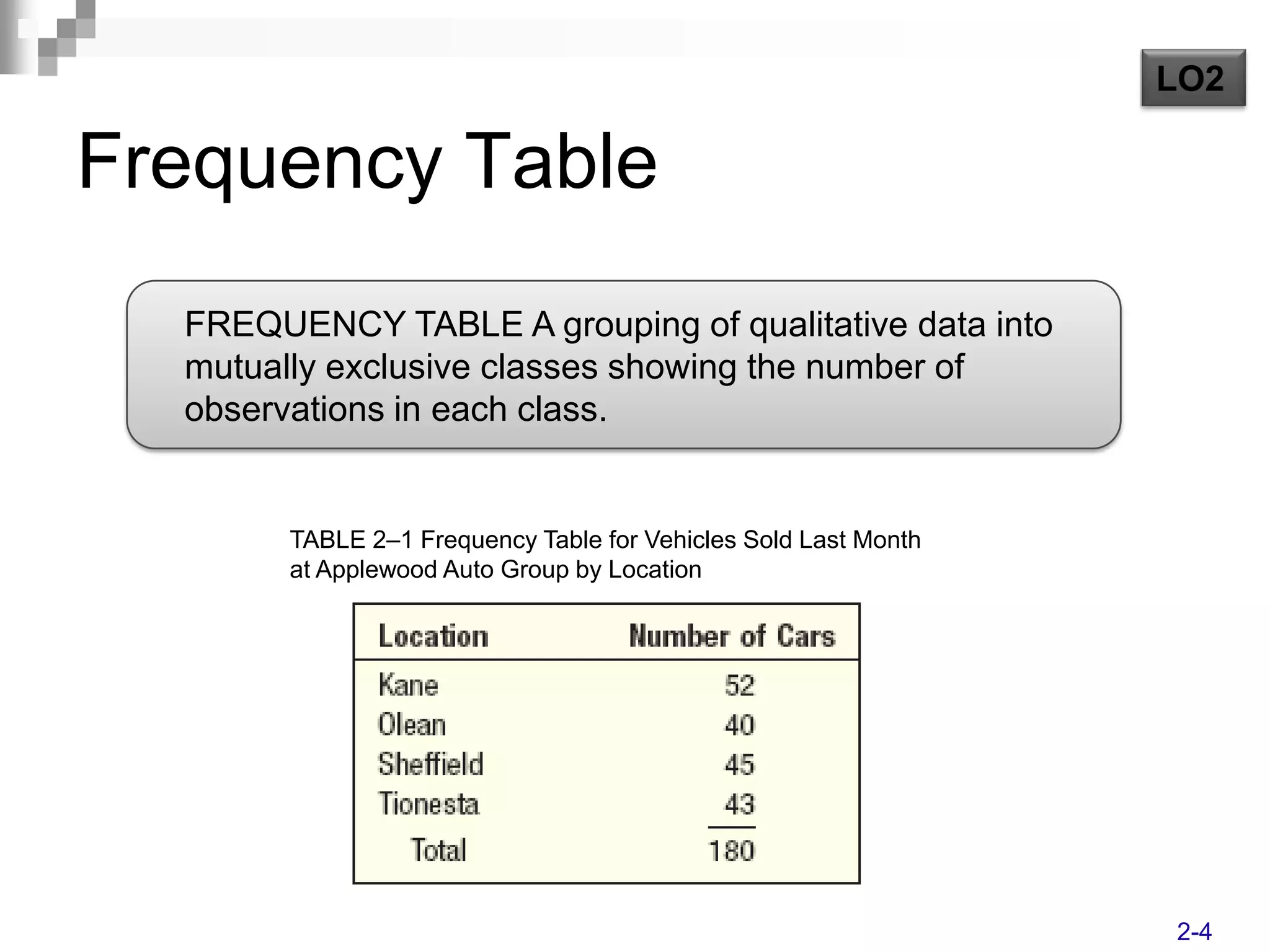
  FREQUENCY TABLE A grouping of qualitative data into
  mutually exclusive classes showing the number of
  observations in each class.


        TABLE 2–1 Frequency Table for Vehicles Sold Last Month
        at Applewood Auto Group by Location


                                                                 2-4
LO2 Organize data into a
                                                bar chart
Bar Charts
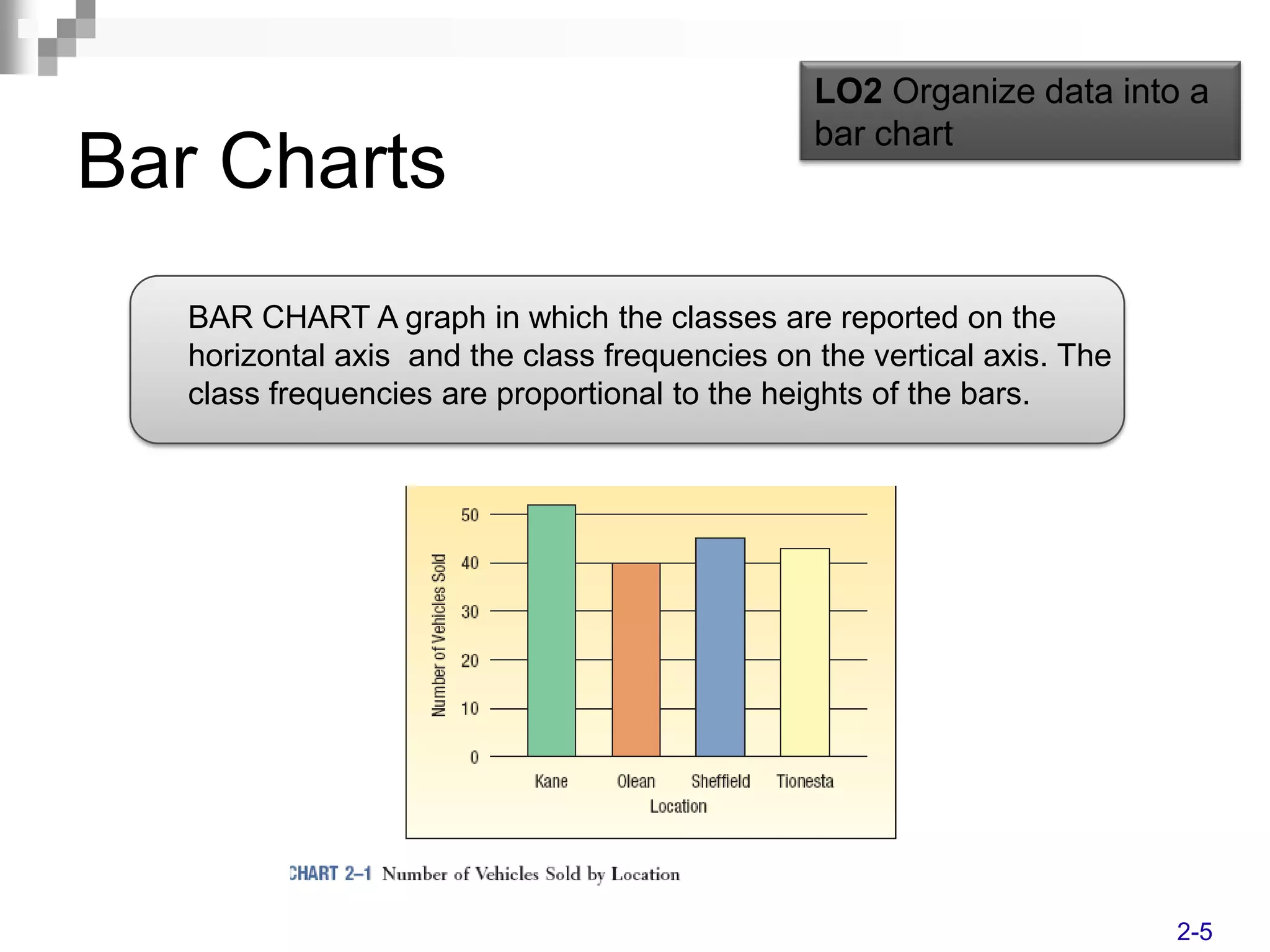
   BAR CHART A graph in which the classes are reported on the
   horizontal axis and the class frequencies on the vertical axis. The
   class frequencies are proportional to the heights of the bars.


                                                                         2-5
LO3 Present a set of data
Pie Charts                            in a pie chart.


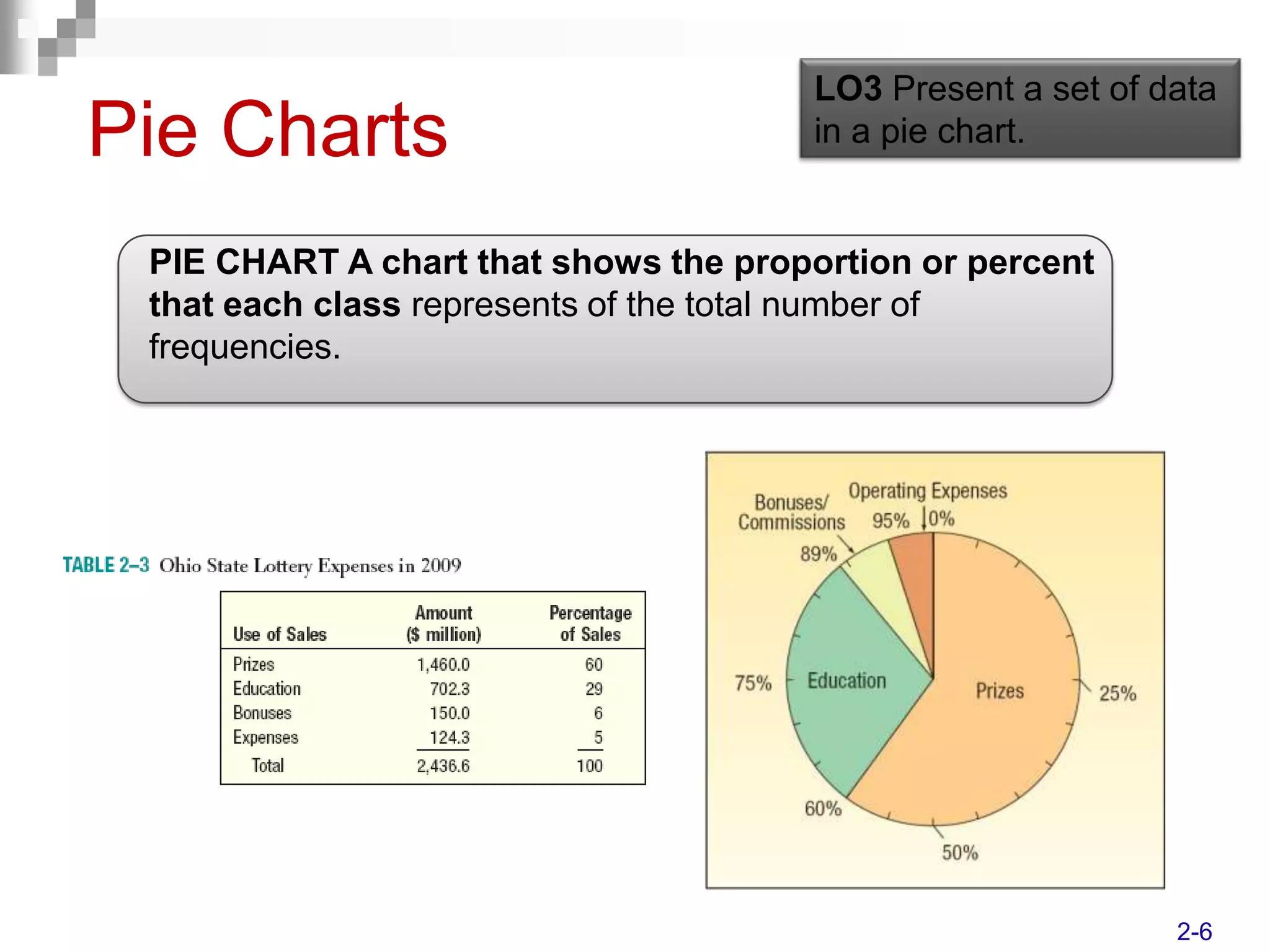
 PIE CHART A chart that shows the proportion or percent
 that each class represents of the total number of
 frequencies.


                                                            2-6
LO3
Pie Chart Using Excel


                        2-7
LO4 Create a frequency
Frequency Distribution                                distribution for a data set.


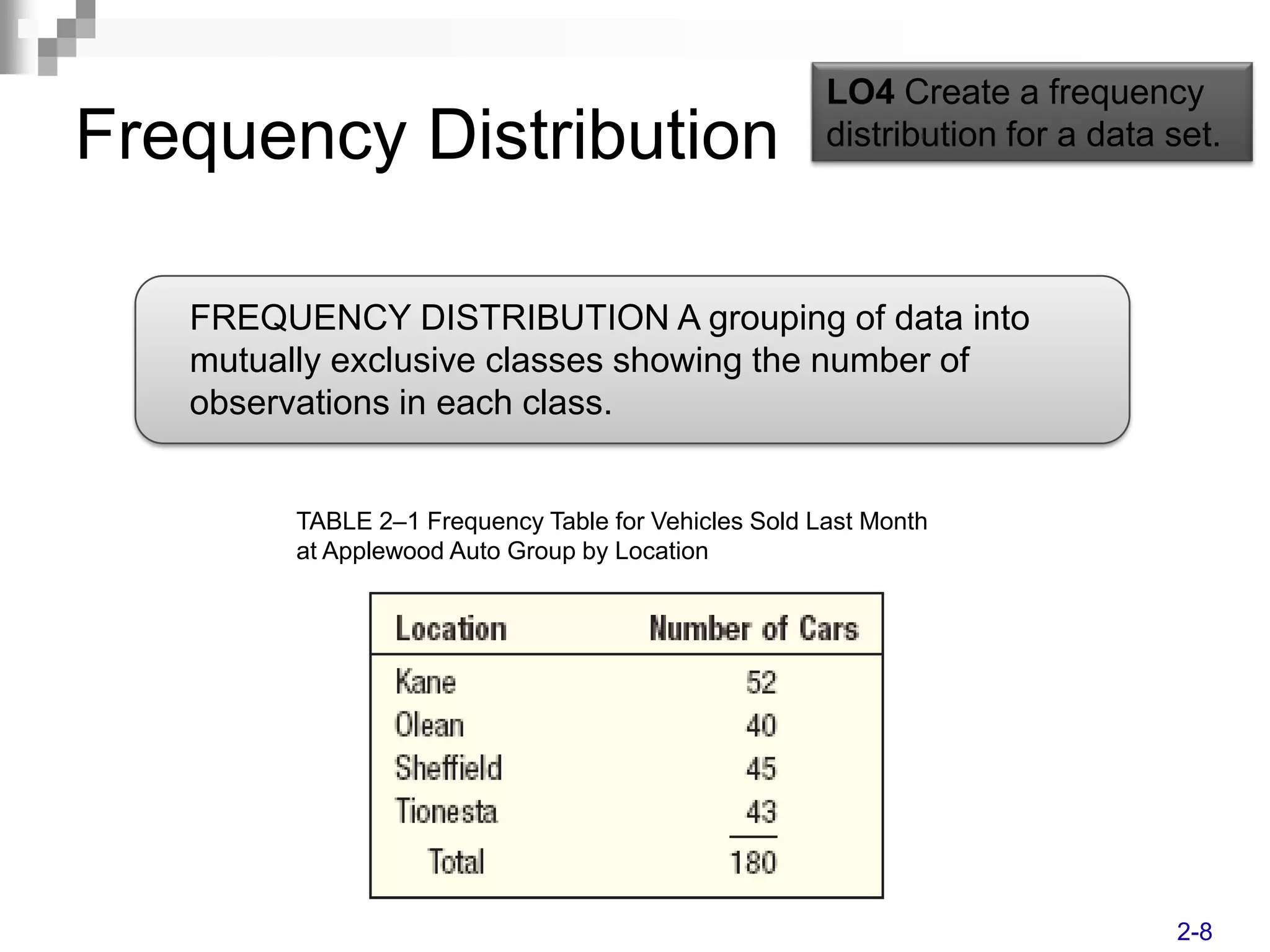
   FREQUENCY DISTRIBUTION A grouping of data into
   mutually exclusive classes showing the number of
   observations in each class.


         TABLE 2–1 Frequency Table for Vehicles Sold Last Month
         at Applewood Auto Group by Location


                                                                              2-8
LO2 and LO3

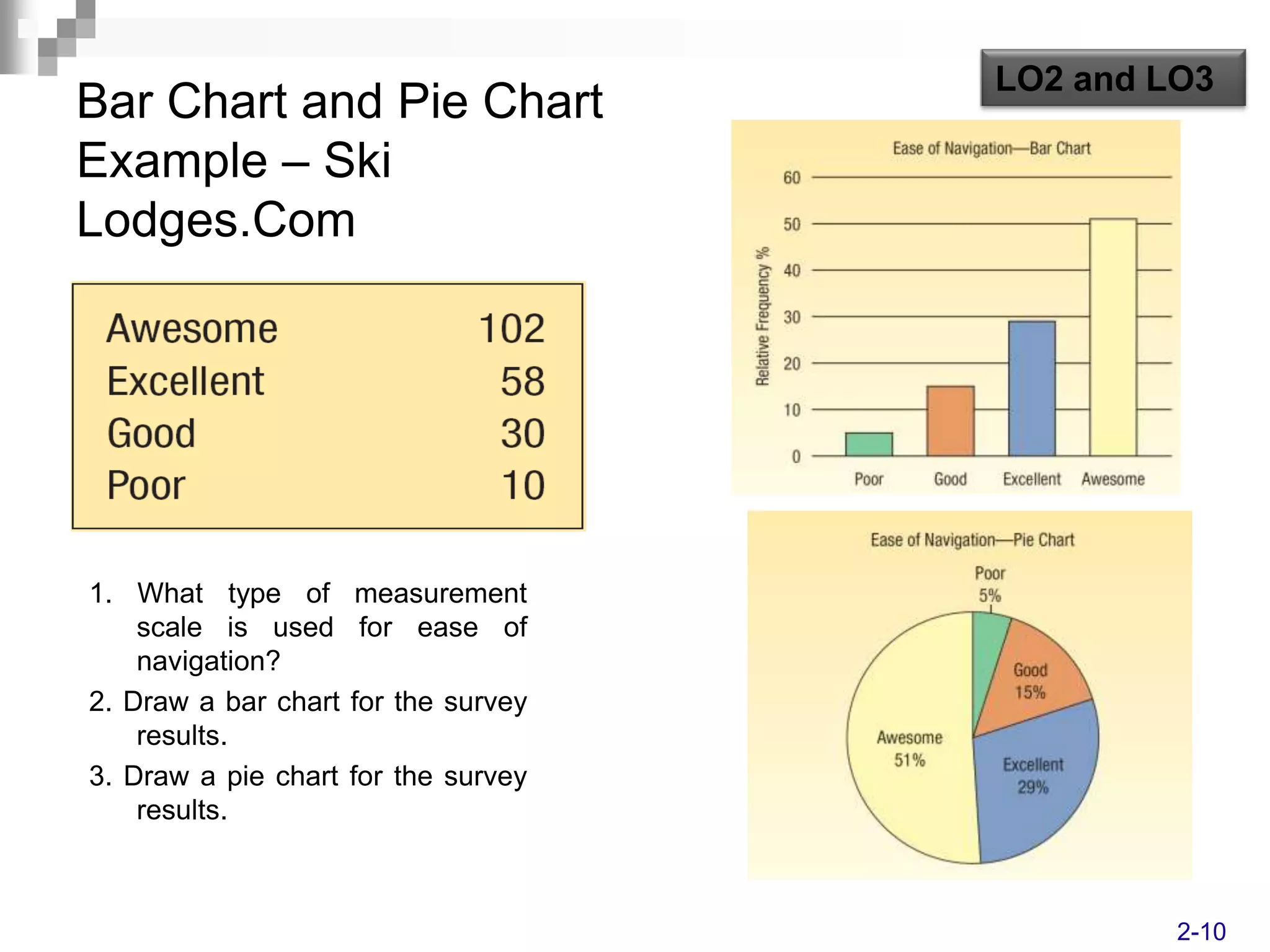
 Bar Chart and Pie Chart Example
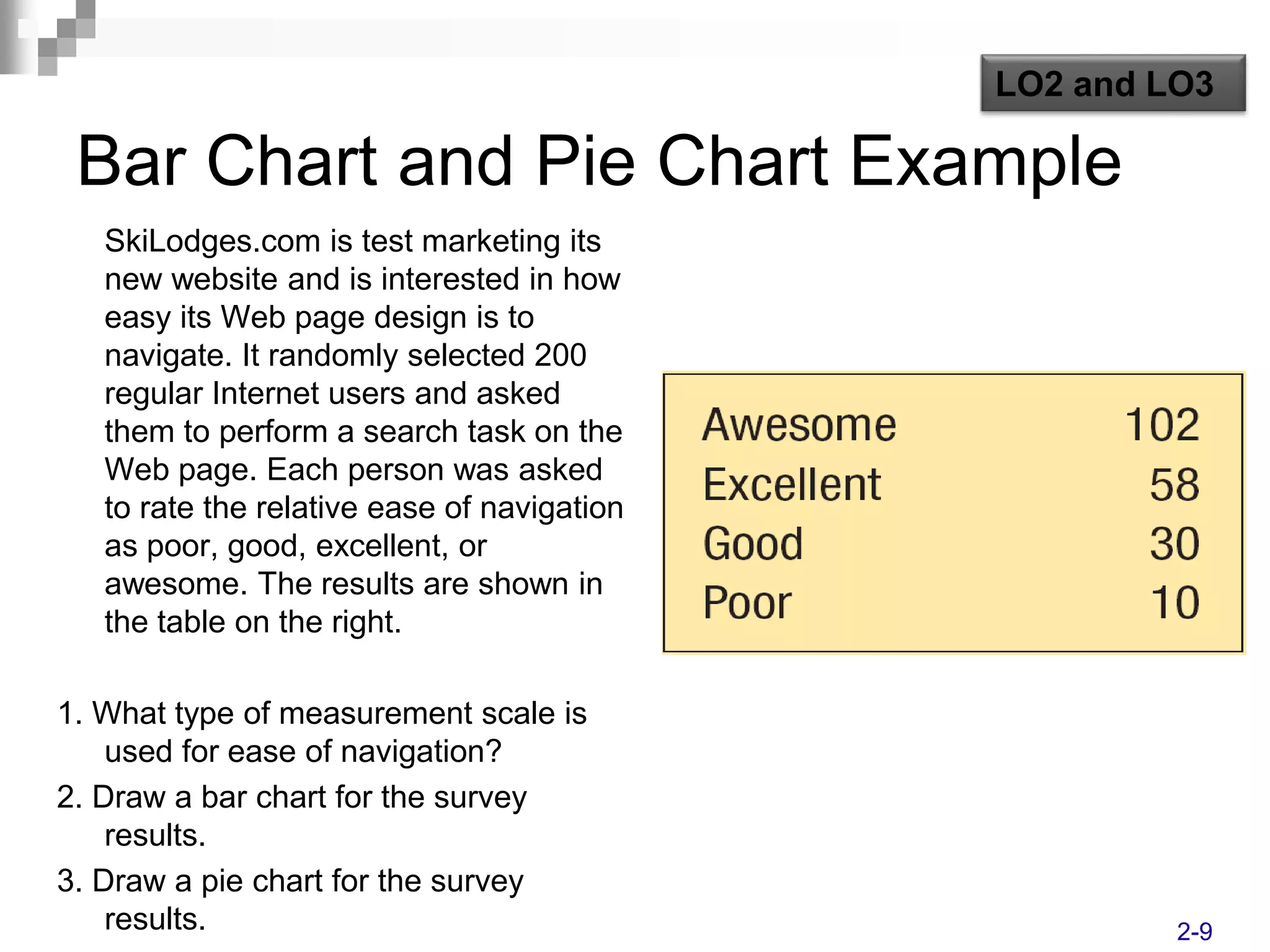
   SkiLodges.com is test marketing its
   new website and is interested in how
   easy its Web page design is to
   navigate. It randomly selected 200
   regular Internet users and asked
   them to perform a search task on the
   Web page. Each person was asked
   to rate the relative ease of navigation
   as poor, good, excellent, or
   awesome. The results are shown in
   the table on the right.

1. What type of measurement scale is
    used for ease of navigation?
2. Draw a bar chart for the survey
    results.
3. Draw a pie chart for the survey
    results.                                          2-9
LO2 and LO3
Bar Chart and Pie Chart
Example – Ski
Lodges.Com


1. What type of       measurement
    scale is used     for ease of
    navigation?
2. Draw a bar chart   for the survey
    results.
3. Draw a pie chart   for the survey
    results.


                                                2-10
LO5 Understand a relative
                                      frequency distribution.

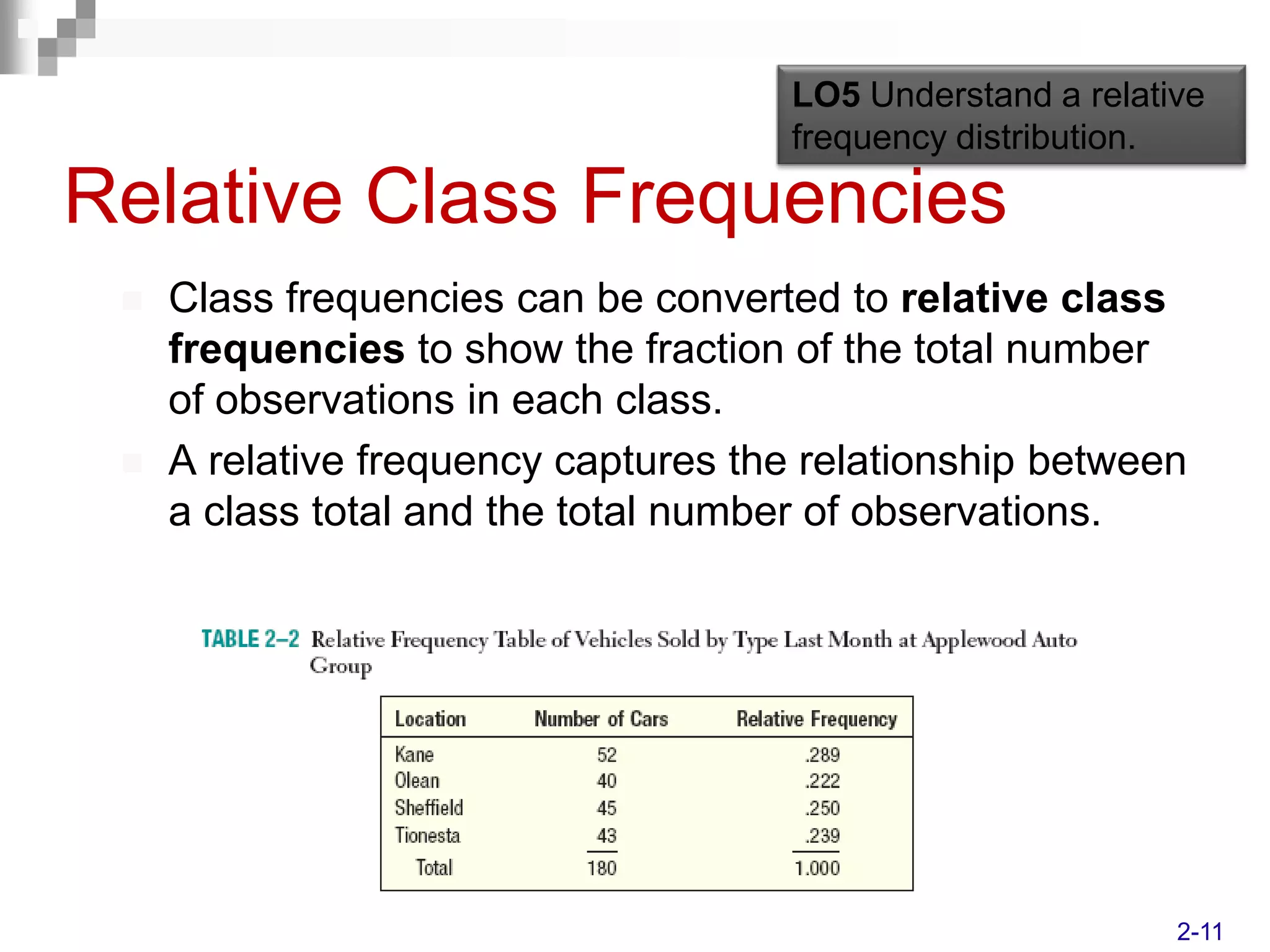
Relative Class Frequencies
    Class frequencies can be converted to relative class
     frequencies to show the fraction of the total number
     of observations in each class.
    A relative frequency captures the relationship between
     a class total and the total number of observations.


                                                             2-11
LO5

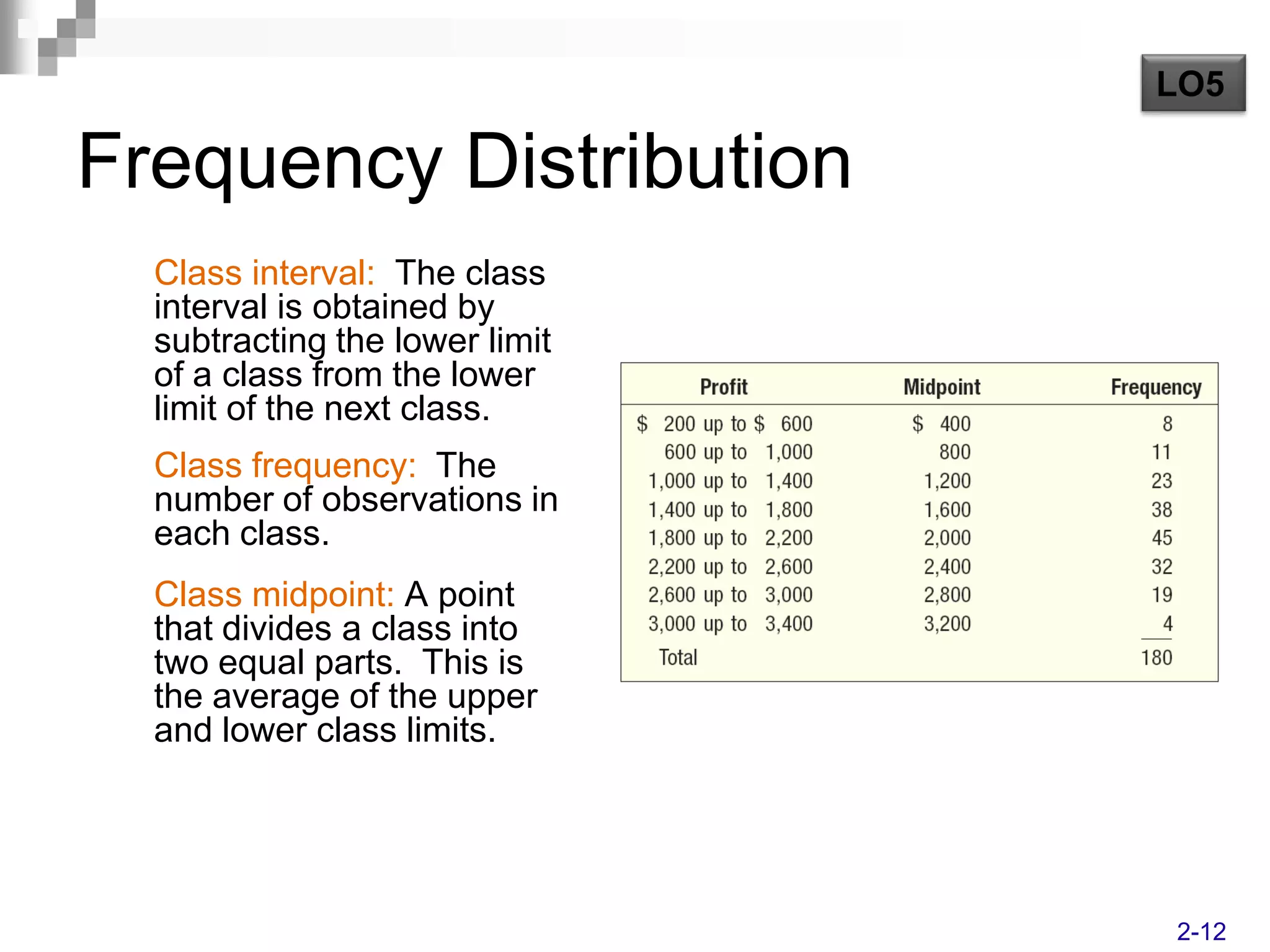
Frequency Distribution
  Class interval: The class
  interval is obtained by
  subtracting the lower limit
  of a class from the lower
  limit of the next class.
  Class frequency: The
  number of observations in
  each class.
  Class midpoint: A point
  that divides a class into
  two equal parts. This is
  the average of the upper
  and lower class limits.


                                2-12
LO6 Present data from a
EXAMPLE – Creating a                       frequency distribution in a
Frequency Distribution Table               histogram or frequency polygon.

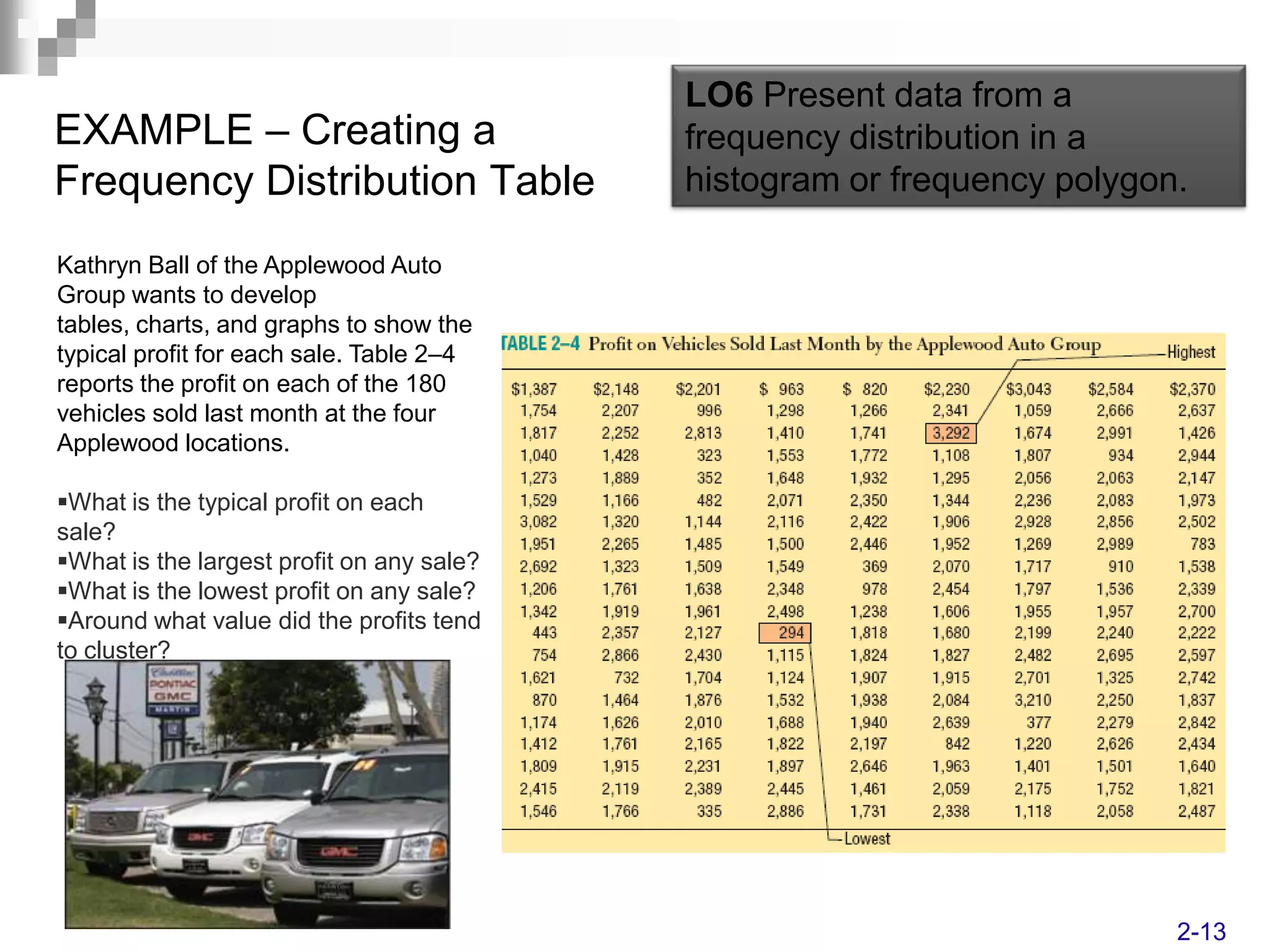
Kathryn Ball of the Applewood Auto
Group wants to develop
tables, charts, and graphs to show the
typical profit for each sale. Table 2–4
reports the profit on each of the 180
vehicles sold last month at the four
Applewood locations.

What is the typical profit on each
sale?
What is the largest profit on any sale?
What is the lowest profit on any sale?
Around what value did the profits tend
to cluster?


                                                                         2-13
LO6
    Constructing a Frequency Table - Example
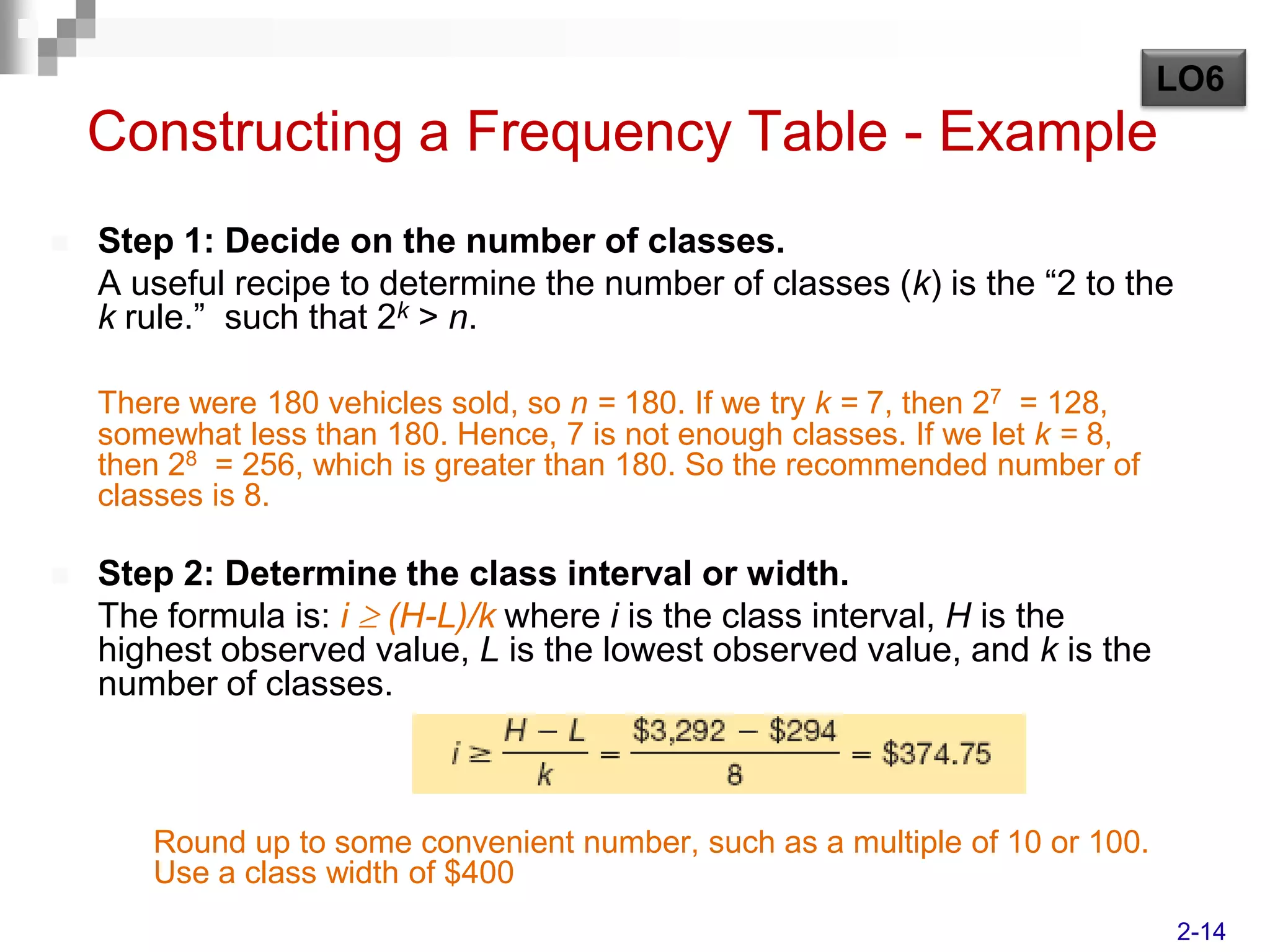
   Step 1: Decide on the number of classes.
    A useful recipe to determine the number of classes (k) is the “2 to the
    k rule.” such that 2k > n.

    There were 180 vehicles sold, so n = 180. If we try k = 7, then 27 = 128,
    somewhat less than 180. Hence, 7 is not enough classes. If we let k = 8,
    then 28 = 256, which is greater than 180. So the recommended number of
    classes is 8.

   Step 2: Determine the class interval or width.
    The formula is: i  (H-L)/k where i is the class interval, H is the
    highest observed value, L is the lowest observed value, and k is the
    number of classes.


       Round up to some convenient number, such as a multiple of 10 or 100.
       Use a class width of $400
                                                                                2-14
LO6
Constructing a Frequency Table - Example

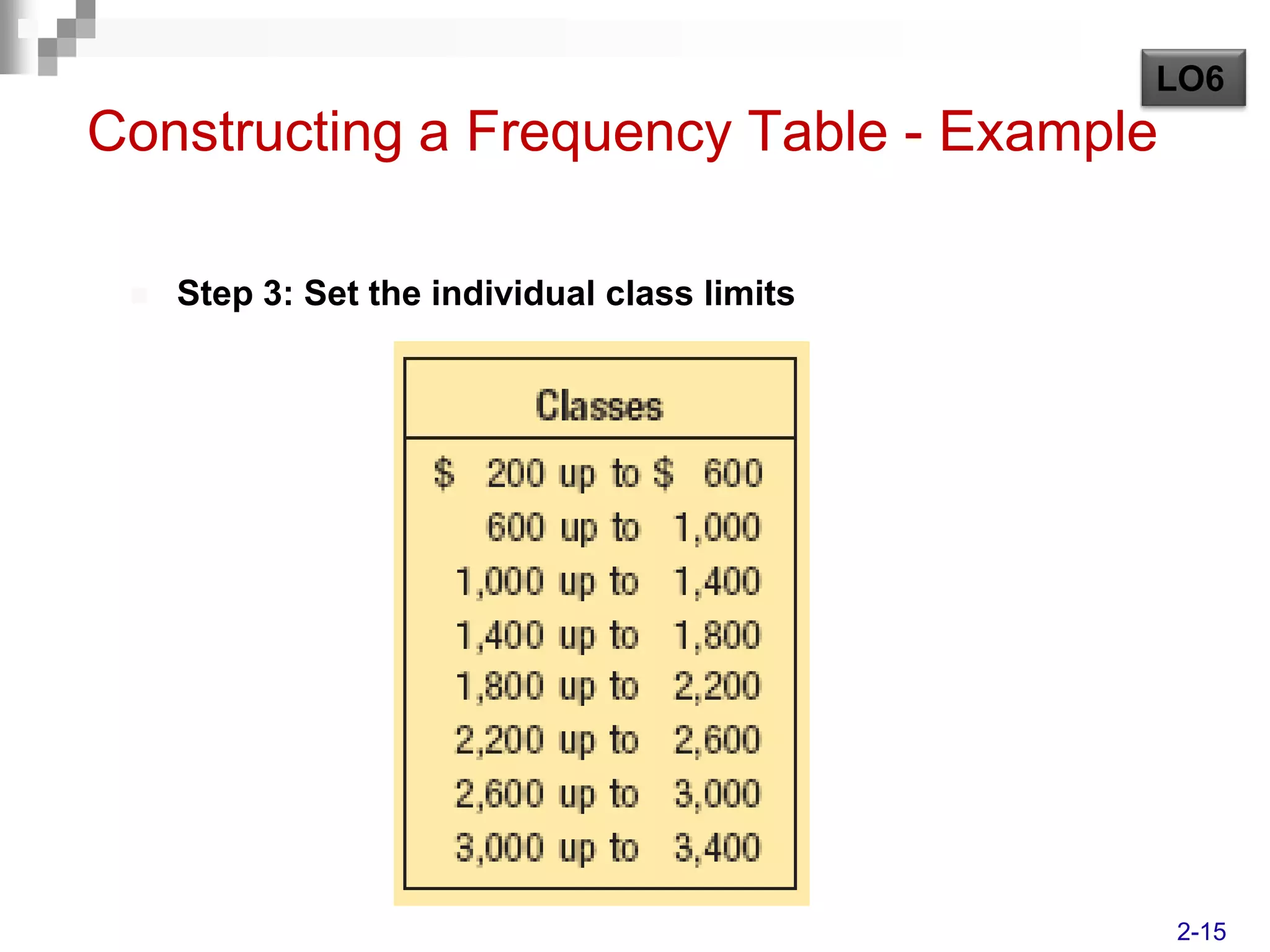
    Step 3: Set the individual class limits


                                               2-15
LO6

    Constructing a Frequency Table

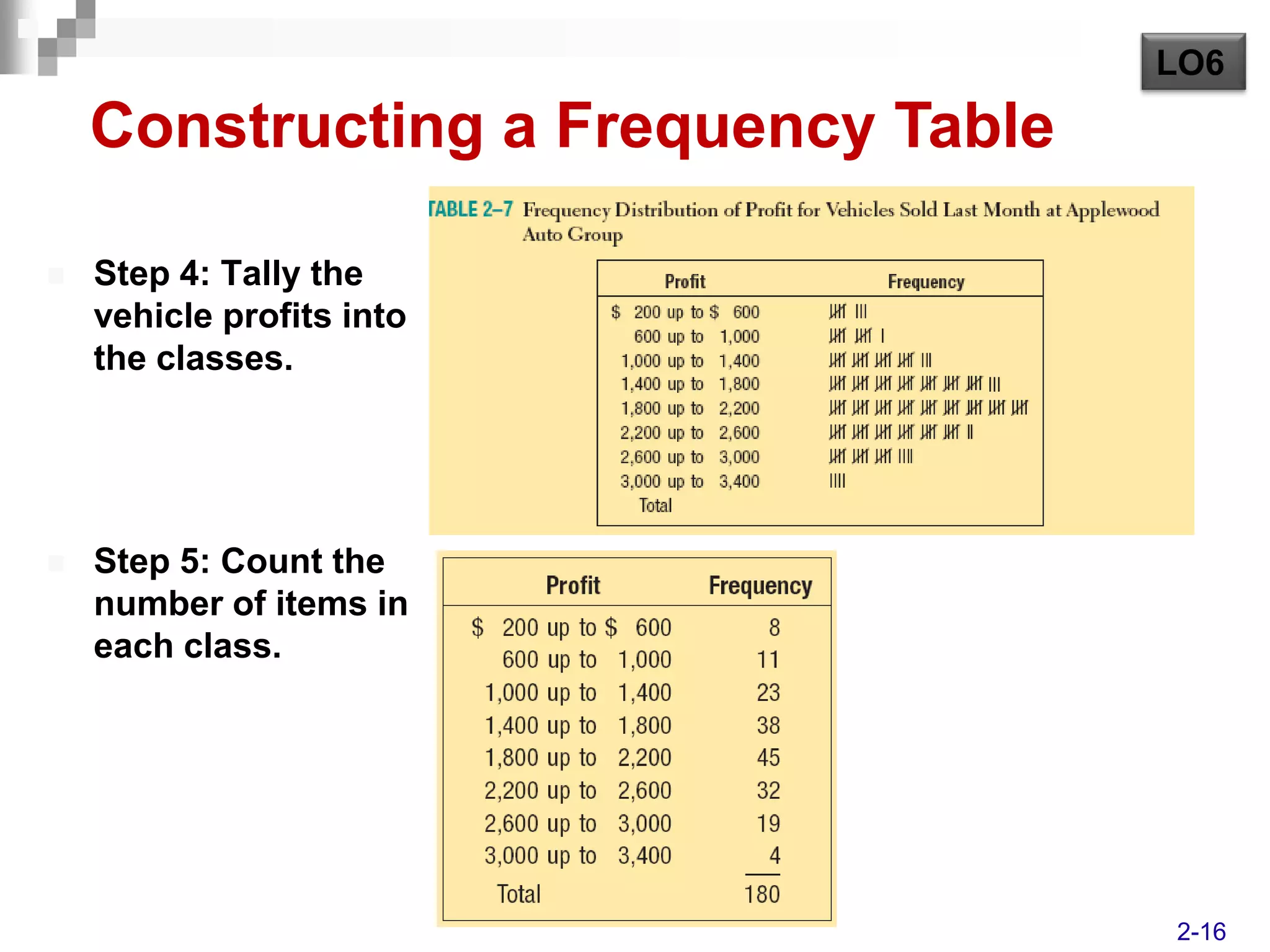
   Step 4: Tally the
    vehicle profits into
    the classes.


   Step 5: Count the
    number of items in
    each class.


                                     2-16
LO6


Relative Frequency Distribution
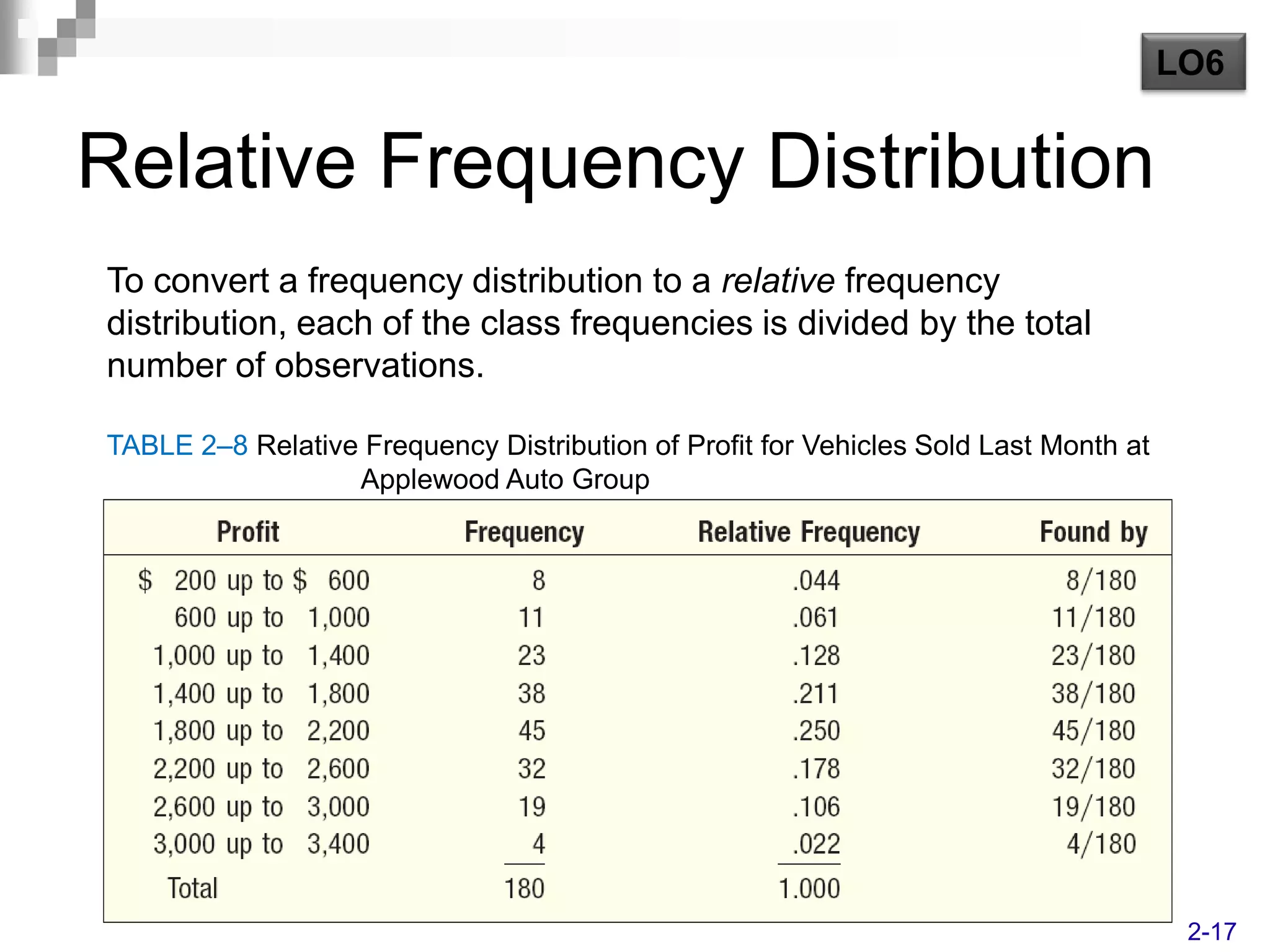
To convert a frequency distribution to a relative frequency
distribution, each of the class frequencies is divided by the total
number of observations.

TABLE 2–8 Relative Frequency Distribution of Profit for Vehicles Sold Last Month at
                  Applewood Auto Group


                                                                                       2-17
LO6

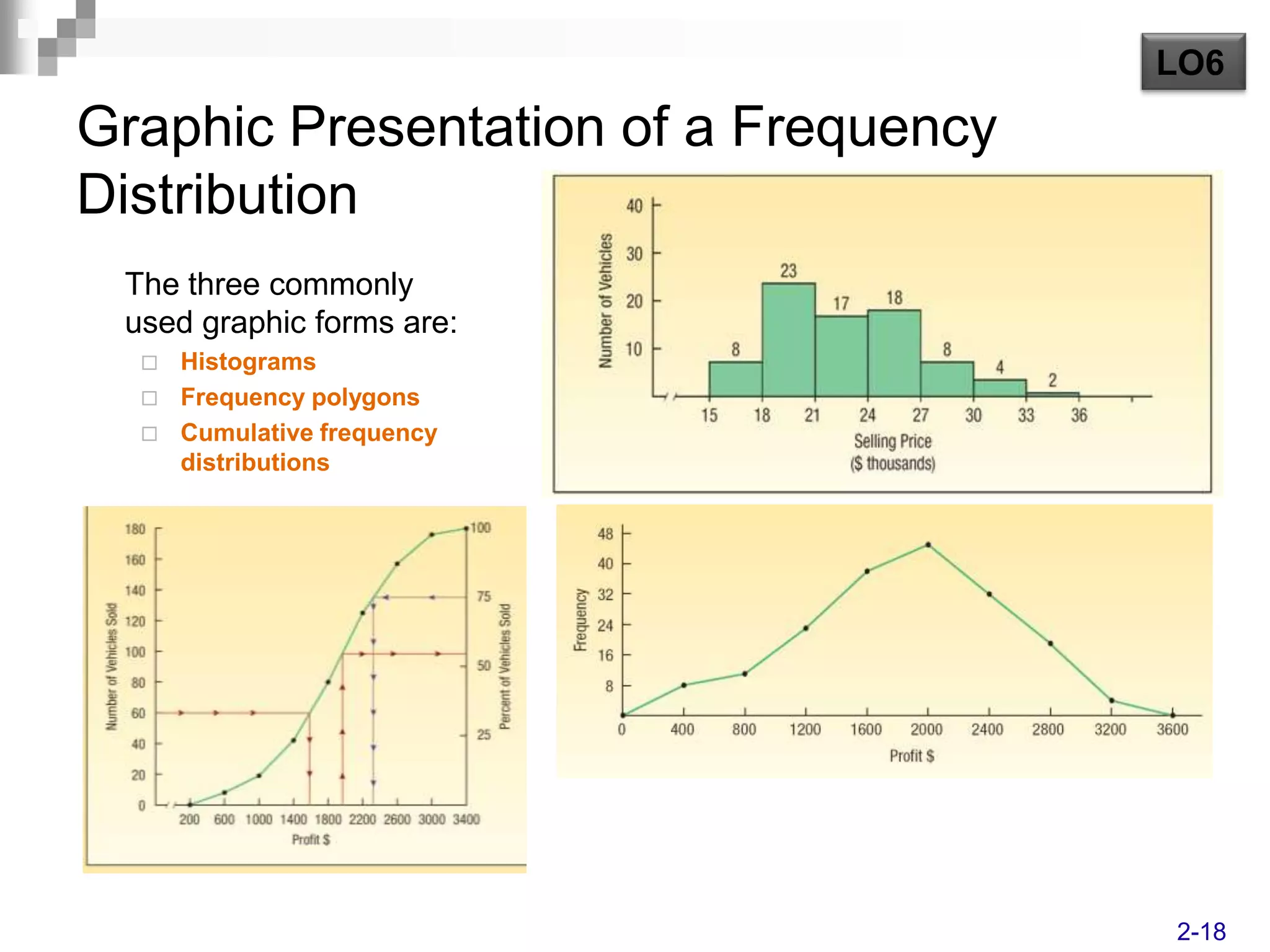
Graphic Presentation of a Frequency
Distribution
 The three commonly
 used graphic forms are:
     Histograms
     Frequency polygons
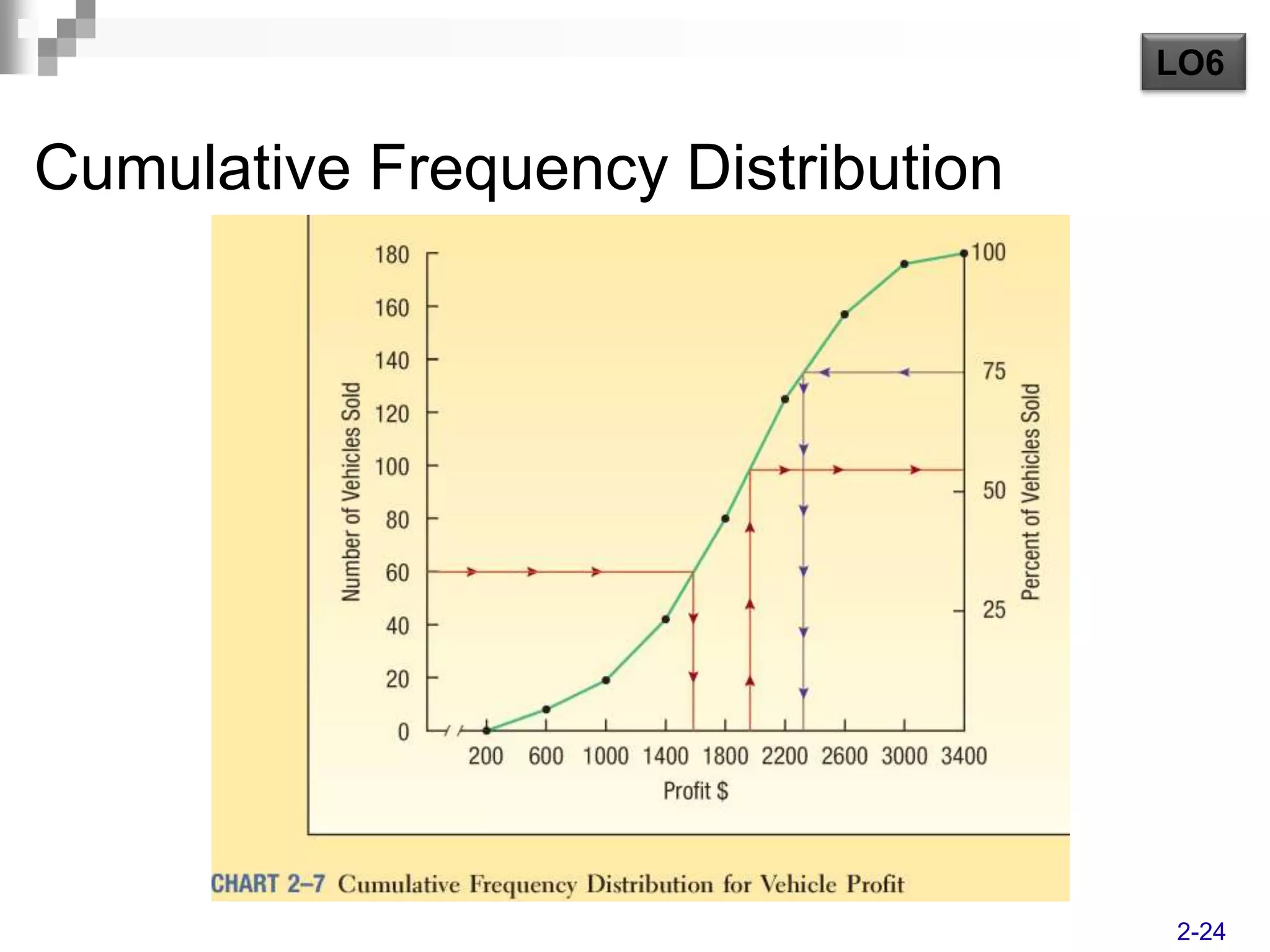
     Cumulative frequency
      distributions


                                      2-18
LO6


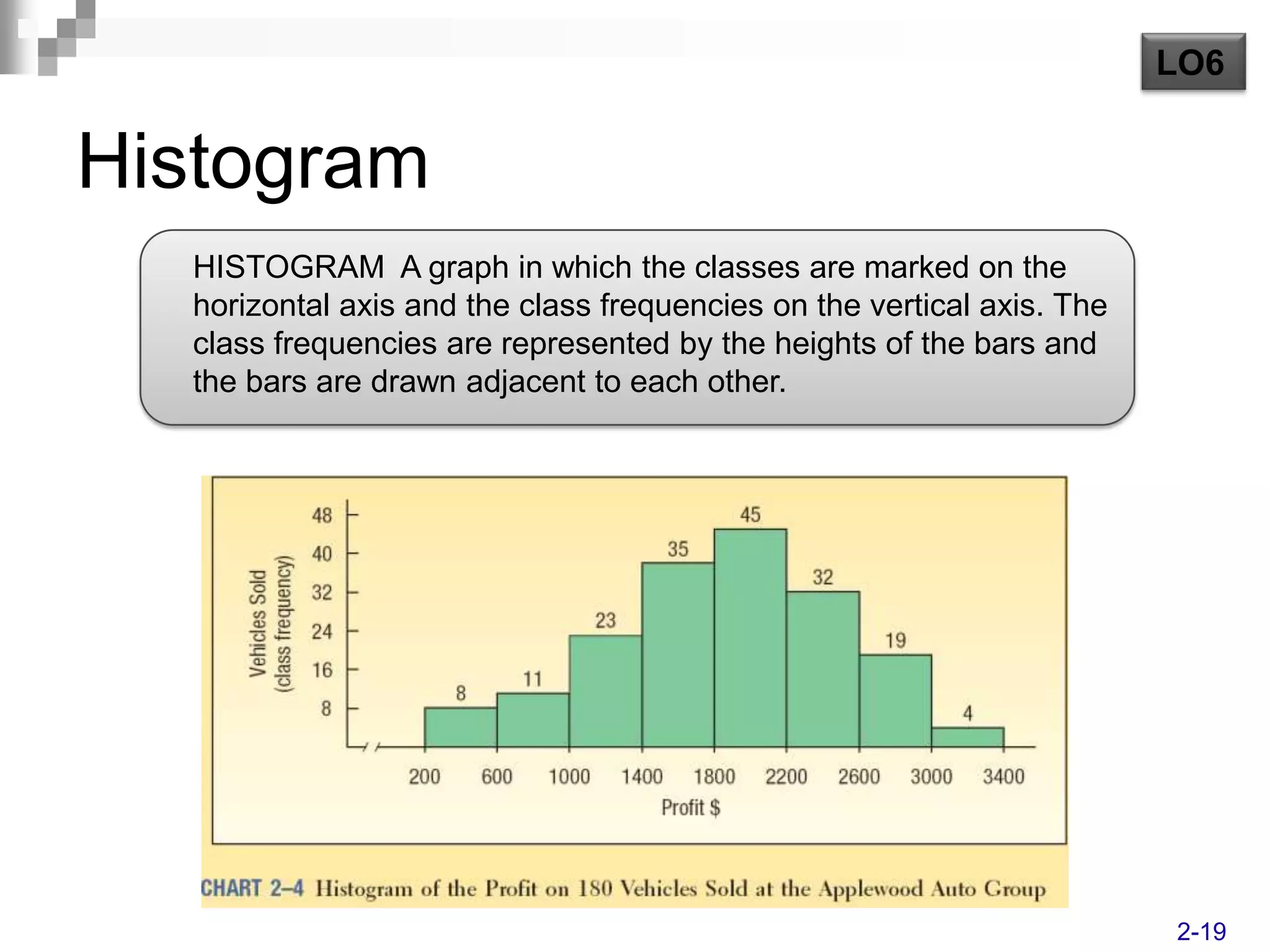
Histogram
  HISTOGRAM A graph in which the classes are marked on the
  horizontal axis and the class frequencies on the vertical axis. The
  class frequencies are represented by the heights of the bars and
  the bars are drawn adjacent to each other.


                                                                        2-19
LO6


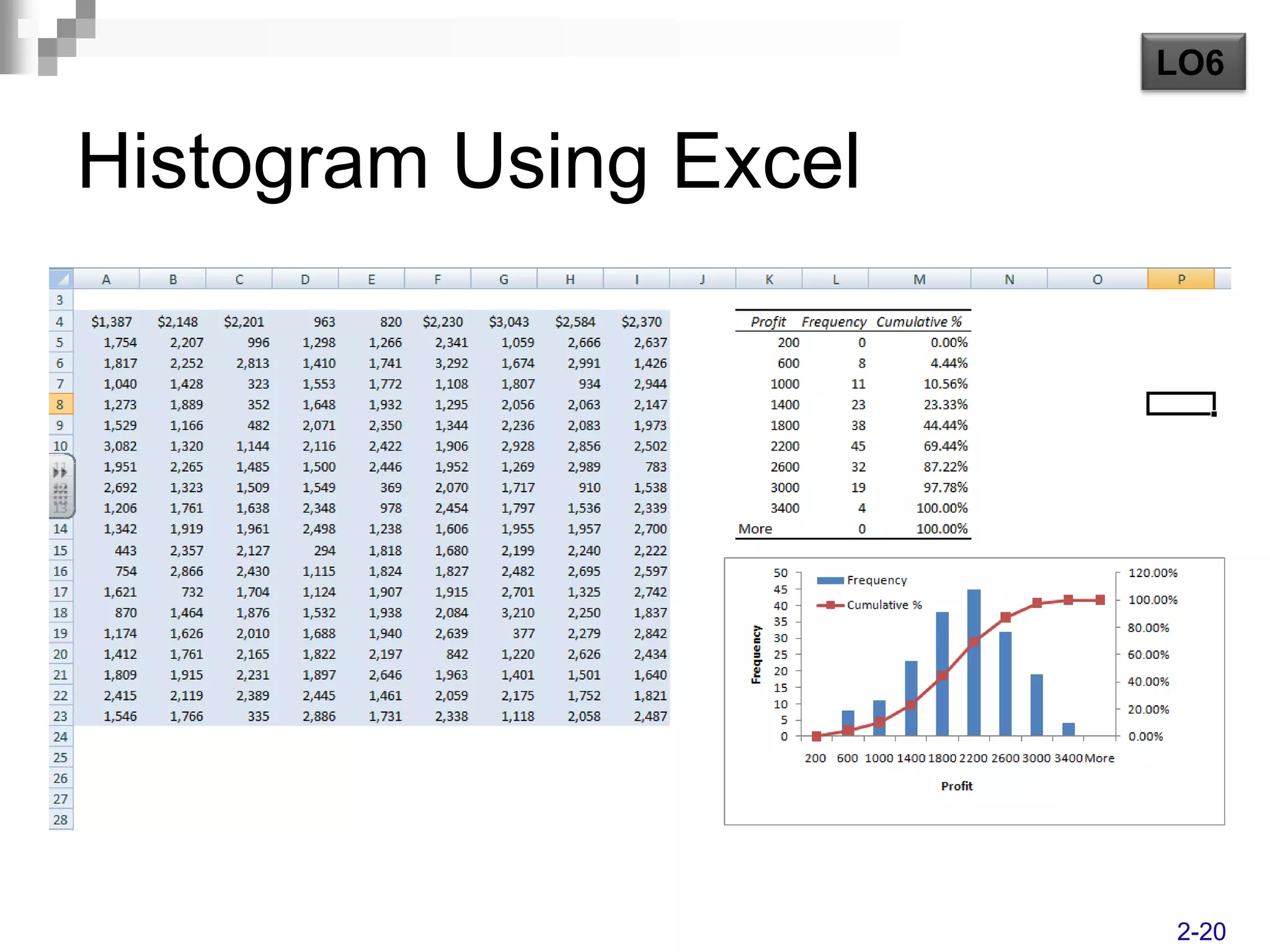
Histogram Using Excel


                        2-20
LO6

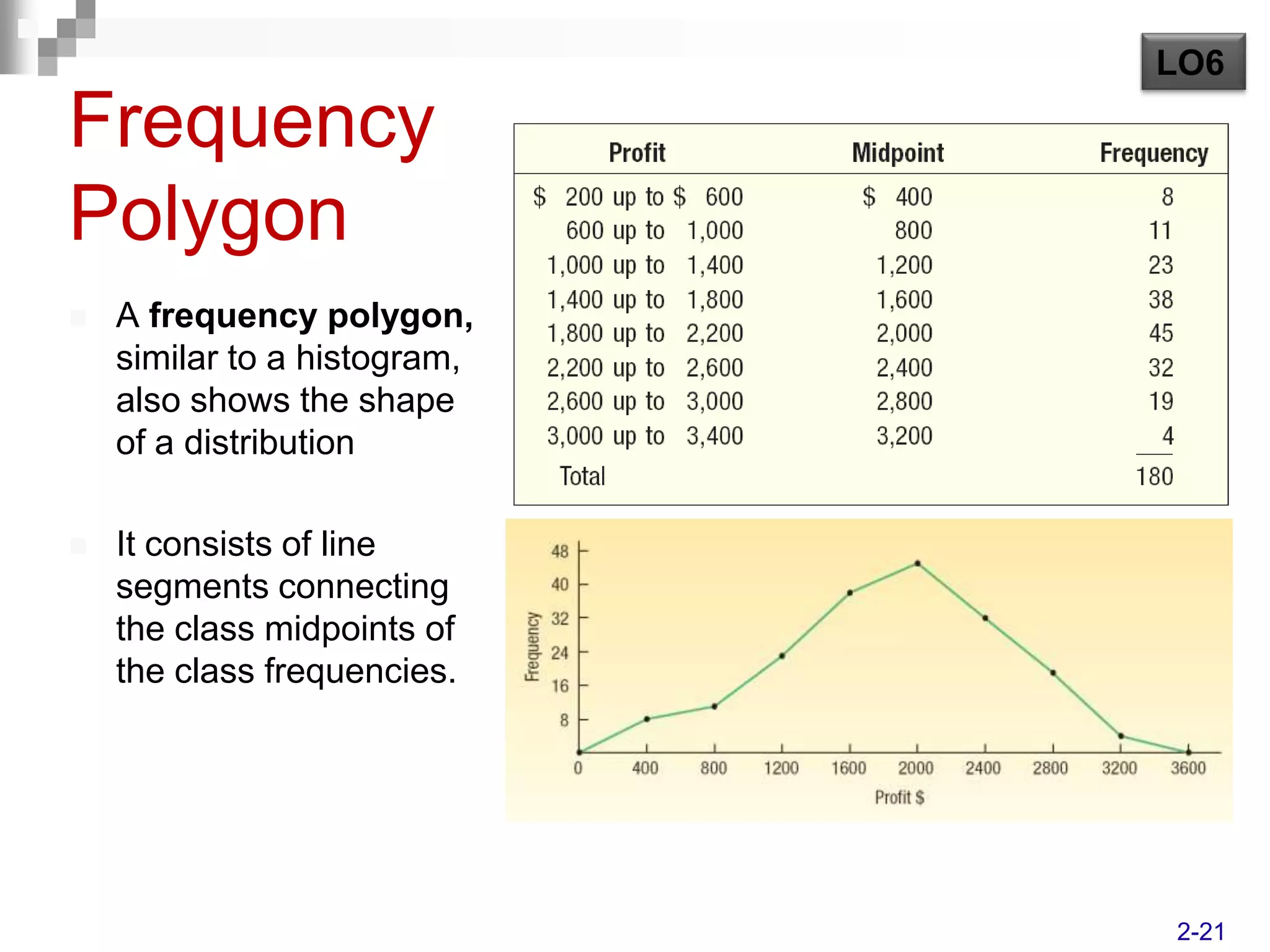
Frequency
Polygon
   A frequency polygon,
    similar to a histogram,
    also shows the shape
    of a distribution

   It consists of line
    segments connecting
    the class midpoints of
    the class frequencies.


                              2-21
LO6

    Histogram Versus Frequency Polygon
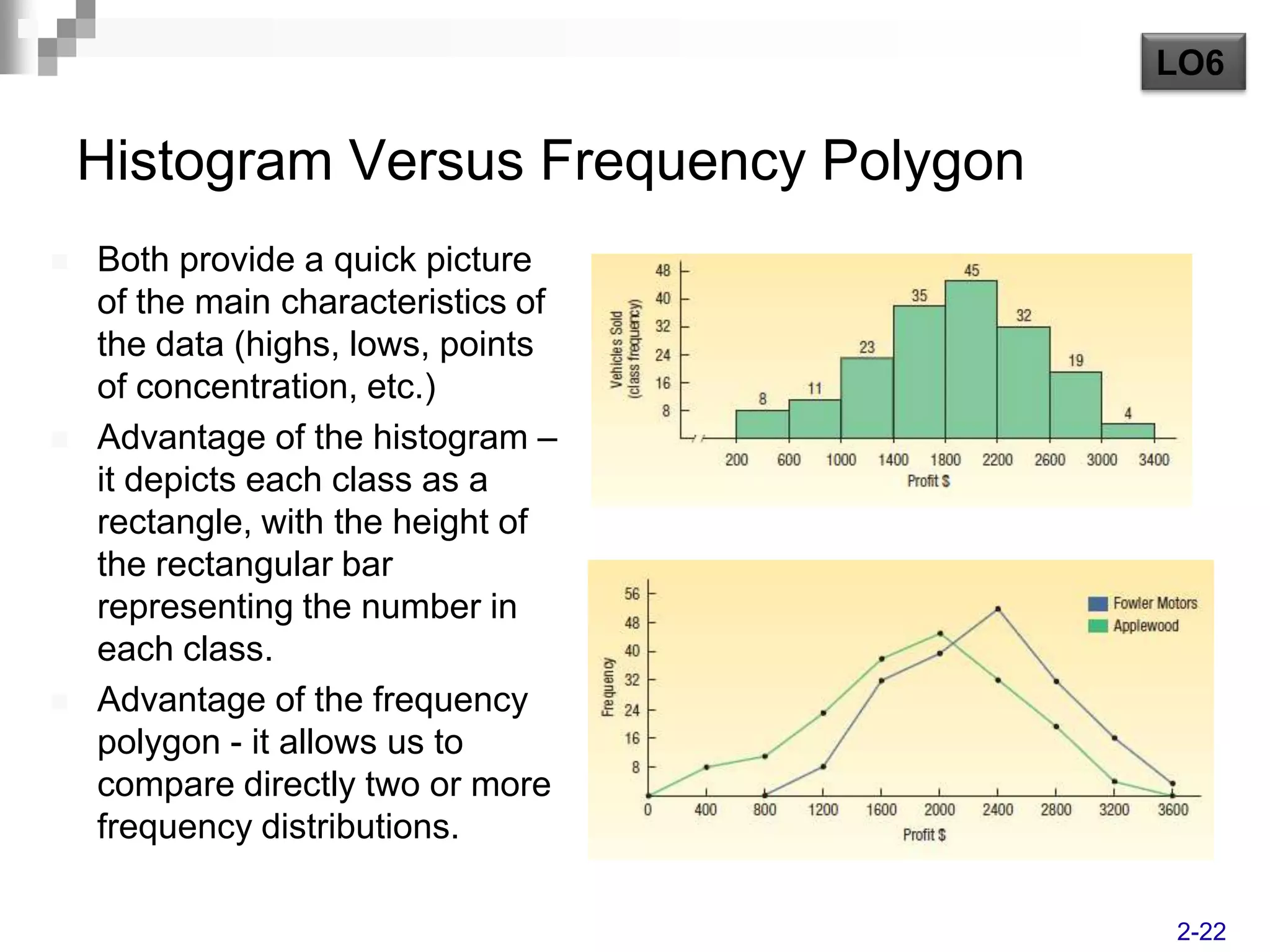
   Both provide a quick picture
    of the main characteristics of
    the data (highs, lows, points
    of concentration, etc.)
   Advantage of the histogram –
    it depicts each class as a
    rectangle, with the height of
    the rectangular bar
    representing the number in
    each class.
   Advantage of the frequency
    polygon - it allows us to
    compare directly two or more
    frequency distributions.

                                         2-22
LO6

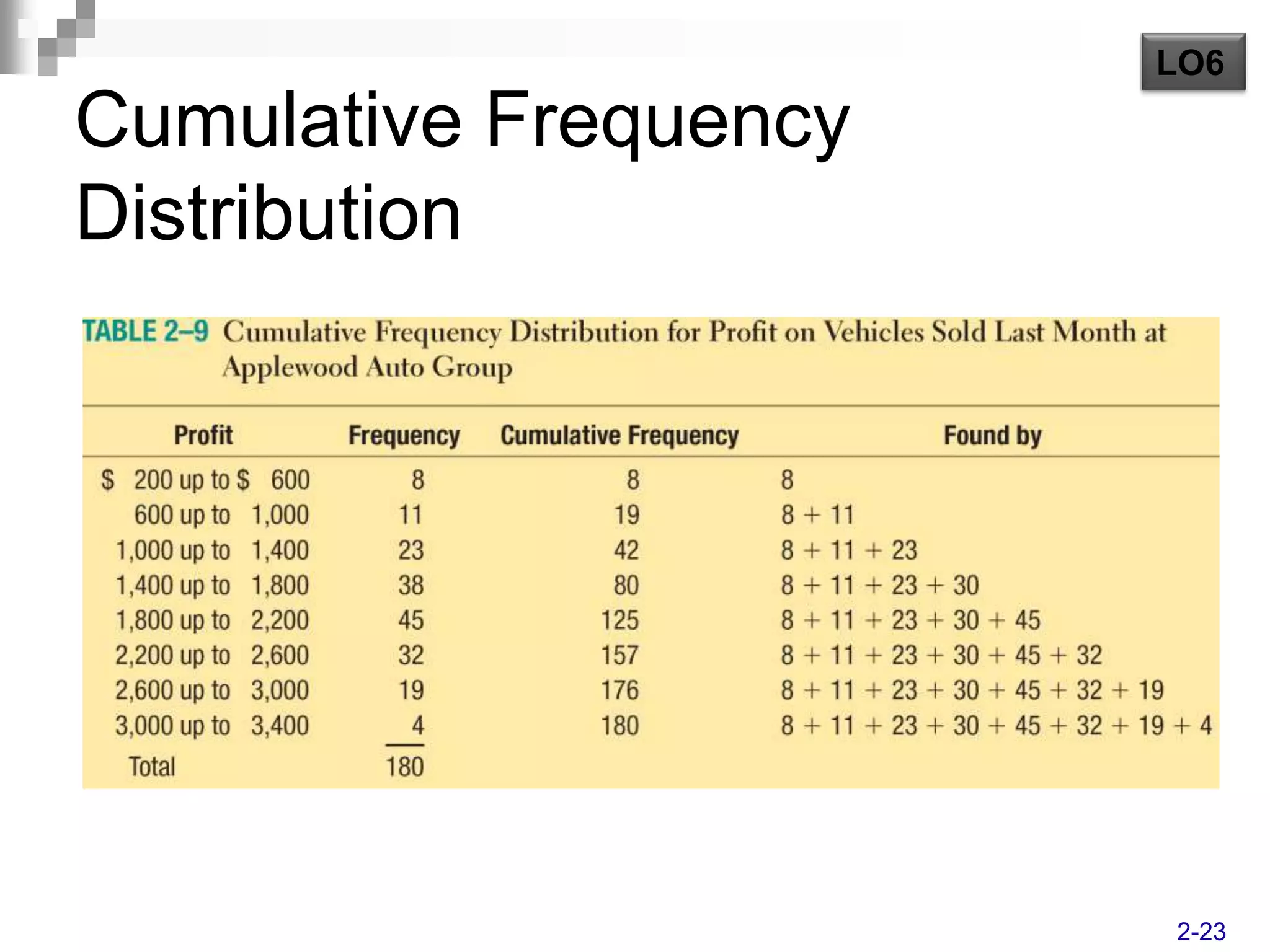
Cumulative Frequency
Distribution


                       2-23
LO6


Cumulative Frequency Distribution


                                    2-24

Chap002

  • 1.
    Describing Data: Frequency Tables, Frequency Distributions, and Graphic Presentation Chapter 2 McGraw-Hill/Irwin Copyright © 2012 by The McGraw-Hill Companies, Inc. All rights reserved.
  • 2.
    LEARNING OBJECTIVES LO1Make a frequency table for a set of data. LO2 Organize data into a bar chart. LO3 Present a set of data in a pie chart. LO4 Create a frequency distribution for a data set. LO5 Understand a relative frequency distribution. LO6 Present data from a frequency distribution in a histogram or frequency polygon. 2-2
  • 3.
    Describing Data with LO1 Make a frequency table for a set of data Charts, Tables and Graphs - Example The Applewood Auto Group (AAG)sells a wide range of vehicles through its four dealerships. Ms. Kathryn Ball, a member of the senior management team at AAG, is responsible for tracking and analyzing vehicle sales and the profitability of those vehicles. Kathryn would like to summarize the profit earned on the vehicles sold with tables, charts, and graphs that she would review monthly. She wants to know the profit per vehicle sold, as well as the lowest and highest amount of profit. She is also interested in describing the demographics of the buyers. What are their ages? How many vehicles have they previously purchased from one of the Applewood dealerships? What type of vehicle did they purchase? Partial data for 180 customers are shown on the table on the right. 2-3
  • 4.
    LO2 Frequency Table FREQUENCY TABLE A grouping of qualitative data into mutually exclusive classes showing the number of observations in each class. TABLE 2–1 Frequency Table for Vehicles Sold Last Month at Applewood Auto Group by Location 2-4
  • 5.
    LO2 Organize datainto a bar chart Bar Charts BAR CHART A graph in which the classes are reported on the horizontal axis and the class frequencies on the vertical axis. The class frequencies are proportional to the heights of the bars. 2-5
  • 6.
    LO3 Present aset of data Pie Charts in a pie chart. PIE CHART A chart that shows the proportion or percent that each class represents of the total number of frequencies. 2-6
  • 7.
  • 8.
    LO4 Create afrequency Frequency Distribution distribution for a data set. FREQUENCY DISTRIBUTION A grouping of data into mutually exclusive classes showing the number of observations in each class. TABLE 2–1 Frequency Table for Vehicles Sold Last Month at Applewood Auto Group by Location 2-8
  • 9.
    LO2 and LO3 Bar Chart and Pie Chart Example SkiLodges.com is test marketing its new website and is interested in how easy its Web page design is to navigate. It randomly selected 200 regular Internet users and asked them to perform a search task on the Web page. Each person was asked to rate the relative ease of navigation as poor, good, excellent, or awesome. The results are shown in the table on the right. 1. What type of measurement scale is used for ease of navigation? 2. Draw a bar chart for the survey results. 3. Draw a pie chart for the survey results. 2-9
  • 10.
    LO2 and LO3 BarChart and Pie Chart Example – Ski Lodges.Com 1. What type of measurement scale is used for ease of navigation? 2. Draw a bar chart for the survey results. 3. Draw a pie chart for the survey results. 2-10
  • 11.
    LO5 Understand arelative frequency distribution. Relative Class Frequencies  Class frequencies can be converted to relative class frequencies to show the fraction of the total number of observations in each class.  A relative frequency captures the relationship between a class total and the total number of observations. 2-11
  • 12.
    LO5 Frequency Distribution Class interval: The class interval is obtained by subtracting the lower limit of a class from the lower limit of the next class. Class frequency: The number of observations in each class. Class midpoint: A point that divides a class into two equal parts. This is the average of the upper and lower class limits. 2-12
  • 13.
    LO6 Present datafrom a EXAMPLE – Creating a frequency distribution in a Frequency Distribution Table histogram or frequency polygon. Kathryn Ball of the Applewood Auto Group wants to develop tables, charts, and graphs to show the typical profit for each sale. Table 2–4 reports the profit on each of the 180 vehicles sold last month at the four Applewood locations. What is the typical profit on each sale? What is the largest profit on any sale? What is the lowest profit on any sale? Around what value did the profits tend to cluster? 2-13
  • 14.
    LO6 Constructing a Frequency Table - Example  Step 1: Decide on the number of classes. A useful recipe to determine the number of classes (k) is the “2 to the k rule.” such that 2k > n. There were 180 vehicles sold, so n = 180. If we try k = 7, then 27 = 128, somewhat less than 180. Hence, 7 is not enough classes. If we let k = 8, then 28 = 256, which is greater than 180. So the recommended number of classes is 8.  Step 2: Determine the class interval or width. The formula is: i  (H-L)/k where i is the class interval, H is the highest observed value, L is the lowest observed value, and k is the number of classes. Round up to some convenient number, such as a multiple of 10 or 100. Use a class width of $400 2-14
  • 15.
    LO6 Constructing a FrequencyTable - Example  Step 3: Set the individual class limits 2-15
  • 16.
    LO6 Constructing a Frequency Table  Step 4: Tally the vehicle profits into the classes.  Step 5: Count the number of items in each class. 2-16
  • 17.
    LO6 Relative Frequency Distribution Toconvert a frequency distribution to a relative frequency distribution, each of the class frequencies is divided by the total number of observations. TABLE 2–8 Relative Frequency Distribution of Profit for Vehicles Sold Last Month at Applewood Auto Group 2-17
  • 18.
    LO6 Graphic Presentation ofa Frequency Distribution The three commonly used graphic forms are:  Histograms  Frequency polygons  Cumulative frequency distributions 2-18
  • 19.
    LO6 Histogram HISTOGRAMA graph in which the classes are marked on the horizontal axis and the class frequencies on the vertical axis. The class frequencies are represented by the heights of the bars and the bars are drawn adjacent to each other. 2-19
  • 20.
  • 21.
    LO6 Frequency Polygon  A frequency polygon, similar to a histogram, also shows the shape of a distribution  It consists of line segments connecting the class midpoints of the class frequencies. 2-21
  • 22.
    LO6 Histogram Versus Frequency Polygon  Both provide a quick picture of the main characteristics of the data (highs, lows, points of concentration, etc.)  Advantage of the histogram – it depicts each class as a rectangle, with the height of the rectangular bar representing the number in each class.  Advantage of the frequency polygon - it allows us to compare directly two or more frequency distributions. 2-22
  • 23.
  • 24.

Editor's Notes