Lecture Slides  Elementary Statistics   Eleventh Edition  and the Triola Statistics Series  by Mario F. Triola
Chapter 2 Summarizing and Graphing Data 2-1  Review and Preview 2-2  Frequency Distributions 2-3  Histograms 2-4  Statistical Graphics 2-5  Critical Thinking: Bad Graphs
Section 2-1  Review and Preview
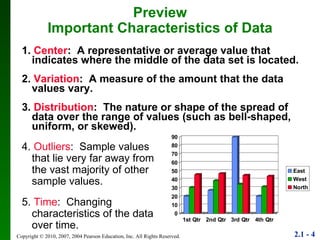
1.  Center :  A representative or average value that indicates where the middle of the data set is located. 2.  Variation :  A measure of the amount that the data values vary. 3.  Distribution :  The nature or shape of the spread of data over the range of values (such as bell-shaped, uniform, or skewed). Preview Important Characteristics of Data 4.  Outliers :  Sample values that lie very far away from the vast majority of other sample values. 5.  Time :  Changing characteristics of the data over time.
Copyright © 2010 Pearson Education Section 2-2  Frequency Distributions Copyright © 2010 Pearson Education
When working with large data sets, it is often helpful to organize and summarize data by constructing a table called a  frequency distribution , defined later.  Because computer software and calculators can generate frequency distributions, the details of constructing them are not as important as what they tell us about data sets. It helps us understand the nature of the  distribution  of a data set.  Key Concept Copyright © 2010 Pearson Education
Frequency Distribution (or Frequency Table)   shows how a data set is partitioned among all of several categories (or classes) by listing all of the categories along with the number of data values in each of the categories. Copyright © 2010 Pearson Education Definition
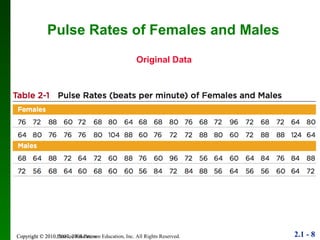
Pulse Rates of Females and Males Original Data Copyright © 2010 Pearson Education
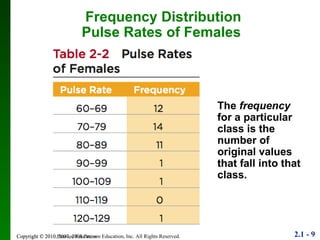
Copyright © 2010 Pearson Education Frequency Distribution Pulse Rates of Females  The  frequency  for a particular class is the number of original values that fall into that class.
Frequency Distributions Copyright © 2010 Pearson Education Definitions
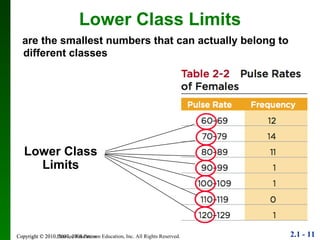
are the smallest numbers that can actually belong to different classes Lower Class Limits Copyright © 2010 Pearson Education Lower Class Limits
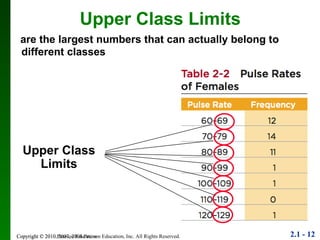
Upper Class Limits are the largest numbers that can actually belong to different classes Copyright © 2010 Pearson Education Upper Class Limits
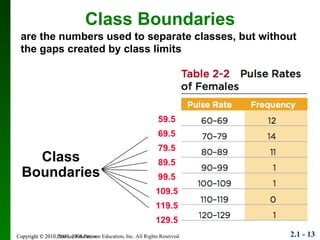
are the numbers used to separate classes, but without the gaps created by class limits Copyright © 2010 Pearson Education Class Boundaries Class Boundaries 59.5 69.5 79.5 89.5 99.5 109.5 119.5 129.5
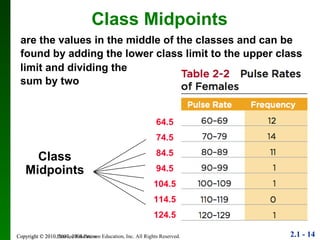
Copyright © 2010 Pearson Education Class Midpoints are the values in the middle of the classes and can be found by adding the lower class limit to the upper class Class Midpoints limit and dividing the sum by two 64.5 74.5 84.5 94.5 104.5 114.5 124.5
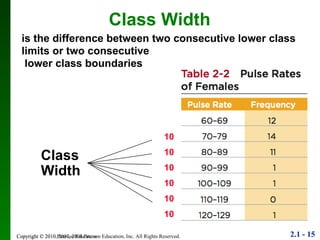
is the difference between two consecutive lower class limits or two consecutive  lower class boundaries Copyright © 2010 Pearson Education Class Width Class  Width 10 10 10 10 10 10
1. Large data sets can be summarized. 2. We can analyze the nature of data. 3. We have a basis for constructing important graphs. Copyright © 2010 Pearson Education Reasons for Constructing  Frequency Distributions
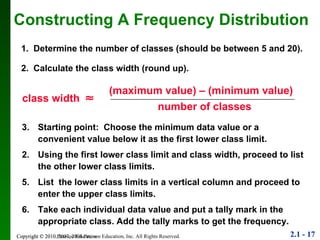
1.  Determine the number of classes (should be between 5 and 20). 2.  Calculate the class width (round up). Copyright © 2010 Pearson Education 3.  Starting point:  Choose the minimum data value or a convenient value below it as the first lower class limit. Using the first lower class limit and class width, proceed to list the other lower class limits. 5.  List  the lower class limits in a vertical column and proceed to enter the upper class limits. 6.  Take each individual data value and put a tally mark in the appropriate class. Add the tally marks to get the frequency. Constructing A Frequency Distribution class width   (maximum value) – (minimum value) number of classes
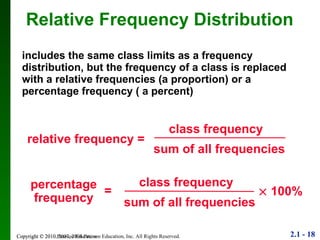
includes the same class limits as a frequency distribution, but the frequency of a class is replaced with a relative frequencies (a proportion) or a percentage frequency ( a percent) Copyright © 2010 Pearson Education Relative Frequency Distribution relative frequency = class frequency sum of all frequencies percentage frequency class frequency sum of all frequencies    100% =
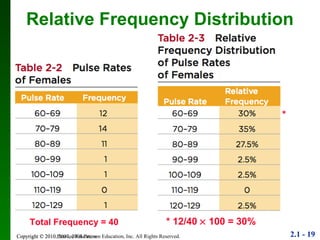
Copyright © 2010 Pearson Education Relative Frequency Distribution * 12/40    100 = 30% Total Frequency = 40 *
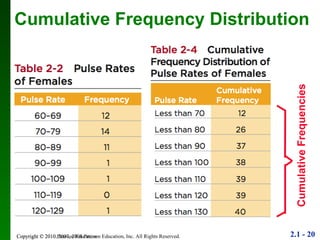
Copyright © 2010 Pearson Education Cumulative Frequency Distribution Cumulative Frequencies
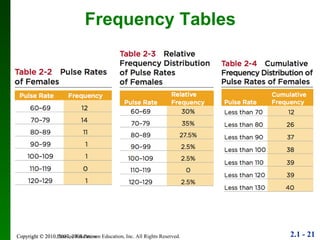
Frequency Tables Copyright © 2010 Pearson Education
Copyright © 2010 Pearson Education Critical Thinking Interpreting Frequency Distributions In later chapters, there will be frequent reference to data with a  normal distribution .  One key characteristic of a normal distribution is that it has a “bell” shape. The frequencies start low, then increase to one or two high frequencies, then decrease to a low frequency. The distribution is approximately symmetric, with frequencies preceding the maximum being roughly a mirror image of those that follow the maximum.
Copyright © 2010 Pearson Education Gaps Gaps The presence of gaps can show that we have data from two or more different populations. However, the converse is not true, because data from different populations do not necessarily result in gaps.
Copyright © 2010 Pearson Education Recap In this Section we have discussed Important characteristics of data Frequency distributions Procedures for constructing frequency distributions Relative frequency distributions Cumulative frequency distributions
Copyright © 2010 Pearson Education Section 2-3  Histograms
Key Concept Copyright © 2010 Pearson Education We use a visual tool called a  histogram  to analyze the shape of the distribution of the data.
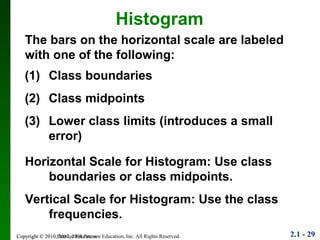
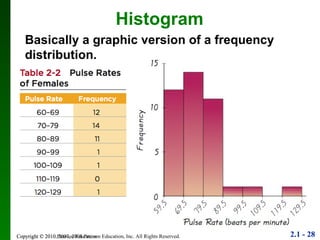
Copyright © 2010 Pearson Education Histogram A graph consisting of bars of equal width drawn adjacent to each other (without gaps). The horizontal scale represents the classes of quantitative data values and the vertical scale represents the frequencies. The heights of the bars correspond to the frequency values.
Copyright © 2010 Pearson Education Histogram Basically a graphic version of a frequency distribution.
Copyright © 2010 Pearson Education Histogram The bars on the horizontal scale are labeled with one of the following: Class boundaries Class midpoints Lower class limits (introduces a small error) Horizontal Scale for Histogram: Use class boundaries or class midpoints. Vertical Scale for Histogram: Use the class frequencies.
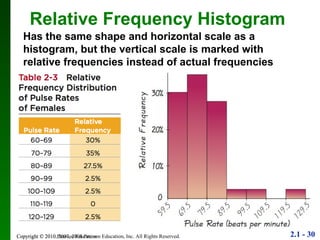
Copyright © 2010 Pearson Education Relative Frequency Histogram  Has the same shape and horizontal scale as a histogram, but the vertical scale is marked with relative frequencies instead of actual frequencies
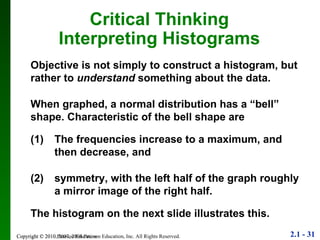
Copyright © 2010 Pearson Education Objective is not simply to construct a histogram, but rather to  understand  something about the data. When graphed, a normal distribution has a “bell” shape. Characteristic of the bell shape are Critical Thinking Interpreting Histograms (1) The frequencies increase to a maximum, and then decrease, and (2) symmetry, with the left half of the graph roughly a mirror image of the right half. The histogram on the next slide illustrates this.
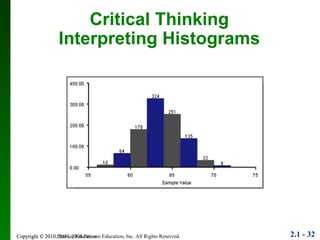
Copyright © 2010 Pearson Education Critical Thinking Interpreting Histograms
Copyright © 2010 Pearson Education Recap In this Section we have discussed Histograms Relative Frequency Histograms
Section 2-4  Statistical Graphics
Key Concept This section discusses other types of statistical graphs.  Our objective is to identify a suitable graph for representing the data set. The graph should be effective in revealing the important characteristics of the data.
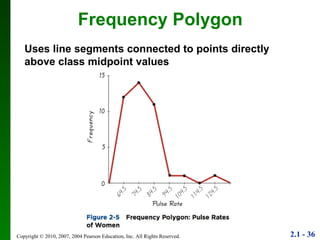
Frequency Polygon Uses line segments connected to points directly above class midpoint values
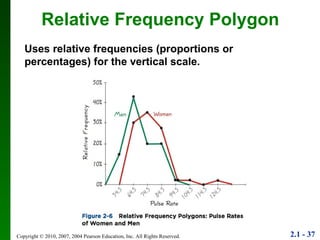
Relative Frequency Polygon Uses relative frequencies (proportions or percentages) for the vertical scale.
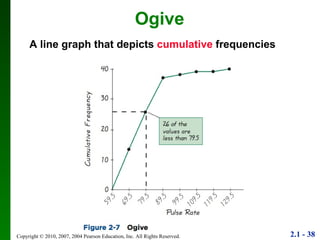
Ogive A line graph that depicts  cumulative  frequencies
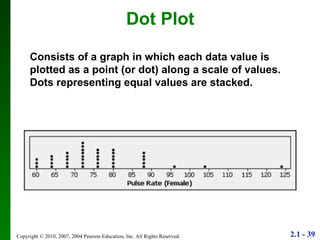
Dot Plot Consists of a graph in which each data value is plotted as a point (or dot) along a scale of values. Dots representing equal values are stacked.
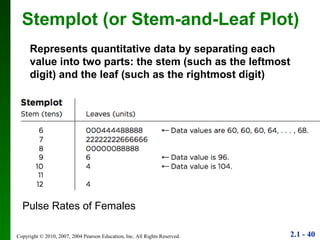
Stemplot (or Stem-and-Leaf Plot) Represents quantitative data by separating each value into two parts: the stem (such as the leftmost digit) and the leaf (such as the rightmost digit) Pulse Rates of Females
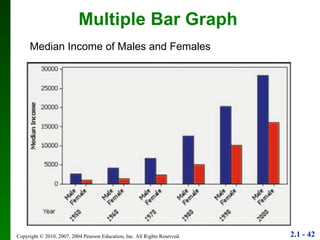
Bar Graph  Uses bars of equal width to show frequencies of categories of qualitative data. Vertical scale represents frequencies or relative frequencies. Horizontal scale identifies the different categories of qualitative data. A  multiple bar graph  has two or more sets of bars, and is used to compare two or more data sets.
Multiple Bar Graph  Median Income of Males and Females
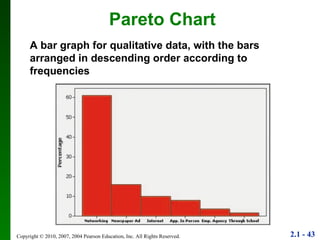
Pareto Chart A bar graph for qualitative data, with the bars arranged in descending order according to frequencies
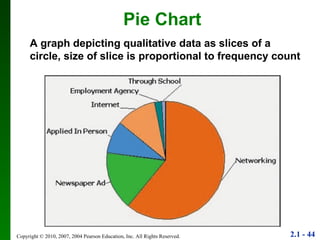
Pie Chart A graph depicting qualitative data as slices of a circle, size of slice is proportional to frequency count
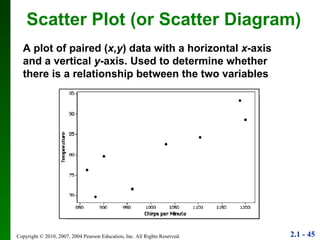
Scatter Plot (or Scatter Diagram) A plot of paired ( x,y ) data with a horizontal  x -axis and a vertical  y -axis. Used to determine whether there is a relationship between the two variables
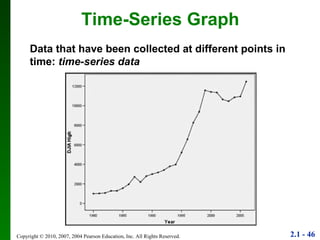
Time-Series Graph Data that have been collected at different points in time:  time-series data
Important Principles Suggested by Edward Tufte For small data sets of 20 values or fewer, use a table instead of a graph. A graph of data should make the viewer focus on the true nature of the data, not on other elements, such as eye-catching but distracting design features. Do not distort data, construct a graph to reveal the true nature of the data. Almost all of the ink in a graph should be used for the data, not the other design elements.
Important Principles Suggested by Edward Tufte Don’t use screening consisting of features such as slanted lines, dots, cross-hatching, because they create the uncomfortable illusion of movement. Don’t use area or volumes for data that are actually one-dimensional in nature. (Don’t use drawings of dollar bills to represent budget amounts for different years.) Never publish pie charts, because they waste ink on nondata components, and they lack appropriate scale.
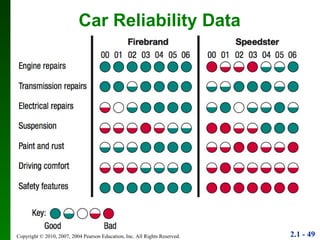
Car Reliability Data
Recap In this section we saw that graphs are excellent tools for describing, exploring and comparing data. Describing data : Histogram - consider distribution, center, variation, and outliers. Exploring data : features that reveal some useful and/or interesting characteristic of the data set. Comparing data : Construct similar graphs to compare data sets.
Section 2-5  Critical Thinking: Bad Graphs
Key Concept Some graphs are bad in the sense that they contain errors. Some are bad because they are technically correct, but misleading. It is important to develop the ability to recognize bad graphs and identify exactly how they are misleading.
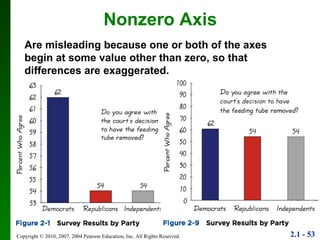
Nonzero Axis Are misleading because one or both of the axes begin at some value other than zero, so that differences are exaggerated.
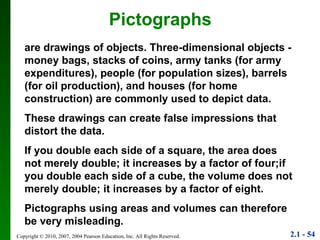
Pictographs are drawings of objects. Three-dimensional objects - money bags, stacks of coins, army tanks (for army expenditures), people (for population sizes), barrels (for oil production), and houses (for home construction) are commonly used to depict data. These drawings can create false impressions that distort the data. If you double each side of a square, the area does not merely double; it increases by a factor of four;if you double each side of a cube, the volume does not merely double; it increases by a factor of eight. Pictographs using areas and volumes can therefore be very misleading.
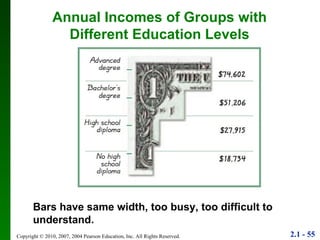
Annual Incomes of Groups with Different Education Levels Bars have same width, too busy, too difficult to understand.
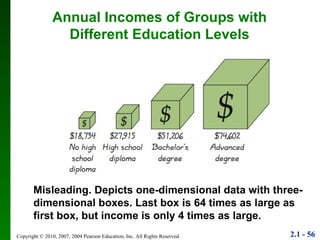
Annual Incomes of Groups with Different Education Levels Misleading. Depicts one-dimensional data with three-dimensional boxes. Last box is 64 times as large as first box, but income is only 4 times as large.
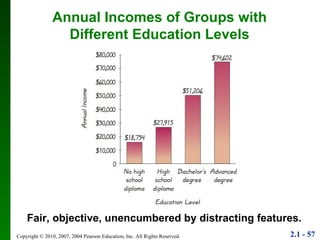
Annual Incomes of Groups with Different Education Levels Fair, objective, unencumbered by distracting features.

Stat11t chapter2

  • 1.
    Lecture Slides Elementary Statistics Eleventh Edition and the Triola Statistics Series by Mario F. Triola
  • 2.
    Chapter 2 Summarizingand Graphing Data 2-1 Review and Preview 2-2 Frequency Distributions 2-3 Histograms 2-4 Statistical Graphics 2-5 Critical Thinking: Bad Graphs
  • 3.
    Section 2-1 Review and Preview
  • 4.
    1. Center: A representative or average value that indicates where the middle of the data set is located. 2. Variation : A measure of the amount that the data values vary. 3. Distribution : The nature or shape of the spread of data over the range of values (such as bell-shaped, uniform, or skewed). Preview Important Characteristics of Data 4. Outliers : Sample values that lie very far away from the vast majority of other sample values. 5. Time : Changing characteristics of the data over time.
  • 5.
    Copyright © 2010Pearson Education Section 2-2 Frequency Distributions Copyright © 2010 Pearson Education
  • 6.
    When working withlarge data sets, it is often helpful to organize and summarize data by constructing a table called a frequency distribution , defined later. Because computer software and calculators can generate frequency distributions, the details of constructing them are not as important as what they tell us about data sets. It helps us understand the nature of the distribution of a data set. Key Concept Copyright © 2010 Pearson Education
  • 7.
    Frequency Distribution (orFrequency Table) shows how a data set is partitioned among all of several categories (or classes) by listing all of the categories along with the number of data values in each of the categories. Copyright © 2010 Pearson Education Definition
  • 8.
    Pulse Rates ofFemales and Males Original Data Copyright © 2010 Pearson Education
  • 9.
    Copyright © 2010Pearson Education Frequency Distribution Pulse Rates of Females The frequency for a particular class is the number of original values that fall into that class.
  • 10.
    Frequency Distributions Copyright© 2010 Pearson Education Definitions
  • 11.
    are the smallestnumbers that can actually belong to different classes Lower Class Limits Copyright © 2010 Pearson Education Lower Class Limits
  • 12.
    Upper Class Limitsare the largest numbers that can actually belong to different classes Copyright © 2010 Pearson Education Upper Class Limits
  • 13.
    are the numbersused to separate classes, but without the gaps created by class limits Copyright © 2010 Pearson Education Class Boundaries Class Boundaries 59.5 69.5 79.5 89.5 99.5 109.5 119.5 129.5
  • 14.
    Copyright © 2010Pearson Education Class Midpoints are the values in the middle of the classes and can be found by adding the lower class limit to the upper class Class Midpoints limit and dividing the sum by two 64.5 74.5 84.5 94.5 104.5 114.5 124.5
  • 15.
    is the differencebetween two consecutive lower class limits or two consecutive lower class boundaries Copyright © 2010 Pearson Education Class Width Class Width 10 10 10 10 10 10
  • 16.
    1. Large datasets can be summarized. 2. We can analyze the nature of data. 3. We have a basis for constructing important graphs. Copyright © 2010 Pearson Education Reasons for Constructing Frequency Distributions
  • 17.
    1. Determinethe number of classes (should be between 5 and 20). 2. Calculate the class width (round up). Copyright © 2010 Pearson Education 3. Starting point: Choose the minimum data value or a convenient value below it as the first lower class limit. Using the first lower class limit and class width, proceed to list the other lower class limits. 5. List the lower class limits in a vertical column and proceed to enter the upper class limits. 6. Take each individual data value and put a tally mark in the appropriate class. Add the tally marks to get the frequency. Constructing A Frequency Distribution class width  (maximum value) – (minimum value) number of classes
  • 18.
    includes the sameclass limits as a frequency distribution, but the frequency of a class is replaced with a relative frequencies (a proportion) or a percentage frequency ( a percent) Copyright © 2010 Pearson Education Relative Frequency Distribution relative frequency = class frequency sum of all frequencies percentage frequency class frequency sum of all frequencies  100% =
  • 19.
    Copyright © 2010Pearson Education Relative Frequency Distribution * 12/40  100 = 30% Total Frequency = 40 *
  • 20.
    Copyright © 2010Pearson Education Cumulative Frequency Distribution Cumulative Frequencies
  • 21.
    Frequency Tables Copyright© 2010 Pearson Education
  • 22.
    Copyright © 2010Pearson Education Critical Thinking Interpreting Frequency Distributions In later chapters, there will be frequent reference to data with a normal distribution . One key characteristic of a normal distribution is that it has a “bell” shape. The frequencies start low, then increase to one or two high frequencies, then decrease to a low frequency. The distribution is approximately symmetric, with frequencies preceding the maximum being roughly a mirror image of those that follow the maximum.
  • 23.
    Copyright © 2010Pearson Education Gaps Gaps The presence of gaps can show that we have data from two or more different populations. However, the converse is not true, because data from different populations do not necessarily result in gaps.
  • 24.
    Copyright © 2010Pearson Education Recap In this Section we have discussed Important characteristics of data Frequency distributions Procedures for constructing frequency distributions Relative frequency distributions Cumulative frequency distributions
  • 25.
    Copyright © 2010Pearson Education Section 2-3 Histograms
  • 26.
    Key Concept Copyright© 2010 Pearson Education We use a visual tool called a histogram to analyze the shape of the distribution of the data.
  • 27.
    Copyright © 2010Pearson Education Histogram A graph consisting of bars of equal width drawn adjacent to each other (without gaps). The horizontal scale represents the classes of quantitative data values and the vertical scale represents the frequencies. The heights of the bars correspond to the frequency values.
  • 28.
    Copyright © 2010Pearson Education Histogram Basically a graphic version of a frequency distribution.
  • 29.
    Copyright © 2010Pearson Education Histogram The bars on the horizontal scale are labeled with one of the following: Class boundaries Class midpoints Lower class limits (introduces a small error) Horizontal Scale for Histogram: Use class boundaries or class midpoints. Vertical Scale for Histogram: Use the class frequencies.
  • 30.
    Copyright © 2010Pearson Education Relative Frequency Histogram Has the same shape and horizontal scale as a histogram, but the vertical scale is marked with relative frequencies instead of actual frequencies
  • 31.
    Copyright © 2010Pearson Education Objective is not simply to construct a histogram, but rather to understand something about the data. When graphed, a normal distribution has a “bell” shape. Characteristic of the bell shape are Critical Thinking Interpreting Histograms (1) The frequencies increase to a maximum, and then decrease, and (2) symmetry, with the left half of the graph roughly a mirror image of the right half. The histogram on the next slide illustrates this.
  • 32.
    Copyright © 2010Pearson Education Critical Thinking Interpreting Histograms
  • 33.
    Copyright © 2010Pearson Education Recap In this Section we have discussed Histograms Relative Frequency Histograms
  • 34.
    Section 2-4 Statistical Graphics
  • 35.
    Key Concept Thissection discusses other types of statistical graphs. Our objective is to identify a suitable graph for representing the data set. The graph should be effective in revealing the important characteristics of the data.
  • 36.
    Frequency Polygon Usesline segments connected to points directly above class midpoint values
  • 37.
    Relative Frequency PolygonUses relative frequencies (proportions or percentages) for the vertical scale.
  • 38.
    Ogive A linegraph that depicts cumulative frequencies
  • 39.
    Dot Plot Consistsof a graph in which each data value is plotted as a point (or dot) along a scale of values. Dots representing equal values are stacked.
  • 40.
    Stemplot (or Stem-and-LeafPlot) Represents quantitative data by separating each value into two parts: the stem (such as the leftmost digit) and the leaf (such as the rightmost digit) Pulse Rates of Females
  • 41.
    Bar Graph Uses bars of equal width to show frequencies of categories of qualitative data. Vertical scale represents frequencies or relative frequencies. Horizontal scale identifies the different categories of qualitative data. A multiple bar graph has two or more sets of bars, and is used to compare two or more data sets.
  • 42.
    Multiple Bar Graph Median Income of Males and Females
  • 43.
    Pareto Chart Abar graph for qualitative data, with the bars arranged in descending order according to frequencies
  • 44.
    Pie Chart Agraph depicting qualitative data as slices of a circle, size of slice is proportional to frequency count
  • 45.
    Scatter Plot (orScatter Diagram) A plot of paired ( x,y ) data with a horizontal x -axis and a vertical y -axis. Used to determine whether there is a relationship between the two variables
  • 46.
    Time-Series Graph Datathat have been collected at different points in time: time-series data
  • 47.
    Important Principles Suggestedby Edward Tufte For small data sets of 20 values or fewer, use a table instead of a graph. A graph of data should make the viewer focus on the true nature of the data, not on other elements, such as eye-catching but distracting design features. Do not distort data, construct a graph to reveal the true nature of the data. Almost all of the ink in a graph should be used for the data, not the other design elements.
  • 48.
    Important Principles Suggestedby Edward Tufte Don’t use screening consisting of features such as slanted lines, dots, cross-hatching, because they create the uncomfortable illusion of movement. Don’t use area or volumes for data that are actually one-dimensional in nature. (Don’t use drawings of dollar bills to represent budget amounts for different years.) Never publish pie charts, because they waste ink on nondata components, and they lack appropriate scale.
  • 49.
  • 50.
    Recap In thissection we saw that graphs are excellent tools for describing, exploring and comparing data. Describing data : Histogram - consider distribution, center, variation, and outliers. Exploring data : features that reveal some useful and/or interesting characteristic of the data set. Comparing data : Construct similar graphs to compare data sets.
  • 51.
    Section 2-5 Critical Thinking: Bad Graphs
  • 52.
    Key Concept Somegraphs are bad in the sense that they contain errors. Some are bad because they are technically correct, but misleading. It is important to develop the ability to recognize bad graphs and identify exactly how they are misleading.
  • 53.
    Nonzero Axis Aremisleading because one or both of the axes begin at some value other than zero, so that differences are exaggerated.
  • 54.
    Pictographs are drawingsof objects. Three-dimensional objects - money bags, stacks of coins, army tanks (for army expenditures), people (for population sizes), barrels (for oil production), and houses (for home construction) are commonly used to depict data. These drawings can create false impressions that distort the data. If you double each side of a square, the area does not merely double; it increases by a factor of four;if you double each side of a cube, the volume does not merely double; it increases by a factor of eight. Pictographs using areas and volumes can therefore be very misleading.
  • 55.
    Annual Incomes ofGroups with Different Education Levels Bars have same width, too busy, too difficult to understand.
  • 56.
    Annual Incomes ofGroups with Different Education Levels Misleading. Depicts one-dimensional data with three-dimensional boxes. Last box is 64 times as large as first box, but income is only 4 times as large.
  • 57.
    Annual Incomes ofGroups with Different Education Levels Fair, objective, unencumbered by distracting features.