Sandia National Laboratories is a multi-program laboratory managed and operated by Sandia Corporation, a wholly owned subsidiary of Lockheed Martin Corporation, for the U.S. Department of Energy’s National Nuclear Security Administration under contract DE-AC04-94AL85000. 
Photos placed in horizontal position with even amount of white space between photos and header 
To replace these boxes with images open the slide master 
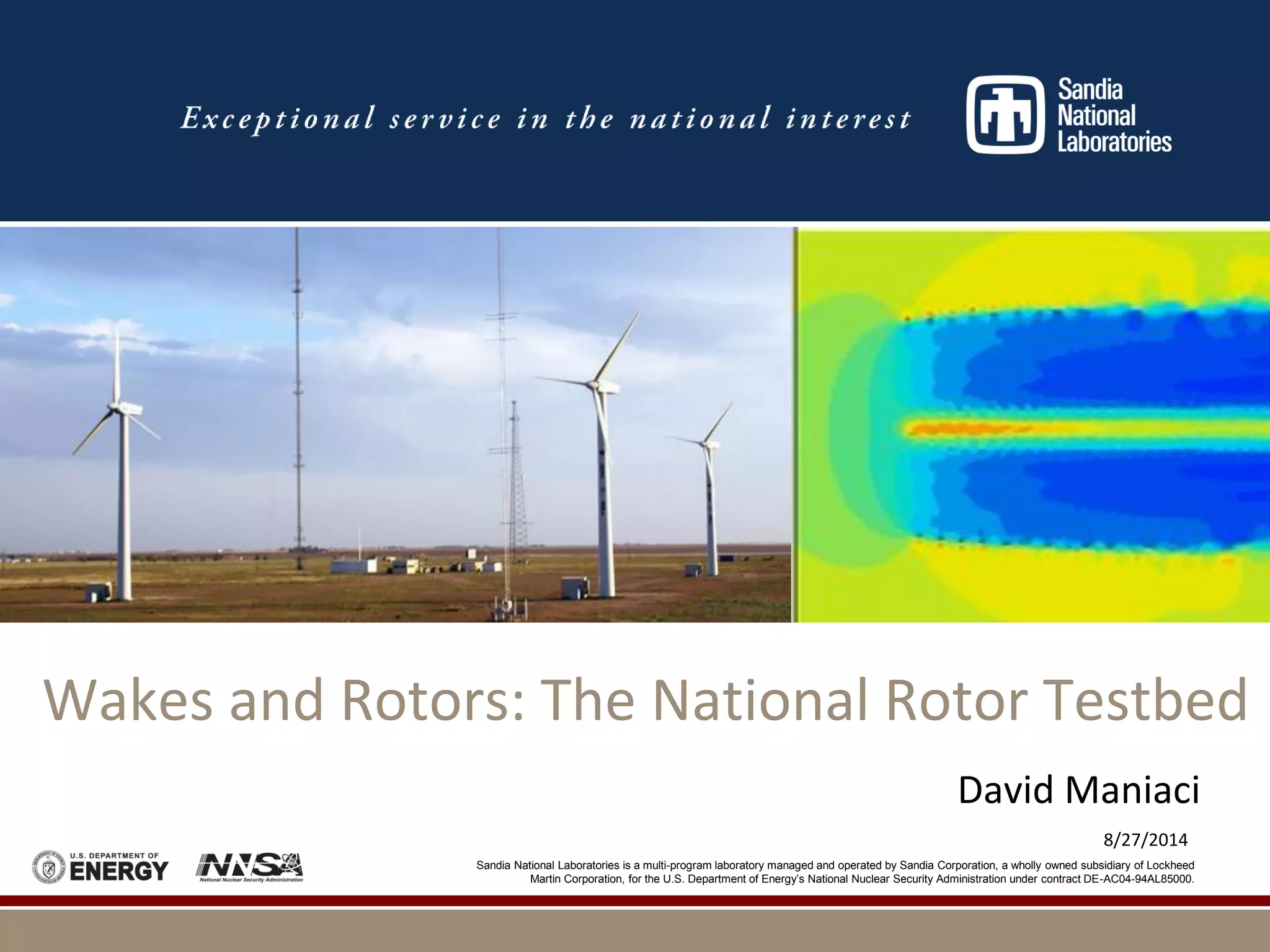
Wakes and Rotors: The National Rotor Testbed 
David Maniaci 
8/27/2014
Vision—SWiFT Experiment I: Inflow & Near-Wake Characterization 
The Atmosphere to electrons (A2e) initiative has identified the evolution of wakes in turbulent inflow as the key physical process affecting the power production and turbine loads in multi-array wind plants. 
High-quality experimental data is necessary to understand the physical processes governing the generation and evolution of wakes and to validate high-fidelity computational models using a formal and systematic Verification and Validation (V&V) approach.
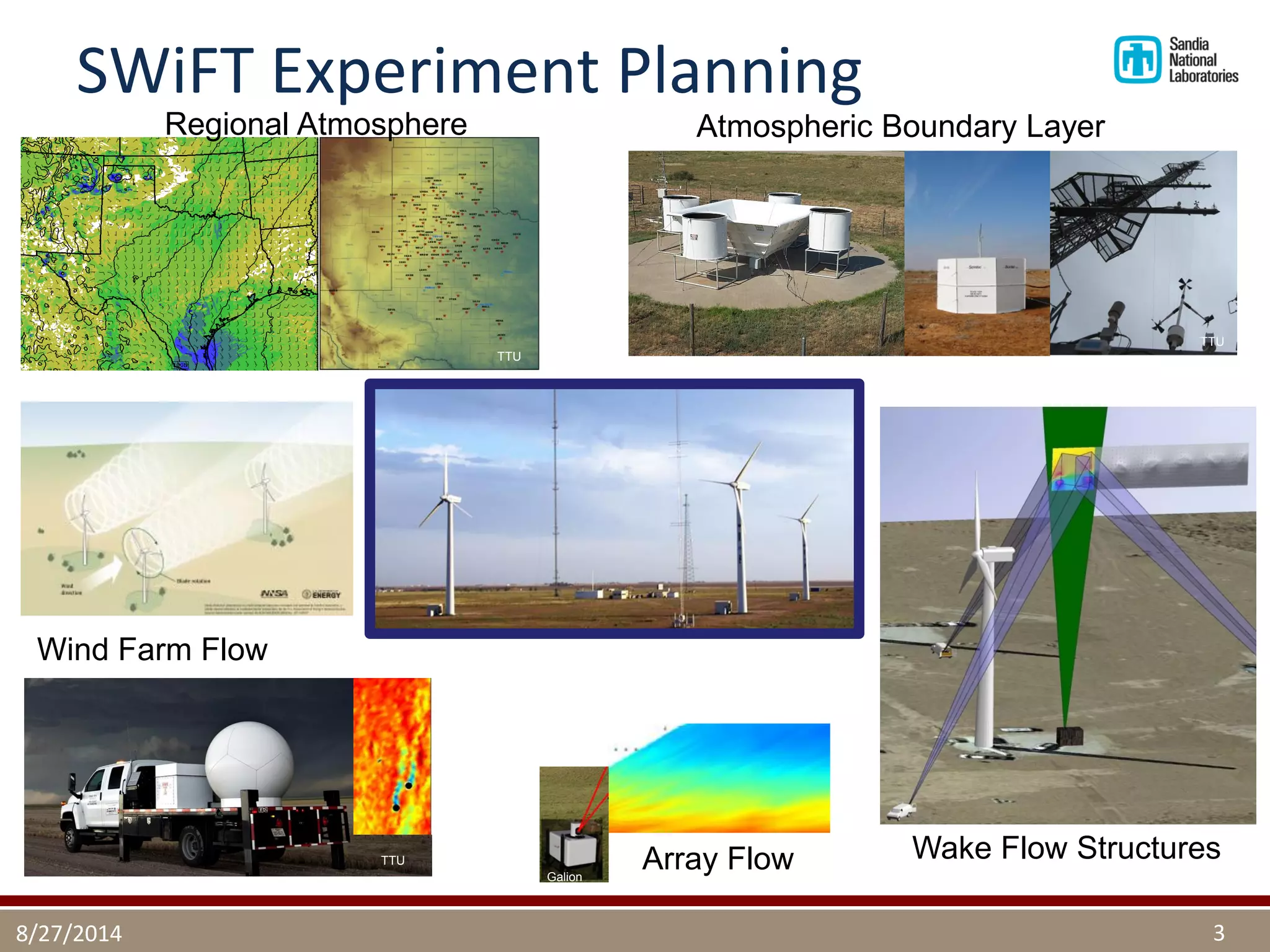
SWiFT Experiment Planning 
8/27/2014 
3 
Regional Atmosphere 
Atmospheric Boundary Layer 
Wind Farm Flow 
Array Flow 
Wake Flow Structures 
Galion 
TTU 
TTU 
TTU
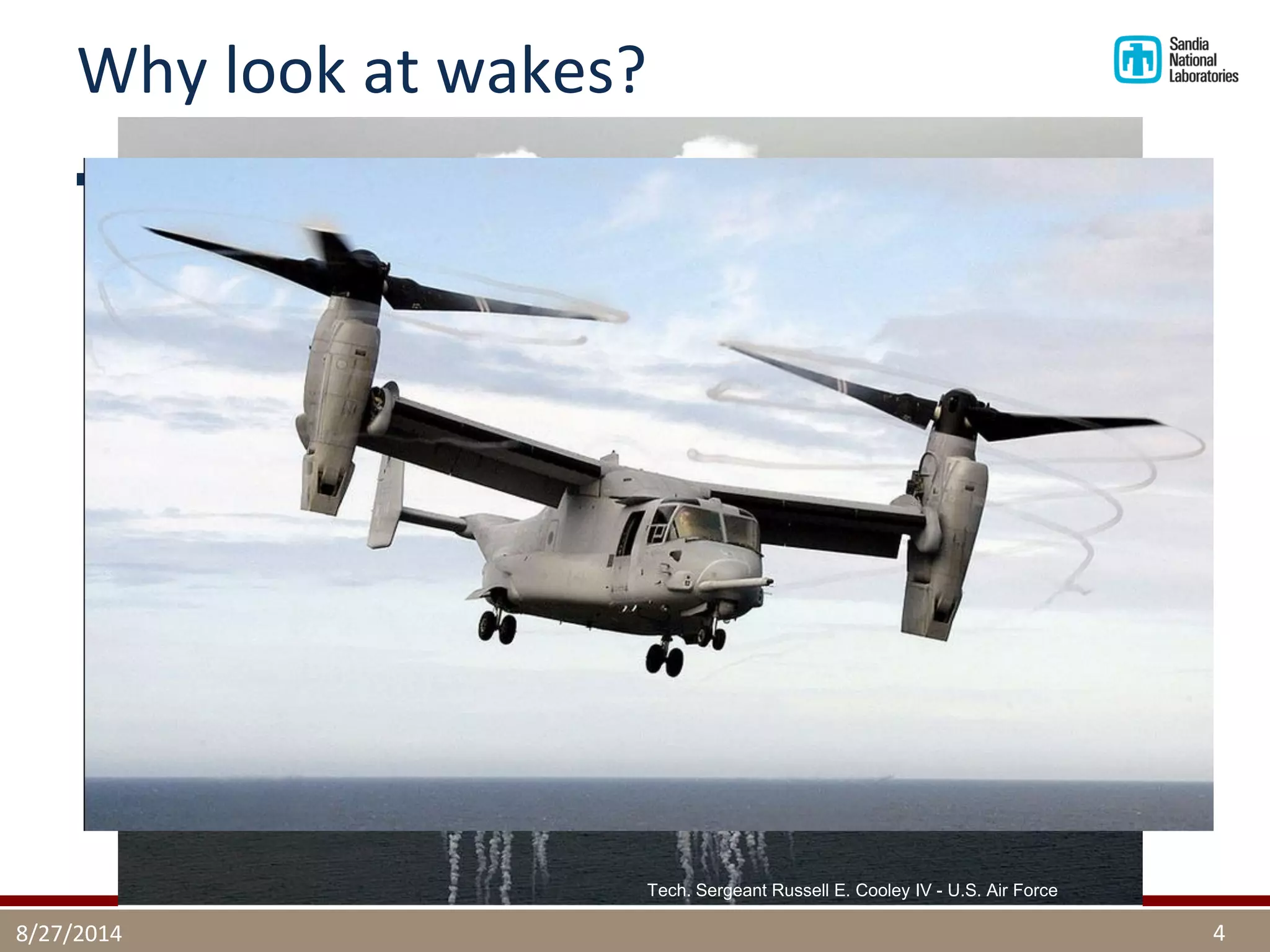
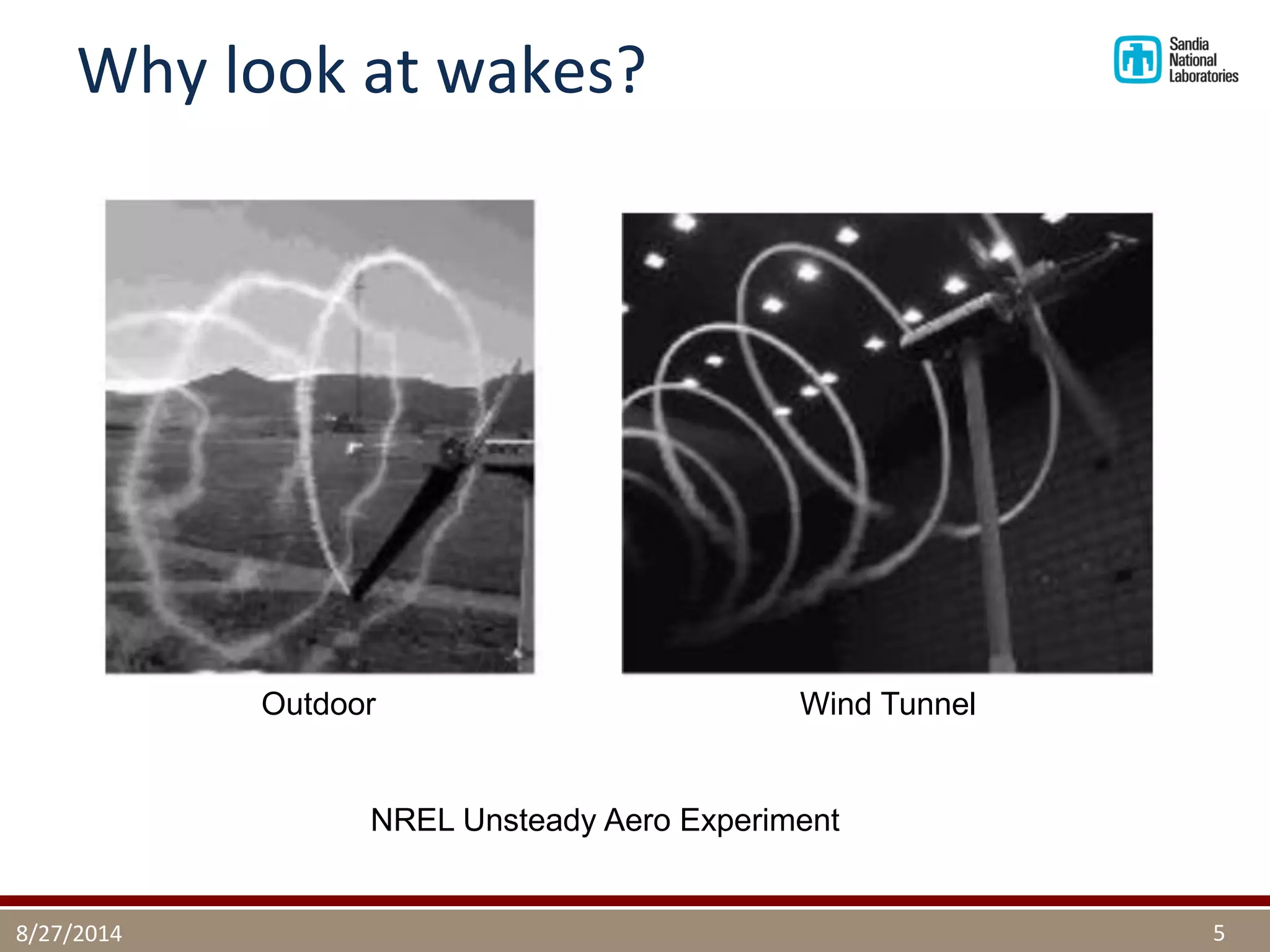
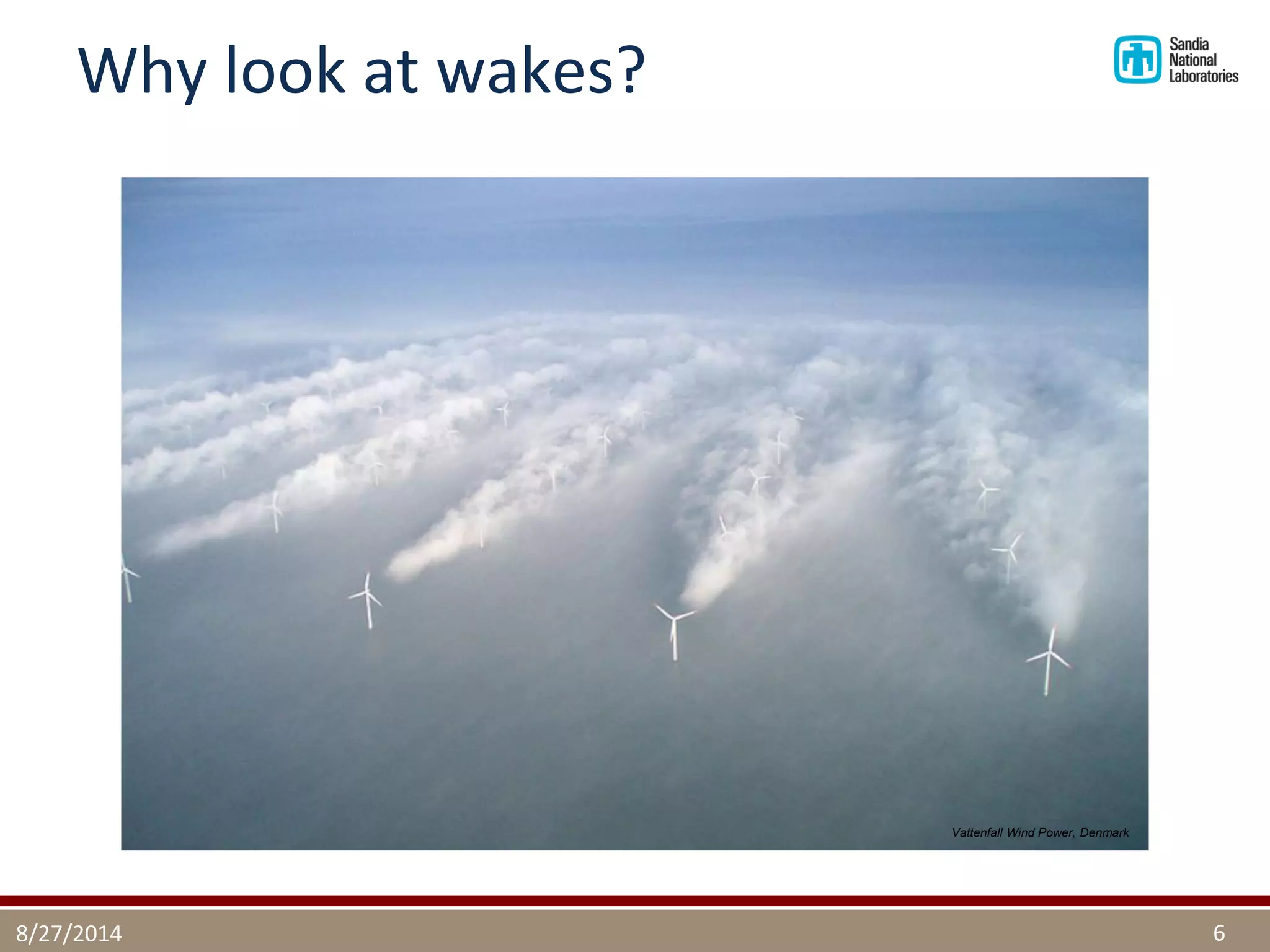
Why look at wakes? 
Because they are very photogenic 
8/27/2014 
4 
NASA LARC 
Tech. Sergeant Russell E. Cooley IV - U.S. Air Force
Why look at wakes? 
8/27/2014 
5 
NREL Unsteady Aero Experiment 
Outdoor 
Wind Tunnel
Why look at wakes? 
8/27/2014 
6 
Vattenfall Wind Power, Denmark
Why look at wakes? 
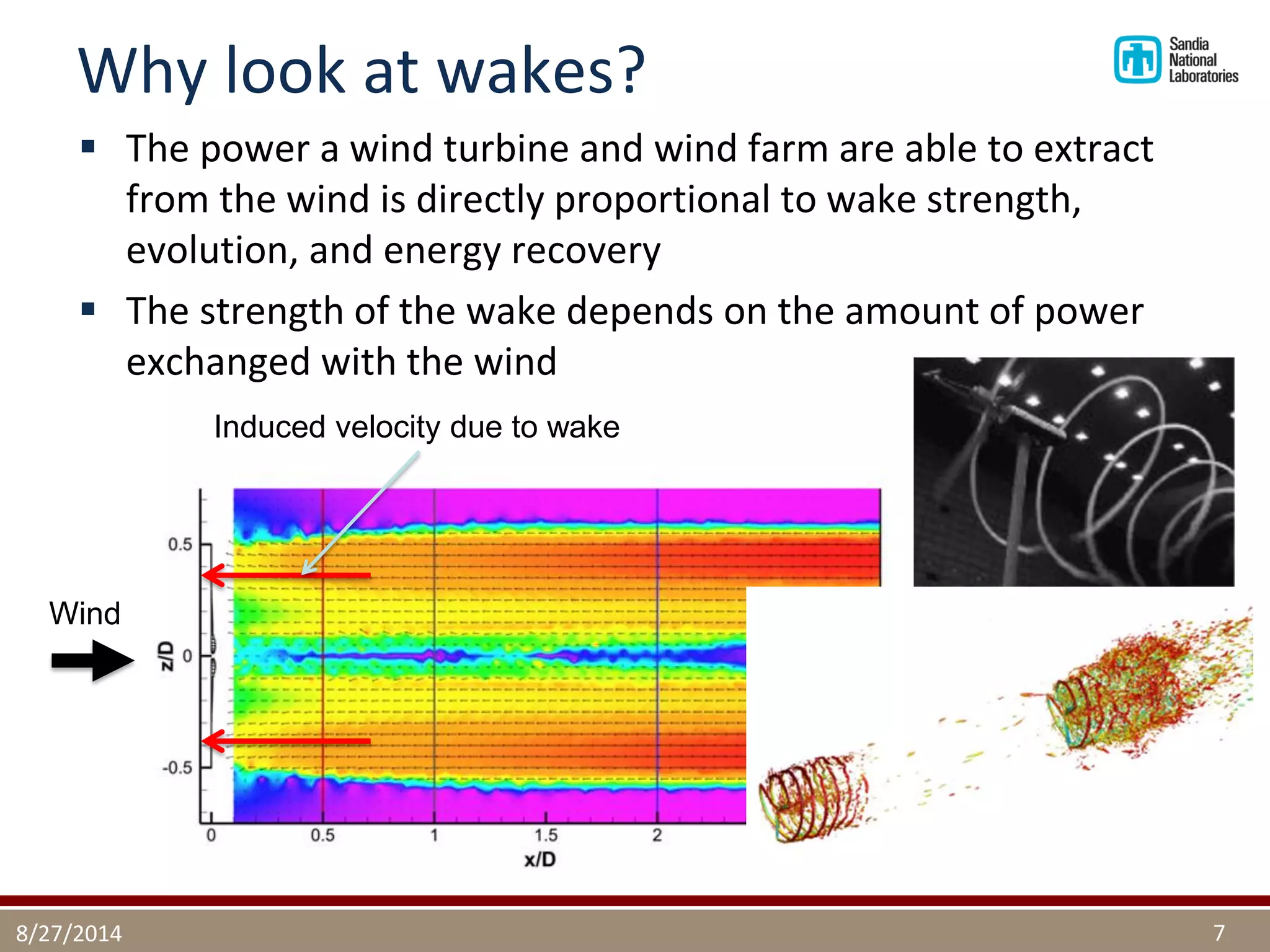
The power a wind turbine and wind farm are able to extract from the wind is directly proportional to wake strength, evolution, and energy recovery 
The strength of the wake depends on the amount of power exchanged with the wind 
8/27/2014 
7 
Wind 
Induced velocity due to wake
Circulation and Wake Formation 
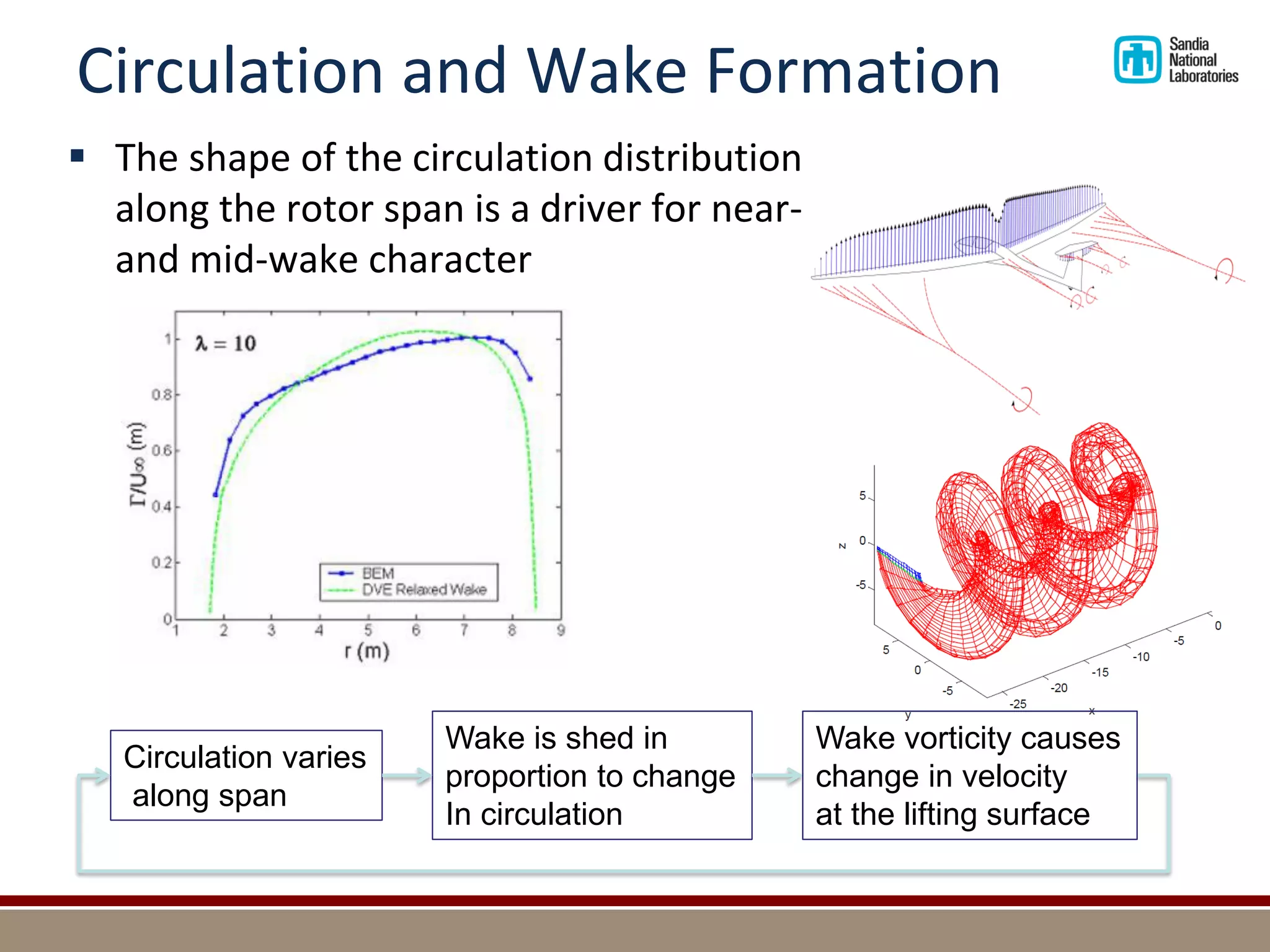
 The shape of the circulation distribution 
along the rotor span is a driver for near-and 
mid-wake character 
dy 
d 
L V CV c rel l rel 
 
 
   
WakeStrength 
2 
1 
' 2   
Wake is shed in 
proportion to change 
In circulation 
Circulation varies 
along span 
Wake vorticity causes 
change in velocity 
at the lifting surface
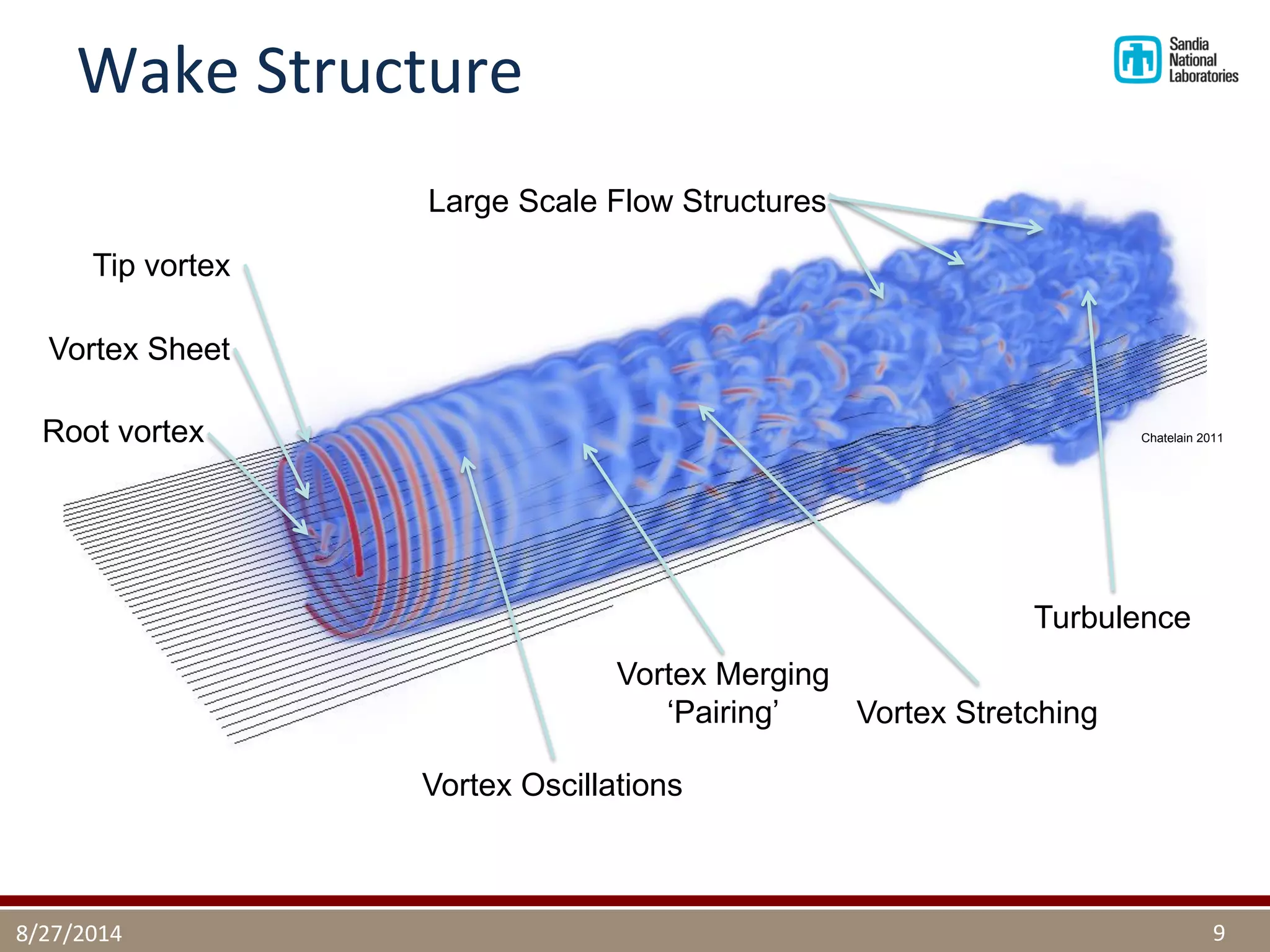
Wake Structure 
8/27/2014 
9 
Tip vortex 
Root vortex 
Vortex Sheet 
Vortex Stretching 
Vortex Oscillations 
Vortex Merging ‘Pairing’ 
Turbulence 
Large Scale Flow Structures 
Chatelain 2011
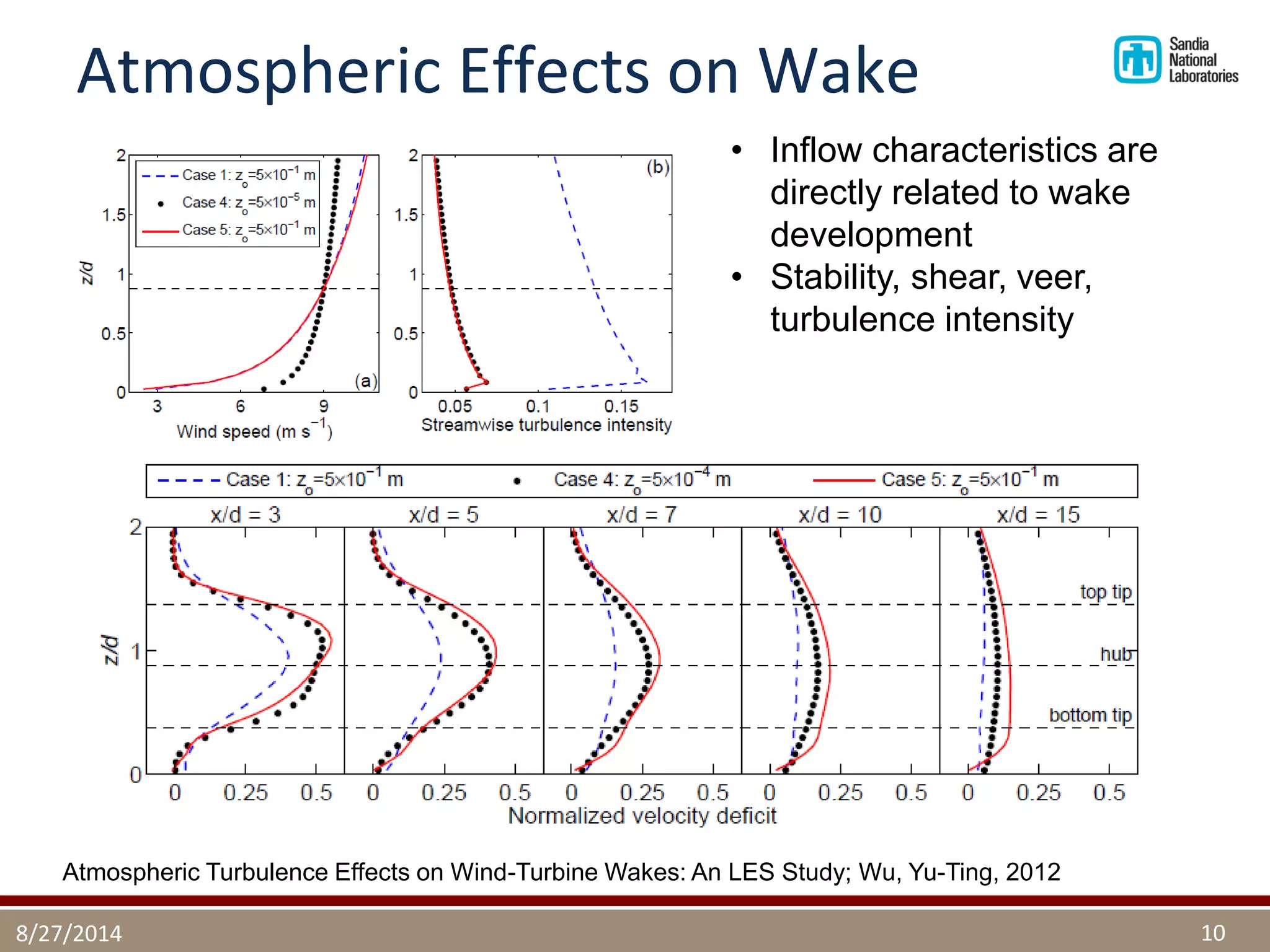
Atmospheric Effects on Wake 
8/27/2014 
10 
UMN 
•Inflow characteristics are directly related to wake development 
•Stability, shear, veer, turbulence intensity 
Atmospheric Turbulence Effects on Wind-Turbine Wakes: An LES Study; Wu, Yu-Ting, 2012
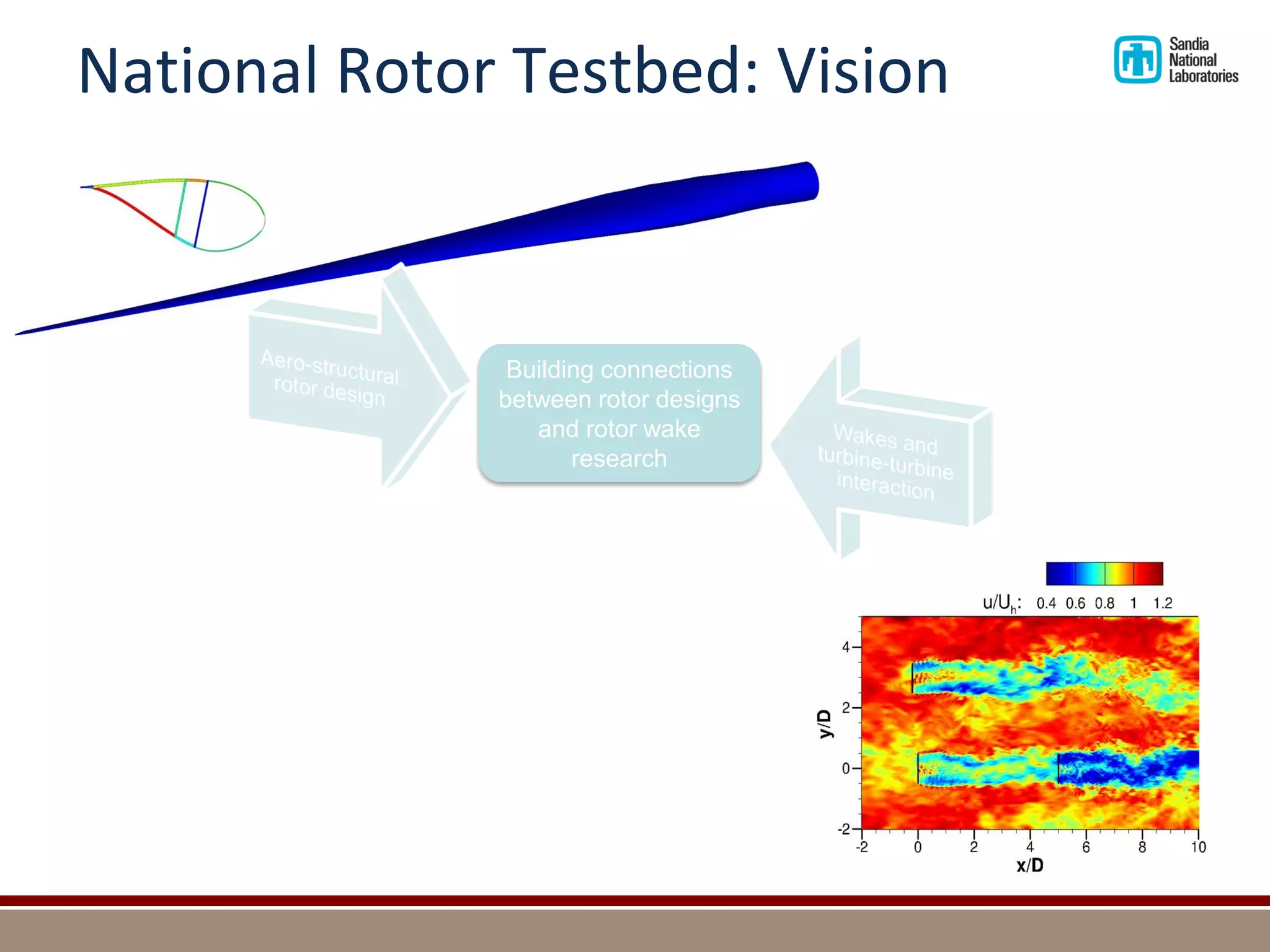
National Rotor Testbed: Vision 
Building connections between rotor designs and rotor wake research
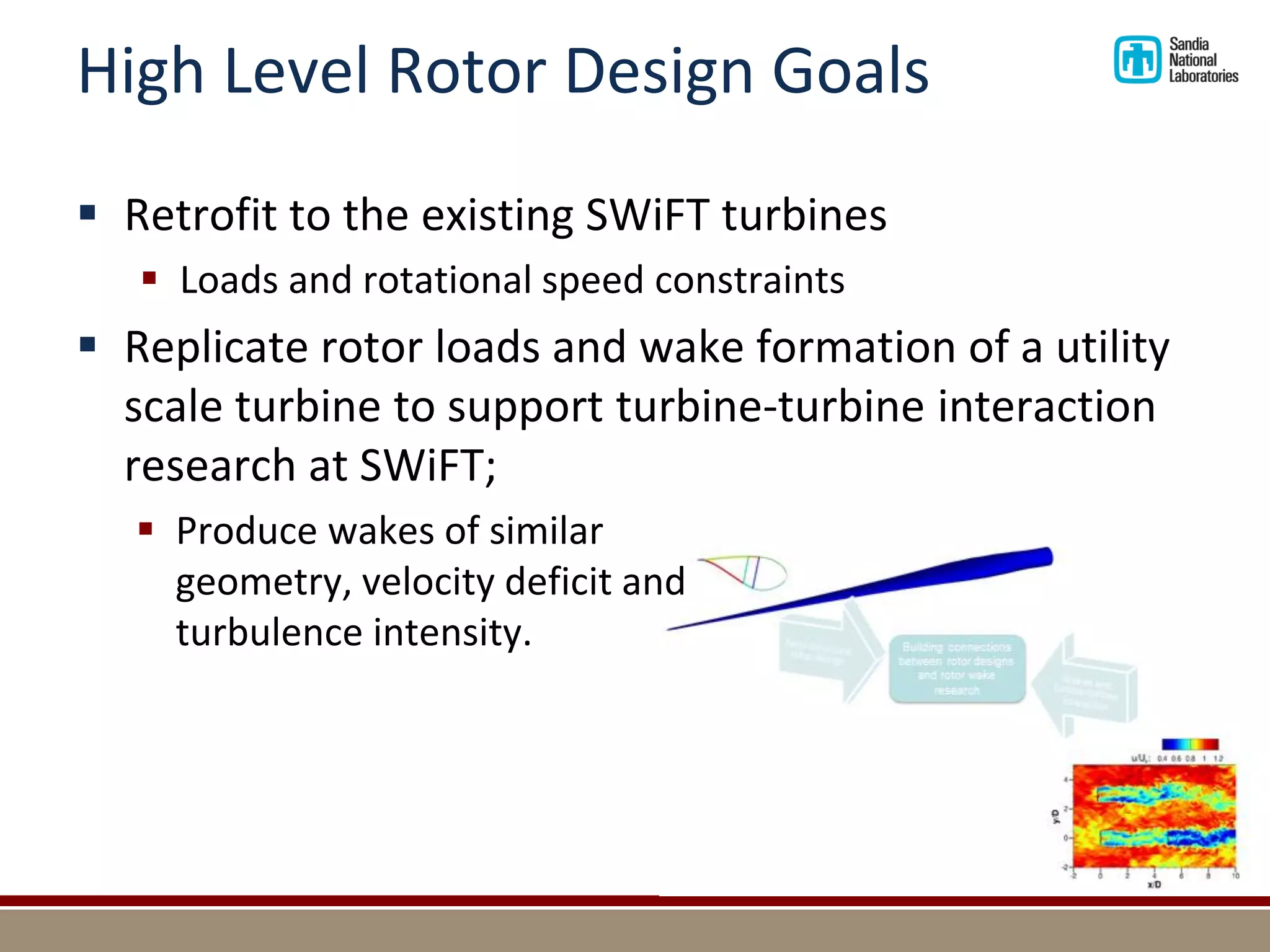
High Level Rotor Design Goals 
Retrofit to the existing SWiFT turbines 
Loads and rotational speed constraints 
Replicate rotor loads and wake formation of a utility scale turbine to support turbine-turbine interaction research at SWiFT; 
Produce wakes of similar geometry, velocity deficit and turbulence intensity.
NRT Wake Research 
Predict the wake behavior of the NRT rotor relative to a full- scale machine using models of multiple fidelities 
Determine if rotor loading effects wake development 
Determine sensitivity of wake development to rotor loading 
Support planning by identifying the most valuable experiments for validation 
Show the limits (and strengths) of the available analysis methods 
8/27/2014 
13
NRT Wake Research 
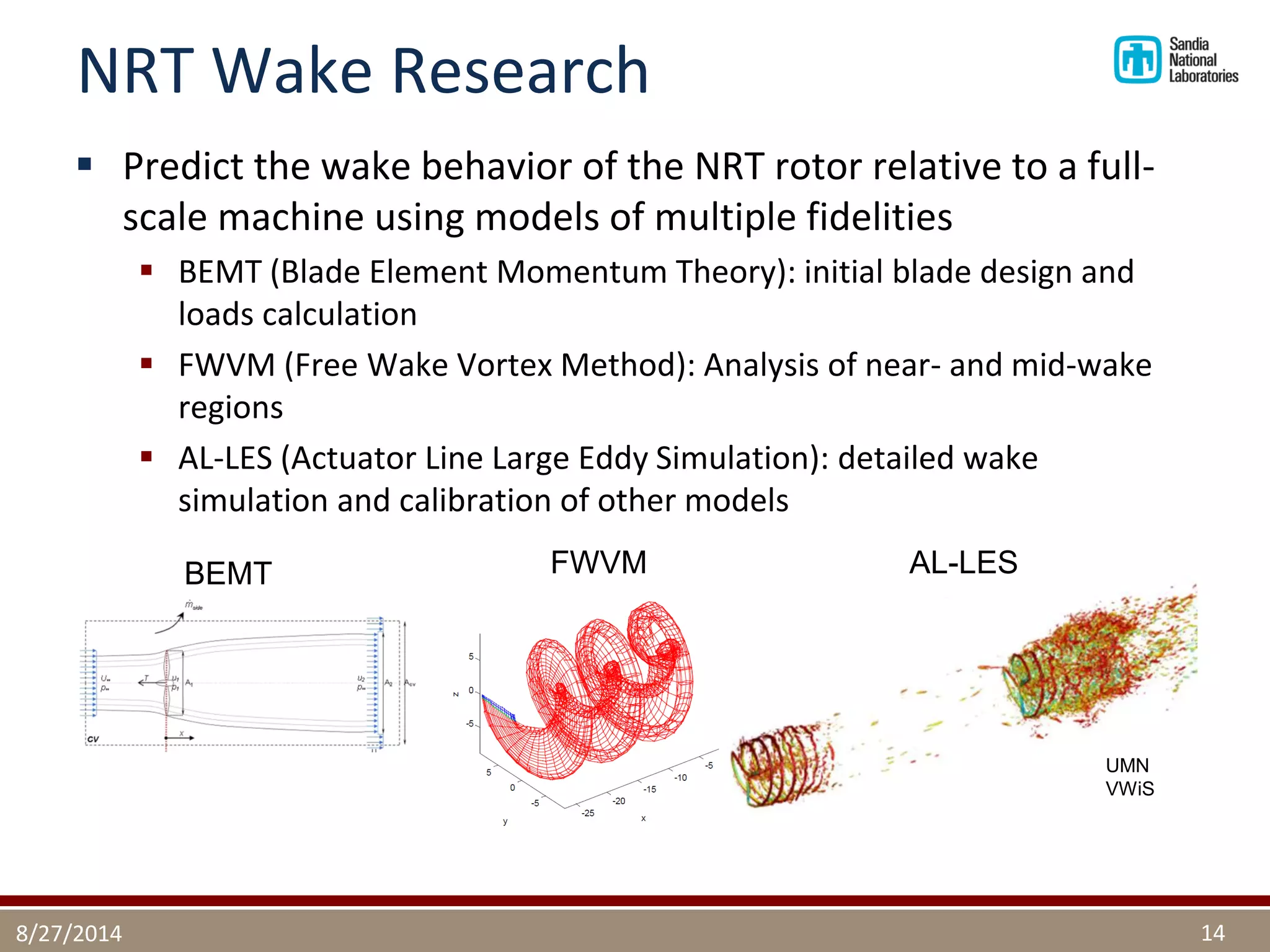
Predict the wake behavior of the NRT rotor relative to a full- scale machine using models of multiple fidelities 
BEMT (Blade Element Momentum Theory): initial blade design and loads calculation 
FWVM (Free Wake Vortex Method): Analysis of near- and mid-wake regions 
AL-LES (Actuator Line Large Eddy Simulation): detailed wake simulation and calibration of other models 
8/27/2014 
14 
FWVM 
BEMT 
UMN VWiS 
AL-LES
Comparison of BEMT and FWVM 
8/27/2014 
15 
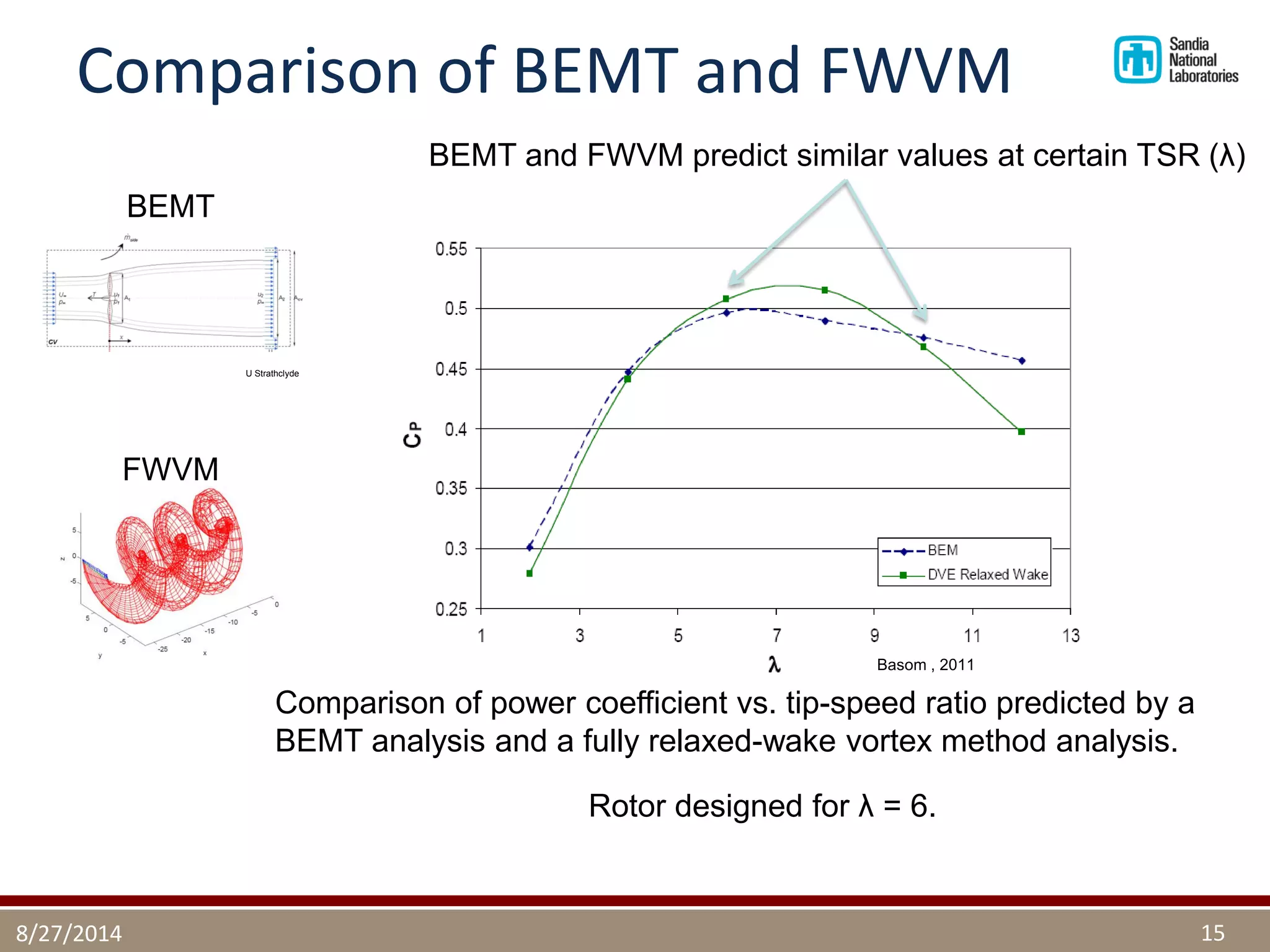
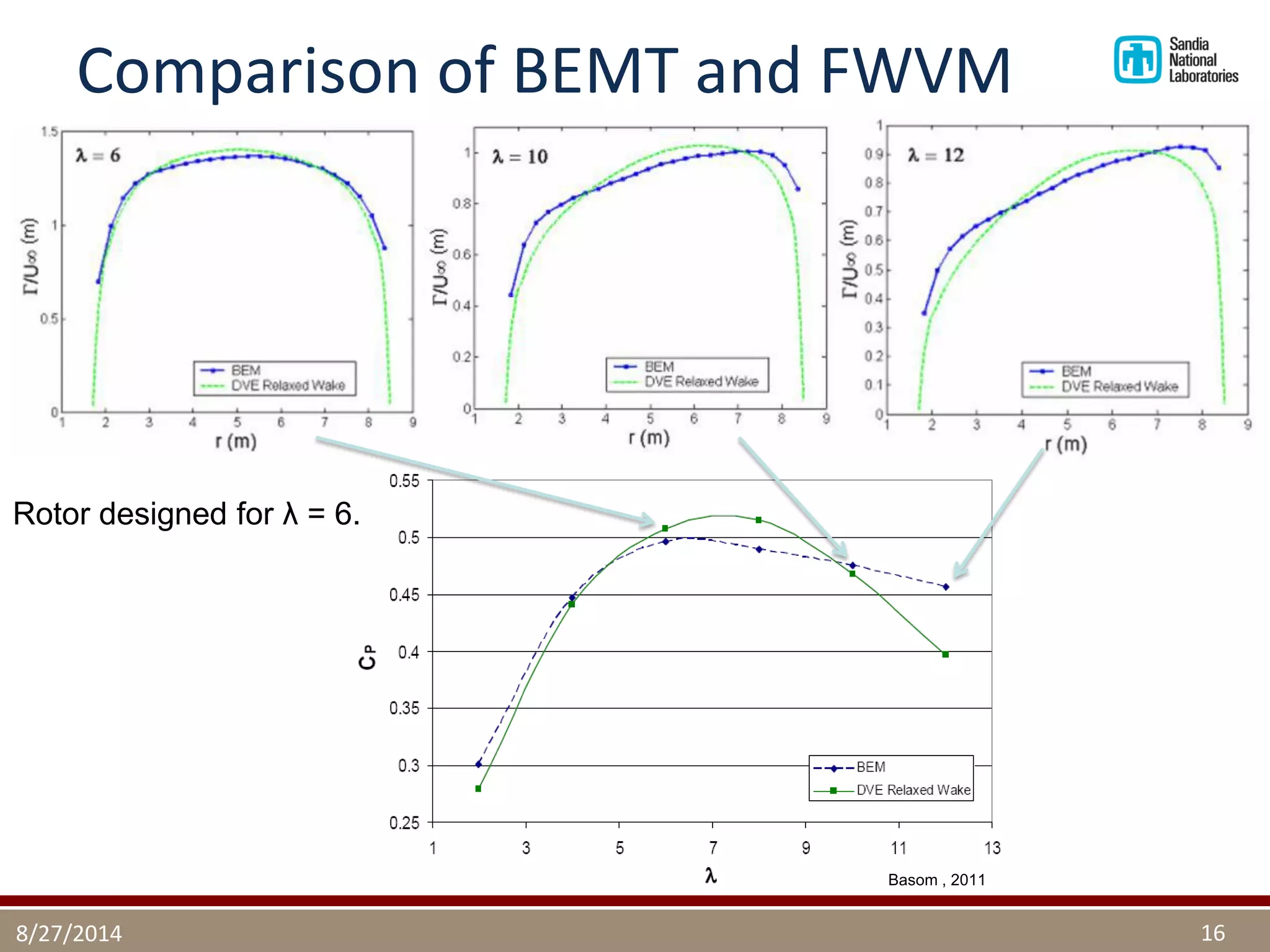
Comparison of power coefficient vs. tip-speed ratio predicted by a BEMT analysis and a fully relaxed-wake vortex method analysis. 
Rotor designed for λ = 6. 
BEMT and FWVM predict similar values at certain TSR (λ) 
Basom , 2011 
BEMT 
FWVM 
U Strathclyde
Comparison of BEMT and FWVM 
8/27/2014 
16 
Basom , 2011 
Rotor designed for λ = 6.
NRT Wake Research 
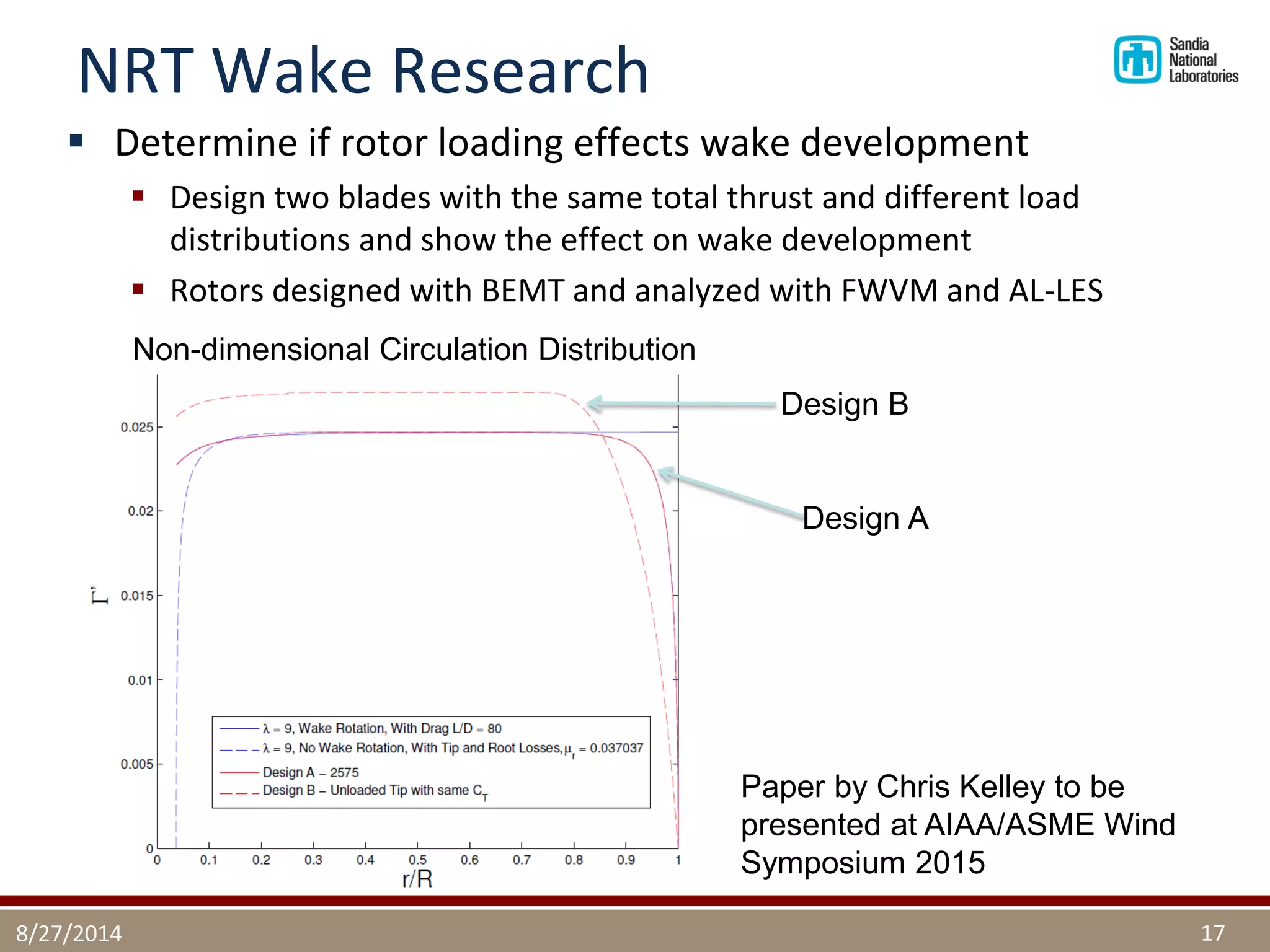
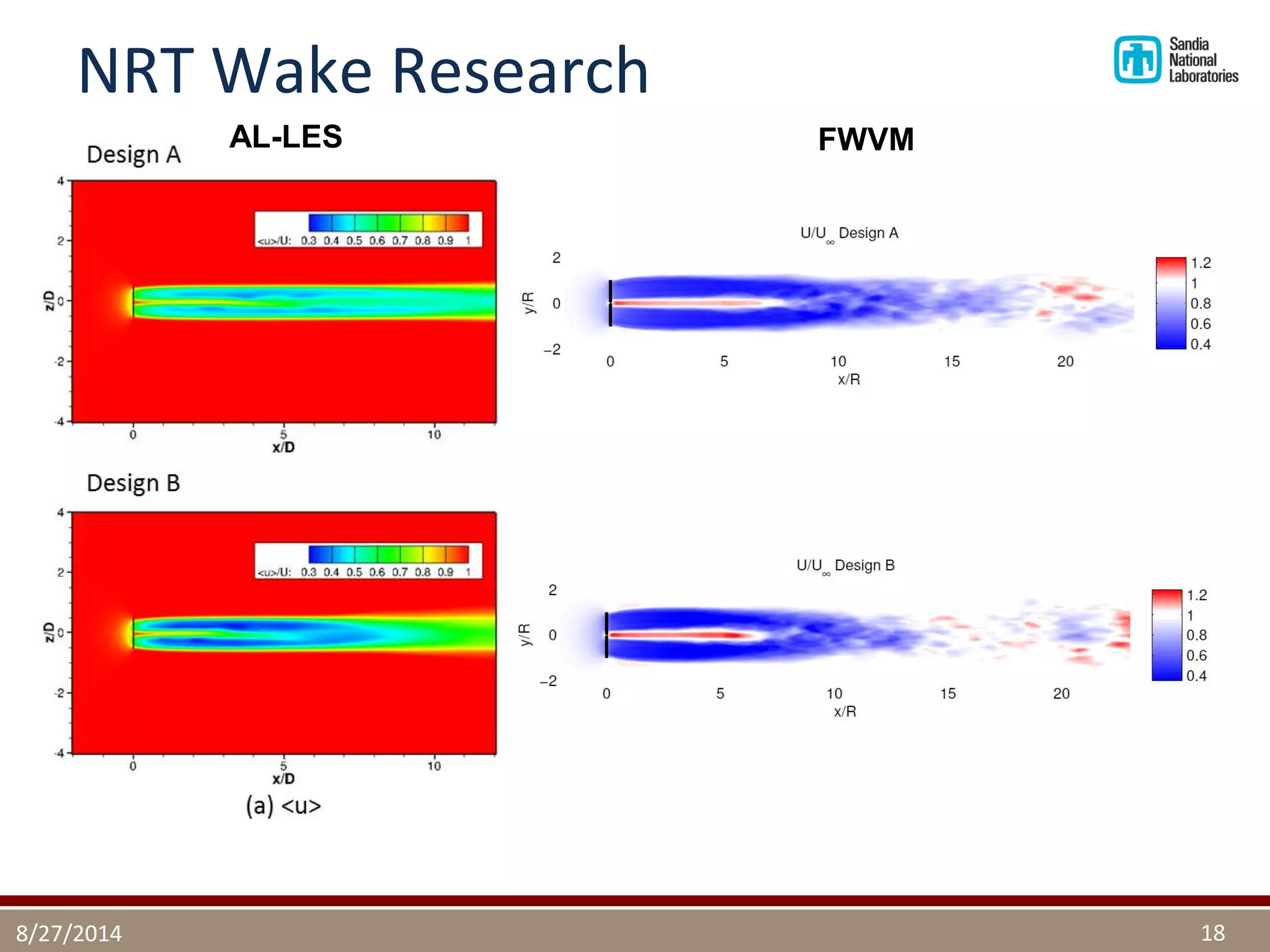
Determine if rotor loading effects wake development 
Design two blades with the same total thrust and different load distributions and show the effect on wake development 
Rotors designed with BEMT and analyzed with FWVM and AL-LES 
8/27/2014 
17 
Non-dimensional Circulation Distribution 
Design B 
Design A 
Paper by Chris Kelley to be presented at AIAA/ASME Wind Symposium 2015
NRT Wake Research 
8/27/2014 
18 
Design A 
FWVM 
AL-LES
Where to go from here 
Analyze effect of shear and atmospheric turbulence on the relative wake development of the NRT and full-scale rotors 
Focus on LES analysis 
Determine sensitivity of wake development to rotor loading 
Link FWVM to DAKOTA and utilize HPC resources to perform many simulations 
No experimental data exists to validate the effect of rotor loading on wake development 
Support planning of experiments by showing the limits (and strengths) of the available analysis methods
Acknowledgements 
Fellow Sandians involved in research: Matt Barone, Jon Berg, Phillip Chiu, Brandon Ennis, Tommy Herges, Chris Kelley, Brian Resor 
Researchers at UMN: Xiaolei Yang, Aaron Boomsma, and Fotis Sotiropoulos 
This research is funded by the U.S. Department of Energy Office of Energy Efficiency and Renewable Energy (EERE) program.
Thank You 
8/27/2014 
21 
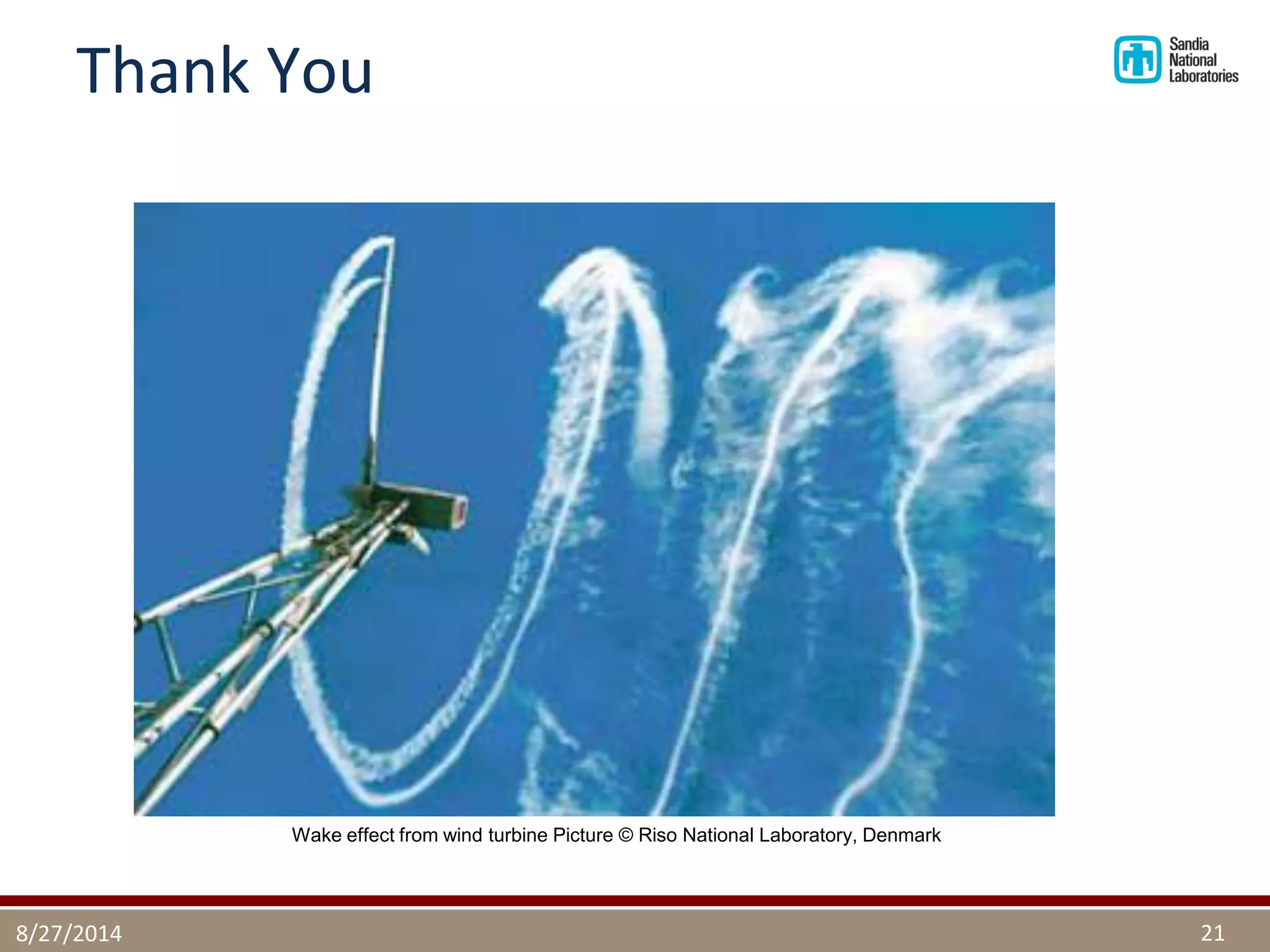
Wake effect from wind turbine Picture © Riso National Laboratory, Denmark
Back-Up Slides 
8/27/2014 
22
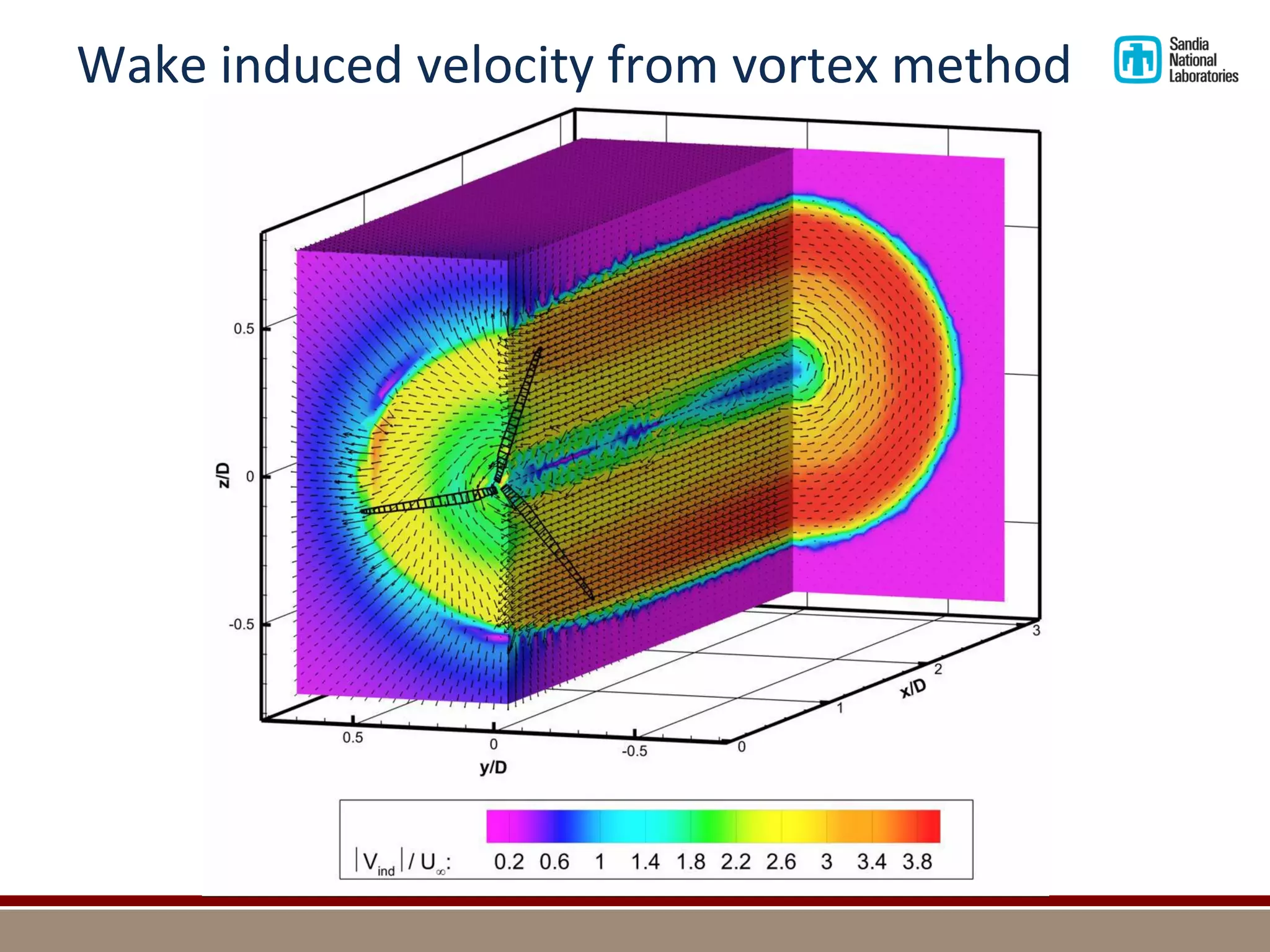
Wake induced velocity from vortex method 
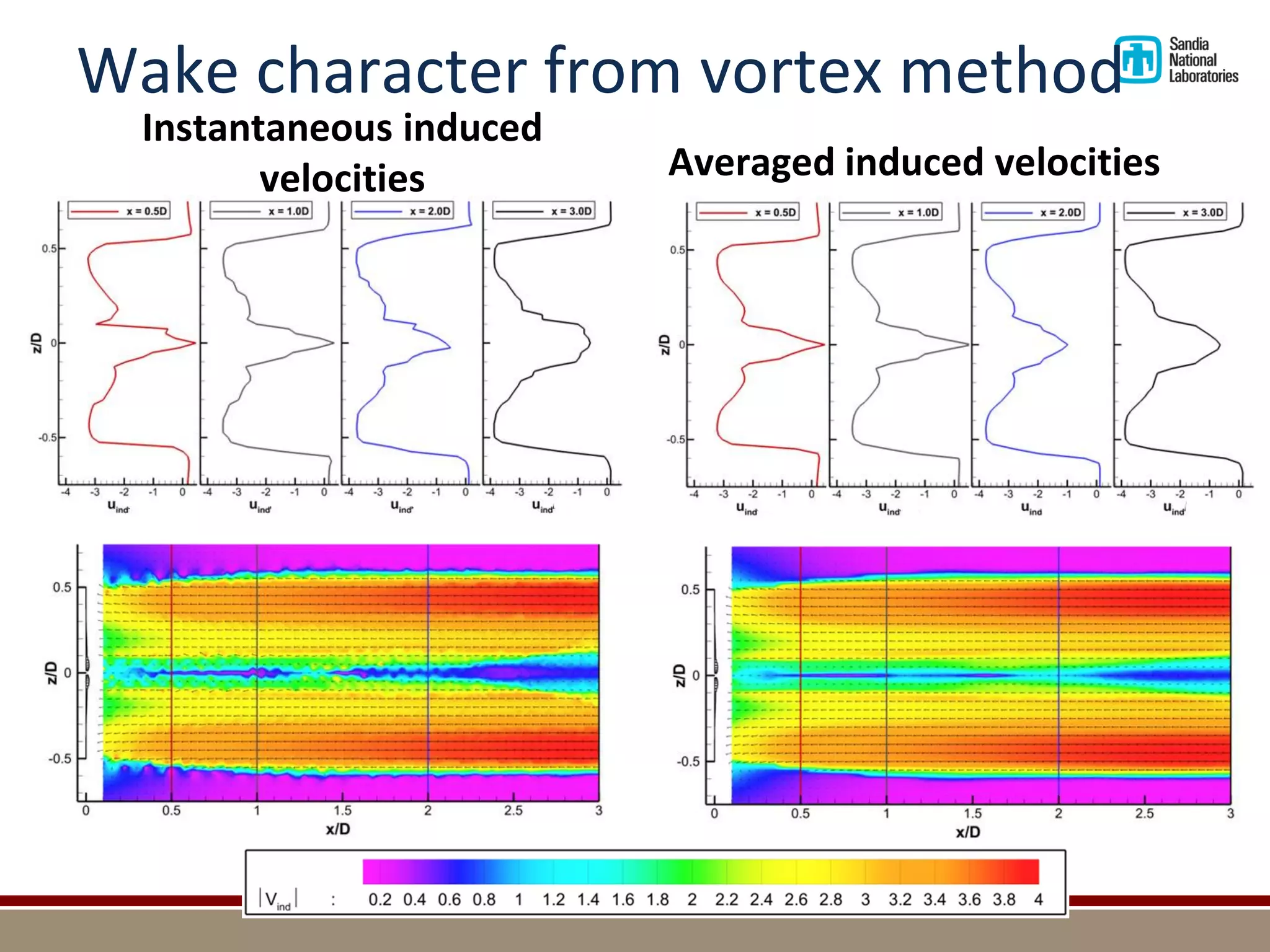
Instantaneous induced velocities
Wake character from vortex method 
Instantaneous induced velocities 
Averaged induced velocities
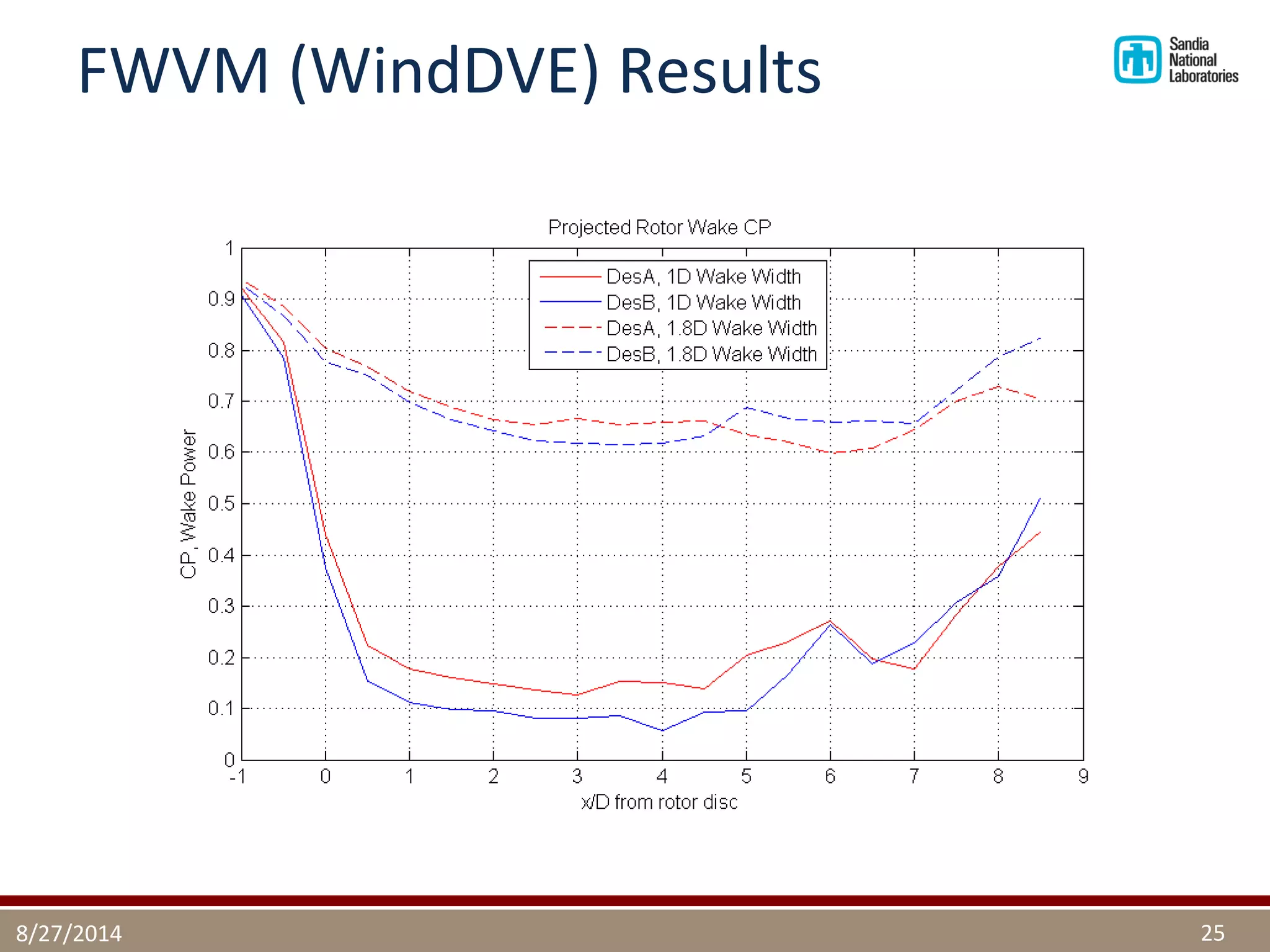
FWVM (WindDVE) Results 
8/27/2014 
25
Vision—SWiFT Experiment I: Inflow & Near-Wake Characterization 
Objectives 
Detailed characterization of the turbulent inflow conditions and atmospheric boundary layer profiles at the SWiFT Facility. 
Design, build, and test a scaled wind turbine rotor capable of reproducing the wake characteristics observed in utility-scale turbines; verify scaling capability. 
Detailed characterization of the near-wake coherent structures (primarily tip vortices), the turbulent wake breakdown process in the intermediate range, and the preliminary stages of fully turbulent Gaussian far-wake profile. 
Utilize data in conjunction with high-fidelity models through formal and systematic Verification and Validation (V&V) process developed within the A2e initiative. 
Complement other A2e experimental campaigns in the wind tunnel and utility- scale wind farms to understand the impact of scaling on rotor aerodynamics. 
Success Criteria 
Able to quantify model bias and uncertainties in turbulent inflow and near-wake region. 
High-quality experimental data for use in V&V exercises to develop and improve high-fidelity inflow and wake models.

2014 Sandia Wind Turbine Blade Workshop- Maniaci

  • 1.
    Sandia National Laboratoriesis a multi-program laboratory managed and operated by Sandia Corporation, a wholly owned subsidiary of Lockheed Martin Corporation, for the U.S. Department of Energy’s National Nuclear Security Administration under contract DE-AC04-94AL85000. Photos placed in horizontal position with even amount of white space between photos and header To replace these boxes with images open the slide master Wakes and Rotors: The National Rotor Testbed David Maniaci 8/27/2014
  • 2.
    Vision—SWiFT Experiment I:Inflow & Near-Wake Characterization The Atmosphere to electrons (A2e) initiative has identified the evolution of wakes in turbulent inflow as the key physical process affecting the power production and turbine loads in multi-array wind plants. High-quality experimental data is necessary to understand the physical processes governing the generation and evolution of wakes and to validate high-fidelity computational models using a formal and systematic Verification and Validation (V&V) approach.
  • 3.
    SWiFT Experiment Planning 8/27/2014 3 Regional Atmosphere Atmospheric Boundary Layer Wind Farm Flow Array Flow Wake Flow Structures Galion TTU TTU TTU
  • 4.
    Why look atwakes? Because they are very photogenic 8/27/2014 4 NASA LARC Tech. Sergeant Russell E. Cooley IV - U.S. Air Force
  • 5.
    Why look atwakes? 8/27/2014 5 NREL Unsteady Aero Experiment Outdoor Wind Tunnel
  • 6.
    Why look atwakes? 8/27/2014 6 Vattenfall Wind Power, Denmark
  • 7.
    Why look atwakes? The power a wind turbine and wind farm are able to extract from the wind is directly proportional to wake strength, evolution, and energy recovery The strength of the wake depends on the amount of power exchanged with the wind 8/27/2014 7 Wind Induced velocity due to wake
  • 8.
    Circulation and WakeFormation  The shape of the circulation distribution along the rotor span is a driver for near-and mid-wake character dy d L V CV c rel l rel      WakeStrength 2 1 ' 2   Wake is shed in proportion to change In circulation Circulation varies along span Wake vorticity causes change in velocity at the lifting surface
  • 9.
    Wake Structure 8/27/2014 9 Tip vortex Root vortex Vortex Sheet Vortex Stretching Vortex Oscillations Vortex Merging ‘Pairing’ Turbulence Large Scale Flow Structures Chatelain 2011
  • 10.
    Atmospheric Effects onWake 8/27/2014 10 UMN •Inflow characteristics are directly related to wake development •Stability, shear, veer, turbulence intensity Atmospheric Turbulence Effects on Wind-Turbine Wakes: An LES Study; Wu, Yu-Ting, 2012
  • 11.
    National Rotor Testbed:Vision Building connections between rotor designs and rotor wake research
  • 12.
    High Level RotorDesign Goals Retrofit to the existing SWiFT turbines Loads and rotational speed constraints Replicate rotor loads and wake formation of a utility scale turbine to support turbine-turbine interaction research at SWiFT; Produce wakes of similar geometry, velocity deficit and turbulence intensity.
  • 13.
    NRT Wake Research Predict the wake behavior of the NRT rotor relative to a full- scale machine using models of multiple fidelities Determine if rotor loading effects wake development Determine sensitivity of wake development to rotor loading Support planning by identifying the most valuable experiments for validation Show the limits (and strengths) of the available analysis methods 8/27/2014 13
  • 14.
    NRT Wake Research Predict the wake behavior of the NRT rotor relative to a full- scale machine using models of multiple fidelities BEMT (Blade Element Momentum Theory): initial blade design and loads calculation FWVM (Free Wake Vortex Method): Analysis of near- and mid-wake regions AL-LES (Actuator Line Large Eddy Simulation): detailed wake simulation and calibration of other models 8/27/2014 14 FWVM BEMT UMN VWiS AL-LES
  • 15.
    Comparison of BEMTand FWVM 8/27/2014 15 Comparison of power coefficient vs. tip-speed ratio predicted by a BEMT analysis and a fully relaxed-wake vortex method analysis. Rotor designed for λ = 6. BEMT and FWVM predict similar values at certain TSR (λ) Basom , 2011 BEMT FWVM U Strathclyde
  • 16.
    Comparison of BEMTand FWVM 8/27/2014 16 Basom , 2011 Rotor designed for λ = 6.
  • 17.
    NRT Wake Research Determine if rotor loading effects wake development Design two blades with the same total thrust and different load distributions and show the effect on wake development Rotors designed with BEMT and analyzed with FWVM and AL-LES 8/27/2014 17 Non-dimensional Circulation Distribution Design B Design A Paper by Chris Kelley to be presented at AIAA/ASME Wind Symposium 2015
  • 18.
    NRT Wake Research 8/27/2014 18 Design A FWVM AL-LES
  • 19.
    Where to gofrom here Analyze effect of shear and atmospheric turbulence on the relative wake development of the NRT and full-scale rotors Focus on LES analysis Determine sensitivity of wake development to rotor loading Link FWVM to DAKOTA and utilize HPC resources to perform many simulations No experimental data exists to validate the effect of rotor loading on wake development Support planning of experiments by showing the limits (and strengths) of the available analysis methods
  • 20.
    Acknowledgements Fellow Sandiansinvolved in research: Matt Barone, Jon Berg, Phillip Chiu, Brandon Ennis, Tommy Herges, Chris Kelley, Brian Resor Researchers at UMN: Xiaolei Yang, Aaron Boomsma, and Fotis Sotiropoulos This research is funded by the U.S. Department of Energy Office of Energy Efficiency and Renewable Energy (EERE) program.
  • 21.
    Thank You 8/27/2014 21 Wake effect from wind turbine Picture © Riso National Laboratory, Denmark
  • 22.
  • 23.
    Wake induced velocityfrom vortex method Instantaneous induced velocities
  • 24.
    Wake character fromvortex method Instantaneous induced velocities Averaged induced velocities
  • 25.
  • 26.
    Vision—SWiFT Experiment I:Inflow & Near-Wake Characterization Objectives Detailed characterization of the turbulent inflow conditions and atmospheric boundary layer profiles at the SWiFT Facility. Design, build, and test a scaled wind turbine rotor capable of reproducing the wake characteristics observed in utility-scale turbines; verify scaling capability. Detailed characterization of the near-wake coherent structures (primarily tip vortices), the turbulent wake breakdown process in the intermediate range, and the preliminary stages of fully turbulent Gaussian far-wake profile. Utilize data in conjunction with high-fidelity models through formal and systematic Verification and Validation (V&V) process developed within the A2e initiative. Complement other A2e experimental campaigns in the wind tunnel and utility- scale wind farms to understand the impact of scaling on rotor aerodynamics. Success Criteria Able to quantify model bias and uncertainties in turbulent inflow and near-wake region. High-quality experimental data for use in V&V exercises to develop and improve high-fidelity inflow and wake models.