Game Theory
Enrico Franchi (efranchi@ce.unipr.it)
Introduction

Game theory can be defined as the study
of mathematical models of conflict and
cooperation between intelligent rational
decision-makers.


                             R. Myerson
Rationality and Intelligence
  • A decision-maker is rational if he makes
    decisions consistently in pursuit of his
    own objectives
  • A player is intelligent if he knows
    everything that we know about the
    game and he can make inferences about
    the situation that we can make
Outcomes
• Let O be a finite set of outcomes
• A lottery is a probability distribution
  over O l = [ p1 : o1 ,…, pk : ok ]
              oi ∈O     pi ∈[0,1]
                   k

                  ∑p    i   =1
                  i=1

• We assume agents can rank outcomes
  and lotteries with a utility function
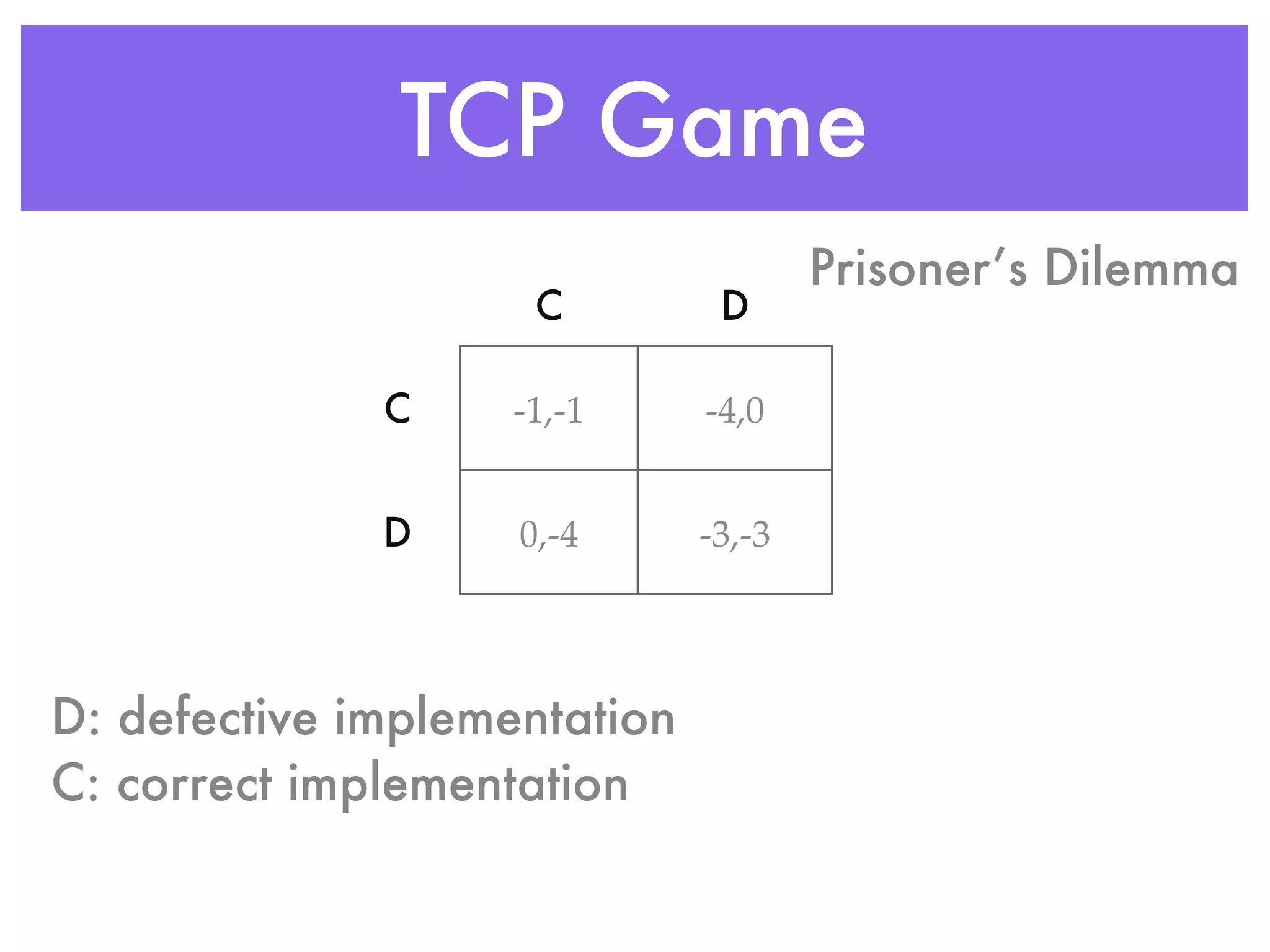
TCP Game
                                      Prisoner’s Dilemma
                     C         D

              C    -1,-1      -4,0


              D     0,-4      -3,-3


D: defective implementation
C: correct implementation
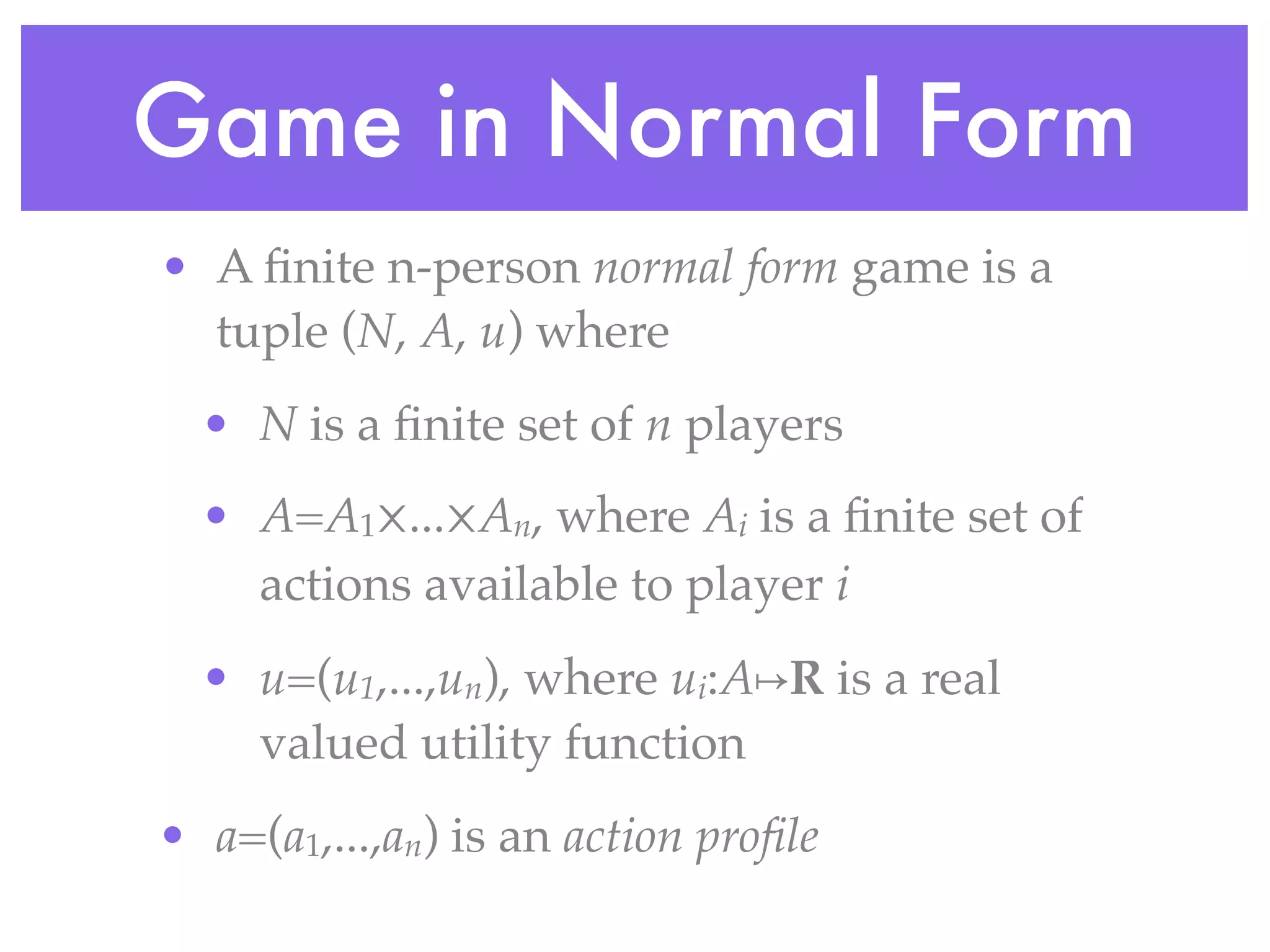
Game in Normal Form
• A finite n-person normal form game is a
  tuple (N, A, u) where
  • N is a finite set of n players
  • A=A1⨉...⨉An, where Ai is a finite set of
    actions available to player i
  • u=(u1,...,un), where ui:A↦R is a real
    valued utility function
• a=(a1,...,an) is an action profile
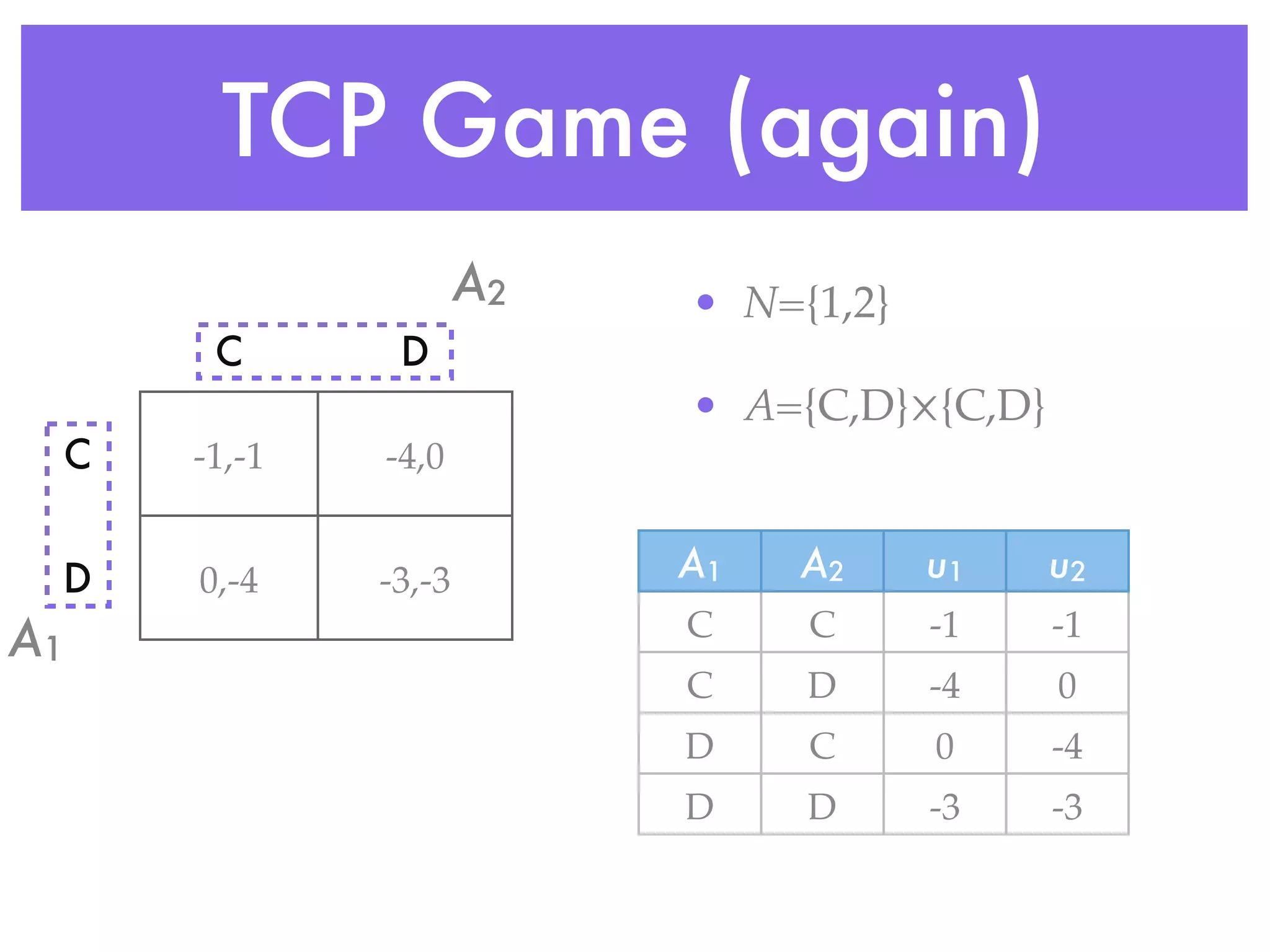
TCP Game (again)
                         A2   • N={1,2}
          C       D
                              • A={C,D}⨉{C,D}
     C   -1,-1   -4,0


 D       0,-4    -3,-3        A1   A2     u1    u2
A1                            C    C      -1    -1
                              C    D      -4    0
                              D    C      0     -4
                              D    D      -3    -3
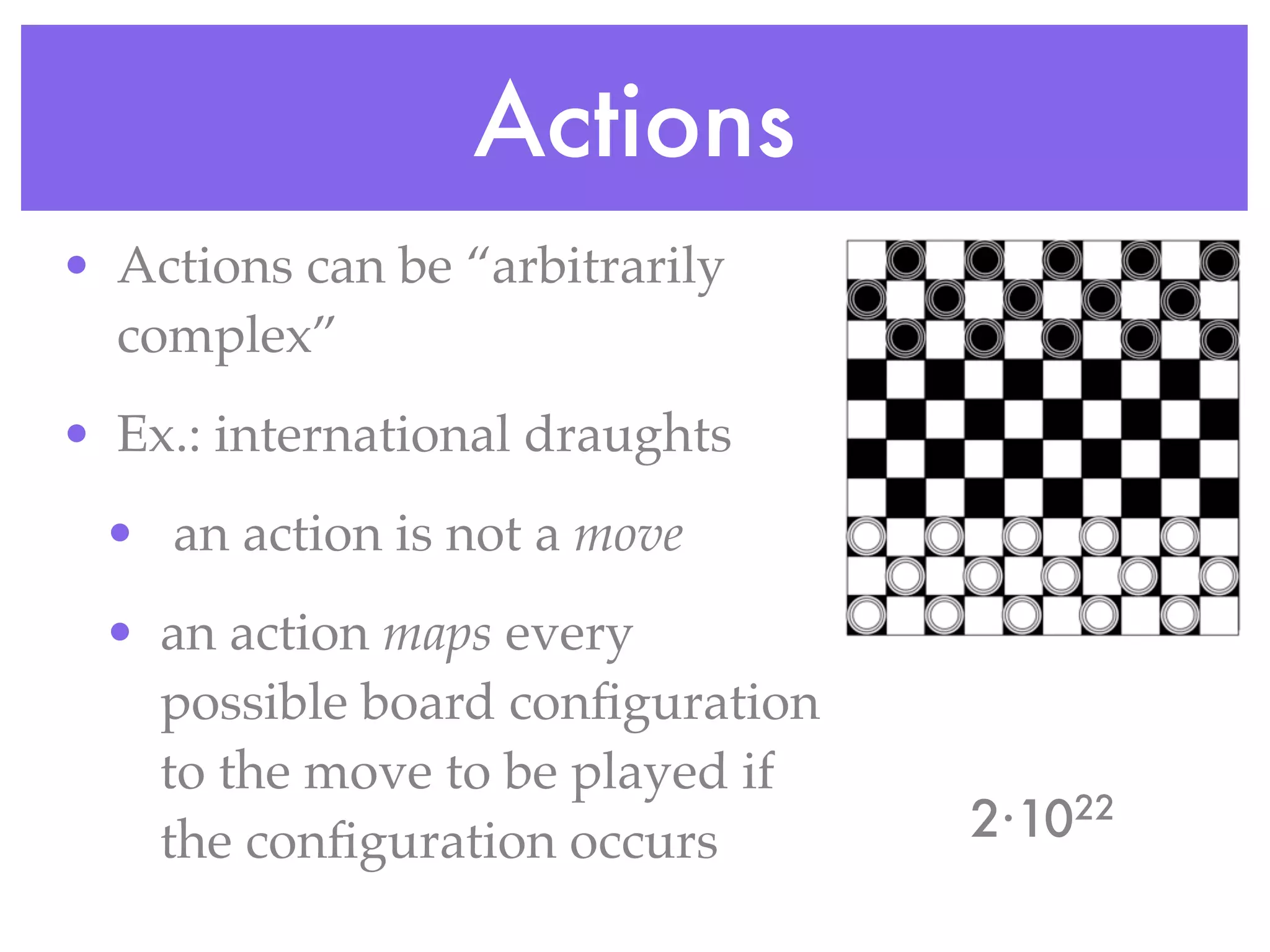
Actions
• Actions can be “arbitrarily
  complex”
• Ex.: international draughts
 • an action is not a move
 • an action maps every
   possible board configuration
   to the move to be played if
   the configuration occurs       2·1022
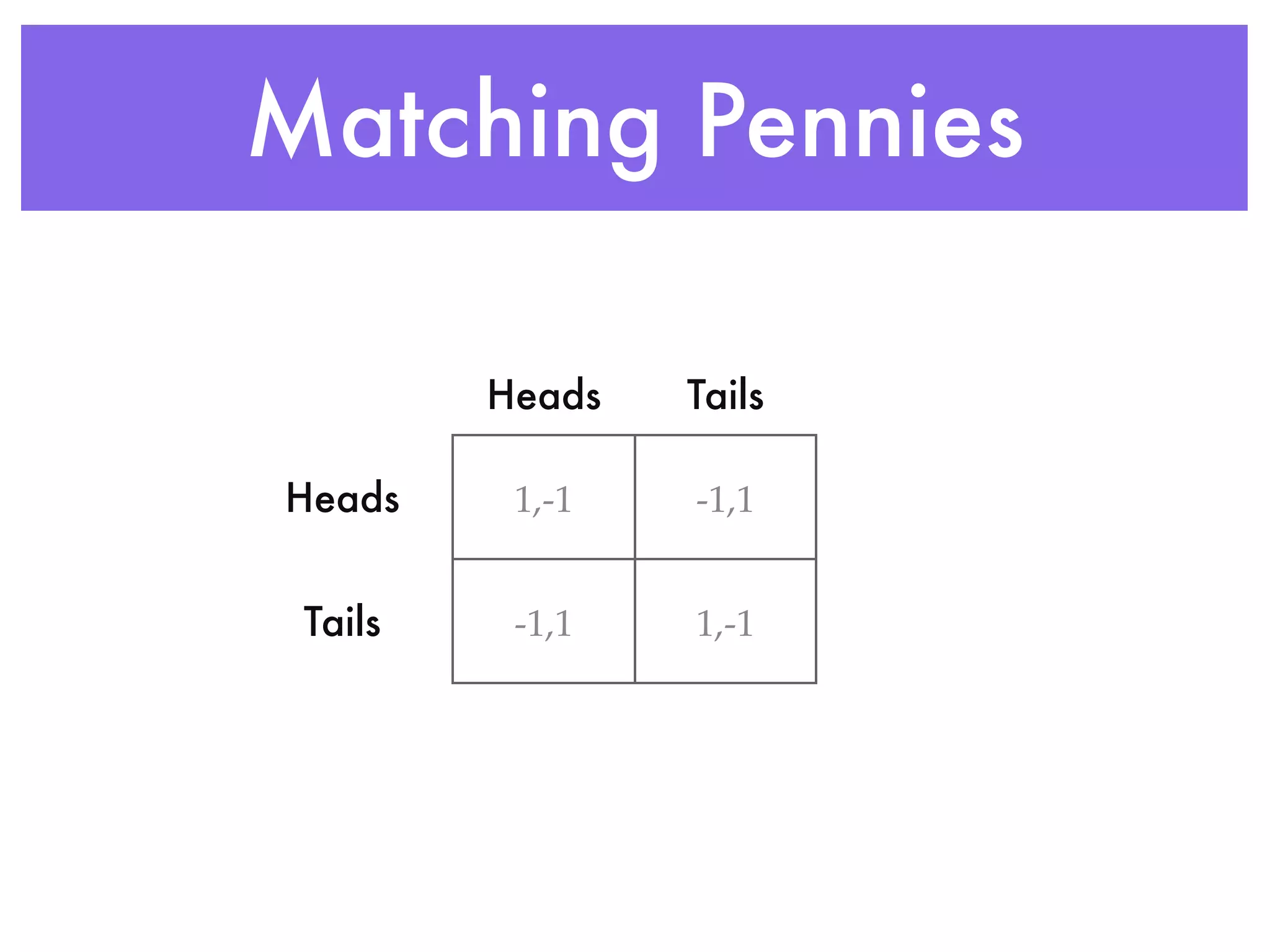
Matching Pennies

         Heads   Tails

Heads     1,-1   -1,1


 Tails    -1,1   1,-1
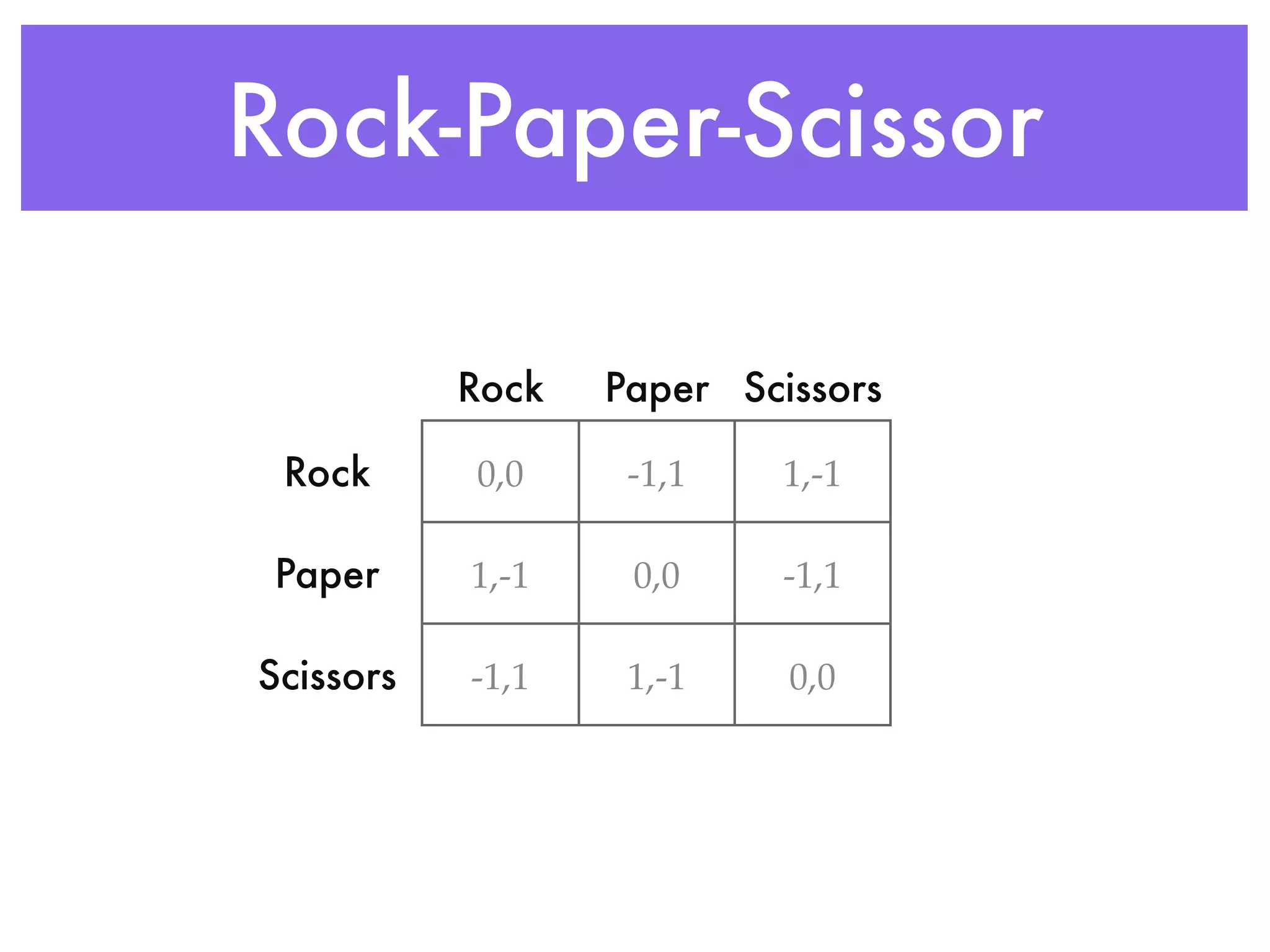
Rock-Paper-Scissor

           Rock   Paper Scissors

 Rock      0,0     -1,1    1,-1

 Paper     1,-1    0,0     -1,1

Scissors   -1,1    1,-1    0,0
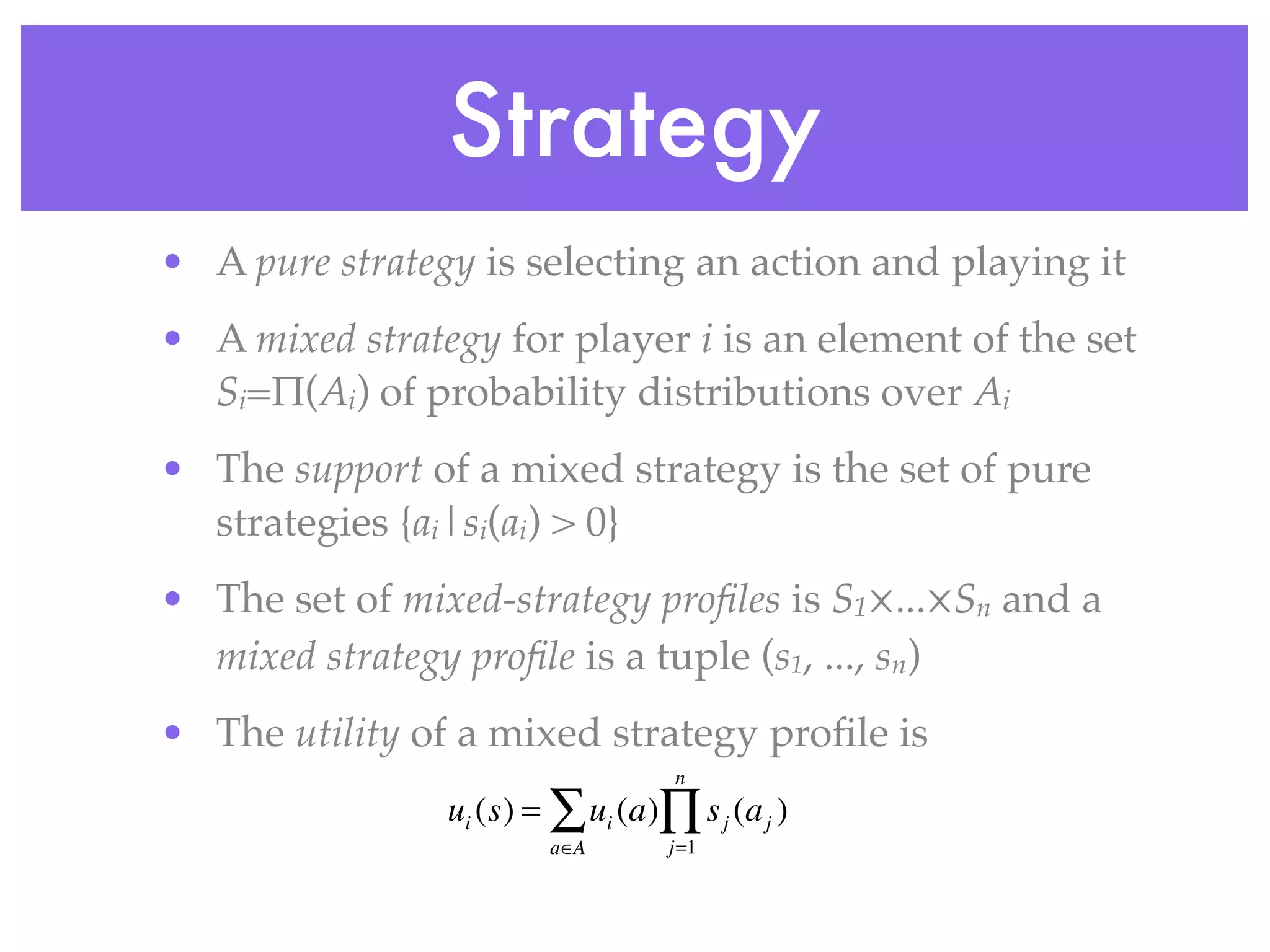
Strategy
• A pure strategy is selecting an action and playing it
• A mixed strategy for player i is an element of the set
  Si=!(Ai) of probability distributions over Ai
• The support of a mixed strategy is the set of pure
  strategies {ai|si(ai) > 0}
• The set of mixed-strategy profiles is S1⨉...⨉Sn and a
  mixed strategy profile is a tuple (s1, ..., sn)
• The utility of a mixed strategy profile is
                                   n
                ui (s) = ∑ ui (a)∏ s j (a j )
                        a∈A       j=1
Solution Concept
• Games are complex, the environment
  can be stochastic, other player’s choices
  affect the outcome
• Game theorists study certain subsets of
  outcomes that are interesting in one
  sense or another which are called
  solution concepts
Pareto Efficiency
• The strategy profile s Pareto dominates
  the strategy profile s’ if for some players
  the utility for s is strictly higher and for
  the others is not worse
• A strategy profile is Pareto optimal if
  there is no other strategy profile
  dominating it
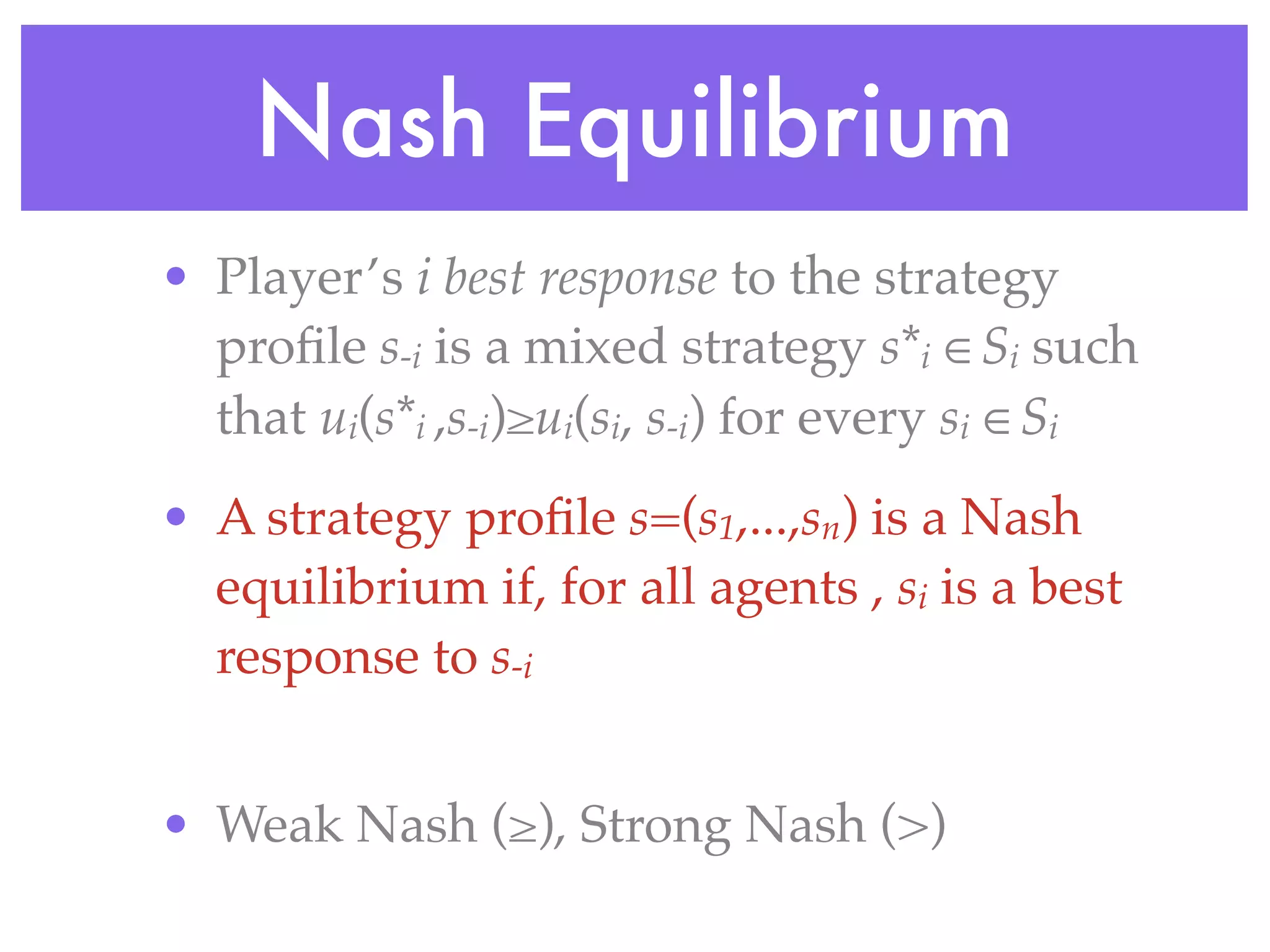
Nash Equilibrium
• Player’s i best response to the strategy
  profile s-i is a mixed strategy s*i ∈Si such
  that ui(s*i ,s-i)≥ui(si, s-i) for every si ∈Si
• A strategy profile s=(s1,...,sn) is a Nash
  equilibrium if, for all agents , si is a best
  response to s-i


• Weak Nash (≥), Strong Nash (>)
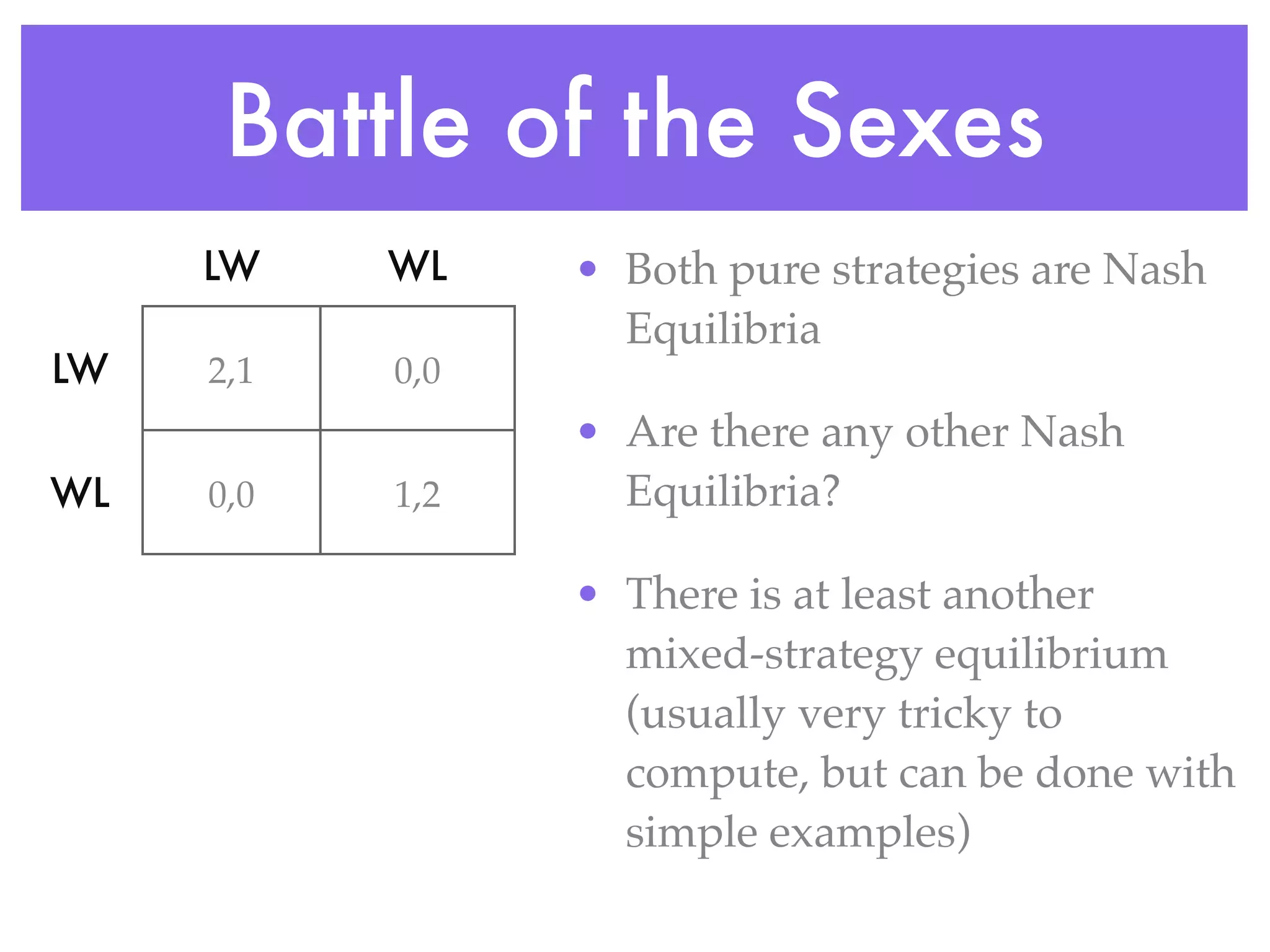
Battle of the Sexes
     LW    WL    • Both pure strategies are Nash
                   Equilibria
LW   2,1   0,0
                 • Are there any other Nash
WL   0,0   1,2     Equilibria?

                 • There is at least another
                   mixed-strategy equilibrium
                   (usually very tricky to
                   compute, but can be done with
                   simple examples)
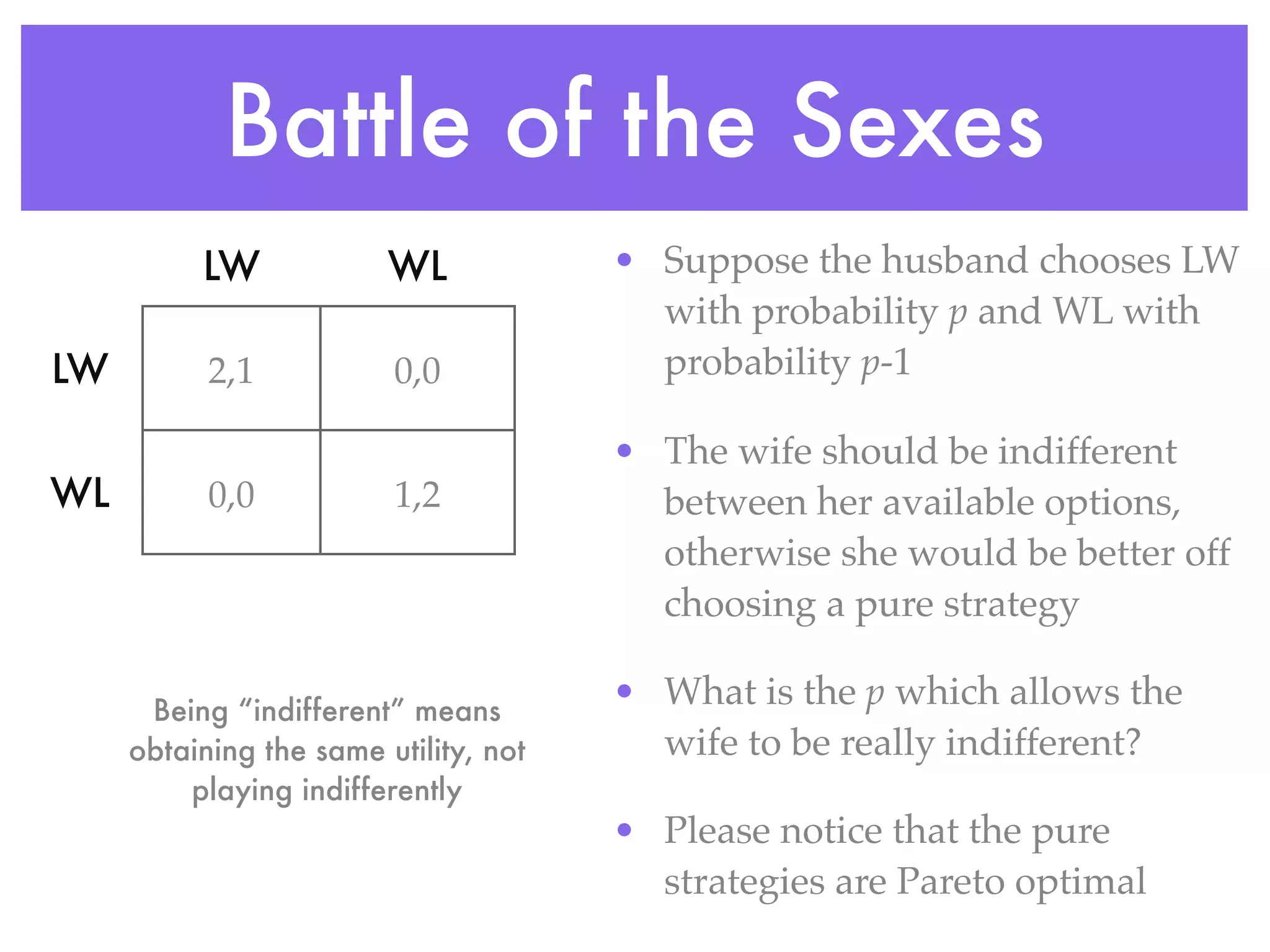
Battle of the Sexes
          LW             WL            • Suppose the husband chooses LW
                                         with probability p and WL with
LW         2,1           0,0             probability p-1

                                       • The wife should be indifferent
WL         0,0           1,2             between her available options,
                                         otherwise she would be better off
                                         choosing a pure strategy

      Being “indifferent” means
                                       • What is the p which allows the
     obtaining the same utility, not     wife to be really indifferent?
         playing indifferently
                                       • Please notice that the pure
                                         strategies are Pareto optimal
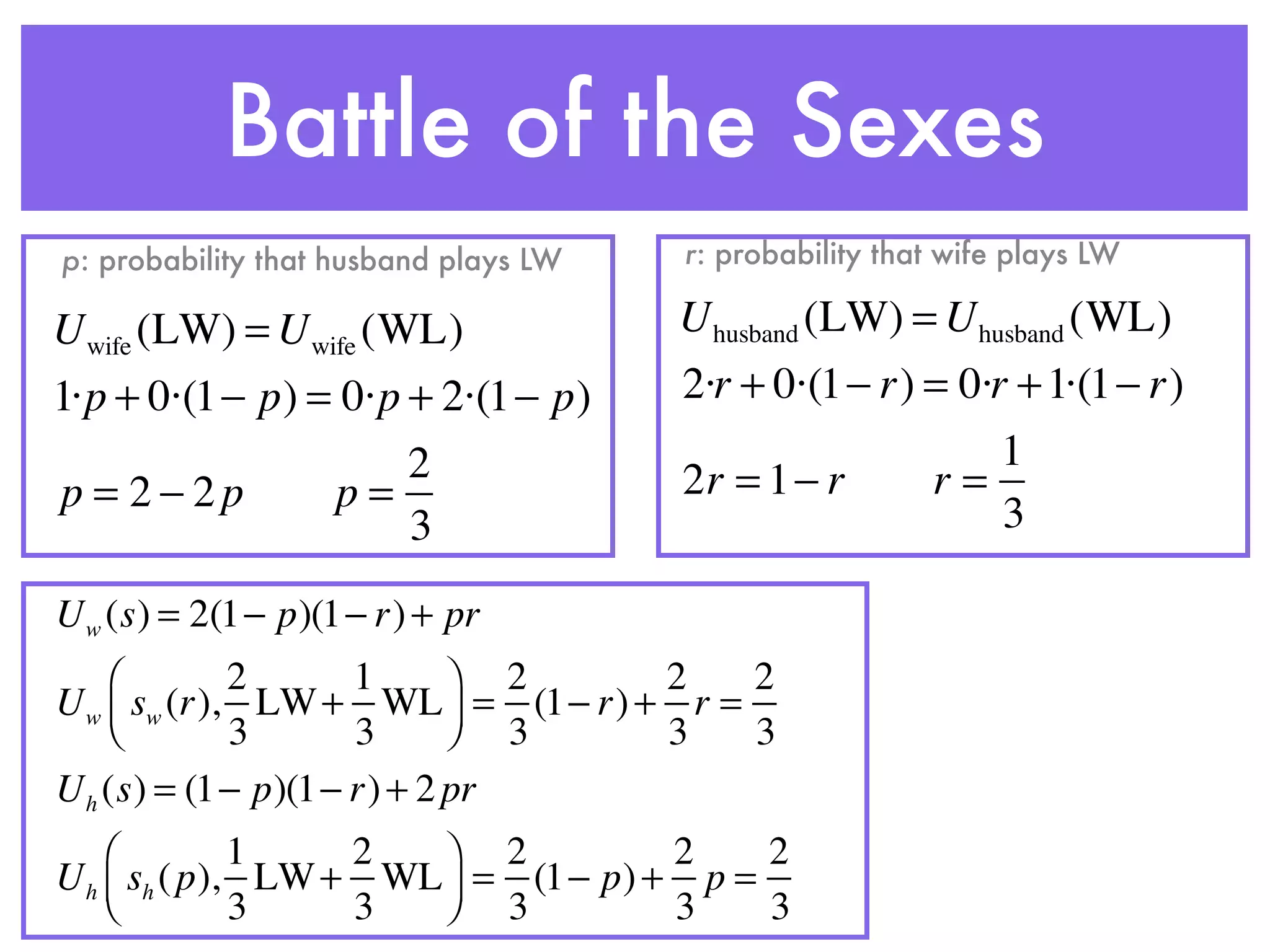
Battle of the Sexes
p: probability that husband plays LW   r: probability that wife plays LW

U wife (LW) = U wife (WL)              U husband (LW) = U husband (WL)
1·p + 0·(1− p) = 0·p + 2·(1− p)        2·r + 0·(1− r) = 0·r + 1·(1− r)
                      2                                     1
p = 2− 2p          p=                  2r = 1− r         r=
                      3                                     3

U w (s) = 2(1− p)(1− r) + pr
    ⎛        2      1      ⎞ 2    2    2
U w ⎜ sw (r), LW + WL ⎟ = (1− r) + r =
    ⎝        3      3      ⎠ 3    3    3
U h (s) = (1− p)(1− r) + 2 pr
    ⎛         1    2   ⎞ 2         2    2
U h ⎜ sh ( p), LW + WL ⎟ = (1− p) + p =
    ⎝         3    3   ⎠ 3         3    3
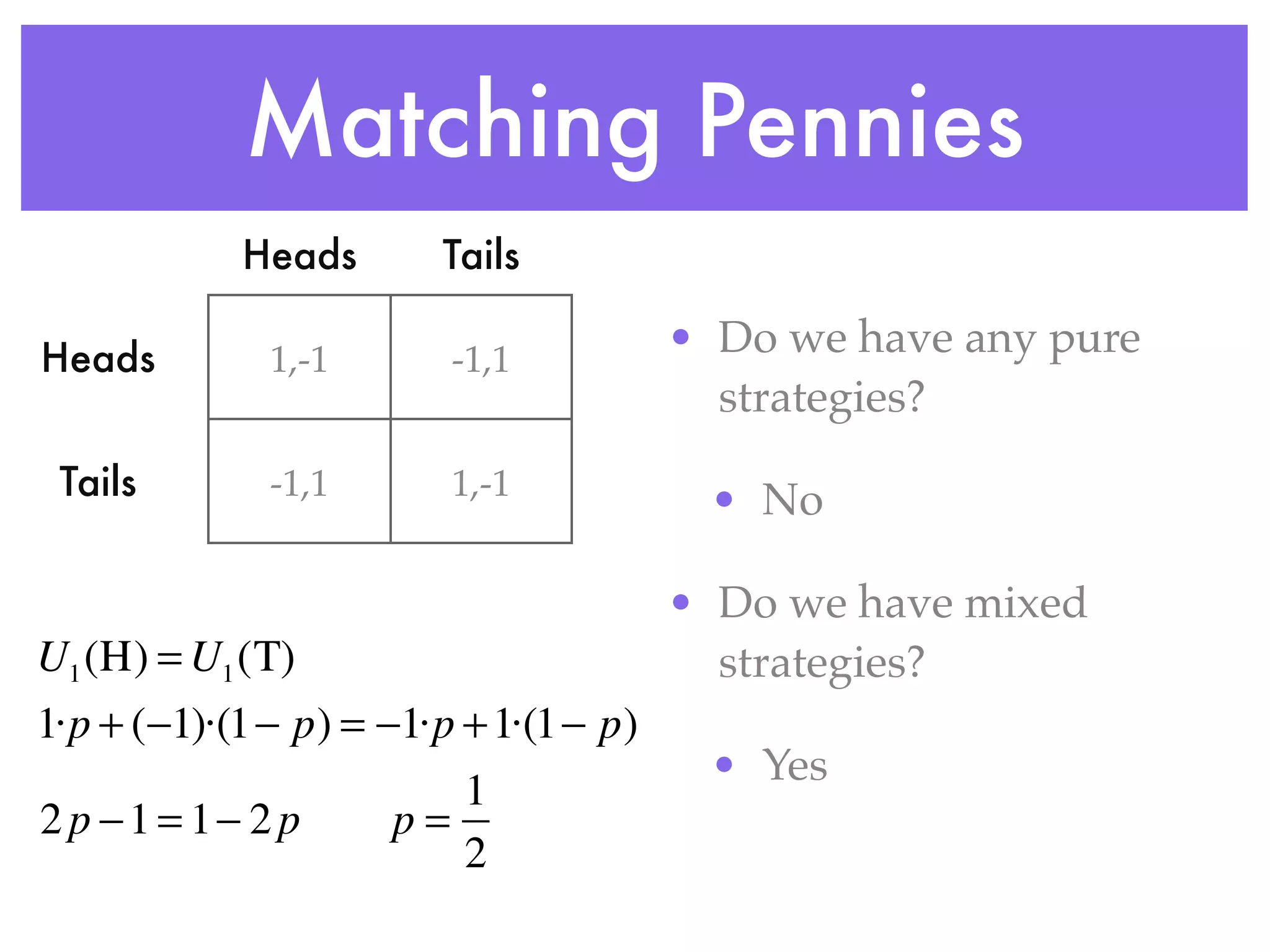
Matching Pennies
           Heads       Tails

Heads        1,-1       -1,1
                                      • Do we have any pure
                                        strategies?
 Tails       -1,1       1,-1           • No

                                      • Do we have mixed
U1 (H) = U1 (T)                         strategies?
1·p + (−1)·(1− p) = −1·p + 1·(1− p)
                                       • Yes
                         1
2 p − 1 = 1− 2 p     p=
                         2
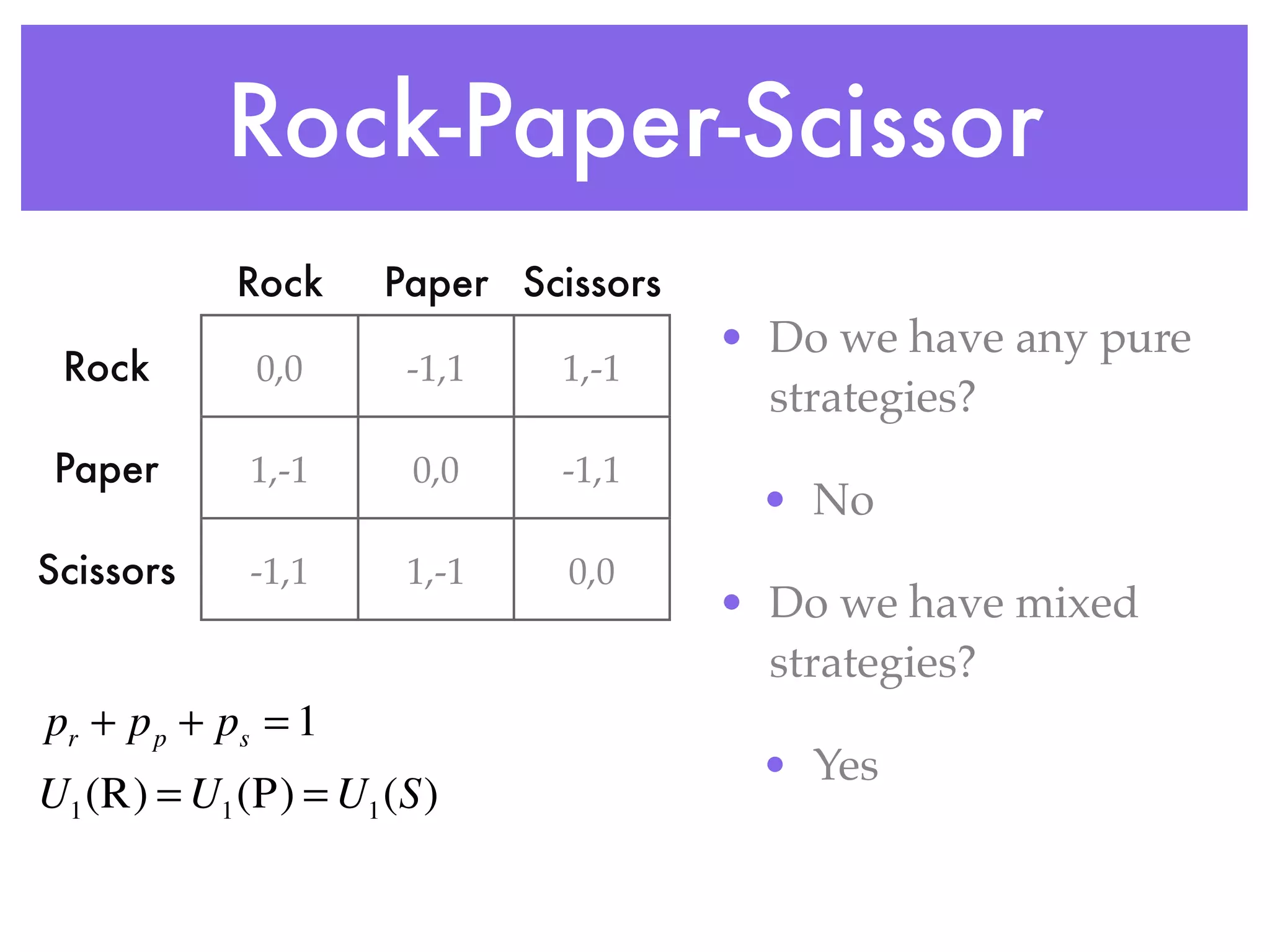
Rock-Paper-Scissor
           Rock     Paper Scissors
                                     • Do we have any pure
 Rock        0,0      -1,1   1,-1
                                       strategies?
Paper       1,-1      0,0    -1,1
                                      • No
Scissors    -1,1      1,-1   0,0
                                     • Do we have mixed
                                       strategies?
pr + p p + ps = 1
                                      • Yes
U1 (R) = U1 (P) = U1 (S)
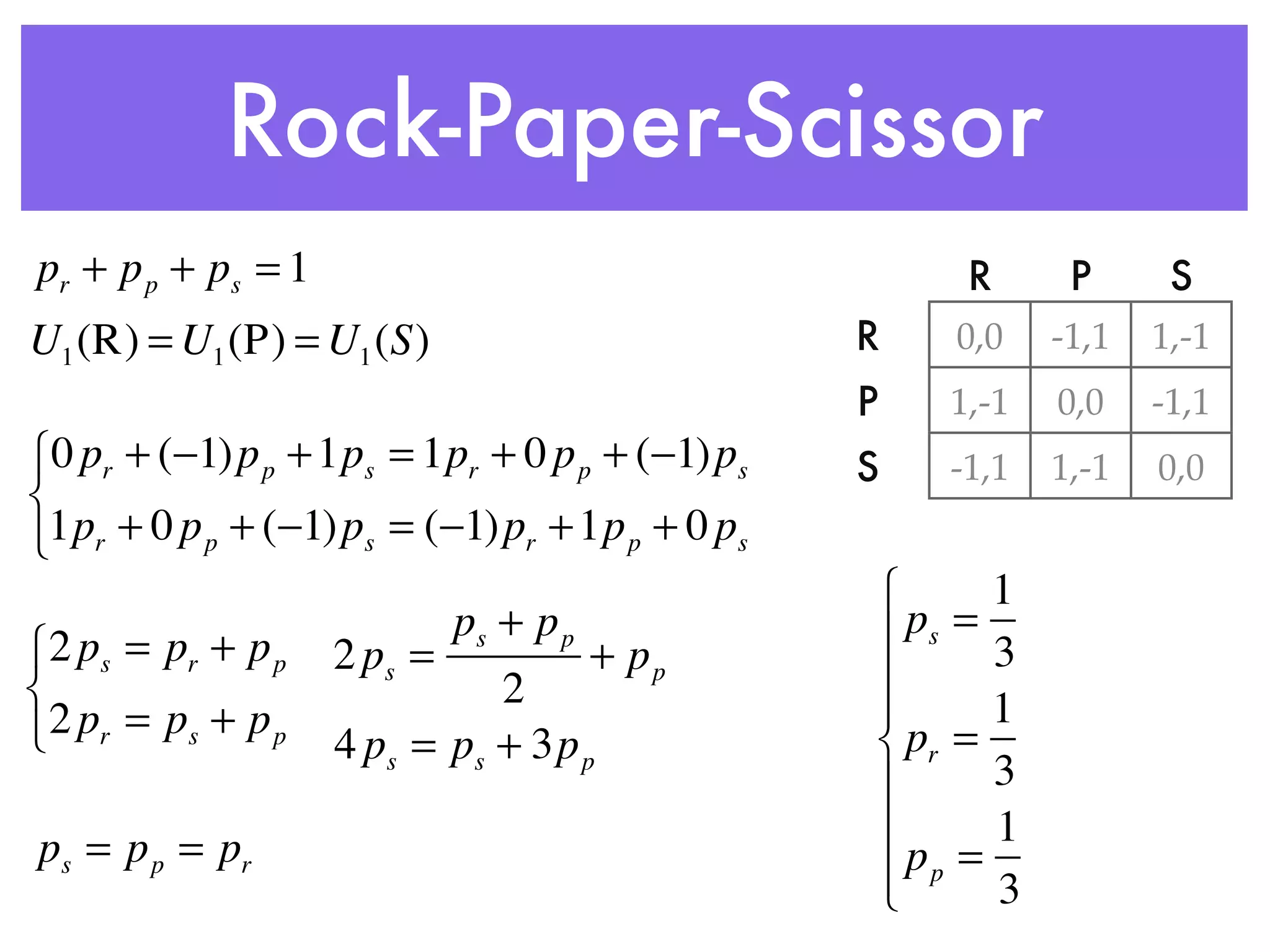
Rock-Paper-Scissor
pr + p p + ps = 1                                     R      P      S
U1 (R) = U1 (P) = U1 (S)                         R   0,0    -1,1   1,-1
                                                 P   1,-1   0,0    -1,1
⎧0 pr + (−1) p p + 1ps = 1pr + 0 p p + (−1) ps   S   -1,1   1,-1   0,0
⎨
⎩1pr + 0 p p + (−1) ps = (−1) pr + 1p p + 0 ps
                                                 ⎧      1
                             ps + p p            ⎪ ps =
⎧2 ps = pr + p p    2 ps =              + pp            3
⎨                             2                  ⎪
  2 pr = ps + p p                                ⎪      1
⎩                   4 ps = ps + 3p p             ⎨ pr =
                                                 ⎪      3
ps = p p = pr                                    ⎪p = 1
                                                 ⎪ p 3
                                                 ⎩
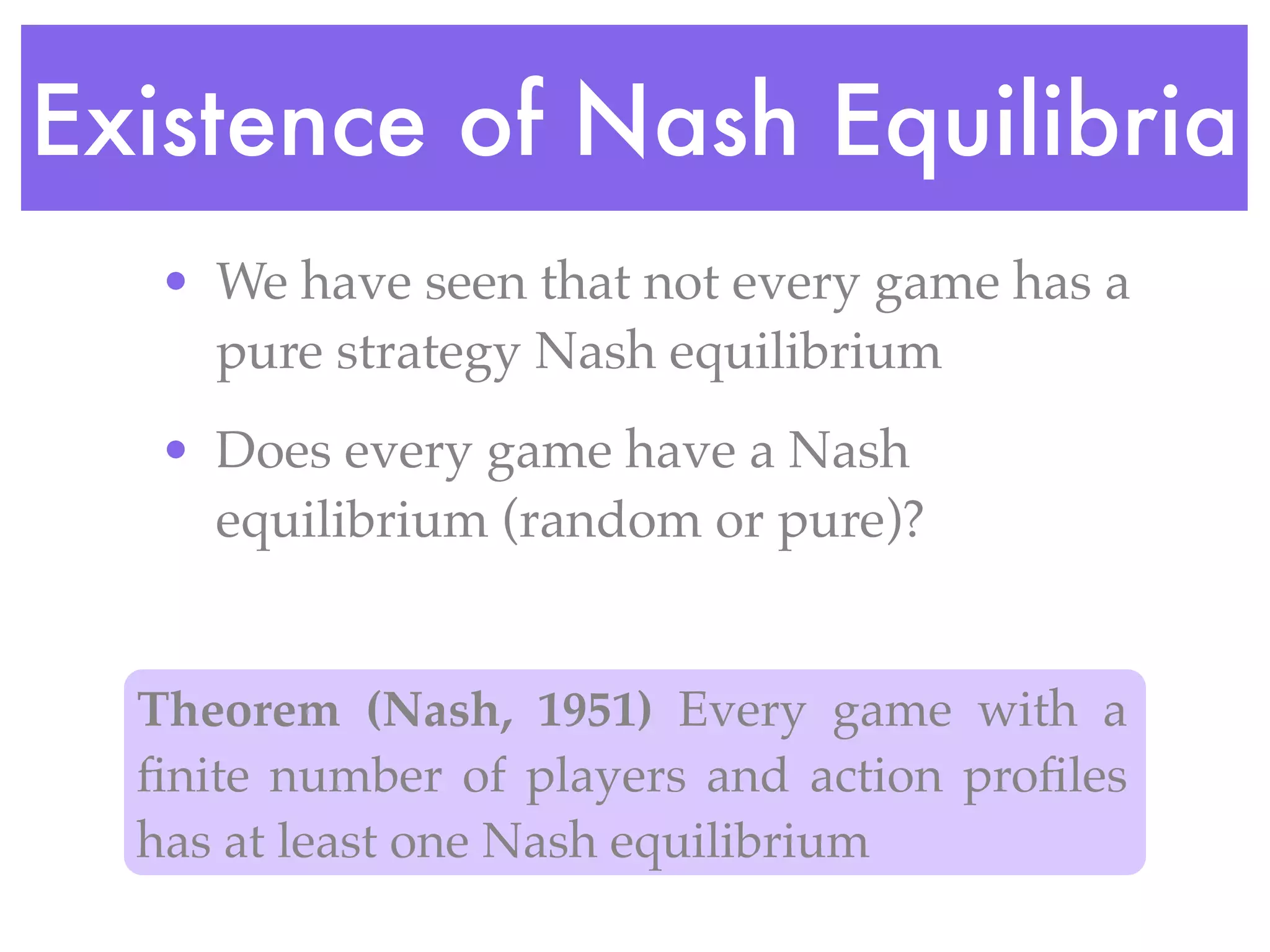
Existence of Nash Equilibria
   • We have seen that not every game has a
     pure strategy Nash equilibrium
   • Does every game have a Nash
     equilibrium (random or pure)?


  Theorem (Nash, 1951) Every game with a
  finite number of players and action profiles
  has at least one Nash equilibrium
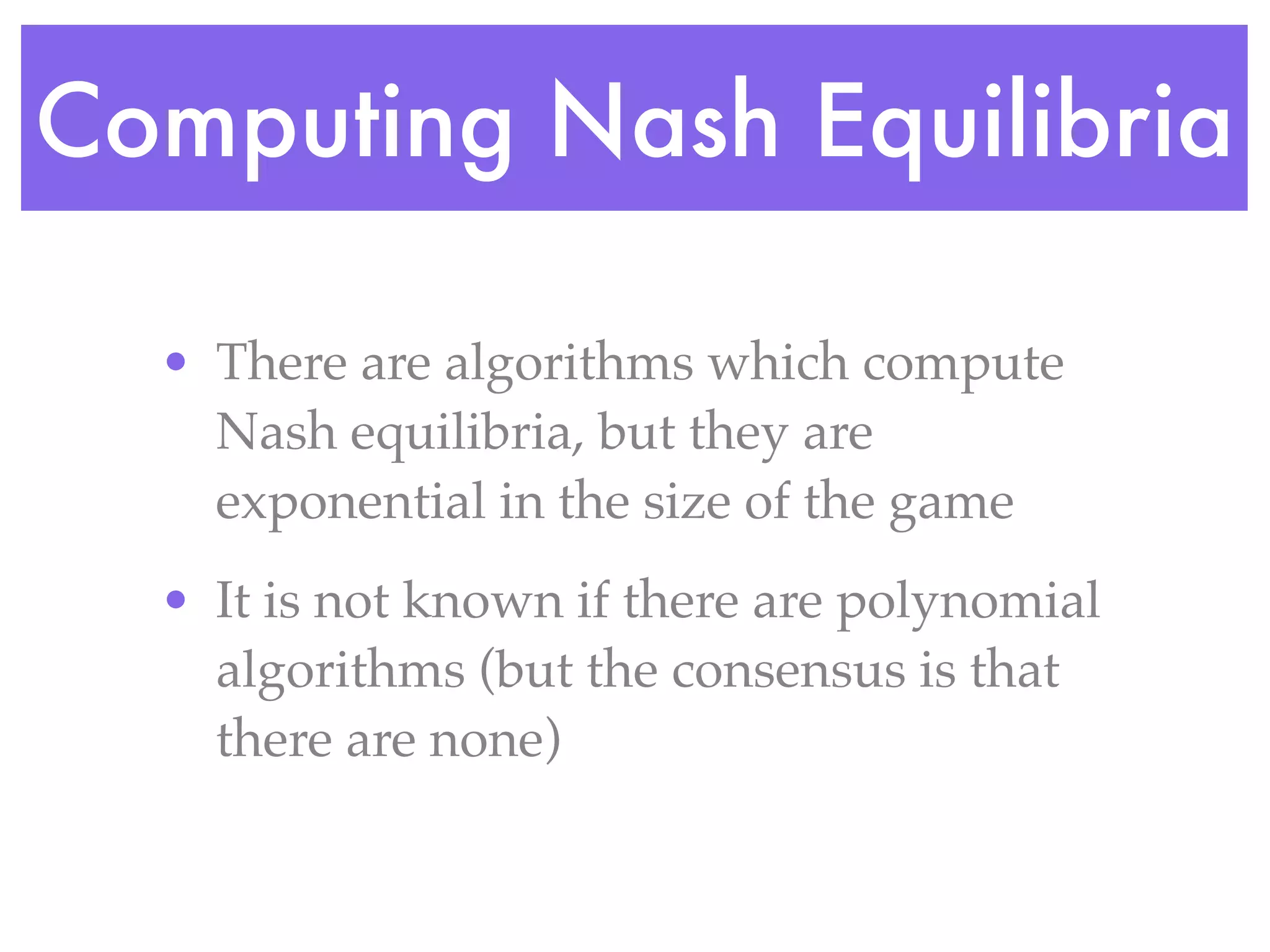
Computing Nash Equilibria

  • There are algorithms which compute
    Nash equilibria, but they are
    exponential in the size of the game
  • It is not known if there are polynomial
    algorithms (but the consensus is that
    there are none)
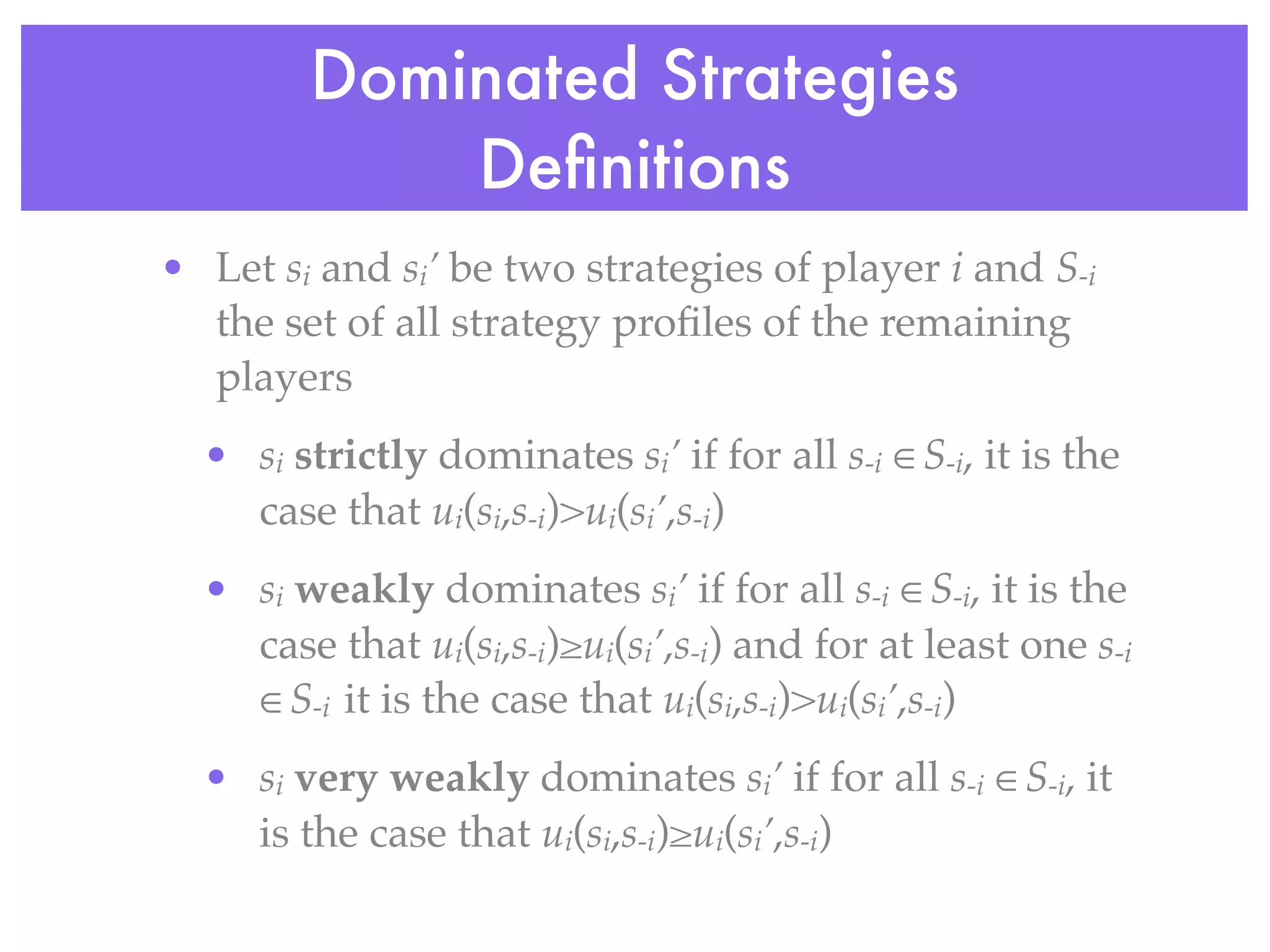
Dominated Strategies
            Definitions
• Let si and si’ be two strategies of player i and S-i
  the set of all strategy profiles of the remaining
  players
  • si strictly dominates si’ if for all s-i ∈S-i, it is the
    case that ui(si,s-i)>ui(si’,s-i)
  • si weakly dominates si’ if for all s-i ∈S-i, it is the
    case that ui(si,s-i)≥ui(si’,s-i) and for at least one s-i
    ∈S-i it is the case that ui(si,s-i)>ui(si’,s-i)
  • si very weakly dominates si’ if for all s-i ∈S-i, it
    is the case that ui(si,s-i)≥ui(si’,s-i)
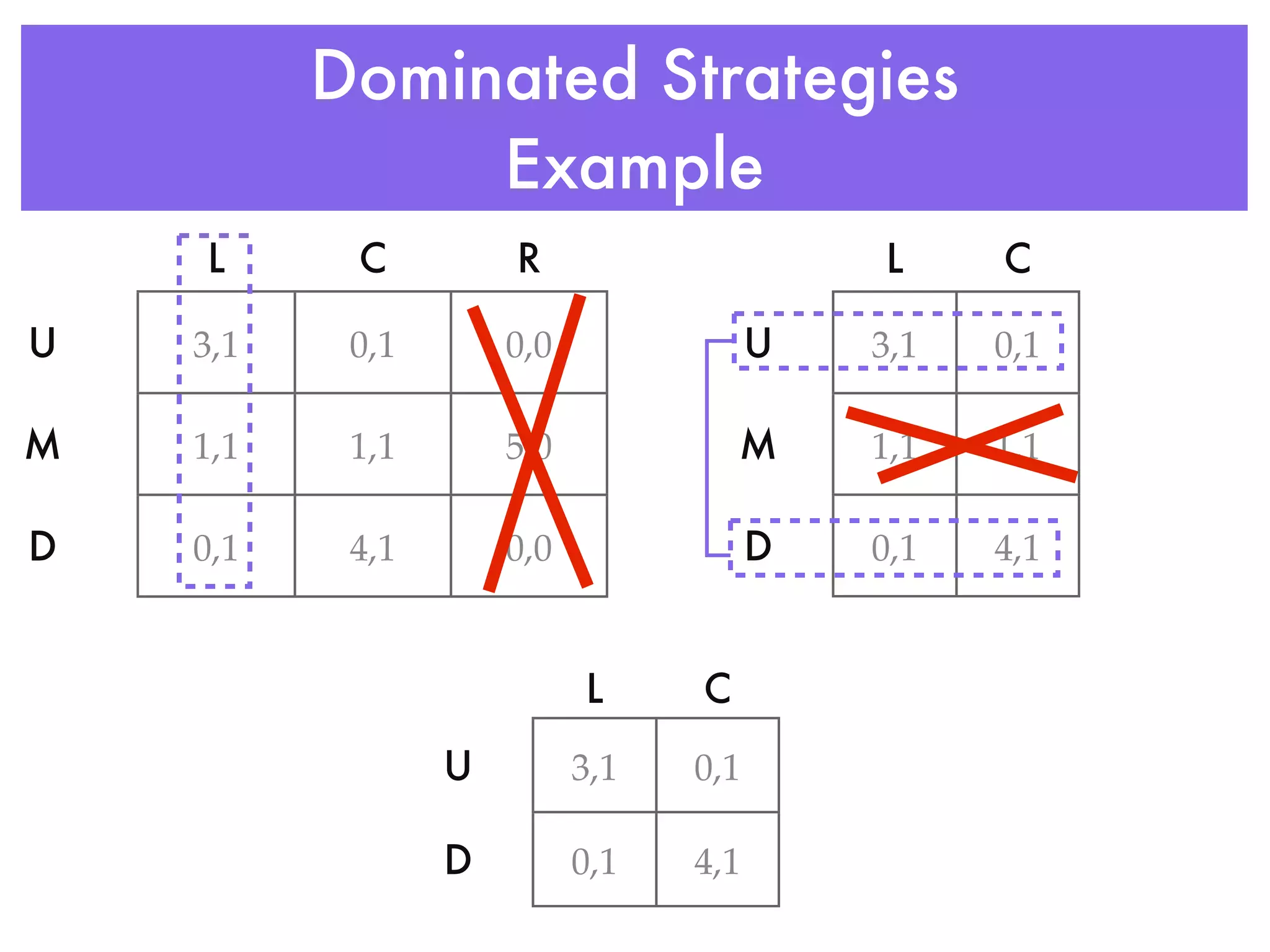
Dominated Strategies
               Example
    L      C         R                     L     C

U   3,1    0,1       0,0               U   3,1   0,1

M   1,1    1,1       5,0             M     1,1   1,1

D   0,1    4,1       0,0               D   0,1   4,1


                           L     C
                 U         3,1   0,1

                 D         0,1   4,1
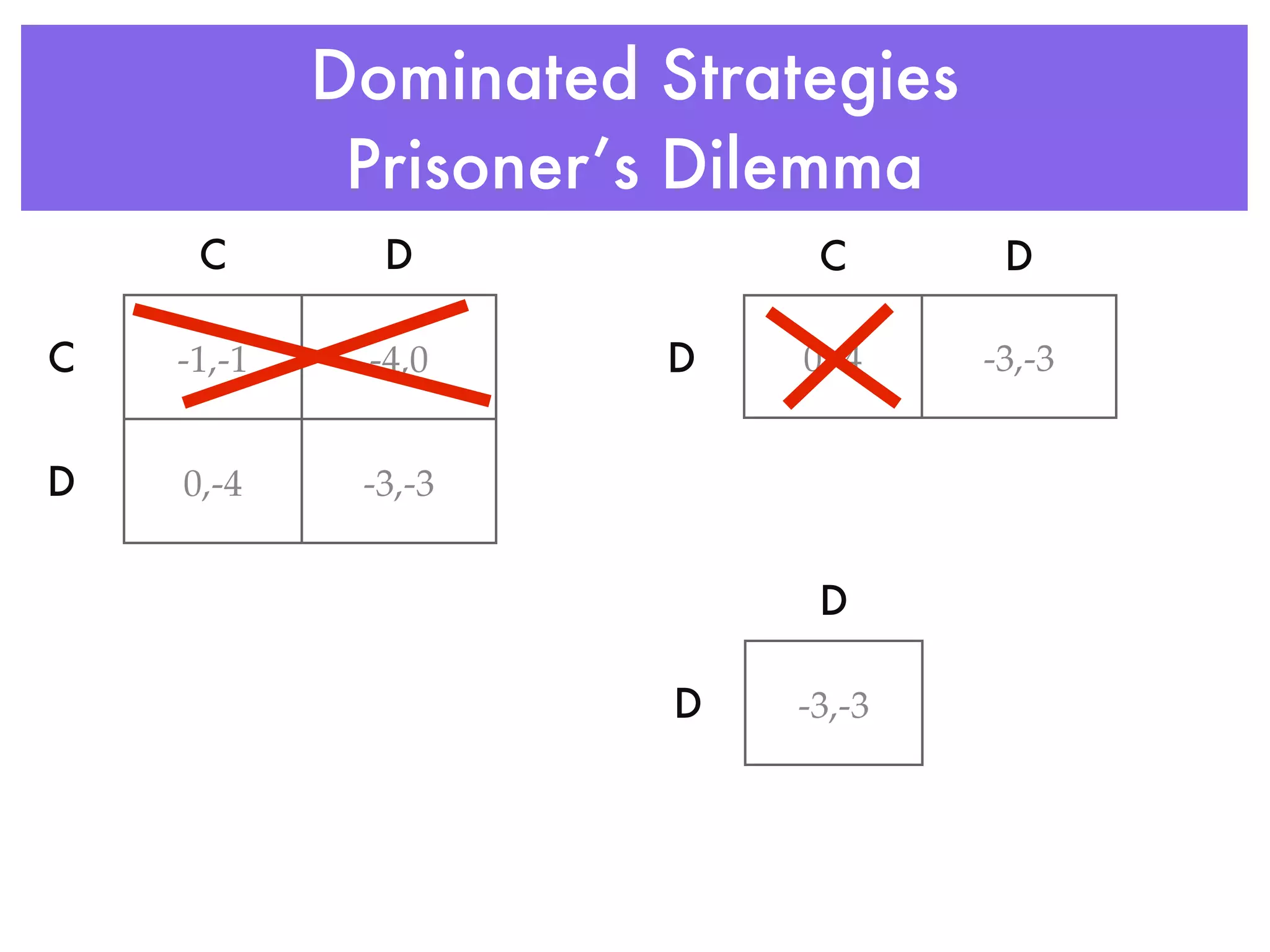
Dominated Strategies
             Prisoner’s Dilemma
     C        D             C       D

C   -1,-1    -4,0      D   0,-4    -3,-3


D   0,-4     -3,-3


                            D

                       D   -3,-3
Dominated Strategies
      as solution concepts
• The set of all strategy profiles that assign
  0 probability to playing any action that
  would be removed through iterated
  removal of strictly dominated strategies
  is a solution concept
• Sometimes, no action can be “removed”,
  sometimes we can solve the game (we
  say the game is solvable by iterated
  elimination)
Dominated Strategies
                  Costs
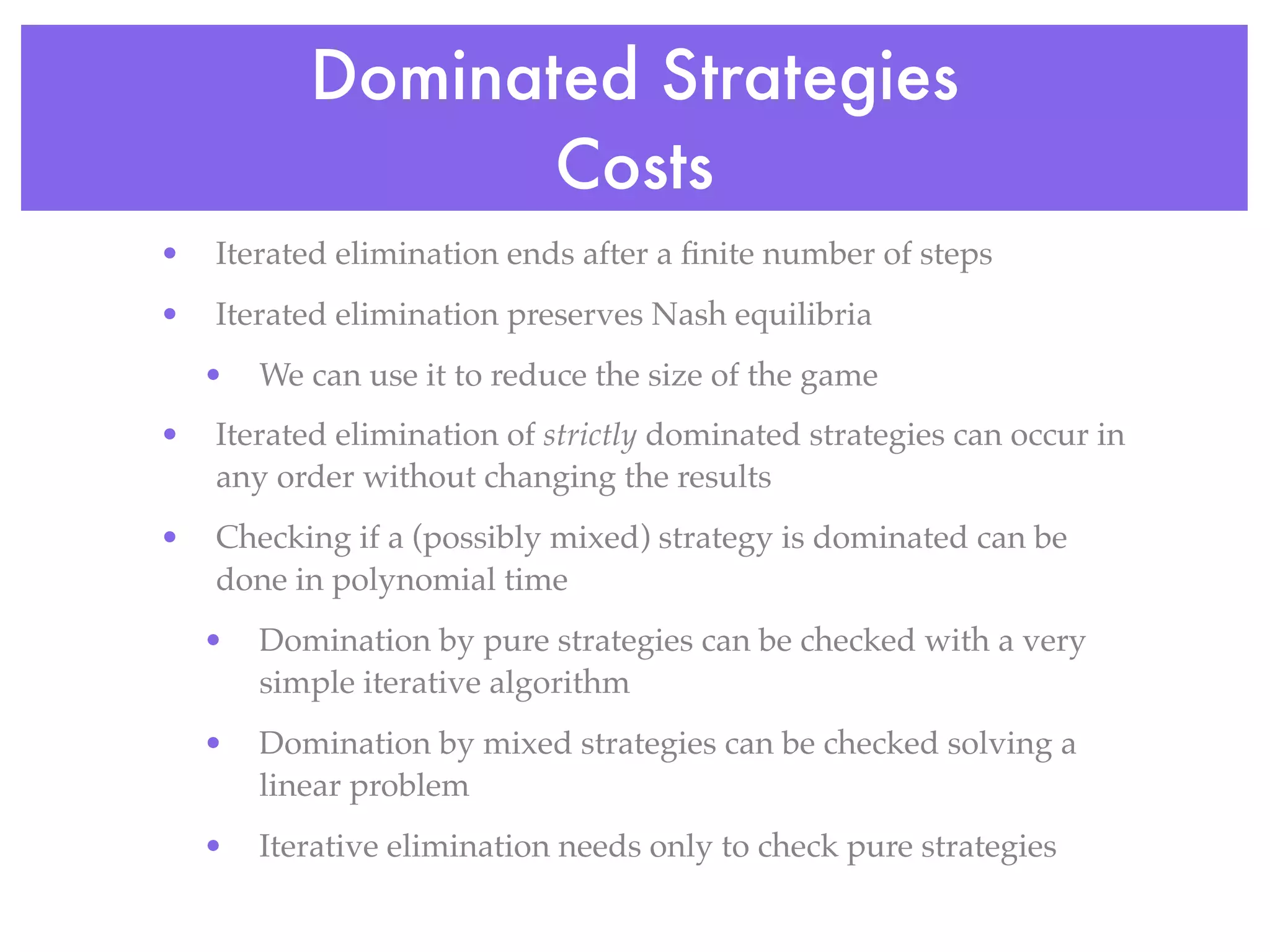
•   Iterated elimination ends after a finite number of steps
•   Iterated elimination preserves Nash equilibria
    •   We can use it to reduce the size of the game
•   Iterated elimination of strictly dominated strategies can occur in
    any order without changing the results
•   Checking if a (possibly mixed) strategy is dominated can be
    done in polynomial time
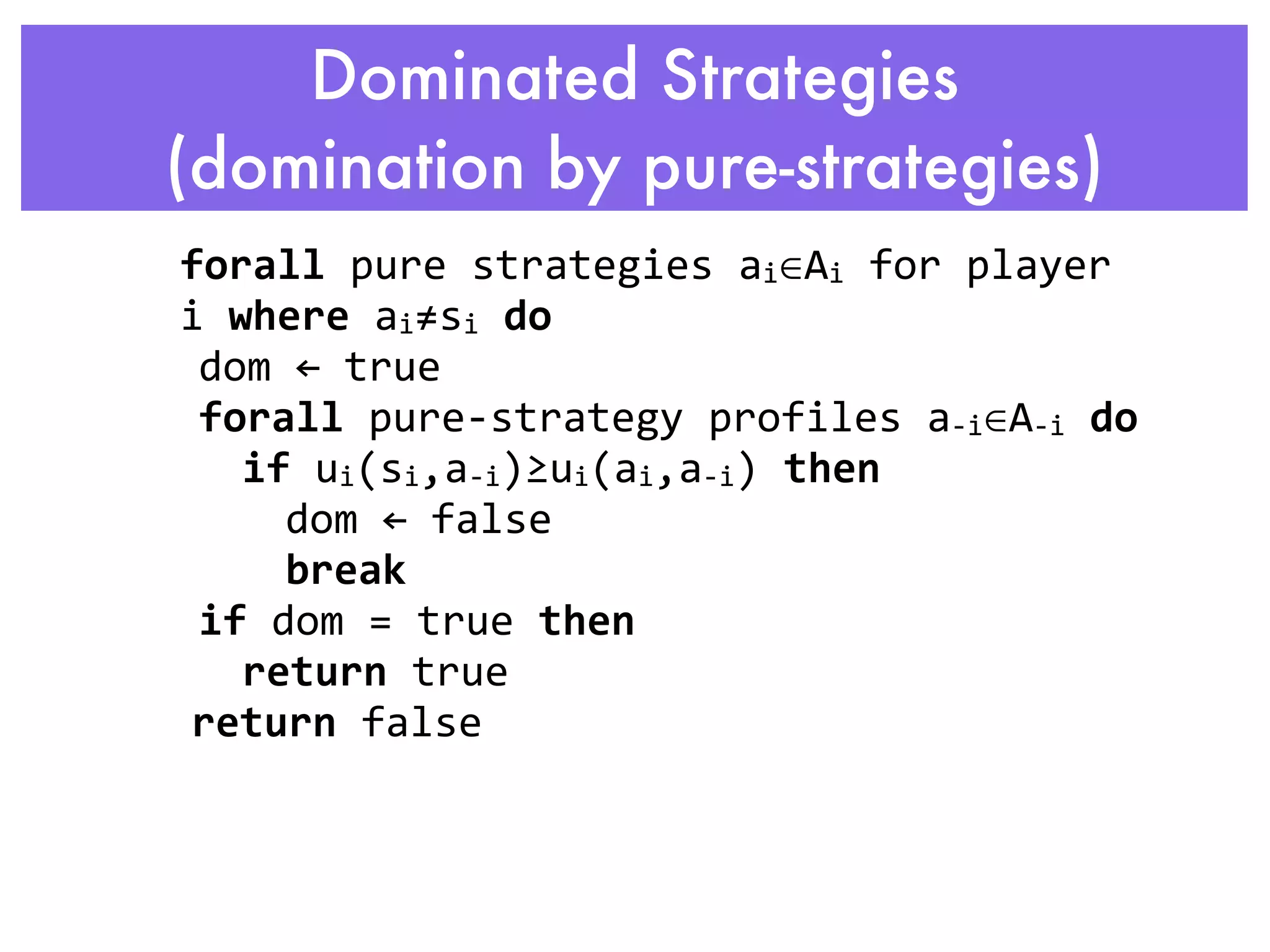
    •   Domination by pure strategies can be checked with a very
        simple iterative algorithm
    •   Domination by mixed strategies can be checked solving a
        linear problem
    •   Iterative elimination needs only to check pure strategies
Dominated Strategies
  (domination by pure-strategies)
         forall	
  pure	
  strategies	
  ai∈Ai	
  for	
  player	
  
         i	
  where	
  ai≠si	
  do
           dom	
  ←	
  true
           forall	
  pure-­‐strategy	
  profiles	
  a-­‐i∈A-­‐i	
  do
               if	
  ui(si,a-­‐i)≥ui(ai,a-­‐i)	
  then
                  dom	
  ←	
  false
                  break
           if	
  dom	
  =	
  true	
  then
               return	
  true
   	
  	
  return	
  false


Other Solution Concepts:
        Maxmin & Minmax
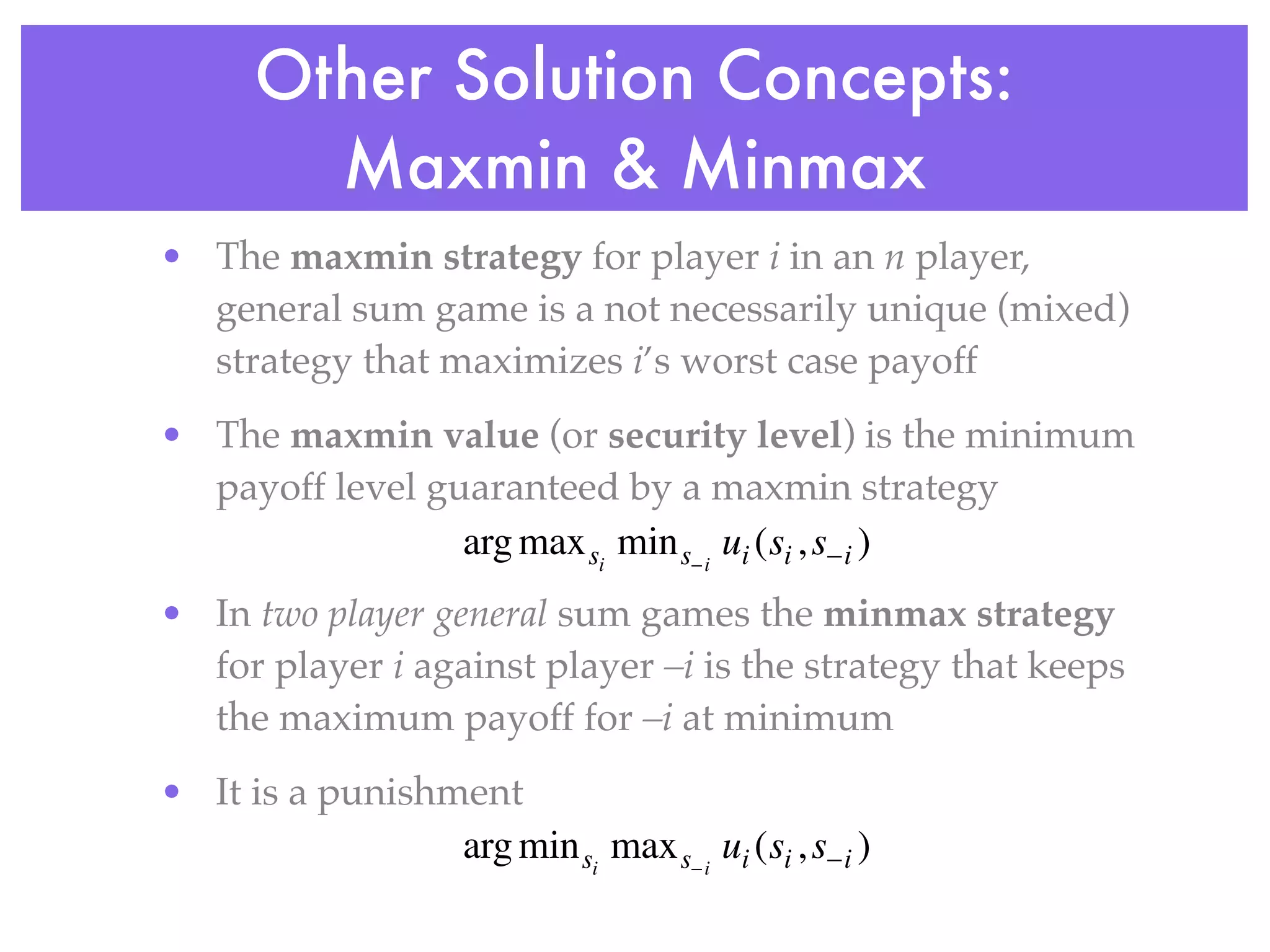
• The maxmin strategy for player i in an n player,
  general sum game is a not necessarily unique (mixed)
  strategy that maximizes i’s worst case payoff
• The maxmin value (or security level) is the minimum
  payoff level guaranteed by a maxmin strategy
                 arg max si min s− i ui (si , s−i )
• In two player general sum games the minmax strategy
  for player i against player –i is the strategy that keeps
  the maximum payoff for –i at minimum
• It is a punishment
                 arg min si max s− i ui (si , s−i )
Other Solution Concepts:
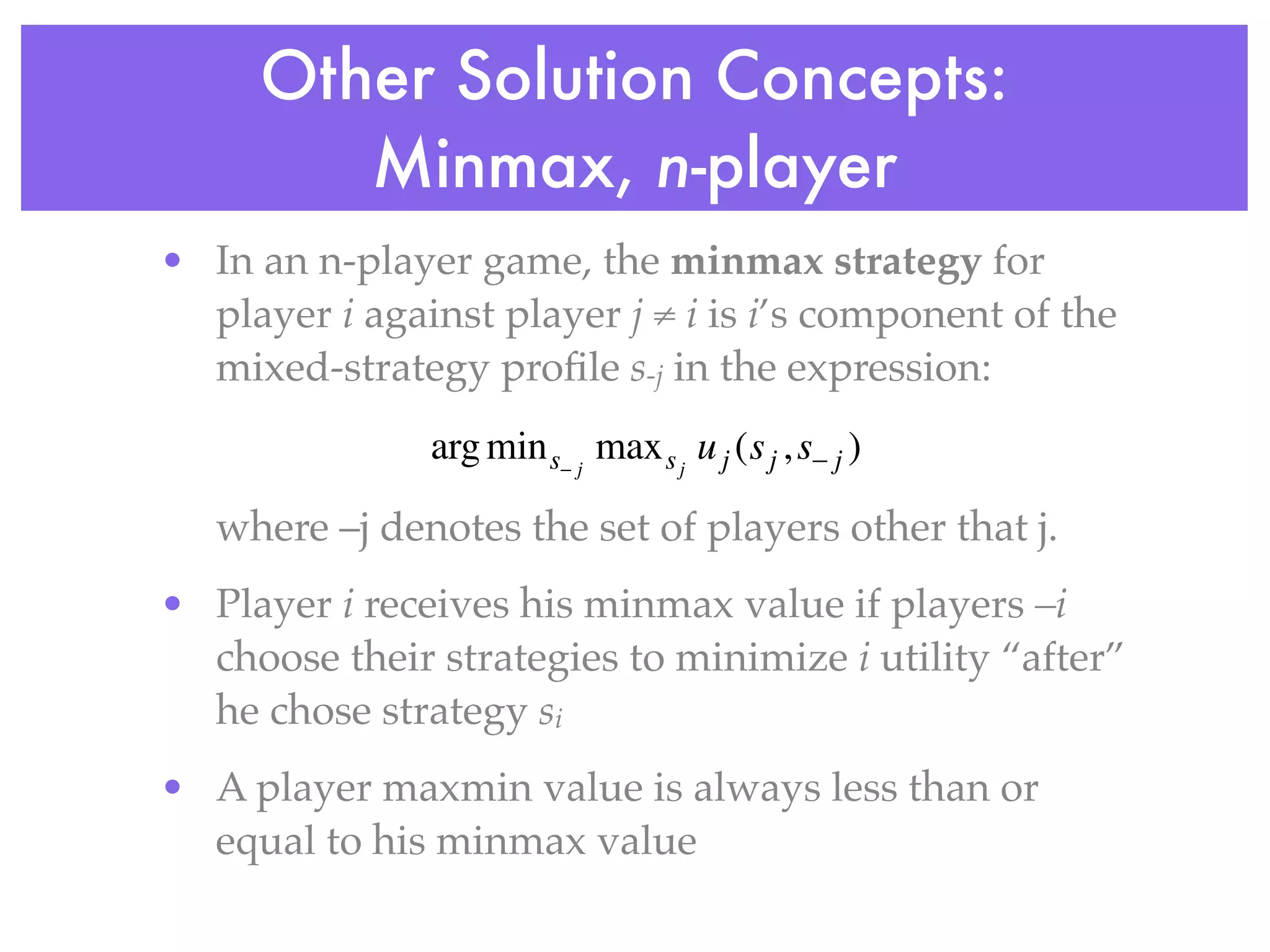
        Minmax, n-player
• In an n-player game, the minmax strategy for
  player i against player j ≠ i is i’s component of the
  mixed-strategy profile s-j in the expression:
               arg min s− j max s j u j (s j , s− j )

   where –j denotes the set of players other that j.
• Player i receives his minmax value if players –i
  choose their strategies to minimize i utility “after”
  he chose strategy si
• A player maxmin value is always less than or
  equal to his minmax value
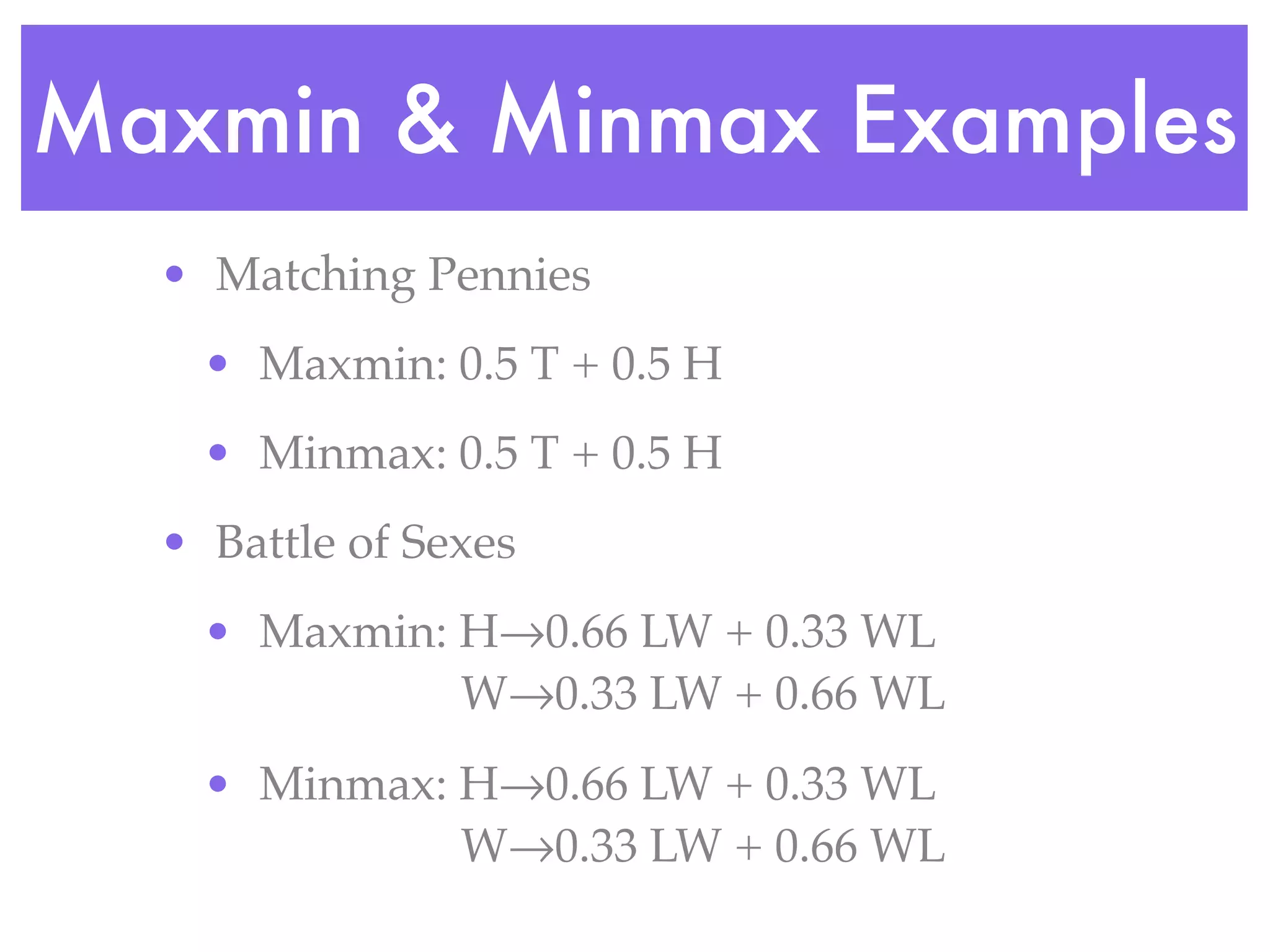
Maxmin & Minmax Examples
  • Matching Pennies
    • Maxmin: 0.5 T + 0.5 H
    • Minmax: 0.5 T + 0.5 H
  • Battle of Sexes
    • Maxmin: H→0.66 LW + 0.33 WL
              W→0.33 LW + 0.66 WL
    • Minmax: H→0.66 LW + 0.33 WL
              W→0.33 LW + 0.66 WL
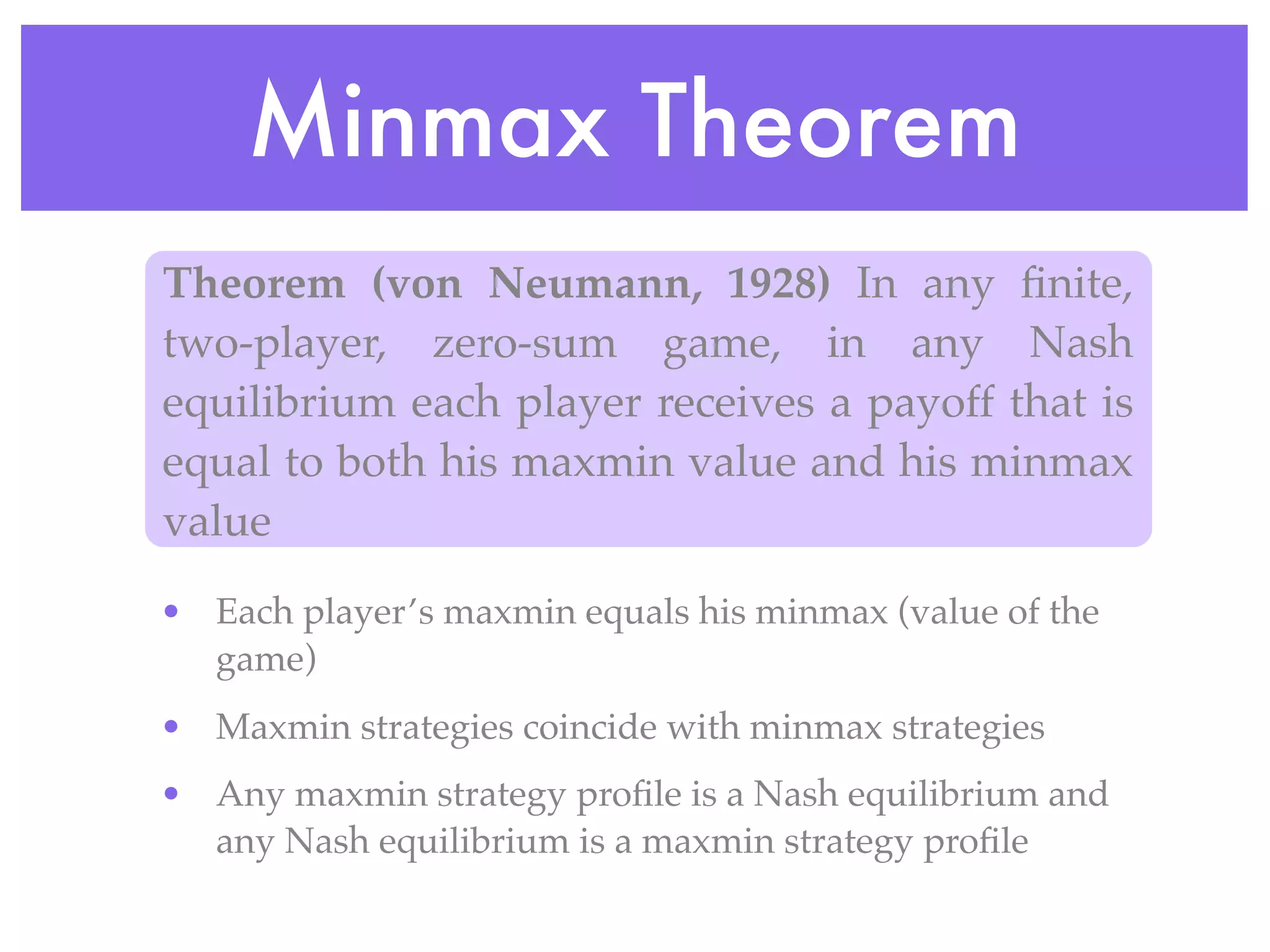
Minmax Theorem
Theorem (von Neumann, 1928) In any finite,
two-player, zero-sum game, in any Nash
equilibrium each player receives a payoff that is
equal to both his maxmin value and his minmax
value
• Each player’s maxmin equals his minmax (value of the
  game)
• Maxmin strategies coincide with minmax strategies
• Any maxmin strategy profile is a Nash equilibrium and
  any Nash equilibrium is a maxmin strategy profile
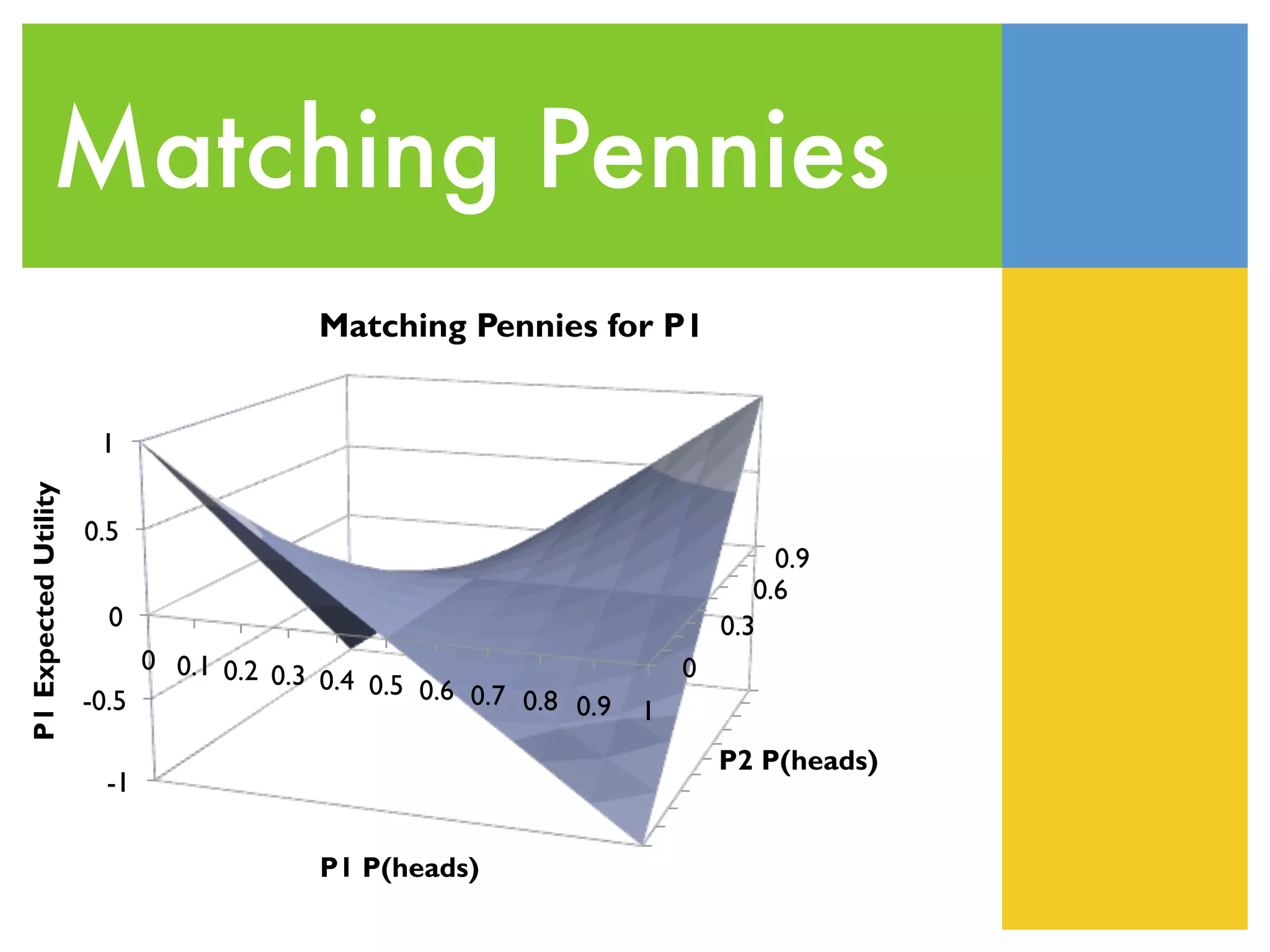
Matching Pennies
                                        Matching Pennies for P1


                       1
P1 Expected Utility


                      0.5
                                                                                0.9
                                                                              0.6
                        0                                                  0.3
                           0 0.1 0.2                                   0
                                     0.3 0.4 0.5
                      -0.5                       0.6 0.7 0.8
                                                             0.9   1
                                                                           P2 P(heads)
                       -1

                                        P1 P(heads)
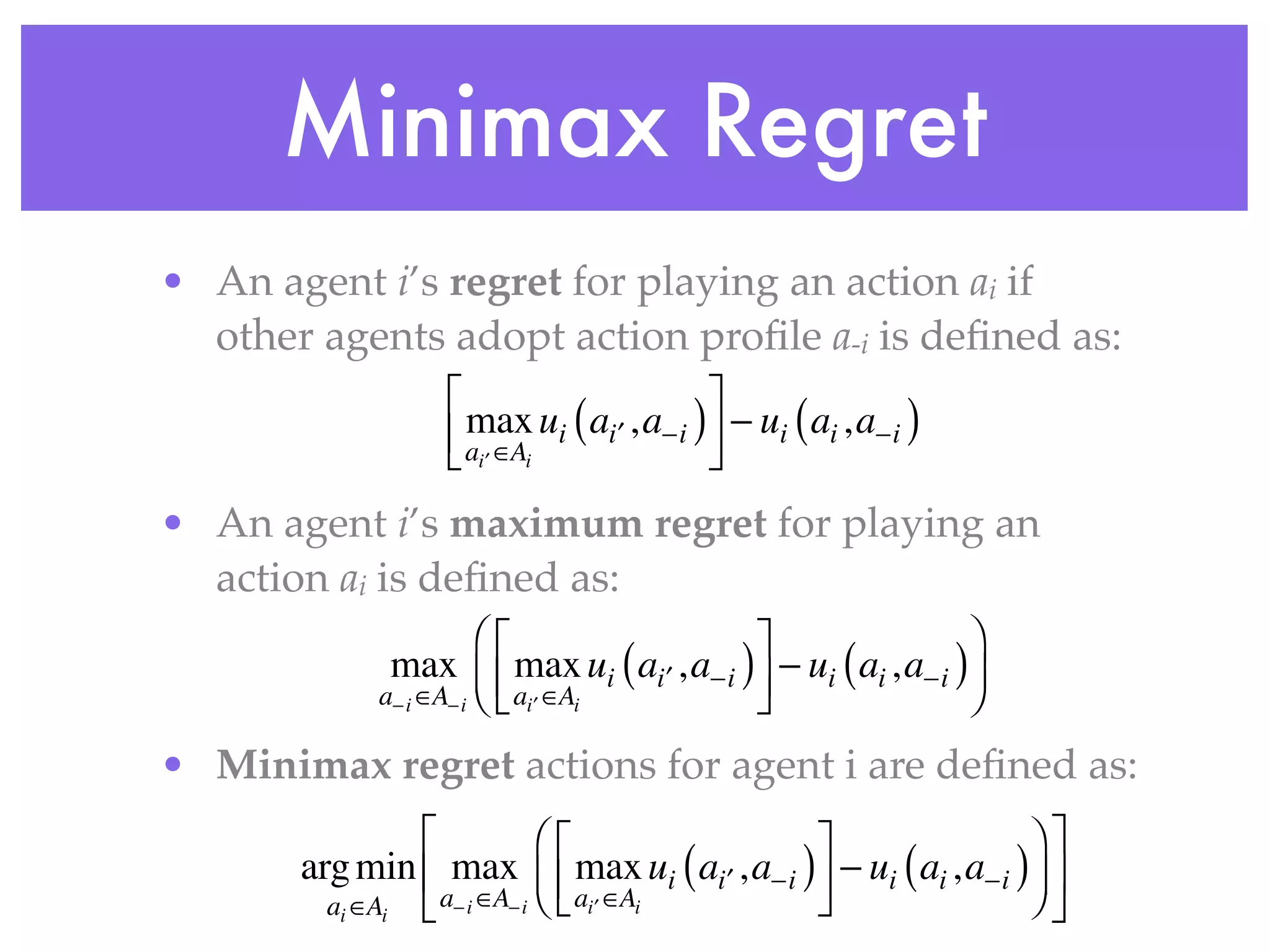
Minimax Regret
• An agent i’s regret for playing an action ai if
  other agents adopt action profile a-i is defined as:
                  ⎡                          ⎤
                  ⎢ ai′ ∈Ai ui ( ai′ , a−i ) ⎥ − ui ( ai , a−i )
                  ⎣
                    max
                                             ⎦
• An agent i’s maximum regret for playing an
  action ai is defined as:
                        ⎛⎡                 ⎤                  ⎞
              max ⎜ ⎢ max ui ( ai′ , a−i ) ⎥ − ui ( ai , a−i )⎟
             a− i ∈A− i ⎝ ⎣ ai ′ ∈Ai       ⎦                  ⎠
• Minimax regret actions for agent i are defined as:
                ⎡            ⎛⎡               ⎤                  ⎞⎤
       arg min ⎢ max ⎜ ⎢ max ui ( ai′ , a−i ) ⎥ − ui ( ai , a−i )⎟ ⎥
         ai ∈Ai ⎣ a− i ∈A− i ⎝ ⎣ ai ′ ∈Ai     ⎦                  ⎠⎦
Maxmin vs. Minmax Regret
                                       L        R
regret(T ,[R])= 1− 1+  = 
regret(B,[R]) = 1− 1 = 0
regret(T ,[L]) = 100 − 100 = 0   T   100, a   1-!, b
regret(B,[L]) = 100 − 2 = 98

max regret(T )= max{,0} =      B    2, c    1, d
max regret(B) = max{98,0} = 98


                         P1 Maxmin is B (why?), his
                         Minimax Regret strategy is T
Computing Equilibria
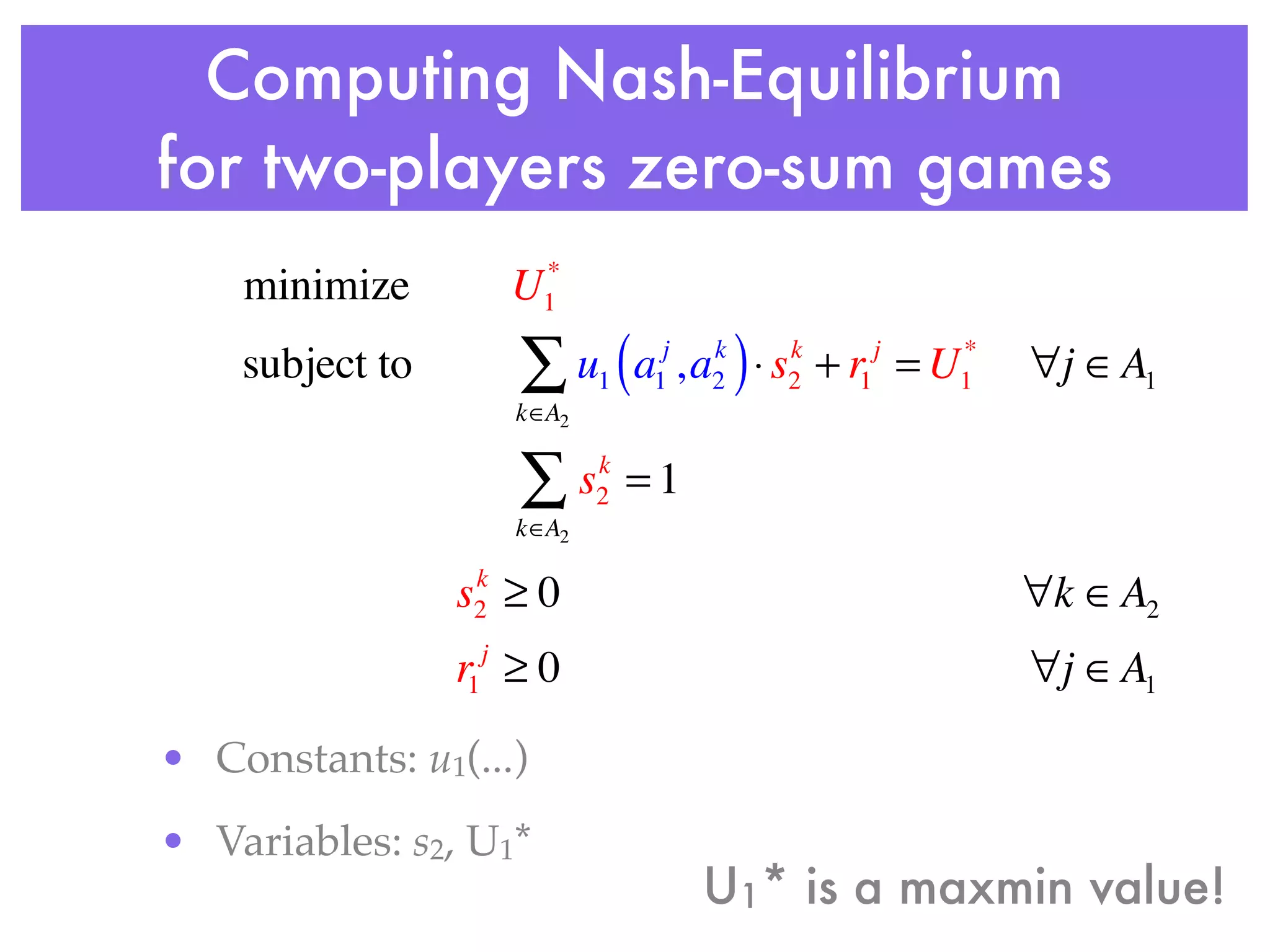
Computing Nash-Equilibrium
for two-players zero-sum games
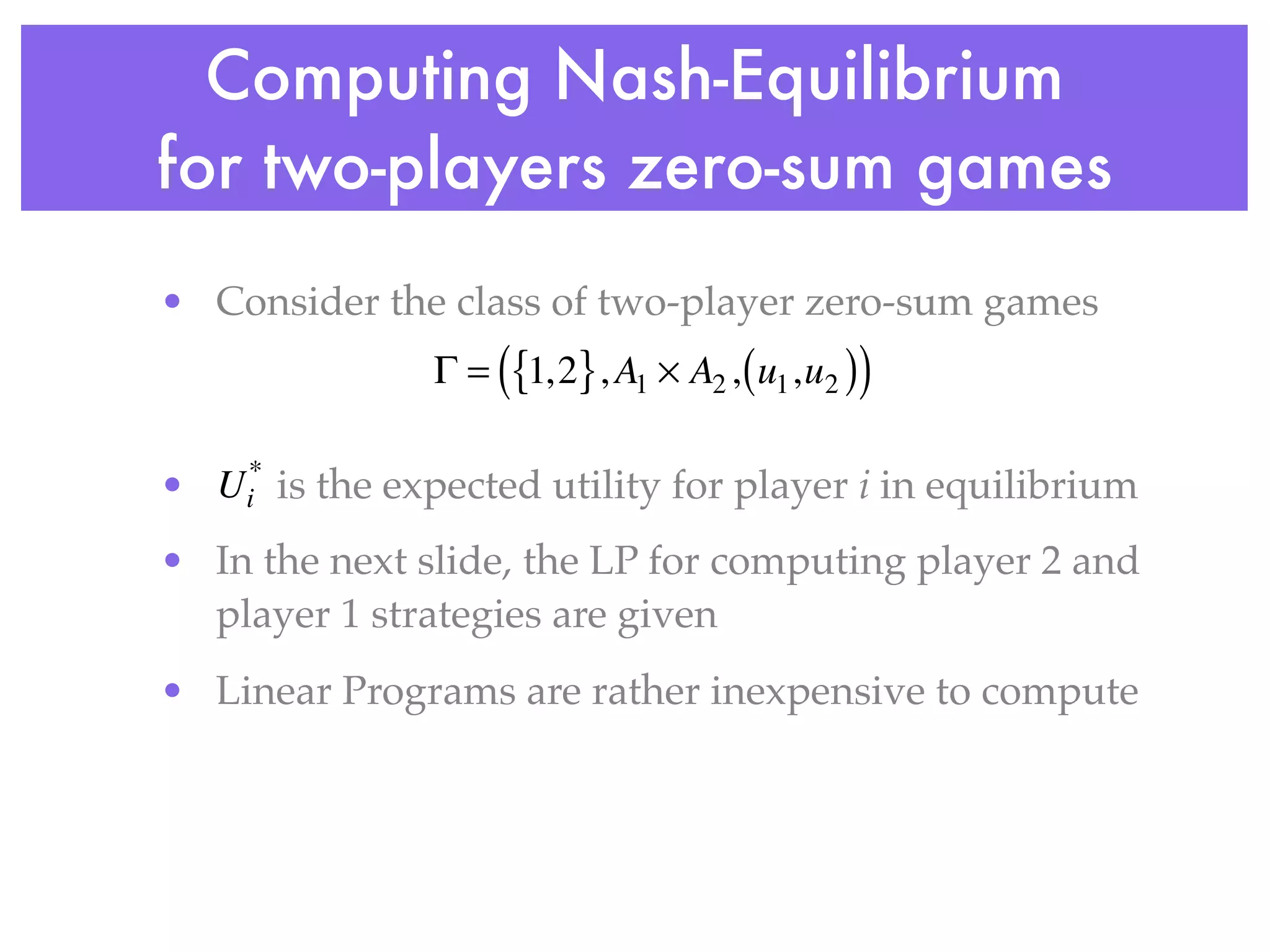
• Consider the class of two-player zero-sum games
                       (
                  Γ = {1, 2} , A1 × A2 , ( u1 ,u2 )   )
     *
•   Ui   is the expected utility for player i in equilibrium
• In the next slide, the LP for computing player 2 and
  player 1 strategies are given
• Linear Programs are rather inexpensive to compute
Computing Nash-Equilibrium
for two-players zero-sum games
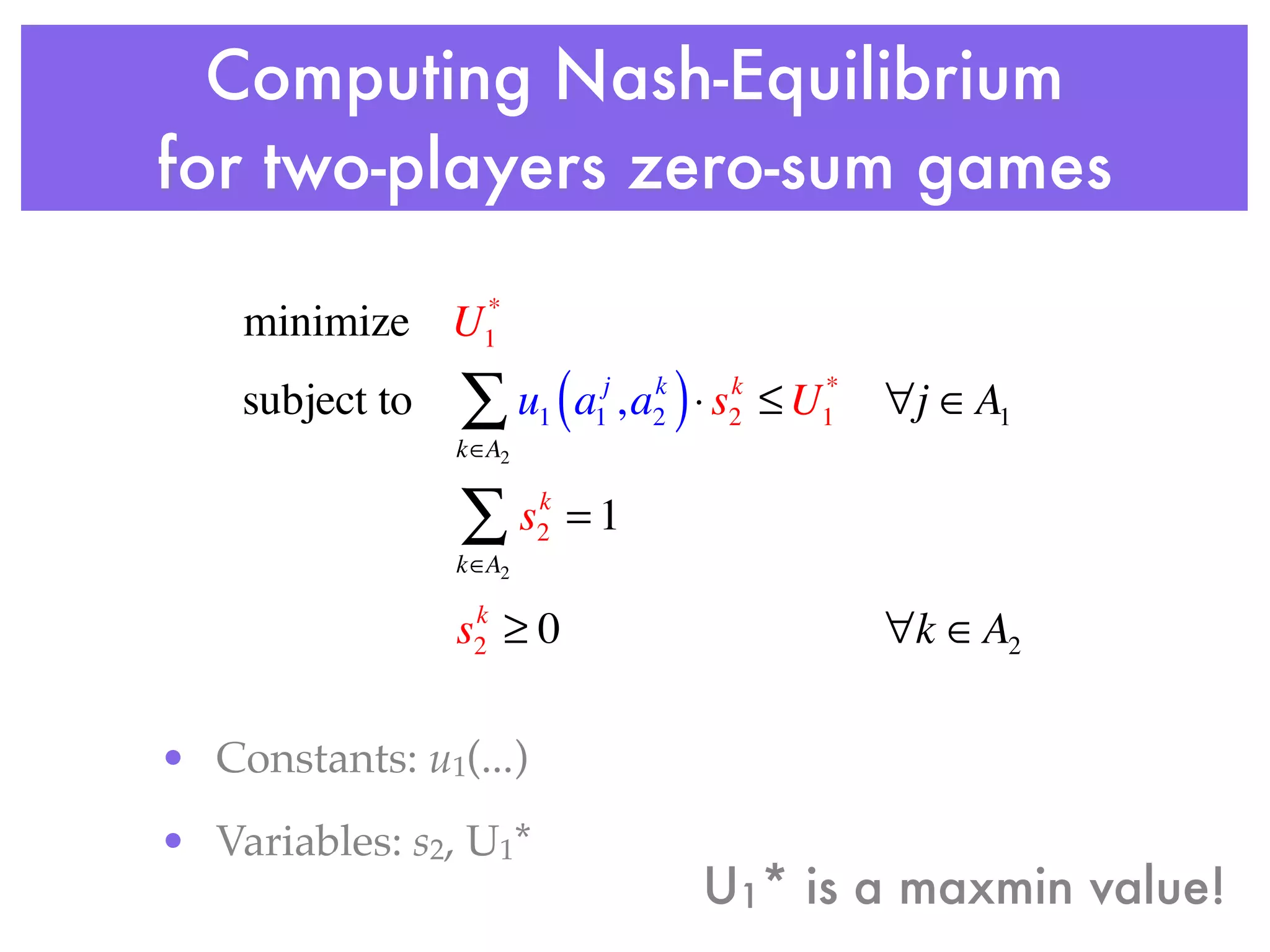
                   *
    minimize U     1

    subject to   ∑ u (a , a ) ⋅ s
                        1    1
                              j   k
                                  2
                                       k
                                       2   ≤U
                                            *
                                            1   ∀j ∈A1
                 k∈A2


                 ∑s     k
                        2   =1
                 k∈A2

                 s ≥0
                  k
                  2                             ∀k ∈A2

• Constants: u1(...)
• Variables: s2, U1*
                                      U1* is a maxmin value!
Computing Nash-Equilibrium
for two-players zero-sum games
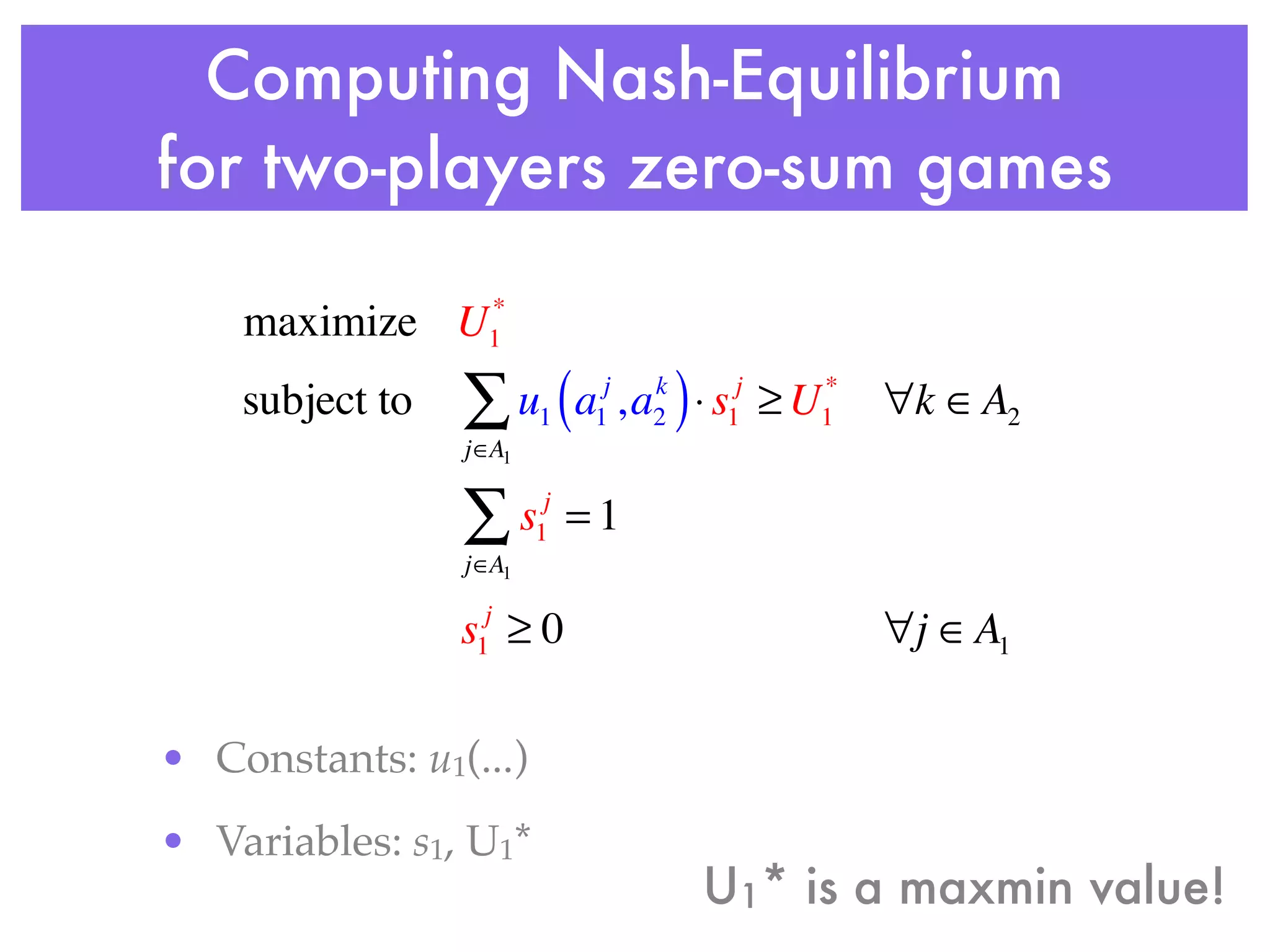
                   *
    maximize U     1

    subject to   ∑ u (a , a ) ⋅ s
                        1     1
                               j   k
                                   2    1
                                         j
                                             ≥U
                                              *
                                              1   ∀k ∈A2
                 j∈A1


                 ∑s     1
                         j
                             =1
                 j∈A1

                 s ≥0
                  1
                   j
                                                  ∀j ∈A1

• Constants: u1(...)
• Variables: s1, U1*
                                       U1* is a maxmin value!
Computing Nash-Equilibrium
for two-players zero-sum games
                        *
    minimize          U 1

    subject to        ∑ u (a , a ) ⋅ s
                             1    1
                                   j   k
                                       2
                                           k
                                           2   + r1 = U
                                                  j   *
                                                      1   ∀j ∈A1
                      k∈A2


                      ∑s     k
                             2   =1
                      k∈A2

                 s ≥0
                  k
                  2                                       ∀k ∈A2
                 r1 ≥ 0
                  j
                                                          ∀j ∈A1

• Constants: u1(...)
• Variables: s2, U1*
                                       U1* is a maxmin value!
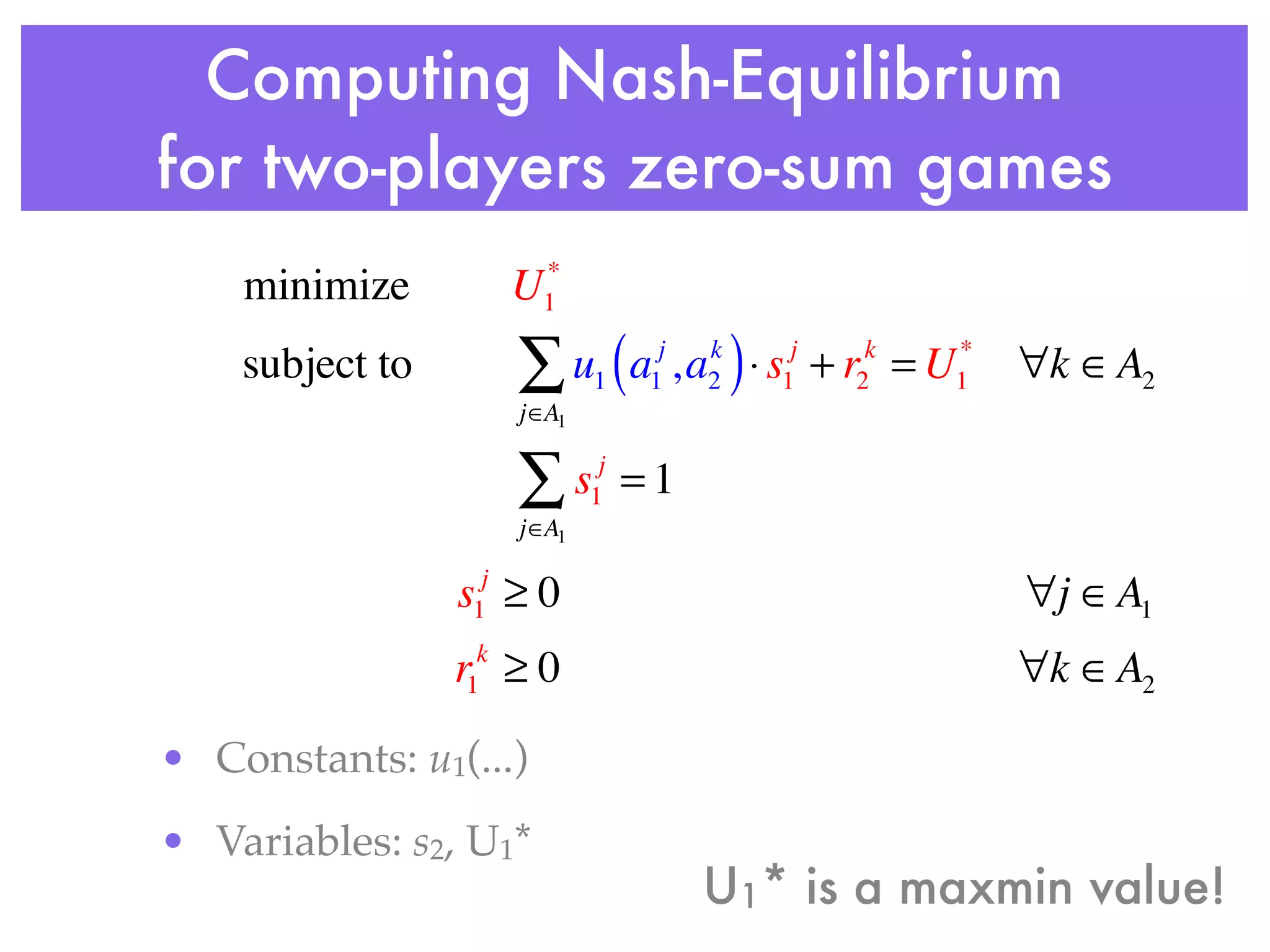
Computing Nash-Equilibrium
for two-players zero-sum games
                        *
    minimize          U 1

    subject to        ∑ u (a , a ) ⋅ s
                             1     1
                                    j   k
                                        2   1
                                             j
                                                 +r =U
                                                  2
                                                   k   *
                                                       1   ∀k ∈A2
                      j∈A1


                      ∑s     1
                              j
                                  =1
                      j∈A1

                 s ≥0
                 1
                  j
                                                           ∀j ∈A1
                 r ≥0
                 1
                  k
                                                           ∀k ∈A2

• Constants: u1(...)
• Variables: s2, U1*
                                        U1* is a maxmin value!
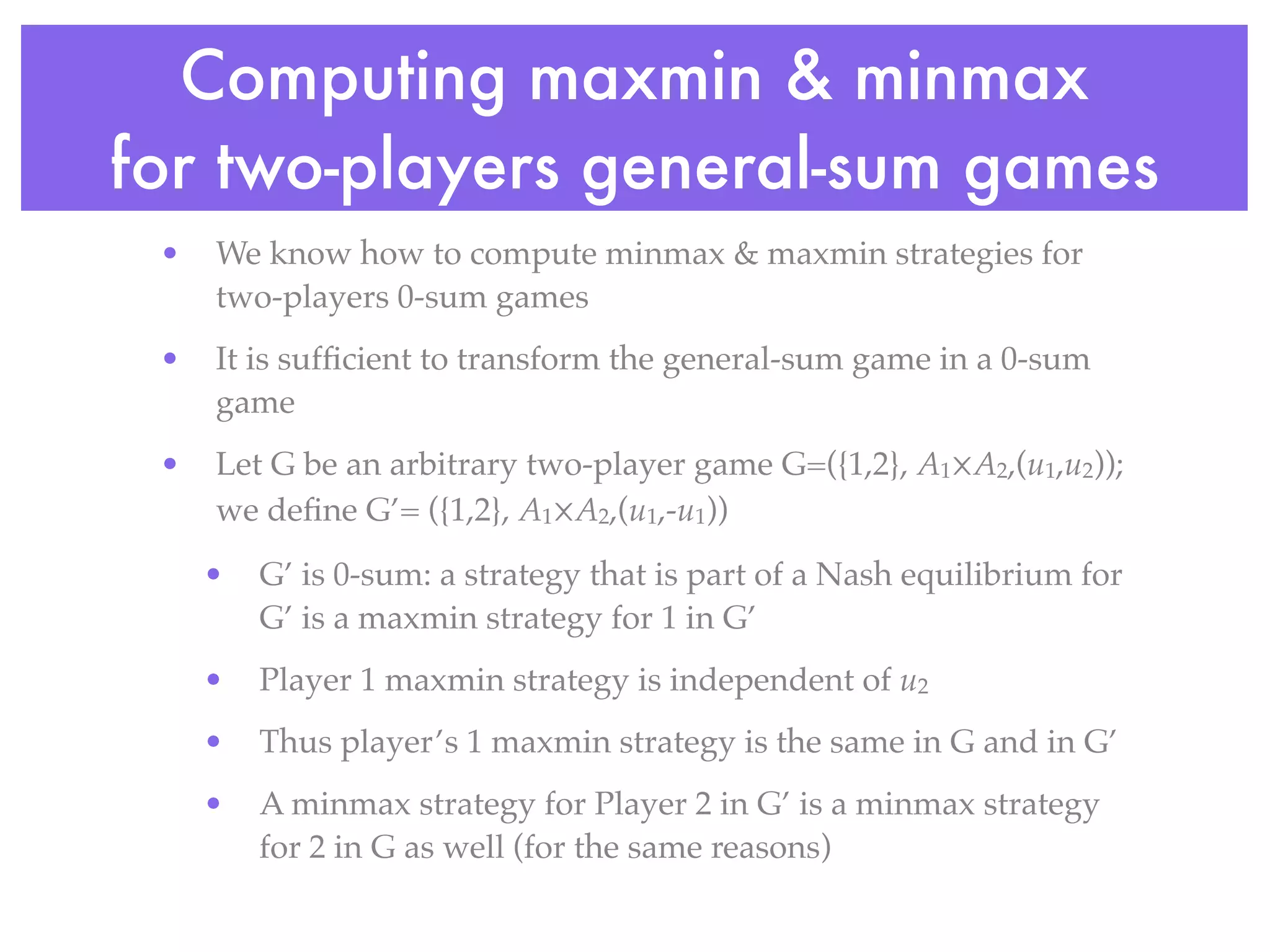
Computing maxmin & minmax
for two-players general-sum games
 •   We know how to compute minmax & maxmin strategies for
     two-players 0-sum games
 •   It is sufficient to transform the general-sum game in a 0-sum
     game
 •   Let G be an arbitrary two-player game G=({1,2}, A1⨉A2,(u1,u2));
     we define G’= ({1,2}, A1⨉A2,(u1,-u1))
     •   G’ is 0-sum: a strategy that is part of a Nash equilibrium for
         G’ is a maxmin strategy for 1 in G’
     •   Player 1 maxmin strategy is independent of u2
     •   Thus player’s 1 maxmin strategy is the same in G and in G’
     •   A minmax strategy for Player 2 in G’ is a minmax strategy
         for 2 in G as well (for the same reasons)
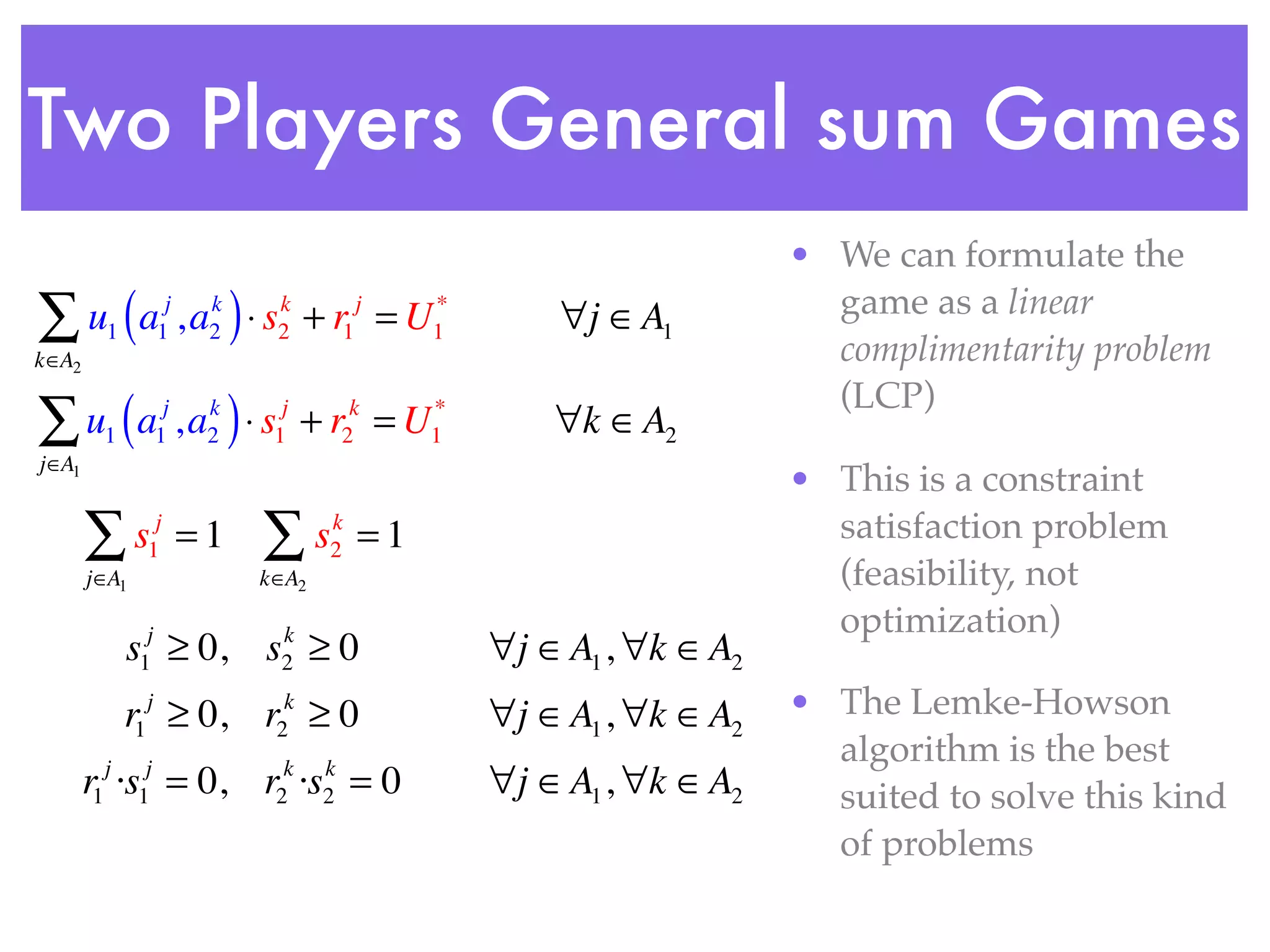
Two Players General sum Games
                                                                    • We can formulate the
∑ u (a , a ) ⋅ s
         1         1
                    j    k
                         2
                              k
                              2    + r1 = U
                                         j    *
                                              1       ∀j ∈A1          game as a linear
                                                                      complimentarity problem
k∈A2


∑ u (a , a ) ⋅ s
                                                                      (LCP)
        1          1
                    j    k
                         2    1
                               j
                                   +r =U2
                                         k    *
                                              1      ∀k ∈A2
j∈A1
                                                                    • This is a constraint
       ∑s      1
                j
                        =1   ∑s     k
                                    2    =1                           satisfaction problem
       j∈A1                  k∈A2                                     (feasibility, not
                                                                      optimization)
             s ≥ 0, s ≥ 0
              1
               j               k
                               2                  ∀j ∈A1 , ∀k ∈A2
             r1 ≥ 0, r ≥ 0
               j               k
                                                  ∀j ∈A1 , ∀k ∈A2   • The Lemke-Howson
                              2
                                                                      algorithm is the best
       r1 ·s = 0, r ·s = 0
        j
              1
               j
                              2
                               k    k
                                    2             ∀j ∈A1 , ∀k ∈A2     suited to solve this kind
                                                                      of problems
Computing n-players Nash
  • Could be formulated as a nonlinear
    complementarity problem (NLCP), thus it
    would not be easily solvable
  • A sequence of linear complementarity
    problems (SLCP) can be used; it is not
    always convergent, but if we’re lucky it’s fast
  • It is possible to formulate as the
    computation of the minimum of a specific
    function, both with or without constraints
Software Tools

McKelvey, Richard D., McLennan,
Andrew M., and Turocy, Theodore L.
(2010). Gambit: Software Tools for Game
Theory, Version 0.2010.09.01.
http://www.gambit-project.org.
Other Games
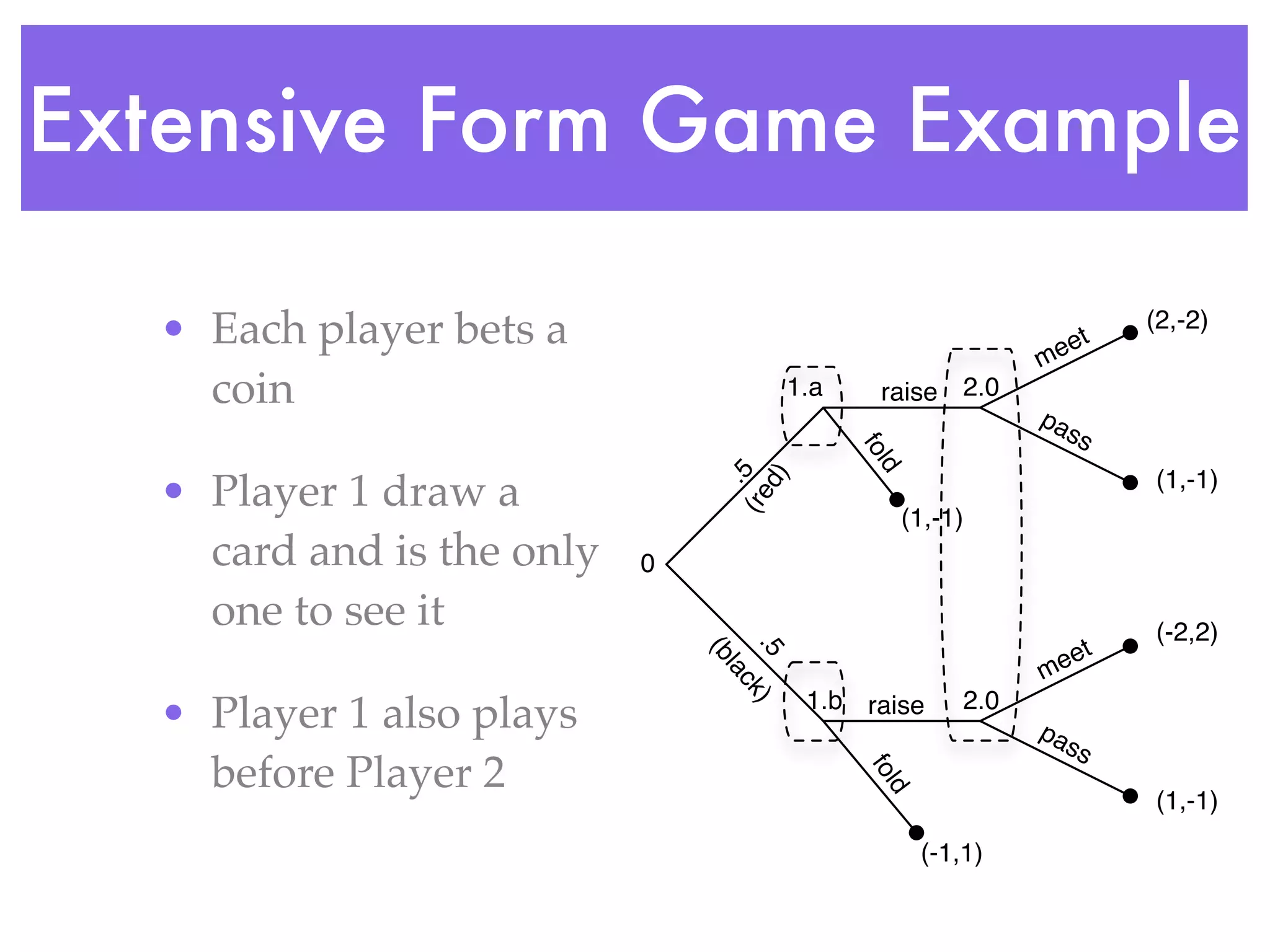
Extensive Form Game Example
             Outline   Introduction            Game Representations              Reductions


             Extended Form of Game-1

  • Each player bets a                                                      et
                                                                                     (2,-2)
                                                                       me
    coin                                       1.a      raise 2.0
                                                                       pa
                                                                            ss


                                                     fo
                                                       ld
                                                                                      (1,-1)
  • Player 1 draw a


                                       (re 5
                                          d)
                                          .
                                                            (1,-1)
    card and is the only       0

    one to see it                                                                     (-2,2)
                                                                            et


                                       .5 )
                                      (b
                                                                       me
                                      la
                                          ck
                                                1.b raise        2.0
  • Player 1 also plays                                                pa
                                                                            ss
    before Player 2
                                                      fo
                                                        ld
                                                                                      (1,-1)
                                                             (-1,1)
Repeated Games
• What happens if the same NF game is
  repeated:
 • An infinite number of times?
 • A finite number of times?
 • A finite but unknown number of
   times?
Bayesian Games
• Represent uncertainty about the game
  being played; there is a set of possible
  games
    • with the same number of agents and
      same strategy spaces but different
      payoffs
    • Agents beliefs are posteriors obtained
      conditioning a common prior on
      individual private signals

Game theory

  • 1.
    Game Theory Enrico Franchi(efranchi@ce.unipr.it)
  • 2.
    Introduction Game theory canbe defined as the study of mathematical models of conflict and cooperation between intelligent rational decision-makers. R. Myerson
  • 3.
    Rationality and Intelligence • A decision-maker is rational if he makes decisions consistently in pursuit of his own objectives • A player is intelligent if he knows everything that we know about the game and he can make inferences about the situation that we can make
  • 4.
    Outcomes • Let Obe a finite set of outcomes • A lottery is a probability distribution over O l = [ p1 : o1 ,…, pk : ok ] oi ∈O pi ∈[0,1] k ∑p i =1 i=1 • We assume agents can rank outcomes and lotteries with a utility function
  • 5.
    TCP Game Prisoner’s Dilemma C D C -1,-1 -4,0 D 0,-4 -3,-3 D: defective implementation C: correct implementation
  • 6.
    Game in NormalForm • A finite n-person normal form game is a tuple (N, A, u) where • N is a finite set of n players • A=A1⨉...⨉An, where Ai is a finite set of actions available to player i • u=(u1,...,un), where ui:A↦R is a real valued utility function • a=(a1,...,an) is an action profile
  • 7.
    TCP Game (again) A2 • N={1,2} C D • A={C,D}⨉{C,D} C -1,-1 -4,0 D 0,-4 -3,-3 A1 A2 u1 u2 A1 C C -1 -1 C D -4 0 D C 0 -4 D D -3 -3
  • 8.
    Actions • Actions canbe “arbitrarily complex” • Ex.: international draughts • an action is not a move • an action maps every possible board configuration to the move to be played if the configuration occurs 2·1022
  • 9.
    Matching Pennies Heads Tails Heads 1,-1 -1,1 Tails -1,1 1,-1
  • 10.
    Rock-Paper-Scissor Rock Paper Scissors Rock 0,0 -1,1 1,-1 Paper 1,-1 0,0 -1,1 Scissors -1,1 1,-1 0,0
  • 11.
    Strategy • A purestrategy is selecting an action and playing it • A mixed strategy for player i is an element of the set Si=!(Ai) of probability distributions over Ai • The support of a mixed strategy is the set of pure strategies {ai|si(ai) > 0} • The set of mixed-strategy profiles is S1⨉...⨉Sn and a mixed strategy profile is a tuple (s1, ..., sn) • The utility of a mixed strategy profile is n ui (s) = ∑ ui (a)∏ s j (a j ) a∈A j=1
  • 12.
    Solution Concept • Gamesare complex, the environment can be stochastic, other player’s choices affect the outcome • Game theorists study certain subsets of outcomes that are interesting in one sense or another which are called solution concepts
  • 13.
    Pareto Efficiency • Thestrategy profile s Pareto dominates the strategy profile s’ if for some players the utility for s is strictly higher and for the others is not worse • A strategy profile is Pareto optimal if there is no other strategy profile dominating it
  • 14.
    Nash Equilibrium • Player’si best response to the strategy profile s-i is a mixed strategy s*i ∈Si such that ui(s*i ,s-i)≥ui(si, s-i) for every si ∈Si • A strategy profile s=(s1,...,sn) is a Nash equilibrium if, for all agents , si is a best response to s-i • Weak Nash (≥), Strong Nash (>)
  • 15.
    Battle of theSexes LW WL • Both pure strategies are Nash Equilibria LW 2,1 0,0 • Are there any other Nash WL 0,0 1,2 Equilibria? • There is at least another mixed-strategy equilibrium (usually very tricky to compute, but can be done with simple examples)
  • 16.
    Battle of theSexes LW WL • Suppose the husband chooses LW with probability p and WL with LW 2,1 0,0 probability p-1 • The wife should be indifferent WL 0,0 1,2 between her available options, otherwise she would be better off choosing a pure strategy Being “indifferent” means • What is the p which allows the obtaining the same utility, not wife to be really indifferent? playing indifferently • Please notice that the pure strategies are Pareto optimal
  • 17.
    Battle of theSexes p: probability that husband plays LW r: probability that wife plays LW U wife (LW) = U wife (WL) U husband (LW) = U husband (WL) 1·p + 0·(1− p) = 0·p + 2·(1− p) 2·r + 0·(1− r) = 0·r + 1·(1− r) 2 1 p = 2− 2p p= 2r = 1− r r= 3 3 U w (s) = 2(1− p)(1− r) + pr ⎛ 2 1 ⎞ 2 2 2 U w ⎜ sw (r), LW + WL ⎟ = (1− r) + r = ⎝ 3 3 ⎠ 3 3 3 U h (s) = (1− p)(1− r) + 2 pr ⎛ 1 2 ⎞ 2 2 2 U h ⎜ sh ( p), LW + WL ⎟ = (1− p) + p = ⎝ 3 3 ⎠ 3 3 3
  • 18.
    Matching Pennies Heads Tails Heads 1,-1 -1,1 • Do we have any pure strategies? Tails -1,1 1,-1 • No • Do we have mixed U1 (H) = U1 (T) strategies? 1·p + (−1)·(1− p) = −1·p + 1·(1− p) • Yes 1 2 p − 1 = 1− 2 p p= 2
  • 19.
    Rock-Paper-Scissor Rock Paper Scissors • Do we have any pure Rock 0,0 -1,1 1,-1 strategies? Paper 1,-1 0,0 -1,1 • No Scissors -1,1 1,-1 0,0 • Do we have mixed strategies? pr + p p + ps = 1 • Yes U1 (R) = U1 (P) = U1 (S)
  • 20.
    Rock-Paper-Scissor pr + pp + ps = 1 R P S U1 (R) = U1 (P) = U1 (S) R 0,0 -1,1 1,-1 P 1,-1 0,0 -1,1 ⎧0 pr + (−1) p p + 1ps = 1pr + 0 p p + (−1) ps S -1,1 1,-1 0,0 ⎨ ⎩1pr + 0 p p + (−1) ps = (−1) pr + 1p p + 0 ps ⎧ 1 ps + p p ⎪ ps = ⎧2 ps = pr + p p 2 ps = + pp 3 ⎨ 2 ⎪ 2 pr = ps + p p ⎪ 1 ⎩ 4 ps = ps + 3p p ⎨ pr = ⎪ 3 ps = p p = pr ⎪p = 1 ⎪ p 3 ⎩
  • 21.
    Existence of NashEquilibria • We have seen that not every game has a pure strategy Nash equilibrium • Does every game have a Nash equilibrium (random or pure)? Theorem (Nash, 1951) Every game with a finite number of players and action profiles has at least one Nash equilibrium
  • 22.
    Computing Nash Equilibria • There are algorithms which compute Nash equilibria, but they are exponential in the size of the game • It is not known if there are polynomial algorithms (but the consensus is that there are none)
  • 23.
    Dominated Strategies Definitions • Let si and si’ be two strategies of player i and S-i the set of all strategy profiles of the remaining players • si strictly dominates si’ if for all s-i ∈S-i, it is the case that ui(si,s-i)>ui(si’,s-i) • si weakly dominates si’ if for all s-i ∈S-i, it is the case that ui(si,s-i)≥ui(si’,s-i) and for at least one s-i ∈S-i it is the case that ui(si,s-i)>ui(si’,s-i) • si very weakly dominates si’ if for all s-i ∈S-i, it is the case that ui(si,s-i)≥ui(si’,s-i)
  • 24.
    Dominated Strategies Example L C R L C U 3,1 0,1 0,0 U 3,1 0,1 M 1,1 1,1 5,0 M 1,1 1,1 D 0,1 4,1 0,0 D 0,1 4,1 L C U 3,1 0,1 D 0,1 4,1
  • 25.
    Dominated Strategies Prisoner’s Dilemma C D C D C -1,-1 -4,0 D 0,-4 -3,-3 D 0,-4 -3,-3 D D -3,-3
  • 26.
    Dominated Strategies as solution concepts • The set of all strategy profiles that assign 0 probability to playing any action that would be removed through iterated removal of strictly dominated strategies is a solution concept • Sometimes, no action can be “removed”, sometimes we can solve the game (we say the game is solvable by iterated elimination)
  • 27.
    Dominated Strategies Costs • Iterated elimination ends after a finite number of steps • Iterated elimination preserves Nash equilibria • We can use it to reduce the size of the game • Iterated elimination of strictly dominated strategies can occur in any order without changing the results • Checking if a (possibly mixed) strategy is dominated can be done in polynomial time • Domination by pure strategies can be checked with a very simple iterative algorithm • Domination by mixed strategies can be checked solving a linear problem • Iterative elimination needs only to check pure strategies
  • 28.
    Dominated Strategies (domination by pure-strategies) forall  pure  strategies  ai∈Ai  for  player   i  where  ai≠si  do dom  ←  true forall  pure-­‐strategy  profiles  a-­‐i∈A-­‐i  do if  ui(si,a-­‐i)≥ui(ai,a-­‐i)  then dom  ←  false break if  dom  =  true  then return  true    return  false    
  • 29.
    Other Solution Concepts: Maxmin & Minmax • The maxmin strategy for player i in an n player, general sum game is a not necessarily unique (mixed) strategy that maximizes i’s worst case payoff • The maxmin value (or security level) is the minimum payoff level guaranteed by a maxmin strategy arg max si min s− i ui (si , s−i ) • In two player general sum games the minmax strategy for player i against player –i is the strategy that keeps the maximum payoff for –i at minimum • It is a punishment arg min si max s− i ui (si , s−i )
  • 30.
    Other Solution Concepts: Minmax, n-player • In an n-player game, the minmax strategy for player i against player j ≠ i is i’s component of the mixed-strategy profile s-j in the expression: arg min s− j max s j u j (s j , s− j ) where –j denotes the set of players other that j. • Player i receives his minmax value if players –i choose their strategies to minimize i utility “after” he chose strategy si • A player maxmin value is always less than or equal to his minmax value
  • 31.
    Maxmin & MinmaxExamples • Matching Pennies • Maxmin: 0.5 T + 0.5 H • Minmax: 0.5 T + 0.5 H • Battle of Sexes • Maxmin: H→0.66 LW + 0.33 WL W→0.33 LW + 0.66 WL • Minmax: H→0.66 LW + 0.33 WL W→0.33 LW + 0.66 WL
  • 32.
    Minmax Theorem Theorem (vonNeumann, 1928) In any finite, two-player, zero-sum game, in any Nash equilibrium each player receives a payoff that is equal to both his maxmin value and his minmax value • Each player’s maxmin equals his minmax (value of the game) • Maxmin strategies coincide with minmax strategies • Any maxmin strategy profile is a Nash equilibrium and any Nash equilibrium is a maxmin strategy profile
  • 33.
    Matching Pennies Matching Pennies for P1 1 P1 Expected Utility 0.5 0.9 0.6 0 0.3 0 0.1 0.2 0 0.3 0.4 0.5 -0.5 0.6 0.7 0.8 0.9 1 P2 P(heads) -1 P1 P(heads)
  • 34.
    Minimax Regret • Anagent i’s regret for playing an action ai if other agents adopt action profile a-i is defined as: ⎡ ⎤ ⎢ ai′ ∈Ai ui ( ai′ , a−i ) ⎥ − ui ( ai , a−i ) ⎣ max ⎦ • An agent i’s maximum regret for playing an action ai is defined as: ⎛⎡ ⎤ ⎞ max ⎜ ⎢ max ui ( ai′ , a−i ) ⎥ − ui ( ai , a−i )⎟ a− i ∈A− i ⎝ ⎣ ai ′ ∈Ai ⎦ ⎠ • Minimax regret actions for agent i are defined as: ⎡ ⎛⎡ ⎤ ⎞⎤ arg min ⎢ max ⎜ ⎢ max ui ( ai′ , a−i ) ⎥ − ui ( ai , a−i )⎟ ⎥ ai ∈Ai ⎣ a− i ∈A− i ⎝ ⎣ ai ′ ∈Ai ⎦ ⎠⎦
  • 35.
    Maxmin vs. MinmaxRegret L R regret(T ,[R])= 1− 1+  =  regret(B,[R]) = 1− 1 = 0 regret(T ,[L]) = 100 − 100 = 0 T 100, a 1-!, b regret(B,[L]) = 100 − 2 = 98 max regret(T )= max{,0} =  B 2, c 1, d max regret(B) = max{98,0} = 98 P1 Maxmin is B (why?), his Minimax Regret strategy is T
  • 36.
  • 37.
    Computing Nash-Equilibrium for two-playerszero-sum games • Consider the class of two-player zero-sum games ( Γ = {1, 2} , A1 × A2 , ( u1 ,u2 ) ) * • Ui is the expected utility for player i in equilibrium • In the next slide, the LP for computing player 2 and player 1 strategies are given • Linear Programs are rather inexpensive to compute
  • 38.
    Computing Nash-Equilibrium for two-playerszero-sum games * minimize U 1 subject to ∑ u (a , a ) ⋅ s 1 1 j k 2 k 2 ≤U * 1 ∀j ∈A1 k∈A2 ∑s k 2 =1 k∈A2 s ≥0 k 2 ∀k ∈A2 • Constants: u1(...) • Variables: s2, U1* U1* is a maxmin value!
  • 39.
    Computing Nash-Equilibrium for two-playerszero-sum games * maximize U 1 subject to ∑ u (a , a ) ⋅ s 1 1 j k 2 1 j ≥U * 1 ∀k ∈A2 j∈A1 ∑s 1 j =1 j∈A1 s ≥0 1 j ∀j ∈A1 • Constants: u1(...) • Variables: s1, U1* U1* is a maxmin value!
  • 40.
    Computing Nash-Equilibrium for two-playerszero-sum games * minimize U 1 subject to ∑ u (a , a ) ⋅ s 1 1 j k 2 k 2 + r1 = U j * 1 ∀j ∈A1 k∈A2 ∑s k 2 =1 k∈A2 s ≥0 k 2 ∀k ∈A2 r1 ≥ 0 j ∀j ∈A1 • Constants: u1(...) • Variables: s2, U1* U1* is a maxmin value!
  • 41.
    Computing Nash-Equilibrium for two-playerszero-sum games * minimize U 1 subject to ∑ u (a , a ) ⋅ s 1 1 j k 2 1 j +r =U 2 k * 1 ∀k ∈A2 j∈A1 ∑s 1 j =1 j∈A1 s ≥0 1 j ∀j ∈A1 r ≥0 1 k ∀k ∈A2 • Constants: u1(...) • Variables: s2, U1* U1* is a maxmin value!
  • 42.
    Computing maxmin &minmax for two-players general-sum games • We know how to compute minmax & maxmin strategies for two-players 0-sum games • It is sufficient to transform the general-sum game in a 0-sum game • Let G be an arbitrary two-player game G=({1,2}, A1⨉A2,(u1,u2)); we define G’= ({1,2}, A1⨉A2,(u1,-u1)) • G’ is 0-sum: a strategy that is part of a Nash equilibrium for G’ is a maxmin strategy for 1 in G’ • Player 1 maxmin strategy is independent of u2 • Thus player’s 1 maxmin strategy is the same in G and in G’ • A minmax strategy for Player 2 in G’ is a minmax strategy for 2 in G as well (for the same reasons)
  • 43.
    Two Players Generalsum Games • We can formulate the ∑ u (a , a ) ⋅ s 1 1 j k 2 k 2 + r1 = U j * 1 ∀j ∈A1 game as a linear complimentarity problem k∈A2 ∑ u (a , a ) ⋅ s (LCP) 1 1 j k 2 1 j +r =U2 k * 1 ∀k ∈A2 j∈A1 • This is a constraint ∑s 1 j =1 ∑s k 2 =1 satisfaction problem j∈A1 k∈A2 (feasibility, not optimization) s ≥ 0, s ≥ 0 1 j k 2 ∀j ∈A1 , ∀k ∈A2 r1 ≥ 0, r ≥ 0 j k ∀j ∈A1 , ∀k ∈A2 • The Lemke-Howson 2 algorithm is the best r1 ·s = 0, r ·s = 0 j 1 j 2 k k 2 ∀j ∈A1 , ∀k ∈A2 suited to solve this kind of problems
  • 44.
    Computing n-players Nash • Could be formulated as a nonlinear complementarity problem (NLCP), thus it would not be easily solvable • A sequence of linear complementarity problems (SLCP) can be used; it is not always convergent, but if we’re lucky it’s fast • It is possible to formulate as the computation of the minimum of a specific function, both with or without constraints
  • 45.
    Software Tools McKelvey, RichardD., McLennan, Andrew M., and Turocy, Theodore L. (2010). Gambit: Software Tools for Game Theory, Version 0.2010.09.01. http://www.gambit-project.org.
  • 46.
  • 47.
    Extensive Form GameExample Outline Introduction Game Representations Reductions Extended Form of Game-1 • Each player bets a et (2,-2) me coin 1.a raise 2.0 pa ss fo ld (1,-1) • Player 1 draw a (re 5 d) . (1,-1) card and is the only 0 one to see it (-2,2) et .5 ) (b me la ck 1.b raise 2.0 • Player 1 also plays pa ss before Player 2 fo ld (1,-1) (-1,1)
  • 48.
    Repeated Games • Whathappens if the same NF game is repeated: • An infinite number of times? • A finite number of times? • A finite but unknown number of times?
  • 49.
    Bayesian Games • Representuncertainty about the game being played; there is a set of possible games • with the same number of agents and same strategy spaces but different payoffs • Agents beliefs are posteriors obtained conditioning a common prior on individual private signals