For any help regarding Stochastic Processes Homework Help
visit :- https://www.excelhomeworkhelp.com/
 Email :- info@excelhomeworkhelp.com
or call us at :- +1 678 648 4277
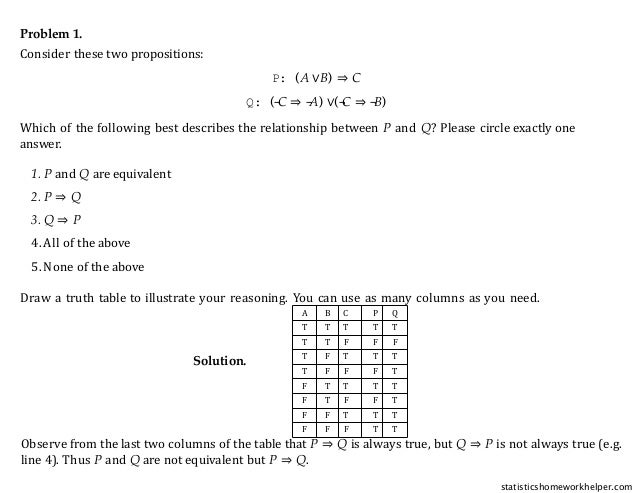
A B C P Q
T T T T T
T T F F F
T F T T T
T F F F T
F T T T T
F T F F T
F F T T T
F F F T T
Observe from the last two columns of the table that P ⇒ Q is always true, but Q ⇒ P is not always true (e.g.
line 4). Thus P and Q are not equivalent but P ⇒ Q.
Problem 1.
Consider these two propositions:
P: (A ∨B) ⇒ C
Q: (¬
C ⇒ ¬
A) ∨(¬
C ⇒ ¬
B)
Which of the following best describes the relationship between P and Q? Please circle exactly one
answer.
1. P and Q are equivalent
2. P ⇒ Q
3. Q ⇒ P
4.All of the above
5.None of the above
Draw a truth table to illustrate your reasoning. You can use as many columns as you need.
Solution.
statisticshomeworkhelper.com
Problem 2.
Let G0 = 1, G1 = 3, G2 = 9, and define
Gn = Gn−1 + 3Gn−2 + 3Gn−3
for n ≥ 3. Show by induction that Gn ≤ 3n for all n ≥ 0.
Solution. The proof is by strong induction with hypothesis P(n) := Gn ≤ 3n.
Proof. Base Cases
n = 0: G0 = 1 = 30.
n = 1: G1 = 3 ≤ 31.
n = 2: G2 = 9 ≤ 32.
Inductive Step: Assume n ≥ 3 and P(k) for all k such that 0 ≤ k ≤ n.
Gn = Gn−1 + 3Gn−2 + 3Gn−3 by (1) by
induction hypothesis
≤ 3n−1 + (3)3n−2 + (3)3n−3
= 3n−2[3 + 3 +
1]
= (7)3n−2
< (9)3n−2
= 3n
statisticshomeworkhelper.com
Problem 3.
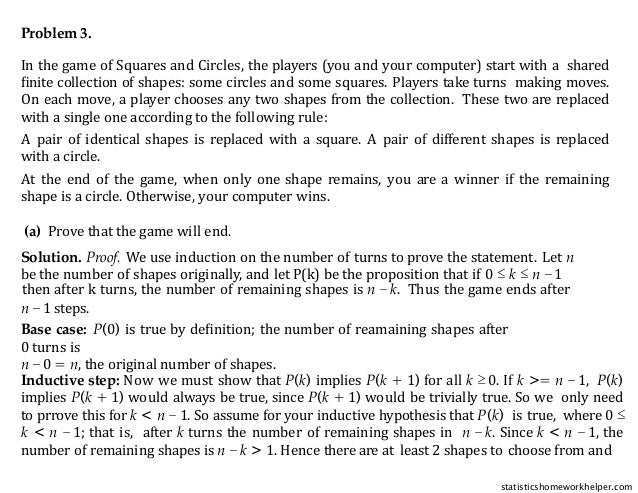
In the game of Squares and Circles, the players (you and your computer) start with a shared
finite collection of shapes: some circles and some squares. Players take turns making moves.
On each move, a player chooses any two shapes from the collection. These two are replaced
with a single one according to the following rule:
A pair of identical shapes is replaced with a square. A pair of different shapes is replaced
with a circle.
At the end of the game, when only one shape remains, you are a winner if the remaining
shape is a circle. Otherwise, your computer wins.
(a) Prove that the game will end.
Solution. Proof. We use induction on the number of turns to prove the statement. Let n
be the number of shapes originally, and let P(k) be the proposition that if 0 ≤ k ≤ n −1
then after k turns, the number of remaining shapes is n − k. Thus the game ends after
n −1 steps.
Base case: P(0) is true by definition; the number of reamaining shapes after
0 turns is
n −0 = n, the original number of shapes.
Inductive step: Now we must show that P(k) implies P(k + 1) for all k ≥ 0. If k >= n −1, P(k)
implies P(k + 1) would always be true, since P(k + 1) would be trivially true. So we only need
to prrove this for k < n − 1. So assume for your inductive hypothesis that P(k) is true, where 0 ≤
k < n − 1; that is, after k turns the number of remaining shapes in n − k. Since k < n − 1, the
number of remaining shapes is n − k > 1. Hence there are at least 2 shapes to choose from and
statisticshomeworkhelper.com
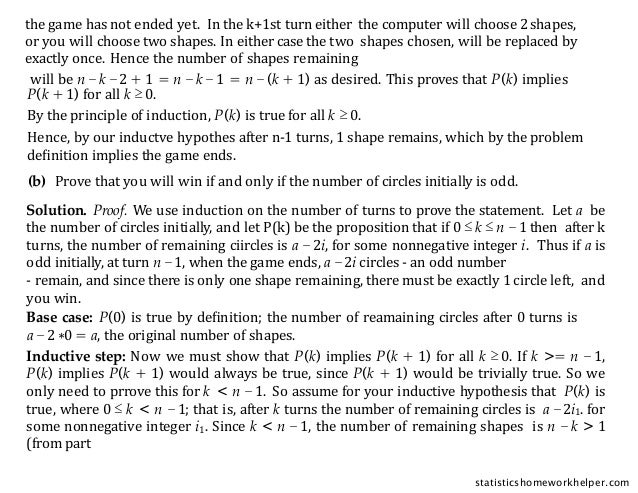
P(k + 1) for all k ≥ 0.
By the principle of induction, P(k) is true for all k ≥ 0.
Hence, by our inductve hypothes after n-1 turns, 1 shape remains, which by the problem
definition implies the game ends.
will be n −k −2 + 1 = n −k −1 = n −(k + 1) as desired. This proves that P(k) implies
(b) Prove that you will win if and only if the number of circles initially is odd.
Solution. Proof. We use induction on the number of turns to prove the statement. Let a be
the number of circles initially, and let P(k) be the proposition that if 0 ≤ k ≤ n − 1 then after k
turns, the number of remaining ciircles is a − 2i, for some nonnegative integer i. Thus if a is
odd initially, at turn n −1, when the game ends, a −2i circles - an odd number
- remain, and since there is only one shape remaining, there must be exactly 1 circle left, and
you win.
Base case: P(0) is true by definition; the number of reamaining circles after 0 turns is
a −2 ∗0 = a, the original number of shapes.
Inductive step: Now we must show that P(k) implies P(k + 1) for all k ≥ 0. If k >= n − 1,
P(k) implies P(k + 1) would always be true, since P(k + 1) would be trivially true. So we
only need to prrove this for k < n − 1. So assume for your inductive hypothesis that P(k) is
true, where 0 ≤ k < n − 1; that is, after k turns the number of remaining circles is a −2i1. for
some nonnegative integer i1. Since k < n −1, the number of remaining shapes is n − k > 1
(from part
the game has not ended yet. In the k+1st turn either the computer will choose 2shapes,
or you will choose two shapes. In either case the two shapes chosen, will be replaced by
exactly once. Hence the number of shapes remaining
statisticshomeworkhelper.com
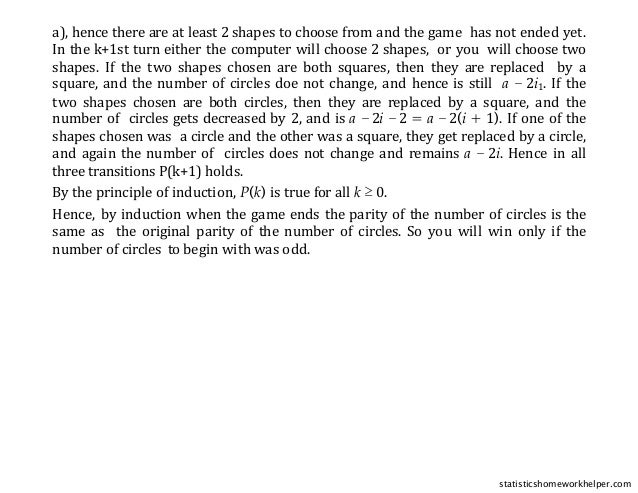
a), hence there are at least 2 shapes to choose from and the game has not ended yet.
In the k+1st turn either the computer will choose 2 shapes, or you will choose two
shapes. If the two shapes chosen are both squares, then they are replaced by a
square, and the number of circles doe not change, and hence is still a − 2i1. If the
two shapes chosen are both circles, then they are replaced by a square, and the
number of circles gets decreased by 2, and is a − 2i − 2 = a − 2(i + 1). If one of the
shapes chosen was a circle and the other was a square, they get replaced by a circle,
and again the number of circles does not change and remains a − 2i. Hence in all
three transitions P(k+1) holds.
By the principle of induction, P(k) is true for all k ≥ 0.
Hence, by induction when the game ends the parity of the number of circles is the
same as the original parity of the number of circles. So you will win only if the
number of circles to begin with was odd.
statisticshomeworkhelper.com
Problem 4.
(a) Find a number x ∈{0, 1, . . . , 112} such that 11x ≡ 1 (mod 113).
Solution. We can do this using the pulverizer. Specifically, if we find a pair (s, t) such that
11s + 113t = 1, then we know that 11s ≡ 1 (mod 113).
x
113
y
11
rem (x, y) = x −q ·
y
3 = 113 −10 ·11
1
1
3 2 = 11 −3 ·3
= 11 −3 ·(113 −10 ·
11)
= −3 ·113 + 31 ·11
3 2 1 = 3 −2
= (113 −10 ·11) −(−3 ·113 + 31 ·18)
= (4 ·113 −41 ·11)
From the above work we see that 1 = 4 ·113 − 41 ·11, and so −41 ·11 ≡ 1 (mod 113).
Therefore -41 is an inverse of 113. However, it is not the unique inverse of 113 in the range
{1, . . . , 113}, which is given by rem (−41, 113) = 72. So the multiplicative inverse of 11
modulo 113 is 72. □
(b) [7 pts] Find a number y ∈{0, 1, . . . , 112} such that 11112111 ≡ y (mod 113) (Hint: Note
that 113 is a prime.)
Solution. By Fermat’s Theorem, since 113 is prime and 113 and 11 are relatively prime, it
must be that
11 ·11111 ≡ 11113−1 ≡ 1 (mod 113),
so x ≡ 111 (mod 113) (where x is defined as in part a). As a result,
1000
11112111 ≡11112·
1000+111 ≡11112 ·11111 ≡11000 ·x ≡x ≡72
so the answer is 72.
(mod
113),
statisticshomeworkhelper.com
Problem 5.
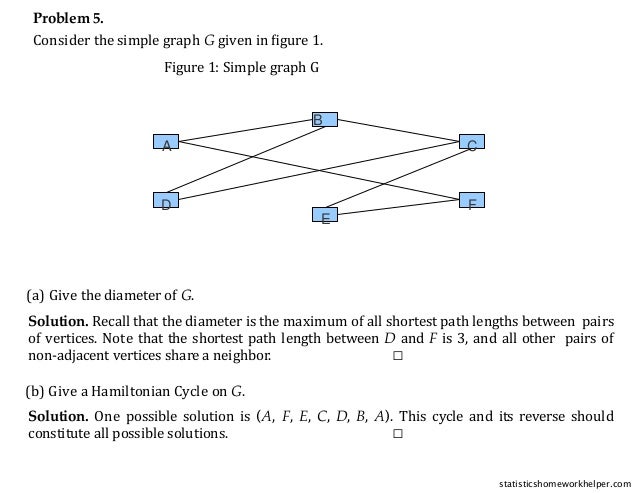
Consider the simple graph G given in figure 1.
A
Figure 1: Simple graph G
B
C
D
E
F
(a) Give the diameter of G.
Solution. Recall that the diameter is the maximum of all shortest path lengths between pairs
of vertices. Note that the shortest path length between D and F is 3, and all other pairs of
non-adjacent vertices share a neighbor. □
(b) Give a Hamiltonian Cycle on G.
Solution. One possible solution is (A, F, E, C, D, B, A). This cycle and its reverse should
constitute all possible solutions. □
statisticshomeworkhelper.com
(e) [4 pts] Give a list of edges reflecting the order in which one of the greedy algorithms
presented in class (i.e. in lecture, recitation, or the course text) would choose edges when
finding an MST on H.
Solution. Kruskal’s alg (building up an acyclic subgraph) gives two possible orders:
((C, D), (B, C), (A, B), (E, F), (C, E)) and ((C, D), (B, C), (E, F), (A, B), (C, E)). Prim’s al
gorithm (building up a connected, acyclic subgraph) gives one possible order:
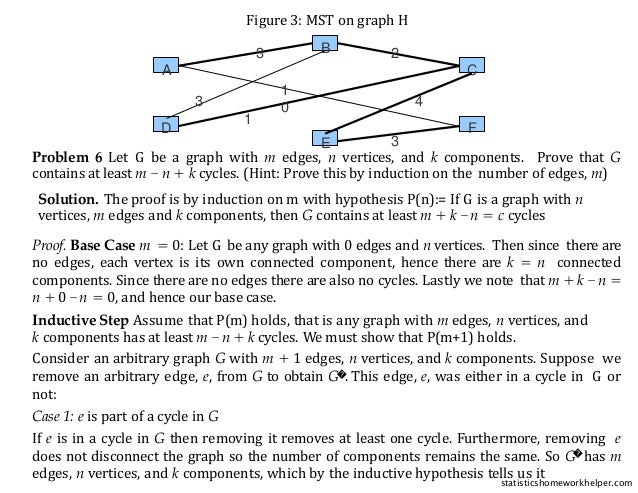
((C, D), (B, C), (A, B), (C, E), (E, F)). Figure 3 below gives the MST generated in any case.
Figure 2: Weighted graph H
A
B
C
D
E
F
1
0
3 2
3
1
4
3
(c) Give a coloring on G and show that it uses the smallest possible number of colors.
Solution. One possible 3-coloring is: {A, D, E} red; {B, F} green; C blue. Because there
exists an odd-length cycle (e.g. (B, D, C)), no 2-coloring exists. Therefore the given coloring
uses the least possible number of colors. □
(d) Does G have an Eulerian cycle? Justify your answer.
Solution. No. This follows from the fact that there exist vertices with odd degree; e.g.
B.
Now consider graph H, which is like G but with weighted edges, in figure 2:
□
statisticshomeworkhelper.com
Figure 3: MST on graph H
A
B
C
D
E
F
1
0
3 2
3
1
4
3
Problem 6 Let G be a graph with m edges, n vertices, and k components. Prove that G
contains at least m − n + k cycles. (Hint: Prove this by induction on the number of edges, m)
Solution. The proof is by induction on m with hypothesis P(n):= If G is a graph with n
vertices, m edges and k components, then G contains at least m + k −n = c cycles
Proof. Base Case m = 0: Let G be any graph with 0 edges and n vertices. Then since there are
no edges, each vertex is its own connected component, hence there are k = n connected
components. Since there are no edges there are also no cycles. Lastly we note that m + k −n =
n + 0 −n = 0, and hence our base case.
Inductive Step Assume that P(m) holds, that is any graph with m edges, n vertices, and
k components has at least m −n + k cycles. We must show that P(m+1) holds.
Consider an arbitrary graph G with m + 1 edges, n vertices, and k components. Suppose we
remove an arbitrary edge, e, from G to obtain G�. This edge, e, was either in a cycle in G or
not:
Case 1: e is part of a cycle in G
If e is in a cycle in G then removing it removes at least one cycle. Furthermore, removing e
does not disconnect the graph so the number of components remains the same. So G� has m
edges, n vertices, and k components, which by the inductive hypothesis tells us it
statisticshomeworkhelper.com
10
vertices, and k + 1 components, so by the inductive hypothesis it contains at least m + (k +
1) − n cycles. Now since e was not part of a cycle, G and G�have the same number of cycles.
So G also has at leastm + (k + 1) − n cycles. Rearranging we get that G has at least (m + 1) +
k −n cycles as desired.
□
cycle). So G has at least m + k −n + 1, or (m + 1) + k −n cycles, as desired.
Case 2: e is not part of a cycle in G If e is not part of a cycle removing it disconnects the graph
of G, so the number of components in G�is k + 1. So, G�contains m edges, n
has at least m + k −n cycles. But G has at least one more cycle than G�(since e is part of a
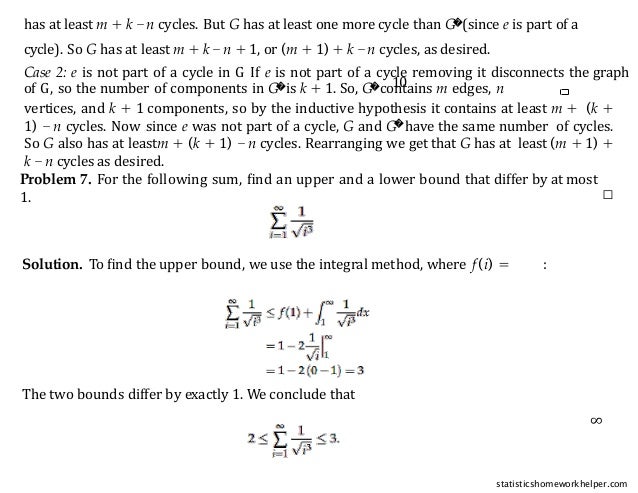
Problem 7. For the following sum, find an upper and a lower bound that differ by at most
1.
Solution. To find the upper bound, we use the integral method, where f (i) = :
The two bounds differ by exactly 1. We conclude that
∞
statisticshomeworkhelper.com
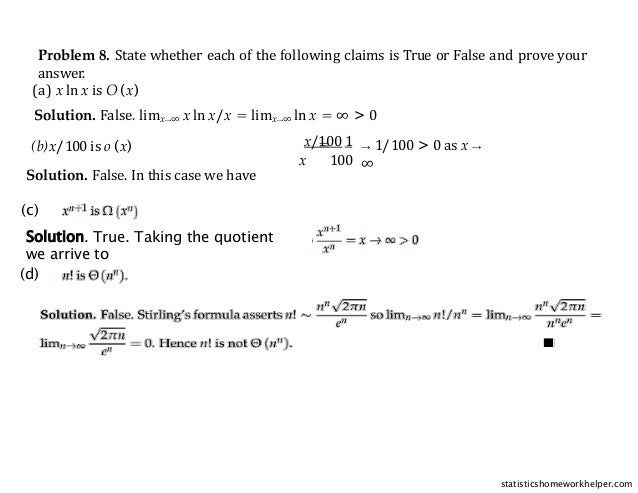
Problem 8. State whether each of the following claims is True or False and prove your
answer.
(a) x ln x is O (x)
Solution. False. limx→∞ x ln x/x = limx→∞ ln x = ∞ > 0
(b)x/100 is o (x)
Solution. False. In this case we have
=
x/100 1
x 100
→ 1/100 > 0 as x →
∞
(c)
Solution. True. Taking the quotient
we arrive to
(d)
statisticshomeworkhelper.com

Stochastic Processes Homework Help

  • 1.
    For any helpregarding Stochastic Processes Homework Help visit :- https://www.excelhomeworkhelp.com/  Email :- info@excelhomeworkhelp.com or call us at :- +1 678 648 4277
  • 2.
    A B CP Q T T T T T T T F F F T F T T T T F F F T F T T T T F T F F T F F T T T F F F T T Observe from the last two columns of the table that P ⇒ Q is always true, but Q ⇒ P is not always true (e.g. line 4). Thus P and Q are not equivalent but P ⇒ Q. Problem 1. Consider these two propositions: P: (A ∨B) ⇒ C Q: (¬ C ⇒ ¬ A) ∨(¬ C ⇒ ¬ B) Which of the following best describes the relationship between P and Q? Please circle exactly one answer. 1. P and Q are equivalent 2. P ⇒ Q 3. Q ⇒ P 4.All of the above 5.None of the above Draw a truth table to illustrate your reasoning. You can use as many columns as you need. Solution. statisticshomeworkhelper.com
  • 3.
    Problem 2. Let G0= 1, G1 = 3, G2 = 9, and define Gn = Gn−1 + 3Gn−2 + 3Gn−3 for n ≥ 3. Show by induction that Gn ≤ 3n for all n ≥ 0. Solution. The proof is by strong induction with hypothesis P(n) := Gn ≤ 3n. Proof. Base Cases n = 0: G0 = 1 = 30. n = 1: G1 = 3 ≤ 31. n = 2: G2 = 9 ≤ 32. Inductive Step: Assume n ≥ 3 and P(k) for all k such that 0 ≤ k ≤ n. Gn = Gn−1 + 3Gn−2 + 3Gn−3 by (1) by induction hypothesis ≤ 3n−1 + (3)3n−2 + (3)3n−3 = 3n−2[3 + 3 + 1] = (7)3n−2 < (9)3n−2 = 3n statisticshomeworkhelper.com
  • 4.
    Problem 3. In thegame of Squares and Circles, the players (you and your computer) start with a shared finite collection of shapes: some circles and some squares. Players take turns making moves. On each move, a player chooses any two shapes from the collection. These two are replaced with a single one according to the following rule: A pair of identical shapes is replaced with a square. A pair of different shapes is replaced with a circle. At the end of the game, when only one shape remains, you are a winner if the remaining shape is a circle. Otherwise, your computer wins. (a) Prove that the game will end. Solution. Proof. We use induction on the number of turns to prove the statement. Let n be the number of shapes originally, and let P(k) be the proposition that if 0 ≤ k ≤ n −1 then after k turns, the number of remaining shapes is n − k. Thus the game ends after n −1 steps. Base case: P(0) is true by definition; the number of reamaining shapes after 0 turns is n −0 = n, the original number of shapes. Inductive step: Now we must show that P(k) implies P(k + 1) for all k ≥ 0. If k >= n −1, P(k) implies P(k + 1) would always be true, since P(k + 1) would be trivially true. So we only need to prrove this for k < n − 1. So assume for your inductive hypothesis that P(k) is true, where 0 ≤ k < n − 1; that is, after k turns the number of remaining shapes in n − k. Since k < n − 1, the number of remaining shapes is n − k > 1. Hence there are at least 2 shapes to choose from and statisticshomeworkhelper.com
  • 5.
    P(k + 1)for all k ≥ 0. By the principle of induction, P(k) is true for all k ≥ 0. Hence, by our inductve hypothes after n-1 turns, 1 shape remains, which by the problem definition implies the game ends. will be n −k −2 + 1 = n −k −1 = n −(k + 1) as desired. This proves that P(k) implies (b) Prove that you will win if and only if the number of circles initially is odd. Solution. Proof. We use induction on the number of turns to prove the statement. Let a be the number of circles initially, and let P(k) be the proposition that if 0 ≤ k ≤ n − 1 then after k turns, the number of remaining ciircles is a − 2i, for some nonnegative integer i. Thus if a is odd initially, at turn n −1, when the game ends, a −2i circles - an odd number - remain, and since there is only one shape remaining, there must be exactly 1 circle left, and you win. Base case: P(0) is true by definition; the number of reamaining circles after 0 turns is a −2 ∗0 = a, the original number of shapes. Inductive step: Now we must show that P(k) implies P(k + 1) for all k ≥ 0. If k >= n − 1, P(k) implies P(k + 1) would always be true, since P(k + 1) would be trivially true. So we only need to prrove this for k < n − 1. So assume for your inductive hypothesis that P(k) is true, where 0 ≤ k < n − 1; that is, after k turns the number of remaining circles is a −2i1. for some nonnegative integer i1. Since k < n −1, the number of remaining shapes is n − k > 1 (from part the game has not ended yet. In the k+1st turn either the computer will choose 2shapes, or you will choose two shapes. In either case the two shapes chosen, will be replaced by exactly once. Hence the number of shapes remaining statisticshomeworkhelper.com
  • 6.
    a), hence thereare at least 2 shapes to choose from and the game has not ended yet. In the k+1st turn either the computer will choose 2 shapes, or you will choose two shapes. If the two shapes chosen are both squares, then they are replaced by a square, and the number of circles doe not change, and hence is still a − 2i1. If the two shapes chosen are both circles, then they are replaced by a square, and the number of circles gets decreased by 2, and is a − 2i − 2 = a − 2(i + 1). If one of the shapes chosen was a circle and the other was a square, they get replaced by a circle, and again the number of circles does not change and remains a − 2i. Hence in all three transitions P(k+1) holds. By the principle of induction, P(k) is true for all k ≥ 0. Hence, by induction when the game ends the parity of the number of circles is the same as the original parity of the number of circles. So you will win only if the number of circles to begin with was odd. statisticshomeworkhelper.com
  • 7.
    Problem 4. (a) Finda number x ∈{0, 1, . . . , 112} such that 11x ≡ 1 (mod 113). Solution. We can do this using the pulverizer. Specifically, if we find a pair (s, t) such that 11s + 113t = 1, then we know that 11s ≡ 1 (mod 113). x 113 y 11 rem (x, y) = x −q · y 3 = 113 −10 ·11 1 1 3 2 = 11 −3 ·3 = 11 −3 ·(113 −10 · 11) = −3 ·113 + 31 ·11 3 2 1 = 3 −2 = (113 −10 ·11) −(−3 ·113 + 31 ·18) = (4 ·113 −41 ·11) From the above work we see that 1 = 4 ·113 − 41 ·11, and so −41 ·11 ≡ 1 (mod 113). Therefore -41 is an inverse of 113. However, it is not the unique inverse of 113 in the range {1, . . . , 113}, which is given by rem (−41, 113) = 72. So the multiplicative inverse of 11 modulo 113 is 72. □ (b) [7 pts] Find a number y ∈{0, 1, . . . , 112} such that 11112111 ≡ y (mod 113) (Hint: Note that 113 is a prime.) Solution. By Fermat’s Theorem, since 113 is prime and 113 and 11 are relatively prime, it must be that 11 ·11111 ≡ 11113−1 ≡ 1 (mod 113), so x ≡ 111 (mod 113) (where x is defined as in part a). As a result, 1000 11112111 ≡11112· 1000+111 ≡11112 ·11111 ≡11000 ·x ≡x ≡72 so the answer is 72. (mod 113), statisticshomeworkhelper.com
  • 8.
    Problem 5. Consider thesimple graph G given in figure 1. A Figure 1: Simple graph G B C D E F (a) Give the diameter of G. Solution. Recall that the diameter is the maximum of all shortest path lengths between pairs of vertices. Note that the shortest path length between D and F is 3, and all other pairs of non-adjacent vertices share a neighbor. □ (b) Give a Hamiltonian Cycle on G. Solution. One possible solution is (A, F, E, C, D, B, A). This cycle and its reverse should constitute all possible solutions. □ statisticshomeworkhelper.com
  • 9.
    (e) [4 pts]Give a list of edges reflecting the order in which one of the greedy algorithms presented in class (i.e. in lecture, recitation, or the course text) would choose edges when finding an MST on H. Solution. Kruskal’s alg (building up an acyclic subgraph) gives two possible orders: ((C, D), (B, C), (A, B), (E, F), (C, E)) and ((C, D), (B, C), (E, F), (A, B), (C, E)). Prim’s al gorithm (building up a connected, acyclic subgraph) gives one possible order: ((C, D), (B, C), (A, B), (C, E), (E, F)). Figure 3 below gives the MST generated in any case. Figure 2: Weighted graph H A B C D E F 1 0 3 2 3 1 4 3 (c) Give a coloring on G and show that it uses the smallest possible number of colors. Solution. One possible 3-coloring is: {A, D, E} red; {B, F} green; C blue. Because there exists an odd-length cycle (e.g. (B, D, C)), no 2-coloring exists. Therefore the given coloring uses the least possible number of colors. □ (d) Does G have an Eulerian cycle? Justify your answer. Solution. No. This follows from the fact that there exist vertices with odd degree; e.g. B. Now consider graph H, which is like G but with weighted edges, in figure 2: □ statisticshomeworkhelper.com
  • 10.
    Figure 3: MSTon graph H A B C D E F 1 0 3 2 3 1 4 3 Problem 6 Let G be a graph with m edges, n vertices, and k components. Prove that G contains at least m − n + k cycles. (Hint: Prove this by induction on the number of edges, m) Solution. The proof is by induction on m with hypothesis P(n):= If G is a graph with n vertices, m edges and k components, then G contains at least m + k −n = c cycles Proof. Base Case m = 0: Let G be any graph with 0 edges and n vertices. Then since there are no edges, each vertex is its own connected component, hence there are k = n connected components. Since there are no edges there are also no cycles. Lastly we note that m + k −n = n + 0 −n = 0, and hence our base case. Inductive Step Assume that P(m) holds, that is any graph with m edges, n vertices, and k components has at least m −n + k cycles. We must show that P(m+1) holds. Consider an arbitrary graph G with m + 1 edges, n vertices, and k components. Suppose we remove an arbitrary edge, e, from G to obtain G�. This edge, e, was either in a cycle in G or not: Case 1: e is part of a cycle in G If e is in a cycle in G then removing it removes at least one cycle. Furthermore, removing e does not disconnect the graph so the number of components remains the same. So G� has m edges, n vertices, and k components, which by the inductive hypothesis tells us it statisticshomeworkhelper.com
  • 11.
    10 vertices, and k+ 1 components, so by the inductive hypothesis it contains at least m + (k + 1) − n cycles. Now since e was not part of a cycle, G and G�have the same number of cycles. So G also has at leastm + (k + 1) − n cycles. Rearranging we get that G has at least (m + 1) + k −n cycles as desired. □ cycle). So G has at least m + k −n + 1, or (m + 1) + k −n cycles, as desired. Case 2: e is not part of a cycle in G If e is not part of a cycle removing it disconnects the graph of G, so the number of components in G�is k + 1. So, G�contains m edges, n has at least m + k −n cycles. But G has at least one more cycle than G�(since e is part of a Problem 7. For the following sum, find an upper and a lower bound that differ by at most 1. Solution. To find the upper bound, we use the integral method, where f (i) = : The two bounds differ by exactly 1. We conclude that ∞ statisticshomeworkhelper.com
  • 12.
    Problem 8. Statewhether each of the following claims is True or False and prove your answer. (a) x ln x is O (x) Solution. False. limx→∞ x ln x/x = limx→∞ ln x = ∞ > 0 (b)x/100 is o (x) Solution. False. In this case we have = x/100 1 x 100 → 1/100 > 0 as x → ∞ (c) Solution. True. Taking the quotient we arrive to (d) statisticshomeworkhelper.com