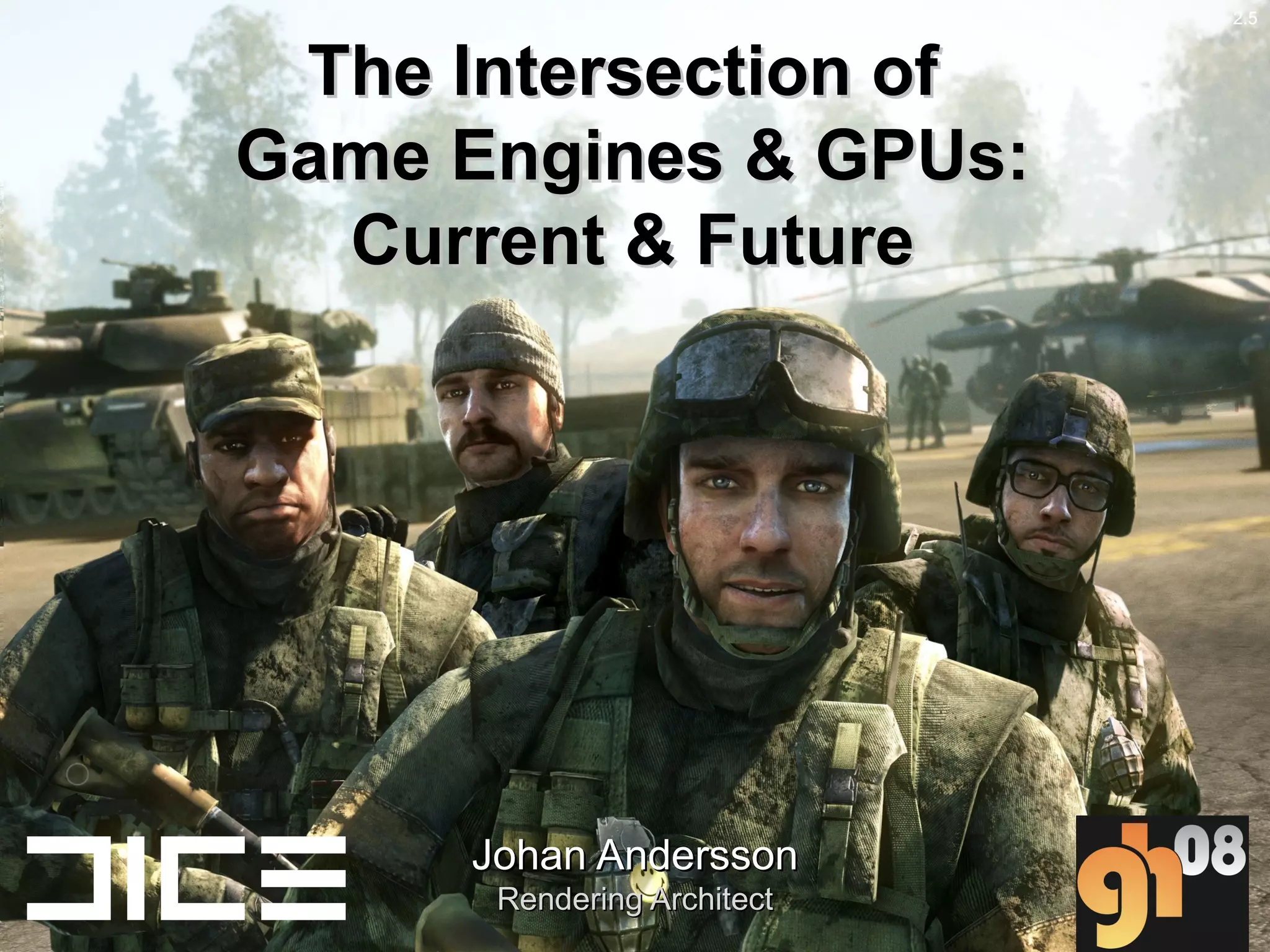
The Intersection of  Game Engines & GPUs: Current & Future Johan Andersson Rendering Architect 2.5
Agenda Goal Share and discuss current & future graphics use cases in our games and implications for graphics hardware Areas Engine overview Shaders Parallelization Texturing Raytracing GPU compute Conclusions Q & A
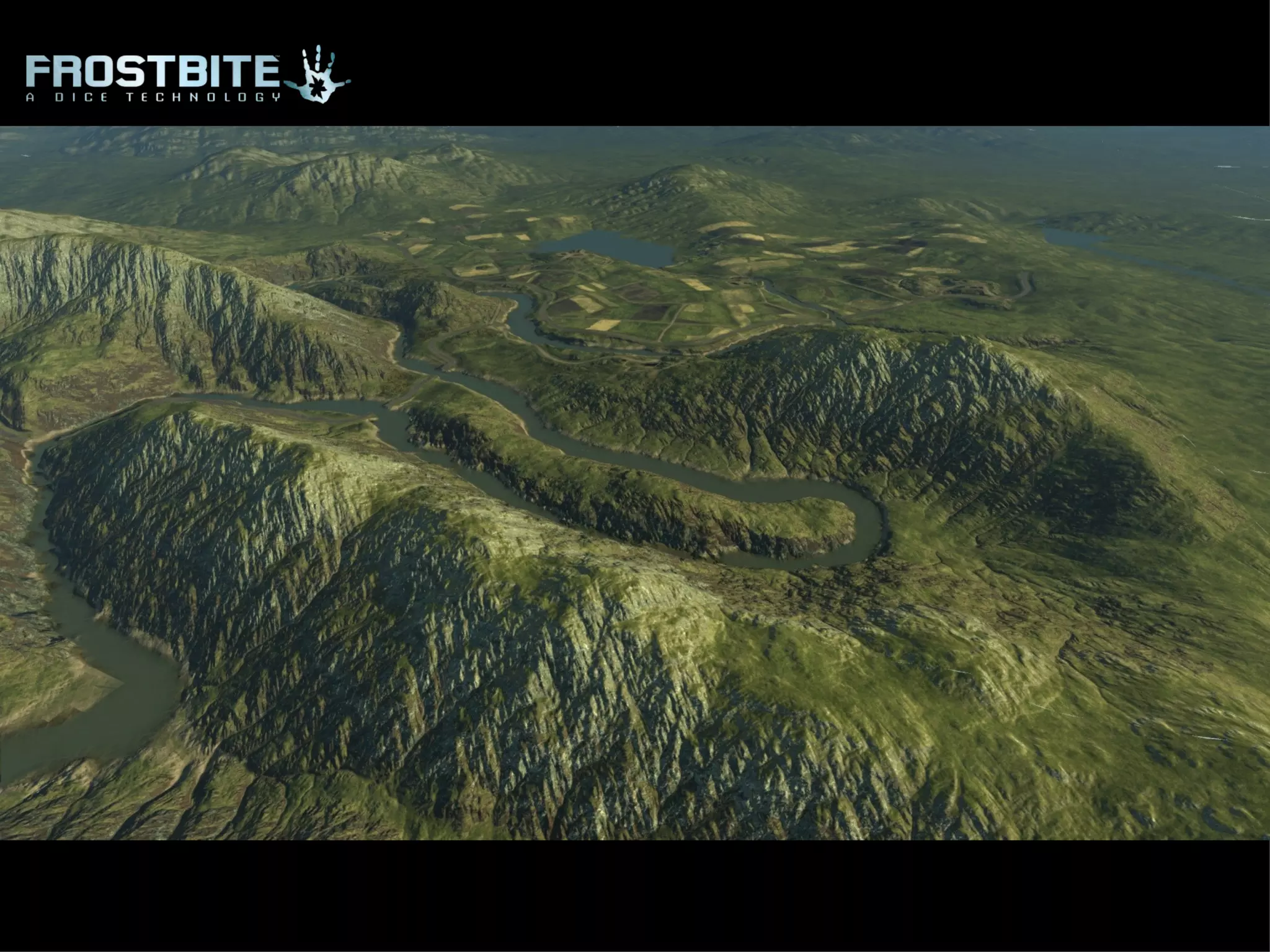
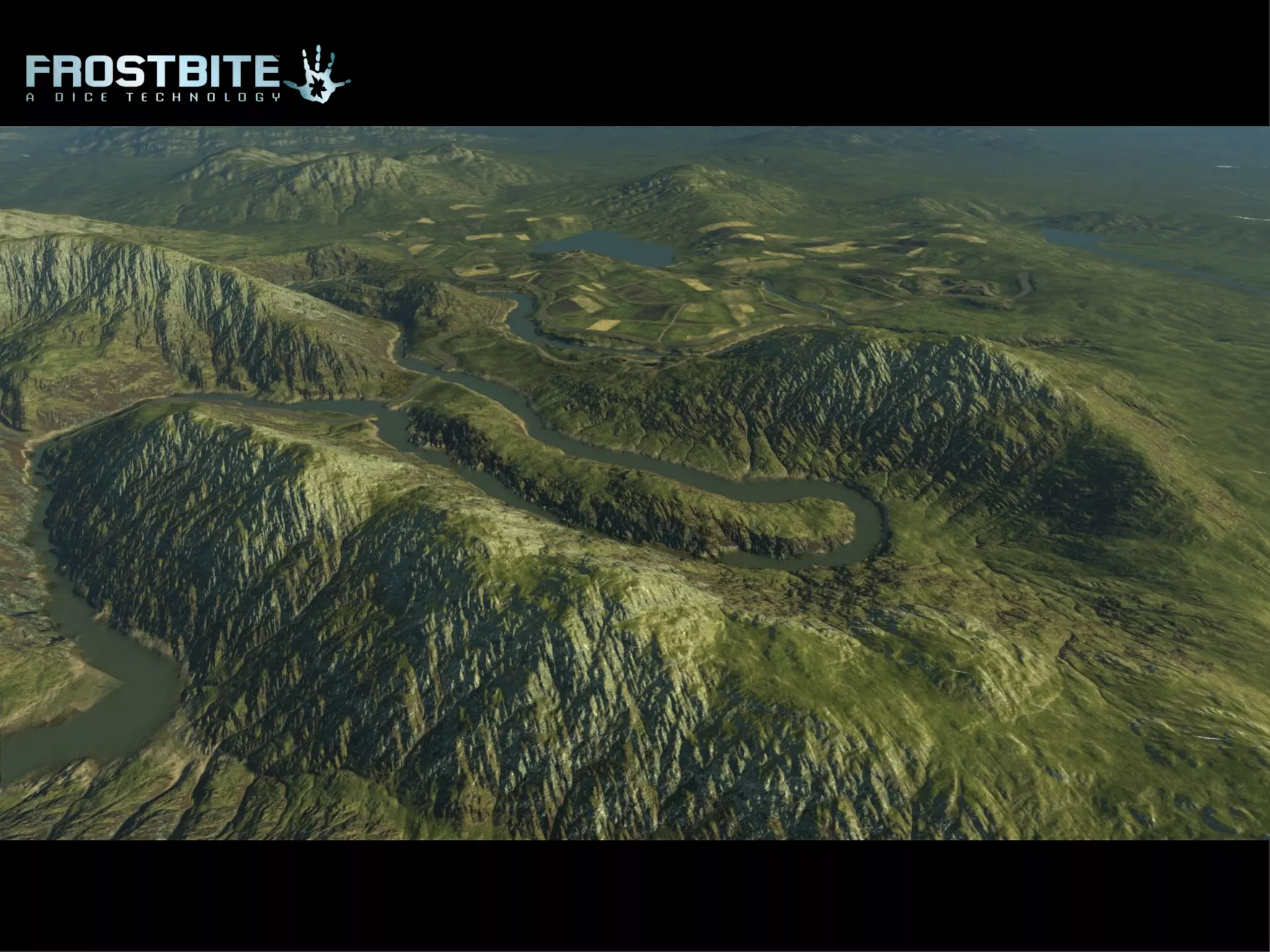
Frostbite DICE proprietary engine Xbox 360 PS3 Windows (Direct3D 10) Focus Large outdoor environments Singleplayer & multiplayer Destruction! New: Content workflows
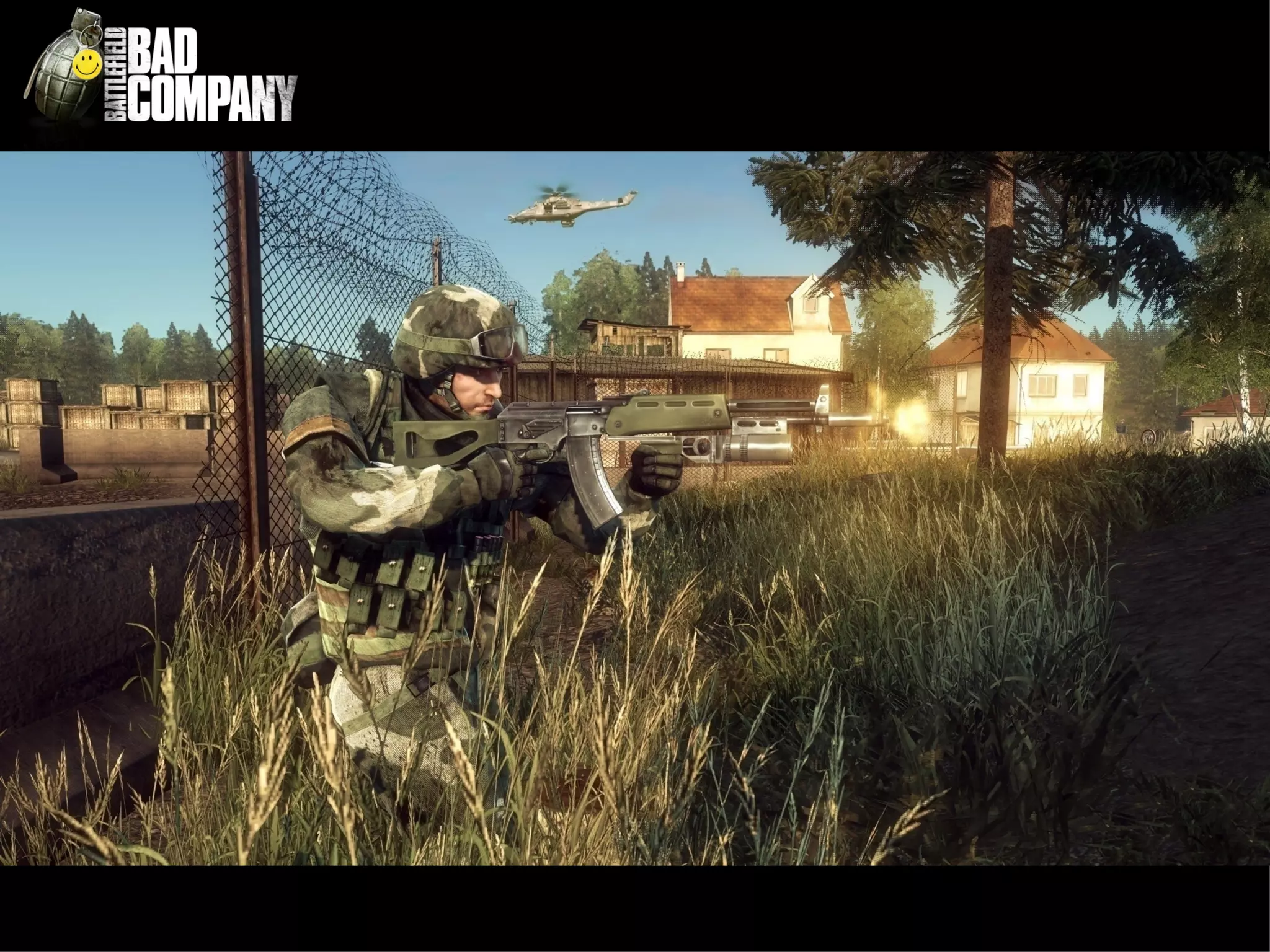
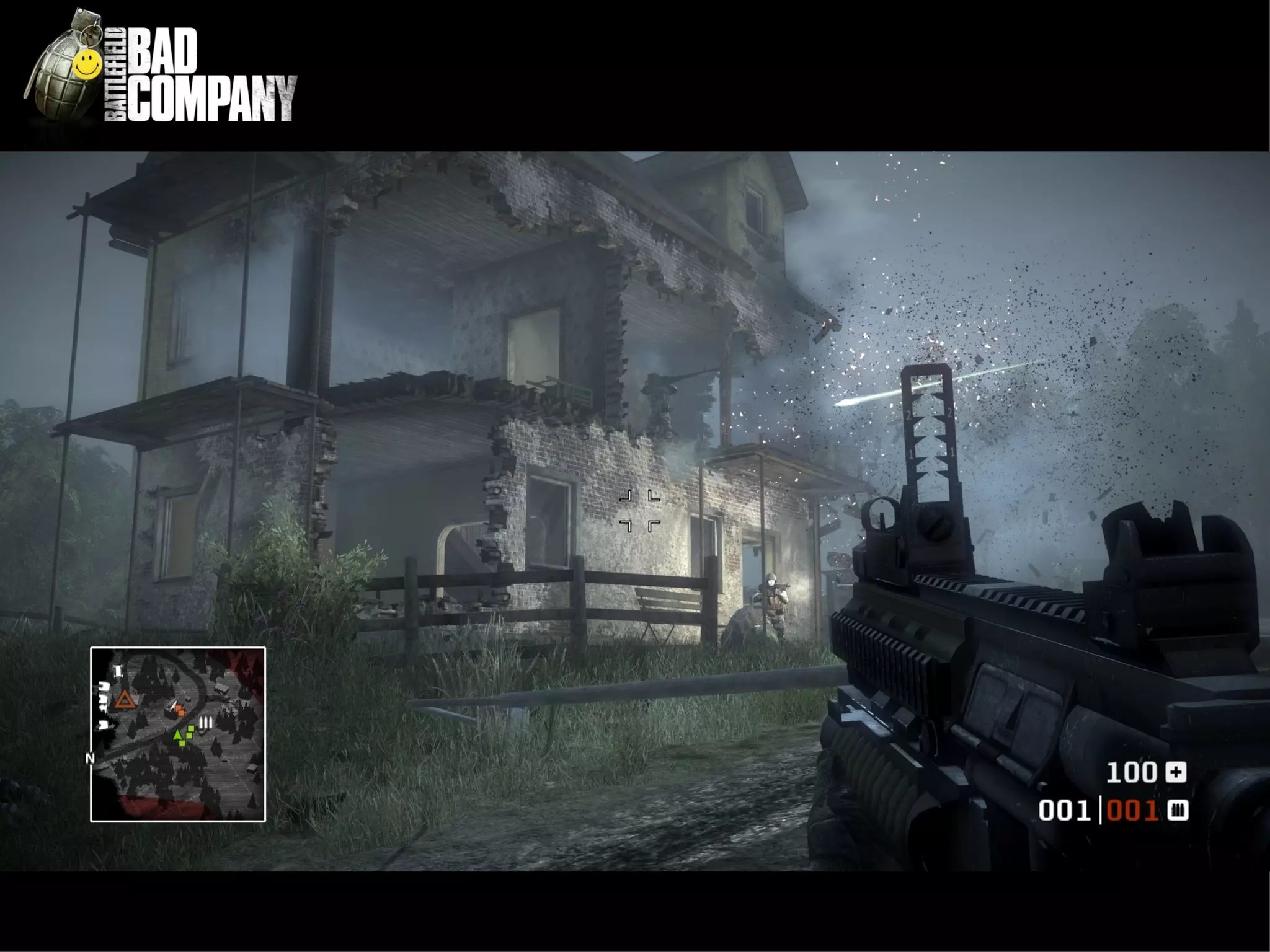
BFBC screenshot
BFBC screenshot
 
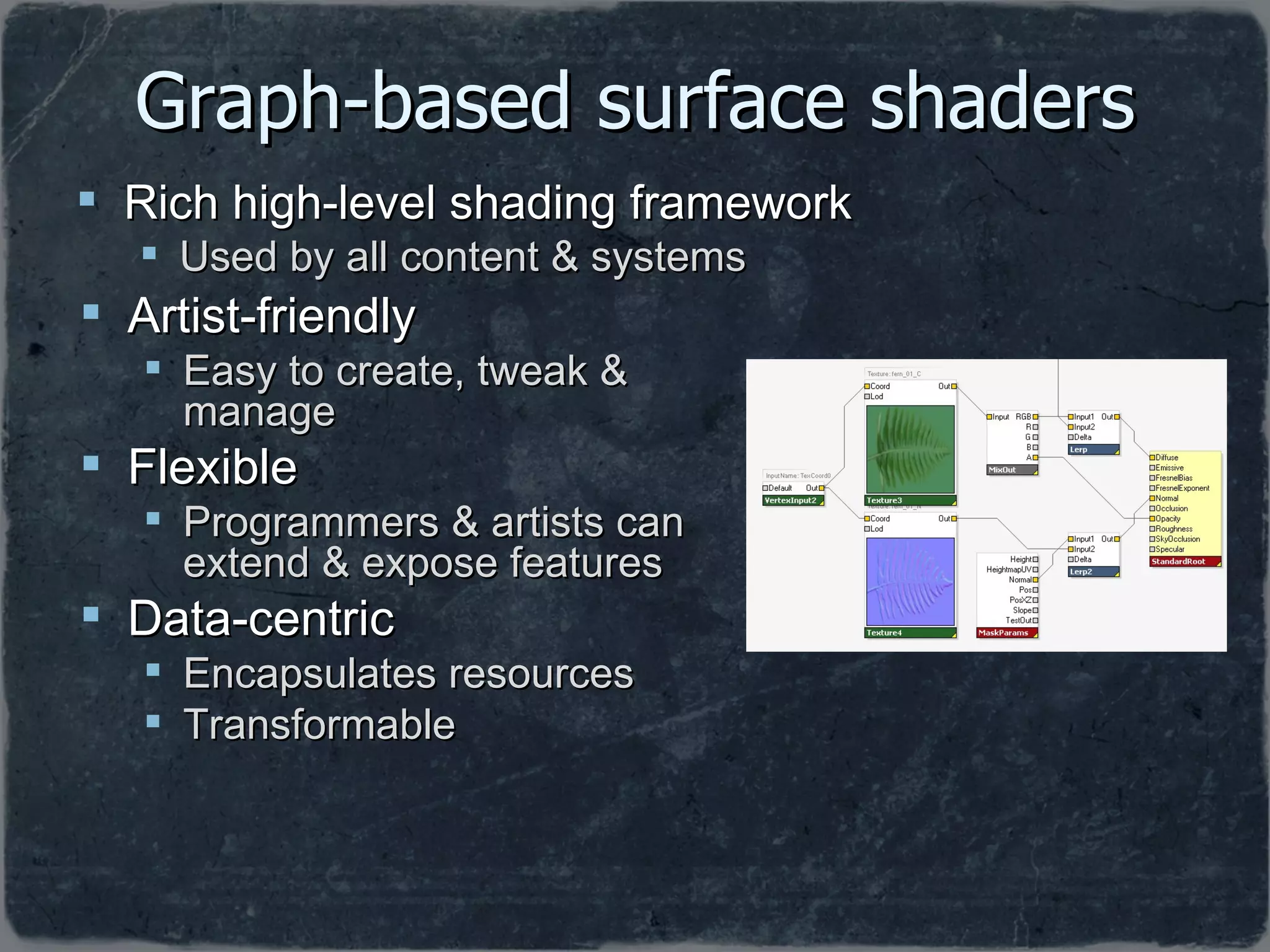
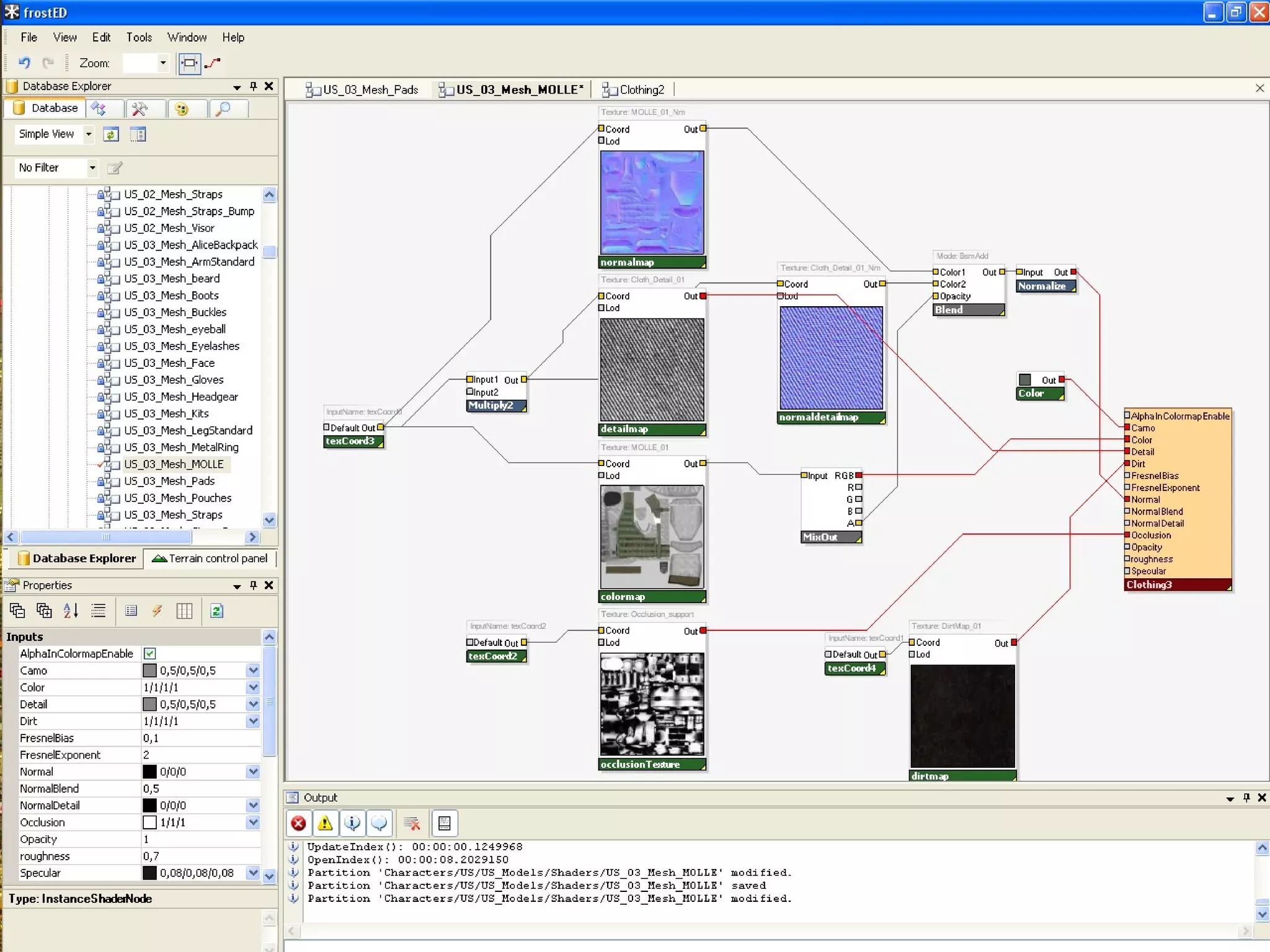
Graph-based surface shaders Artist-friendly Easy to create, tweak & manage Flexible Programmers & artists can extend & expose features Data-centric Encapsulates resources Transformable Rich high-level shading framework Used by all content & systems
 
Shader permutations Generate shader permutations For each  used combination of features/data HLSL vertex & pixel shaders Many features = permutation explosion Shader graphs, lighting, geometry Balance perf. vs permutations vs features Dynamic branching Live with many permutations
Shader subroutines Next step: Static subroutine linking Inline in all subroutines at call site Similar to a switch statement Reduces # permutations  Implementation moved to driver or GPU Doesn’t work with instancing Future step: Dynamic subroutines Control function pointers inside shader Problem solved, but coherency important
Rendering & Parallelization
Jobs Must utilize multi-core 6 HW threads on Xbox 360 6 SPUs on PS3 2-8 cores on PC Job  definition Fully independent stateless function PS3 SPU requirement Graph dependencies Task-parallel and data-parallel
Rendering jobs Refactor rendering systems to jobs Most will move to GPU Eventually One-way data flow Compute shaders & stream output Jobs Decal projection Particle simulation Terrain geometry processing Undergrowth generation [2] Frustum culling Occlusion culling Command buffer generation PS3: Triangle culling
Parallel command buffer recording  Dispatch draw calls and state to multiple command buffers in parallel Scales linearly with # cores 1500-4000 draw calls per frame Super-important for all platforms, used on: Xbox 360 PS3 (SPU-based) No support in DX10!
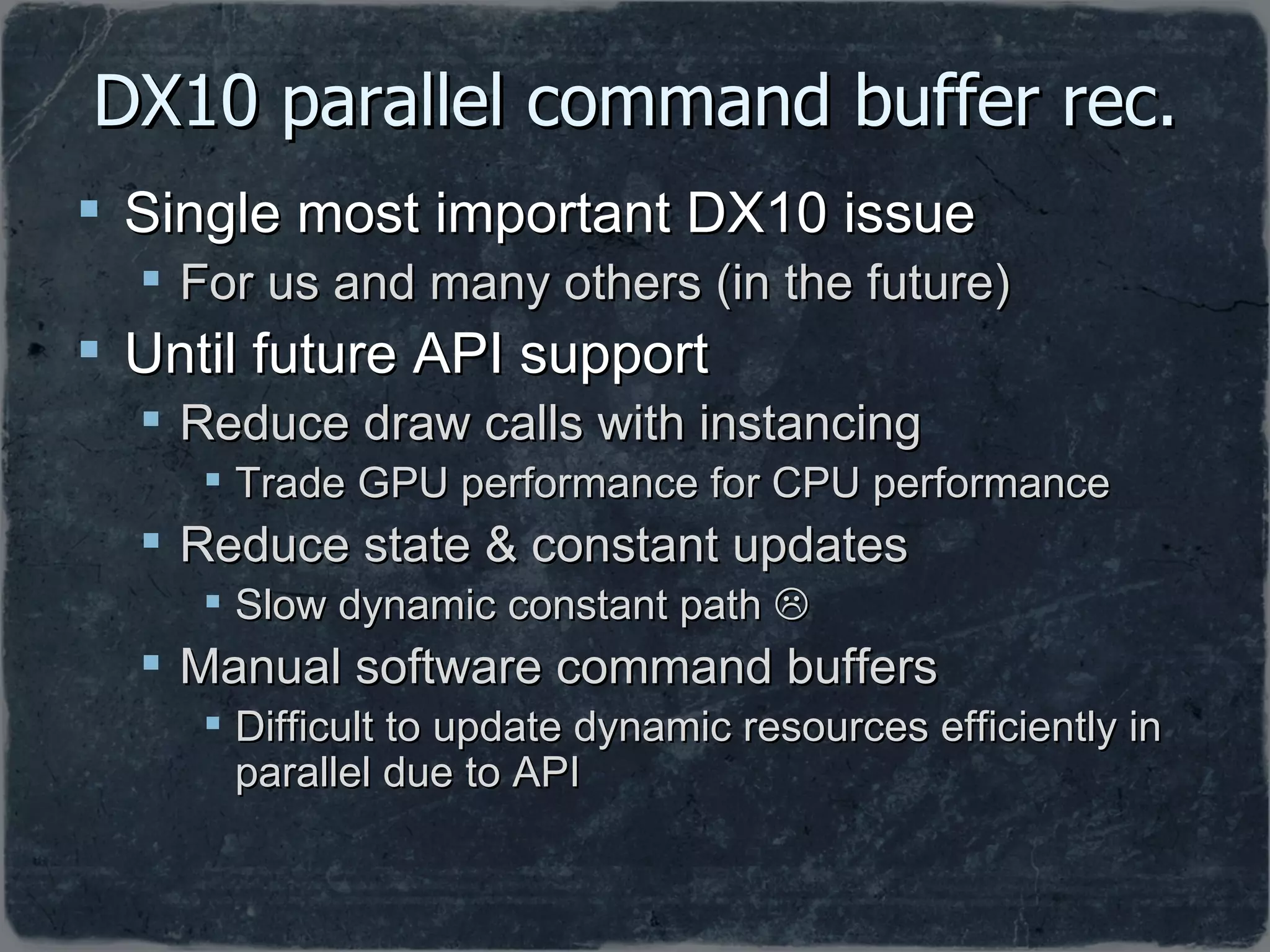
DX10 parallel command buffer rec. Single most important DX10 issue  For us and many others (in the future) Until future API support Reduce draw calls with instancing Trade GPU performance for CPU performance Reduce state & constant updates Slow dynamic constant path   Manual software command buffers  Difficult to update dynamic resources efficiently in parallel due to API
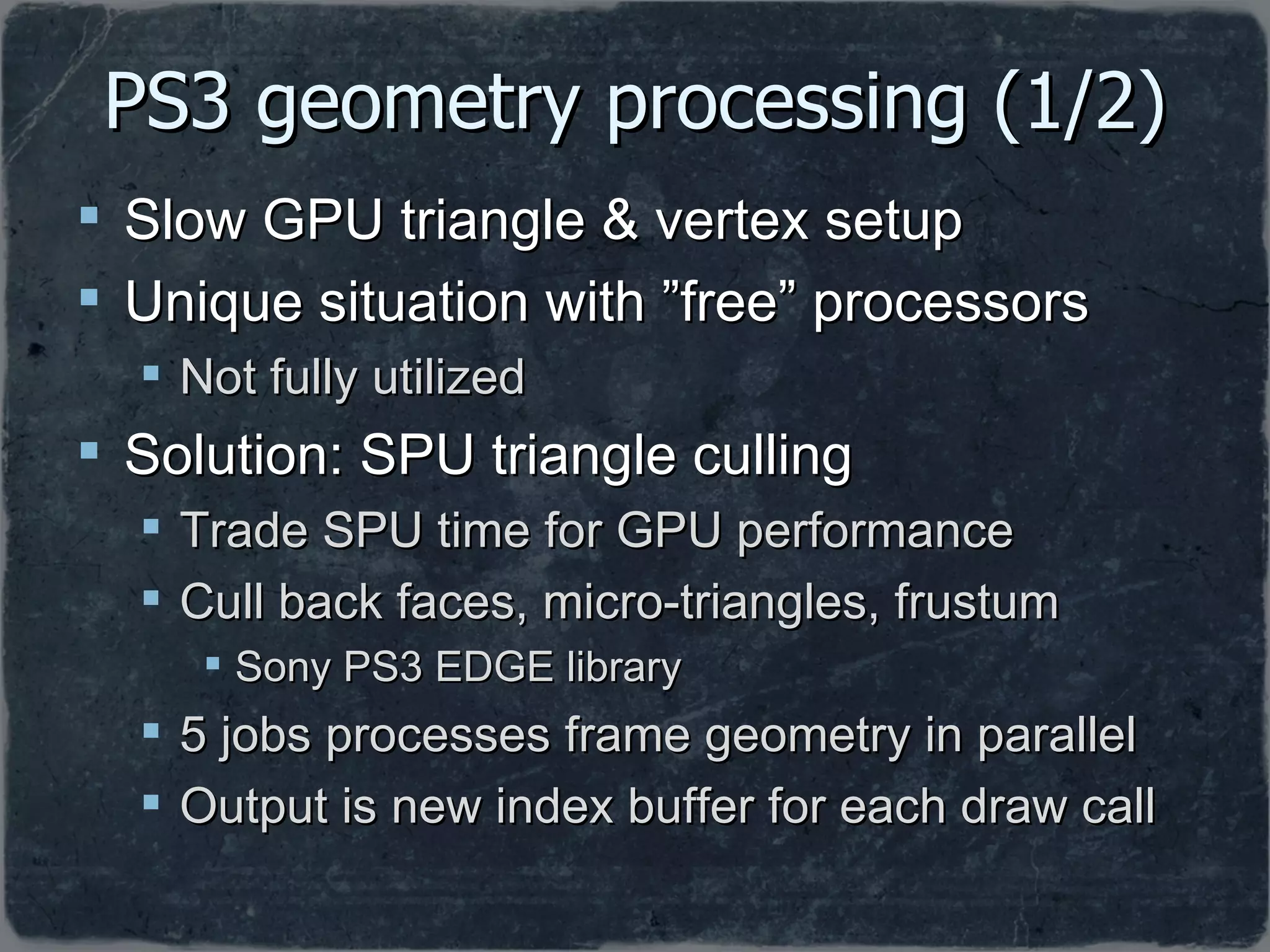
PS3 geometry processing (1/2) Slow GPU triangle & vertex setup  Unique situation with ”free” processors Not fully utilized Solution: SPU triangle culling Trade SPU time for GPU performance Cull back faces, micro-triangles, frustum Sony PS3 EDGE library 5 jobs processes frame geometry in parallel Output is new index buffer for each draw call
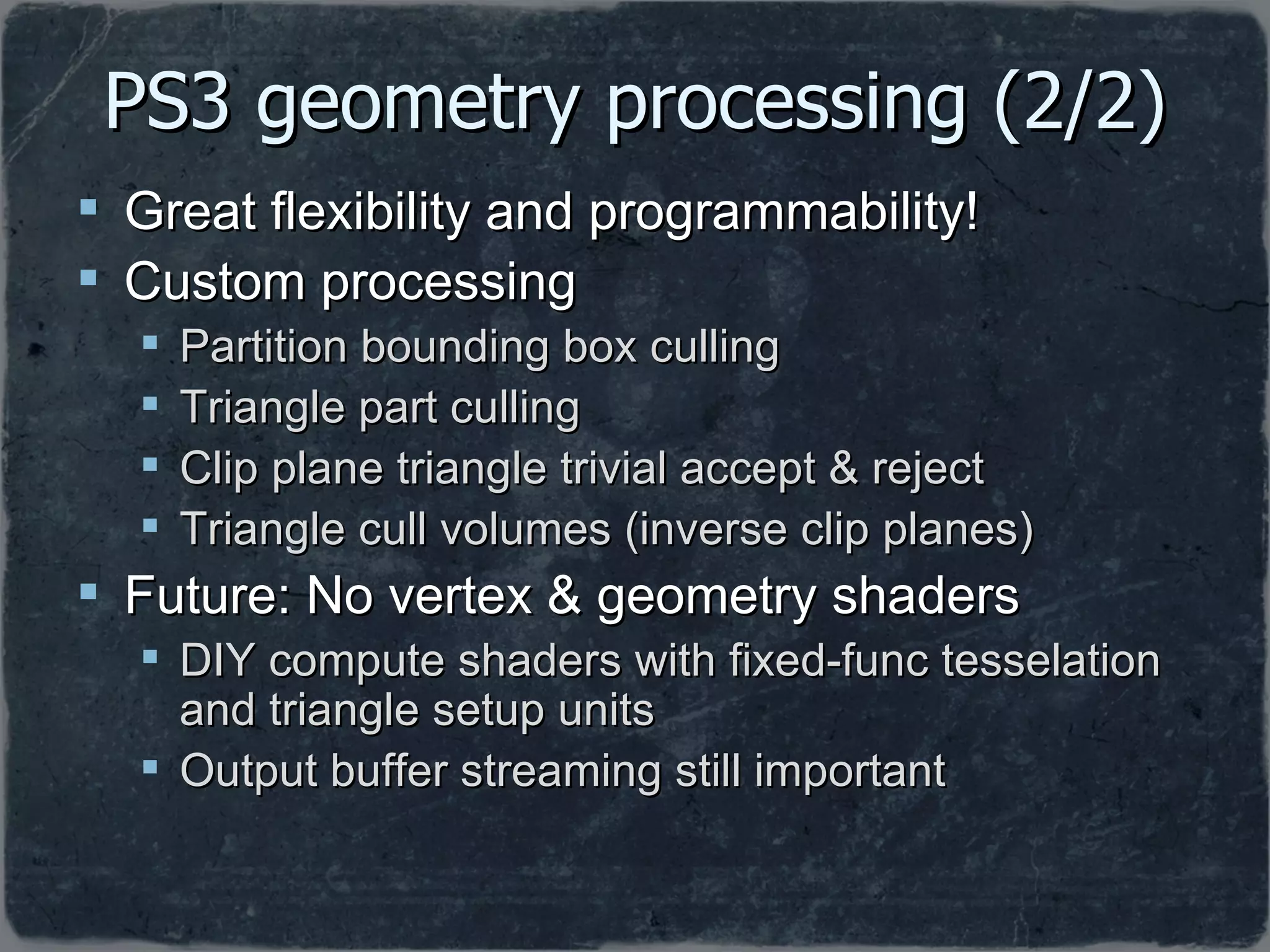
PS3 geometry processing (2/2) Great flexibility and programmability! Custom processing Partition bounding box culling Triangle part culling Clip plane triangle trivial accept & reject Triangle cull volumes (inverse clip planes) Future: No vertex & geometry shaders DIY compute shaders with fixed-func tesselation and triangle setup units Output buffer streaming still important
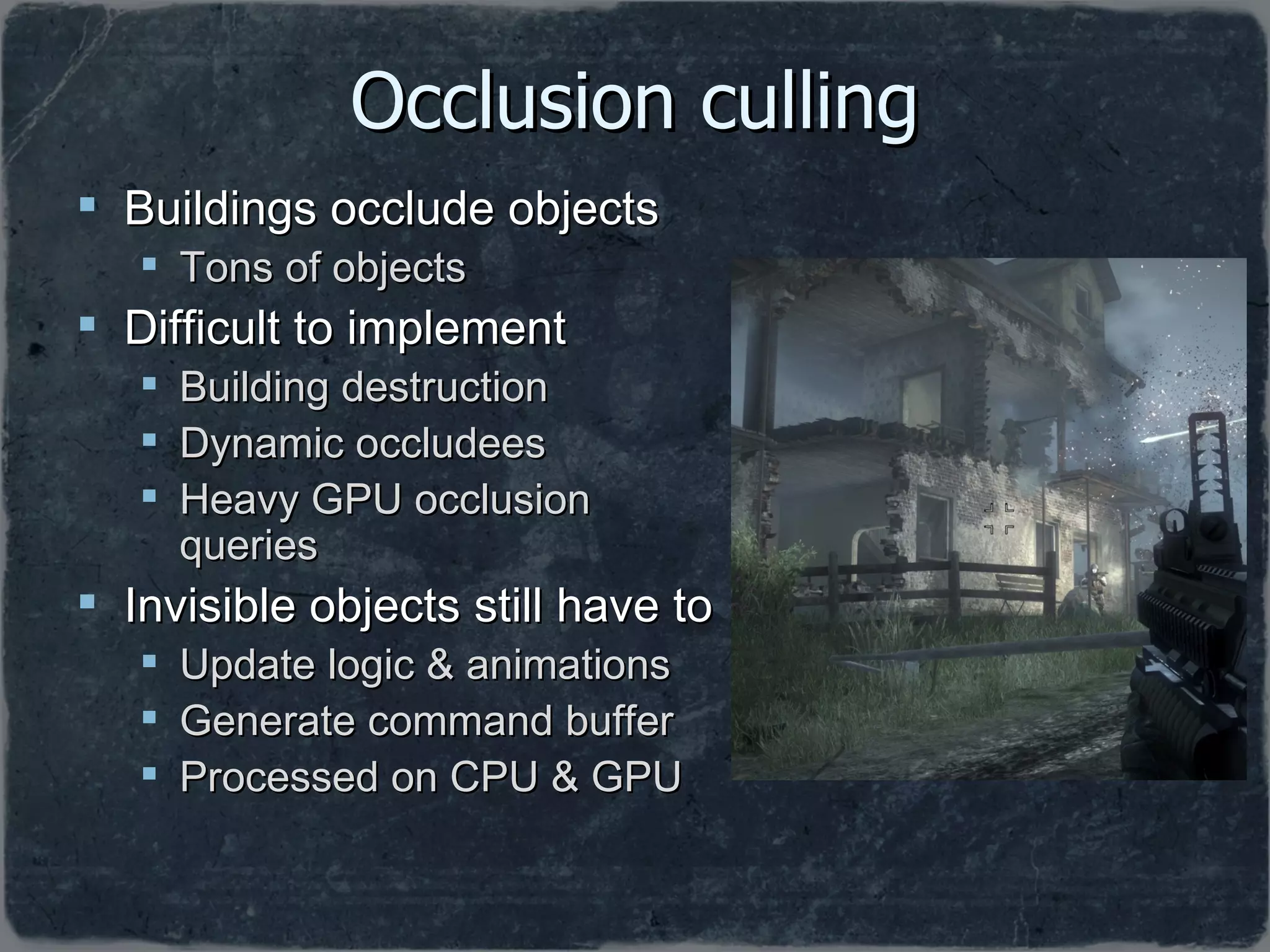
Occlusion culling Buildings occlude objects Tons of objects Difficult to implement Building destruction Dynamic occludees Heavy GPU occlusion queries Invisible objects still have to Update logic & animations Generate command buffer Processed on CPU & GPU
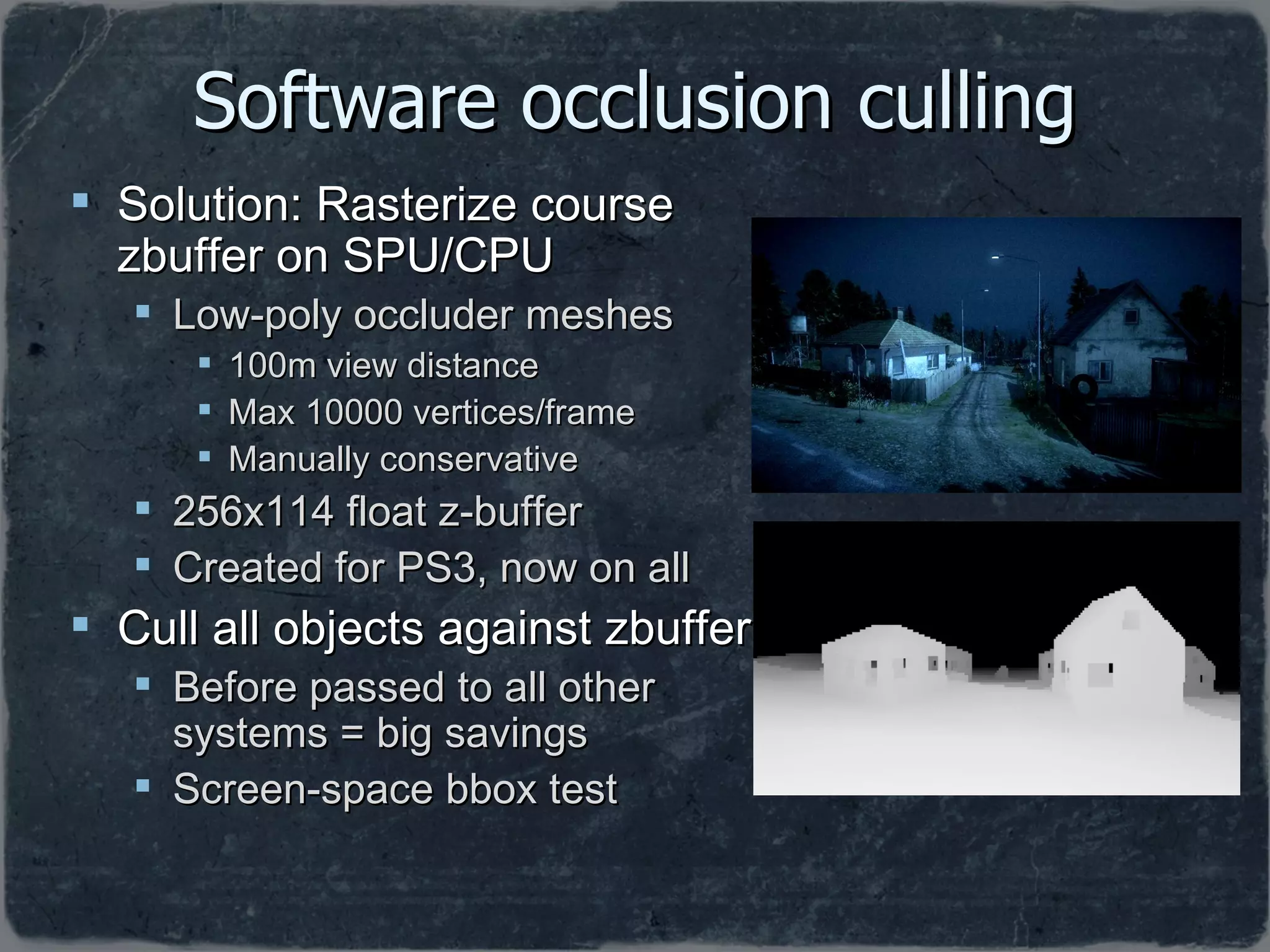
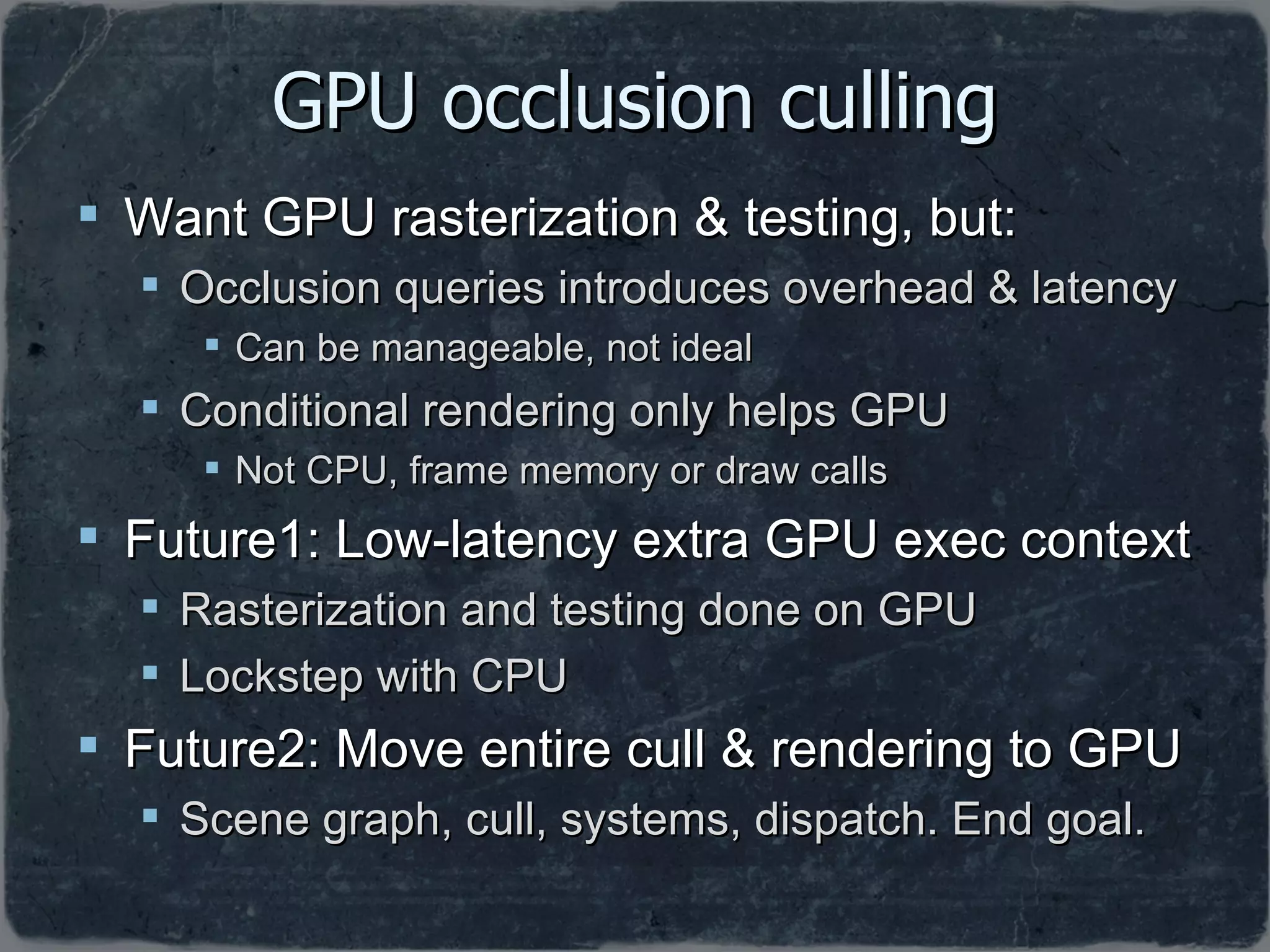
Software occlusion culling Solution: Rasterize course zbuffer on SPU/CPU Low-poly occluder meshes 100m view distance Max 10000 vertices/frame Manually conservative 256x114 float z-buffer Created for PS3, now on all Cull all objects against zbuffer Before passed to all other systems = big savings Screen-space bbox test
GPU occlusion culling Want GPU rasterization & testing, but: Occlusion queries introduces overhead & latency Can be manageable, not ideal Conditional rendering only helps GPU Not CPU, frame memory or draw calls Future1: Low-latency extra GPU exec context Rasterization and testing done on GPU Lockstep with CPU Future2: Move entire cull & rendering to GPU Scene graph, cull, systems, dispatch. End goal.
Texturing
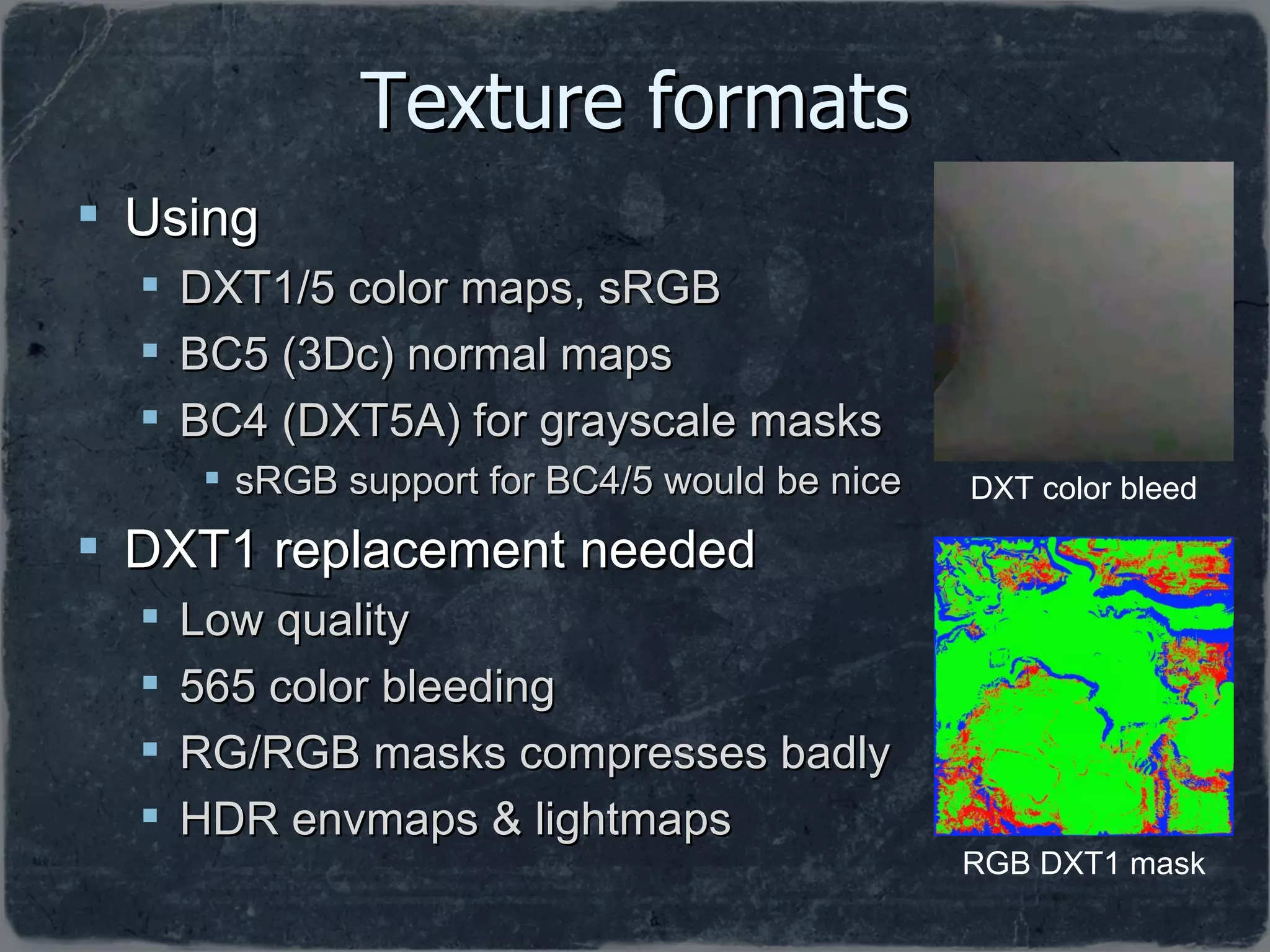
Texture formats Using DXT1/5 color maps, sRGB BC5 (3Dc) normal maps BC4 (DXT5A) for grayscale masks sRGB support for BC4/5 would be nice DXT1 replacement needed Low quality 565 color bleeding RG/RGB masks compresses badly HDR envmaps & lightmaps RGB DXT1 mask DXT color bleed
 
Future texture sampling Texture sampling derivatives 1st order  texel  derivatives 2nd order as well? Implement in sampler unit Bad performance or quality with shader sampling  Artifacts with ddx/ddy technique Replace normalmaps with easily compressed bumpmaps Bicubic upsampling Terrain masks Terrain heightmap Derived normals [2]
 
Current sparse textures Save memory for terrain Static quadtree mask texture Dynamic sparse destruction mask Implementation Indirection texture lookup in atlas Arrays too small, want 8192 slices Correct bilinear filtering by borders Siggraph’07 course for details [2] Source mask Atlas texture
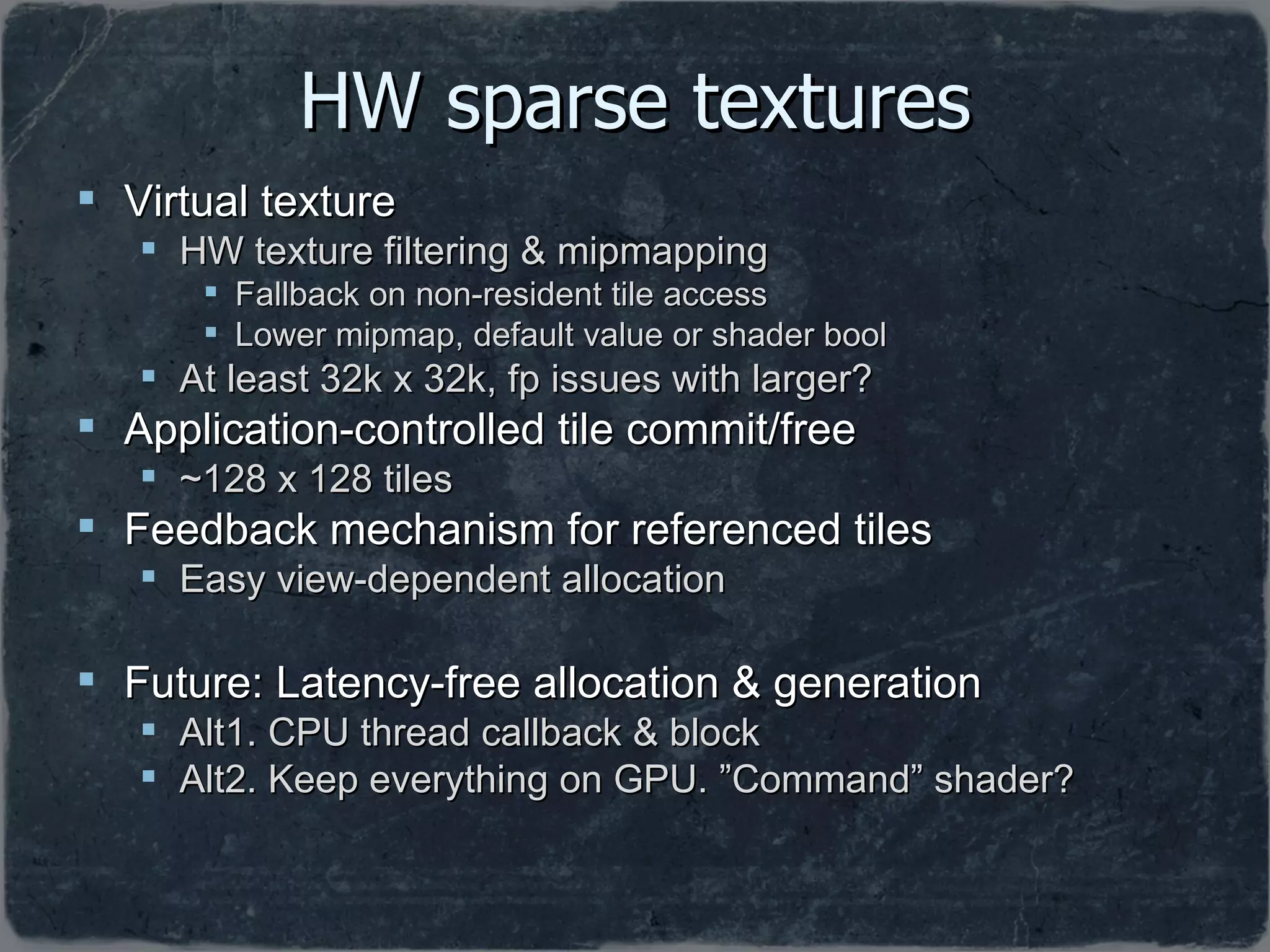
HW sparse textures Virtual texture HW texture filtering & mipmapping Fallback on non-resident tile access  Lower mipmap, default value or shader bool At least 32k x 32k, fp issues with larger? Application-controlled tile commit/free ~128 x 128 tiles Feedback mechanism for referenced tiles Easy view-dependent allocation Future: Latency-free allocation & generation Alt1. CPU thread callback & block Alt2. Keep everything on GPU. ”Command” shader?
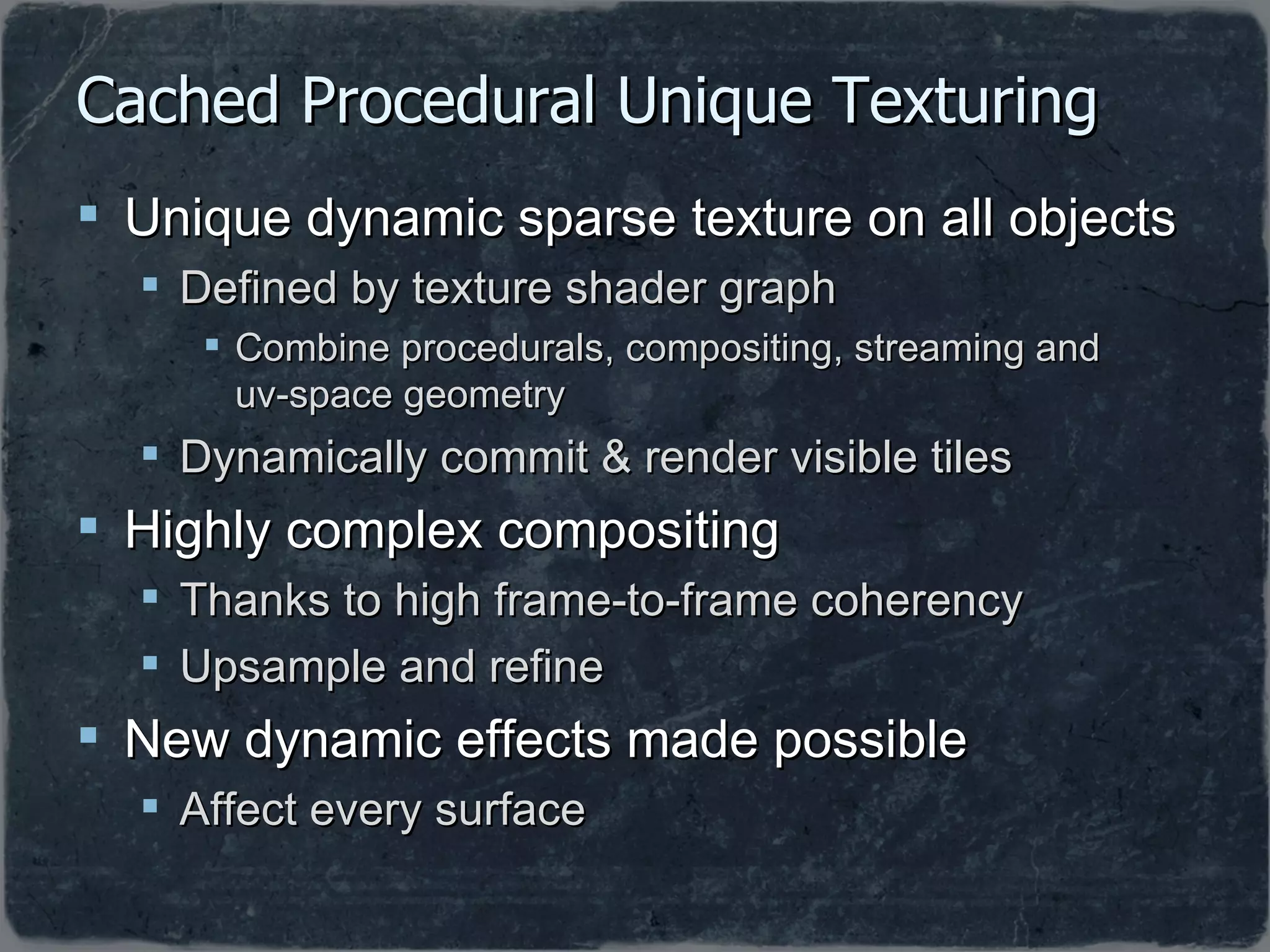
Cached Procedural Unique Texturing Unique dynamic sparse texture on all objects  Defined by texture shader graph Combine procedurals, compositing, streaming and  uv-space geometry Dynamically commit & render visible tiles Highly complex compositing Thanks to high frame-to-frame coherency Upsample and refine New dynamic effects made possible Affect every surface
Raytracing
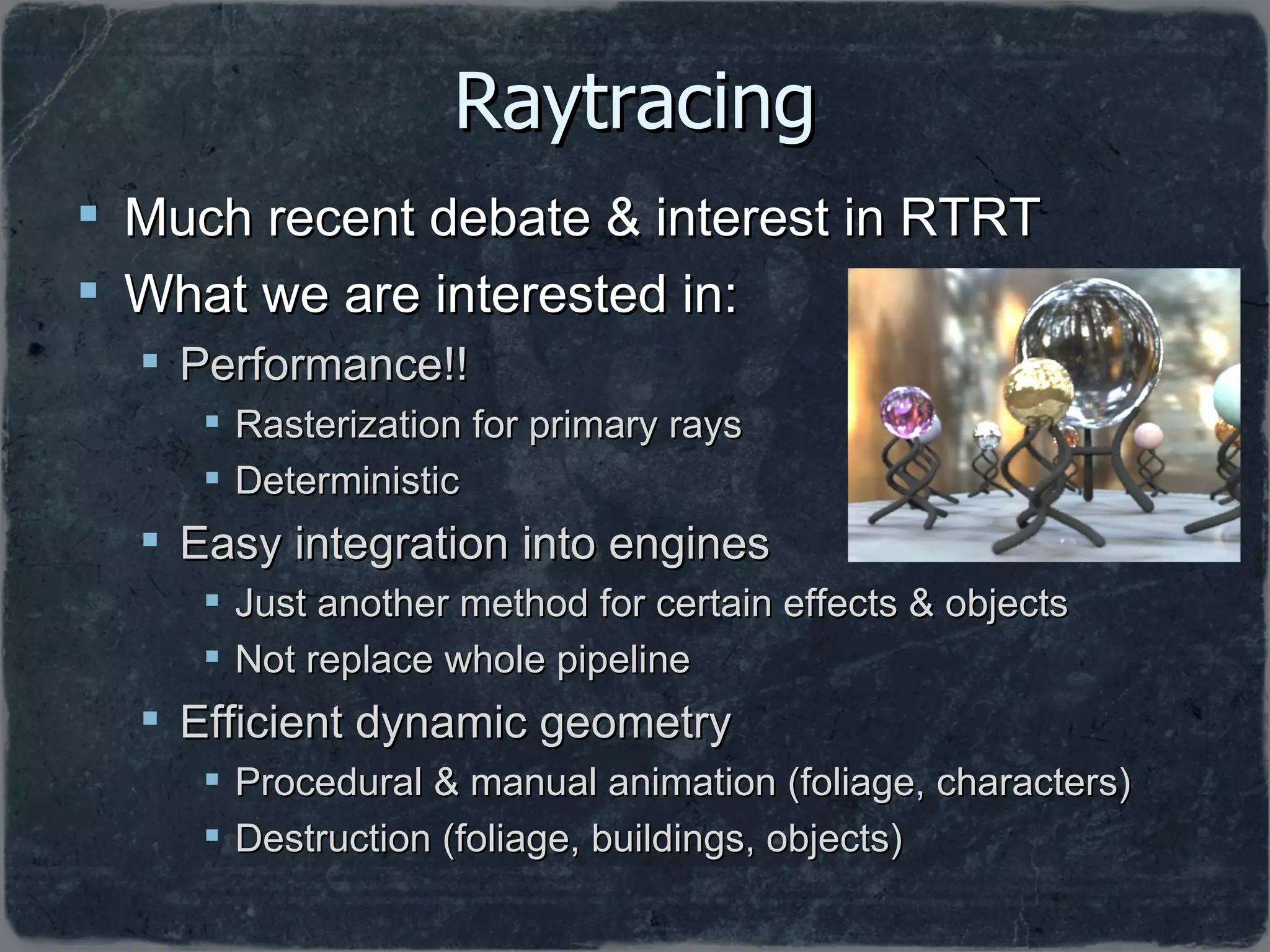
Raytracing Much recent debate & interest in RTRT What we are interested in: Performance!!  Rasterization for primary rays Deterministic Easy integration into engines Just another method for certain effects & objects Not replace whole pipeline  Efficient dynamic geometry Procedural & manual animation (foliage, characters) Destruction (foliage, buildings, objects)
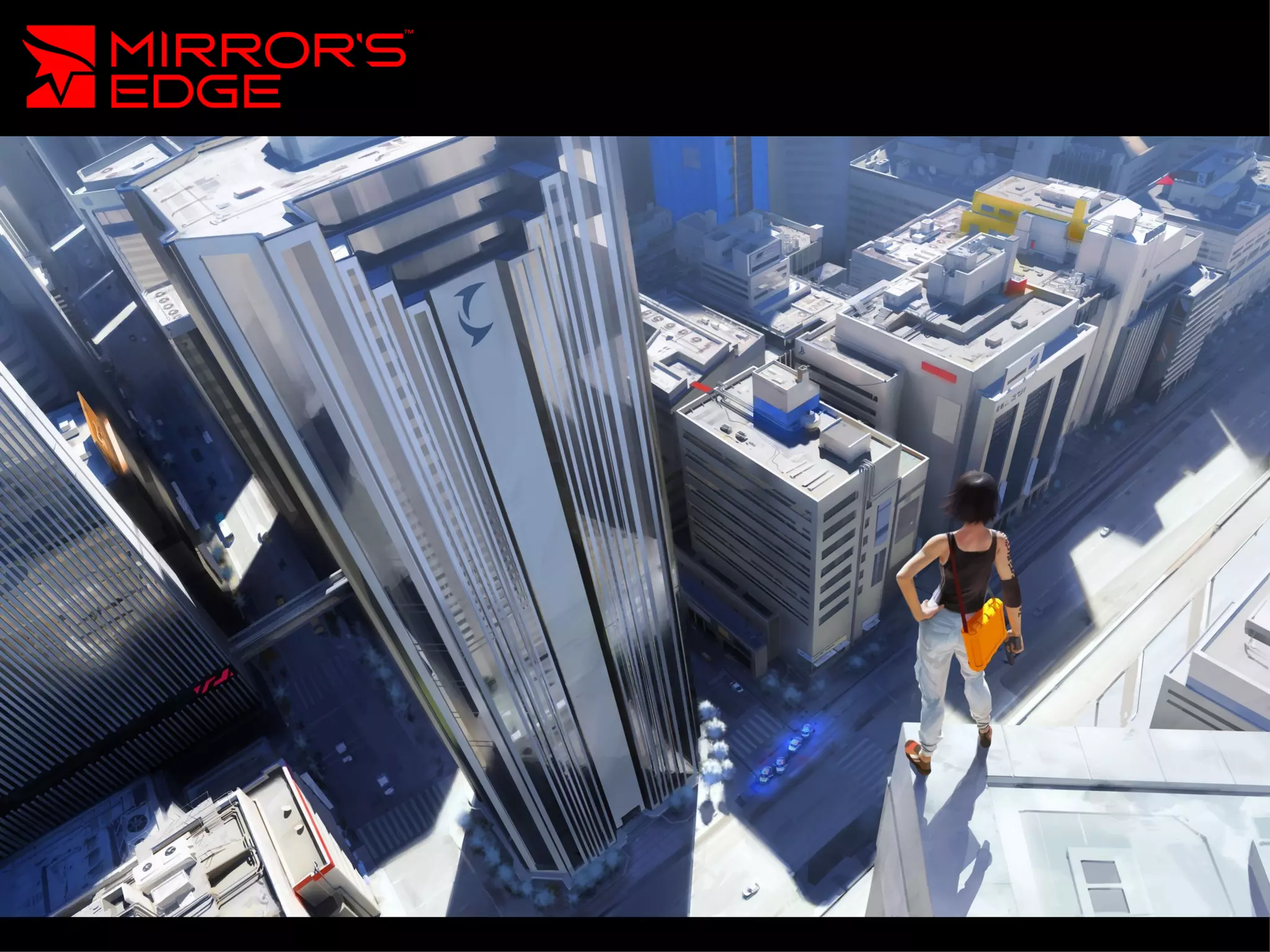
Mirror’s Edge
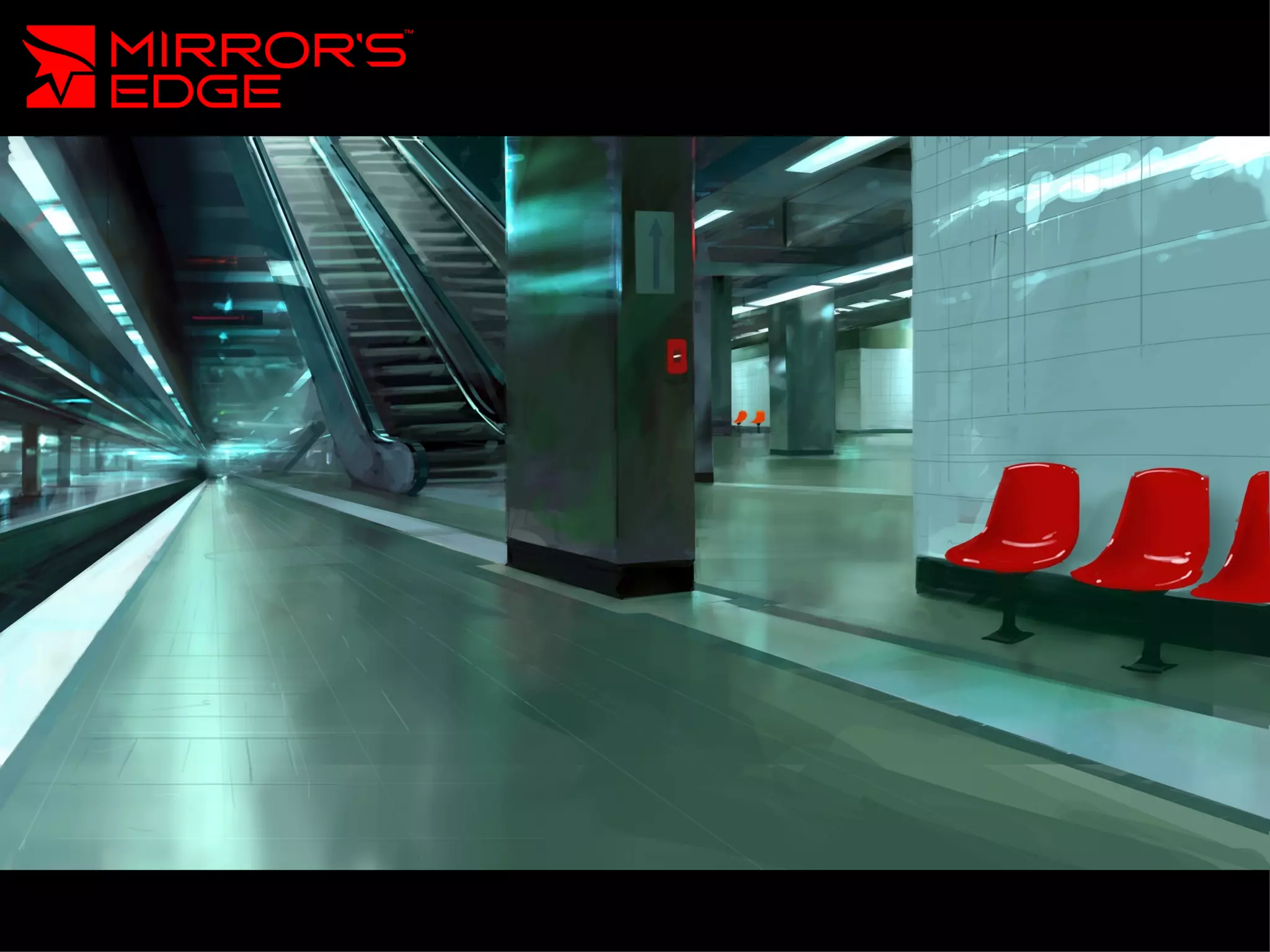
Raytraced reflections wanted Glass & metal Mostly planar surfaces Reflection locality Correct reflections for important objects Main character Simplified world geometry & shading for rest Common for games Brickmaps? [3]
Mirror’s Edge Soft reflections
GPGPU
GPGPU uses Effect physics Particle vs world soft collision AI pathfinding AI visibility View rasterization. Obstruction from smoke & foliage Procedural animation Trees, undergrowth, hair Post-processing
CUDA DOF post-process filter Thesis work at DICE [4] Test CUDA and performance Poisson disc blur Multi-passed diffusion Seperable diffusion Good: Easy to learn (C) Map complex algorithms Thread & memory control Bad: Performance vs shaders Beta interop Vendor-specific Circle of confusion map Output
GPU Compute programming model Wanted: Easy & efficient Direct3D 10 interop Low-latency Compute tasks Vendor-independent base interface OpenCL? Efficient CPU multi-core backend Server, older GPUs, debugging MCUDA [5] Eventually platform-independent Future consoles
Conclusions Shader subroutines More software-controlled pipeline More texture sampler functionality Limited-case raytracing GPU compute for games
Questions? Contact: johan.andersson@dice.se
References [1] Tartarchuk, Natasha & Andersson, Johan. ”Rendering Architecture and  Real-time Procedural Shading & Texturing Techniques”.  GDC 2007.  Link [2] Andersson, Johan. ” Terrain Rendering in Frostbite using Procedural Shader Splatting”.  Siggraph 2007.  Link [3]  Christensen, Per H. & Batali, Dana. "An Irradiance Atlas for Global Illumination in Complex Production Scenes“. Eurographics Symposium on Rendering 2004.  Link [4] Lonroth, Per & Unger, Mattias. ”Advanced Real-time Post-Processing using GPGPU techniques”. Master thesis, 2008. [5] John Stratton, Sam Stone, Wen-mei Hwu. "MCUDA: An Efficient Implementation of CUDA Kernels on Multi-cores". Technical report, University of Illinois at Urbana-Champaign, IMPACT-08-01, March, 2008.
Bonus slides
Real-time REYES Very interesting Displacement mapping & procedurals Stochastic sampling Potentially more efficient & general Compared to maxed out rasterization & tessellation on everything = pixel-sized triangles But No experience  More research & experimentation needed
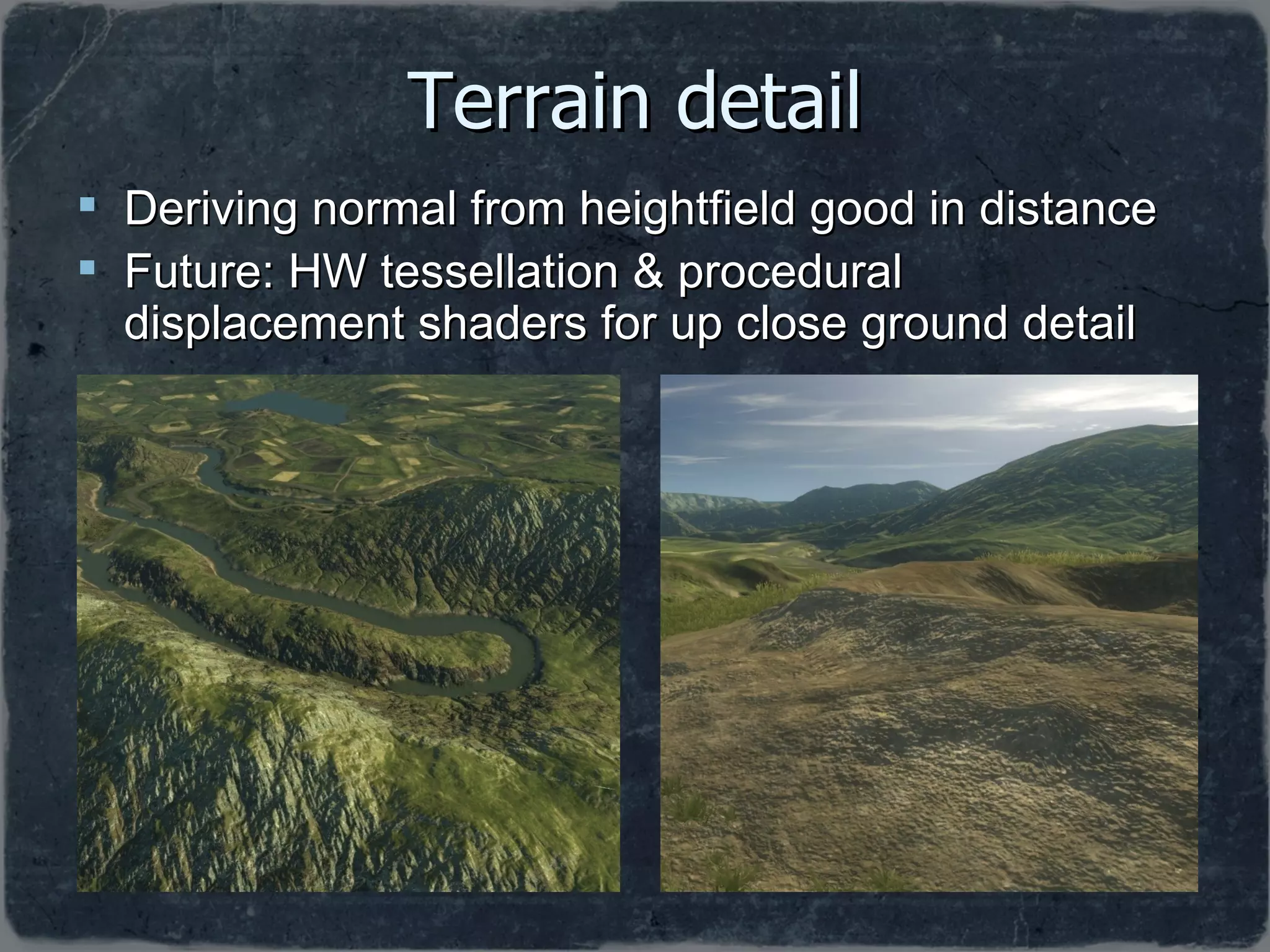
Terrain detail Deriving normal from heightfield good in distance Future: HW tessellation & procedural displacement shaders for up close ground detail
Texture arrays Use cases: Everything! Rich parameterized shaders Vary slice index per instance, triangle or texel  Instancing without comprimising on variation or perf. Cascaded shadow maps HW PCF only in DX 10.1   Stable Cascaded Bounding Box Shadow Maps Sparse textures More slices plz For tile pools. 64x64x8192
Other raytracing uses Global Illumination & Ambient Occlusion Incremental Photon Mapping? Async collision raycasts AI pathfinding, gameplay, sound obstruction Seperate collision world from visual world CPU job-based now

The Intersection of Game Engines & GPUs: Current & Future (Graphics Hardware 2008)

  • 1.
    The Intersection of Game Engines & GPUs: Current & Future Johan Andersson Rendering Architect 2.5
  • 2.
    Agenda Goal Shareand discuss current & future graphics use cases in our games and implications for graphics hardware Areas Engine overview Shaders Parallelization Texturing Raytracing GPU compute Conclusions Q & A
  • 3.
    Frostbite DICE proprietaryengine Xbox 360 PS3 Windows (Direct3D 10) Focus Large outdoor environments Singleplayer & multiplayer Destruction! New: Content workflows
  • 4.
  • 5.
  • 6.
  • 7.
    Graph-based surface shadersArtist-friendly Easy to create, tweak & manage Flexible Programmers & artists can extend & expose features Data-centric Encapsulates resources Transformable Rich high-level shading framework Used by all content & systems
  • 8.
  • 9.
    Shader permutations Generateshader permutations For each used combination of features/data HLSL vertex & pixel shaders Many features = permutation explosion Shader graphs, lighting, geometry Balance perf. vs permutations vs features Dynamic branching Live with many permutations
  • 10.
    Shader subroutines Nextstep: Static subroutine linking Inline in all subroutines at call site Similar to a switch statement Reduces # permutations Implementation moved to driver or GPU Doesn’t work with instancing Future step: Dynamic subroutines Control function pointers inside shader Problem solved, but coherency important
  • 11.
  • 12.
    Jobs Must utilizemulti-core 6 HW threads on Xbox 360 6 SPUs on PS3 2-8 cores on PC Job definition Fully independent stateless function PS3 SPU requirement Graph dependencies Task-parallel and data-parallel
  • 13.
    Rendering jobs Refactorrendering systems to jobs Most will move to GPU Eventually One-way data flow Compute shaders & stream output Jobs Decal projection Particle simulation Terrain geometry processing Undergrowth generation [2] Frustum culling Occlusion culling Command buffer generation PS3: Triangle culling
  • 14.
    Parallel command bufferrecording Dispatch draw calls and state to multiple command buffers in parallel Scales linearly with # cores 1500-4000 draw calls per frame Super-important for all platforms, used on: Xbox 360 PS3 (SPU-based) No support in DX10!
  • 15.
    DX10 parallel commandbuffer rec. Single most important DX10 issue For us and many others (in the future) Until future API support Reduce draw calls with instancing Trade GPU performance for CPU performance Reduce state & constant updates Slow dynamic constant path  Manual software command buffers Difficult to update dynamic resources efficiently in parallel due to API
  • 16.
    PS3 geometry processing(1/2) Slow GPU triangle & vertex setup Unique situation with ”free” processors Not fully utilized Solution: SPU triangle culling Trade SPU time for GPU performance Cull back faces, micro-triangles, frustum Sony PS3 EDGE library 5 jobs processes frame geometry in parallel Output is new index buffer for each draw call
  • 17.
    PS3 geometry processing(2/2) Great flexibility and programmability! Custom processing Partition bounding box culling Triangle part culling Clip plane triangle trivial accept & reject Triangle cull volumes (inverse clip planes) Future: No vertex & geometry shaders DIY compute shaders with fixed-func tesselation and triangle setup units Output buffer streaming still important
  • 18.
    Occlusion culling Buildingsocclude objects Tons of objects Difficult to implement Building destruction Dynamic occludees Heavy GPU occlusion queries Invisible objects still have to Update logic & animations Generate command buffer Processed on CPU & GPU
  • 19.
    Software occlusion cullingSolution: Rasterize course zbuffer on SPU/CPU Low-poly occluder meshes 100m view distance Max 10000 vertices/frame Manually conservative 256x114 float z-buffer Created for PS3, now on all Cull all objects against zbuffer Before passed to all other systems = big savings Screen-space bbox test
  • 20.
    GPU occlusion cullingWant GPU rasterization & testing, but: Occlusion queries introduces overhead & latency Can be manageable, not ideal Conditional rendering only helps GPU Not CPU, frame memory or draw calls Future1: Low-latency extra GPU exec context Rasterization and testing done on GPU Lockstep with CPU Future2: Move entire cull & rendering to GPU Scene graph, cull, systems, dispatch. End goal.
  • 21.
  • 22.
    Texture formats UsingDXT1/5 color maps, sRGB BC5 (3Dc) normal maps BC4 (DXT5A) for grayscale masks sRGB support for BC4/5 would be nice DXT1 replacement needed Low quality 565 color bleeding RG/RGB masks compresses badly HDR envmaps & lightmaps RGB DXT1 mask DXT color bleed
  • 23.
  • 24.
    Future texture samplingTexture sampling derivatives 1st order texel derivatives 2nd order as well? Implement in sampler unit Bad performance or quality with shader sampling Artifacts with ddx/ddy technique Replace normalmaps with easily compressed bumpmaps Bicubic upsampling Terrain masks Terrain heightmap Derived normals [2]
  • 25.
  • 26.
    Current sparse texturesSave memory for terrain Static quadtree mask texture Dynamic sparse destruction mask Implementation Indirection texture lookup in atlas Arrays too small, want 8192 slices Correct bilinear filtering by borders Siggraph’07 course for details [2] Source mask Atlas texture
  • 27.
    HW sparse texturesVirtual texture HW texture filtering & mipmapping Fallback on non-resident tile access Lower mipmap, default value or shader bool At least 32k x 32k, fp issues with larger? Application-controlled tile commit/free ~128 x 128 tiles Feedback mechanism for referenced tiles Easy view-dependent allocation Future: Latency-free allocation & generation Alt1. CPU thread callback & block Alt2. Keep everything on GPU. ”Command” shader?
  • 28.
    Cached Procedural UniqueTexturing Unique dynamic sparse texture on all objects Defined by texture shader graph Combine procedurals, compositing, streaming and uv-space geometry Dynamically commit & render visible tiles Highly complex compositing Thanks to high frame-to-frame coherency Upsample and refine New dynamic effects made possible Affect every surface
  • 29.
  • 30.
    Raytracing Much recentdebate & interest in RTRT What we are interested in: Performance!! Rasterization for primary rays Deterministic Easy integration into engines Just another method for certain effects & objects Not replace whole pipeline Efficient dynamic geometry Procedural & manual animation (foliage, characters) Destruction (foliage, buildings, objects)
  • 31.
  • 32.
    Raytraced reflections wantedGlass & metal Mostly planar surfaces Reflection locality Correct reflections for important objects Main character Simplified world geometry & shading for rest Common for games Brickmaps? [3]
  • 33.
  • 34.
  • 35.
    GPGPU uses Effectphysics Particle vs world soft collision AI pathfinding AI visibility View rasterization. Obstruction from smoke & foliage Procedural animation Trees, undergrowth, hair Post-processing
  • 36.
    CUDA DOF post-processfilter Thesis work at DICE [4] Test CUDA and performance Poisson disc blur Multi-passed diffusion Seperable diffusion Good: Easy to learn (C) Map complex algorithms Thread & memory control Bad: Performance vs shaders Beta interop Vendor-specific Circle of confusion map Output
  • 37.
    GPU Compute programmingmodel Wanted: Easy & efficient Direct3D 10 interop Low-latency Compute tasks Vendor-independent base interface OpenCL? Efficient CPU multi-core backend Server, older GPUs, debugging MCUDA [5] Eventually platform-independent Future consoles
  • 38.
    Conclusions Shader subroutinesMore software-controlled pipeline More texture sampler functionality Limited-case raytracing GPU compute for games
  • 39.
  • 40.
    References [1] Tartarchuk,Natasha & Andersson, Johan. ”Rendering Architecture and Real-time Procedural Shading & Texturing Techniques”. GDC 2007. Link [2] Andersson, Johan. ” Terrain Rendering in Frostbite using Procedural Shader Splatting”. Siggraph 2007. Link [3] Christensen, Per H. & Batali, Dana. "An Irradiance Atlas for Global Illumination in Complex Production Scenes“. Eurographics Symposium on Rendering 2004. Link [4] Lonroth, Per & Unger, Mattias. ”Advanced Real-time Post-Processing using GPGPU techniques”. Master thesis, 2008. [5] John Stratton, Sam Stone, Wen-mei Hwu. "MCUDA: An Efficient Implementation of CUDA Kernels on Multi-cores". Technical report, University of Illinois at Urbana-Champaign, IMPACT-08-01, March, 2008.
  • 41.
  • 42.
    Real-time REYES Veryinteresting Displacement mapping & procedurals Stochastic sampling Potentially more efficient & general Compared to maxed out rasterization & tessellation on everything = pixel-sized triangles But No experience More research & experimentation needed
  • 43.
    Terrain detail Derivingnormal from heightfield good in distance Future: HW tessellation & procedural displacement shaders for up close ground detail
  • 44.
    Texture arrays Usecases: Everything! Rich parameterized shaders Vary slice index per instance, triangle or texel Instancing without comprimising on variation or perf. Cascaded shadow maps HW PCF only in DX 10.1  Stable Cascaded Bounding Box Shadow Maps Sparse textures More slices plz For tile pools. 64x64x8192
  • 45.
    Other raytracing usesGlobal Illumination & Ambient Occlusion Incremental Photon Mapping? Async collision raycasts AI pathfinding, gameplay, sound obstruction Seperate collision world from visual world CPU job-based now