CHAPTER 4 - PROBABILITY
INTRODUCTORY VOCABULARY Random (trials) – individual outcomes of a trial are uncertain, but when a large number of trials are performed a regular distribution appears Probability – Proportion of times an outcome would occur in a large number of trials Experimental Probability – What did happen in an experiment. The proportion of times an event occurred in an experiment
Theoretical Probability – What should happen in an experiment. Usually found by looking at experimental probabilities. Probability Models –  List of all possible outcomes The probability of each outcome is then listed. Sample Space – the set of all possible outcomes of an event. S = {  } Examples: Rolling a die once; S = {1,2,3,4,5,6} Flipping a coin twice; S = {HH,HT,TH,TT}
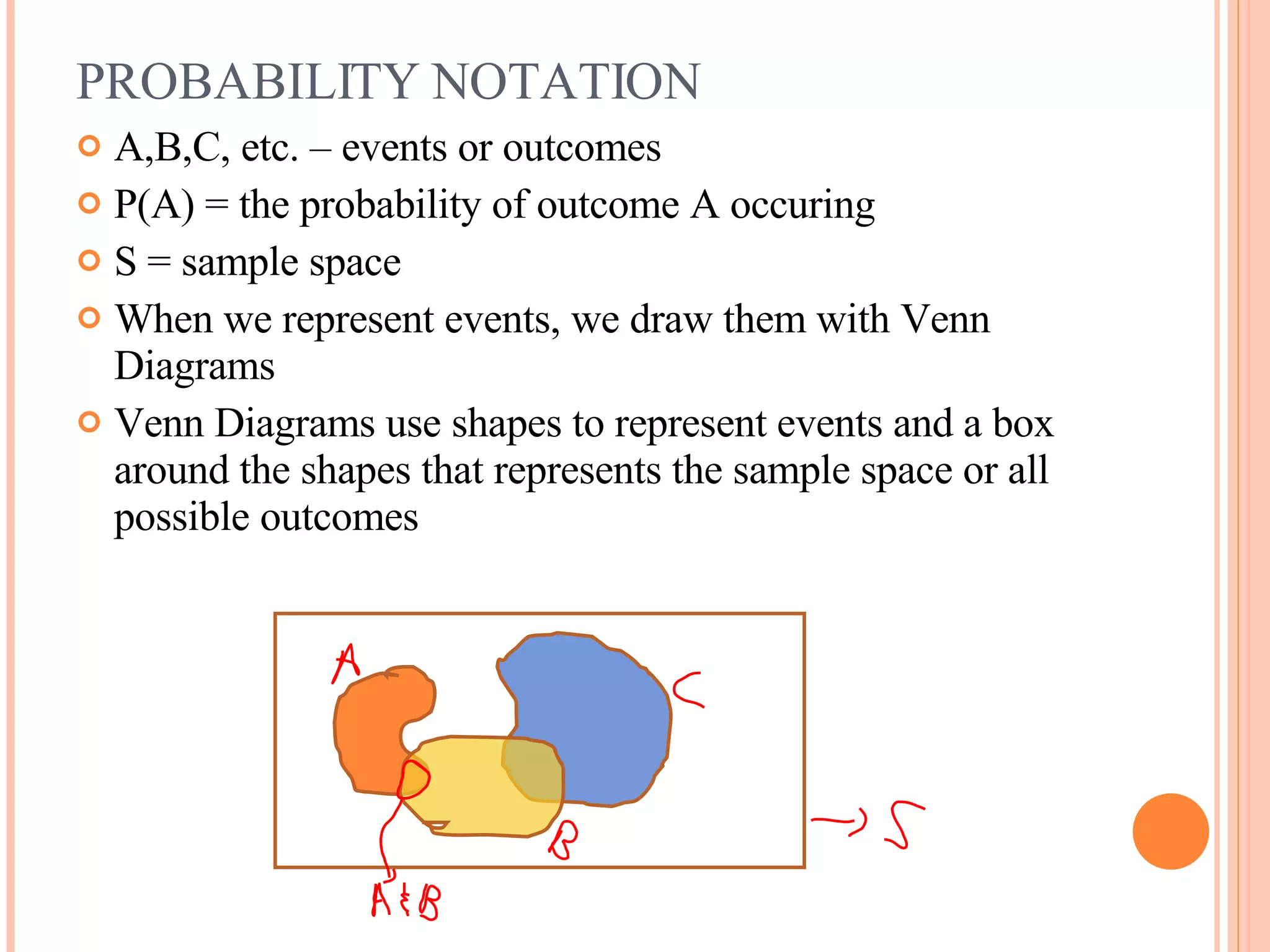
PROBABILITY NOTATION A,B,C, etc. – events or outcomes P(A) = the probability of outcome A occuring S = sample space When we represent events, we draw them with Venn Diagrams Venn Diagrams use shapes to represent events and a box around the shapes that represents the sample space or all possible outcomes
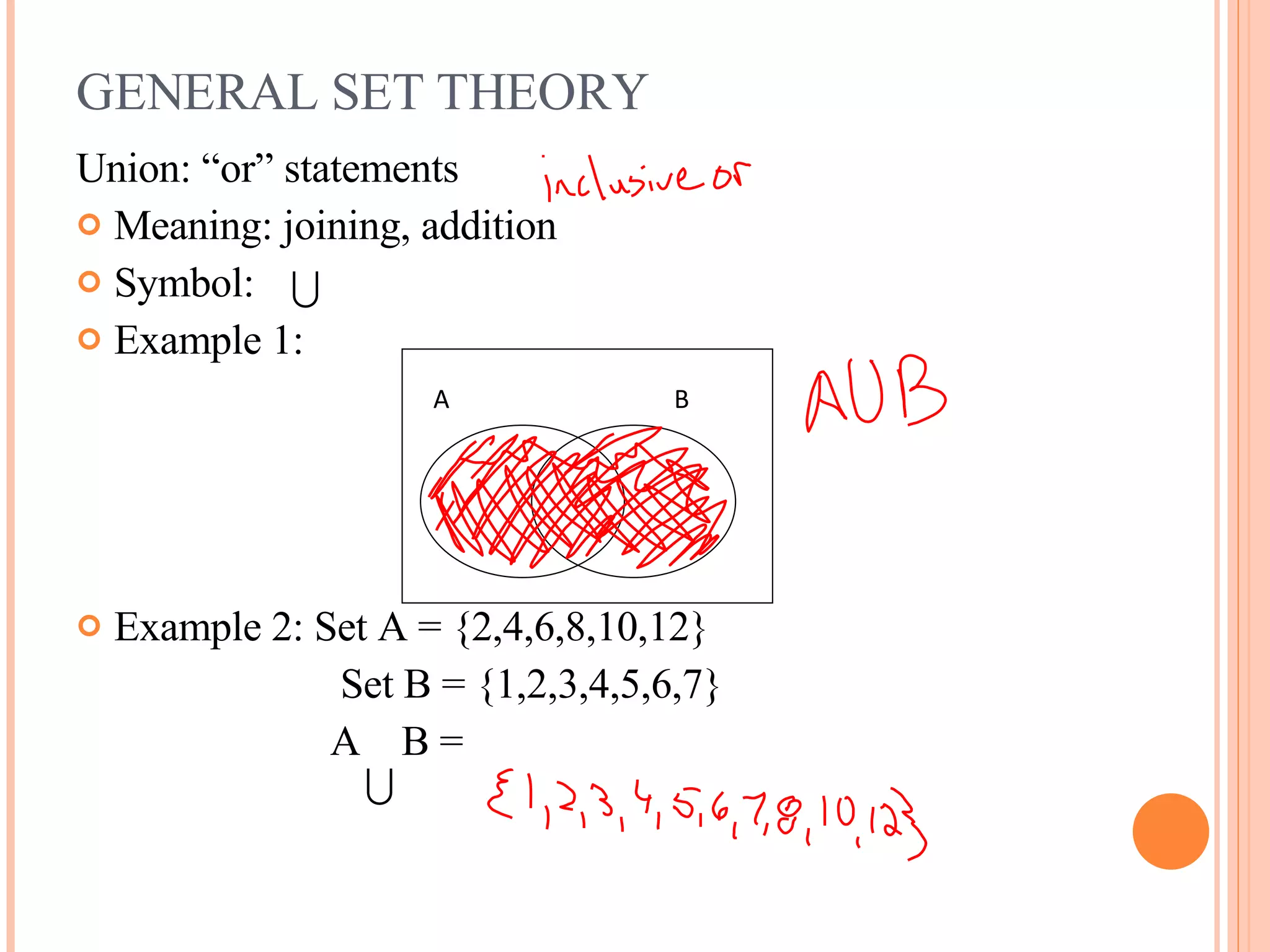
GENERAL SET THEORY Union: “or” statements Meaning: joining, addition Symbol:  Example 1: Example 2: Set A = {2,4,6,8,10,12}   Set B = {1,2,3,4,5,6,7} A  B =  A B
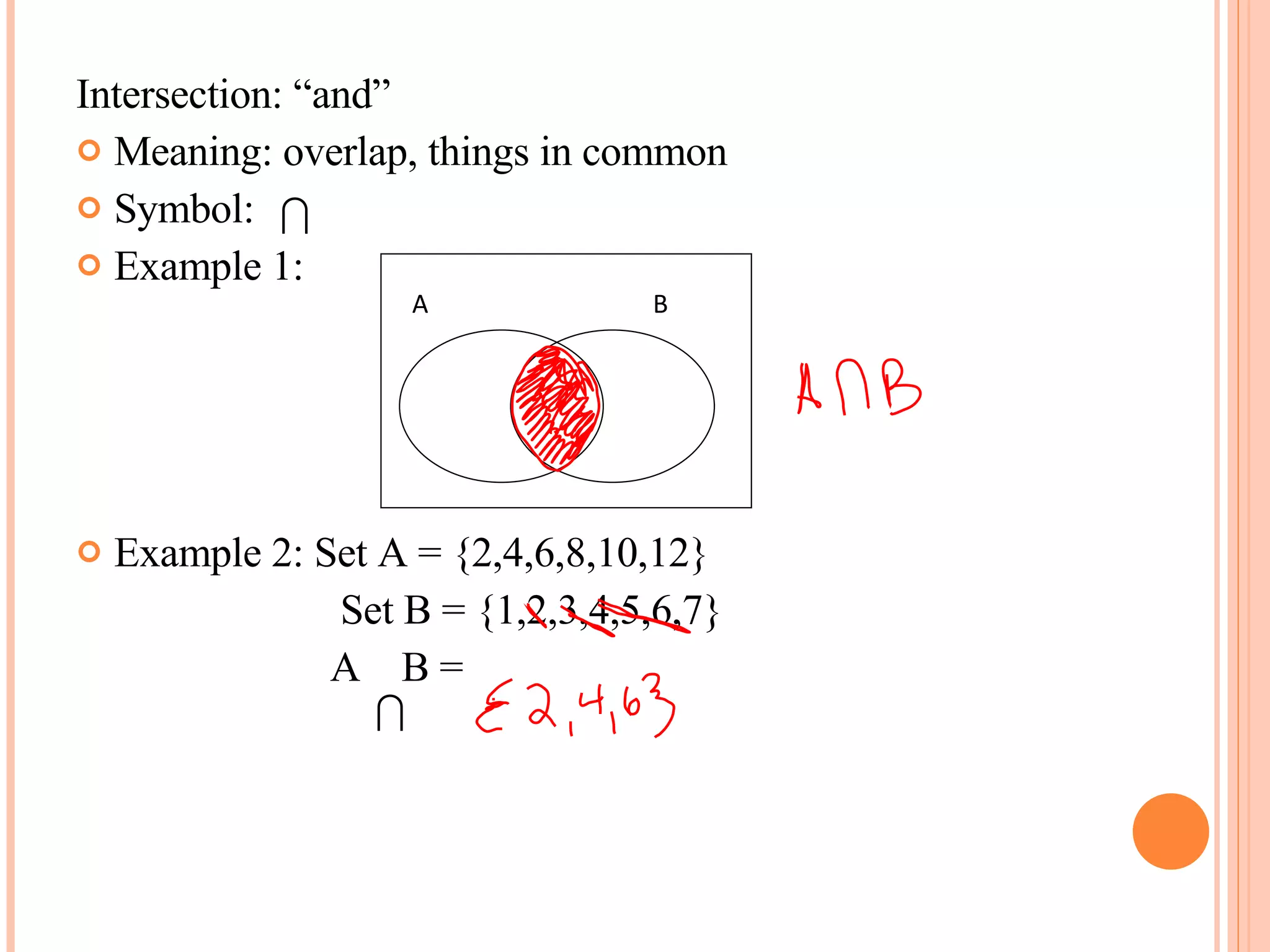
Intersection: “and” Meaning: overlap, things in common Symbol:  Example 1: Example 2: Set A = {2,4,6,8,10,12}   Set B = {1,2,3,4,5,6,7} A  B =  A B
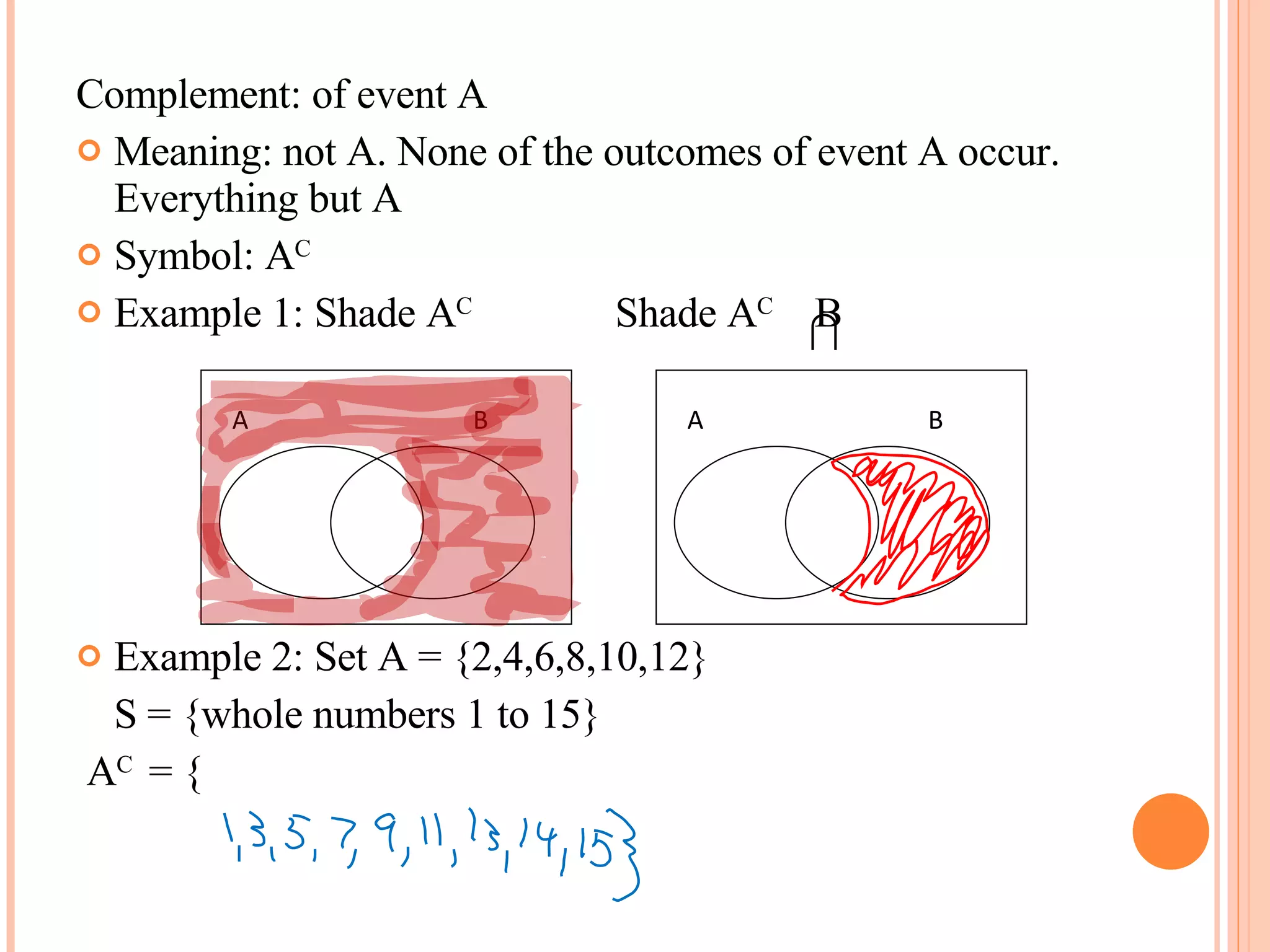
Complement: of event A Meaning: not A. None of the outcomes of event A occur. Everything but A Symbol: A C Example 1: Shade A C     Shade A C   B Example 2: Set A = {2,4,6,8,10,12} S = {whole numbers 1 to 15} A C  = { A B A B
TRY THE SET THEORY WORKSHEET
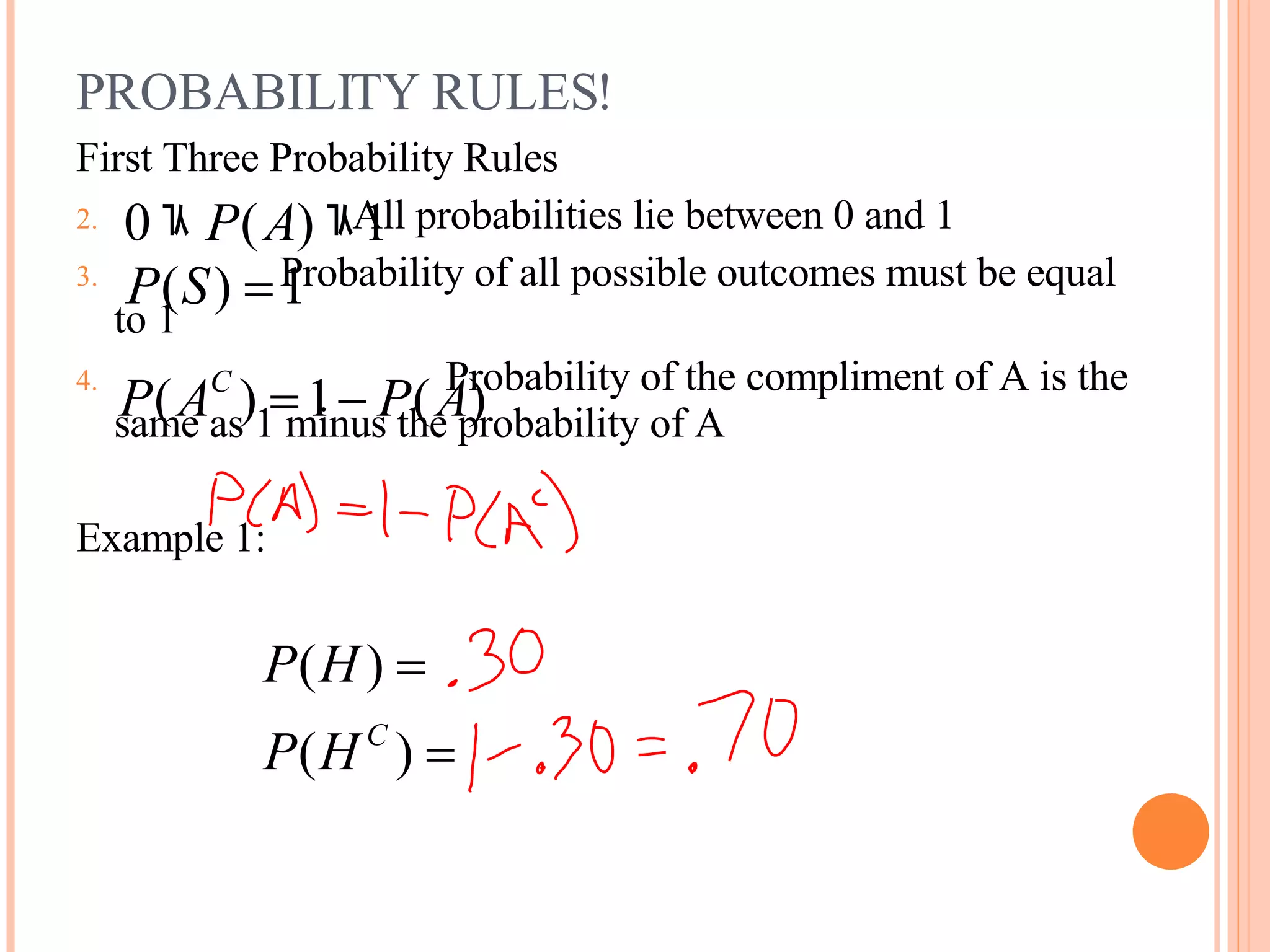
PROBABILITY RULES! First Three Probability Rules All probabilities lie between 0 and 1 Probability of all possible outcomes must be equal to 1 Probability of the compliment of A is the same as 1 minus the probability of A Example 1:
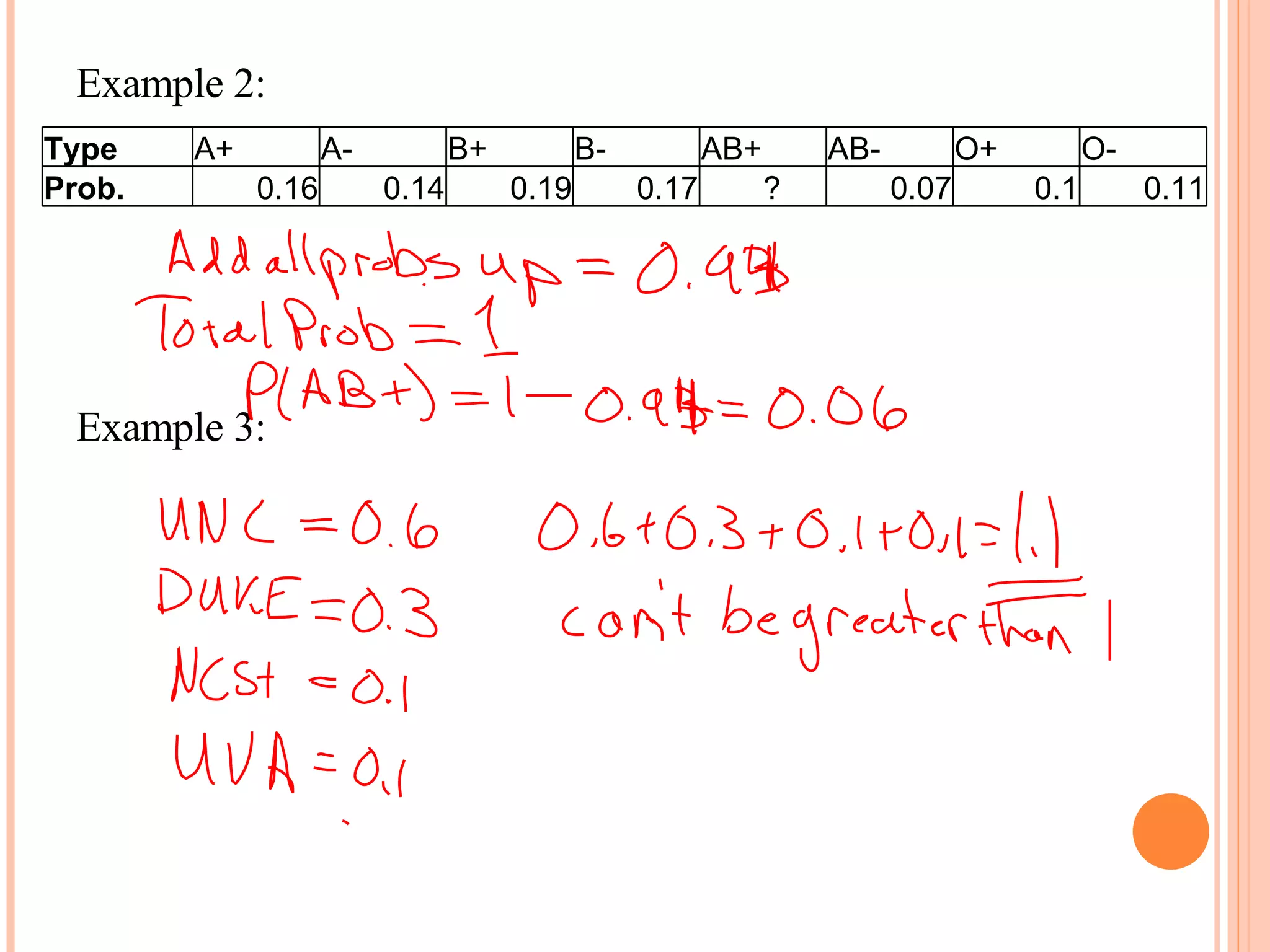
Example 2: Example 3:  Type A+ A- B+ B- AB+ AB- O+ O- Prob. 0.16 0.14 0.19 0.17    ? 0.07 0.1 0.11
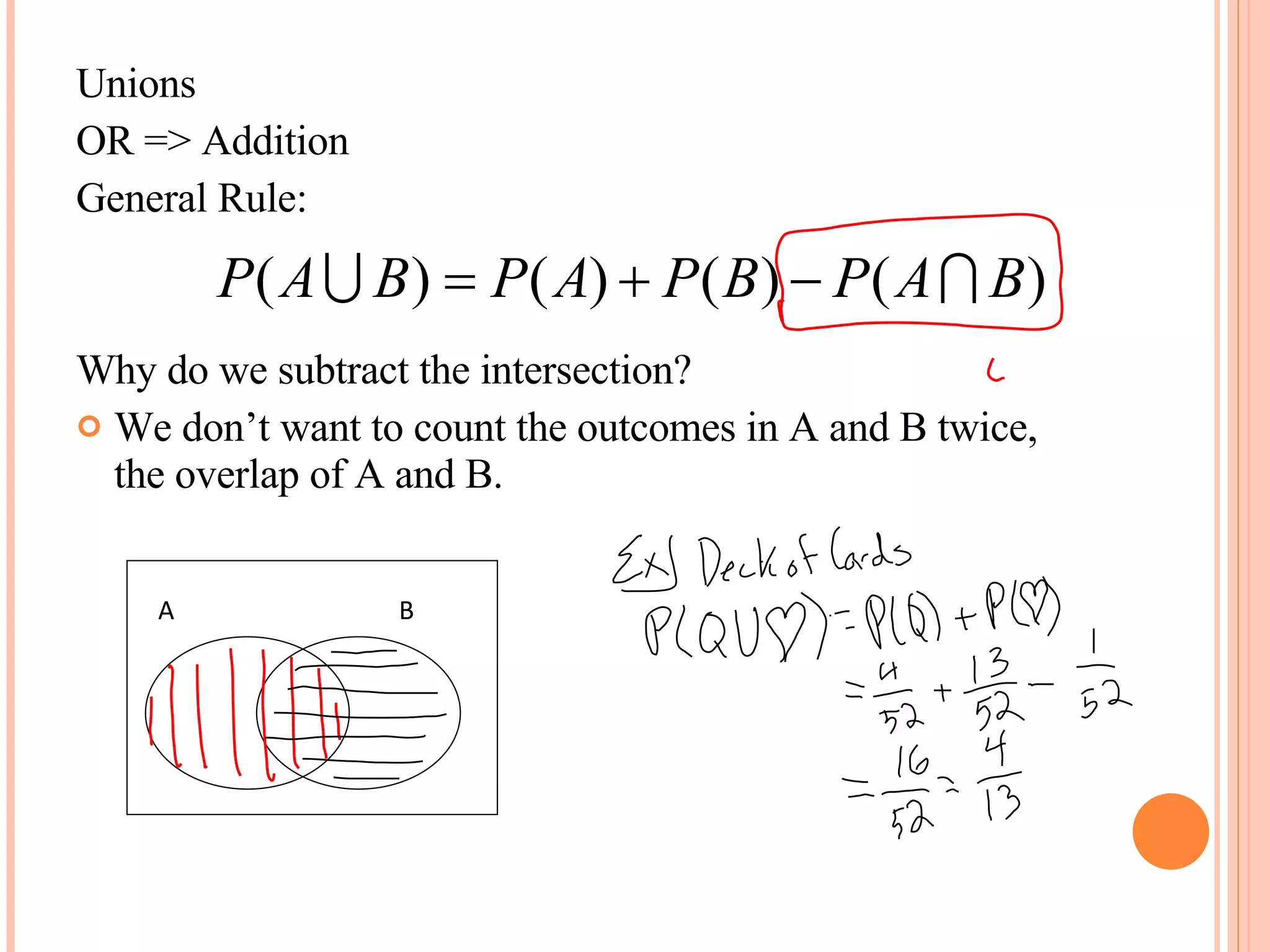
Unions OR => Addition General Rule: Why do we subtract the intersection? We don’t want to count the outcomes in A and B twice, the overlap of A and B. A B
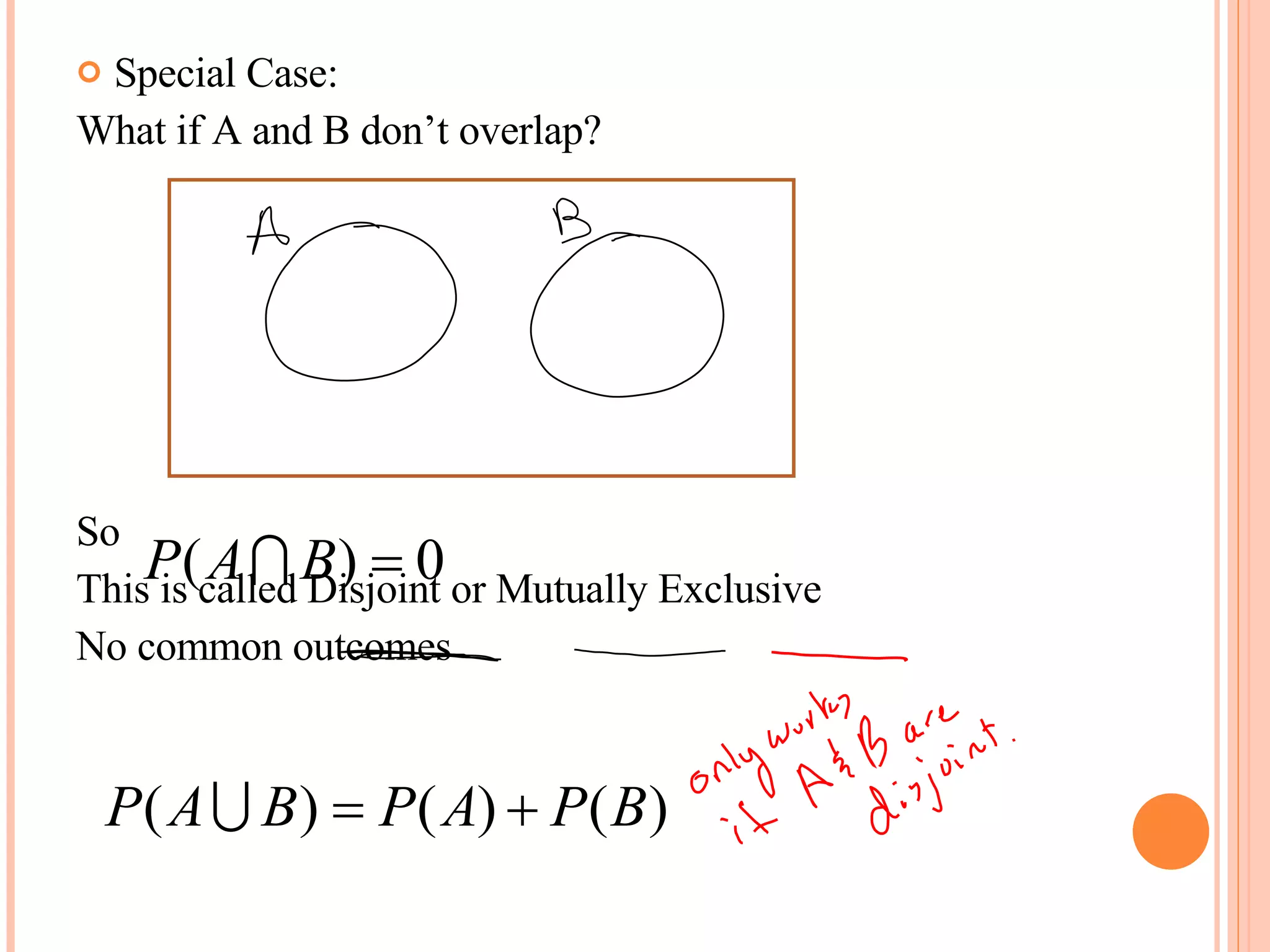
Special Case: What if A and B don’t overlap? So  This is called Disjoint or Mutually Exclusive No common outcomes
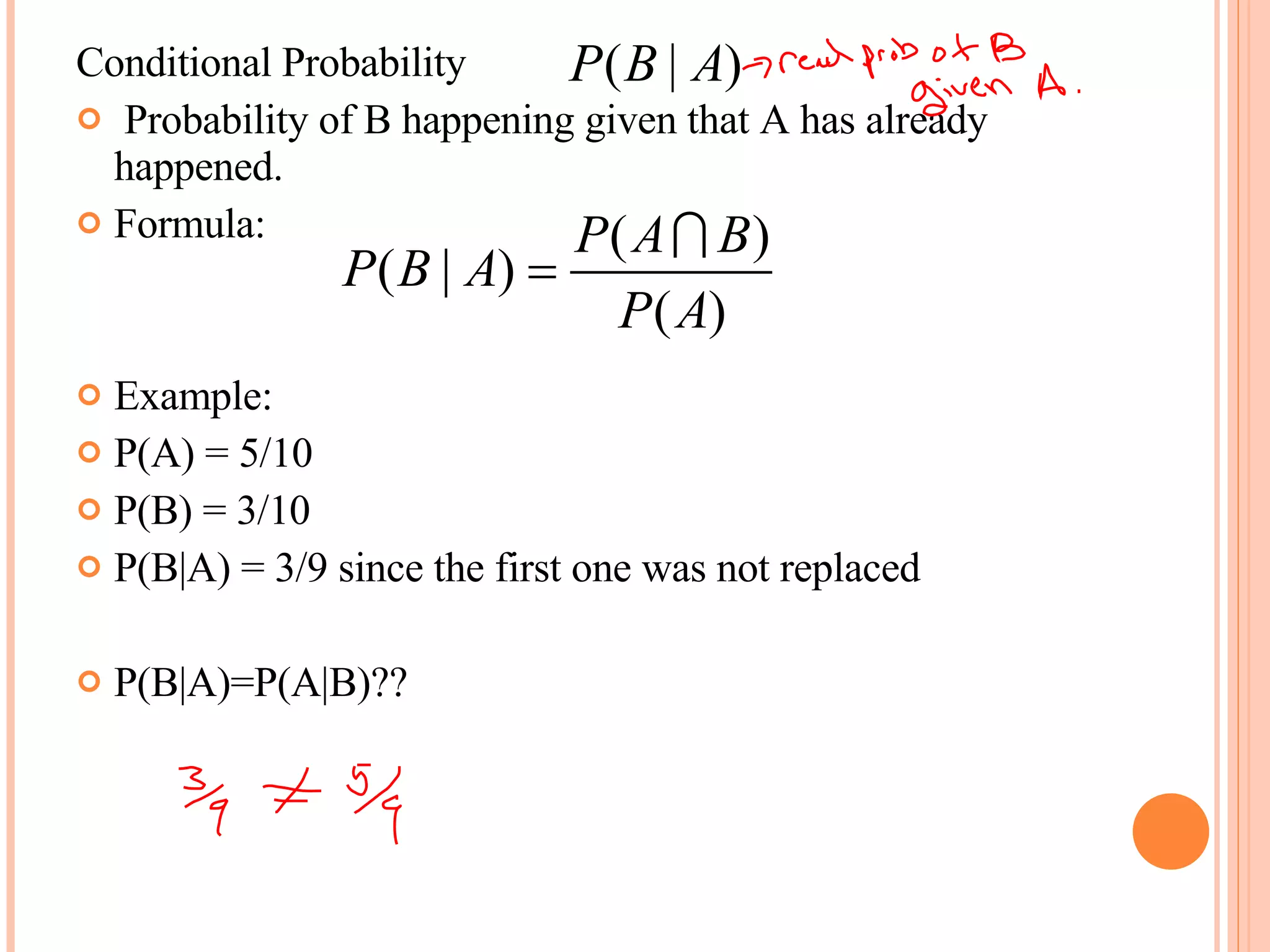
Conditional Probability Probability of B happening given that A has already happened. Formula:  Example: P(A) = 5/10 P(B) = 3/10 P(B|A) = 3/9 since the first one was not replaced P(B|A)=P(A|B)??
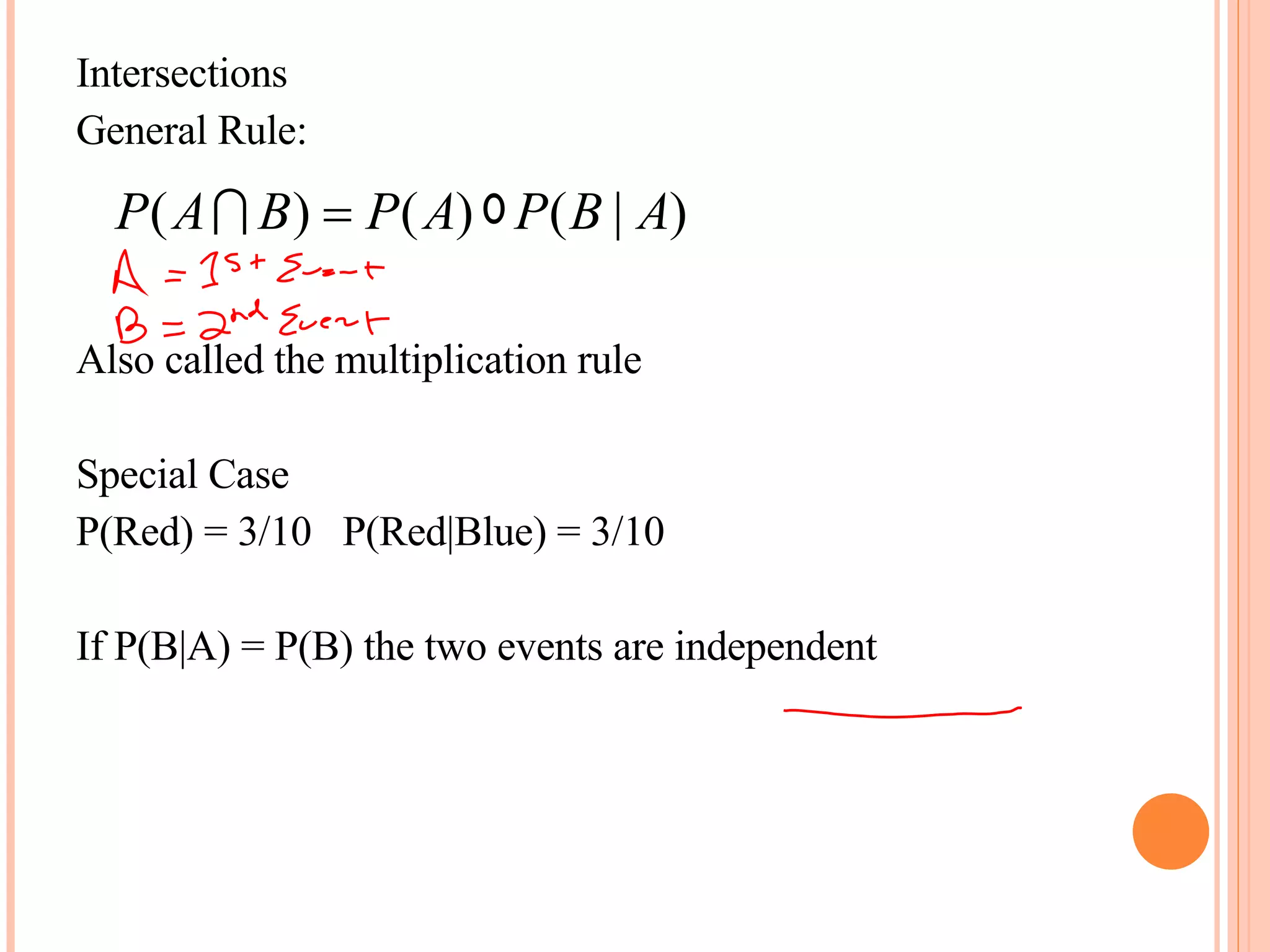
Intersections General Rule: Also called the multiplication rule Special Case P(Red) = 3/10  P(Red|Blue) = 3/10 If P(B|A) = P(B) the two events are independent

Chapter 4 Probability Notes

  • 1.
    CHAPTER 4 -PROBABILITY
  • 2.
    INTRODUCTORY VOCABULARY Random(trials) – individual outcomes of a trial are uncertain, but when a large number of trials are performed a regular distribution appears Probability – Proportion of times an outcome would occur in a large number of trials Experimental Probability – What did happen in an experiment. The proportion of times an event occurred in an experiment
  • 3.
    Theoretical Probability –What should happen in an experiment. Usually found by looking at experimental probabilities. Probability Models – List of all possible outcomes The probability of each outcome is then listed. Sample Space – the set of all possible outcomes of an event. S = { } Examples: Rolling a die once; S = {1,2,3,4,5,6} Flipping a coin twice; S = {HH,HT,TH,TT}
  • 4.
    PROBABILITY NOTATION A,B,C,etc. – events or outcomes P(A) = the probability of outcome A occuring S = sample space When we represent events, we draw them with Venn Diagrams Venn Diagrams use shapes to represent events and a box around the shapes that represents the sample space or all possible outcomes
  • 5.
    GENERAL SET THEORYUnion: “or” statements Meaning: joining, addition Symbol: Example 1: Example 2: Set A = {2,4,6,8,10,12} Set B = {1,2,3,4,5,6,7} A B = A B
  • 6.
    Intersection: “and” Meaning:overlap, things in common Symbol: Example 1: Example 2: Set A = {2,4,6,8,10,12} Set B = {1,2,3,4,5,6,7} A B = A B
  • 7.
    Complement: of eventA Meaning: not A. None of the outcomes of event A occur. Everything but A Symbol: A C Example 1: Shade A C Shade A C B Example 2: Set A = {2,4,6,8,10,12} S = {whole numbers 1 to 15} A C = { A B A B
  • 8.
    TRY THE SETTHEORY WORKSHEET
  • 9.
    PROBABILITY RULES! FirstThree Probability Rules All probabilities lie between 0 and 1 Probability of all possible outcomes must be equal to 1 Probability of the compliment of A is the same as 1 minus the probability of A Example 1:
  • 10.
    Example 2: Example3: Type A+ A- B+ B- AB+ AB- O+ O- Prob. 0.16 0.14 0.19 0.17   ? 0.07 0.1 0.11
  • 11.
    Unions OR =>Addition General Rule: Why do we subtract the intersection? We don’t want to count the outcomes in A and B twice, the overlap of A and B. A B
  • 12.
    Special Case: Whatif A and B don’t overlap? So This is called Disjoint or Mutually Exclusive No common outcomes
  • 13.
    Conditional Probability Probabilityof B happening given that A has already happened. Formula: Example: P(A) = 5/10 P(B) = 3/10 P(B|A) = 3/9 since the first one was not replaced P(B|A)=P(A|B)??
  • 14.
    Intersections General Rule:Also called the multiplication rule Special Case P(Red) = 3/10 P(Red|Blue) = 3/10 If P(B|A) = P(B) the two events are independent