


Henri Fayol's
14 Principles
of
Management
FATHER OF MODERN OPERATIONAL MANAGEMENT
THEORY
Contents
Henri Fayol's 14 Principles of Management
 Introduction
 14 Principles of Management
Henri Fayol's 14 Principles
of Management
 A principle refers to a fundamental truth.
 It establishes cause and effect relationship between two or
more variables under given situation.
 They serve as a guide to thought & actions.
 Therefore, management principles are the statements of
fundamental truth based on logic which provides guidelines
for managerial decision making and actions.
 These principles are derived: -
 On the basis of observation and analysis i.e. practical experience of
managers.
 By conducting experimental studies.
Henri Fayol's 14 Principles
of Management
1) DIVISION OF WORK
2) AUTHORITY &
RESPONSIBILITY
3) DISCIPLINE
4) UNITY OF COMMAND
5) UNITY OF DIRECTION
6) SUBORDINATION OF
INDIVIDUAL
INTERESTS TO THE
GENERAL INTERESTS
7) REMUNERATION
8) CENTRALIZATION
9) SCALAR CHAIN
10) ORDER
11) EQUITY
12) INITIATIVE
13) STABILITY OF TENURE
OF PERSONNEL
14) ESPIRIT DE CORPS
DIVISION OF WORK
 Work should be divided among
individuals and groups to
ensure that effort and attention
are focused on special portions
of the task.
 Fayol presented work
specialization as the best way
to use the human resources of
the organization.
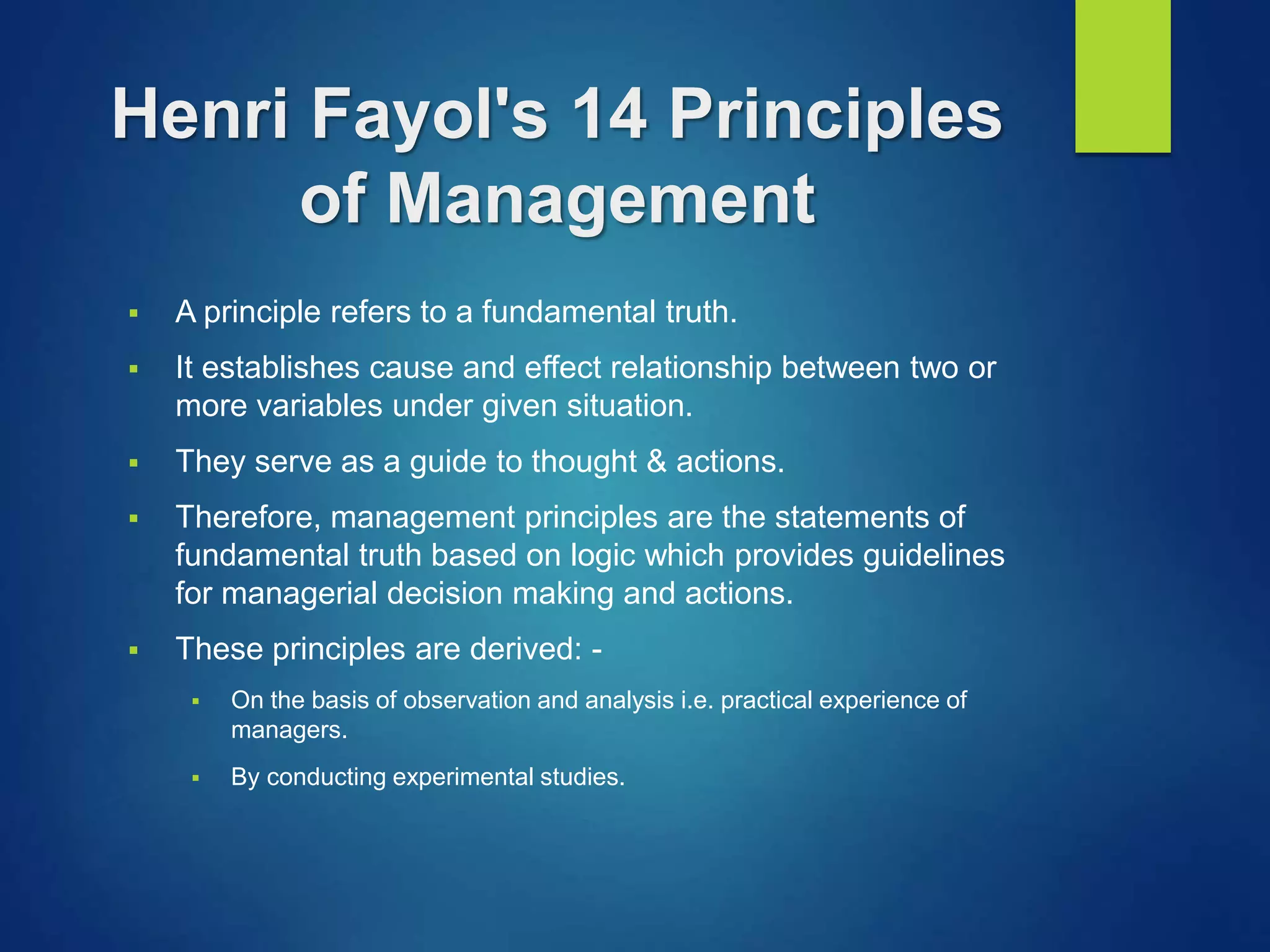
AUTHORITY AND RESPONSIBILITY
 The concepts of Authority and
responsibility are closely
related.
 Authority was defined by Fayol
as the right to give orders and
the power to exact obedience.
 Responsibility involves being
accountable, and is therefore
naturally associated with
authority. Whoever assumes
authority also assumes
responsibility.
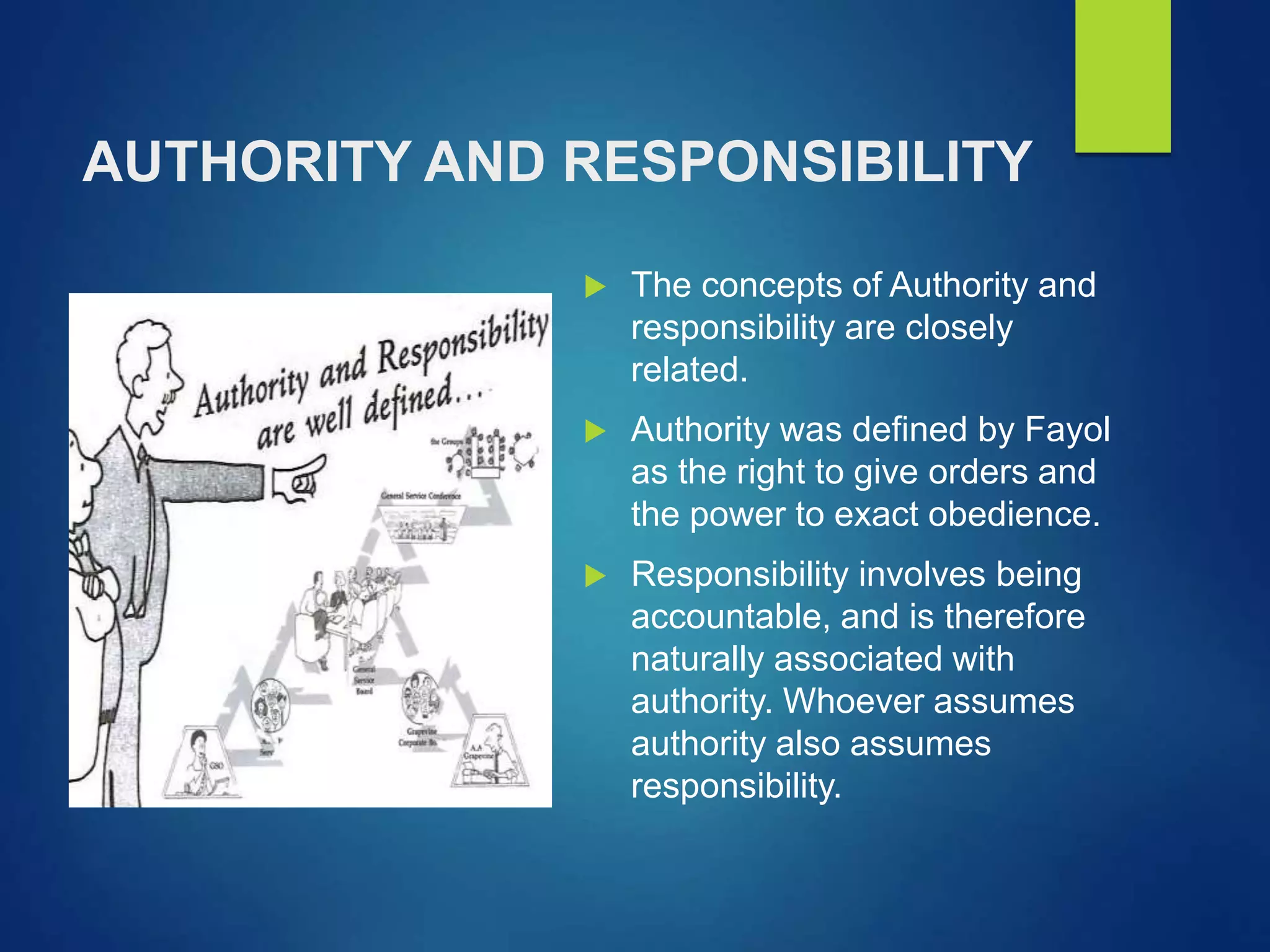
DISCIPLINE
 A successful
organization requires the
common effort of
workers.
 Penalties should be
applied judiciously to
encourage this common
effort.
UNITY OF COMMAND
 Workers should
receive orders from
only one manager
UNITY OF DIRECTION
 The entire organization
should be moving
towards a common
objective in a common
direction.
SUBORDINATION OF INDIVIDUAL
INTERESTS TO THE GENERAL
INTERESTS
 The interests of
one person should
not take priority
over the interests
of the organization
as a whole.
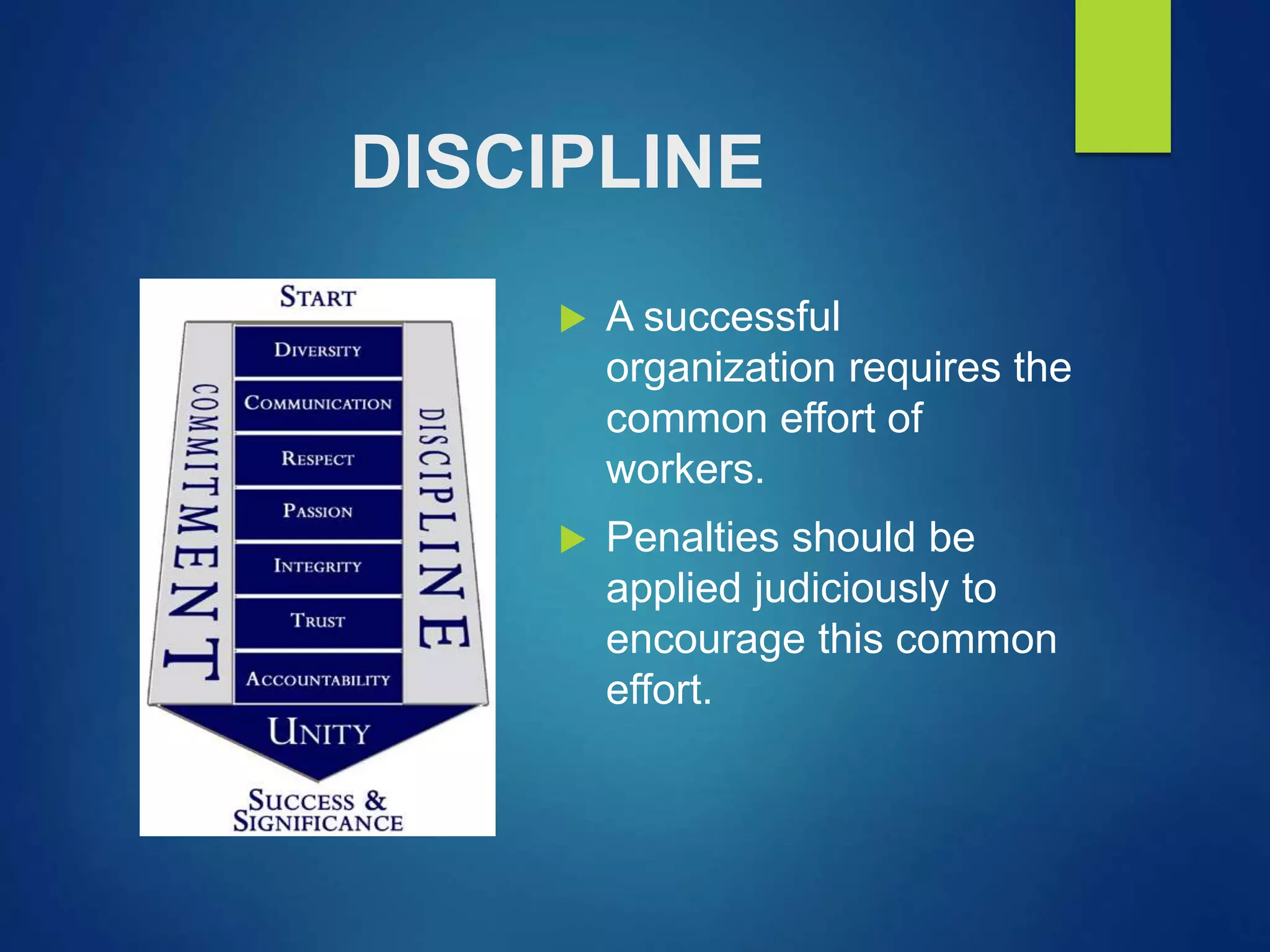
REMUNERATION
 Many variables, such as
cost of living, supply of
qualified personnel,
general business
conditions, and success
of the business, should
be considered in
determining a worker’s
rate of pay.
CENTRALIZATION
 Fayol defined centralization
as lowering the importance
of the subordinate role.
 Decentralization is
increasing the importance.
 The degree to which
centralization or
decentralization should be
adopted depends on the
specific organization in
which the manager is
working.
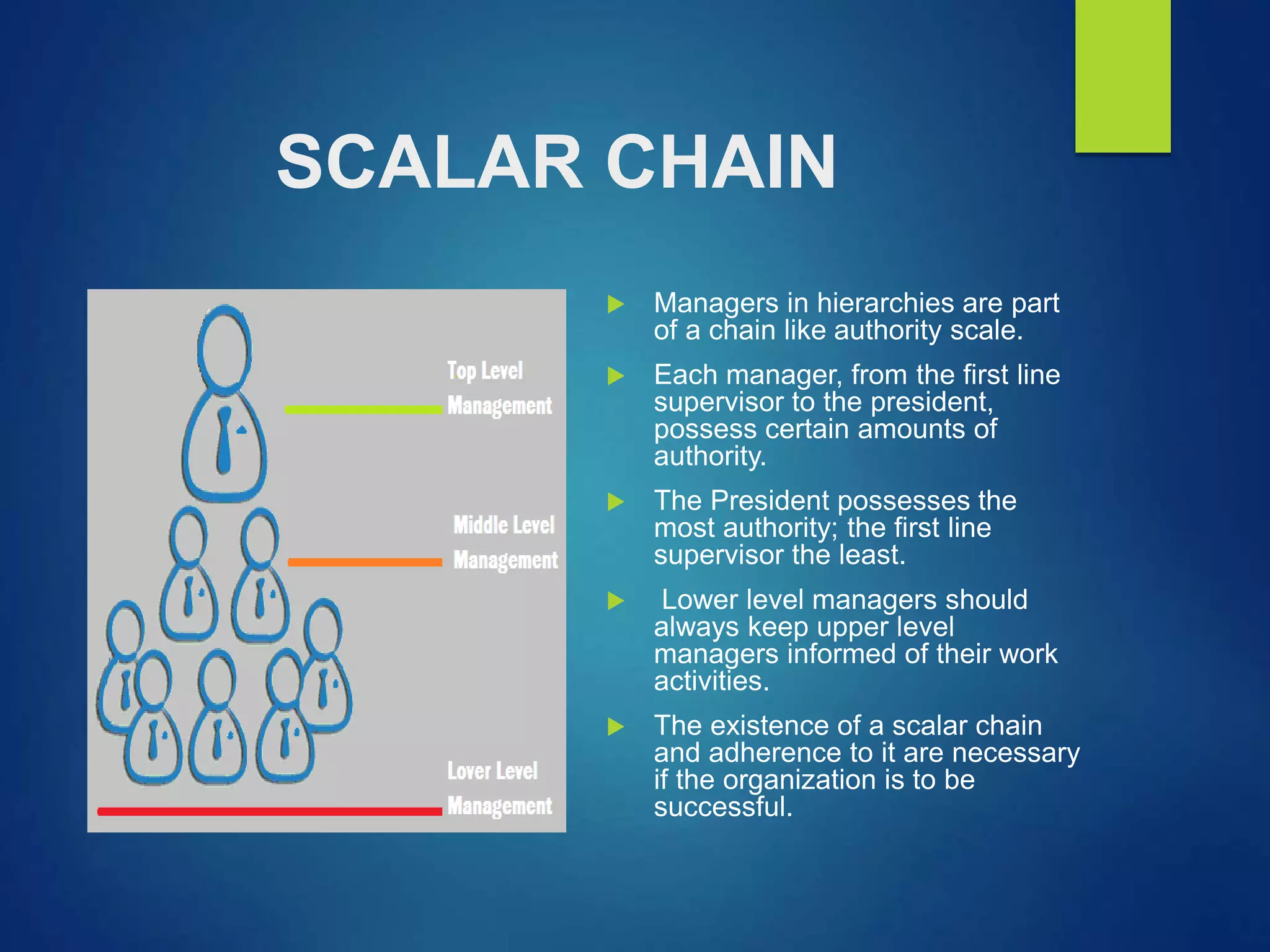
SCALAR CHAIN
 Managers in hierarchies are part
of a chain like authority scale.
 Each manager, from the first line
supervisor to the president,
possess certain amounts of
authority.
 The President possesses the
most authority; the first line
supervisor the least.
 Lower level managers should
always keep upper level
managers informed of their work
activities.
 The existence of a scalar chain
and adherence to it are necessary
if the organization is to be
successful.
ORDER
 For the sake of
efficiency and
coordination, all
materials and people
related to a specific kind
of work should be
treated as equally as
possible.
EQUITY
 All employees should
be treated as equally
as
possible.
STABILITY OF TENURE OF
PERSONNEL
 Retaining productive
employees should always
be a high priority of
management.
 Recruitment and
Selection Costs, as well as
increased product-reject
rates are usually
associated with hiring new
workers.
INITIATIVE
 Management should
take steps to encourage
worker initiative, which
is defined as new or
additional work activity
undertaken through self
direction.
ESPIRIT DE CORPS
 Management should
encourage harmony
and general good
feelings among
employees.
Presented By-
Prachi Porwal

14 principles of management

  • 1.
    Henri Fayol's 14 Principles of Management FATHEROF MODERN OPERATIONAL MANAGEMENT THEORY
  • 2.
    Contents Henri Fayol's 14Principles of Management  Introduction  14 Principles of Management
  • 3.
    Henri Fayol's 14Principles of Management  A principle refers to a fundamental truth.  It establishes cause and effect relationship between two or more variables under given situation.  They serve as a guide to thought & actions.  Therefore, management principles are the statements of fundamental truth based on logic which provides guidelines for managerial decision making and actions.  These principles are derived: -  On the basis of observation and analysis i.e. practical experience of managers.  By conducting experimental studies.
  • 4.
    Henri Fayol's 14Principles of Management 1) DIVISION OF WORK 2) AUTHORITY & RESPONSIBILITY 3) DISCIPLINE 4) UNITY OF COMMAND 5) UNITY OF DIRECTION 6) SUBORDINATION OF INDIVIDUAL INTERESTS TO THE GENERAL INTERESTS 7) REMUNERATION 8) CENTRALIZATION 9) SCALAR CHAIN 10) ORDER 11) EQUITY 12) INITIATIVE 13) STABILITY OF TENURE OF PERSONNEL 14) ESPIRIT DE CORPS
  • 5.
    DIVISION OF WORK Work should be divided among individuals and groups to ensure that effort and attention are focused on special portions of the task.  Fayol presented work specialization as the best way to use the human resources of the organization.
  • 6.
    AUTHORITY AND RESPONSIBILITY The concepts of Authority and responsibility are closely related.  Authority was defined by Fayol as the right to give orders and the power to exact obedience.  Responsibility involves being accountable, and is therefore naturally associated with authority. Whoever assumes authority also assumes responsibility.
  • 7.
    DISCIPLINE  A successful organizationrequires the common effort of workers.  Penalties should be applied judiciously to encourage this common effort.
  • 8.
    UNITY OF COMMAND Workers should receive orders from only one manager
  • 9.
    UNITY OF DIRECTION The entire organization should be moving towards a common objective in a common direction.
  • 10.
    SUBORDINATION OF INDIVIDUAL INTERESTSTO THE GENERAL INTERESTS  The interests of one person should not take priority over the interests of the organization as a whole.
  • 11.
    REMUNERATION  Many variables,such as cost of living, supply of qualified personnel, general business conditions, and success of the business, should be considered in determining a worker’s rate of pay.
  • 12.
    CENTRALIZATION  Fayol definedcentralization as lowering the importance of the subordinate role.  Decentralization is increasing the importance.  The degree to which centralization or decentralization should be adopted depends on the specific organization in which the manager is working.
  • 13.
    SCALAR CHAIN  Managersin hierarchies are part of a chain like authority scale.  Each manager, from the first line supervisor to the president, possess certain amounts of authority.  The President possesses the most authority; the first line supervisor the least.  Lower level managers should always keep upper level managers informed of their work activities.  The existence of a scalar chain and adherence to it are necessary if the organization is to be successful.
  • 14.
    ORDER  For thesake of efficiency and coordination, all materials and people related to a specific kind of work should be treated as equally as possible.
  • 15.
    EQUITY  All employeesshould be treated as equally as possible.
  • 16.
    STABILITY OF TENUREOF PERSONNEL  Retaining productive employees should always be a high priority of management.  Recruitment and Selection Costs, as well as increased product-reject rates are usually associated with hiring new workers.
  • 17.
    INITIATIVE  Management should takesteps to encourage worker initiative, which is defined as new or additional work activity undertaken through self direction.
  • 18.
    ESPIRIT DE CORPS Management should encourage harmony and general good feelings among employees.
  • 19.

Editor's Notes

  • #5 https://managementinnovations.wordpress.com/2008/12/04/henri-fayols-14-principles-of-management/